warning MERCEDES-BENZ CL COUPE 2009 Owners Manual
[x] Cancel search | Manufacturer: MERCEDES-BENZ, Model Year: 2009, Model line: CL COUPE, Model: MERCEDES-BENZ CL COUPE 2009Pages: 421, PDF Size: 10.78 MB
Page 354 of 421
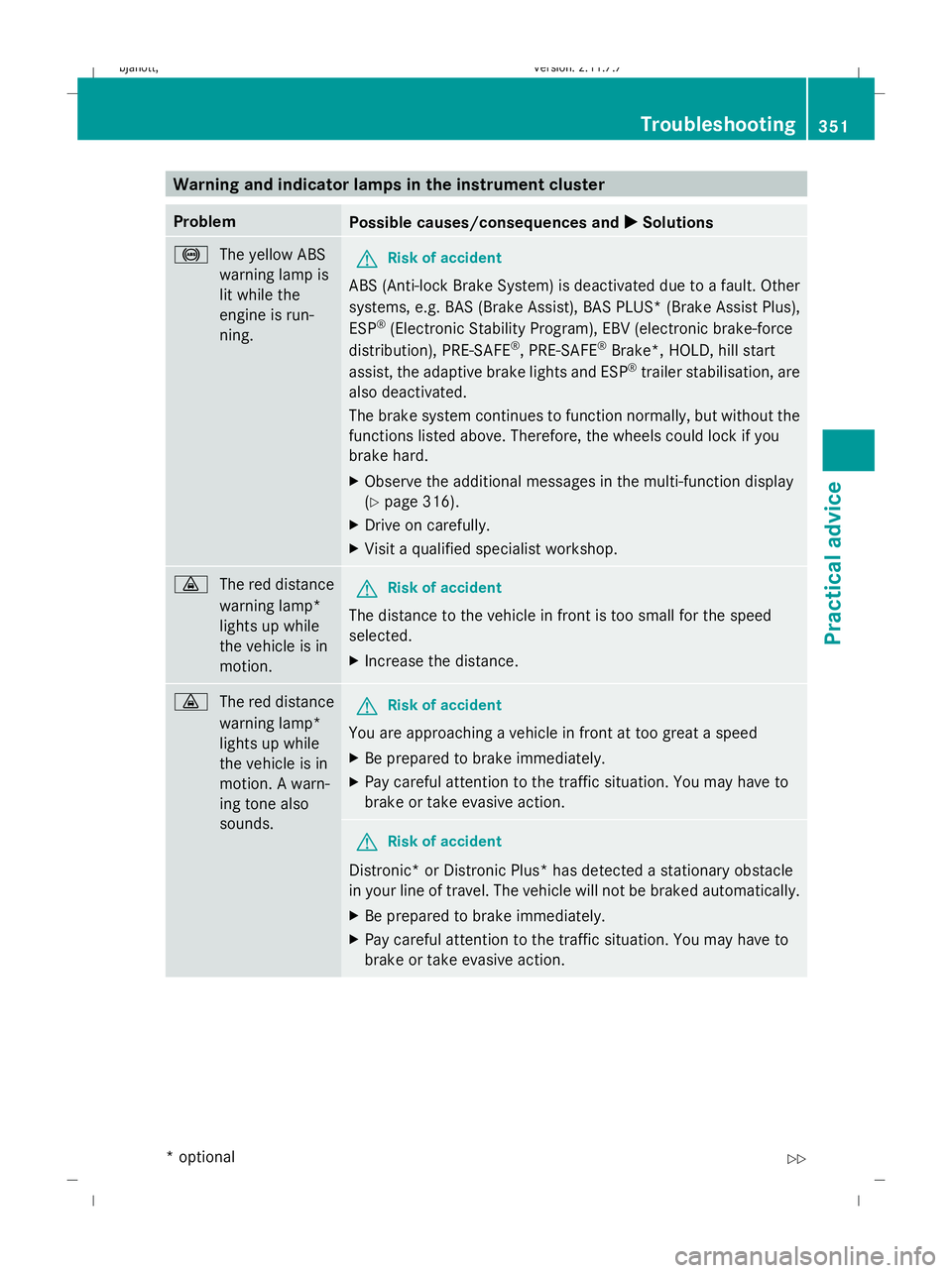
Warning and indicator lamps in the instrument cluster
Problem
Possible causes/consequences and
X
X Solutions !
The yellow ABS
warning lamp is
lit while the
engine is run-
ning. G
Risk of accident
ABS (Anti-lock Brake System) is deactivated due to a fault. Other
systems, e.g. BAS (Brake Assist), BAS PLUS* (Brake Assist Plus),
ESP ®
(Electronic Stability Program), EBV (electronic brake-force
distribution), PRE-SAFE ®
, PRE-SAFE ®
Brake*, HOLD, hill start
assist, the adaptive brake lights and ESP ®
trailer stabilisation, are
also deactivated.
The brake system continues to function normally, but without the
functions listed above. Therefore, the wheels could lock if you
brake hard.
X Observe the additional messages in the multi-function display
(Y page 316).
X Drive on carefully.
X Visit a qualified specialist workshop. ·
The red distance
warning lamp*
lights up while
the vehicle is in
motion. G
Risk of accident
The distance to the vehicle in front is too small for the speed
selected.
X Increase the distance. ·
The red distance
warning lamp*
lights up while
the vehicle is in
motion. A warn-
ing tone also
sounds. G
Risk of accident
You are approaching a vehicle in front at too great a speed
X Be prepared to brake immediately.
X Pay careful attention to the traffic situation. You may have to
brake or take evasive action. G
Risk of accident
Distronic* or Distronic Plus* has detected a stationary obstacle
in your line of travel. The vehicle will not be braked automatically.
X Be prepared to brake immediately.
X Pay careful attention to the traffic situation. You may have to
brake or take evasive action. Troubleshooting
351Practical advice
* optional
216_AKB; 2; 3, en-GB
bjanott,
Version: 2.11.7.7 2009-02-27T14:54:17+01:00 - Seite 351 Z
Dateiname: 6515230602_buchblock.pdf; erzeugt am 04. Mar 2009 11:16:40; WK
Page 355 of 421
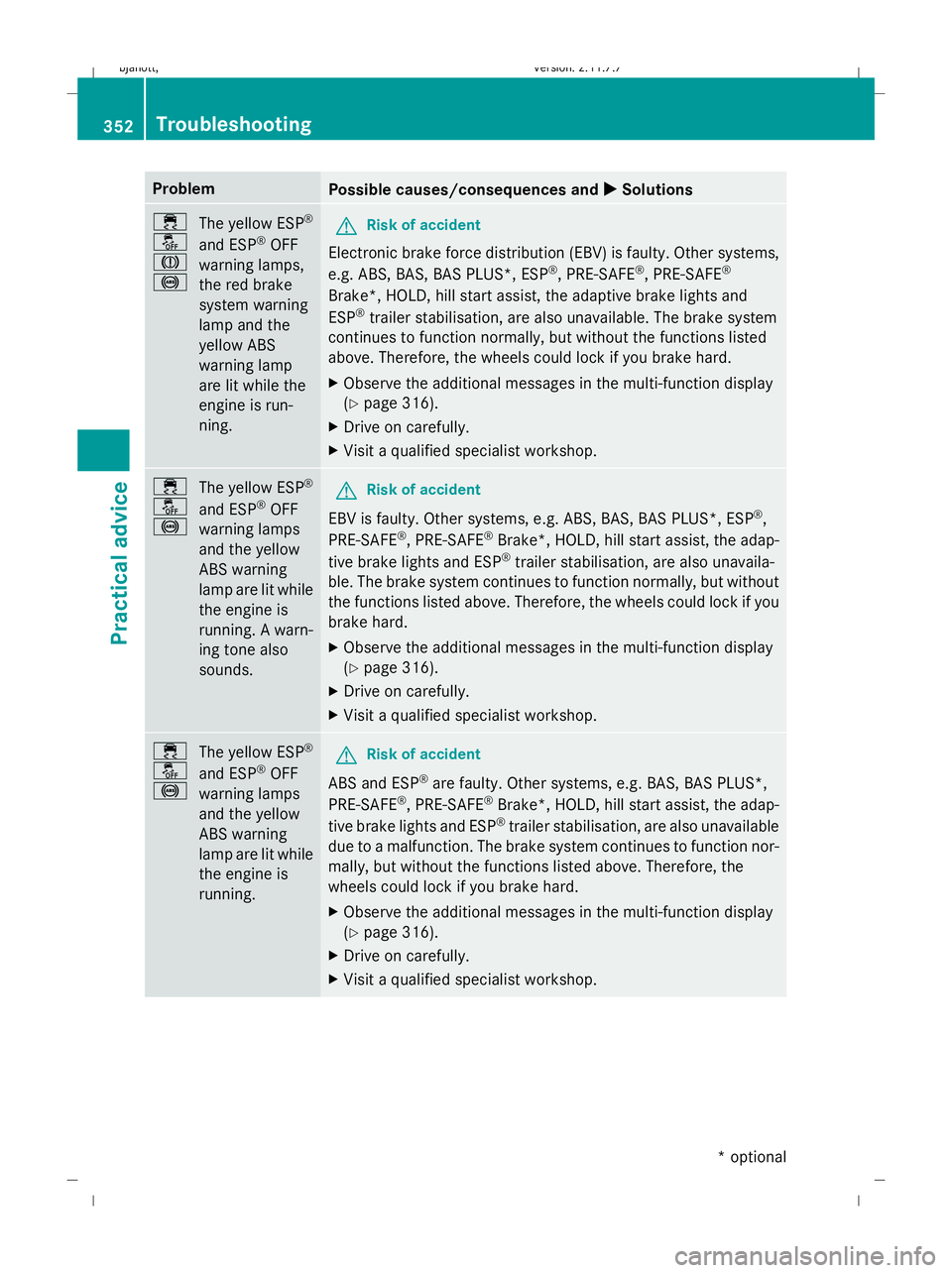
Problem
Possible causes/consequences and
X XSolutions ÷
å
J
!
The yellow ESP
®
and ESP ®
OFF
warning lamps,
the red brake
system warning
lamp and the
yellow ABS
warning lamp
are lit while the
engine is run-
ning. G
Risk of accident
Electronic brake force distribution (EBV) is faulty. Other systems,
e.g. ABS, BAS, BAS PLUS*, ESP ®
, PRE-SAFE ®
, PRE-SAFE ®
Brake*, HOLD, hill start assist, the adaptive brake lights and
ESP ®
trailer stabilisation, are also unavailable. The brake system
continues to function normally, but without the functions listed
above. Therefore, the wheels could lock if you brake hard.
X Observe the additional messages in the multi-function display
(Y page 316).
X Drive on carefully.
X Visit a qualified specialist workshop. ÷
å
!
The yellow ESP
®
and ESP ®
OFF
warning lamps
and the yellow
ABS warning
lamp are lit while
the engine is
running. A warn-
ing tone also
sounds. G
Risk of accident
EBV is faulty. Other systems, e.g. ABS, BAS, BAS PLUS*, ESP ®
,
PRE-SAFE ®
, PRE-SAFE ®
Brake*, HOLD, hill start assist, the adap-
tive brake lights and ESP ®
trailer stabilisation, are also unavaila-
ble. The brake system continues to function normally, but without
the functions listed above. Therefore, the wheels could lock if you
brake hard.
X Observe the additional messages in the multi-function display
(Y page 316).
X Drive on carefully.
X Visit a qualified specialist workshop. ÷
å
!
The yellow ESP
®
and ESP ®
OFF
warning lamps
and the yellow
ABS warning
lamp are lit while
the engine is
running. G
Risk of accident
ABS and ESP ®
are faulty. Other systems, e.g. BAS, BAS PLUS*,
PRE-SAFE ®
, PRE-SAFE ®
Brake*, HOLD, hill start assist, the adap-
tive brake lights and ESP ®
trailer stabilisation, are also unavailable
due to a malfunction. The brake system continues to function nor-
mally, but without the functions listed above. Therefore, the
wheels could lock if you brake hard.
X Observe the additional messages in the multi-function display
(Y page 316).
X Drive on carefully.
X Visit a qualified specialist workshop. 352
TroubleshootingPractical advice
* optional
216_AKB; 2; 3, en-GB
bjanott,
Version: 2.11.7.7 2009-02-27T14:54:17+01:00 - Seite 352
Dateiname: 6515230602_buchblock.pdf; erzeugt am 04. Mar 2009 11:16:41; WK
Page 356 of 421
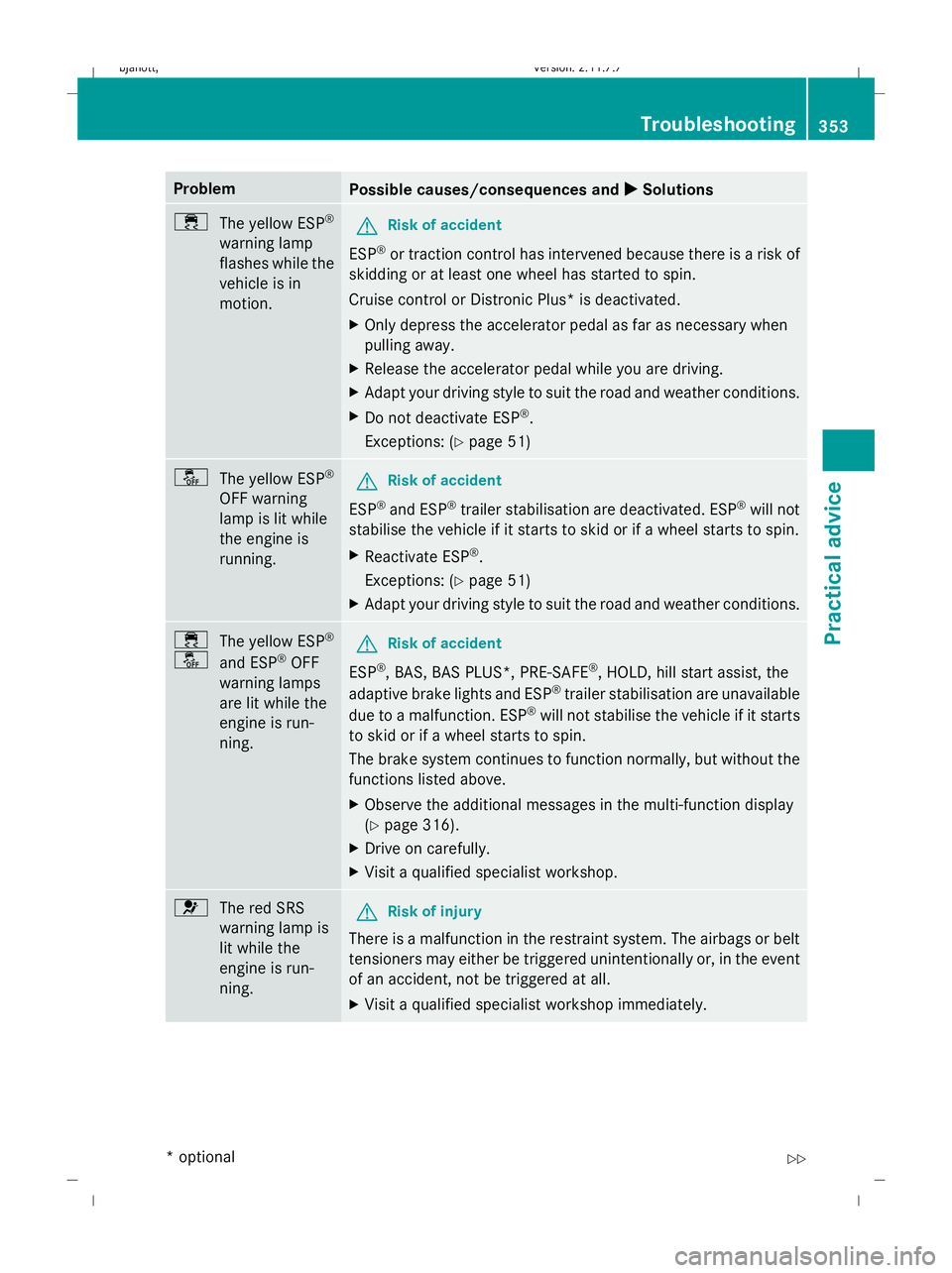
Problem
Possible causes/consequences and
X
X Solutions ÷
The yellow ESP ®
warning lamp
flashes while the
vehicle is in
motion. G
Risk of accident
ESP ®
or traction control has intervened because there is a risk of
skidding or at least one wheel has started to spin.
Cruise control or Distronic Plus* is deactivated.
X Only depress the accelerator pedal as far as necessary when
pulling away.
X Release the accelerator pedal while you are driving.
X Adapt your driving style to suit the road and weather conditions.
X Do not deactivate ESP ®
.
Exceptions: (Y page 51) å
The yellow ESP ®
OFF warning
lamp is lit while
the engine is
running. G
Risk of accident
ESP ®
and ESP ®
trailer stabilisation are deactivated. ESP ®
will not
stabilise the vehicle if it starts to skid or if a wheel starts to spin.
X Reactivate ESP ®
.
Exceptions: (Y page 51)
X Adapt your driving style to suit the road and weather conditions. ÷
å
The yellow ESP
®
and ESP ®
OFF
warning lamps
are lit while the
engine is run-
ning. G
Risk of accident
ESP ®
, BAS, BAS PLUS*, PRE-SAFE ®
, HOLD, hill start assist, the
adaptive brake lights and ESP ®
trailer stabilisation are unavailable
due to a malfunction. ESP ®
will not stabilise the vehicle if it starts
to skid or if a wheel starts to spin.
The brake system continues to function normally, but without the
functions listed above.
X Observe the additional messages in the multi-function display
(Y page 316).
X Drive on carefully.
X Visit a qualified specialist workshop. 6
The red SRS
warning lamp is
lit while the
engine is run-
ning. G
Risk of injury
There is a malfunction in the restraint system. The airbags or belt
tensioners may either be triggered unintentionally or, in the event
of an accident, not be triggered at all.
X Visit a qualified specialist workshop immediately. Troubleshooting
353Practical advice
* optional
216_AKB; 2; 3, en-GB
bjanott,
Version: 2.11.7.7 2009-02-27T14:54:17+01:00 - Seite 353 Z
Dateiname: 6515230602_buchblock.pdf; erzeugt am 04. Mar 2009 11:16:41; WK
Page 357 of 421
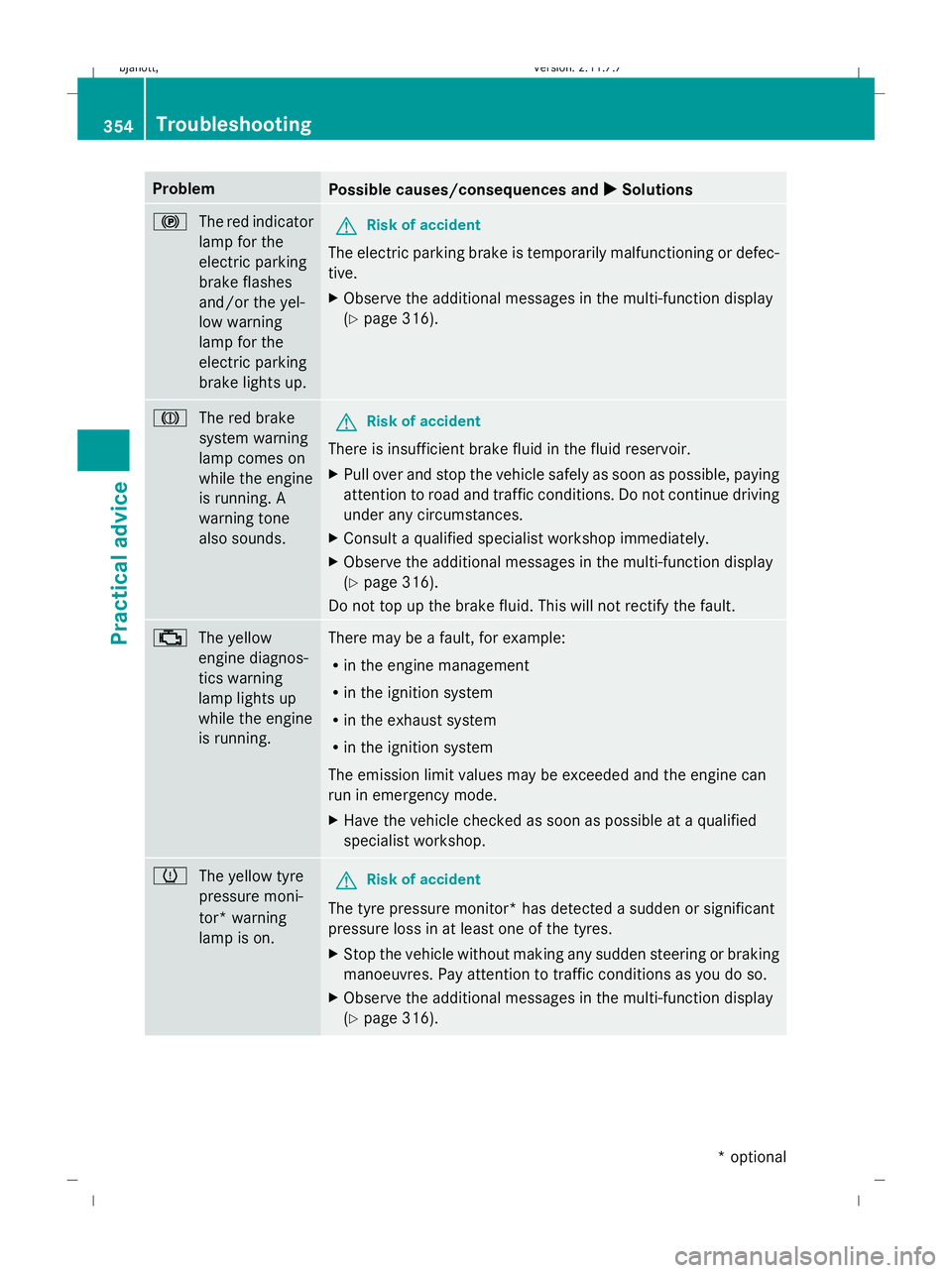
Problem
Possible causes/consequences and
X XSolutions !
The red indicator
lamp for the
electric parking
brake flashes
and/or the yel-
low warning
lamp for the
electric parking
brake lights up. G
Risk of accident
The electric parking brake is temporarily malfunctioning or defec-
tive.
X Observe the additional messages in the multi-function display
(Y page 316). J
The red brake
system warning
lamp comes on
while the engine
is running. A
warning tone
also sounds. G
Risk of accident
There is insufficient brake fluid in the fluid reservoir.
X Pull over and stop the vehicle safely as soon as possible, paying
attention to road and traffic conditions. Do not continue driving
under any circumstances.
X Consult a qualified specialist workshop immediately.
X Observe the additional messages in the multi-function display
(Y page 316).
Do not top up the brake fluid. This will not rectify the fault. ;
The yellow
engine diagnos-
tics warning
lamp lights up
while the engine
is running. There may be a fault, for example:
R
in the engine management
R in the ignition system
R in the exhaust system
R in the ignition system
The emission limit values may be exceeded and the engine can
run in emergency mode.
X Have the vehicle checked as soon as possible at a qualified
specialist workshop. h
The yellow tyre
pressure moni-
tor* warning
lamp is on. G
Risk of accident
The tyre pressure monitor* has detected a sudden or significant
pressure loss in at least one of the tyres.
X Stop the vehicle without making any sudden steering or braking
manoeuvres. Pay attention to traffic conditions as you do so.
X Observe the additional messages in the multi-function display
(Y page 316). 354
TroubleshootingPractical advice
* optional
216_AKB; 2; 3, en-GB
bjanott,
Version: 2.11.7.7 2009-02-27T14:54:17+01:00 - Seite 354
Dateiname: 6515230602_buchblock.pdf; erzeugt am 04. Mar 2009 11:16:41; WK
Page 358 of 421
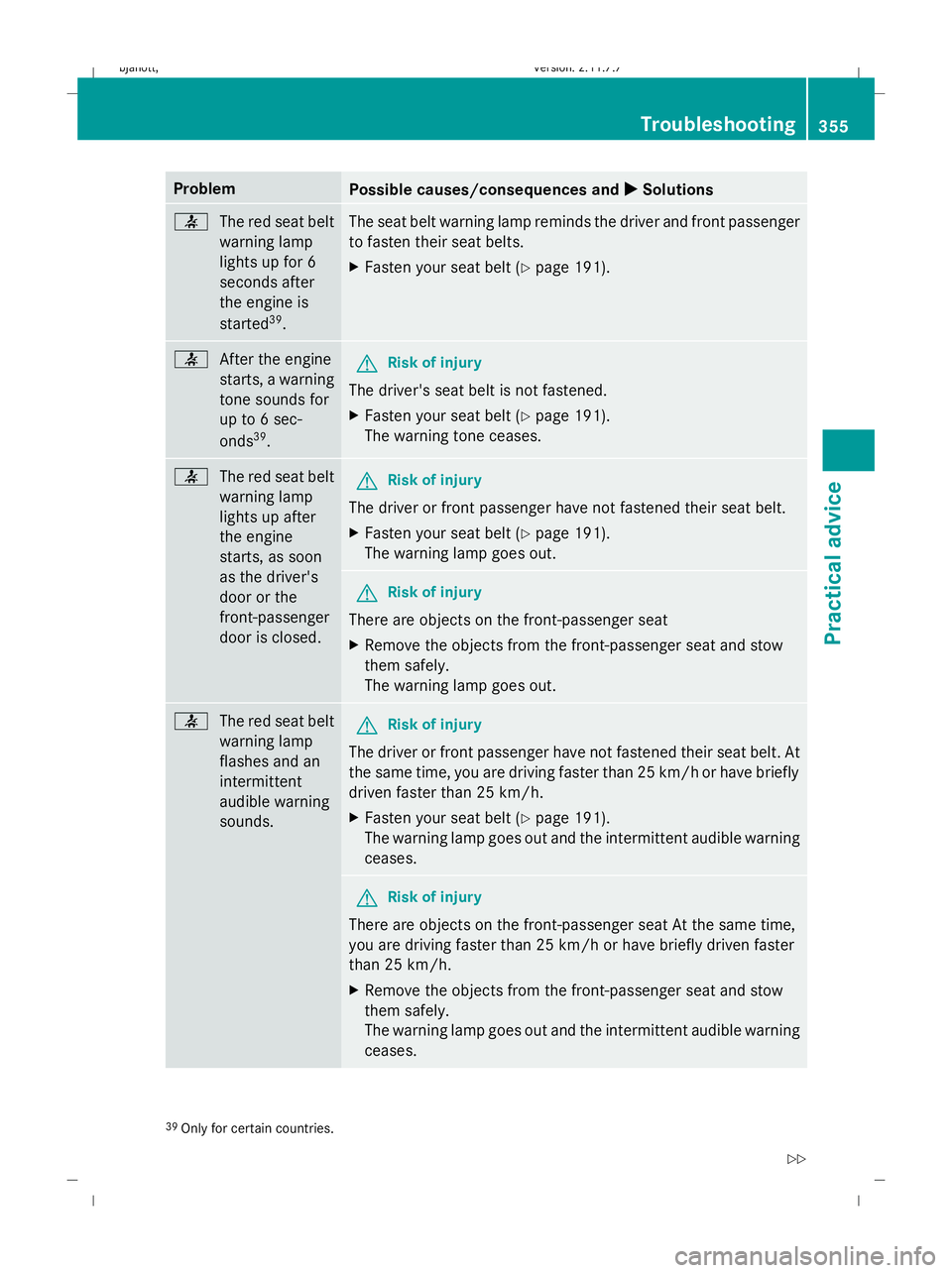
Problem
Possible causes/consequences and
X
X Solutions 7
The red seat belt
warning lamp
lights up for 6
seconds after
the engine is
started 39
. The seat belt warning lamp reminds the driver and front passenger
to fasten their seat belts.
X Fasten your seat belt (Y page 191). 7
After the engine
starts, a warning
tone sounds for
up to 6 sec-
onds39
. G
Risk of injury
The driver's seat belt is not fastened.
X Fasten your seat belt (Y page 191).
The warning tone ceases. 7
The red seat belt
warning lamp
lights up after
the engine
starts, as soon
as the driver's
door or the
front-passenger
door is closed. G
Risk of injury
The driver or front passenger have not fastened their seat belt.
X Fasten your seat belt (Y page 191).
The warning lamp goes out. G
Risk of injury
There are objects on the front-passenger seat
X Remove the objects from the front-passenger seat and stow
them safely.
The warning lamp goes out. 7
The red seat belt
warning lamp
flashes and an
intermittent
audible warning
sounds. G
Risk of injury
The driver or front passenger have not fastened their seat belt. At
the same time, you are driving faster than 25 km/h or have briefly
driven faster than 25 km/h.
X Fasten your seat belt (Y page 191).
The warning lamp goes out and the intermittent audible warning
ceases. G
Risk of injury
There are objects on the front-passenger seat At the same time,
you are driving faster than 25 km/h or have briefly driven faster
than 25 km/h.
X Remove the objects from the front-passenger seat and stow
them safely.
The warning lamp goes out and the intermittent audible warning
ceases. 39
Only for certain countries. Troubleshooting
355Practical advice
216_AKB; 2; 3, en-GB
bjanott, Version: 2.11.7.7 2009-02-27T14:54:17+01:00 - Seite 355 Z
Dateiname: 6515230602_buchblock.pdf; erzeugt am 04. Mar 2009 11:16:41; WK
Page 359 of 421
Problem
Possible causes/consequences and
X XSolutions The yellow reserve fuel
warning lamp lights up
while the engine is run-
ning. The fuel level has fallen below the reserve range. The operation of
the auxiliary heating* can no longer be guaranteed.
X
Refuel at the nearest filling station. Warning tones
Problem
Possible causes/consequences and
X XSolutions The anti-theft warning
alarm* is triggered. You have opened the vehicle with the anti-theft alarm system still
activated*.
X
Switch off the alarm (Y page 55).You hear a warning
tone. A message appears in the multi-function display.
X
See the explanations for the display message (Y page 316).You are driving with the electric parking brake applied.
X
Release the electric parking brake. The lights are still switched on when you leave the vehicle.
X
Turn the light switch to $orc.
or
X If the rear foglamp is switched on: press the light switch in to
the stop. G
Risk of injury
The driver or front passenger have not fastened their seat belt.
X Fasten your seat belt (Y page 191).You hear a warning
tone.
The
· red distance warning lamp* lights up while the vehicle
is in motion.
X Observe the explanations for the distance warning lamp*
(Y page 351). You hear a dual warning
tone.
The
9 red Blind Spot Assist* warning lamp flashes in one of
the exterior mirrors.
X Observe the explanations for the Blind Spot Assist* warning
lamp (Y page 350). 356
TroubleshootingPractical advice
* optional
216_AKB; 2; 3, en-GB
bjanott,
Version: 2.11.7.7 2009-02-27T14:54:17+01:00 - Seite 356
Dateiname: 6515230602_buchblock.pdf; erzeugt am 04. Mar 2009 11:16:41; WK
Page 362 of 421
Problem
Possible causes/consequences and
X
X Solutions The coolant tempera-
ture gauge shows a
value above 120 †.
The coolant warning
lamp may also light up
and a warning tone may
sound (Y
page 212). The coolant level is too low. The coolant is too hot and the engine
is no longer being cooled sufficiently.
X
Stop as soon as possible and allow the engine and the coolant
to cool down.
X Check the coolant level (Y page 294). Observe the warning
notes as you do so and top up the coolant if necessary. If the coolant level is correct, the radiator fan may be faulty. The
coolant is too hot and the engine is no longer being cooled suffi-
ciently.
X
If the coolant temperature is less than 120 †, you can continue
driving to the nearest qualified specialist workshop.
X Avoid heavy loads on the engine as you do so, e.g. driving on
mountain roads and stop/start driving. Automatic transmission
Problem
Possible causes/consequences and
X
X Solutions The transmission has
problems shifting gear. The transmission is losing oil.
X
Have the transmission checked at a qualified specialist work-
shop immediately. The acceleration ability
is deteriorating.
The transmission no
longer changes gear. The transmission is in emergency mode.
It is only possible to shift into
secondgear and reverse gear.
X Stop the vehicle.
X Turn the key in the ignition to position 0(Y page 182) or press
the Start/Stop button* repeatedly until all indicator lamps in
the instrument cluster go out.
X Wait at least 10 seconds before restarting the engine.
X Have the transmission checked at a qualified specialist work-
shop immediately. Troubleshooting
359Practical advice
* optional
216_AKB; 2; 3, en-GB
bjanott,
Version: 2.11.7.7 2009-02-27T14:54:17+01:00 - Seite 359 Z
Dateiname: 6515230602_buchblock.pdf; erzeugt am 04. Mar 2009 11:16:42; WK
Page 363 of 421
PARKTRONIC
Problem
Possible causes/consequences and
X XSolutions Only the red segments
in the PARKTRONIC
warning display are lit.
You also hear a warning
tone for approximately
two seconds.
PARKTRONIC is deacti-
vated after approx-
imately 20 seconds and
the indicator lamp in
the PARKTRONIC but-
ton lights up. PARKTRONIC has malfunctioned and has switched itself off.
X
If problems persist, have PARKTRONIC checked at a qualified
specialist workshop. Only the red segments
in the PARKTRONIC
warning display are lit.
PARKTRONIC is deacti-
vated after approx-
imately 20 seconds. The PARKTRONIC sensors are dirty or there is interference.
X
Clean the PARKTRONIC sensors (Y page 310).
X Switch the ignition back on. Only the red segments
in the PARKTRONIC
warning display are lit.
PARKTRONIC is deacti-
vated after approx-
imately 20 seconds. The problem may be caused by an external source of radio or
ultrasound waves.
X
See if PARKTRONIC functions in a different location. Headlamps
Problem
Possible causes/consequences and
X XSolutions The headlamps are mis-
ted up on the inside. Air humidity is very high.
X
Drive with the headlamps switched on.
The headlamps are demisted after a short distance. The headlamp housing is not sealed and moisture has been able
to enter.
X
Have the headlamps checked at a qualified specialist workshop. 360
TroubleshootingPractical advice
216_AKB; 2; 3, en-GB
bjanott,
Version: 2.11.7.7 2009-02-27T14:54:17+01:00 - Seite 360
Dateiname: 6515230602_buchblock.pdf; erzeugt am 04. Mar 2009 11:16:42; WK
Page 376 of 421

Removing the wiper blades
X
Remove the wiper blade from the retainer
on the wiper arm in the direction of the
arrow. Fitting
X Slide the new wiper blade into the retainer
on the wiper arm in the opposite direction
to the arrow.
X Turn the wiper blade parallel to the wiper
arm.
X Fold the wiper arm back onto the wind-
screen. Flat tyre
Flat tyre equipment variants
Your vehicle may be equipped with:
R a TIREFIT kit (Y page 315)
R a "Minispare" emergency spare
wheel* (Y page 315)
R a spare wheel* (Y page 316)
R the MOExtended run-flat sys-
tem* (Y page 381) Preparing the vehicle
i Vehicle preparation is not necessary on
vehicles with MOE tyres*. X
Stop the vehicle as far away as possible
from traffic on solid, non-slippery and level
ground.
X Switch on the hazard warning lamps.
X Engage the electric parking brake manually
(Y page 205).
X Move the DIRECT SELECT selector lever to
P.
X All occupants must get out of the vehicle.
Make sure that they are not endangered as
they get out of the vehicle.
X Make sure that no one is near the danger
area whilst a wheel is being changed. Any-
one who is not directly assisting in the
wheel change should, for example, stand
behind the barrier.
X Switch off the engine.
X Remove the key from the ignition lock.
X Get out of the vehicle.
X Close the driver’s door.
X Place the warning triangle (Y page 314) at
a suitable distance. Observe legal require-
ments. Using the TIREFIT kit
You can use the TIREFIT kit to seal small
punctures, particularly those in the tyre tread.
You can use TIREFIT at outside temperatures
down to -20 †. G
Risk of accident
In the following situations, your safety is at
particular risk and tyre sealant is unable to
provide breakdown assistance if:
R there are cuts or punctures in the tyre
greater than 4 mm
R the wheel rim is damaged
R you have driven at very low tyre pressures
or on a flat tyre
Do not drive any further. Consult a qualified
specialist workshop which has the necessary Flat tyre
373Practical advice
* optional
216_AKB; 2; 3, en-GB
bjanott,
Version: 2.11.7.7 2009-02-27T14:54:17+01:00 - Seite 373 Z
Dateiname: 6515230602_buchblock.pdf; erzeugt am 04. Mar 2009 11:16:47; WK
Page 378 of 421
X
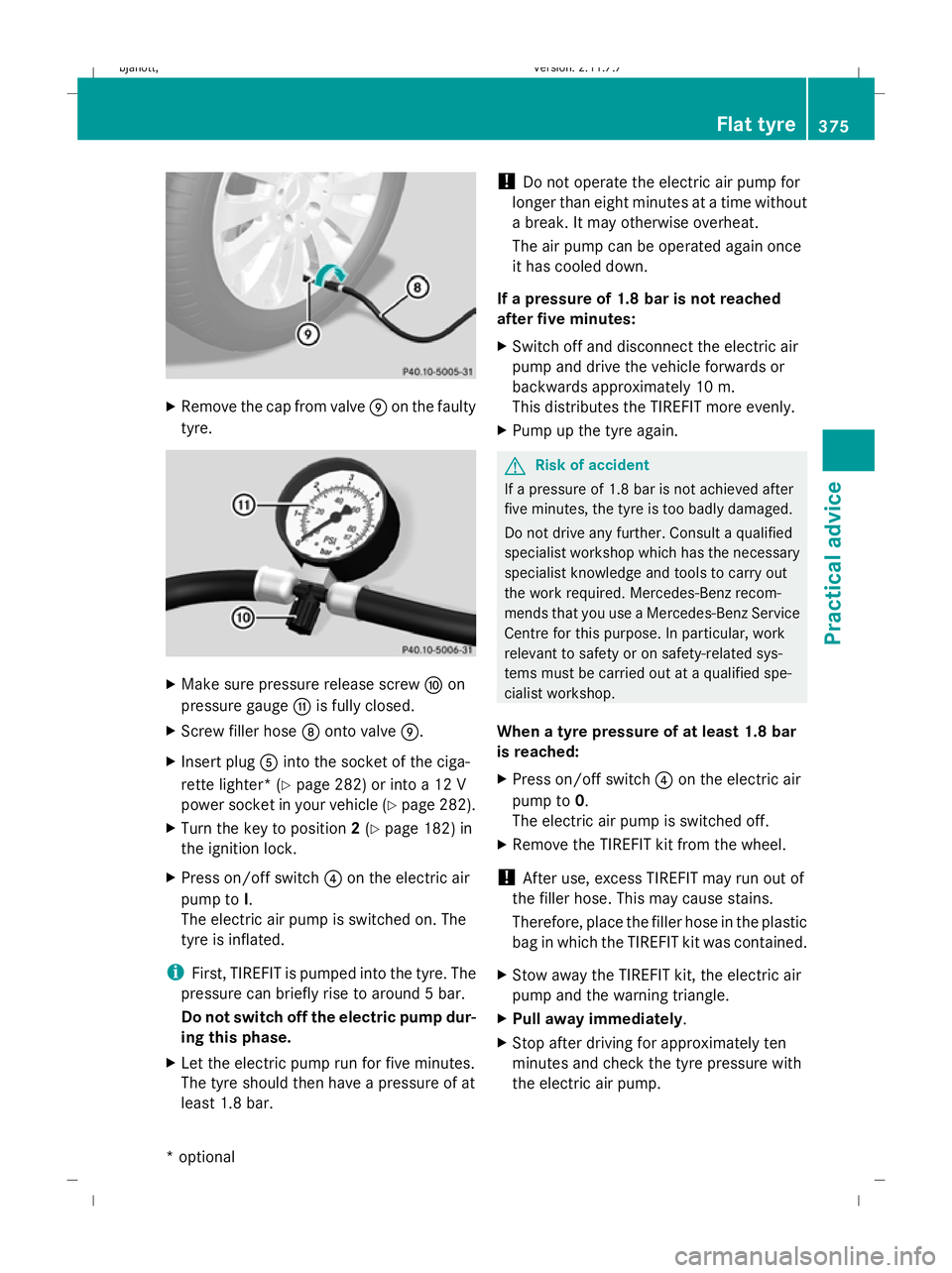
Remove the cap from valve Eon the faulty
tyre. X
Make sure pressure release screw Fon
pressure gauge Gis fully closed.
X Screw filler hose Donto valve E.
X Insert plug Ainto the socket of the ciga-
rette lighter* (Y page 282) or into a 12 V
power socket in your vehicle (Y page 282).
X Turn the key to position 2(Y page 182) in
the ignition lock.
X Press on/off switch ?on the electric air
pump to I.
The electric air pump is switched on. The
tyre is inflated.
i First, TIREFIT is pumped into the tyre. The
pressure can briefly rise to around 5 bar.
Do not switch off the electric pump dur-
ing this phase.
X Let the electric pump run for five minutes.
The tyre should then have a pressure of at
least 1.8 bar. !
Do not operate the electric air pump for
longer than eight minutes at a time without
a break. It may otherwise overheat.
The air pump can be operated again once
it has cooled down.
If a pressure of 1.8 bar is not reached
after five minutes:
X Switch off and disconnect the electric air
pump and drive the vehicle forwards or
backwards approximately 10 m.
This distributes the TIREFIT more evenly.
X Pump up the tyre again. G
Risk of accident
If a pressure of 1.8 bar is not achieved after
five minutes, the tyre is too badly damaged.
Do not drive any further. Consult a qualified
specialist workshop which has the necessary
specialist knowledge and tools to carry out
the work required. Mercedes-Benz recom-
mends that you use a Mercedes-Benz Service
Centre for this purpose. In particular, work
relevant to safety or on safety-related sys-
tems must be carried out at a qualified spe-
cialist workshop.
When a tyre pressure of at least 1.8 bar
is reached:
X Press on/off switch ?on the electric air
pump to 0.
The electric air pump is switched off.
X Remove the TIREFIT kit from the wheel.
! After use, excess TIREFIT may run out of
the filler hose. This may cause stains.
Therefore, place the filler hose in the plastic
bag in which the TIREFIT kit was contained.
X Stow away the TIREFIT kit, the electric air
pump and the warning triangle.
X Pull away immediately.
X Stop after driving for approximately ten
minutes and check the tyre pressure with
the electric air pump. Flat tyre
375Practical advice
* optional
216_AKB; 2; 3, en-GB
bjanott
,V ersion: 2.11.7.7
2009-02-27T14:54:17+01:00 - Seite 375 Z
Dateiname: 6515230602_buchblock.pdf; erzeugt am 04. Mar 2009 11:16:48; WK