warning MERCEDES-BENZ CL COUPE 2009 Manual Online
[x] Cancel search | Manufacturer: MERCEDES-BENZ, Model Year: 2009, Model line: CL COUPE, Model: MERCEDES-BENZ CL COUPE 2009Pages: 421, PDF Size: 10.78 MB
Page 334 of 421
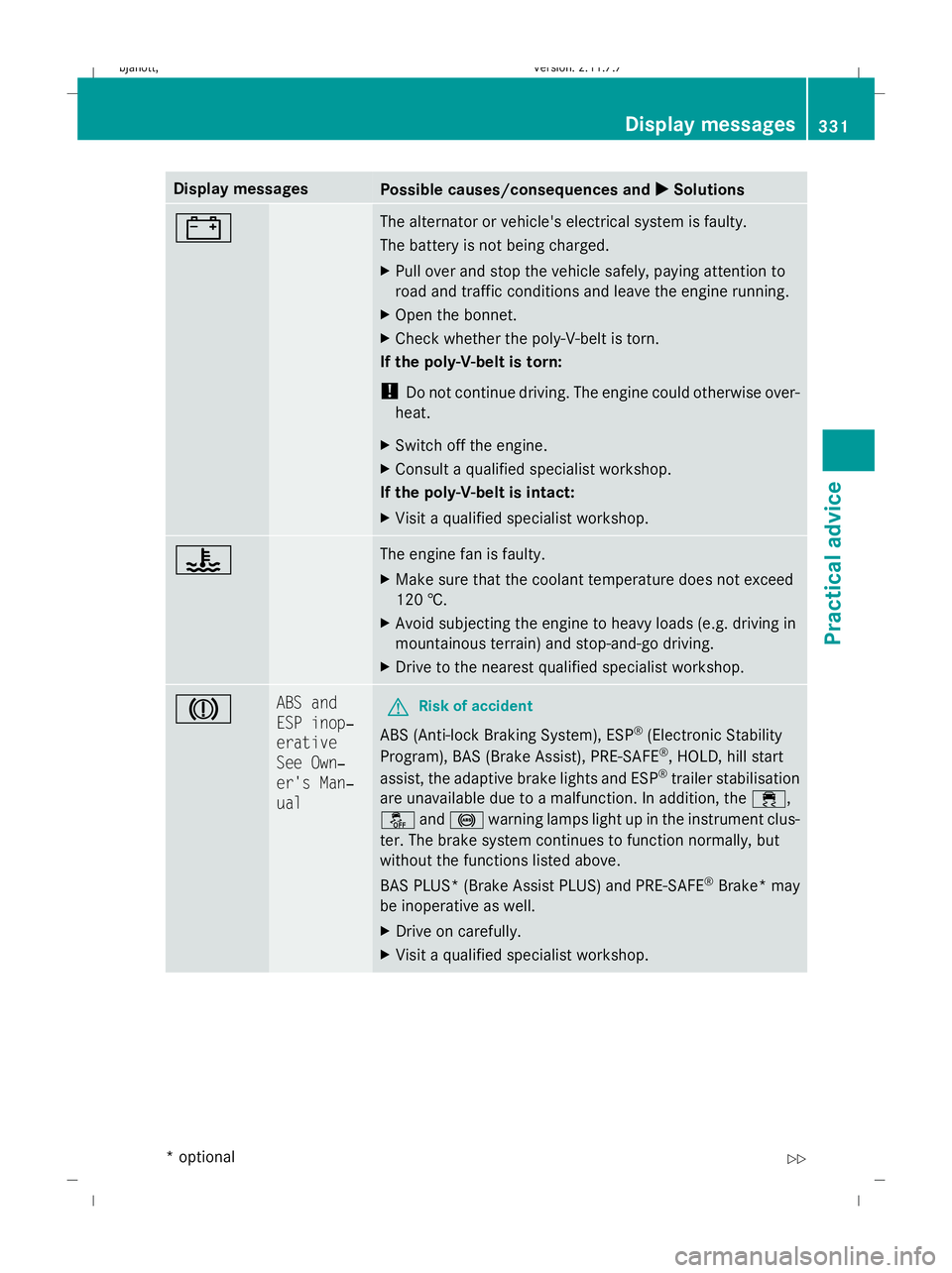
Display messages
Possible causes/consequences and
X
X Solutions # The alternator or vehicle's electrical system is faulty.
The battery is not being charged.
X
Pull over and stop the vehicle safely, paying attention to
road and traffic conditions and leave the engine running.
X Open the bonnet.
X Check whether the poly-V-belt is torn.
If the poly-V-belt is torn:
! Do not continue driving. The engine could otherwise over-
heat.
X Switch off the engine.
X Consult a qualified specialist workshop.
If the poly-V-belt is intact:
X Visit a qualified specialist workshop. ? The engine fan is faulty.
X
Make sure that the coolant temperature does not exceed
120 †.
X Avoid subjecting the engine to heavy loads (e.g. driving in
mountainous terrain) and stop-and-go driving.
X Drive to the nearest qualified specialist workshop. J ABS and
ESP inop‐
erative
See Own‐
er's Man‐
ual
G
Risk of accident
ABS (Anti-lock Braking System), ESP ®
(Electronic Stability
Program), BAS (Brake Assist), PRE-SAFE ®
, HOLD, hill start
assist, the adaptive brake lights and ESP ®
trailer stabilisation
are unavailable due to a malfunction. In addition, the ÷,
å and! warning lamps light up in the instrument clus-
ter. The brake system continues to function normally, but
without the functions listed above.
BAS PLUS* (Brake Assist PLUS) and PRE-SAFE ®
Brake *may
be inoperative as well.
X Drive on carefully.
X Visit a qualified specialist workshop. Display messages
331Practical advice
* optional
216_AKB; 2; 3, en-GB
bjanott,
Version: 2.11.7.7 2009-02-27T14:54:17+01:00 - Seite 331 Z
Dateiname: 6515230602_buchblock.pdf; erzeugt am 04. Mar 2009 11:16:37; WK
Page 335 of 421
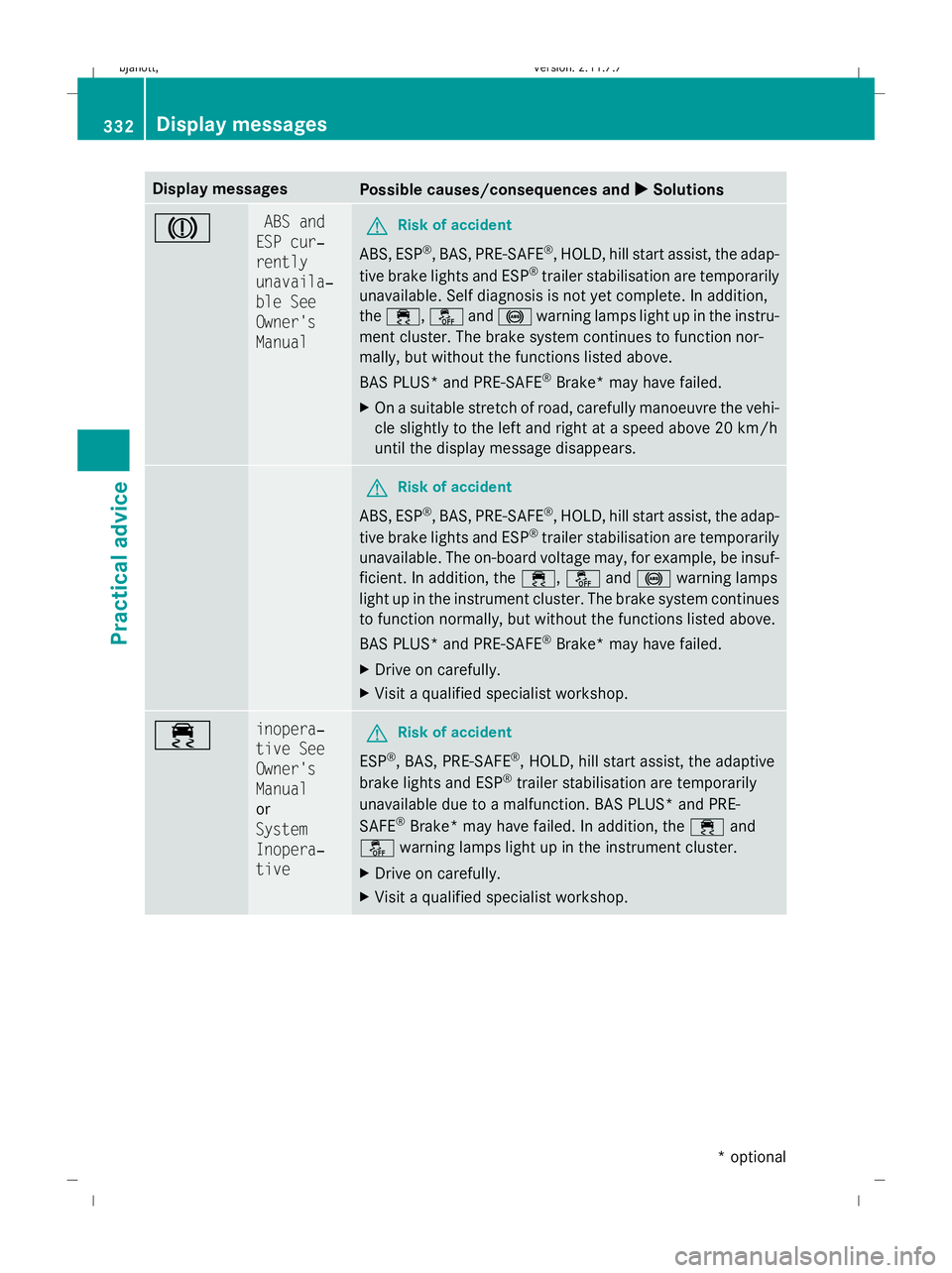
Display messages
Possible causes/consequences and
X
X Solutions J ABS and
ESP cur‐
rently
unavaila‐
ble See
Owner's
Manual G
Risk of accident
ABS, ESP ®
, BAS, PRE-SAFE ®
, HOLD, hill start assist, the adap-
tive brake lights and ESP ®
trailer stabilisation are temporarily
unavailable. Self diagnosis is not yet complete. In addition,
the ÷, åand! warning lamps light up in the instru-
ment cluster. The brake system continues to function nor-
mally, but without the functions listed above.
BAS PLUS* and PRE-SAFE ®
Brake* may have failed.
X On a suitable stretch of road, carefully manoeuvre the vehi-
cle slightly to the left and right at a speed above 20 km/h
until the display message disappears. G
Risk of accident
ABS, ESP ®
, BAS, PRE-SAFE ®
, HOLD, hill start assist, the adap-
tive brake lights and ESP ®
trailer stabilisation are temporarily
unavailable. The on-board voltage may, for example, be insuf-
ficient. In addition, the ÷,åand! warning lamps
light up in the instrument cluster. The brake system continues
to function normally, but without the functions listed above.
BAS PLUS* and PRE-SAFE ®
Brake* may have failed.
X Drive on carefully.
X Visit a qualified specialist workshop. ÷ inopera‐
tive See
Owner's
Manual
or
System
Inopera‐
tive
G
Risk of accident
ESP ®
, BAS, PRE-SAFE ®
, HOLD, hill start assist, the adaptive
brake lights and ESP ®
trailer stabilisation are temporarily
unavailable due to a malfunction. BAS PLUS* and PRE-
SAFE ®
Brake* may have failed. In addition, the ÷and
å warning lamps light up in the instrument cluster.
X Drive on carefully.
X Visit a qualified specialist workshop. 332
Display
messagesPractical advice
* optional
216_AKB; 2; 3, en-GB
bjanott
,V ersion: 2.11.7.7
2009-02-27T14:54:17+01:00 - Seite 332
Dateiname: 6515230602_buchblock.pdf; erzeugt am 04. Mar 2009 11:16:37; WK
Page 336 of 421
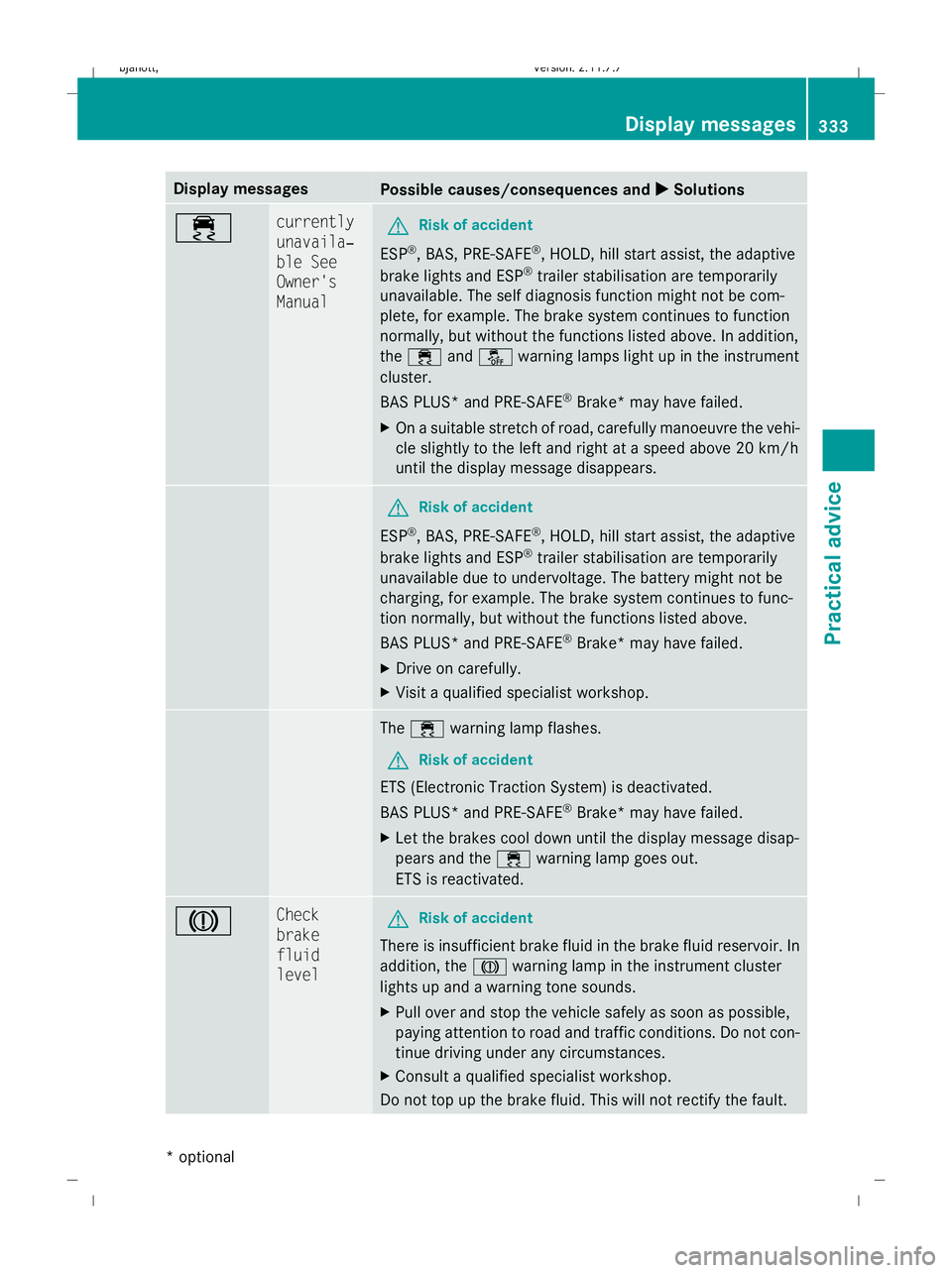
Display messages
Possible causes/consequences and
X
X Solutions ÷ currently
unavaila‐
ble See
Owner's
Manual
G
Risk of accident
ESP ®
, BAS, PRE-SAFE ®
, HOLD, hill start assist, the adaptive
brake lights and ESP ®
trailer stabilisation are temporarily
unavailable. The self diagnosis function might not be com-
plete, for example. The brake system continues to function
normally, but without the functions listed above. In addition,
the ÷ andå warning lamps light up in the instrument
cluster.
BAS PLUS* and PRE-SAFE ®
Brake* may have failed.
X On a suitable stretch of road, carefully manoeuvre the vehi-
cle slightly to the left and right at a speed above 20 km/h
until the display message disappears. G
Risk of accident
ESP ®
, BAS, PRE-SAFE ®
, HOLD, hill start assist, the adaptive
brake lights and ESP ®
trailer stabilisation are temporarily
unavailable due to undervoltage. The battery might not be
charging, for example. The brake system continues to func-
tion normally, but without the functions listed above.
BAS PLUS* and PRE-SAFE ®
Brake* may have failed.
X Drive on carefully.
X Visit a qualified specialist workshop. The
÷ warning lamp flashes.
G Risk of accident
ETS (Electronic Traction System) is deactivated.
BAS PLUS* and PRE-SAFE ®
Brake* may have failed.
X Let the brakes cool down until the display message disap-
pears and the ÷warning lamp goes out.
ETS is reactivated. J Check
brake
fluid
level
G
Risk of accident
There is insufficient brake fluid in the brake fluid reservoir. In
addition, the Jwarning lamp in the instrument cluster
lights up and a warning tone sounds.
X Pull over and stop the vehicle safely as soon as possible,
paying attention to road and traffic conditions. Do not con-
tinue driving under any circumstances.
X Consult a qualified specialist workshop.
Do not top up the brake fluid. This will not rectify the fault. Display
messages
333Practical advice
* optional
216_AKB; 2; 3, en-GB
bjanott
,V ersion: 2.11.7.7
2009-02-27T14:54:17+01:00 - Seite 333 Z
Dateiname: 6515230602_buchblock.pdf; erzeugt am 04. Mar 2009 11:16:37; WK
Page 337 of 421
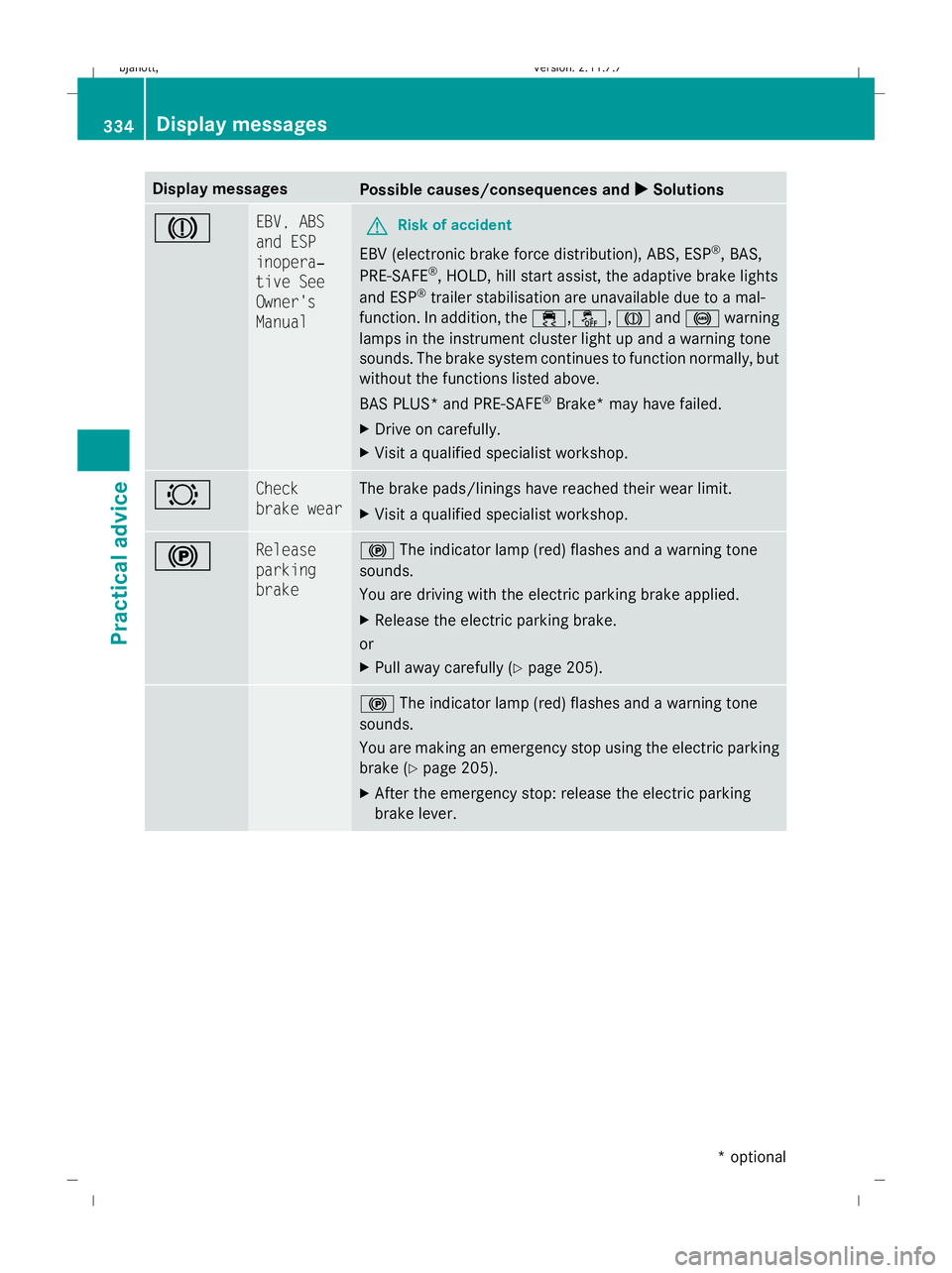
Display messages
Possible causes/consequences and
X
X Solutions J EBV, ABS
and ESP
inopera‐
tive See
Owner's
Manual
G
Risk of accident
EBV (electronic brake force distribution), ABS, ESP ®
, BAS,
PRE-SAFE ®
, HOLD, hill start assist, the adaptive brake lights
and ESP ®
trailer stabilisation are unavailable due to a mal-
function. In addition, the ÷,å,J and! warning
lamps in the instrument cluster light up and a warning tone
sounds. The brake system continues to function normally, but
without the functions listed above.
BAS PLUS* and PRE-SAFE ®
Brake* may have failed.
X Drive on carefully.
X Visit a qualified specialist workshop. # Check
brake wear The brake pads/linings have reached their wear limit.
X
Visit a qualified specialist workshop. ! Release
parking
brake !
The indicator lamp (red) flashes and a warning tone
sounds.
You are driving with the electric parking brake applied.
X Release the electric parking brake.
or
X Pull away carefully (Y page 205). !
The indicator lamp (red) flashes and a warning tone
sounds.
You are making an emergency stop using the electric parking
brake (Y page 205).
X After the emergency stop: release the electric parking
brake lever. 334
Display
messagesPractical advice
* optional
216_AKB; 2; 3, en-GB
bjanott
,V ersion: 2.11.7.7
2009-02-27T14:54:17+01:00 - Seite 334
Dateiname: 6515230602_buchblock.pdf; erzeugt am 04. Mar 2009 11:16:37; WK
Page 338 of 421
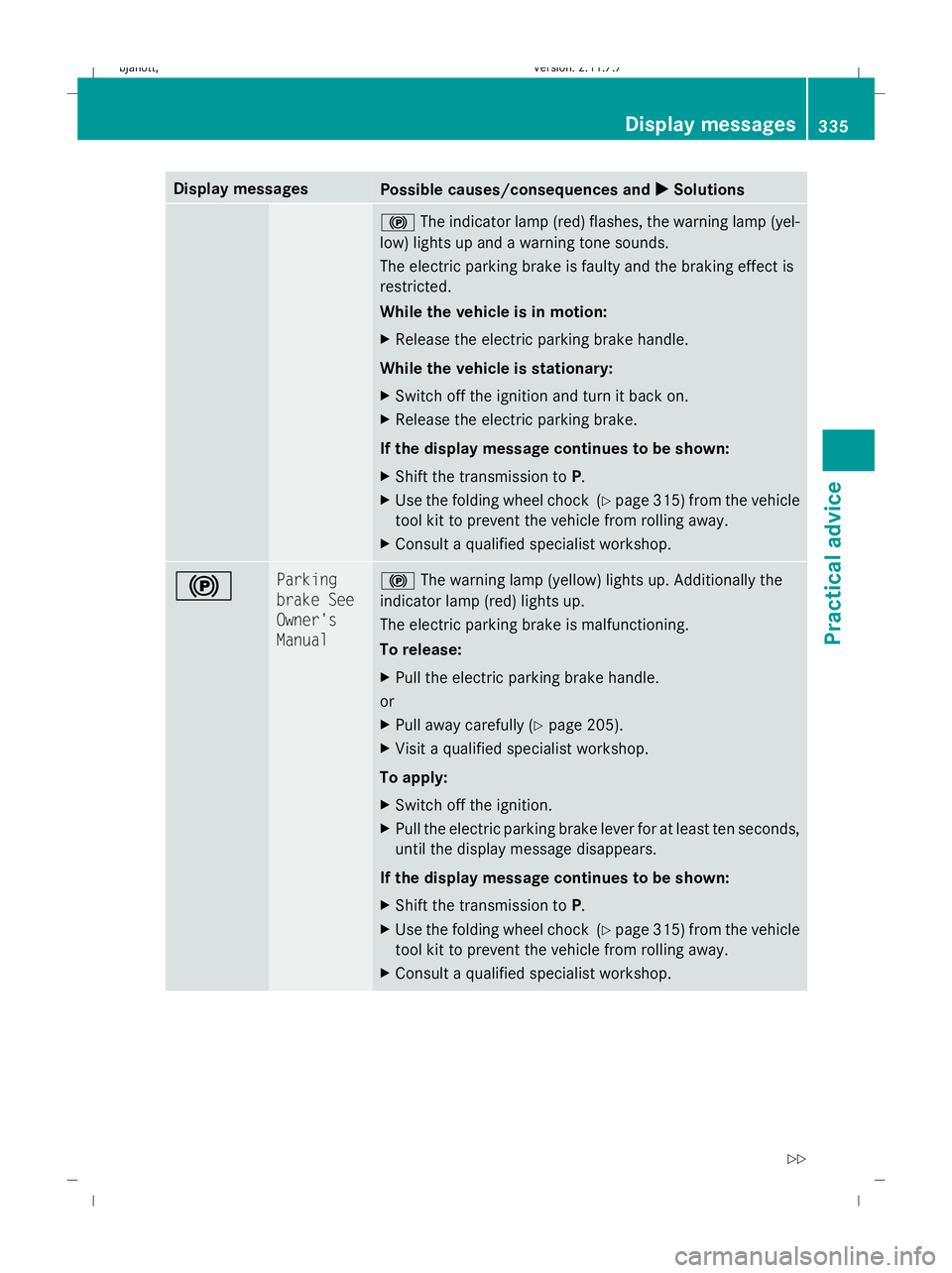
Display messages
Possible causes/consequences and
X
X Solutions !
The indicator lamp (red) flashes, the warning lamp (yel-
low) lights up and a warning tone sounds.
The electric parking brake is faulty and the braking effect is
restricted.
While the vehicle is in motion:
X Release the electric parking brake handle.
While the vehicle is stationary:
X Switch off the ignition and turn it back on.
X Release the electric parking brake.
If the display message continues to be shown:
X Shift the transmission to P.
X Use the folding wheel chock (Y page 315) from the vehicle
tool kit to prevent the vehicle from rolling away.
X Consult a qualified specialist workshop. ! Parking
brake See
Owner's
Manual !
The warning lamp (yellow) lights up. Additionally the
indicator lamp (red) lights up.
The electric parking brake is malfunctioning.
To release:
X Pull the electric parking brake handle.
or
X Pull away carefully (Y page 205).
X Visit a qualified specialist workshop.
To apply:
X Switch off the ignition.
X Pull the electric parking brake lever for at least ten seconds,
until the display message disappears.
If the display message continues to be shown:
X Shift the transmission to P.
X Use the folding wheel chock (Y page 315) from the vehicle
tool kit to prevent the vehicle from rolling away.
X Consult a qualified specialist workshop. Display
messages
335Practical advice
216_AKB; 2; 3, en-GB
bjanott ,V ersion: 2.11.7.7
2009-02-27T14:54:17+01:00 - Seite 335 Z
Dateiname: 6515230602_buchblock.pdf; erzeugt am 04. Mar 2009 11:16:37; WK
Page 339 of 421
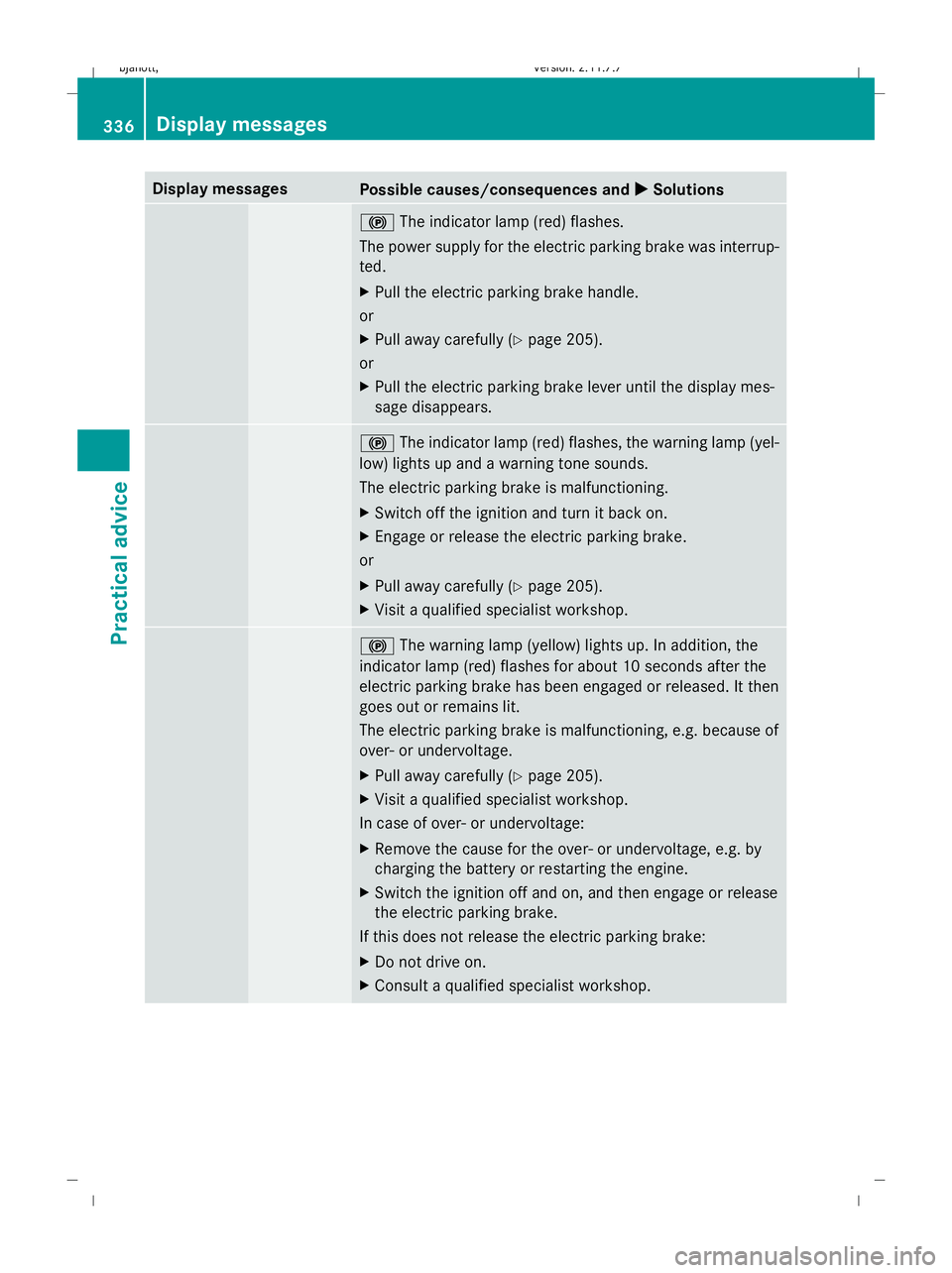
Display messages
Possible causes/consequences and
X
X Solutions !
The indicator lamp (red) flashes.
The power supply for the electric parking brake was interrup-
ted.
X Pull the electric parking brake handle.
or
X Pull away carefully (Y page 205).
or
X Pull the electric parking brake lever until the display mes-
sage disappears. !
The indicator lamp (red) flashes, the warning lamp (yel-
low) lights up and a warning tone sounds.
The electric parking brake is malfunctioning.
X Switch off the ignition and turn it back on.
X Engage or release the electric parking brake.
or
X Pull away carefully (Y page 205).
X Visit a qualified specialist workshop. !
The warning lamp (yellow) lights up. In addition, the
indicator lamp (red) flashes for about 10 seconds after the
electric parking brake has been engaged or released. It then
goes out or remains lit.
The electric parking brake is malfunctioning, e.g. because of
over- or undervoltage.
X Pull away carefully (Y page 205).
X Visit a qualified specialist workshop.
In case of over- or undervoltage:
X Remove the cause for the over- or undervoltage, e.g. by
charging the battery or restarting the engine.
X Switch the ignition off and on, and then engage or release
the electric parking brake.
If this does not release the electric parking brake:
X Do not drive on.
X Consult a qualified specialist workshop. 336
Display
messagesPractical advice
216_AKB; 2; 3, en-GB
bjanott ,V ersion: 2.11.7.7
2009-02-27T14:54:17+01:00 - Seite 336
Dateiname: 6515230602_buchblock.pdf; erzeugt am 04. Mar 2009 11:16:37; WK
Page 340 of 421
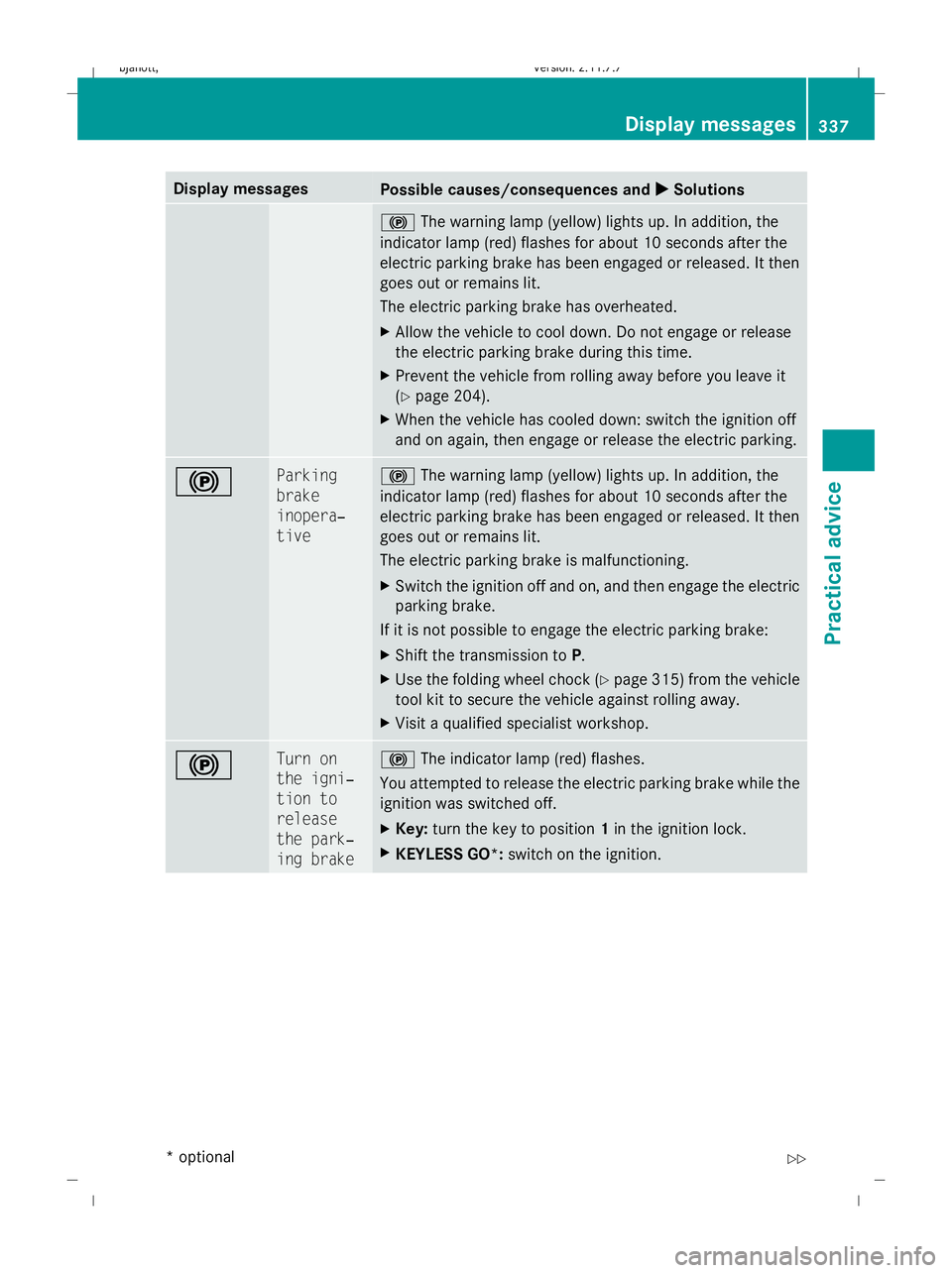
Display messages
Possible causes/consequences and
X
X Solutions !
The warning lamp (yellow) lights up. In addition, the
indicator lamp (red) flashes for about 10 seconds after the
electric parking brake has been engaged or released. It then
goes out or remains lit.
The electric parking brake has overheated.
X Allow the vehicle to cool down. Do not engage or release
the electric parking brake during this time.
X Prevent the vehicle from rolling away before you leave it
(Y page 204).
X When the vehicle has cooled down: switch the ignition off
and on again, then engage or release the electric parking. ! Parking
brake
inopera‐
tive !
The warning lamp (yellow) lights up. In addition, the
indicator lamp (red) flashes for about 10 seconds after the
electric parking brake has been engaged or released. It then
goes out or remains lit.
The electric parking brake is malfunctioning.
X Switch the ignition off and on, and then engage the electric
parking brake.
If it is not possible to engage the electric parking brake:
X Shift the transmission to P.
X Use the folding wheel chock (Y page 315) from the vehicle
tool kit to secure the vehicle against rolling away.
X Visit a qualified specialist workshop. ! Turn on
the igni‐
tion to
release
the park‐
ing brake !
The indicator lamp (red) flashes.
You attempted to release the electric parking brake while the
ignition was switched off.
X Key: turn the key to position 1in the ignition lock.
X KEYLESS GO*: switch on the ignition. Display
messages
337Practical advice
* optional
216_AKB; 2; 3, en-GB
bjanott
,V ersion: 2.11.7.7
2009-02-27T14:54:17+01:00 - Seite 337 Z
Dateiname: 6515230602_buchblock.pdf; erzeugt am 04. Mar 2009 11:16:38; WK
Page 345 of 421
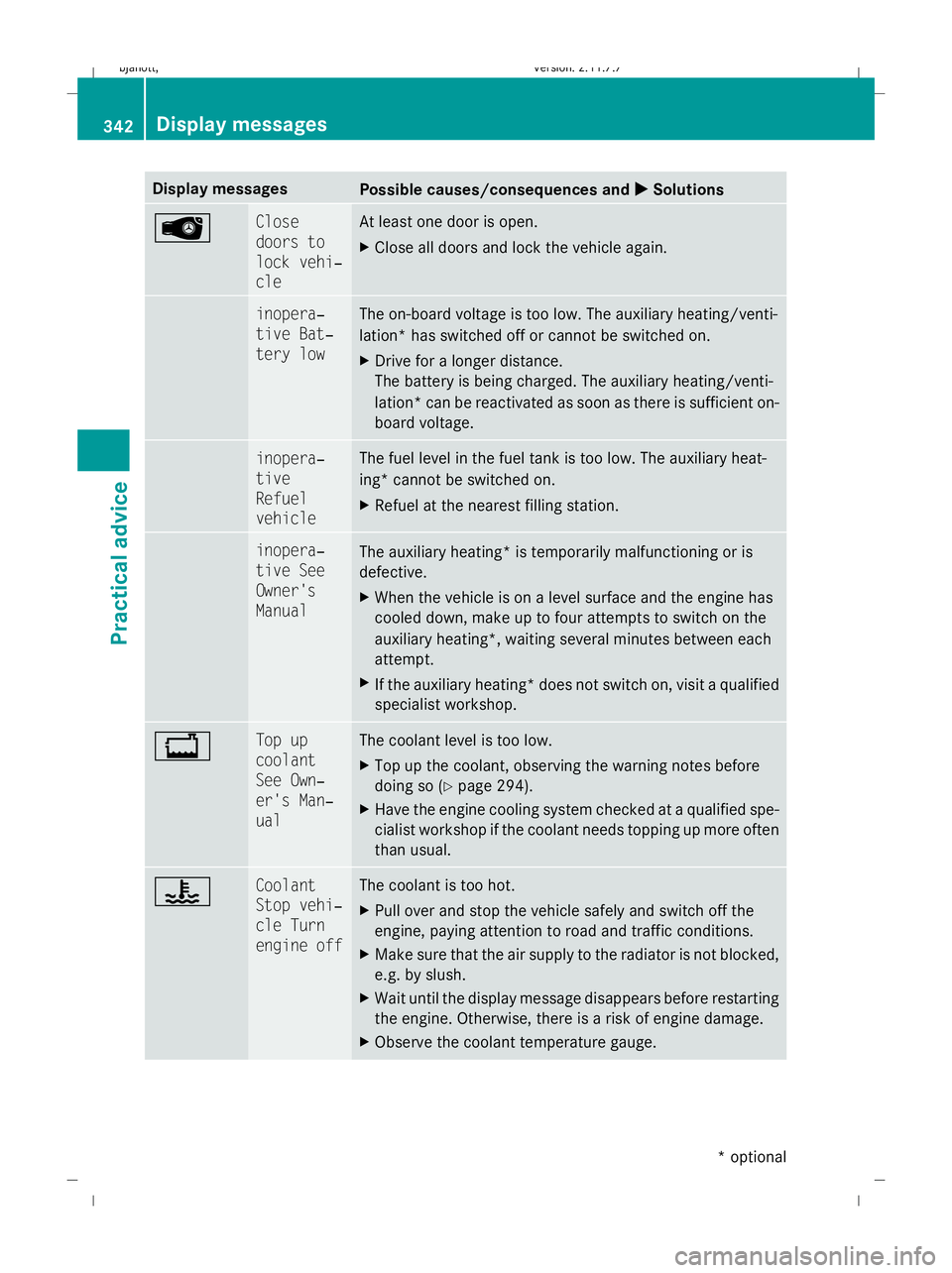
Display messages
Possible causes/consequences and
X
X Solutions  Close
doors to
lock vehi‐
cle At least one door is open.
X
Close all doors and lock the vehicle again. & inopera‐
tive Bat‐
tery low The on-board voltage is too low. The auxiliary heating/venti-
lation* has switched off or cannot be switched on.
X
Drive for a longer distance.
The battery is being charged. The auxiliary heating/venti-
lation *can be reactivated as soon as there is sufficient on-
board voltage. & inopera‐
tive
Refuel
vehicle The fuel level in the fuel tank is too low. The auxiliary heat-
ing* cannot be switched on.
X
Refuel at the nearest filling station. & inopera‐
tive See
Owner's
Manual
The auxiliary heating
*is temporarily malfunctioning or is
defective.
X When the vehicle is on a level surface and the engine has
cooled down, make up to four attempts to switch on the
auxiliary heating*, waiting several minutes between each
attempt.
X If the auxiliary heating* does not switch on, visit a qualified
specialist workshop. + Top up
coolant
See Own‐
er's Man‐
ual The coolant level is too low.
X
Top up the coolant, observing the warning notes before
doing so (Y page 294).
X Have the engine cooling system checked at a qualified spe-
cialist workshop if the coolant needs topping up more often
than usual. ? Coolant
Stop vehi‐
cle Turn
engine off The coolant is too hot.
X
Pull over and stop the vehicle safely and switch off the
engine, paying attention to road and traffic conditions.
X Make sure that the air supply to the radiator is not blocked,
e.g. by slush.
X Wait until the display message disappears before restarting
the engine. Otherwise, there is a risk of engine damage.
X Observe the coolant temperature gauge. 342
Display messagesPractical advice
* optional
216_AKB; 2; 3, en-GB
bjanott
,V ersion: 2.11.7.7
2009-02-27T14:54:17+01:00 - Seite 342
Dateiname: 6515230602_buchblock.pdf; erzeugt am 04. Mar 2009 11:16:38; WK
Page 352 of 421
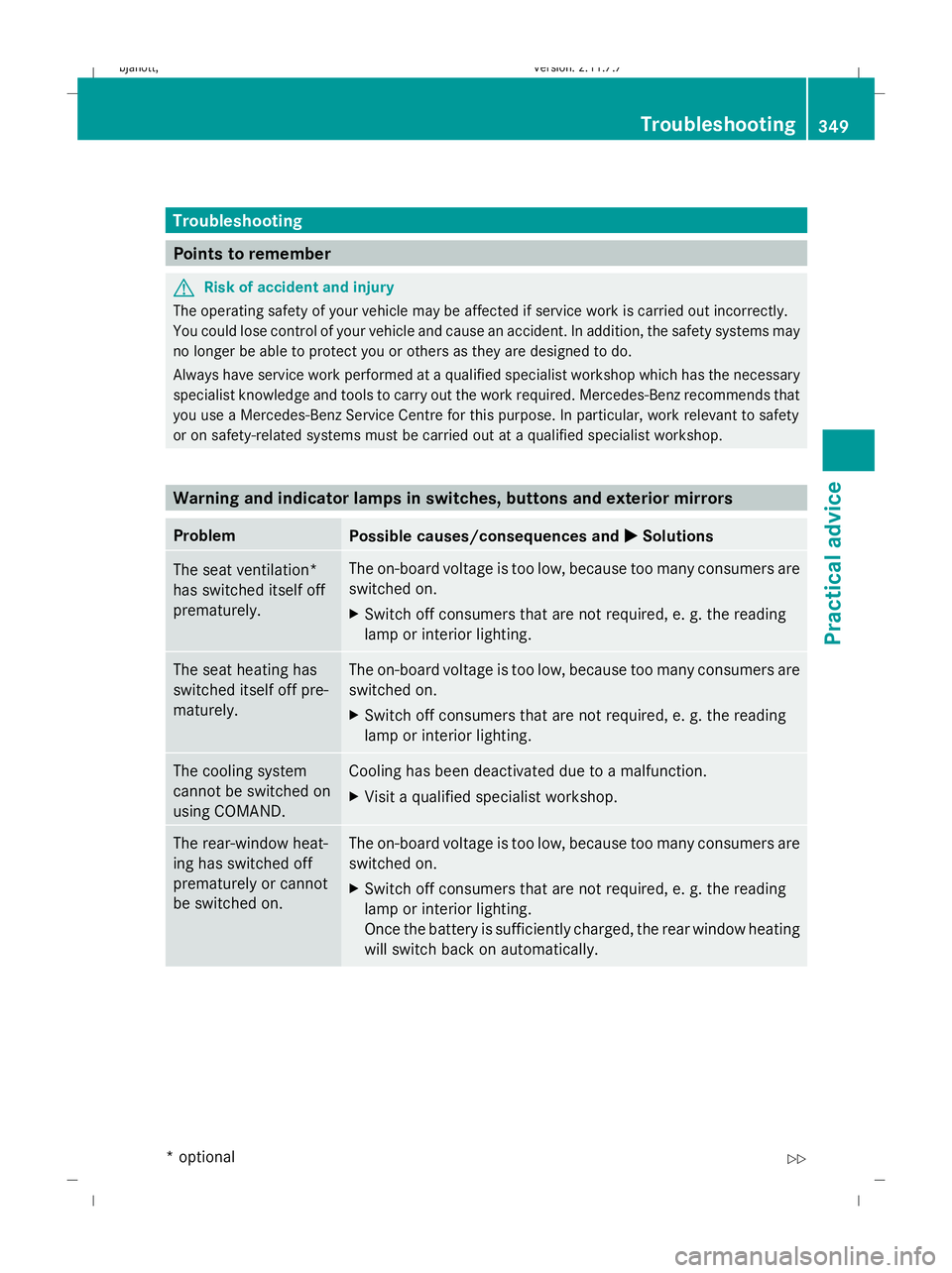
Troubleshooting
Points to remember
G
Risk of accident and injury
The operating safety of your vehicle may be affected if service work is carried out incorrectly.
You could lose control of your vehicle and cause an accident. In addition, the safety systems may
no longer be able to protect you or others as they are designed to do.
Always have service work performed at a qualified specialist workshop which has the necessary
specialist knowledge and tools to carry out the work required. Mercedes-Benz recommends that
you use a Mercedes-Benz Service Centre for this purpose. In particular, work relevant to safety
or on safety-related systems must be carried out at a qualified specialist workshop. Warning and indicator lamps in switches, buttons and exterior mirrors
Problem
Possible causes/consequences and
X
X Solutions The seat ventilation*
has switched itself off
prematurely. The on-board voltage is too low, because too many consumers are
switched on.
X Switch off consumers that are not required, e. g. the reading
lamp or interior lighting. The seat heating has
switched itself off pre-
maturely. The on-board voltage is too low, because too many consumers are
switched on.
X Switch off consumers that are not required, e. g. the reading
lamp or interior lighting. The cooling system
cannot be switched on
using COMAND. Cooling has been deactivated due to a malfunction.
X
Visit a qualified specialist workshop. The rear-window heat-
ing has switched off
prematurely or cannot
be switched on. The on-board voltage is too low, because too many consumers are
switched on.
X Switch off consumers that are not required, e. g. the reading
lamp or interior lighting.
Once the battery is sufficiently charged, the rear window heating
will switch back on automatically. Troubleshooting
349Practical advice
* optional
216_AKB; 2; 3, en-GB
bjanott
,V ersion: 2.11.7.7
2009-02-27T14:54:17+01:00 - Seite 349 Z
Dateiname: 6515230602_buchblock.pdf; erzeugt am 04. Mar 2009 11:16:40; WK
Page 353 of 421
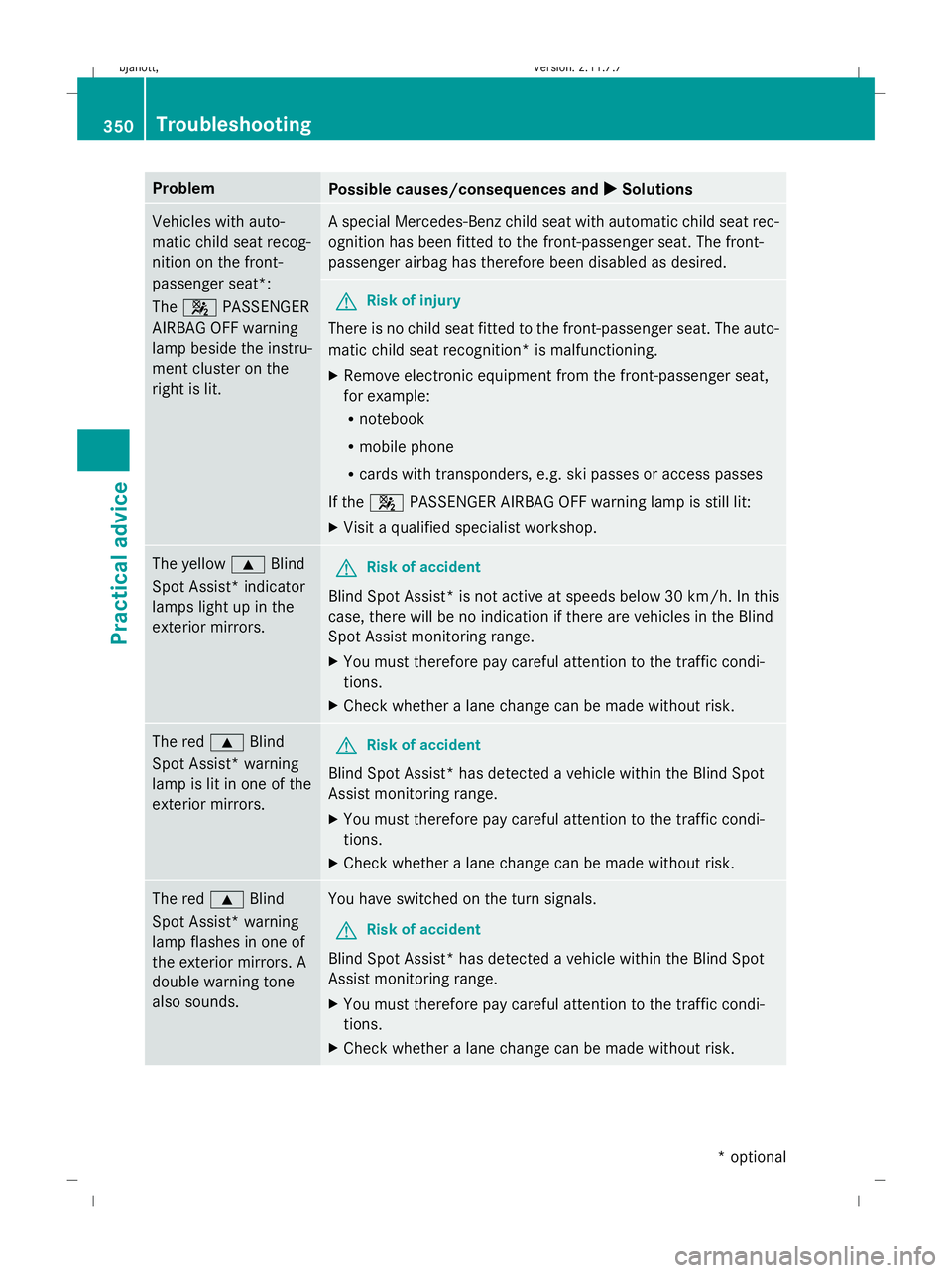
Problem
Possible causes/consequences and
X XSolutions Vehicles with auto-
matic child seat recog-
nition on the front-
passenger seat*:
The
4 PASSENGER
AIRBAG OFF warning
lamp beside the instru-
ment cluster on the
right is lit. A special Mercedes-Benz child seat with automatic child seat rec-
ognition has been fitted to the front-passenger seat. The front-
passenger airbag has therefore been disabled as desired.
G
Risk of injury
There is no child seat fitted to the front-passenger seat. The auto-
matic child seat recognition* is malfunctioning.
X Remove electronic equipment from the front-passenger seat,
for example:
R
notebook
R mobile phone
R cards with transponders, e.g. ski passes or access passes
If the 4 PASSENGER AIRBAG OFF warning lamp is still lit:
X Visit a qualified specialist workshop. The yellow
9Blind
Spot Assist* indicator
lamps light up in the
exterior mirrors. G
Risk of accident
Blind Spot Assist* is not active at speeds below 30 km/h. In this
case, there will be no indication if there are vehicles in the Blind
Spot Assist monitoring range.
X You must therefore pay careful attention to the traffic condi-
tions.
X Check whether a lane change can be made without risk. The red
9Blind
Spot Assist* warning
lamp is lit in one of the
exterior mirrors. G
Risk of accident
Blind Spot Assist* has detected a vehicle within the Blind Spot
Assist monitoring range.
X You must therefore pay careful attention to the traffic condi-
tions.
X Check whether a lane change can be made without risk. The red
9Blind
Spot Assist* warning
lamp flashes in one of
the exterior mirrors. A
double warning tone
also sounds. You have switched on the turn signals.
G Risk of accident
Blind Spot Assist* has detected a vehicle within the Blind Spot
Assist monitoring range.
X You must therefore pay careful attention to the traffic condi-
tions.
X Check whether a lane change can be made without risk. 350
TroubleshootingPractical advice
* optional
216_AKB; 2; 3, en-GB
bjanott,
Version: 2.11.7.7 2009-02-27T14:54:17+01:00 - Seite 350
Dateiname: 6515230602_buchblock.pdf; erzeugt am 04. Mar 2009 11:16:40; WK