engine MERCEDES-BENZ CLA COUPE 2018 Owner's Manual
[x] Cancel search | Manufacturer: MERCEDES-BENZ, Model Year: 2018, Model line: CLA COUPE, Model: MERCEDES-BENZ CLA COUPE 2018Pages: 326, PDF Size: 5.59 MB
Page 280 of 326
Remove theSmartKey if you park th evehicl e
and do no trequire any electrical consumers.
The vehicl ewill then use ver ylittl ee nergy, thus
conserving battery power .
If th epower suppl yhas been interrupted, e.g. if
you reconnect th ebattery, you will hav eto:
Rset th eclock usin gthe multimedia system;
see th eseparat eoperating instruction s
Rreset thefunction for foldin gthe exterio rmir-
ror sin/out automatically, by foldin gthe mir -
ror so ut once (
Ypage 97)
Charging th ebattery
GWARNIN G
During charging and jump-starting ,explosive
gase scan escape from th ebattery. There is a
ris kofane xplosion .
Particularly avoi dfire, open flames, creating
sparks and smoking. Ensur ethe re is sufficien t
ventilation while charging and jump-starting .
Do no tlean ove rabattery.
GWARNIN G
Battery acid is caustic. There is ariskofi njury.
Avoid contact wit hskin, eyes or clothing .Do
no tinhale any battery gases. Do no tlean ove r
th eb attery. Kee pchildren away from batter-
ies. Wash away battery acid immediately wit h
plenty of clean water and seek medical atten -
tion .
GWARNIN G
Ad ischarged battery can freez eattempera-
tures belo wfreezing point. When jump-start -
ing thevehicl eorc harging th ebattery, gase s
can escape from th ebattery. There is arisko f
an explosion .
Allow th efroze nbattery to thaw out before
charging it or jump-starting .
!Only use battery chargers wit hamaximum
charging voltag eof14.8V .
!Only charge th ebattery usin gthe jump-
starting connection point.
The jump-starting connection poin tisinthe
engin ecom partmen t(
Ypage 278).
XOpen thehood.
XConnect th ebattery charge rtothepositive
termina land ground poin tinthesam eorder
as when connecting th edonor battery in th e
jump-starting procedure (
Ypage 278).
If th eindicator/warning lamp sdonotligh tupi n
th ei nstrumen tcluste ratlow temperatures ,itis
ver ylikely that th edischarged battery has fro-
zen. In this cas eyou may neither jump-start th e
vehicl enorcharge th ebattery. The servic elife of
at hawed-out battery may be shorter. The start -
ing characteristics can be impaired, particularly
at low temperatures .Havet he thawed-out bat -
tery checke dataqualified specialist workshop.
Only charge th einstalled battery wit habattery
charge rwhic hh as been tested and approve dby
Mercedes-Benz .Abattery charge runi
ts p
ecially
adapted for Mercedes-Benz vehicles and tested
and approve dbyMercedes-Benz is available as
an accessory. It permit sthe charging of th ebat-
tery in it sinstalled position .Contac tana uthor-
ized Mercedes-Benz Cente rfor further informa-
tion and availability. Read th ebattery charger's
operating instruction sbefore charging th ebat-
tery.
Jump-starting
Fo rthe jump-starting procedure ,use only th ejump-starting connection point, consisting of apos-
itive termina land aground point, in th eenginec om partment.
GWARNIN G
Battery acid is caustic. There is ariskofi njury.
Avoid contact wit hskin, eyes or clothing .Donotinhale any battery gases. Do no tlean ove rthe
battery. Kee pchildren away from batteries. Wash away battery acid immediately wit hplenty of
clean water and seek medical attention .
278Jump-starting
Breakdown assistance
Page 281 of 326
GWARNING
During charging and jump-starting, explosive gasesc an escapefrom the battery .There is arisk
of an explosion.
Particularl yavoi dfire, open flames, creating sparks and smoking. Ensure there is sufficient ven-
tilation while charging and jump-starting. Do not leano verabattery.
GWARNING
During the charging process,ab attery produces hydrogen gas. If ashort circui toccurs or sparks
are created ,the hydrogen gas can ignite. There is arisk of an explosion.
RMake sure that the positive terminal of aconnected battery does not come into contact with
vehiclep arts.
RNever place metal objects or tools on abattery.
RIt is important that you observe the described order of the battery terminal swhen connecting
and disconnecting abattery.
RWhen jump-starting, make sure that the battery polesw ith identical polarity are connected.
RIt is particularlyimportant to observe the described order when connecting and disconnecting
the jumper cables.
RNever connect or disconnect the battery terminal swhile the engine is running.
GWARNING
Ad ischarged battery can freeze at temperatures below freezing point. When jump-starting the
vehicleorc harging the battery,g asescan escapef rom the battery.T here isarisk of an explosion.
Allow the frozen battery to thaw out before charging it or jump-starting.
!Avoid repeated and lengthy starting attempts. Otherwise, the catalytic converter coul dbe
damaged by the non-combusted fuel.
If the indicator/warning lamp sdonot light up in the instrument cluster at low temperatures, it is very
likelyt hat the discharged battery has frozen. In this case you may neither jump-start the vehiclen or
charge the battery.L et the battery thaw first. The service life of athawed-out battery may be shorter.
The starting characteristics can be impaired,p articularlyatlow temperatures. Have the thawed-out
battery checked at aqualified specialist workshop.
Do not start the vehicleu singarapi dc harging device. If you rvehicle's battery is discharged, the
engine can be jump-started from another vehicleorf romasecond battery using jumper cables.
Observe the following points:
RThe battery is not accessible in all vehicles. If the other vehicle's battery is not accessible,j ump-
start the vehicleu singasecond battery or ajump-starting device.
RYou may only jump-start the vehiclew hen the engine and exhaust system are cold.
RDo not start the engine if the battery is frozen. Let the battery thaw first.
ROnly jump-start from batterieswitha12Vv oltagerating.
ROnly use jumper cables that are not damaged and have asufficient cross-section and insulated
terminal clamps.
RMake sure that the two vehicles do not touch.
Jump-starting279
Breakdown assistance
Z
Page 282 of 326
Make sure that:
RThe jumper cables are not damaged.
RNon-insulated parts of the terminal clamps do not come into contact with other metal parts while
the jumper cables are connected to the battery.
RThe jumper cables cannot come into contact with parts that can move when the engine is running,
such as the V-belt pulleyorthe fan.
XSecure the vehicle by applying the electric parking brake.
XShift the transmission to position j.
XTurn the SmartKey to positiongin the ignition lock and remove it.
XSwitch off all electrical consumers, e.g. rear window defroster, lighting, etc.
XOpen the hood.
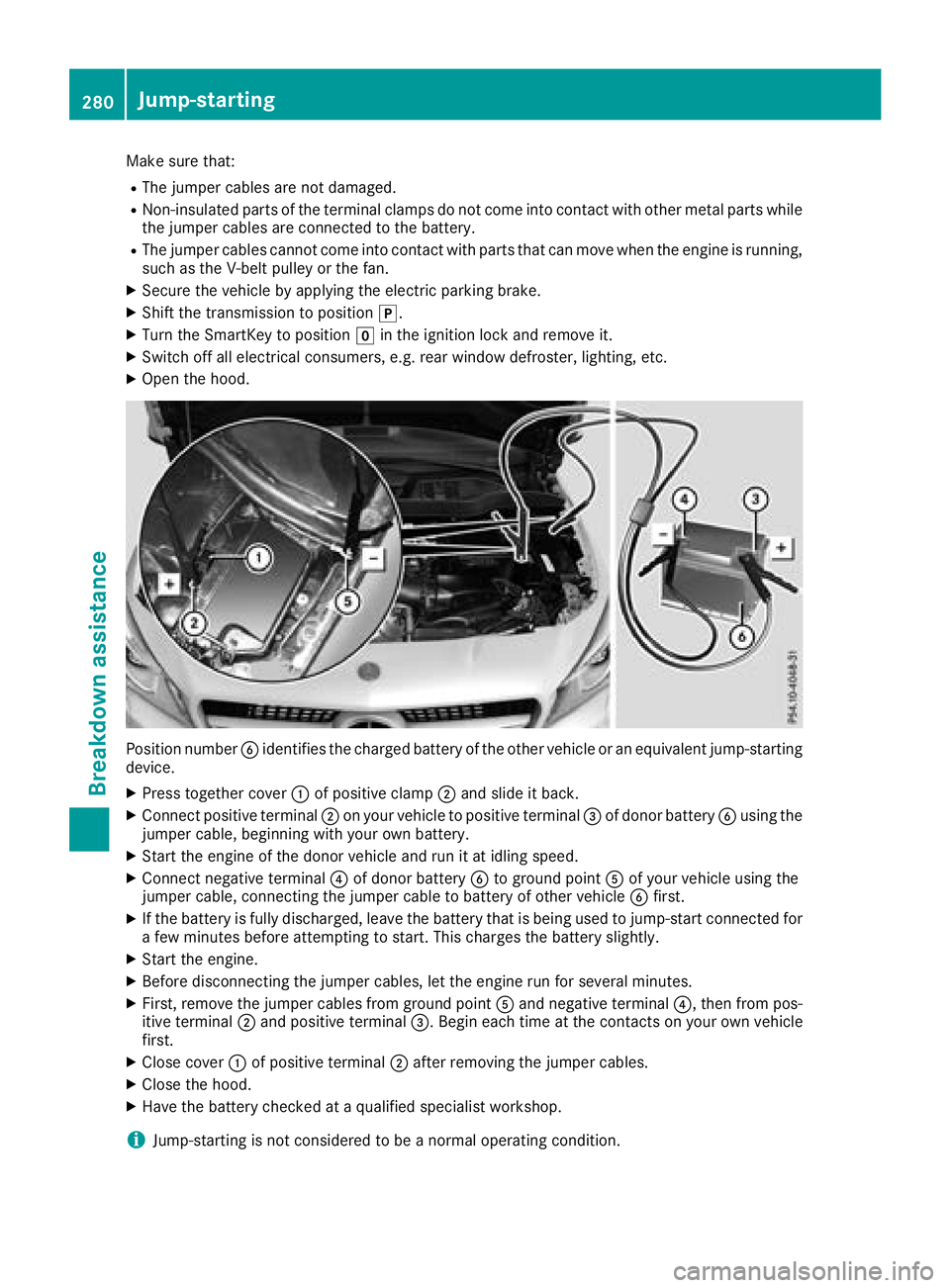
Position number Bidentifies the charged battery of the other vehicle or an equivalent jump-starting
device.
XPress together cover :of positive clamp ;and slide it back.
XConnect positive terminal ;on your vehicle to positive terminal =of donor battery Busing the
jumper cable, beginning with your own battery.
XStart the engine of the donor vehicle and run it at idling speed.
XConnect negative terminal ?of donor battery Bto ground point Aof your vehicle using the
jumper cable, connecting the jumper cable to battery of other vehicle Bfirst.
XIf the battery is fully discharged, leave the battery that is being used to jump-start connected for
afew minutes before attempting to start. This charges the battery slightly.
XStart the engine.
XBefore disconnecting the jumper cables, let the engine run for several minutes.
XFirst, remove the jumper cables from ground point Aand negative terminal ?,then from pos-
itive terminal ;and positive terminal =.Begin each time at the contacts on your own vehicle
first.
XClose cover :of positive terminal ;after removing the jumper cables.
XClose the hood.
XHave the battery checked at aqualified specialist workshop.
iJump-starting is not considered to be anormal operating condition.
280Jump-starting
Breakdown assistance
Page 286 of 326
Noteson4 MATIC vehicles
!
Vehicle swith4 MATIC must not be towed
with eithe rthe front or the rea raxler aised, as
doing so will damage the transmission.
Vehicle swith4 MATIC mayo nlye ithe rbet owed
away with both axles on the ground or be loaded
up and transported.
If the vehicle' stransmission, front, or rea raxlei s
damaged, have the vehicl etransporte dona
truck or trailer.
In the even tofdamagetot he electrical sys-
tem:
If the battery is defective, the automatic trans-
mission will be locked in position j.Tos hift the
automatic transmission to position i,you
must provide powe rtothe vehicle' son-board
electrica lsys temint he same wa yaswhenjump-
starting (
Ypage 278).
Have the vehicl etransporte donatransporte ror
trailer.
Tow-startin g(em ergency engine
starting)
!
Vehicle switha utomatic transmission must
not be tow-started .You could otherwis edam -
ag et he automatic transmission.
iYouc an find information on "Jump-starting"
under (Ypage 278).
Fuses
Important safety notes
GWARNING
If yo umanipulate or bridg eafaulty fuse or if
yo ur eplace it with afusew ithah igheramper -
age, the electric cable scould be overloaded.
This could resul tinafire. There is ariskofa n
accident and injury.
Alway sreplace faulty fusesw itht he specified
new fusesh avingthe correc tamperage.
!Onlyu sefusest hath aveb eena pproved for
Mercedes-Benz vehicles and which have the
correc tfus er ating for the systemc oncerned.
Onlyu sefusesm arked with an "S" .Other- wise,c
omponents or systems could be dam-
aged.
!Make sure tha tnomoisture can ente rthe
fuse bo xwhent he cover is open.
!When closing the cover, make sure tha titis
lying correctly on the fuse box. Moistur eseep-
ing in or dirt could otherwis eimpair the oper-
ation of the fuses.
Th ef uses in your vehicl eserve to close down
faulty circuits .Ifafuse blows, al lthe compo-
nents on the circuit and their functions stop
operating.
Blown fusesm ustber eplaced with fusesoft he
same rating ,which yo ucan recognize by the
color and value. Th efuser ating sarelistedint he
fuse allocation chart.
Th efusea lloc atio
nc h
art is in the fuse bo xinthe
front-passenge rfootwell (Ypage 285).
If an ewly inserte dfusea lsob lows ,havet he
cause traced and rectifie dataqualified special-
is tw orkshop ,e.g.ana uthorized Mercedes-Benz
Center.
Before changin gafuse
XSecure the vehicl eagain st rolling away
(Ypage 141).
XSwitch off al lelectrica lconsumers.
XVehicle swithout KEYLESS-GO: remove the
SmartKeyf romthe ignition lock.
XVehicle swithK EYLESS -GOs tart-function
or KEYLESS-GO: open the driver's door.
Th ev ehicl eelectronics ar enow in position
g .Thisc orresponds to the SmartKeyb eing
remove dfromt he ignition.
Th ef uses arel oc ated in variou sfuseb oxes:
RFuse bo xinthe engine compartment on the
left-hand side of the vehicle, when viewed in
the directio noftravel
RFuse bo xinthe front-passenge rfootwell
Th efus ea lloc atio nchart is on the fuse bo xinthe
front-passenge rfootwell (
Ypage 285).
284Fuses
Breakdow nassistance
Page 287 of 326
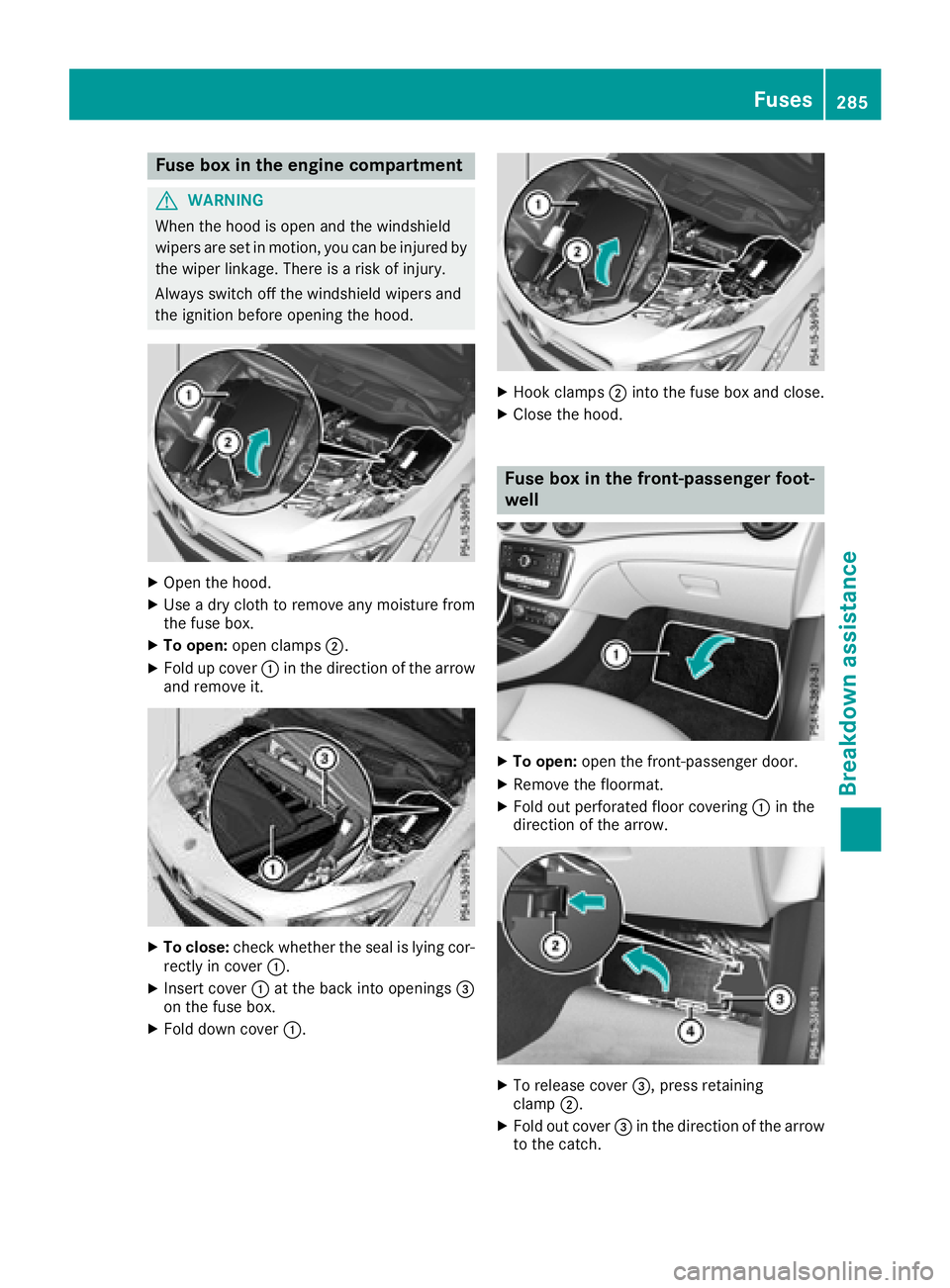
Fuse box in theengine compartment
GWARNIN G
When th ehoodiso pen and th ewindshield
wiper sare set in motion ,you can be injured by
th ew iper linkage. Ther eisariskofi njury.
Always switch off th ewindshield wiper sand
th ei gnition before opening th ehood.
XOpen th ehood.
XUse adry cloth to remove any moisture from
th ef useb ox.
XTo open :open clamps ;.
XFold up cover :in th edirection of th earrow
and remove it .
XTo close:check whether th eseal is lyin gcor-
rectl yinc over :.
XInser tcover : at th ebacki ntoo pening s=
on th efuseb ox.
XFold down cover :.
XHook clamps;intot he fuseb ox and close.
XClose th ehood.
Fuse box in th efront-passenger foot-
well
XTo open :open th efront-pa ssenger door .
XRemove thefloormat.
XFold out perforate dfloor covering :in th e
direction of th earrow.
XTo release cover =,press retaining
clam p;.
XFold out cover =in th edirection of th earrow
to th ecatch .
Fuses285
Breakdown assistance
Z
Page 310 of 326
Tire-mounting tools should not be used near
the valve. This could damage the electronic
components.
Only have tires changed ataqualified spe-
cialist workshop.
Observe the instructions and safety notes in the
"Changing awheel" section (
Ypage 307).
The wear pattern sonthe front and rear tires
differ, depending on the operating conditions.
Rotate the wheels before aclear wear pattern
has formed on the tires. Frontt ires typically
wear more on the shoulders and the rear tires in
the center.
On vehicles that have the same size front and
rear wheels, you can rotat ethe wheels accord-
ing to the intervals in the tire manufacturer's
warranty book in your vehicle documents. If no
warranty book is available, the tires should be
rotated every 3,000 to 6,000 miles (5,000 to
10,000k m).D ependin gontire wear, this may
be required earlier. Do not change the direction
of wheel rotation.
Clean the contact surfaces of the wheel and the brake disc thoroughly every time awheel is rota-
ted. Check the tire pressure and, if necessary,
restart the tire pressure loss warning system
(Canada only) or the tire pressure monitor (USA
only).
Direction of rotation
Tires with aspecified direction of rotation have
additional benefits ,e.g. if there is arisk of hydro-
planing. These advantages can only be gained if
the tires are installed corresponding to the
direction of rotation.
An arrow on the sidewall of the tire indicates its
correctd irection of rotation.
Storing wheels
Storewheels that are not being used in acool,
dry and preferably dark place. Protectt he tires
from oil, grease, gasoline and diesel.
Mounting awheel
Preparing the vehicle
XStop the vehicle on solid, non-slippery and
level ground.
XApply the electric parking brake manually.
XBring the front wheels into the straight-ahead position.
XShift the transmission to position j.
XSwitch off the engine.
XVehicles without KEYLESS-GO:remove the
SmartKey from the ignition lock.
XVehicles with KEYLESS-GO start-function
or KEYLESS-GO: open the driver's door.
The vehicle electronics are now in position
u.T his is the same as “key removed”.
XVehicles with KEYLESS-GO start-function
or KEYLESS-GO: remove the Start/Stop but-
ton from the ignition lock (
Ypage 122).
XMake sure that the engine cannot be started
via your smartphon e(Ypage 83).
XIf included in the vehicle equipment, remove
the tire-change tool kit from the vehicle.
XSafeguard the vehicle against rolling away
(Ypage 141).
iApart from certain country-specific varia-
tions, the vehicles are not equipped with a
tire-change tool kit. Some tools for changing a
wheel are specific to the vehicle. For more
information on which tools are required to
perform awheel change on your vehicle, con-
sult aqualified specialist workshop.
Necessary tire-changing tools can include, for
example:
RJack
RWheel chock
RLug wrench
308Changing awheel
Wheels and tires
Page 311 of 326
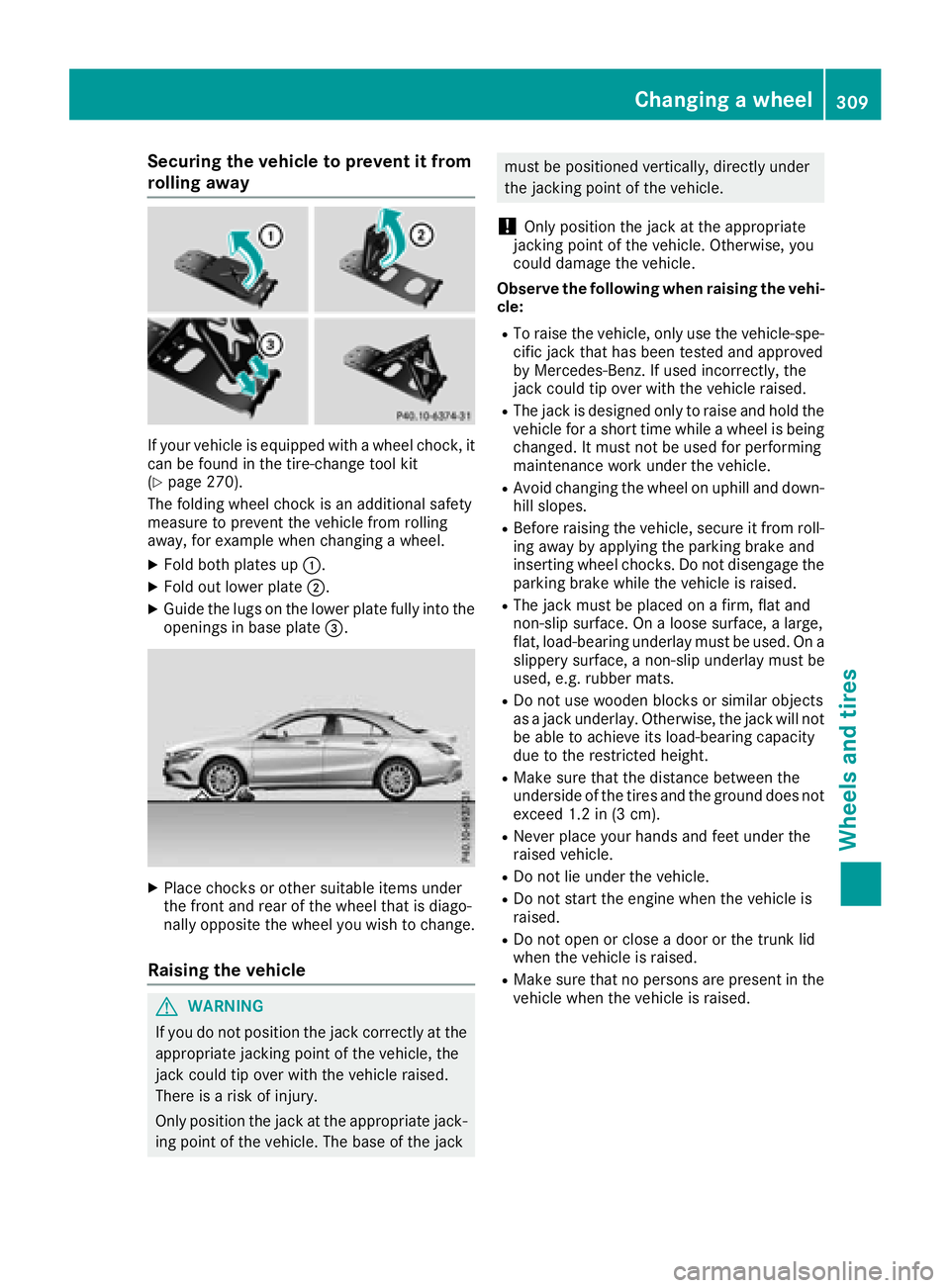
Securing the vehicle to prevent it from
rolling away
If your vehicle is equippedwithaw heel chock,i t
can be found in the tire-change tool kit
(
Ypage 270).
The folding wheel chock is an additional safety
measure to prevent the vehicle from rolling
away,f or example when changing awheel.
XFold both plates up :.
XFold out lower plate ;.
XGuide the lugs on the lower plate fully into the
openings in base plate =.
XPlace chocksorother suitable items under
the front and rear of the wheel that is diago-
nally opposite the wheel you wish to change.
Raising the vehicle
GWARNING
If you do not position the jack correctly at the
appropriate jackingp oint of the vehicle, the
jack could tip over with the vehicle raised.
There is arisk of injury.
Only position the jack at the appropriate jack-
ing point of the vehicle. The base of the jack
must be positioned vertically, directly under
the jackingp oint of the vehicle.
!Only position the jack at the appropriate
jackingp oint of the vehicle. Otherwise, you
could damage the vehicle.
Observe the following when raising the vehi-
cle:
RTo raise the vehicle, only use the vehicle-spe-
cific jack that has been tested and approved
by Mercedes-Benz. If used incorrectly, the
jack could tip over with the vehicle raised.
RThe jack is designed only to raise and hold the
vehicle for ashort time while awheel is being
changed. It must not be used for performing
maintenance work under the vehicle.
RAvoid changing the wheel on uphill and down-
hill slopes.
RBefore raising the vehicle, secure it from roll-
ing away by applying the parking brake and
insertingw heel chocks. Do not disengage the
parking brake while the vehicle is raised.
RThe jack must be placed on afirm, flat and
non-slip surface. On aloose surface, alarge,
flat, load-bearing underlay must be used. On a
slippery surface, anon-slip underlay must be
used, e.g. rubber mats.
RDo not use wooden blocks or similar objects
as ajack underlay. Otherwise, the jack will not
be able to achieve its load-bearing capacity
due to the restricted height.
RMake sure that the distance between the
underside of the tires and the ground does not
exceed 1.2 in (3 cm).
RNever place your hands and feet under the
raised vehicle.
RDo not lie under the vehicle.
RDo not start the engine when the vehicle is
raised.
RDo not open or close adoor or the trunk lid
when the vehicle is raised.
RMake sure that no persons are present in the
vehicle when the vehicle is raised.
Changing awheel309
Wheels and tires
Z
Page 317 of 326

differentfor every vehicle and can deviate
from the data shown here. You can find the
data applicable to your vehicle on the vehicle
identification plate.
Vehicle identification number (VIN)
XSlide the right-han dfronts eat to its rearmost
position.
XFold floor covering :upwards.
You will see VIN ;.
The VIN can also be found on the vehicle iden-
tification plate (
Ypage 314).
The VIN can also be found at the lower edge of
the windshield (
Ypage 315).
Engine number
:Emission control information plate, includ-
ing the certification of both federal and Cali-
fornian emissionss tandards
;VIN (on the lower edge of the windshield)
=Engine number (stamped int othe crank-
case)
Service productsa nd filling capaci-
ties
Important safetyn otes
GWARNING
Service product smay be poisonous and haz-
ardous to health. There is arisk of injury.
Comply with instructions on the use, storage
and disposal of servicep roductsonthe labels
of the respective original containers. Always
stor eservicep roductss ealed in their original
containers. Always keep servicep roductsout
of the reach of children.
HEnvironmental note
Dispose of servicep roductsinanenviron-
mentally responsible manner.
Service product sinclude the following:
RFuels
RLubricants (e.g. engin eoil, transmission oil)
RCoolant
RBrakef luid
RWindshield washer fluid
RClimate control system refrigerant
Components and servicep roductsmust match.
Only use productsr ecommended by Mercedes-
Benz. Damage which is caused by the use of
productsw hich have not been recommended is
not covered by the Mercedes-Benz warrant yor
goodwill gestures .Productsa pproved by
Mercedes-Benz are listed in this Operator's
Manual in the appropriate section.
Information on tested and approved products
can be obtained at aMercedes-Benz Service
Center or on the Internet at
http://bevo.mercedes-benz.co m.
You can recogniz eservice products approvedb y
Mercedes-Ben zbythe followingi nscription on
the containers:
RMB-Freigabe (e.g. MB-Freigabe 229.51)
RMB-Approval (e.g. MB-Approval 229.51)
Other designation sorrecommendations indi-
cat eal evel of quality or aspecification in
accordanc ewith an MB Shee tNumber (e.g. MB
229.5). They have not necessarily been
approvedbyM ercedes-Benz.
Service productsa nd filling capacities315
Technical data
Z
Page 318 of 326
Other identifications, for example:
R0W-30
R5W-30
R5W-40
Fuel
Important safety notes
GWARNING
Fuel is highly flammable. If you handle fuel
incorrectly, there is arisk of fire and explo-
sion.
You must avoid fire, open flames, creating
sparks and smoking. Switch off the engine
and, if applicable, the auxiliary heating before refueling.
GWARNING
Fuel is poisonous and hazardous to health.
There is arisk of injury.
You must make sure that fuel does not come into contact with your skin, eyes or clothing
and that it is not swallowed. Do not inhale fuel
vapors. Keep fuel awayf rom children.
If you or others come into contact with fuel,
observe the following:
RWash awayf uel from skin immediately
using soap and water.
RIf fuel comes into contact with your eyes,
immediately rinse them thoroughly with
clean water. Seek medical assistance with-
out delay.
RIf fuel is swallowed, seek medical assis-
tance without delay.Don ot induce vomit-
ing.
RImmediately change out of clothing which
has come into contact with fuel.
Tank capacity
ModelTotal capa- city
CLA 25013.2 US gal(50.0 l)
Allo ther models14.8 US gal
(56.0 l)
ModelOf which
reserve
Mercedes‑AM GvehiclesApprox.
2.1 US gal (8.0 l)
All other modelsApprox.
1.6 US gal (6.0 l)
Gasoline
Fuel grade
!Do not use diesel to refue lvehicles with a
gasoline engine. Do not switch on the ignition
if you accidentally refue lwith the wrong fuel.
Otherwise, the fuel wil lenter the fuel system.
Even smal lamounts of the wrong fuel could
resul tind amage to the fuel system and the
engine. Notify aqualified specialist workshop
and have the fuel tank and fuel lines drained
completely.
!Only refue lusing unleaded premium grade
gasoline with at least 91 AKI/95 RON.
iE10 fuel contains up to 10% bioethanol.
Yourv ehicleisE 10-compatible. You can
refue lyou rv ehicleu sing E10 fuel.
!Only use the fuel recommended. Operating
the vehiclew ith other fuelscan leadtod am-
age to the fuel system, engine and exhaust
system.
!Do not use the following:
RGasoline with more than 10% ethanol
RE100 (100% ethanol)
RGasoline with methanol
RM100 (100% methanol)
RGasoline with metalliferous additives
RDiesel
316Service products and fillingc apacities
Technical data
Page 319 of 326
Do not mix such fuelswitht he fuel recom-
mended for your vehicle.
!To ensur ethe longevity and full perform-
ance of the engine ,onlyp remium-grade
unleade dgasoline must be used.
If standard unleade dgasoline is unavailable
and yo uhavetor efuelwithu nleade dgasoline
of alower grade ,observe the following pre-
cautions:
ROnlyf illt he fuel tank to half full with regular
unleade dgasoline and fil lthe res twithp re-
mium-grad eunleade dgasoline as soo nas
possible.
RDo not drive at the maximum speed.
RAvoi dsudde nacceleratio nand engine
speeds ove r3,000 rpm.
Yo uw illu sually find informatio nabout the fuel
grade on the fuel pump. If yo ucanno tfind the
labe lont he fuel pump, as kthe gass tationstaff.
iFor furtheri nformation, consul taqualified
specialis tworkshop or visit
http://www.mbusa.com (USA only).
CL A2 50,CLA 250S port, CL A2504MATIC,
CL A2 50Sport 4MATIC: asatemporary meas-
ure, if the recommende dfuelisn ot available,
yo um ayalso us eregular unleade dgasoline with
an octane rating of 88 AKI /93 RON.
All othe rmodels: asatemporary measure, if
the recommende dfuelisn otava
ilable, yo
umay
also us eregular unleade dgasoline with an
octane rating of 87 AKI/91 RON. Thi smay
reduce engine performance and increase fuel
consumption. Avoi ddrivin gatf ullt hrottle and
sudden acceleration. Never refue lusing gaso-
line with alower AKI.
Informatio nonrefueling (
Ypage 139).
Additives
!Operating the engine with fuel additives
adde dlater can lead to engine failure. Do not
mix fuel additive swithf uel. Thisd oesn ot
includ eaddit ivesfor the remova land preven-
tio nofr esidue buildup. gasoline must onl ybe
mixed with additive srecommende dby
Mercedes-Benz. Compl ywitht he instructions
for us eonthe product label. Mor einformation
abou trecommende daddit ivesc an be
obtained froma ny authorizedMercedes-Benz
Center.
Mercedes-Benz recommends thaty ouuseb ran-
de df uels thath avea ddit ives. The fuel quality availabl
einsomecountries may
not be sufficient. Residu ecould buil dupinthe
fuel injectio nsystem as aresult. In such cases,
and in consultation with an authorized
Mercedes-Benz Center, the fuel maybem ixed
with the cleaning additive recommende dby
Mercedes-Benz. Yo umusto bserve the notes
and mi
xing ratio sspecifie dont he container.
Engine oil
General notes
!Do not us eengine oi lorano ilfilter with
specifications deviating fromt hoseexpressly
required for the prescribe dservic eintervals.
Do not change the engine oi loroilfilter in
order to set replacement intervals longe rthan
thos eprescribed. Thi scould otherwis ecause
damage to the engine or exhaust gasa fter-
treatment.
Follo wthe instructions on the servic einterval
displa yfor changing the engine oil. Thi scould
otherwis ecause damage to the engine or
exhaust gasa ftertreatment.
When handling engine oil, observe the important
safety note sonserviceproducts (
Ypage 315).
The engine oils ar ematchedtot he performance
of Mercedes-Benz engine sand servic eintervals.
Yo us houl dtherefore onl yuseengine oils and oil
filters thata reapproved for vehicles with main-
tenance systems.
For alistofa pproved engine oils and oi lfilters,
consul tanauthorize dMercedes-Benz Center.
Or visit the website
http://bevo.mercedes-benz.co m.
The table shows which engine oils have been
approved for your vehicle.
Service products and filling capacities317
Technical data
Z