brake MERCEDES-BENZ CLS-Class 2014 W218 User Guide
[x] Cancel search | Manufacturer: MERCEDES-BENZ, Model Year: 2014, Model line: CLS-Class, Model: MERCEDES-BENZ CLS-Class 2014 W218Pages: 382, PDF Size: 5.36 MB
Page 26 of 382
Change of address or change of
ownership
In th eevent of achang eofa ddress, please
sen dust he"Notificatio nofAddress Change"
in the Service and Guarantee booklet or
simply call the Mercedes-Benz Customer
Assistance Cente r(USA )att he hotline
number
1-800-FOR-MERCedes(1-800-367-6372 )or
Customer Servic eCenter (Canada) at
1-800-387-0100 .This will assist us in
contacting you in atimely manner should the
need arise.
If you sell your Mercedes, please leave the
entirel iterature in the vehicle so that it is
available to the next owner.
If you have purchased aused car, please send
us the "Notification of Used Car Purchase" in
the Servic eand Guarantee booklet or simply
call the Mercedes-Benz Customer Assistance
Center (USA) at the hotline number
1-800-FOR-MERCedes(1-800-367-6372)or
Customer Servic e(Canada) at
1-800-387-0100. Vehicle operation outside the USA
and Canada
If you plan to operate your vehicle in foreign
countries, please be aware that:
R service facilities or replacement parts may
not be readily available.
R unleaded fuel for vehicles with acatalytic
converter may not be available. Leaded fuel
may cause damage to the catalytic
converter.
R the fuel may have aconsiderably lower
octaner ating. Unsuitable fuel can cause
engine damage.
Some Mercedes-Benz models are available
for delivery in Europe through our European
Delivery Program. For details, consult an
authorized Mercedes-Benz Center or write to
one of the following addresses.
In the USA Mercedes-Benz USA,L
LC
European Delivery Department
One Mercedes Drive
Montvale, NJ 07645-0350
In Canada
Mercedes-Benz Canada, Inc.
European Delivery Department
98 Vanderhoof Avenue
Toronto, Ontario M4G 4C9 Operating safety
Important safety notes
G
WARNING
If you do not have the prescribed service/
maintenance work or any required repairs
carried out, this can result in malfunctions or
system failures. There is arisk of an accident.
Always have the prescribed service/
maintenance work as well as any required
repairs carried out at aqualified specialist
workshop. G
WARNING
If you switch off the ignition while driving,
safety-relevant functions are only available
with limitations, or not at all. This could affect,
for example, the power steering and the brake
boosting effect .You will require considerably
more effort to steer and brake. There is arisk
of an accident.
Do not switch off the ignition while driving. G
WARNING
Modifications to electronic components, their
software as well as wiring can impair their
function and/or the function of other
networked components. In particular,
systems relevant to safety could also be
affected. As aresult, these may no longer
function as intended and/or jeopardize the
operating safety of the vehicle. There is an
increased risk of an accident and injury. 24
Introduction
Page 32 of 382
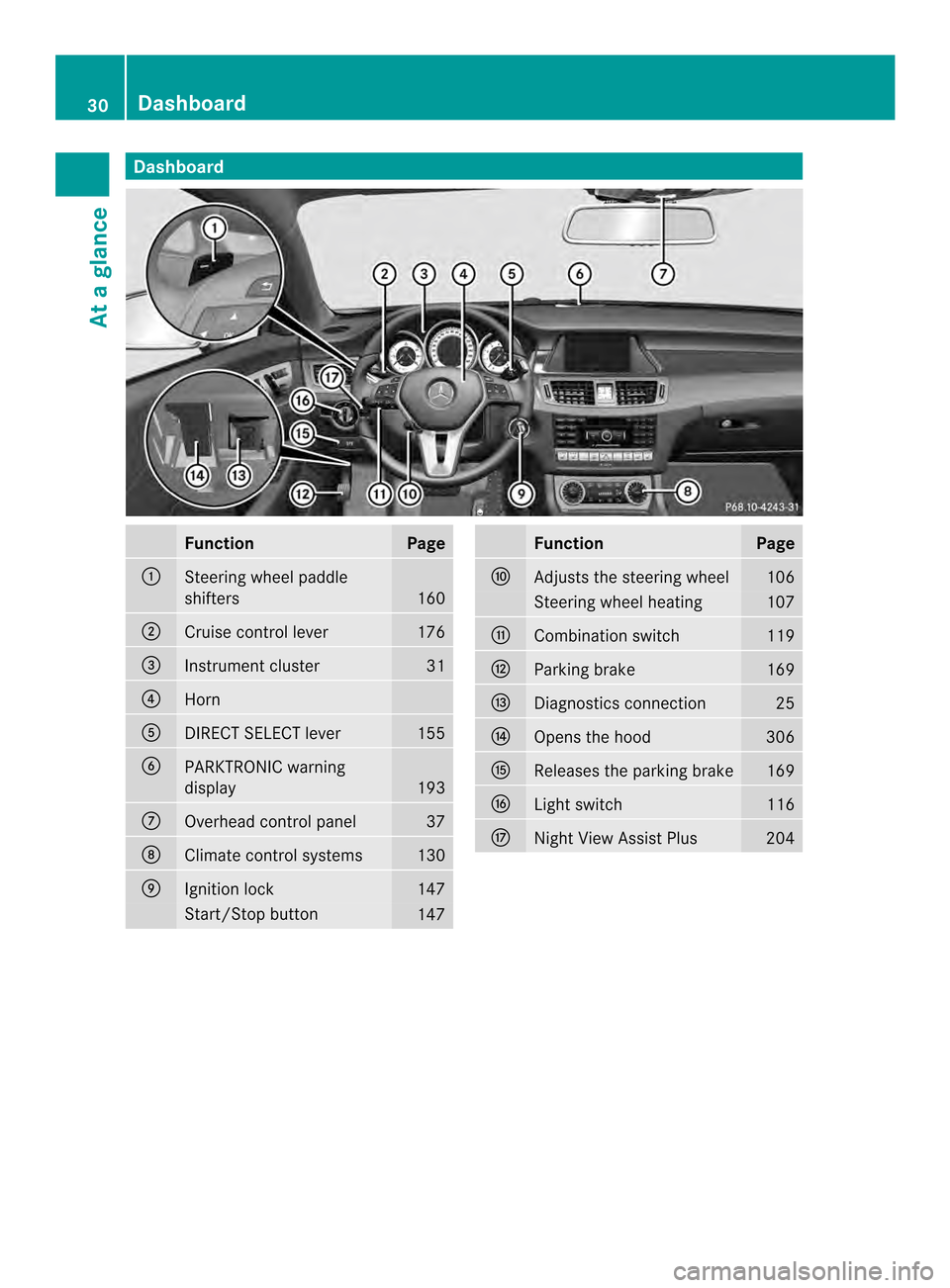
Dashboard
Function Page
001A
Steerin
gwhee lpaddle
shifters 160
0010
Cruis
econtrol lever 176
0024
Instrumen
tcluster 31
0021
Horn
001E
DIREC
TSELEC Tlever 155
0025
PARKTRONIC warning
display
193
0009
Overhead contro
lpanel 37
0016
Climat
econtrol systems 130
001D
Ignition lock 147
Start/Sto
pbutton 147 Function Page
000F
Adjust
sthe steerin gwheel 106
Steerin
gwhee lheating 107
0004
Combination switch 119
000B
Parking brake 169
001C
Diagnostic
sconnection 25
000E
Opens th
ehood 306
0012
Releases th
eparking brake 169
0013
Light switch 116
0017
Night Vie
wAssistP lus 20430
DashboardAt
ag lance
Page 34 of 382
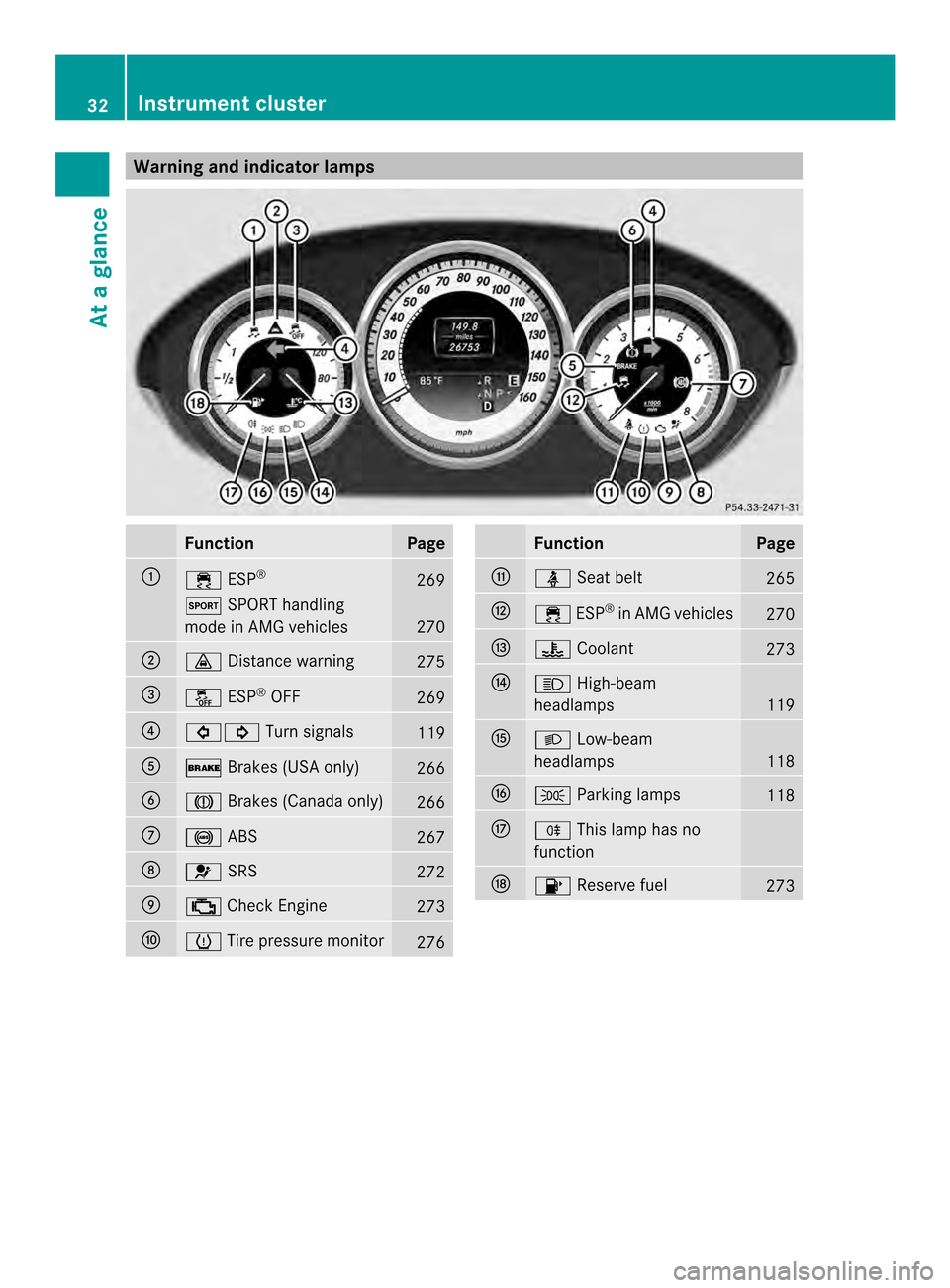
Warning and indicator lamps
Function Page
001A
0011
ESP® 269
0005
SPORT handling
mode in AMG vehicles 270
0010
0008
Distance warning 275
0024
0009
ESP®
OFF 269
0021
00020001
Turn signals 119
001E
0004
Brakes (USA only) 266
0025
0001
Brakes (Canada only) 266
0009
001C
ABS 267
0016
0012
SRS 272
001D
000A
Check Engine 273
000F
0008
Tire pressure monitor 276 Function Page
0004
0006
Seat belt 265
000B
0011
ESP®
in AMG vehicles 270
001C
0017
Coolant 273
000E
0015
High-beam
headlamps 119
0012
001D
Low-beam
headlamps 118
0013
0008
Parking lamps 118
0017
0005
This lamp has no
function 0020
0007
Reserve fuel 27332
Instrument clusterAt
ag lance
Page 47 of 382
tota
lavailable propellant gas, thereby
reducing the risk of injury .Ifthe ai rbag
control uni trecognize swithi naf ew
milliseconds tha tthe vehicle is being braked
or accelerated faster than originally
predicted, the front air bag is filled with the
maximum amount of propellant gas available.
The deployment of the front-passenger front
air bag is also influenced by the weight
category of the front passenger, which is
determined by the Occupant Classification
System (OCS) (Y page 47).
The lighter the passenger-side occupant, the
higher the vehicle deceleration rate required
(predicted at the start of the impact) for
second-stage inflation of the front-passenger
front air bag. In the second stage, the front
air bags are inflated with the maximum
amount of propellant gas available.
The front air bags are not deployed in
situations where alow impact severity is
predicted. You will then be protected by the
fastened seat belt.
The front-passenger front air bag will only
deploy if:
R the system, based on the OCS weight
sensor readings, detectst hat the front-
passenger seat is occupied
R the PASSENGER AIR BAG OFF indicator
lamp on the center console is not lit
(Y page 47)
R the air bag control unit predicts ahigh
impact severity
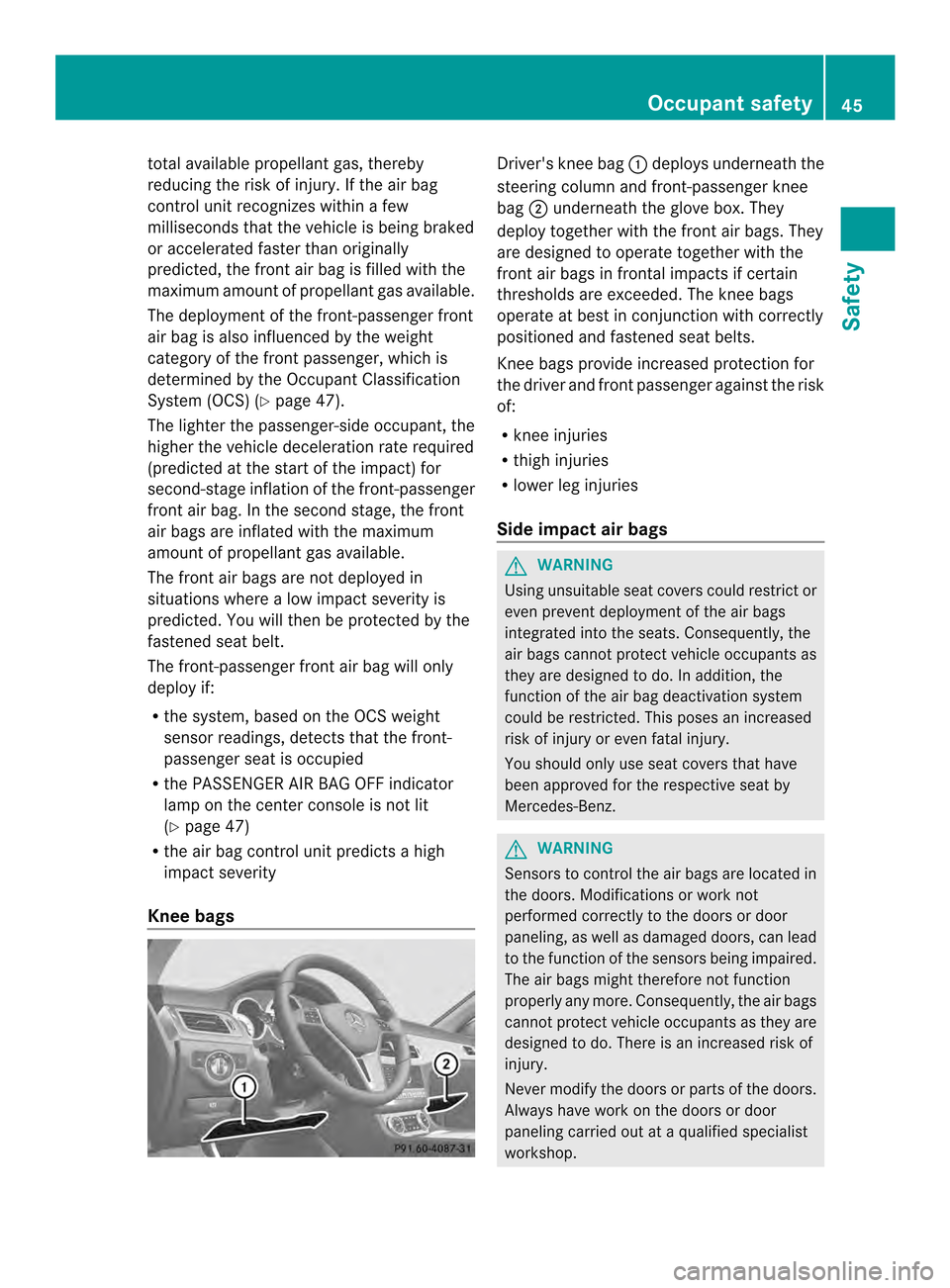
Knee bags Driver's knee bag
001Adeploysu nderneath the
steering column and front-passenger knee
bag 0010underneath the glove box. They
deploy together with the front air bags. They
are designed to operate together with the
front air bags in frontal impacts if certain
thresholds are exceeded. The knee bags
operate at best in conjunction with correctly
positioned and fastened seat belts.
Knee bags provide increased protection for
the driver and front passenger against the risk
of:
R knee injuries
R thigh injuries
R lower leg injuries
Side impact air bags G
WARNING
Using unsuitable seat covers could restrict or
even prevent deployment of the air bags
integrated into the seats. Consequently, the
air bags cannot protect vehicle occupants as
they are designed to do. In addition, the
function of the air bag deactivation system
could be restricted. This poses an increased
risk of injury or even fatal injury.
You should only use seat covers that have
been approved for the respective seat by
Mercedes-Benz. G
WARNING
Sensors to control the air bags are located in
the doors. Modifications or work not
performed correctly to the doors or door
paneling, as well as damaged doors, can lead
to the function of the sensors being impaired.
The air bags might therefore not function
properly any more. Consequently, the air bags
cannot protect vehicle occupants as they are
designed to do. There is an increased risk of
injury.
Never modify the doors or parts of the doors.
Always have work on the doors or door
paneling carried out at aqualified specialist
workshop. Occupant safety
45Safety Z
Page 64 of 382
G
WARNING
If children are left unsupervised in the vehicle,
they could:
R open the doors, thus endangering other
people or road users.
R get out and disrupt traffic.
R operate the vehicle's equipment.
Additionally, children coul dset the vehicl ein
motion if, for example, they:
R release the parking brake.
R shifting the automatic transmission out of
park position P
R Start the engine.
There is arisk of an accident and injury.
When leaving the vehicle, alwayst ake the
SmartKey with you and lock the vehicle. Never
leave children or animals unattended in the
vehicle. Always keep the SmartKey out of
reach of children. G
WARNING
If persons, particularl ychildren are subjected
to prolonged exposure to extreme heator
cold ,there is ariskofi njury ,possibl yeven
fatal. Never leave children unattende dinthe
vehicle. G
WARNING
If the child restraint system is subjected to
direct sunlight, parts may get very hot.
Children ma yburn themselves on these parts,
particularly on the metal parts of the child
restraint system. There is arisk of injury.
If you leave the vehicle, takin gthe child with
you, alway sensure that the child restraint
system is not exposed to direct sunlight.
Protec titwithablanket ,for example. If the
child restraint system has been exposed to
direct sunlight, let it cool down before
securing the child in it. Never leave children
unattended in the vehicle. If an infan
torchild is traveling in the vehicle:
R Secure the child with achild or infant seat
restraint system appropriate to the age and
weight of the child.
R Make sure that the infant or child is
properly secured at all times while the
vehicle is in motion.
Mercedes-Ben zrecommends that you always
properly secure all infants and children with
ac hild or infan tseat restraint system for the
trip.
The use of seat belts and infan tand child
restraint system sisrequired by la win:
R all50s tates
R the U.S. territories
R the District of Columbia
R allC anadia nprovinces
Infants and children must alwaysbes eated in
an appropriate infant or child restraint system
recommende dfor the size and weight of the
child .The infant or child restraint system
must be properly secured in accordance with
the manufacturer's instructions.
All infant or child restraint systems must meet
the following standards:
R U.S. Federal Motor Vehicle Safety
Standards 213 and 225
R CanadianM otor Vehicle Safety Standards
213 and 210.2
Confirmation that the child restraint system
corresponds to the standards can be found
on an instruction label on the child restraint
system. This confirmation can also be found
in the installation instructions that are
included with the child restraint system.
Always read and follow the manufacturer's
instructions when using an infant or child
restraint system or booster seat.
Observe the warning labels in the vehicle
interior or on the infant or child restraint. 62
Children in the vehicleSafety
Page 67 of 382

Additionally, children could set the vehicl
ein
motion if, for example, they:
R release the parking brake.
R shifting the automatic transmission ou tof
park position P
R Start the engine.
There is arisk of an acciden tand injury.
When leaving the vehicle, always take the
SmartKey with you and lock the vehicle. Never
leave children or animals unattended in the
vehicle. Always keep the SmartKey out of
reach of children. G
WARNING
If persons, particularly children are subjected
to prolonged exposure to extreme heat or
cold, ther eisarisk of injury, possibly even
fatal. Never leave children unattended in the
vehicle. G
WARNING
If children are traveling in the vehicle, they
could:
R open doors, thus endangering other people
or road users
R exit the vehicle and be caught by oncoming
traffic
R operate vehicle equipment and become
trapped
There is arisk of an acciden tand injury.
Always activate the child-proof lock sand
override feature if children are traveling in the
vehicle. When leaving the vehicle, always take
the key with you and lock the vehicle. Never
leave children unattended in the vehicle.
You can activate the following child-proof
locks:
R rear doors (Y page 65)
R rear side windows (Y page 65) Child-proof locks for the rear doors G
WARNING
Children could open arear door from inside
the vehicle. This could result in serious
injuries or an accident. Therefore, when
children ride in the rear always secure the rear
doors with the child-proof locks. You secure each door individually with the
child-proof lock
sonthe rear doors. Adoor
secured with achild-proof lock cannot be
opened from inside the vehicle. When the
vehicle is unlocked, the door can be opened
from the outside.
X To activate: press the child-proof lock
lever up in the direction of arrow 001A.
X Make sure that the child-proof locks are
working properly.
X To deactivate: press the child-proof lock
lever down in the direction of arrow 0010.
Overrid efeature for the rear side
windows G
WARNING
When children ride on the vehicle's rear seats,
activate the override switch. Otherwise, the
children could be injured, e.g. by trapping
themselves in the rear side window. Children in the vehicle
65Safety Z
Page 68 of 382

X
To activate/deactivate: press button0010.
If indicator lamp 001Ais lit, operatio nofthe
rear side windows is disabled. Operation is
only possible using the switches in the
driver's door. If indicator lamp 001Ais off,
operation is possible using the switches in
the rear compartment. Driving safety systems
Overview of driving safety systems
In this section, you will find information about
the following driving safety systems:
R ABS ( Anti-lock BrakingSystem)
(Y page 66)
R BAS ( Brake Assist System) (Y page 67)
R BAS PLUS ( BrakeAssist System Plus)
(Y page 67)
R ESP ®
(Electronic StabilityProgram)
(Y page 68)
R EBD ( Electronic Brake force Distribution)
(Y page 71)
R ADAPTIVE BRAKE (Y page 72)
R PRE-SAFE ®
Brake (Y page 72) Important safety notes
If you fail to adapt your driving style or
become distracted, the driving safety
systems can neither reduce the risk of
accident nor override the laws of physics.
Driving safety systems are merely aids
designed to assist driving. You are responsible for the distance to the vehicle in
front,f
or vehicle speed and for braking in
good time. Always adapt your driving style to
suit the prevailing road, weather and traffic
conditionsa nd maintain asafe distanc efrom
th ev ehicle in front. Drive carefully.
i The driving safety systems describe donly
work as effectivel yaspossible when there
is adequat econtac tbetween th etires and
th er oad surface. Pleas epay special
attentio ntothenote sont ires,
recommende dminimu mtire tread depths,
etc .(Ypage 334).
In wintry drivin gconditions, always use
winter tires (M+S tires) and if necessary,
sno wchains. Only in this way will the
drivin gsafet ysystems described in this
section work as effectively as possible. ABS (Anti-lock Brakin
gSystem)
Important safety notes i
Observe the "Importan tsafet ynotes"
sectio n(Ypage 66). G
WARNING
If ABSisf aulty, the wheels could lock when
braking. The steerability and braking
characteristics may be severely impaired.
Additionally, further driving safety systems
are deactivated. There is an increased danger
of skidding and accidents.
Drive on carefully.H ave ABS checked
immediately at aqualified specialist
workshop.
When ABS is malfunctioning, other systems,
including driving safety systems, will also
become inoperative. Observe the information
on the ABS warning lamp (Y page 267) and
displaym essages which may be shown in the
instrument cluster (Y page 238).
ABS regulates brake pressure in such away
that the wheels do not lock when you brake.
This allows you to continue steering the
vehicle when braking. 66
Driving safety systemsSafety
Page 69 of 382
ABS works fro
maspeed of abou t5mph
(8 km/h )upwar ds,regardless of road-surface
conditions .ABS works on slippery surfaces,
eve nify ou only brake gently.
The yellow 001CABS warning lamp in the
instrument cluster lights up when the ignition
is switched on. It goes out when the engine is
running.
Braking X
If ABS intervenes: continue to depress the
brake pedal vigorously until the braking
situation is over.
X To makeaf ull brake application:
depress the brake pedal with full force.
If ABS intervenes when braking, you will feel
ap ulsing in the brake pedal.
The pulsating brake pedal can be an
indication of hazardous road conditions, and
functions as areminder to take extrac are
while driving. BAS (Brake Assist System)
i Observe the "Important safety notes"
section (Y page 66). G
WARNING
If BAS is malfunctioning, the braking distance
in an emergenc ybraking situation is
increased. There is arisk of an accident.
In an emergenc ybraking situation, depress
the brake pedal with full force. ABS prevents
the wheels from locking.
BAS operates in emergenc ybraking
situations. If you depress the brake pedal
quickly, BAS automatically boosts the braking
force, thus shortening the stopping distance.
The brakes will function as usual once you
release the brake pedal. BAS is deactivated. BAS PLUS (Brake Assist System
PLUS)
General information i
Observe the "Important safety notes"
section (Y page 66).
BAS PLUS is only available in vehicles
equipped with DISTRONIC PLUS.
For BAS PLUS to assist you when driving, the
radar sensor system must be:
R activated (Y page 232)
R operational
With the help of the radar sensor system, BAS
PLUS can detect obstacles that are in the
path of your vehicle for an extended period of
time.
If the radar sensor system is malfunctioning,
BAS PLUS will not be available. The brake
system is still available with complete brake
boosting effect and BAS.
BAS PLUS provides braking assistance in
hazardous situations at speeds greater than
4m ph (7 km/h).
At speeds of up to approximately 40 mph
(70 km/h) ,BAS PLUS can also react to
stationary objects. Examples of stationary
object sare stopped or parked vehicles.
Important safety notes G
WARNING
BAS PLUS cannot alwaysc learly identify
object sand complex traffic situations. BAS
PLUS cannot intervene in these cases. There
is ar isk of an accident.
Always pay careful attention to the traffic
situation and be ready to brake. G
WARNING
BAS PLUS does not react:
R to people or animals
R to oncoming vehicles
R to crossin gtraffic
R when cornering Driving safety systems
67Safety
Z
Page 70 of 382
As
aresult, BAS PLUS may not intervene in all
critical situations. There is arisk of an
accident.
Always pay careful attention to the traffic
situation and be ready to brake.
In particular, the detection of obstacles can
be impaired if there is:
R dirt on the sensor soranythin gelse
covering the sensors
R snow or heavy rain
R interference by other radar sources
R there are strong radar reflections, for
example in parking garages
R an arrow vehicle travelin ginfront, e.g. a
motorbike
R av ehicle travelin ginfrontonad ifferent line
relative to the center of your vehicle
Following damage to the fron tend of the
vehicle, have the configuratio nand operation
of the rada rsensor schecked at aqualified
specialist workshop. This also applies to
collisions at low speeds where ther eisno
visible damage to the fron tofthe vehicle.
Braking assistance To prevent
acollision with the vehicle in front,
BAS PLUS calculates the brake force
necessary if:
R you approach an obstacle, and
R BAS PLUS has detected arisk of collision
When driving at aspeed under 20 mph
(30 km/h):ify ou depress the brake pedal,
BAS PLUS is activated. The increase in brake
pressure will be carried out at the last
possible moment.
When driving at aspeed greater than
20 mph (30 km/h):ify ou depress the brake
pedal sharply, BAS PLUS automatically raises
the brake pressure to avalue adapted to the
traffic situation.
If BAS PLUS demands particularly high
braking force, preventative passenger protection measures (PRE-SAFE
®
)a re
activated simultaneously.
X Keep the brake pedal depressed until the
emergenc ybraking situation is over.
ABS prevent sthe wheels from locking.
BAS PLUS is deactivated and the brakes
function as usual if:
R you release the brake pedal
R there is no longer arisk of collision
R no obstacle is detected in front of your
vehicle ESP
®
(Electronic Stability Program)
Important safety notes i
Observe the "Important safety notes"
section (Y page 66). G
WARNING
If ESP ®
is malfunctioning, ESP ®
is unable to
stabilize the vehicle. Additionally, further
driving safety systems are deactivated. This
increases the risk of skidding and an accident.
Drive on carefully. Have ESP ®
checked at a
qualified specialist workshop.
! Vehicles with 4MATIC: switch off the
ignition when the parking brake is being
tested on abrake dynamometer.
Application of the brakes by ESP ®
may
otherwise destroy the brake system.
Vehicles without 4MATIC: observe the notes
on ESP ®
(Y page 330) when towing the
vehicle with araised rear axle.
ESP ®
is deactivated if the 0009warning lamp
in the instrument cluster lights up
continuously when the engine is running.
If the 0011 warning lamp and the 0009
warning lamp are lit continuously, ESP ®
is not
available due to amalfunction.
Observe the information on warning lamps
(Y page 269) and display messages which
may be shown in the instrument cluster
(Y page 238). 68
Driving safety systemsSafety
Page 71 of 382
If ESP
®
detects that the vehicle is deviating
from the direction desire dbythe driver, one
or more wheels are braked to stabilize the
vehicle .The engine output is also modified to
keep the vehicle on the desired course within
physical limits. ESP ®
assists the driver when
pulling away on wet or slippery roads. ESP ®
can also stabilize the vehicle during braking.
If ESP ®
intervenes, the 0011ESP®
warning
lamp flashes in the instrumentc luster.
If ESP ®
intervenes:
X Do not deactivat eESP®
under any
circumstances.
X Only depres sthe accelerator pedal as far
as necessary when pulling away.
X Adapt your drivin gstyle to suit the
prevailing road and weathe rconditions.
i Only use wheels with the recommended
tire sizes. Only then will ESP ®
function
properly.
ETS/4ETS (Electronic Traction System) ETS/4ETS traction control is part of ESP
®
.
Traction control brakes the drive wheels
individuall yifthey spin. This enables you to
pull away and accelerate on slippery surfaces,
for example if the road surface is slippery on
one side. In addition, more drive torque is
transferred to the wheel or wheels with
traction.
Traction control remains active, even if you
deactivate ESP ®
.
Deactivating/activating ESP ®
(except
AMG vehicles) G
WARNING
If you deactivate ESP ®
,E SP ®
no longer
stabilizes the vehicle. There is an increased
risk of skidding and an accident.
Only deactivate ESP ®
in the situations
described in the following. !
Avoid spinnin gthe driven wheels for an
extended period with ESP ®
deactivated.
You could otherwise damage the drivetrain.
X To deactivate:(Y page 227).
The 0009 ESP®
OFF warning lamp in the
instrument cluster lights up.
X To activate: (Ypage 227).
The 0009 ESP®
OFF warning lamp in the
instrument cluster goes out.
ESP ®
is activated automatically when the
engine is started.
The ECO start/stop function switches the
engine off automatically when the vehicle
stops moving. The engine starts
automatically when the driver wants to pull
away again. ESP ®
remains in its previously
selected status. Example: if ESP ®
was
deactivated before the engine was switched
off, ESP ®
remains deactivated when the
engine is switched on again.
If ESP ®
is deactivated and one or more wheels
start to spin, the 0011ESP®
warning lamp in
the instrument cluster flashes. In such
situations, ESP ®
will not stabilize the vehicle.
It may be best to deactivate ESP ®
in the
following situations:
R when using snow chains
R in deep snow
R on sand or gravel
If you deactivate ESP ®
:
R ESP ®
no longer improves driving stability.
R traction control is still activated.
R ESP ®
still provides support when you
brake.
R engine torque is not limited and the drive
wheels are able to spin. The spinning
wheels produce acutting effect for better
traction. Driving safety systems
69Safety Z