service MERCEDES-BENZ E-CLASS CABRIOLET 2010 User Guide
[x] Cancel search | Manufacturer: MERCEDES-BENZ, Model Year: 2010, Model line: E-CLASS CABRIOLET, Model: MERCEDES-BENZ E-CLASS CABRIOLET 2010Pages: 333, PDF Size: 7.64 MB
Page 23 of 333
Inform Mercedes-Benz as soon as poss
ible
abou tany change in address or vehicl eown-
ership. Correct use
Observe the following info rmation when using
your vehicle:
R the safety notes in this manual
R the "Technical data” section in this manual
R national road traffic regulations
R national road traffic licensing regulations G
Risk of injury
Various warning stickers are affixed to your
vehicle. Their purpose is to draw your atten-
tion, and the attention of others, to various
dangers. Therefore, do not remove any warn-
ing stickers unless the sticker clearly states
that you may do so.
If you remove the warning stickers, you or
others could be injured by failing to recognise
certain dangers. Implied warranty
! Follow the instructions in this manual
about the proper operation of your vehicle
as well as about possible vehicle damage.
Damage to your vehicle that arises from
culpable contraventions against these
instructions are not covered either by
Mercedes -Benz implied warranty or by the
New or Used-Vehicle Warrant yof
Daimler AG. Data stored in the vehicle
Fault data
Compone ntsc ritical for vehicl eoperation are
equipped with fault data memories as stand-
ard. There are also memories dedicated to
storing the technica lreactions of vehicle
component stodriving situations (e.g. the
trigge ring of an airbag ,ESP ®
intervention). This data is used exclusively to:
R assist in the rectification of faults and
defects
R help Mercedes-Benz optimise and develop
vehicle functions
The data cannot be used to trac ethe vehicle's
movements.
When your vehicle is serviced by Mercedes-
Ben z,this technical information can be read
out from the fault memory. Thi sisperformed
by authorised employees of the Mercedes-
Benz service network using special diagnos-
tic computers.
Af teraf ault has been rectified, the informa-
tion is deleted from the memory. Other mem-
ory data is constantly overwritten. Other devices tha
tstore data
Depe nding on the equipment level, your vehi-
cle may featur ecommunication sand/or
entertainment systems (e.g .navigation devi-
ces, telephone systems). Thes eallow you to
save and edit data required for the operation
of the respective device.
Fur ther information on operation (e.g. on
deletin gdata) can be found in the separate
operating instructions. 20
Introduction BA 207 ECE ÄJ 201
0/1a; 1; 2, en-GB
mkalafa Version: 3.0.2.11 2010-01-26T13:03:22+01:00-Seite 20
Page 35 of 333
Vehicl
eequipment
i Thismanua ldesc ribe sallthe standard
and optional equipment of your vehicle
which wa savailable at th etime of pur-
chase. Countr y-specif ic differences are
possible. Bear in mind tha tyour vehicle
ma ynot featur eall function sdescribed
here. Occupant safety
Important safet
ynotes
Seat belts, together with belt tensioners, belt
forc elimiter sand airbags, are complemen-
tary, coordi nated restraint systems. They
reduce the risk of injur yinspecific ,pre-
define dtypes of accident situa tions and
thereby increase occupan tsafety. However,
seat belts and airbags generally do not pro-
tec tagainst objec tspenetratin gthe vehicle
from the outside.
To ensur ethat the restraint system scan
deliver their full potential protection, make
sure that:
R the seat and head restraint are adjusted
properly (Y page 92).
R the seat belt has been fastened properly
(Y page 41)
R the airbags can inflate unrestricted if
deployed (Y page 34)
R the steering wheel is adjusted properly
(Y page 92)
R the restraint systems have not been modi-
fied.
i An airbag increases the protection of
vehicle occupant swearing aseat belt. As
such they are only an additional restraint
system which complemen ts,b ut does not
replace, the seat belt. All vehicle occupants
must wear their seat belt correctly at all
times, even if the vehicle is equipped with
airbags. Airbags are not deployed in all
types of accidents, e.g. in situations where
airbag deployment would not increase the protection afforded by
acorrectly worn
seat belt. Airbag deployment only provides
increased protection if the seat belt is worn
correctly, because:
R the seat belt helps to keep the vehicle
occupan tinthe best position in relation
to the airbag
R for example, in ahead-on collision ,the
seat belt can mor eadequately prevent
the occupant from being propelled
towards the point of the impact, and is
thus better suited to prevent injury.
Therefore, in accident situations where an
airba gisd eployed, it only provides protec-
tion in addition to the seat belt if the seat
belt is being worn correctly. G
Risk of accident and inju
ry
Always have maintenance work carried out at
aq ualified specialist workshop which has the
necessary specialist knowledg eand tool sto
carry out the work required.
Mercedes-Benz recommends that you use a
Mercedes-Benz Service Centre for thi spur-
pose.
In particular, work relevant to safety or on
safety-related systems must be carried out at
aq ualified specialist workshop .Ifthis wor kis
not carried out correctly, the operating safety
of your vehicl emay be affected. There is arisk
of an accident and injury. G
Risk of injury
The restrain tsystem may not work as inten-
ded if the following components have been
modified or work on thes ecomponents has
not been performed correctly:
R restraint system ,consisting of the seat
belts and anchorages, belt tensioners, belt
force limiters, airbags
R wiring
R networked electronic systems
Airbags or belt tensioners coul dthen fail, e.g.
in the even tofanaccident in which the decel-
eratio nforc ew ould normally be high enough
to trigger the systems, or they coul dbetrig- 32
Occupant safetySafety
BA 207 ECE ÄJ 2010/1a; 1; 2, en-GB
mkalafa
Version: 3.0.2.11 2010-01-26T13:03:22+01:00-Seite 32
Page 39 of 333
Fron
tairbags The fron
tairbags increase protection for the
driver' sand front-passenger' shead and
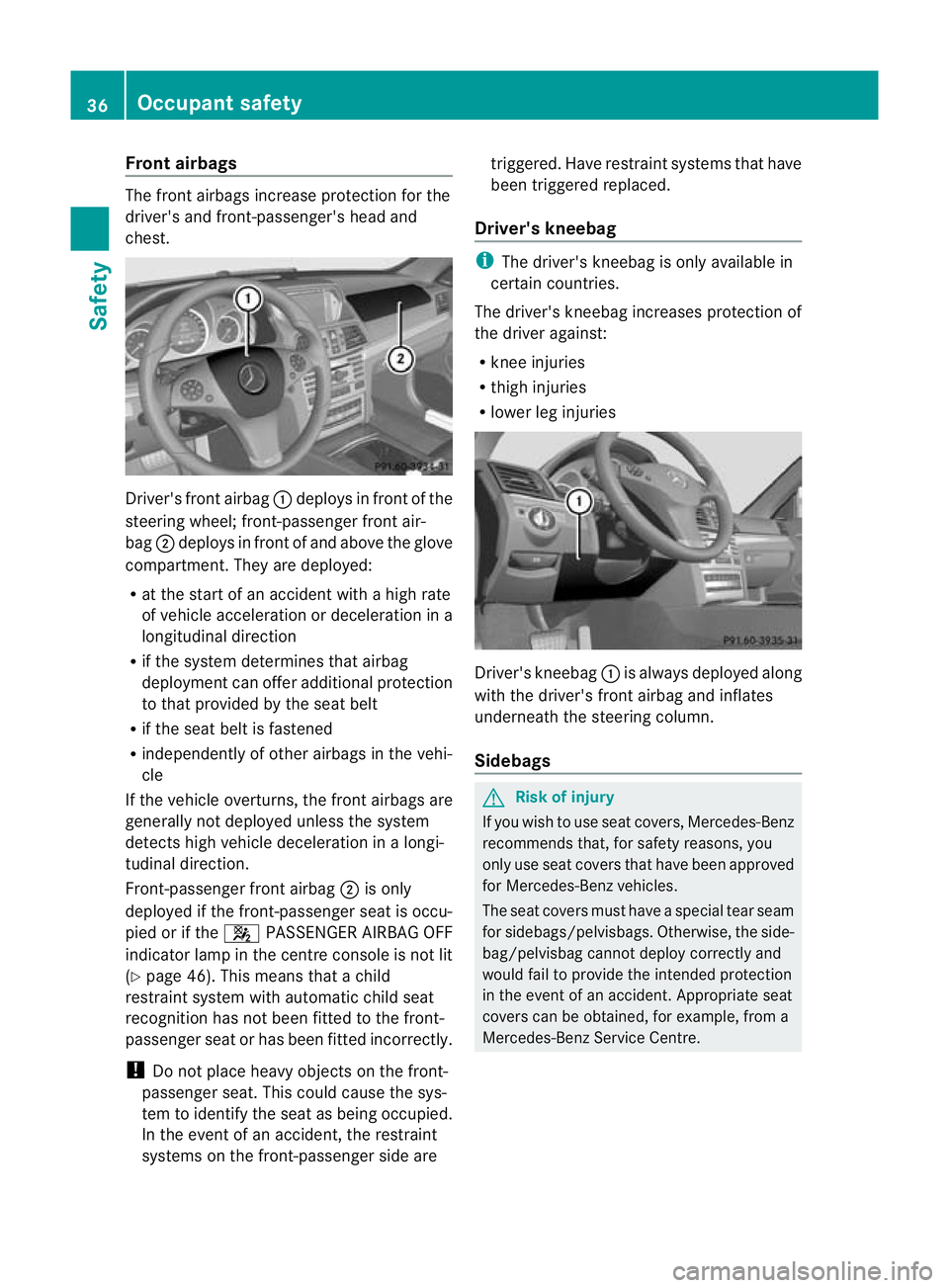
chest. Driver
's front air bag:deploys in front of the
steerin gwheel; front-passenger front air-
bag ;deploys in front of and above the glove
compartment .They ar edeployed:
R at the star tofanaccident with ahigh rate
of vehicle acceleration or deceleration in a
longitudinal dire ction
R if the system determines that airbag
deploymen tcan offer additional protec tion
to that provide dbytheseat belt
R if th eseat belt is fastened
R independently of other airbag sinthe vehi-
cle
If the vehicle overturns ,the front airbags are
generally not deployed unless the system
detec tshigh vehicle deceleration in alongi-
tudinal direction.
Front-passenger front airbag ;is only
deployed if the front-passenger seat is occu-
pied or if the 4PASSENGER AIRBA GOFF
indicato rlamp in the centre console is not lit
(Y page 46). This means that achild
restraint system with automatic chil dseat
recognition has not been fitted to the front-
passenger seat or has been fitted incorrectly.
! Do not place heavy object sonthe front-
passenger seat. This could cause the sys-
tem to identify the seat as being occupied.
In the even tofanaccident, the restraint
systems on the front-passenger sid eare triggered
.Have restraint systems that have
been triggered replaced.
Driver's kneebag i
The driver' skneebag is only available in
certain countries.
The driver's kneebag increases protection of
the driver against:
R knee injuries
R thig hinjuries
R lowe rleg injuries Driver's kneebag
:is always deployed along
with the driver' sfront airbag and inflates
underneath th esteering column.
Sidebags G
Risk of injury
If you wish to use seat covers, Mercedes-Benz
recommends that, for safety reasons ,you
only use seat covers that have been approved
for Mercedes-Ben zvehicles.
The seat cover smust have aspecial tear seam
for sidebags/pelvisbags. Otherwise, the side-
bag/pelvisbag cannot deploy correctly and
would fail to provide the intended protection
in the event of an accident. Appropriate seat
cover scan be obtained, for example, from a
Mercedes-Benz Service Centre. 36
Occupant safetySafety
BA 207 ECE ÄJ 201
0/1a; 1; 2, en-GB
mkalafa Version: 3.0.2.11 2010-01-26T13:03:22+01:00-Seite 36
Page 40 of 333
When deployed, the sidebags offer additional
protection for the thorax of the vehicle occu-
pant sont he side of the vehicle on whic hthe
impac toccurs. However, the ydonot protect
the:
R head
R neck
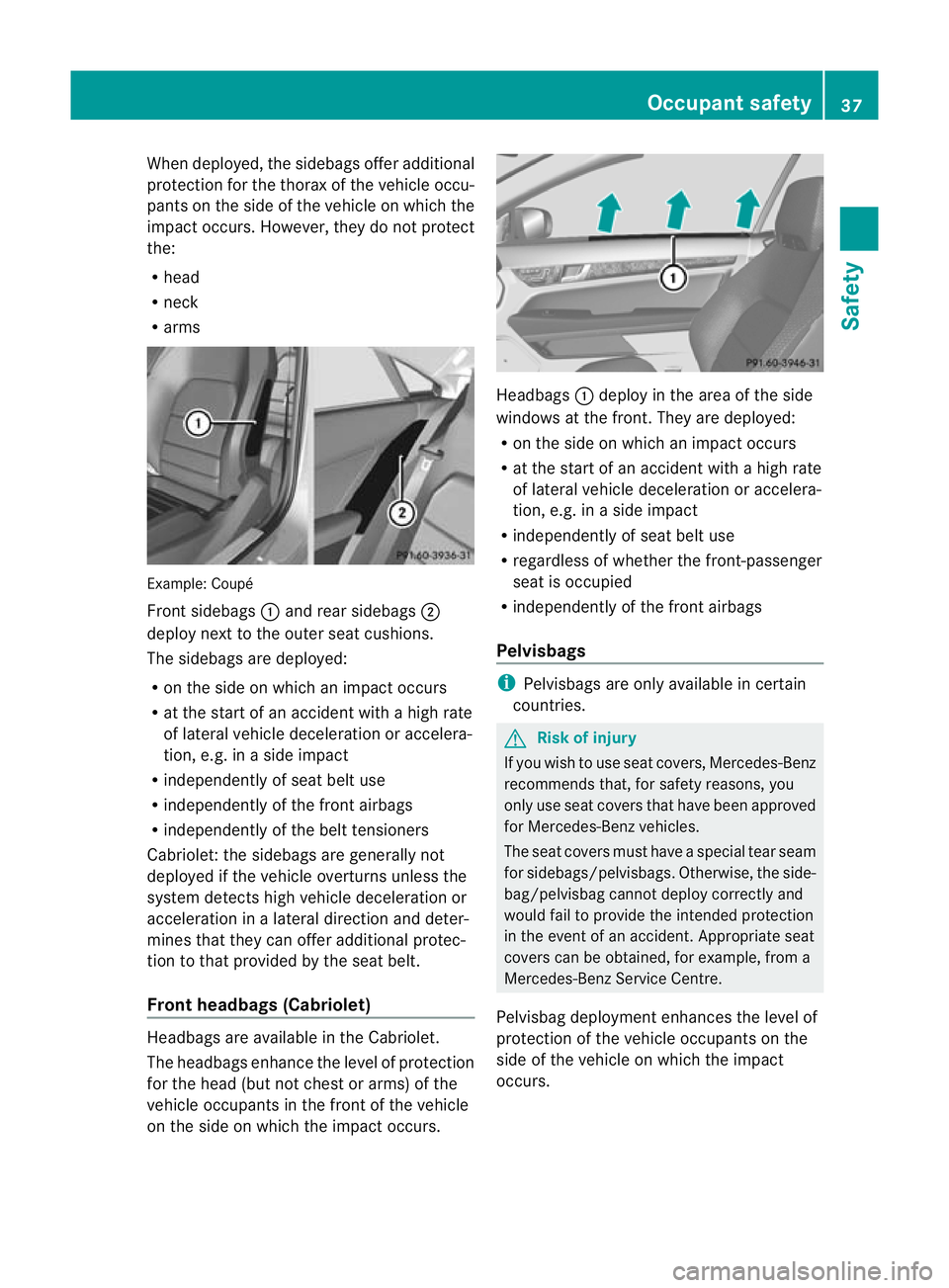
R arms Example: Coupé
Fron
tsidebags :and rear sidebags ;
deploy nex ttothe outer seat cushions.
The sidebags ar edeployed:
R on the side on which an impact occurs
R at the star tofanaccident with ahigh rate
of lateral vehicle deceleration or accelera-
tion, e.g. in aside impact
R independently of seat belt use
R independently of the front airbags
R independently of the belt tensioners
Cabriolet: the sidebags are generally not
deployed if the vehicle overturn sunles sthe
system detec tshigh vehicle deceleration or
acceleration in alateral direction and deter-
mines that they can offer additional protec-
tion to that provided by the seat belt.
Front headbags (Cabriolet) Headbags are available in the Cabriolet.
The headbags enhanc
ethe level of protection
for the head (but not chest or arms) of the
vehicle occupan tsin the front of the vehicle
on the side on which the impact occurs. Headbags
:deploy in the area of the side
windows at the front .They ar edeployed:
R on the side on which an impact occurs
R at the star tofanaccident with ahigh rate
of lateral vehicle deceleration or accelera-
tion, e.g. in aside impact
R independently of seat belt use
R regardless of whether the front-passenger
seat is occupied
R independently of the front airbags
Pelvisbags i
Pelvisbags are only available in certain
countries. G
Risk of injury
If you wish to use seat covers, Mercedes-Benz
recommends that, for safety reasons, you
only use seat cover sthat hav ebeen approved
for Mercedes-Ben zvehicles.
The seat cover smust have aspecial tear seam
for sidebags/pelvisbags. Otherwise, the side-
bag/pelvisbag cannot deploy correctly and
would fail to provide the intended protection
in the event of an accident. Appropriate seat
cover scan be obtained, for example, from a
Mercedes-Benz Service Centre.
Pelvisbag deployment enhances the level of
protection of the vehicle occupant sonthe
side of the vehicle on whic hthe impact
occur s. Occupant safety
37Safety
BA 207ECE ÄJ 2010/1a; 1; 2, en-GB
mkalafa Version: 3.0.2.11 2010-01-26T13:03:22+01:00-Seite 37 Z
Page 43 of 333
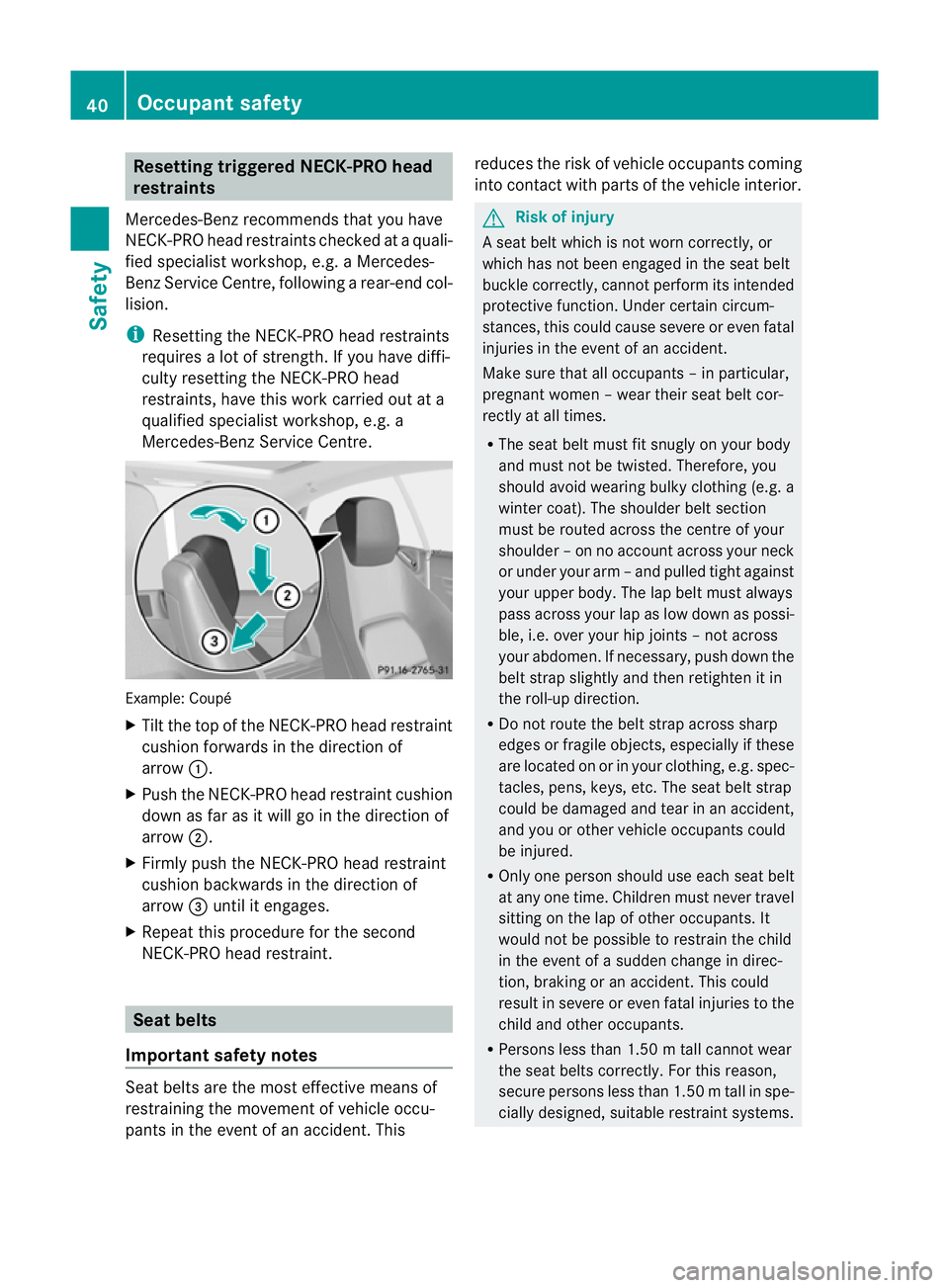
Resetting trig
geredN ECK-PR Ohead
restraints
Mercedes-Ben zrecom mends that you have
NECK-PRO hea drestraint schecked at aquali-
fied specialist workshop, e.g. aMercedes-
Ben zService Cent re,followin garear-en dcol-
lision.
i Resetting the NECK -PRO head restraints
requires alot of strength. If you have diffi-
culty resettin gthe NECK -PRO head
restraints, have this work carried out at a
qualified specialist workshop, e.g. a
Mercedes-Benz Service Centre. Example: Coupé
X
Tilt the top of the NECK-PRO head restraint
cushio nforwards in the direction of
arrow :.
X Push the NECK -PRO head restraint cushion
down as far as it will go in the direction of
arrow ;.
X Firmly push the NECK-PRO head restraint
cushio nbackwards in the direction of
arrow =until it engages.
X Repeat this procedure for the second
NECK -PRO head restraint. Seat belts
Important safet ynotes Seat belts are the most effective means of
restrainin gthe movemen tofvehicle occu-
pant sint he even tofanaccide nt.T his reduce
sthe risk of vehicle occupants coming
int oc ontac twith parts of the vehicle interior. G
Risk of injury
As eat belt which is not worn cor rectly, or
which has not bee nengaged in the sea tbelt
buckle cor rectly, cannot perform its intended
prote ctive function .Under certain circum-
stances, this could cause severe or even fatal
injuries in the event of an accident.
Make sure that all occupants –inparticular,
pregnan twome n–w ear their seat belt cor-
rectly at all times.
R The seat belt must fit snugly on your body
and must no tbetwisted. Therefore, you
should avoid wearing bulky clothin g(e.g. a
winter coat) .The shoulder belt section
must be routed across the cen treofy our
shoulder –onnoaccount acros syour neck
or under your arm –and pulled tight against
your uppe rbody. The lap belt must always
pass across your lap as low down as possi-
ble, i.e. over your hip join ts–n ot across
your abdomen. If necessary ,push down the
belt strap slightly and then retighten it in
the roll-up direction.
R Do not route the belt strap across sharp
edge sorfragil eobjects, especially if these
are located on or in your clothing, e.g. spec-
tacles, pens, keys, etc. The seat belt strap
could be damaged and tear in an accident,
and you or other vehicl eoccupants could
be injured.
R Onl yone person should use each sea tbelt
at any one time. Children must never travel
sittin gont he lap of other occupan ts.It
would not be possible to restrain the child
in the event of asudden change in direc-
tion, braking or an accident .This could
result in sever eoreven fata linjuries to the
child and othe roccupants.
R Persons les sthan 1.50 mtall cannot wear
the seat belts correctly. For this reason,
secure persons less than 1.50 mtall in spe-
cially designed, suitable restraint systems. 40
Occupant safetySafety
BA 20
7ECE ÄJ 2010/1a; 1; 2, en-GB
mkalafa Version: 3.0.2.11 2010-01-26T13:03:22+01:00-Seite 40
Page 47 of 333
ates rapidly in
alongitudinal dir ectiondur-
ing the initial stages of the impact
R in the even tofaside impact, on th eside
opposit ethe im pactift he vehicle deceler-
ates or accelerates rapidly in alateral direc-
tion
R Cabriolet: in certain situations if the vehicle
overturns and the system determines that
it can provide additional protection.
If the airbags are deplo yed,you will hear a
bang and asmall amount of powder may also
be released. Only in rare cases will th ebang
affect your hearing. The powde rthat is
released generally does not constitute a
healt hhazard. The 6SRS warning lamp
lights up. G
Risk of injury
If the seat belt tensioners have been trig-
gered, they provide no additional protection
in the event of another accident. Therefore,
have belt tensioners which have been trig-
gered replaced at aqualified specialist work-
shop.
Comply with safety regulations when dispos-
ing of belt tensione rs.A ny Mercedes-Be nz
Service Centre can provid edetails of these
regulations. Children in the vehicle
Impor
tantsafety notes G
Ris
kofi njury
Do not leav echildren unsupervised in the
vehicle, even if they ar esecured in achild
restraint system .They coul dinjure them-
selves on parts of the vehicle. The ycould also
be seriously or even fatally injure dbypro-
longe dexposure to extreme hea torcold.
Do not expose the child restraint system to
direct sunlight. Part softhe chil drestraint sys-
tem could heat up and the child could burn
herself/himself on them.
If ac hild opens adoor, the child or other per-
sons coul dbeinjured as aresult. They could get out and injure themselves or be injured by
ap
assing vehicle. G
Risk of injury
Unsecured or incorrectly positioned loads
increase the risk of injury for children and all
other occupants in the event of:
R an accident
R ab raking manoeuvre
R as udden change of direction
Do not carry heavy or hard objects inside the
vehicle unless they are secured. You will find
further information under "Loading guide-
lines" in the index.
If ac hild is travellin ginyour vehicle, secure
the child using achild restraint system which
is appropriate to the size, weight and age of
the chil dand recommended for Mercedes-
Benz vehicles. You should fit the restraint sys-
tem to asuitable rear seat. Make sure that
the child is secured in achild restraint system
throughout the trip.
You can obtai ninformation abou tthe correct
chil drestraint system from any Mercedes-
Benz Servic eCentre.
i It is advisable to use Mercedes-Ben zcare
product stocleanc hildr estraint systems.
You can obtain informatio nabout this from
any Mercedes-Benz Ser vice Centre. Chil
drestraint systems
Importan tsafety notes Mercedes-Benz reco
mmends that you only
use the child restraint system slisted at
(Y page 53). G
Risk of injury
To reduce the risk of serious or even fatal
injury to the child in the event of asudden
change in direction, brakin goranaccident:
R Children less than 1.5 0mtall and under
twelv eyears of age must alway sbesecured 44
Children in th
evehicleSafety
BA 20 7ECE ÄJ 2010/1a; 1; 2, en-GB
mkalafa Version: 3.0.2.11 2010-01-26T13:03:22+01:00-Seite 44
Page 49 of 333
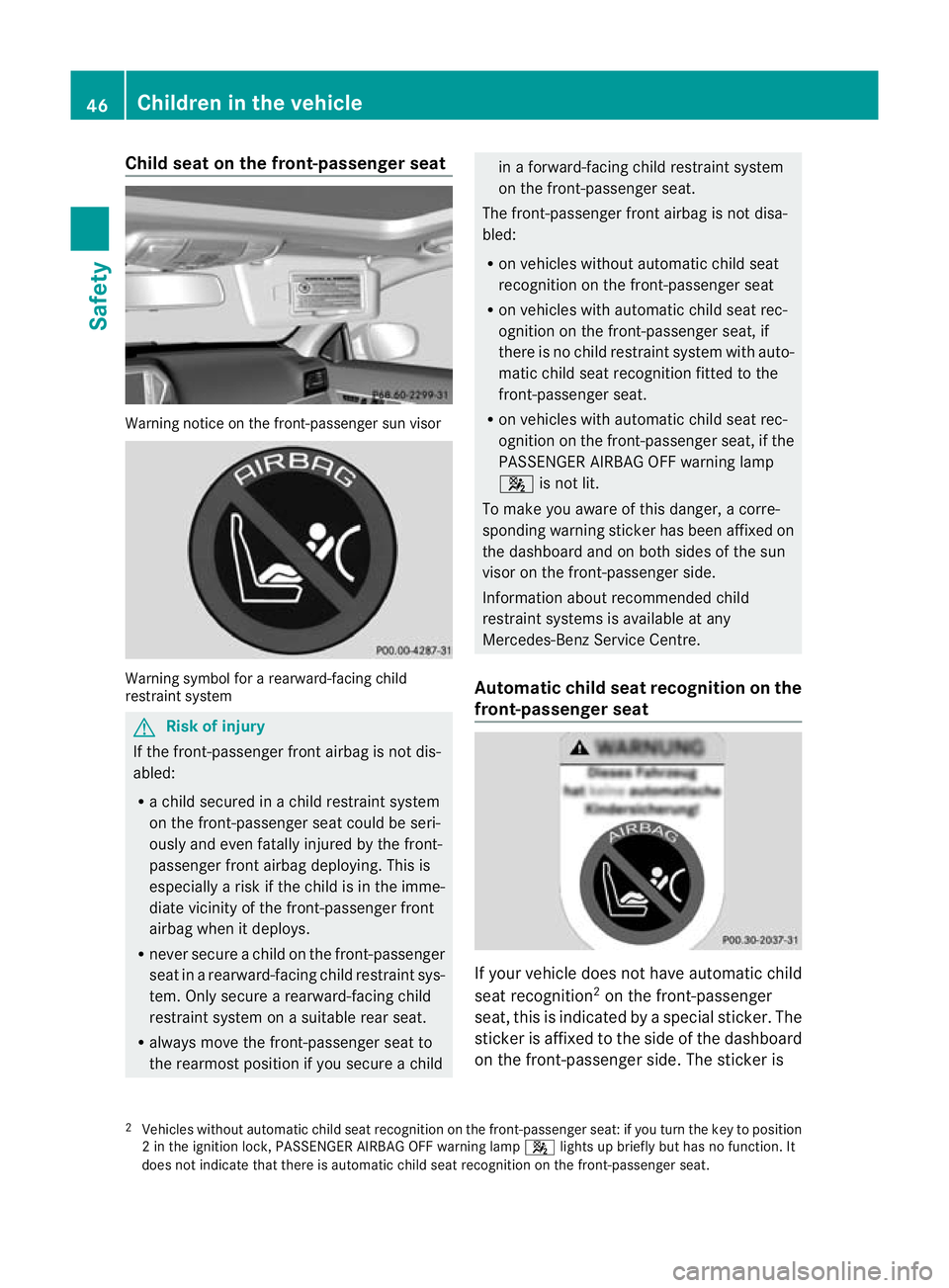
Child seat on th
efront-passenger seat War
ning notic eonthe front-pa ssenger sun visor War
ning symbol for arearward-facing child
restraint system G
Ris
kofi njury
If th efront-p assenger front airbag is not dis-
abled:
R ac hilds ecured in achildr estraint system
on th efront-p assenger seat could be seri-
ously and even fatally injured by the front-
passenger front airbag deploying .This is
especially arisk if the child is in the imme-
diate vicinity of the fron t-passenger front
airba gwhen it deploys.
R never secur eachild on the front-passenger
seat in arearward-facing child restraint sys-
tem. Only secur earearward-facing child
restraint system on asuitable rear seat.
R always move the front-passenger seat to
the rearmost position if you secure achild in
af orward-facing child restraint system
on the front-passenger seat.
The front-passenger front airbag is not disa-
bled:
R on vehicles withou tautomatic child seat
recognition on the front-passenger seat
R on vehicles with automatic child seat rec-
ognition on the front-passenger seat, if
there is no child restraint system with auto-
matic child seat recognition fitted to the
front-passenger seat.
R on vehicles with automatic child seat rec-
ognition on the front-passenger seat, if the
PASSENGER AIRBAG OFF warning lamp
4 is not lit.
To make you aware of this danger, acorre-
spondin gwarning sticker has been affixed on
the dashboard and on both sides of the sun
visor on the front-passenger side.
Infor mation about recommended child
restraint systems is available at any
Mercedes-Benz Service Centre.
Automatic child seat recognitio nonthe
front-passenge rseat If your vehicle does not have automatic child
seat recognition
2
on the fron t-passenger
seat, this is indicated by aspecial sticker. The
sticker is affixed to the side of the dashboard
on the front-passenger side. The sticker is
2 Vehicles withou tautomatic child seat recognition on the front-passenger seat: if you turn the key to position
2int he ignition lock ,PASSENGER AIRBAG OFF warning lamp 4lights up briefly but has no function. It
doe snot indicat ethat ther eisa utomatic child seat recognition on the front-passenger seat. 46
Children in th
evehicleSafety
BA 20 7ECE ÄJ 2010/1a; 1; 2, en-GB
mkalafa Version:3.0.2.11
2010-01-26T13:03:22+01:00
-Seite 46
Page 60 of 333
R
dirt on the sensor sorthe sensor sare cov-
ered
R sno worh eavy rain
R interferenc ebyother radar sources
R strong radar reflections, for example in
multi-storey car parks
BA SP LUS does no treact to people or ani-
mals, oncomin gvehicles and crossin gtraffic.
BAS PLUS may not detect narrow vehicles
such as motorcycle sand vehicles driving on
ad ifferen tline.
Following acollision or collision-related dam-
age to the fron tend of the vehicle, have the
configuratio nand operatio nofthe radar sen-
sors chec kedataM ercedes-Ben zService
Centre.
If BAS PLU Sisn ot available due to amalfunc-
tion in the radar senso rsystem, the brake
syste mremains available with ful lbrake
boostin geffect and BAS. Adaptiv
ebrake lamps
i Adaptive brake lamps are only available in
certain countries.
If you brake sharply from aspeed of more
than 50 km/ horifbraking is assisted by BAS
or BAS PLUS, th ebrake lamp sflash rapidly.
In this way, traffic travelling behind you is
warned in an even more noticeable manner.
If you brake sharply from aspeed of more
than 70 km/ htoastandstill, the hazard warn-
ing lamps are activated automatically .Ifthe
brakes ar eapplied again, the brak elamps
light up continuously .The hazard warning
lamps switc hoff automatically if you travel
faster than 10 km/h .You can also switc hoff
th eh azard warning lamps using the hazard
warning switch button (Y page 110). ESP
®
(Electronic Stability Program)
Important safety notes If ESP
®
detect sthat the vehicle is deviating
from the direction desired by the driver ,one
or more wheels are braked to stabilis ethe
vehicle. If necessary, the engin eoutput is also
modified to keep the vehicle on the desired
course within physical limits. ESP ®
assists
the driver when pulling away on wet or slip-
pery roads. ESP ®
can also stabilise the vehi-
cle during braking.
If ESP ®
intervenes, the äwarning lamp
flashes in the instrument cluster. G
Risk of accident
If the ä warning lamp in the instrument
cluster flashes, proceed as follows:
R do not deactivate ESP ®
under any circum-
stances.
R only depress the accelerator pedal as far as
necessary when pulling away.
R adapt your driving style to suit the prevail-
ing road and weather conditions.
Otherwise ,the vehicle coul dskid.
ESP ®
cannot reduce the risk of an accident if
you drive too fast. ESP ®
cannot override the
laws of physics.
! The ignition must be switched off if you
are towing the vehicl ewith the front/rear
axle raised. Interven tion by ESP ®
coul doth-
erwise damage the brake system.
i Only use wheels with the recommended
tyre sizes. Only then will ESP ®
function
properly.
ETS (Electronic Traction Support) Traction control is part of ESP
®
.
Traction control brakes the drive wheels indi-
viduall yifthey spin. This enables you to pull
away and accelerate on slipper ysurfaces, for
example if the road surface is slippery on one
side. Driving safety systems
57Safety
BA 207 ECE ÄJ 2010/1a; 1; 2, en-GB
mkalafaV ersion: 3.0.2.11
2010-01-26T13:03:22+01:00
-Seite 57 Z
Page 71 of 333
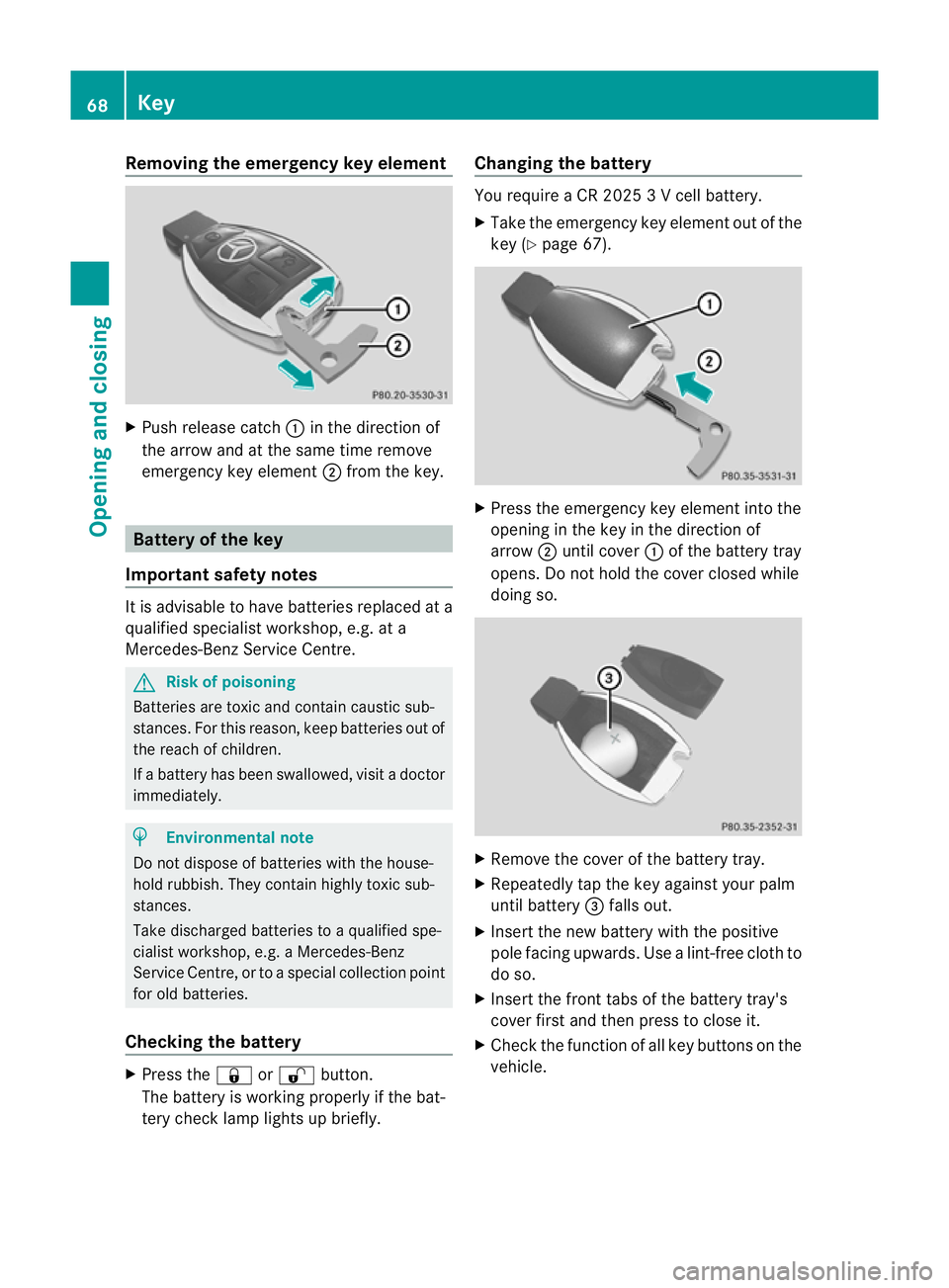
Removi
ngthe emergenc ykey element X
Push releas ecatch :in the direction of
the arro wand at the same tim eremove
emergency key element ;from th ekey. Battery of th
ekey
Important safety notes It is advisable to have batteries replaced at a
qualified specialist workshop, e.g
.ata
Mercedes-Ben zService Centre. G
Risk of poisoning
Batteries are toxic and contain caustic sub-
stances. For this reason ,keep batteries out of
the reac hofchildren.
If ab attery has been swallowed, visit adoctor
immediately. H
Environmental note
Do not dispose of batteries with the house-
hold rubbish. They contain highly toxi csub-
stances.
Take discharge dbatteries to aqualified spe-
cialist workshop, e.g. aMercedes-Benz
Servic eCentre, or to aspecial collection point
for old batteries.
Checking the battery X
Press the &or% button.
The batter yisworking properly if the bat-
ter yc heck lam plights up briefly. Changing the battery You require
aCR20253Vc ell battery.
X Take the emergency key elemen tout of the
key (Y page 67). X
Press the emergency key element into the
opening in the key in the direction of
arrow ;until cover :of the battery tray
opens .Donot hold the cover closed while
doing so. X
Remove the cover of the battery tray.
X Repeatedly tap the key against your palm
until battery =falls out.
X Insert the new battery with the positive
pole facing upwards. Use alint-free clot hto
do so.
X Insert the fron ttabs of the battery tray's
cover firs tand then pres stoclose it.
X Check the function of all key buttons on the
vehicle. 68
KeyOpening and closing
BA 20
7ECE ÄJ 2010/1a; 1; 2, en-GB
mkalafa Version: 3.0.2.11 2010-01-26T13:03:22+01:00-Seite68
Page 82 of 333
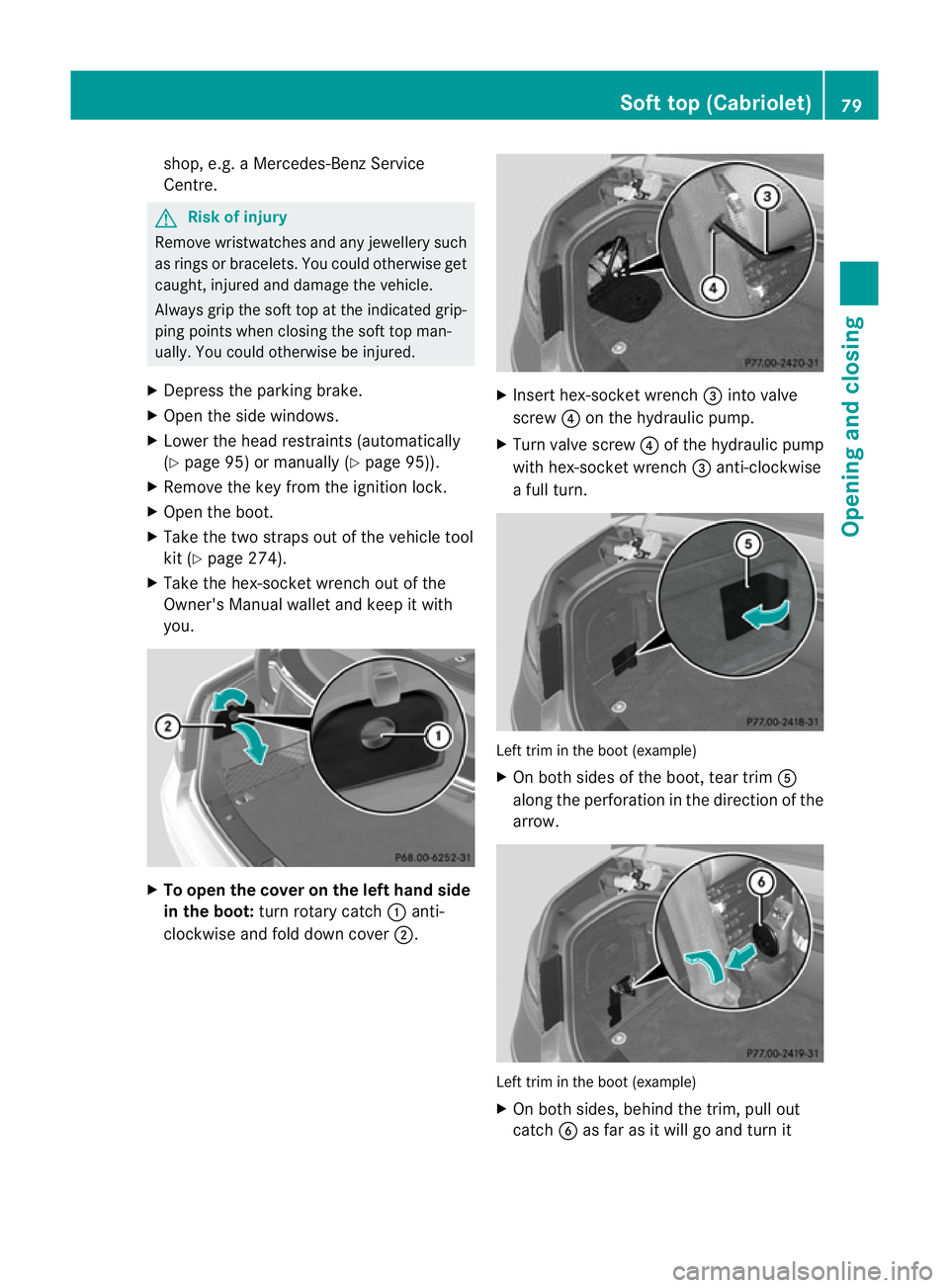
shop, e.g.
aMercedes-Ben zService
Centre. G
Risk of injury
Remove wristwatches and any jewellery such
as rings or bracelets. You could otherwise get
caught, injured and damage the vehicle.
Always grip the soft top at the indicated grip-
ping point swhen closing the soft top man-
ually. You coul dotherwis ebeinjured.
X Depress the parking brake.
X Ope nthe side windows.
X Lower the head restraint s(automatically
(Y page 95) or manually (Y page95)).
X Remove the key from the ignition lock.
X Open the boot.
X Take the two st raps out of the vehicle tool
kit (Y page 27 4).
X Take the hex-socket wren chout of the
Owner 'sManual wallet and keep it with
you. X
To ope nthe cover on the left hand side
in the boot: turn rotary catch :anti-
clockwis eand fold dow ncover ;. X
Inser thex-socket wren ch= intov alve
screw ?on the hydraulic pump.
X Turn valve screw ?of the hydraulic pump
with hex-socket wrench =anti-clockwise
af ull turn. Left trim in the boot (example)
X
On both side softhe boot, tear trim A
alon gthe perforation in the direction of the
arrow. Left trim in the boot (example)
X
On both sides, behind the trim ,pull out
catch Bas far as it will go and turn it Soft top (Cabriolet)
79Openingand closing
BA 20 7ECE ÄJ 2010/1a; 1; 2, en-GB
mkalafa Version:3.0.2.11
2010-01-26T13:03:22+01:0
0-Seite 79 Z