service MERCEDES-BENZ E-CLASS CABRIOLET 2010 Owner's Manual
[x] Cancel search | Manufacturer: MERCEDES-BENZ, Model Year: 2010, Model line: E-CLASS CABRIOLET, Model: MERCEDES-BENZ E-CLASS CABRIOLET 2010Pages: 333, PDF Size: 7.64 MB
Page 86 of 333
N
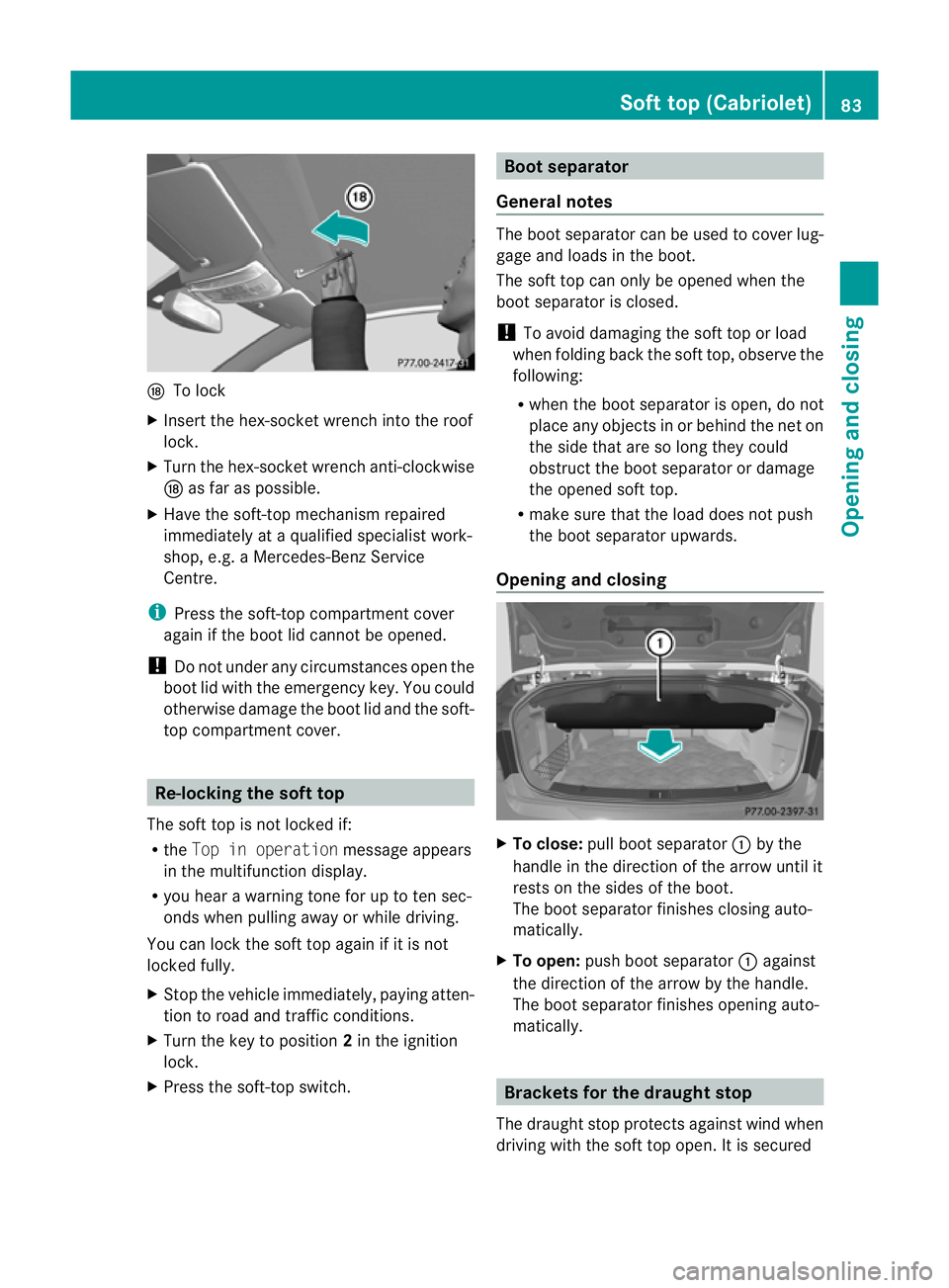
To lock
X Insert the hex-socket wrench int othe roof
lock.
X Tur nthe hex- socket wrench anti-clockwi se
N as fa rasp ossible.
X Hav ethe soft -top mechanism repaired
immediately at aqualified specialist work-
shop, e.g. aMercedes-Benz Service
Centre.
i Press the soft-top compartmen tcover
again if the boot lid can notb eo pened.
! Do not under any circumstances open the
boot lid with the emergenc ykey. You could
otherwise damage the boot lid and the soft-
top compartmen tcover. Re-locking th
esoft top
The soft top is not locked if:
R the Topino peration message appears
in th emultifunction display.
R you hear awarning ton efor up to ten sec-
onds when pullin gaway or while driving.
You can lock the soft top again if it is not
locked fully.
X Stop the vehicle immediately, paying atten-
tion to road and traf ficc onditions.
X Tur nthe key to position 2in the ignition
lock.
X Press the soft -top switch. Boot sepa
rator
General notes The boot separator can be used to cover lug-
gage and loads in the boot.
The soft top can only be opened when the
boot separator is closed.
!
To avoid damaging the soft top or load
when folding back the soft top, observe the
following:
R when the boot separator is open, do not
place any object sinorbehind the net on
the side that are so long they could
obstruct the boot separator or damage
the opened soft top.
R mak esure that the load does not push
the boot separator upwards.
Openin gand closing X
To close: pull boot separator :by the
handle in the direction of the arrow until it
rest sont he sides of the boot.
The boot separator finishes closing auto-
matically.
X To open: push boot separator :against
the direction of the arrow by the handle.
The boot separator finishes opening auto-
matically. Brackets fo
rthe draught stop
Th ed raught stop protects against wind when
driving with th esoft top open. It is secured Soft top (Cabriolet)
83Opening and closing
BA 207ECE ÄJ 2010 /1a; 1; 2, en-GB
mkalafa Version: 3.0.2.11 2010-01-26T13:03:22+01:00 -Seite 83 Z
Page 96 of 333
Seats
Important safety notes
G
Ris
kofi njury
The seats can still be adjusted when there is
no key in the ignition lock. For this reason,
children should never be left unsupervised in
the vehicle. They could adjust the seats and
becom etrapped. G
Ris
kofa ccident
Only adjust the driver' sseat when the vehicle
is stationary .You will otherwise be distracted
from the road and traffic condition sand you
could los econtrol of the vehicle as aresult of
the seat moving. This could cause an acci-
dent. G
Risk of injury
Make sure that nobody can becom etrapped
when adjustin gthe seats.
Observ ethe note sonairbags.
Secur echildren as recommended; see the
"Childre ninthe vehicle" section. G
Risk of injury
Make sur ethat the bac kofyour head is sup-
ported at eye level by the cen tralarea of the
head restraint. If your head is not supported
correctly by th ehead restraint ,you coul dsuf-
fer asever eneck injury in the event of an
accident .Never driv eifthe head rest raints are
not engaged and set correctly.
! To avoid damage to the seats and the seat
heating, observe the following information:
R do not spill any liquids on the seats. If
liquid is spilled on the seats, dry them as
soon as possible.
R if the seat cover sare damp or wet, do not
switc hont he seat heating. The seat
heating should also not to be used to dry
the seats. R
clea nthe seat cover sasrecommended;
see the "In terior care" section.
R do not transport heav yloads on the
seats. Do not plac eshar pobjects on the
seat cushions ,e.g. knives, nails or tools.
Th es eats should only be occupied by
passengers, if possible.
R when the seat heatin gisinoperation ,do
not cover the seats with insulating mate-
rials, e.g. blanke ts,c oats, bags, seat cov-
ers, child seats or booster seats.
! When you mov ethe seats, make sur ethat
ther eare no objects in th efootwell or
behind the seats. Otherwise, you could
damage the seats and the objects.
i The head restraint sinthe fron tseats are
fit tedw ith the NECK -PRO system
(Y page 39). For this reason, it is not pos-
sibl etor emov ethe head restraint sfrom
th ef ront seats.
Please contact aMercedes-Ben zService
Cent refor more info rmation.
i Related topics:
R Through-loading feature in the rear
bench seat 19
(folding the rear bench seat
forwards) Adjusting the seats manually and
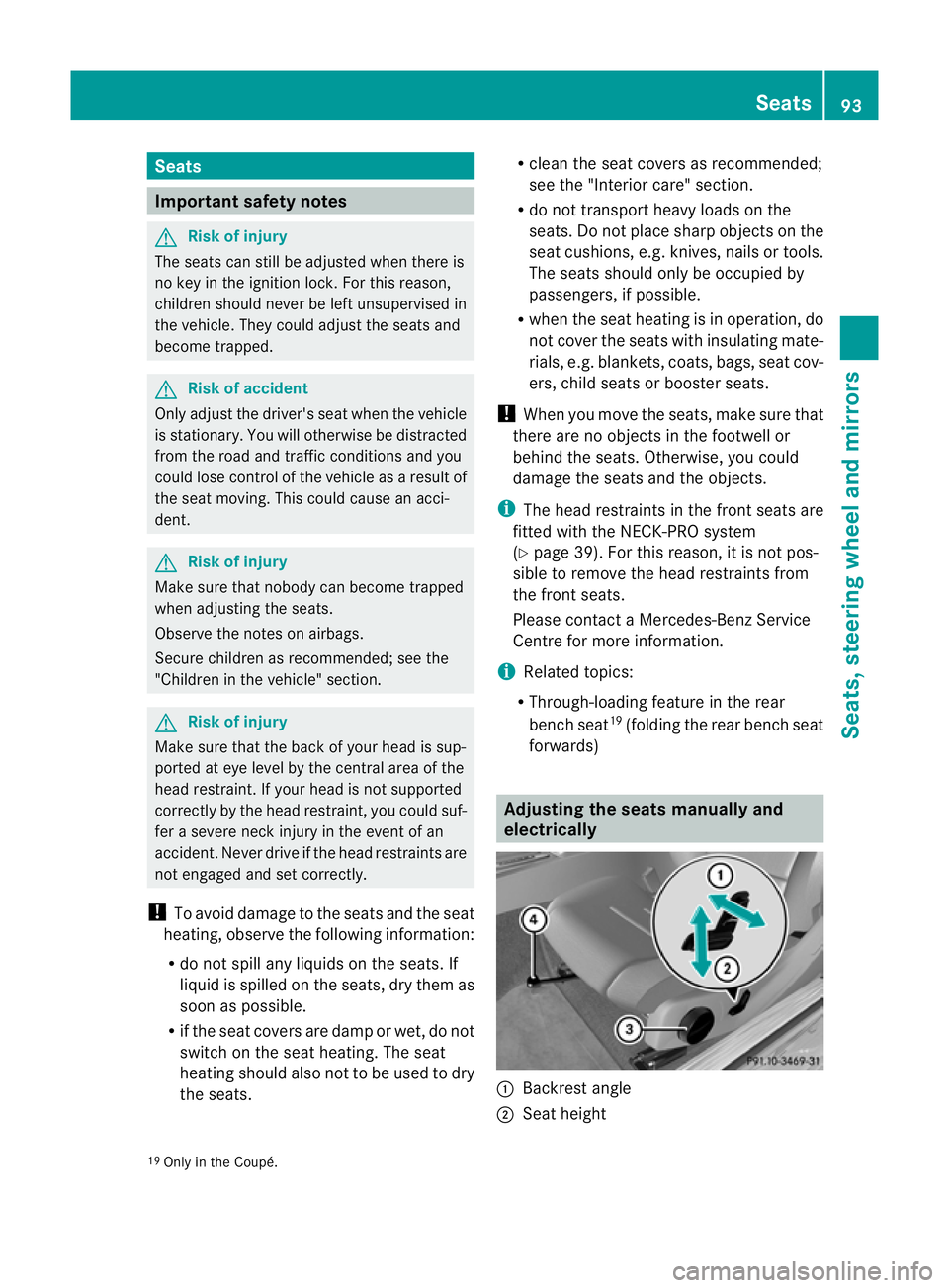
electrically
:
Backrest angle
; Seat height
19 Only in the Coupé. Seats
93Seats,steering wheel and mirrors
BA 207 ECE ÄJ 201 0/1a; 1; 2, en-GB
mkalafa Version: 3.0.2.11 2010-01-26T13:03:22+01:00-Seite 93 Z
Page 116 of 333
Changing bulbs
Important safety notes
Xenon bulbs If your vehicle is equipped wit
hxenon bulb s,
you ca nrecognise this by th efollowing: the
cone of light from th exenon bulbs moves
from th etop to the bottomand back again
whe nyou star tthe engine. Fo rthis to be
observed ,the lights must be switched on
before startin gthe engine. G
Risk of injury
Xenon bulb scarry ahigh voltage. You could
get an electric shock and be seriously or even
fatally injured if you touch the electric con-
tacts on xenon bulbs. Therefore, never
remov ethe cover from xenon bulbs.
Do not change xenon bulbs yourself, but have
them replaced at aqualified specialist work-
sho pwhich has the necessar yspecialist
knowledge and tools to carry out the work
required.
Mercedes-Ben zrecom mends that you use a
Mercedes-Benz Service Centre for this pur-
pose. In particular, work relevant to safety or
on safety-related systems must be carried out
at aq ualified specialist workshop.
Bulbs and lamps are an important aspect of
vehicle safety. You must therefore make sure
that thes efunction correctly at all times.
Have the headlamp setting checked regularly.
Other bulbs G
Risk of injury
Bulbs and lights can become very hot. For this
reason, allow them to cool down before
changin gthem. Otherwise, you coul dburn
yourself when you touch them.
Keep bulbs out of the reach of children. Oth-
er wise ,they could damage them, for example,
and inj uret hemselves.
Never use abulbw hich ha sbeend ropped.
Suc hab ulbm ay explod eand injure you. Halogen bulb
sare pressu rised and could
explode when yo uchange them, especiall yif
the yarever yhot. Yo ushould therefor ewear
eye protec tion and gloves when you are
changing them.
There are bulbs other than the xenon bulbs
that you cannot replace. Replace only the
bulbs listed (Y page 113). Hav ethe bulbs that
you cannot replac eyourself changed at a
qualified specialist workshop.
Mercedes-Ben zrecom mends that you use a
Mercedes-Ben zService Cent refor this pur-
pose .Inp articular, work relevant to safety or
on safety-related systems must be carried out
at aq ualified specialist workshop.
If you require assistanc echangi ngbulbs, con-
sult aqualified specialist workshop.
Do not touch the glass tube of new bulbs with
your bare hands. Even minor contamination
can burn int othe glass surface and reduce
the servic elife of the bulbs. Always use alint-
free clot horonly touch the bas eofthe bulb
when fit ting.
Only use bulb softhe cor rect type.
If the new bul bstill doe snot light up, consult
aq ualified specialist workshop.
Bulbs and lamps are an important aspect of
vehicle safety. You must therefore make sure
that these function correctly at all times.
Have the headlamp setting checked regularly. Overview: changing bulbs/bulb types
You can change the following bulbs .The bulb
typ ecan be found in the legend. Changin
gbulbs
113Lightsand windscreen wipers
BA 20 7ECE ÄJ 2010/1a; 1; 2, en-GB
mkalafa Version:3.0.2.11
2010-01-26T13:03:22+01:0
0-Seite 113 Z
Page 117 of 333
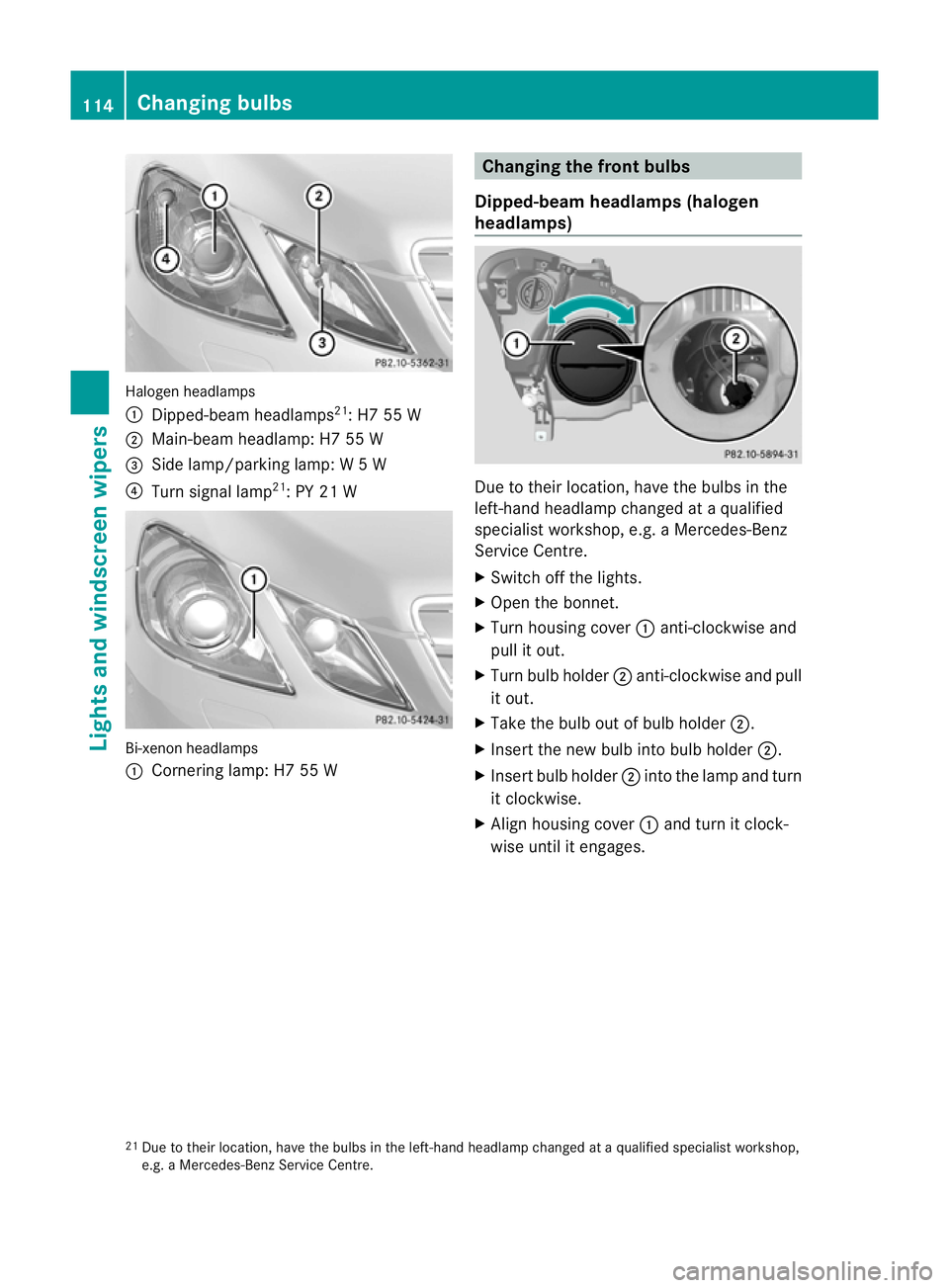
Halogen he
adlamps
: Dipped-bea mheadlamps 21
:H755W
; Main-bea mheadlamp: H7 55 W
= Side lamp/parkin glamp: W5W
? Turnsignal lamp 21
:PY21W Bi-xenon headlamps
:
Cornering lamp :H755W Changing the front bulbs
Dipped-beam headlamps (halogen
headlamps) Due to their location, have the bulbs in the
left-hand headlamp changed at
aqualified
specialist workshop, e.g. aMercedes-Benz
Ser vice Centre.
X Switch off the lights.
X Open the bonnet.
X Turn housing cover :anti-clockwise and
pul lito ut.
X Turn bulb holder ;anti-clockwise and pull
it out.
X Take the bulb out of bulb holder ;.
X Inser tthe new bulb int obulb holder ;.
X Insert bulb holder ;into the lamp and turn
it clockwise.
X Align housing cover :and turn it clock-
wise until it engages.
21 Due to their location, have the bulbs in the left-hand headlamp changed at aqualified specialis tworkshop,
e.g. aMercedes-Ben zService Centre. 114
Changing bulbsLights and windscreen wipers
BA 20
7ECE ÄJ 2010 /1a;1;2,e n-GB
mkalafa Version: 3.0.2.11 2010-01-26T13:03:22+01:00-Seite 114
Page 152 of 333

It is hazard
oustoy our health if your skin
comes into direct contact with fuels or you
breathe in fuel vapours. G
Risk of fire
Do not use petrol to refuel vehicles with adie-
sel engine. Never mix diesel with petrol. This
causes damage to the fuel system and engine
and could result in the vehicle catching fire.
! Do not use petrol to refuel vehicles with a
diesel engine. Do not use diesel to refuel
vehicles with apetrol engine. Even asmall
quantity of th ewrong fue lwill damage the
fuel system and engine.
! If the wrong fuel has been added by mis-
take, do not switch on the ignition .Ifyou
do, the fuel coul denter the fuel lines .The
fuel tan kand the fuel lines must then be
drained .Inform aqualified specialist work-
sho pand have the fuel tank and the fuel
lines drained comple tely. Petrol (EN 228)
Fuel grade !
Only refuel using unleaded premium-
grade petrol with at least
95 RON/8 5MON, whic hconforms to Euro-
pean standar dEN2 28.
Yo uc an otherwise impair engine output or
damage the engine.
! Do not use the following:
R E85 (petrol with 85 %ethanol)
R E10 0(100 %ethanol)
R M15 (petro lwith 15 %methanol)
R M85 (petrol with 85 %methanol)
R M10 0(100 %methanol)
R diesel
Do not mix these fuel swith petrol and do
not use any special additives. Otherwise,
this can lead to damage to the engine. This
does not include additives for the removal and prevention of residue build-up on the
inlet valves.
i If the recommended fuel is not available,
but only as atemporary measure, you may
also use regula runleaded petrol,
91 RON/82.5 MON. Thi smay reduce
engine performance and increase fuel con-
sumption. Avoid driv ingatf ull throttle.
In some countries, the fuel grad eavail able
may not be adequate and could cause res-
idu etob uild up around the inlet valve. In
such cases, and in consultation with a
Mercedes-Benz Service Centre, the petrol
may be mixed with the additive recommen-
ded by Mercedes-Benz (part no.
A000989254510). You must observe the
note sand mixing ratios specified on the
container.
For further information on "Fuel" ,see
(Y page 313). Diesel (EN 590, DIN 51628)
Fuel grade !
Only refuel with diesel that conform sto
Europea nstandard EN 590 or German
standard DIN 5162 8orthe equivalent. You
can otherwise impair engin eoutput or dam-
age the engine.
! Vehicles with diesel particle filters: in
countries outsid ethe EU ,only use low sul-
phu rEuro diesel with asulphu rcontent of
under 50 ppm. Otherwise, the emission
con trol system coul dbedamaged.
! Vehicles without adiesel particle fil-
ter: the engin eoil should be changed more
frequently in countries in which diesel with
ah igher sulphur conten tisavailable .More
information about intervals for changing
the engin eoil can be obtained from any
Mercedes-Benz Service Centre.
! Using fuel that does not confor mtoEuro-
pean standard EN 590 or German standard
DIN 51628 can lead to increased wear, Refuelling
149Drivingand pa rking
BA 20 7ECE ÄJ 2010/1a; 1; 2, en-GB
mkalafa Version: 3.0.2.11 2010-01-26T13:03:22+01:00-Seite 149 Z
Page 157 of 333

Parking up th
evehicle Problem Possible causes/consequences and
M Solutions
The vehicle is to be left
parked up for longer
than four weeks. The battery may be damaged by heavy discharging.
X
Disconnect the battery (Y page 286)orconnect it to abattery
trickle charger.
i You can obtain more information about battery trickle charg-
ers at aqualified specialist workshop, e.g. aMercedes-Benz
Servic eCentre. The vehicle is to be left
parked up for longer
than six weeks. Damage resulting from non-use may occu
rifthe vehicle is parked
up for long periods.
X Visit aqualified specialist worksho pand see kadvice. Driving tips
General driving tips
Rolling with the engine switched off G
Risk of accident
Never switc hthe engin eoff while the vehicle
is in motion.
There is no powe rassistanc efor the steering
and the service brake when the engin eisnot
running.
You will require considerably mor eeffort to
steer and brak eand you could therefore lose
control of the vehicl eand cause an accident. Engine oil
! Vehicle swithadiesel particle filter:
If the vehicle is mostly driven for short dis-
tances, it is possible that malfunctions may
occur durin gthe automa ticc leaning of the
diesel particle filter. This can lead to engine
damage. Therefore, if you frequently drive
short distances, make sure to drive on
motorways or countr yroads for 20 minutes
at least ever y500 km. Appl
ying th ebrakes
Important safet ynotes G
Risk of accident
Do not change down for additional engine
brakin gona slipper yroad surface. This could
cause the driv ewheels to lose their grip and
the vehi clec ould skid. G
Risk of accident
Make sure that other road users are not
endangered by your braking.
Downhill gradients On long and steep downhill gradients, espe-
cially if the vehicle is laden or towin gatrailer,
you must shift to alower gear in good tim eor,
on vehicles wit hautomatic transmission,
select shift range 1,2or 3.
i This also applie sifyou have activated
cruise control, SPEEDTRONIC or DIS-
TRONIC PLU S.
This will use the brakin geffect of th eengine,
so les sbraki ngwill be required to maintain
the speed .This relieves the load on the brake
syste mand prevent sthe brake sfrom ove r-
heati ngand wearing too quickly. If you need
additional braking, depress the brake pedal
repeatedly rather than continuously. 154
Driving tipsDriving and parking
BA 207 ECE ÄJ 2010/1a; 1; 2, en-GB
mkala
fa Version: 3.0.2.11
2010-01-26T13:03:22+01:00
-Seite 154
Page 160 of 333

characteristics cause
dbythe differ enttyres.
You shoul dtherefor eadapt your drivin gstyle
and drive carefully.
Have the spare whee lreplaced at the nearest
qualified specialist workshop which has the
necessar yspecialist knowledge and tools to
carry out the work required. Mercedes- Benz
recommends that you use aMercedes-Benz
Ser vice Centre for thi spurpose. In particular,
work relevant to safety or on safety-related
systems must be carried out at aqualified
specialist workshop.
Snow chains For safety reasons
,Mercedes-Benz recom-
mends that you only use snow chain swhich
hav ebeen speciall yapproved for your vehicle
by Mercedes-Benz ,ora re of acorresponding
standar dofquality.
If you intend to fit snow chains, pleas ebear
the following point sinmind:
R you may not attac hsnow chains to all
wheel-tyre combinations ;see the "Tyres
and wheels" section in the "Techni caldata"
chapter.
R snow chains must not be fitted to emer-
gency spare wheels ,e.g. a"Minispare"
emergency spar ewheel.
R fit snow chains only in pair sand only to the
rear wheels .Observ ethe manufacturer's
installation instructions.
Do not exceed the maximum permissible
speed of 50 km /h.
i You may wish to deactivat eESP®
when
pulling away with snow chains fitted
(Y page 57). This way you can allow the
wheels to spin in acontrolled manner, ach-
ieving an inc reased driving forc e(cutting
actio n).
Slipper yroad surfaces G
Risk of accident
Do not shift down for additional engine brak-
ing on aslippery road surface. This could cause the drive wheels to lose their grip and
the vehicle could skid.
You should drive particularly carefully on slip-
pery road surfaces. Avoid sudden accelera-
tion ,steering and braking manoeuvres.
If the vehicle threatens to skid or cannot be
stopped when movin gatlow speed:
X Vehicles with manua ltransmission: engage
neutral.
X Vehicles wit hautomatic transmission: shift
the transmission to position N.
X Try to bring the vehicle under control using
corrective steering.
i For more information on driving with
snow chains, see (Y page 157). Drivin
gabroad
General notes An extensiv
eMercedes–Benz Ser vice net-
work is als oavailable in othe rcountries. The
Ser vice Hotline's current telephone numbers
for use whe nyou ar eabroad are to be found
in the "Service24h" section of the Ser vice
Boo klet.
Only low-oc tane fuel is available in certain
countries.
You can find further information about fuel
grade son(Ypage 14 8).
Sym metrical dipped-beam headlamps If your journey takes you to countries where
vehicle
sare driven on th eopposite side of the
road to the country in which the vehicle is
registered, your headlamps must be switched
to symmetrical dipped beam. This prevents
oncomin gtraffic from being dazzled.
Have th eheadlamps conver tedasc lose as
possible to the border before drivin ginthese
countries. When usin gsymmetrical lights, the
edg eoft he carriageway is not lit as widely
and as fa rahead as nor mal. Drivin
gtips
157Driving and parking
BA 207ECE ÄJ 2010/1a; 1; 2, en-GB
mkalafa Version:3.0.2.11
2010-01-26T13:03:22+01:0
0-Seite 157 Z
Page 188 of 333
lar, this may be the case if the vehicles are
drivin gatthe edge of their lan enearest your
vehicle. Due to the nature of the system,
warnings may be issued in err or when driving
clos etoc rashb arriers or similar solid lane
borders.
The two sensors for Blind Spot Assis tare
integrate dinto the sides of the rear bumper.
Make sure that the bumpe risfree from dirt,
ice or slus haround th esensors. For example,
the rada rsensors must not be covered by
cycle racks or overhanging loads. Followin ga
severe impac torinthe even tofdamage to
the bumpers, have the function of the radar
sensors checked at aqualified specialist
workshop, e.g. aMercedes-Ben zService
Cent re.B lind Spot Assist may otherwise not
work properly.
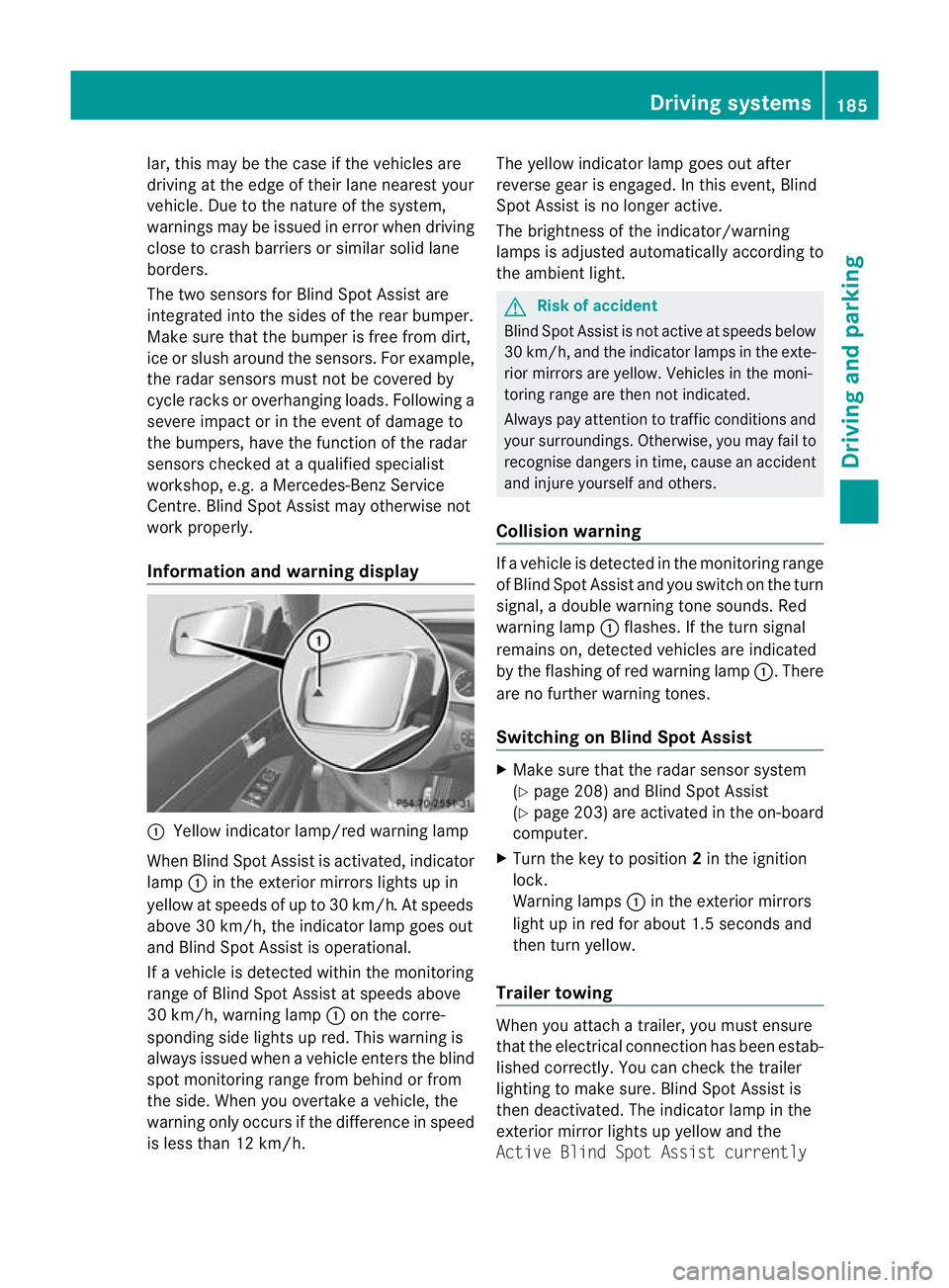
Information and warning display :
Yellow indicator lamp/red warnin glamp
When Blind Spot Assis tisa ctivated, indicator
lamp :in the exterior mirrors lights up in
yellow at speed sofupto30km/ h.At speeds
above 30 km/h, the indicator lamp goe sout
and Blind Spo tAssist is operational.
If av ehicle is detected within the monitoring
range of Blin dSpot Assist at speeds above
30 km/h, warning lamp :on the corre-
sponding side lights up red. This warning is
always issued when avehicle enter sthe blind
spot monitoring range from behind or from
the side. When you overtak eavehicle, the
warning only occurs if the difference in speed
is less than 12 km/h. The yellow indicator lam
pgoes out after
reverse gear is engaged. In this event, Blind
Spot Assist is no longer active.
The brightness of the indicator/warning
lamps is adjusted automatically according to
the ambient light. G
Risk of accident
Blind Spot Assist is not active at speeds below
30 km/h, and the indicator lamps in the exte-
rio rm irror sare yel low.Vehicles in the moni-
toring range are then not indicated.
Alway spay attention to traffic conditions and
your surroundings. Otherwise ,you may fai lto
recognise dangers in time ,cause an accident
and injure yoursel fand others.
Collisio nwarning If
av ehicle is detected in the mon itoring range
of Blind Spot Assis tand you switch on the turn
signal, adouble warnin gtone sounds. Red
warnin glamp :flashes .Ifthe tur nsignal
remains on, detected vehicles are indicated
by the flashing of red warnin glamp :.T here
ar enof urther warning tones.
Switching on Blind Spot Assist X
Make sure that the radar senso rsystem
(Y page 208) and Blind Spot Assist
(Y page 203) are activated in the on-board
computer.
X Turn the key to position 2in the ignition
lock.
Warning lamps :in the exterior mirrors
ligh tupinr ed for about 1. 5seconds and
then tur nyellow.
Trailer towing When you attach
atrailer, yo umust ensure
that the electrical connection has been estab-
lished correctly. You can check the trailer
lighting to make sure. Blind Spot Assis tis
then deactivated .The indicator lam pint he
exterior mirror lights up yellow and the
Active Blin dSpot Assist currently Drivin
gsystems
185Drivingand pa rking
BA 20 7ECE ÄJ 2010 /1a;1;2,e n-GB
mkalafa Version: 3.0.2.11 2010-01-26T13:03:22+01:00-Seite 185 Z
Page 193 of 333
!
You can connect consumer swithapower
ratin gofupto2 40Wtot he permanent
power supply and up to 18 0Wto the power
supp lythat is switched on via the ignition
lock.
You must not charge atrailer battery using
th ep ower supply.
The trailer's permanen tpower supply is
switched off in the even toflow vehicle supply
voltage and after six hour satthe latest.
You can obtai nfurther information about
installing the trailer electrics from aqualified
specialist workshop, e.g. aMercedes-Benz
Ser vice Centre.
X To switch the connected power supply
on or off: turn the key in the ignitio nlock
to position 2or 0respec tively. Bulb failur
eindicator for LEDs
i If LE Dlamps are fitted in the trailer, an
error message may appear in the multi-
function display –even if there is no fault –
if th ecorrespondin gLED chain's current
draw drops below 50 milliamperes (mA).
To ensure reliabl eoperation of the bulb failure
indic ator,am inimum current of 50 mA must
be guaranteed by the manufacturer of each
LED chain in the trailer lighting. Trailer with 7-pin connector
General information If you
rtrailer ha sa7-pin connector, you can
connect it to the 13-pin socket on the ball
coupling using an adapter or, if necessary, an
adapter cable. Both of thes ecan be obtained
at aq ualified specialist workshop, e.g. at a
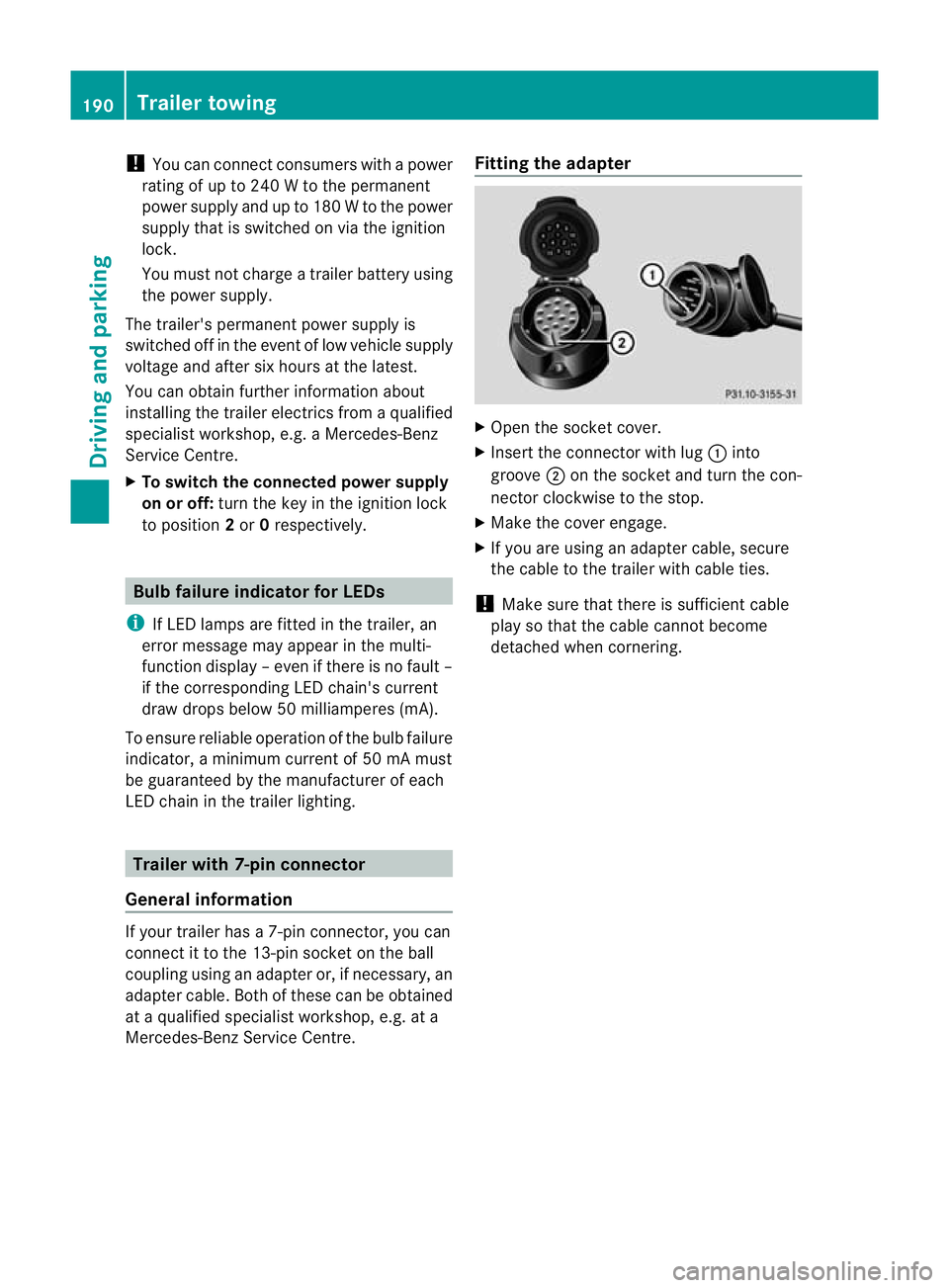
Mercedes-Benz Service Centre. Fittin
gthe adapter X
Open th esocke tcover.
X Insert the connector with lug :into
groove ;on the socket and tur nthe con-
nector clockwi seto the stop.
X Make the cover engage.
X If you are using an adapter cable, secure
the cabl etothe trailer with cable ties.
! Make sur ethat ther eissufficient cable
pla ysot hat the cable cannot become
detached when cornering. 190
Trailer towingDriving and parking
BA 20
7ECE ÄJ 2010/1a; 1; 2, en-GB
mkalafa Version: 3.0.2.11 2010-01-26T13:03:22+01:00-Seite 190
Page 195 of 333
Vehicl
eequipment
i Thismanua ldesc ribe sallthe standard
and optional equipment of your vehicle
which wa savailable at th etime of pur-
chase. Countr y-specif ic differences are
possible. Bear in mind tha tyour vehicle
ma ynot featur eall function sdescribed
here. Important safet
ynotes
You will find an illustration of the instrument
cluster in the "At aglance" section
(Y page 24). G
Risk of accident
Only use the on-board computer when road
and traf ficc ondition spermit .You would oth-
erwise be distracted and unable to concen-
trate properly on driving, and coul dcause an
accident. G
Risk of accident
If the instrument cluster or multifunc tion dis-
play fails, no messages can be displayed.
This means that you will not see information
about the driving situation ,such as the speed,
outside temperature, warning/indicator
lamps, display message sorsystem failures.
Handling characteristics may be affected.
Adapt your driving style and speed accord-
ingly.
Immediately consult aqualified specialist
workshop which has the necessary specialist
knowledg eand tool stocarry out the work
required. Mercedes-Benz recommends that
you use aMercedes-Benz Servic eCentr efor
this purpose. In particular ,work relevant to
safet yorons afety-related systems must be
carried out at aqualified specialist workshop. G
Risk of accident
The on-board computer only records and dis-
plays malfunctions and warnings from certain
systems. For this reason, you should always make sure that your vehicle is safe to use. You
could otherwis
ecause an accident by driving
an unsafe vehicle. G
Risk of accident and injury
The operating safety of your vehicle could be
jeopardise difmaintenance work is carried
out incorrectly. As aresult, you could lose
control of the vehicle and cause an accident.
In addition ,the safety system smay no longer
be able to protec tyou or other sasthey are
designe dtodo.
Always have maintenanc ework carried out at
aq ualified specialist workshop .The qualified
specialist workshop must hav ethe necessary
specialist knowledge and tools to carry out
the wor krequired. Mercedes-Benz recom-
mends that you use aMercedes-Benz Service
Centr efor this purpose. In particular ,work
relevant to safet yoronsafety-related sys-
tems must be carried out at aqualified spe-
cialist workshop. Displays and operation
Coolant temperature gauge
The coolant temperature gauge is in the
instrument cluster on the right-hand side.
Under normal operating conditions and with
the specified coolant level, the coolant tem-
perature may rise to 120 †.
The coolant temperature may rise to the top
end of the scale at high outsid etemperatures
and on long uphill stretches. Rev counter
The red band in the rev coun terindicate sthe
engine' soverrevving range.
! Do not drive in th eoverrevving range.
Doing so wil ldamage the engine.
The fuel supply is interrupted to protec tthe
engin ewhen the red band is reached. 192
Displays and operationOn-boar
dcompu tera nd displays
BA 20 7ECE ÄJ 2010 /1a;1;2,e n-GB
mkalafa Version: 3.0.2.11 2010-01-26T13:03:22+01:00-Seite 192