transmission MERCEDES-BENZ E-CLASS CABRIOLET 2011 Repair Manual
[x] Cancel search | Manufacturer: MERCEDES-BENZ, Model Year: 2011, Model line: E-CLASS CABRIOLET, Model: MERCEDES-BENZ E-CLASS CABRIOLET 2011Pages: 353, PDF Size: 8.42 MB
Page 312 of 353
Jump-starting
G
WARNING
There is arisk of acid burns when jump-starting avehicle due to the gases which escape from
the battery. Do not lean over the battery while the engine is being jump-started. G
WARNING
Gases escaping from the battery during jump-starting may cause minor explosions. Avoid cre-
ating sparks. Keep naked flames away from the battery, and do not smoke.
Comply with safety precautions when handling batteries. You will find these under "Battery" in
the index.
! Avoid repeated and lengthy startinga ttempts. Otherwise, non-combusted fuel may dam-
age the catalytic converter 22
and create arisk of fire.
Do not use arapid-charging device to start the engine.
Make sure the jump leads are not damaged.
Make sure the jump leads are not touching any other metal objectsw hen they are connected
to the battery.
If your vehicle's battery is discharged, the engine can be jump-started from another vehicle
or from asecond battery using jump leads.
Observe the following points:
X The battery is not accessible in all vehicles. If the other vehicle's battery is not accessible,
jump-start the vehicle using asecond battery or ajump-starting device.
X Only jump-start th evehicl ewhen th eengineisc olda nd th ecatalyti cconverter system has
cooled down 23
.
X Do not start the engine if the battery is frozen. Let the battery thaw first.
X Jump-starting may only be performed from batteries with anominal voltage of 12 V.
X Only use jump leads which have asufficient cross-section and insulated terminal clamps.
X Make sure that the jump leads cannot come into contact with parts, such as the pulley or
the fan. These parts move when the engine is started and while it is running.
X If the battery is fully discharged, leave the battery that is being used to jump-start connected
for afew minutes before attempting to start.T his charges the empty batteryalittle.
i Jump leads and further information about jump-starting can be obtained from any
Mercedes-Ben zService Centre, for example.
X Make sure that the two vehicles do not touch.
X Apply the parking brake firmly.
X Manual transmission: engage neutral.
X Automatic transmission: move the selector lever toP.
X Switch off all electrical consumers (e.g. radio, blower, etc.).
X Open the bonnet (Y page 281).
22 Only vehicles with apetrol engine.
23 Only vehicles with apetrol engine. Jump-starting
309Breakdown assistance Z
Page 314 of 353
R
the engine is not running.
R there is abrake syste mmalfunction.
R there is amalfunctio ninthe power supply
or the vehicle's electrical system.
The power assistance for the steering and the
brake force booster do not work when the
engine is not running. You will need more
force to steer and brake, you may have to
depress the brake pedal with maximum force.
Before towing away,m ake sure that the steer-
ing can be moved and is not locked.
If you tow or tow-start another vehicle, its
weight must not exceed the maximum per-
missible gross vehicle weight of your vehicle. G
WARNING
The vehicle is braked when the HOLD function
or DISTRONIC PLUS is activated. Therefore,
deactivate HOLD and DISTRONIC PLUS if the
vehicle is to be towed.
It is better to have the vehicle transported
than to have it towed.
! You may tow the vehicle for amaximum
of 50 km. Atowing speed of 50 km/h must
not be exceeded.
For towing distances over 50 km, the entire
vehicle must be lifted up and transported.
! Only secure the tow rope or towing bar to
the towing eyes. The vehicle may otherwise
be damaged.
! Do not use the towing eye for recovery,
as this could damage the vehicle. If in
doubt, recover the vehicle with acrane.
! Pull away smoothly when towing away or
tow-starting avehicle. If the tractive power
is too high, the vehicles could be damaged.
! On vehicles with KEYLESS-GO, use the
key instead of the Start/Stop button. Turn
the key to position 2in the ignition lock and
shift the automatic transmission to N.
Then, turn the key back to 0and leave it in
the ignition lock. When towing
avehicle with an automatic
transmission, the transmission must be in
position N.
The battery must be connected and charged.
Otherwise, you:
R cannot turn the key in the ignition lock to
position 2
R cannot shift the transmission to position
N on vehicles with automatic transmission
Vehicles with automatic transmission:
release the selector lever lock manually to
move it out of position P(Y page 160).
i Before the vehicle is towed, switch off the
automatic locking feature (Y page 78). You
could otherwise be locked out when push-
ing or towing the vehicle.
Deactivate tow-away protection
(Y page 68) before the vehicle is towed. Fitting/removing the towing eye
Fitting the towing eye Vehicles with
atrailer tow hitch: if you intend
to use the vehicle for towing, fold out the ball
coupling and connect the towbar to it
(Y page 206).
X Remove the towing eye from the vehicle
tool kit (Y page 295). G
WARNING
The exhaust tail pipe may be hot. You could
burn yourself if you touch the tail pipe. Be
particularly careful when removing the rear
cover.
The mountings for the removable towing eyes
are located in the bumpers. They are at the
front and at the rear, under the covers. Towing and tow-starting
311Breakdown assistance Z
Page 315 of 353
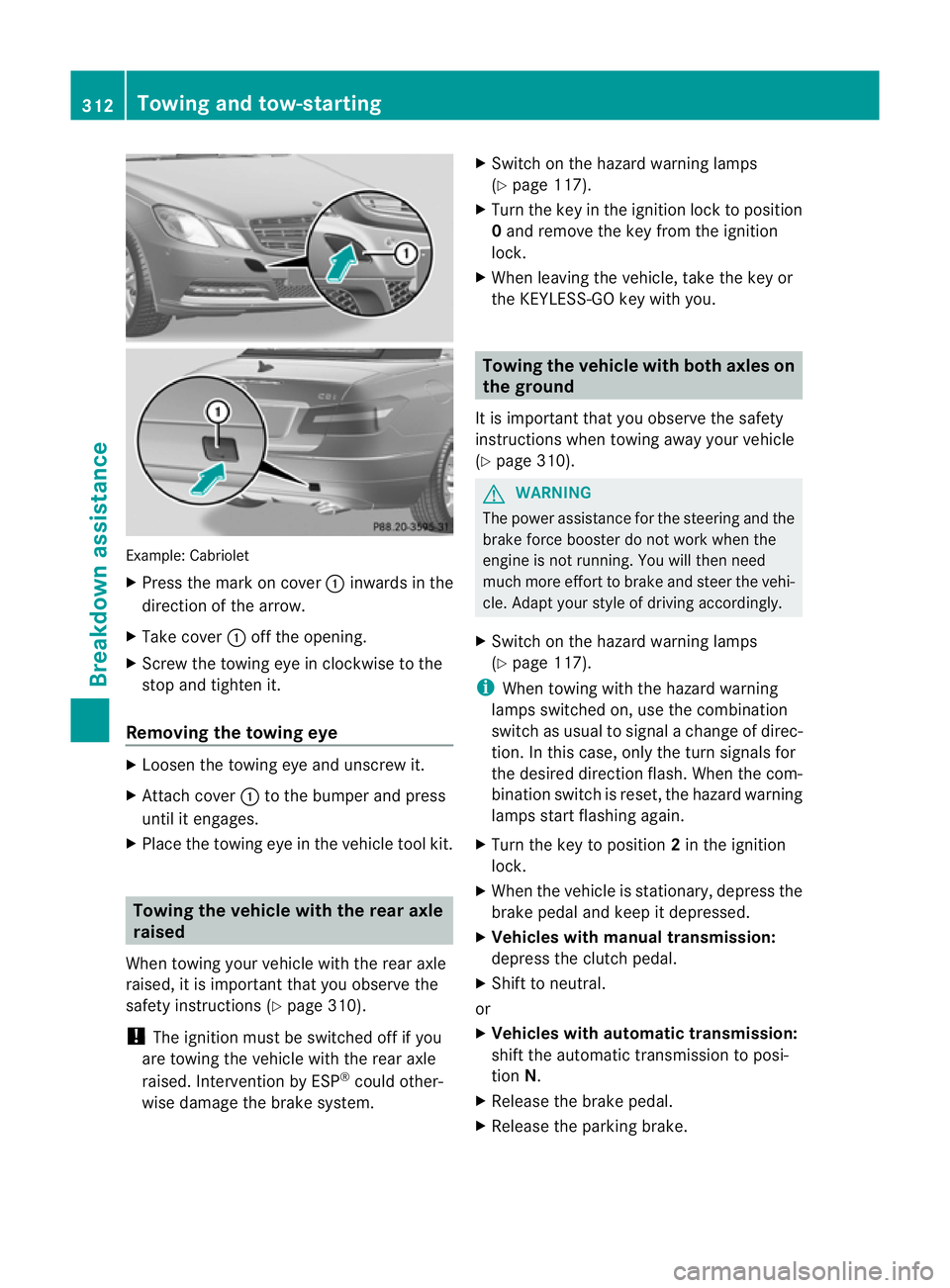
Example: Cabriolet
X
Press the mark on cover :inwards in the
direction of the arrow.
X Take cover :off the opening.
X Screw the towing ey einclockwise to the
stop and tighten it.
Removing the towin geye X
Loosen the towing ey eand unscrew it.
X Attach cover :to the bumpe rand press
unti lite ngages.
X Place the towing ey einthe vehicl etool kit. Towin
gthe vehicle with the rear axle
raised
Whe ntowing your vehicle with the rear axle
raised, it is important that you observe the
safety instructions (Y page 310).
! The ignition must be switched off if you
are towing the vehicle with the rear axle
raised. Intervention by ESP ®
could other-
wise damage the brake system. X
Switch on the hazard warning lamps
(Y page 117).
X Turn the key in the ignition lock to position
0and remove the key from the ignition
lock.
X When leaving the vehicle, take the key or
the KEYLESS-GO key with you. Towing the vehicle with both axles on
the ground
It is important that you observe the safety
instructions when towing away your vehicle
(Y page 310). G
WARNING
The power assistance for the steering and the
brake force booster do not work when the
engine is not running. You will then need
much more effort to brake and steer the vehi-
cle. Adapt your style of driving accordingly.
X Switch on the hazard warning lamps
(Y page 117).
i When towing with the hazard warning
lamps switched on, use the combination
switch as usual to signal achange of direc-
tion. In this case, only the turn signals for
the desired direction flash. When the com-
bination switch is reset, the hazard warning
lamps start flashing again.
X Turn the key to position 2in the ignition
lock.
X When the vehicle is stationary, depress the
brake pedal and keep it depressed.
X Vehicles with manualt ransmission:
depress the clutch pedal.
X Shift to neutral.
or
X Vehicles with automatic transmission:
shift the automatic transmission to posi-
tion N.
X Release the brake pedal.
X Release the parking brake. 312
Towing and tow-startingBreakdown assistance
Page 316 of 353
Transporting the vehicle
The towing eyes or trailer tow hitch can be
used to pull the vehicl eonto atrailer or trans-
porter if yo uwishtot ransport it.
X Vehicle swithm anual transmission:
shift to neutral.
X Vehicle switha utomatic transmission:
tur nthe key to position 2in the ignition
lock.
X Move the selector lever to N.
As soon as the vehicle is loaded:
X Prevent the vehicle from rolling away by
applying the parking brake.
X Vehicles with manualt ransmission:
shift to first gear or reverse gear.
X Vehicles with automatic transmission:
move the selector lever to P.
X Turn the key in the ignition lock to position
0 and remove the key from the ignition
lock.
X Secure the vehicle.
! Only lash the vehicle down by the wheels
or wheel rims, not by parts of the vehicle
such as axle or steering components. Oth-
erwise, the vehicle could be damaged. Tow-starting (emergency engine
starting)
When tow-starting, it is important that you
observe the safety instructions (Y page 310)
and the legal requirements in each respective
country.
! Vehicles with automatic transmission
must not be tow-started. The transmission
may otherwise be damaged.
Before tow-starting the following conditions
must be fulfilled:
R the battery is connected.
R the engine has cooled down.
R the catalytic converters have cooled down. X
Switch on the hazard warning lamps
(Y page 117).
X Fit the towing eye (Y page 311).
X Secure the rigid towing bar or the towing
rope.
X Depress and hold the brake pedal.
X Turn the key to position 2in the ignition
lock.
X Depress the clutch pedal and keep it
depressed.
X Shift to neutral.
X Release the brake pedal.
X Tow-start the vehicle.
X Engage second gear.
X Release the clutch pedal slowly;don ot
operate the accelerator pedal while doing
so.
The engine is started.
X Depress the clutch pedal and shift to neu-
tral.
X Stop at asuitable place.
X Apply the parking brake.
X Remove the rigid towing bar or towing rope.
X Remove the towing eye (Y page 312).
X Switch off the hazard warning lamps. Electrical fuses
Important safety notes
The fuses in your vehicle serve to close down
faulty circuits. If afuse blows ,all th ecom po-
nent sont hecircuit and their function sstop
operating. G
WARNING
Only use fuses that have been approve dfor
Mercedes-Ben zvehicles and which have the
correct fuse ratin gfor the systems con-
cerned. Do not attempt to repair or bridge
faulty fuses. Otherwise, acircuit overload
could cause afire. Have the cause traced and
rectified at aqualified specialist workshop,
e.g. aMercedes-Benz Service Centre. Electrical fuses
313Breakdown assistance Z
Page 334 of 353
H
Environmenta
lnote
Daimler AG also supplies reconditioned
assemblies and part swhicha re of th esame
quality as new parts. For these, th esame war-
ranty applies as for new parts.
Always specify th evehicle identification num-
ber (VIN )(Y page 333) and th eengine num-
ber (Y page 333) when orderin ggenuine
Mercedes-Ben zparts. Vehicle electronics
Tampering with th
eengine electron-
ics G
WARNING
Only have work on th eenginee lectronics and
related component scarried out at aqualified
specialist worksho pwhichh as th enecessary
specialist knowledg eand tools to carry out
th ew ork required .Mercedes-Ben zrecom-
mends that you use aMercedes-Ben zService
Centr efor this purpose. In particular, work
relevant to safety or on safety-related sys-
tems must be carried out at aqualified spe-
cialist workshop. Otherwise, the vehicle's
roadworthiness could be affected.
! Only have maintenanc ework on the
engine electronics and its associated parts,
such as control units, sensor sand connec-
tor leads, carried out at aqualified special-
ist workshop, e.g. aMercedes-Benz Service
Centre. Vehicle componentsm ay other-
wise wear mor equickly and th evehicle's
operatin gpermit may be invalidated. Retrofitting of two-way radios and
mobile phones (RF transmitters)
Use th eTechnical Specification
ISO/TS 21609 35
implementation regulation
when retrofitting RF (radi ofrequency) trans-
mitters. If your vehicle has fittings for two-way radio
equipment, use th
epower supply or aerial
connection sintended for use wit hthe basic
wiring. Be sure to observ ethe manufacturer's
additional instruction swhen installing th efit-
tings.
! Hav eaftermarket radio frequency trans-
mittin gequipmen tinstalled at aquali fied
specialist workshop .Mercedes-Benzr ec-
ommends that you use aMercedes-Benz
Service Centr efor this purpose.
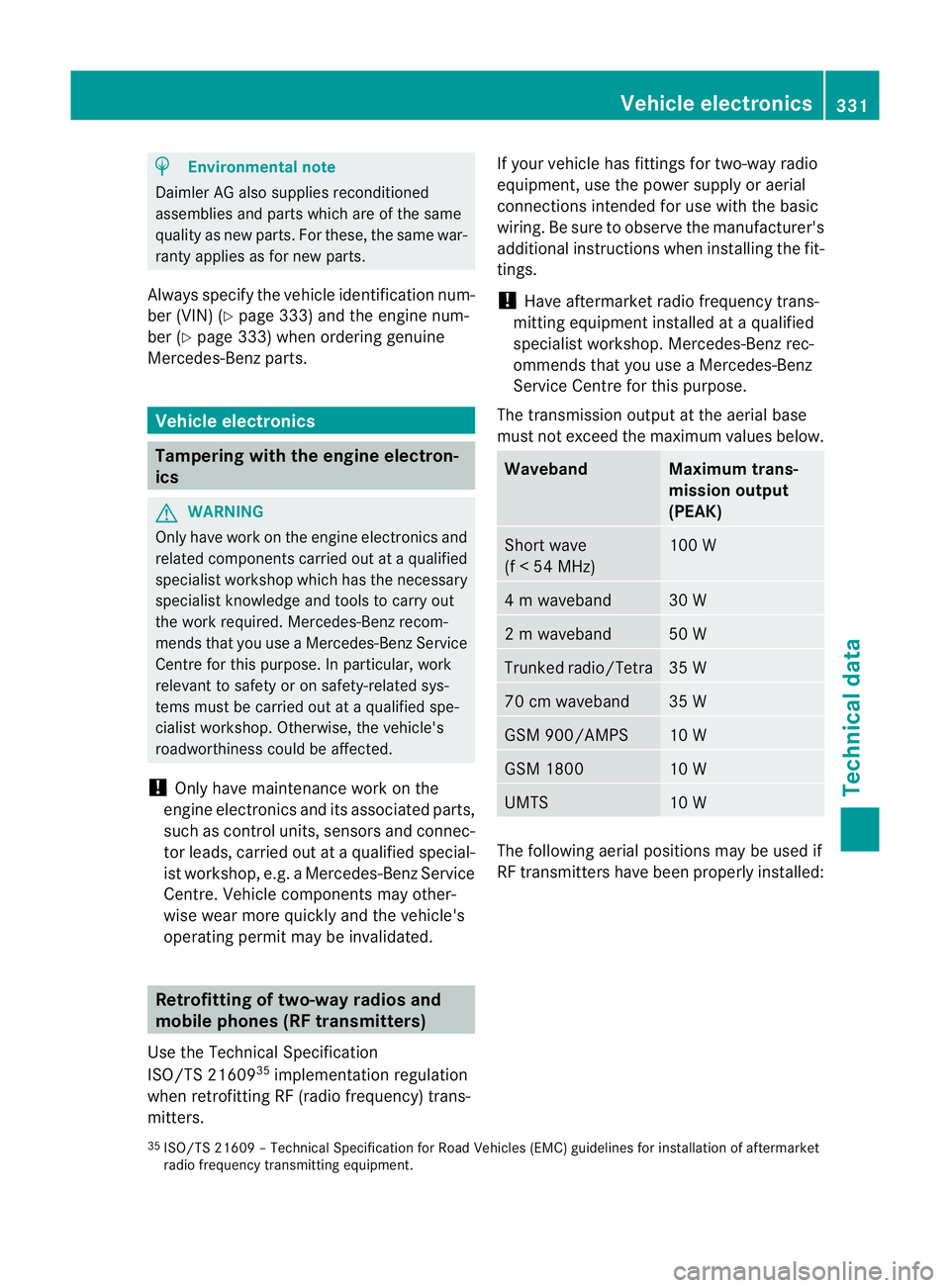
The transmission output at the aerial base
must not exceed the maximum values below. Waveband Maximum trans-
mission output
(PEAK)
Short wave
(f
<54M Hz) 100 W
4mw
aveband 30 W
2mw
aveband 50 W
Trunked radio/Tetra 35 W
70 cm waveband 35 W
GSM 900/AMPS 10 W
GSM 1800 10 W
UMTS 10 W
The following aerial position
smay be used if
RF transmitters have been properly installed:
35 ISO/TS 2160 9–Technical Specification for Road Vehicles (EMC) guidelines for installation of aftermarket
radio frequenc ytransmitting equipment. Vehicle electronics
331Technical data Z
Page 336 of 353
Vehicl
eidentificatio nplates Vehicl
eidentificatio nplate with vehi-
cl ei dentificatio nnumber (VIN) and
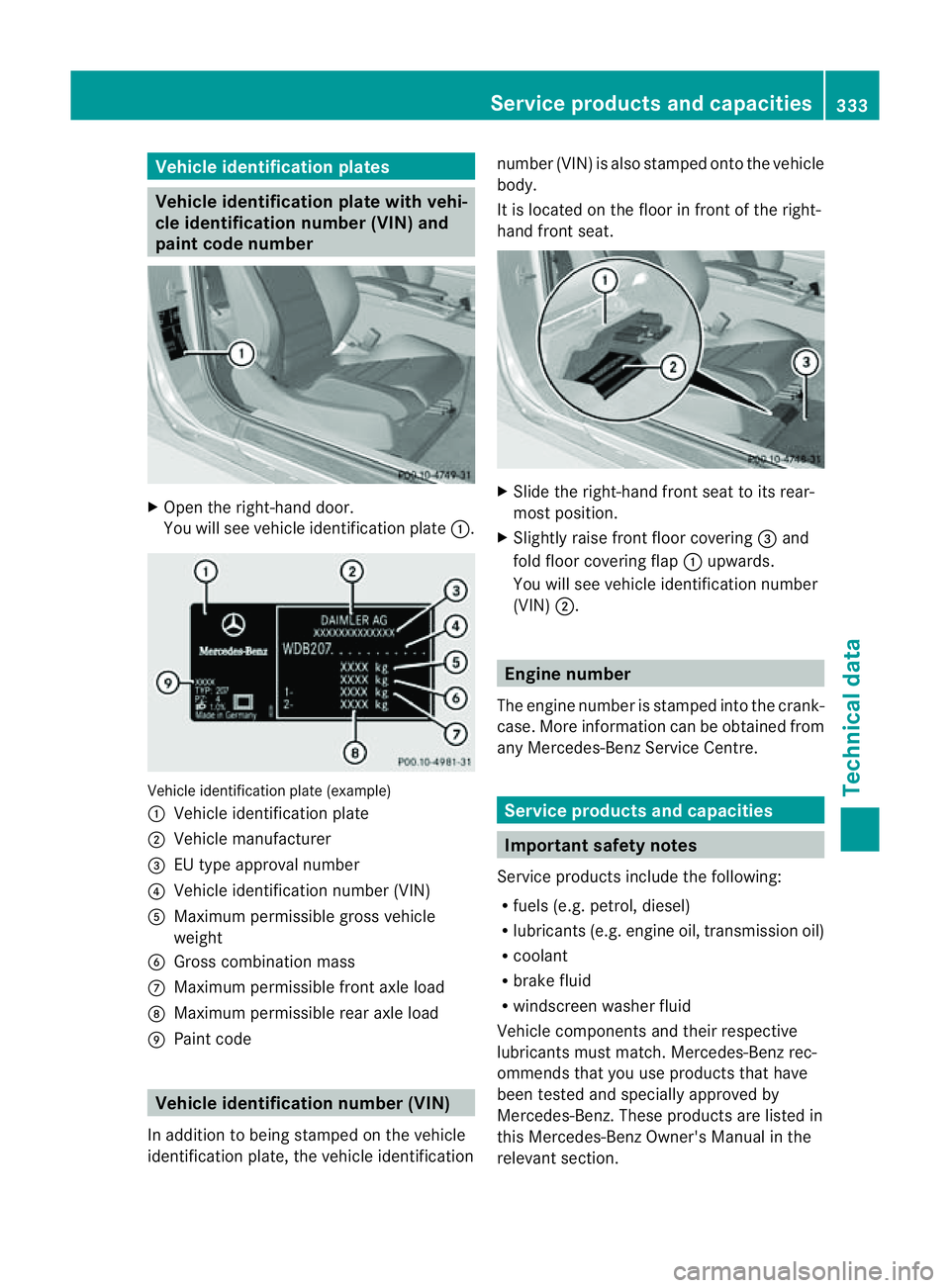
pain tcode number X
Open th eright-han ddoor.
You will see vehicle identification plate :.Vehicle identification plat
e(example)
: Vehicle identification plate
; Vehicle manufacturer
= EU type approval number
? Vehicle identification number (VIN)
A Maximum permissible gross vehicle
weight
B Gros scombinatio nmass
C Maximum permissible fron taxle load
D Maximu mpermissible rear axle load
E Paint code Vehicle identification number (VIN)
In addition to being stamped on the vehicle
identification plate, the vehicle identification number (VIN) is also stamped ontot
he vehicle
body.
It is located on the floor in fron tofthe right-
hand fron tseat. X
Slide the right-hand fron tseat to its rear-
most position.
X Slightly raise fron tfloor covering =and
fold floor coverin gflap :upwards.
You will see vehicle identification number
(VIN) ;. Engine number
The engine number is stamped int othe crank-
case. More information can be obtained from
any Mercedes-Ben zServic eCentre. Service products and capacities
Important safety notes
Servic eproducts include the following:
R fuels (e.g .petrol, diesel)
R lubricant s(e.g. engin eoil, transmission oil)
R coolant
R brake fluid
R windscreen washer fluid
Vehicle componentsa nd their respective
lubricant smust match. Mercedes-Benzr ec-
ommends that you use product sthat have
been tested and specially approved by
Mercedes-Benz.T hese productsare listed in
this Mercedes-BenzO wner's Manual in the
relevant section. Service products and capacities
333Technical data Z
Page 341 of 353
Vehicl
eweigh ts Unlade
nweigh t(in accordance with EU
Directive), manual transmission 42Coupé
Cabriolet
Unlade
nweigh t(in accordance with EC
Directive), automatic transmission 42Coupé
Cabriolet
The unladen weight includes the driver
(68 kg), luggage (7 kg) and al lfluid s(fuel
tank 90% full) .Items of optional equipment
increase the unladen weight and reduc ethe
maximum payload. Maximum roof
load, Coupé only
100 kg
Maximum boot
load
100 kg
Vehicle-specifi
cweight information can be
found on the vehicle identification plate
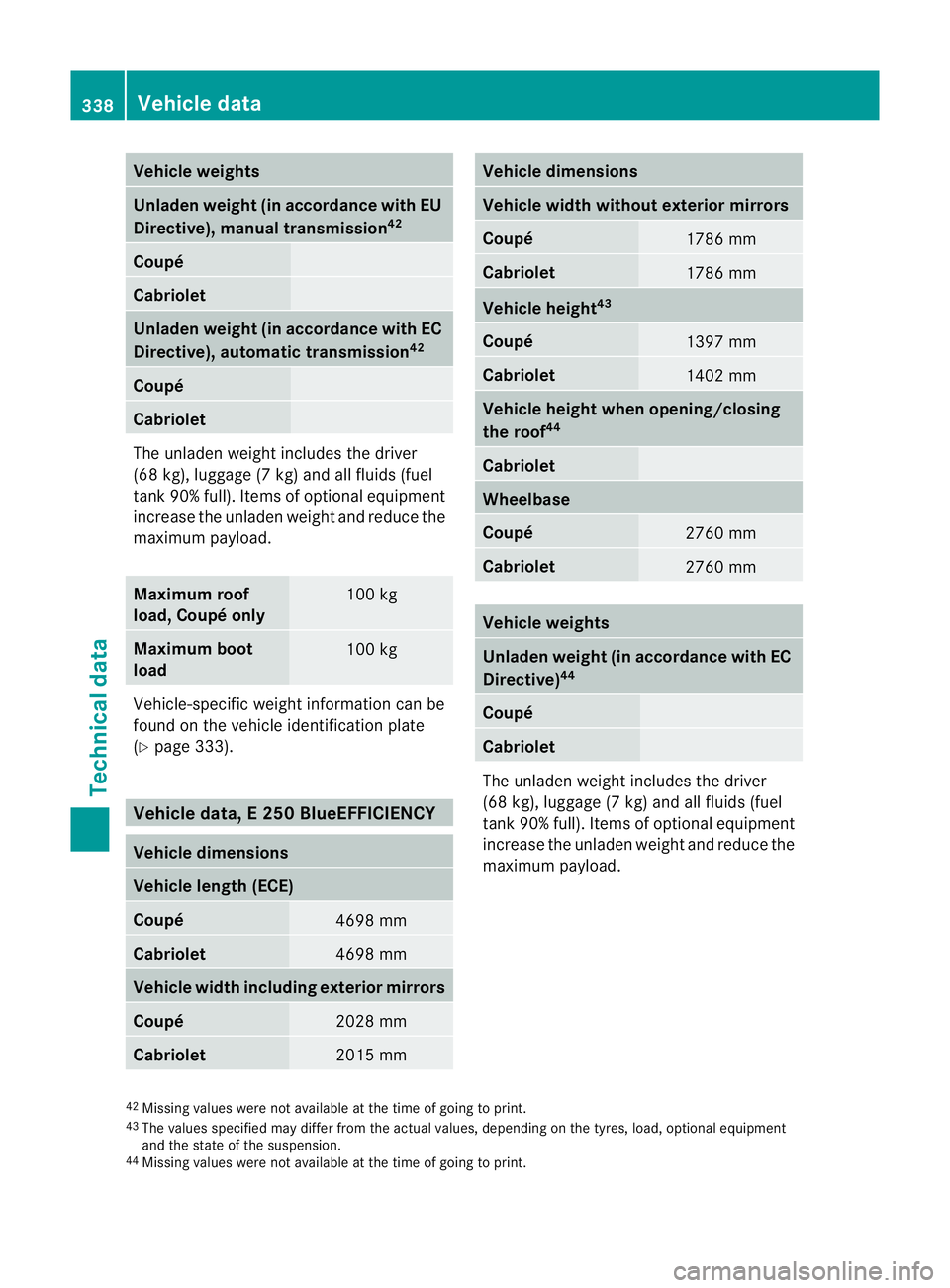
(Y page 333). Vehicle data,
E250 BlueEFFICIENCY Vehicle dimensions
Vehicle length (ECE)
Coupé
4698mm
Cabriolet
4698mm
Vehicle width including exterior mirrors
Coupé
2028mm
Cabriolet
2015mm Vehicle dimensions
Vehicle width without exterior mirrors
Coupé
1786mm
Cabriolet
1786mm
Vehicle height
43 Coupé
1397mm
Cabriolet
1402mm
Vehicle height when opening/closing
the roof
44 Cabriolet
Wheelbase
Coupé
2760mm
Cabriolet
2760mm
Vehicle weights
Unladen weight (in accordance with EC
Directive)
44 Coupé
Cabriolet
The unladen weight includes the driver
(68 kg), luggage (7 kg) and all fluids (fuel
tank 90% full). Item
sofoptional equipment
increase the unladen weight and reduce the
maximum payload. 42
Missing values were not available at the time of going to print.
43 The values specified may differ from the actual values, depending on the tyres, load, optional equipment
and the stat eofthe suspension.
44 Missing values were not available at the time of going to print. 338
Vehicle dataTechnical data
Page 344 of 353
Vehicl
eweigh ts Cabriolet
The unladen weight includes the driver
(68 kg), luggage (7 kg) and al
lfluid s(fuel
tank 90% full) .Items of optional equipment
increase the unladen weight and reduc ethe
maximum payload. Maximum roof
load, Coupé only
100 kg
Maximum boot
load
100 kg
Vehicle-specifi
cweight information can be
found on the vehicle identification plate
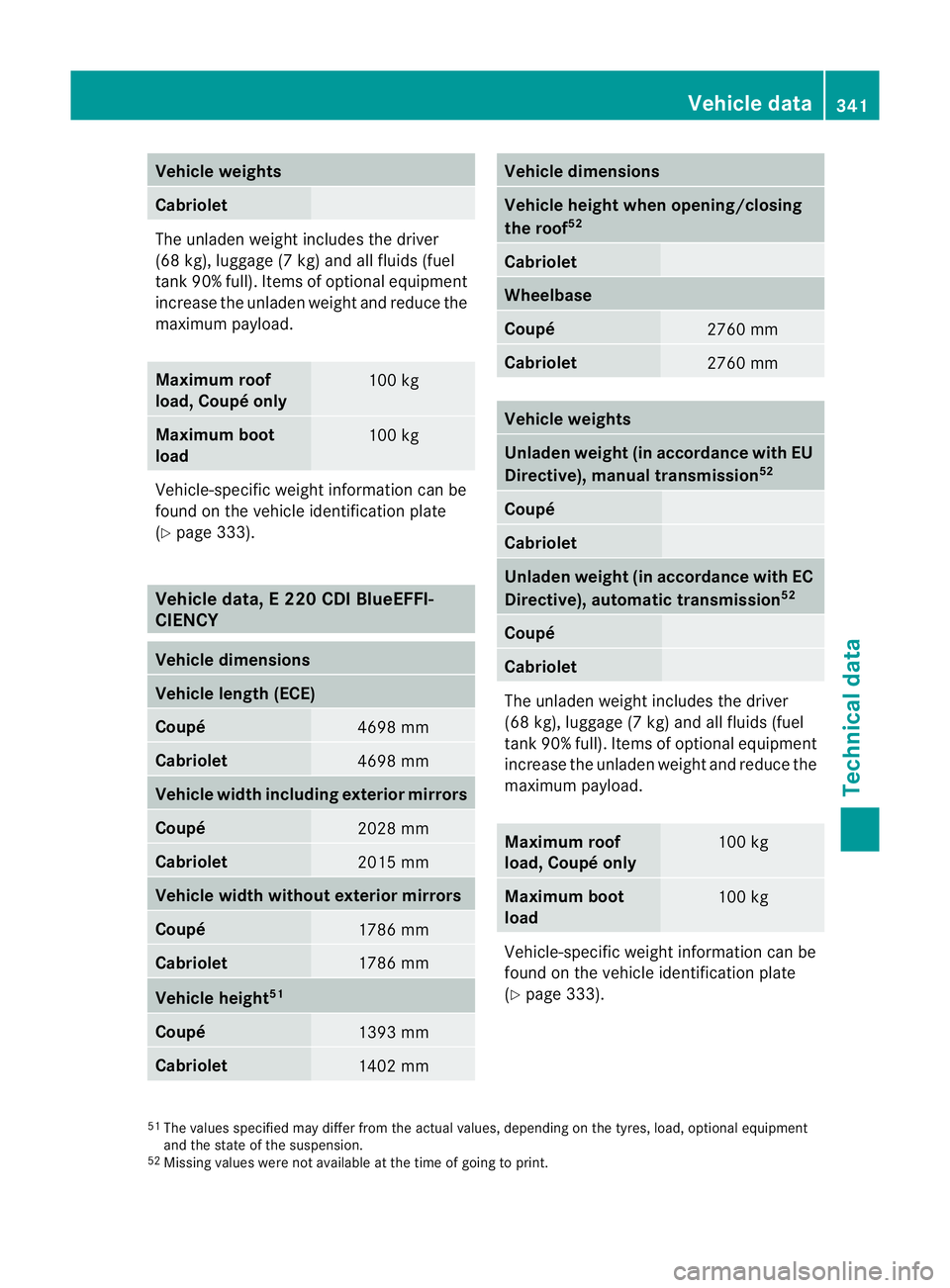
(Y page 333). Vehicle data,
E220 CDI BlueEFFI-
CIENCY Vehicle dimensions
Vehicle length (ECE)
Coupé
4698mm
Cabriolet
4698mm
Vehicle width including exterior mirrors
Coupé
2028mm
Cabriolet
2015mm
Vehicle width without exterior mirrors
Coupé
1786mm
Cabriolet
1786mm
Vehicle height
51 Coupé
1393mm
Cabriolet
1402mm Vehicle dimensions
Vehicle height when opening/closing
the roof
52 Cabriolet
Wheelbase
Coupé
2760mm
Cabriolet
2760mm
Vehicle weights
Unladen weight (in accordance with EU
Directive), manual transmission
52 Coupé
Cabriolet
Unladen weight (in accordance with EC
Directive), automatic transmission
52 Coupé
Cabriolet
The unladen weight includes the driver
(68 kg), luggage (7 kg) and all fluids (fuel
tank 90% full). Item
sofoptional equipment
increase the unladen weight and reduce the
maximum payload. Maximum roof
load, Coupé only
100 kg
Maximum boot
load
100 kg
Vehicle-specific weight information can be
found on the vehicle identification plate
(Y page 333). 51
The values specified may differ from the actual values, depending on the tyres, load, optional equipment
and the stat eofthe suspension.
52 Missing values were not available at the time of going to print. Vehicle data
341Technical data Z
Page 345 of 353
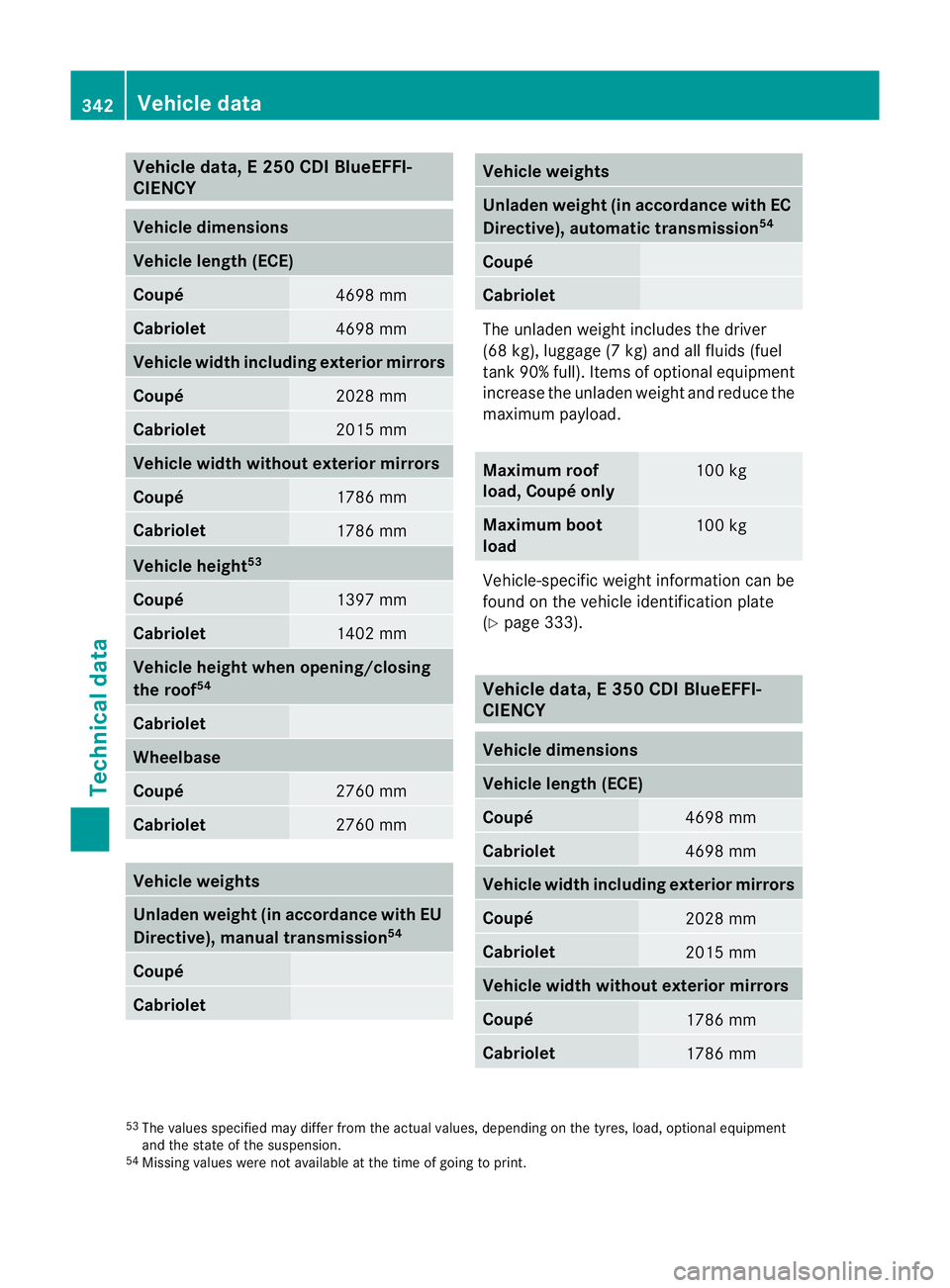
Vehicl
edata, E250 CDI BlueEFFI-
CIENCY Vehicle dimensions
Vehicle length (ECE)
Coupé
4698 mm
Cabriolet
4698 mm
Vehicle width including exterior mirrors
Coupé
2028 mm
Cabriolet
2015 mm
Vehicle width withou
texterior mirrors Coupé
1786 mm
Cabriolet
1786 mm
Vehicle height
53 Coupé
1397 mm
Cabriolet
1402 mm
Vehicle height when opening/closing
th
er oof 54 Cabriolet
Wheelbase
Coupé
2760 mm
Cabriolet
2760 mm
Vehicle weights
Unladen weigh
t(in accordance with EU
Directive), manual transmission 54Coupé
Cabriolet Vehicle weights
Unladen weight (in accordance with EC
Directive), automatic transmission
54 Coupé
Cabriolet
The unladen weight includes the driver
(68 kg), luggage (7 kg) and all fluids (fuel
tan
k90% full). Items of optional equipment
increase the unladen weight and reduce the
maximum payload. Maximum roof
load, Coupé only
100 kg
Maximum boot
load
100 kg
Vehicle-specifi
cweight information can be
found on the vehicle identification plate
(Y page 333). Vehicle data,
E350 CDI BlueEFFI-
CIENCY Vehicle dimensions
Vehicle length (ECE)
Coupé
4698mm
Cabriolet
4698mm
Vehicle width including exterior mirrors
Coupé
2028mm
Cabriolet
2015mm
Vehicle width without exterior mirrors
Coupé
1786mm
Cabriolet
1786mm
53
The values specified may differ from the actual values, depending on the tyres, load, optional equipment
and the stat eofthe suspension.
54 Missing values were not available at the time of going to print. 342
Vehicle dataTechnical data
Page 348 of 353
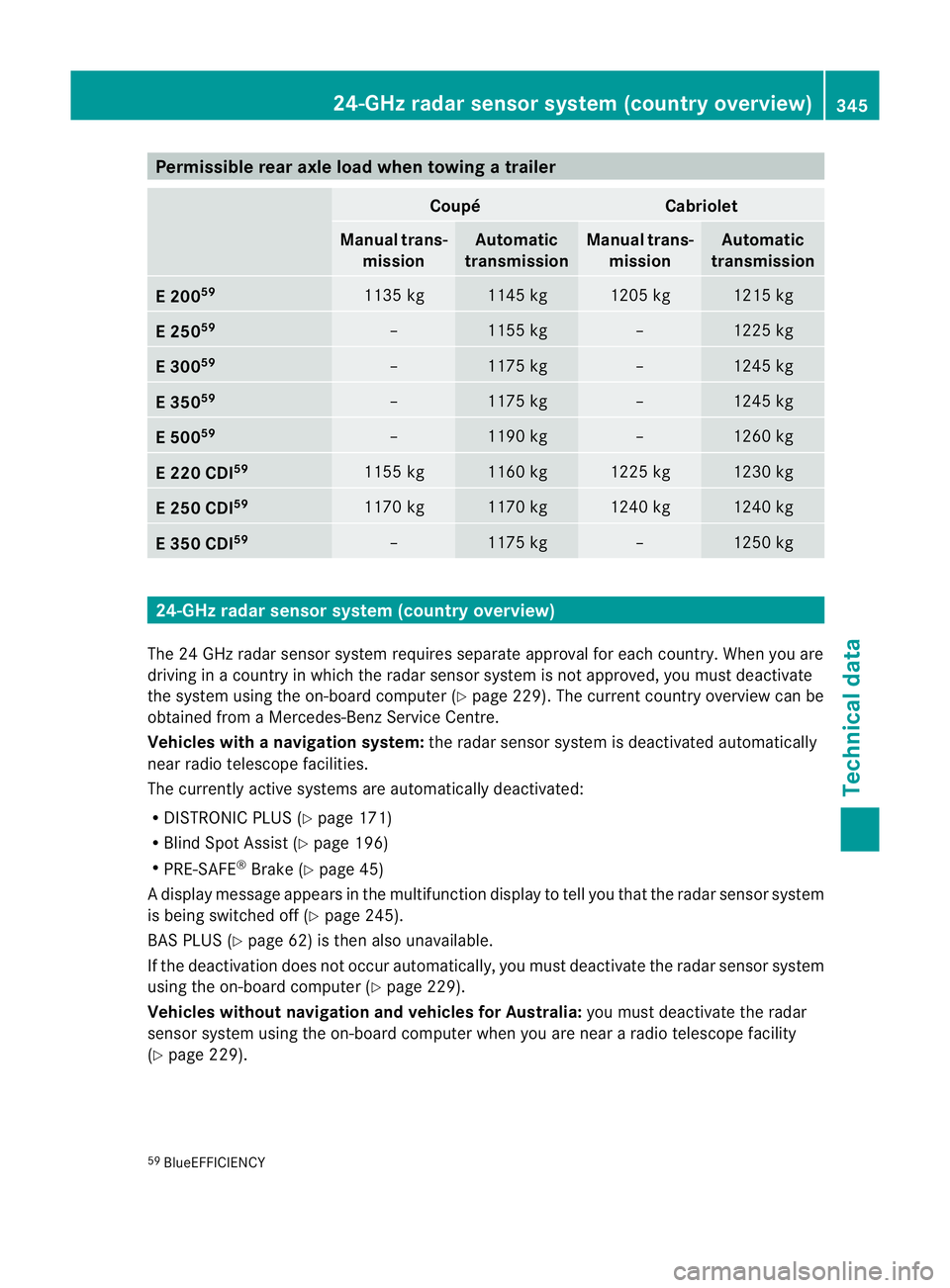
Permissible rear axle load when towing
atrailer Coupé Cabriolet
Manual trans-
mission Automatic
transmission Manual trans-
mission Automatic
transmission E2
0059 1135 kg 1145 kg 1205 kg 1215 kg
E2
5059 – 1155 kg – 1225 kg
E3
0059 – 1175 kg – 1245 kg
E3
5059 – 1175 kg – 1245 kg
E5
0059 – 1190 kg – 1260 kg
E2
20 CDI 59 1155 kg 1160 kg 1225 kg 1230 kg
E2
50 CDI 59 1170 kg 1170 kg 1240 kg 1240 kg
E3
50 CDI 59 – 1175 kg – 1250 kg
24-GHz radar sensor syste
m(coun try overview)
Th e24G Hz radar sensor system requires separate approval for each country. When you are
driving in acountry in whic hthe radar sensor system is no tapproved, you must deactivate
the system using the on-board computer (Y page 229). The currentcountry overview can be
obtaine dfrom aMercedes-Benz Service Centre.
Vehicles with anavigation system: the radar sensor system is deactivated automatically
near radio telescope facilities.
The currently active systems are automatically deactivated:
R DISTRONI CPLUS (Y page171)
R Blind Spot Assist (Y page196)
R PRE-SAFE ®
Brake (Y page45)
Ad isplay message appears in the multifunction display to tell you that the radar sensor system
is being switched off (Y page 245).
BA SP LUS (Y page 62) is the nalso unavailable.
If the deactivation does not occur automatically, you must deactivat ethe radar sensor system
using the on-board computer (Y page 229).
Vehicles withou tnavigation and vehicles for Australia: you must deactivate the radar
sensor system using the on-board computer whe nyou are near aradio telescope facility
(Y page 229).
59 BlueEFFICIENCY 24-GHz radar sensor system (countryo
verview)
345Technical data Z