automatic transmission MERCEDES-BENZ E-CLASS ESTATE 2012 Workshop Manual
[x] Cancel search | Manufacturer: MERCEDES-BENZ, Model Year: 2012, Model line: E-CLASS ESTATE, Model: MERCEDES-BENZ E-CLASS ESTATE 2012Pages: 457, PDF Size: 11.62 MB
Page 377 of 457
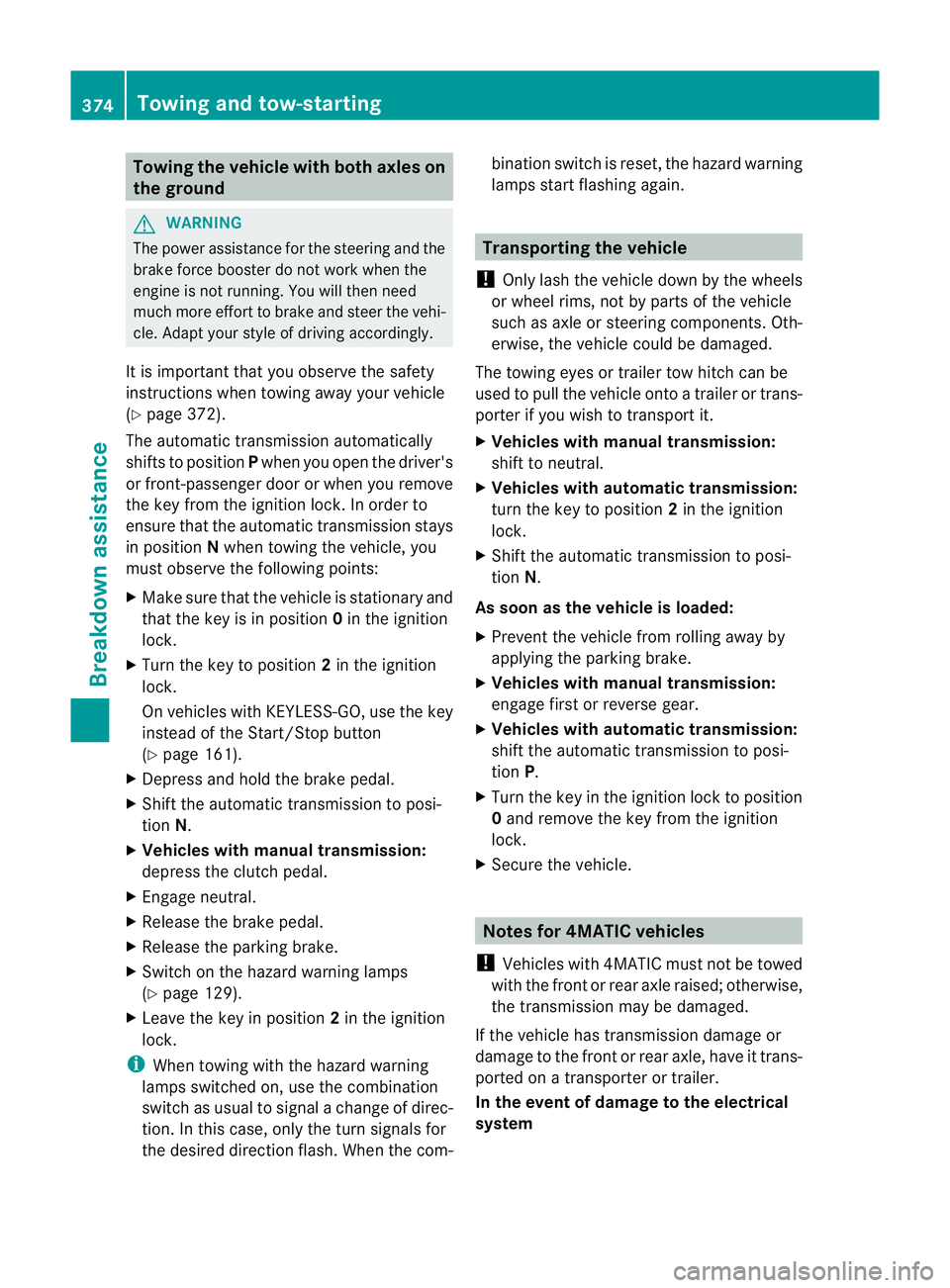
Towing the vehicle with both axles on
the ground
G
WARNING
The powe rassistance for the steering and the
brake force booster do not work when the
engine is not running. You will then need
much more effort to brake and steer the vehi-
cle. Adapt your style of driving accordingly.
It is important that you observe the safety
instructions when towing away your vehicle
(Y page 372).
The automatic transmission automatically
shifts to position Pwhen you open the driver's
or front-passenger door or when you remove
the key from the ignition lock. In order to
ensure that the automatic transmission stays
in position Nwhen towing the vehicle, you
must observe the following points:
X Make sure that the vehicle is stationary and
that the key is in position 0in the ignition
lock.
X Turn the key to position 2in the ignition
lock.
On vehicles with KEYLESS-GO, use the key
instead of the Start/Stop button
(Y page 161).
X Depress and hold the brake pedal.
X Shift the automatic transmission to posi-
tion N.
X Vehicles with manual transmission:
depress the clutch pedal.
X Engage neutral.
X Release the brake pedal.
X Release the parking brake.
X Switch on the hazard warning lamps
(Y page 129).
X Leave the key in position 2in the ignition
lock.
i When towing with the hazard warning
lamps switched on, use the combination
switch as usual to signal achange of direc-
tion. In this case, only the turn signals for
the desired direction flash. When the com- bination switch is reset, the hazard warning
lamps start flashing again. Transporting the vehicle
! Only lash the vehicle down by the wheels
or wheel rims, not by parts of the vehicle
such as axle or steering components. Oth-
erwise, the vehicle could be damaged.
The towing eyes or trailer tow hitch can be
used to pull the vehicle onto a trailer or trans-
porter if you wish to transport it.
X Vehicles with manual transmission:
shift to neutral.
X Vehicles with automatic transmission:
turn the key to position 2in the ignition
lock.
X Shift the automatic transmission to posi-
tion N.
As soon as the vehicle is loaded:
X Prevent the vehicle from rolling away by
applying the parking brake.
X Vehicles with manual transmission:
engage first or reverse gear.
X Vehicles with automatic transmission:
shift the automatic transmission to posi-
tion P.
X Turn the key in the ignition lock to position
0and remove the key from the ignition
lock.
X Secure the vehicle. Notes for 4MATIC vehicles
! Vehicles with 4MATIC must not be towed
with the front or rear axle raised; otherwise,
the transmission may be damaged.
If the vehicle has transmission damage or
damage to the front or rear axle, have it trans-
ported on a transporter or trailer.
In the event of damage to the electrical
system 374
Towing and tow-startingBreakdown assistance
Page 378 of 457
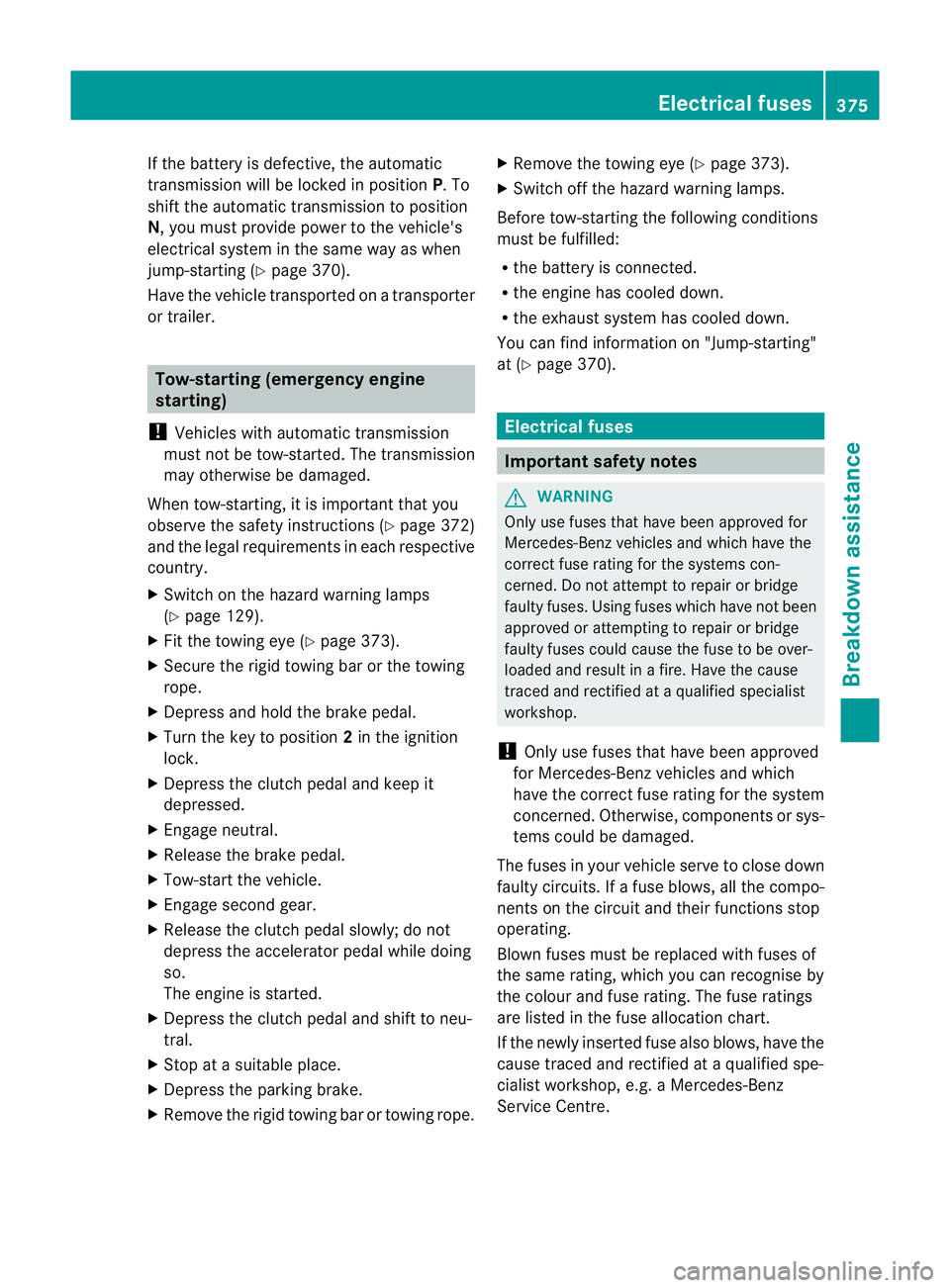
If the battery is defective, the automatic
transmission will be locked in position P. To
shift the automatic transmission to position
N, you must provide powert o the vehicle's
electrical system in the same way as when
jump-starting (Y page 370).
Have the vehicle transported on a transporter
or trailer. Tow-starting (emergency engine
starting)
! Vehicles with automatic transmission
must not be tow-started. The transmission
may otherwise be damaged.
When tow-starting, it is important that you
observe the safety instructions (Y page 372)
and the legal requirements in each respective
country.
X Switch on the hazard warning lamps
(Y page 129).
X Fit the towing eye (Y page 373).
X Secure the rigid towing bar or the towing
rope.
X Depress and hold the brake pedal.
X Turn the key to position 2in the ignition
lock.
X Depress the clutch pedal and keep it
depressed.
X Engage neutral.
X Release the brake pedal.
X Tow-start the vehicle.
X Engage second gear.
X Release the clutch pedal slowly; do not
depress the accelerator pedal while doing
so.
The engine is started.
X Depress the clutch pedal and shift to neu-
tral.
X Stop at a suitable place.
X Depress the parking brake.
X Remove the rigid towing bar or towing rope. X
Remove the towing eye (Y page 373).
X Switch off the hazard warning lamps.
Before tow-starting the following conditions
must be fulfilled:
R the battery is connected.
R the engine has cooled down.
R the exhaust system has cooled down.
You can find information on "Jump-starting"
at (Y page 370). Electrical fuses
Important safety notes
G
WARNING
Only use fuses that have been approved for
Mercedes-Benz vehicles and which have the
correct fuse rating for the systems con-
cerned. Do not attempt to repair or bridge
faulty fuses. Using fuses which have not been
approved or attempting to repair or bridge
faulty fuses could cause the fuse to be over-
loaded and result in a fire. Have the cause
traced and rectified at a qualified specialist
workshop.
! Only use fuses that have been approved
for Mercedes-Benz vehicles and which
have the correc tfuse rating for the system
concerned. Otherwise, components or sys-
tems could be damaged.
The fuses in your vehicle serve to close down
faulty circuits. If afuse blows, all the compo-
nents on the circuit and their functions stop
operating.
Blown fuses must be replace dwith fuses of
the same rating, which you can recognise by
the colour and fuse rating. The fuse ratings
are listed in the fuse allocation chart.
If the newly inserted fuse also blows, have the
cause traced and rectified at a qualified spe-
cialist workshop, e.g. a Mercedes-Benz
Service Centre. Electrical fuses
375Breakdown assistance Z
Page 451 of 457
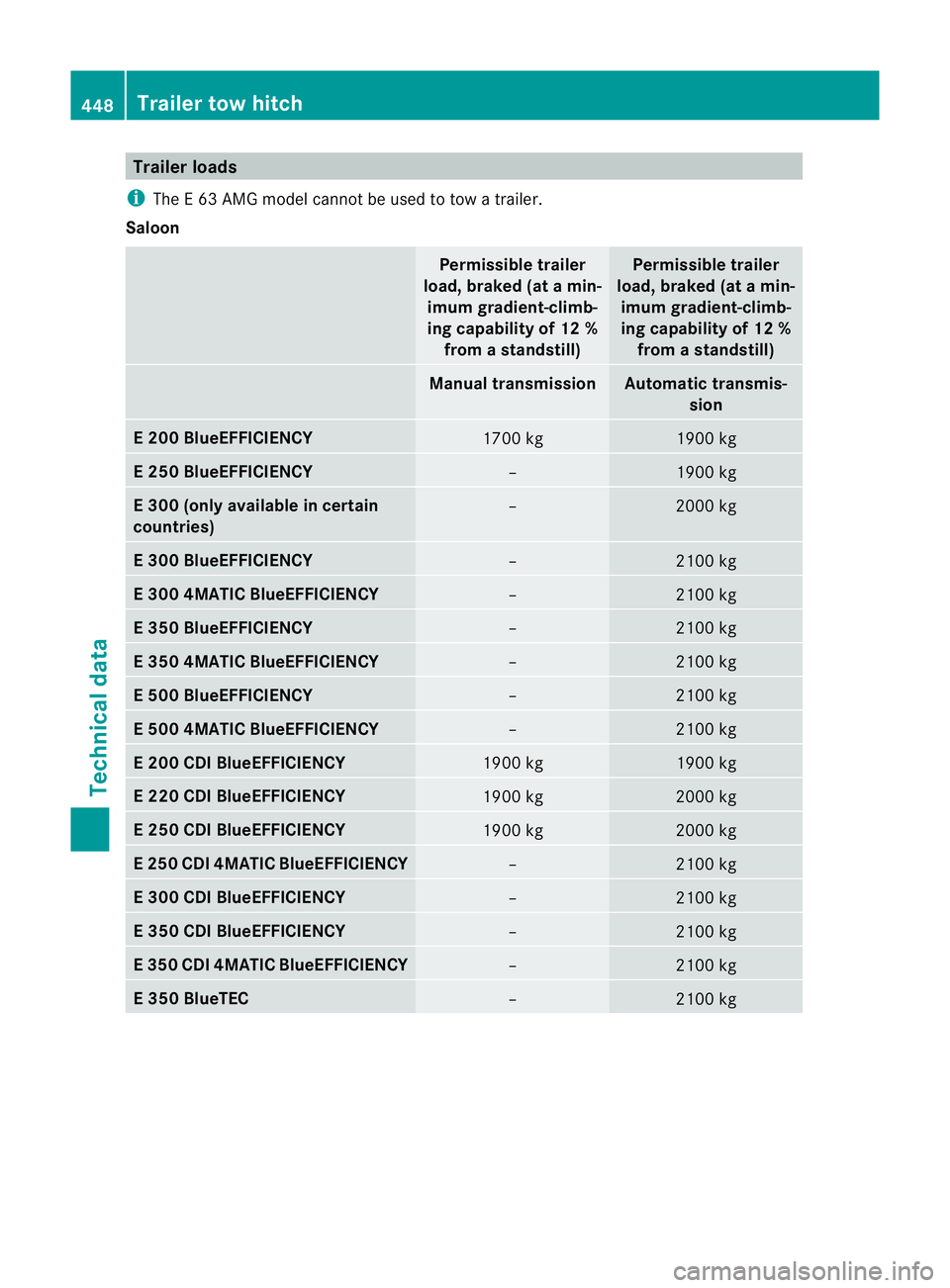
Trailer loads
i The E63A MG model cannot be used to tow a trailer.
Saloon Permissible trailer
load, braked (at a min- imum gradient-climb-
ing capability of 12 % from a standstill) Permissible trailer
load, braked (at a min- imum gradient-climb-
ing capability of 12 % from a standstill) Manual transmission Automatic transmis-
sion E 200 BlueEFFICIENCY
1700 kg 1900 kg
E 250 BlueEFFICIENCY
– 1900 kg
E 300 (only available in certain
countries)
– 2000 kg
E 300 BlueEFFICIENCY
– 2100 kg
E 300 4MATIC BlueEFFICIENCY
– 2100 kg
E 350 BlueEFFICIENCY
– 2100 kg
E 350 4MATIC BlueEFFICIENCY
– 2100 kg
E 500 BlueEFFICIENCY
– 2100 kg
E 500 4MATIC BlueEFFICIENCY
– 2100 kg
E 200 CDI BlueEFFICIENCY
1900 kg 1900 kg
E 220 CDI BlueEFFICIENCY
1900 kg 2000 kg
E 250 CDI BlueEFFICIENCY
1900 kg 2000 kg
E 250 CDI 4MATIC BlueEFFICIENCY
– 2100 kg
E 300 CDI BlueEFFICIENCY
– 2100 kg
E 350 CDI BlueEFFICIENCY
– 2100 kg
E 350 CDI 4MATIC BlueEFFICIENCY
– 2100 kg
E 350 BlueTEC
– 2100 kg448
Trailer tow hitchTechnical data
Page 452 of 457
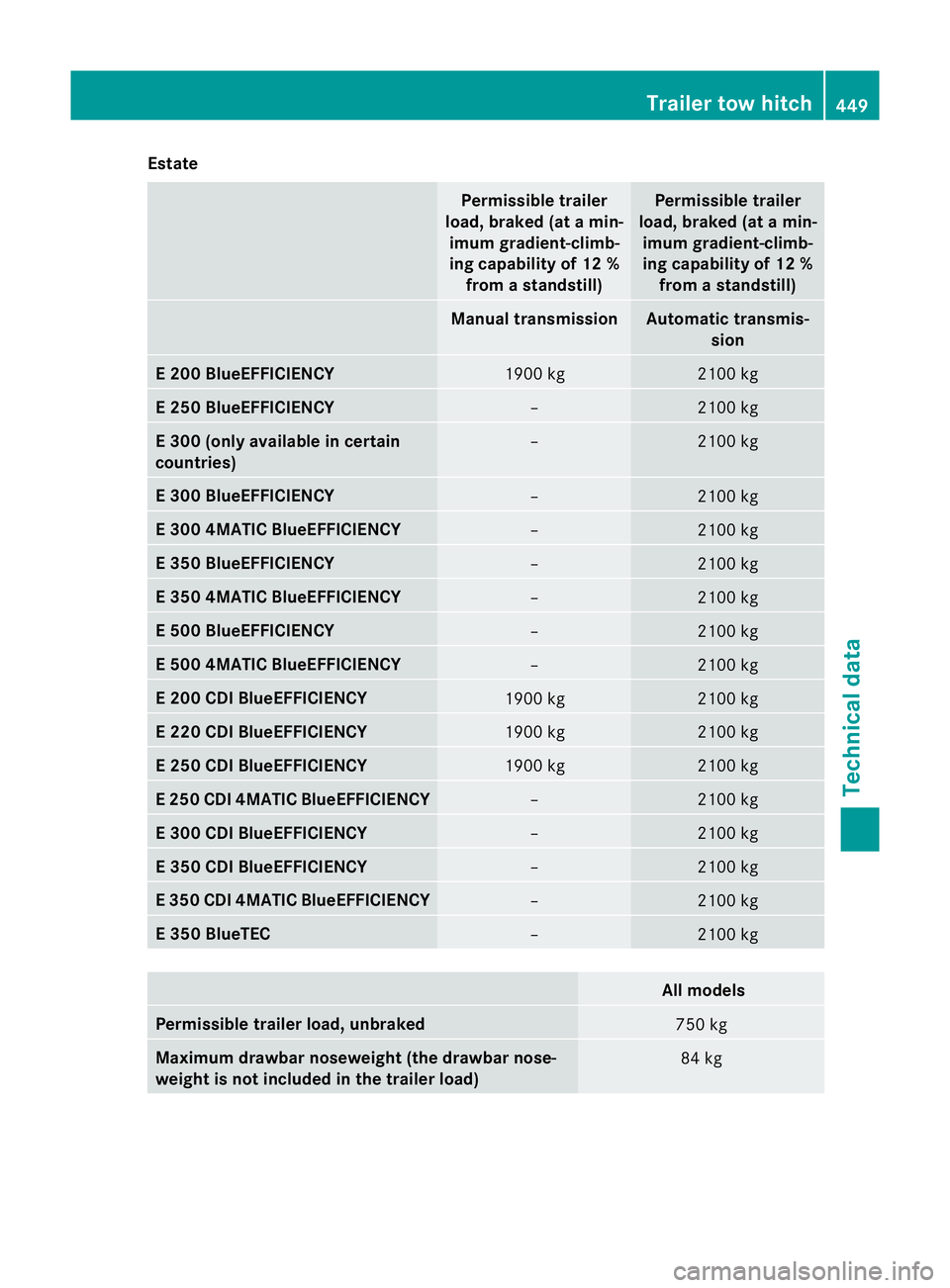
Estate
Permissible trailer
load, braked (at a min- imum gradient-climb-
ing capability of 12 % from a standstill) Permissible trailer
load, braked (at a min- imum gradient-climb-
ing capability of 12 % from a standstill) Manual transmission Automatic transmis-
sion E 200 BlueEFFICIENCY
1900 kg 2100 kg
E 250 BlueEFFICIENCY
– 2100 kg
E 300 (only available in certain
countries)
– 2100 kg
E 300 BlueEFFICIENCY
– 2100 kg
E 300 4MATIC BlueEFFICIENCY
– 2100 kg
E 350 BlueEFFICIENCY
– 2100 kg
E 350 4MATIC BlueEFFICIENCY
– 2100 kg
E 500 BlueEFFICIENCY
– 2100 kg
E 500 4MATIC BlueEFFICIENCY
– 2100 kg
E 200 CDI BlueEFFICIENCY
1900 kg 2100 kg
E 220 CDI BlueEFFICIENCY
1900 kg 2100 kg
E 250 CDI BlueEFFICIENCY
1900 kg 2100 kg
E 250 CDI 4MATIC BlueEFFICIENCY
– 2100 kg
E 300 CDI BlueEFFICIENCY
– 2100 kg
E 350 CDI BlueEFFICIENCY
– 2100 kg
E 350 CDI 4MATIC BlueEFFICIENCY
– 2100 kg
E 350 BlueTEC
– 2100 kg
All models
Permissible trailer load
,unbraked 750 kg
Maximum drawbar noseweight (the drawbar nose-
weight is not included in the trailer load) 84 kgTrailer tow hitch
449Technical data Z
Page 453 of 457
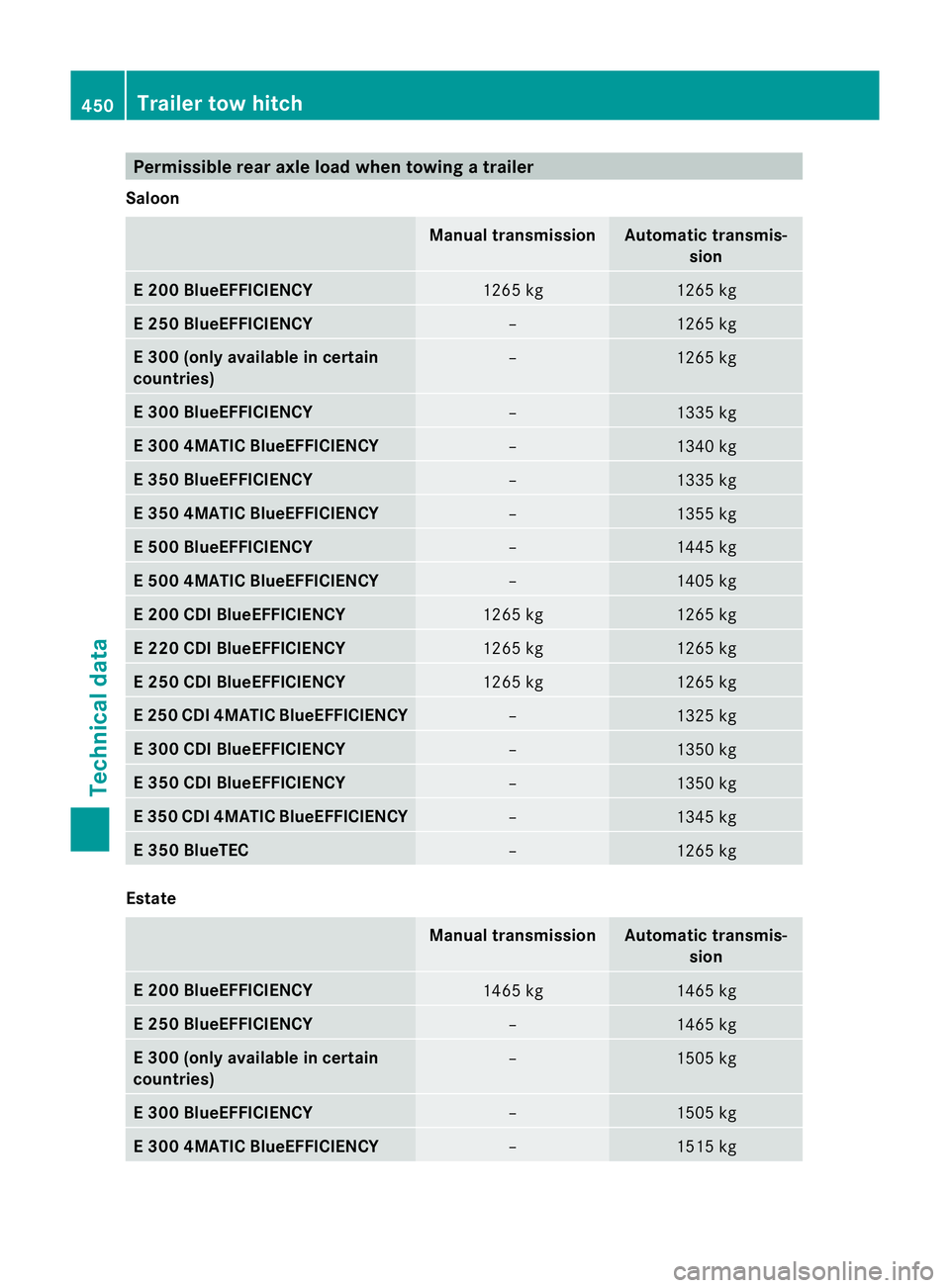
Permissible rear axle load when towing
atrailer
Saloon Manual transmission Automatic transmis-
sion E 200 BlueEFFICIENCY
1265 kg 1265 kg
E 250 BlueEFFICIENCY
– 1265 kg
E 300 (onl
yavailable in certain
countries) – 1265 kg
E 300 BlueEFFICIENCY
– 1335 kg
E 300 4MATIC BlueEFFICIENCY
– 1340 kg
E 350 BlueEFFICIENCY
– 1335 kg
E 350 4MATIC BlueEFFICIENCY
– 1355 kg
E 500 BlueEFFICIENCY
– 1445 kg
E 500 4MATIC BlueEFFICIENCY
– 1405 kg
E 200 CDI BlueEFFICIENCY
1265 kg 1265 kg
E 220 CDI BlueEFFICIENCY
1265 kg 1265 kg
E 250 CDI BlueEFFICIENCY
1265 kg 1265 kg
E 250 CDI 4MATIC BlueEFFICIENCY
– 1325 kg
E 300 CDI BlueEFFICIENCY
– 1350 kg
E 350 CDI BlueEFFICIENCY
– 1350 kg
E 350 CDI 4MATIC BlueEFFICIENCY
– 1345 kg
E 350 BlueTEC
– 1265 kg
Estate
Manual transmission Automatic transmis-
sion E 200 BlueEFFICIENCY
1465 kg 1465 kg
E 250 BlueEFFICIENCY
– 1465 kg
E 300 (only available in certain
countries)
– 1505 kg
E 300 BlueEFFICIENCY
– 1505 kg
E 300 4MATIC BlueEFFICIENCY
– 1515 kg450
Trailer tow hitchTechnical data
Page 454 of 457
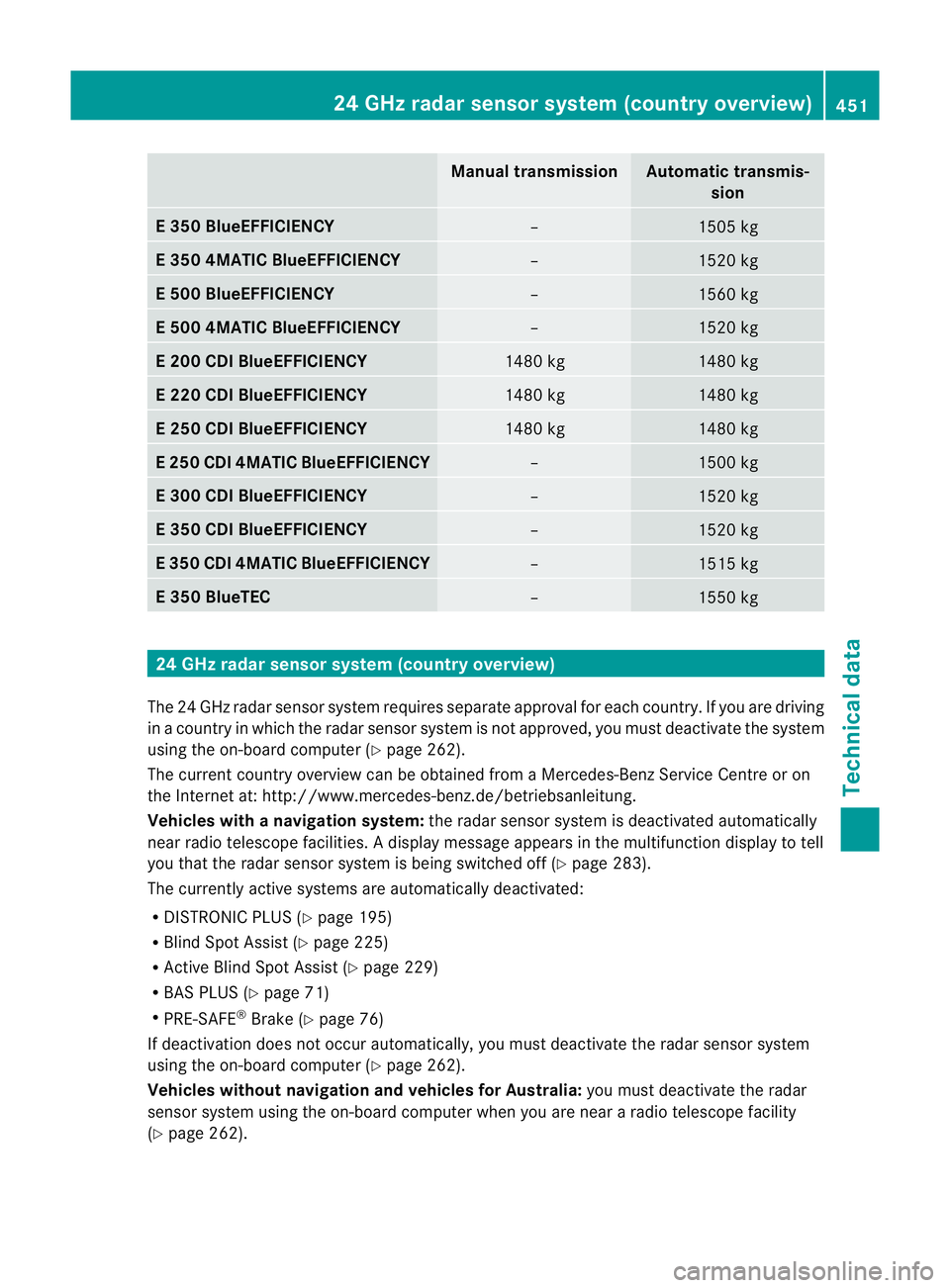
Manual transmission Automatic transmis-
sion E 350 BlueEFFICIENCY
– 1505 kg
E 350 4MATIC BlueEFFICIENCY
– 1520 kg
E 500 BlueEFFICIENCY
– 1560 kg
E 500 4MATIC BlueEFFICIENCY
– 1520 kg
E 200 CDI BlueEFFICIENCY
1480 kg 1480 kg
E 220 CDI BlueEFFICIENCY
1480 kg 1480 kg
E 250 CDI BlueEFFICIENCY
1480 kg 1480 kg
E 250 CDI 4MATIC BlueEFFICIENCY
– 1500 kg
E 300 CDI BlueEFFICIENCY
– 1520 kg
E 350 CDI BlueEFFICIENCY
– 1520 kg
E 350 CDI 4MATIC BlueEFFICIENCY
– 1515 kg
E 350 BlueTEC
– 1550 kg
24 GHz radar sensor system (country overview)
The 24 GHz rada rsensor system requires separate approval for each country. If you are driving
in a country in which the radar sensor system is not approved, you must deactivate the system
using the on-board computer (Y page 262).
The current country overview can be obtained from a Mercedes-Benz Service Centre or on
the Internet at: http://www.mercedes-benz.de/betriebsanleitung.
Vehicles with anavigation system: the radar sensor system is deactivated automatically
near radio telescope facilities. Adisplay message appears in the multifunction display to tell
you that the radar sensor system is being switched off (Y page 283).
The currently active systems are automatically deactivated:
R DISTRONIC PLUS (Y page 195)
R Blind Spot Assist (Y page 225)
R Active Blind Spot Assist (Y page 229)
R BAS PLUS (Y page 71)
R PRE-SAFE ®
Brake (Y page 76)
If deactivation does not occur automatically, you must deactivate the radar sensor system
using the on-board computer (Y page 262).
Vehicles withou tnavigation and vehicles for Australia: you must deactivate the radar
sensor system using the on-board computer whe nyou are near a radio telescope facility
(Y page 262). 24 GHz radar sensor system (country overview)
451Technical data Z