radio MERCEDES-BENZ E-CLASS SALOON 2008 User Guide
[x] Cancel search | Manufacturer: MERCEDES-BENZ, Model Year: 2008, Model line: E-CLASS SALOON, Model: MERCEDES-BENZ E-CLASS SALOON 2008Pages: 401, PDF Size: 6.89 MB
Page 235 of 401
Tyres and wheels
232Restart Run Flat Indicator?
Yes Cancel
disappears.
The tyre pressure values stored at the last
restart will continue to be monitored. Checking the tyre pressure electroni-
cally*
The tyre pressure monitor only functions if
the correct wheel electronics are fitted to all
wheels. These monitor the pressure in all four
tyres, which you have set when restarting the
tyre pressure monitor. The monitor warns you
when the pressure drops in one or more of
the tyres. G
Risk of accident
The tyre pressure monitor does not warn
you of an incorrectly set tyre pressure. The
table on the inside of the fuel filler flap will
help you decide whether the tyre pressures
should be corrected.
The tyre pressure monitor is not able to
warn you of a sudden loss of pressure, e.g.
if the tyre is penetrated by a foreign object.
In the event of a sudden loss of pressure,
bring the vehicle to a halt by braking care-
fully. Do not make any sudden steering
movements when doing so. i
The operation of the tyre pressure moni-
tor can be affected by interference from
radio transmitting equipment (e.g. radio
headphones, two-way radios) that may be
being operated in or near the vehicle.
i If you are carrying a deflated tyre in the
vehicle, you may only reactivate the tyre
pressure monitor if:
R the deflated tyre is no longer in the vehi-
cle
R you have adjusted the tyre pressure cor-
rectly
Calling up the tyre pressure using the
on-board computer X
Make sure that the key is in position 2in
the ignition lock.
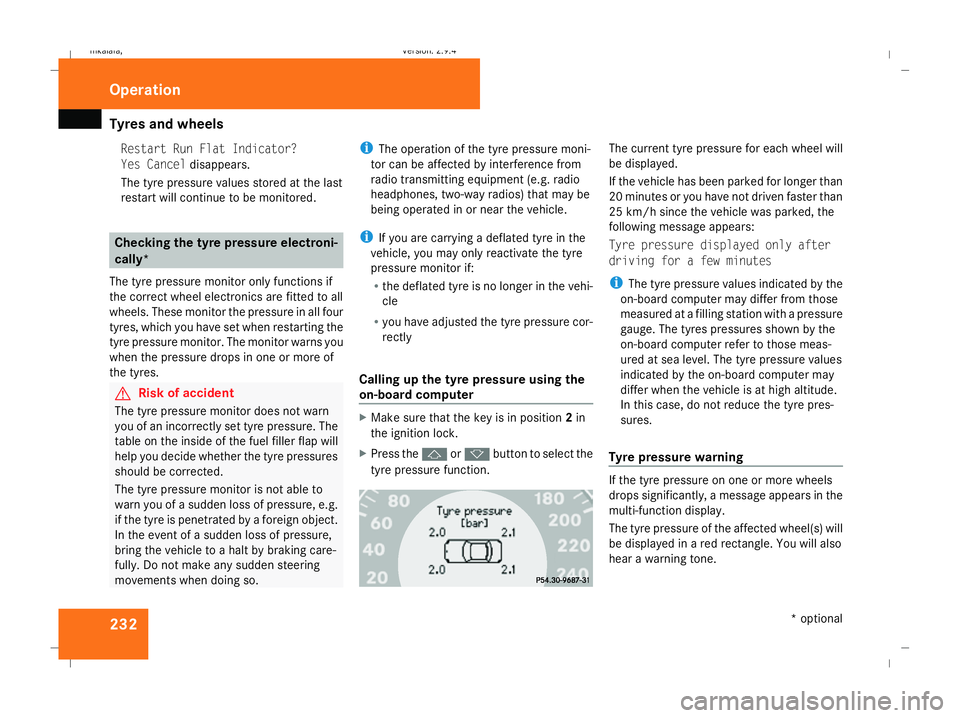
X Press the jork button to select the
tyre pressure function. The current tyre pressure for each wheel will
be displayed.
If the vehicle has been parked for longer than
20 minutes or you have not driven faster than
25 km/h since the vehicle was parked, the
following message appears:
Tyre pressure displayed only after
driving for a few minutes
i
The tyre pressure values indicated by the
on-board computer may differ from those
measured at a filling station with a pressure
gauge. The tyres pressures shown by the
on-board computer refer to those meas-
ured at sea level. The tyre pressure values
indicated by the on-board computer may
differ when the vehicle is at high altitude.
In this case, do not reduce the tyre pres-
sures.
Tyre pressure warning If the tyre pressure on one or more wheels
drops significantly, a message appears in the
multi-function display.
The tyre pressure of the affected wheel(s) will
be displayed in a red rectangle. You will also
hear a warning tone.Operation
* optional
211_AKB; 2; 5, en-GB
mkalafa
,V ersion: 2.9.4
2008-02-29T16:57:07+01:00 - Seite 232 Dateiname: 6515_3416_02_buchblock.pdf; preflight
Page 249 of 401
Care
246R
battery
R connectors
R lights
R seals
Damaged seals or electrical components
can lead to failures or leaks.
Cleaning the wiper blades and the out-
side of the windscreen G
Risk of injury
Turn the key to position 0in the ignition
lock before cleaning the windscreen or the
wiper blades. There is otherwise a risk of
the windscreen wipers being set in motion
and causing injury.
X Turn the key to position 1in the ignition
lock (Y page 76).
X Set the windscreen wipers to position
u on the combination switch
(Y page 105).
X Turn the key to position 0or remove it when
the wiper arms are vertical (Y page 76).!
Only fold the wiper arms away from the
windscreen when they are in a vertical posi-
tion, otherwise you will damage the bonnet.
X Fold the wiper arms away from the wind-
screen until you feel them engage.
X Clean the windscreen and the wiper blades.
X Fold the windscreen wipers back again
before the ignition is switched on.
! Do not clean the wiper blades too often,
otherwise the rubber may become porous,
resulting in wiper noise.
Cleaning the windows !
Do not use dry cloths, abrasive products,
solvents or cleaning agents containing sol-
vents to clean the inside of the windows.
Clean the insides of the windows with a
damp cloth or commercially-available glass
cleaner. Avoid touching the inside of the
rear windscreen and the side windows with
hard objects, e.g. ice scrapers or rings. You
could otherwise cause damage to the win-
dows, rear window heating or aerial on the
rear window. i
Anti-glare film retrofitted to the insides of
the windows could interfere with radio or
mobile phone reception, especially if it is
conductive or metal-coated film. Informa-
tion about anti-glare film can be obtained
from any Mercedes-Benz Service Centre.
Cleaning the headlamps X
Clean the headlamp lenses with a wet
sponge.
! Only use washer fluid which is suitable
for plastic lenses. Unsuitable washer fluid
could damage the plastic lenses of the
headlamps.
Do not use the following:
R dry cloths
R abrasive cleaning agents
R solvents
R cleaning agents containing solvent
You could otherwise scratch or damage the
surface of the lenses. Operation
211_AKB; 2; 5, en-GB
mkalafa,
Version: 2.9.4 2008-02-29T16:57:07+01:00 - Seite 246Dateiname: 6515_3416_02_buchblock.pdf; preflight
Page 266 of 401
Display
messages 263Display messages Possible cause/consequence Possible solution
Tyre press.
mon. Wheel sensor miss-
ing The tyre pressure monitor* is not receiv-
ing a signal from at least one wheel
because a wheel has been fitted which
does not have suitable sensors (e.g. the
spare wheel). Or there is a malfunction in
at least one wheel sensor.
A line is displayed in the multi-function
display for the tyre concerned instead of
the tyre pressure value. X
Have the tyre pressure monitor* and wheels
checked at a qualified specialist workshop.
Once wheels with suitable wheel sensors have
been fitted again, the tyre pressures are dis-
played in the multi-function display after driv-
ing for a few minutes. Tyre pressure
monitor currently unavail-
able The tyre pressure monitor* is temporarily
deactivated. The voltage of the vehicle's
electrical system is too low or radio inter-
ference prevents the reception of sensor
signals. X
Drive on.
Once the causes have been eliminated, the tyre
pressure monitor* automatically reactivates
after a few minutes of driving. Practical advi
ce
* optional
211_AKB; 2; 5, en-GB
mkalafa,
Version: 2.9.4 2008-02-29T16:57:07+01:00 - Seite 263 ZDateiname: 6515_3416_02_buchblock.pdf; preflight
Page 282 of 401
Display
messages 279Display messages Possible cause/consequence Possible solution
H Tyre pressure
Check tyres The pressure in one or more tyres has
dropped significantly. The affected wheel
is highlighted in the tyre pressure display
of the tyre pressure monitor*. X
Stop the vehicle without making any sudden
steering or braking manoeuvres. Pay attention
to the traffic conditions as you do so.
X Check the tyres.
X Repair or change the faulty tyre if necessary
(Y page 317).
X Check the tyre pressure and correct it if nec-
essary (Y page 229).
The warning will disappear automatically after
you have been driving for a few minutes with
the corrected tyre pressure. I Change key batter-
ies The batteries of the KEYLESS GO key* are
discharged. X
Change the batteries (Y page 310).I Key not detected
The KEYLESS GO key* is not in the vehicle.
It will no longer be possible to centrally
lock the vehicle and start the engine if the
engine is switched off. X
Stop the vehicle. Pay attention to the traffic
conditions as you do so.
X Look for the KEYLESS GO key *.I Key not detected
The
KEYLESS GO* key is not detected
while the engine is running, because there
is interference from a strong source of
radio waves. X
Stop the vehicle. Pay attention to the traffic
conditions as you do so.
X Operate the vehicle using the key in the ignition
lock if necessary. Practical advice
* optional
211_AKB; 2; 5, en-GB
mkalafa
,V ersion: 2.9.4
2008-02-29T16:57:07+01:00 - Seite 279 ZDateiname: 6515_3416_02_buchblock.pdf; preflight
Page 301 of 401
Troubleshooting
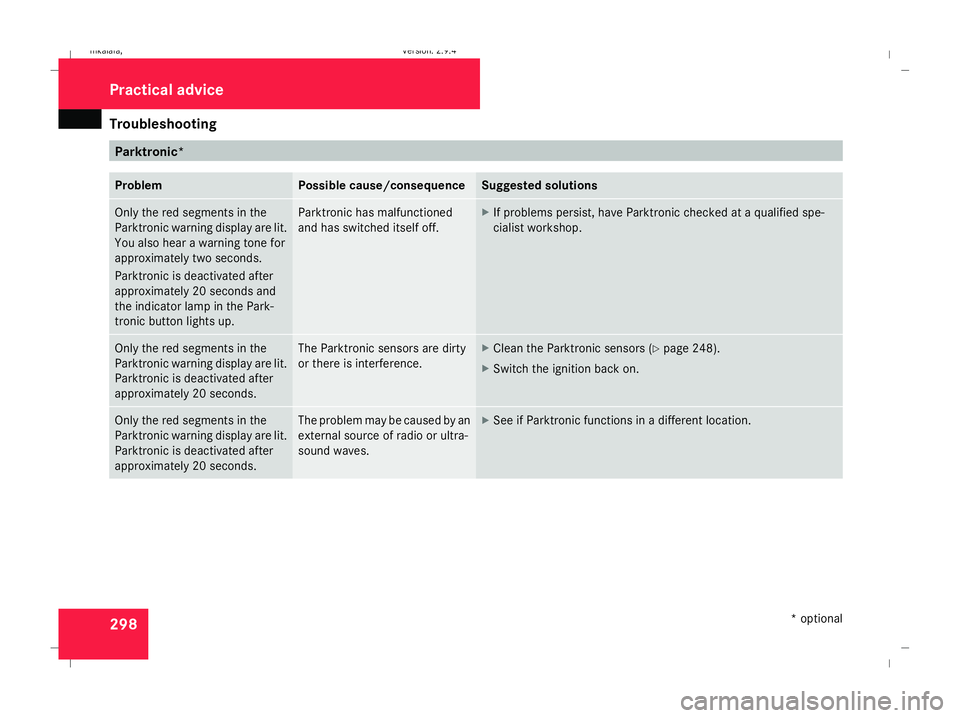
298 Parktronic*
Problem Possible cause/consequence Suggested solutions
Only the red segments in the
Parktronic warning display are lit.
You also hear a warning tone for
approximately two seconds.
Parktronic is deactivated after
approximately 20 seconds and
the indicator lamp in the Park-
tronic button lights up. Parktronic has malfunctioned
and has switched itself off. X
If problems persist, have Parktronic checked at a qualified spe-
cialist workshop. Only the red segments in the
Parktronic warning display are lit.
Parktronic is deactivated after
approximately 20 seconds. The Parktronic sensors are dirty
or there is interference. X
Clean the Parktronic sensors ( Ypage 248).
X Switch the ignition back on. Only the red segments in the
Parktronic warning display are lit.
Parktronic is deactivated after
approximately 20 seconds. The problem may be caused by an
external source of radio or ultra-
sound waves. X
See if Parktronic functions in a different location. Practical advice
* optional
211_AKB; 2; 5, en-GB
mkalafa
,V ersion: 2.9.4
2008-02-29T16:57:07+01:00 - Seite 298 Dateiname: 6515_3416_02_buchblock.pdf; preflight
Page 306 of 401
Troubleshooting
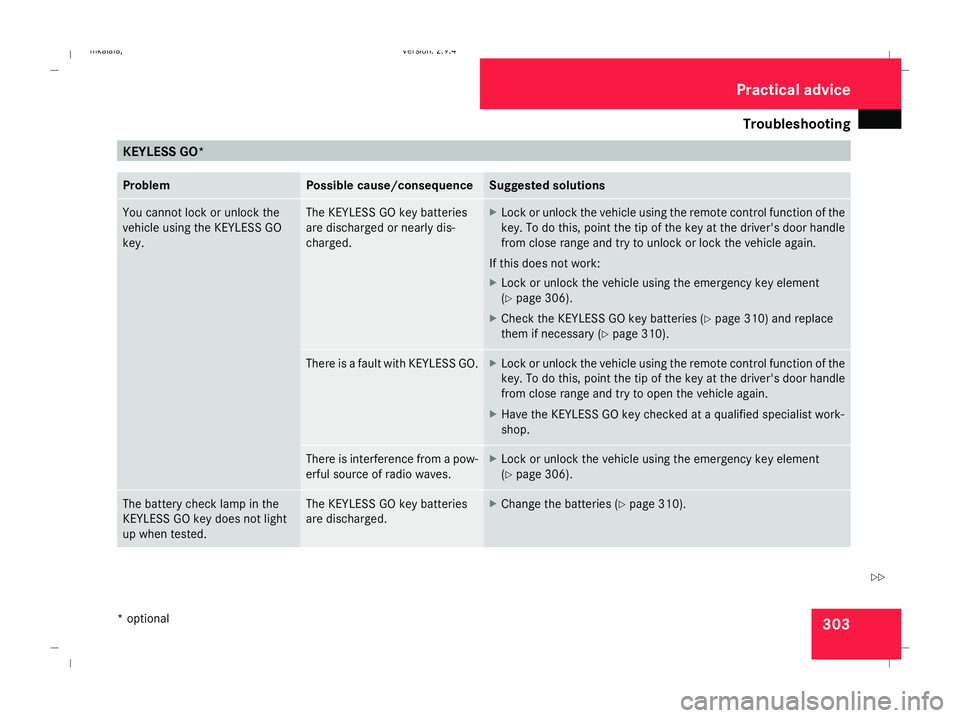
303KEYLESS GO*
Problem Possible cause/consequence Suggested solutions
You cannot lock or unlock the
vehicle using the KEYLESS GO
key. The KEYLESS GO key batteries
are discharged or nearly dis-
charged. X
Lock or unlock the vehicle using the remote control function of the
key. To do this, point the tip of the key at the driver's door handle
from close range and try to unlock or lock the vehicle again.
If this does not work:
X Lock or unlock the vehicle using the emergency key element
(Y page 306).
X Check the KEYLESS GO key batteries (Y page 310) and replace
them if necessary (Y page 310). There is a fault with KEYLESS GO. X
Lock or unlock the vehicle using the remote control function of the
key. To do this, point the tip of the key at the driver's door handle
from close range and try to open the vehicle again.
X Have the KEYLESS GO key checked at a qualified specialist work-
shop. There is interference from a pow-
erful source of radio waves. X
Lock or unlock the vehicle using the emergency key element
(Y page 306). The battery check lamp in the
KEYLESS GO key does not light
up when tested. The KEYLESS GO key batteries
are discharged. X
Change the batteries (Y page 310). Practical advice
* optional
211_AKB; 2; 5, en-GB
mkalafa
,V ersion: 2.9.4
2008-02-29T16:57:07+01:00 - Seite 303 ZDateiname: 6515_3416_02_buchblock.pdf; preflight
Page 307 of 401
Troubleshooting
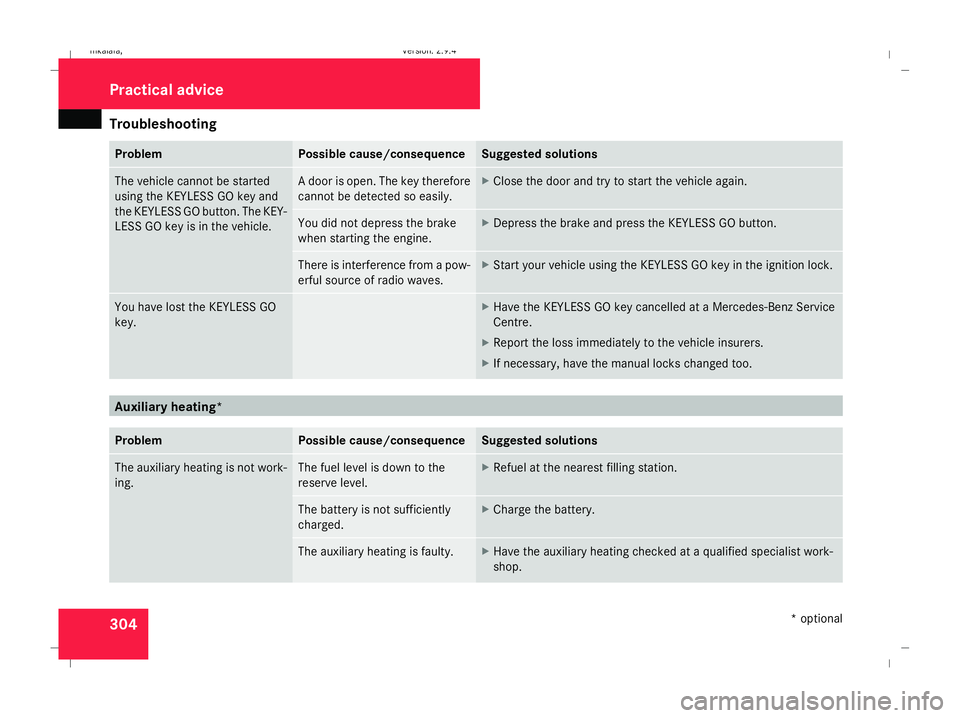
304 Problem Possible cause/consequence Suggested solutions
The vehicle cannot be started
using the KEYLESS GO key and
the KEYLESS GO button. The KEY-
LESS GO key is in the vehicle. A door is open. The key therefore
cannot be detected so easily. X
Close the door and try to start the vehicle again. You did not depress the brake
when starting the engine. X
Depress the brake and press the KEYLESS GO button. There is interference from a pow-
erful source of radio waves. X
Start your vehicle using the KEYLESS GO key in the ignition lock. You have lost the KEYLESS GO
key. X
Have the KEYLESS GO key cancelled at a Mercedes-Benz Service
Centre.
X Report the loss immediately to the vehicle insurers.
X If necessary, have the manual locks changed too. Auxiliary heating*
Problem Possible cause/consequence Suggested solutions
The auxiliary heating is not work-
ing. The fuel level is down to the
reserve level. X
Refuel at the nearest filling station. The battery is not sufficiently
charged. X
Charge the battery. The auxiliary heating is faulty. X
Have the auxiliary heating checked at a qualified specialist work-
shop. Practical advice
* optional
211_AKB; 2; 5, en-GB
mkalafa
,V ersion: 2.9.4
2008-02-29T16:57:07+01:00 - Seite 304 Dateiname: 6515_3416_02_buchblock.pdf; preflight
Page 348 of 401
Vehicle electronics
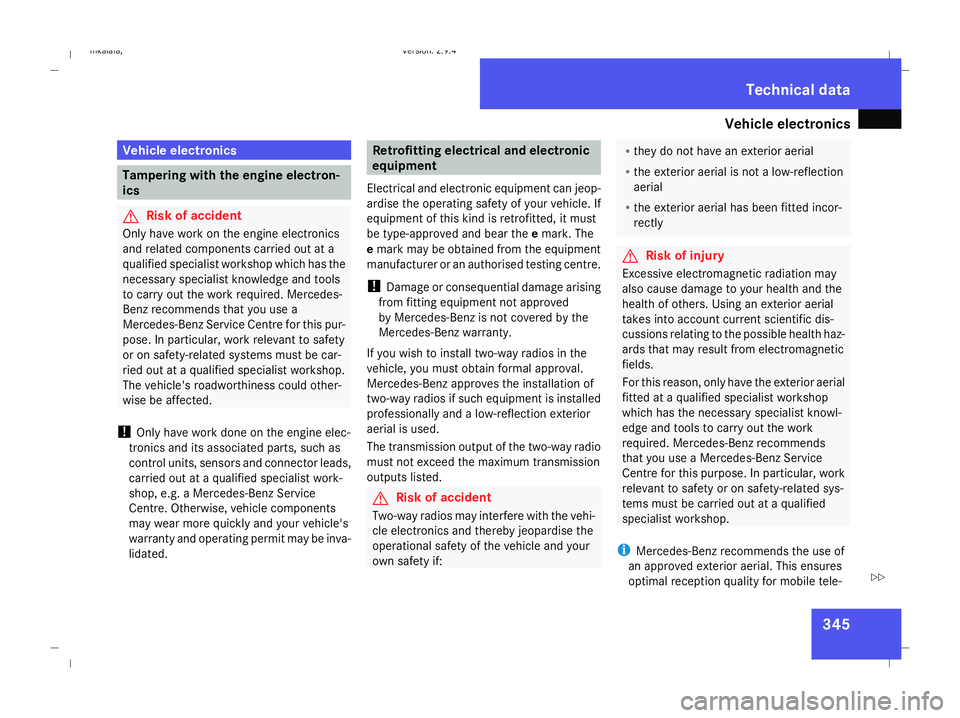
345Vehicle electronics
Tampering with the engine electron-
ics
G
Risk of accident
Only have work on the engine electronics
and related components carried out at a
qualified specialist workshop which has the
necessary specialist knowledge and tools
to carry out the work required. Mercedes-
Benz recommends that you use a
Mercedes-Benz Service Centre for this pur-
pose. In particular, work relevant to safety
or on safety-related systems must be car-
ried out at a qualified specialist workshop.
The vehicle's roadworthiness could other-
wise be affected.
! Only have work done on the engine elec-
tronics and its associated parts, such as
control units, sensors and connector leads,
carried out at a qualified specialist work-
shop, e.g. a Mercedes-Benz Service
Centre. Otherwise, vehicle components
may wear more quickly and your vehicle's
warranty and operating permit may be inva-
lidated. Retrofitting electrical and electronic
equipment
Electrical and electronic equipment can jeop-
ardise the operating safety of your vehicle. If
equipment of this kind is retrofitted, it must
be type-approved and bear the emark. The
e mark may be obtained from the equipment
manufacturer or an authorised testing centre.
! Damage or consequential damage arising
from fitting equipment not approved
by Mercedes-Benz is not covered by the
Mercedes-Benz warranty.
If you wish to install two-way radios in the
vehicle, you must obtain formal approval.
Mercedes-Benz approves the installation of
two-way radios if such equipment is installed
professionally and a low-reflection exterior
aerial is used.
The transmission output of the two-way radio
must not exceed the maximum transmission
outputs listed. G
Risk of accident
Two-way radios may interfere with the vehi-
cle electronics and thereby jeopardise the
operational safety of the vehicle and your
own safety if: R
they do not have an exterior aerial
R the exterior aerial is not a low-reflection
aerial
R the exterior aerial has been fitted incor-
rectly G
Risk of injury
Excessive electromagnetic radiation may
also cause damage to your health and the
health of others. Using an exterior aerial
takes into account current scientific dis-
cussions relating to the possible health haz-
ards that may result from electromagnetic
fields.
For this reason, only have the exterior aerial
fitted at a qualified specialist workshop
which has the necessary specialist knowl-
edge and tools to carry out the work
required. Mercedes-Benz recommends
that you use a Mercedes-Benz Service
Centre for this purpose. In particular, work
relevant to safety or on safety-related sys-
tems must be carried out at a qualified
specialist workshop.
i Mercedes-Benz recommends the use of
an approved exterior aerial. This ensures
optimal reception quality for mobile tele- Technical data
211_AKB; 2; 5, en-GB
mkalafa,
Version: 2.9.4
2008-02-29T16:57:07+01:00 - Seite 345 ZDateiname: 6515_3416_02_buchblock.pdf; preflight
Page 394 of 401
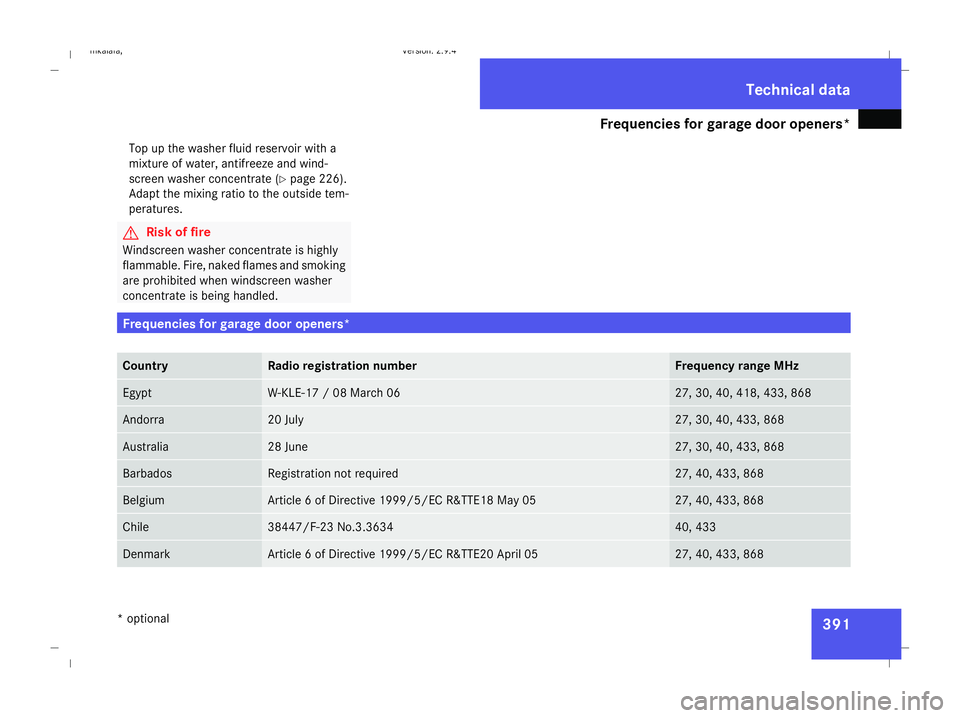
Frequencies for garage door openers*
391
Top up the washer fluid reservoir with a
mixture of water, antifreeze and wind-
screen washer concentrate (Y
page 226).
Adapt the mixing ratio to the outside tem-
peratures. G
Risk of fire
Windscreen washer concentrate is highly
flammable. Fire, naked flames and smoking
are prohibited when windscreen washer
concentrate is being handled. Frequencies for garage door openers*
Country Radio registration number Frequency range MHz
Egypt W-KLE-17 / 08 March 06 27, 30, 40, 418, 433, 868
Andorra 20 July 27, 30, 40, 433, 868
Australia 28 June 27, 30, 40, 433, 868
Barbados Registration not required 27, 40, 433, 868
Belgium Article 6 of Directive 1999/5/EC R&TTE18 May 05 27, 40, 433, 868
Chile 38447/F-23 No.3.3634 40, 433
Denmark Article 6 of Directive 1999/5/EC R&TTE20 April 05 27, 40, 433, 868 Technical data
* optional
211_AKB; 2; 5, en-GB
mkalafa,
Version: 2.9.4
2008-02-29T16:57:07+01:00 - Seite 391 ZDateiname: 6515_3416_02_buchblock.pdf; preflight
Page 395 of 401
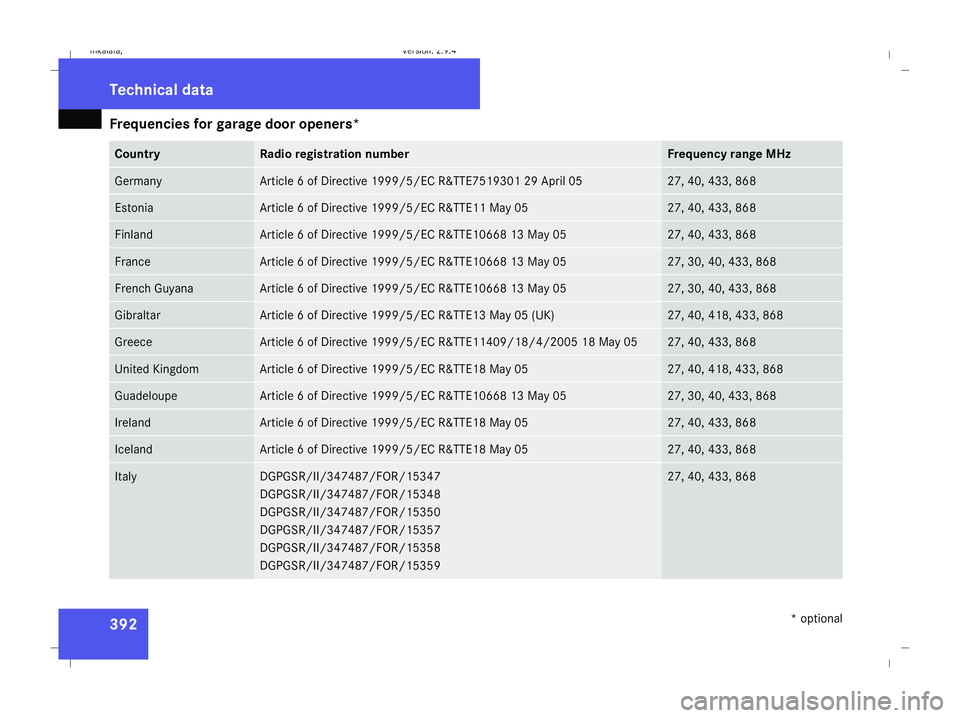
Frequencies for garage door openers*
392 Country Radio registration number Frequency range MHz
Germany Article 6 of Directive 1999/5/EC R&TTE7519301 29 April 05 27, 40, 433, 868
Estonia Article 6 of Directive 1999/5/EC R&TTE11 May 05 27, 40, 433, 868
Finland Article 6 of Directive 1999/5/EC R&TTE10668 13 May 05 27, 40, 433, 868
France Article 6 of Directive 1999/5/EC R&TTE10668 13 May 05 27, 30, 40, 433, 868
French Guyana Article 6 of Directive 1999/5/EC R&TTE10668 13 May 05 27, 30, 40, 433, 868
Gibraltar Article 6 of Directive 1999/5/EC R&TTE13 May 05 (UK) 27, 40, 418, 433, 868
Greece Article 6 of Directive 1999/5/EC R&TTE11409/18/4/2005 18 May 05 27, 40, 433, 868
United Kingdom Article 6 of Directive 1999/5/EC R&TTE18 May 05 27, 40, 418, 433, 868
Guadeloupe Article 6 of Directive 1999/5/EC R&TTE10668 13 May 05 27, 30, 40, 433, 868
Ireland Article 6 of Directive 1999/5/EC R&TTE18 May 05 27, 40, 433, 868
Iceland Article 6 of Directive 1999/5/EC R&TTE18 May 05 27, 40, 433, 868
Italy DGPGSR/II/347487/FOR/15347
DGPGSR/II/347487/FOR/15348
DGPGSR/II/347487/FOR/15350
DGPGSR/II/347487/FOR/15357
DGPGSR/II/347487/FOR/15358
DGPGSR/II/347487/FOR/15359 27, 40, 433, 868Technical data
* optional
211_AKB; 2; 5, en-GB
mkalafa,
Version: 2.9.4 2008-02-29T16:57:07+01:00 - Seite 392Dateiname: 6515_3416_02_buchblock.pdf; preflight