blind spot MERCEDES-BENZ E-CLASS SALOON 2009 User Guide
[x] Cancel search | Manufacturer: MERCEDES-BENZ, Model Year: 2009, Model line: E-CLASS SALOON, Model: MERCEDES-BENZ E-CLASS SALOON 2009Pages: 373, PDF Size: 12.37 MB
Page 171 of 373

For Blind Spot Assist to help you when driving,
the radar sensor system must be switched on
and operational. G
Risk of accident
Blind Spot Assist cannot detect road and traf-
fic conditions.
Blind Spot Assist may not detect narrow vehi-
cles, such as motorcycles or bicycles, or only
detect them too late.
Monitoring may be affected by dirty sensors,
strong spray or poor visibility caused by snow,
rain or mist, for example. In this case, vehicles
are detected late or not at all.
Always pay attention to traffic conditions and
your surroundings. Otherwise, you may fail to
recognise dangers in time, cause an accident
and injure yourself and others.
Monitoring range of the sensors
Blind Spot Assist monitors the area up to
three metres behind your vehicle and directly
next to your vehicle as shown in the diagram. Example: Saloon
G
Risk of accident
Blind Spot Assist monitors certain areas in the
immediate vicinity of your vehicle. Vehicles
that approach and drive past at high speeds
are not detected. There is no display and no
warning. If the lanes are very wide, it may not be pos-
sible to monitor the complete width of the
neighbouring lane. For this reason, vehicles in
the next lane may not be detected, especially
if they are driving in a staggered formation in
different lanes. This may be the case if vehi-
cles are driving at the edge of their lane that
is furthest away from your vehicle.
Always pay attention to traffic conditions and
your surroundings. Otherwise, you may fail to
recognise dangers in time, cause an accident
and injure yourself and others.
If the lanes are narrow, the system may be
unable to distinguish the neighbouring lane
from the one beyond it. For this reason, vehi-
cles in the farther lane may be indicated,
especially if the vehicles are driving in a stag-
gered formation in different lanes. This may
be the case if vehicles are driving at the edge
of the lane that is nearest your vehicle. Due
to the nature of the system, warnings may be
issued in error when driving close to crash
barriers or similar solid lane borders.
The two sensors for Blind Spot Assist are
integrated into the sides of the rear bumper.
Make sure that the bumper is free from dirt,
ice or slush around the sensors. For example,
the radar sensors must not be covered by
cycle racks or overhanging loads. Following a
severe impact or in the event of damage to
the bumpers, have the function of the radar
sensors checked at a qualified specialist
workshop, e.g. a Mercedes-Benz Service
Centre. Otherwise, Blind Spot Assist may not
work properly. 168
Driving systemsControls
212_AKB; 2; 4, en-GB
mkalafa
,V ersion: 2.11.8.1
2009-05-05T14:17:16+02:00 - Seite 168
Dateiname: 6515346702_buchblock.pdf; erzeugt am 07. May 2009 14:16:26; WK
Page 172 of 373
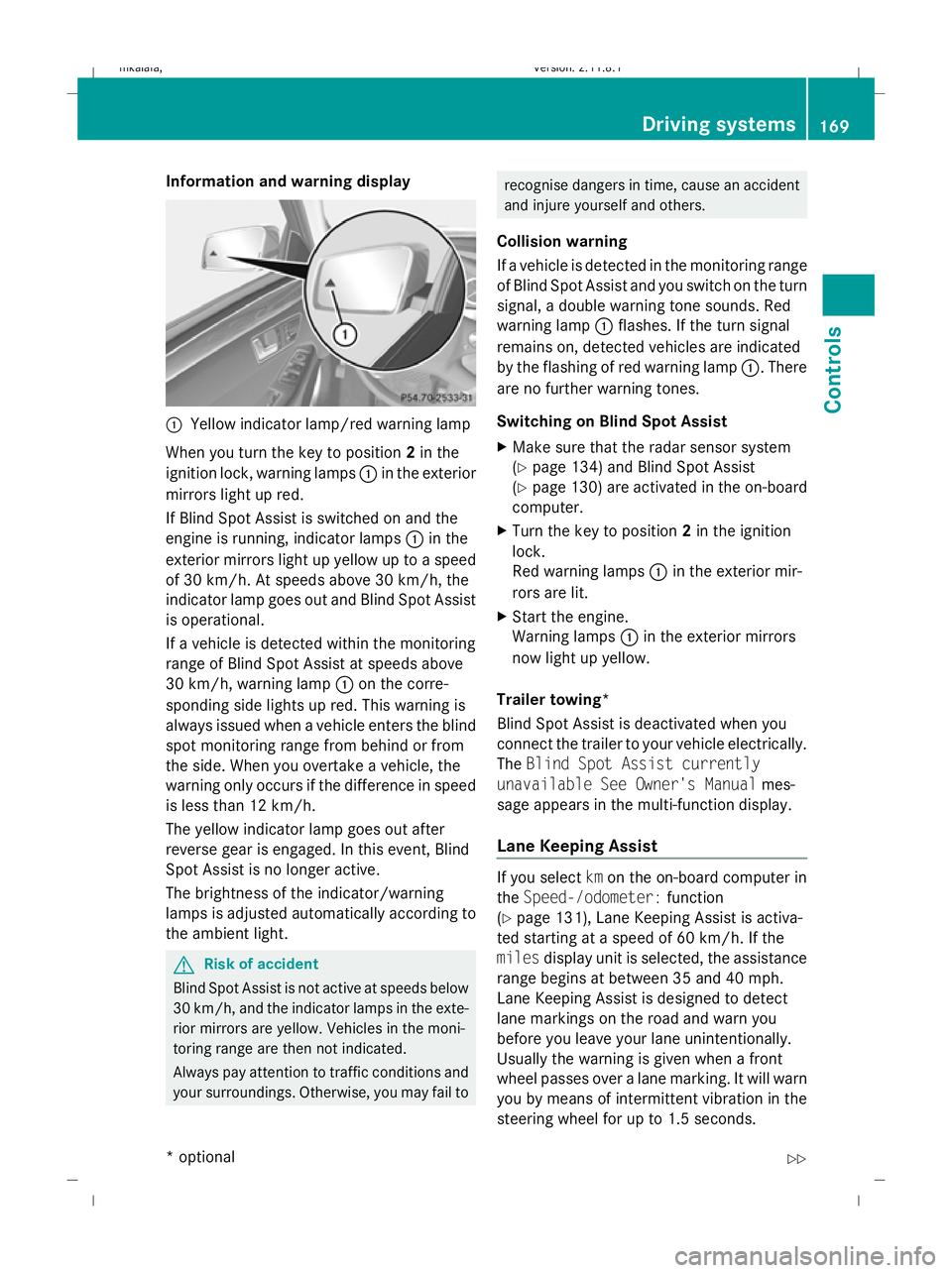
Information and warning display
:
Yellow indicator lamp/red warning lamp
When you turn the key to position 2in the
ignition lock, warning lamps :in the exterior
mirrors light up red.
If Blind Spot Assist is switched on and the
engine is running, indicator lamps :in the
exterior mirrors light up yellow up to a speed
of 30 km/h. At speeds above 30 km/h, the
indicator lamp goes out and Blind Spot Assist
is operational.
If a vehicle is detected within the monitoring
range of Blind Spot Assist at speeds above
30 km/h, warning lamp :on the corre-
sponding side lights up red. This warning is
always issued when a vehicle enters the blind
spot monitoring range from behind or from
the side. When you overtake a vehicle, the
warning only occurs if the difference in speed
is less than 12 km/h.
The yellow indicator lamp goes out after
reverse gear is engaged. In this event, Blind
Spot Assist is no longer active.
The brightness of the indicator/warning
lamps is adjusted automatically according to
the ambient light. G
Risk of accident
Blind Spot Assist is not active at speeds below
30 km/h, and the indicator lamps in the exte-
rior mirrors are yellow. Vehicles in the moni-
toring range are then not indicated.
Always pay attention to traffic conditions and
your surroundings. Otherwise, you may fail to recognise dangers in time, cause an accident
and injure yourself and others.
Collision warning
If a vehicle is detected in the monitoring range
of Blind Spot Assist and you switch on the turn
signal, a double warning tone sounds. Red
warning lamp :flashes. If the turn signal
remains on, detected vehicles are indicated
by the flashing of red warning lamp :. There
are no further warning tones.
Switching on Blind Spot Assist
X Make sure that the radar sensor system
(Y page 134) and Blind Spot Assist
(Y page 130) are activated in the on-board
computer.
X Turn the key to position 2in the ignition
lock.
Red warning lamps :in the exterior mir-
rors are lit.
X Start the engine.
Warning lamps :in the exterior mirrors
now light up yellow.
Trailer towing*
Blind Spot Assist is deactivated when you
connect the trailer to your vehicle electrically.
The Blind Spot Assist currently
unavailable See Owner's Manual mes-
sage appears in the multi-function display.
Lane Keeping Assist If you select
kmon the on-board computer in
the Speed-/odometer: function
(Y page 131), Lane Keeping Assist is activa-
ted starting at a speed of 60 km/h. If the
miles display unit is selected, the assistance
range begins at between 35 and 40 mph.
Lane Keeping Assist is designed to detect
lane markings on the road and warn you
before you leave your lane unintentionally.
Usually the warning is given when a front
wheel passes over a lane marking. It will warn
you by means of intermittent vibration in the
steering wheel for up to 1.5 seconds. Driving systems
169Controls
* optional
212_AKB; 2; 4, en-GB
mkalafa
,V ersion: 2.11.8.1
2009-05-05T14:17:16+02:00 - Seite 169 Z
Dateiname: 6515346702_buchblock.pdf; erzeugt am 07. May 2009 14:16:27; WK
Page 238 of 373
X
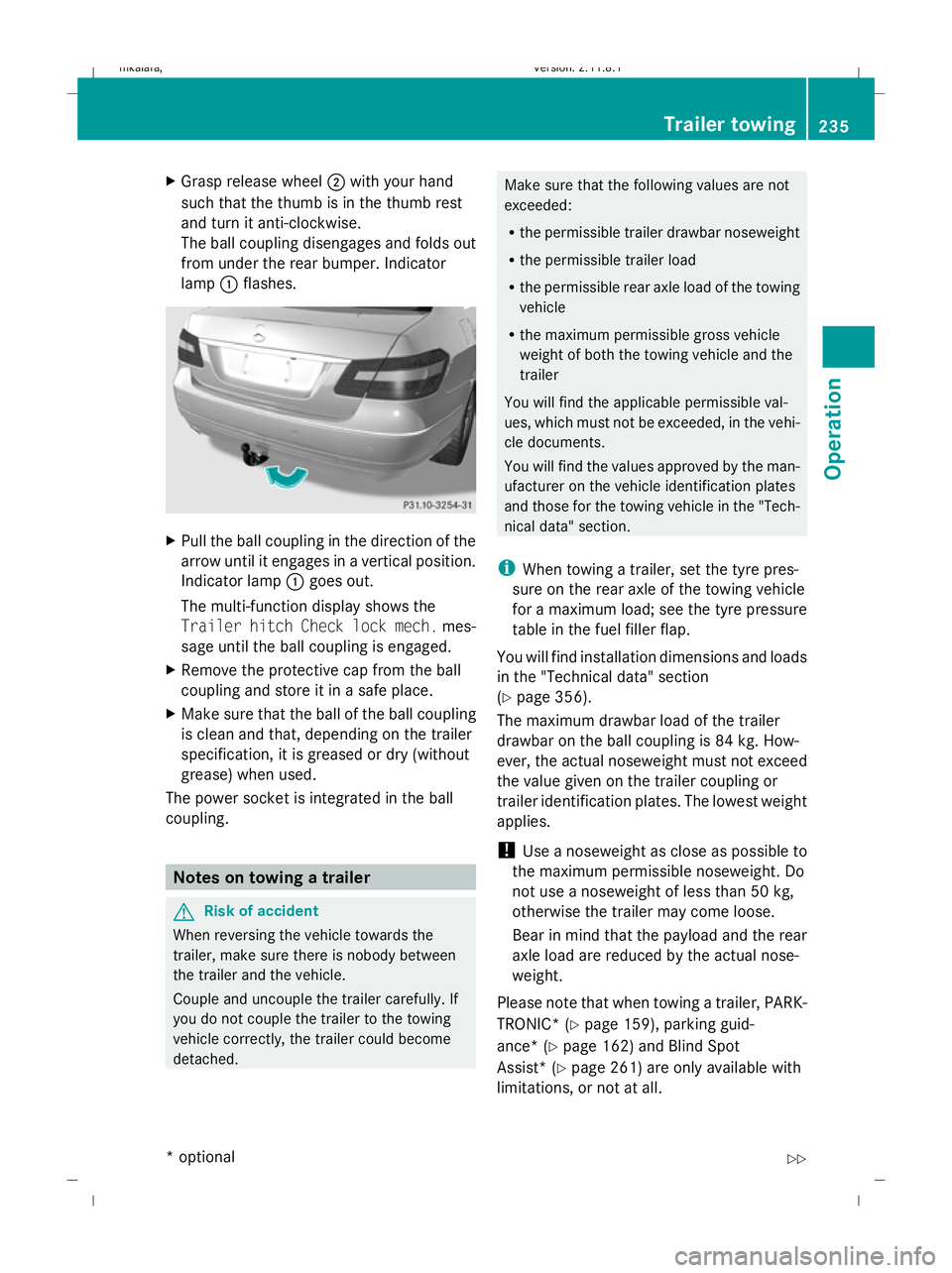
Grasp release wheel ;with your hand
such that the thumb is in the thumb rest
and turn it anti-clockwise.
The ball coupling disengages and folds out
from under the rear bumper. Indicator
lamp :flashes. X
Pull the ball coupling in the direction of the
arrow until it engages in a vertical position.
Indicator lamp :goes out.
The multi-function display shows the
Trailer hitch Check lock mech. mes-
sage until the ball coupling is engaged.
X Remove the protective cap from the ball
coupling and store it in a safe place.
X Make sure that the ball of the ball coupling
is clean and that, depending on the trailer
specification, it is greased or dry (without
grease) when used.
The power socket is integrated in the ball
coupling. Notes on towing a trailer
G
Risk of accident
When reversing the vehicle towards the
trailer, make sure there is nobody between
the trailer and the vehicle.
Couple and uncouple the trailer carefully. If
you do not couple the trailer to the towing
vehicle correctly, the trailer could become
detached. Make sure that the following values are not
exceeded:
R
the permissible trailer drawbar noseweight
R the permissible trailer load
R the permissible rear axle load of the towing
vehicle
R the maximum permissible gross vehicle
weight of both the towing vehicle and the
trailer
You will find the applicable permissible val-
ues, which must not be exceeded, in the vehi-
cle documents.
You will find the values approved by the man-
ufacturer on the vehicle identification plates
and those for the towing vehicle in the "Tech-
nical data" section.
i When towing a trailer, set the tyre pres-
sure on the rear axle of the towing vehicle
for a maximum load; see the tyre pressure
table in the fuel filler flap.
You will find installation dimensions and loads
in the "Technical data" section
(Y page 356).
The maximum drawbar load of the trailer
drawbar on the ball coupling is 84 kg. How-
ever, the actual noseweight must not exceed
the value given on the trailer coupling or
trailer identification plates. The lowest weight
applies.
! Use a noseweight as close as possible to
the maximum permissible noseweight. Do
not use a noseweight of less than 50 kg,
otherwise the trailer may come loose.
Bear in mind that the payload and the rear
axle load are reduced by the actual nose-
weight.
Please note that when towing a trailer, PARK-
TRONIC* ( Ypage 159), parking guid-
ance* (Y page 162) and Blind Spot
Assist* (Y page 261) are only available with
limitations, or not at all. Trailer towing
235Operation
* optional
212_AKB; 2; 4, en-GB
mkalafa
,V ersion: 2.11.8.1
2009-05-05T14:17:16+02:00 - Seite 235 Z
Dateiname: 6515346702_buchblock.pdf; erzeugt am 07. May 2009 14:16:59; WK
Page 264 of 373

Display messages
Possible causes/consequences and
X
X Solutions PRE-SAFE Functions
limited
See Own‐
er's Man‐
ual
G
Risk of accident
PRE-SAFE ®
Brake* is faulty. BAS PLUS* or the distance warn-
ing signal may also have failed.
X Visit a qualified specialist workshop. Radar sen‐
sor deactiva‐
ted See
Owner's
Manual
Vehicles with Distronic Plus*: the radar sensor system is
deactivated.
X Check whether the radar sensor system may be activated
(Y page 362).
X Switch on the radar sensor system (Y page 135).Radar sen‐
sor deactiva‐
ted
autom.
See Own‐
er's Man‐
ual
Vehicles with a navigation system*: the vehicle is close to a
radio-telescope facility and, therefore, must not transmit any
radar signals. The radar sensor system has switched off auto-
matically.
The following functions are unavailable:
R Distronic Plus* (Y page 140)
R BAS PLUS* (Y page 59)
R PRE-SAFE ®
Brake* (Y page 63)
R Blind Spot Assist* (Y page 167)
X Drive on.
These functions are available again as soon as the vehicle
is far enough away from the radio telescope facility
(Y page 362). Child seat in wrong
position
See Own‐
er's Man‐
ual
G
Risk of injury
Vehicles with automatic child seat recognition *on the front-
passenger seat: the child seat is incorrectly positioned.
X Fit the child seat in the correct position. G
Risk of injury
Vehicles with automatic child seat recognition* on the front-
passenger seat: the child seat recognition sensor is faulty.
X Visit a qualified specialist workshop. Blind
Spot
Assist inopera‐
tive
Blind Spot Assist* is faulty.
X
Visit a qualified specialist workshop. Display messages
261Practical advice
* optional
212_AKB; 2; 4, en-GB
mkalafa,
Version: 2.11.8.1 2009-05-05T14:17:16+02:00 - Seite 261 Z
Dateiname: 6515346702_buchblock.pdf; erzeugt am 07. May 2009 14:17:09; WK
Page 265 of 373
Display messages
Possible causes/consequences and
X
X Solutions Blind
Spot
Assist currently
unavaila‐
ble See
Owner's
Manual
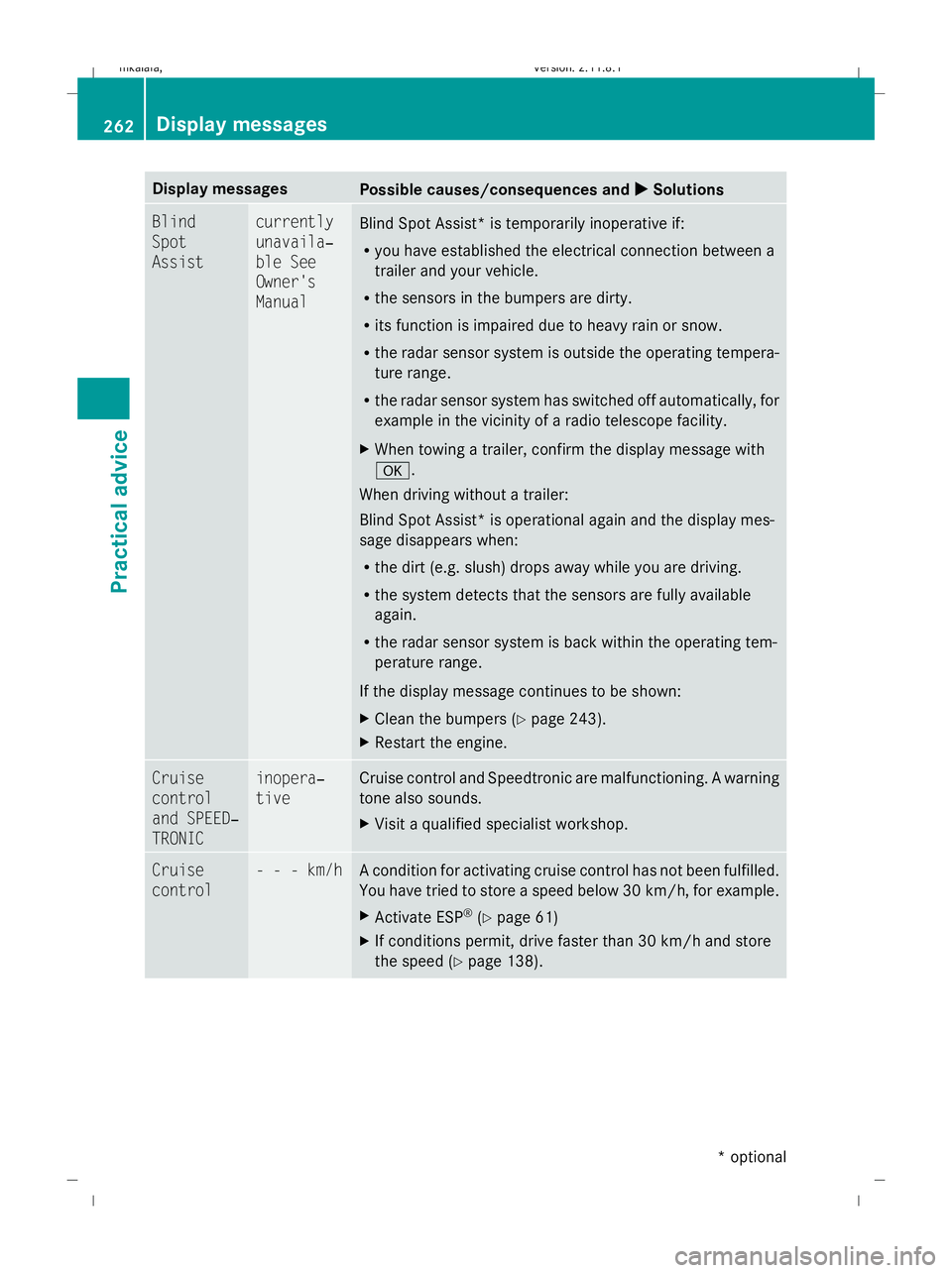
Blind Spot Assist* is temporarily inoperative if:
R
you have established the electrical connection between a
trailer and your vehicle.
R the sensors in the bumpers are dirty.
R its function is impaired due to heavy rain or snow.
R the radar sensor system is outside the operating tempera-
ture range.
R the radar sensor system has switched off automatically, for
example in the vicinity of a radio telescope facility.
X When towing a trailer, confirm the display message with
a.
When driving without a trailer:
Blind Spot Assist* is operational again and the display mes-
sage disappears when:
R the dirt (e.g. slush) drops away while you are driving.
R the system detects that the sensors are fully available
again.
R the radar sensor system is back within the operating tem-
perature range.
If the display message continues to be shown:
X Clean the bumpers (Y page 243).
X Restart the engine. Cruise
control
and SPEED‐
TRONIC inopera‐
tive Cruise control and Speedtronic are malfunctioning. A warning
tone also sounds.
X
Visit a qualified specialist workshop. Cruise
control - - - km/h A condition for activating cruise control has not been fulfilled.
You have tried to store a speed below 30 km/h, for example.
X
Activate ESP ®
(Y page 61)
X If conditions permit, drive faster than 30 km/h and store
the speed (Y page 138). 262
Display
messagesPractical advice
* optional
212_AKB; 2; 4, en-GB
mkalafa
,V ersion: 2.11.8.1
2009-05-05T14:17:16+02:00 - Seite 262
Dateiname: 6515346702_buchblock.pdf; erzeugt am 07. May 2009 14:17:09; WK
Page 283 of 373
Problem
Possible causes/consequences and
X XSolutions Vehicles with auto-
matic child seat recog-
nition on the front-
passenger seat*:
The
45indica-
tor lamp on the centre
console is lit. A special Mercedes-Benz child seat with automatic child seat rec-
ognition has been fitted to the front-passenger seat. The front-
passenger airbag has therefore been disabled as desired.
G
Risk of injury
There is no child seat fitted to the front-passenger seat. The auto-
matic child seat recognition* is malfunctioning.
X Remove electronic equipment from the front-passenger seat,
for example:
R
notebook
R mobile phone
R cards with transponders, e.g. ski passes or access passes
If the 45indicator lamp remains lit:
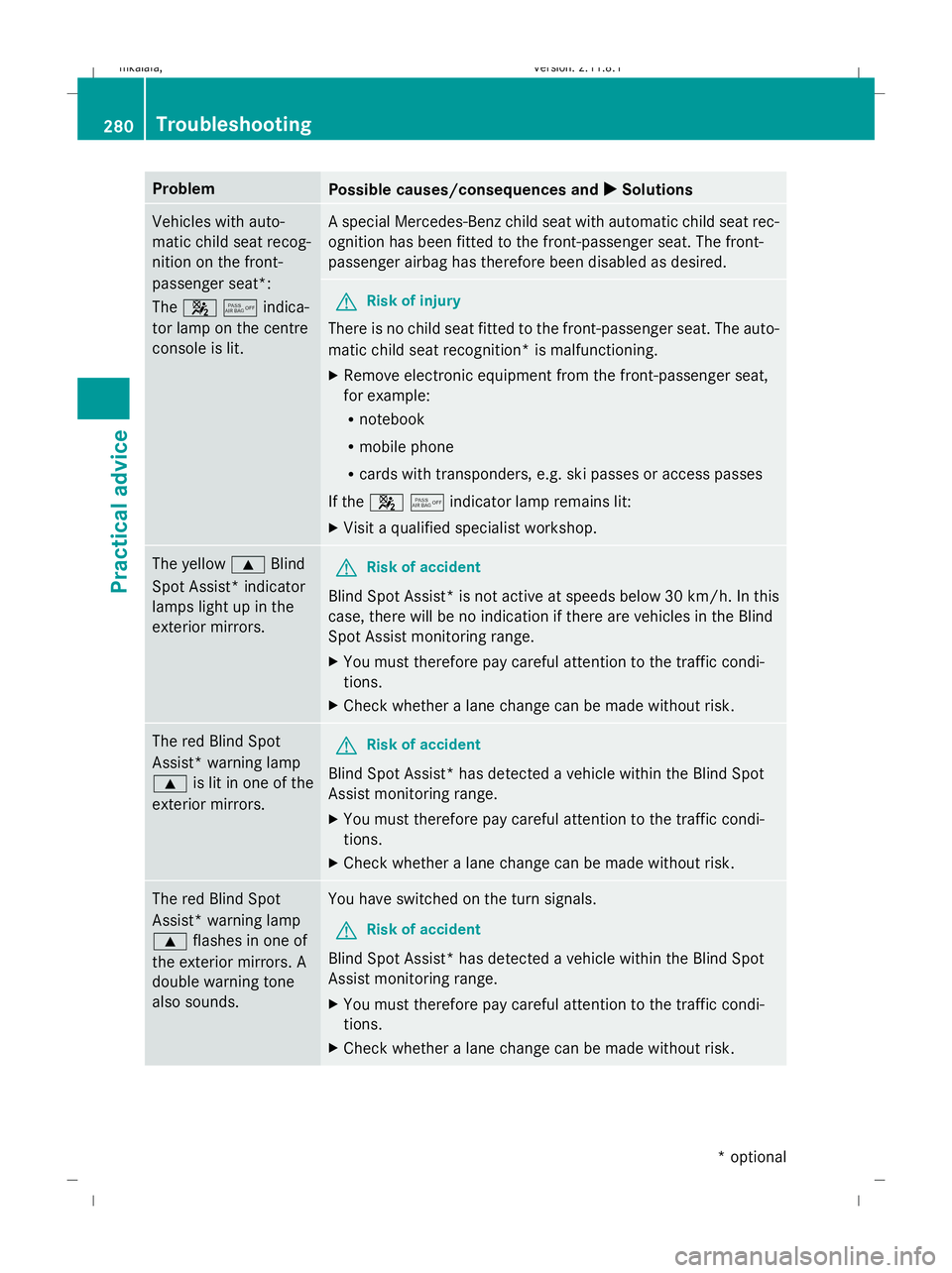
X Visit a qualified specialist workshop. The yellow
9Blind
Spot Assist* indicator
lamps light up in the
exterior mirrors. G
Risk of accident
Blind Spot Assist *is not active at speeds below 30 km/h. In this
case, there will be no indication if there are vehicles in the Blind
Spot Assist monitoring range.
X You must therefore pay careful attention to the traffic condi-
tions.
X Check whether a lane change can be made without risk. The red Blind Spot
Assist* warning lamp
9
is lit in one of the
exterior mirrors. G
Risk of accident
Blind Spot Assist* has detected a vehicle within the Blind Spot
Assist monitoring range.
X You must therefore pay careful attention to the traffic condi-
tions.
X Check whether a lane change can be made without risk. The red Blind Spot
Assist* warning lamp
9
flashes in one of
the exterior mirrors. A
double warning tone
also sounds. You have switched on the turn signals.
G Risk of accident
Blind Spot Assist* has detected a vehicle within the Blind Spot
Assist monitoring range.
X You must therefore pay careful attention to the traffic condi-
tions.
X Check whether a lane change can be made without risk. 280
TroubleshootingPractical advice
* optional
212_AKB; 2; 4, en-GB
mkalafa,
Version: 2.11.8.1 2009-05-05T14:17:16+02:00 - Seite 280
Dateiname: 6515346702_buchblock.pdf; erzeugt am 07. May 2009 14:17:11; WK
Page 291 of 373
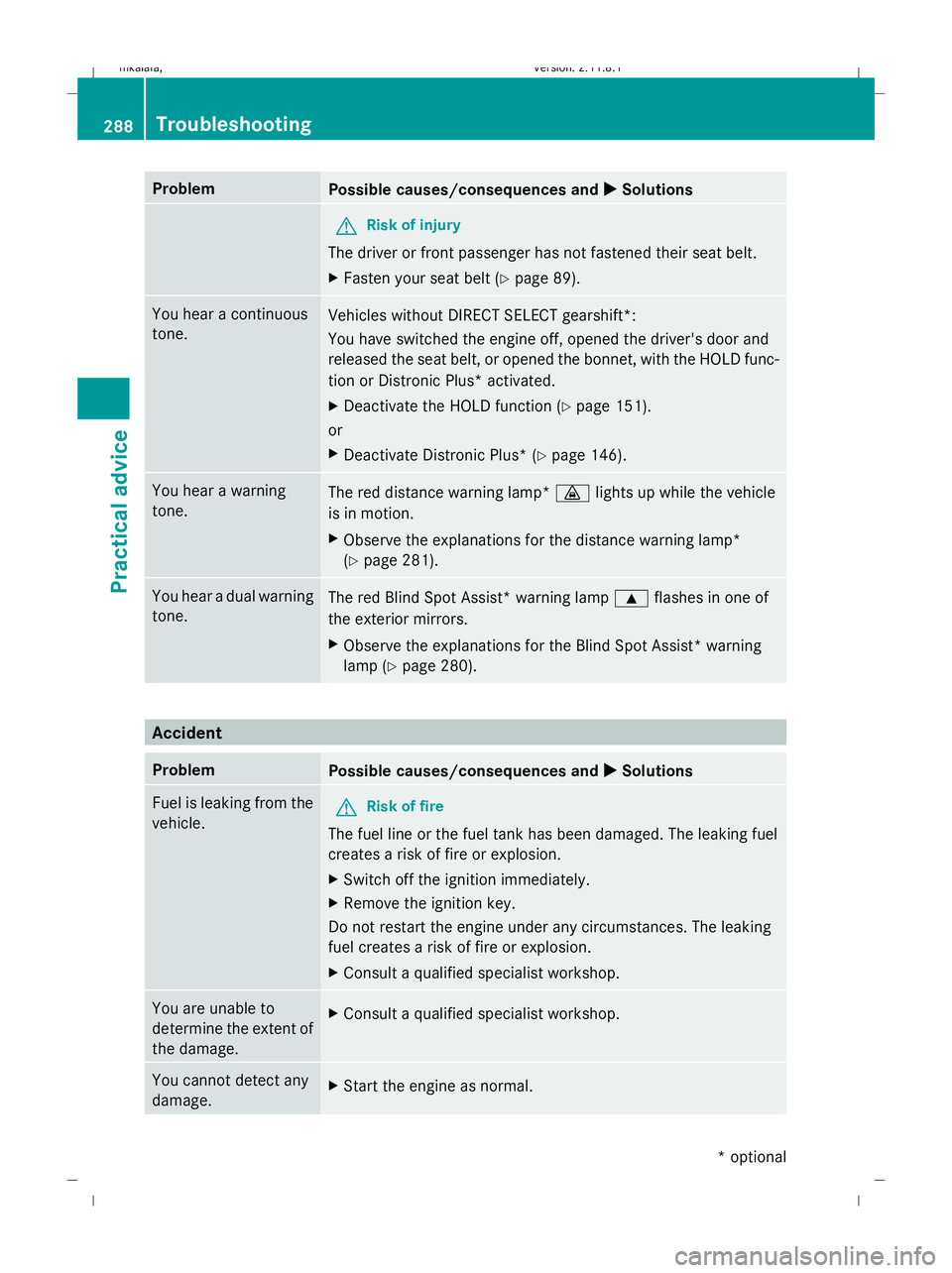
Problem
Possible causes/consequences and
X XSolutions G
Risk of injury
The driver or front passenger has not fastened their seat belt.
X Fasten your seat belt (Y page 89).You hear a continuous
tone.
Vehicles without DIRECT SELECT gearshift*:
You have switched the engine off, opened the driver's door and
released the seat belt, or opened the bonnet, with the HOLD func-
tion or Distronic Plus* activated.
X
Deactivate the HOLD function (Y page 151).
or
X Deactivate Distronic Plus* (Y page 146).You hear a warning
tone.
The red distance warning lamp*
·lights up while the vehicle
is in motion.
X Observe the explanations for the distance warning lamp*
(Y page 281). You hear a dual warning
tone.
The red Blind Spot Assist* warning lamp
9flashes in one of
the exterior mirrors.
X Observe the explanations for the Blind Spot Assist* warning
lamp (Y page 280). Accident
Problem
Possible causes/consequences and
X XSolutions Fuel is leaking from the
vehicle.
G
Risk of fire
The fuel line or the fuel tank has been damaged. The leaking fuel
creates a risk of fire or explosion.
X Switch off the ignition immediately.
X Remove the ignition key.
Do not restart the engine under any circumstances. The leaking
fuel creates a risk of fire or explosion.
X Consult a qualified specialist workshop. You are unable to
determine the extent of
the damage.
X
Consult a qualified specialist workshop. You cannot detect any
damage.
X
Start the engine as normal. 288
TroubleshootingPractical advice
* optional
212_AKB; 2; 4, en-GB
mkalafa,
Version: 2.11.8.1 2009-05-05T14:17:16+02:00 - Seite 288
Dateiname: 6515346702_buchblock.pdf; erzeugt am 07. May 2009 14:17:13; WK
Page 365 of 373

Country Radio type approval number MHz frequency
range
Slovenia Article 6 of Directive 1999/5/EC R&TTE
500-1/2005-437 9 May 05 27, 40, 433, 868
Spain 000438/2005, 000439/2005, 000440/2005
000441/2005, 000445/2005, 000446/2005
000447/2005 27, 40, 433, 868
South Africa 11 October 2005 27, 40, 433
Syria 279/4/14 / 05 March 06
Czech Republic General Licence GL-30/R/2000 Reg. No. 844 13
May 05 27, 40, 433
Turkey National Certification 23 July 07 433
Hungary Article 6 of Directive 1999/5/EC R&TTE18 May
05 27, 40, 433, 868
United Arab
Emirates 1623/5/10-2/26/76 433
Cyprus Article 6 of Directive 1999/5/EC R&TTE5 May 05 27, 40, 433, 868
24-GHz radar sensor system (country
overview)*
The 24 GHz radar sensor system requires
separate approval for each country. When
you are driving in a country in which the radar
sensor system is not approved, you must
deactivate the system using the on-board
computer (Y page 134). The current country
overview can be obtained from a Mercedes-
Benz Service Centre. The radar sensor system is automatically
deactivated near radio telescope facilities. If
Distronic Plus*, Blind Spot Assist* or PRE-
SAFE
®
Brake* are activated at this point, a
corresponding warning will appear in the
multi-function display to tell you that the
radar sensor system is being switched off.
BAS PLUS* is also no longer available. If the
deactivation does not occur automatically,
you must deactivate the radar sensor system
using the on-board computer (Y page 134).Country Radio telescope
facilities Geographic coordinates
(latitude/longitude) Distance to be
maintained from the facility Egypt – – –
Andorra – – –
Australia Parkes 32°59'59"S, 148°15'44" E 10 km
Narrabri 30°18'52"S, 149°32'56" E 10 km362
24-GHz radar sensor system (country overview)*Technical data
* optional
212_AKB; 2; 4, en-GB
mkalafa,
Version: 2.11.8.1 2009-05-05T14:17:16+02:00 - Seite 362
Dateiname: 6515346702_buchblock.pdf; erzeugt am 07. May 2009 14:17:38; WK