ESP MERCEDES-BENZ E-CLASS SALOON 2015 User Guide
[x] Cancel search | Manufacturer: MERCEDES-BENZ, Model Year: 2015, Model line: E-CLASS SALOON, Model: MERCEDES-BENZ E-CLASS SALOON 2015Pages: 497, PDF Size: 16.23 MB
Page 27 of 497
Protection of the environment
General notes
H
Environmental note
Daimler's declared policy is one of compre-
hensive environmental protection.
Our objectives are to use the natural resour-
ces which form the basis of our existence on
this planet sparingly and in amanner which
takes the requirements of both nature and
humanity into consideration.
You too can help to protect the environment
by operating your vehicle in an environmen-
tally-responsible manner.
Fuel consumption and the rate of engine,
transmission, brake and tyre wear depend on
the following factors:
R operating condition sofyour vehicle
R your personal driving style
You can influence both factors. Therefore,
please bear the following in mind:
Operating conditions:
R avoid short trips, as these increase fuel
consumption.
R observe the correct tyre pressure.
R do not carry any unnecessary weight in the
vehicle.
R remove the roof rack once you no longer
need it.
R ar egularly serviced vehicle will contribute
to environmental protection. You should
therefore adhere to the service intervals.
R all maintenance work should be carried out
at aq ualified specialist workshop.
Personal driving style:
R do not depress the accelerator pedal when
startingt he engine.
R do not warm up the engine when the vehicle
is stationary.
R drive carefully and maintain asafe distance
from the vehicle in front.
R avoid frequent, sudden acceleration and
braking. R
change gear in good time and use each gear
only up to Ôof its maximum engine speed.
R switch off the engine in stationary traffic.
R monitor the vehicle's fuel consumption. Returning an end-of-life vehicle
EU countries only:
Mercedes-Benz will take back your old vehicle to dispose of it in an environmentally-respon-sible manner in accordance with the Euro-
pean Union (EU) End of Life Vehicles Direc-
tive.
There is anetwork of return points and dis-
assembly plants available. You can return
your vehicle to these plants free of charge.
This makes avaluable contribution to the
recycling process and the conservation of
resources.
For further information on recycling old vehi- cles, recovery and the terms of the policy,
visit the Mercedes-Benz homepage. Genuine Mercedes-Benz parts
H
Environmental note
Daimler AG also suppliesr econditioned
assemblies and parts which are of the same
quality as new parts. For these, the same war-
ranty appliesasf or new parts.
! Airbags and seat belt tensioners, as well
as control units and sensors for these
restraint systems, may be installed in the
following areas of your vehicle:
R doors
R door pillars
R door sills
R seats
R dashboard
R instrumen tcluster
R centre console 24
Introduction
Page 28 of 497
Do not instal
laccessorie ssuchasa udio
systems in these areas. Do not carry out
repairs or welding .You could impair the
operating efficiency of the restraint sys-
tems.
Have accessorie sretrofitted at aquali fied
specialis tworkshop.
Yo uc ould jeopardise the operating safety of
your vehicl eifyouusep arts, tyres and wheels
as well as accessorie srelevant to safety
which have not been approved by Mercedes. This could lead to malfunctions in safety-rel-
evant systems, e.g .the brake system. Only
us eg enuine Mercedes-Benz parts or parts of
equa lquali ty.O nlyu setyres ,wheel sand
accessorie sthath aveb eens pecifically
approved for your vehicle.
Mercedes-Benz tests genuine parts and con-
version parts and accessorie stha th aveb een
specifically approved for your vehicl efor their
reliability, safety and suitability. Despite
ongoing market research, Mercedes-Benz is
unabl etoassessother parts. Mercedes-Benz
therefore accepts no responsibility for the
us eofs uchp arts in Mercedes-Benz vehicles,
eve nift heyh aveb eeno fficially approved or
independentl yapproved by atesting centre.
In Germany, certai nparts ar eonlyo fficially
approved for installatio normodification if
the ycomply with lega lrequirements .This
also applie stosomeother countries .All gen-
uine Mercedes-Benz parts mee tthe approval
requirements .The useofn on-approved parts
ma yinvalidate the vehicle' sgenera lope rating
permit.
This is the case:
R if the ycause achange of the vehicl etype
fro mt hatfor which the vehicle' sgeneral
operating permi twasgranted
R if other roa dusers could be endangered
R if the emission or noise level sareadversely
affected
Alway sspecify the vehicl eide ntification num-
be r(VIN) when ordering genuine Mercedes-
Benz parts (Y page 472). Owner's Manual
Vehicle equipment
This Owner' sManuald escribe sallmodels
and al lstandard and optional equipment
availabl efor your vehicl eatthe tim eofpub-
lication of the Owner' sManual. Country-spe-
cific differences ar epossible. Note tha tyour
vehicl emaynot be fitte dwitha llfeatures
described. This is also the cas efor systems
and functions relevant to safety .The refore,
the equipment on your vehicl emaydiffe rfrom
tha tint he descriptions and illustrations.
Th eo riginal purchase contract documenta-
tio nfor your vehicl econtains alistofa llof the
systems in your vehicle.
Shoul dyou have any questions concerning
equipment and operation, please consul ta
Mercedes-Benz Service Centre.
Th eO wner'sM anualand Service Bookle tare
important documents and shoul dkeptint he
vehicle. Operatin
gsafety Important safety notes
G
WARNING
If yo udon ot have the prescribe dservice/
maintenanc eworkorn ecessary repairs car-
ried out, thi scould resul tinmalfunctions or
syste mfailures. There is ariskofana ccident.
Alway shavet he prescribe dservice/mainte-
nanc eworkasw ellasn ecessary repairs car-
ried ou tataqualified specialis tworkshop. G
WARNING
Flammabl ematerial such as leaves ,grass or
twigs ma yign ite if the ycome into contact with
ho tparts of the exhaust system. There is arisk
of fire.
When driving off roa doronunpaved roads,
check the vehicle' sundersid eregularly .In
particular ,remove parts of plants or other
flammabl ematerial swhich have become Introduction
25 Z
Page 38 of 497
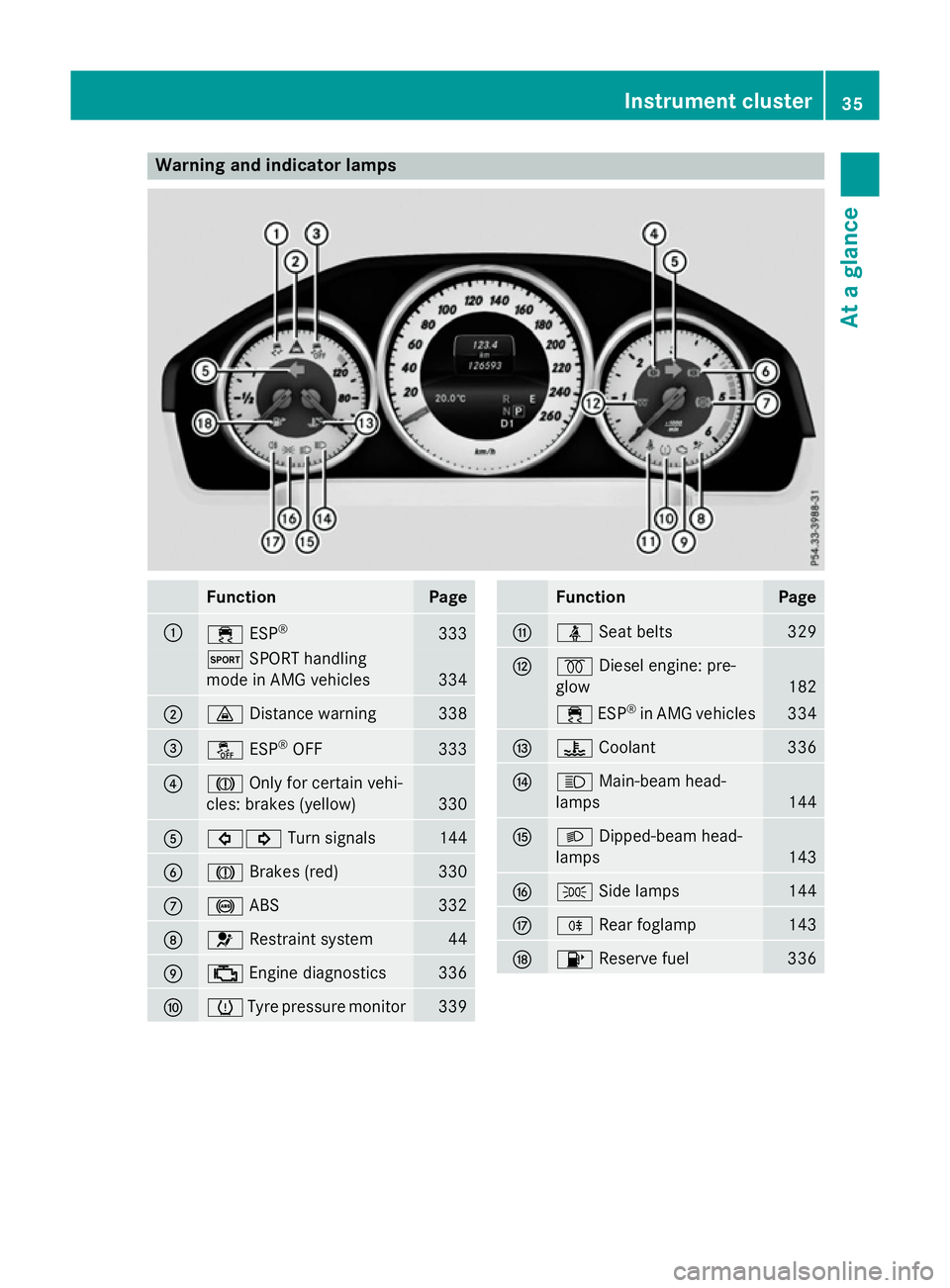
Warning and indicator lamps
Function Page
:
÷
ESP® 333
M
SPORT handling
mode in AMG vehicles 334
;
·
Distance warning 338
=
å
ESP®
OFF 333
?
J
Only for certain vehi-
cles: brakes (yellow) 330
A
#!
Turn signals 144
B
J
Brakes (red) 330
C
!
ABS 332
D
6
Restraint system 44
E
;
Engine diagnostics 336
F
h
Tyre pressure monitor 339 Function Page
G
ü
Seat belts 329
H
%
Diesel engine: pre-
glow 182
÷
ESP®
in AMG vehicles 334
I
?
Coolant 336
J
K
Main-beam head-
lamps 144
K
L
Dipped-bea mhead-
lamps 143
L
T
Side lamps 144
M
R
Rearfoglamp 143
N
8
Reserve fuel 336Instrument cluster
35Atag lance
Page 43 of 497
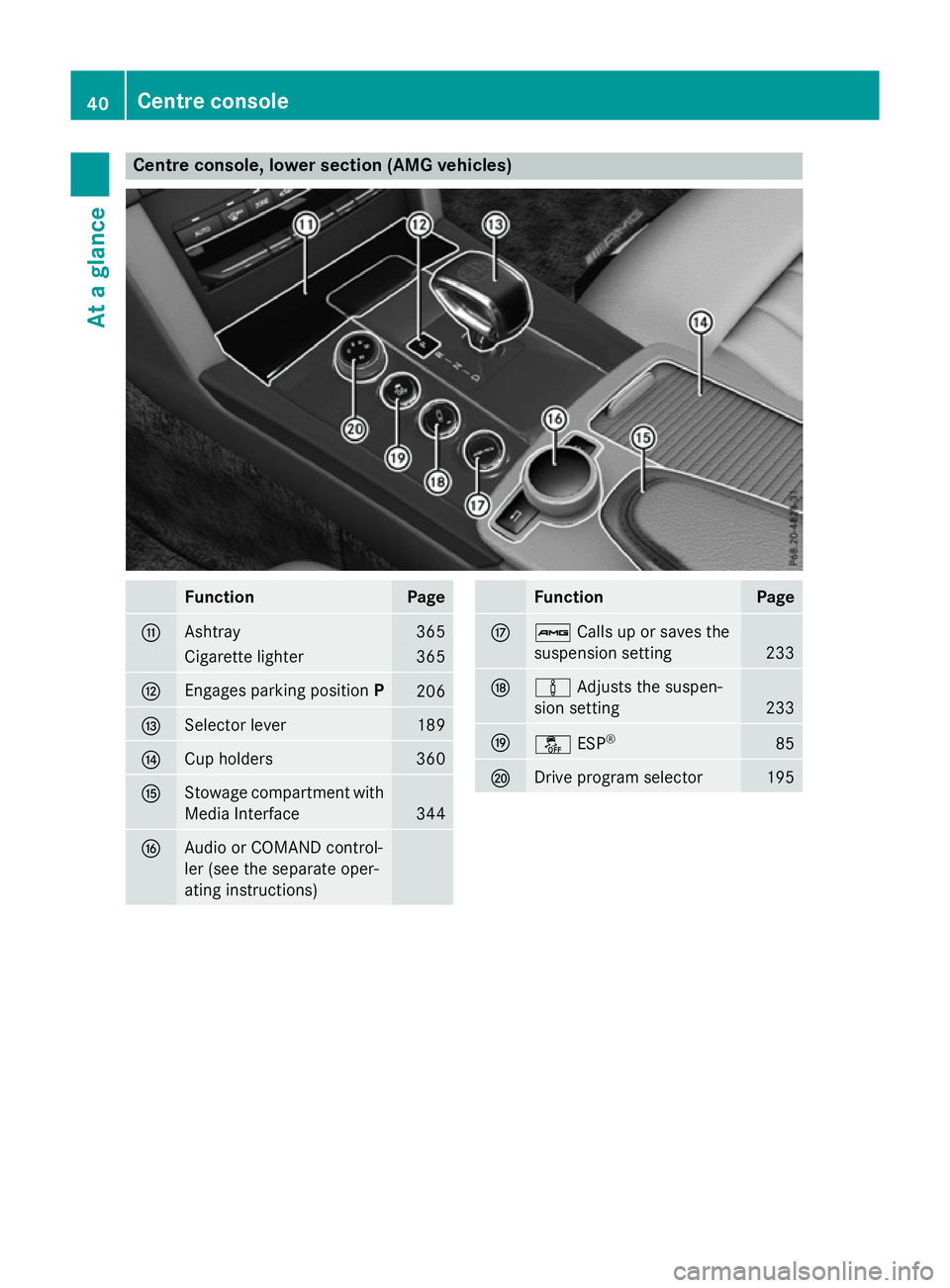
Centre console, lower section (AMG vehicles)
Function Page
G
Ashtray 365
Cigarett
elighter 365
H
Engages parking position
P 206
I
Selector lever 189
J
Cup holders 360
K
Stowage compartmen
twith
Media Interface 344
L
Audi
oorC OMAND control-
ler (see th eseparate oper-
atin ginstructions) Function Page
M
ß
Calls up or save sthe
suspension setting 233
N
à
Adjusts th esuspen-
sion setting 233
O
å
ESP® 85
P
Drive program selector 19540
Centre consoleAt
ag lance
Page 55 of 497
Sidebags
G
WARNING
Unsuitable seat covers may obstruct or even
prevent deployment of the airbags integrated into the seats. The airbags may then fail to
protect the vehicle occupants as intended.
Operation of the automatic child seat recog-
nition may also be impaired. There is an
increased risk of injury, possibly even fatal.
Use only seat covers which have been specif-
ically approved for the respective seat by
Mercedes-Benz. Example: Saloon
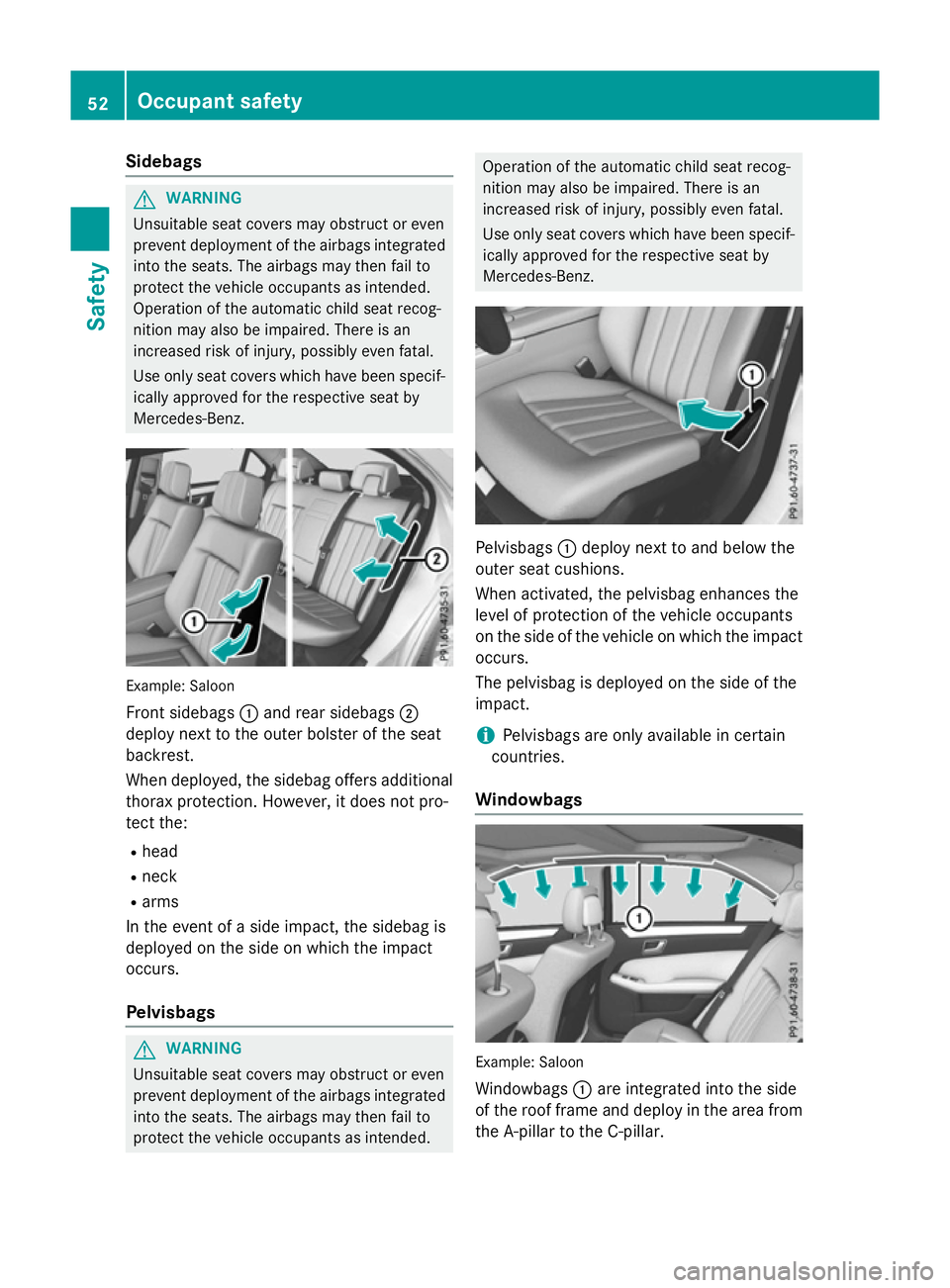
Front sidebags :and rear sidebags ;
deploy next to the outer bolster of the seat
backrest.
When deployed, the sidebag offers additional thorax protection. However, it does not pro-
tect the:
R head
R neck
R arms
In the event of aside impact, the sidebag is
deployed on the side on which the impact
occurs.
Pelvisbags G
WARNING
Unsuitable seat covers may obstruct or even
prevent deployment of the airbags integrated into the seats. The airbags may then fail to
protect the vehicle occupants as intended. Operation of the automatic child seat recog-
nition may also be impaired. There is an
increased risk of injury, possibly even fatal.
Use only seat covers which have been specif- ically approved for the respective seat by
Mercedes-Benz. Pelvisbags
:deploy next to and below the
outer seat cushions.
When activated, the pelvisbag enhances the
level of protection of the vehicle occupants
on the side of the vehicle on which the impact
occurs.
The pelvisbag is deployed on the side of the
impact.
i Pelvisbags are only available in certain
countries.
Windowbags Example: Saloon
Windowbags :are integrated into the side
of the roof frame and deploy in the area from the A-pillar to the C-pillar. 52
Occupant safetySafety
Page 56 of 497
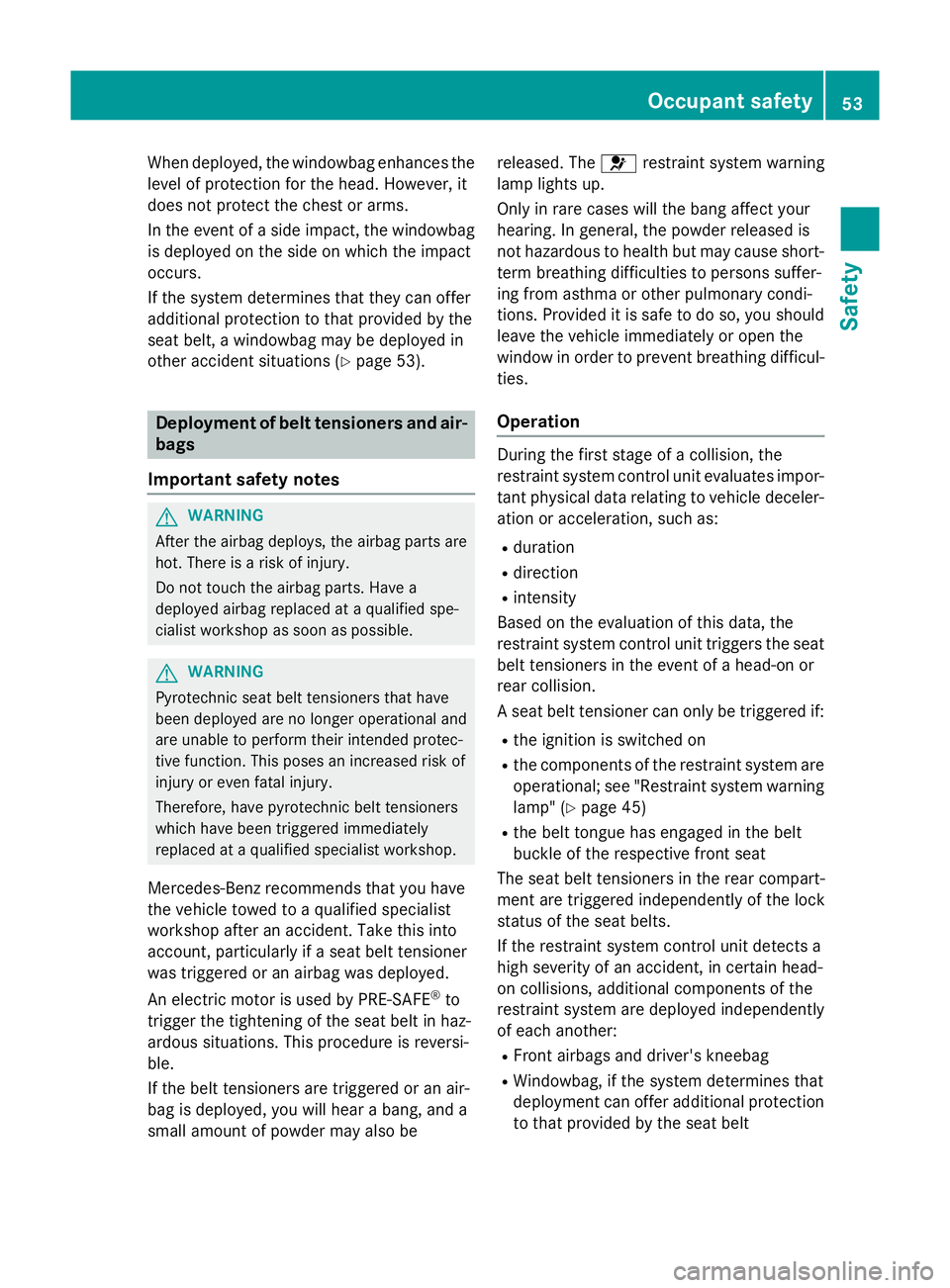
When deployed, the windowbag enhances the
level of protection for the head. However, it
does not protec tthe chest or arms.
In the event of aside impact, the windowbag
is deployed on the side on which the impact
occurs.
If the system determines that they can offer
additional protection to that provided by the
seat belt, awindowbag may be deployed in
other accident situation s(Ypage 53). Deployment of belt tensioners and air-
bags
Important safety notes G
WARNING
After the airbag deploys, the airbag parts are
hot. There is arisk of injury.
Do not touch the airbag parts. Have a
deployed airbag replaced at aqualified spe-
cialist workshop as soon as possible. G
WARNING
Pyrotechnic seat belt tensioners that have
been deployed are no longer operational and
are unable to perform their intended protec-
tive function. This poses an increased risk of
injury or even fatal injury.
Therefore, have pyrotechnic belt tensioners
which have been triggered immediately
replaced at aqualified specialist workshop.
Mercedes-Benz recommends that you have
the vehicle towed to aqualified specialist
workshop after an accident .Take this into
account ,particularly if aseat belt tensioner
was triggered or an airbag was deployed.
An electric motor is used by PRE-SAFE ®
to
trigger the tightening of the seat belt in haz-
ardous situations. This procedure is reversi-
ble.
If the belt tensioners are triggered or an air-
bag is deployed, you will hear abang, and a
small amount of powder may also be released. The
6restraint system warning
lamp lights up.
Only in rare cases will the bang affect your
hearing. In general, the powder released is
not hazardous to health but may cause short- term breathin gdifficulties to persons suffer-
ing from asthma or other pulmonary condi-
tions. Provided it is safe to do so, you should
leave the vehicle immediately or open the
window in order to preven tbreathin gdifficul-
ties.
Operation During the first stage of
acollision, the
restraint system control unit evaluates impor-
tant physical data relating to vehicle deceler- ation or acceleration, such as:
R duration
R direction
R intensity
Based on the evaluation of this data, the
restraint system control unit trigger sthe seat
belt tensioners in the event of ahead-on or
rear collision.
As eat belt tensioner can only be triggered if:
R the ignition is switched on
R the componentsoft he restraint system are
operational; see "Restraint system warning lamp" (Y page 45)
R the belt tongue has engaged in the belt
buckle of the respective fron tseat
The seat belt tensioners in the rear compart-
ment are triggered independently of the lock
status of the seat belts.
If the restraint system control unit detect sa
high severit yofanaccident,incertain head-
on collisions, additional componentsoft he
restraint system are deployed independently
of each another:
R Fron tairbags and driver's kneebag
R Windowbag, if the system determines that
deployment can offer additional protection
to that provided by the seat belt Occupant safety
53Safety Z
Page 57 of 497
Depending on the perso
ninthe front-
passenge rsea t, the front-passenge rfront air-
ba gise ithe rd isable dorenabled .The front-
passenge rfront airba gcan onl ybedeployed
in an accident if the PASSENGER AIR BAG OFF indicator lamp is off .Obser ve the information
on the PASSENGER AIR BAG OFF indicator
lamp (Y page 45).
Your vehicl ehastwo-stage front airbags. In
the first deployment stage ,the front airba gis
fille dwithp ropellant ga storeduce the risk of
injuries .The front airba gisfullydeployed if
the second deployment stage is activated
withi nafew milliseconds.
Th ea ctivatio nthreshold for the seat belt ten-
sioners and airbags is determine dbased on
the evaluation of the vehicle' srateofd ecel-
eratio noracceleratio natvarious points in the
vehicle. This proces sispre-emptiv einnature.
Th et riggering/deployment proces sshould
take place in good tim eatthe start of the
collision.
Th er ateofv ehicledeceleratio noraccelera-
tio na nd the directio nofthe force ar eessen-
tiall ydetermine dby:
R the distributio nofforces during the colli-
sion
R the collision angle
R the deformatio ncharacteristics of the vehi-
cle
R the characteristics of the object with which
the vehicl ehascollided
Factors which can onl ybeseena nd measured
after acollision ha soccurre ddonot play a
decisiv eroleint he deployment of an airbag,
nor do the yprovide an indicatio nofairbag
deployment.
Th ev ehicl emaybe deformed significantly
without an airba gbeing deployed .Thisist he
cas eifo nlyp arts which ar erelativel yeasily
deformed ar eaffecte dand the rate of decel-
eratio nisn ot high .Conversely ,anairba gm ay
be deployed eve nthoug hthe vehicl esuffers
onl ym inor deformation. This is the cas eif, for
example, ver yrigid vehicl eparts such as lon- gitudina
lbod ym embers ar ehit,a nd sufficient
deceleratio noccurs as aresult.
If the restraint syste mcontro lunitd etects a
side impact or if the vehicl eoverturns, the
applicabl ecomponents of the restraint sys-
tem ar eactivated independentl yofeach
other depending on the apparent typ eofacci-
dent.
R Sidebag sand pelvisba gonthe side on
which an impact occurs, independent from the seat belt tensioner and seat belt usage
Vehicle switht he automatic child seat rec-
ognition on the front-passenge rseat: the
sideba gand pelvisba gonthe front-
passenge rside( front) deploy under the fol-
lowing conditions:
- an occupant is detecte donthe front-
passenge rseator
- the belt tongue is engaged in the belt
buckle of the front-passenge rseat
R Windowbag on the side on which an impact
occurs, independent of seat belt usag eand
regardles sofwhether the front-passenger
seat is occupied
R Sea tbeltt ensioners ,ifthe syste mdeter-
mines tha tdeployme nt can offer additional
protection for the vehicl eoccupants in this
situation
R Windowbag sonthe driver's and front-
passenge rsideinc ertainsituations if the
vehicl eoverturns and if the syste mdeter-
mines tha tdeployme nt can offer additional
protection to tha tprovide dbythe seat belt
i Not al
lairbags ar edeployed in an acci-
dent. Th edifferent airba gsystems work
independentl yofeacho ther.
How the airba gsystemw orks is deter-
mined by the severity of the accident detec- ted ,especially the vehicl edeceleratio nor
acceleration, and the apparent typ eofacci-
dent:
R frontal collision
R side impact
R overturn 54
Occupant safetySafety
Page 66 of 497
of injury to the head and neck in the event of
an accident or sudden braking, for example.
Always drive with the head restraint sfitted.
Ensure that the centre of the head restraints
support the back of each vehicle occupant's
head at eye level before driving off.
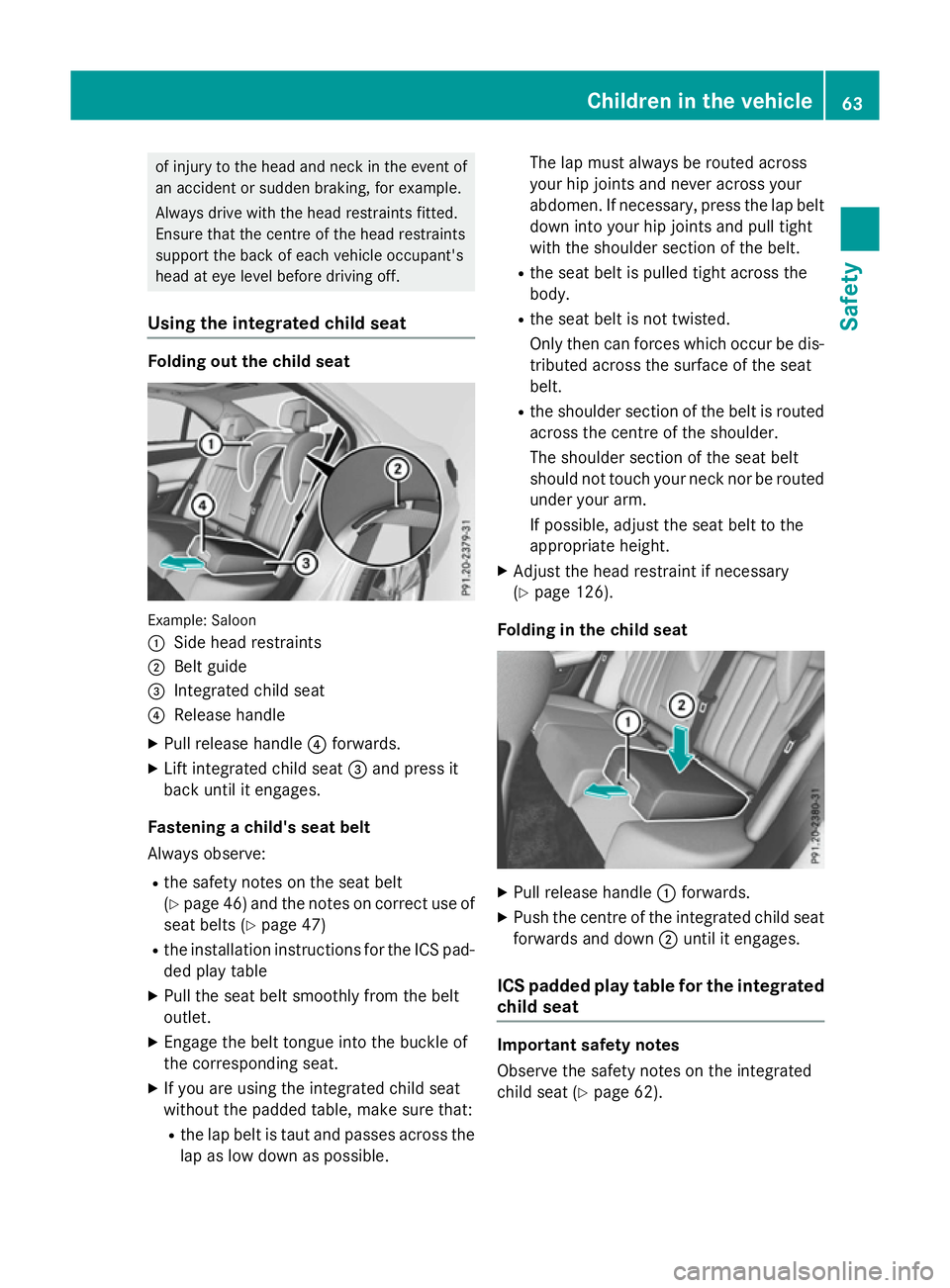
Using the integrated child seat Folding out the child seat
Example: Saloon
:
Side head restraints
; Belt guide
= Integrated child seat
? Release handle
X Pull release handle ?forwards.
X Lift integrated child seat =and press it
back until it engages.
Fastening achild's seat belt
Always observe:
R the safety notes on the seat belt
(Y page 46) and the notes on correc tuse of
seat belts (Y page 47)
R the installation instructions for the ICS pad-
ded play table
X Pull the seat belt smoothly from the belt
outlet.
X Engage the belt tongue into the buckle of
the corresponding seat.
X If you are using the integrated child seat
without the padded table, make sure that:
R the lap belt is taut and passes across the
lap as low down as possible. The lap must always be routed across
your hip jointsa nd never across your
abdomen. If necessary, press the lap belt down into your hip jointsa nd pull tight
with the shoulder section of the belt.
R the seat belt is pulled tight across the
body.
R the seat belt is not twisted.
Only then can forces which occur be dis-
tributed across the surface of the seat
belt.
R the shoulder section of the belt is routed
across the centre of the shoulder.
The shoulder section of the seat belt
should not touch your neck nor be routed
under your arm.
If possible, adjust the seat belt to the
appropriate height.
X Adjust the head restraint if necessary
(Y page 126).
Folding in the child seat X
Pull release handle :forwards.
X Push the centre of the integrated child seat
forwards and down ;until it engages.
ICS padded play table for the integrated
child seat Important safety notes
Observe the safety notes on the integrated
child seat (Y
page 62). Children in the vehicle
63Safety Z
Page 67 of 497
G
WARNING
If the ICS padded playt able has been incor-
rectly fitted to the integrated child seat, it
cannot perform its intended protective func-
tion. Achild therefore cannot be restrained in
the event of an accident, heavy braking or a
sudden change of direction. In addition, the
ICS padded playt able couldbecome loose
and be thrown around, endangering vehicle
occupants. This pose sanincreased risk of
injury or even fatal injury.
Fit the ICS padded playt able as described.
After fitting the ICS padded playt able,make
sure that it is secure dcorrectly. For safety
reasons, only use the ICS padded playt able
that has been tested and approved for your
vehicle.
The ICS padded playt able is only suitable for
use with the folded-out integrated child seat.
On the rear seats with an integrated child
seat, only use the ICS padded playt able that
is recommende dfor Mercedes-Benz vehicles.
Only use the ICS padded playt able with its
original cover. Withou tthe original cover, the
officia lapproval is invalidated.
Use the ICS padded playt able in accordance
with the instructions in the table in the "Inte-
grated child seat( ICS)"section (Y page62).
Note that children under two years old and
children who weigh less than 12.5 kg require ad ifferent and suitable child restraint system.
Information about other child restraint sys-
tems is available at any Mercedes-Benz Ser-
vice Centre.
You must not use the integrated child seat
with ICS padded playt able asadirect attach-
ment to ababyc ar seatf or which abody
weight of up to 10 kg is permissible. Note that
children younger than 24 months old require
ad ifferent child restraint system
(Y page7 4).
If you are not using the ICS padded playt able,
stow it in an appropriate place, e.g. in the
boot/luggage compartment. You willf ind fur-
ther information on stowing objects, luggage and loads securely under "Loading guide-
lines".
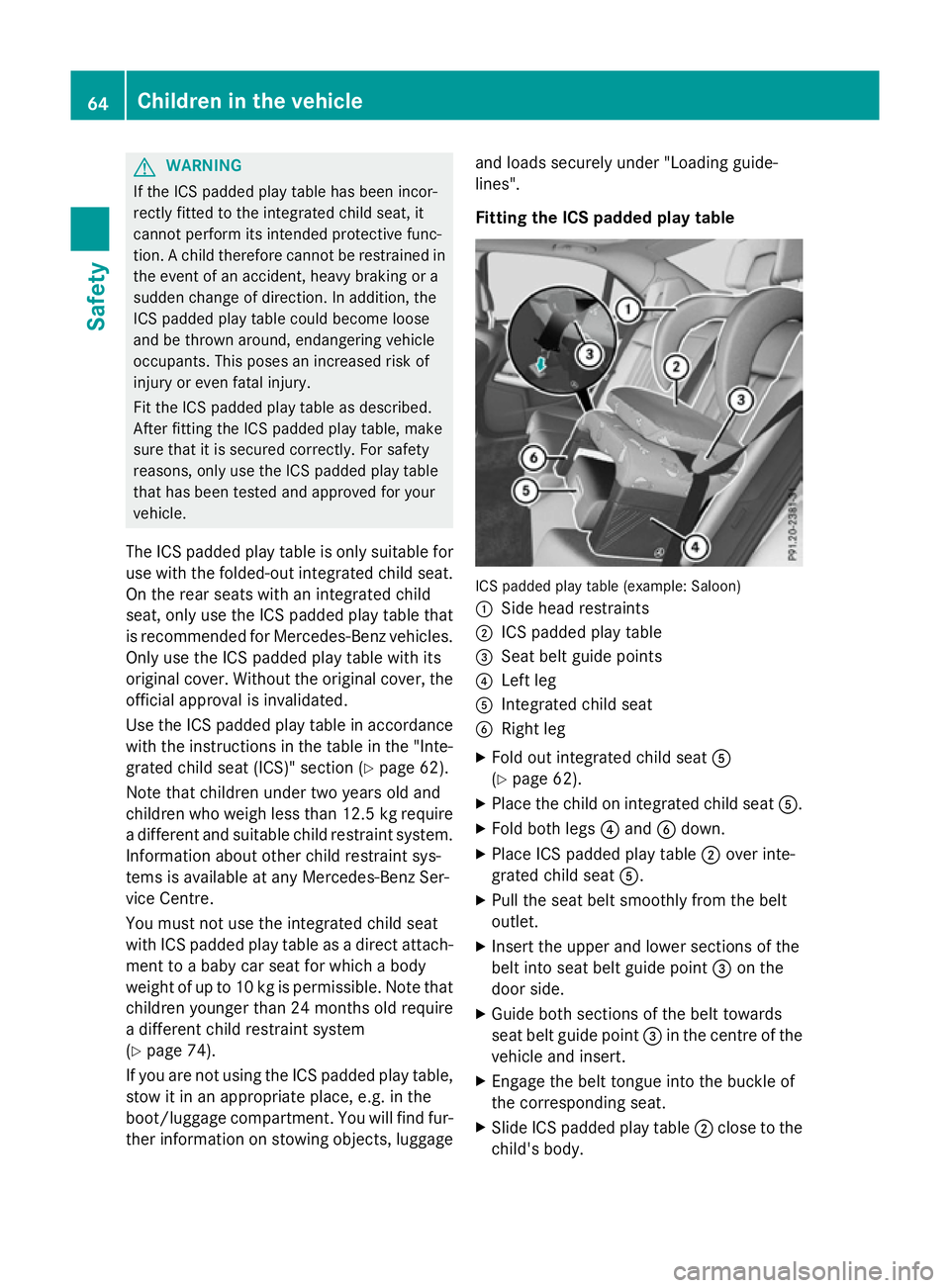
Fittin gthe ICSp added play table ICS padded pla
ytable (example: Saloon)
: Side headr estraints
; ICS padded playt able
= Seat beltg uide points
? Left leg
A Integrated child seat
B Right leg
X Fold out integrated child seat A
(Y page6 2).
X Place the child on integrated child seat A.
X Fold both legs ?and Bdown.
X Place ICS padded playt able;over inte-
grated child seat A.
X Pullt he seat belts moothly from the belt
outlet.
X Insert the upper and lower sections of the
belti nto seat beltg uide point=on the
door side.
X Guide both sections of the beltt owards
seat beltg uide point =in the centre of the
vehicl eand insert.
X Engage the beltt ongue into the buckle of
the corresponding seat.
X Slide ICS padded playt able;close to the
child's body. 64
Children in the vehicleSafety
Page 69 of 497
chil
drestraint system with transponders has
bee nfitted .Inthis case, the PASSENGER AIR
BAG OFF indicator lamp lights up and remains
lit. The front-passenger front airba gisdisa-
bled.
i If the front-passenger front airba gisdis-
able dbyt he automatic chil dseatrecogni-
tion, the following remain enabled on the
front-passenger side:
R the sidebag
R the pelvisbag
R the windowbag
R the bel ttensioner G
WARNING
If yo usecure achildinac hildr estraint system
on the front-passenger sea tand the
PASSENGER AIR BAG OFF indicator lamp is
off, the front-passenger front airba gcan
deploy in the event of an accident. The child
could be struck by the airbag. Thi sposes an
increased ris kofinjury or eve nfata linjury.
Make sure that the front-passenger front air-
ba gh asbee ndisable d. The PASSENGER AIR-
BAG OFF indicator lamp mus tbelit. G
WARNING
If the PASSENGER AIRBAG OFF indicator lamp is lit, the front-passenger front airba gisdisa-
bled. It will not be deployed in the event of an
accident and cannot perform its intended pro-
tectiv efunction. Aperson in the front-
passenger sea tcould then, for example, come
into contact with the vehicle's interior ,espe-
ciall yift he person is sitting too clos etothe
dashboard. Thi sposes an increased ris kof
injury or eve nfata linjury.
In this cas ethe front-passenger sea tmay not
be used. You may only transpor tachildont he
front-passenger sea tifthey are seated in a
suitabl erearward or forward-facing child
restraint system. Alway sobserve the infor-
mation abou tsuitabl epositioning of the child
restraint system in this Owner's Manua las
well as the chil drestraint system manufac-
turer's installation instructions. G
WARNING
If yo usecure achildinaf orward-facing child
restraint system on the front-passenger seat
and yo uposition the front-passenger sea ttoo
close to the dashboard, in the event of an
accident, the chil dcould:
R come into contact with the vehicle's inte-
rio rift he PASSENGER AIR BAG OFF indi-
cator lamp is lit, for example
R be struck by the airba gifthe PASSENGER
AIR BAG OFF indicator lamp is off
Thi sposes an increased ris kofinjury or even
fata linjury.
Move the front-passenger sea tasfar back as
possible .Alway smake sure that the shoulder
bel tstra pisc orrectly routed from the vehicle
bel tsashg uide to the shoulder bel tguide on
the chil drestraint system. The shoulder belt
stra pmustb erouted forward sand down-
wards from the vehicle bel tsashg uide .Ifnec-
essary ,adjust the vehicle bel tsashg uide and
the front-passenger sea taccordingly .Always
observe the information abou tsuitabl eposi-
tioning of the chil drestraint system in this
Owner's Manua laswellast he chil drestraint
system manufacturer' sinstallation instruc-
tions.
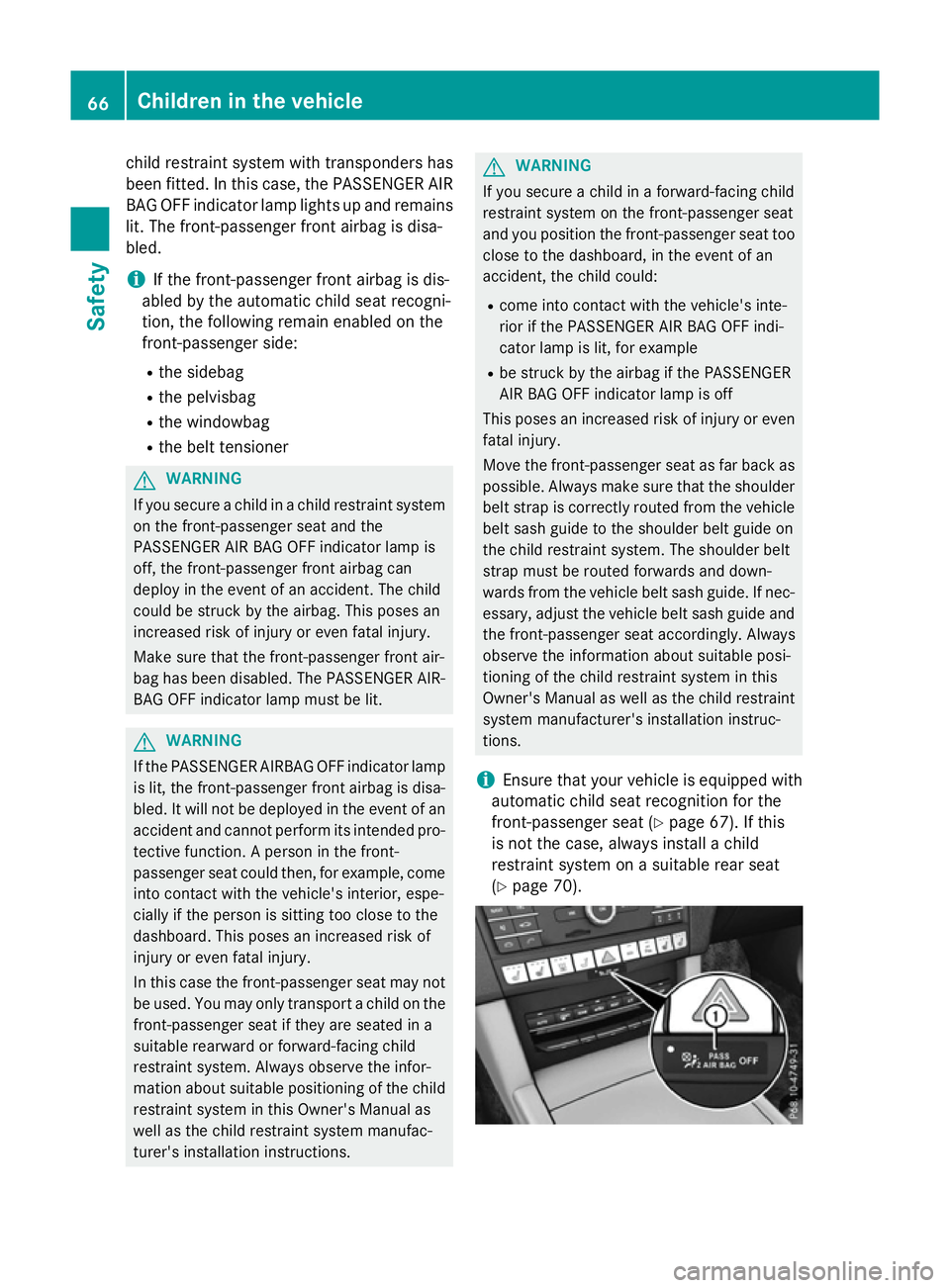
i Ensur
ethat your vehicle is equipped with
automatic chil dseatrecognition for the
front-passenger sea t(Ypage 67). If this
is not the case, always install achild
restraint system on asuitabl erears eat
(Y page 70). 66
Childre
ninthe vehicleSafety