engine MERCEDES-BENZ E-CLASS WAGON 2001 W210 Owners Manual
[x] Cancel search | Manufacturer: MERCEDES-BENZ, Model Year: 2001, Model line: E-Class WAGON, Model: MERCEDES-BENZ E-Class WAGON 2001 W210Pages: 345, PDF Size: 16.08 MB
Page 292 of 345
289 Towing the vehicle
Te ch n ica l
data Instruments
and controlsOperation DrivingInstrument
cluster displayPractical hintsCar care Index We recommend that the vehicle be transported using
f lat bed equipment. This method is preferable to other
types of towing.
The vehicle may be towed with all wheels on the ground
and the selector lever in position “N” for distances up to
30 miles (50 km) and at a speed not to exceed 30 mph
(50 km / h). The electronic key must be in steering lock
position 2.
To be certain to avoid a possibility of damage to the
transmission, however, we recommend the drive shaft
be disconnected at the rear axle drive f lange for any
towing beyond a short tow to a nearby garage.
Do not tow with sling-type equipment. Towing with
sling-type equipment over bumpy roads will damage
radiator and supports.
Use wheel lift, dolly, or flat bed equipment, with
electronic key in steering lock turned to position 0.Note:
To signal turns while being towed with hazard warning
flasher in use, turn electronic key in steering lock to
position 2 and activate combination switch for left or
right turn signal in usual manner – only the selected
turn signal will operate.
Upon canceling the turn signal, the hazard warning
flasher will operate again.
Caution!
If the vehicle is towed with the front axle raised, the
engine must be shut off (electronic key in steering lock
position 0 or 1). Otherwise, the ESP will immediately be
engaged and will apply the rear wheel brakes. Switch off
t h e tow - aw ay a lar m a s we l l as t he ES P .
Wa r n i n g !
With the engine not running, there is no power
assistance for the braking and steering systems. In
this case, it is important to keep in mind that a
considerably higher degree of effort is necessary to
brake and steer the vehicle.
Page 303 of 345
300 Electronic main key
Te ch n ica l
data Instruments
and controlsOperation DrivingInstrument
cluster displayPractical hintsCar care Index
Important!
Batteries contain materials that can harm the
environment if disposed of improperly. Recycling of
batteries is the preferred method of disposal. For
disposal, please follow manufacturer’s recommendation
on battery package.
Replacement Battery:
Lithium, type CR 2025 or equivalent.
Synchronizing remote control
The remote control may have to be resynchronized, if
the vehicle cannot be locked or unlocked.
To synchronize insert electronic key in starter switch.
The remote control should once again be operational.Emergency engine shut-down
If the engine can no longer be stopped using the
electronic key, the engine can be turned off by removing
two fuses.
For easy removal of fuses use the fuse extractor
(supplied with vehicle tool kit) to pull out the fuses
marked on the fuse chart as “ENGINE EMERGENCY
OFF”.
The fuse chart is also located in the vehicle tool kit,
seepage272.
For fuses see page 263.
Page 305 of 345
302 Manual release for fuel filler flap
Te ch n ica l
data Instruments
and controlsOperation DrivingInstrument
cluster displayPractical hintsCar care Index
Manual release for fuel filler flap
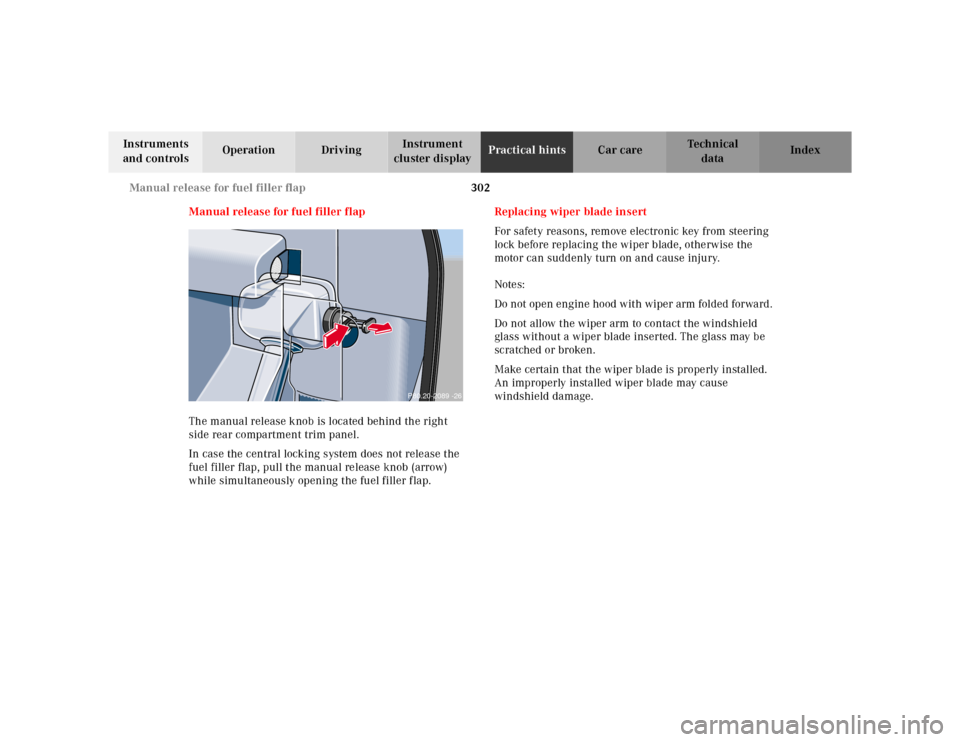
The manual release knob is located behind the right
side rear compartment trim panel.
In case the central locking system does not release the
fuel filler flap, pull the manual release knob (arrow)
while simultaneously opening the fuel filler f lap.Replacing wiper blade insert
For safety reasons, remove electronic key from steering
lock before replacing the wiper blade, otherwise the
motor can suddenly turn on and cause injury.
Notes:
Do not open engine hood with wiper arm folded forward.
Do not allow the wiper arm to contact the windshield
glass without a wiper blade inserted. The glass may be
scratched or broken.
Make certain that the wiper blade is properly installed.
An improperly installed wiper blade may cause
windshield damage.
P80.20-2089 -26
Page 310 of 345
307 Contents - Vehicle care
Te ch n ica l
data Instruments
and controlsOperation DrivingInstrument
cluster displayPractical hintsCar careIndex
Vehicle careCleaning and care of
the vehicle .................................. 308
Power washer ..............................309
Tar stains .....................................309
Paintwork, painted body
components .................................309
Engine cleaning .......................... 310Vehicle washing ..........................310
Ornamental moldings ................310
Headlamps, taillamps,
turn signal lenses .......................310
Cleaning the parktronic
system sensors ............................ 311
Window cleaning ........................ 311
Wiper blades ............................... 311
Light alloy wheels ......................312Instrument cluster ..................... 312
Steering wheel and
gear selector lever ...................... 312
Cup holder ................................... 312
Seat belts ..................................... 312
Headliner ..................................... 312
Upholstery ................................... 313
Hard plastic trim items ............. 313
Plastic and rubber parts ............ 313
Page 313 of 345
310 Cleaning and care of the vehicle
Te ch n ica l
data Instruments
and controlsOperation DrivingInstrument
cluster displayPractical hintsCar careIndex
Engine cleaning
Prior to cleaning the engine compartment make sure to
protect electrical components and connectors from the
intrusion of water and cleaning agents.
Corrosion protection, such as MB Anticorrosion Wax
should be applied to the engine compartment after
every engine cleaning. Before applying, all control
linkage bushings and joints should be lubricated. The
poly-V-belt and all pulleys should be protected from any
wax.
Ve h i c l e w a s h i n g
Do not use hot water or wash your vehicle in direct
sunlight. Use only a mild car wash detergent, such as
Mercedes-Benz approved Car Shampoo.
Thoroughly spray the vehicle with a diffused jet of
water. Direct only a very weak spray towards the
ventilation intake. Use plenty of water and rinse the
sponge and chamois frequently.
Rinse with clear water and thoroughly wipe dry with a
chamois. Do not allow cleaning agents to dry on the
finish.Due to the width of the vehicle, prior to running the
vehicle through an automatic car wash, fold back the
outside mirrors to prevent them from getting damaged.
In the winter, thoroughly remove all traces of road salt
as soon as possible.
When washing the underbody, do not forget to clean the
inner sides of the wheels.
Ornamental moldings
For regular cleaning and care of very dirty chrome-
plated parts, use a chrome cleaner.
Headlamps, taillamps, turn signal lenses
Use a mild car wash detergent, such as Mercedes-Benz
approved Car Shampoo, with plenty of water.
To prevent scratches, never apply strong force and use
only a soft, non-scratchy cloth when cleaning the lenses.
Do not attempt to wipe dirty lenses with a dry cloth or
sponge.
Page 318 of 345
315 Contents - Technical data
Te ch n ica l
data Instruments
and controlsOperation DrivingInstrument
cluster displayPractical hints Car care Index
Technical dataSpare parts service ........................ 316
Warranty coverage......................... 316
Identification labels....................... 317
Layout of poly-V-belt drive............ 318
Technical data................................. 319
Fuels, coolants, lubricants etc. -
capacities ................................... 322Engine oils...................................... 324
Engine oil additives ...................... 324
Air conditioner refrigerant .......... 324
Brake fluid ...................................... 324
Premium unleaded gasoline ........ 325
Fuel requirements......................... 325
Gasoline additives ......................... 326
Coolants .......................................... 326
Consumer information ................. 328
Page 321 of 345
318 Technical data
Te ch n ica l
data Instruments
and controlsOperation DrivingInstrument
cluster displayPractical hints Car care Index
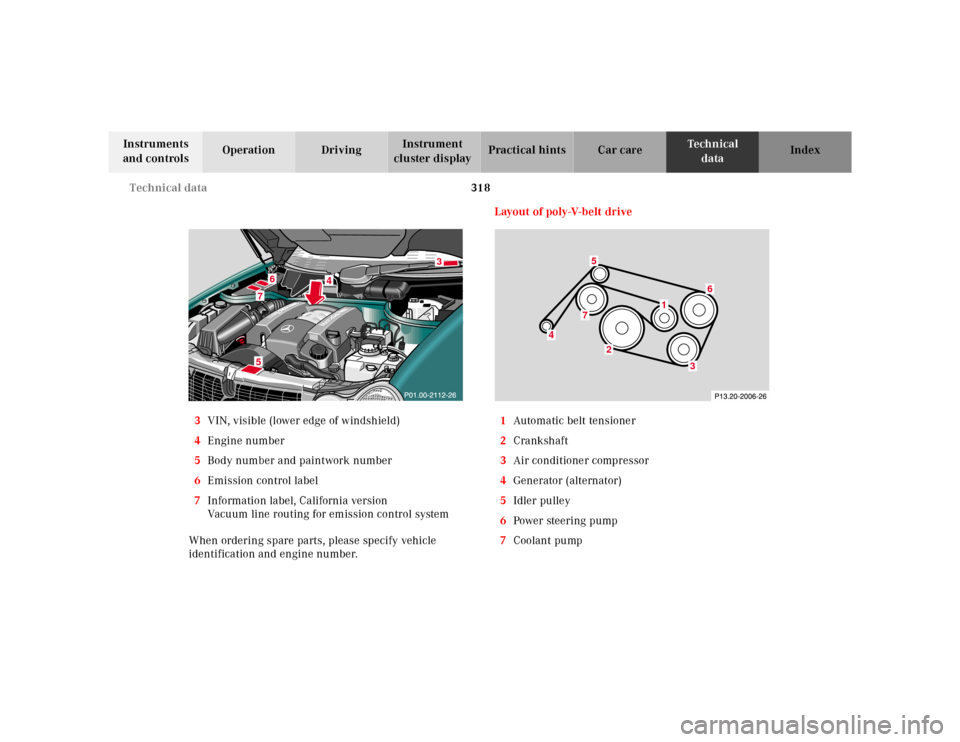
3VIN, visible (lower edge of windshield)
4Engine number
5Body number and paintwork number
6Emission control label
7Information label, California version
Vacuum line routing for emission control system
When ordering spare parts, please specify vehicle
identification and engine number.Layout of poly-V-belt drive
1Automatic belt tensioner
2Crankshaft
3Air conditioner compressor
4Generator (alternator)
5Idler pulley
6Power steering pump
7Coolant pump
6
7
4
3
5
6
5
1
2
3
7
4
Page 322 of 345
319 Technical data
Te ch n ica l
data Instruments
and controlsOperation DrivingInstrument
cluster displayPractical hints Car care Index Technical data
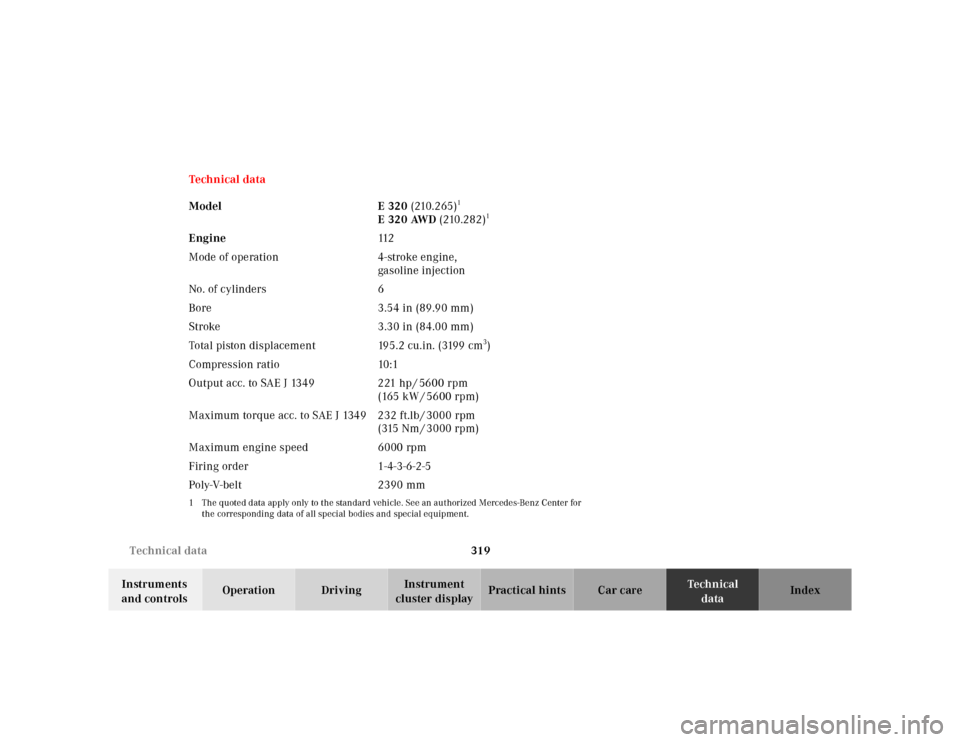
Model E 320 ( 210. 2 65 )
1
E 320 AWD (210.282)
1
Engine11 2
Mode of operation 4-stroke engine,
gasoline injection
No. of cylinders 6
Bore 3.54 in (89.90 mm)
Stroke 3.30 in (84.00 mm)
Total piston displacement 195.2 cu.in. (3199 cm
3)
Compression ratio 10:1
Output acc. to SAE J 1349 221 hp / 5600 rpm
(165 kW / 5600 rpm)
Maximum torque acc. to SAE J 1349 232 ft.lb / 3000 rpm
(315 Nm / 3000 rpm)
Maximum engine speed 6000 rpm
Firing order 1-4-3-6-2-5
Poly-V-belt 2390 mm
1 The quoted data apply only to the standard vehicle. See an authorized Mercedes-Benz Center for
the corresponding data of all special bodies and special equipment.
Page 325 of 345
322 Fuels, coolants, lubricants etc. - capacities
Te ch n ica l
data Instruments
and controlsOperation DrivingInstrument
cluster displayPractical hints Car care Index
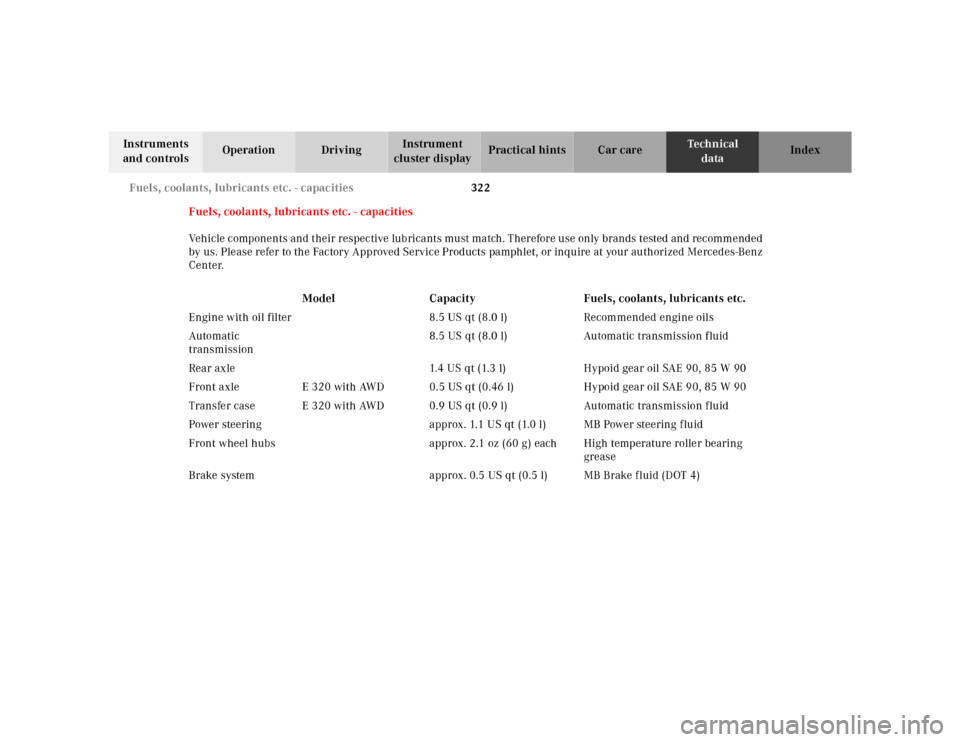
Fuels, coolants, lubricants etc. - capacities
Vehicle components and their respective lubricants must match. Therefore use only brands tested and recommended
by us. Please refer to the Factory Approved Service Products pamphlet, or inquire at your authorized Mercedes-Benz
Center.
Model Capacity Fuels, coolants, lubricants etc.
Engine with oil filter 8.5 US qt (8.0 l) Recommended engine oils
Automatic
transmission8.5 US qt (8.0 l) Automatic transmission fluid
Rear axle 1.4 US qt (1.3 l) Hypoid gear oil SAE 90, 85 W 90
Front axle E 320 with AWD 0.5 US qt (0.46 l) Hypoid gear oil SAE 90, 85 W 90
Transfer case E 320 with AWD 0.9 US qt (0.9 l) Automatic transmission fluid
Power steering approx. 1.1 US qt (1.0 l) MB Power steering fluid
Front wheel hubs approx. 2.1 oz (60 g) each High temperature roller bearing
grease
Brake system approx. 0.5 US qt (0.5 l) MB Brake fluid (DOT 4)
Page 327 of 345
324 Fuels, coolants, lubricants etc. - capacities
Te ch n ica l
data Instruments
and controlsOperation DrivingInstrument
cluster displayPractical hints Car care Index
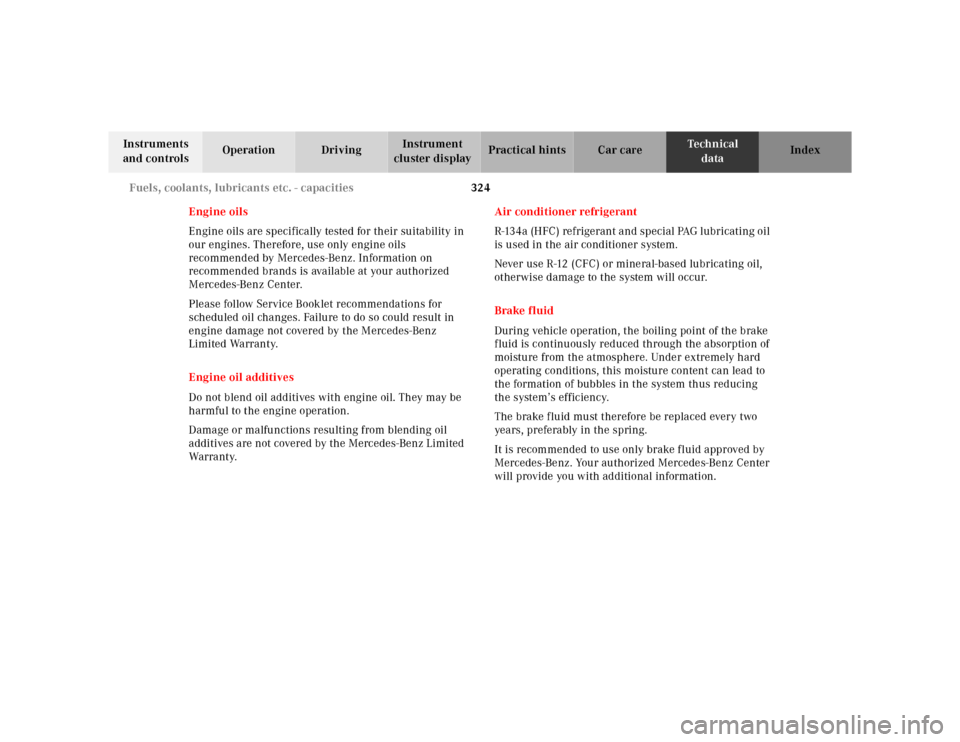
Engine oils
Engine oils are specifically tested for their suitability in
our engines. Therefore, use only engine oils
recommended by Mercedes-Benz. Information on
recommended brands is available at your authorized
Mercedes-Benz Center.
Please follow Service Booklet recommendations for
scheduled oil changes. Failure to do so could result in
engine damage not covered by the Mercedes-Benz
Limited Warranty.
Engine oil additives
Do not blend oil additives with engine oil. They may be
harmful to the engine operation.
Damage or malfunctions resulting from blending oil
additives are not covered by the Mercedes-Benz Limited
War ra nt y.Air conditioner refrigerant
R-134a (HFC) refrigerant and special PAG lubricating oil
is used in the air conditioner system.
Never use R-12 (CFC) or mineral-based lubricating oil,
otherwise damage to the system will occur.
Brake fluid
During vehicle operation, the boiling point of the brake
fluid is continuously reduced through the absorption of
moisture from the atmosphere. Under extremely hard
operating conditions, this moisture content can lead to
the formation of bubbles in the system thus reducing
the system’s efficiency.
The brake fluid must therefore be replaced every two
years, preferably in the spring.
It is recommended to use only brake fluid approved by
Mercedes-Benz. Your authorized Mercedes-Benz Center
will provide you with additional information.