fuel MERCEDES-BENZ E-CLASS WAGON 2018 Owner's Guide
[x] Cancel search | Manufacturer: MERCEDES-BENZ, Model Year: 2018, Model line: E-CLASS WAGON, Model: MERCEDES-BENZ E-CLASS WAGON 2018Pages: 506, PDF Size: 6.73 MB
Page 364 of 506
RThe tires maywearexc essively and/or
une venly, which may greatlyimpair tire
traction.
RThe driving characteristics, as well as
st eering and braking, may be greatly
impaired.
#Comply with there commended tire
pressure and check the tire pressure of
all tires including the spare wheel regu‐
larly:
Rat least once a month
Rwhen the load changes
Rbefore embarking on a longe r journey
Rif operating conditionschange, e.g. off-
ro ad driving
#Ad just the tire pressure as necessar y.
Driving withtire pressure that is too high or too
low can:
RSho rten the service life of the tires.
RCause increased tire damage.
RAd versely af fect handling characteristics and
th us dr iving saf ety, e.g. due to hydroplaning.
&
WARNING Risk of an accident due to
insuf ficient tire pressure
Ti re s with pressure that is too low can over‐
heat and bur stas a result.
In addition, they also suf fer from excessive
and/or ir regular wear, which can significantly
impair the braking properties and the han‐
dling characteristics.
#Av oid excessively low tire pressures in
all the tires, including the spare wheel.
Tire pressure which is too low can cause:
RTire defects as a result of overheating
RImpaired handling characteristics
RIrre gular wear
RIncreased fuel consum ption
&
WARNING Risk of accident from exces‐
sive tire pressure
Ti re s with excessively high pressure can
burs t because they are damaged more easily
by highw ayfill, pot holes etc.
In addition, they also suf fer from ir regular
we ar, which can significantly impair the brak‐
ing properties and the handling characteris‐
tics.
#Av oid excessively high tire pressures in
all the tires, including the spare wheel.
Excessively high tire pressure can result in:
RIncreased braking dis tance
RImpaired handling characteristics
RIrre gular wear
RImpaired driving com fort
RSusceptibility todamage
362
Wheels and tires
Page 365 of 506
&WARNING Risk of accident caused by
re peated drop in tire pressure
If th e tire pressure drops repeatedl y,the
wheel, valve or tire may be damaged.
Insuf ficient tire pressure can cause the tires
to bur st.
#Inspect the tire for signs of fore ign
objects.
#Check whe ther the wheel or valve has a
leak.
#If yo u are unab leto rectify the damage,
conta ct aqualified specialist workshop.
Yo u can find information on tire pressure forth e
ve hicle's factor y-mounted tires on thefo llowing
labels:
RTi re and Loading Info rmation placard on the
B‑pillar of your vehicle (→page 367).
RTire pressure table on the inside of the fuel
fi ller flap (→page 363).
Observ eth e maximum tire pressure
(
→page 374). Use a sui
table pressure gauge tocheck the tire
pressure. The outer appearance of a tire does
not permit any reliable conclusion about the tire
pressure.
Ve hicles with a tire pressure monitoring sys‐
te m: You can also check the tire pressure using
th e on-board computer.
Only cor rect tire pressure when the tires are
cold. Conditions for cold tires:
RThe vehicle has been par ked with the tires
out of direct sunlight for at least th ree hours.
RThe vehicle has tr aveled less than 1 mile
(1.6 km).
A rise in the tire temp erature of 18°F (10 °C)
increases the tire pressure byappr ox.10 kPa
(0.1 bar/1.5 psi). Take this into account when
ch ecking the tire pressure of warm tires.
The tire pressure re commendedfor increased
load/speed in the tire pressure table can af fect
th eride comfort.
&
WARNING Risk of accident from unsuita‐
ble accessori es onthe tire valves
If yo u mount unsuitable accessories onto tire
va lves, the tire valves may be overloaded and
malfunction, which can cause tire pressure
loss. Tire pressure monitoring sy stems for
re trofitting will cause the tire valve toremain
open. This can also result in tire pressure
loss.
#Only scr ewstandard valve caps or valve
caps specifically appr ovedby
Mercedes-Benz foryo ur vehicle onto
th e tire valve.
Ti re pressure table
The tire pressure table is on the inside of the
fuel filler flap.
% The data shown in the images is example
data.
Wheels and tires 363
Page 367 of 506
Further related subjects:
RNo tes on tire pressure (→page 361)
RTire pressure table (→page 363)
RTire and Loading Info rmation placard
(→page 367)
Ti re pressure moni toring sy stem
Fu nction of the tire pressure moni toring sys‐
te m
&
DANG ER Risk of accident due toincor‐
re ct tire pressure
Every tire, including the spare (if pr ovided),
should be checked when cold at least once a
month and inflated tothe pressure recom‐
mended bytheve hicle manufacturer (see
Ti re and Loading Info rmation placard on the
B-pillar on the driver ’sside or the tire pres‐
sure label on the inside of the fuel filler flap
of your vehicle). If your vehicle has tires of a
dif fere nt size than the size indicated on the
Ti re and Loading Info rmation placard or the
tire pressure table, you need todeterm ine
th e proper tire pressure forth ose tires.
As an added saf etyfe ature, your vehicle has
been equipped with a tire pressure monitor‐
ing sy stem (TPMS) that illuminates a low tire
pressure indicator lamp when one or more of
yo ur tires are signif icantly underinflated.
Ac cording ly, if the low tire pressure indicator
lamp lights up, you should stop and check
yo ur tires as soon as possible, and inflate
th em tothe proper pressure. Driving on a
significantly underinflated tire causes the tire
to ove rheat and can lead totire failure.
Un derinflation also increases fuel consump‐
tion and reduces tire tread life, and may
af fect theve hicle's handling and braking abil‐
ity. Please no tethat the TPMS is not a substi‐
tute for proper tire maintenance, and it is the
driver's responsibility tomaintain cor rect tire
pressure, even if underinflation has not
re ached the le velto trig ger illumination of
th e TPMS low tire pressure indicator lamp.
Yo ur vehicle has also been equipped with a
TPMS malfunction indicator toindicate whenthe sy stem is not operating proper ly. The
TPMS malfunction indica tor is combined with
th e low tire pressure indicator lamp. When
th e sy stem de tects a malfunction, the indica‐
to r lamp will flash for app roxima tely a minute
and then remain continuously illumina ted.
This sequence will continue upon subsequent
ve hicle start-ups as long as the malfunction
ex ists.
When the malfunction indicator is illumina‐
te d, the sy stem may not be able todetect or
signal low tire pressure as intended. TPMS
malfunctions may occur for a variet yof rea‐
sons, including the ins tallation of incompati‐
ble replacement or alternate tires or wheels
on theve hicle that pr eventthe TPMS from
functioning properly.
Alw aysch eck the TPMS malfunction warning
lamp af terre placing one or more tires or
wheels on your vehicle toensure that the
re placement or alternate tires and wheels
allow the TPMS tocontinue tofunction prop‐
erly.
Wheels and tires 365
Page 380 of 506
Uniform Tire Quality Grading Standards: a
uniform standard tograde thequ ality of tires
with rega rd totread quality, tire traction and
te mp erature characteristics. The quality grading
assessment is made bythe manufacturer follow‐
ing specifications from theU. S. go vernment. The
qu ality grade of a tire is imprinted on the side
wa ll of the tire.
Re commended tire pressure :th ere commen‐
ded tire pressure is the tire pressure specified
fo rth e tires mounted totheve hicle at thefa c‐
to ry.
The tire and information table conta insthere c‐
ommended tire pressures for cold tires, the max‐
imum permissible load and the maximum per‐
missible vehicle speed.
The tire pressure table conta insthere commen‐
ded tire pressures for cold tires under various
operating conditions, i.e. loading and/or speed
of theve hicle.
Increased vehicle weight due tooptional
equipment: the combined weight of all standard
and optional equipment available forth eve hicle, re
ga rdless of whe ther it is actually ins talled on
th eve hicle or not.
Rim: the part of the wheel on which the tire is
ins talled.
GA WR (Gross Axle Weight Rating): the GAWR
is the maximum permissible axle load. The
actual load on an axle must ne verexc eed the
gros s axle weight rating. The gross axle
weight
ra ti
ng can be found on theve hicle identification
plate on the B‑pillar on the driver's side.
Speed rating: the speed rating is pa rtof the tire
identification. It specifies the speed range for
which a tire is appr oved.
GV W (Gross Vehicle Weight): the gross vehicle
we ight comprises thewe ight of theve hicle
including fuel, tools, the spare wheel, accesso‐
ri es ins talled, occupants, luggage and the trailer
dr aw bar nose weight, if applicable. The gross
ve hicle weight must not exceed the gross vehicle
we ight rating GVWR as specified on theve hicle
identification plate on the B‑pillar on the driver's
side.
GV WR (Gross Vehicle Weight Rating): the
GV WR is the maximum permitted gross weight of
the fully laden vehicle (weight of theve hicle
including all accessories, occupants, fuel, lug‐
ga ge and the trailer dr awbar nose weight if appli‐
cable). The grossve hicle weight rating is speci‐
fi ed on theve hicle identification plate on the
B‑pillar on the driver's side.
Maximum weight of the laden vehicle: the
maximum weight is the sum of the curb weight
of theve hicle, thewe ight of the accessories, the
maximum load and thewe ight of optional equip‐
ment ins talled at thefa ctor y.
Kilopascal (kPa): metricunit for tire pressure .
6.9 kPa cor responds to1 psi. Ano ther unit for
tire pressure is bar.10
0 ki
lopascal (kPa) equals
1 bar.
Load index: in additiontothe load-bearing
index, the load index may also be imprinted on
th e side wall of the tire. This specifies the load-
bearing capacity of the tire more precisel y.
Curb weight: thewe ight of a vehicle with stand‐
ard equipment including the maximum capacity
of fuel, oil and coolant. It also includes the air
conditioning sy stem and optional equipment if
37 8
Wheels and tires
Page 382 of 506
Changing a wheel
Notes on selecting, mounting and replacing
tires
Mercedes -AMG vehicles: be sure toobser ve
th e no tes in the Supplement. Otherwise, you
may not recognize dangers.
Yo u can ask for information rega rding permitte d
wheel/tire combinations at an authorized
Mercedes-Benz Center.
& WARNING Risk of accident due toincor‐
re ct dimensions of wheels and tires
If wheels and tires of the wrong size are
ins talled, the wheel brakes or wheel suspen‐
sion components may be damaged.
#Alw aysre place wheels and tires with
th ose that fulfill the specifications of
th e original part.
When replacing wheels, make sure tofit th e
cor rect:
RDesignation
RModel
When replacing tires, make sure toins tallth e
cor rect:
RDesignation
RManufactu rer
RModel
&
WARNING Risk of injury thro ugh exceed‐
ing the specified tire load rating or the
permissible speed rating
Exceeding the specified tire load rating or
th e permissible speed rating may lead totire
damage andtothe tires bur sting.
#Therefore, only use tire types and sizes
appr ovedfo ryo ur vehicle model.
#Obser vethe tire load rating and speed
ra ting requ ired foryo ur vehicle.
* NO
TEDama getovehicle and tires due to
non-app rove d tire types and sizes
Fo r saf etyre asons, only use wheels, tires
and accessories which havebeen appr oved
fo ryo ur vehicle byMercedes-Benz.
These tires ha vebeen specially adap tedfo r
use with the control sy stems, e.g. ABS or
ESP
®, and are mar ked as follo ws :
RMO = Mercedes-Benz Original
RMOE = Mercedes-Benz Original Extended
(run-flat tires only for cer tain wheels)
RMO1 = Mercedes-Benz Original (only cer‐
tain AMG tires)
Cer tain characteristics, e.g. handling, vehicle
noise emissions or fuel consum ption, may
ot herwise be adversely af fected. In addition,
when driving wi tha load, tire dimension var‐
iations could cause the tires tocome into
contact wi th the body and axle components.
This could result in damage tothe tires or the
ve hicle.
380
Wheels and tires
Page 385 of 506
Thewear patte rns on the front and rear wheels
dif fer:
RFr ont wheels wear more on the shoulder of
th e tire.
RRe ar wheels wear more in the center of the
tire.
On vehicles that ha vethe same size front and
re ar wheels, inter change the wheels according
to the inter vals in the tire manufacturer's war‐
ra nty book in your vehicle documents. If this is
not available, inter change the tires every
3000 to6000 miles (5000 to10000 km),
depending on thewe ar. Ensure that the direction
of rotation is maintained.
It is impe rative toobser vethe instructions and
saf etyno tes on "Wheel change" when doing so.
Note s onstoring wheels
RAf terre moving wheels, store them in a cool,
dry and preferably dark place.
RPr otect the tires from conta ct withoil, grease
or fuel.
Overview of the tire-chan getool kit
Apart from some countr y-specific variants, vehi‐
cles are not equipped with a tire-change tool kit.
Fo r more information on which tire-changing
to ols are required and appr oved for per form ing a
wheel change on your vehicle, consult a qualified
specialist workshop.
Necessary tire-changing tools may include, for
ex ample:
RJack
RChock
RWheel wrench
RCentering pin
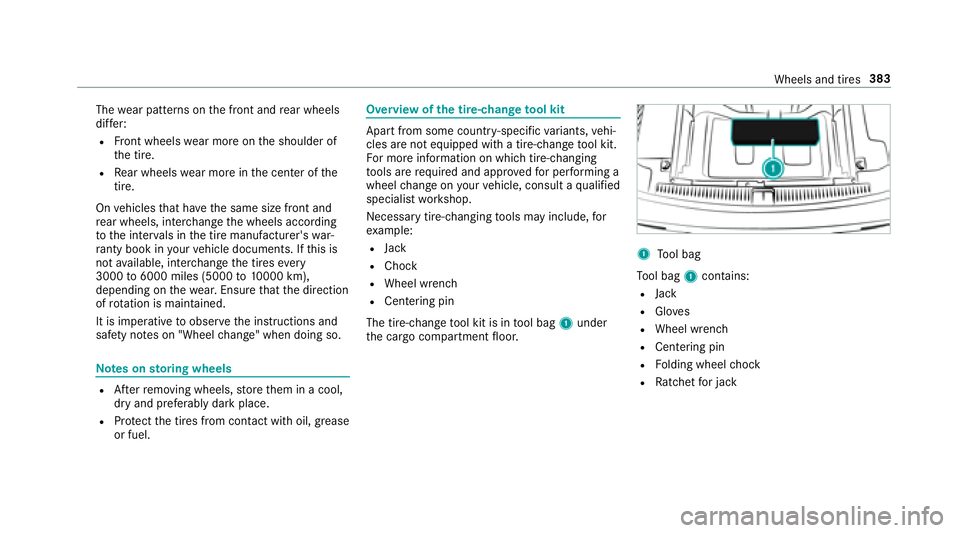
The tire-change tool kit is in tool bag 1under
th e cargo compartment floor.
1To ol bag
To ol bag 1contains:
RJack
RGloves
RWheel wrench
RCentering pin
RFo lding wheel chock
RRa tchet for jack
Wheels and tires 383
Page 395 of 506
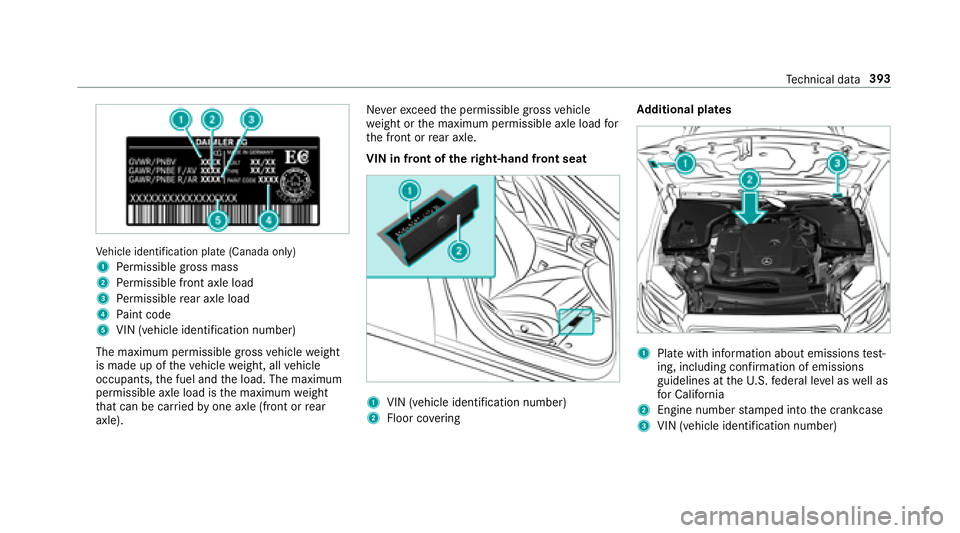
Vehicle identification plate (Canada only)
1
Pe rm issible grossmass
2Pe rm issible front axle load
3Perm issible rear axle load
4Pa int code
5VIN (vehicle identification number)
The maximum permissible gross vehicle weight
is made up of theve hicle weight, all vehicle
occupants, the fuel and the load. The maximum
permissible axle load is the maximum weight
th at can be car ried byone axle (front or rear
axle). Ne
verexc eed the permissible gross vehicle
we ight or the maximum permissible axle load for
th e front or rear axle.
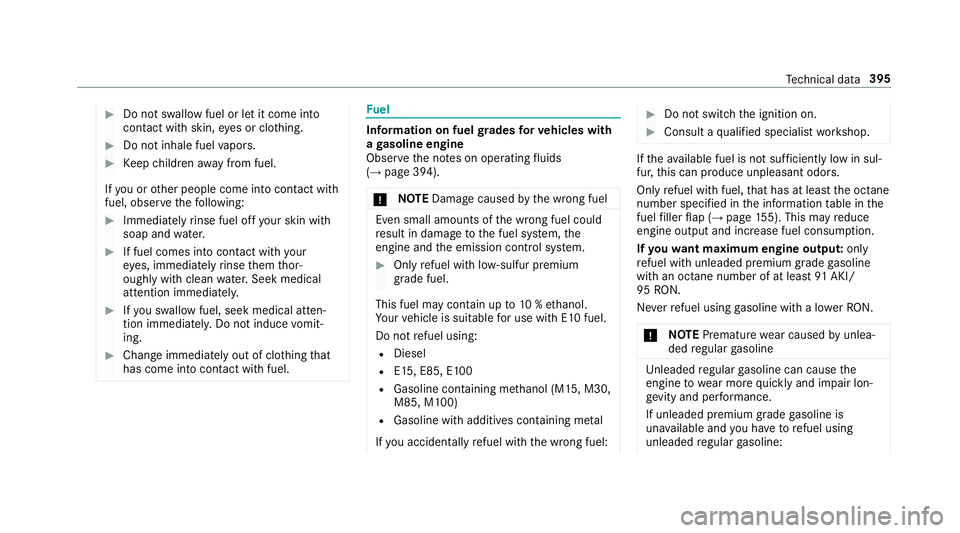
VIN in front of theright-hand front seat
1VIN (vehicle identification number)
2Floor co vering Ad
ditional plates
1Pla tewith information about emissions test‐
ing, including con firm ation of emissions
guidelines at theU. S. federal le vel as well as
fo r California
2Engine number stamped into the crankcase
3VIN (vehicle identification number)
Te ch nical da ta393
Page 396 of 506

Operatingfluids
Note s on operating fluids
Mercedes-AMG vehicles: be sure toobser ve
th e no tes in the Supplement. Otherwise, you
may failto recognize dangers.
&
WARNING Risk of injury from operating
fl uids harmful to your health
Operating fluids maybe pois onous and harm‐
ful to yo ur health.
#Obser vethete xt on the original con‐
ta iners when using, storing or disposing
of operating fluids.
#Alw aysst ore operating fluids sealed in
th eir original conta iners.
#Alwayske ep children away from operat‐
ing fluids.
+ENV IRON MENTALNO TEEnvironmental
pollution caused byenvironmen tally ir re‐
sponsible disposal
#Dispose of operating fluids in an envi‐
ro nmentally responsible manner.
Operating fluids include thefo llowing:
RFu els
RLubricants
RCoolant
RBrake fluid
RWi ndshield washer fluid
RClimate cont rol sy stem refrigerant
Only use products recommended byMercedes-
Benz. Damage caused byusing vehicle products
which ha venot been recommended is not cov‐
ered bythe Mercedes-Benz guarantee, warranty
or goodwill gestures.
Yo u can identify operating fluids appr ovedby
Mercedes-Benz bythefo llowing insc ript ion on
th e conta iners:
RMB-Freigabe (e.g. MB-Fr eigabe 229.51)
RMB-Approval (e.g. MB-App rova l 229.51)
Fu rther information on appr oved operating flu‐
ids:
Rin the Mercedes-Benz Specifications for
operating fluids at http://be vo.mercedes-
benz.com (byen tering the designation)
Rat a qualified specialist workshop
&
WARNING Risk offire and explosion
caused byfuel
Fu els are highly inflammable.
#You must avoidfire , open flames, creat‐
ing spar ksand smoking.
#Before refueling, switch off the engine
and, if ins talled in your vehicle, thest a‐
tionary heater.
& WARNING Risk of injury from fuel
Fu els are poisonous and harmful to your
health
39 4
Tech nical da ta
Page 397 of 506
#Do not swallow fuel or let it come into
contact withskin, eyes or clo thing.
#Do not inhale fuel vapors.
#Ke ep children away from fuel.
If yo u or other people come into contact with
fuel, obser vethefo llowing:
#Immediately rinse fuel off your skin wit h
soap and water.
#If fuel comes into contact with your
ey es, immediately rinse them thor‐
oughly with clean water.Seek medical
attention immediately.
#If yo u sw allow fuel, seek medical atten‐
tion immediatel y.Do not induce vomit‐
ing.
#Change immediately out of clo thing that
has come into con tact wi thfuel.
Fuel
Information on fuel grades forve hicles with
a ga soline engine
Obser vethe no tes on operating fluids
(
→page 394).
* NO
TEDama gecaused bythe wrong fuel
Even small amounts of the wrong fuel could
re sult in damage tothe fuel sy stem, the
engine and the emission control sy stem.
#Only refuel with lo w-sulfur premium
grade fuel.
This fuel may contain up to10 %ethanol.
Yo ur vehicle is suitable for use with E10 fuel.
Do not refuel using:
RDiesel
RE15, E85, E100
RGasoline containing me thanol (M15, M30,
M85, M100)
RGasoline with additives con taining me tal
If yo u accidenta llyrefuel with the wrong fuel:
#Do not switch the ignition on.
#Consult a qualified specialist workshop.
Ifth eav ailable fuel is not suf ficiently low in sul‐
fur, this can produce unpleasant odors.
Only refuel with fuel, that has at least the octane
number specified in the information table in the
fuel filler flap (
→page 155). This ma yre duce
engine output and increase fuel consum ption.
If yo uwa nt maximum engine output: only
re fuel with unleaded premium grade gasoline
with an octane number of at least 91AKI/
95 RON.
Ne verre fuel using gasoline with a lo werRO N.
* NO
TEPremature wear caused byunlea‐
ded regular gasoline
Unleaded regular gasoline can cause the
engine towe ar more quickly and impair lon‐
ge vity and per form ance.
If unleaded premium grade gasoline is
una vailable and you ha vetorefuel using
unleaded regular gasoline:
Tech nical da ta395
Page 398 of 506
#Onlyfill th e fuel tank tohalf full with
unleaded regular gasoline and refill as
soon as possible with unleaded pre‐
mium grade gasoline.
#Do not drive at the maximum speed.
#Av oid sudden acceleration and engine
speeds over 3,000 rpm.
Fu rther information on fuel can be found:
RAt aga sst ation
RAt aqu alified specialist workshop
RUSA onl y:Un der http://www.mbusa.com
Information on additives in gasoline
Obser vethe no tes on operating fluids
(
→page 394).
* NO
TEDama gecaused bynon-app rove d
additives
Even small amounts of the wrong additive
may lead tomalfunctions occur ring.
#Only add cleaning additives recommen‐
ded byMercedes-Benz tothe fuel.
Mercedes-Benz recommends that you use fuel
br ands that ha veadditives.
The fuel grade available in some countries may
not be suf ficient. Residue could build up in the
fuel injection sy stem as a result. In this case, in
consultation with an authorized Mercedes-Benz
Center, the fuel may be mixed with the cleaning
additive recommended byMercedes-Benz.
Alw ays obser vethe no tes and mixing ratios
speci fied on the conta iner.
Ta nk capacity and reser vefuel le vel
Capacity
Model Total capacity
Al lmodels 21.1US gal(8 0.0 l)
Model Of whichreser ve
All model s3 .2gal (12.0 l)
Engine oil
Note s on engine oil
Obser vethe no tes on operating fluids
(
→page 394).
* NO
TEEngine damage causedbyan
incor rect oil filter, incor rect oil or addi‐
tives
#Do not use engine oils or oil filters other
th an those which meet the specifica‐
tions necessary forth e prescribed
service inter vals.
396
Tech nical da ta