heating MERCEDES-BENZ G-CLASS SUV 2008 Owner's Manual
[x] Cancel search | Manufacturer: MERCEDES-BENZ, Model Year: 2008, Model line: G-CLASS SUV, Model: MERCEDES-BENZ G-CLASS SUV 2008Pages: 293, PDF Size: 4.49 MB
Page 130 of 293
Air conditioning
127Setting the airflow
X Press the Ubutton.
The indicator lamp in the Ubutton goes
out.
X To increase/reduce: turn thumbwheel
1 clockwise or anti-clockwise
(Y page 122).
i The airflow from the rear-compartment
vents and the centre vents is the same. Demisting the windscreen
i You should only select the "demisting"
function until the windscreen is clear again.
i If you have switched on the demisting
function with the Pbutton, you cannot
make any other settings.
X To activate: press thePbutton.
The indicator lamp in the Pbutton
comes on.
The system automatically switches to the
following functions:
R cooling with air dehumidification off
R high airflow
R high temperature R
air distribution to the windscreen and
front side windows
R air-recirculation mode off
i If necessary, also activate the windscreen
heating* (Y page 128).
X To switch off: press thePbutton.
The indicator lamp in the Pbutton goes
out. The previously selected settings come
into effect again.
or
X Press the Ubutton.
The indicator lamp in the Ubutton
comes on. The indicator lamp in the P
button goes out. Airflow and air distribution
are set to automatic mode. Demisting the windows
Windows misted up on the inside X
Activate the "demisting" function.
X If necessary, activate the windscreen heat-
ing* (Y page 128).
Windows misted up on the outside X
Activate the windscreen wipers.
X Close the centre air vents.
When automatic air distribution is switched
off:
X Turn the air distribution thumbwheel to the
Y ora symbol.
i You should only select this setting until
the windscreen is clear again.
X If necessary, activate the windscreen heat-
ing* (Y page 128). Cont
rols
* option al
463_AKB; 1; 8, en-GB
wobuchh,
Version: 2.10.6 2008-07-17T15:19:41+02:00 - Seite 127 ZDateiname: 6515_4091_02_buchblock.pdf; preflight
Page 131 of 293
Air conditioning
128 Switching windscreen heating* on/
off G
Risk of accident
Clear all windows of ice or snow before set-
ting off. Impaired visibility could otherwise
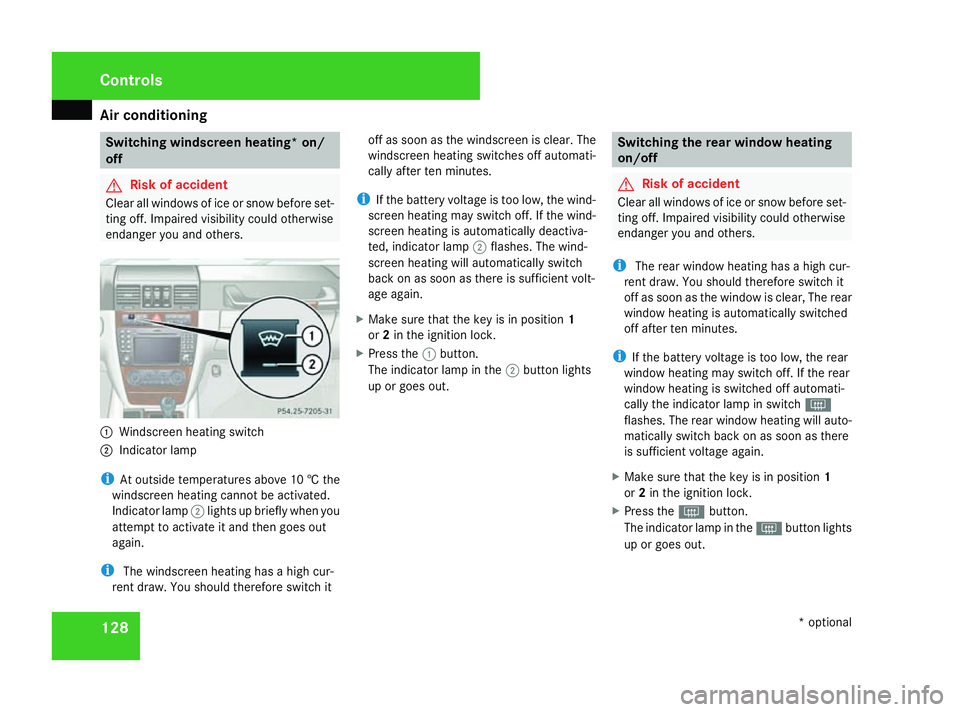
endanger you and others. 1
Windscreen heating switch
2 Indicator lamp
i At outside temperatures above 10 †the
windscreen heating cannot be activated.
Indicator lamp 2lights up briefly when you
attempt to activate it and then goes out
again.
i The windscreen heating has a high cur-
rent draw. You should therefore switch it off as soon as the windscreen is clear. The
windscreen heating switches off automati-
cally after ten minutes.
i If the battery voltage is too low, the wind-
screen heating may switch off. If the wind-
screen heating is automatically deactiva-
ted, indicator lamp 2flashes. The wind-
screen heating will automatically switch
back on as soon as there is sufficient volt-
age again.
X Make sure that the key is in position 1
or 2in the ignition lock.
X Press the 1button.
The indicator lamp in the 2button lights
up or goes out. Switching the rear window heating
on/off
G
Risk of accident
Clear all windows of ice or snow before set-
ting off. Impaired visibility could otherwise
endanger you and others.
i The rear window heating has a high cur-
rent draw. You should therefore switch it
off as soon as the window is clear, The rear
window heating is automatically switched
off after ten minutes.
i If the battery voltage is too low, the rear
window heating may switch off. If the rear
window heating is switched off automati-
cally the indicator lamp in switch F
flashes. The rear window heating will auto-
matically switch back on as soon as there
is sufficient voltage again.
X Make sure that the key is in position 1
or 2in the ignition lock.
X Press the Fbutton.
The indicator lamp in the Fbutton lights
up or goes out. Controls
* optional
463_AKB; 1; 8, en-GB
wobuchh
,V ersion: 2.10.6
2008-07-17T15:19:41+02:00 - Seite 128 Dateiname: 6515_4091_02_buchblock.pdf; preflight
Page 132 of 293
Air conditioning
129Activating/deactivating air-recircula-
tion mode
You can deactivate the flow of fresh air if
unpleasant odours are entering the vehicle
from outside. The air already inside the vehi-
cle will then be recirculated. G
Risk of accident
Only switch over to air-recirculation mode
briefly at low outside temperatures. Other-
wise, the windows could mist up, thus
impairing visibility and endangering your-
self and others. This may prevent you from
observing the traffic conditions, thereby
causing an accident.
X To activate: briefly press the ,button.
The indicator lamp in the ,button
comes on.
i Air-recirculation mode is activated auto-
matically at high outside temperatures.
When air-recirculation mode is activated
automatically, the indicator lamp in
the , button is not lit.
Outside air is added after about 30
minutes. X
To deactivate: press the,button.
The indicator lamp in the ,button goes
out.
i Air-recirculation mode switches off auto-
matically:
R after approximately five minutes at out-
side temperatures below approximately
5 †
R after approximately five minutes if cool-
ing with air dehumidification is deactiva-
ted
R after approximately 30 minutes at out-
side temperatures above approximately
5 † Switching the residual heat on/off
It is possible to make use of the residual heat
of the engine to continue heating the station-
ary vehicle for up to 30 minutes after the
engine has been switched off. The heating
time depends on the coolant temperature and
on the interior temperature that has been set.
i The blower will run at a low speed regard-
less of the airflow setting. i
If you activate the "residual heat" function
at high temperatures, only the ventilation
will be activated.
X Make sure that the key is in position 1or
0 in the ignition lock or that it has been
removed.
X To switch on: press the9button.
The indicator lamp in the 9button lights
up.
X To deactivate: press the9button.
The indicator lamp in the 9button goes
out.
i The auxiliary heating/ventilation is auto-
matically deactivated after about 30
minutes, or when:
R the ignition is switched on
R the battery voltage drops
R when the coolant temperature is too low Cont
rols
463_AKB; 1; 8, en-GB
wobuchh,
Version: 2.10.6 2008-07-17T15:19:41+02:00 - Seite 129 ZDateiname: 6515_4091_02_buchblock.pdf; preflight
Page 133 of 293
Air conditioning
130 Auxiliary heating/ventilation*
G
Risk of poisoning
Exhaust fumes are produced when the aux-
iliary heating is in operation. Inhaling these
exhaust fumes can be poisonous. You
should therefore switch off the auxiliary
heating in confined spaces without an
extraction system, e.g. a garage. G
Risk of fire
When operating the auxiliary heating, parts
of the vehicle may become very hot, and
highly inflammable material such as fuels
could be ignited. Operating the auxiliary
heating is thus prohibited at filling stations
or when your vehicle is being refuelled. You
must therefore switch off the auxiliary heat-
ing at filling stations.
The auxiliary heating heats the air in the vehi-
cle interior to the set temperature without
using the heat of the running engine. The aux-
iliary heating is operated using fuel directly
from the vehicle's fuel tank. For this reason,
the tank content must be at least at reserve
fuel level to ensure that the auxiliary heating
functions.
The auxiliary heating/ventilation automati-
cally adjusts to changes in temperature and weather conditions. For this reason, the aux-
iliary heating could switch from ventilation
mode to heating mode or from heating mode
to ventilation mode.
You cannot use the auxiliary ventilation to
cool the vehicle interior to a temperature
lower than the outside temperature.
Before activating
X
It is preferable to set the air conditioning to
U.
X Set the temperature.
The auxiliary heating/ventilation can be acti-
vated even when the air conditioning is being
controlled manually. Optimum comfort can
be obtained by activating automatic mode
and setting the temperature to 22 †.
Activating/deactivating the auxiliary
heating/ventilation The auxiliary heating/ventilation can be acti-
vated or deactivated using the remote control
or the button on the centre console.
The on-board computer can be used to spec-
ify up to three departure times, one of which
may be preselected (Y
page 108).
For direct access to the Heatersubmenu in
the on-board computer: X
Make sure that the key is in position 1
or 2in the ignition lock.
X Press the auxiliary heating/ventilation but-
ton for about three seconds.
The auxiliary heating switches off automati-
cally after 50 minutes.
i This time limit can be altered. To do this,
visit a qualified specialist workshop, e.g. a
Mercedes-Benz Service Centre.
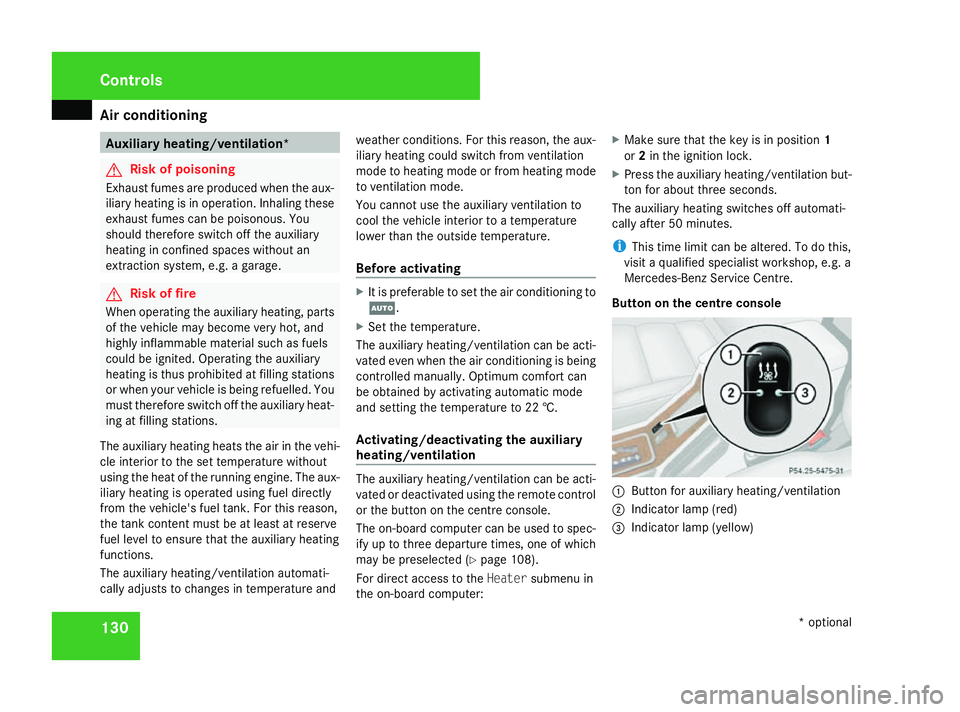
Button on the centre console 1
Button for auxiliary heating/ventilation
2 Indicator lamp (red)
3 Indicator lamp (yellow) Cont
rols
* optional
463_AKB; 1; 8, en-GB
wobuchh,
Version: 2.10.6 2008-07-17T15:19:41+02:00 - Seite 130Dateiname: 6515_4091_02_buchblock.pdf; preflight
Page 134 of 293
Air conditioning
131
The indicator lamps in the button may light up
in red or yellow.
R Red: auxiliary heating/ventilation is acti-
vated
R Yellow: departure time of the auxiliary
heating/ventilation is preselected
(Y page 108)
Activating the auxiliary heating/ventila-
tion
If the key is in position 1or 2in the ignition
lock:
X Press and hold button 1for more than two
seconds.
Red indicator lamp 2lights up.
If the key is removed from the ignition lock or
in position 0:
X Briefly press button 1.
Red indicator lamp 2lights up.
Deactivating the auxiliary heating/venti-
lation
X Press and hold button 1for more than two
seconds.
The red or yellow indicator lamp in the 1
button goes out. Remote control
Your vehicle comes with one remote control.
You may use one additional remote control
for your vehicle. For further information, con-
sult a qualified specialist workshop, e.g. a
Mercedes-Benz Service Centre.
The remote control has a maximum range of
approximately 300 metres. This range may be
reduced by:
R sources of radio interference
R solid objects between the remote control
and the vehicle
R the remote control being in an unfavoura-
ble position in relation to the vehicle
R transmitting from an enclosed space
i The optimum range can be achieved if you
hold the remote control vertically, pointing
upwards when you press one of the but-
tons.
i More information about the auxiliary
heating can be found in the "Practical
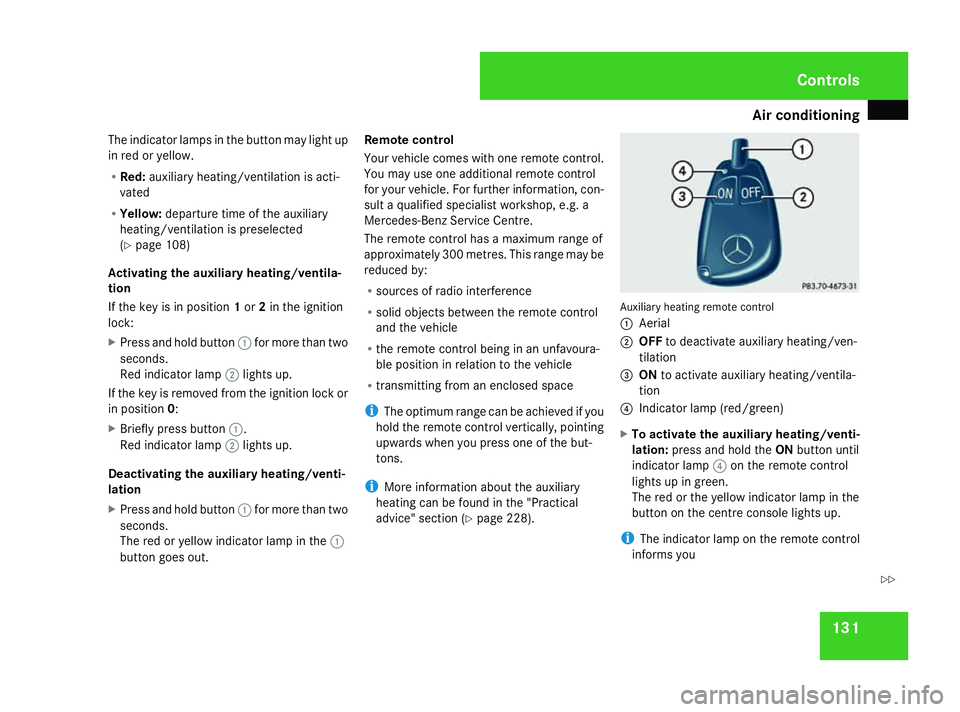
advice" section (Y page 228). Auxiliary heating remote control
1
Aerial
2 OFF to deactivate auxiliary heating/ven-
tilation
3 ON to activate auxiliary heating/ventila-
tion
4 Indicator lamp (red/green)
X To activate the auxiliary heating/venti-
lation: press and hold the ONbutton until
indicator lamp 4on the remote control
lights up in green.
The red or the yellow indicator lamp in the
button on the centre console lights up.
i The indicator lamp on the remote control
informs you Controls
463_AKB; 1; 8, en-GB
wobuchh
, Version: 2.10.6
2008-07-17T15:19:41+02:00 - Seite 131 ZDateiname: 6515_4091_02_buchblock.pdf; preflight
Page 135 of 293
Sliding sunroof
132R
whether a signal has been transmitted to
the auxiliary heating or ventilation
R about the remote control's battery
charge status:
If the remote control indicator lamp first
lights up orange when you press one of
the buttons, the battery is almost dis-
charged.
If the remote control indicator lamp only
flashes orange when you press one of the
buttons, the battery is discharged.
Replace the battery (Y page 235).
The signal has been interrupted if the indi-
cator lamp on the remote control flashes
green when switching on or red when
switching off.
In this case, repeat the procedure. Stand
somewhere else or move closer to the vehi-
cle, if necessary.
X To deactivate the auxiliary heating/
ventilation: press and hold the OFFbutton
until indicator lamp 4on the remote con-
trol lights up in red.
The red or the yellow indicator lamp in the
button on the centre console goes out. Sliding sunroof
Sliding/tilting sunroof*
G
Risk of injury
Children could injure themselves if they
operate the sliding/tilting sunroof.
Never leave children unsupervised in the
vehicle. Always take the key with you when
leaving the vehicle, even if you are only
leaving it for a short time. G
Risk of injury
Make sure that nobody can become trap-
ped when you are opening and closing the
sliding/tilting sunroof. If there is a risk of
entrapment, release the switch and push it
briefly in any direction to stop the sliding/
tilting sunroof. G
Risk of injury
If you are not wearing a seat belt, there is
a risk that you could be thrown through the
opening in the event of the vehicle over-
turning. Therefore, always wear a seat belt
to reduce the risk of injuries.
! Only open the sliding/tilting sunroof if it
is free of snow and ice. Otherwise, mal-
functions may occur. Do not allow anything to protrude from the
sliding/tilting sunroof. The seals could oth-
erwise be damaged.
i Resonance noises can occur in addition
to the usual airflow noises when the slid-
ing/tilting sunroof is open. They are caused
by minor pressure fluctuations in the vehi-
cle interior.
Change the position of the sliding/tilting
sunroof or open a side window slightly to
reduce or eliminate these noises.
i It is also possible to open and close the
sliding/tilting sunroof from the outside
using the "Summer opening" and "Conve-
nience closing" features respectively. Controls
* optional
463_AKB; 1; 8, en-GB
wobuchh,
Version: 2.10.6 2008-07-17T15:19:41+02:00 - Seite 132Dateiname: 6515_4091_02_buchblock.pdf; preflight
Page 152 of 293
Features
149
X
Make sure that the engine is not running
and that the vehicle is secured against roll-
ing away.
X Move the selector lever to D.
You now have more space to remove insert
2.
X Move slide knob 3to the right, so that
insert 2is released.
X Pull insert 2upwards and remove it.
X To close: press cover 4until it engages.
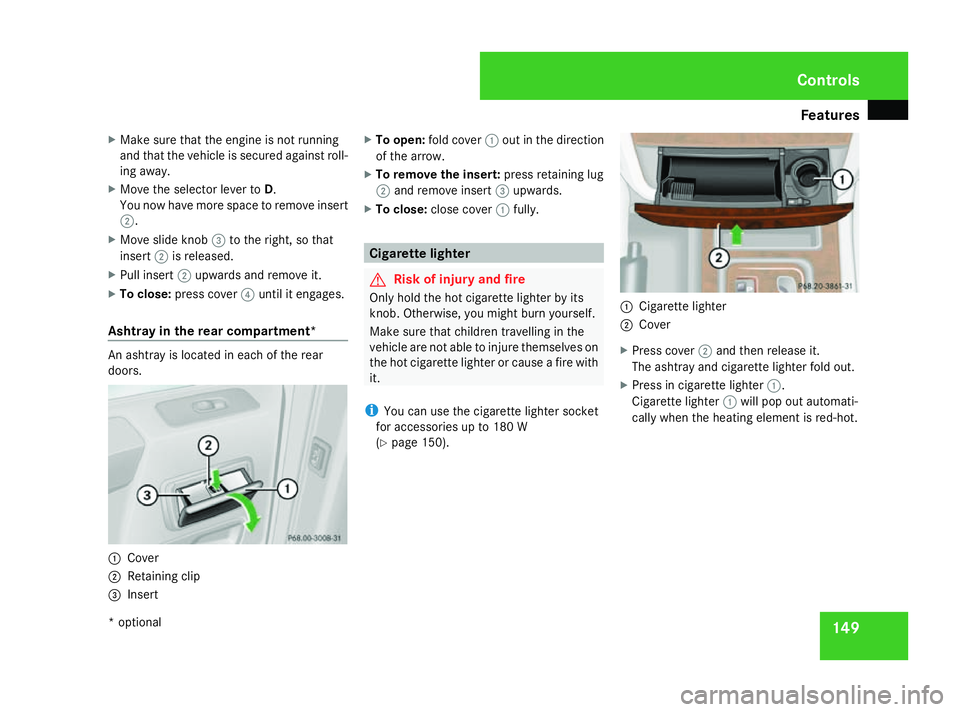
Ashtray in the rear compartment* An ashtray is located in each of the rear
doors.
1
Cover
2 Retaining clip
3 Insert X
To open: fold cover 1out in the direction
of the arrow.
X To remove the insert: press retaining lug
2 and remove insert 3upwards.
X To close: close cover 1fully. Cigarette lighter
G
Risk of injury and fire
Only hold the hot cigarette lighter by its
knob. Otherwise, you might burn yourself.
Make sure that children travelling in the
vehicle are not able to injure themselves on
the hot cigarette lighter or cause a fire with
it.
i You can use the cigarette lighter socket
for accessories up to 180 W
(Y page 150). 1
Cigarette lighter
2 Cover
X Press cover 2and then release it.
The ashtray and cigarette lighter fold out.
X Press in cigarette lighter 1.
Cigarette lighter 1will pop out automati-
cally when the heating element is red-hot. Cont
rols
* option al
463_AKB; 1; 8, en-GB
wobuchh,
Version: 2.10.6 2008-07-17T15:19:41+02:00 - Seite 149 ZDateiname: 6515_4091_02_buchblock.pdf; preflight
Page 157 of 293
Refuelling
154 Running-in notes
If you treat the engine with sufficient care
from the very start, you will be rewarded with
excellent performance for the remainder of
the engine's life.
R You should therefore drive at varying road
and engine speeds for the first 1,500 km.
R Avoid heavy loads, e.g. driving at full throt-
tle, during this time. Do not exceed 2
/ 3 of
the maximum permissible engine speed for
each gear.
R Do not shift down a gear manually in order
to brake.
R Try to avoid depressing the accelerator
pedal beyond the pressure point (kick-
down).
R Only use ranges 3,2or 1for slow driving,
e.g. in mountainous terrain.
After 1,500 km you may gradually bring the
vehicle up to full road and engine speeds.
Additional driving tips for AMG vehicles:
R Do not drive faster than 140 km/h for the
first 1,500 km.
R Only bring the engine up to a maximum
speed of 4,500 rpm for a brief period. i
You should also observe these notes if the
engine or rear axle transmission on your
vehicle has been replaced. Refuelling
Refuelling
G
Risk of explosion
Fuel is highly flammable. Fire, naked flames
and smoking are therefore prohibited when
handling fuels.
Before refuelling, turn off the engine and
the auxiliary heating*. G
Risk of injury
Avoid any contact with fuels.
You can damage your health if your skin
comes into direct contact with fuel or if you
inhale fuel vapours. G
Risk of fire
Do not use petrol to refuel vehicles with a
diesel engine. Never mix diesel with petrol.
This causes damage to the fuel system and
engine and could result in the vehicle catch-
ing fire.
! Do not use petrol to refuel vehicles with a
diesel engine. Do not use diesel to refuel
vehicles with a petrol engine. Even small
amounts of the wrong fuel will cause dam-
age to the injection system. Damage result- Operation
* optional
463_AKB; 1; 8, en-GB
wobuchh
,V ersion: 2.10.6
2008-07-17T15:19:41+02:00 - Seite 154 Dateiname: 6515_4091_02_buchblock.pdf; preflight
Page 159 of 293
Refuelling
156which conforms to European standard
EN 228 or German standard DIN 51626-1.
You could otherwise impair engine output
or damage the engine.
i If the recommended fuel is not available
and only as a temporary measure, you may
also use premium unleaded petrol,
95 RON/85 MON. This may reduce engine
performance and increase fuel consump-
tion. You must avoid driving at full throttle.
! In emergencies, and only when the rec-
ommended fuel is not available, you may
also use standard unleaded petrol,
91 RON/82.5 MON. However, using this
fuel results in considerably higher petrol
consumption and significantly reduced per-
formance. Avoid driving at full throttle, and
only drive in drive program C.
If no fuel other than regular petrol fuel
91 RON/82.5 MO Nor a lower grade is per-
manently available, you should have the
vehicle adapted to run on this fuel by the
local after-sales service. Diesel (EN 590, DIN 51628)
! Refuel using only Diesel which conforms
to European standard EN 590 or German
standard DIN 51628.
You could otherwise impair engine output
or damage the engine.
You will find further information about die-
sel under "Fuel" in the index.
! When refuelling vehicles with a diesel par-
ticulate filter in countries outside the EU,
only low-sulphur Euro diesel with less than
0.005 percent sulphur content by weight
(50 ppm) should be used. In countries in
which diesel with a higher sulphur content
is available (e.g. 0.035 percent by weight),
the engine oil should be renewed at more
frequent intervals. More information about
intervals for changing the engine oil can be
obtained from any Mercedes-Benz Service
Centre.
! The use of fuels which do not meet the
requirements of EN 590 or German stand-
ard DIN 51628 can cause increased wear,
and damage the engine and the exhaust
system. Do not use the following:
R
marine diesel
R heating oil
R bio-diesel
R vegetable oil
R petrol
R paraffin
R kerosene
Do not add such fuels to diesel fuel and do
not use any special additives (exception:
flow improvers – see "Low outside temper-
atures").
Damage caused by the use of unapproved
fuels or additives is not covered by the war-
ranty.
Low outside temperatures The flow properties of diesel may be insuffi-
cient at low ambient temperatures.
To prevent operating problems, diesel fuel
with improved cold flow qualities is available
during the winter months. Your vehicle must
be refuelled with this winter diesel at temper-
atures of -5 °C or below.
You can use this winter diesel at tempera-
tures down to about -20 °C without problems.Operation
463_AKB; 1; 8, en-GB
wobuchh,
Version: 2.10.6 2008-07-17T15:19:41+02:00 - Seite 156Dateiname: 6515_4091_02_buchblock.pdf; preflight
Page 160 of 293
Engine compartment
157
If only summer diesel fuel or less cold-resist-
ant winter diesel fuel (e.g. in Mediterranean
regions) is available, you should add an
amount of flow improver to the fuel corre-
sponding to the outside temperature.
Mix the additive with the diesel in good time,
before the flow properties of the diesel
become insufficient. Otherwise, malfunctions
can only be rectified by heating the entire fuel
system, e.g. by parking the vehicle in a heated
garage. G
Risk of fire
Do not use petrol to refuel vehicles with a
diesel engine. Never mix diesel with petrol.
This would damage the fuel system and
engine and could result in a vehicle fire.
Flow improver
The effectiveness of a flow improver is not
guaranteed with every fuel. Observe the infor-
mation provided by the manufacturer when
using a flow improver. Only use flow improv-
ers that have been tested and approved by
Mercedes-Benz. Information about flow
improvers that have been tested and
approved by Mercedes-Benz can be obtained
from any Mercedes-Benz Service Centre. Engine compartment
Bonnet
G
Risk of accident
Do not pull the release lever while the vehi-
cle is in motion. The bonnet may otherwise
open and block your view.
Opening G
Risk of injury
There is a risk of injury if the bonnet is open,
even if the engine is not running.
Some engine components can become
very hot.
To avoid the risk of burns, only touch those
components described in the Owner’s Man-
ual and observe the relevant safety notes. G
Risk of injury
The radiator fan between the radiator and
the engine can start automatically, even if
the key has been removed from the ignition
lock. For this reason you must not reach
into the turning area of the fan. You can
otherwise be injured. Vehicles with a petrol engine:
The electronic ignition system uses high
voltage. For this reason, you must never
touch components of the ignition system
(ignition coil, ignition cable, spark plug con-
nector or test socket) when:
R the engine is running
R the engine is being started
R the ignition is switched on and the engine
is being cranked by hand
Vehicles with a diesel engine:
The electronic injection control uses high
voltage. Therefore, never touch fuel injec-
tion system components when:
R the engine is running
R the engine is being started
R the ignition is switched on
X Make sure that the windscreen wipers are
switched off. G
Risk of injury
The windscreen wipers and wiper linkage
could be set in motion.
When the bonnet is open, you or others
could be injured by the wiper rods. Operation
463_AKB; 1; 8, en-GB
wobuchh,
Version: 2.10.6 2008-07-17T15:19:41+02:00 - Seite 157 ZDateiname: 6515_4091_02_buchblock.pdf; preflight