heating MERCEDES-BENZ G-CLASS SUV 2008 Owner's Guide
[x] Cancel search | Manufacturer: MERCEDES-BENZ, Model Year: 2008, Model line: G-CLASS SUV, Model: MERCEDES-BENZ G-CLASS SUV 2008Pages: 293, PDF Size: 4.49 MB
Page 173 of 293
Driving
tips 170 Braking
G
Risk of accident
Do not change down for additional engine
braking on a slippery road surface. This
could cause the drive wheels to lose their
grip and the vehicle could skid. G
Risk of accident
Make sure that other road users are not
endangered by your braking.
Downhill gradients On long and steep downhill gradients, espe-
cially if the vehicle is laden or towing a trailer,
you must select shift range 1,2or 3in good
time.
i This also applies if you have activated
cruise control or Speedtronic.
This will use the braking effect of the engine,
so less braking will be required to maintain
the speed. This relieves the load on the brake
system and prevents the brakes from over-
heating and wearing too quickly. If you need
additional braking, depress the brake pedal
repeatedly rather than continuously. Heavy and light loads If the brakes have been subjected to a heavy
load, do not stop the vehicle immediately, but
drive on for a short while. This allows the air-
flow to cool the brakes more quickly.
G
Risk of accident
Never depress the brake pedal continu-
ously while the vehicle is in motion, e.g.
never cause the brakes to rub by applying
constant slight pedal pressure. This causes
the brake system to overheat, increases
the braking distance and can lead to the
brakes failing completely.
If the brakes have been used only moderately,
you should occasionally test their effective-
ness. To do this, brake more firmly from a
higher speed. This improves the grip of the
brakes.
Wet roads If driving in heavy rain for a prolonged period
of time without braking, there may be a
delayed reaction from the brakes when brak-
ing for the first time. You must brake harder.
Therefore, you must maintain a greater dis-
tance from the vehicle in front.Brake firmly after driving on a wet road. This
way the brake discs will become warm, drying
more quickly, which will protect them against
corrosion.
Limited braking performance on salted
roads G
Risk of accident
The layer of salt on the brake discs and the
brake pads/linings may cause a delay in
the braking effect, resulting in a signifi-
cantly longer braking distance, which could
lead to an accident.
To avoid this danger, you should:
R occasionally brake carefully, without put-
ting other road users at risk, when you
are driving on salted roads. This helps to
remove any salt that may have started to
build up on the brake discs and the brake
pads/linings.
R maintain a greater distance to the vehicle
ahead and drive with particular care.
R carefully apply the brakes at the end of a
trip and immediately after commencing a
new trip, so that salt residues are
removed from the brake disc. Operation
463_AKB; 1; 8, en-GB
wobuchh
,V ersion: 2.10.6
2008-07-17T15:19:41+02:00 - Seite 170 Dateiname: 6515_4091_02_buchblock.pdf; preflight
Page 182 of 293
Trailer towing*
179
Coupling up a trailer G
Risk of injury
Do not connect a trailer with an engaged
overrun brake. Otherwise, your hand could
become trapped between the bumper and
drawbar.
! Do not uncouple a trailer with overrun
brake between the bumper and drawbar,
otherwise your vehicle could be damaged
by the spring action of the overrun brake.
X Position the trailer level behind the vehicle.
X Couple up the trailer.
X Establish the electrical connection
between the vehicle and the trailer.
Driving tips In Germany, the maximum permissible speed
for vehicle/trailer combinations is 80 km/h.
! A maximum speed of 80 km/h should not
be exceeded, even in countries where
higher speeds are permitted for vehicle/
trailer combinations.
When towing a trailer, your vehicle's handling
characteristics will be different in comparison
to when driving without a trailer. The vehicle/trailer combination:
R
is heavier
R is restricted in its acceleration and gradi-
ent-climbing capability
R has an increased braking distance
R is affected more by strong crosswinds
R demands more sensitive steering
R consumes more fuel
X On long and steep downhill gradients,
select shift range 1,2or 3in good time.
i This also applies if you have activated
cruise control or Speedtronic.
X If necessary, shift the transfer case to
LOW (Ypage 92).
This will use the braking effect of the
engine, so less braking will be required to
maintain the speed. This relieves the load
on the brake system and prevents the
brakes from overheating and wearing too
quickly. If you need additional braking,
depress the brake pedal repeatedly rather
than continuously. G
Risk of accident
Never depress the brake pedal continu-
ously while the vehicle is in motion, e.g. never cause the brakes to rub by applying
constant slight pedal pressure. This causes
the brake system to overheat, increases
the braking distance and can lead to the
brakes failing completely.
Driving tips
R Maintain a greater distance from the vehi-
cle in front than when driving without a
trailer.
R Avoid braking abruptly. If possible, brake
gently at first to allow the trailer to run on.
Then increase the braking force rapidly.
R The values given for gradient-climbing
capabilities from a standstill refer to sea
level. When driving in mountainous areas,
note that the power output of the engine,
and consequently the vehicle's gradient-
climbing capability, decrease with increas-
ing altitude.
If the trailer swings from side to side:
X Do not accelerate.
X Do not counter-steer.
X Brake if necessary. Operation
* optional
463_AKB; 1; 8, en-GB
wobuchh
,V ersion: 2.10.6
2008-07-17T15:19:41+02:00 - Seite 179 ZDateiname: 6515_4091_02_buchblock.pdf; preflight
Page 187 of 293
Care
184
Cleaning the wiper blades and the out-
side of the windscreen G
Risk of injury
Before cleaning the windscreen or wiper
blades, turn the key in the ignition lock to
0. The windscreen wipers could otherwise
move and cause injury.
X Turn the key to position 1in the ignition
lock (Y page 59).
X Set the windscreen wipers to position Ion
the combination switch (Y page 82).
X Turn the key to position 0or remove it when
the wiper arms are vertical (Y page 59).
! Only fold the wiper arms away from the
windscreen when they are in a vertical posi-
tion, otherwise you will damage the bonnet.
X Fold the wiper arms away from the wind-
screen until you feel them snap into place.
X Clean the windscreen and the wiper blades.
X Fold the windscreen wipers back again
before the ignition is switched on.
! Do not clean the wiper blades too often
as this will result in the rubber becoming
porous, leading to wiper noise. Cleaning the windows !
Do not use dry cloths, abrasive products,
solvents or cleaning agents containing sol-
vents to clean the inside of the windows.
Clean the insides of the windows with a
damp cloth or commercially-available glass
cleaner. Avoid touching the inside of the
rear windscreen and the side windows with
hard objects, e.g. ice scrapers or rings. You
could otherwise cause damage to the win-
dows, rear window heating or aerial on the
rear window.
i Anti-glare film retrofitted to the insides of
the windows could interfere with radio or
mobile phone reception, especially if it is
conductive or metal-coated film. Informa-
tion about anti-glare film can be obtained
from any Mercedes-Benz Service Centre.
Cleaning the headlamps X
Clean the headlamp lenses with a wet
sponge.
! Only use washer fluid which is suitable
for plastic lenses. Unsuitable washer fluid
could damage the plastic lenses of the
headlamps.
Do not use the following: R
dry cloths
R abrasive cleaning agents
R solvents
R cleaning agents containing solvent
You could otherwise scratch or damage the
surface of the lenses.
Plastic trim !
Do not use dry, coarse or hard cloths and
do not scrub. Doing so will scratch or dam-
age the surfaces.
! In order to protect the vehicle's high-qual-
ity surfaces and to retain the overall
appearance, avoid contact with cosmetics
and suntan lotion.
X Wipe plastic parts with a damp, lint-free
cloth (e.g. a microfibre cloth).
X Light soiling: use a low-foaming soap (e.g.
a light liquid hand soap) diluted in water.
X Heavy soiling: use a cleaning agent that is
solvent-free and non-corrosive. Mercedes-
Benz recommends that you use a
Mercedes-Benz cleaning product for this
purpose. Operation
463_AKB; 1; 8, en-GB
wobuchh,
Version: 2.10.6 2008-07-17T15:19:41+02:00 - Seite 184Dateiname: 6515_4091_02_buchblock.pdf; preflight
Page 213 of 293
Troubleshooting
210 Troubleshooting
Points to remember
G
Risk of accident and injury
If maintenance work is carried out incorrectl y this can jeopardise the operating safety of your vehicle. You risk losing control of your vehicle
and thereby causing an accident. The safety systems may also no longer be able to protect you or others as they are designed to do.
Always have maintenance work carried out at a qualified specialist workshop which has the necessary specialist knowledge and tools to
carry out the work required.
Mercedes-Benz recommends that you use a Mercedes-Benz Service Centre for this purpose.
In particular, all work relevant to safety or on safety-related systems must be carried out at a qualified specialist workshop. Warning and indicator lamps in switches and buttons
Problem Possible cause/consequence Suggested solutions
One or all of the indicator lamps
in the seat heating button are
flashing. There is insufficient voltage
because too many consumers are
switched on. The seat heating has
switched itself off automatically. X
Switch off consumers that are not required, e.g. reading lamps,
interior lighting, etc.
The seat heating will automatically switch back on as soon as there
is sufficient voltage again. The indicator lamp in the
9
button on the Thermatic control
panel is on or flashes when you
press the button. The cooling sys-
tem cannot be switched on. The cooling system is losing
refrigerant. X
Visit a qualified specialist workshop. Practical advice
463_AKB; 1; 8, en-GB
wobuchh,
Version: 2.10.6 2008-07-17T15:19:41+02:00 - Seite 210Dateiname: 6515_4091_02_buchblock.pdf; preflight
Page 214 of 293
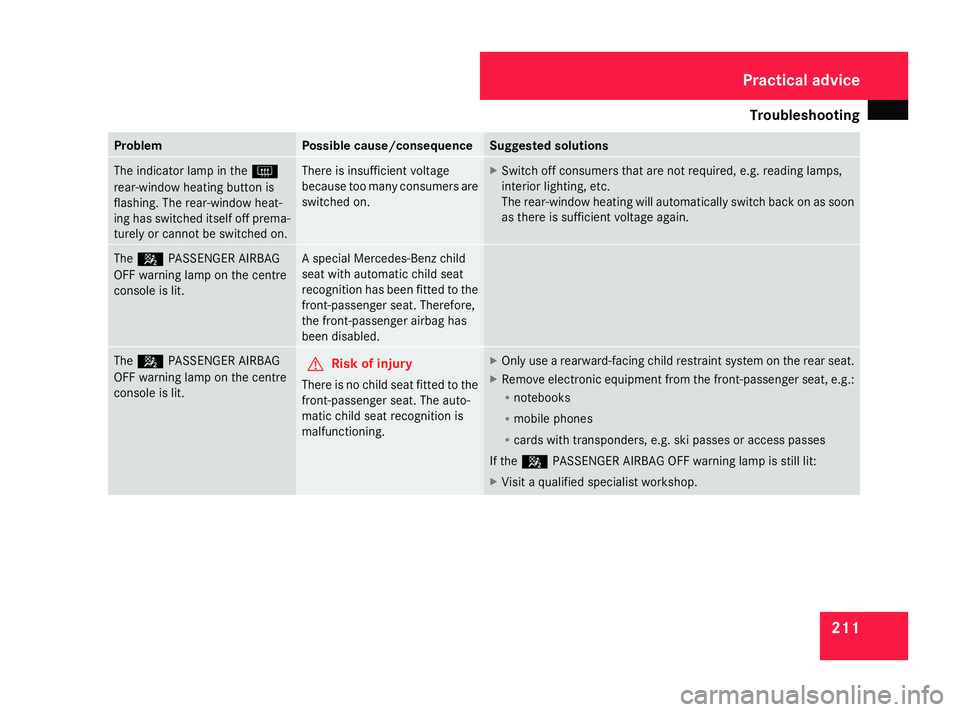
Troubleshooting
211Problem Possible cause/consequence Suggested solutions
The indicator lamp in the
F
rear-window heating button is
flashing. The rear-window heat-
ing has switched itself off prema-
turely or cannot be switched on. There is insufficient voltage
because too many consumers are
switched on. X
Switch off consumers that are not required, e.g. reading lamps,
interior lighting, etc.
The rear-window heating will automatically switch back on as soon
as there is sufficient voltage again. The
5 PASSENGER AIRBAG
OFF warning lamp on the centre
console is lit. A special Mercedes-Benz child
seat with automatic child seat
recognition has been fitted to the
front-passenger seat. Therefore,
the front-passenger airbag has
been disabled. The
5 PASSENGER AIRBAG
OFF warning lamp on the centre
console is lit. G
Risk of injury
There is no child seat fitted to the
front-passenger seat. The auto-
matic child seat recognition is
malfunctioning. X
Onl y use a rearward-facing child restraint system on the rear seat.
X Remove electronic equipment from the front-passenger seat, e.g.:
R
notebooks
R mobile phones
R cards with transponders, e.g. ski passes or access passes
If the 5 PASSENGER AIRBAG OFF warning lamp is still lit:
X Visit a qualified specialist workshop. Practical advice
463_AKB; 1; 8, en-GB
wobuchh,
Version: 2.10.6 2008-07-17T15:19:41+02:00 - Seite 211 ZDateiname: 6515_4091_02_buchblock.pdf; preflight
Page 219 of 293
Troubleshooting
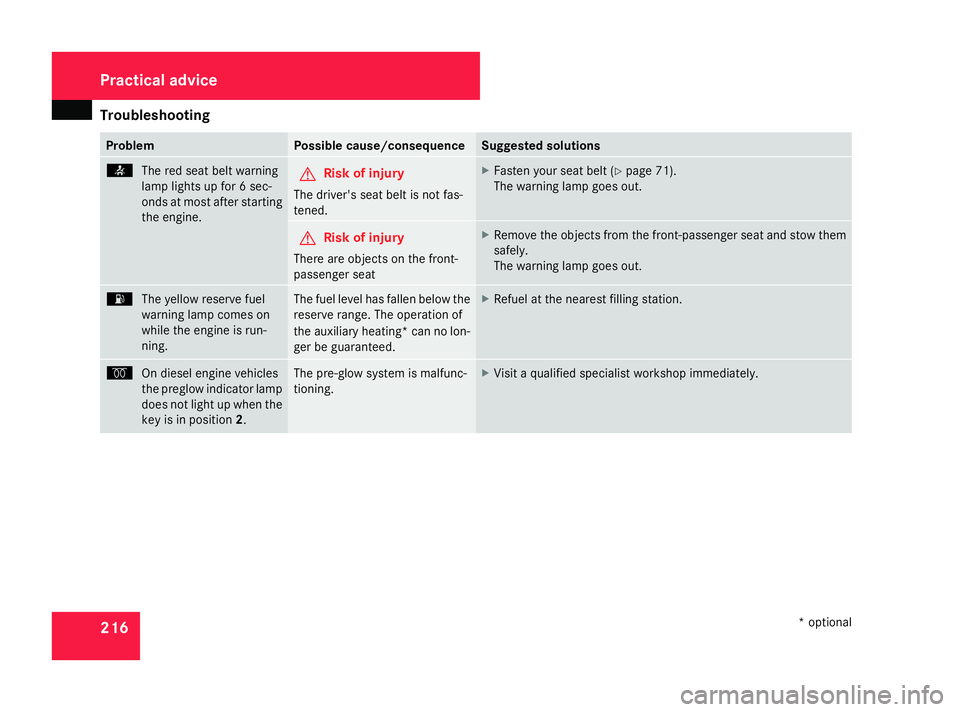
216 Problem Possible cause/consequence Suggested solutions
<
The red seat belt warning
lamp lights up for 6 sec-
onds at most after starting
the engine. G
Risk of injury
The driver's seat belt is not fas-
tened. X
Fasten your seat belt ( Ypage 71).
The warning lamp goes out. G
Risk of injury
There are objects on the front-
passenger seat X
Remove the objects from the front-passenger seat and stow them
safely.
The warning lamp goes out. A
The yellow reserve fuel
warning lamp comes on
while the engine is run-
ning. The fuel level has fallen below the
reserve range. The operation of
the auxiliary heating* can no lon-
ger be guaranteed. X
Refuel at the nearest filling station. q
On diesel engine vehicles
the preglow indicator lamp
does not light up when the
key is in position 2. The pre-glow system is malfunc-
tioning. X
Visit a qualified specialist workshop immediately. Practical advice
* optional
463_AKB; 1; 8, en-GB
wobuchh,
Version: 2.10.6 2008-07-17T15:19:41+02:00 - Seite 216Dateiname: 6515_4091_02_buchblock.pdf; preflight
Page 229 of 293
Troubleshooting
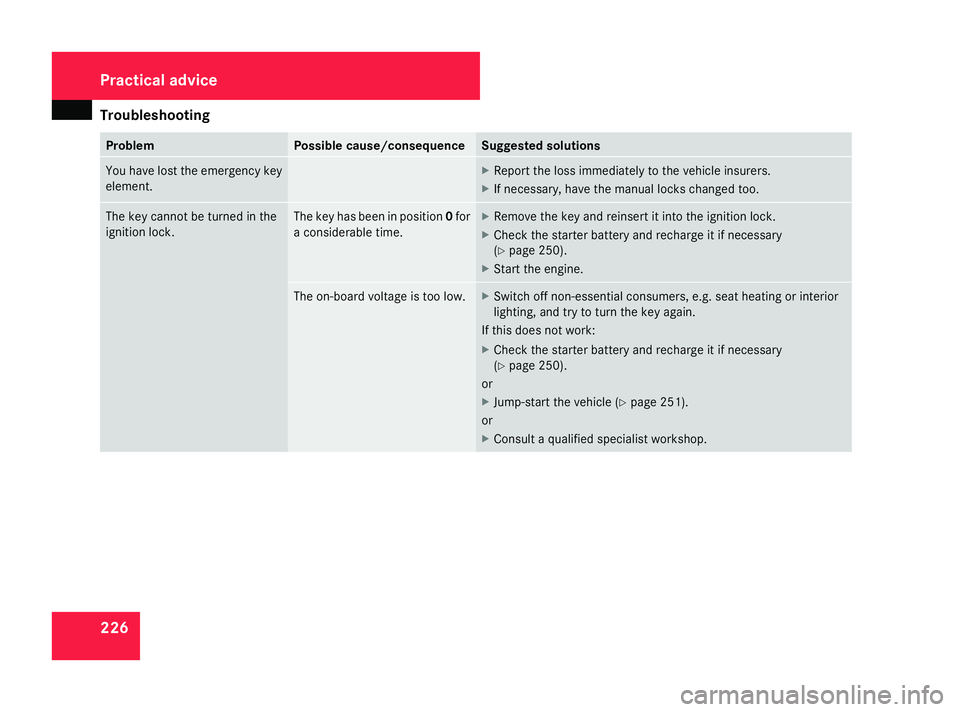
226 Problem Possible cause/consequence Suggested solutions
You have lost the emergency key
element. X
Report the loss immediatel y to the vehicle insurers.
X If necessary, have the manual locks changed too. The key cannot be turned in the
ignition lock. The key has been in position
0for
a considerable time. X
Remove the key and reinsert it into the ignition lock.
X Check the starter battery and recharge it if necessary
(Y page 250).
X Start the engine. The on-board voltage is too low. X
Switch off non-essential consumers, e.g. seat heating or interior
lighting, and try to turn the key again.
If this does not work:
X Check the starter battery and recharge it if necessary
(Y page 250).
or
X Jump-start the vehicle (Y page 251).
or
X Consult a qualified specialist workshop. Practical advice
463_AKB; 1; 8, en-GB
wobuchh,
Version: 2.10.6 2008-07-17T15:19:41+02:00 - Seite 226Dateiname: 6515_4091_02_buchblock.pdf; preflight
Page 231 of 293
Troubleshooting
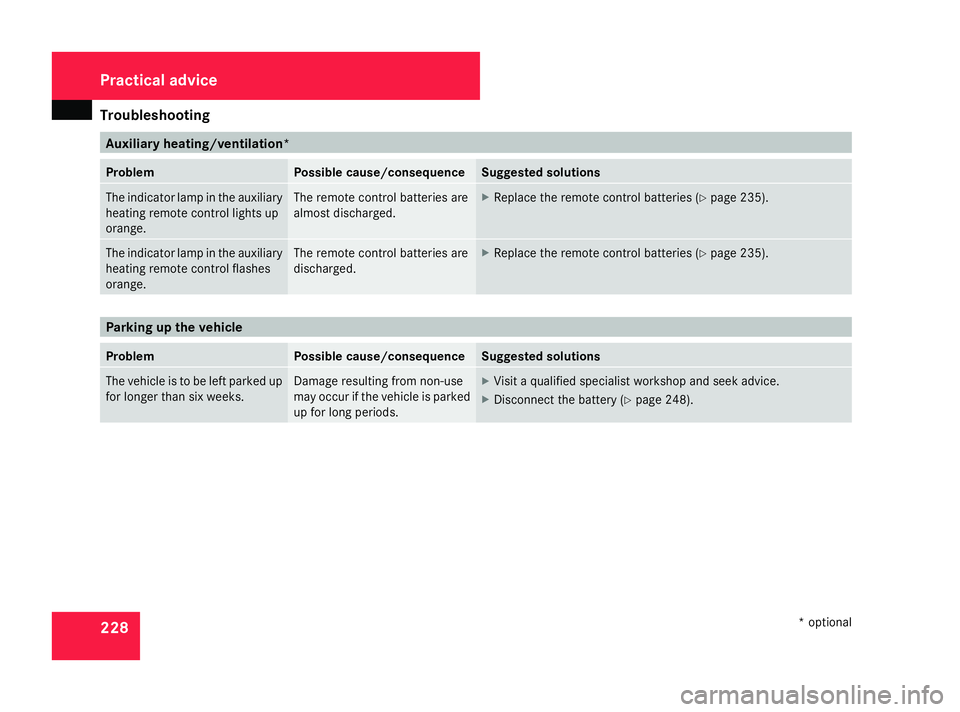
228 Auxiliary heating/ventilation*
Problem Possible cause/consequence Suggested solutions
The indicator lamp in the auxiliary
heating remote control lights up
orange. The remote control batteries are
almost discharged. X
Replace the remote control batteries (Y page 235).The indicator lamp in the auxiliary
heating remote control flashes
orange. The remote control batteries are
discharged. X
Replace the remote control batteries (Y page 235).Parking up the vehicle
Problem Possible cause/consequence Suggested solutions
The vehicle is to be left parked up
for longer than six weeks. Damage resulting from non-use
ma
y occur if the vehicle is parked
up for long periods. X
Visit a qualified specialist workshop and seek advice.
X Disconnect the battery (Y page 248).Practical advice
* optional
463_AKB; 1; 8, en-GB
wobuchh,
Version: 2.10.6 2008-07-17T15:19:41+02:00 - Seite 228Dateiname: 6515_4091_02_buchblock.pdf; preflight
Page 238 of 293
Changing the bulbs
235
X
Push the battery tray back into the key
housing until the battery tray engages.
X Check the function of all key buttons on the
vehicle. Auxiliary heating* remote control
Checking the batteries X
Press the ONorOFF button.
The battery charge check lamp lights up
when you press the button:
R ON green
R OFF red
and then briefly orange.
If the batteries are discharged, the battery
check lamp only lights up in orange when
the buttons are pressed.
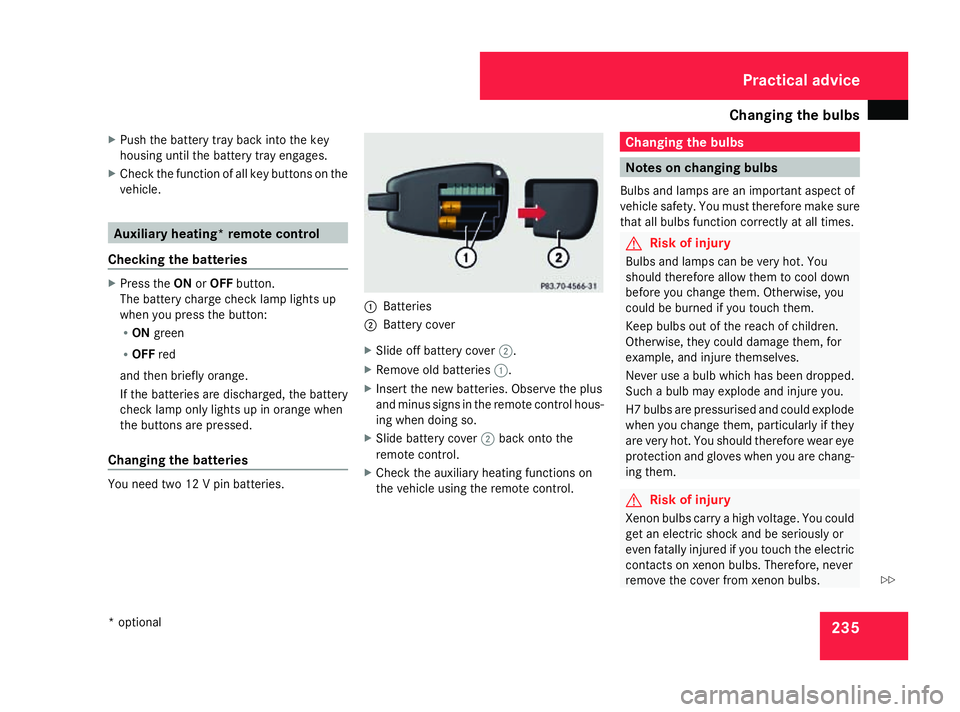
Changing the batteries You need two 12 V pin batteries. 1
Batteries
2 Battery cover
X Slide off battery cover 2.
X Remove old batteries 1.
X Insert the new batteries. Observe the plus
and minus signs in the remote control hous-
ing when doing so.
X Slide battery cover 2back onto the
remote control.
X Check the auxiliary heating functions on
the vehicle using the remote control. Changing the bulbs
Notes on changing bulbs
Bulbs and lamps are an important aspect of
vehicle safety. You must therefore make sure
that all bulbs function correctly at all times. G
Risk of injury
Bulbs and lamps can be very hot. You
should therefore allow them to cool down
before you change them. Otherwise, you
could be burned if you touch them.
Keep bulbs out of the reach of children.
Otherwise, they could damage them, for
example, and injure themselves.
Never use a bulb which has been dropped.
Such a bulb may explode and injure you.
H7 bulbs are pressurised and could explode
when you change them, particularly if they
are very hot. You should therefore wear eye
protection and gloves when you are chang-
ing them. G
Risk of injury
Xenon bulbs carry a high voltage. You could
get an electric shock and be seriously or
even fatally injured if you touch the electric
contacts on xenon bulbs. Therefore, never
remove the cover from xenon bulbs. Practical advice
* optional
463_AKB; 1; 8, en-GB
wobuchh, Version: 2.10.6 2008-07-17T15:19:41+02:00 - Seite 235 ZDateiname: 6515_4091_02_buchblock.pdf; preflight
Page 279 of 293
Service products and capacities
276 Service products and capacities
Notes on service products and capaci-
ties
Service products are:
R fuels (e.g. petrol, diesel)
R lubricants (e.g. engine oil, transmission oil,
grease)
R coolant
R brake fluid
Mercedes-Benz recommends that you only
use those products which have been tested
and specially approved by Mercedes-Benz for
your vehicle and are listed in the Mercedes-
Benz Specifications for Service Products
since:
R parts and service products are matched.
R damage caused by the use of non-approved
service products is not covered by the war-
ranty
You can obtain further information from any
Mercedes-Benz Service Centre. G
Risk of accident
When handling, storing and disposing of
any service products, please observe the
relevant regulations. Failure to do so could endanger other persons and the environ-
ment.
Keep service products away from children.
To protect your health, do not allow service
products to come into contact with your
eyes or open wounds. See a doctor imme-
diately if any service product is swallowed. H
Environmental note
Dispose of service products in an environ-
mentally-responsible manner. Fuels
G
Risk of explosion
Fuel is highly flammable. Fire, naked flames
and smoking are therefore prohibited when
handling fuels.
Before refuelling, turn off the engine and
the auxiliary heating*. G
Risk of injury
Do not allow fuel to come into contact with
skin or clothing.
Allowing fuels to come into direct contact
with your skin or inhaling fuel vapours is
damaging to your health. Tank capacity Total capacity Approximately 96 l
Of which reserve
fuel
Approximately 13 l
!
Do not use petrol to refuel vehicles with a
diesel engine. Do not use diesel to refuel
vehicles with a petrol engine. Never mix
diesel with petrol. Even small amounts of
the wrong fuel result in damage to the
injection system. Damage resulting from
adding the wrong fuel is not covered by the
warranty.
More information about refuelling and fuels
can be found in the "Operation" section. Technical data
* optional
463_AKB; 1; 8, en-GB
wobuchh,
Version: 2.10.6 2008-07-17T15:19:41+02:00 - Seite 276Dateiname: 6515_4091_02_buchblock.pdf; preflight