ESP MERCEDES-BENZ G-CLASS SUV 2008 Workshop Manual
[x] Cancel search | Manufacturer: MERCEDES-BENZ, Model Year: 2008, Model line: G-CLASS SUV, Model: MERCEDES-BENZ G-CLASS SUV 2008Pages: 293, PDF Size: 4.49 MB
Page 201 of 293
Display
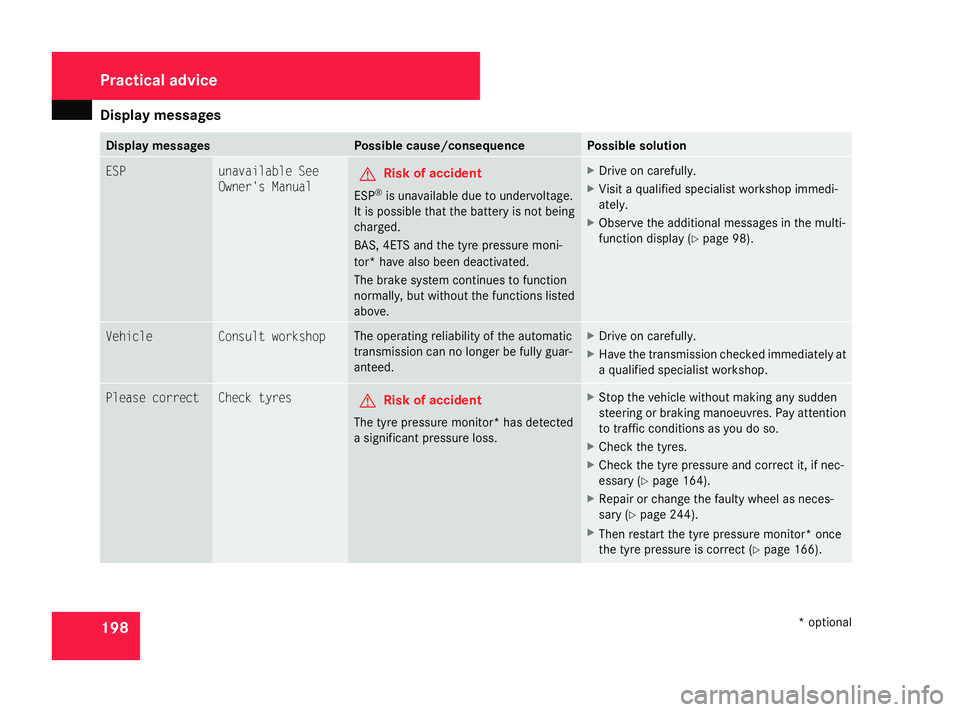
messages 198 Display messages Possible cause/consequence Possible solution
ESP unavailable See
Owner's Manual
G
Risk of accident
ESP ®
is unavailable due to undervoltage.
It is possible that the battery is not being
charged.
BAS, 4ETS and the tyre pressure moni-
tor* have also been deactivated.
The brake system continues to function
normally, but without the functions listed
above. X
Drive on carefully.
X Visit a qualified specialist workshop immedi-
ately.
X Observe the additional messages in the multi-
function display ( Ypage 98). Vehicle Consult workshop The operating reliability of the automatic
transmission can no longer be fully guar-
anteed. X
Drive on carefully.
X Have the transmission checked immediately at
a qualified specialist workshop. Please correct Check tyres
G
Risk of accident
The tyre pressure monitor* has detected
a significant pressure loss. X
Stop the vehicle without making any sudden
steering or braking manoeuvres. Pay attention
to traffic conditions as you do so.
X Check the tyres.
X Check the tyre pressure and correct it, if nec-
essary ( Ypage 164).
X Repair or change the faulty wheel as neces-
sary ( Ypage 244).
X Then restart the tyre pressure monitor* once
the tyre pressure is correct (Y page 166).Practical advice
* optional
463_AKB; 1; 8, en-GB
wobuchh,
Version: 2.10.6 2008-07-17T15:19:41+02:00 - Seite 198Dateiname: 6515_4091_02_buchblock.pdf; preflight
Page 215 of 293
Troubleshooting
212 Warning and indicator lamps in the instrument cluster
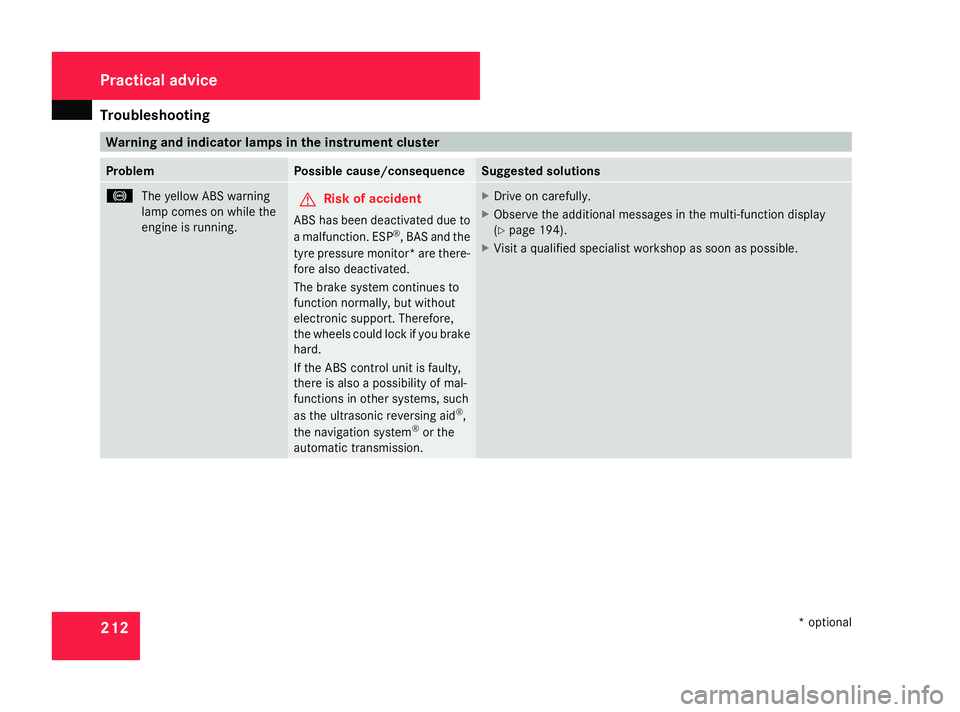
Problem Possible cause/consequence Suggested solutions
-
Theyellow ABS warning
lamp comes on while the
engine is running. G
Risk of accident
ABS has been deactivated due to
a malfunction. ESP ®
, BAS and the
tyre pressure monitor* are there-
fore also deactivated.
The brake system continues to
function normally, but without
electronic support. Therefore,
the wheels could lock if you brake
hard.
If the ABS control unit is faulty,
there is also a possibility of mal-
functions in other systems, such
as the ultrasonic reversing aid ®
,
the navigation system ®
or the
automatic transmission. X
Drive on carefully.
X Observe the additional messages in the multi-function display
(Y page 194).
X Visit a qualified specialist workshop as soon as possible. Practical advice
* optional
463_AKB; 1; 8, en-GB
wobuchh,
Version: 2.10.6 2008-07-17T15:19:41+02:00 - Seite 212Dateiname: 6515_4091_02_buchblock.pdf; preflight
Page 216 of 293
Troubleshooting
213Problem Possible cause/consequence Suggested solutions
-
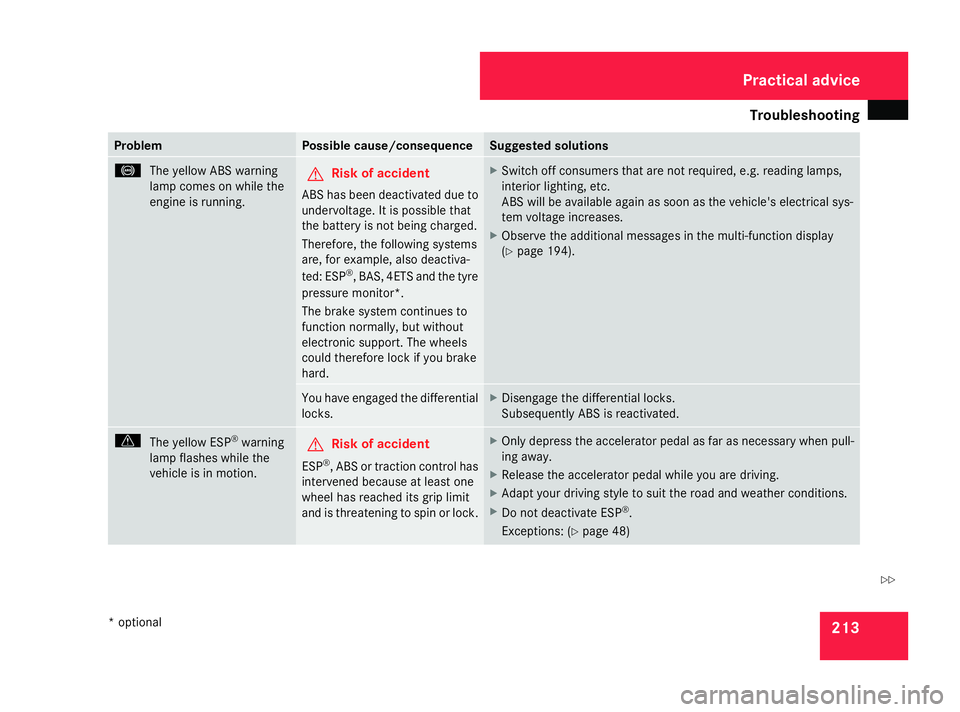
Theyellow ABS warning
lamp comes on while the
engine is running. G
Risk of accident
ABS has been deactivated due to
undervoltage. It is possible that
the battery is not being charged.
Therefore, the following systems
are, for example, also deactiva-
ted: ESP ®
, BAS, 4ETS and the tyre
pressure monitor*.
The brake system continues to
function normally, but without
electronic support. The wheels
could therefore lock if you brake
hard. X
Switch off consumers that are not required, e.g. reading lamps,
interior lighting, etc.
ABS will be available again as soon as the vehicle's electrical sys-
tem voltage increases.
X Observe the additional messages in the multi-function display
(Y page 194). You have engaged the differential
locks. X
Disengage the differential locks.
Subsequently ABS is reactivated. v
The yellow ESP ®
warning
lamp flashes while the
vehicle is in motion. G
Risk of accident
ESP ®
, ABS or traction control has
intervened because at least one
wheel has reached its grip limit
and is threatening to spin or lock. X
Only depress the accelerator pedal as far as necessary when pull-
ing away.
X Release the accelerator pedal while you are driving.
X Adapt your driving style to suit the road and weather conditions.
X Do not deactivate ESP ®
.
Exceptions: (Y page 48) Practical advice
* optional
463_AKB; 1; 8, en-GB
wobuchh,
Version: 2.10.6 2008-07-17T15:19:41+02:00 - Seite 213 ZDateiname: 6515_4091_02_buchblock.pdf; preflight
Page 217 of 293
Troubleshooting
214 Problem Possible cause/consequence Suggested solutions
v
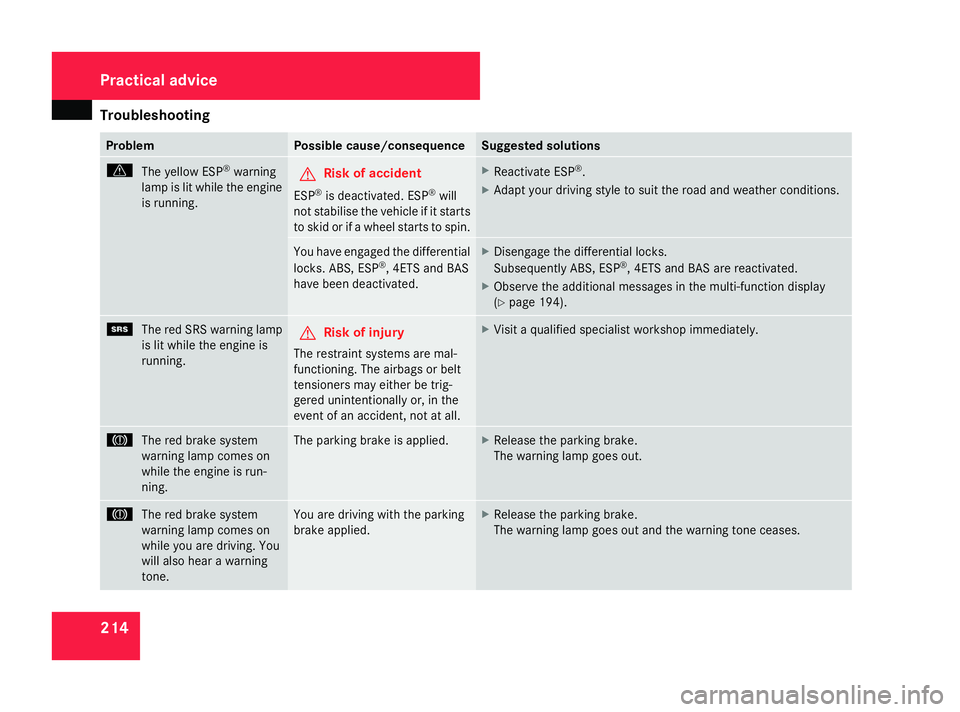
Theyellow ESP ®
warning
lamp is lit while the engine
is running. G
Risk of accident
ESP ®
is deactivated. ESP ®
will
not stabilise the vehicle if it starts
to skid or if a wheel starts to spin. X
Reactivate ESP ®
.
X Adapt your driving style to suit the road and weather conditions. You have engaged the differential
locks. ABS, ESP
®
, 4ETS and BAS
have been deactivated. X
Disengage the differential locks.
Subsequently ABS, ESP ®
, 4ETS and BAS are reactivated.
X Observe the additional messages in the multi-function display
(Y page 194). 1
The red SRS warning lamp
is lit while the engine is
running. G
Risk of injury
The restraint systems are mal-
functioning. The airbags or belt
tensioners may either be trig-
gered unintentionally or, in the
event of an accident, not at all. X
Visit a qualified specialist workshop immediately. 3
The red brake system
warning lamp comes on
while the engine is run-
ning. The parking brake is applied. X
Release the parking brake.
The warning lamp goes out. 3
The red brake system
warning lamp comes on
while you are driving. You
will also hear a warning
tone. You are driving with the parking
brake applied. X
Release the parking brake.
The warning lamp goes out and the warning tone ceases. Practical advice
463_AKB; 1; 8, en-GB
wobuchh,
Version: 2.10.6 2008-07-17T15:19:41+02:00 - Seite 214Dateiname: 6515_4091_02_buchblock.pdf; preflight
Page 223 of 293
Troubleshooting
220 Engine
Problem Possible cause/consequence Suggested solutions
The engine will not start. You can
hear the starter motor operating. R
There is a malfunction in the
engine electronics.
R There is a malfunction in the
fuel supply. X
Turn the key back to position 0in the ignition lock before the next
starting attempt.
X Try to start the engine again (Y page 86). When doing so, remember
that excessively long and frequent attempts to start the engine will
drain the battery.
If the engine does not start after several attempts:
X Consult a qualified specialist workshop. Vehicles with a diesel engine:
The engine will not start. You can
hear the starter motor operating.
The reserve fuel warning lamp is
on and the fuel gauge shows 0. The fuel tank has been run dry. X
Refuel the vehicle.
X Bleed the fuel system (Y page 219).The engine will not start. You can-
not hear the starter motor oper-
ating. The on-board voltage is too low
because the starter battery is too
weak or discharged. X
Jump-start the vehicle (Y page 251).
If the engine does not start despite attempting to jump-start it:
X Consult a qualified specialist workshop. Vehicles with a petrol engine:
The engine is not running
smoothly and is misfiring. There is a malfunction in the
engine electronics or a mechani-
cal component of the engine con-
trol unit. X
Only depress the accelerator pedal slightly.
X Have the cause rectified immediately at a qualified specialist work-
shop.
Otherwise, non-combusted fuel may get into the catalytic converter
and damage it. Practical advice
463_AKB; 1; 8, en-GB
wobuchh,
Version: 2.10.6 2008-07-17T15:19:41+02:00 - Seite 220Dateiname: 6515_4091_02_buchblock.pdf; preflight
Page 243 of 293
Changing the bulbs
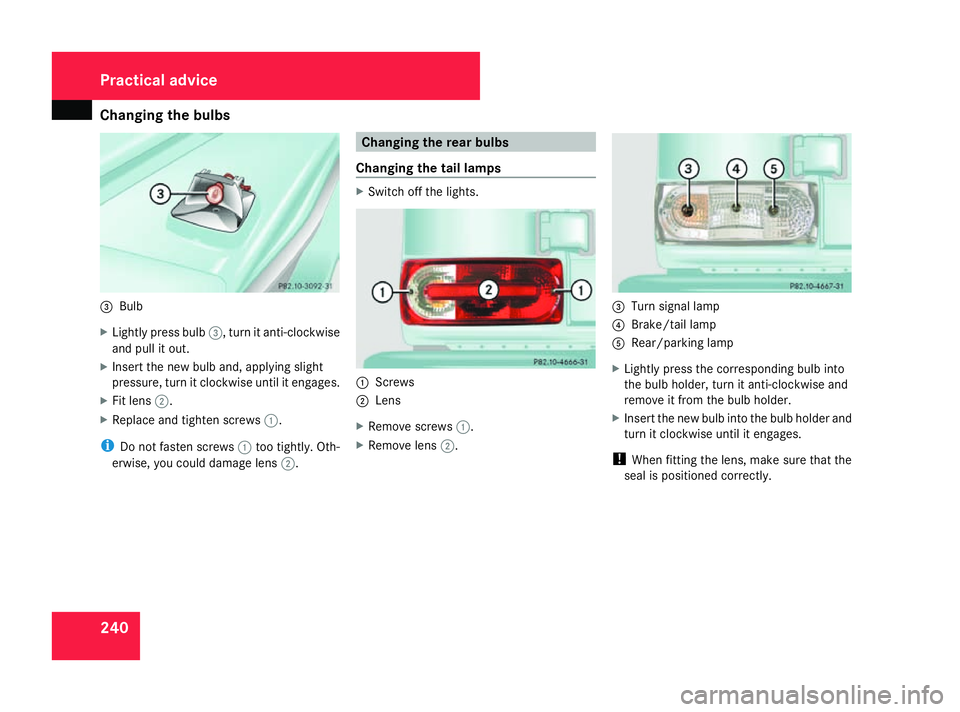
2403
Bulb
X Lightly press bulb 3, turn it anti-clockwise
and pull it out.
X Insert the new bulb and, applying slight
pressure, turn it clockwise until it engages.
X Fit lens 2.
X Replace and tighten screws 1.
i Do not fasten screws 1too tightly. Oth-
erwise, you could damage lens 2. Changing the rear bulbs
Changing the tail lamps X
Switch off the lights. 1
Screws
2 Lens
X Remove screws 1.
X Remove lens 2. 3
Turn signal lamp
4 Brake/tail lamp
5 Rear/parking lamp
X Lightly press the corresponding bulb into
the bulb holder, turn it anti-clockwise and
remove it from the bulb holder.
X Insert the new bulb into the bulb holder and
turn it clockwise until it engages.
! When fitting the lens, make sure that the
seal is positioned correctly. Practical advice
463_AKB; 1; 8, en-GB
wobuchh
, Version: 2.10.6
2008-07-17T15:19:41+02:00 - Seite 240 Dateiname: 6515_4091_02_buchblock.pdf; preflight
Page 247 of 293
Flat tyre
244
X
Close the driver’s door.
X Place the warning triangle ( Ypage 188) or
warning lamps at a suitable distance.
Observe legal requirements. Changing a wheel and fitting the spare
wheel G
Risk of accident
If the spare wheel is more than six years
old, or it does not correspond to the regular
wheel type: have the spare wheel replaced
by a new wheel at the nearest qualified spe-
cialist workshop, e.g. a Mercedes-Benz
Service Centre.
Never drive the vehicle with more than one
spare wheel fitted.
Vehicles with different tyre dimensions on
the front and rear axles: wheel and tyre size
of the spare wheel and normal wheel are
different. When using the spare wheel, the
handling characteristics are compromised.
Do not exceed the maximum speed of 80
km/h. G
Risk of accident
Vehicles with AMG equipment: when you fit
the spare wheel, make sure you observe the
following:
R the maximum speed of 80 km/h
R the prescribed tyre pressure
Preparing the vehicle X
Prepare the vehicle as described
(Y page 243).
X If a trailer is coupled, uncouple it.
X Remove the vehicle tool kit and the jack
(Y page 191).
X Remove the spare wheel from the spare
wheel bracket (Y page 192).
X Secure the vehicle to prevent it from rolling
away.
On level ground: place chocks or similar
items under the front and rear of the wheel
that is diagonally opposite the wheel you
wish to change.
X On downhill gradients: place chocks or
similar items under both wheels of the
other axle. Raising
the vehicle G
Risk of injury
The jack is designed only to raise the vehi-
cle for a short time while a wheel is being
changed.
The vehicle must be placed on stands if you
intend to work under it.
Make sure that the jack is placed on a firm,
non-slip, level surface. Do not use wooden
blocks or similar items as jacking supports.
Otherwise, the jack will not be able to ach-
ieve its load-bearing capacity due to the
restricted height.
Do not start the engine at any time while
the wheel is being changed.
Do not lie under the vehicle when it is being
supported by the jack. If you do not raise
the vehicle as described, it could slip off the
jack (e.g. when starting the engine, opening
or closing a door or the tailgate) and you
could be seriously injured. G
Risk of accident
If you fail to position the jack correctly, the
vehicle may: Practical advice
463_AKB; 1; 8, en-GB
wobuchh
,V ersion: 2.10.6
2008-07-17T15:19:41+02:00 - Seite 244 Dateiname: 6515_4091_02_buchblock.pdf; preflight
Page 248 of 293
Flat tyre
245R
slip off the jack
R injure you or others
R be damaged
Thus, it is important to make sure that the
jack is positioned correctly in the respec-
tive jacking points. Before positioning the
jack, remove any dirt that may have collec-
ted in the jacking points. Wheel wrench
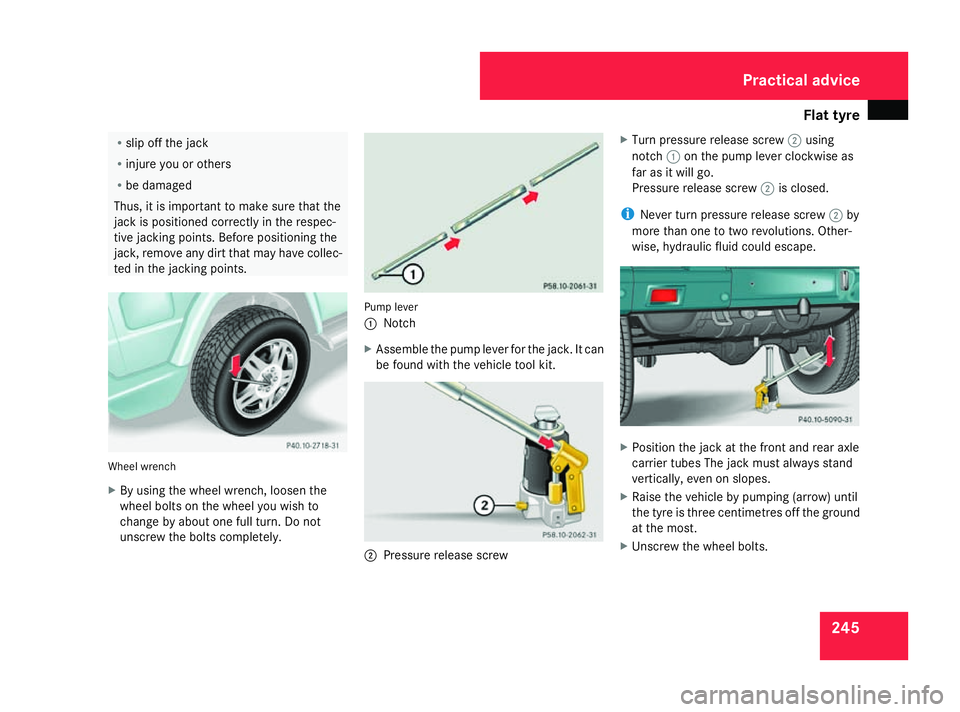
X
By using the wheel wrench, loosen the
wheel bolts on the wheel you wish to
change by about one full turn. Do not
unscrew the bolts completely. Pump lever
1
Notch
X Assemble the pump lever for the jack. It can
be found with the vehicle tool kit. 2
Pressure release screw X
Turn pressure release screw 2using
notch 1on the pump lever clockwise as
far as it will go.
Pressure release screw 2is closed.
i Never turn pressure release screw 2by
more than one to two revolutions. Other-
wise, hydraulic fluid could escape. X
Position the jack at the front and rear axle
carrier tubes The jack must always stand
vertically, even on slopes.
X Raise the vehicle by pumping (arrow) until
the tyre is three centimetres off the ground
at the most.
X Unscrew the wheel bolts. Practical advice
463_AKB; 1; 8, en-GB
wobuchh,
Version: 2.10.6
2008-07-17T15:19:41+02:00 - Seite 245 ZDateiname: 6515_4091_02_buchblock.pdf; preflight
Page 250 of 293
Battery
247
X
Cover the faulty wheel with the tyre cover
provided.
X Check the tyre pressure and correct it, if
necessary.
You will find a table of tyre pressures on the
inside of your vehicle's fuel filler flap. Battery
Notes on the vehicle battery
In order for the battery to achieve the maxi-
mum possible service life, it must always be
sufficiently charged.
Have the battery charge checked more fre-
quently if you use the vehicle mainly for short
trips or if you leave it standing idle for a
lengthy period.
To prevent damage from corrosion, only
replace the battery with one that has a central
ventilation cover.
Consult a Mercedes-Benz Service Centre if
you wish to leave your vehicle parked up for
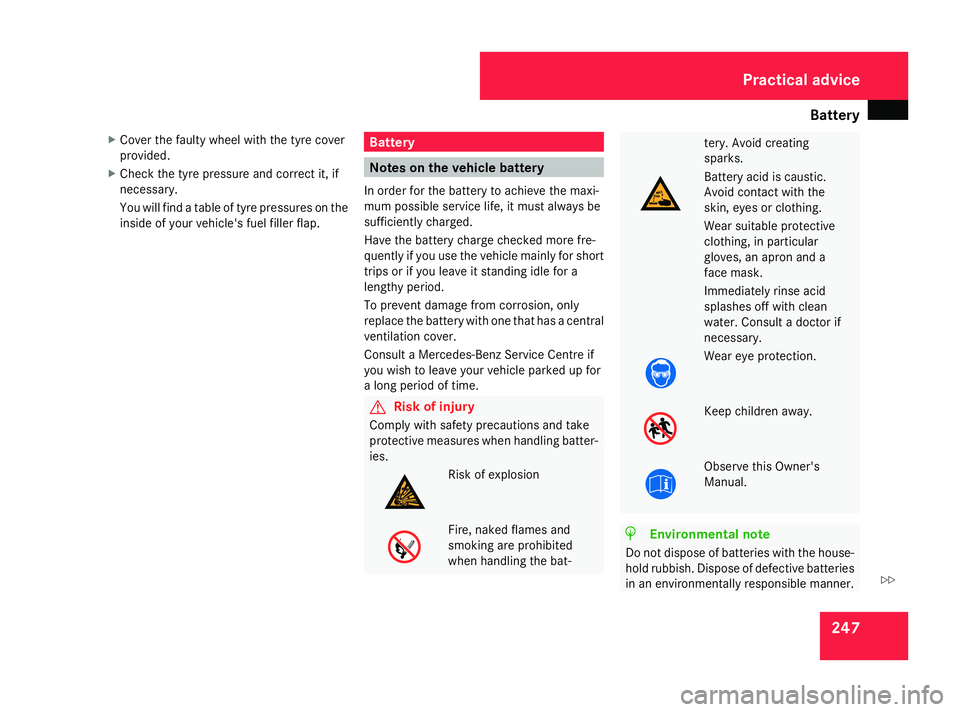
a long period of time. G
Risk of injury
Comply with safety precautions and take
protective measures when handling batter-
ies. Risk of explosion
Fire, naked flames and
smoking are prohibited
when handling the bat- tery. Avoid creating
sparks.
Battery acid is caustic.
Avoid contact with the
skin, eyes or clothing.
Wear suitable protective
clothing, in particular
gloves, an apron and a
face mask.
Immediately rinse acid
splashes off with clean
water. Consult a doctor if
necessary.
Wear eye protection.
Keep children away.
Observe this Owner's
Manual.
H
Environmental note
Do not dispose of batteries with the house-
hold rubbish. Dispose of defective batteries
in an environmentally responsible manner. Practical advice
463_AKB; 1; 8, en-GB
wobuchh, Version: 2.10.6 2008-07-17T15:19:41+02:00 - Seite 247 ZDateiname: 6515_4091_02_buchblock.pdf; preflight
Page 262 of 293
Mercedes-Benz genuine parts
259Notes on the technical data
i The technical data was determined in
accordance with EU directives. All data
applies to the vehicle's standard equip-
ment. The data may therefore differ for
vehicles with optional equipment. You can
obtain further information from a
Mercedes-Benz Service Centre. Mercedes-Benz genuine parts
Mercedes-Benz tests genuine parts and con-
version parts and accessories which have
been specifically approved for your vehicle for
their reliability, safety and suitability. Despite
ongoing market research, Mercedes-Benz is
unable to evaluate other parts. Mercedes-
Benz therefore accepts no responsibility for
the use of such parts in Mercedes-Benz vehi-
cles, even if they have been independently or
officially approved.
In Germany and some other countries, certain
parts are only officially approved for installa-
tion or modification if they comply with legal
requirements. All genuine Mercedes-Benz
parts meet this requirement. The use of non-
approved parts may invalidate the vehicle's
general operating permit. This is the case if:
R they cause a change of the vehicle type
from that for which the vehicle's general
operating permit was granted
R other road users could be endangered
R the emission or noise levels are adversely
affected
The use of non-approved parts could affect
your vehicle's operating safety. Mercedes-
Benz therefore recommends genuine Mercedes-Benz parts and conversion parts
and accessories that have been approved for
your vehicle. H
Environmental note
Daimler also supplies reconditioned
assemblies and parts which are of the same
quality as new parts. For these, the same
warranty applies as for new parts.
Genuine Mercedes-Benz parts and approved
conversion parts and accessories are availa-
ble from Mercedes-Benz Service Centres.
There, you can also receive advice about tech-
nical modifications and have the parts pro-
fessionally fitted.
Always quote the vehicle identification num-
ber and the engine number when ordering
genuine parts. You will find these numbers on
the vehicle data card in the Service Booklet
or on your vehicle's identification plates
(Y page 261). Technical data
463_AKB; 1; 8, en-GB
wobuchh,
Version: 2.10.6 2008-07-17T15:19:41+02:00 - Seite 259 ZDateiname: 6515_4091_02_buchblock.pdf; preflight