ECU MERCEDES-BENZ G-CLASS SUV 2012 Service Manual
[x] Cancel search | Manufacturer: MERCEDES-BENZ, Model Year: 2012, Model line: G-CLASS SUV, Model: MERCEDES-BENZ G-CLASS SUV 2012Pages: 357, PDF Size: 8.86 MB
Page 264 of 357
Problem Possible causes/consequences and
M Solutions
?
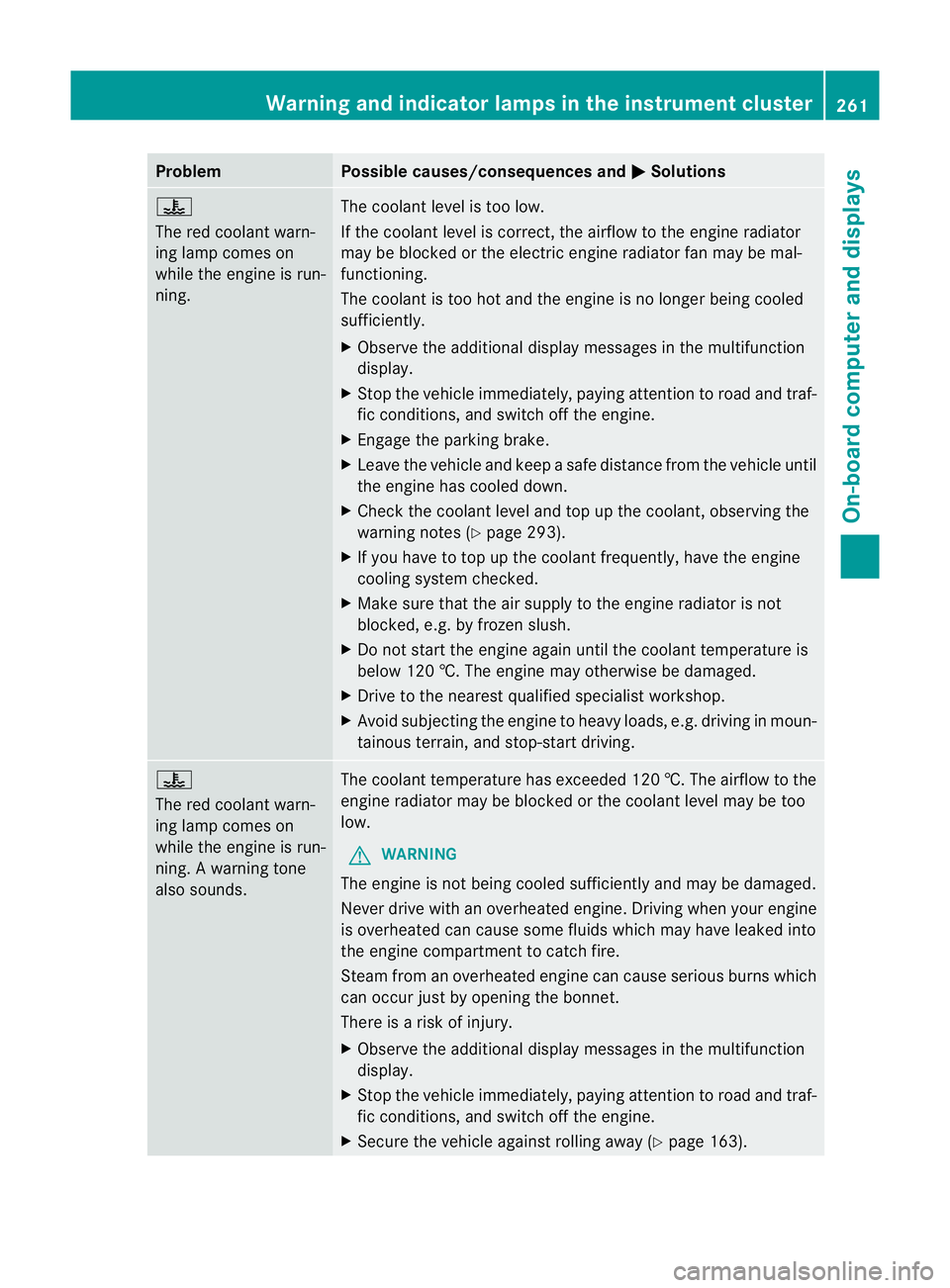
The red coolant warn-
ing lamp comes on
while the engine is run-
ning.
The coolant level is too low.
If the coolant level is correct, the airflow to the engine radiator
may be blocked or the electric engine radiator fan may be mal-
functioning.
The coolant is too hot and the engine is no longer being cooled
sufficiently.
X
Observe the additional display messages in the multifunction
display.
X Stop the vehicle immediately, paying attention to road and traf-
fic conditions, and switch off the engine.
X Engage the parking brake.
X Leave the vehicle and keep a safe distance from the vehicle until
the engine has cooled down.
X Check the coolant level and top up the coolant, observing the
warning notes (Y page 293).
X If you have to top up the coolant frequently, have the engine
cooling system checked.
X Make sure that the air supply to the engine radiator is not
blocked, e.g. by frozen slush.
X Do not start the engine again until the coolant temperature is
below 120 †. The engine may otherwise be damaged.
X Drive to the nearest qualified specialist workshop.
X Avoid subjecting the engine to heavy loads, e.g. driving in moun-
tainous terrain, and stop-start driving. ?
The red coolant warn-
ing lamp comes on
while the engine is run-
ning. A warning tone
also sounds.
The coolant temperature has exceeded 120 †. The airflow to the
engine radiator may be blocked or the coolant level may be too
low.
G WARNING
The engine is not being cooled sufficiently and may be damaged.
Never drive with an overheated engine. Driving when your engine
is overheated can cause some fluids which may have leaked into
the engine compartment to catch fire.
Steam from an overheated engine can cause serious burns which
can occur just by opening the bonnet.
There is a risk of injury.
X Observe the additional display messages in the multifunction
display.
X Stop the vehicle immediately, paying attention to road and traf-
fic conditions, and switch off the engine.
X Secure the vehicle against rolling away (Y page 163).Warning and indicator lamps in the instrument cluster
261On-board computer and displays Z
Page 266 of 357
Tyres
Problem Possible causes/consequences and
M Solutions
h
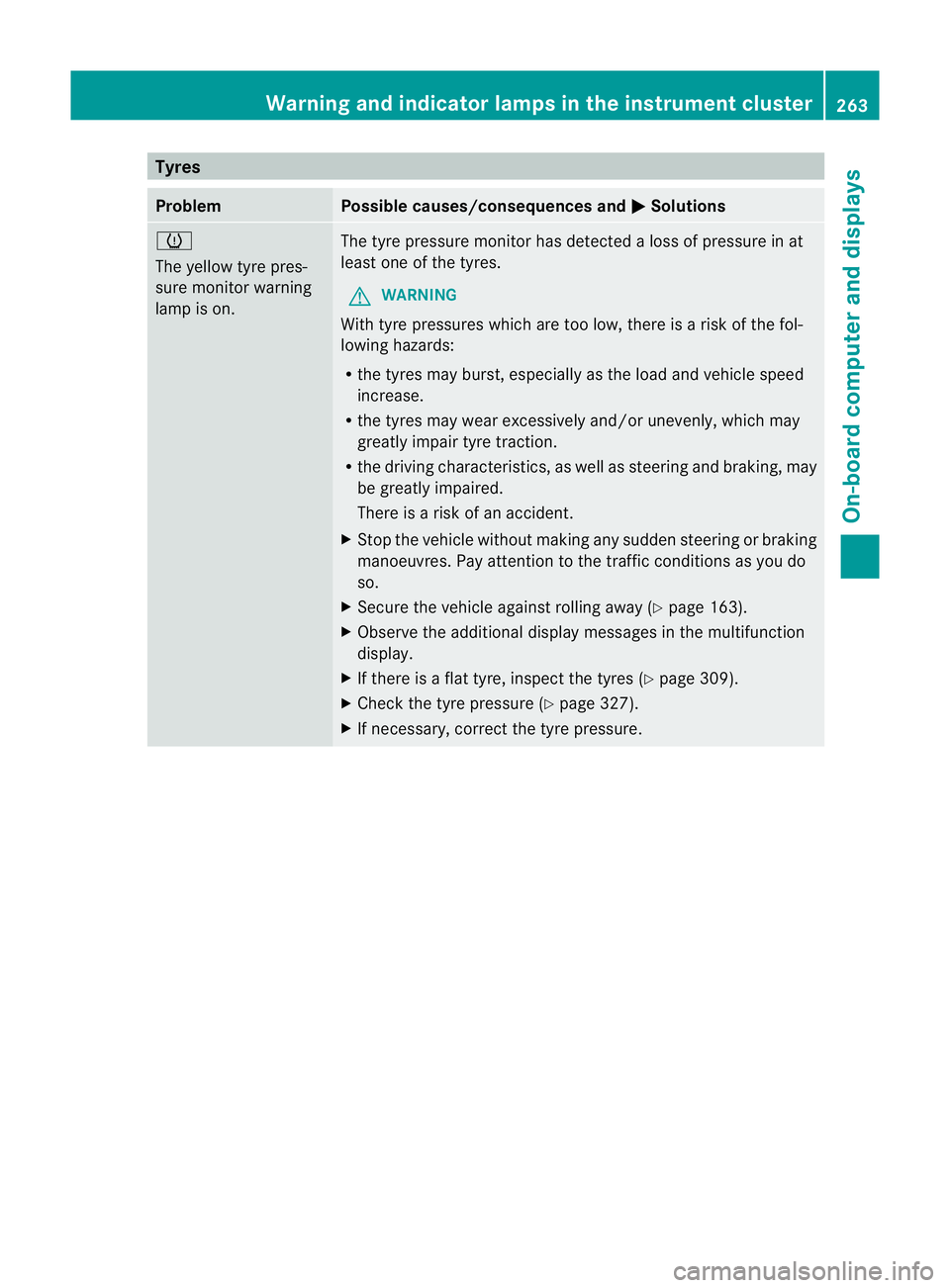
The yellow tyre pres-
sure monitor warning
lamp is on.
The tyre pressure monitor has detected a loss of pressure in at
leas tone of the tyres.
G WARNING
With tyre pressures which are too low, there is a ris kofthe fol-
lowing hazards:
R the tyres may burst, especially as the load and vehicle speed
increase.
R the tyres may wear excessively and/or unevenly, which may
greatly impair tyre traction.
R the driving characteristics, as well as steering and braking, may
be greatly impaired.
There is a risk of an accident.
X Stop the vehicle without making any sudden steering or braking
manoeuvres. Pay attention to the traffic conditions as you do
so.
X Secure the vehicle against rolling away (Y page 163).
X Observe the additional display messages in the multifunction
display.
X If there is a flat tyre, inspect the tyres (Y page 309).
X Check the tyre pressure (Y page 327).
X If necessary, correct the tyre pressure. Warning and indicator lamps in the instrument cluster
263On-board computer and displays Z
Page 269 of 357
Useful information
i This Owner's Manual describes all mod-
els, series and optional equipment for your
vehicle that were available at the time of
going to press. Country-specific differen-
ces are possible. Note that your vehicle
may not be fitted with all features descri-
bed. This is also the case for systems and
functions relevant to safety.
i Read the information on qualified special-
ist workshops: (Y page 22). Loading guidelines
G
WARNING
Secure and position the load as described in
the loading guidelines.
Otherwise, vehicle occupants could
be injured by the load being thrown around in
the even tofsharp braking, a sudden change
in direction or an accident. This also applies
to seats which have been removed.
You will find further information in the "Secur-
ing a load" section.
Even if you follow all the loading guidelines,
the load will increase the risk of injury in the
event of an accident. G
WARNING
Keep the boot lid/tailgate closed when the
engine is running. Otherwise, you could be
poisoned by exhaust fumes entering the vehi-
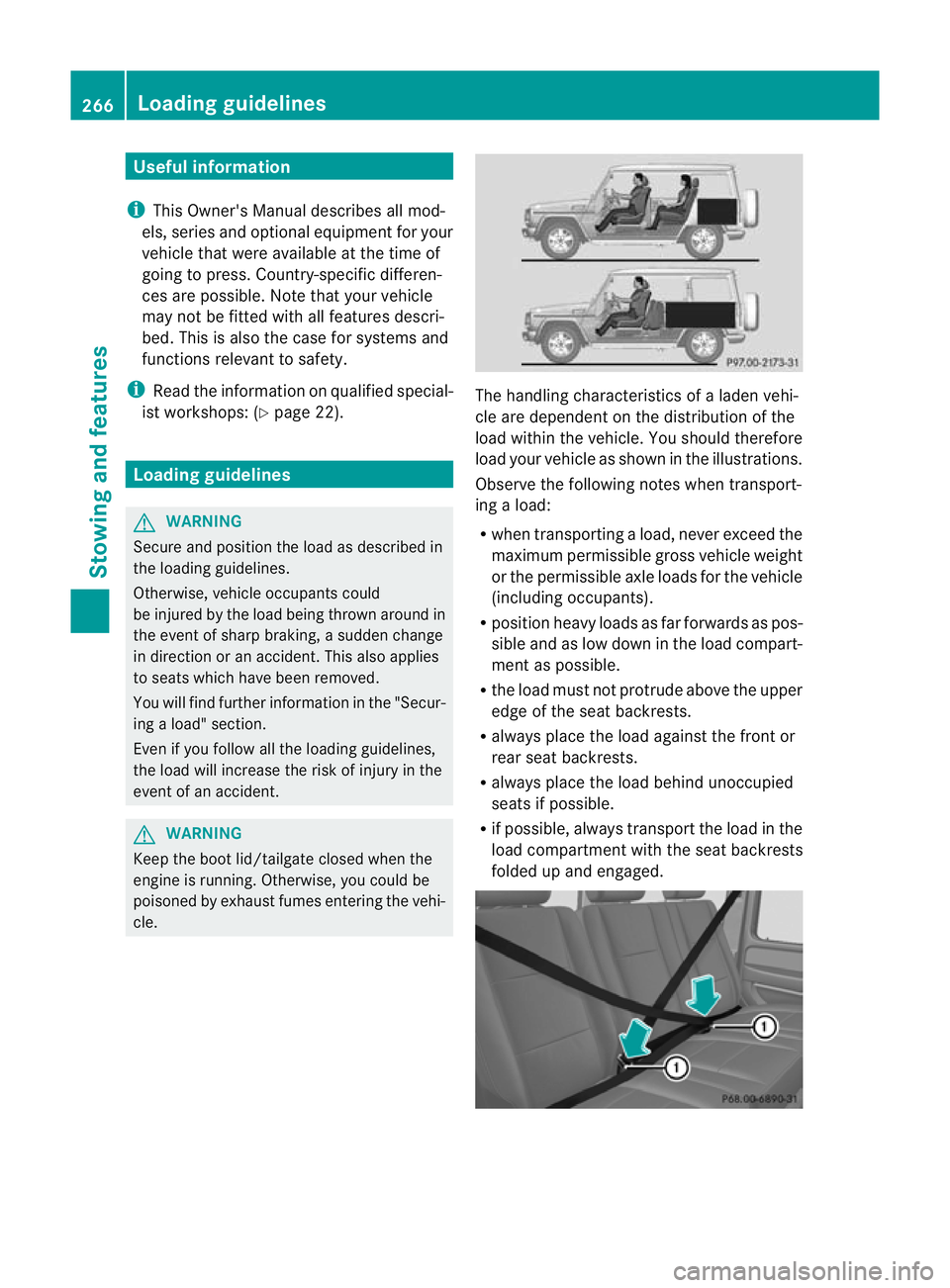
cle. The handling characteristics of a laden vehi-
cle are dependent on the distribution of the
load within the vehicle. You should therefore
load your vehicle as shown in the illustrations.
Observe the following notes when transport-
ing a load:
R when transporting a load, never exceed the
maximum permissible gross vehicle weight
or the permissible axle loads for the vehicle
(including occupants).
R position heavy loads as far forwards as pos-
sible and as low down in the load compart-
ment as possible.
R the load must not protrude above the upper
edge of the seat backrests.
R always place the load against the front or
rear seat backrests.
R always place the load behind unoccupied
seats if possible.
R if possible, always transport the load in the
load compartmentw ith the seat backrests
folded up and engaged. 266
Loading guidelinesStowing and features
Page 270 of 357
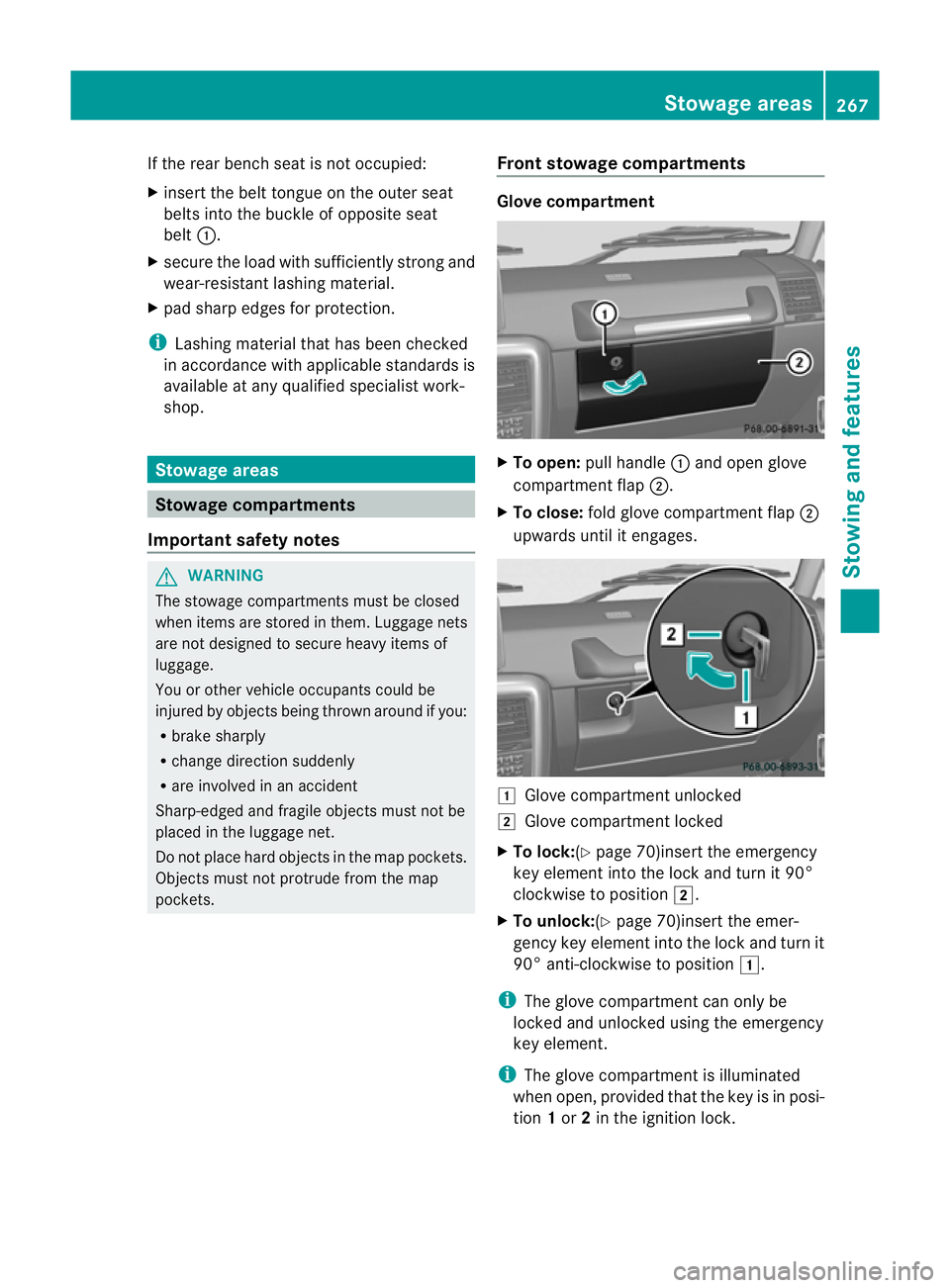
If the rear bench seat is not occupied:
X
insert the belt tongue on the outer seat
belts into the buckle of opposite seat
belt :.
X secure the load with sufficiently strong and
wear-resistant lashing material.
X pad sharp edges for protection.
i Lashing material that has been checked
in accordance with applicable standards is
available at any qualified specialist work-
shop. Stowage areas
Stowage compartments
Important safety notes G
WARNING
The stowage compartments must be closed
when items are stored in them. Luggage nets
are not designed to secure heavy items of
luggage.
You or other vehicle occupants could be
injured by objects being thrown around if you:
R brake sharply
R change direction suddenly
R are involved in an accident
Sharp-edged and fragile objects must not be
placed in the luggage net.
Do not place hard objects in the map pockets.
Objects must not protrude from the map
pockets. Front stowage compartments Glove compartment
X
To open: pull handle :and open glove
compartment flap ;.
X To close: fold glove compartment flap ;
upwards until it engages. 1
Glove compartment unlocked
2 Glove compartment locked
X To lock:(Y page 70)insert the emergency
key element into the lock and turn it 90°
clockwise to position 2.
X To unlock:(Y page 70)insert the emer-
gency key element into the lock and turn it
90° anti-clockwise to position 1.
i The glove compartment can only be
locked and unlocked using the emergency
key element.
i The glove compartment is illuminated
when open, provided that the key is in posi-
tion 1or 2in the ignition lock. Stowage areas
267Stowing and features Z
Page 271 of 357
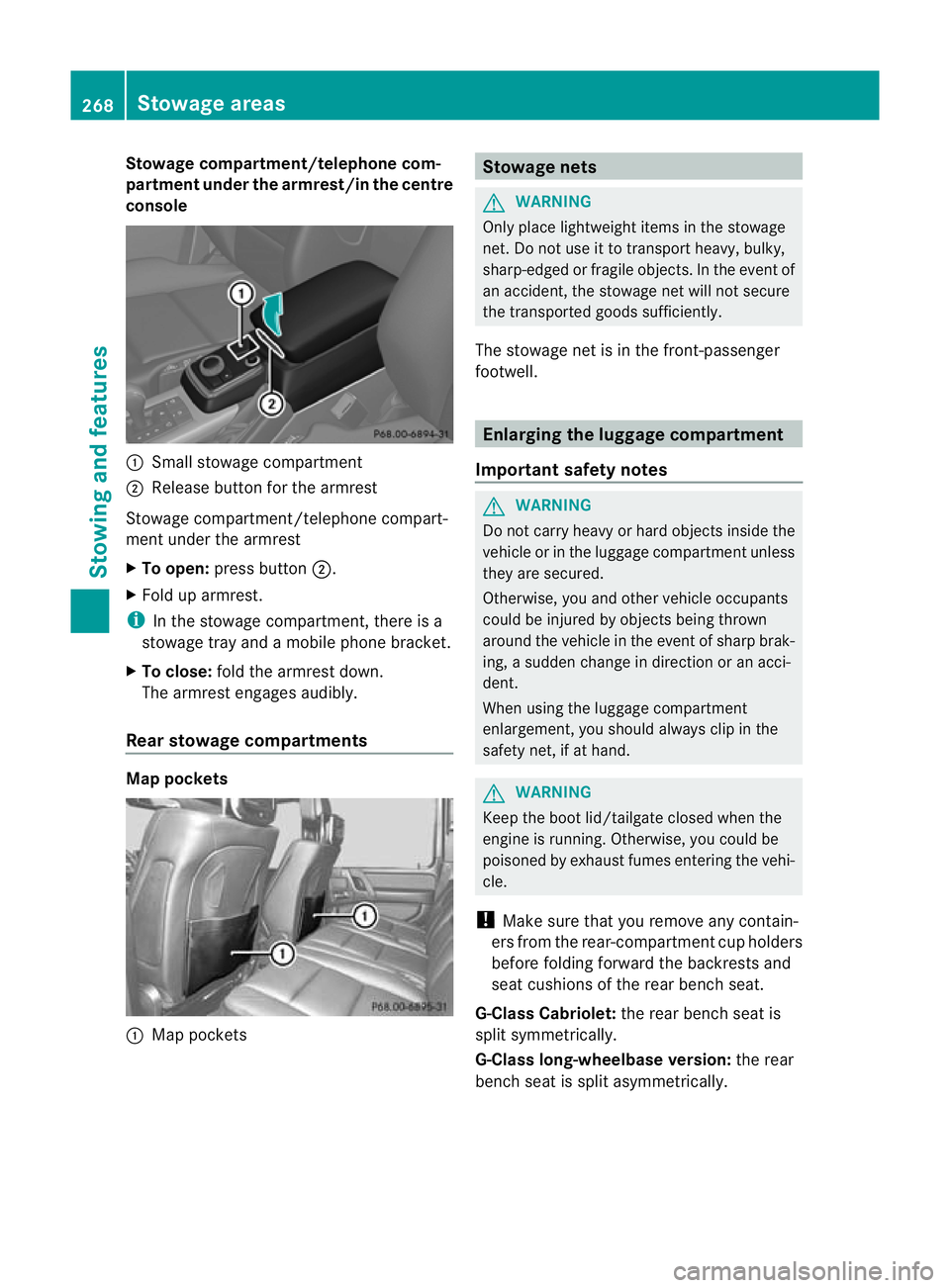
Stowage compartment/telephone com-
partment under the armrest/in the centre
console
:
Small stowage compartment
; Release button for the armrest
Stowage compartment/telephone compart-
ment under the armrest
X To open: press button ;.
X Fold up armrest.
i In the stowage compartment, there is a
stowage tray and a mobile phone bracket.
X To close: fold the armrest down.
The armrest engages audibly.
Rear stowage compartments Map pockets
:
Map pockets Stowage nets
G
WARNING
Only place lightweight items in the stowage
net. Do not use it to transport heavy, bulky,
sharp-edged or fragile objects. In the event of
an accident, the stowage net will not secure
the transported goods sufficiently.
The stowage net is in the front-passenger
footwell. Enlarging the luggage compartment
Important safety notes G
WARNING
Do not carry heavy or hard objects inside the
vehicle or in the luggage compartmen tunless
they are secured.
Otherwise, you and othe rvehicle occupants
could be injured by objects being thrown
around the vehicle in the event of sharp brak-
ing, a sudden change in direction or an acci-
dent.
When using the luggage compartment
enlargement, you should alway sclip in the
safety net, if at hand. G
WARNING
Keep the boot lid/tailgate closed when the
engine is running. Otherwise, you could be
poisoned by exhaust fumes entering the vehi-
cle.
! Make sure that you remove any contain-
ers fro mthe rear-compartment cup holders
before folding forward the backrests and
seat cushions of the rear bench seat.
G-Class Cabriolet: the rear bench seat is
split symmetrically.
G-Class long-wheelbase version: the rear
bench seat is split asymmetrically. 268
Stowage areasStowing and features
Page 273 of 357
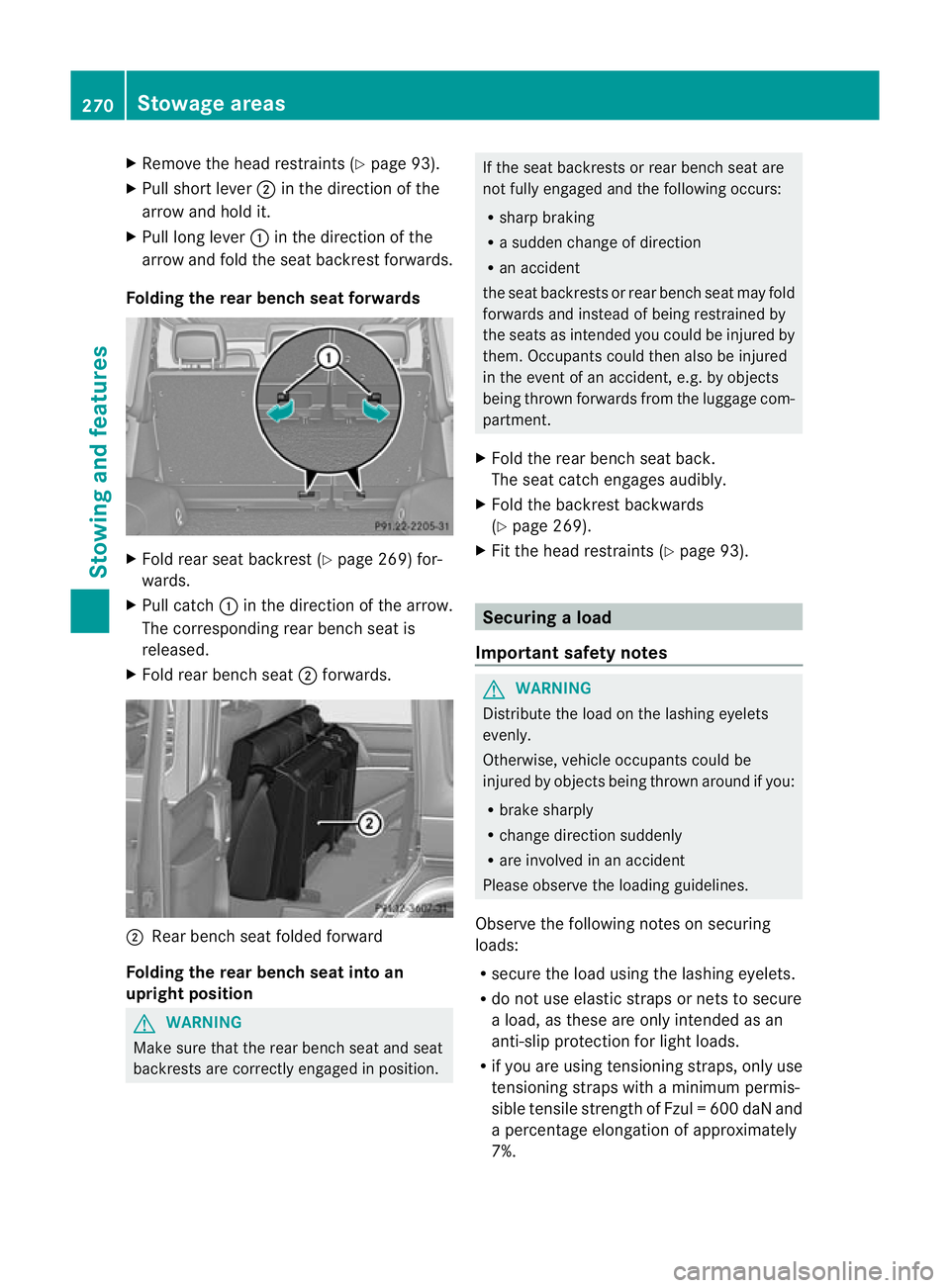
X
Remove the head restraints (Y page 93).
X Pull short lever ;in the direction of the
arrow and hold it.
X Pull long lever :in the direction of the
arrow and fold the seat backrest forwards.
Folding the rear bench seat forwards X
Fold rear seat backrest (Y page 269) for-
wards.
X Pull catch :in the direction of the arrow.
The corresponding rear bench seat is
released.
X Fold rear bench seat ;forwards. ;
Rear bench seat folded forward
Folding the rear bench sea tinto an
upright position G
WARNING
Make sure that the rear bench seat and seat
backrests are correctly engaged in position. If the seat backrests or rear bench seat are
not fully engaged and the following occurs:
R sharp braking
R a sudden change of direction
R an accident
the seat backrests or rear bench seat may fold
forwards and instead of being restrained by
the seats as intended you could be injured by
them. Occupants could then also be injured
in the event of an accident, e.g. by objects
being thrown forwards from the luggage com-
partment.
X Fold the rear bench seat back.
The seat catch engages audibly.
X Fold the backrest backwards
(Y page 269).
X Fit the head restraints (Y page 93). Securing
aload
Important safety notes G
WARNING
Distribute the load on the lashing eyelets
evenly.
Otherwise, vehicle occupants could be
injured by objects being thrown around if you:
R brake sharply
R change directio nsuddenly
R are involved in an accident
Please observe the loading guidelines.
Observe the following notes on securing
loads:
R secure the load using the lashing eyelets.
R do no tuse elastic straps or nets to secure
a load, as these are only intended as an
anti-slip protection for light loads.
R if you are using tensioning straps, only use
tensioning straps with a minimum permis-
sible tensile strength of Fzul =600 daN and
a percentage elongatio nofapproximately
7%. 270
Stowage areasStowing and features
Page 274 of 357
R
do not route lashing materials across sharp
edges or corners.
R Pad sharp edges for protection.
R only use lashing material that has been
checked in accordance with applicable
standards, e.g. lashing nets or lashing
straps.
R fill the spaces between the load and the
load compartment walls and the wheel
mountings in a form-locking way. Only use
dimensionally stable transportation aids
for this, such as chocks, wooden fixings or
padding.
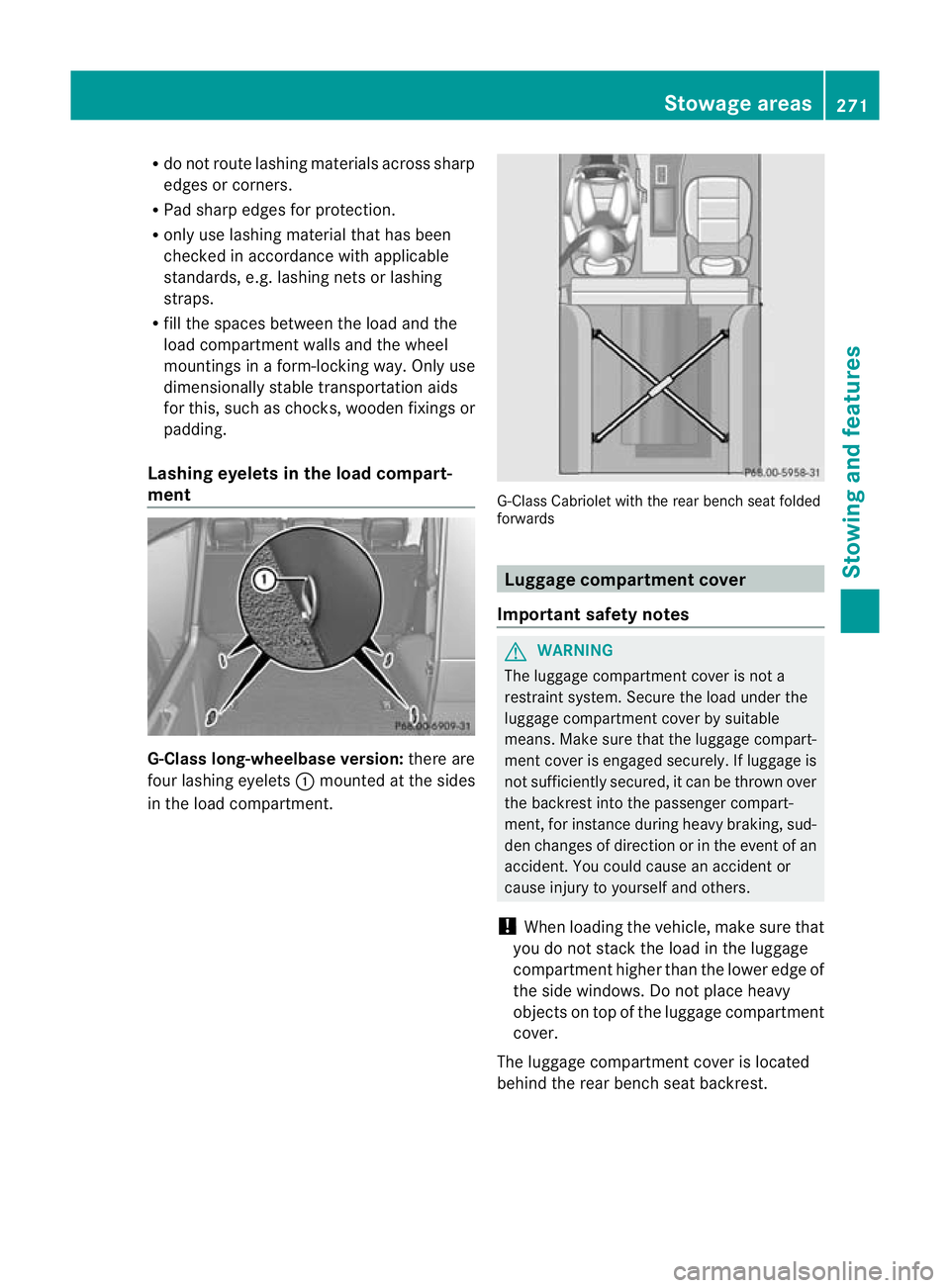
Lashing eyelets in the load compart-
ment G-Class long-wheelbase version:
there are
four lashing eyelets :mounted at the sides
in the load compartment. G-Class Cabriolet with the rear bench seat folded
forwards
Luggage compartment cover
Important safety notes G
WARNING
The luggage compartment cover is not a
restraint system. Secure the load under the
luggage compartment cover by suitable
means. Make sure that the luggage compart-
ment cover is engaged securely. If luggage is
not sufficiently secured, it can be thrown over
the backrest into the passenger compart-
ment, for instance during heavy braking, sud-
den changes of direction or in the event of an
accident. You could cause an acciden tor
cause injury to yoursel fand others.
! Whe nloading the vehicle, make sure that
you do not stack the load in the luggage
compartment higher than the lower edge of
the side windows. Do not place heavy
objects on top of the luggage compartment
cover.
The luggage compartment cover is located
behind the rear bench seat backrest. Stowage areas
271Stowing and features Z
Page 275 of 357
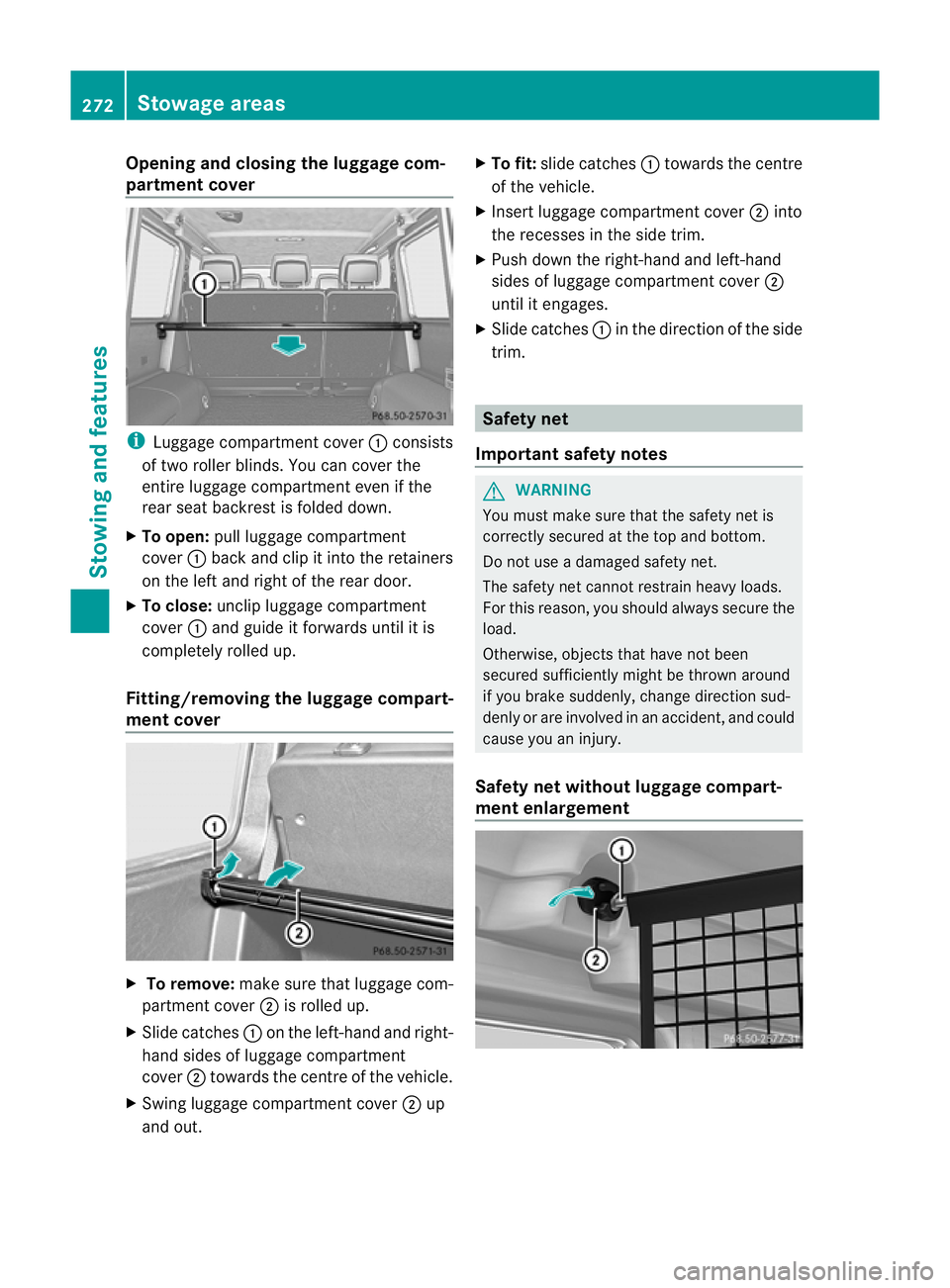
Opening and closing the luggage com-
partment cover
i
Luggage compartment cover :consists
of two roller blinds. You can cover the
entire luggage compartment even if the
rear seat backrest is folded down.
X To open: pull luggage compartment
cover :back and clip it into the retainers
on the left and right of the rear door.
X To close: unclip luggage compartment
cover :and guide it forwards until it is
completely rolled up.
Fitting/removing the luggage compart-
ment cover X
To remove: make sure that luggage com-
partment cover ;is rolled up.
X Slide catches :on the left-hand and right-
hand sides of luggage compartment
cover ;towards the centre of the vehicle.
X Swing luggage compartment cover ;up
and out. X
To fit: slide catches :towards the centre
of the vehicle.
X Insert luggage compartment cover ;into
the recesses in the side trim.
X Push down the right-hand and left-hand
sides of luggage compartment cover ;
until it engages.
X Slide catches :in the direction of the side
trim. Safety net
Important safety notes G
WARNING
You must make sure that the safety net is
correctly secured at the top and bottom.
Do not use a damaged safety net.
The safety net cannot restrain heavy loads.
For this reason, you should always secure the
load.
Otherwise, objects that have not been
secured sufficiently might be thrown around
if you brake suddenly, change direction sud-
denly or are involved in an accident, and could
cause you an injury.
Safety net without luggage compart-
ment enlargement 272
Stowage areasStowing and features
Page 277 of 357
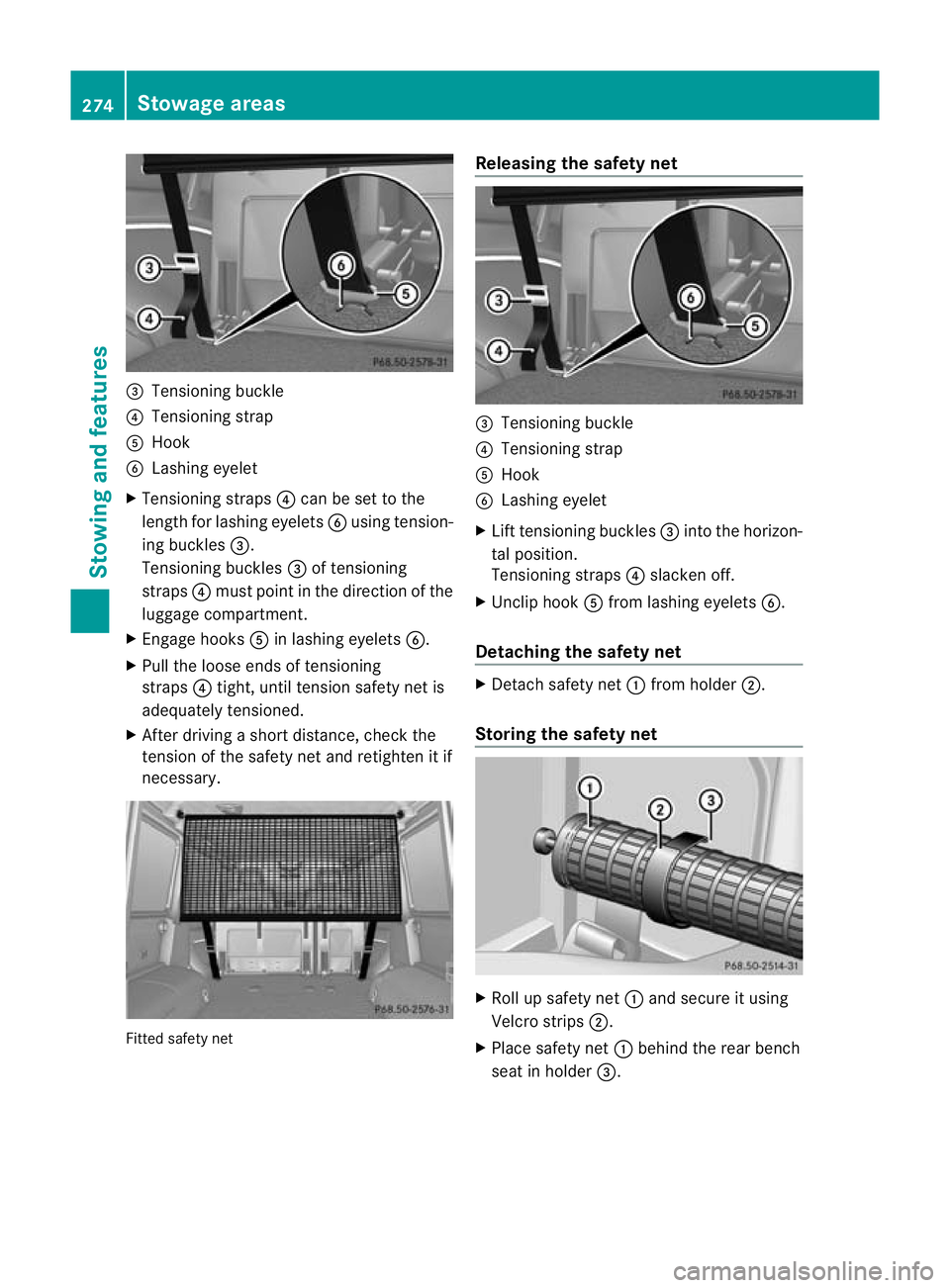
=
Tensioning buckle
? Tensioning strap
A Hook
B Lashing eyelet
X Tensioning straps ?can be set to the
length for lashing eyelets Busing tension-
ing buckles =.
Tensioning buckles =of tensioning
straps ?must point in the direction of the
luggage compartment.
X Engage hooks Ain lashing eyelets B.
X Pull the loose ends of tensioning
straps ?tight, until tension safety net is
adequately tensioned.
X After driving a short distance, check the
tension of the safety net and retighten it if
necessary. Fitted safety net Releasing the safety net
=
Tensioning buckle
? Tensioning strap
A Hook
B Lashing eyelet
X Lift tensioning buckles =into the horizon-
tal position.
Tensioning straps ?slacken off.
X Unclip hook Afrom lashing eyelets B.
Detaching the safety net X
Detach safety net :from holder ;.
Storing the safety net X
Roll up safety net :and secure it using
Velcro strips ;.
X Place safety net :behind the rear bench
seat in holder =.274
Stowage areasStowing and features
Page 278 of 357
Roof carrier
G
WARNING
An incorrectl ysecured roof carrier, ski rack or
load could become detached from the vehi-
cle. These objects may then be thrown around
and can injure you or others or cause an acci-
dent. Follow the roof carrier/ski rack manu-
facturer's installation instructions and special
instructions for use.
The roof load raises the vehicle's centre of
gravity, thereby affecting vehicle handling.
Always observe the maximum roof load (see
the "Technical data" section). Always adapt
your driving style to the prevailing road, traffic
and weather conditions and drive with partic-
ular care if the roof is laden.
! Mercedes-Benz recommends that you
only use roof carriers that have been tested
and approved for Mercedes-Benz vehicles.
This helps to preven tdamage to the vehi-
cle.
Positio nthe load on the roof carrier in such
a way that the vehicle will not sustain dam-
age even when it is in motion.
Make sure that the sliding sunroof can be
fully raised, depending on the vehicle's
equipment.
X Follow the manufacturer’s installation
instructions when fitting the roof carrier. Features
Cup holders
Important safety notes G
WARNING
If you are transporting objects in the stowage
compartments, the stowage compartments
must remain closed while the vehicle is in
motion. Otherwise, vehicle occupants could
be injured by objects being thrown around if
you: R
brake sharply
R change direction suddenly
R are involved in an accident
Only use the cup holders for containers of a
suitable size and which have lids. The drinks
could otherwise spill.
Cup holders should not be used for hot drinks.
You may otherwise scald yourself.
Cup holders in the glove compartment X
To open: fold down the glove compartment
cover.
i Locking/unlocking the glove compart-
ment (Y page 267).
Cup holder on the centre console X
Fold cup holder :all the way up.
Cup holders in the rear compartment !
Make sure that you remove any contain-
ers from the rear-compartment cup holders Features
275Stowing and features Z