key MERCEDES-BENZ G-CLASS SUV 2014 User Guide
[x] Cancel search | Manufacturer: MERCEDES-BENZ, Model Year: 2014, Model line: G-CLASS SUV, Model: MERCEDES-BENZ G-CLASS SUV 2014Pages: 272, PDF Size: 39.13 MB
Page 23 of 272
Introduction
In addition to the printed Operator's Manual,
the vehicle document wallet also contains
further operating instructions, such as:
R Digital Operator's Manual on CD
R Maintenance Booklet
R Equipment-dependent supplements
The printed Operator's Manual gives you a
fast, concise overview of your vehicle's most
important functions.
You can also access the Digital Operator's
Manual via COMAND. If you have further
questions that are not covered in the printed
Operator's Manual, please consult the Digital
Operator's Manual.
i You will not incur any costs when calling
up the Digital Operator's Manual. It works
without connecting to the Internet.
In the following sections you will find further
information about:
R how to install the Digital Operator's Manual
on your COMAND (Y page 21)
R how to access and operate the Digital
Operator's Manual
R the differing access options from the basic
menu
There are three options for accessing via the
basic menu of the Digital Operator's Manual:
R Visual search
R Keyword search
R Contents Installation
Check whether or not the Digital Operator's
Manual has already been installed. To do so,
call up the Digital Operator's Manual via
COMAND as follows: X
Using the COMAND controller, select the
® symbol from the menu bar in the
COMAND display and press Wto confirm.
X Choose the "Operator's Manual" selection
card and confirm with W.
There are two possibilities:
1. The Digital Operator's Manual is
installed. The basic menu for the Digital
Operator's Manual opens.
2. The Digital Operator's Manual is not
installed. The following message appears:
The Operator's Manual has not yet
The Operator's Manual has not yet
been installed. Please insert the been installed. Please insert the
correct disc. correct disc.
If the Digital Operator's Manual has not yet
been installed, you have the option of
installing it yourself. You will find the
installation CD required in the vehicle
document wallet.
The duration of the installation process may
vary.
The installation process takes approximately
five minutes. This timespan only applies if you
install the Digital Operator's Manual while the
vehicle is at a standstill and no other
COMAND functions are in use at the time. The
duration of the installation process may
increase accordingly if other COMAND
functions such as navigation or telephony are
in use at the time.
If you encounter any problems during
installation, please contact your authorized
Mercedes-Benz Center.
X To install the Digital Operator's
Manual: stop the vehicle safely, paying
attention to road and traffic conditions.
X Turn the SmartKey to position 2in the
ignition lock.
X Switch on COMAND.
X Insert the installation CD into the CD/DVD
drive.
X Follow the installation steps on the
COMAND display.
i If the check was not successful, a
message appears, e.g. The Operator's
The Operator's Digital Operator's Manual
21
Page 25 of 272
Keyword search
The keyword search allows you to perform a
keyword search using character entry. A
detailed description of character entry can be
found in the section "COMAND" under the
heading "Phone book - entering characters". :
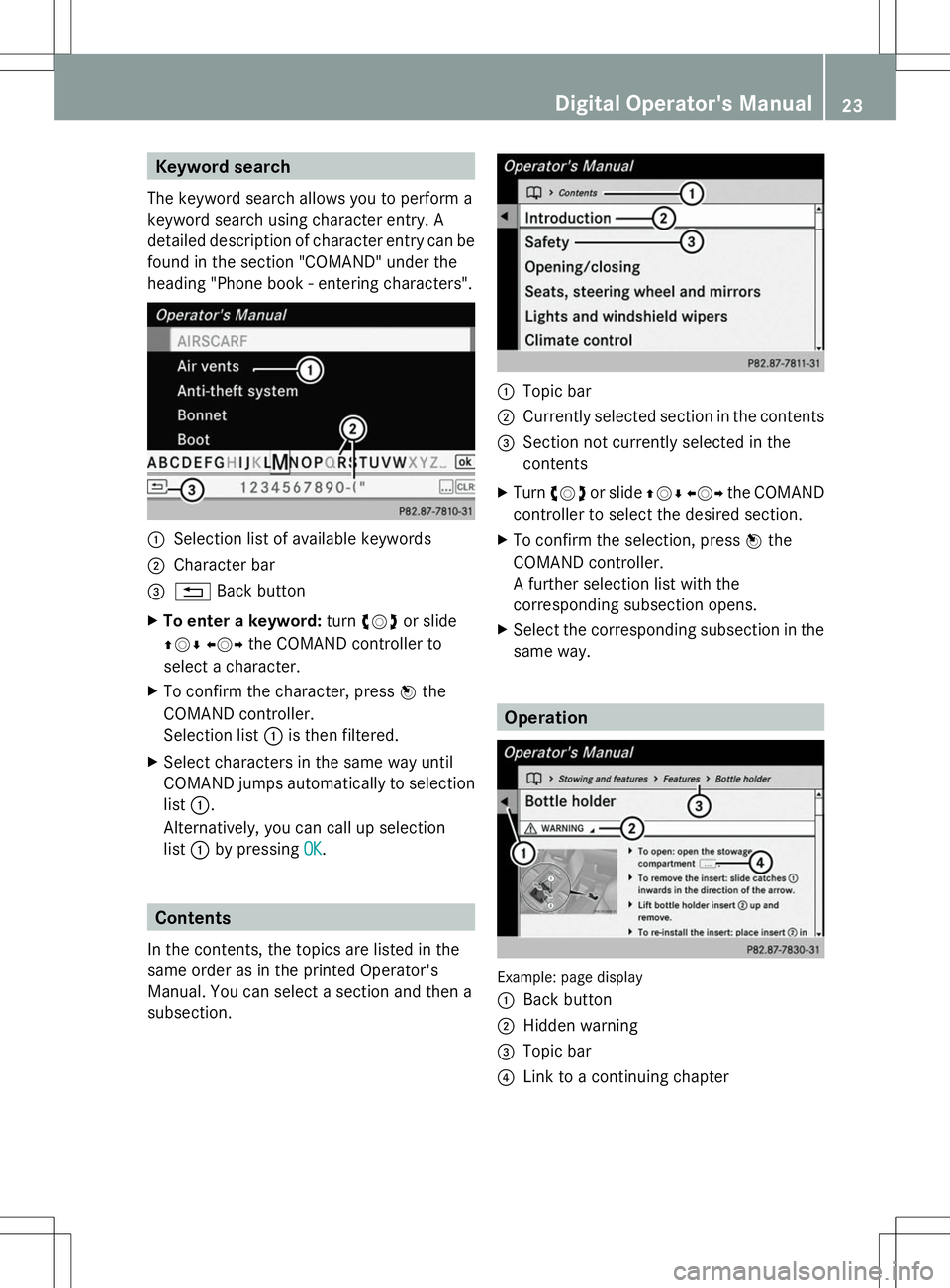
Selection list of available keywords
; Character bar
= % Back button
X To enter a keyword: turncVd or slide
ZVÆ XVYthe COMAND controller to
select a character.
X To confirm the character, press Wthe
COMAND controller.
Selection list :is then filtered.
X Select characters in the same way until
COMAND jumps automatically to selection
list :.
Alternatively, you can call up selection
list :by pressing OK
OK. Contents
In the contents, the topics are listed in the
same order as in the printed Operator's
Manual. You can select a section and then a
subsection. :
Topic bar
; Currently selected section in the contents
= Section not currently selected in the
contents
X Turn cVd or slide ZVÆXVY the COMAND
controller to select the desired section.
X To confirm the selection, press Wthe
COMAND controller.
A further selection list with the
corresponding subsection opens.
X Select the corresponding subsection in the
same way. Operation
Example: page display
:
Back button
; Hidden warning
= Topic bar
? Link to a continuing chapter Digital Operator's Manual
23
Page 45 of 272
bag is disabled. If the front-passenger seat is
recognized as empty, the air bag control unit
will not deploy the front-passenger air bag in
the event of a collision.
Ask your passenger to sit correctly on the
front-passenger seat in an upright position
until the 4/ indicator lamp goes out.
If the 4/ indicator lamp does not go
out, please consult an authorized Mercedes-
Benz Center. Driver's air bag
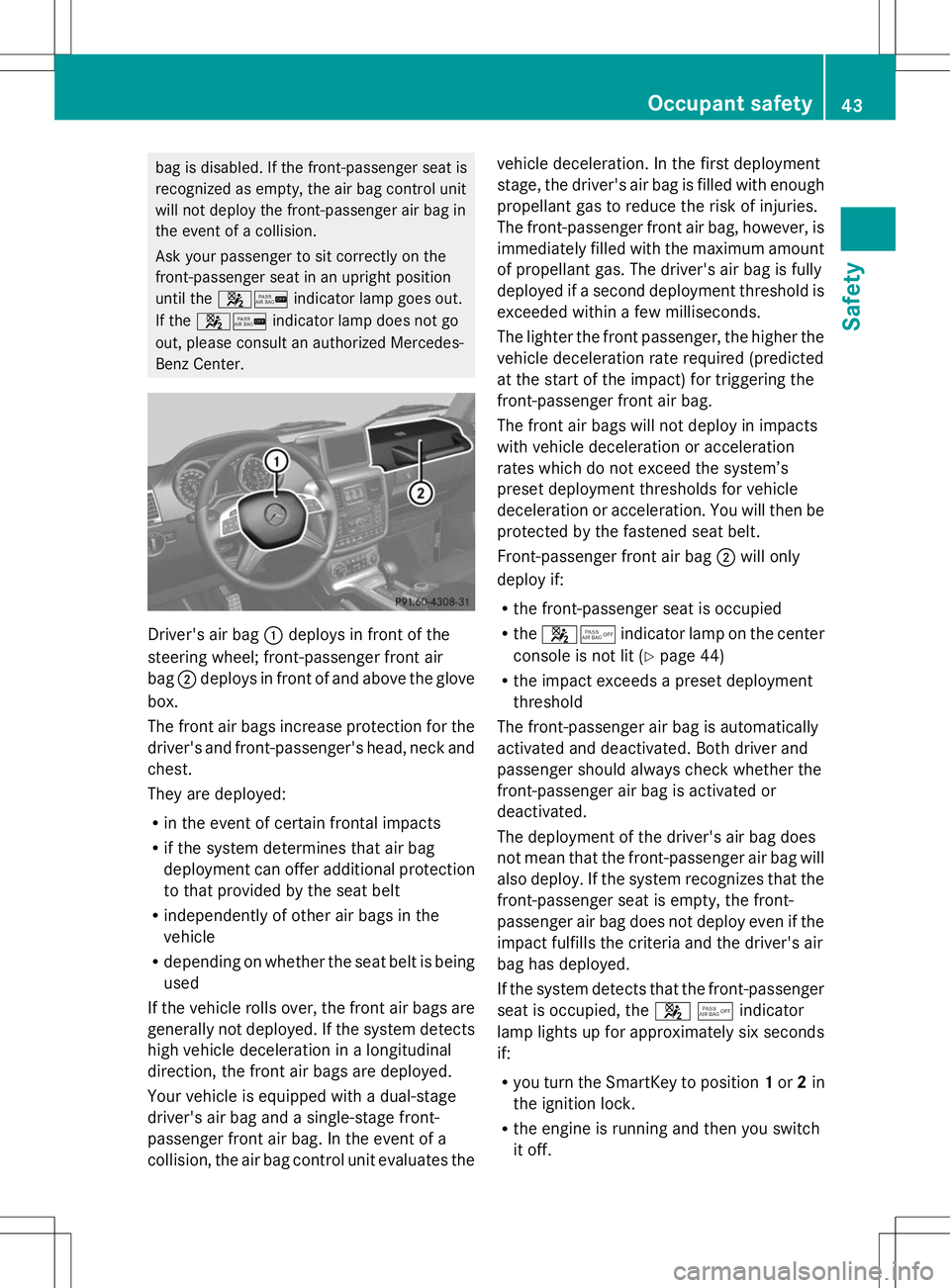
:deploys in front of the
steering wheel; front-passenger front air
bag ;deploys in front of and above the glove
box.
The front air bags increase protection for the
driver's and front-passenger's head, neck and
chest.
They are deployed:
R in the event of certain frontal impacts
R if the system determines that air bag
deployment can offer additional protection
to that provided by the seat belt
R independently of other air bags in the
vehicle
R depending on whether the seat belt is being
used
If the vehicle rolls over, the front air bags are
generally not deployed. If the system detects
high vehicle deceleration in a longitudinal
direction, the front air bags are deployed.
Your vehicle is equipped with a dual-stage
driver's air bag and a single-stage front-
passenger front air bag. In the event of a
collision, the air bag control unit evaluates the vehicle deceleration. In the first deployment
stage, the driver's air bag is filled with enough
propellant gas to reduce the risk of injuries.
The front-passenger front air bag, however, is
immediately filled with the maximum amount
of propellant gas. The driver's air bag is fully
deployed if a second deployment threshold is
exceeded within a few milliseconds.
The lighter the front passenger, the higher the
vehicle deceleration rate required (predicted
at the start of the impact) for triggering the
front-passenger front air bag.
The front air bags will not deploy in impacts
with vehicle deceleration or acceleration
rates which do not exceed the system’s
preset deployment thresholds for vehicle
deceleration or acceleration. You will then be
protected by the fastened seat belt.
Front-passenger front air bag ;will only
deploy if:
R the front-passenger seat is occupied
R the 45 indicator lamp on the center
console is not lit (Y page 44)
R the impact exceeds a preset deployment
threshold
The front-passenger air bag is automatically
activated and deactivated. Both driver and
passenger should always check whether the
front-passenger air bag is activated or
deactivated.
The deployment of the driver's air bag does
not mean that the front-passenger air bag will
also deploy. If the system recognizes that the
front-passenger seat is empty, the front-
passenger air bag does not deploy even if the
impact fulfills the criteria and the driver's air
bag has deployed.
If the system detects that the front-passenger
seat is occupied, the 45indicator
lamp lights up for approximately six seconds
if:
R you turn the SmartKey to position 1or 2in
the ignition lock.
R the engine is running and then you switch
it off. Occupant safety
43Safety Z
Page 48 of 272
Observe the manufacturer's instructions
when installing special child restraint
systems. Your vehicle is equipped with a BabySmart™
system.
Special child restraint systems which are
compatible with BabySmart™ are necessary
for deactivating the front-passenger air bag.
When the special BabySmart™-compatible
child restraint system is installed correctly
and is recognized by the sensor system in the
front-passenger seat, the front-passenger air
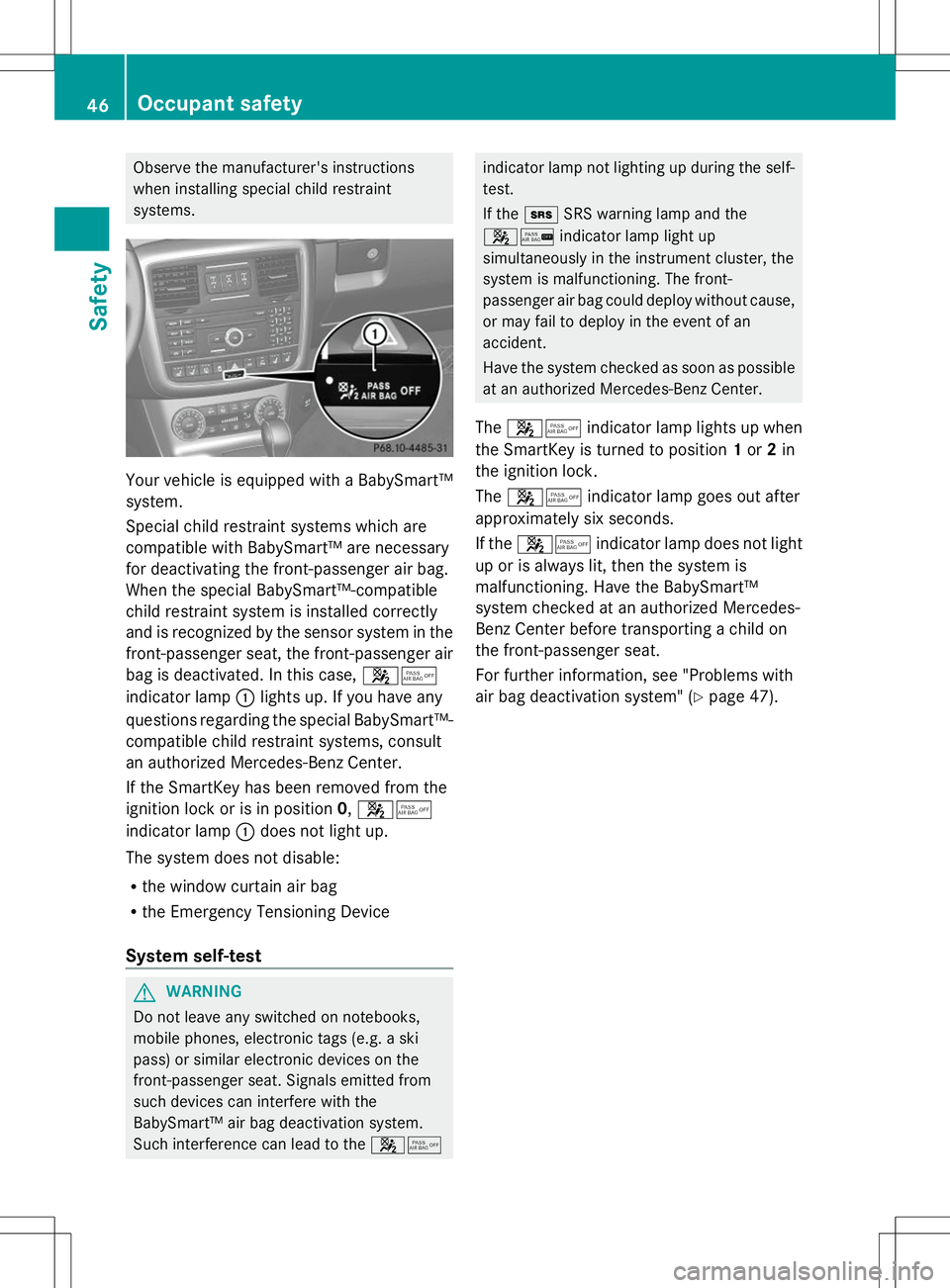
bag is deactivated. In this case, 45
indicator lamp :lights up. If you have any
questions regarding the special BabySmart™-
compatible child restraint systems, consult
an authorized Mercedes-Benz Center.
If the SmartKey has been removed from the
ignition lock or is in position 0,45
indicator lamp :does not light up.
The system does not disable:
R the window curtain air bag
R the Emergency Tensioning Device
System self-test G
WARNING
Do not leave any switched on notebooks,
mobile phones, electronic tags (e.g. a ski
pass) or similar electronic devices on the
front-passenger seat. Signals emitted from
such devices can interfere with the
BabySmart™ air bag deactivation system.
Such interference can lead to the 45 indicator lamp not lighting up during the self-
test.
If the
+ SRS warning lamp and the
4/ indicator lamp light up
simultaneously in the instrument cluster, the
system is malfunctioning. The front-
passenger air bag could deploy without cause,
or may fail to deploy in the event of an
accident.
Have the system checked as soon as possible
at an authorized Mercedes-Benz Center.
The 45 indicator lamp lights up when
the SmartKey is turned to position 1or 2in
the ignition lock.
The 45 indicator lamp goes out after
approximately six seconds.
If the 45 indicator lamp does not light
up or is always lit, then the system is
malfunctioning. Have the BabySmart™
system checked at an authorized Mercedes-
Benz Center before transporting a child on
the front-passenger seat.
For further information, see "Problems with
air bag deactivation system" (Y page 47).46
Occupant safetySafety
Page 51 of 272
center of the shoulder. It should not touch
the neck. Never route the belt under the
shoulder. The height of the belt outlet can
be altered to ensure correct usage.
R The lap belt should be routed as low as
possible across the hips, not across the
abdomen. If the lap belt is routed across the
abdomen, it could cause serious injuries in
the event of an impact.
R Never route the seat belt over rigid or
fragile objects in or on your clothing, such
as eyeglasses, pens, keys etc, as this could
cause injuries.
R Always ensure that the seat belt is routed
correctly. This is particularly important if
you are wearing loose clothing.
R Only one person should use each seat belt
at any one time. Never use a seat belt to
restrain more than one person or route the
belt around additional objects.
R Never wear seat belts when they are
twisted. Otherwise, in the event of an
impact, the full width of the seat belt is
unavailable to distribute the force of the
impact. The twisted seat belt routed across
your body could cause injuries.
R Pregnant women should also wear a three-
point seat belt. The lap belt must always
pass across your lap as low down as
possible, i.e. across your hips; not across
your abdomen.
R The seat backrest should be set as close to
vertical as possible.
R Check the seat belt during the journey in
order to make sure that it is correctly
positioned.
R Never rest your feet on the dashboard or
the seat. Always keep both feet on the floor
in front of the seat.
R When using a seat belt to secure an infant
restraint system, child restraint system or
a child on a booster seat, always follow the
child seat manufacturer's instructions. Fastening seat belts Important safety notes
G
WARNING
According to accident statistics, children are
safer when properly restrained on the rear
seats than on the front-passenger seat. Thus,
we strongly recommend that children be
placed in the rear seat whenever possible.
Regardless of seating position, children 12
years old and under must be seated and
properly secured in an appropriately sized
child restraint system or booster seat
recommended for the size and weight of the
child. For additional information, see the
"Children in the vehicle" section.
A child's risk of serious or fatal injuries is
significantly increased if the child restraints
are not properly secured in the vehicle and/
or the child is not properly secured in the child
restraint. G
WARNING
Children 12 years old and under must never
ride in the front seat, except in a Mercedes-
Benz authorized BabySmart™ compatible
child seat, which operates with the
BabySmart™ system installed in the vehicle
to deactivate the front passenger front air bag
when it is installed properly. Otherwise they
will be struck by the air bag when it inflates in
a crash. If this happens, serious or fatal injury
will result. Occupant safety
49Safety Z
Page 55 of 272
!
If the co-driver's seat is unoccupied, do
not insert the belt tongue into the buckle of
the co-driver's seat. This may otherwise
lead to the triggering of the Emergency
Tensioning Device in the event of an
accident, which will then need to be
replaced.
X In order to ensure that the pyrotechnic
Emergency Tensioning Devices have not
been triggered, always have the seat belts
checked after an accident.
If the Emergency Tensioning Devices have
been triggered, they must be replaced.
The seat belts for the front seats and rear
outer seats are equipped with Emergency
Tensioning Devices and seat belt force
limiters.
The ETDs on the driver's and front-passenger
seat consist of pyrotechnic belt buckle
tensioners and belt anchor installation
tensioners that are triggered together. The
belt buckle tensioner is mounted on the B-
pillar and the belt anchor installation is
mounted on the side of the seat. After
deploying, both tensioners must always be
replaced.
The ETDs tighten the seat belts in an accident,
pulling them close against the body.
The ETDs do not correct incorrect seat
positions or incorrectly fastened seat belts.
The ETDs do not pull vehicle occupants back
towards the backrest.
Seat belt force limiters, when activated, are
employed to help reduce the peak force
exerted by the seat belts on occupants during
a crash.
The front seat belt force limiters are
synchronized with the front air bags, which
take on a part of the deceleration force. Thus,
the force exerted on the occupant is
distributed over a greater area. The ETDs can only be activated when:
R
the SmartKey is in position 1or 2in the
ignition lock.
R the restraint systems are operational; see
"SRS warning lamp" (Y page 40).
R the belt tongue is engaged in the buckle on
each of the lap-shoulder belts in the front
R the front-passenger seat is occupied and
the belt tongue is engaged in the buckle on
the front-passenger side
The Emergency Tensioning Devices are
triggered depending on the type and severity
of an accident, if:
R in the event of a head-on or rear-end
collision, the vehicle decelerates or
accelerates rapidly in a longitudinal
direction during the initial stages of the
impact
R in the event of a side impact, on the side
opposite the impact the vehicle
decelerates or accelerates rapidly in a
lateral direction
R in certain situations where the vehicle rolls
over, the system determines that it can
provide additional protection
If the ETDs are deployed, you will hear a bang,
and a small amount of powder may also be
released. Only in rare cases will the bang
affect your hearing. The powder that is
released generally does not constitute a
health hazard. The 6SRS warning lamp
lights up. Children in the vehicle
Child restraint systems
Important safety notes G
WARNING
According to accident statistics, children are
safer when properly restrained in the rear
seating positions than in the front seating
position. Thus, we strongly recommend that
children be placed in the rear seats whenever Children in the vehicle
53Safety
Z
Page 57 of 272
When the child restraint is not in use, remove
it from the vehicle or secure it with the seat
belt to prevent the child restraint from
becoming a projectile in the event of an
accident. G
WARNING
When leaving the vehicle, always remove the
SmartKey from the ignition lock. Always take
the SmartKey with you and lock the vehicle.
Do not leave children unattended in the
vehicle, even if they are secured in a child
restraint system, or with access to an
unlocked vehicle. A child's unsupervised
access to a vehicle could result in an accident
and/or serious personal injury. The children
could:
R injure themselves on parts of the vehicle
R be seriously or fatally injured through
excessive exposure to extreme heat or cold
R injure themselves or cause an accident with
vehicle equipment that can be operated
even if the SmartKey is removed from the
ignition lock or removed from the vehicle,
such as seat adjustment, steering wheel
adjustment, or the memory function
If children open a door, they could injure other
persons or get out of the vehicle and injure
themselves or be injured by following traffic.
Do not expose the child restraint system to
direct sunlight. The child restraint system's
metal parts, for example, could become very
hot, and the child could be burned on these
parts. G
WARNING
Do not carry heavy or hard objects in the
passenger compartment or trunk unless they
are firmly secured in place.
Unsecured or improperly positioned cargo
increases a child's risk of injury in the event
of
R strong braking maneuvers
R sudden changes of direction
R an accident We recommend that all infants and children
be properly restrained using the infant or
child restraint systems at all times while the
vehicle is in motion.
Always use a child restraint system that is
compatible with BabySmart™ on the front-
passenger seat.
The use of infant or child restraints is required
by law in all 50 states, the District of
Columbia, all U.S. territories and all Canadian
provinces.
Infants and small children must be seated in
an appropriate infant or child restraint system
recommended for the size and weight of the
child. The infant or child restraint system
must be properly secured in accordance with
the manufacturer's instructions. All infant or
child restraint systems must comply with the
U.S. Federal Motor Vehicle Safety Standards
213 and 225 and Canadian Motor Vehicle
Safety Standards 213 and 210.2.
Confirmation that the child restraint system
corresponds to the standards can be found
on an instruction label on the child restraint
system. This confirmation can also be found
in the installation instructions that are
included with the child restraint system.
Always read and follow the manufacturer's
instructions when using an infant or child
restraint system or booster seat.
Observe the warning labels in the vehicle
interior or on the infant or child restraint.
If an infant or child is traveling in the vehicle:
X Secure the child with a child or infant seat
restraint system appropriate to the age and
weight of the child.
X Make sure that the infant or child is
properly secured at all times while the
vehicle is in motion.
Special seat belt retractor G
WARNING
Observe "Important safety notes"
(Y page 53). Children in the vehicle
55Safety Z
Page 60 of 272
Make sure that:
R
Top Tether hook :is hooked into Top
Tether anchorage ;as shown.
R Top Tether belt =is not twisted.
X Make sure that Top Tether belt =is not
twisted.
X Tension Top Tether belt =. Comply with
the manufacturer's installation
instructions when doing so.
X Move head restraint back down again
slightly if necessary (Y page 78). Make
sure that you do not interfere with the
correct routing of Top Tether belt =.Child-proof locks
Important safety notes G
WARNING
When children ride on the vehicle's rear seats,
activate the override switch. Otherwise, the
children could be injured, e.g. by trapping
themselves in the rear side window. G
WARNING
When leaving the vehicle, always remove the
SmartKey from the ignition lock. Always take
the SmartKey with you and lock the vehicle.
Do not leave children unattended in the
vehicle, even if they are secured in a child
restraint system, or with access to an
unlocked vehicle. A child's unsupervised
access to a vehicle could result in an accident
and/or serious personal injury. The children
could:
R injure themselves on parts of the vehicle
R be seriously or fatally injured through
excessive exposure to extreme heat or cold
R injure themselves or cause an accident with
vehicle equipment that can be operated
even if the SmartKey is removed from the
ignition lock or removed from the vehicle,
such as seat adjustment, steering wheel
adjustment, or the memory function If children open a door, they could injure other
persons or get out of the vehicle and injure
themselves or be injured by following traffic.
Do not expose the child restraint system to
direct sunlight. The child restraint system's
metal parts, for example, could become very
hot, and the child could be burned on these
parts.
Child-proof locks for the rear doors G
WARNING
Children could open a rear door from inside
the vehicle. This could result in serious
injuries or an accident. Therefore, when
children ride in the rear always secure the rear
doors with the child-proof locks.
You secure each door individually with the
child-proof locks on the rear doors. A door
secured with a child-proof lock cannot be
opened from inside the vehicle. When the
vehicle is unlocked, the door can be opened
from the outside. X
To activate: press the child-proof lock
lever down in the direction of arrow ;.
X Make sure that the child-proof locks are
working properly.
X To deactivate: press the child-proof lock
lever up in the direction of arrow :.58
Children in the vehicleSafety
Page 65 of 272
R
ESP ®
still provides support when you
brake.
R and are driving above 37 mph (60 km/h)
(on AMG vehicles above 62 mph
(100 km/h)), ESP ®
still intervenes when
one wheel reaches its grip limit even
though it is switched off.
i If ESP ®
is deactivated and one or more
wheels start to spin, the ÷warning lamp
in the instrument cluster flashes. In such
situations, ESP ®
will not stabilize the
vehicle.
i If you have switched off ESP ®
, it switches
on again automatically at speeds above
37 mph (60 km/h) (on AMG vehicles above
62 mph (100 km/h)) or if you have
exceeded a certain lateral acceleration.
Trailer stabilization G
WARNING
If road and weather conditions are poor,
trailer stabilization will not be able to prevent
the vehicle/trailer combination from
swerving. Trailers with a high center of gravity
can tip over before ESP ®
can detect this.
There is a risk of an accident.
Always adapt your driving style to the
prevailing road and weather conditions.
Trailer stabilization does not work if ESP ®
is
deactivated because of a malfunction.
If your vehicle with trailer (vehicle/trailer
combination) begins to lurch, you can only
stabilize the vehicle/trailer combination by
depressing the brake firmly.
In this situation, ESP ®
assists you and can
detect if the vehicle/trailer combination
begins to lurch. ESP ®
slows the vehicle down
by braking and limiting the engine output until
the vehicle/trailer combination has
stabilized.
Trailer stabilization is active above speeds of
about 37 mph (60 km/h). EBD (electronic brake force
distribution)
i Observe the "Important safety notes"
section ( Ypage 59). G
WARNING
If EBD has malfunctioned, the rear wheels can
still lock, e.g. under full braking. This
increases the risk of skidding and an accident.
You should therefore adapt your driving style
to the different handling characteristics. Have
the brake system checked at a qualified
specialist workshop.
Observe information regarding indicator and
warning lamps (Y page 160) as well as
display messages (Y page 144).
EBD monitors and controls the brake
pressure on the rear wheels to improve
driving stability while braking. ADAPTIVE BRAKE
ADAPTIVE BRAKE provides increased braking
safety. In addition to the braking function,
ADAPTIVE BRAKE also has the HOLD function
(Y page 123) and hill start assist
(Y page 99). Theft deterrent locking system
Immobilizer
X To activate: remove the SmartKey from
the ignition lock.
X To deactivate: switch on the ignition.
The immobilizer prevents your vehicle from
being started without the correct SmartKey.
When leaving the vehicle, always take the
SmartKey with you and lock the vehicle. The
engine can be started by anyone with a valid
SmartKey that is left inside the vehicle.
i The immobilizer is always deactivated
when you start the engine. Theft deterrent locking system
63Safety Z
Page 66 of 272
In the event that the engine cannot be
started when the starter battery is fully
charged, the immobilizer may be faulty.
Contact an authorized Mercedes-Benz
Center or call 1-800-FOR-MERCedes (in the
USA) or 1-800-387-0100 (in Canada). ATA (anti-theft alarm system)
X
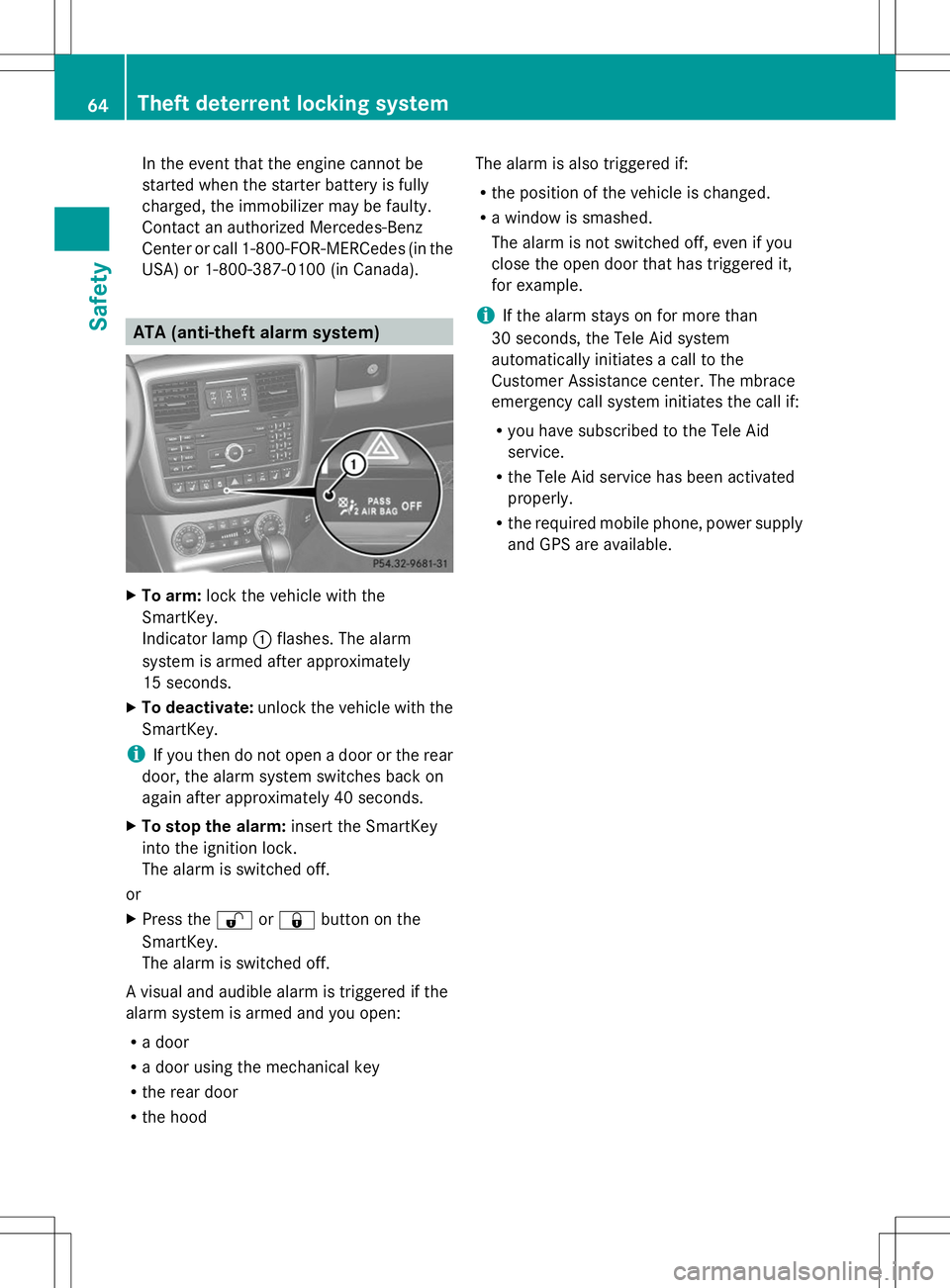
To arm: lock the vehicle with the
SmartKey.
Indicator lamp :flashes. The alarm
system is armed after approximately
15 seconds.
X To deactivate: unlock the vehicle with the
SmartKey.
i If you then do not open a door or the rear
door, the alarm system switches back on
again after approximately 40 seconds.
X To stop the alarm: insert the SmartKey
into the ignition lock.
The alarm is switched off.
or
X Press the %or& button on the
SmartKey.
The alarm is switched off.
A visual and audible alarm is triggered if the
alarm system is armed and you open:
R a door
R a door using the mechanical key
R the rear door
R the hood The alarm is also triggered if:
R
the position of the vehicle is changed.
R a window is smashed.
The alarm is not switched off, even if you
close the open door that has triggered it,
for example.
i If the alarm stays on for more than
30 seconds, the Tele Aid system
automatically initiates a call to the
Customer Assistance center. The mbrace
emergency call system initiates the call if:
R you have subscribed to the Tele Aid
service.
R the Tele Aid service has been activated
properly.
R the required mobile phone, power supply
and GPS are available. 64
Theft deterrent locking systemSafety