engine MERCEDES-BENZ G-CLASS SUV 2016 Owners Manual
[x] Cancel search | Manufacturer: MERCEDES-BENZ, Model Year: 2016, Model line: G-CLASS SUV, Model: MERCEDES-BENZ G-CLASS SUV 2016Pages: 261, PDF Size: 6.01 MB
Page 231 of 261
reduced. The starting characteristics may be impaired, especially at low temperatures. Have the
thawe dbattery checked at aqualified specialist workshop.
Do not use arapidc harging device to start the vehicle. If yourv ehicle's battery is discharged, the
engine can be jump-started from another vehicl eorfromasecond battery using jump leads.
Observe the following points:
R The battery is not accessible in all vehicles. If the other vehicle's battery is not accessible, jump-
start the vehicl eusing adonor battery or ajump-starting device.
R Do not start the engine if the battery is frozen. Let the battery thaw first.
R Jump-starting may be performe donly using batterie swithanominal voltag eof12V.
R Use only jump leads that have asufficient cross-section and insulated terminal clamps.
R If the battery is full ydischarged, leave the battery that is being used to jump-start connected for
af ew minutes before attempting to start. This charge sthe empty battery alittle.
R Make sure that the two vehicles do not touch.
Make sure that:
R The jump leads are not damaged.
R Non-insulated parts of the terminal clamp sdonot come into contact with other metal parts while
the jump leads are connected to the battery.
R The jump leads cannot come into contact with parts that can move when the engine is running,
such as the V-belt pulley or the fan.
X Apply the parking brake.
X Shift the automatic transmission to position P.
X Make sure that the ignitio nisswitched off. All indicator lamp sonthe instrument cluster must be
off.
X Switch off all electrica lconsumers, e.g. rear windo wheating, lighting etc.
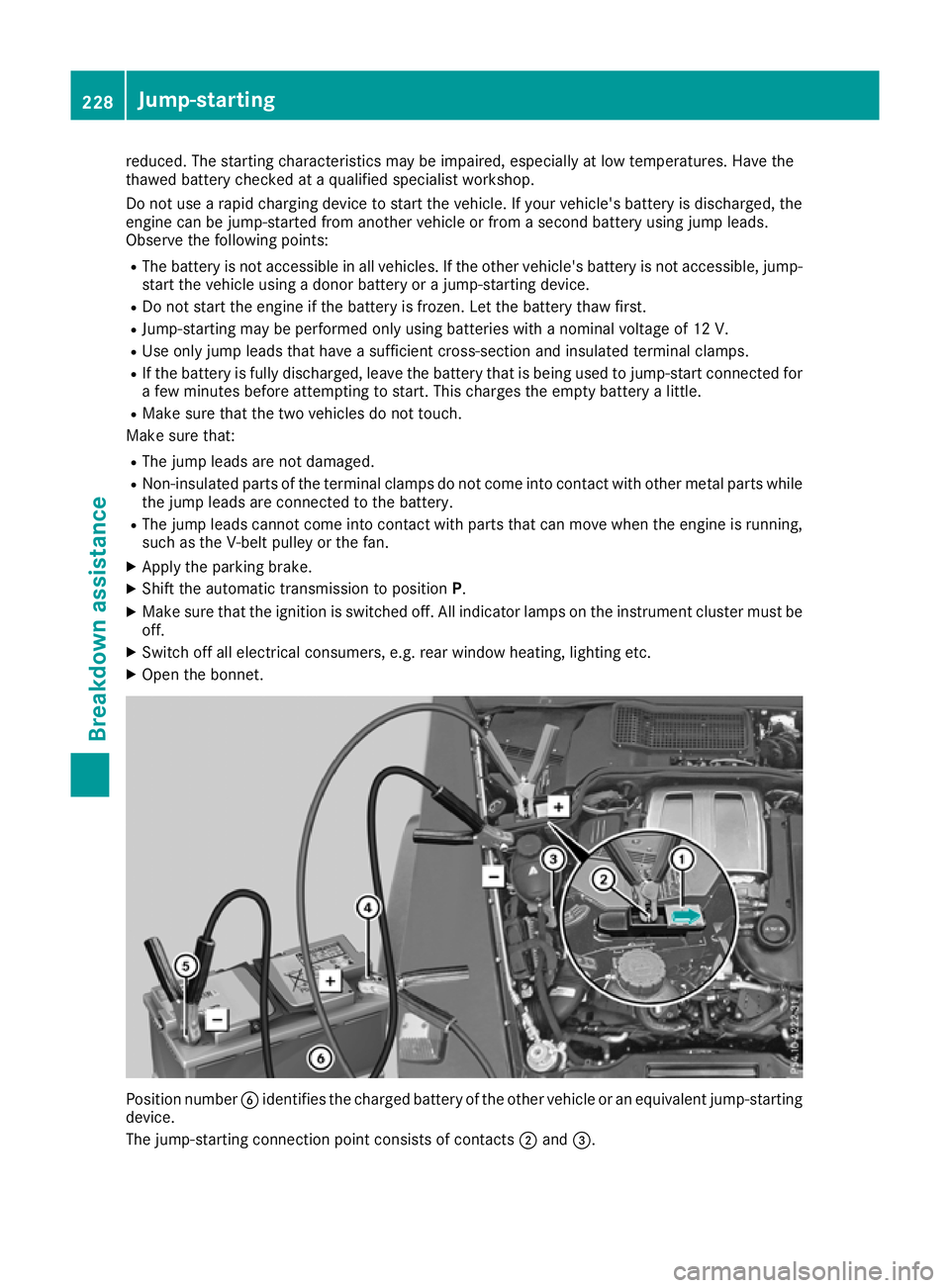
X Open the bonnet. Position number
Bidentifies the charged battery of the other vehicle or an equivalent jump-starting
device.
The jump-startin gconnection point consists of contacts ;and =. 228
Jump-startingBreakdowna
ssistan ce
Page 232 of 261
X
Lift up cover :of positive terminal ;in the direction of the arrow.
X Connect positive terminal ;on yourv ehicle to positive terminal ?of donor battery Busing the
jump lead, Alwaysb eginw ith positive terminal ;on youro wn vehicle first.
X Start the engine of the donor vehicle and run it at idling speed.
X Connect negative terminal Aof donor battery Bto earth point =of yourv ehicle using the jump
lead, connecting the jump leadtod onor batteryBfirst.
X Start the engine.
X Before disconnecting the jump leads, let the engines run for several minutes.
X First, remove the jump leads from earth point =and negative terminal A,then from positive
terminal ;and positive terminal ?.Each time, beginatt he contacts on youro wn vehicle.
X Close cover :of positive terminal ;after removing the jump leads.
X Have the battery checked at aqualifieds pecialist workshop.
Jump-starting is not considered to be anormal operating condition.
i Jump-starting cablesa
nd further information regarding jump-starting can be obtained at any
qualifieds pecialist workshop. Towinga
wayand tow-starting Importan
tsafety notes G
WARNING
Safety-relevant function sare restricted or not
available if:
R the engine is not running.
R the brake system or the power steering is
malfunctioning
R the voltag esupply or the vehicle's electrical
system is malfunctioning.
If yourv ehicleist owed,s ignificantly greater
force may be required to steer the vehicl eor
to brake. There is arisk of an accident.
In such circumstances, use atowing bar.
Make sure that the steering is moving freely
before towing. G
WARNING
If the steering whee llock is engaged, the vehi-
cle can no longer be steered .There is arisk of
an accident.
Always switch on the ignitio nwhen towing
with atow rope or atowing bar. G
WARNING
When towing or tow-starting another vehicle
and its weight is greater than the permissible gross weight of yourv ehicle, the:
R towing eye may be torn off
R car/trailer combination may swerve or
even overturn
There is arisk of an accident.
When towing or tow-starting another vehicle,
its weight should not be greater than the per- missible gross weight of yourv ehicle.
Detail sonthe permissible gross vehicl eweight
of yourv ehiclecan be found on the vehicl eiden-
tification plate (Y page249).
! You may tow the vehicl
efor am aximu mof
50km. Atowing spee dof50km/h must not
be exceeded.
For towing distances over 50 km, the entire
vehicl emust be lifted up and transported.
! Only secure the tow cabl
eortowing bar to
the towing eyes. You coul dotherwise damage
the vehicle.
! Observe the following points when towing
with atow rope:
R Secure the tow rope on the same side on
both vehicles.
R Make sure that the tow rope is not longer
than legally permitted. Mark the tow rope in the middle, e.g. with awhite cloth Towin
gawayand tow-starting
229Breakdown assis tance Z
Page 235 of 261

In th
eevent of damage to th eengine,
transmission or electrical system X
Shift th etransfer cas etoneutral position
Neutral (Ypage 125).
X Shif tthe automatic transmissio ntoposition
N.
In the even tofdamage to the transfer
case Have the propeller shafts between the axles and
the transfe rcase removed.
In the event of damage to the front axle Have the propeller shaft between the rea
raxle
and the transfe rcase removed.
The nhavet he vehicle towe dawayw itht he front
axl eraised.
In the event of damage to the rear axle Have the propeller shaft between the front axle
and the transfe rcase removed.
The nhavet he vehicle towe dwitht he rea raxle
raised and wheel rollers unde rthe front axle. Tow-start
ing( em ergency engine
starting)
! Do not tow-start vehicles with automatic
transmission. Yo ucould otherwis edamage
the automatic transmission.
Yo uc an find informatio non"Jump-starting"
under (Y page 227). Fuses
Importan
tsafety notes G
WARNING
If yo umanipulate, bridge or replace afaulty
fuse with afuse of ahigher amperage ,the
electric cables coul dbeoverloaded. This may
result in afire. There is arisk of an accident
and injury.
Always replace faulty fuses with specified new fuses of the correct amperage. The fuses in your vehicle disconnect fault
ycir-
cuits. If afuse blows, all the components in the
circuit and their functions will fail.
Blown fuses must be replaced with fuses of the same rating, which you can recognise by the
colour and fuse rating. The fuse ratings are listed
in the fuse allocation chart (Y page 233).
If the newly inserted fuse also blows, have the
cause traced and rectified at aqualified special-
ist workshop, e.g. aMercedes-Benz Service
Centre.
! Only use fuses that have been approved for
Mercedes-Benz vehicles and which have the
correc tfuse rating for the system concerned.
Otherwise, components or systems could be
damaged.
! Make sure that no moisture can enter the
fuse box when the cover is open.
! When closing the cover, make sure that it is
lying correctly on the fuse box. Moisture seep-
ing in or dirt could otherwise impair the oper-
ation of the fuses. Bef
orer eplacing afuse
Observ ethe important safety notes
(Y page 232).
X Switch off the engine.
X Switch off al lelectrical consumers.
X Remove the key from the ignition lock.
All indicator lamps on the instrument cluster
must be off.
X Secure the vehicl eagain st rolling away
(Y page 113).
The fuses are locate dinvarious fus eboxes:
R Main fus eboxon the front-passenger side of
the dashboard
R Fus eboxin the front-passenger footwell
R Fus eboxin the transmission tunnel
R Fus eboxin the luggage compartment
The fus ealloc ation chart and the spare fuses are
in the fus eboxon the dashboard on the front-
passenger side (Y page 233).
The fus eextractor is in the vehicl etool kit
(Y page 223). 232
FusesBreakdo
wn assis tance
Page 247 of 261
X
Stop the vehicl eonsolid,non-slipper yand
level ground.
X Appl ythe parking brake.
X Move the front wheel stothe straight-ahead
position.
X Shif tthe automatic transmissio ntoposition
P.
X Switch off the engine.
X Ifat raile risc oupled to the vehicle, uncouple
it.
X Remove the vehicl etool sand jack from the
vehicl e(Ypage 223).
X Remove the spare wheel from the spare wheel
bracket (Y page 223).
X Secure the vehicl eagains trolling away.
Securing the vehicle against rolling
away X
Place chocks or other suitable items under
the front and rea rofthe wheel that is diago-
nally opposite the wheel you wish to change.
Raising the vehicle G
WARNING
If you do not position the jack correctl yatthe
appropriate jacking point of the vehicle, the
jack coul dtip over with the vehicl eraised.
There is arisk of injury.
Only position the jack at the appropriate jack-
ing point of the vehicle. The base of the jack
must be positioned vertically,d irectly under
the jacking point of the vehicle.
! Only position the jack at the appropriate
jacking point of the vehicle. Otherwise, you
coul ddamage the vehicle.
Observe the following whenr aisingthe vehi-
cle:
R Use only the vehicle-specific jack that has
been tested and approved by Mercedes-Benz
to rais ethe vehicle. If the jack is used incor-
rectly, it coul dtip over while the vehicl eis
raised.
R The jack is designed only to rais ethe vehicle
for ashort time while awhee lisb eing
changed .Itisnot permissible to use it to per-
form maintenance work under the vehicle. R
Avoid changing the whee lonuphilland down-
hill slopes.
R Before raising the vehicle, secur eitagainst
rolling away by applying the parking brake and
positioning whee lchocks. Do not release the
parking brake whil ethe vehicl eisraised.
R The jack must be place donafirm, flatand
non-slip surface. On aloo se surface, alarge,
fla tload-beari ng underlay must be used .Ona
slippery surface, anon-slip underlay must be
used ,e.g.u se arubber matont iles.
R Do not us ewoode nblocks or similar objects
as ajack underlay .Otherwise, the jack will not
be able to achieve its load-bearing capacity
du etot he restricte dheight.
R Ensure tha tthe distance between the under-
side of the tyr eand the ground does not
exceed 3cm.
R Do not place your hands or fee tunder the
raised vehicle.
R Do not li eunder the raised vehicle.
R Do not start the engine when the vehicl eis
raised.
R Do not open or close adoorw hent he vehicle
is raised.
R Ensure tha tnopersons ar epresent in the
vehicl ewhenr aisin gthe vehicle. X
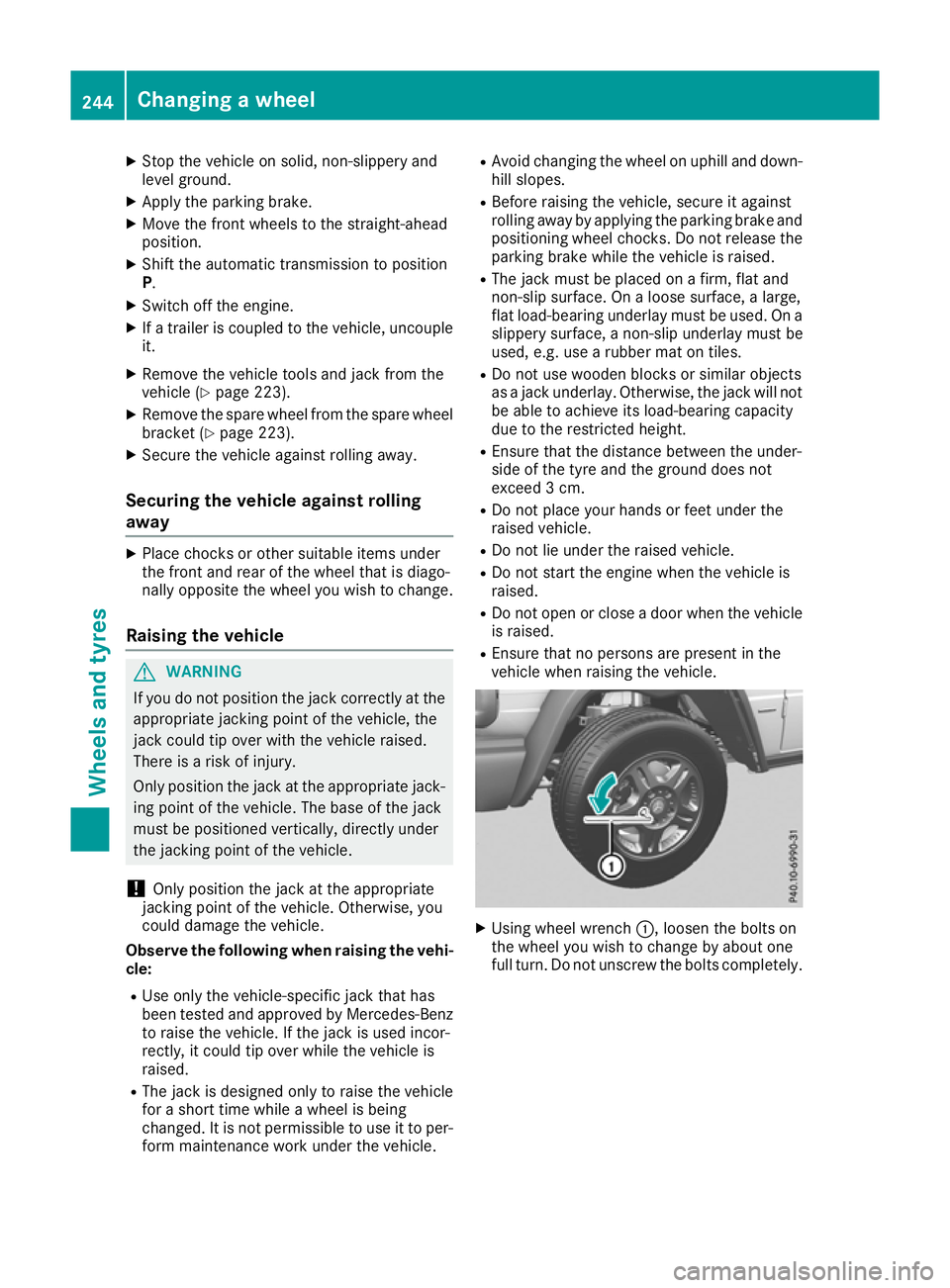
Using wheel wrench :,loosen the bolts on
the wheel you wish to change by abouto ne
full turn. Do not unscrew the bolts completely. 244
Changing
awheelWheels and tyres
Page 251 of 261
Information on technica
ldata
i The technical dat
awere determine din
accordanc ewithEUD irectives .All dat aapply
to th evehicle's standard equipment. The data
may therefor ediffer for vehicles wit hoptional
equipment. You can obtain further informa-
tion from aMercedes-Ben zServic eCentre. Vehicle electronics
Tampering with th
eengin eelect ron-
ics
! Onl
yhavew orkc arrie douton the engine
electronics and its associated parts, such as
contro lunits, sensors, actuating components
and connector leads, at aquali fied specialist
workshop .Vehicl ecomponents ma yother-
wise wear mor equickl yand the vehicle's
operating permi tmaybe invalidated. Fittin
gtwo-way radios and mobile
phones (RF transmitters) G
WARNING
If RF transmitters ar etampere dwith or not
properly retrofitted, the electromagnetic radi- ation they emit can interfere with the vehicle
electronics. This may jeopardise the opera-
tional safety of the vehicle. There is arisk of an
accident.
You should have all work on electrica land
electronic components carrie dout at aquali-
fied specialist workshop. G
WARNING
If you operate RF transmitters incorrectly in
the vehicle, the electromagnetic radiation
coul dinterfere with the vehicl eelectronics,
e.g.:
R if the RF transmitter is not connected to an
exterior aerial
R the exterior aerial has been fitted incor-
rectly or is not alow-reflection type
This coul djeopardise the operating safety of
the vehicle. There is arisk of an accident. Have the low-reflection exterior aeria
lfitted at
aq ualifie dspecialist workshop .Wheno per-
ating RF transmitters in the vehicle, always
connect them to the low-reflection exterior
aerial.
! The operating permit may be invalidated if
the instructions for installatio nand use of RF
transmitters are not observed.
In particular, the following conditions mus tbe
complied with:
R only approve dwavebands may be used.
R observe the maximum permissibl eoutput
in these wavebands.
R only approve daerialp ositions may be
used.
Excessive levels of electromagnetic radiation
may cause damag etoyourh ealth and to the
health of others .The use of an exterior aerial
takes into consideration the scientific discus-
sio ns urrounding the possible health risk posed
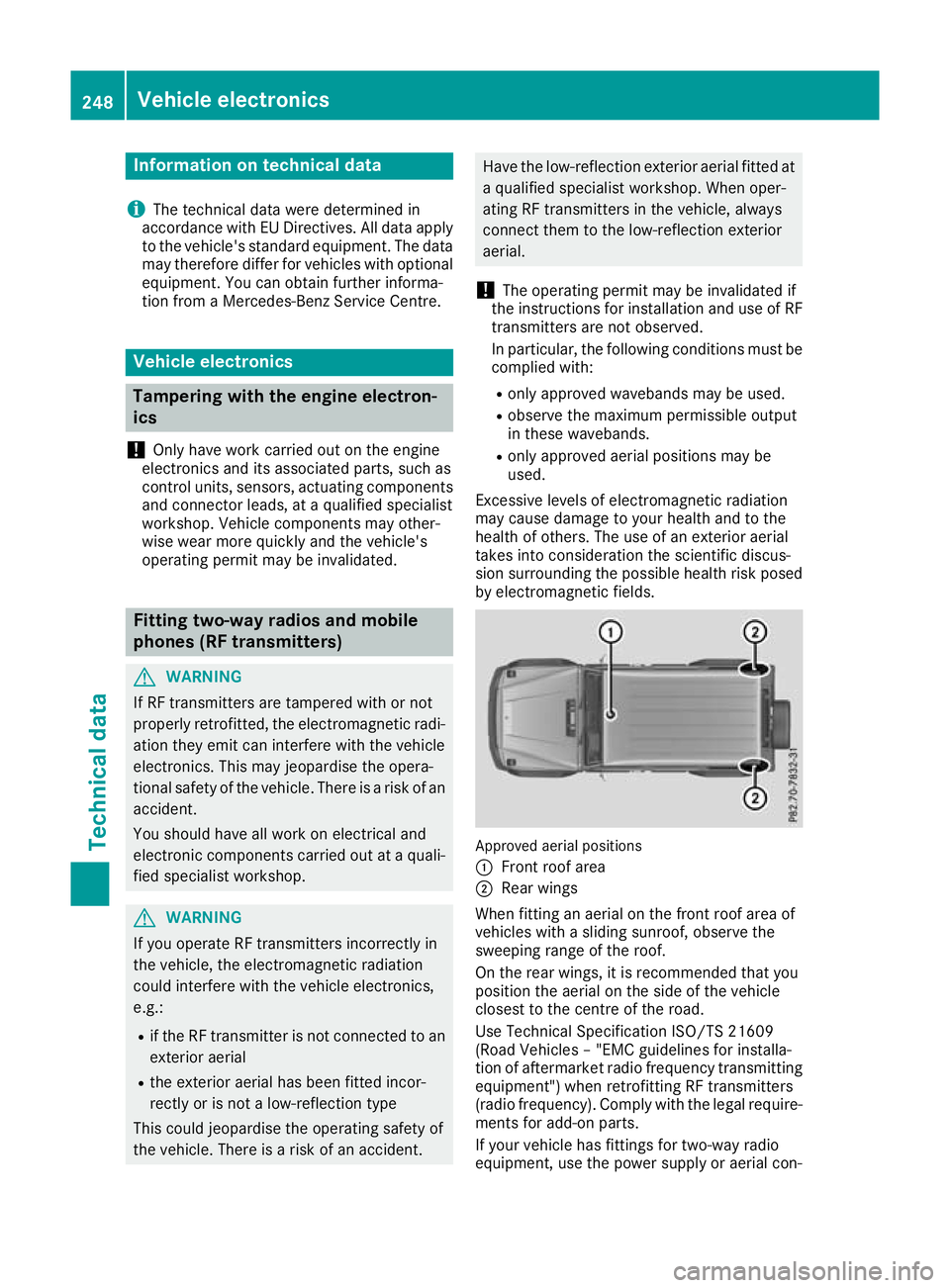
by electromagnetic fields. Approve
daerialp ositions
: Front roo farea
; Rear wings
Whe nfitting an aeria lonthe front roo fareaof
vehicles with aslidin gsunroof, observe the
sweeping rang eofthe roof.
On the rea rwings, it is recommended tha tyou
position the aeria lonthe side of the vehicle
closes ttothe centre of the road.
Use Technical Specification ISO/T S21609
(Roa dVehicles –"EM Cg uideli nesfor installa-
tio nofa ftermarket radio frequency transmitting
equipment") when retrofitting RF transmitters
(radi ofrequency) .Com plyw itht he lega lrequire-
ments for add-on parts.
If your vehicl ehasfittings for two-wa yradio
equipment, us ethe power supply or aeria lcon- 248
Vehiclee
lectronicsTechnical data
Page 253 of 261
Vehicl
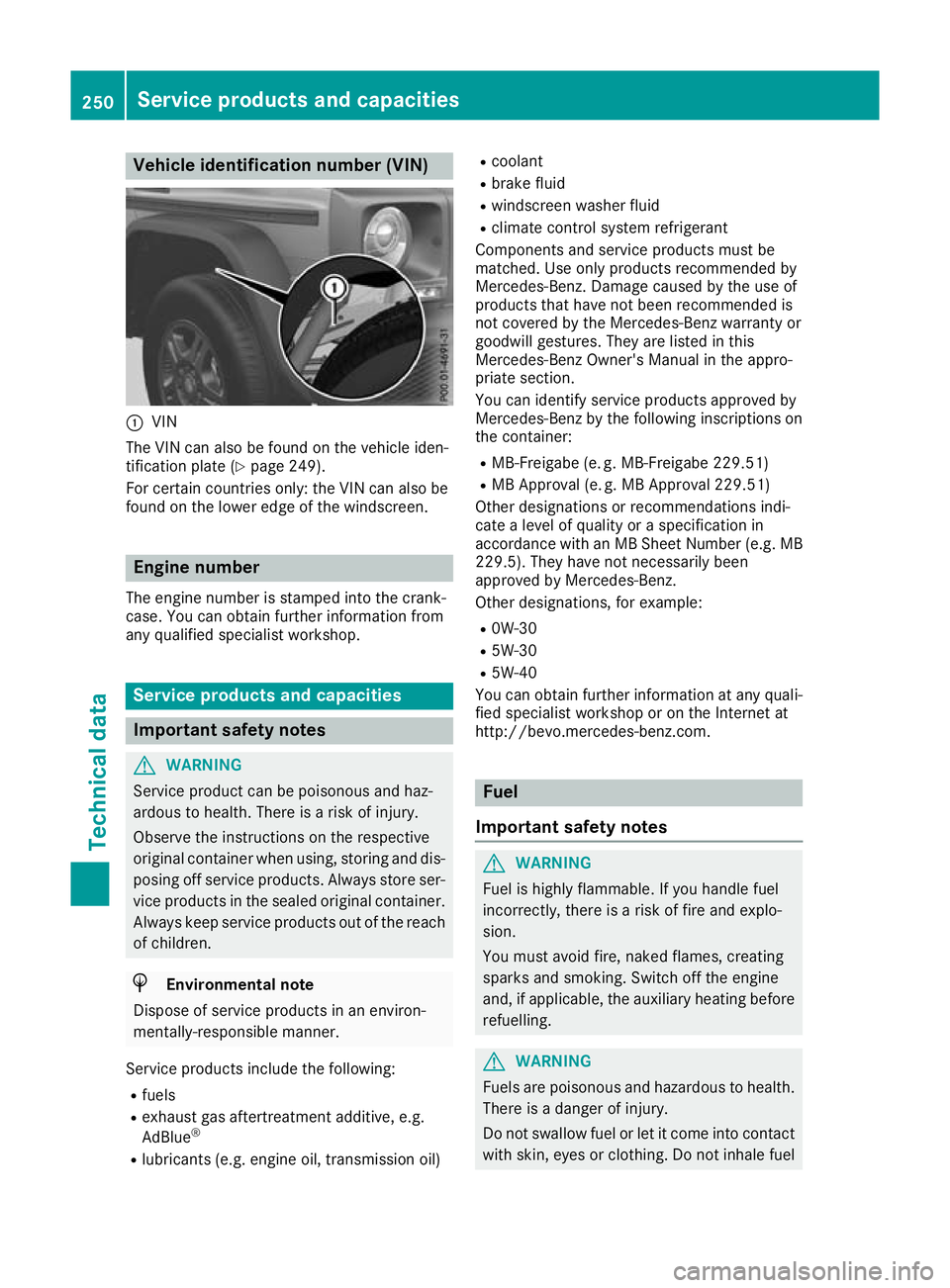
eidentificatio nnumber (VIN) :
VIN
The VIN can alsobef ound on the vehicle iden-
tification plate (Y page 249).
For certain countries only: the VIN can also be
found on the lower edge of the windscreen. Engine number
The engine number is stampe dintot he crank-
case. You can obtain further informatio nfrom
any qualified specialist workshop. Service products and capacities
Important safety notes
G
WARNING
Servic eproduct can be poisonous and haz-
ardous to health. There is arisk of injury.
Observe the instructions on the respective
original container when using, storing and dis- posing off service products. Always store ser-
vice products in the sealed original container. Always keep service products out of the reach
of children. H
Environmental note
Dispose of service products in an environ-
mentally -responsible manner.
Servic eproduct sinclude th efollowing:
R fuels
R exhaust gas aftertreatmen tadditive, e.g.
AdBlue ®
R lubricant s(e.g .engine oil, transmission oil) R
coolant
R brake fluid
R windscreen washer fluid
R climat econtrol system refrigerant
Components and service products mus tbe
matched. Use only products recommended by
Mercedes-Benz. Damage caused by the us eof
products that have not bee nrecommended is
not covered by the Mercedes-Benz warranty or
goodwil lgestures. The yare listed in this
Mercedes-Benz Owner's Manua linthe appro-
priate section.
You can identify service products approved by
Mercedes-Benz by the following inscriptions on
the container:
R MB-Freigabe (e. g. MB-Freigabe 229.51)
R MB Approva l(e. g. MB Approva l229.51)
Other designations or recommendations indi-
cate alevel of quality or aspecification in
accordance with an MB Shee tNumber (e.g .MB
229.5). The yhaven ot necessaril ybeen
approved by Mercedes-Benz.
Other designations ,for example:
R 0W-30
R 5W-30
R 5W-40
You can obtain further information at any quali-
fie ds pecialist worksho poronthe Internet at
http://bevo.mercedes-benz.com. Fuel
Important safety notes G
WARNING
Fuel is highly flammable .Ifyou handl efuel
incorrectly ,there is arisk of fire and explo-
sion.
You must avoi dfire, naked flames, creating
sparks and smoking. Switch off the engine
and, if applicable,t he auxiliary heating before
refuelling. G
WARNING
Fuel sare poisonous and hazardous to health.
There is adange rofinjury.
Do not swallowf uel or let it come into contact
with skin, eyesorc lothing. Do not inhal efuel 250
Service products and capacitiesTechnical data
Page 254 of 261
vapours. Keep fuel
sout of the reach of chil-
dren.
If you or others come into contact with fuel,
observe the following:
R Wash the fuel off any affected area sofskin
with water and soap immediately.
R If you get fuel in youre yes, rinse them thor-
oughly with clea nwater immediately. Seek
immediate medical attention.
R If fuel is swallowed,s eek immediate medi-
cal attention. Do not induce vomiting.
R Change any clothing that has come into
contact with fuel immediately.
Tank capacity Model Total capa-
city G3
50dPROFESSIONAL Approx.
96.0 l Model Of which
reserve fuel G3
50dPROFESSIONAL Approx.
14.0 l Diesel
Fuel grade
G
WARNING
If you mix diesel fuel with petrol, the flash
point of this fuel mixture is lower than that of pure diesel fuel.W hen the engine is running,
components in the exhaust system may over-
heatu nnoticed. There is arisk of fire.
Never refue lwith petrol. Never add petrol to
diesel fuel.
! When refuelling, only use diesel fuel that
conforms to the European standard EN 590 or is of equivalent quality .Fuel that does not
conform to EN 590 can leadtoi ncreased wear
as wellasd amage to the engine and exhaust
system. !
Do not use the following:
R marine diesel
R heating oil
R bio-diesel
R vegetable oil
R petrol
R paraffin
R kerosene
Do not mix such fuels with diesel fuel and do
not use any special additives. Otherwise,
engine damage may occur.
! Vehiclesw
ith diesel particle filters: in
countries outside the EU, only use low sulphur
Euro diesel with asulphurc ontent of under
50 ppm. Otherwise, the emission control sys- tem could be damaged.
You will usually find information aboutt he fuel
quality on the pump. If you cannot find the label
on the petrol pump, ask the filling station staff.
Information on refuelling (Y page 109).
Low outside temperatures In winter months, diesel fuel with an improved
cold flow quality is available. In Europe, the
EN 590 standard defines various climate-
dependent temperature categories. Malfunc-
tions can be avoided by refuelling with diesel
fuel that corresponds to the climatic specifica-
tions outlined in EN 590. At unusually low out-
side temperatures, it is possible that the flow
characteristics of the diesel fuel could be insuf- ficient. Accordingly, diesel fuel from warmer
areas may not be suitablef or operation in colder
climatic conditions.
i Further information on country-specific fuel
properties and fuel types with low-tempera-
ture resistance can be obtained from oil com- panies, e.g. at filling stations. AdBlue
®
Important safety notes Comply with the important safety notes for ser-
vice produc tswhen handlin gAdBlue ®
(Y page 250). Service products and capacities
251Technical data Z
Page 255 of 261
AdBlue
®
is aw ater-soluble fluid for the exhaust
ga sa ftertreatment of diese lengines. It is:
R non-toxic
R colourless and odourless
R non-flammable
If yo uopent he AdBlue ®
tank, small amounts of
ammoni avapour mayber eleased.
Ammonia vapour shaveap ungent odou rand are
particularly irritating to the skin, mucou smem-
branes and eyes. Yo umayexperience aburning
sensation in your eyes, nose and throat. You
ma yalsoe xperience coughing and watery eyes.
Do not inhal eany ammoni avapours thatmaybe
released .Fillt he AdBlue ®
tank onl yinwell-ven-
tilate dareas.
Lo wo utside temperatures AdBlue
®
freeze satat emperature of approx-
imatel y-11 †. The vehicl eisdelivere dfrom the
factory equipped with an AdBlue ®
preheating
system .Winter operatio ncan thu sbeguaran-
tee devenatt emperature sbelow -11 †.
Additives !
Onl
yuse AdBlue ®
in accordance with ISO
22241. Do not use additives with AdBlue ®
and do not dilute AdBlue ®
with water. This
may destroy the BlueTEC exhaust gas after-
treatment system.
Purity !
Impurities in AdBlue ®
(e.g. due to other ser-
vice products, cleaning agents or dust) lead
to:
R increased emission values
R damage to the catalytic converter
R engine damage
R malfunctions in the BlueTEC ®
exhaust gas
aftertreatments ystem
Assuring the purity of AdBlue ®
is particularly
important with regard to avoiding malfunctions
in the BlueTEC exhaust gas aftertreatments ys-
tem.
If AdBlue ®
is pumped out of the AdBlue ®
tank,
e.g. during repair work, do not use this fluid to
refill the tank. The purity of the fluid can no lon-
ger be guaranteed. Fillin
gcapacities Model Tota
lcapacity G3
50dPROFES-
SIONAL 15.0 l
Engine oil
General notes When handling engin
eoil, observe the important
safety notes on service products (Y page 250).
The quality of the engine oil is decisive for the
function and service life of an engine. After
extensive tests, Mercedes-Benz approves
engine oils that correspond to the curren ttech-
nical standard.
Therefore, only Mercedes-Benz-approved
engine oils may be used in Mercedes-Benz
engines.
Further information on tested and approved
engine oils can be obtained from any Mercedes-
Benz Servic eCentre. Mercedes-Benz recom-
mends that you have the oil change carried out
at aq ualified specialist workshop. Mercedes-
Benz approval is indicated on the oil container
by the inscription „MB-Freigabe“ or „MB
Approval“ and the corresponding designation,
e.g. MB-Freigabeor MB Approval 229.51.
You can call up an overview of approved engine oils on the Internet at
http://bevo.mercedes-benz.com by entering
the designation ,e.g. 229.5.
The table shows which engine oils have been
approved for your vehicle. Model MB-Freigabe or
MB Approval
G3
50dPROFESSIONAL 229.51, 229.52252
Service products and capacitiesTechnical data
Page 256 of 261
i
If the engine oils listed on the table are not
available, you may top up with the following
engine oils until the next oil change:
R MB-Freigabe or MB-Approval 229.3, 229.5
or ACEA C3
It may be used only once and the topping-up
quantity must not exceed 1.0 l.
Fillin gcapaciti es Th
ef ollowing values refer to an oil change,
including the oil filter. Model Replacement
amount G3
50dPROFESSIONAL 12.5 l
Ad
diti ves !
Do not use any additives wit
hthe engine oil.
This could damage the engine. Brake fluid
G
WARNING
The brake fluid continuously absorbs mois-
ture from the air. This results in the boiling
point of the brake fluid lowering. If the boiling
point of the brake fluid is too low, vapour
pockets may form when the brakes are sub-
jected to aheavy load. This would impair brak-
ing efficiency. There is arisk of an accident.
Have the brake flui drenewe datthe prescri-
bed intervals.
Comply with the important safety notes for ser- vice products when handling brake fluid
(Y page2 50).
Only use brake flui dapproved by Mercedes-
Benz according to MB-Freigabe or MB-Approval
331.0.
Information about approved brake flui dcan be
obtained at any qualified specialist worksho por
on the Internet at
http://bevo.mercedes-benz.com.
i Have the brake flui
dregularl yreplaced at a
qualified specialist worksho pinaccordance
with the replacement interval sand the
replacement confirmed in the service report. Coolant
Im portant safety notes G
WARNING
If antifreeze come sinto contact with hot com-
ponents in the engine compartment, it may
ignite. There is arisk of fire and injury.
Let the engine cool downb efore you top up
the antifreeze .Make sure that antifreeze is
not spilled next to the filler neck. Thoroughly
clea nthe antifreeze from components before
starting the engine.
! Only add coolant that has been premixed
with the desired antifreeze protection. You
coul dotherwise damage the engine.
Further information on coolants can be found in the Mercedes-Benz Specifications for Ser-
vice Products, MB Specifications for Service
Products 310.1, e.g. on the Internet at
http://bevo.mercedes-benz.com .Orcontact
aq ualified specialist workshop.
! Always use
asuitable coolant mixture, even
in countries where high temperatures prevail.
Otherwise, the engine cooling system is not
sufficiently protected from corrosio nand
overheating.
i Have the coolant regularl
yreplaced at a
qualified specialist worksho pand the replace-
ment confirmed in the service report.
Comply with the important safety notes for ser- vice products when handling coolant
(Y page2 50).
The coolant is amixture of water and anti-
freeze/anti-corrosion additive. It is responsible
for the following:
R anti-corrosion protection
R antifreeze protection
R raising the boiling point
If antifreeze/corrosio ninhibitor is present in the
correct concentration, the boiling point of the
coolant willbea round 130 †. Service products and capacities
253Technical data Z
Page 257 of 261
The antifreeze/corrosion inhibitor concentra-
tion in the engine cooling system should:
R be at least 50%. This will protec tthe engine
cooling system against freezin gdown to
approximately -37 †.
R not exceed 55% (antifreez eprotection down
to -45 †). Heat will otherwise not be dissipa-
ted as effectively.
Mercedes-Benz recommends an antifreeze/
corrosion inhibitor in accordanc ewith MB Spec-
ifications for Servic eProducts 310.1.
i When the vehicle is first delivered, it is filled
with acoolant mixture that ensures adequate
antifreeze and corrosion protection.
i The coolant is checked at specified intervals
at aq ualified specialist workshop. Windscreen and headlamp cleaning
system
Importants afety notes G
WARNING
If windscreen washer concentrate comes into contact with hot components of the engine or
the exhaust system, it can ignite. There is a
risk of fire and injury.
Make sure the windscreen washer concen-
trate does not come into contact with the filler neck.
! Do not use distille
dorde-ionised water in
the washer flui dreservoir. Otherwise, the
leve lsensor may be damaged.
! Only the washer fluids SummerFi
tand Win-
terFit can be mixed. Otherwise, the spraying
nozzles coul dbecome blocked.
Do not use distilledord e-ionised water.Other-
wise, the leve lsensor may give afalser eading.
When handling washer fluid, observe the impor- tant safety notes on service products
(Y page2 50).
At temperatures above freezing:
X Fill the washer flui dreservoir with amixture of
water and washer fluid, e.g. MB SummerFit.
Mix 1part MB SummerFi tto100 parts water. At temperatures belo
wfreezing:
X Fillthe washe rfluid reservoi rwitham ixture of
water and washe rfluid ,e.g.MBW interFit.
For the correct mixing ratio ,refer to the infor-
matio nont he antifreeze reservoir.
i Add washe
rfluid concentrate ,e.g.MBS um-
merFit or MB WinterFit, to the washe rfluid all
year round. Vehicl
edata General notes
Please note that for the specified vehicle data:
R the heig htss pecified may vary as aresulto f:
- tyres
- load
- condition of the suspension
- items of optional equipment
R items of optional equipment reduce the max-
imum payload
R vehicle-specific weight information can be
found on the vehicle identification plate
(Y page 249)
R onlyf or certain countries: you can find vehi-
cle-specific vehicle data in the COC docu-
ments (CERTIFICATE OF CONFORMITY).
These documents are delivered with your
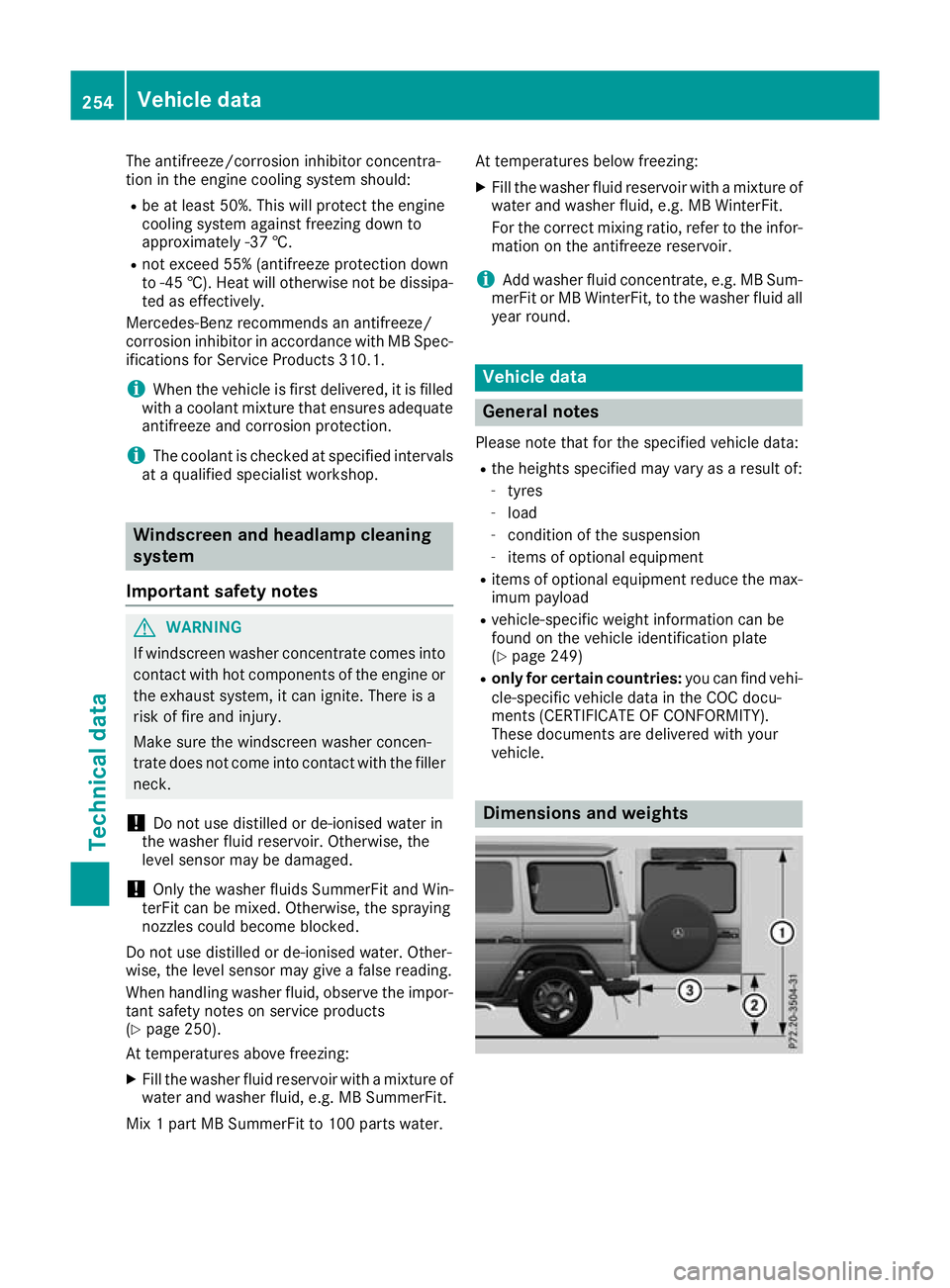
vehicle. Dimensions and weights254
Vehicle dataTechnical data