wheel size MERCEDES-BENZ GLA 2019 Owners Manual
[x] Cancel search | Manufacturer: MERCEDES-BENZ, Model Year: 2019, Model line: GLA, Model: MERCEDES-BENZ GLA 2019Pages: 346, PDF Size: 16.66 MB
Page 23 of 346
MOExtended tires .......................... 306
Optional equipment weight (defi-
nition) ............................................ 325
PSI (pounds per square inch)
(definition) .....................................324
Replacing ....................................... 325
Service life ..................................... 305
Sidewall (definition) ....................... 325
Speed rating (definition) ................ 324
Storing ...........................................326
Structure and characteristics
(definition) ..................................... 323
Summer tires ................................. 306
Temperature .................................. 319
TIN (Tire Identification Number)
(definition) ..................................... 325
Tire bead (definition) ......................325
Tire pressure (definition) ................ 324
Tire pressures (recommended) ...... 324
Tire size (data) ............................... 329
Tire size designation, load-bear-
ing capacity, speed rating .............. 320
Tire tread ....................................... 305
Tire tread (definition) ..................... 325
Total load limit (definition) ............. 325
Traction ......................................... 319
Traction (definition) ....................... 325
Tread wear..................................... 319
Uniform Tire Quality Grading
Standards ...................................... 319
Uniform Tire Quality Grading
Standards (definition) .................... 323
Wear indicator (definition) ............. 325
Wheel rim (definition) .................... 324
see Flat tire
Tool
see Vehicle tool kit
Top Tether............................................ 56
Tow-starting
Emergency engine starting ............ 301
Important safety notes .................. 298
Installing the towing eye ................ 299
Removing the towing eye ............... 299
Towing
Permitted towing methods ............ 300
Towing a trailer
ESP®(Electronic Stability Pro-
gram) ............................................... 66
Towing away
Important safety guidelines ........... 298
Installing the towing eye ................ 299
Notes for 4MATIC vehicles ............ 301
Removing the towing eye ............... 299
Transporting the vehicle ................ 300
With both axles on the ground ....... 300
With the front axle raised ............... 299
Towing eye......................................... 287
Traction system
see ETS/4ETS (Electronic Trac-
tion System)
Traffic reports
see also Digital Operator's Man-
ual .................................................. 242
Transmission
see Automatic transmission
Transmission position display
(DIRECT SELECT lever)...................... 134
Transporting the vehicle.................. 300
Traveling uphill
Brow of hill ..................................... 156
Driving downhill ............................. 156
Maximum gradient-climbing
capability ....................................... 156
Trim pieces (cleaning instruc-
tions).................................................. 284
Trip computer (on-board com-
puter).................................................. 192
Trip odometer
Calling up ....................................... 192
Resetting (on-board computer) ...... 193
Trunk
Emergency release button ............... 83
Opening (from outside the vehi-
cle, HANDS-FREE ACCESS) .............. 80
Trunk lid
see Tailgate
Turn signals
Display message ............................ 214
Replacing bulbs (front) ................... 108
Switching on/off........................... 104
Two-way radio
Frequencies ................................... 332
Installation ..................................... 332
Transmission output (maximum) .... 332
Index21
Page 25 of 346
Important safety notes .................. 304
Information on driving .................... 304
Interchanging/changing ................ 325
Mounting a new wheel ................... 328
Removing a wheel.......................... 328
Storing ........................................... 326
Tightening torque ........................... 329
Wheel size/tire size ....................... 329
Wheels and tires
Changing a wheel.......................... 326
Window curtain air bag
Display message ............................ 211
Operation ......................................... 47
Windows
see Side windows
Windshield
Defrosting ...................................... 120
Windshield washer system
Adding washer fluid ....................... 276
Important safety notes .................. 338
Windshield wipers
Display message ............................ 228
Problem (malfunction) ................... 112
Rear window wiper........................ 110
Replacing the wiper blades ............ 110
Switching on/off........................... 109
Winter driving
Slippery road surfaces ................... 153
Snow chains .................................. 307
Winter operation
General notes ................................ 306
Winter tires
M+S tires....................................... 306
Wiper blades
Cleaning ......................................... 282
Important safety notes .................. 110
Replacing (rear window)................ 112
Wooden trim (cleaning instruc-
tions).................................................. 284
Workshop
see Qualified specialist workshop
Z
ZONE function
Switching on/off........................... 120
Index23
Page 290 of 346
XSwitch off the engine.
XVehicles without KEYLESS-GO:removethe SmartKey from the ignition lock.
XVehicles with KEYLESS-GO start-func-tion or KEYLESS-GO:open the driver'sdoor.The vehicle electronics are now in positionZ. This is the same as the SmartKey havingbeen removed.
XVehicles with KEYLESS-GO start-func-tion or KEYLESS-GO:remove the Start/Stop button from the ignition lock(Ypage 125).
XMake sure that the engine cannot be startedvia your smartphone (Ypage 126).
XMake sure that the passengers are notendangered as they do so. Make sure thatno one is near the danger area while awheel is being changed. Anyone who is notdirectly assisting in the wheel changeshould, for example, stand behind the bar-rier.
XGet out of the vehicle. Pay attention to traf-fic conditions when doing so.
XClose the driver's door.
MOExtended tires (tires with run-flat
properties)
General notes
With MOExtended tires (tires with run flatcharacteristics), you can continue to drive yourvehicle even if there is a total loss of pressurein one or more tires. The affected tire must notshow any clearly visible damage.
You can recognize an MOExtended tire by theMOExtended marking which appears on thesidewall of the tire. You will find this markingnext to the tire size designation, the load-bear-ing capacity and the speed index(Ypage 320).
MOExtended tires may be used only in con-junction with an activated tire pressure losswarning system (Canada only) or tire pressuremonitor (USA only).
If a pressure loss warning messageappears in the multifunction display:
Robserve the instructions in the display mes-sages (Ypage 223).
Rcheck the tire for damage
Rif driving on, observe the following notes
The driving distance possible in run-flat modeis approximately 50 miles (80 km) when thevehicle is partially laden. When the vehicle isfully laden it is approximately 19 miles(30 km).
In addition to the vehicle load, the driving dis-tance possible depends upon:
RVehicle speed
RRoad condition
ROutside temperature
The driving distance possible in run-flat modemay be reduced by extreme driving conditionsor maneuvers, or it can be increased through amoderate style of driving.
The driving distance possible in run-flat modeis counted from the moment the tire pressureloss warning appears in the multifunction dis-play.
You must not exceed the maximum permissi-ble speed for limp-home mode of 50 mph(80 km/h).
When replacing one or all tires, please observethe following specifications for your vehicle'stires:
RSize
RType and
RThe "MOExtended" marking
If a tire has gone flat and cannot be replacedwith an MOExtended tire, a standard tire maybe used as a temporary measure. Make surethat you use the proper size and type (summeror winter tire).
Vehicles equipped with MOExtended tires arenot equipped with a TIREFIT kit at the factory.It is therefore recommended that you addition-ally equip your vehicle with a TIREFIT kit if youmount tires that do not feature run-flat charac-teristics, e.g. winter tires. A TIREFIT kit may beobtained from a qualified specialist workshop.
288Flat tire
Roadside Assistance
Page 308 of 346
(tires with run-flat characteristics)" section(Ypage 288).
ROnly mount tires of the correct size onto thewheels.
RBreak in new tires at moderate speeds forthe first 60 miles (100 km). The new tiresonly reach their full performance after thisdistance.
RDo not drive with tires which have too littletread depth. This significantly reduces thetraction on wet roads (hydroplaning).
RReplace the tires after six years at the lat-est, regardless of wear.
Observe the notes on the emergency sparewheel (Ypage 330).
MOExtended tires (tires with run-flat
properties)
With MOExtended tires (tires with run flatcharacteristics), you can continue to drive yourvehicle even if there is a total loss of pressurein one or more tires.
MOExtended tires may only be used in con-junction with an activated tire pressure losswarning system (Canada only) or tire pressuremonitor (USA only) and only on wheels specifi-cally tested by Mercedes-Benz.
Notes on driving with MOExtended tires with aflat tire (Ypage 288).
Vehicles equipped with MOExtended tires arenot equipped with a TIREFIT kit at the factory.It is therefore recommended that you addition-ally equip your vehicle with a TIREFIT kit if youmount tires that do not feature run-flat charac-teristics, e.g. winter tires. A TIREFIT kit may beobtained from a qualified specialist workshop.
Winter operation
General notes
Have your vehicle winter-proofed at a qualifiedspecialist workshop at the onset of winter.
Observe the notes in the "Changing a wheel"section (Ypage 325).
Driving with summer tires
At temperatures below 45 ‡ (+7 †), summertires lose elasticity and therefore traction andbraking power. Change the tires on your vehi-cle to M+S tires. Using summer tires at verycold temperatures could cause cracks to form,thereby damaging the tires permanently.Mercedes-Benz cannot accept responsibilityfor this type of damage.
GWARNING
Damaged tires can cause tire inflation pres-
sure loss. As a result, you could lose control
of your vehicle. There is a risk of accident.
Check the tires regularly for signs of dam-
age and replace any damaged tires immedi-
ately.
M+S tires
GWARNING
M+S tires with a tire tread depth of less than
Page 309 of 346
When you have mounted the M+S tires:
XCheck the tire pressures (Ypage 307).
XRestart the tire pressure monitor (USA only)(Ypage 314).
XRestart the tire pressure loss warning sys-tem (Canada) (Ypage 311)
Snow chains
GWARNING
If snow chains are mounted on the rear
wheels, the snow chains could cause abra-
sion to the vehicle body or to chassis com-
ponents. This could cause damage to the
vehicle or the tires. There is a risk of an
accident.
To avoid hazardous situations:
Rnever mount snow chains on the rear
wheels
Ronly mount snow chains in pairs on the
front wheels.
!On some tire sizes there is not enoughspace for snow chains. To avoid damage tothe vehicle or tires, observe the "Wheel andtire combinations" section under "Tires andwheels".
For safety reasons, Mercedes-Benz recom-mends that you only use snow chains thathave been specially approved for your vehicleby Mercedes-Benz, or are of a correspondingstandard of quality. For more information,please contact a qualified specialist workshop.
If you intend to mount snow chains, pleasebear the following points in mind:
RSnow chains may not be mounted on allwheel/tire combinations. Permissiblewheel-tire combinations (Ypage 329).
ROnly use snow chains when driving on roadscompletely covered by snow. Remove thesnow chains as soon as possible when youcome to a road that is not snow-covered.
RLocal regulations may restrict the use ofsnow chains. Observe the appropriate regu-lations if you wish to mount snow chains.
RDo not exceed the maximum permissiblespeed of 30mph (50 km/h).
RIf snow chains are installed, you cannot useActive Parking Assist (Ypage 176).
You may wish to deactivate ESP®when pullingaway with snow chains installed . This allowsthe wheels to spin in a controlled manner, ach-ieving increased propulsive force (cuttingaction).
RDeactivate ESP®(all vehicles exceptMercedes-AMG vehicles) (Ypage 64)
RDeactivate ESP®(Mercedes-AMG vehicles)(Ypage 65)
Information about driving with an emergencyspare wheel (Ypage 330).
Tire pressure
Tire pressure specifications
Important safety notes
GWARNING
Underinflated or overinflated tires pose the
following risks:
Rthe tires may burst, especially as the load
and vehicle speed increase.
Rthe tires may wear excessively and/or
unevenly, which may greatly impair tire
traction.
Rthe driving characteristics, as well as
steering and braking, may be greatly
impaired.
There is a risk of an accident.
Follow recommended tire inflation pressures
and check the pressure of all the tires
including the spare wheel:
Rmonthly, at least
Rif the load changes
Rbefore beginning a long journey
Runder different operating conditions, e.g.
off-road driving
If necessary, correct the tire pressure.
iThe data on the Tire and Loading Informa-tion placard and tire pressure table shownhere are examples. Tire pressure specifica-
Tire pressure307
Wheels and tires
Z
Page 310 of 346
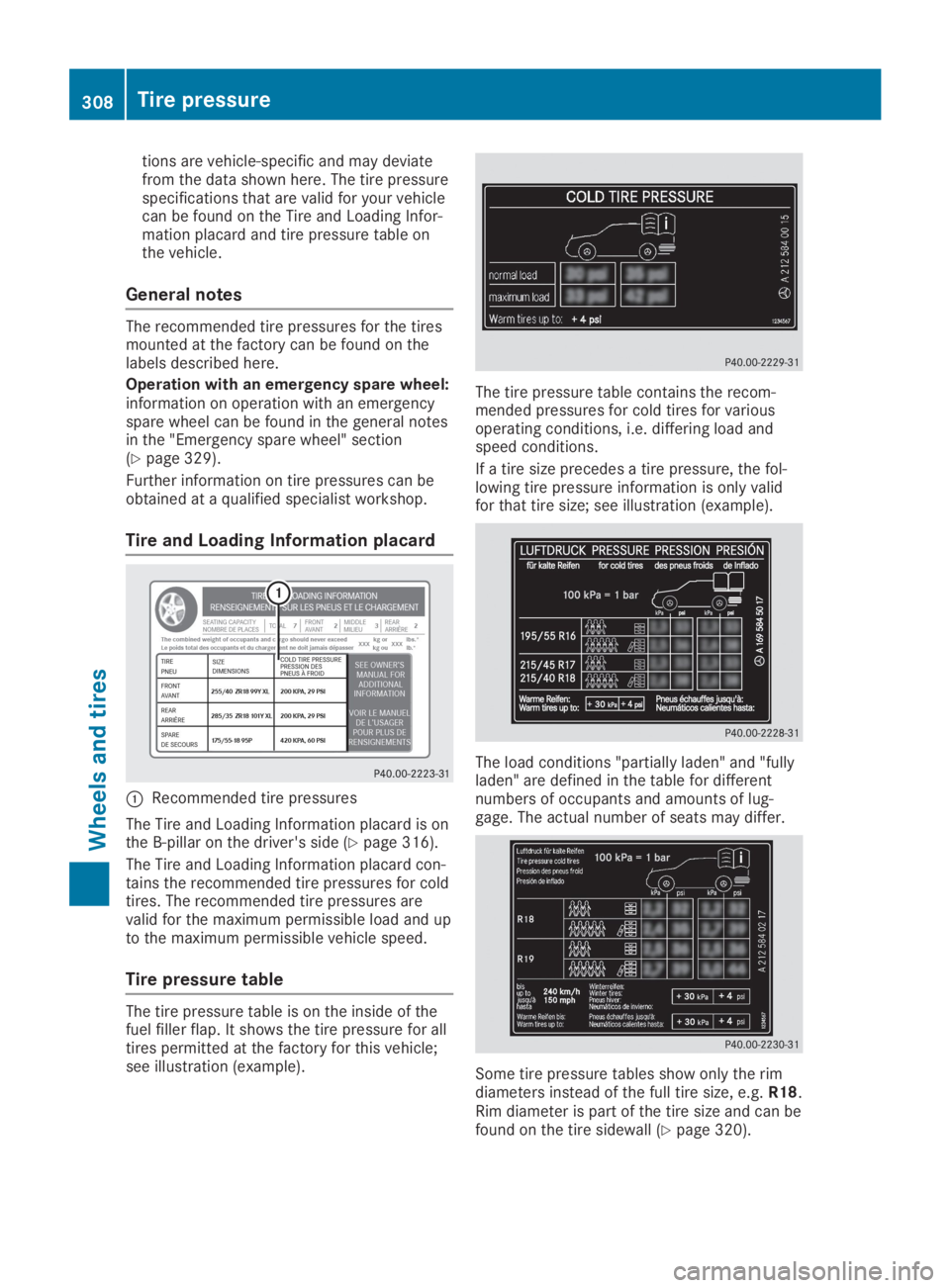
tions are vehicle-specific and may deviatefrom the data shown here. The tire pressurespecifications that are valid for your vehiclecan be found on the Tire and Loading Infor-mation placard and tire pressure table onthe vehicle.
General notes
The recommended tire pressures for the tiresmounted at the factory can be found on thelabels described here.
Operation with an emergency spare wheel:information on operation with an emergencyspare wheel can be found in the general notesin the "Emergency spare wheel" section(Ypage 329).
Further information on tire pressures can beobtained at a qualified specialist workshop.
Tire and Loading Information placard
CRecommended tire pressures
The Tire and Loading Information placard is onthe B-pillar on the driver's side (Ypage 316).
The Tire and Loading Information placard con-tains the recommended tire pressures for coldtires. The recommended tire pressures arevalid for the maximum permissible load and upto the maximum permissible vehicle speed.
Tire pressure table
The tire pressure table is on the inside of thefuel filler flap. It shows the tire pressure for alltires permitted at the factory for this vehicle;see illustration (example).
The tire pressure table contains the recom-mended pressures for cold tires for variousoperating conditions, i.e. differing load andspeed conditions.
If a tire size precedes a tire pressure, the fol-lowing tire pressure information is only validfor that tire size; see illustration (example).
The load conditions "partially laden" and "fullyladen" are defined in the table for differentnumbers of occupants and amounts of lug-gage. The actual number of seats may differ.
Some tire pressure tables show only the rimdiameters instead of the full tire size, e.g.R18.Rim diameter is part of the tire size and can befound on the tire sidewall (Ypage 320).
308Tire pressure
Wheels and tires
Page 314 of 346
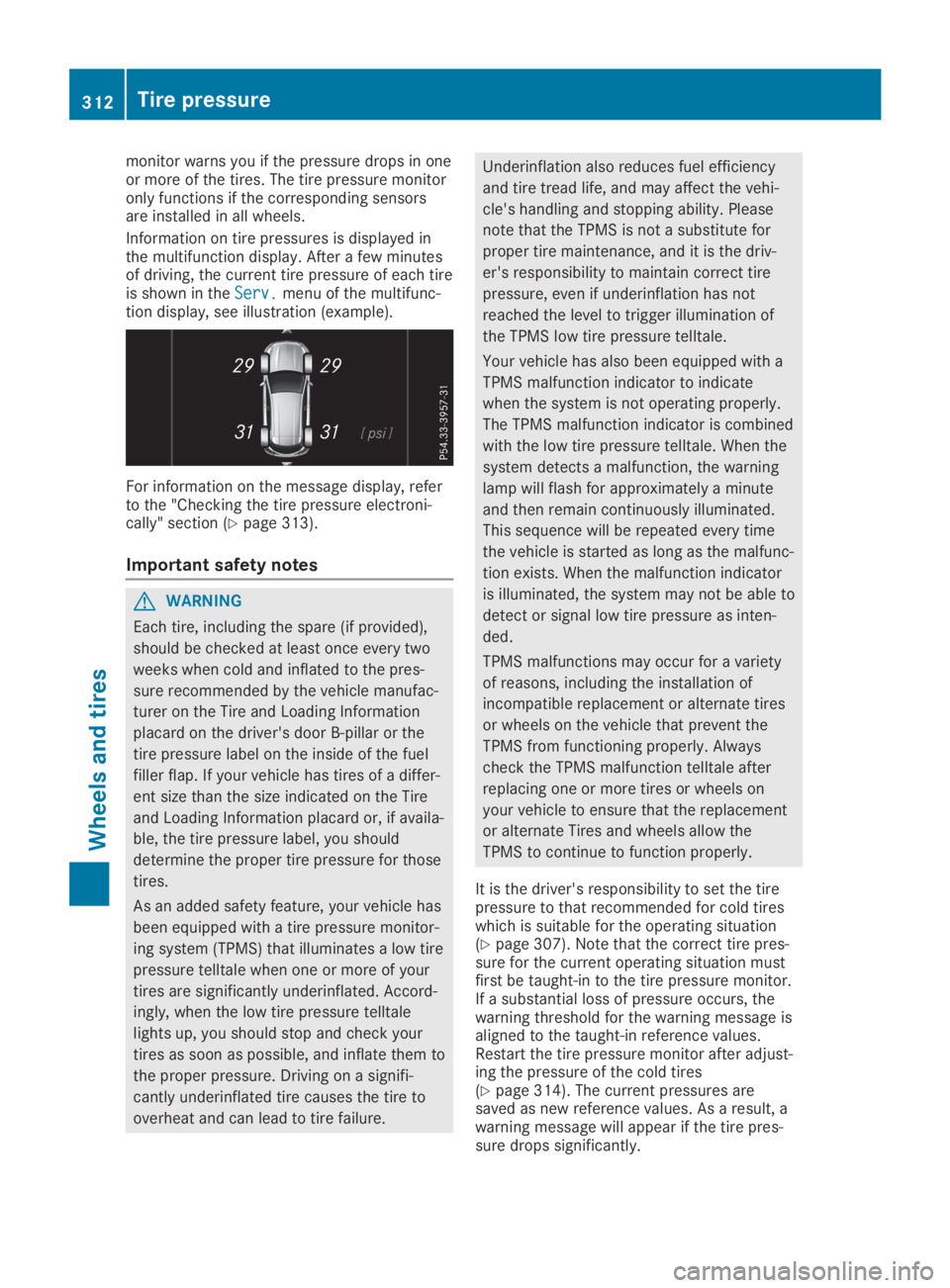
monitor warns you if the pressure drops in oneor more of the tires. The tire pressure monitoronly functions if the corresponding sensorsare installed in all wheels.
Information on tire pressures is displayed inthe multifunction display. After a few minutesof driving, the current tire pressure of each tireis shown in theServ.Serv.menu of the multifunc-tion display, see illustration (example).
For information on the message display, referto the "Checking the tire pressure electroni-cally" section (Ypage 313).
Important safety notes
GWARNING
Each tire, including the spare (if provided),
should be checked at least once every two
weeks when cold and inflated to the pres-
sure recommended by the vehicle manufac-
turer on the Tire and Loading Information
placard on the driver's door B-pillar or the
tire pressure label on the inside of the fuel
filler flap. If your vehicle has tires of a differ-
ent size than the size indicated on the Tire
and Loading Information placard or, if availa-
ble, the tire pressure label, you should
determine the proper tire pressure for those
tires.
As an added safety feature, your vehicle has
been equipped with a tire pressure monitor-
ing system (TPMS) that illuminates a low tire
pressure telltale when one or more of your
tires are significantly underinflated. Accord-
ingly, when the low tire pressure telltale
lights up, you should stop and check your
tires as soon as possible, and inflate them to
the proper pressure. Driving on a signifi-
cantly underinflated tire causes the tire to
overheat and can lead to tire failure.
Underinflation also reduces fuel efficiency
and tire tread life, and may affect the vehi-
cle's handling and stopping ability. Please
note that the TPMS is not a substitute for
proper tire maintenance, and it is the driv-
er's responsibility to maintain correct tire
pressure, even if underinflation has not
reached the level to trigger illumination of
the TPMS low tire pressure telltale.
Your vehicle has also been equipped with a
TPMS malfunction indicator to indicate
when the system is not operating properly.
The TPMS malfunction indicator is combined
with the low tire pressure telltale. When the
system detects a malfunction, the warning
lamp will flash for approximately a minute
and then remain continuously illuminated.
This sequence will be repeated every time
the vehicle is started as long as the malfunc-
tion exists. When the malfunction indicator
is illuminated, the system may not be able to
detect or signal low tire pressure as inten-
ded.
TPMS malfunctions may occur for a variety
of reasons, including the installation of
incompatible replacement or alternate tires
or wheels on the vehicle that prevent the
TPMS from functioning properly. Always
check the TPMS malfunction telltale after
replacing one or more tires or wheels on
your vehicle to ensure that the replacement
or alternate Tires and wheels allow the
TPMS to continue to function properly.
It is the driver's responsibility to set the tirepressure to that recommended for cold tireswhich is suitable for the operating situation(Ypage 307). Note that the correct tire pres-sure for the current operating situation mustfirst be taught-in to the tire pressure monitor.If a substantial loss of pressure occurs, thewarning threshold for the warning message isaligned to the taught-in reference values.Restart the tire pressure monitor after adjust-ing the pressure of the cold tires(Ypage 314). The current pressures aresaved as new reference values. As a result, awarning message will appear if the tire pres-sure drops significantly.
312Tire pressure
Wheels and tires
Page 318 of 346
CountryRadio type approval number
IC: 2546A-MC34MA4
Loading the vehicle
Instruction labels for tires and loads
GWARNING
Overloaded tires can overheat, causing a
blowout. Overloaded tires can also impair
the steering and driving characteristics and
lead to brake failure. There is a risk of acci-
dent.
Observe the load rating of the tires. The load
rating must be at least half of the GAWR of
your vehicle. Never overload the tires by
exceeding the maximum load.
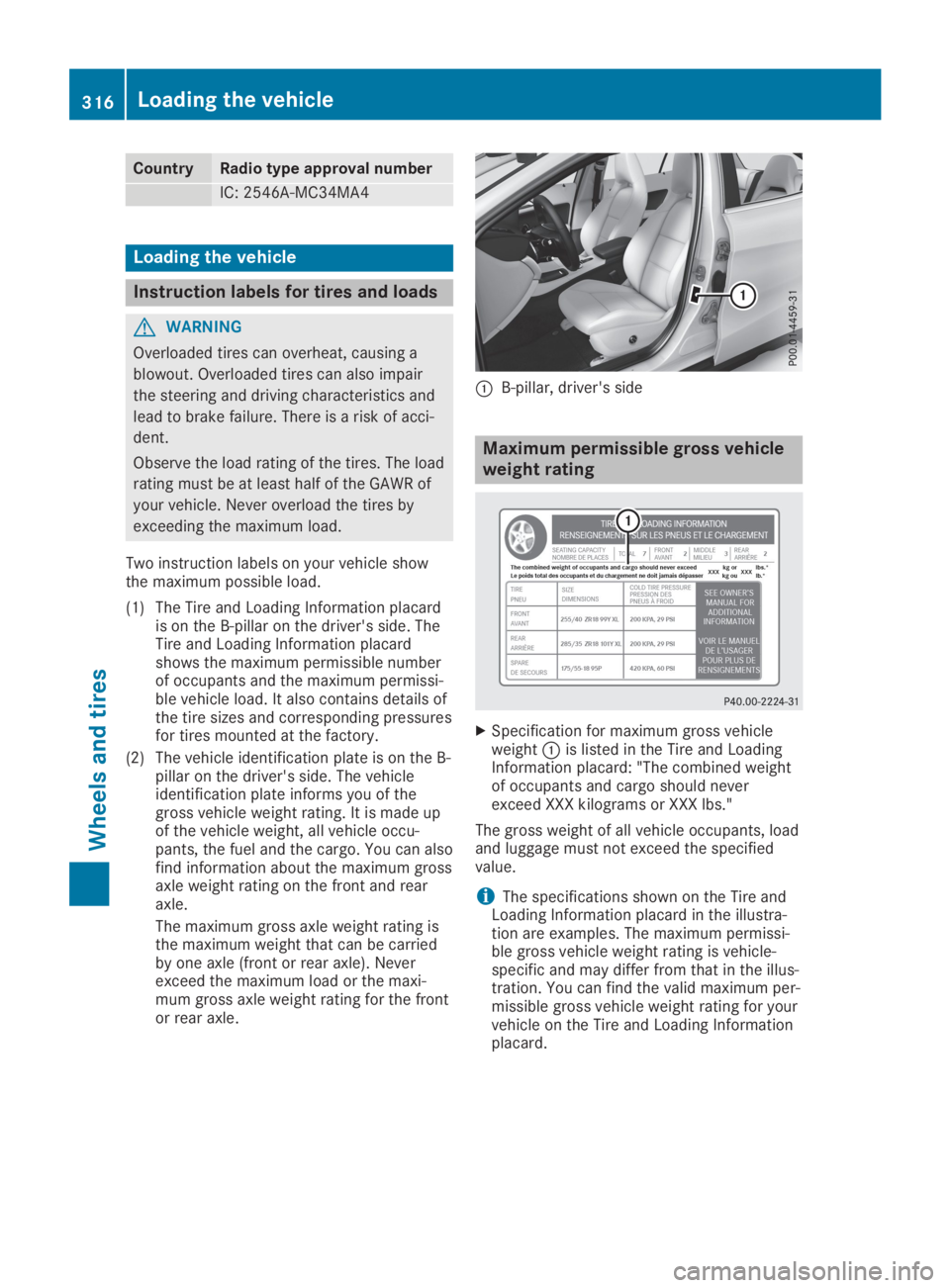
Two instruction labels on your vehicle showthe maximum possible load.
(1) The Tire and Loading Information placardis on the B-pillar on the driver's side. TheTire and Loading Information placardshows the maximum permissible numberof occupants and the maximum permissi-ble vehicle load. It also contains details ofthe tire sizes and corresponding pressuresfor tires mounted at the factory.
(2) The vehicle identification plate is on the B-pillar on the driver's side. The vehicleidentification plate informs you of thegross vehicle weight rating. It is made upof the vehicle weight, all vehicle occu-pants, the fuel and the cargo. You can alsofind information about the maximum grossaxle weight rating on the front and rearaxle.
The maximum gross axle weight rating isthe maximum weight that can be carriedby one axle (front or rear axle). Neverexceed the maximum load or the maxi-mum gross axle weight rating for the frontor rear axle.
CB-pillar, driver's side
Maximum permissible gross vehicle
weight rating
XSpecification for maximum gross vehicleweightCis listed in the Tire and LoadingInformation placard: "The combined weightof occupants and cargo should neverexceed XXX kilograms or XXX lbs."
The gross weight of all vehicle occupants, loadand luggage must not exceed the specifiedvalue.
iThe specifications shown on the Tire andLoading Information placard in the illustra-tion are examples. The maximum permissi-ble gross vehicle weight rating is vehicle-specific and may differ from that in the illus-tration. You can find the valid maximum per-missible gross vehicle weight rating for yourvehicle on the Tire and Loading Informationplacard.
316Loading the vehicle
Wheels and tires
Page 319 of 346
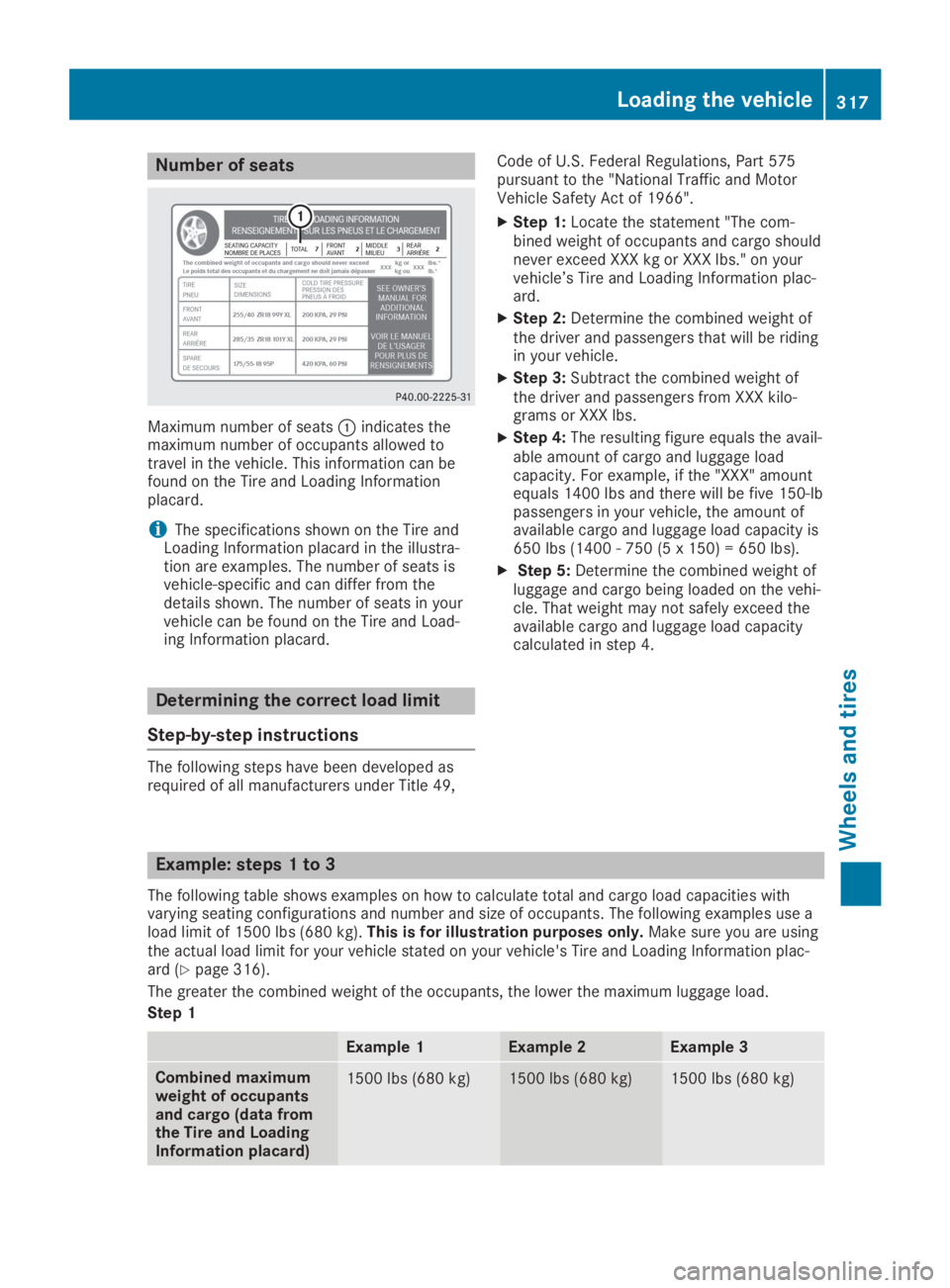
Number of seats
Maximum number of seatsCindicates themaximum number of occupants allowed totravel in the vehicle. This information can befound on the Tire and Loading Informationplacard.
iThe specifications shown on the Tire andLoading Information placard in the illustra-tion are examples. The number of seats isvehicle-specific and can differ from thedetails shown. The number of seats in yourvehicle can be found on the Tire and Load-ing Information placard.
Determining the correct load limit
Step-by-step instructions
The following steps have been developed asrequired of all manufacturers under Title 49,
Code of U.S. Federal Regulations, Part 575pursuant to the "National Traffic and MotorVehicle Safety Act of 1966".
XStep 1:Locate the statement "The com-bined weight of occupants and cargo shouldnever exceed XXX kg or XXX lbs." on yourvehicle’s Tire and Loading Information plac-ard.
XStep 2:Determine the combined weight ofthe driver and passengers that will be ridingin your vehicle.
XStep 3:Subtract the combined weight ofthe driver and passengers from XXX kilo-grams or XXX lbs.
XStep 4:The resulting figure equals the avail-able amount of cargo and luggage loadcapacity. For example, if the "XXX" amountequals 1400 lbs and there will be five 150-lbpassengers in your vehicle, the amount ofavailable cargo and luggage load capacity is650 lbs (1400 - 750 (5 x 150) = 650 lbs).
XStep 5:Determine the combined weight ofluggage and cargo being loaded on the vehi-cle. That weight may not safely exceed theavailable cargo and luggage load capacitycalculated in step 4.
Example: steps 1 to 3
The following table shows examples on how to calculate total and cargo load capacities withvarying seating configurations and number and size of occupants. The following examples use aload limit of 1500 lbs (680 kg).This is for illustration purposes only.Make sure you are usingthe actual load limit for your vehicle stated on your vehicle's Tire and Loading Information plac-ard (Ypage 316).
The greater the combined weight of the occupants, the lower the maximum luggage load.
Step 1
Example 1Example 2Example 3
Combined maximumweight of occupantsand cargo (data fromthe Tire and LoadingInformation placard)
1500 lbs (680 kg)1500 lbs (680 kg)1500 lbs (680 kg)
Loading the vehicle317
Wheels and tires
Z
Page 323 of 346
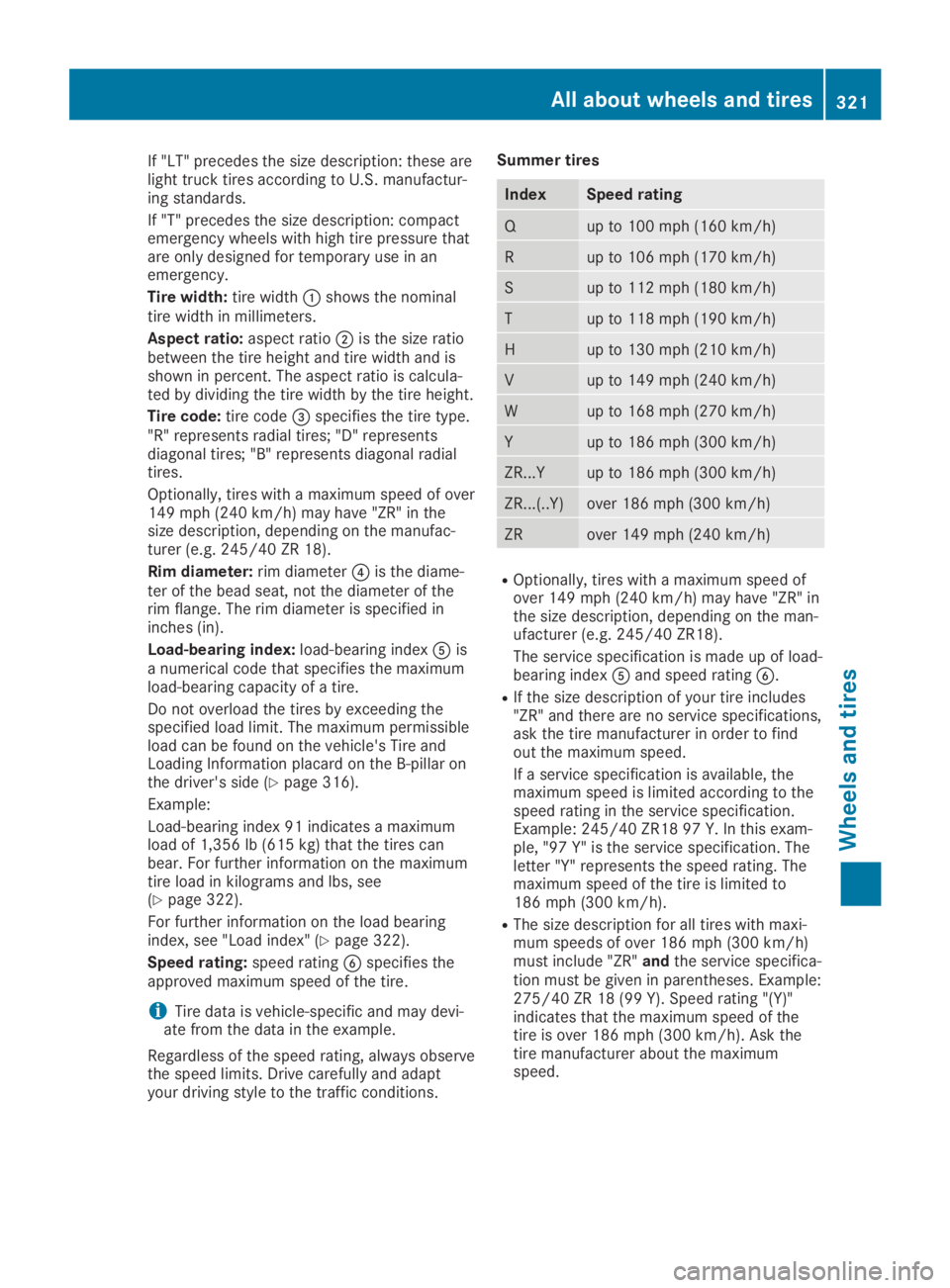
If "LT" precedes the size description: these arelight truck tires according to U.S. manufactur-ing standards.
If "T" precedes the size description: compactemergency wheels with high tire pressure thatare only designed for temporary use in anemergency.
Tire width:tire widthCshows the nominaltire width in millimeters.
Aspect ratio:aspect ratioDis the size ratiobetween the tire height and tire width and isshown in percent. The aspect ratio is calcula-ted by dividing the tire width by the tire height.
Tire code:tire code