engine light MERCEDES-BENZ GLC 2019 User Guide
[x] Cancel search | Manufacturer: MERCEDES-BENZ, Model Year: 2019, Model line: GLC, Model: MERCEDES-BENZ GLC 2019Pages: 370, PDF Size: 19.55 MB
Page 60 of 370
PRE-SAFE®takes the following measuresdepending on the hazardous situation detected:
Rthe front seat belts are pre-tensioned.
Rif the vehicle skids, the side windows and thesliding sunroof are closed.
Rvehicles with the memory function for thefront-passenger seat: the front-passengerseat is adjusted if it is in an unfavorable posi-tion.
If the hazardous situation passes without result-
ing in an accident, PRE-SAFE®slackens the belt
pre-tensioning. All settings made by PRE-SAFE®
can then be reversed.
If the seat belt pre-tensioning is not reduced:
XMove the seat backrest or seat back slightlywhen the vehicle is stationary.The seat belt pre-tensioning is reduced andthe locking mechanism is released.
The seat-belt adjustment is an integral part of
the PRE-SAFE®convenience function. Informa-tion about the convenience function can befound under "Belt adjustment" (Ypage 47).
PRE-SAFE®PLUS (anticipatory occu-
pant protection system PLUS)
Introduction
PRE-SAFE®PLUS is only available in vehicleswith the Driving Assistance package.
Using the radar sensor system, PRE-SAFE®
PLUS is able to detect that a frontal or rear-endcollision is imminent. In certain hazardous sit-
uations, PRE-SAFE®PLUS takes pre-emptivemeasures to protect the vehicle occupants.
Important safety notes
The intervention of PRE-SAFE®PLUS cannotprevent an imminent collision.
The driver is not warned about the intervention
of PRE-SAFE®PLUS.
PRE-SAFE®PLUS does not intervene:
Rif the vehicle is backing up
Rwhen the vehicle is towing a trailer and thereis a risk of a rear-end collision
When driving, or when parking or exiting a park-ing space using Active Parking Assist, PRE-
SAFE®PLUS will not apply the brakes.
Function
PRE-SAFE®PLUS intervenes in certain situa-tions if the radar sensor system detects animminent frontal or rear-end collision.
PRE-SAFE®PLUS takes the following measuresdepending on the hazardous situation detected:
Rif the radar sensor system detects that ahead-on collision is imminent, the seat beltsare pre-tensioned.
Rif the radar sensor system detects that a rear-end collision is imminent:
-the brake pressure is increased if the driverapplies the brakes when the vehicle is sta-tionary.
-the seat belts are pre-tensioned.
The PRE-SAFE®PLUS braking application is can-celed:
Rif the accelerator pedal is depressed when agear is engaged
Rif the risk of a collision passes or is no longerdetected
Rif Active Distance Assist DISTRONIC indicatesan intention to intervene
If the hazardous situation passes without result-ing in an accident, the original settings arerestored.
Automatic measures after an acci-
dent
Immediately after an accident, the followingmeasures are implemented, depending on thetype and severity of the impact:
Rthe hazard warning lamps are switched on
Rthe emergency lighting is activated
Rthe vehicle doors are unlocked
Rthe front side windows are lowered
Rvehicles with a memory function: the electri-cally adjustable steering wheel is raised whenthe driver's door is opened
Rthe engine is switched off and the fuel supplyis cut off
Rvehicles with mbrace: automatic emergencycall
58Occupant safety
Safety
Page 61 of 370
Children in the vehicle
Important safety notes
Accident statistics show that children securedin the rear seats are safer than children securedin the front-passenger seat. For this reason,Mercedes-Benz strongly advises that you installa child restraint system on a rear seat. Childrenare generally better protected there.
If a child younger than twelve years old andunder 5 ft (1.50 m) in height is traveling in thevehicle:
Ralways secure the child in a child restraintsystem suitable for Mercedes-Benz vehicles.The child restraint system must be appropri-ate to the age, weight and size of the child.
Rbe sure to observe the instructions and safetynotes in this section in addition to the childrestraint system manufacturer's installationinstructions.
Ralways observe the instructions and safetynotes on the "Occupant classification system(OCS)". (Ypage 51)
GWARNING
If you leave children unsupervised in the vehi-
cle, they could set it in motion by, for example:
Rrelease the parking brake.
Rshift the automatic transmission out of the
parking positionP.
Rstart the engine.
In addition, they may operate vehicle equip-
ment and become trapped. There is a risk of
an accident and injury.
When leaving the vehicle, always take the
SmartKey with you and lock the vehicle. Never
leave children unsupervised in the vehicle.
GWARNING
If persons, particularly children are subjected
to prolonged exposure to extreme heat or
cold, there is a risk of injury, possibly even
fatal. Never leave children unattended in the
vehicle.
GWARNING
If the child restraint system is subjected to
direct sunlight, parts may get very hot. Chil-
dren may burn themselves on these parts,
particularly on the metal parts of the child
restraint system. There is a risk of injury.
If you leave the vehicle, taking the child with
you, always ensure that the child restraint
system is not exposed to direct sunlight. Pro-
tect it with a blanket, for example. If the child
restraint system has been exposed to direct
sunlight, let it cool down before securing the
child in it. Never leave children unattended in
the vehicle.
Always ensure that all vehicle occupants havetheir seat belts fastened correctly and are sittingproperly. Particular attention must be paid tochildren.
Observe the safety notes on the seat belt(Ypage 45)and the notes on correct use of seatbelts (Ypage 46).
A booster seat may be necessary to achieveproper seat belt positioning for children over40 lbs(18 kg) until they reach a height where athree-point seat belt can be properly fastenedwithout a booster seat.
Special seatbelt retractor
GWARNING
If the seat belt is released while driving, the
child restraint system will no longer be
secured properly. The special seat belt retrac-
tor is disabled and the inertia real draws in a
portion of the seat belt. The seat belt cannot
be immediately refastened. There is an
increased risk of injury, possibly even fatal.
Stop the vehicle immediately, paying atten-
tion to road and traffic conditions. Reactivate
the special seat belt retractor and secure the
child restraint system properly.
All seat belts in the vehicle, except the driver'sseat belt, are equipped with a special seat beltretractor. When activated, the special seat beltretractor ensures that the seat belt cannotslacken once the child seat is secured.
Children in the vehicle59
Safety
Z
Page 67 of 370
Driving safety systems
Overview of driving safety systems
In this section, you will find information aboutthe following driving safety systems:
RABS (Anti-lockBrakingSystem)(Ypage 65)
RBAS (BrakeAssistSystem) (Ypage 66)
RActive Brake Assist (Ypage 66)
RESP®(ElectronicStabilityProgram)(Ypage 68)
REBD (ElectronicBrake forceDistribution)(Ypage 72)
RADAPTIVE BRAKE (Ypage 72)
RActive Brake Assist with cross-traffic function(Ypage 72)
RSTEER CONTROL (Ypage 75)
Important safety notes
If you fail to adapt your driving style or if you areinattentive, the driving safety systems can nei-ther reduce the risk of an accident nor overridethe laws of physics. Driving safety systems aremerely aids designed to assist driving. You areresponsible for maintaining the distance to thevehicle in front, for vehicle speed, for braking ingood time, and for staying in lane. Always adaptyour driving style to suit the prevailing road andweather conditions and maintain a safe distancefrom the vehicle in front. Drive carefully.
The driving safety systems described only workas effectively as possible when there is ade-quate contact between the tires and the roadsurface. Pay particular attention to the informa-tion regarding tires, recommended minimumtire tread depths etc. in the "Wheels and tires"section (Ypage 330).
In wintry driving conditions, always use wintertires (M+S tires)and if necessary, snow chains.Only in this way will the driving safety systemsdescribed in this section work as effectively aspossible.
ABS (Anti-lock Braking System)
General information
ABS regulates brake pressure in such a way thatthe wheels do not lock when you brake. Thisallows you to continue steering the vehicle whenbraking.
The%ABS warning lamp in the instrumentcluster lights up when the ignition is switchedon. It goes out when the engine is running.
ABS works from a speed of about 5 mph(8 km/h), regardless of road-surface conditions.ABS works on slippery surfaces, even when youonly brake gently.
Important safety notes
iObserve the "Important safety notes" sec-tion (Ypage 65).
GWARNING
If ABS is faulty, the wheels could lock when
braking. The steerability and braking charac-
teristics may be severely impaired. Addition-
ally, further driving safety systems are deac-
tivated. There is an increased danger of skid-
ding and accidents.
Drive on carefully. Have ABS checked imme-
diately at a qualified specialist workshop.
When ABS is malfunctioning, other systems,including driving safety systems, will alsobecome inoperative. Observe the informationon the ABS warning lamp (Ypage 259) and dis-play messages which may be shown in theinstrument cluster (Ypage 228).
Braking
XIf ABS intervenes:continue to depress thebrake pedal vigorously until the braking sit-uation is over.
XTo make a full brake application:depressthe brake pedal with full force.
If ABS intervenes when braking, you will feel apulsing in the brake pedal.
The pulsating brake pedal can be an indicationof hazardous road conditions, and functions as areminder to take extra care while driving.
Driving safety systems65
Safety
Z
Page 80 of 370
multimedia system; see the Digital Operator'sManual.
You will receive visual and acoustic locking con-firmation if all components were able to belocked.
When the locator lighting is activated via themultimedia system, it lights up when it is darkafter the vehicle is unlocked with the SmartKey;see the Digital Operator's Manual.
XTo open the tailgate automatically fromoutside the vehicle:press and hold theTbutton until the tailgate opens.
XTo close the tailgate automatically fromoutside the vehicle:if the SmartKey is loca-ted in the immediate vicinity of the vehicle,press theTbutton on the SmartKey.When the tailgate closes you can then releasethe button.
KEYLESS-GO
General notes
Bear in mind that the engine can be started byany of the vehicle occupants if there is a Smart-Key in the vehicle (Ypage 133).
Locking/unlocking centrally
You can start, lock or unlock the vehicle usingKEYLESS-GO. To do this, you only need carry theSmartKey with you. You can combine the func-tions of KEYLESS-GO with those of a conven-tional SmartKey. Unlock the vehicle by usingKEYLESS-GO, for instance, and lock it using the7button on the SmartKey.
The driver's door and the door at which the han-dle is used, must both be closed. The SmartKeymust be outside the vehicle. When locking orunlocking with KEYLESS-GO, the distancebetween the SmartKey and the correspondingdoor handle must not be greater than 3 ft (1 m).
A brief radio connection between the vehicleand the SmartKey determines whether a validSmartKey is in, or in the direct vicinity of, thevehicle. This occurs, for example:
Rwhen starting the engine
Rwhile driving
Rwhen using HANDS-FREE ACCESS
Rwhen the external door handles are touched
Rduring convenience closing
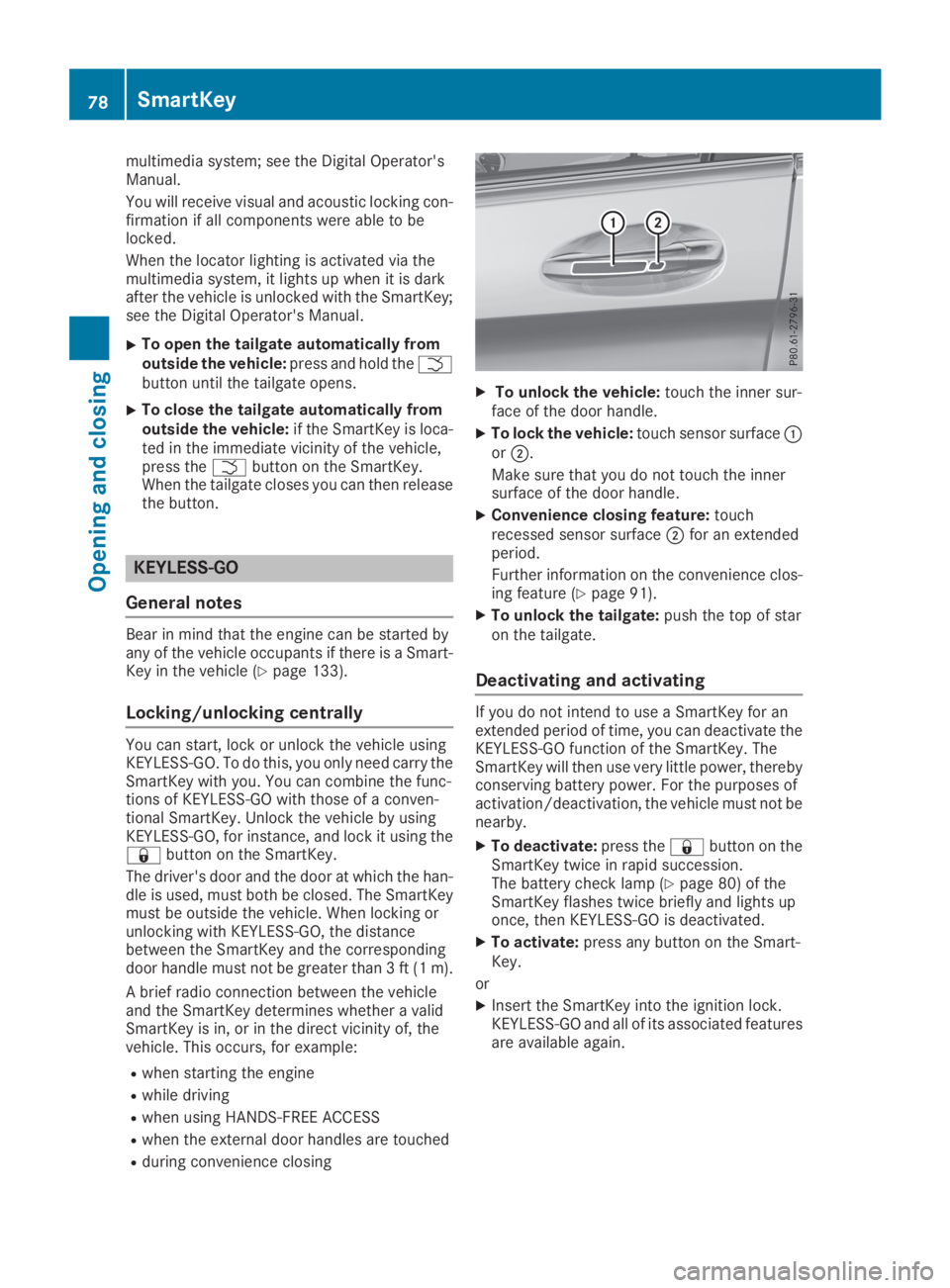
XTo unlock the vehicle:touch the inner sur-face of the door handle.
XTo lock the vehicle:touch sensor surfaceCorD.
Make sure that you do not touch the innersurface of the door handle.
XConvenience closing feature:touchrecessed sensor surfaceDfor an extendedperiod.
Further information on the convenience clos-ing feature (Ypage 91).
XTo unlock the tailgate:push the top of staron the tailgate.
Deactivating and activating
If you do not intend to use a SmartKey for anextended period of time, you can deactivate theKEYLESS-GO function of the SmartKey. TheSmartKey will then use very little power, therebyconserving battery power. For the purposes ofactivation/deactivation, the vehicle must not benearby.
XTo deactivate:press the7button on theSmartKey twice in rapid succession.The battery check lamp (Ypage 80) of theSmartKey flashes twice briefly and lights uponce, then KEYLESS-GO is deactivated.
XTo activate:press any button on the Smart-Key.
or
XInsert the SmartKey into the ignition lock.KEYLESS-GO and all of its associated featuresare available again.
78SmartKey
Opening and closing
Page 84 of 370
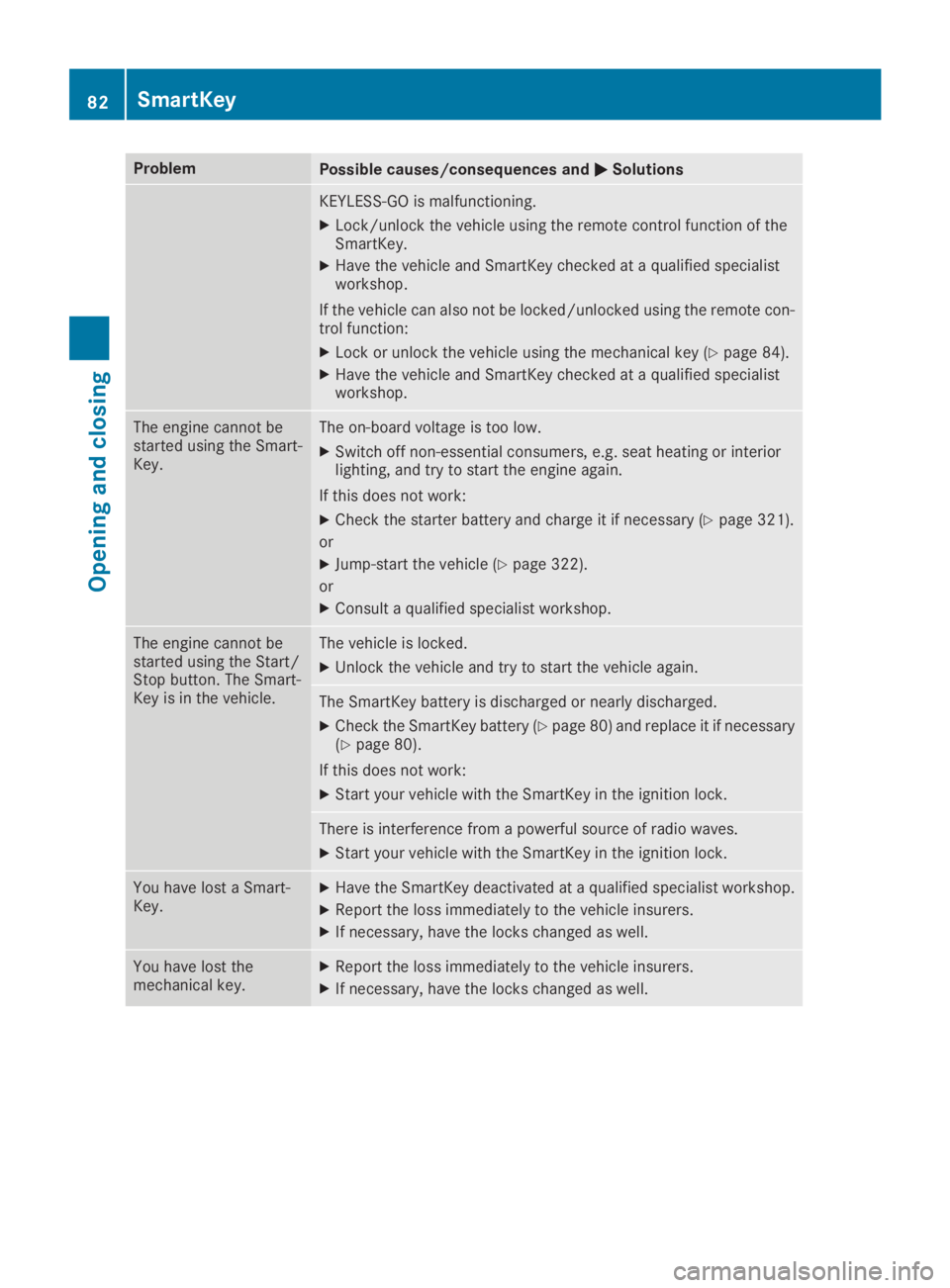
ProblemPossible causes/consequences andPPSolutions
KEYLESS-GO is malfunctioning.
XLock/unlock the vehicle using the remote control function of theSmartKey.
XHave the vehicle and SmartKey checked at a qualified specialistworkshop.
If the vehicle can also not be locked/unlocked using the remote con-trol function:
XLock or unlock the vehicle using the mechanical key (Ypage 84).
XHave the vehicle and SmartKey checked at a qualified specialistworkshop.
The engine cannot bestarted using the Smart-Key.
The on-board voltage is too low.
XSwitch off non-essential consumers, e.g. seat heating or interiorlighting, and try to start the engine again.
If this does not work:
XCheck the starter battery and charge it if necessary (Ypage 321).
or
XJump-start the vehicle (Ypage 322).
or
XConsult a qualified specialist workshop.
The engine cannot bestarted using the Start/Stop button. The Smart-Key is in the vehicle.
The vehicle is locked.
XUnlock the vehicle and try to start the vehicle again.
The SmartKey battery is discharged or nearly discharged.
XCheck the SmartKey battery (Ypage 80) and replace it if necessary(Ypage 80).
If this does not work:
XStart your vehicle with the SmartKey in the ignition lock.
There is interference from a powerful source of radio waves.
XStart your vehicle with the SmartKey in the ignition lock.
You have lost a Smart-Key.XHave the SmartKey deactivated at a qualified specialist workshop.
XReport the loss immediately to the vehicle insurers.
XIf necessary, have the locks changed as well.
You have lost themechanical key.XReport the loss immediately to the vehicle insurers.
XIf necessary, have the locks changed as well.
82SmartKey
Opening and closing
Page 87 of 370
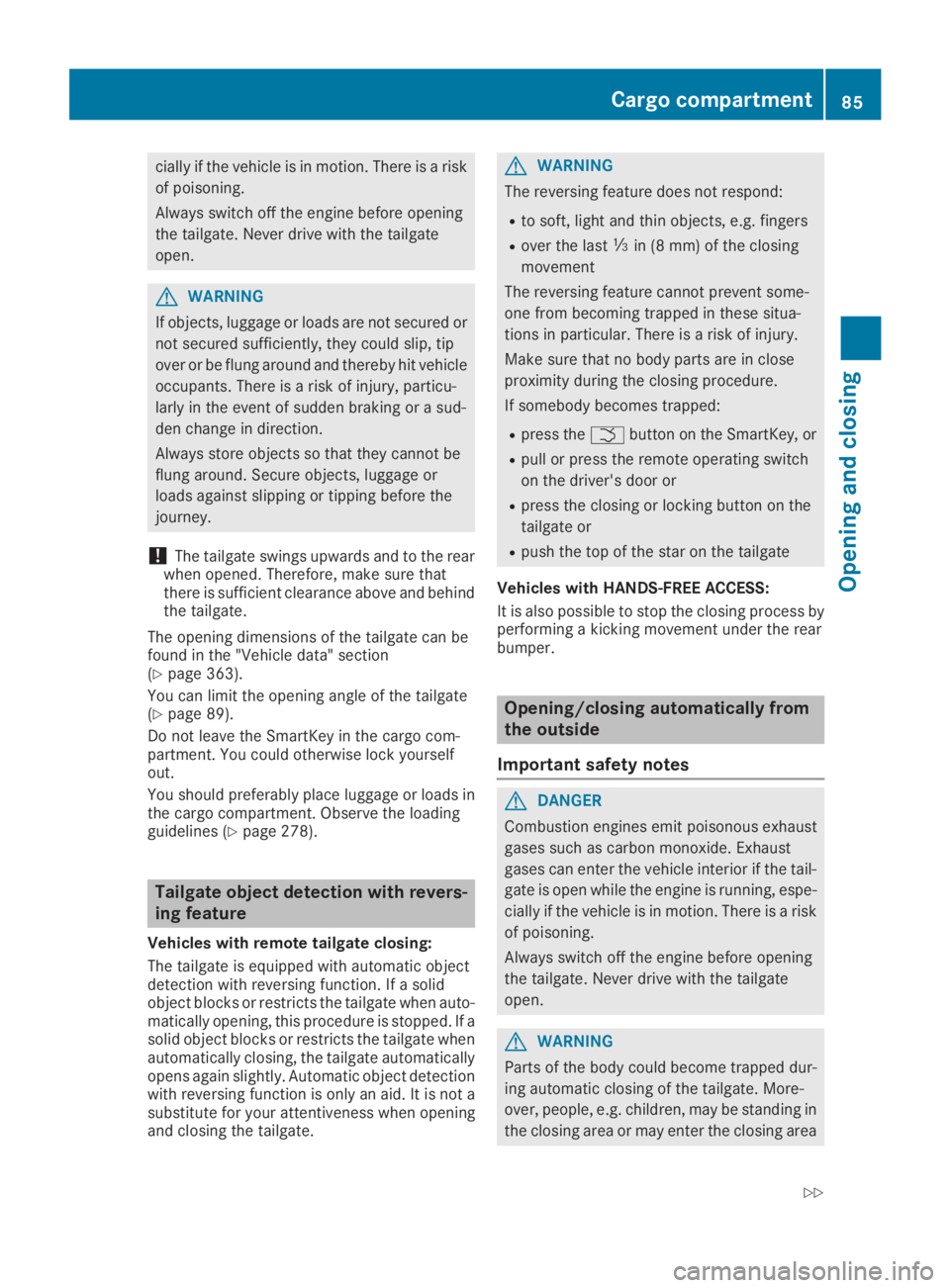
cially if the vehicle is in motion. There is a risk
of poisoning.
Always switch off the engine before opening
the tailgate. Never drive with the tailgate
open.
GWARNING
If objects, luggage or loads are not secured or
not secured sufficiently, they could slip, tip
over or be flung around and thereby hit vehicle
occupants. There is a risk of injury, particu-
larly in the event of sudden braking or a sud-
den change in direction.
Always store objects so that they cannot be
flung around. Secure objects, luggage or
loads against slipping or tipping before the
journey.
!The tailgate swings upwards and to the rearwhen opened. Therefore, make sure thatthere is sufficient clearance above and behindthe tailgate.
The opening dimensions of the tailgate can befound in the "Vehicle data" section(Ypage 363).
You can limit the opening angle of the tailgate(Ypage 89).
Do not leave the SmartKey in the cargo com-partment. You could otherwise lock yourselfout.
You should preferably place luggage or loads inthe cargo compartment. Observe the loadingguidelines (Ypage 278).
Tailgate object detection with revers-
ing feature
Vehicles with remote tailgate closing:
The tailgate is equipped with automatic objectdetection with reversing function. If a solidobject blocks or restricts the tailgate when auto-matically opening, this procedure is stopped. If asolid object blocks or restricts the tailgate whenautomatically closing, the tailgate automaticallyopens again slightly. Automatic object detectionwith reversing function is only an aid. It is not asubstitute for your attentiveness when openingand closing the tailgate.
GWARNING
The reversing feature does not respond:
Rto soft, light and thin objects, e.g. fingers
Rover the last
Page 112 of 370
![MERCEDES-BENZ GLC 2019 User Guide When the engine is running and the vehicle isstationary: if you move the selector lever from adriving position to], the daytime driving lightsand low-beam headlamps go out after threeminutes.
When th](/img/4/59088/w960_59088-111.png "MERCEDES-BENZ GLC 2019 User Guide When the engine is running and the vehicle isstationary: if you move the selector lever from adriving position to], the daytime driving lightsand low-beam headlamps go out after threeminutes.
When th")
When the engine is running and the vehicle isstationary: if you move the selector lever from adriving position to], the daytime driving lightsand low-beam headlamps go out after threeminutes.
When the engine is running, the vehicle is sta-tionary and in bright ambient light: if you turn thelight switch to the`position, the daytimerunning lamps and parking lamps switch on.
If the engine is running and you turn the lightswitch to theXposition, the manual settingstake precedence over the daytime runninglamps.
Low-beam headlamps
GWARNING
When the light switch is set toX, the low-
beam headlamps may not be switched on
automatically if there is fog, snow or other
causes of poor visibility due to the weather
conditions such as spray. There is a risk of an
accident.
In such situations, turn the light switch to
X.
Even if the light sensor does not detect that it isdark, the parking lamps and low-beam head-lamps switch on when the ignition is switched onand the light switch is set to theXposition.This is a particularly useful function in the eventof rain and fog.
XTo switch on the low-beam headlamps:turn the SmartKey to positionHin the igni-tion lock or start the engine.
XTurn the light switch to theXposition.The greenXindicator lamp in the instru-ment cluster lights up.
Rear fog lamp
The rear fog lamp improves visibility of yourvehicle for the traffic behind in the event of thickfog. You must observe the legal requirementsfor the country in which you are currently drivingwhen operating the rear fog lamp.
XTo switch on the rear fog lamp:turn theSmartKey in the ignition lock to positionHorstart the engine.
XTurn the light switch to theXorXposition.
XPress the^button.The yellow^indicator lamp on the instru-ment cluster lights up.
Parking lamps
!If the battery charge is very low, the parkinglamps or standing lamps are automaticallyswitched off to enable the next engine start.Always park your vehicle safely and in a well litarea, in accordance with the relevant legalstipulations. Avoid using the`parkinglamps over a period of several hours. If pos-sible, switch on the right-handdor left-handcstanding lamps.
XTo switch on the parking lamps:turn thelight switch to the`position.The green`indicator lamp on the instru-ment cluster lights up.
Standing lamps
Switching on the standing lamps ensures thecorresponding side of the vehicle is illuminated.
XTo switch on the parking lamp:turn theSmartKey to positionZin the ignition lock orremove the SmartKey.
XTurn the light switch to thec(left-handside of the vehicle) ord(right-hand side ofthe vehicle) position.
Combination switch
CHigh-beam headlamps
DTurn signal, right
110Exterior lighting
Lights and windshield wipers
Page 124 of 370
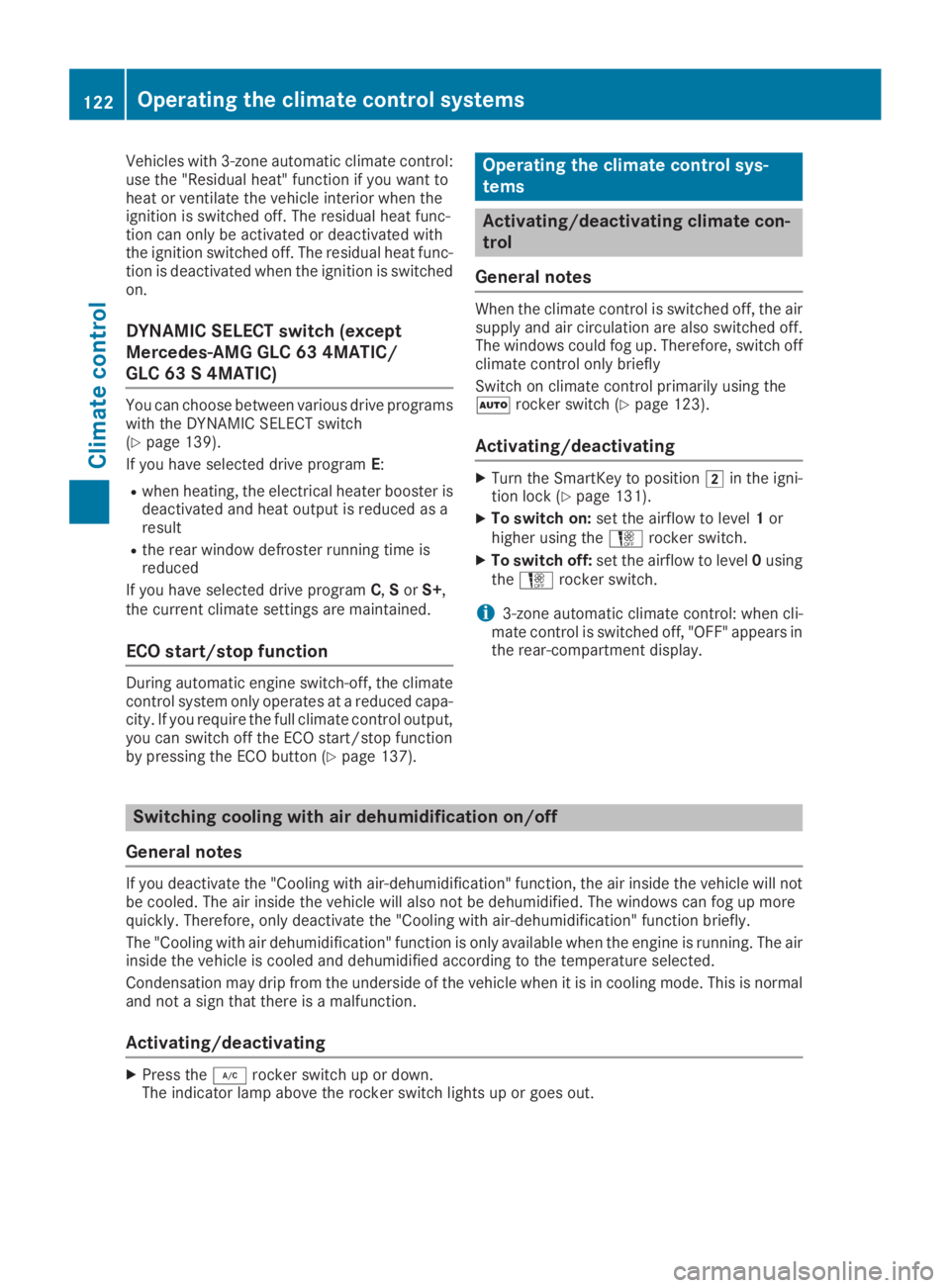
Vehicles with 3-zone automatic climate control:use the "Residual heat" function if you want toheat or ventilate the vehicle interior when theignition is switched off. The residual heat func-tion can only be activated or deactivated withthe ignition switched off. The residual heat func-tion is deactivated when the ignition is switchedon.
DYNAMIC SELECT switch (except
Mercedes-AMG GLC 63 4MATIC/
GLC 63 S 4MATIC)
You can choose between various drive programswith the DYNAMIC SELECT switch(Ypage 139).
If you have selected drive programE:
Rwhen heating, the electrical heater booster isdeactivated and heat output is reduced as aresult
Rthe rear window defroster running time isreduced
If you have selected drive programC,SorS+,the current climate settings are maintained.
ECO start/stop function
During automatic engine switch-off, the climatecontrol system only operates at a reduced capa-city. If you require the full climate control output,you can switch off the ECO start/stop functionby pressing the ECO button (Ypage 137).
Operating the climate control sys-
tems
Activating/deactivating climate con-
trol
General notes
When the climate control is switched off, the airsupply and air circulation are also switched off.The windows could fog up. Therefore, switch offclimate control only briefly
Switch on climate control primarily using theXrocker switch (Ypage 123).
Activating/deactivating
XTurn the SmartKey to positionHin the igni-tion lock (Ypage 131).
XTo switch on:set the airflow to level1orhigher using theHrocker switch.
XTo switch off:set the airflow to level0usingtheHrocker switch.
i3-zone automatic climate control: when cli-mate control is switched off, "OFF" appears inthe rear-compartment display.
Switching cooling with air dehumidification on/off
General notes
If you deactivate the "Cooling with air-dehumidification" function, the air inside the vehicle will notbe cooled. The air inside the vehicle will also not be dehumidified. The windows can fog up morequickly. Therefore, only deactivate the "Cooling with air-dehumidification" function briefly.
The "Cooling with air dehumidification" function is only available when the engine is running. The airinside the vehicle is cooled and dehumidified according to the temperature selected.
Condensation may drip from the underside of the vehicle when it is in cooling mode. This is normaland not a sign that there is a malfunction.
Activating/deactivating
XPress theZrocker switch up or down.The indicator lamp above the rocker switch lights up or goes out.
122Operating the climate control systems
Climate control
Page 128 of 370
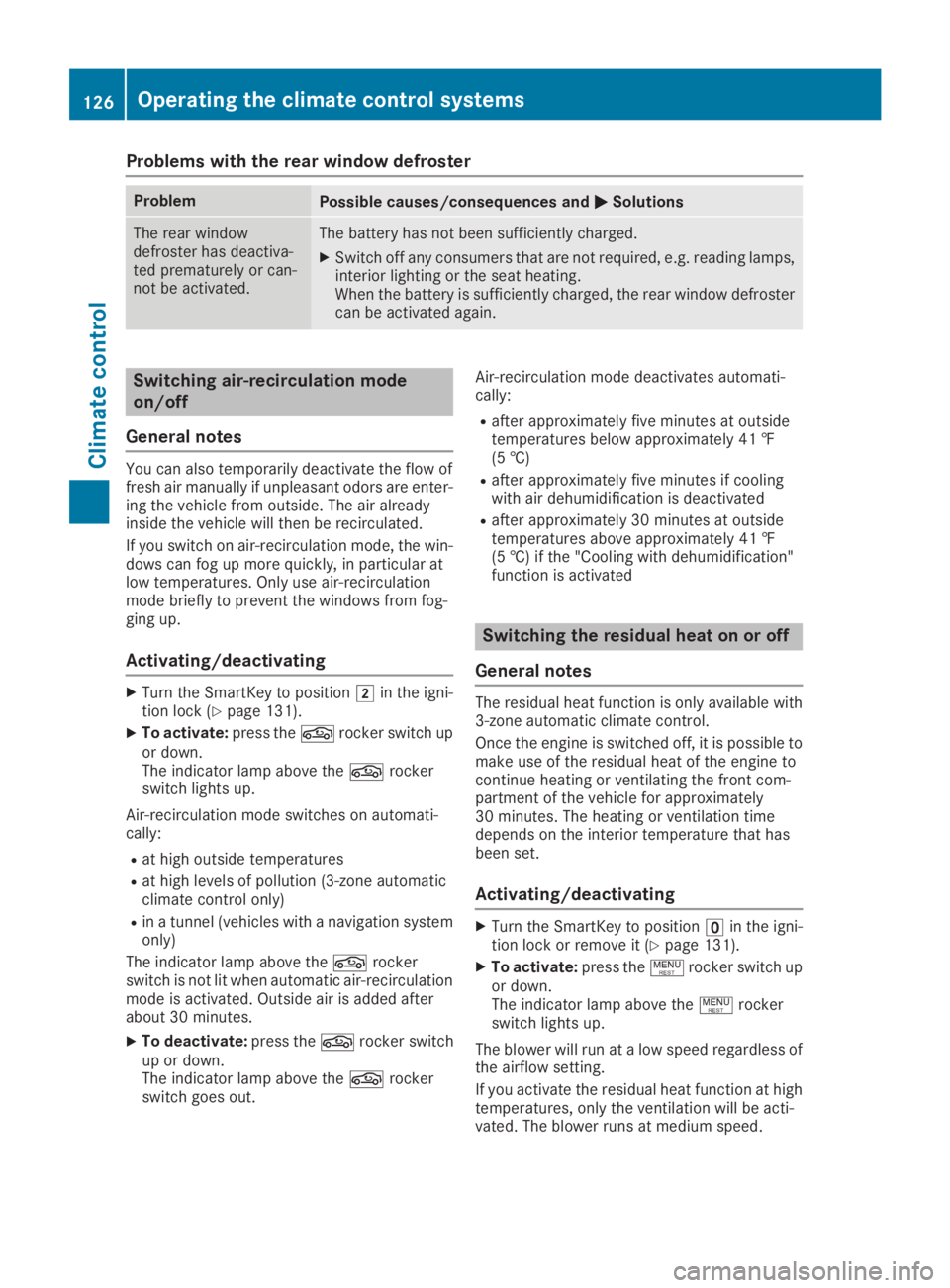
Problems with the rear window defroster
ProblemPossible causes/consequences andPPSolutions
The rear windowdefroster has deactiva-ted prematurely or can-not be activated.
The battery has not been sufficiently charged.
XSwitch off any consumers that are not required, e.g. reading lamps,interior lighting or the seat heating.When the battery is sufficiently charged, the rear window defrostercan be activated again.
Switching air-recirculation mode
on/off
General notes
You can also temporarily deactivate the flow offresh air manually if unpleasant odors are enter-ing the vehicle from outside. The air alreadyinside the vehicle will then be recirculated.
If you switch on air-recirculation mode, the win-dows can fog up more quickly, in particular atlow temperatures. Only use air-recirculationmode briefly to prevent the windows from fog-ging up.
Activating/deactivating
XTurn the SmartKey to positionHin the igni-tion lock (Ypage 131).
XTo activate:press therrocker switch upor down.The indicator lamp above therrockerswitch lights up.
Air-recirculation mode switches on automati-cally:
Rat high outside temperatures
Rat high levels of pollution (3-zone automaticclimate control only)
Rin a tunnel (vehicles with a navigation systemonly)
The indicator lamp above therrockerswitch is not lit when automatic air-recirculationmode is activated. Outside air is added afterabout 30 minutes.
XTo deactivate:press therrocker switchup or down.The indicator lamp above therrockerswitch goes out.
Air-recirculation mode deactivates automati-cally:
Rafter approximately five minutes at outsidetemperatures below approximately 41 ‡(5 †)
Rafter approximately five minutes if coolingwith air dehumidification is deactivated
Rafter approximately 30 minutes at outsidetemperatures above approximately 41 ‡(5 †) if the "Cooling with dehumidification"function is activated
Switching the residual heat on or off
General notes
The residual heat function is only available with3-zone automatic climate control.
Once the engine is switched off, it is possible tomake use of the residual heat of the engine tocontinue heating or ventilating the front com-partment of the vehicle for approximately30 minutes. The heating or ventilation timedepends on the interior temperature that hasbeen set.
Activating/deactivating
XTurn the SmartKey to position
Page 134 of 370
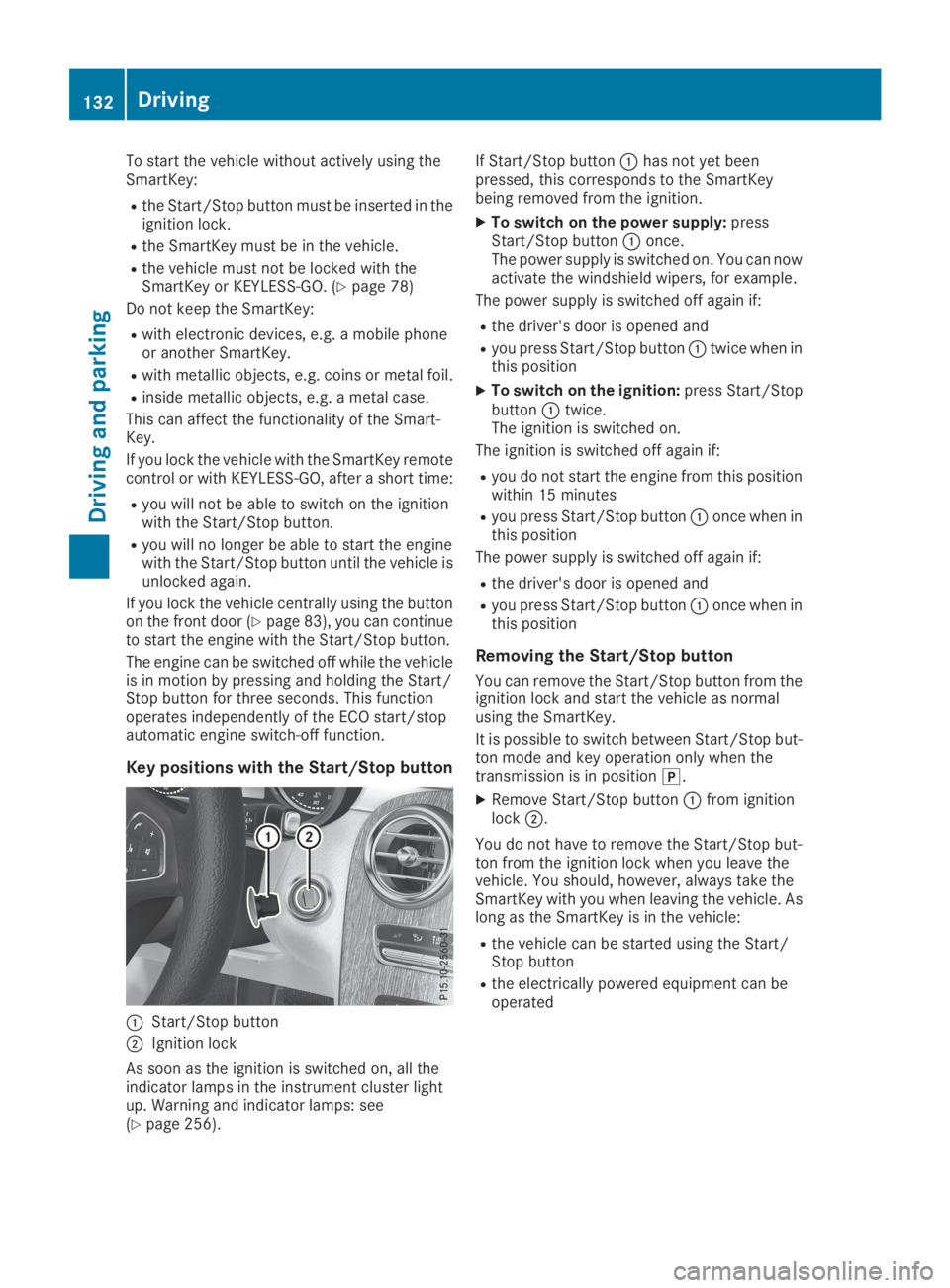
To start the vehicle without actively using theSmartKey:
Rthe Start/Stop button must be inserted in theignition lock.
Rthe SmartKey must be in the vehicle.
Rthe vehicle must not be locked with theSmartKey or KEYLESS-GO. (Ypage 78)
Do not keep the SmartKey:
Rwith electronic devices, e.g. a mobile phoneor another SmartKey.
Rwith metallic objects, e.g. coins or metal foil.
Rinside metallic objects, e.g. a metal case.
This can affect the functionality of the Smart-Key.
If you lock the vehicle with the SmartKey remotecontrol or with KEYLESS-GO, after a short time:
Ryou will not be able to switch on the ignitionwith the Start/Stop button.
Ryou will no longer be able to start the enginewith the Start/Stop button until the vehicle isunlocked again.
If you lock the vehicle centrally using the buttonon the front door (Ypage 83), you can continueto start the engine with the Start/Stop button.
The engine can be switched off while the vehicleis in motion by pressing and holding the Start/Stop button for three seconds. This functionoperates independently of the ECO start/stopautomatic engine switch-off function.
Key positions with the Start/Stop button
CStart/Stop button
DIgnition lock
As soon as the ignition is switched on, all theindicator lamps in the instrument cluster lightup. Warning and indicator lamps: see(Ypage 256).
If Start/Stop buttonChas not yet beenpressed, this corresponds to the SmartKeybeing removed from the ignition.
XTo switch on the power supply:pressStart/Stop buttonConce.The power supply is switched on. You can nowactivate the windshield wipers, for example.
The power supply is switched off again if:
Rthe driver's door is opened and
Ryou press Start/Stop buttonCtwice when inthis position
XTo switch on the ignition:press Start/StopbuttonCtwice.The ignition is switched on.
The ignition is switched off again if:
Ryou do not start the engine from this positionwithin 15 minutes
Ryou press Start/Stop buttonConce when inthis position
The power supply is switched off again if:
Rthe driver's door is opened and
Ryou press Start/Stop buttonConce when inthis position
Removing the Start/Stop button
You can remove the Start/Stop button from theignition lock and start the vehicle as normalusing the SmartKey.
It is possible to switch between Start/Stop but-ton mode and key operation only when thetransmission is in position].
XRemove Start/Stop buttonCfrom ignitionlockD.
You do not have to remove the Start/Stop but-ton from the ignition lock when you leave thevehicle. You should, however, always take theSmartKey with you when leaving the vehicle. Aslong as the SmartKey is in the vehicle:
Rthe vehicle can be started using the Start/Stop button
Rthe electrically powered equipment can beoperated
132Driving
Driving and parking