trailer MERCEDES-BENZ GLC 2019 Owner's Guide
[x] Cancel search | Manufacturer: MERCEDES-BENZ, Model Year: 2019, Model line: GLC, Model: MERCEDES-BENZ GLC 2019Pages: 370, PDF Size: 19.55 MB
Page 207 of 370
XSwitch off the engine.
XClose the doors and tailgate.
XCouple up the trailer.
XEstablish the electrical connection betweenthe vehicle and the trailer.
XCheck that the trailer lighting system is work-ing.
XPush the combination switch upwards/down-wards and check whether the correspondingturn signal on the trailer flashes.
A trailer that is connected is recognized onlywhen the electrical connection is establishedcorrectly and when the lighting system is work-ing properly. The function of other systems alsodepends on this, for example:
RESP®
RPARKTRONIC
RActive Parking Assist
RActive Blind Spot Assist
RActive Lane Keeping Assist
Vehicles with AIR BODY CONTROL: if you coupleup a trailer, the vehicle always remains at high-way level. Observe the following note when cou-pling up a trailer:
RUnless highway level has been set manually,the vehicle is automatically lowered to high-way level. If a speed of 5 mph (8 km/h) hasbeen reached, this may be the case.
These restrictions apply to accessories that aresupplied with power via the trailer socket in yourvehicle, e.g. a rear bicycle rack.
Observe the maximum permissible trailerdimensions (width and length).
Most U.S. states and all Canadian provincesrequire by law:
RSafety chains between the towing vehicle andthe trailer. The chains should be cross-woundunder the trailer drawbar. They must be fas-tened to the vehicle's trailer coupling, not tothe bumper or the axle.
Leave enough play in the chains to make tightcornering possible.
RA separate brake system for certain types oftrailer.
RSafety switch for braked trailers. Check thespecific legal requirements applicable to yourstate.
If the trailer becomes detached from the tow-ing vehicle, the safety feature applies thetrailer brakes.
Towing a trailer
There are several legal requirements for towinga trailer, e.g. the maximum permissible speed.Make sure that your car/trailer combinationcomplies with the local regulations:
Rin your place of residence
Rat your destination
The police and local authorities can provide reli-able information.
To accumulate driving experience and accustomyourself to the new handling characteristics,practice the following at a location where thereis no traffic:
RCornering
RStopping
RBacking up
Check the following before the journey:
RTrailer tow hitch
RSafety switch for braked trailers
RSafety chains
RElectrical connections
RLighting system
RWheels and tires
RLoad securing
Adjust the exterior mirrors so that you have aclear view of the rear section of the trailer.
If the trailer is equipped with electronically con-trolled brakes, pull away carefully in the car/trailer combination. Brake manually using thebrake controller and check whether the brakesfunction correctly.
Regularly check that the load is secure.
When towing a trailer, your vehicle's handlingcharacteristics will be different in comparisonwith when driving without a trailer.
The vehicle/trailer combination:
Ris heavier
Ris restricted in its acceleration and gradient-climbing capability
Rhas an increased braking distance
Ris affected more by strong crosswinds
Rdemands more sensitive steering
Rhas a larger turning circle
Avoid sudden steering movements.
Avoid braking abruptly. If possible, brake gentlyat first to allow the trailer to run on. Then,increase the braking force rapidly.
Towing a trailer205
Driving and parking
Z
Page 208 of 370
When overtaking, pay particular attention to theextended length of your vehicle/trailer combi-nation.
Due to the length of the vehicle/trailer combi-nation, you require additional road space whenovertaking before you can change back to theoriginal lane.
If the automatic transmission repeatedly shiftsbetween gears on uphill or downhill gradients,shift to a lower gear.
Driving in a lower gear and at a reduced speeddecreases the risk of engine damage.
If the coolant temperature increases signifi-cantly when climate control is switched on,switch climate control off.
Coolant heat can also be dissipated by openingthe windows and switching the ventilationblower and the interior temperature to the high-est level.
Decoupling a trailer
GWARNING
If you uncouple a trailer with the overrun
brake engaged, you could trap your hand
between the vehicle and the trailer drawbar.
There is a risk of injury.
Do not uncouple a trailer if the overrun brake
is engaged.
GWARNING
Vehicles with level control:
The vehicle is lowered as soon as you discon-
nect the trailer cable. This could result in your
limbs or those of other people that are
between the vehicle body and tires or under-
neath the vehicle being trapped. There is a
risk of injury.
Make sure that nobody is in the immediate
vicinity of the wheel housings or under the
vehicle when you disconnect the trailer cable.
!Do not disconnect a trailer with an engagedoverrun brake. Otherwise, your vehicle couldbe damaged by the rebounding of the overrunbrake.
XApply the vehicle's parking brake manually.
XShift the transmission to position].
XClose all doors and the tailgate.
XSwitch off the engine.
XSecure the vehicle and trailer against rollingaway.
XRemove the trailer cable.
XRemove the safety chains, if there are any.
XUncouple the trailer.
Removing the ball coupling
XObserve the manufacturer's installationinstructions.
XPress the protective cap into the ball couplingrecess.
XMake sure that the protective cap is firmly inplace.
Observe the loading guidelines (Ypage 278)and the safety notes regarding stowage spaces(Ypage 278).
Information on cleaning and care of the trailertow hitch (Ypage 310).
Trailer power supply
!Accessories with a maximum power con-sumption of 180 W can be connected to thepermanent power supply.
You must not charge a trailer battery using thepower supply.
The trailer socket of your vehicle is equipped atthe factory with a permanent power supply.
The permanent power supply is supplied viatrailer socket pin 4.
The trailer's permanent power supply isswitched off in the event of low vehicle supplyvoltage and after six hours at the latest.
A qualified specialist workshop can providemore information about installing the trailerelectrics.
Permissible trailer loads and trailer
drawbar noseweights
Weight specifications
The gross trailer weight is calculated as theweight of the trailer plus the weight of the loadand the trailer's equipment.
206Towing a trailer
Driving and parking
Page 209 of 370
You will find permissible trailer loads under"Technical data" (Ypage 364).
Loading a trailer
RWhen loading the trailer, make sure that nei-ther the permissible gross trailer weight northe permissible gross vehicle weight areexceeded. The permissible gross vehicleweight is indicated on the identification plateon the B-pillar on the driver's side of the vehi-cle.
You can find the maximum permissible valueson the type plates of your vehicle and thetrailer. When calculating how much weightthe vehicle and trailer may carry, pay atten-tion to the respective lowest values.
RThe trailer drawbar load on the ball couplingmust be added to the rear axle load to avoidexceeding the permissible gross axle weight.The permissible gross vehicle weight is indi-cated on the identification plate on the B-pil-lar on the driver's side of the vehicle.
Mercedes-Benz recommends a trailer loadwhere the trailer drawbar noseweight accountsfor 8% to 15% of the permissible gross trailerweight.
Additional accessories, passengers and loadreduce the permissible trailer load and nose-weight that your vehicle can tow.
Checking the vehicle and trailer weight
RHave the towing vehicle, including the driver,passengers and load, and completely loadedtrailer weighed on a suitable weighingmachine. This will allow you to ensure that theweights of the towing vehicle and trailer com-ply with the maximum permissible values.
RCheck the gross axle weight rating of the frontand rear axles, the gross weight of the trailerand trailer drawbar load.
Towing a trailer207
Driving and parking
Z
Page 241 of 370
Display messagesPossible causes/consequences andPPSolutions
Further information about the Occupant Classification System(Ypage 51).
Lights
Display messagesPossible causes/consequences andPPSolutions
I
CheckCheckLeftLeftLowLowBeamBeam(Example)
The corresponding bulb is faulty.
XVisit a qualified specialist workshop.
or
XCheck whether you are permitted to replace the bulb yourself(Ypage 114).
iLED light sources: the display message for the correspondinglamp only appears when all the LEDs in the lamp have failed.
I
Active HeadlampsActive HeadlampsInoperativeInoperative
The active light function is malfunctioning.
XVisit a qualified specialist workshop.
I
Malfunction SeeMalfunction SeeOperator’s ManualOperator’s Manual
The exterior lighting is malfunctioning.
XVisit a qualified specialist workshop.
Vehicles with trailer tow hitch: a fuse may have blown.
XPull over and stop the vehicle safely as soon as possible, payingattention to road and traffic conditions.
XSecure the vehicle against rolling away (Ypage 152).
XCheck the fuses (Ypage 327).
XIf necessary, replace the blown fuse. Observe the warning notes.
If the display message remains on show:
XVisit a qualified specialist workshop.
I
Automatic HeadlampAutomatic HeadlampMode InoperativeMode Inoperative
The light sensor is malfunctioning.
XVisit a qualified specialist workshop.
I
Switch Off LightsSwitch Off Lights
You leave the vehicle and the lights are switched on. A warning tonealso sounds.
XTurn the light switch to theXposition.
I
Switch On HeadlampsSwitch On Headlamps
You are driving with low-beam headlamps switched off.
XTurn the light switch to theXorXposition.
Displaymessages239
On-b oard computer and displays
Z
Page 312 of 370
chrome trims must not be polished with achrome polish as this will cause them to losetheir black shine. For optimal care, the face-plates should be rubbed with a lightly oiledcloth after every car wash. Commerciallyavailable engine and care oils are suitable forthis.
For heavier soiling, you can apply a fine paint-work polish with a microfiber cloth. Removethe excess polish residue after polishing.
Impurities combined with the effects of road gritand corrosive environmental factors may causeflash rust to form on the surface. You canrestore the original shine of the exhaust pipe bycleaning it regularly, especially in winter andafter washing.
XClean the exhaust pipe with a care producttested and approved by Mercedes-Benz.
Cleaning the trailer tow hitch
HEnvironmental note
Dispose of rags soaked in oil and grease in an
environmentally responsible manner.
!Please note the care instructions in thetrailer coupling manufacturer's operatinginstructions.
The ball coupling must be cleaned if it becomesdirty or corroded.
XRemove rust on the ball, e.g. with a wirebrush.
XRemove dirt with a clean, lint-free cloth or abrush.
XAfter cleaning, lightly oil or grease the ballcoupling.
XCheck that the vehicle's trailer tow hitch isworking properly.
You can also have the maintenance work on theball coupling and the trailer tow hitch carried outby a qualified specialist workshop.
Interior care
Cleaning the display
!For cleaning, do not use any of the following:
Ralcohol-based thinner or gasoline
Rabrasive cleaning agents
Rcommercially-available household cleaningagents
These may damage the display surface. Donot put pressure on the display surface whencleaning. This could lead to irreparable dam-age to the display.
XBefore cleaning the display, make sure that itis switched off and has cooled down.
XClean the display surface using a commer-cially available microfiber cloth and TFT/LCDdisplay cleaner.
XDry the display surface using a dry microfibercloth.
Cleaning the plastic trim
GWARNING
Care products and cleaning agents containing
solvents cause surfaces in the cockpit to
become porous. As a result, plastic parts may
come loose in the event of air bag deploy-
ment. There is a risk of injury.
Do not use any care products and cleaning
agents to clean the cockpit.
!Never attach the following to plastic surfa-ces:
Rstickers
Rfilms
Rperfume oil container or similar
You could otherwise damage the plastic.
!Do not allow cosmetics, insect repellent orsunscreen to come into contact with the plas-tic trim. This maintains the high-quality look ofthe surfaces.
XWipe the plastic trim with a damp, lint-freecloth, e.g. a microfiber cloth.
XHeavy soiling:use care and cleaning prod-ucts recommended and approved byMercedes-Benz.The surface may change color temporarily.Wait until the surface is dry again.
310Care
Maintenance and care
Page 327 of 370
!Only secure the tow rope or tow bar at thetowing eyes, or the trailer tow hitch, if availa-ble. You could otherwise damage the vehicle.
!Do not use the trailer tow hitch for recoveryor towing. Do not use the towing eye forrecovery. this could damage the vehicle. If indoubt, have the vehicle recovered using acrane.
!When towing, pull away slowly andsmoothly. If the tractive power is too high, thevehicles could be damaged.
!Shift the automatic transmission to position\\and do not open the driver's or front pas-senger's door during towing. The automatictransmission may otherwise shift to position], which could damage the transmission.
!Do not tow with sling-type equipment. Thiscould damage the vehicle.
!You may tow the vehicle for a maximum dis-tance of 30 miles (50 kilometers). A towingspeed of 30 mph (50 km/h) must not beexceeded.
For towing distances over 30 miles(50 kilometers), the entire vehicle must beraised and transported.
It is better to have the vehicle transported thanto have it towed away.
If the vehicle has suffered transmission damage,have it transported on a transporter or trailer.
The automatic transmission must be in position\\when the vehicle is being towed. If the auto-matic transmission cannot be shifted to position\\, have the vehicle transported on a trans-porter or trailer.
The battery must be connected and charged.Otherwise, you:
Rcannot turn the SmartKey to positionHinthe ignition lock
Rcannot release the electric parking brake.
Rcannot shift the automatic transmission toposition\\
Disarm the automatic locking feature before thevehicle is towed (Ypage 84). You could other-wise be locked out when pushing or towing thevehicle.
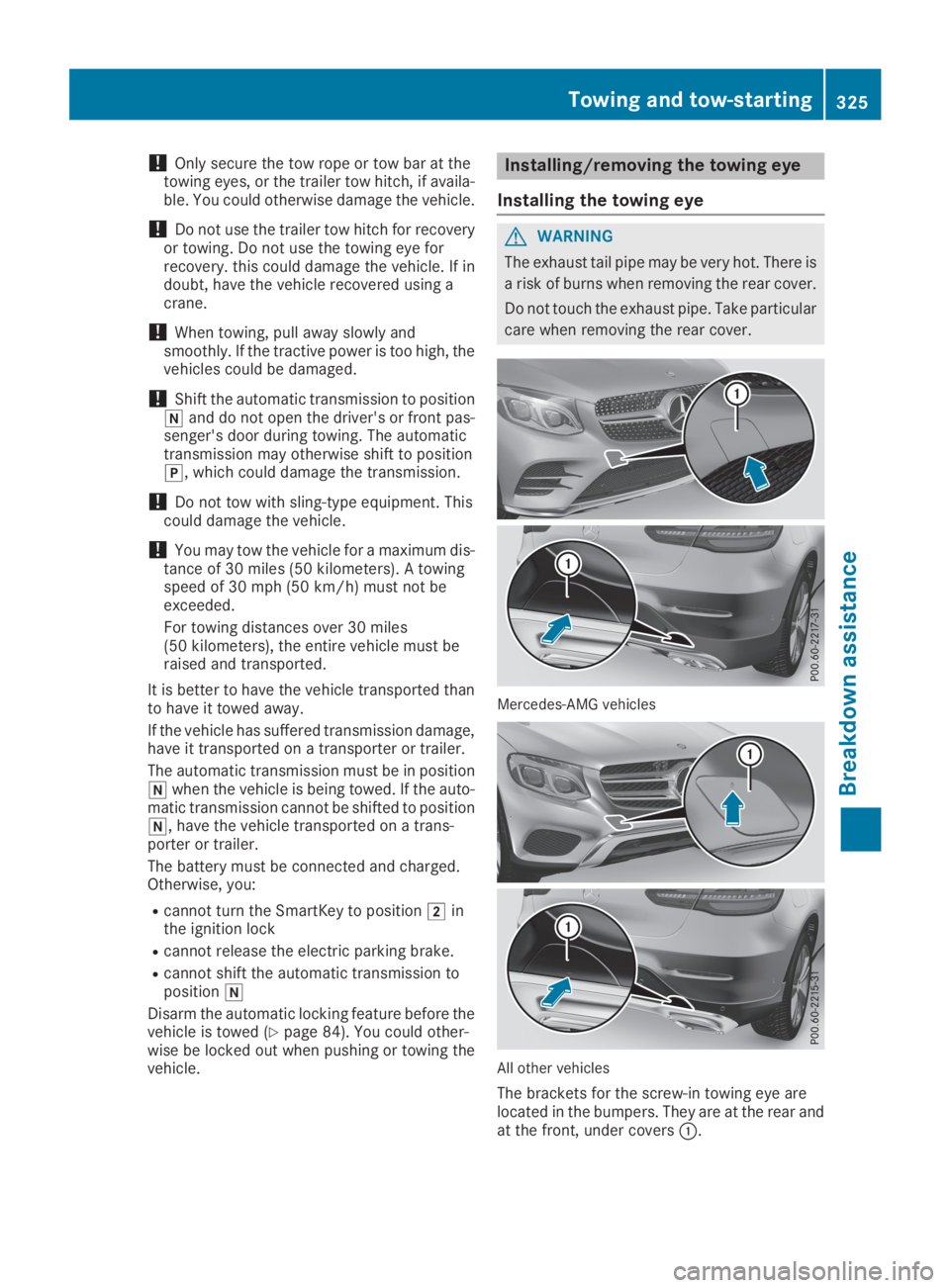
Installing/removing the towing eye
Installing the towing eye
GWARNING
The exhaust tail pipe may be very hot. There is
a risk of burns when removing the rear cover.
Do not touch the exhaust pipe. Take particular
care when removing the rear cover.
Mercedes-AMG vehicles
All other vehicles
The brackets for the screw-in towing eye arelocated in the bumpers. They are at the rear andat the front, under coversC.
Towing and tow-starting325
Breakdown assistance
Z
Page 328 of 370
XRemove the towing eye from the retainer(Ypage 314).
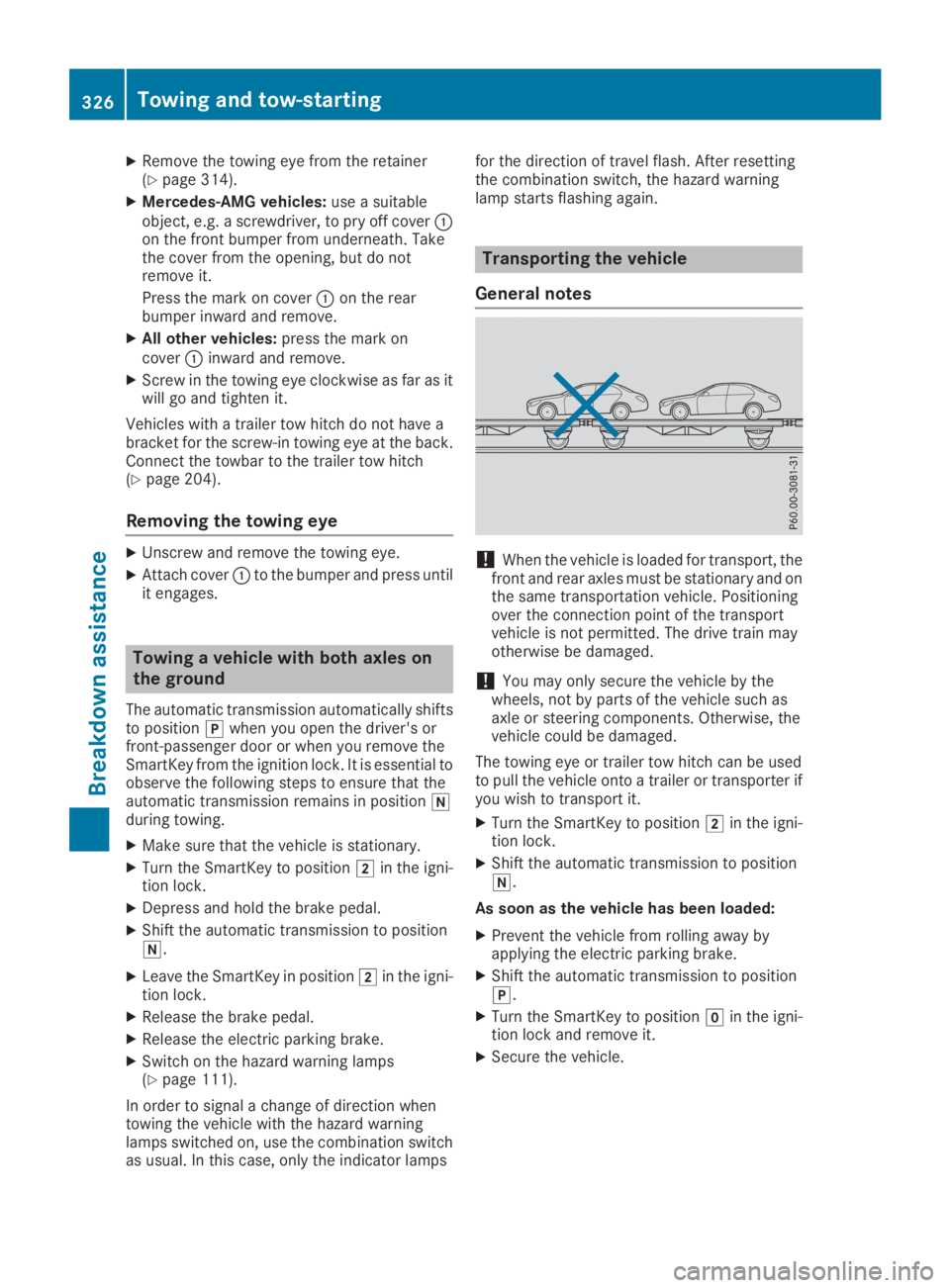
XMercedes-AMG vehicles:use a suitableobject, e.g. a screwdriver, to pry off coverCon the front bumper from underneath. Takethe cover from the opening, but do notremove it.
Press the mark on coverCon the rearbumper inward and remove.
XAll other vehicles:press the mark oncoverCinward and remove.
XScrew in the towing eye clockwise as far as itwill go and tighten it.
Vehicles with a trailer tow hitch do not have abracket for the screw-in towing eye at the back.Connect the towbar to the trailer tow hitch(Ypage 204).
Removing the towing eye
XUnscrew and remove the towing eye.
XAttach coverCto the bumper and press untilit engages.
Towing a vehicle with both axles on
the ground
The automatic transmission automatically shiftsto position]when you open the driver's orfront-passenger door or when you remove theSmartKey from the ignition lock. It is essential toobserve the following steps to ensure that theautomatic transmission remains in position\\during towing.
XMake sure that the vehicle is stationary.
XTurn the SmartKey to positionHin the igni-tion lock.
XDepress and hold the brake pedal.
XShift the automatic transmission to position\\.
XLeave the SmartKey in positionHin the igni-tion lock.
XRelease the brake pedal.
XRelease the electric parking brake.
XSwitch on the hazard warning lamps(Ypage 111).
In order to signal a change of direction whentowing the vehicle with the hazard warninglamps switched on, use the combination switchas usual. In this case, only the indicator lamps
for the direction of travel flash. After resettingthe combination switch, the hazard warninglamp starts flashing again.
Transporting the vehicle
General notes
!When the vehicle is loaded for transport, thefront and rear axles must be stationary and onthe same transportation vehicle. Positioningover the connection point of the transportvehicle is not permitted. The drive train mayotherwise be damaged.
!You may only secure the vehicle by thewheels, not by parts of the vehicle such asaxle or steering components. Otherwise, thevehicle could be damaged.
The towing eye or trailer tow hitch can be usedto pull the vehicle onto a trailer or transporter ifyou wish to transport it.
XTurn the SmartKey to positionHin the igni-tion lock.
XShift the automatic transmission to position\\.
As soon as the vehicle has been loaded:
XPrevent the vehicle from rolling away byapplying the electric parking brake.
XShift the automatic transmission to position].
XTurn the SmartKey to positionZin the igni-tion lock and remove it.
XSecure the vehicle.
326Towing and tow-starting
Breakdown assistance
Page 329 of 370
Notes on 4MATIC vehicles
!Vehicles with 4MATIC must not be towedwith either the front or the rear axle raised, asdoing so will damage the transmission.
Vehicles with 4MATIC may either be towed awaywith both axles on the ground or be loaded upand transported.
If the vehicle's transmission, front, or rear axle isdamaged, have the vehicle transported on atruck or trailer.
In the event of damage to the electrical sys-tem:if the battery is defective, the automatictransmission will be locked in positionP. To shiftthe automatic transmission to positionN, youmust provide power to the vehicle's electricalsystem in the same way as when jump-starting(Ypage 322).
Have the vehicle transported on a transporter ortrailer.
Tow-starting (emergency engine
starting)
!Vehicles with automatic transmission mustnot be tow-started. You could otherwise dam-age the automatic transmission.
iYou can find information on "Jump-starting"under (Ypage 322).
Fuses
Important safety notes
GWARNING
If you manipulate or bridge a faulty fuse or if
you replace it with a fuse with a higher amper-
age, the electric cables could be overloaded.
This could result in a fire. There is a risk of an
accident and injury.
Always replace faulty fuses with the specified
new fuses having the correct amperage.
Blown fuses must be replaced with fuses of thesame rating, which you can recognize by thecolor and value. The fuse ratings are listed in thefuse allocation chart.
The fuse allocation chart is on the fuse box in thecargo compartment (Ypage 328).
If a newly inserted fuse also blows, have thecause traced and rectified at a qualified special-ist workshop, e.g. an authorized Mercedes-BenzCenter.
!Only use fuses that have been approved forMercedes-Benz vehicles and which have thecorrect fuse rating for the system concerned.Otherwise, components or systems could bedamaged.
!Make sure that no moisture can enter thefuse box when the cover is open.
!When closing the cover, make sure that it islying correctly on the fuse box. Moisture seep-ing in or dirt could otherwise impair the oper-ation of the fuses.
The fuses in your vehicle serve to close downfaulty circuits. If a fuse blows, all the compo-nents on the circuit and their functions stopoperating.
Before changing a fuse
Observe the important safety notes(Ypage 327)
XSwitch off the engine.
XSwitch off all electrical consumers.
XMake sure that the ignition is switched off(Ypage 132).
or
XWhen using the SmartKey, turn the SmartKeyto position
Page 335 of 370
For safety reasons, Mercedes-Benz recom-mends that you only use snow chains that havebeen specially approved for your vehicle byMercedes-Benz, or are of a correspondingstandard of quality. For more information,please contact a qualified specialist workshop.
If you intend to mount snow chains, please bearthe following points in mind:
RSnow chains may not be mounted on allwheel/tire combinations. Observe the infor-mation regarding permitted wheel/tire com-binations (Ypage 354).
ROnly use snow chains when driving on roadscompletely covered by snow. Remove thesnow chains as soon as possible when youcome to a road that is not snow-covered.
RLocal regulations may restrict the use of snowchains. Observe the appropriate regulations ifyou wish to mount snow chains.
RDo not exceed the maximum permissiblespeed of 31 mph (50 km/h).
ROn vehicles with AIR BODY CONTROL, youmust only drive at raised vehicle level if snowchains have been installed (Ypage 172).
RWhen snow chains are installed, never useActive Parking Assist (Ypage 175).
You may wish to deactivate ESP®when pullingaway with snow chains installed:
RAll vehicles (except Mercedes‑AMG vehicles)(Ypage 69)
RMercedes‑AMG vehicles (Ypage 70)
You can thereby allow the wheels to spin in acontrolled manner, achieving an increased driv-ing force (cutting action).
Tire pressure
Tire pressure specifications
Important safety notes
GWARNING
Underinflated or overinflated tires pose the
following risks:
Rthe tires may burst, especially as the load
and vehicle speed increase.
Rthe tires may wear excessively and/or
unevenly, which may greatly impair tire
traction.
Rthe driving characteristics, as well as steer-
ing and braking, may be greatly impaired.
There is a risk of an accident.
Follow recommended tire inflation pressures
and check the pressure of all the tires includ-
ing the spare wheel:
Rmonthly, at least
Rif the load changes
Rbefore beginning a long journey
Runder different operating conditions, e.g.
off-road driving
If necessary, correct the tire pressure.
The data on the Tire and Loading Informationplacard and tire pressure table shown here areexamples. Tire pressure specifications are vehi-cle-specific and may deviate from the datashown here. The tire pressure specificationsthat are valid for your vehicle can be found onthe Tire and Loading Information placard andtire pressure table on the vehicle.
General notes
The recommended tire pressures for the tiresmounted at the factory can be found on thelabels described here.
Operation with a trailer:the applicable valuefor the rear axle is the maximum tire pressurevalue stated in the table inside the fuel filler flap.
Further information on tire pressures can beobtained at a qualified specialist workshop.
Tire pressure333
Wheels and tires
Z
Page 339 of 370
Ryou are driving on sand or gravel.
Ryou adopt a very sporty driving style (corner-ing at high speeds or driving with high rates ofacceleration).
Ryou are towing a very heavy or large trailer.
Ryou are driving with a heavy load (in the vehi-cle or on the roof).
Restarting the tire pressure loss warn-
ing system
Restart the tire pressure loss warning system ifyou have:
Rchanged the tire pressure
Rchanged the wheels or tires
Rmounted new wheels or tires
XBefore restarting, make sure that the tirepressures are set properly on all four tires forthe respective operating conditions.
The recommended tire pressure can be foundon the Tire and Loading Information placardon the B-pillar. Additionally, a tire pressuretable is attached to the fuel filler flap. The tirepressure loss warning system can only givereliable warnings if you have set the correcttire pressure. If an incorrect tire pressure isset, these incorrect values will be monitored.
XAlso observe the notes in the section on tirepressures (Ypage 333).
XMake sure that the SmartKey is in positionHin the ignition lock (Ypage 131).
XPress