warning MERCEDES-BENZ GLC 2019 Workshop Manual
[x] Cancel search | Manufacturer: MERCEDES-BENZ, Model Year: 2019, Model line: GLC, Model: MERCEDES-BENZ GLC 2019Pages: 370, PDF Size: 19.55 MB
Page 74 of 370
Crosswind Assist is active at vehicle speedsabove 50 mph(80 km/h)when driving straightahead or cornering gently.
Important safety notes
Crosswind Assist does not work if ESP®isswitched off or deactivated because of a mal-function.
EBD (electronic brake force distribu-
tion)
General information
EBD monitors and controls the brake pressureon the rear wheels to improve driving stabilitywhile braking.
Important safety notes
iObserve the "Important safety notes" sec-tion (Ypage 65).
GWARNING
If EBD is malfunctioning, the rear wheels can
lock, e.g. under full braking. This increases the
risk of skidding and an accident.
You should therefore adapt your driving style
to the different handling characteristics. Have
the brake system checked at a qualified spe-
cialist workshop.
Observe information regarding indicator andwarning lamps (Ypage 259) as well as displaymessages (Ypage 230).
ADAPTIVE BRAKE
ADAPTIVE BRAKE enhances braking safety andoffers increased braking comfort. In addition tothe braking function, ADAPTIVE BRAKE also hasthe HOLD function (Ypage 170) and hill startassist (Ypage 135).
Active Brake Assist with cross-traffic
function
General information
iObserve the important safety notes in the"Driving safety systems" section (Ypage 65).
Active Brake Assist with cross-traffic functioncan help you to minimize the risk of a collisionwith a vehicle in front or a pedestrian and reducethe effects of such a collision. If the Active BrakeAssist with cross-traffic function detects a riskof collision, you will be warned visually andacoustically and, if necessary, your brake appli-cation will be assisted according to the situa-tion. If you do not react, the system can alsoreact by braking automatically. In the event of adetected risk of collision due to crossing traffic,you will also be visually and acoustically warnedas well as assisted by the brake boosting effectaccording to the situation.
Active Brake Assist with cross-traffic function isonly available in vehicles with the Driving Assis-tance Plus package.
For Active Brake Assist with cross-traffic func-tion to assist you when driving, the radar sensorsystem and the camera system must be opera-tional.
If the radar sensor system or the camera systemis malfunctioning, Active Brake Assist withcross-traffic function is restricted or no longeravailable. The brake system is still available withcomplete brake boosting effect and BAS.
The radar sensor system and camera systemhelp Active Brake Assist with cross-traffic func-tion to detect obstacles that are in the path ofyour vehicle for an extended period of time.
In addition, pedestrians in the path of your vehi-cle can be detected.
Active Brake Assist with cross-traffic functiondetects pedestrians using typical characteris-tics such as body contours and the posture of aperson standing upright.
iObserve the restrictions described in the"Important safety notes" section(Ypage 72).
Important safety notes
GWARNING
Active Brake Assist with cross-traffic function
will initially brake your vehicle by a partial
72Driving safety systems
Safety
Page 75 of 370
application of the brakes if a danger of colli-
sion is detected. There may be a collision
unless you brake yourself. Even after subse-
quent full application of the brakes a collision
cannot always be avoided, particularly when
approaching at too high a speed. There is a
risk of an accident.
Always apply the brakes yourself and try to
take evasive action, provided it is safe to do
so.
In the event of a partial application of the brakes,the vehicle is braked with up to 50% of the fullbraking pressure.
GWARNING
Active Brake Assist with cross-traffic function
cannot always clearly identify objects and
complex traffic situations.
In such cases, Active Brake Assist with cross-
traffic function might:
Rissue an unnecessary warning or engage
Rneither give a warning nor intervene
There is a risk of an accident.
Always pay particular attention to the traffic
situation and be prepared to brake, especially
if Active Brake Assist with cross-traffic func-
tion alerts you. Terminate the intervention in a
non-critical driving situation.
GWARNING
Active Brake Assist with cross-traffic function
cannot always clearly identify people, partic-
ularly if they are moving. Active Brake Assist
with cross-traffic function cannot intervene in
these cases. There is a risk of an accident.
Always pay particular attention to the traffic
situation and be prepared to brake, especially
if Active Brake Assist with cross-traffic func-
tion alerts you.
In order to maintain the appropriate distance tothe vehicle in front and thus prevent a collision,you must apply the brakes yourself.
GWARNING
Active Brake Assist with cross-traffic function
does not react:
Rto small people, e.g. children
Rto animals
Rto oncoming vehicles
Rwhen cornering
As a result, Active Brake Assist with cross-
traffic function may not warn you or engage in
all critical situations. There is a risk of an acci-
dent.
Always pay careful attention to the traffic sit-
uation and be ready to brake.
In the event of snowfall or heavy rain, the rec-ognition can be impaired.
Recognition by the radar sensor system is alsoimpaired if:
Rthere is dirt on the sensors or anything elsecovering the sensors
Rthere is interference by other radar sources
Rthere are strong radar reflections, for exam-ple in parking garages
Ra narrow vehicle is traveling in front, e.g. amotorbike
Ra vehicle is traveling in front on a different line
Rvehicles moving quickly into the radar sensorsystem detection range
Recognition by the camera system is alsoimpaired in the event of:
Rdirt on the camera or if the camera is covered
Rglare on the camera system, e.g. from the sunbeing low in the sky
Rdarkness
Ror if:
-pedestrians move quickly, e.g. into the pathof the vehicle
-the camera system no longer recognizes apedestrian as a person due to special cloth-ing or other objects
-a pedestrian is concealed by other objects
-the typical outline of a pedestrian is notdistinguishable from the background
Following damage to the front end of the vehicle,have the configuration and operation of theradar sensors checked at a qualified specialistworkshop. This also applies to collisions at slow
Driving safety systems73
Safety
Z
Page 79 of 370
SmartKey
Important safety notes
GWARNING
If children are left unsupervised in the vehicle,
they could:
Ropen the doors, thus endangering other
people or road users.
Rget out and disrupt traffic.
Roperate the vehicle's equipment.
Additionally, children could set the vehicle in
motion if, for example, they:
Rrelease the parking brake.
Rshifting the automatic transmission out of
park positionP
RStart the engine.
There is a risk of an accident and injury.
When leaving the vehicle, always take the
SmartKey with you and lock the vehicle. Never
leave children or animals unattended in the
vehicle. Always keep the SmartKey out of
reach of children.
GWARNING
If you attach heavy or large objects to the
SmartKey, the SmartKey could be uninten-
tionally turned in the ignition lock. This could
cause the engine to be switched off. There is a
risk of an accident.
Do not attach any heavy or large objects to the
SmartKey. Remove any bulky key rings before
inserting the SmartKey into the ignition lock.
!Keep the SmartKey away from strong mag-netic fields. Otherwise, the remote controlfunction could be affected.
Strong magnetic fields can occur in the vicin-ity of powerful electrical installations.
Do not keep the SmartKey:
Rwith electronic devices, e.g. a mobile phoneor another SmartKey.
Rwith metallic objects, e.g. coins or metal foil.
Rinside metallic objects, e.g. a metal case.
This can affect the functionality of the Smart-Key.
Vehicles with KEYLESS-GO start function:donot keep the SmartKey in the cargo compart-ment. Otherwise, the SmartKey may not bedetected, e.g. when starting the engine usingthe Start/Stop button.
A brief radio connection between the vehicleand the SmartKey determines whether a validSmartKey is in, or in the direct vicinity of, thevehicle. This occurs, for example:
Rwhen starting the engine
Rwhile driving
Rwhen using HANDS-FREE ACCESS
Rwhen the external door handles are touched
Rduring convenience closing
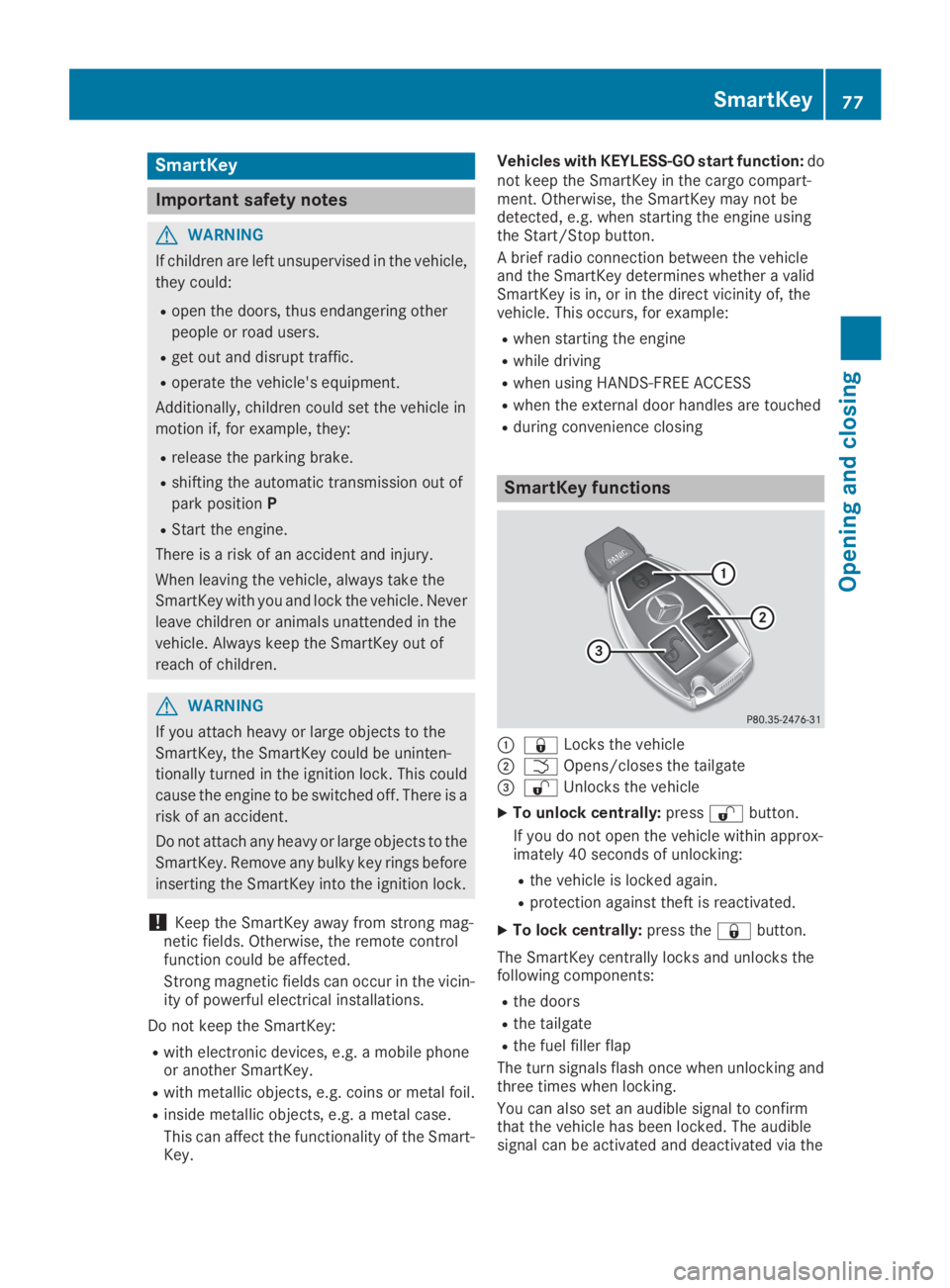
SmartKey functions
C7Locks the vehicle
DTOpens/closes the tailgate
Page 82 of 370
SmartKey battery
Important safety notes
GWARNING
Batteries contain toxic and corrosive substan-
ces. If batteries are swallowed, it can result in
severe health problems. There is a risk of fatal
injury.
Keep batteries out of the reach of children. If
a battery is swallowed, seek medical attention
immediately.
HEnvironmental note
Batteries contain dangerous
substances. It is against the
law to dispose of them with
the household rubbish. They
must be collected separately
and recycled to protect the
environment.
Dispose of batteries in an
environmentally friendly
manner. Take discharged
batteries to a qualified spe-
cialist workshop or a special
collection point for used bat-
teries.
The SmartKey batteries contain perchloratematerial, which may require special handlingand regard for the environment. National guide-lines must be observed during disposal. In Cal-ifornia, seewww.dtsc.ca.gov/HazardousWaste/Perchlorate/index.cfm.
Mercedes-Benz recommends that you have thebatteries replaced at a qualified specialist work-shop.
Checking the battery
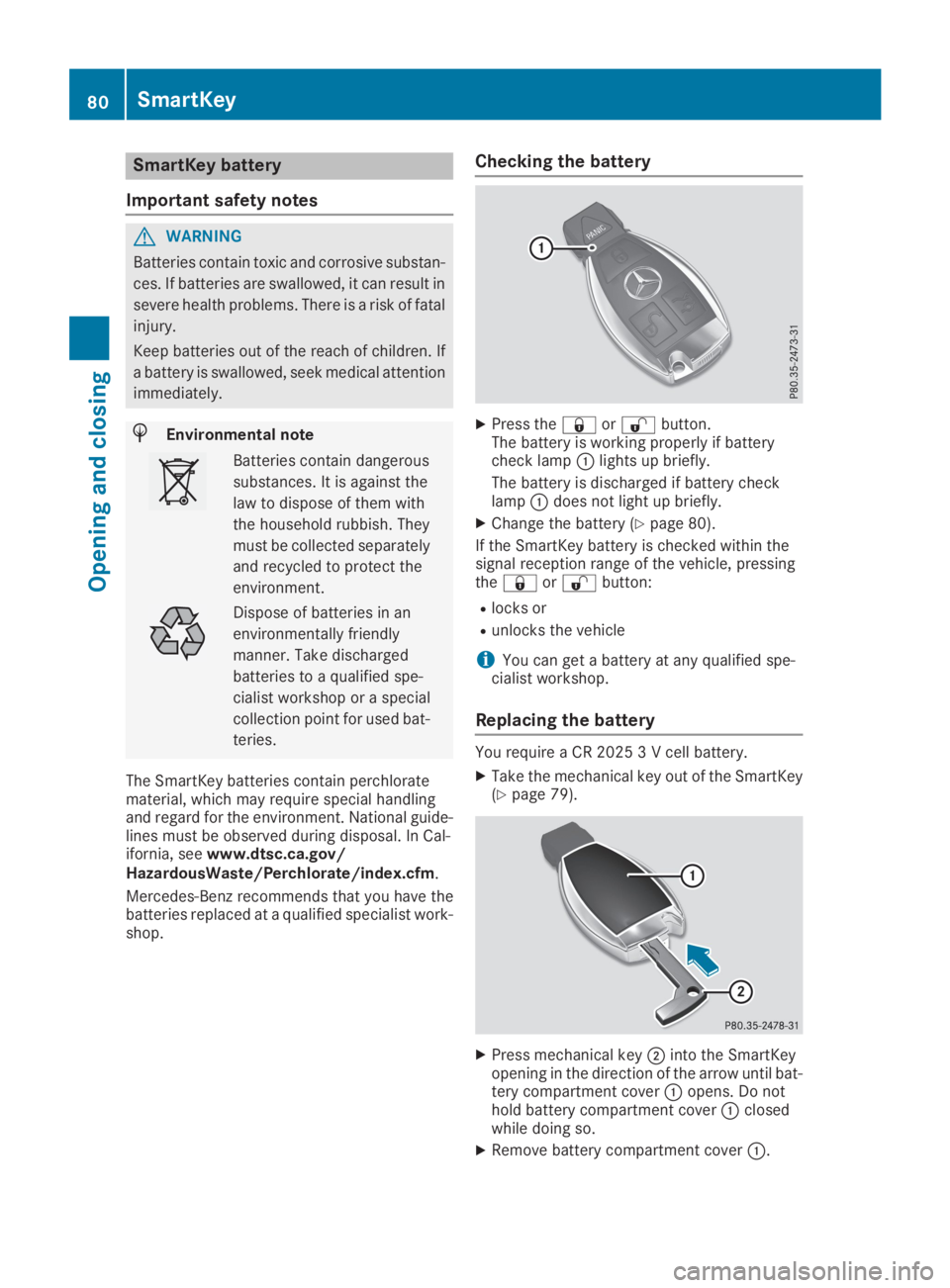
XPress the7or6button.The battery is working properly if batterycheck lampClights up briefly.
The battery is discharged if battery checklampCdoes not light up briefly.
XChange the battery (Ypage 80).
If the SmartKey battery is checked within thesignal reception range of the vehicle, pressingthe7or6button:
Rlocks or
Runlocks the vehicle
iYou can get a battery at any qualified spe-cialist workshop.
Replacing the battery
You require a CR 2025 3 V cell battery.
XTake the mechanical key out of the SmartKey(Ypage 79).
XPress mechanical keyDinto the SmartKeyopening in the direction of the arrow until bat-tery compartment coverCopens. Do nothold battery compartment coverCclosedwhile doing so.
XRemove battery compartment coverC.
80SmartKey
Opening and closing
Page 85 of 370

Doors
Important safety notes
GWARNING
If children are left unsupervised in the vehicle,
they could:
Ropen the doors, thus endangering other
people or road users.
Rget out and disrupt traffic.
Roperate the vehicle's equipment.
Additionally, children could set the vehicle in
motion if, for example, they:
Rrelease the parking brake.
Rshifting the automatic transmission out of
park positionP
RStart the engine.
There is a risk of an accident and injury.
When leaving the vehicle, always take the
SmartKey with you and lock the vehicle. Never
leave children or animals unattended in the
vehicle. Always keep the SmartKey out of
reach of children.
Unlocking and opening doors from
the inside
You can open a door from inside the vehicleeven if it has been locked. You can only open therear doors from inside the vehicle if they are notsecured by the child-proof locks (Ypage 64). Ifthe vehicle has been locked with the SmartKeyor with KEYLESS-GO, opening a door from theinside will trigger the anti-theft alarm system.Switch off the alarm (Ypage 75).
XTo unlock and open a front door:pull doorhandleD.If the door is locked, locking knobCpops up.The door is unlocked and opens.
XTo unlock a rear door:pull the rear doorhandle.The locking knob on the rear door pops up andthe rear door unlocks.
XTo open a rear door:pull the rear door han-dle again.The rear door opens.
Centrally locking and unlocking the
vehicle from the inside
You can centrally lock and unlock the vehiclefrom the inside. The buttons are on the driver’sdoor.
XTo unlock:press buttonC.
XTo lock:press buttonD.When the front-passenger door is closed, thevehicle is locked.
Meanwhile, the fuel filler flap will not be lockedor unlocked.
You cannot unlock the vehicle centrally from theinside if the vehicle has been locked with theSmartKey or KEYLESS-GO.
If the vehicle has been locked with the SmartKeyor with KEYLESS-GO, opening a door from theinside will trigger the anti-theft alarm system.Switch off the alarm (Ypage 75).
If a locked door is opened from the inside, theprevious unlock status of the vehicle will betaken into consideration if:
Rthe vehicle was locked using the locking but-ton for the central locking, or
Rlocked automatically
Doors83
Opening and closing
Z
Page 87 of 370
cially if the vehicle is in motion. There is a risk
of poisoning.
Always switch off the engine before opening
the tailgate. Never drive with the tailgate
open.
GWARNING
If objects, luggage or loads are not secured or
not secured sufficiently, they could slip, tip
over or be flung around and thereby hit vehicle
occupants. There is a risk of injury, particu-
larly in the event of sudden braking or a sud-
den change in direction.
Always store objects so that they cannot be
flung around. Secure objects, luggage or
loads against slipping or tipping before the
journey.
!The tailgate swings upwards and to the rearwhen opened. Therefore, make sure thatthere is sufficient clearance above and behindthe tailgate.
The opening dimensions of the tailgate can befound in the "Vehicle data" section(Ypage 363).
You can limit the opening angle of the tailgate(Ypage 89).
Do not leave the SmartKey in the cargo com-partment. You could otherwise lock yourselfout.
You should preferably place luggage or loads inthe cargo compartment. Observe the loadingguidelines (Ypage 278).
Tailgate object detection with revers-
ing feature
Vehicles with remote tailgate closing:
The tailgate is equipped with automatic objectdetection with reversing function. If a solidobject blocks or restricts the tailgate when auto-matically opening, this procedure is stopped. If asolid object blocks or restricts the tailgate whenautomatically closing, the tailgate automaticallyopens again slightly. Automatic object detectionwith reversing function is only an aid. It is not asubstitute for your attentiveness when openingand closing the tailgate.
GWARNING
The reversing feature does not respond:
Rto soft, light and thin objects, e.g. fingers
Rover the last
Page 88 of 370
during the closing process. There is a risk of
injury.
Make sure that nobody is in the vicinity of the
closing area during the closing process.
Use one of the following options to stop the
closing process:
Rpress theTbutton on the SmartKey.
Rpull or press the remote operating switch
on the driver's door.
Rpress the closing or locking button on the
tailgate.
Rpress the top of the star on the tailgate.
Vehicles with HANDS-FREE ACCESS:
You can also stop the closing process by per-forming a kicking movement under the rearbumper.
!The tailgate swings upwards and to the rearwhen opened. Therefore, make sure thatthere is sufficient clearance above and behindthe tailgate.
Two warning tones sound while the tailgate isopening or closing.
The opening dimensions of the tailgate can befound in the "Vehicle data" section(Ypage 363).
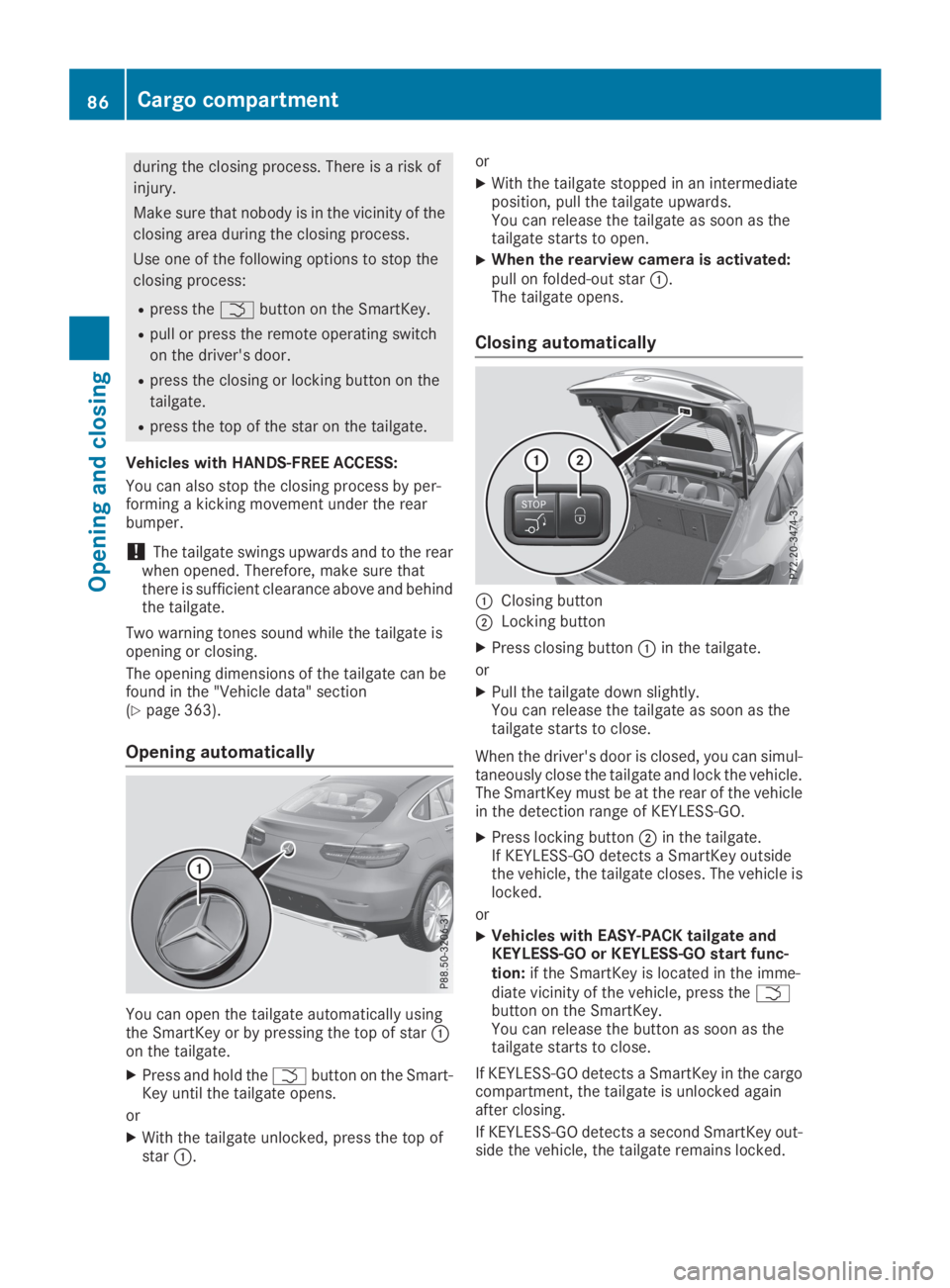
Opening automatically
You can open the tailgate automatically usingthe SmartKey or by pressing the top of starCon the tailgate.
XPress and hold theTbutton on the Smart-Key until the tailgate opens.
or
XWith the tailgate unlocked, press the top ofstarC.
or
XWith the tailgate stopped in an intermediateposition, pull the tailgate upwards.You can release the tailgate as soon as thetailgate starts to open.
XWhen the rearview camera is activated:pull on folded-out starC.The tailgate opens.
Closing automatically
CClosing button
DLocking button
XPress closing buttonCin the tailgate.
or
XPull the tailgate down slightly.You can release the tailgate as soon as thetailgate starts to close.
When the driver's door is closed, you can simul-taneously close the tailgate and lock the vehicle.The SmartKey must be at the rear of the vehiclein the detection range of KEYLESS-GO.
XPress locking buttonDin the tailgate.If KEYLESS-GO detects a SmartKey outsidethe vehicle, the tailgate closes. The vehicle islocked.
or
XVehicles with EASY-PACK tailgate andKEYLESS-GO or KEYLESS-GO start func-tion:if the SmartKey is located in the imme-diate vicinity of the vehicle, press theTbutton on the SmartKey.You can release the button as soon as thetailgate starts to close.
If KEYLESS-GO detects a SmartKey in the cargocompartment, the tailgate is unlocked againafter closing.
If KEYLESS-GO detects a second SmartKey out-side the vehicle, the tailgate remains locked.
86Cargo compartment
Opening and closing
Page 89 of 370
If KEYLESS-GO detects a SmartKey in the cargocompartment before the closing procedurestarts, the tailgate remains open.
HANDS-FREE ACCESS
General notes
With KEYLESS-GO and HANDS-FREE ACCESS,you can open or close the tailgate or stop theprocedure without using your hands. This is use-ful if you have your hands full. To do this, makea kicking movement under the bumper with yourfoot.
Observe the following points:
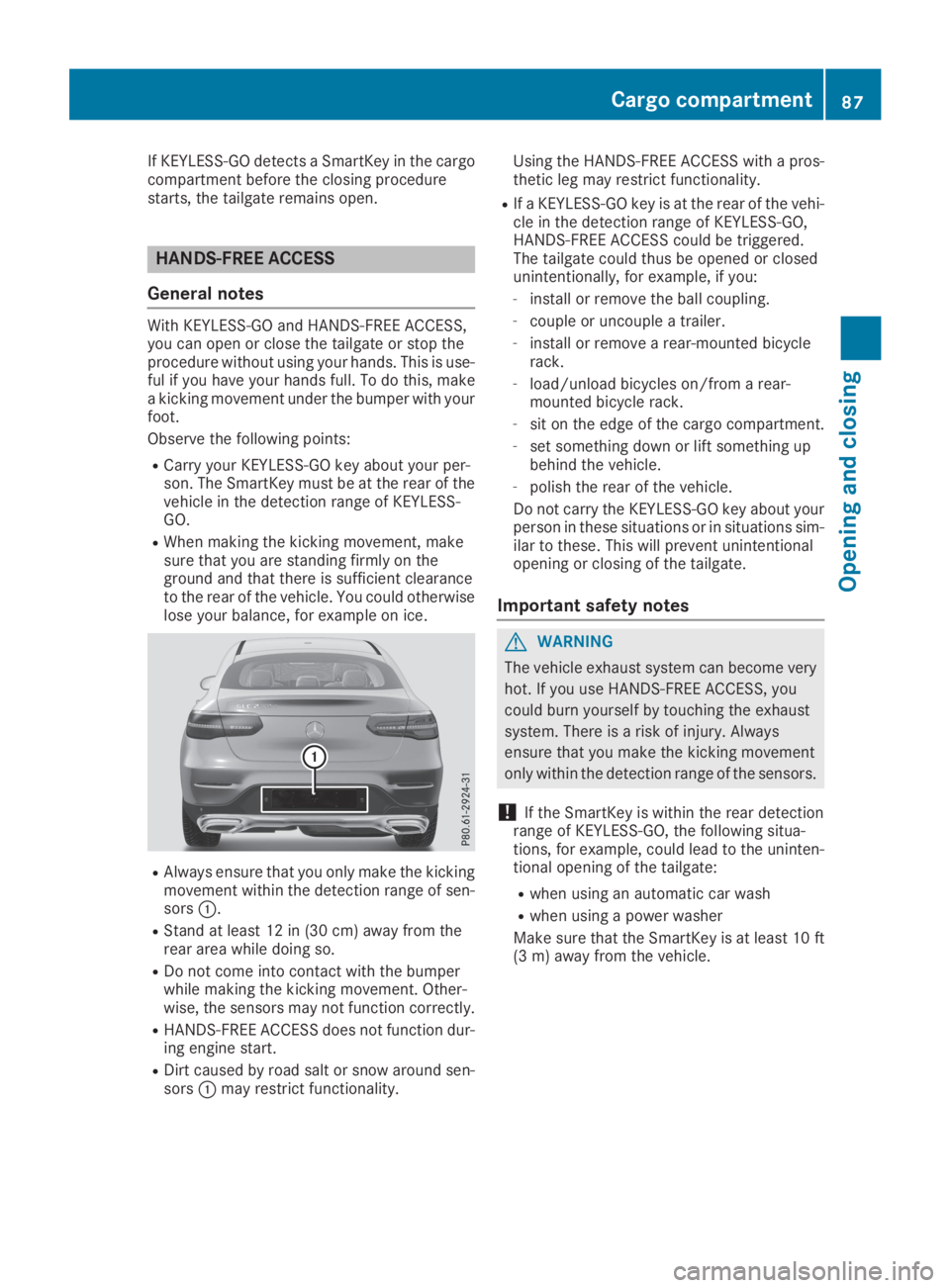
RCarry your KEYLESS-GO key about your per-son. The SmartKey must be at the rear of thevehicle in the detection range of KEYLESS-GO.
RWhen making the kicking movement, makesure that you are standing firmly on theground and that there is sufficient clearanceto the rear of the vehicle. You could otherwiselose your balance, for example on ice.
RAlways ensure that you only make the kickingmovement within the detection range of sen-sorsC.
RStand at least 12 in (30 cm) away from therear area while doing so.
RDo not come into contact with the bumperwhile making the kicking movement. Other-wise, the sensors may not function correctly.
RHANDS-FREE ACCESS does not function dur-ing engine start.
RDirt caused by road salt or snow around sen-sorsCmay restrict functionality.
Using the HANDS-FREE ACCESS with a pros-thetic leg may restrict functionality.
RIf a KEYLESS-GO key is at the rear of the vehi-cle in the detection range of KEYLESS-GO,HANDS-FREE ACCESS could be triggered.The tailgate could thus be opened or closedunintentionally, for example, if you:
-install or remove the ball coupling.
-couple or uncouple a trailer.
-install or remove a rear-mounted bicyclerack.
-load/unload bicycles on/from a rear-mounted bicycle rack.
-sit on the edge of the cargo compartment.
-set something down or lift something upbehind the vehicle.
-polish the rear of the vehicle.
Do not carry the KEYLESS-GO key about yourperson in these situations or in situations sim-ilar to these. This will prevent unintentionalopening or closing of the tailgate.
Important safety notes
GWARNING
The vehicle exhaust system can become very
hot. If you use HANDS-FREE ACCESS, you
could burn yourself by touching the exhaust
system. There is a risk of injury. Always
ensure that you make the kicking movement
only within the detection range of the sensors.
!If the SmartKey is within the rear detectionrange of KEYLESS-GO, the following situa-tions, for example, could lead to the uninten-tional opening of the tailgate:
Rwhen using an automatic car wash
Rwhen using a power washer
Make sure that the SmartKey is at least 10 ft(3 m) away from the vehicle.
Cargo compartment87
Opening and closing
Z
Page 90 of 370
Operation
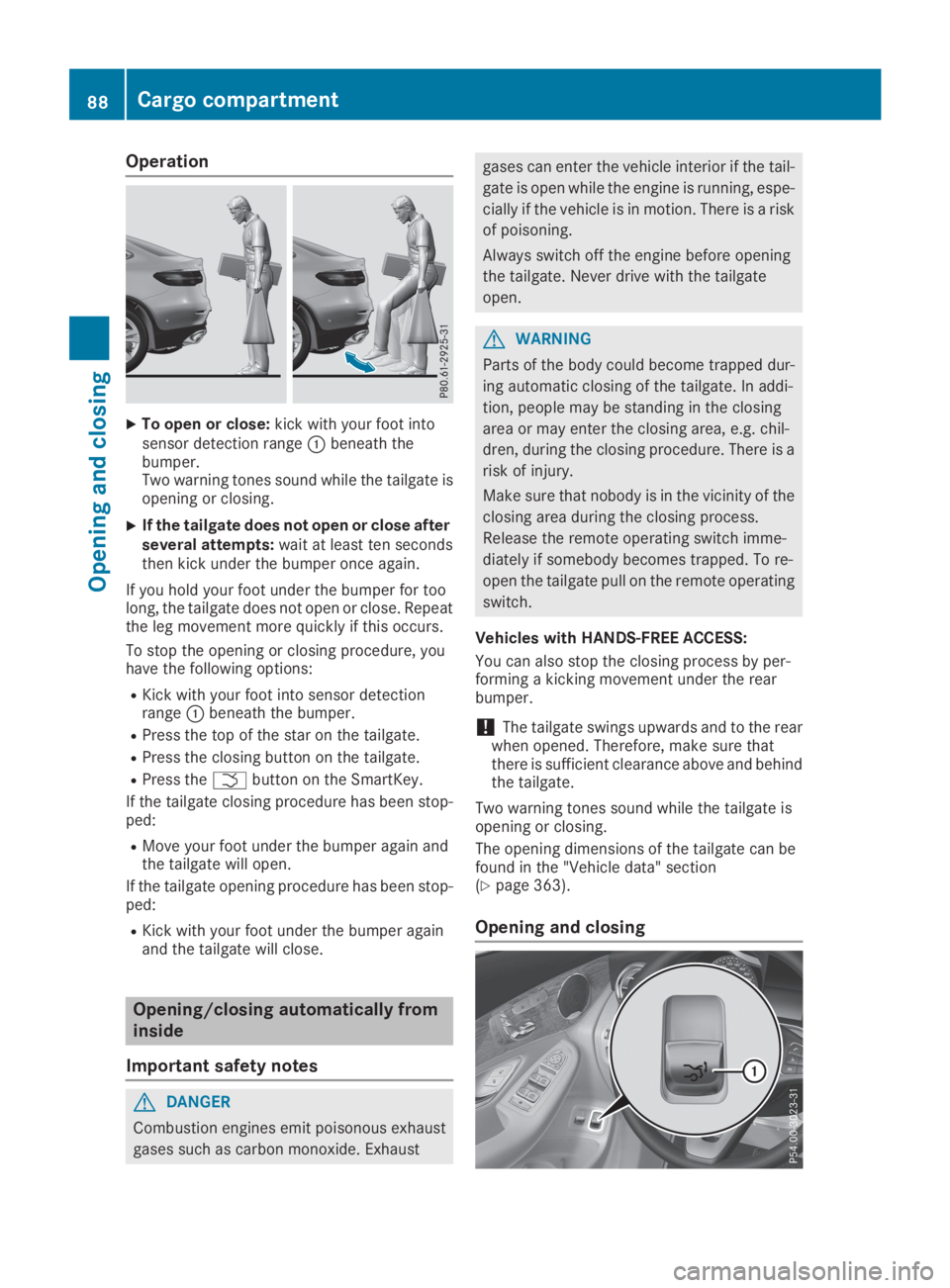
XTo open or close:kick with your foot intosensor detection rangeCbeneath thebumper.Two warning tones sound while the tailgate isopening or closing.
XIf the tailgate does not open or close afterseveral attempts:wait at least ten secondsthen kick under the bumper once again.
If you hold your foot under the bumper for toolong, the tailgate does not open or close. Repeatthe leg movement more quickly if this occurs.
To stop the opening or closing procedure, youhave the following options:
RKick with your foot into sensor detectionrangeCbeneath the bumper.
RPress the top of the star on the tailgate.
RPress the closing button on the tailgate.
RPress theTbutton on the SmartKey.
If the tailgate closing procedure has been stop-ped:
RMove your foot under the bumper again andthe tailgate will open.
If the tailgate opening procedure has been stop-ped:
RKick with your foot under the bumper againand the tailgate will close.
Opening/closing automatically from
inside
Important safety notes
GDANGER
Combustion engines emit poisonous exhaust
gases such as carbon monoxide. Exhaust
gases can enter the vehicle interior if the tail-
gate is open while the engine is running, espe-
cially if the vehicle is in motion. There is a risk
of poisoning.
Always switch off the engine before opening
the tailgate. Never drive with the tailgate
open.
GWARNING
Parts of the body could become trapped dur-
ing automatic closing of the tailgate. In addi-
tion, people may be standing in the closing
area or may enter the closing area, e.g. chil-
dren, during the closing procedure. There is a
risk of injury.
Make sure that nobody is in the vicinity of the
closing area during the closing process.
Release the remote operating switch imme-
diately if somebody becomes trapped. To re-
open the tailgate pull on the remote operating
switch.
Vehicles with HANDS-FREE ACCESS:
You can also stop the closing process by per-forming a kicking movement under the rearbumper.
!The tailgate swings upwards and to the rearwhen opened. Therefore, make sure thatthere is sufficient clearance above and behindthe tailgate.
Two warning tones sound while the tailgate isopening or closing.
The opening dimensions of the tailgate can befound in the "Vehicle data" section(Ypage 363).
Opening and closing
88Cargo compartment
Opening and closing
Page 91 of 370
XTo open:pull remote operating switchCforthe tailgate until the tailgate opens.
XTo close:turn the SmartKey to positionGorHin the ignition lock.
XPress and hold remote operating switch fortailgateCuntil the tailgate is completelyclosed.
When the vehicle is stationary, you can close thetailgate from the driver's seat. When the vehicleis also unlocked, you can also open the tailgatefrom inside.
Limiting the opening angle of the tail-
gate
General notes
!Make sure there is sufficient clearance toopen the tailgate fully when setting the open-ing angle. The tailgate could otherwise bedamaged. Ideally, set the opening angle out-side.
You can limit the opening angle of the tailgate.This is possible in the top half of its openingrange, up to approximately 8 in (20 cm) beforethe stop.
To open the tailgate fully, push the top of the staron the tailgate again after it has stopped auto-matically. This does not delete the stored posi-tion.
Activating
XTo open the tailgate:push the top of the staron the tailgate.
XTo stop the opening process at thedesired position:press the closing button onthe tailgate or push the top of the star on thetailgate again.
XTo store the position:press and hold theclosing button in the tailgate until you hear ashort tone.The opening angle limiter is activated. Thetailgate will now stop in the stored positionwhen opening.
Deactivating
XPress and hold the closing button on the tail-gate until two short tones sound.
Unlocking the tailgate using the
mechanical key
General notes
Use the mechanical key if the tailgate can nolonger be unlocked:
Rusing the SmartKey
Rusing HANDS-FREE ACCESS
Rusing the remote operating switch on the doorcontrol panel
!The tailgate swings upwards and to the rearwhen opened. Therefore, make sure thatthere is sufficient clearance above and behindthe tailgate.
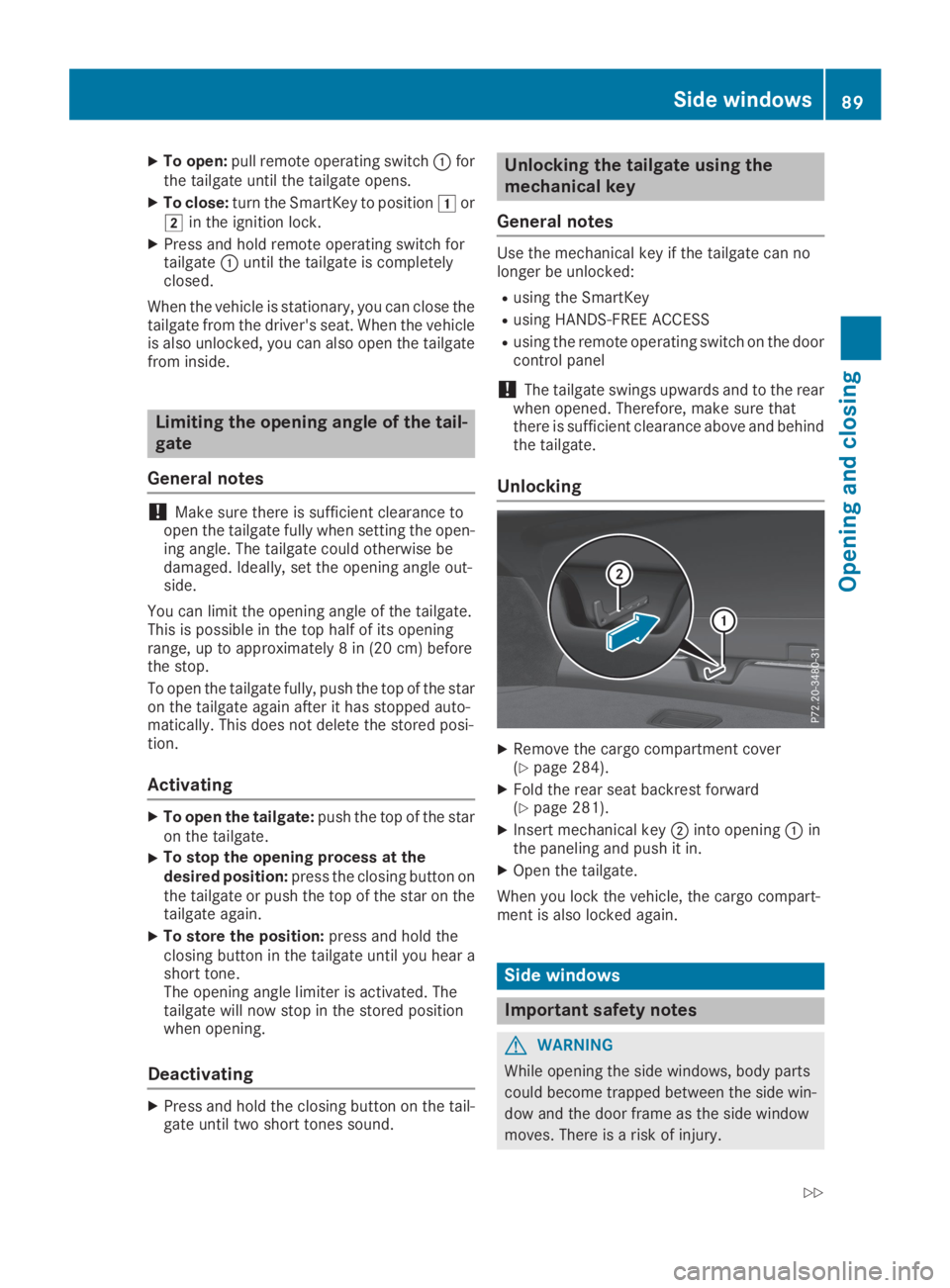
Unlocking
XRemove the cargo compartment cover(Ypage 284).
XFold the rear seat backrest forward(Ypage 281).
XInsert mechanical keyDinto openingCinthe paneling and push it in.
XOpen the tailgate.
When you lock the vehicle, the cargo compart-ment is also locked again.
Side windows
Important safety notes
GWARNING
While opening the side windows, body parts
could become trapped between the side win-
dow and the door frame as the side window
moves. There is a risk of injury.
Side windows89
Opening and closing
Z