lock MERCEDES-BENZ GLC 2019 Repair Manual
[x] Cancel search | Manufacturer: MERCEDES-BENZ, Model Year: 2019, Model line: GLC, Model: MERCEDES-BENZ GLC 2019Pages: 370, PDF Size: 19.55 MB
Page 135 of 370
Starting the engine
Important safety notes
GWARNING
If children are left unsupervised in the vehicle,
they could:
Ropen the doors, thus endangering other
people or road users.
Rget out and disrupt traffic.
Roperate the vehicle's equipment.
Additionally, children could set the vehicle in
motion if, for example, they:
Rrelease the parking brake.
Rshifting the automatic transmission out of
park positionP
RStart the engine.
There is a risk of an accident and injury.
When leaving the vehicle, always take the
SmartKey with you and lock the vehicle. Never
leave children or animals unattended in the
vehicle. Always keep the SmartKey out of
reach of children.
GDANGER
Combustion engines emit poisonous exhaust
gases such as carbon monoxide. Inhaling
these exhaust gases is hazardous to health
and can result in poisoning. There is a risk of
fatal injury. Therefore, never leave the engine
running an enclosed space without adequate
ventilation.
GWARNING
Flammable materials introduced through
environmental influence or by animals can
ignite if in contact with the exhaust system or
parts of the engine that heat up. There is a risk
of fire.
Carry out regular checks to make sure that
there are no flammable foreign materials in
the engine compartment or in the exhaust
system.
General notes
The catalytic converter is preheated for up to30 seconds after a cold start. The sound of theengine may change during this time.
Automatic transmission
XShift the transmission to position](Ypage 141).The transmission position indicator on themultifunction display shows](Ypage 142).
iYou can start the engine in transmissionposition]and\\.
Starting procedure with the SmartKey
To start the engine using the SmartKey insteadof the Start/Stop button, pull the Start/Stopbutton out of the ignition lock.
XTurn the SmartKey to positionIin the igni-tion lock and release it as soon as the engineis running.
If the engine will not start:
XRemove the SmartKey from the ignition lock.
XReinsert the SmartKey into the ignition lockafter a short waiting period.
XTurn the SmartKey to positionHin the igni-tion lock (Ypage 131).The indicator lamps in the instrument clusterlight up (Ypage 256).
XTurn the SmartKey to positionIin the igni-tion lock (Ypage 131) and release it as soonas the engine is running.
Starting procedure with the Start/Stop
button
The Start/Stop button is only available on vehi-cles with KEYLESS-GO or the KEYLESS-GO startfunction.
The Start/Stop button can be used to start thevehicle manually without inserting the SmartKeyinto the ignition lock. The Start/Stop buttonmust be inserted in the ignition lock and theSmartKey must be in the vehicle. This mode forstarting the engine operates independently ofthe ECO start/stop automatic engine start func-tion.
You can start the engine if a valid SmartKey is inthe vehicle. Switch off the engine and always
Driving133
Driving and parking
Z
Page 136 of 370
take the SmartKey with you when leaving thevehicle, even if you only leave it for a short time.Pay attention to the important safety notes.
XDepress the brake pedal and keep itdepressed.
XPress the Start/Stop button once(Ypage 132).The engine starts.
Starting procedure via smartphone
Observe the important safety notes on startingthe engine (Ypage 133).
You can also start your engine via your smart-phone from outside the vehicle. In this case, thepreviously selected climate control setting isactivated. In this way you can cool or heat theinterior of the vehicle before starting the jour-ney.
Only start the engine via your smartphone if it issafe to start and run the engine where your vehi-cle is parked.
Observe the legal stipulations in the area whereyour vehicle is parked. Engine start via smart-phone may be limited to certain countries orregions.
You can execute a maximum of two consecutivestarting attempts via your smartphone. If youpress the start/stop button or insert the Smart-Key into the ignition lock, you can carry out twomore starting attempts with your smartphone.
The engine runs for ten minutes when startingwith the smartphone.
Once you have started the engine, you canswitch the engine off via your smartphone at anytime.
You can only start the engine via your smart-phone if:
Rthe SmartKey is in the ignition lock
Rpark position]is selected
Rthe accelerator pedal is not depressed
Rthe anti-theft alarm system is not activated
Rthe panic alarm is not activated
Rthe hazard warning lamps are switched off
Rthe hood is closed
Rthe doors are closed and locked
Rthe windows and sliding sunroof are closed
Also make sure that:
Rthe fuel tank is sufficiently filled
Rthe starter battery has been sufficientlycharged
GWARNING
Limbs could be crushed or trapped if the
engine is started unintentionally during ser-
vice or maintenance work. There is a risk of
injury.
Always secure the engine against uninten-
tional starting before carrying out mainte-
nance or repair work.
Make sure that the engine cannot be started viayour smartphone before carrying out mainte-nance or repairs. You can prevent an enginestart via your smartphone, for example, if you:
Rswitch on the hazard warning lamps
Rdo not lock the doors
Ropen a side window
Pulling away
General notes
GWARNING
If the engine speed is above the idling speed
and you engage transmission positionDorR,
the vehicle could pull away suddenly. There is
a risk of an accident.
When engaging transmission positionDorR,
always firmly depress the brake pedal and do
not simultaneously accelerate.
Depress the accelerator carefully when pullingaway.
The vehicle locks centrally once you have pulledaway. The locking knobs in the doors drop down.
You can open the doors from the inside at anytime.
You can also deactivate the automatic lockingfeature, see the Digital Operator's Manual.
It is possible to shift the transmission from posi-tion]to the desired position only if youdepress the brake pedal. Only then is the park-ing lock released. If you do not depress thebrake pedal, the DIRECT SELECT lever can still
134Driving
Driving an d parking
Page 137 of 370
be moved but the parking lock remainsengaged.
iUpshifts take place at higher engine speedsafter a cold start. This helps the catalytic con-verter to reach its operating temperaturemore quickly.
Information on the automatic release of theelectric parking brake (Ypage 155).
Pulling away with a trailer
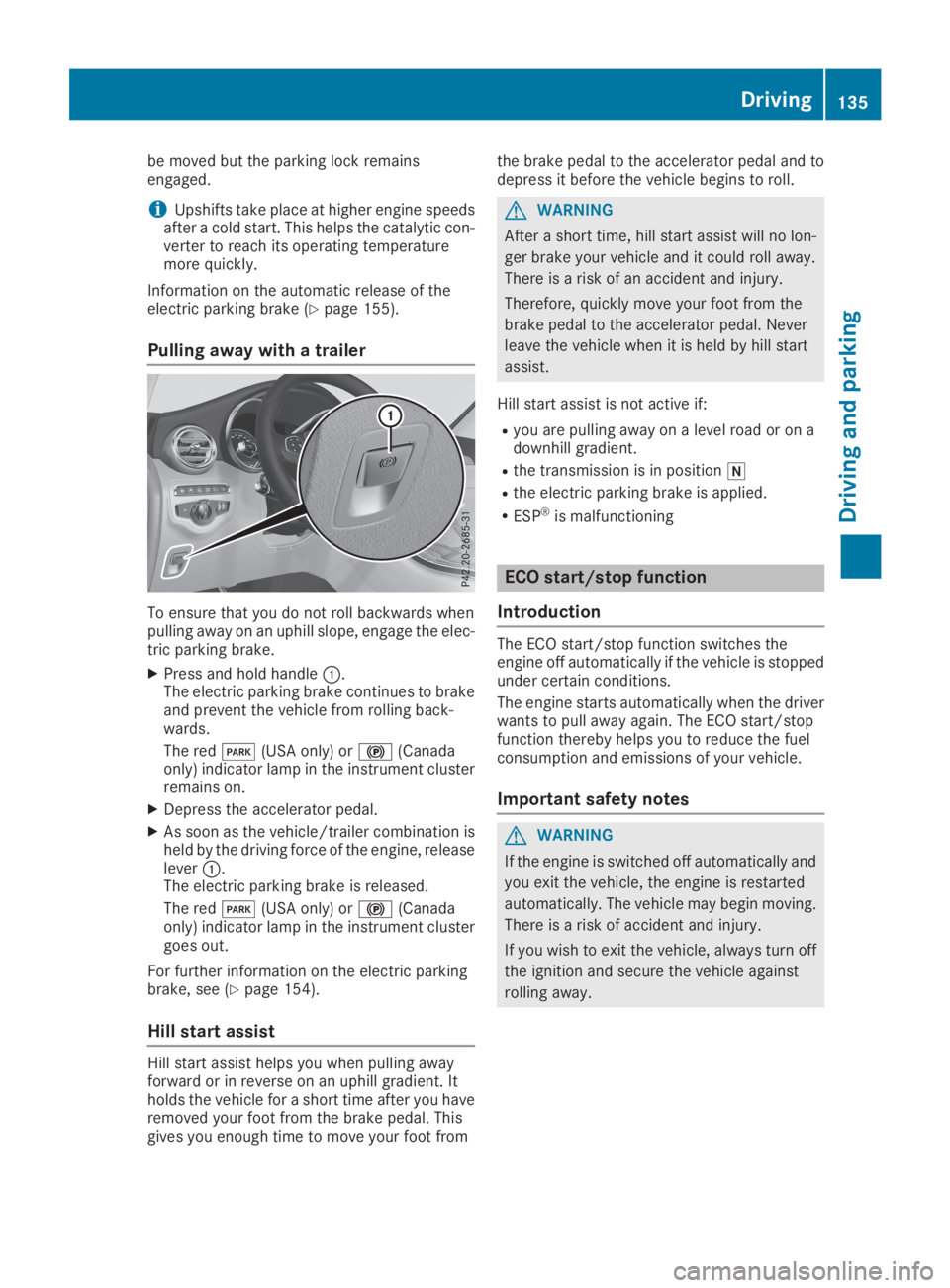
To ensure that you do not roll backwards whenpulling away on an uphill slope, engage the elec-tric parking brake.
XPress and hold handleC.The electric parking brake continues to brakeand prevent the vehicle from rolling back-wards.
The redI(USA only) or$(Canadaonly) indicator lamp in the instrument clusterremains on.
XDepress the accelerator pedal.
XAs soon as the vehicle/trailer combination isheld by the driving force of the engine, releaseleverC.The electric parking brake is released.
The redI(USA only) or$(Canadaonly) indicator lamp in the instrument clustergoes out.
For further information on the electric parkingbrake, see (Ypage 154).
Hill start assist
Hill start assist helps you when pulling awayforward or in reverse on an uphill gradient. Itholds the vehicle for a short time after you haveremoved your foot from the brake pedal. Thisgives you enough time to move your foot from
the brake pedal to the accelerator pedal and todepress it before the vehicle begins to roll.
GWARNING
After a short time, hill start assist will no lon-
ger brake your vehicle and it could roll away.
There is a risk of an accident and injury.
Therefore, quickly move your foot from the
brake pedal to the accelerator pedal. Never
leave the vehicle when it is held by hill start
assist.
Hill start assist is not active if:
Ryou are pulling away on a level road or on adownhill gradient.
Rthe transmission is in position\\
Rthe electric parking brake is applied.
RESP®is malfunctioning
ECO start/stop function
Introduction
The ECO start/stop function switches theengine off automatically if the vehicle is stoppedunder certain conditions.
The engine starts automatically when the driverwants to pull away again. The ECO start/stopfunction thereby helps you to reduce the fuelconsumption and emissions of your vehicle.
Important safety notes
GWARNING
If the engine is switched off automatically and
you exit the vehicle, the engine is restarted
automatically. The vehicle may begin moving.
There is a risk of accident and injury.
If you wish to exit the vehicle, always turn off
the ignition and secure the vehicle against
rolling away.
Driving135
Driving and parking
Z
Page 143 of 370
drive program, regardless of the display in themultimedia system display.
Available drive programs:
IIndividualIndividual settings
S+Sport PlusParticularly sporty drivingcharacteristics
SSportSporty driving characteris-tics
CComfortComfortable and economi-cal driving characteristics
EEconomyParticularly economicaldriving characteristics
Additional information for drive programs(Ypage 145).
You can also change gear yourself using thesteering wheel paddle shifters. For further infor-mation on the manual drive program(Ypage 147).
Automatic transmission
Important safety notes
GWARNING
If the engine speed is above the idling speed
and you engage transmission positionDorR,
the vehicle could pull away suddenly. There is
a risk of an accident.
When engaging transmission positionDorR,
always firmly depress the brake pedal and do
not simultaneously accelerate.
GWARNING
The automatic transmission switches to neu-
tral positionNwhen you switch off the engine.
The vehicle may roll away. There is a risk of an
accident.
After switching off the engine, always switch
to parking positionP. Prevent the parked vehi-
cle from rolling away by applying the parking
brake.
DIRECT SELECT lever
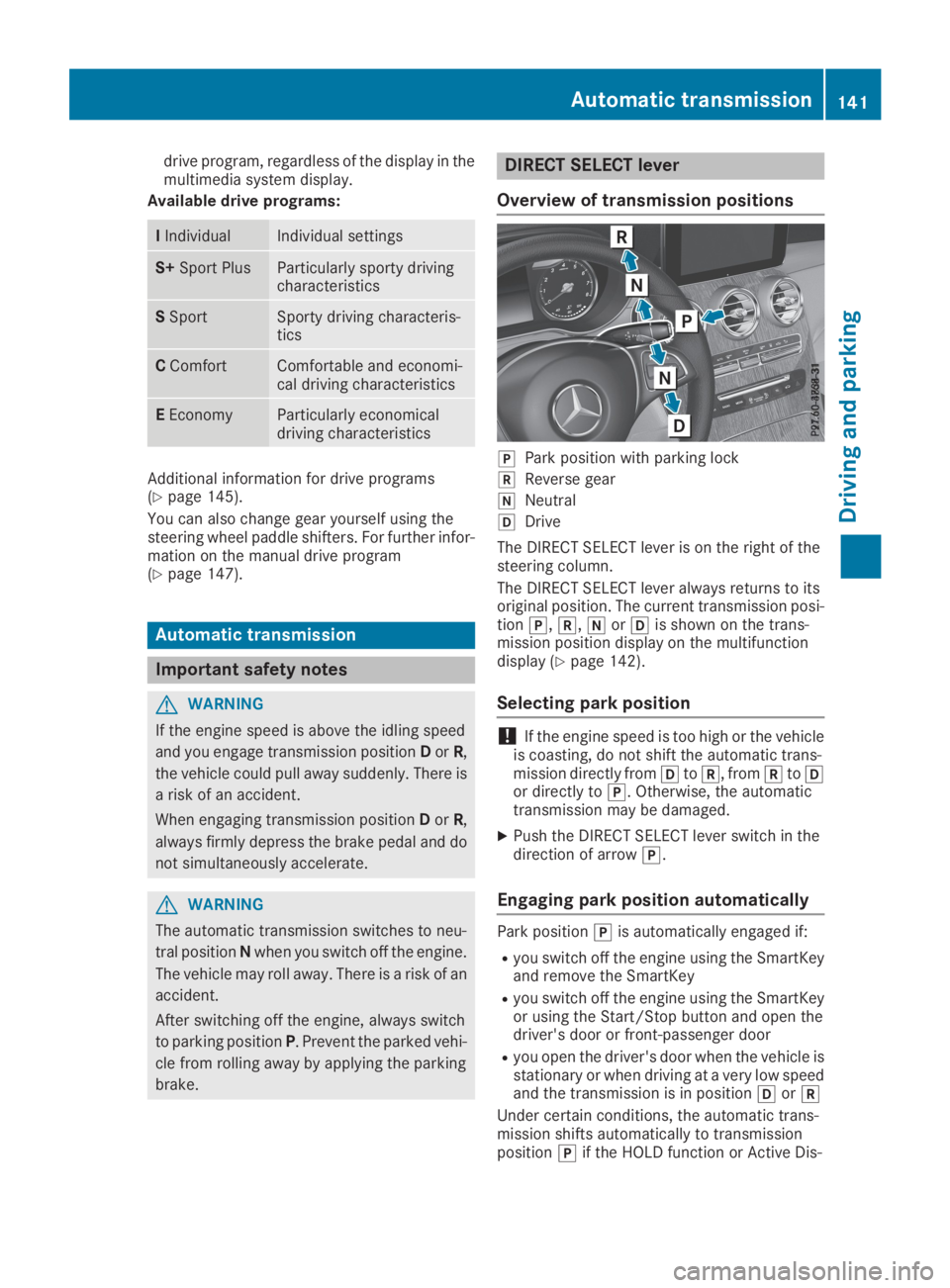
Overview of transmission positions
]Park position with parking lock
^Reverse gear
\\Neutral
[Drive
The DIRECT SELECT lever is on the right of thesteering column.
The DIRECT SELECT lever always returns to itsoriginal position. The current transmission posi-tion],^,\\or[is shown on the trans-mission position display on the multifunctiondisplay (Ypage 142).
Selecting park position
!If the engine speed is too high or the vehicleis coasting, do not shift the automatic trans-mission directly from[to^, from^to[or directly to]. Otherwise, the automatictransmission may be damaged.
XPush the DIRECT SELECT lever switch in thedirection of arrow].
Engaging park position automatically
Park position]is automatically engaged if:
Ryou switch off the engine using the SmartKeyand remove the SmartKey
Ryou switch off the engine using the SmartKeyor using the Start/Stop button and open thedriver's door or front-passenger door
Ryou open the driver's door when the vehicle isstationary or when driving at a very low speedand the transmission is in position[or^
Under certain conditions, the automatic trans-mission shifts automatically to transmissionposition]if the HOLD function or Active Dis-
Automatic transmission141
Driving and parking
Z
Page 144 of 370
tance Assist DISTRONIC is activated. Observethe information on the HOLD function(Ypage 170) and on Active Distance AssistDISTRONIC (Ypage 165).
Engaging reverse gear
!Only move the automatic transmission to^when the vehicle is stationary.
XDepress the brake pedal.
XPush the DIRECT SELECT lever up past thefirst point of resistance.
The ECO start/stop function is not availablewhen reverse gear is engaged. Further informa-tion on the ECO start/stop function(Ypage 136).
Shifting to neutral
GWARNING
If children are left unsupervised in the vehicle,
they could:
Ropen the doors, thus endangering other
people or road users.
Rget out and disrupt traffic.
Roperate the vehicle's equipment.
Additionally, children could set the vehicle in
motion if, for example, they:
Rrelease the parking brake.
Rshifting the automatic transmission out of
park positionP
RStart the engine.
There is a risk of an accident and injury.
When leaving the vehicle, always take the
SmartKey with you and lock the vehicle. Never
leave children or animals unattended in the
vehicle. Always keep the SmartKey out of
reach of children.
XIf the transmission is in position[or^:push the DIRECT SELECT lever up or down tothe first point of resistance.
XIf the transmission is in position]: depressthe brake pedal and push the DIRECT SELECTlever up or down to the first point of resist-ance.
If you switch the engine off with the transmis-sion in position^or[, the automatic trans-mission shifts to\\automatically.
With the SmartKey:if you then open the driv-er's door or the front-passenger door or removethe SmartKey from the ignition lock, the auto-matic transmission shifts to]automatically.
With the Start/Stop button:if you then openthe driver's door or the front-passenger door,the automatic transmission shifts to]auto-matically.
If you want the automatic transmission toremain in neutral\\, e.g. when having the vehi-cle cleaned in an automatic, tow-through carwash:
XVehicles with KEYLESS-GO or KEYLESS-GO start function:remove the Start/Stopbutton from the ignition lock.
XInsert the SmartKey into the ignition lock.
XAll vehicles:switch the ignition on.
XDepress the brake pedal and keep itdepressed.
XShift to neutral\\.
XRelease the brake pedal.
XRelease the electric parking brake.
XSwitch off the ignition and leave the SmartKeyin the ignition lock.
Engaging the drive position
XIf the transmission is in position^or\\:push the DIRECT SELECT lever down past thefirst point of resistance.
XIf the transmission is in position]: depressthe brake pedal and push the DIRECT SELECTlever down past the first point of resistance.
Transmission position and drive pro-
gram display
The current transmission position and drive pro-gram appear in the multifunction display.
142Automatic transmission
Driving an d parking
Page 153 of 370
clean water. Seek medical assistance with-
out delay.
RIf fuel is swallowed, seek medical assis-
tance without delay. Do not induce vomit-
ing.
RImmediately change out of clothing which
has come into contact with fuel.
GWARNING
Electrostatic charge can cause sparks and
thereby ignite fuel vapors. There is a risk of
fire and explosion.
Before you open the fuel filler cap or take hold
of the pump nozzle, touch the metallic vehicle
body. This discharges any electrostatic
charge that may have built up.
Do not get into the vehicle again during the
refueling process. Otherwise, electrostatic
charge could build up again.
Do not get into the vehicle again during the refu-eling process. Otherwise electrostatic chargecould build up again.
!Do not use diesel to refuel vehicles with agasoline engine. Do not switch on the ignitionif you accidentally refuel with the wrong fuel.Otherwise, the fuel will enter the fuel system.Even small amounts of the wrong fuel couldresult in damage to the fuel system and theengine. Notify a qualified specialist workshopand have the fuel tank and fuel lines drainedcompletely.
!Overfilling the fuel tank could damage thefuel system.
!Take care not to spill any fuel on paintedsurfaces. You could otherwise damage thepaintwork.
!Use a filter when adding fuel from a fuel can.The fuel lines and/or the fuel injection systemcould otherwise be blocked by particles fromthe fuel can.
If you overfill the fuel tank, fuel could spray outwhen the fuel pump nozzle is removed.
For further information on fuel and fuel quality(Ypage 358).
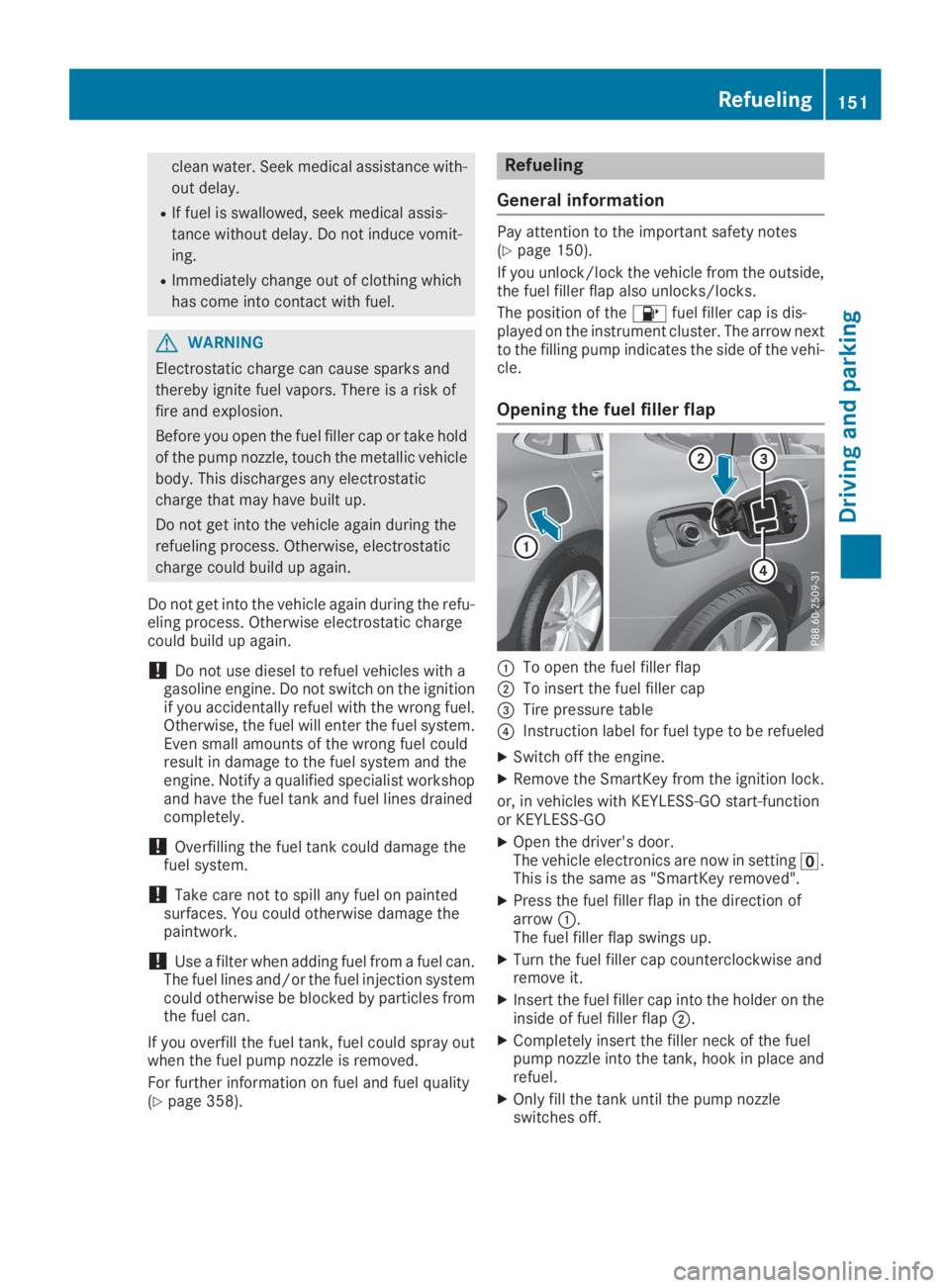
Refueling
General information
Pay attention to the important safety notes(Ypage 150).
If you unlock/lock the vehicle from the outside,the fuel filler flap also unlocks/locks.
The position of the
Page 154 of 370
Do not add any more fuel after the pump stopsfilling for the first time. Otherwise, fuel may leakout.
Closing the fuel filler flap
XReplace the cap on the filler neck and turnclockwise until it engages audibly.
XClose the fuel filler flap.
Close the fuel filler flap before locking the vehi-cle.
If you are driving with the fuel filler cap open, the
Page 155 of 370
GWARNING
If you leave children unsupervised in the vehi-
cle, they could set it in motion by, for example:
Rrelease the parking brake.
Rshift the automatic transmission out of the
parking positionP.
Rstart the engine.
In addition, they may operate vehicle equip-
ment and become trapped. There is a risk of
an accident and injury.
When leaving the vehicle, always take the
SmartKey with you and lock the vehicle. Never
leave children unsupervised in the vehicle.
!Always secure the vehicle correctly againstrolling away. Otherwise, the vehicle or its driv-etrain could be damaged.
To ensure that the vehicle is secured againstrolling away unintentionally:
Rthe electric parking brake must be applied.
Rthe transmission must be in position]andthe SmartKey must be removed from the igni-tion lock.
Rthe front wheels must be turned towards thecurb on steep uphill or downhill gradients.
Rthe empty vehicle must be secured at thefront axle with a wheel chock or similar, forexample, on uphill or downhill gradients.
Ron uphill or downhill gradients the laden vehi-cle must also be secured at the rear axle, forexample with a wheel chock or similar object.
Switching off the engine
Important safety notes
GWARNING
The automatic transmission switches to neu-
tral positionNwhen you switch off the engine.
The vehicle may roll away. There is a risk of an
accident.
After switching off the engine, always switch
to parking positionP. Prevent the parked vehi-
cle from rolling away by applying the parking
brake.
Vehicles with automatic transmission
XApply the electric parking brake.
XShift the transmission to position].
XWith the SmartKey:turn the SmartKey toposition
Page 156 of 370
Electric parking brake
General notes
GWARNING
If you leave children unsupervised in the vehi-
cle, they could set it in motion by, for example:
Rrelease the parking brake.
Rshift the automatic transmission out of the
parking positionP.
Rstart the engine.
In addition, they may operate vehicle equip-
ment and become trapped. There is a risk of
an accident and injury.
When leaving the vehicle, always take the
SmartKey with you and lock the vehicle. Never
leave children unsupervised in the vehicle.
The function of the electric parking brake isdependent on the on-board voltage. If the on-board voltage is low or there is a malfunction inthe system, it may not be possible to apply thereleased parking brake.
XIf this happens, park the vehicle on levelground only and secure it to prevent it fromrolling away.
XShift the transmission to position].
It may not be possible to release an appliedparking brake if the on-board voltage is low orthere is a malfunction in the system. Contact aqualified specialist workshop.
The electric parking brake performs a functiontest at regular intervals while the engine isswitched off. The sounds that can be heard whilethis is occurring are normal.
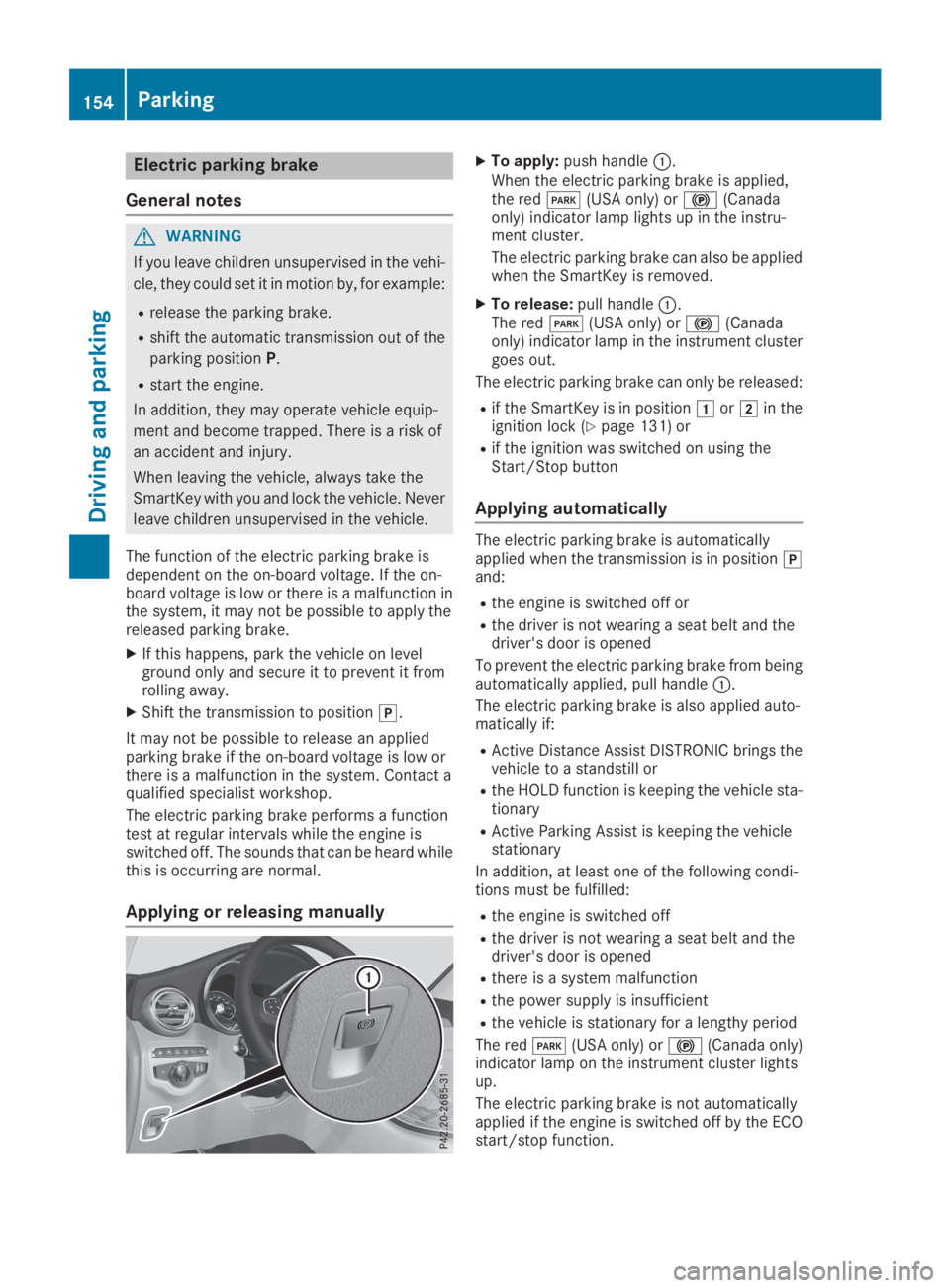
Applying or releasing manually
XTo apply:push handleC.When the electric parking brake is applied,the redI(USA only) or$(Canadaonly) indicator lamp lights up in the instru-ment cluster.
The electric parking brake can also be appliedwhen the SmartKey is removed.
XTo release:pull handleC.The redI(USA only) or$(Canadaonly) indicator lamp in the instrument clustergoes out.
The electric parking brake can only be released:
Rif the SmartKey is in positionGorHin theignition lock (Ypage 131) or
Rif the ignition was switched on using theStart/Stop button
Applying automatically
The electric parking brake is automaticallyapplied when the transmission is in position]and:
Rthe engine is switched off or
Rthe driver is not wearing a seat belt and thedriver's door is opened
To prevent the electric parking brake from beingautomatically applied, pull handleC.
The electric parking brake is also applied auto-matically if:
RActive Distance Assist DISTRONIC brings thevehicle to a standstill or
Rthe HOLD function is keeping the vehicle sta-tionary
RActive Parking Assist is keeping the vehiclestationary
In addition, at least one of the following condi-tions must be fulfilled:
Rthe engine is switched off
Rthe driver is not wearing a seat belt and thedriver's door is opened
Rthere is a system malfunction
Rthe power supply is insufficient
Rthe vehicle is stationary for a lengthy period
The redI(USA only) or$(Canada only)indicator lamp on the instrument cluster lightsup.
The electric parking brake is not automaticallyapplied if the engine is switched off by the ECOstart/stop function.
154Parking
Driving and parking
Page 160 of 370
This helps you to avoid overheating thebrakes and wearing them out excessively.
When you take advantage of engine braking, adrive wheel may not turn for some time, e.g.on a slippery road surface. This could causedamage to the drive train. This type of damageis not covered by the Mercedes-Benz war-ranty.
Heavy and light loads
GWARNING
If you rest your foot on the brake pedal while
driving, the braking system can overheat. This
increases the stopping distance and can even
cause the braking system to fail. There is a
risk of an accident.
Never use the brake pedal as a footrest. Never
depress the brake pedal and the accelerator
pedal at the same time.
!Depressing the brake pedal constantlyresults in excessive and premature wear tothe brake pads.
If the brakes have been subjected to a heavyload, do not stop the vehicle immediately. Driveon for a short while. This allows the airflow tocool the brakes more quickly.
Wet roads
If you have driven for a long time in heavy rainwithout braking, there may be a delayed reac-tion from the brakes when braking for the firsttime. This may also occur after the vehicle hasbeen washed or driven through deep water.
You have to depress the brake pedal morefirmly. Maintain a greater distance from thevehicle in front.
After driving on a wet road or having the vehiclewashed, brake firmly while paying attention tothe traffic conditions. This will warm up thebrake discs, thereby drying them more quicklyand protecting them against corrosion.
Limited braking performance on salt-
treated roads
If you drive on salted roads, a layer of salt resi-due may form on the brake discs and brakepads. This can result in a significantly longerbraking distance.
RIn order to prevent any salt build-up, apply thebrakes occasionally while paying attention tothe traffic conditions.
RCarefully depress the brake pedal and thebeginning and end of a journey.
RMaintain a greater distance to the vehicleahead.
Servicing the brakes
!The brake fluid level may be too low, if:
Rif the red brake warning lamp lights up inthe instrument cluster and
Ryou hear a warning tone while the engine isrunning
Observe additional warning messages in themultifunction display.
The brake fluid level may be too low due tobrake pad wear or leaking brake lines.
Have the brake system checked immediately.Consult a qualified specialist workshop toarrange this.
!Vehicles with 4MATIC:function or per-formance tests may only be carried out on a 2-axle dynamometer. If you wish to operate thevehicle on such a dynamometer, please con-sult a qualified specialist workshop inadvance. You could otherwise damage thedrive train or the brake system.
!Vehicles with 4MATIC:the ESP®systemoperates automatically. If the electric parkingbrake is tested on a brake dynamometer, theengine and ignition must be switched off: turnthe SmartKey in the ignition lock to position