warning MERCEDES-BENZ GLC SUV 2015 Owner's Manual
[x] Cancel search | Manufacturer: MERCEDES-BENZ, Model Year: 2015, Model line: GLC SUV, Model: MERCEDES-BENZ GLC SUV 2015Pages: 497, PDF Size: 15.27 MB
Page 42 of 497
Centre console
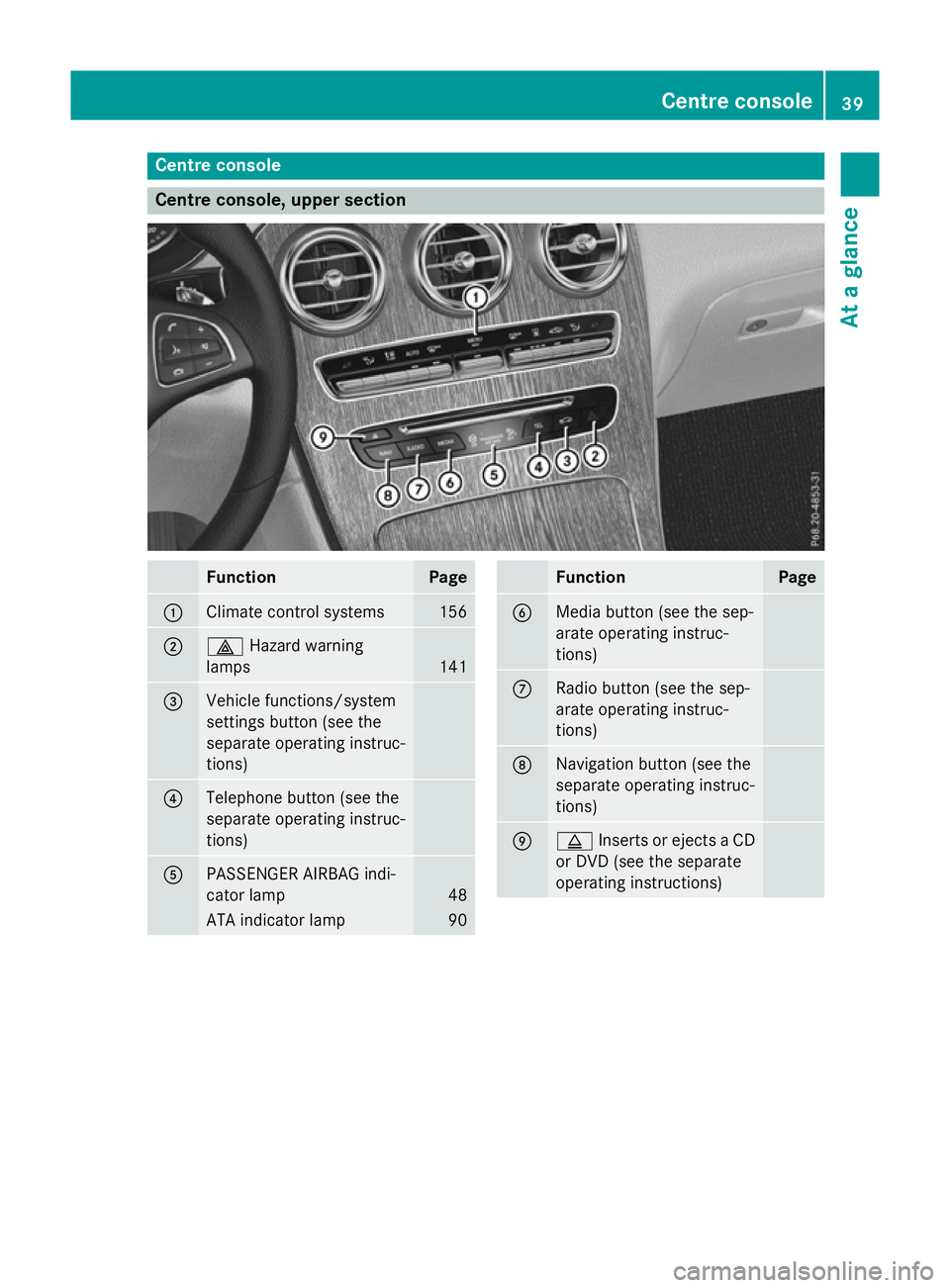
Centre console, upper section
Function Page
:
Climate control systems 156
;
£
Hazard warning
lamps 141
=
Vehicle functions/system
settings button (see the
separate operating instruc-
tions) ?
Telephone button (see the
separate operating instruc-
tions) A
PASSENGER AIRBAG indi-
cator lamp
48
ATA indicator lamp 90 Function Page
B
Media button (see the sep-
arate operating instruc-
tions)
C
Radio button (see the sep-
arate operating instruc-
tions) D
Navigation button (see the
separate operating instruc-
tions)
E
þ
Inserts or ejects a CD
or DVD (see the separate
operating instructions) Centre console
39At a glance
Page 47 of 497
Useful information
i This Owner's Manual describes all mod-
els, series and optional equipment for your
vehicle that were available at the time of
going to press. National variations are pos- sible. Note that your vehicle may not be
equipped with all of the functions descri-
bed. This is also the case for systems and
functions relevant to safety.
i Read the information on qualified special-
ist workshops: (Y page 28). Hybrid vehicles
General notes
Hybrid technology combines a fuel-efficient
internal combustion engine with a powerful
electric motor. Important safety notes
Danger of electric shock G
DANGER
The vehicle's high voltage electrical system is under high voltage. If you modify components
in the vehicle's high-voltage electrical system or touch damaged components, you may be
electrocuted. The components in the vehi-
cle's high-voltage electrical system may be
damaged in an accident, although the damage
is not visible. There is a risk of fatal injury.
Do not touch any high-voltage components
after an accident and never modify the vehi-
cle's high-voltage electrical system. Have the vehicle towed away after an accident and the vehicle's high-voltage electrical system
checked by a qualified specialist workshop.
When towing a vehicle after an accident, be
sure to observe the following sections:
R Transporting the vehicle (Y page 448)
R Towing the vehicle with both axles on the
ground (Y page 447) Read the safety instructions on towing and
tow-starting (Y
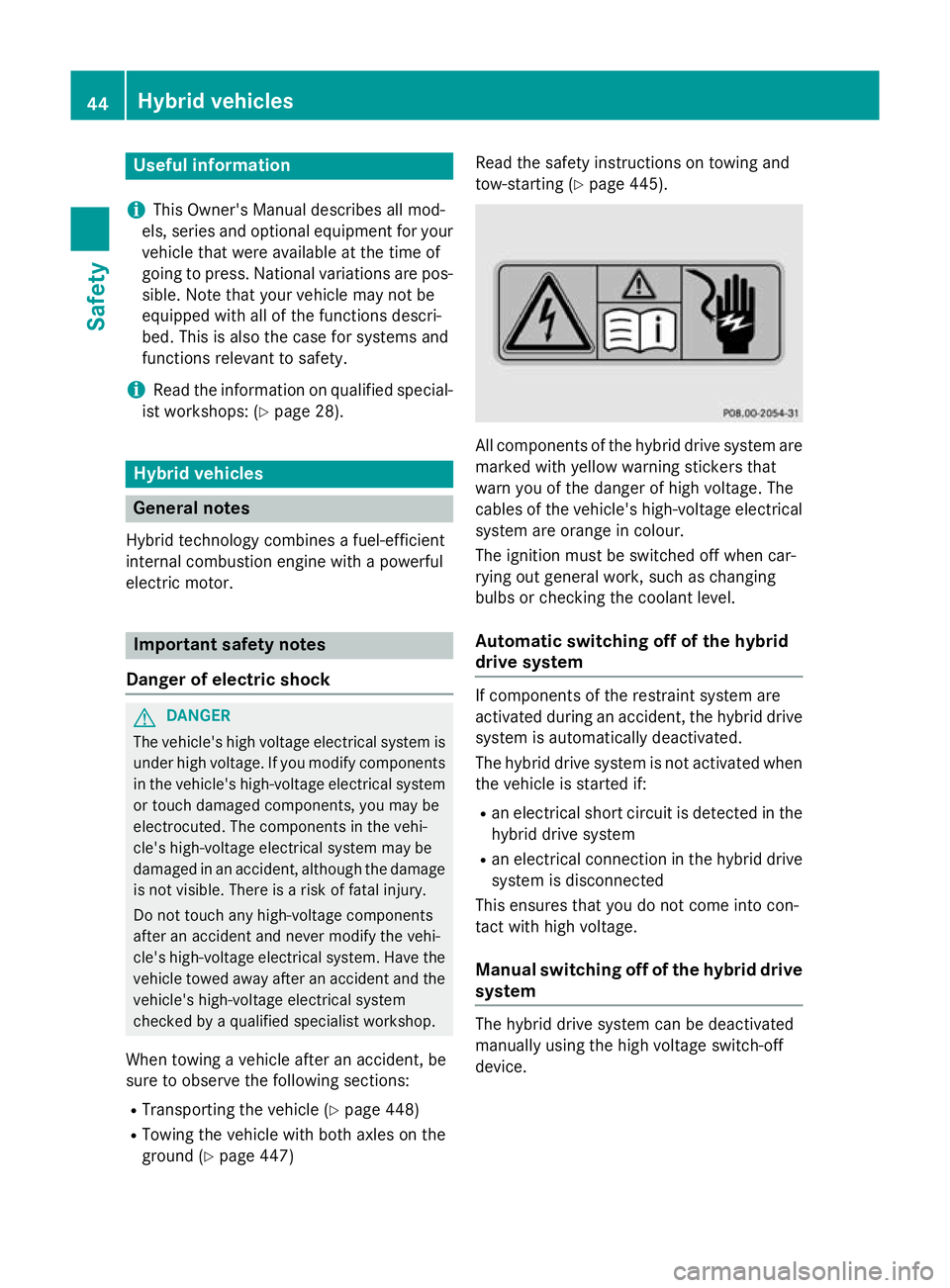
page 445). All components of the hybrid drive system are
marked with yellow warning stickers that
warn you of the danger of high voltage. The
cables of the vehicle's high-voltage electrical system are orange in colour.
The ignition must be switched off when car-
rying out general work, such as changing
bulbs or checking the coolant level.
Automatic switching off of the hybrid
drive system If components of the restraint system are
activated during an accident, the hybrid drive
system is automatically deactivated.
The hybrid drive system is not activated when
the vehicle is started if:
R an electrical short circuit is detected in the
hybrid drive system
R an electrical connection in the hybrid drive
system is disconnected
This ensures that you do not come into con-
tact with high voltage.
Manual switching off of the hybrid drive system The hybrid drive system can be deactivated
manually using the high voltage switch-off
device.44
Hybrid vehiclesSafety
Page 48 of 497
!
To prevent damage to the hybrid drive
system please observe the following
instructions:
R only deactivate the hybrid drive system
manually in the following situations.
R work on the hybrid drive system may only
be carried out at a qualified specialist
workshop, even when it has been deac-
tivated manually.
Deactivate the hybrid system manually if:
R the 6 restraint system warning lamp in
the instrument cluster lights up after an
accident
R the vehicle is badly damaged, e.g. after an
accident, and the restraint system compo-
nents were not activated
R the vehicle is badly damaged and has to be
towed or transported
X If possible, move the vehicle out of the
danger zone: shift the transmission into
position N.
X Release the electric parking brake.
X Roll the vehicle to a safe place and park it
safely.
Get assistance from others if necessary.
The vehicle is locked automatically when the
ignition is switched on and the wheels are
turning. There is therefore a risk of being
locked out if the vehicle is being pushed or
tested on a dynamometer.
X Switch the ignition off.
X Shift the transmission to position P.
Apply the electric parking brake
(Y page 220).
Secure the vehicle against rolling away
(Y page 465).
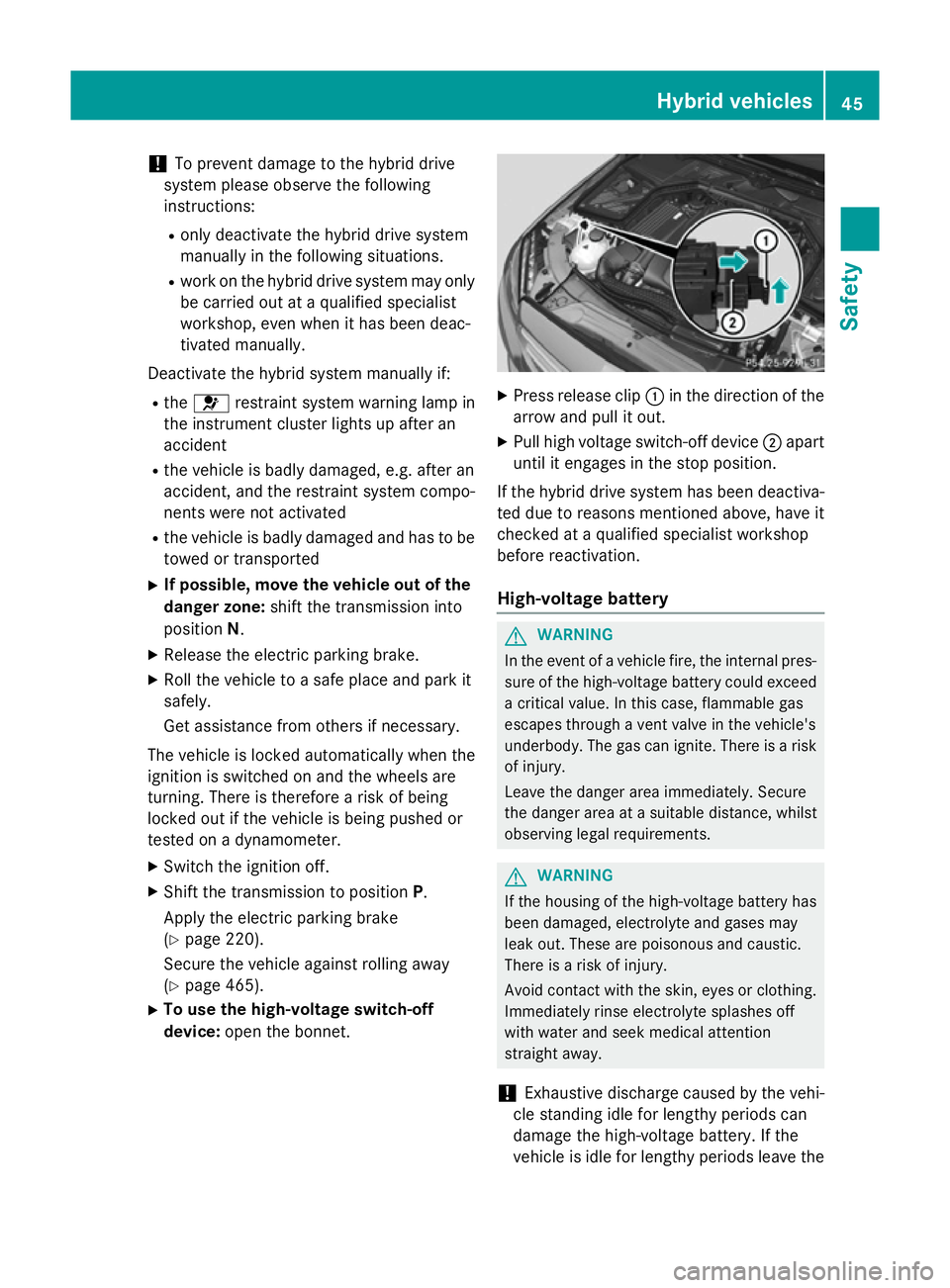
X To use the high-voltage switch-off
device: open the bonnet. X
Press release clip :in the direction of the
arrow and pull it out.
X Pull high voltage switch-off device ;apart
until it engages in the stop position.
If the hybrid drive system has been deactiva- ted due to reasons mentioned above, have it
checked at a qualified specialist workshop
before reactivation.
High-voltage battery G
WARNING
In the event of a vehicle fire, the internal pres- sure of the high-voltage battery could exceeda critical value. In this case, flammable gas
escapes through a vent valve in the vehicle's
underbody. The gas can ignite. There is a risk
of injury.
Leave the danger area immediately. Secure
the danger area at a suitable distance, whilst
observing legal requirements. G
WARNING
If the housing of the high-voltage battery has
been damaged, electrolyte and gases may
leak out. These are poisonous and caustic.
There is a risk of injury.
Avoid contact with the skin, eyes or clothing. Immediately rinse electrolyte splashes off
with water and seek medical attention
straight away.
! Exhaustive discharge caused by the vehi-
cle standing idle for lengthy periods can
damage the high-voltage battery. If the
vehicle is idle for lengthy periods leave the Hybrid vehicles
45Safety Z
Page 49 of 497
high-voltage battery connected to a charg-
ing station.
Charging the high-voltage battery
(Y page 210).
Engine compartment Before opening the bonnet:
X Apply the electric parking brake.
X Shift the transmission to position P.
X Switch the ignition off.
X Remove the key from the ignition lock.
or, on vehicles with KEYLESS-GO start func-
tion or KEYLESS ‑GO:
X Remove the Start/Stop button from the
ignition lock.
X Observe the warning notes on the risk of
electric shock (Y page 44).
X Observe the warning notes about the bon-
net (Y page 415). RBS driving safety system (Recupera-
tive Brake System)
The Recuperative Braking System supports
you when braking with an electronically-con-
trolled brake boost mode and enables the
recovery of kinetic energy (recuperation).
Further information about the Recuperative
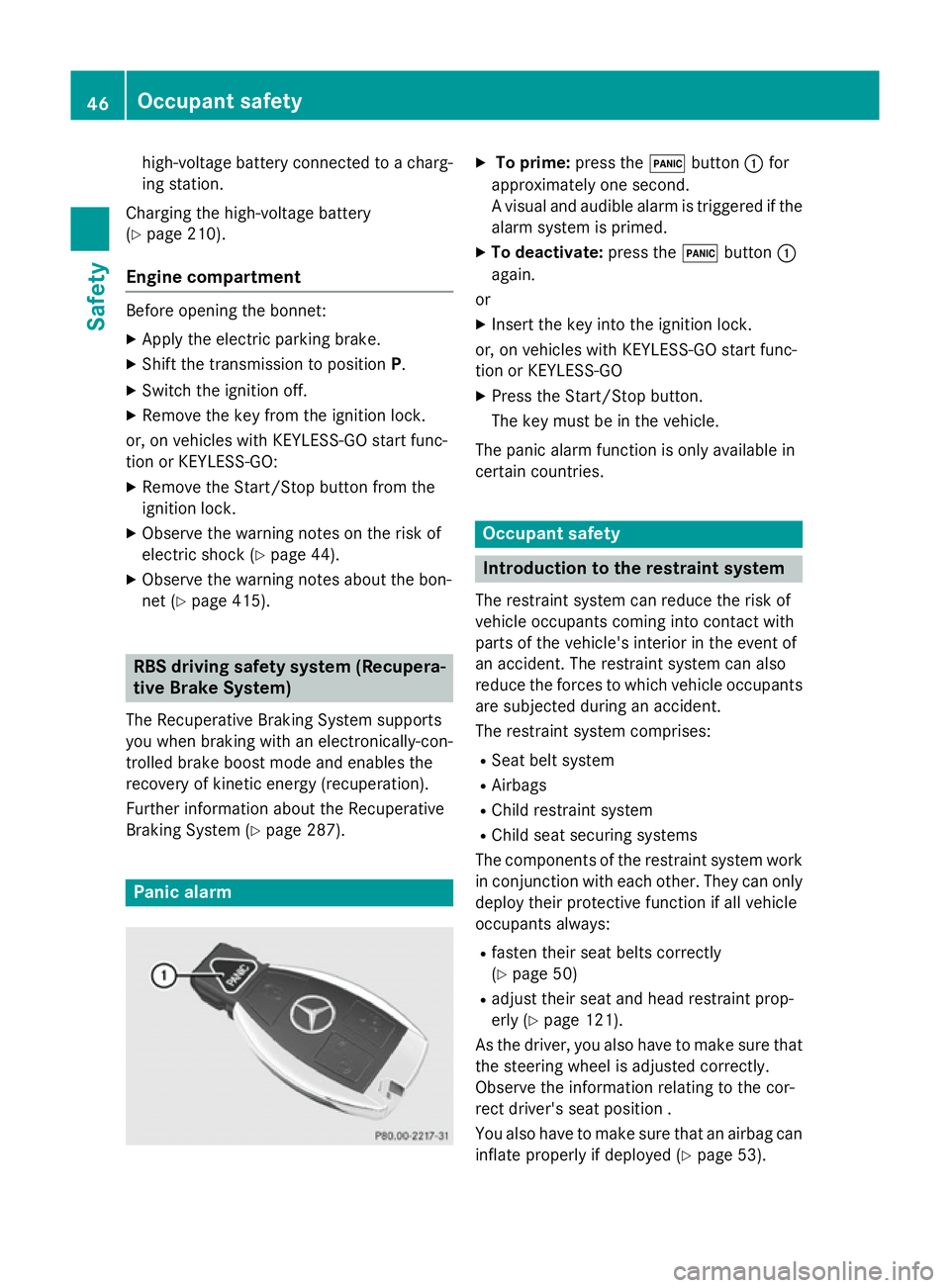
Braking System (Y page 287).Panic alarm X
To prime: press the!button :for
approximately one second.
A visual and audible alarm is triggered if the alarm system is primed.
X To deactivate: press the!button :
again.
or
X Insert the key into the ignition lock.
or, on vehicles with KEYLESS-GO start func-
tion or KEYLESS ‑GO
X Press the Start/Stop button.
The key must be in the vehicle.
The panic alarm function is only available in
certain countries. Occupant safety
Introduction to the restraint system
The restraint system can reduce the risk of
vehicle occupants coming into contact with
parts of the vehicle's interior in the event of
an accident. The restraint system can also
reduce the forces to which vehicle occupants are subjected during an accident.
The restraint system comprises:
R Seat belt system
R Airbags
R Child restraint system
R Child seat securing systems
The components of the restraint system work
in conjunction with each other. They can only
deploy their protective function if all vehicle
occupants always:
R fasten their seat belts correctly
(Y page 50)
R adjust their seat and head restraint prop-
erly (Y page 121).
As the driver, you also have to make sure that
the steering wheel is adjusted correctly.
Observe the information relating to the cor-
rect driver's seat position .
You also have to make sure that an airbag can
inflate properly if deployed (Y page 53).46
Occupant safetySafety
Page 50 of 497
An airbag supplements a correctly fastened
seat belt. As an additional safety device, the
airbag increases the level of protection for
vehicle occupants in the event of an accident.
For example, if the protection of the seat belt is sufficient in an accident, the airbags are not
deployed. In the event of an accident, only the airbags that increase protection in the rele-
vant accident situation are deployed. How-
ever, seat belts and airbags generally do not
protect against objects penetrating the vehi-
cle from the outside.
Information on the restraint system operation
can be found under "Triggering of belt ten-
sioners and airbags" (Y page 62).
For more information about children travel-
ling with you in the vehicle, see "Children in
the vehicle" (Y page 65). Important safety notes
G
WARNING
If the restraint system is modified, it may no
longer work as intended. The restraint system
may then not perform its intended protective function by failing in an accident or triggering
unexpectedly, for example. There is an
increased risk of injury, possibly even fatal.
Never modify parts of the restraint system. Do not attempt to modify the wiring as well as
electronic components or their software.
If it is necessary to modify an airbag system to
accommodate a person with disabilities, con- tact a Mercedes-Benz Service Centre. Restraint system warning lamp
The functions of the restraint system are
checked after the ignition is switched on and at regular intervals while the engine is run-
ning. Therefore, malfunctions can be detec-
ted in good time.
The 6 restraint system warning lamp in
the instrument cluster lights up when the igni- tion is switched on. It goes out no later than a few seconds after the vehicle is started. The
components of the restraint system are in
operational readiness.
A malfunction has occurred if the
6
restraint system warning lamp:
R does not light up after the ignition is
switched on
R does not go out after a few seconds with
the engine running
R lights up again while the engine is running
All vehicles, except hybrid vehicles: G
WARNING
If the restraint system is malfunctioning,
restraint system components may be trig-
gered unintentionally or might not be trig-
gered at all in the event of an accident with a high rate of vehicle deceleration. This can
effect belt tensioners or airbags, for example. There is an increased risk of serious or even
fatal injuries.
Have the restraint system checked and
repaired immediately at a qualified specialist
workshop.
Hybrid vehicles: G
DANGER
If the restraint system is malfunctioning,
restraint system components may be trig-
gered unintentionally or might not be trig-
gered at all in the event of an accident with a high rate of vehicle deceleration. This can
effect belt tensioners or airbags, for example. In addition, the vehicle's high-voltage electri-
cal system may not be deactivated as inten-
ded in the event of an accident. Touching
damaged components of the vehicle's high-
voltage electrical system could result in an
electric shock. There is an increased risk of
injury, possibly even fatal.
Have the restraint system checked and
repaired immediately at a qualified specialist
workshop. After an accident, immediately
switch the ignition off and remove the key
from the ignition lock. Occupant safety
47Safety Z
Page 52 of 497
your body. However, it does not pull the vehi-
cle occupants back in the direction of the seat
backrest.
The belt tensioner does not, however, correct an incorrect seat position or correct the rout-
ing of a seat belt that is worn incorrectly.
If the seat belt is also fitted with a belt force
limiter and this is triggered, the force exerted by the seat belt on the vehicle occupant is
reduced.
The belt force limiters on the front seats are
synchronised with the front airbags, which
take on a part of the deceleration force. This
can reduce the forces to which the vehicle
occupants are subjected during an accident.
! If the co-driver's seat is not occupied, do
not engage the seat belt tongue in the
buckle on the co-driver's seat. Otherwise,
the belt tensioner could be triggered in the
event of an accident and would have to be
replaced.
Important safety notes G
WARNING
The seat belt cannot perform its intended pro- tective function if it is not fastened correctly. Also, an improperly fastened seat belt can
cause additional injuries in the event of an
accident, sudden braking or abrupt changes
of direction. There is an increased risk of
injury, possibly even fatal.
Always make sure that all vehicle occupants
are wearing their seat belt properly and are
seated correctly. G
WARNING
The seat belt does not offer the intended level of protection if you have not moved the back-
rest to an almost vertical position. When brak-
ing or in the event of an accident, you could
slide underneath the seat belt and sustain
abdomen or neck injuries, for example. This
poses an increased risk of injury or even fatal injury. Adjust the seat properly before beginning
your journey. Always ensure that the backrest
is in an almost vertical position and that the
shoulder section of your seatbelt is routed
across the centre of your shoulder. G
WARNING
Persons under 1.50 mtall cannot wear the
seat belts correctly without a suitable, addi-
tional restraint system. The seat belt cannot
perform its intended protective function if it is not fastened correctly. Also, an improperly
fastened seat belt can cause additional inju-
ries in the event of an accident, sudden brak-
ing or abrupt changes of direction. There is an increased risk of injury, possibly even fatal.
Secure persons less than 1.50 mtall in a suit-
able restraint system.
If a child younger than twelve years old and
under 1.50 m in height is travelling in the
vehicle: R always secure the child in a child restraint
system suitable for this Mercedes-Benz
vehicle. The child restraint system must be appropriate to the age, weight and size of
the child.
R always pay attention to the instructions
and safety notes on the automatic co-driv-
er's front airbag deactivation system
(Y page 56)
R be sure to observe the instructions and
safety notes on "Children in the vehicle" in
these Operating Instructions (Y page 65)
in addition to the child restraint system
manufacturer's installation instructions G
WARNING
Seat belts cannot protect as intended, if:
R they are damaged, have been modified, are
extremely dirty, bleached or dyed
R the seat belt buckle is damaged or
extremely dirty
R modifications have been made to the belt
tensioners, belt anchorages or inertia reels Occupant safety
49Safety
Z
Page 55 of 497
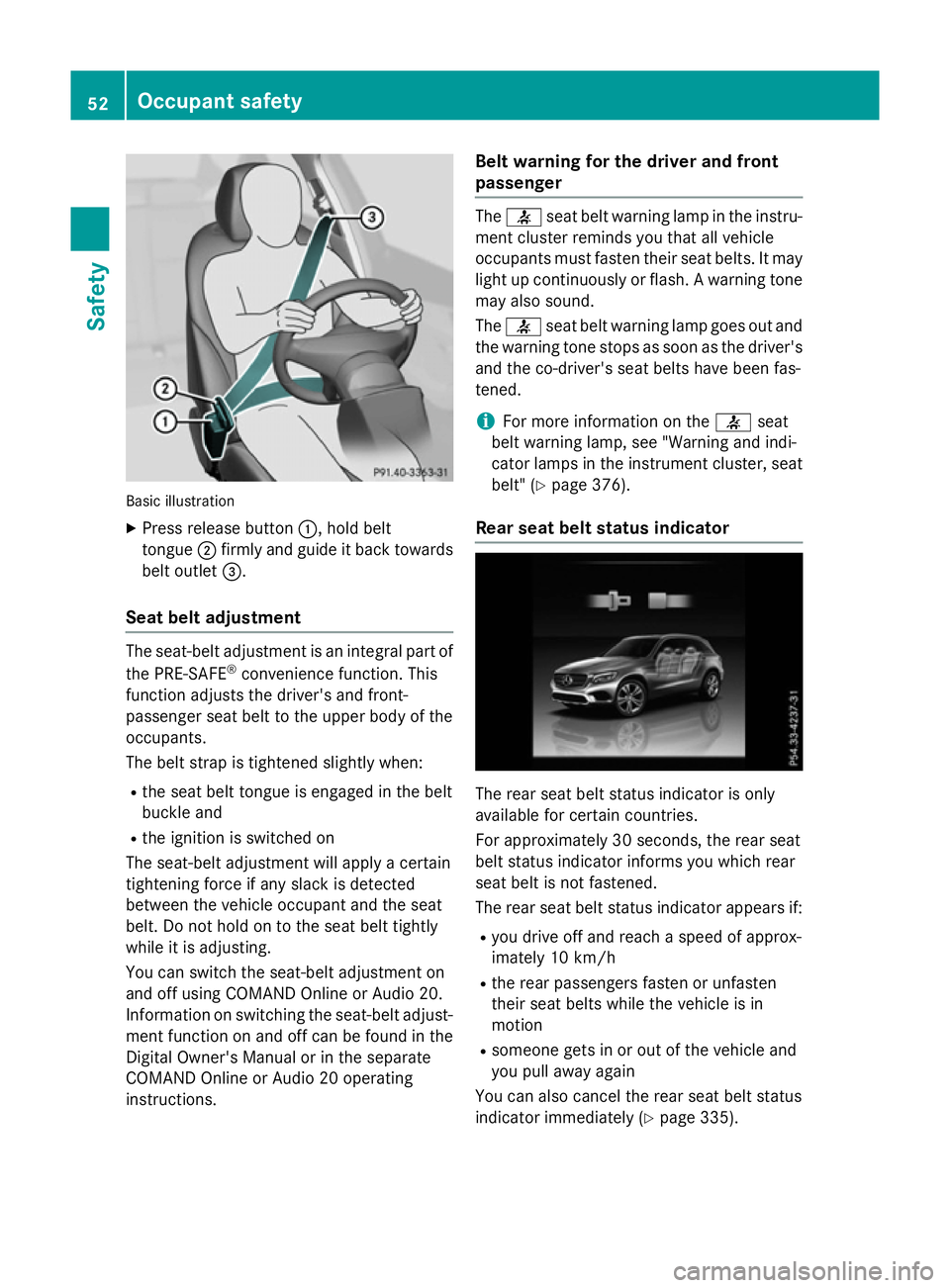
Basic illustration
X Press release button :, hold belt
tongue ;firmly and guide it back towards
belt outlet =.
Seat belt adjustment The seat-belt adjustment is an integral part of
the PRE-SAFE ®
convenience function. This
function adjusts the driver's and front-
passenger seat belt to the upper body of the
occupants.
The belt strap is tightened slightly when:
R the seat belt tongue is engaged in the belt
buckle and
R the ignition is switched on
The seat-belt adjustment will apply a certain
tightening force if any slack is detected
between the vehicle occupant and the seat
belt. Do not hold on to the seat belt tightly
while it is adjusting.
You can switch the seat-belt adjustment on
and off using COMAND Online or Audio 20.
Information on switching the seat-belt adjust-
ment function on and off can be found in the
Digital Owner's Manual or in the separate
COMAND Online or Audio 20 operating
instructions. Belt warning for the driver and front
passenger The
7 seat belt warning lamp in the instru-
ment cluster reminds you that all vehicle
occupants must fasten their seat belts. It may
light up continuously or flash. A warning tone
may also sound.
The 7 seat belt warning lamp goes out and
the warning tone stops as soon as the driver's and the co-driver's seat belts have been fas-
tened.
i For more information on the
7seat
belt warning lamp, see "Warning and indi-
cator lamps in the instrument cluster, seat
belt" (Y page 376).
Rear seat belt status indicator The rear seat belt status indicator is only
available for certain countries.
For approximately 30 seconds, the rear seat
belt status indicator informs you which rear
seat belt is not fastened.
The rear seat belt status indicator appears if:
R you drive off and reach a speed of approx-
imately 10 km/h
R the rear passengers fasten or unfasten
their seat belts while the vehicle is in
motion
R someone gets in or out of the vehicle and
you pull away again
You can also cancel the rear seat belt status
indicator immediately (Y page 335).52
Occupant safetySafety
Page 56 of 497
Airbags
Introduction The installation location of an airbag is iden-
tified by the AIRBAG symbol.
An airbag supplements a correctly worn seat
belt. It is not a replacement for the seat belt. The airbag offers additional protection in
applicable accident situations.
Not all airbags are deployed in an accident.
The different airbag systems work independ-
ently of each other (Y page 62).
However, no system available today can com-
pletely eliminate injuries and fatalities.
It is also not possible to completely rule out a risk of injury caused by an airbag due to the
speed at which the airbag must be deployed.
Important safety notes G
WARNING
If you deviate from the correct seat position,
the airbag cannot perform its intended pro-
tective function and can even cause addi-
tional injuries when deployed. There is an
increased risk of serious or even fatal injuries.
In order to avoid such risks, always ensure
that all vehicle occupants:
R fasten their seatbelts correctly, including
pregnant women
R are seated correctly and maintain the fur-
thest possible distance from the airbags
R observe the following notes
Always ensure that there are no objects loca-
ted between the airbag and the vehicle occu-
pant.
R Adjust the seats properly before beginning
your journey. Always make sure that the
seat is in an almost upright position. The
centre of the head restraint must support
the head at about eye level.
R Move the driver's and front-passenger
seats as far back as possible. The driver's
seat position must allow the vehicle to be
driven safely. R
Only hold the steering wheel on the out-
side. This allows the airbag to be fully
deployed.
R Always lean against the backrest while driv-
ing. Do not lean forwards or lean against
the door or side window. You may other-
wise be in the deployment area of the air-
bags.
R Always keep your feet in the footwell in
front of the seat. Do not put your feet on the
dashboard, for example. Your feet may oth-
erwise be in the deployment area of the
airbag.
R Always secure persons less than 1.50 mtall
in suitable restraint systems. Up to this
height, the seat belt cannot be worn cor-
rectly.
If a child is travelling in your vehicle, also
observe the following notes:
R Always secure children under twelve years
of age and less than 1.50 mtall in suitable
child restraint systems.
R Child restraint systems should be fitted to
the rear seats.
R Only secure a child to the front-passenger
seat when the front-passenger front airbag
is disabled, and only then in a rearward-
facing child restraint system. If the
PASSENGER AIR BAG OFF indicator lamp is
permanently lit, the front-passenger front
airbag is disabled .
R Always observe the instructions and safety
notes on the automatic front-passenger
front airbag deactivation system
(Y page 56) and on "Children in the vehi-
cle" (Y page 65) in addition to the child
restraint system manufacturer's installa-
tion instructions. Occupant safety
53Safety Z
Page 57 of 497
Objects in the vehicle interior may pre-
vent the airbag from functioning cor-
rectly. Before starting your journey and to
avoid risks resulting from the speed of the
airbag as it deploys, make sure that:
R there are no people, animals or objects
between the vehicle occupants and an air-
bag.
R there are no objects between the seat, door
and B-pillar.
R no hard objects, e.g. coat hangers, are
hanging on the grab handles or coat hooks.
R no accessories, such as cup holders, are
attached to the vehicle within the deploy-
ment area of an airbag, e.g. to doors, side
windows, rear side trim or side walls.
R no heavy, sharp-edged or fragile objects
are in the pockets of your clothing. Store
such objects in a suitable place. G
WARNING
If you modify an airbag cover or affix objects
such as stickers to it, the airbag can no longer function correctly. There is an increased risk
of injury.
Never modify an airbag cover or affix objects
to it. G
WARNING
Sensors to control the airbags are located in
the doors. Modifications or work not per-
formed correctly to the doors or door panel-
ling, as well as damaged doors, can lead to the function of the sensors being impaired. The
airbags might therefore not function properly any more. Consequently, the airbags cannot
protect vehicle occupants as they are
designed to do. This poses an increased risk
of injury.
Never modify the doors or parts of the doors.
Always have work on the doors or door pan-
elling carried out at a qualified specialist
workshop. Front airbags !
Do not place heavy objects on the front-
passenger seat. This could cause the sys-
tem to identify the seat as being occupied. In the event of an accident, the restraint
systems on the front-passenger side may
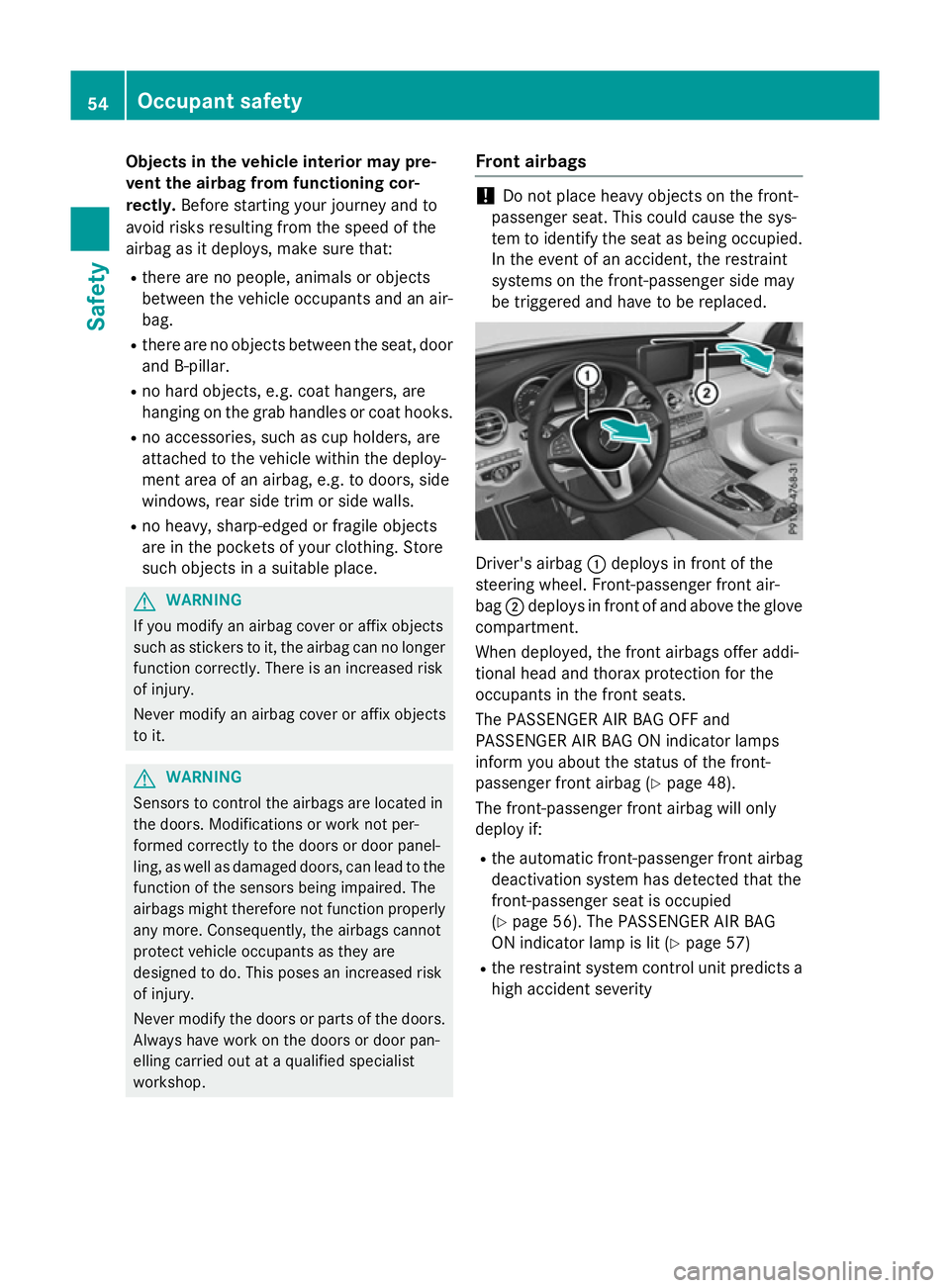
be triggered and have to be replaced. Driver's airbag
:deploys in front of the
steering wheel. Front-passenger front air-
bag ;deploys in front of and above the glove
compartment.
When deployed, the front airbags offer addi-
tional head and thorax protection for the
occupants in the front seats.
The PASSENGER AIR BAG OFF and
PASSENGER AIR BAG ON indicator lamps
inform you about the status of the front-
passenger front airbag (Y page 48).
The front-passenger front airbag will only
deploy if:
R the automatic front-passenger front airbag
deactivation system has detected that the
front-passenger seat is occupied
(Y page 56). The PASSENGER AIR BAG
ON indicator lamp is lit (Y page 57)
R the restraint system control unit predicts a
high accident severity 54
Occupant safetySafety
Page 58 of 497
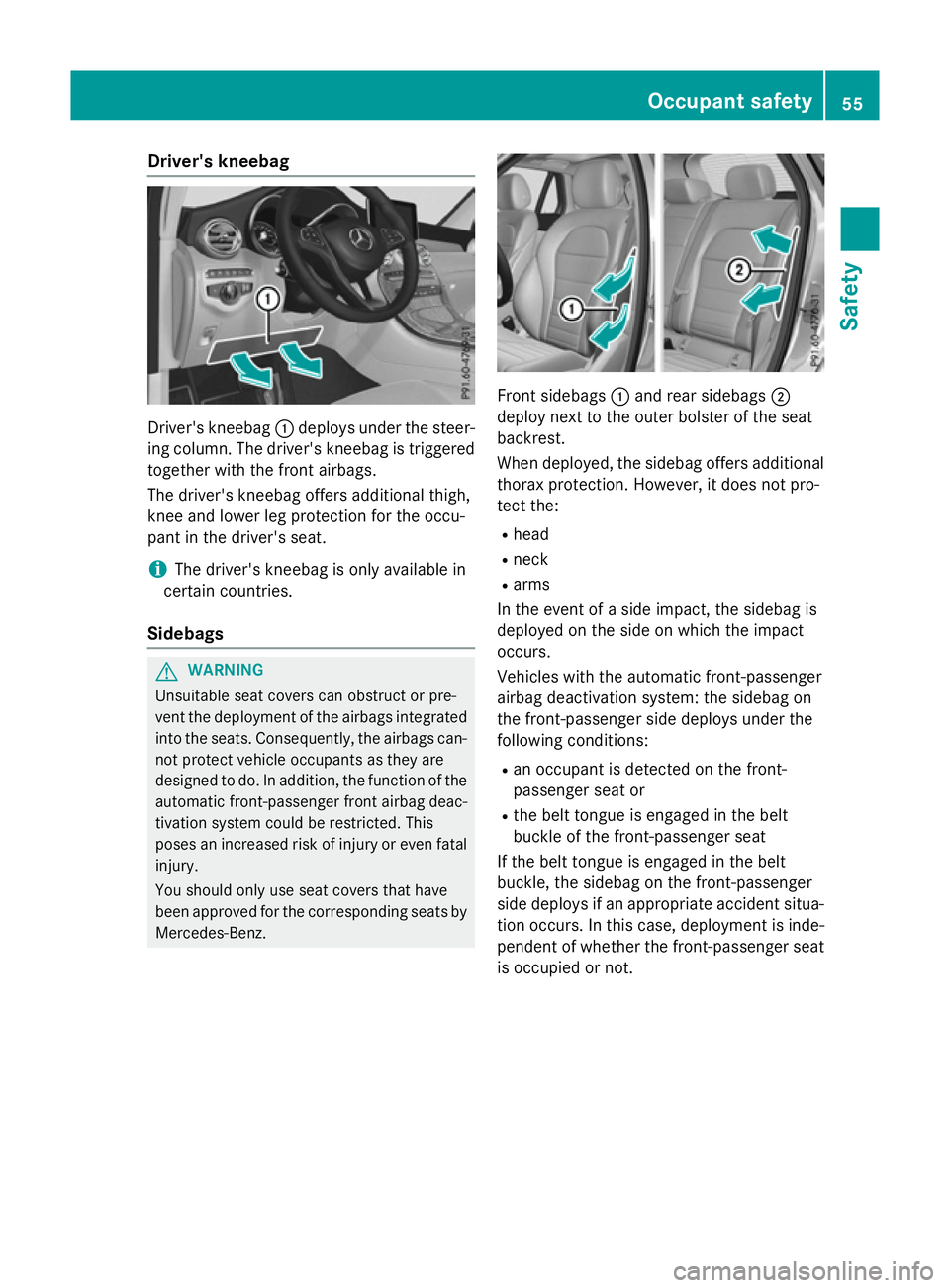
Driver's kneebag
Driver's kneebag
:deploys under the steer-
ing column. The driver's kneebag is triggered
together with the front airbags.
The driver's kneebag offers additional thigh,
knee and lower leg protection for the occu-
pant in the driver's seat.
i The driver's kneebag is only available in
certain countries.
Sidebags G
WARNING
Unsuitable seat covers can obstruct or pre-
vent the deployment of the airbags integrated into the seats. Consequently, the airbags can-
not protect vehicle occupants as they are
designed to do. In addition, the function of the automatic front-passenger front airbag deac-
tivation system could be restricted. This
poses an increased risk of injury or even fatal
injury.
You should only use seat covers that have
been approved for the corresponding seats by Mercedes-Benz. Front sidebags
:and rear sidebags ;
deploy next to the outer bolster of the seat
backrest.
When deployed, the sidebag offers additional thorax protection. However, it does not pro-
tect the:
R head
R neck
R arms
In the event of a side impact, the sidebag is
deployed on the side on which the impact
occurs.
Vehicles with the automatic front-passenger
airbag deactivation system: the sidebag on
the front-passenger side deploys under the
following conditions:
R an occupant is detected on the front-
passenger seat or
R the belt tongue is engaged in the belt
buckle of the front-passenger seat
If the belt tongue is engaged in the belt
buckle, the sidebag on the front-passenger
side deploys if an appropriate accident situa- tion occurs. In this case, deployment is inde- pendent of whether the front-passenger seat
is occupied or not. Occupant safety
55Safety Z