belt MERCEDES-BENZ GLK-CLASS SUV 2015 User Guide
[x] Cancel search | Manufacturer: MERCEDES-BENZ, Model Year: 2015, Model line: GLK-CLASS SUV, Model: MERCEDES-BENZ GLK-CLASS SUV 2015Pages: 386, PDF Size: 26 MB
Page 48 of 386
In the event of other types of impacts and
impacts below air bag deployment thresh-
olds, the air bags will not deploy. The driver
and passenger will then be protected to the
extent possible by a properly fastened seat
belt. A properly fastened seat belt is also nee-ded to provide the best possible protection in
a rollover.
Air bags provide additional protection; they
are not, however, a substitute for seat belts.
All vehicle occupants must fasten their seat
belts regardless of whether your vehicle is
equipped with air bags or not.
It is important for your safety and that of your passenger to have deployed air bags replaced
and to have any malfunctioning air bags
repaired. This will help to make sure the air
bags continue to perform their protective
function for the vehicle occupants in the
event of a crash.
iAfter an air bag has been deployed, have
the vehicle towed to the nearest qualified
specialist workshop, even if your vehicle is
ready to drive.
Front air bags
The front air bags increase protection for the driver's and front passenger's head and
chest.
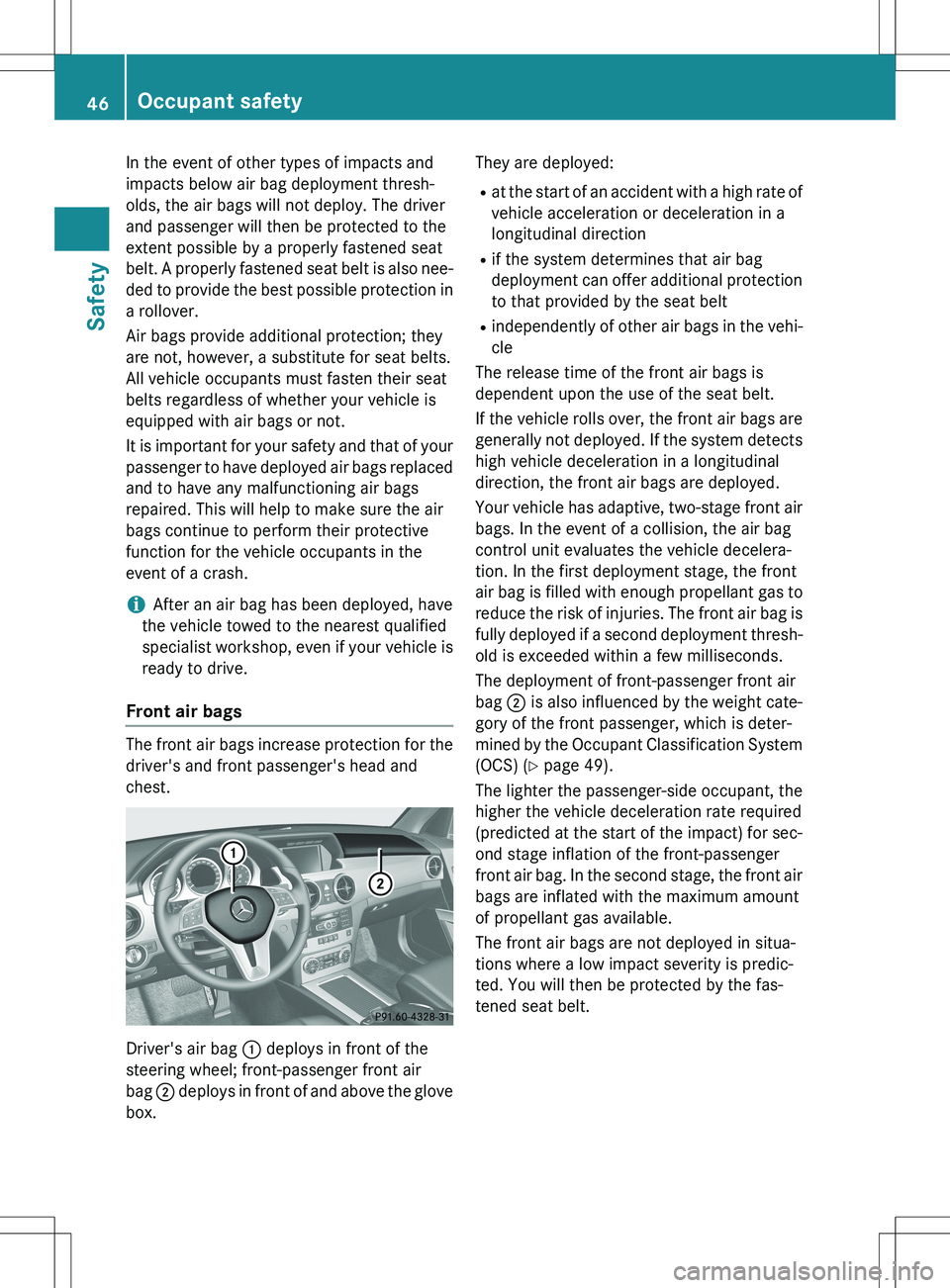
Driver's air bag : deploys in front of the
steering wheel; front-passenger front air
bag ; deploys in front of and above the glove
box. They are deployed:
R at the start of an accident with a high rate of
vehicle acceleration or deceleration in a
longitudinal direction
R if the system determines that air bag
deployment can offer additional protection
to that provided by the seat belt
R independently of other air bags in the vehi-
cle
The release time of the front air bags is
dependent upon the use of the seat belt.
If the vehicle rolls over, the front air bags are
generally not deployed. If the system detects
high vehicle deceleration in a longitudinal
direction, the front air bags are deployed.
Your vehicle has adaptive, two-stage front air bags. In the event of a collision, the air bag
control unit evaluates the vehicle decelera-
tion. In the first deployment stage, the front
air bag is filled with enough propellant gas to
reduce the risk of injuries. The front air bag is fully deployed if a second deployment thresh-
old is exceeded within a few milliseconds.
The deployment of front-passenger front air
bag ; is also influenced by the weight cate-
gory of the front passenger, which is deter-
mined by the Occupant Classification System
(OCS) ( Y page 49).
The lighter the passenger-side occupant, the
higher the vehicle deceleration rate required
(predicted at the start of the impact) for sec- ond stage inflation of the front-passenger
front air bag. In the second stage, the front air
bags are inflated with the maximum amount
of propellant gas available.
The front air bags are not deployed in situa-
tions where a low impact severity is predic-
ted. You will then be protected by the fas-
tened seat belt.
46Occupant safety
Safety
Page 49 of 386
The front-passenger front air bag will only bedeployed if:
R the system, based on the OCS weight sen-
sor readings, detects that the front-
passenger seat is occupied
R the PASSENGER AIR BAG OFF indicator
lamp on the center console is not lit
(Y page 49)
R the air bag control unit predicts a high-
impact severity
Driver's knee bag
The driver's knee bag increases protection of
the driver against: R knee injuries
R thigh injuries
R lower leg injuries
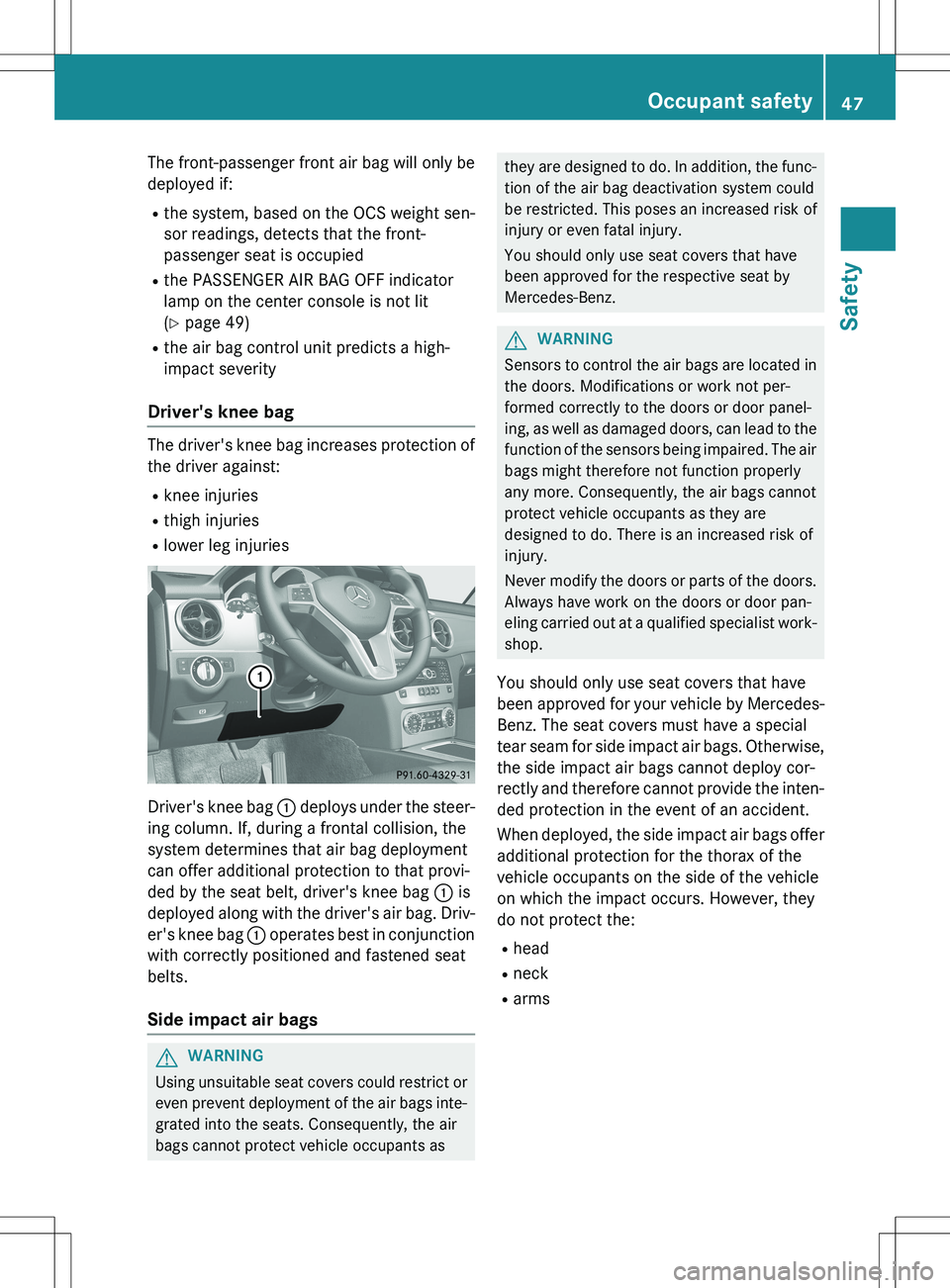
Driver's knee bag : deploys under the steer-
ing column. If, during a frontal collision, the
system determines that air bag deployment
can offer additional protection to that provi-
ded by the seat belt, driver's knee bag : is
deployed along with the driver's air bag. Driv-
er's knee bag : operates best in conjunction
with correctly positioned and fastened seat
belts.
Side impact air bags
GWARNING
Using unsuitable seat covers could restrict or even prevent deployment of the air bags inte- grated into the seats. Consequently, the air
bags cannot protect vehicle occupants as
they are designed to do. In addition, the func- tion of the air bag deactivation system could
be restricted. This poses an increased risk of
injury or even fatal injury.
You should only use seat covers that have
been approved for the respective seat by
Mercedes-Benz.
GWARNING
Sensors to control the air bags are located inthe doors. Modifications or work not per-
formed correctly to the doors or door panel-
ing, as well as damaged doors, can lead to the
function of the sensors being impaired. The air bags might therefore not function properly
any more. Consequently, the air bags cannot
protect vehicle occupants as they are
designed to do. There is an increased risk of
injury.
Never modify the doors or parts of the doors.
Always have work on the doors or door pan-
eling carried out at a qualified specialist work- shop.
You should only use seat covers that have
been approved for your vehicle by Mercedes-
Benz. The seat covers must have a special
tear seam for side impact air bags. Otherwise, the side impact air bags cannot deploy cor-
rectly and therefore cannot provide the inten-
ded protection in the event of an accident.
When deployed, the side impact air bags offer additional protection for the thorax of the
vehicle occupants on the side of the vehicle
on which the impact occurs. However, they
do not protect the:
R head
R neck
R arms
Occupant safety47
Safety
Z
Page 50 of 386
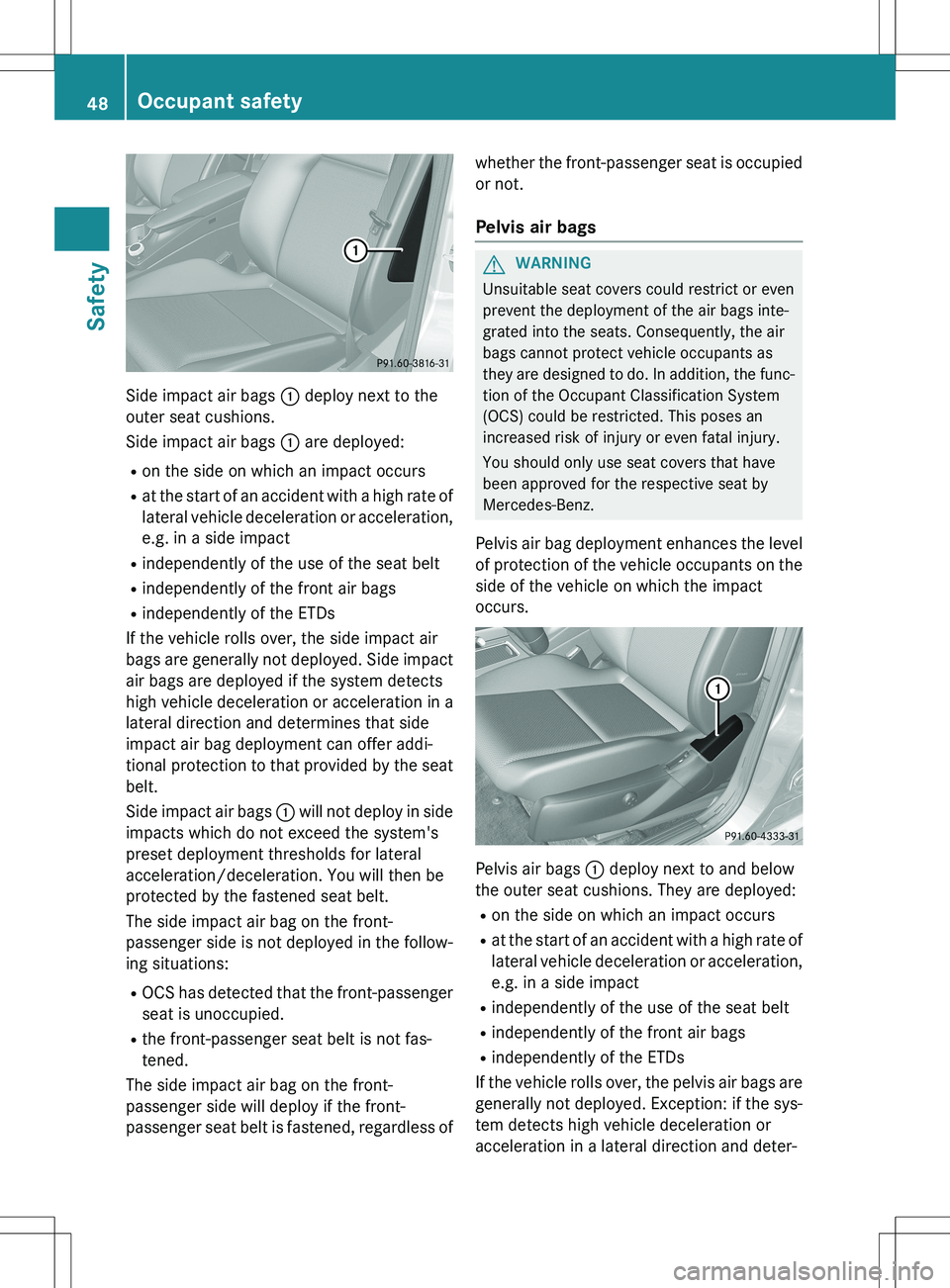
Side impact air bags : deploy next to the
outer seat cushions.
Side impact air bags : are deployed:
R on the side on which an impact occurs
R at the start of an accident with a high rate of
lateral vehicle deceleration or acceleration,
e.g. in a side impact
R independently of the use of the seat belt
R independently of the front air bags
R independently of the ETDs
If the vehicle rolls over, the side impact air
bags are generally not deployed. Side impact air bags are deployed if the system detects
high vehicle deceleration or acceleration in a
lateral direction and determines that side
impact air bag deployment can offer addi-
tional protection to that provided by the seat belt.
Side impact air bags : will not deploy in side
impacts which do not exceed the system's
preset deployment thresholds for lateral
acceleration/deceleration. You will then be
protected by the fastened seat belt.
The side impact air bag on the front-
passenger side is not deployed in the follow-
ing situations:
R OCS has detected that the front-passenger
seat is unoccupied.
R the front-passenger seat belt is not fas-
tened.
The side impact air bag on the front-
passenger side will deploy if the front-
passenger seat belt is fastened, regardless of whether the front-passenger seat is occupied
or not.
Pelvis air bags
GWARNING
Unsuitable seat covers could restrict or even
prevent the deployment of the air bags inte-
grated into the seats. Consequently, the air
bags cannot protect vehicle occupants as
they are designed to do. In addition, the func-
tion of the Occupant Classification System
(OCS) could be restricted. This poses an
increased risk of injury or even fatal injury.
You should only use seat covers that have
been approved for the respective seat by
Mercedes-Benz.
Pelvis air bag deployment enhances the level of protection of the vehicle occupants on the
side of the vehicle on which the impact
occurs.
Pelvis air bags : deploy next to and below
the outer seat cushions. They are deployed:
R on the side on which an impact occurs
R at the start of an accident with a high rate of
lateral vehicle deceleration or acceleration,
e.g. in a side impact
R independently of the use of the seat belt
R independently of the front air bags
R independently of the ETDs
If the vehicle rolls over, the pelvis air bags are
generally not deployed. Exception: if the sys- tem detects high vehicle deceleration or
acceleration in a lateral direction and deter-
48Occupant safety
Safety
Page 51 of 386
mines that deployment can offer additional
protection to that provided by the seat belt.
Pelvis air bags : will not deploy in side
impacts which do not exceed the system's
preset deployment thresholds for lateral
acceleration/deceleration. You will then be
protected by the fastened seat belt.
The pelvis air bag on the front-passenger side is not deployed in the following situations:
R OCS has detected that the front-passenger
seat is unoccupied.
R the front-passenger seat belt is not fas-
tened.
The pelvis air bag on the front-passenger side will deploy if the front-passenger seat belt is
fastened, regardless of whether the front-
passenger seat is occupied or not.
Window curtain air bags
The window curtain air bags enhance the levelof protection for the head, but not chest or
arms, of the vehicle occupants on the side ofthe vehicle on which the impact occurs.
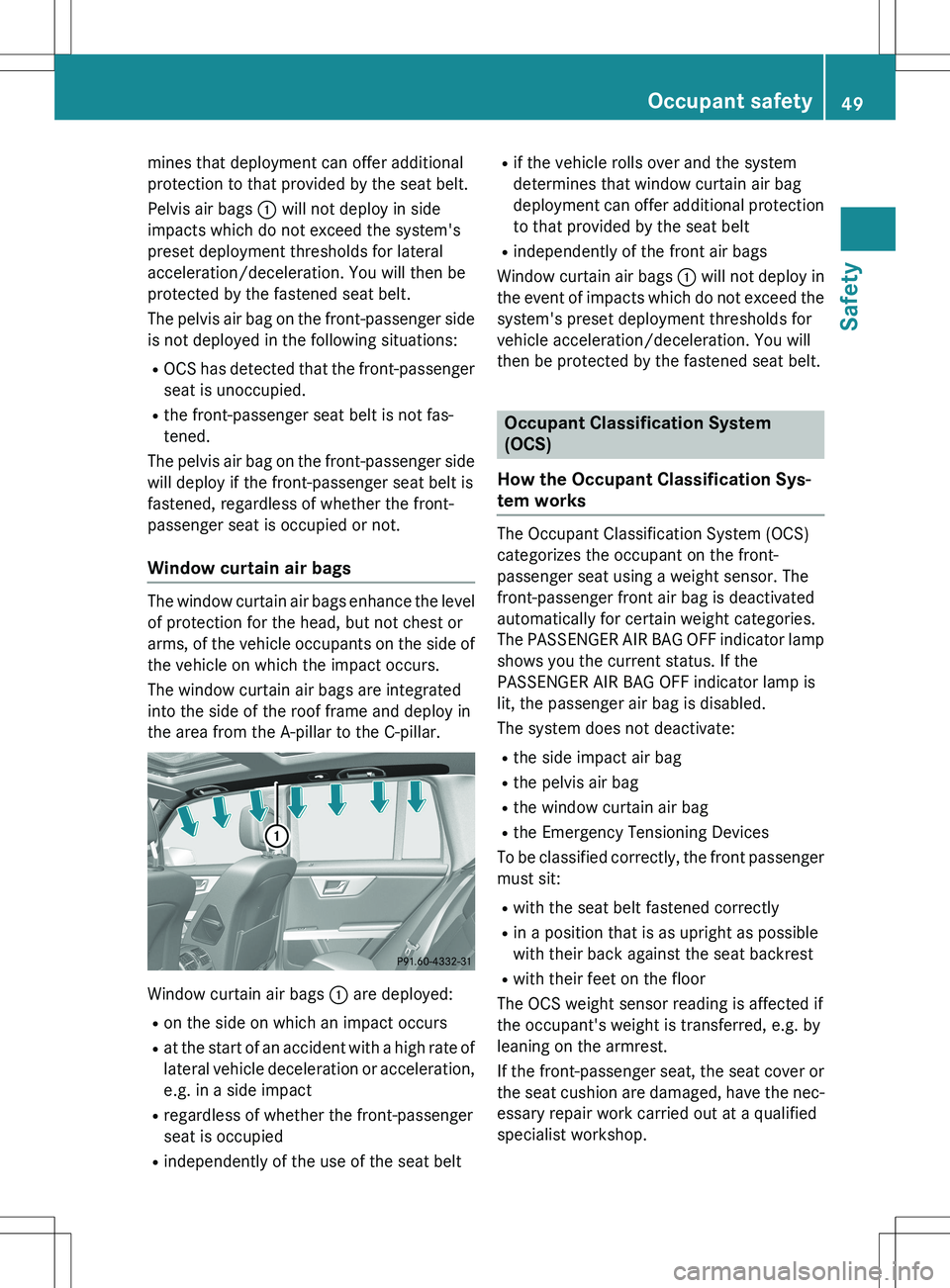
The window curtain air bags are integrated
into the side of the roof frame and deploy in
the area from the A-pillar to the C-pillar.
Window curtain air bags : are deployed:
R on the side on which an impact occurs
R at the start of an accident with a high rate of
lateral vehicle deceleration or acceleration,
e.g. in a side impact
R regardless of whether the front-passenger
seat is occupied
R independently of the use of the seat belt R
if the vehicle rolls over and the system
determines that window curtain air bag
deployment can offer additional protection
to that provided by the seat belt
R independently of the front air bags
Window curtain air bags : will not deploy in
the event of impacts which do not exceed the system's preset deployment thresholds for
vehicle acceleration/deceleration. You will
then be protected by the fastened seat belt.
Occupant Classification System
(OCS)
How the Occupant Classification Sys-
tem works
The Occupant Classification System (OCS)
categorizes the occupant on the front-
passenger seat using a weight sensor. The
front-passenger front air bag is deactivated
automatically for certain weight categories.
The PASSENGER AIR BAG OFF indicator lamp
shows you the current status. If the
PASSENGER AIR BAG OFF indicator lamp is
lit, the passenger air bag is disabled.
The system does not deactivate:
R the side impact air bag
R the pelvis air bag
R the window curtain air bag
R the Emergency Tensioning Devices
To be classified correctly, the front passenger
must sit:
R with the seat belt fastened correctly
R in a position that is as upright as possible
with their back against the seat backrest
R with their feet on the floor
The OCS weight sensor reading is affected if
the occupant's weight is transferred, e.g. by
leaning on the armrest.
If the front-passenger seat, the seat cover or the seat cushion are damaged, have the nec- essary repair work carried out at a qualified
specialist workshop.
Occupant safety49
Safety
Z
Page 53 of 386
toddler restraint, or booster seat recommen-
ded for the size and weight of the child.
The infant or child restraint must be properly
secured with the vehicle's seat belt, the seat
belt and Top Tether strap, or lower anchors
and Top Tether strap, fully in accordance withthe child seat manufacturer's instructions.
Occupants, especially children, should always
sit as upright as possible, wear the seat belt
properly and use an appropriately sized infant
restraint, toddler restraint, or booster seat
recommended for the size and weight of the
child.
Children can be killed or seriously injured by
an inflating air bag. Note the following impor-
tant information when circumstances require you to place a child in the front-passenger
seat:
R Your vehicle is equipped with air bag tech-
nology designed to deactivate the front-
passenger front air bag in your vehicle
when the system senses the weight of a
typical 12-month-old child or less along
with the weight of a standard appropriate
child restraint on the front-passenger seat.
R A child in a rear-facing child restraint on the
front-passenger seat will be seriously
injured or even killed if the front-passenger front air bag inflates in a collision which
could occur under some circumstances,
even with the air bag technology installed in your vehicle. The only means to eliminate
this risk completely is never to place a child
in a rear-facing child restraint in the front-
passenger seat. We therefore strongly rec- ommend that you always place a child in a
rear-facing child restraint on the rear seat.
R If you install a rear-facing child restraint on
the front-passenger seat, make sure the45 indicator lamp is illuminated,
indicating that the front-passenger front air
bag is deactivated. Should the 45
indicator lamp not illuminate or go out while the restraint is installed, please check
installation. Periodically check the45 indicator lamp while driving tomake sure that the 45 indicator
lamp is illuminated. If the 45 indi-
cator lamp goes out or remains out, do not transport a child on the front-passenger
seat until the system has been repaired.
A child in a rear-facing child restraint on thefront-passenger seat will be seriously
injured or even killed if the front-passenger front air bag inflates.
R If you place a child in a forward-facing child
restraint on the front-passenger seat:
- move the seat as far back as possible
- use the proper child restraint recommen-
ded for the age, size and weight of the
child
- secure child restraint with the vehicle's
seat belt according to the child seat man-
ufacturer's instructions
R For children larger than the typical 12-
month-old child, the front-passenger front
air bag may or may not be activated.
If the driver's air bag deploys, this does not
mean that the front-passenger front air bag
will also deploy.
The OCS may have detected that the seat: R is empty or occupied by the weight of a
typical child up to twelve months old,
seated in a child restraint system.
R is occupied by a small individual, such as a
young teenager or a small adult.
R is occupied by a child in a child restraint
system whose weight is greater than that of
a typical twelve month old child.
These are examples of when the OCS deacti-
vates the front-passenger front air bag. Deac- tivation takes place although the collision ful-
fills the criteria for deploying the driver's air
bag.
Occupant safety51
Safety
Z
Page 54 of 386
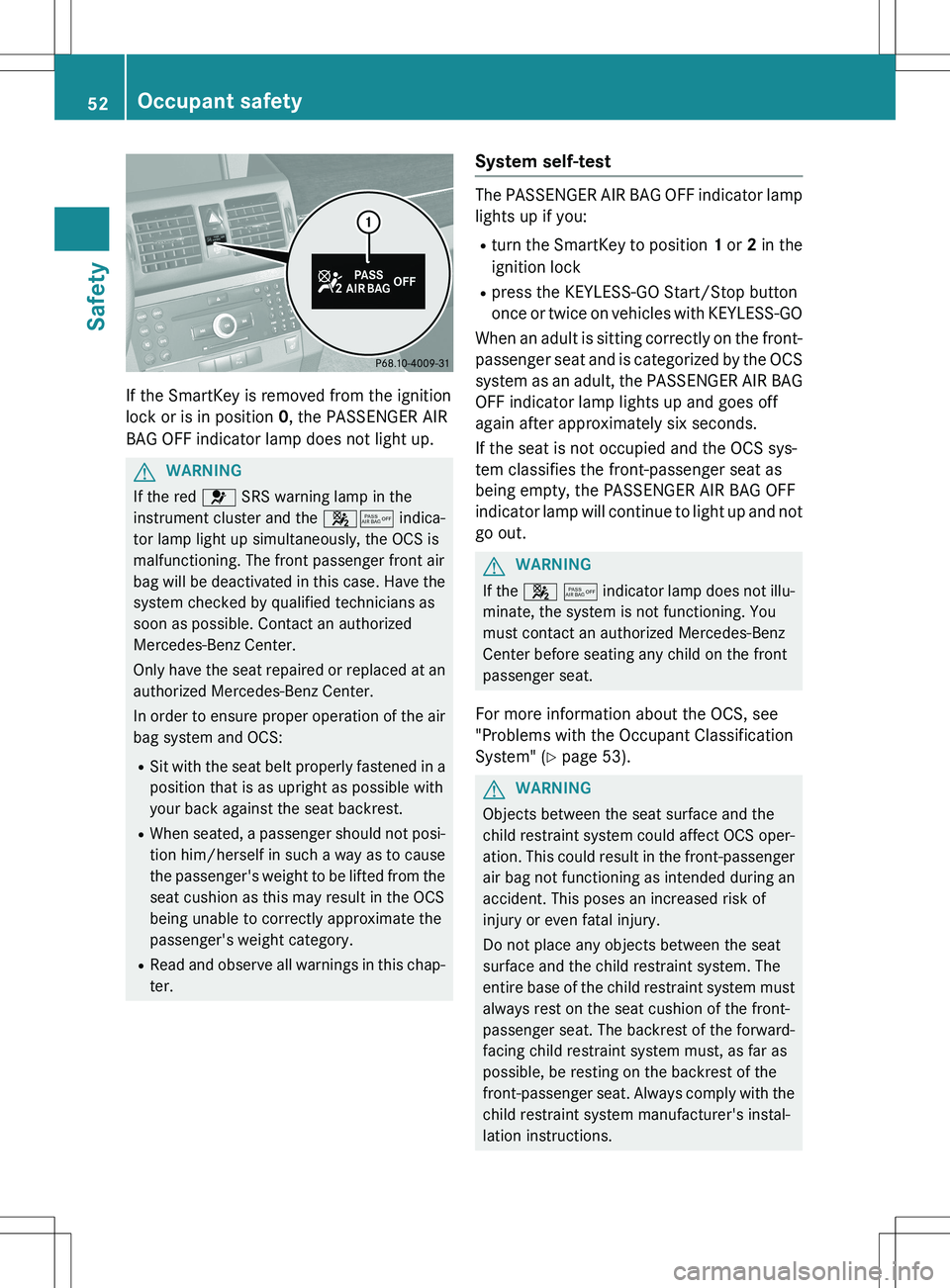
If the SmartKey is removed from the ignition
lock or is in position 0, the PASSENGER AIR
BAG OFF indicator lamp does not light up.
GWARNING
If the red 6 SRS warning lamp in the
instrument cluster and the 45 indica-
tor lamp light up simultaneously, the OCS is
malfunctioning. The front passenger front air
bag will be deactivated in this case. Have the system checked by qualified technicians as
soon as possible. Contact an authorized
Mercedes-Benz Center.
Only have the seat repaired or replaced at an
authorized Mercedes-Benz Center.
In order to ensure proper operation of the air
bag system and OCS:
R Sit with the seat belt properly fastened in a
position that is as upright as possible with
your back against the seat backrest.
R When seated, a passenger should not posi-
tion him/herself in such a way as to cause
the passenger's weight to be lifted from the seat cushion as this may result in the OCS
being unable to correctly approximate the
passenger's weight category.
R Read and observe all warnings in this chap-
ter.
System self-test
The PASSENGER AIR BAG OFF indicator lamp
lights up if you:
R turn the SmartKey to position 1 or 2 in the
ignition lock
R press the KEYLESS-GO Start/Stop button
once or twice on vehicles with KEYLESS-GO
When an adult is sitting correctly on the front-
passenger seat and is categorized by the OCS system as an adult, the PASSENGER AIR BAG
OFF indicator lamp lights up and goes off
again after approximately six seconds.
If the seat is not occupied and the OCS sys-
tem classifies the front-passenger seat as
being empty, the PASSENGER AIR BAG OFF
indicator lamp will continue to light up and not go out.
GWARNING
If the 4 5 indicator lamp does not illu-
minate, the system is not functioning. You
must contact an authorized Mercedes-Benz
Center before seating any child on the front
passenger seat.
For more information about the OCS, see
"Problems with the Occupant Classification
System" ( Y page 53).
GWARNING
Objects between the seat surface and the
child restraint system could affect OCS oper-
ation. This could result in the front-passengerair bag not functioning as intended during an
accident. This poses an increased risk of
injury or even fatal injury.
Do not place any objects between the seat
surface and the child restraint system. The
entire base of the child restraint system must
always rest on the seat cushion of the front-
passenger seat. The backrest of the forward-
facing child restraint system must, as far as
possible, be resting on the backrest of the
front-passenger seat. Always comply with the child restraint system manufacturer's instal-
lation instructions.
52Occupant safety
Safety
Page 55 of 386
Problems with the Occupant Classification System
ProblemPossible causes/consequences and M Solutions
The PASSENGER AIR
BAG OFF indicator
lights up and remains
on.
The person on the
front-passenger seat: R
has the weight of a
typical adult
R has been determined
by the system not to
be a childThe OCS is malfunctioning.
X Make sure that the front passenger is sitting in a correct, upright
position.
X Have the OCS checked as soon as possible at a qualified spe-
cialist workshop.
X Observe the additional display messages in the multifunction
display ( Y page 242).
GWARNING
If the 45 indicator lamp illuminates and remains illuminated w hen the weight of a typical
adult or someone larger than a small individual has been detected on the passenger seat, do not
allow any occupant to use the passenger seat until the system has been rep aired.
ProblemPossible causes/consequences and M Solutions
The PASSENGER AIR
BAG OFF indicator
lamp does not light up
and/or stays on.
The front-passenger
seat is:
R unoccupied
R occupied with a
weight up to that of a
typical twelve-
month-old child in a
standard child
restraint systemThe OCS is malfunctioning.
X Make sure there is nothing between the seat cushion and the
child seat.
X Make sure that the backrest and base of the child restraint sys-
tem are resting securely on the front-passenger seat. If neces-
sary, adjust the position of the front-passenger seat.
X When installing the child restraint system, make sure that the
seat belt is tight. Do not pull the seat belt tight with the front-
passenger seat adjustment. This could result in the seat belt
being pulled too tightly.
X Check the installation of the child restraint system.
X Make sure that no objects are applying additional weight onto
the seat.
X If the PASSENGER AIR BAG OFF indicator lamp remains of f, have
the OCS system checked as soon as possible at a qualified spe-
cialist workshop. Do not transport a child on the front-p assenger
seat until the OCS has been repaired.
X Observe the additional display messages in the multifunction
display ( Y page 242).
Occupant safety53
Safety
Z
Page 56 of 386
GWARNING
If the 45 indicator lamp does not illuminate or remains out wi th the weight of a typical 12-
month-old child in a standard child restraint or less, or is unoccupied, on the front-passenger seat,
do not transport a child on the front-passenger seat until the system has b een repaired.
PRE-SAFE® (anticipatory occupant
protection system)
Introduction
PRE-SAFE ®
takes preemptive measures to
protect occupants in certain hazardous sit-
uations.
Important safety notes
! Make sure that there are no objects in the
footwell under or behind the seats when
moving the seats back. There is a risk that
the seats and/or the objects could be dam-
aged.
Despite your vehicle being equipped with the PRE-SAFE ®
system, the possibility of per-
sonal injuries occurring as a result of an acci-
dent cannot be eliminated.
Always adapt your driving style to suit the
prevailing road and weather conditions and
maintain a safe distance from the vehicle in
front. Drive carefully.
Function
PRE-SAFE ®
intervenes:
R in emergency braking situations, e.g. when
BAS is activated.
R in critical driving situations, e.g. when phys-
ical limits are exceeded and the vehicle
understeers or oversteers severely.
R vehicles with the Driving Assistance
package: when BAS PLUS intervenes pow-
erfully or the radar sensor system detects
an imminent danger of collision in certain
situations. If you are driving faster than approximately
20 mph (30 km/h) PRE-SAFE
®
may take the
following measures in these situations:
R the front seat belts are pre-tensioned.
R vehicles with the memory function for
the front-passenger seat: the front-
passenger seat is adjusted if it is in an
unfavorable position.
R if the vehicle skids, the side windows are
closed so that only a small gap remains.
The panorama roof with power tilt/sliding
panel is completely closed.
If the hazardous situation passes without
resulting in an accident, PRE-SAFE ®
slackens
the belt pre-tensioning. All settings made by
PRE-SAFE ®
can then be reversed.
If the seat belt pre-tensioning is not reduced: X Move the seat backrest or seat back
slightly when the vehicle is stationary.
The seat belt pre-tensioning is reduced and
the locking mechanism is released.
The seat-belt adjustment is an integral part of
the PRE-SAFE ®
convenience function. More
information about seat-belt adjustment can
be found under "Seat-belt adjustment"
( Y page 59).
NECK-PRO head restraints/NECK-
PRO luxury head restraints
GWARNING
The function of the head restraint may be
impaired if you:
R attach objects such as coat hangers to the
head restraints, for example
R use head restraint covers
54Occupant safety
Safety
Page 58 of 386
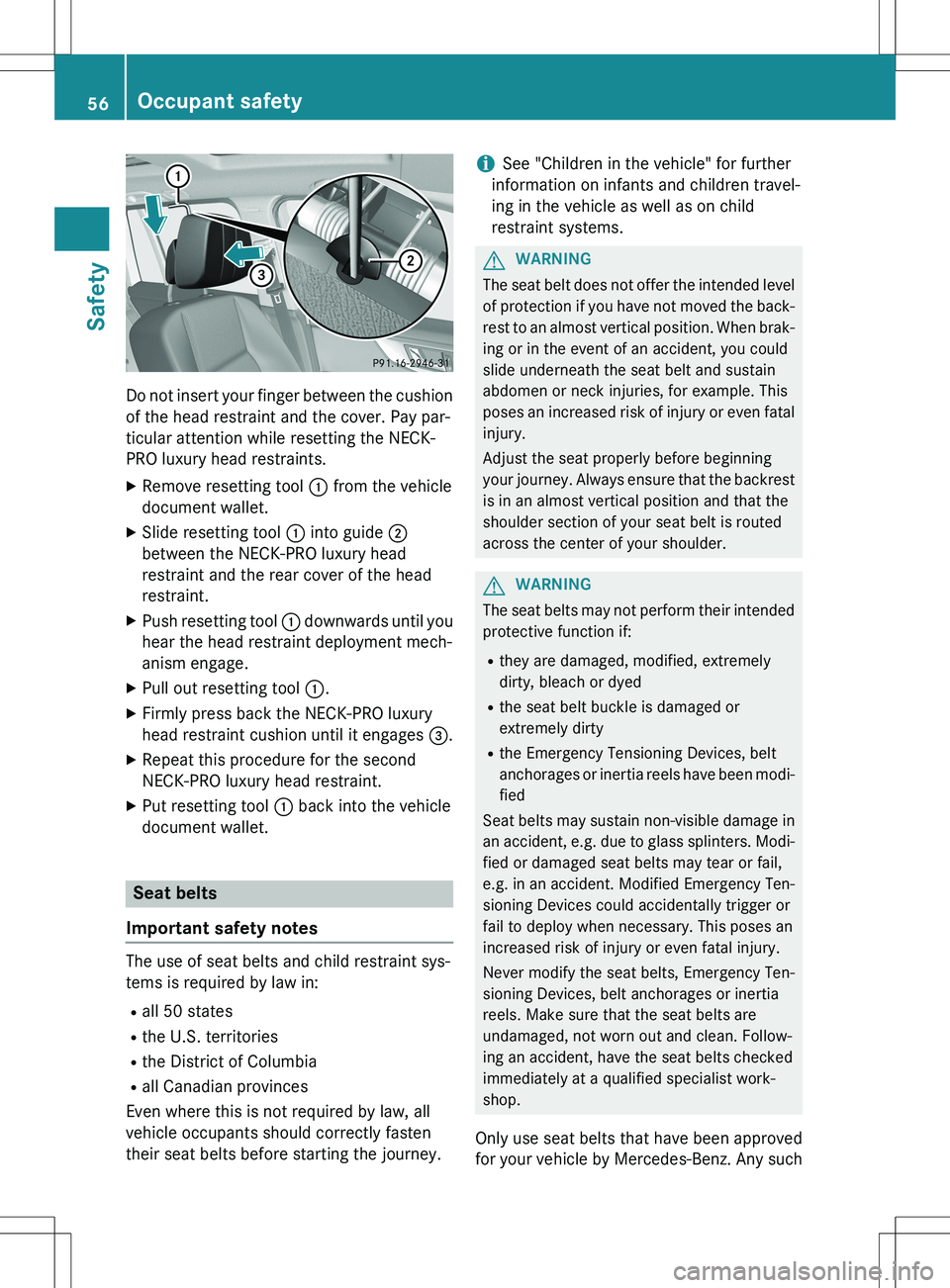
Do not insert your finger between the cushion
of the head restraint and the cover. Pay par-
ticular attention while resetting the NECK-
PRO luxury head restraints. XRemove resetting tool : from the vehicle
document wallet.
X Slide resetting tool : into guide ;
between the NECK-PRO luxury head
restraint and the rear cover of the head
restraint.
X Push resetting tool : downwards until you
hear the head restraint deployment mech-
anism engage.
X Pull out resetting tool :.
X Firmly press back the NECK-PRO luxury
head restraint cushion until it engages =.
X Repeat this procedure for the second
NECK-PRO luxury head restraint.
X Put resetting tool : back into the vehicle
document wallet.
Seat belts
Important safety notes
The use of seat belts and child restraint sys-
tems is required by law in:
R all 50 states
R the U.S. territories
R the District of Columbia
R all Canadian provinces
Even where this is not required by law, all
vehicle occupants should correctly fasten
their seat belts before starting the journey.
iSee "Children in the vehicle" for further
information on infants and children travel-
ing in the vehicle as well as on child
restraint systems.
GWARNING
The seat belt does not offer the intended level of protection if you have not moved the back-
rest to an almost vertical position. When brak-
ing or in the event of an accident, you could
slide underneath the seat belt and sustain
abdomen or neck injuries, for example. This
poses an increased risk of injury or even fatal injury.
Adjust the seat properly before beginning
your journey. Always ensure that the backrest
is in an almost vertical position and that the
shoulder section of your seat belt is routed
across the center of your shoulder.
GWARNING
The seat belts may not perform their intended protective function if:
R they are damaged, modified, extremely
dirty, bleach or dyed
R the seat belt buckle is damaged or
extremely dirty
R the Emergency Tensioning Devices, belt
anchorages or inertia reels have been modi-
fied
Seat belts may sustain non-visible damage in an accident, e.g. due to glass splinters. Modi-
fied or damaged seat belts may tear or fail,
e.g. in an accident. Modified Emergency Ten-
sioning Devices could accidentally trigger or
fail to deploy when necessary. This poses an
increased risk of injury or even fatal injury.
Never modify the seat belts, Emergency Ten-
sioning Devices, belt anchorages or inertia
reels. Make sure that the seat belts are
undamaged, not worn out and clean. Follow-
ing an accident, have the seat belts checked
immediately at a qualified specialist work-
shop.
Only use seat belts that have been approved
for your vehicle by Mercedes-Benz. Any such
56Occupant safety
Safety
Page 59 of 386
modifications could invalidate the vehicle's
general operating permit.
The use of seat belts and child restraint sys-
tems is required by law in:
R all 50 states
R the U.S. territories
R the District of Columbia
R all Canadian provinces
Even where this is not required by law, all
vehicle occupants should correctly fasten
their seat belts before starting the journey.
iSee "Children in the vehicle" for further
information on infants and children travel-
ing in the vehicle, as well as on child
restraint systems.
Proper use of the seat belts
GWARNING
USE SEAT BELTS PROPERLY
R Seat belts can only work when used prop-
erly. Never wear seat belts in any other way
than as described in this section, as that
could result in serious injuries in the event
of an accident.
R Each occupant should wear their seat belt
at all times, because seat belts help reduce
the likelihood of and potential severity of
injuries in accidents, including rollovers.
The integrated restraint system includes
SRS (driver front air bag, driver's side knee
bag, front-passenger front air bag, side
impact air bags, pelvis air bags, window
curtain air bags for the side windows),
Emergency Tensioning Devices, seat belt
force limiters, and front seat knee bolsters.
The system is designed to enhance the pro-
tection offered to properly belted occu-
pants in certain frontal (front air bags, driv-
er's side knee bag and ETDs) and side (side
impact air bags, window curtain air bags,
and ETDs) impacts which exceed preset
deployment thresholds and in certain roll-
overs (window curtain air bags and ETDs).
R Never wear the shoulder belt under your
arm, across your neck or off your shoulder.
In a frontal crash, your body would move
too far forward. That would increase the
chance of head and neck injuries. The seat belt would also apply too much force to the
ribs or abdomen, which could severely
injure internal organs such as your liver or
spleen.
Adjust the seat belt so that the shoulder
section is located as close as possible to
the middle of the shoulder. It should not
touch the neck. Never pass the shoulder
portion of the seat belt under your arm. For
this purpose, you can adjust the height of
the seat belt outlet.
R Position the lap belt as low as possible on
your hips and not across the abdomen. If
the lap belt is positioned across your abdo-
men, it could cause serious injuries in a
crash.
R Never wear seat belts over rigid or breaka-
ble objects in or on your clothing, such as
eyeglasses, pens, keys etc., as these might cause injuries.
R Make sure the seat belt is always fitted
snugly. Take special care of this when wear-
ing loose clothing.
R Never use a seat belt for more than one
person at a time. Do not fasten a seat belt
around a person and another person or
other objects at the same time.
R Seat belts should not be worn twisted. In a
crash, you would not have the full width of
the seat belt to distribute impact forces.
The twisted seat belt against your body
could cause injuries.
R Pregnant women should also always use a
lap-shoulder belt. The lap belt portion
should be positioned as low as possible on
the hips to avoid any possible pressure on
the abdomen.
R Place the seat backrest in a position that is
as upright as possible.
R Check your seat belt during travel to make
sure it is properly positioned.
Occupant safety57
Safety
Z