ignition MERCEDES-BENZ GLK SUV 2008 Repair Manual
[x] Cancel search | Manufacturer: MERCEDES-BENZ, Model Year: 2008, Model line: GLK SUV, Model: MERCEDES-BENZ GLK SUV 2008Pages: 261, PDF Size: 8.67 MB
Page 198 of 261
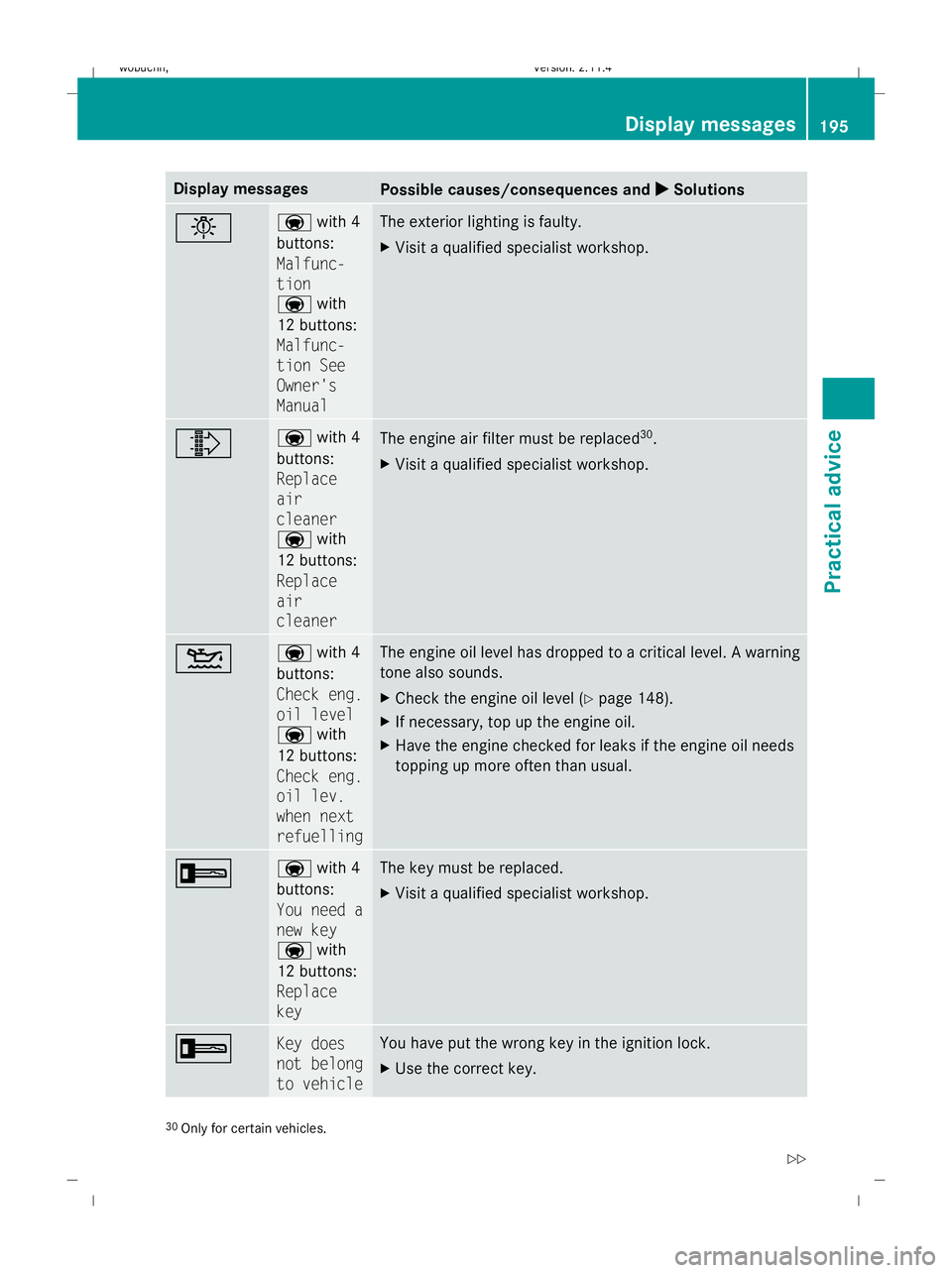
Display messages
Possible causes/consequences and
X
X Solutions b a
with 4
buttons:
Malfunc-
tion
a with
12 buttons:
Malfunc-
tion See
Owner's
Manual The exterior lighting is faulty.
X
Visit a qualified specialist workshop. ¸ a
with 4
buttons:
Replace
air
cleaner
a with
12 buttons:
Replace
air
cleaner The engine air filter must be replaced
30
.
X Visit a qualified specialist workshop. 4 a
with 4
buttons:
Check eng.
oil level
a with
12 buttons:
Check eng.
oil lev.
when next
refuelling The engine oil level has dropped to a critical level. A warning
tone also sounds.
X
Check the engine oil level ( Ypage 148).
X If necessary, top up the engine oil.
X Have the engine checked for leaks if the engine oil needs
topping up more often than usual. + a
with 4
buttons:
You need a
new key
a with
12 buttons:
Replace
key The key must be replaced.
X
Visit a qualified specialist workshop. + Key does
not belong
to vehicle You have put the wrong key in the ignition lock.
X
Use the correct key. 30
Only for certain vehicles. Display
messages
195Practical advice
X204_AKB; 1; 5, en-GB
wobuchh,V ersion: 2.11.4
2008-10-15T13:20:56+02:00 - Seite 195 ZDateiname: 6515_0671_02_buchblock.pdf; preflight
Page 206 of 261
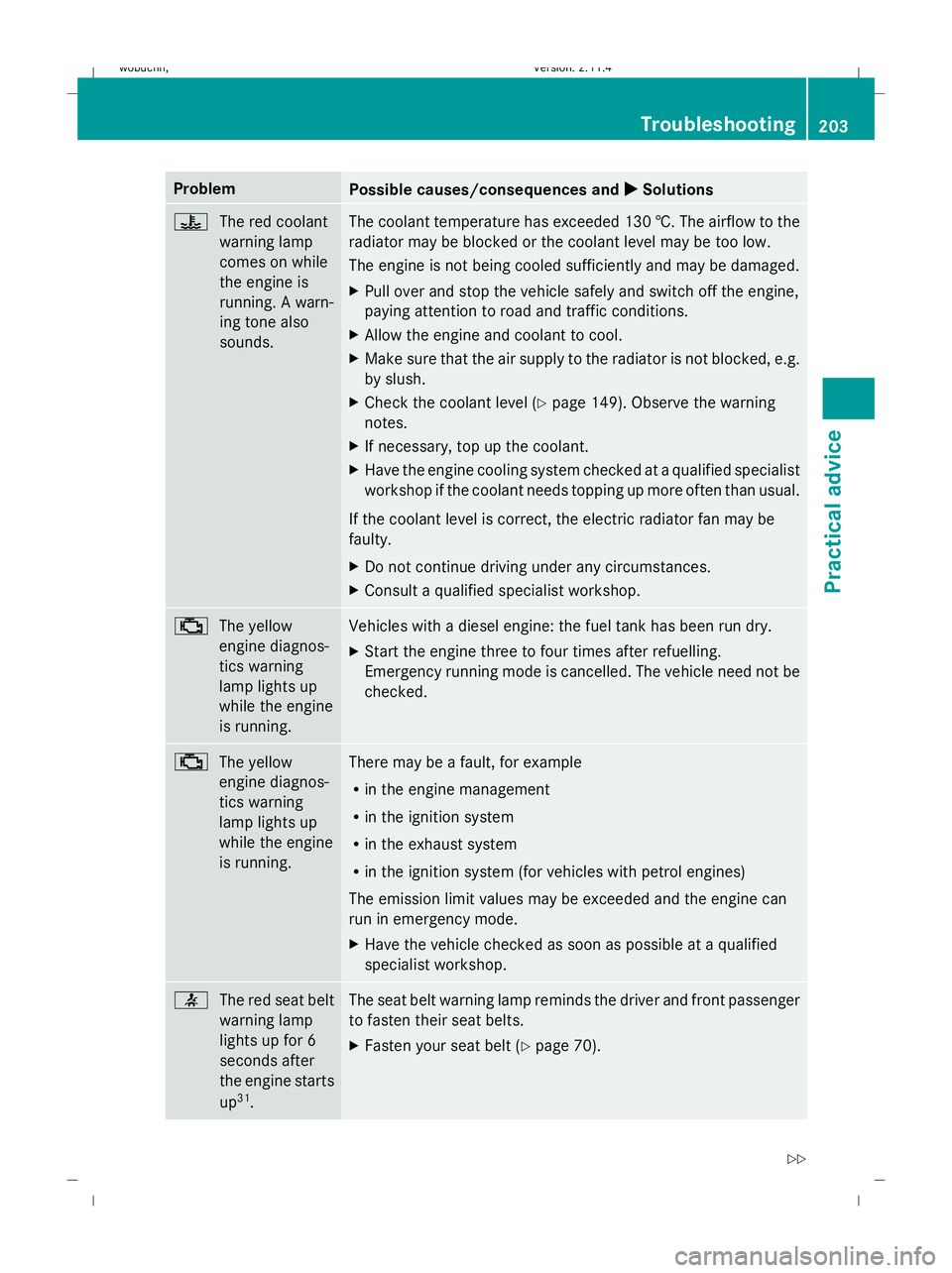
Problem
Possible causes/consequences and
X
X Solutions ?
The red coolant
warning lamp
comes on while
the engine is
running. A warn-
ing tone also
sounds. The coolant temperature has exceeded 130 †. The airflow to the
radiator may be blocked or the coolant level may be too low.
The engine is not being cooled sufficiently and may be damaged.
X
Pull over and stop the vehicle safely and switch off the engine,
paying attention to road and traffic conditions.
X Allow the engine and coolant to cool.
X Make sure that the air supply to the radiator is not blocked, e.g.
by slush.
X Check the coolant level (Y page 149). Observe the warning
notes.
X If necessary, top up the coolant.
X Have the engine cooling system checked at a qualified specialist
workshop if the coolant needs topping up more often than usual.
If the coolant level is correct, the electric radiator fan may be
faulty.
X Do not continue driving under any circumstances.
X Consult a qualified specialist workshop. ;
The yellow
engine diagnos-
tics warning
lamp lights up
while the engine
is running. Vehicles with a diesel engine: the fuel tank has been run dry.
X
Start the engine three to four times after refuelling.
Emergency running mode is cancelled. The vehicle need not be
checked. ;
The yellow
engine diagnos-
tics warning
lamp lights up
while the engine
is running. There may be a fault, for example
R
in the engine management
R in the ignition system
R in the exhaust system
R in the ignition system (for vehicles with petrol engines)
The emission limit values may be exceeded and the engine can
run in emergency mode.
X Have the vehicle checked as soon as possible at a qualified
specialist workshop. 7
The red seat belt
warning lamp
lights up for 6
seconds after
the engine starts
up31
. The seat belt warning lamp reminds the driver and front passenger
to fasten their seat belts.
X Fasten your seat belt (Y page 70). Troubleshooting
203Practical advice
X204_AKB; 1; 5, en-GB
wobuchh, Version: 2.11.4 2008-10-15T13:20:56+02:00 - Seite 203 ZDateiname: 6515_0671_02_buchblock.pdf; preflight
Page 208 of 261
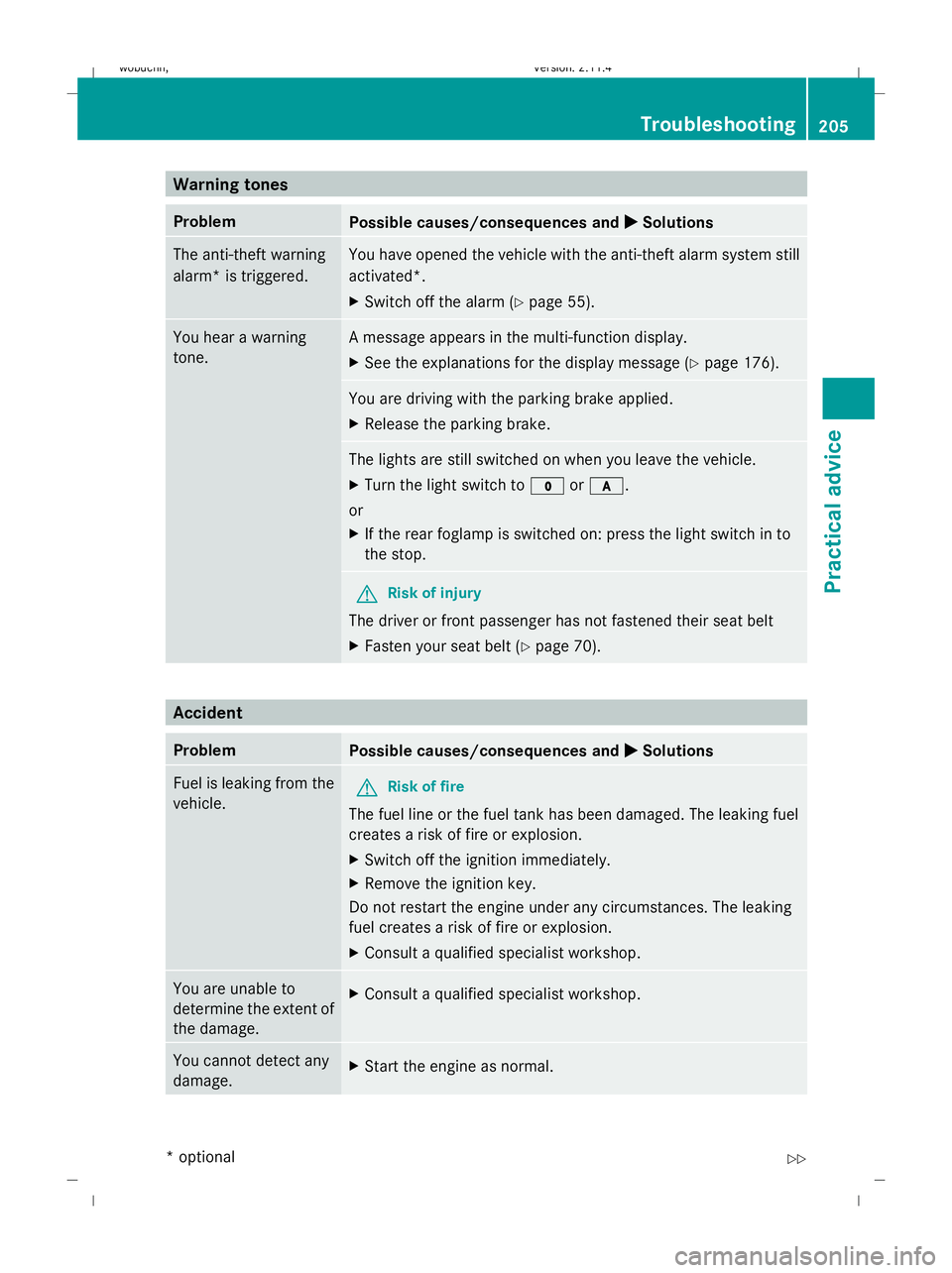
Warning tones
Problem
Possible causes/consequences and
X
X Solutions The anti-theft warning
alarm* is triggered. You have opened the vehicle with the anti-theft alarm system still
activated*.
X Switch off the alarm (Y page 55). You hear a warning
tone. A message appears in the multi-function display.
X
See the explanations for the display message (Y page 176). You are driving with the parking brake applied.
X
Release the parking brake. The lights are still switched on when you leave the vehicle.
X
Turn the light switch to $orc.
or
X If the rear foglamp is switched on: press the light switch in to
the stop. G
Risk of injury
The driver or front passenger has not fastened their seat belt
X Fasten your seat belt (Y page 70). Accident
Problem
Possible causes/consequences and
X
X Solutions Fuel is leaking from the
vehicle.
G
Risk of fire
The fuel line or the fuel tank has been damaged. The leaking fuel
creates a risk of fire or explosion.
X Switch off the ignition immediately.
X Remove the ignition key.
Do not restart the engine under any circumstances. The leaking
fuel creates a risk of fire or explosion.
X Consult a qualified specialist workshop. You are unable to
determine the extent of
the damage.
X
Consult a qualified specialist workshop. You cannot detect any
damage.
X
Start the engine as normal. Troubleshooting
205Practical advice
* optional
X204_AKB; 1; 5, en-GB
wobuchh,
Version: 2.11.4 2008-10-15T13:20:56+02:00 - Seite 205 ZDateiname: 6515_0671_02_buchblock.pdf; preflight
Page 209 of 261
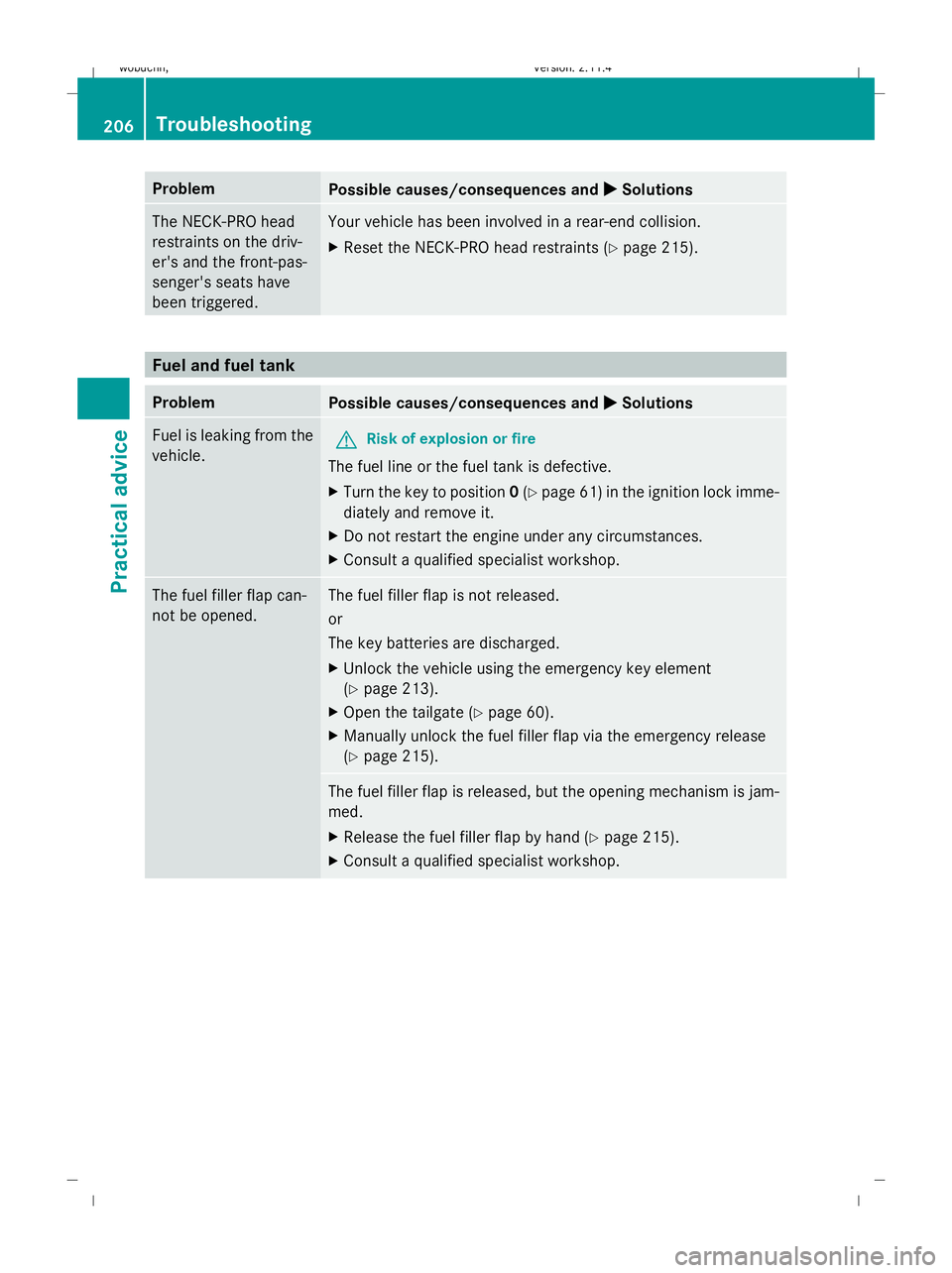
Problem
Possible causes/consequences and
X XSolutions The NECK-PRO head
restraints on the driv-
er's and the front-pas-
senger's seats have
been triggered. Your vehicle has been involved in a rear-end collision.
X
Reset the NECK-PRO head restraints (Y page 215).Fuel and fuel tank
Problem
Possible causes/consequences and
X XSolutions Fuel is leaking from the
vehicle.
G
Risk of explosion or fire
The fuel line or the fuel tank is defective.
X Turn the key to position 0(Y page 61) in the ignition lock imme-
diately and remove it.
X Do not restart the engine under any circumstances.
X Consult a qualified specialist workshop. The fuel filler flap can-
not be opened. The fuel filler flap is not released.
or
The key batteries are discharged.
X
Unlock the vehicle using the emergency key element
(Y page 213).
X Open the tailgate (Y page 60).
X Manually unlock the fuel filler flap via the emergency release
(Y page 215). The fuel filler flap is released, but the opening mechanism is jam-
med.
X
Release the fuel filler flap by hand (Y page 215).
X Consult a qualified specialist workshop. 206 TroubleshootingPractical advice
X204_AKB; 1; 5, en-GB
wobuchh,
Version: 2.11.4 2008-10-15T13:20:56+02:00 - Seite 206Dateiname: 6515_0671_02_buchblock.pdf; preflight
Page 210 of 261
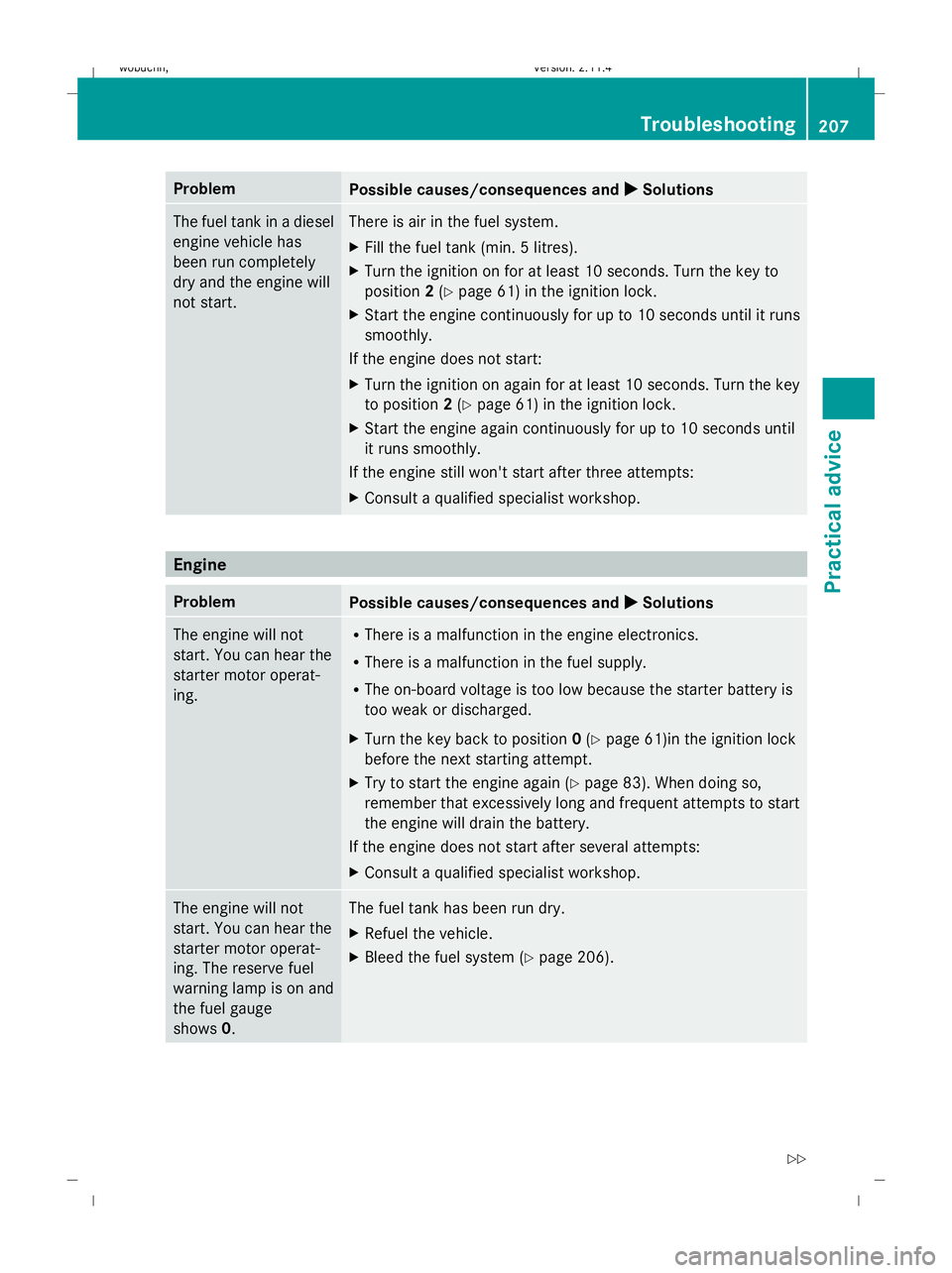
Problem
Possible causes/consequences and
X
X Solutions The fuel tank in a diesel
engine vehicle has
been run completely
dry and the engine will
not start. There is air in the fuel system.
X Fill the fuel tank (min. 5 litres).
X Turn the ignition on for at least 10 seconds. Turn the key to
position 2(Y page 61) in the ignition lock.
X Start the engine continuously for up to 10 seconds until it runs
smoothly.
If the engine does not start:
X Turn the ignition on again for at least 10 seconds. Turn the key
to position 2(Y page 61) in the ignition lock.
X Start the engine again continuously for up to 10 seconds until
it runs smoothly.
If the engine still won't start after three attempts:
X Consult a qualified specialist workshop. Engine
Problem
Possible causes/consequences and
X
X Solutions The engine will not
start. You can hear the
starter motor operat-
ing. R
There is a malfunction in the engine electronics.
R There is a malfunction in the fuel supply.
R The on-board voltage is too low because the starter battery is
too weak or discharged.
X Turn the key back to position 0(Y page 61)in the ignition lock
before the next starting attempt.
X Try to start the engine again (Y page 83). When doing so,
remember that excessively long and frequent attempts to start
the engine will drain the battery.
If the engine does not start after several attempts:
X Consult a qualified specialist workshop. The engine will not
start. You can hear the
starter motor operat-
ing. The reserve fuel
warning lamp is on and
the fuel gauge
shows 0. The fuel tank has been run dry.
X
Refuel the vehicle.
X Bleed the fuel system (Y page 206). Troubleshooting
207Practical advice
X204_AKB; 1; 5, en-GB
wobuchh, Version: 2.11.4 2008-10-15T13:20:56+02:00 - Seite 207 ZDateiname: 6515_0671_02_buchblock.pdf; preflight
Page 212 of 261
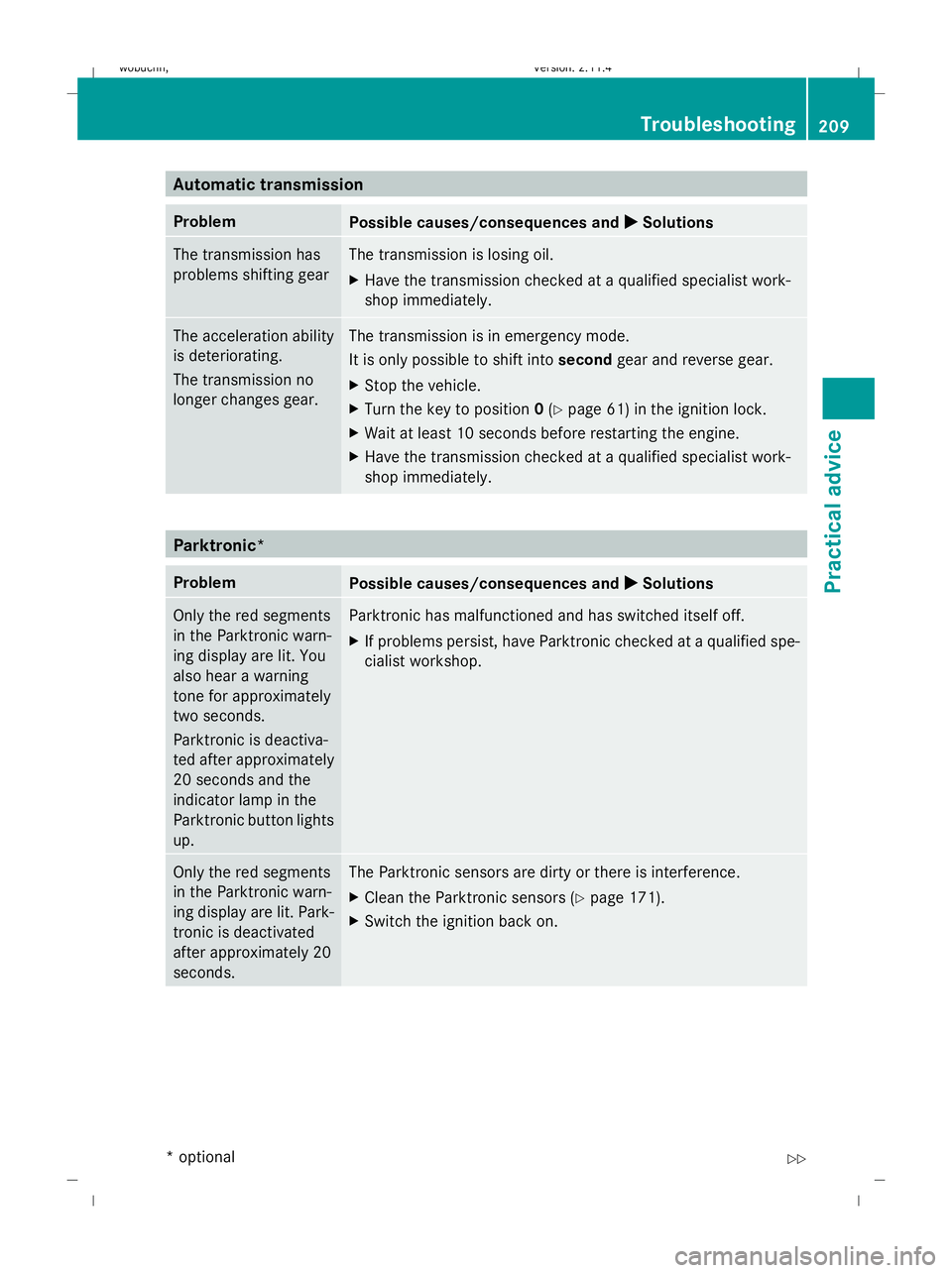
Automatic transmission
Problem
Possible causes/consequences and
X
X Solutions The transmission has
problems shifting gear The transmission is losing oil.
X
Have the transmission checked at a qualified specialist work-
shop immediately. The acceleration ability
is deteriorating.
The transmission no
longer changes gear. The transmission is in emergency mode.
It is only possible to shift into
secondgear and reverse gear.
X Stop the vehicle.
X Turn the key to position 0(Y page 61) in the ignition lock.
X Wait at least 10 seconds before restarting the engine.
X Have the transmission checked at a qualified specialist work-
shop immediately. Parktronic*
Problem
Possible causes/consequences and
X
X Solutions Only the red segments
in the Parktronic warn-
ing display are lit. You
also hear a warning
tone for approximately
two seconds.
Parktronic is deactiva-
ted after approximately
20 seconds and the
indicator lamp in the
Parktronic button lights
up. Parktronic has malfunctioned and has switched itself off.
X
If problems persist, have Parktronic checked at a qualified spe-
cialist workshop. Only the red segments
in the Parktronic warn-
ing display are lit. Park-
tronic is deactivated
after approximately 20
seconds. The Parktronic sensors are dirty or there is interference.
X
Clean the Parktronic sensors (Y page 171).
X Switch the ignition back on. Troubleshooting
209Practical advice
* optional
X204_AKB; 1; 5, en-GB
wobuchh,
Version: 2.11.4 2008-10-15T13:20:56+02:00 - Seite 209 ZDateiname: 6515_0671_02_buchblock.pdf; preflight
Page 213 of 261
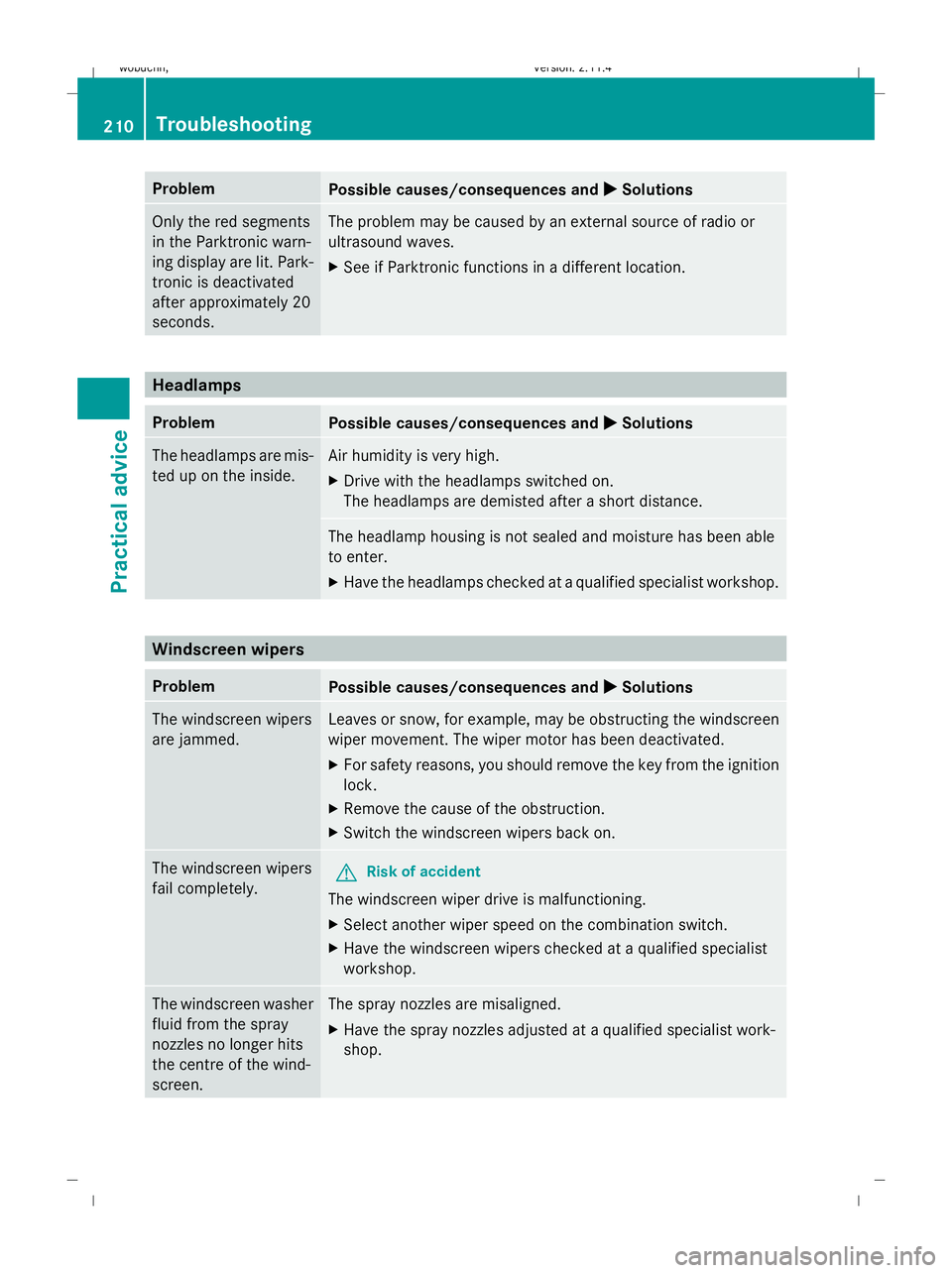
Problem
Possible causes/consequences and
X XSolutions Only the red segments
in the Parktronic warn-
ing display are lit. Park-
tronic is deactivated
after approximately 20
seconds. The problem may be caused by an external source of radio or
ultrasound waves.
X
See if Parktronic functions in a different location. Headlamps
Problem
Possible causes/consequences and
X XSolutions The headlamps are mis-
ted up on the inside. Air humidity is very high.
X
Drive with the headlamps switched on.
The headlamps are demisted after a short distance. The headlamp housing is not sealed and moisture has been able
to enter.
X
Have the headlamps checked at a qualified specialist workshop. Windscreen wipers
Problem
Possible causes/consequences and
X XSolutions The windscreen wipers
are jammed. Leaves or snow, for example, may be obstructing the windscreen
wiper movement. The wiper motor has been deactivated.
X
For safety reasons, you should remove the key from the ignition
lock.
X Remove the cause of the obstruction.
X Switch the windscreen wipers back on. The windscreen wipers
fail completely.
G
Risk of accident
The windscreen wiper drive is malfunctioning.
X Select another wiper speed on the combination switch.
X Have the windscreen wipers checked at a qualified specialist
workshop. The windscreen washer
fluid from the spray
nozzles no longer hits
the centre of the wind-
screen. The spray nozzles are misaligned.
X
Have the spray nozzles adjusted at a qualified specialist work-
shop. 210 TroubleshootingPractical advice
X204_AKB; 1; 5, en-GB
wobuchh,
Version: 2.11.4 2008-10-15T13:20:56+02:00 - Seite 210Dateiname: 6515_0671_02_buchblock.pdf; preflight
Page 216 of 261
Problem
Possible causes/consequences and
X
X Solutions The engine cannot be
started using the key. The steering lock is mechanically blocked.
X
Remove the key and reinsert it into the ignition lock. While doing
this, turn the steering wheel in both directions. Parking up the vehicle
Problem
Possible causes/consequences and
X
X Solutions The vehicle is to be left
parked up for longer
than six weeks. Damage resulting from non-use may occur if the vehicle is parked
up for long periods.
X
Visit a qualified specialist workshop and seek advice.
X Disconnect the battery (Y page 233).Locking/unlocking in an emergency
Emergency key
If the vehicle can no longer be locked or
unlocked with the key, use the emergency
key element.
If you use the emergency key element to
unlock and open the driver's door, the anti-
theft alarm system* will be triggered
(Y page 54).
There are several ways to turn off the alarm:
X Press the %or& button on the key.
or
X Insert the key into the ignition lock.
If you unlock the vehicle using the emergency
key element, the fuel filler flap will not be
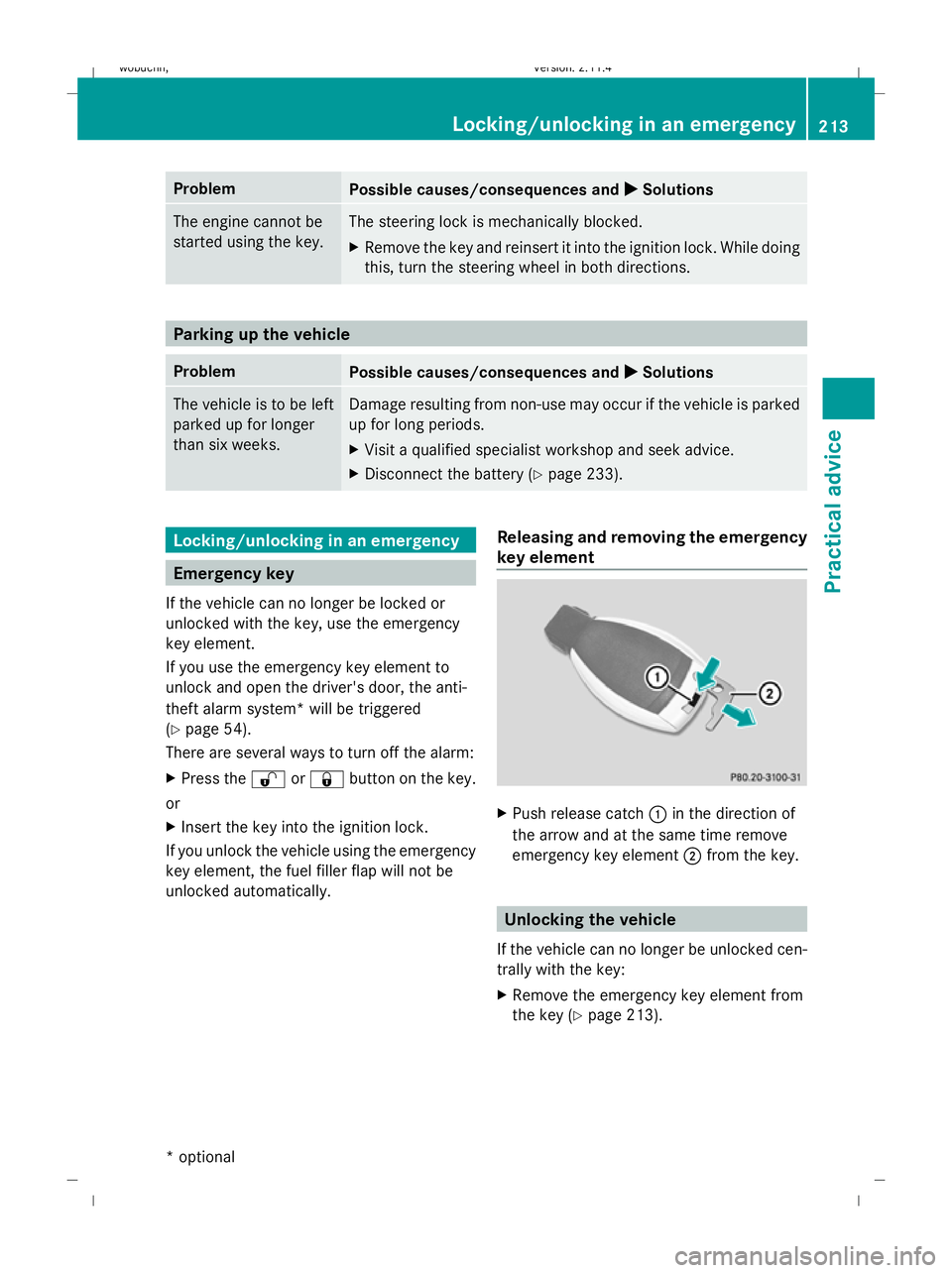
unlocked automatically. Releasing and removing the emergency
key element X
Push release catch :in the direction of
the arrow and at the same time remove
emergency key element ;from the key. Unlocking the vehicle
If the vehicle can no longer be unlocked cen-
trally with the key:
X Remove the emergency key element from
the key (Y page 213). Locking/unlocking in an emergency
213Practical advice
* optional
X204_AKB; 1; 5, en-GB
wobuchh,
Version: 2.11.4 2008-10-15T13:20:56+02:00 - Seite 213 ZDateiname: 6515_0671_02_buchblock.pdf; preflight
Page 224 of 261
the wiper blades twice a year, ideally in spring
and autumn. G
Risk of accident
The wiper arms could start moving and cause
an injury if you leave the windscreen wipers
switched on.
Remove the key from the ignition lock before
replacing the wiper blades.
! To avoid damaging the windscreen wiper
blades, make sure that you touch only the
wiper arm of the windscreen wiper.
Removing !
Before changing the wiper blades, always
set the wiper arms to a vertical position by
using the combination switch. There is oth-
erwise a risk of damaging the bonnet.
X Turn the key to position 1or 2in the ignition
lock.
X Set the windscreen wipers to posi-
tion ° on the combination switch.
X When the wiper arms have reached a ver-
tical position, turn the key to position 0and
remove it from the ignition lock.
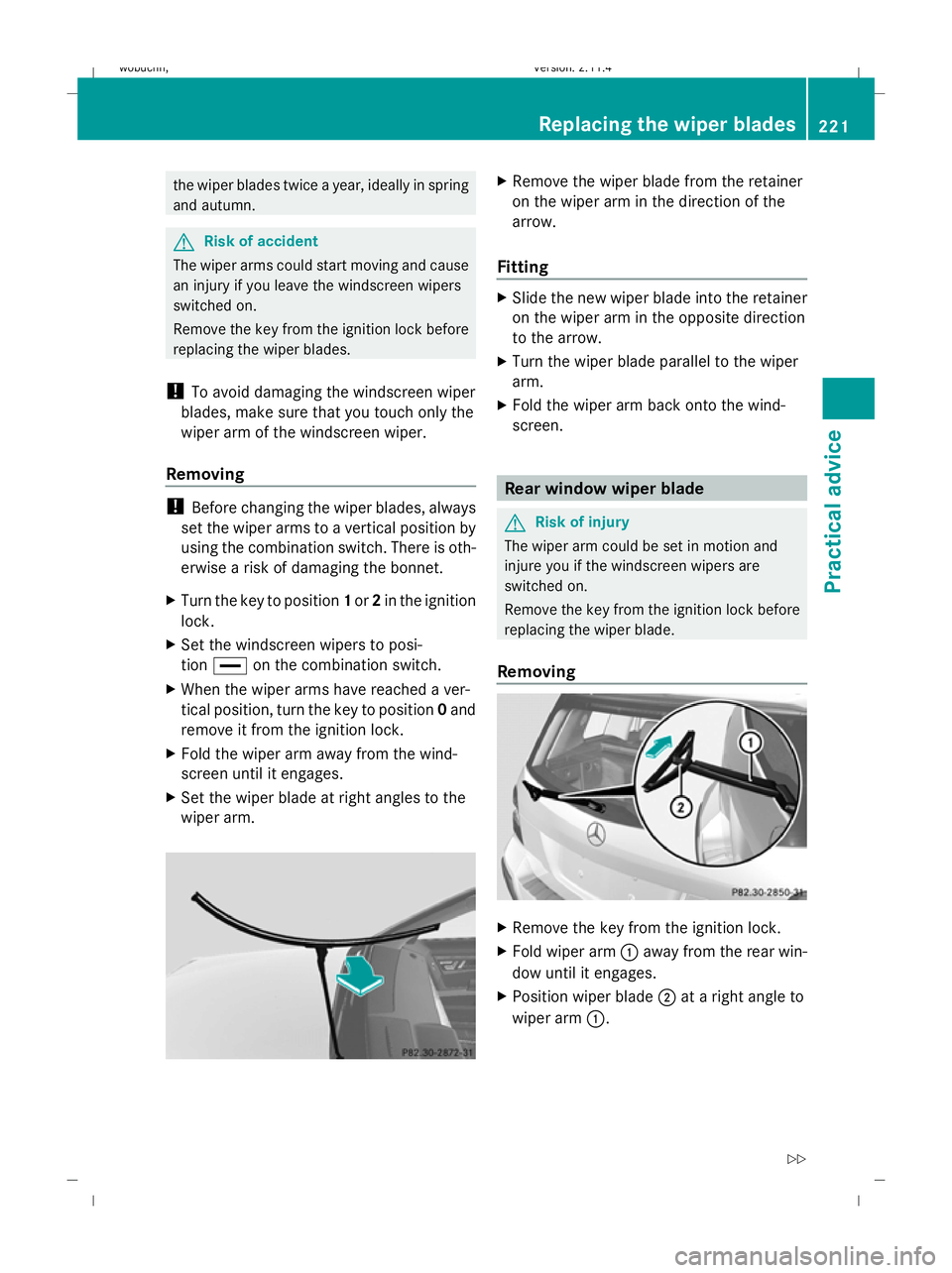
X Fold the wiper arm away from the wind-
screen until it engages.
X Set the wiper blade at right angles to the
wiper arm. X
Remove the wiper blade from the retainer
on the wiper arm in the direction of the
arrow.
Fitting X
Slide the new wiper blade into the retainer
on the wiper arm in the opposite direction
to the arrow.
X Turn the wiper blade parallel to the wiper
arm.
X Fold the wiper arm back onto the wind-
screen. Rear window wiper blade
G
Risk of injury
The wiper arm could be set in motion and
injure you if the windscreen wipers are
switched on.
Remove the key from the ignition lock before
replacing the wiper blade.
Removing X
Remove the key from the ignition lock.
X Fold wiper arm :away from the rear win-
dow until it engages.
X Position wiper blade ;at a right angle to
wiper arm :. Replacing the
wiper blades
221Practical advice
X204_AKB; 1; 5, en-GB
wobuchh,V ersion: 2.11.4
2008-10-15T13:20:56+02:00 - Seite 221 ZDateiname: 6515_0671_02_buchblock.pdf; preflight
Page 225 of 261
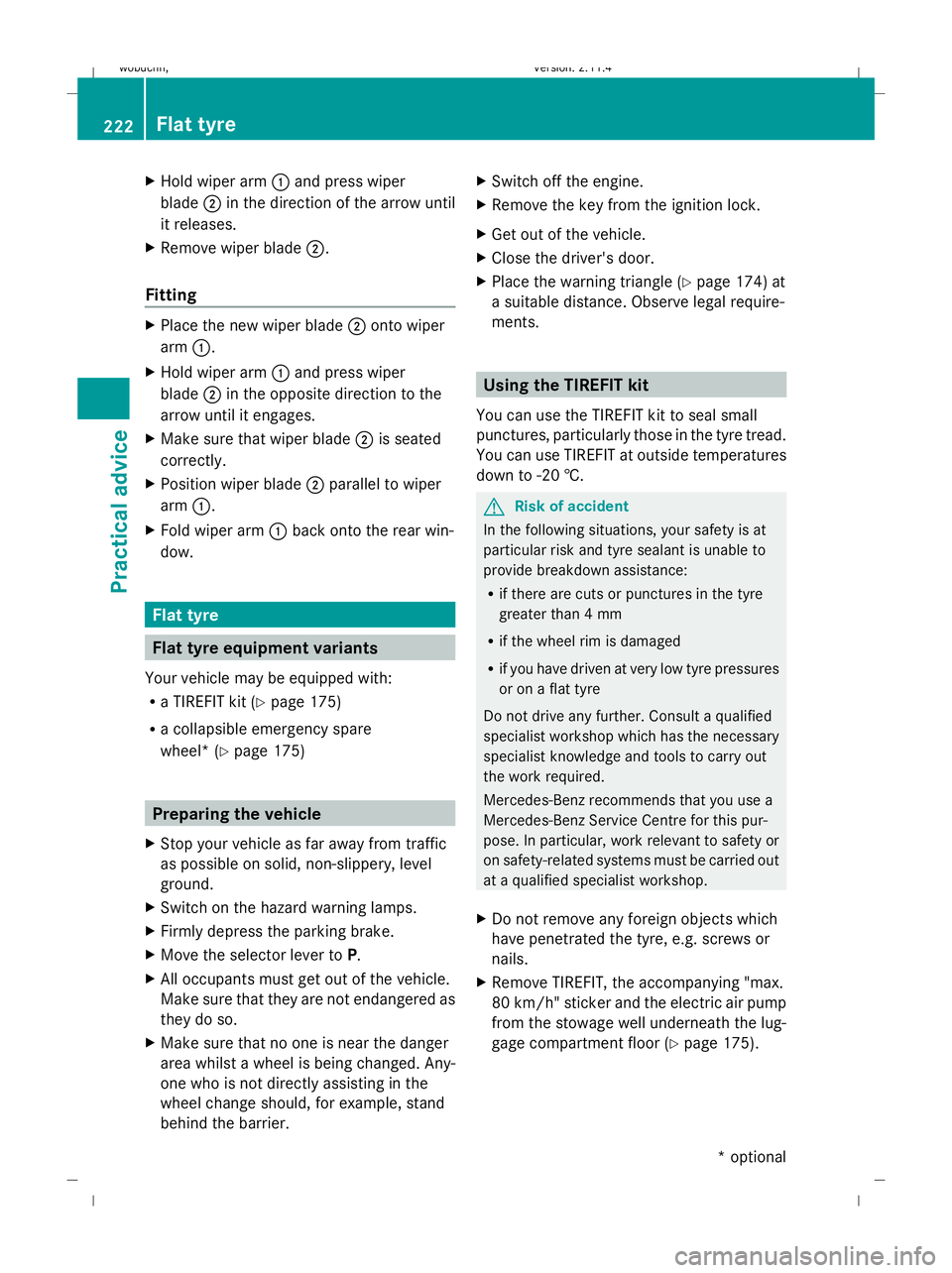
X
Hold wiper arm :and press wiper
blade ;in the direction of the arrow until
it releases.
X Remove wiper blade ;.
Fitting X
Place the new wiper blade ;onto wiper
arm :.
X Hold wiper arm :and press wiper
blade ;in the opposite direction to the
arrow until it engages.
X Make sure that wiper blade ;is seated
correctly.
X Position wiper blade ;parallel to wiper
arm :.
X Fold wiper arm :back onto the rear win-
dow. Flat tyre
Flat tyre equipment variants
Your vehicle may be equipped with:
R a TIREFIT kit (Y page 175)
R a collapsible emergency spare
wheel* (Y page 175) Preparing the vehicle
X Stop your vehicle as far away from traffic
as possible on solid, non-slippery, level
ground.
X Switch on the hazard warning lamps.
X Firmly depress the parking brake.
X Move the selector lever to P.
X All occupants must get out of the vehicle.
Make sure that they are not endangered as
they do so.
X Make sure that no one is near the danger
area whilst a wheel is being changed. Any-
one who is not directly assisting in the
wheel change should, for example, stand
behind the barrier. X
Switch off the engine.
X Remove the key from the ignition lock.
X Get out of the vehicle.
X Close the driver's door.
X Place the warning triangle (Y page 174) at
a suitable distance. Observe legal require-
ments. Using the TIREFIT kit
You can use the TIREFIT kit to seal small
punctures, particularly those in the tyre tread.
You can use TIREFIT at outside temperatures
down to -20 †. G
Risk of accident
In the following situations, your safety is at
particular risk and tyre sealant is unable to
provide breakdown assistance:
R if there are cuts or punctures in the tyre
greater than 4 mm
R if the wheel rim is damaged
R if you have driven at very low tyre pressures
or on a flat tyre
Do not drive any further. Consult a qualified
specialist workshop which has the necessary
specialist knowledge and tools to carry out
the work required.
Mercedes-Benz recommends that you use a
Mercedes-Benz Service Centre for this pur-
pose. In particular, work relevant to safety or
on safety-related systems must be carried out
at a qualified specialist workshop.
X Do not remove any foreign objects which
have penetrated the tyre, e.g. screws or
nails.
X Remove TIREFIT, the accompanying "max.
80 km/h" sticker and the electric air pump
from the stowage well underneath the lug-
gage compartment floor (Y page 175).222 Flat tyrePractical advice
* optional
X204_AKB; 1; 5, en-GB
wobuchh,
Version: 2.11.4 2008-10-15T13:20:56+02:00 - Seite 222Dateiname: 6515_0671_02_buchblock.pdf; preflight