wheel MERCEDES-BENZ METRIS 2016 MY16 Operator’s Manual
[x] Cancel search | Manufacturer: MERCEDES-BENZ, Model Year: 2016, Model line: METRIS, Model: MERCEDES-BENZ METRIS 2016Pages: 310, PDF Size: 7.28 MB
Page 257 of 310
This will prevent smears and reduce wiping
noises caused by residue on the windshield.
Ron vehicles with rear doors, from the rear view
camera lens in the top of the license plate
molding (
Ypage 257)
Washing by hand
In some countries, washing by hand is only
allowed at specially equipped washing bays.
Observe the legal requirementsofthe country
you are currently in when washing by hand.
XDo not use hot water and do not wash the
vehicle in direct sunlight.
XUse asoft car sponge.
XUse amild cleaning agent, e.g. aMercedes-
Benz approved car shampoo.
XThoroughly hose down the vehicle with agen-
tle jet of water.
XDo not point the water jet directly towards the
air inlets.
XUse plenty of water and rinse out the sponge
frequently.
XRinse the vehicle with clean water and dry
thoroughly with achamois.
XDo not let the cleaning agents dry on the
paintwork.
When using the vehicle in winter, remove all
traces of road salt deposits carefully and as
soon as possible.
Power washers
GWARNING
The water jet from acircular jet nozzle (dirt
blasters) can cause invisible exterior damage
to the tires or chassis components .Compo-
nentsd amaged in this way may fail unexpect-
edly. There is arisk of an accident.
Do not use power washers with circular jet
nozzles to clean the vehicle. Have damaged
tires or chassis components replaced imme-
diately.
!Under no circumstances use power washers
in the vehicle interior. The pressurized water
and associated spray produced by the power
washer could cause extensive damage to the
vehicle.
!When using high-pressure cleaning equip-
ment,m aintainaminimum distance of
approx. 1ft(30 cm) between the spray nozzle
and the vehicle parts. Do not use apower
washer with around-jet nozzle. You could
damage the vehicle or engine parts.
!Keep the water jet moving constantly while
cleaning. This will avoid causing damage to
the vehicle.
Do not point the water jet at:
Rdoor joints
Rrear view camera
Rair bellows
Rbrake hoses
Rwheel balance weights
Relectrical components
Relectrical connections
Rseals
Rdrive train, especially not at the intermedi-
ate bearing of the propeller shaft
Cleaning the engine
!Water must not enter intak eorventilation
openings. When cleaning with high pressure
water or steam cleaners, the spray must not
be aimed directly at electrical components or the terminals of electrical lines.
Preserve the engine after the engine has been
cleaned. Protectt he belt drive system from
exposure to the preservative agent.
Also observe the information under "Power
washers" (
Ypage 255).
Cleaning the paintwork
!Do not affix:
Rstickers
Rfilms
Rmagnetic plates or similar items
to painted surfaces. You could otherwise
damage the paintwork.
Scratches, corrosived eposits, areas affected by
corrosion and damage caused by inadequate
care cannot alwaysbec ompletely repaired. In
such cases, visit aqualified specialist workshop.
Care255
Maintenance and care
Z
Page 258 of 310
XRemove impurities immediately, wherepos-
sible, whils tavoidin grubbing to ohard.
XSoak insec tremain swithi nsec tremove rand
rinse off th etreated areas afterwards .
XSoak bird droppings wit hwater and rinse off
th et reated areas afterwards .
XRemove coolant, brakefluid ,tre er esin, oils ,
fuel sand greases by rubbing gentl ywitha
cloth soaked in petroleum ether or lighte r
fluid .
XUse tar remove rtoremove tar stains.
XUse silicon eremove rtoremove wax.
Cleaning th ewindows
GWARNIN G
You could become trapped by th ewindshield
wiper siftheys tart moving while cleaning th e
windshield or wiper blades. There is arisko f
injury.
Always switch off th ewindshield wiper sand
th ei gnition before cleaning th ewindshield or
wiper blades.
!Do no tfoldt he windshield wiper saway from
th ew indshield unless th ehoodisc losed. Oth-
erwise, you could damag ethe hood.
!Hold th ewiper arm securel ywhen foldin g
back. The windshield could be damaged if th e
wiper arm smack sagainst it suddenly.
!Do no tuse dry cloths, abrasive products ,
solvents or cleaning agents containing sol-
vents to clean th einside of th ewindows .Do
no ttou ch th einsides of th ewindows wit h
har dobjects ,e.g.ani ce scrape rorring. There
is otherwise ariskofd amaging th ewindows .
!Clean th ewater drainag echannels of th e
windshield and th erear window at regular
intervals. Deposit ssuchasl eaves, petals and
polle nmay under certain circumstances pre -
ven twater from drainin gaway. This can lead
to corrosio ndamag eand damag etoelec-
tronic components.
XClean th einside and outside of th ewindows
wit had amp cloth and acleaning agen ttha tis
recommended and approve dbyMercedes-
Benz.
Exterior
Cleaning th ewheels
!Do no tuse any acidic or alkalin ecleaning
agents .The yc an caus ecorro sionont he
whee lbolt sort heretainer spring sfor th e
wheel-balancin gweights .
!Do notpark th evehicl efor an extended
period straight after cleaning it ,particularly
after having cleane dthe wheels wit hwhee l
cleaner. Whee lcleaners could caus e
increased corrosio nofthebrak ediscsa nd
brak epads/linings. Fo rthisr eason ,you
should driv efor afew minute safter cleaning .
Braking heat sthe brak ediscsa nd th ebrak e
pads/linings, thus dryin gthem. The vehicl e
can then be parked.
If you clean th ewheels wit hapower washer,
observ ethe safet ynotes for th epower washe r
(
Ypage 255). You could otherwise damag ethe
tires .
Cleaning th ewiper blades
GWARNIN G
You could become trapped by th ewindshield
wiper siftheys tart moving while cleaning th e
windshield or wiper blades. There is arisko f
injury.
Always switch off th ewindshield wiper sand
th ei gnition before cleaning th ewindshield or
wiper blades.
!Do no tfoldt he windshield wiper saway from
th ew indshield unless th ehoodisc losed. Oth-
erwise, you could damag ethe hood.
!Do no tpull th ewiper blade .Otherwise, th e
wiper blade could be damaged.
!Do no tclean wiper blade stoo often and do
no trub them to ohard. Otherwise, th egraph-
it ec oating could be damaged. This could
caus ewiper noise.
!Hold th ewiper arm securel ywhen foldin g
back. The windshield could be damaged if th e
wiper arm smack sagainst it suddenly.
XTurn th ekeyto position 0in th eignition loc k
or remove it .
XFold thewindshield wiper arm saway from th e
windshield until you fee lthe me ngage .
256Care
Maintenance and care
Page 261 of 310
Cleaning thesteering wheel and selec-
tor lever
XThoroughlyw ipe withadamp cloth.
XVehicles with leather upholstery: after
cleaning, use leather car eagents that have
been recommended and approved by
Mercedes-Benz.
Cleaning th etrime lements
!Do no tuse solvent-based cleanin gagents
suchast ar remover, wheel cleaners, polishes
or waxes. Thereiso therwise ariskofd amag-
ing th esurface.
XWipe th etrime lements withad amp, lint-free
cloth ,e.g.am icrofiber cloth.
XHeavy soiling: use careproduct sand clean-
ing agents recommended and approved by
Mercedes-Benz.
Cleaning th eseat covers
!Do no tuse microfiber cloth stoclean genu-
ine leather or artificial leather covers.Ifu sed
often,am icrofiber cloth can damag ethe
cover.
!Clean:
Rartificial leather covers withac loth mois-
tene dwithas olution containing 1% deter-
gent, e.g .dish washingl iquid.
Rcloth covers witham icrofiber cloth mois-
tene dwithas olution containing 1% deter-
gent, e.g .dish washingl iquid. Wipe entire
seat sections carefull ytoa void leaving visi-
ble lines. Leavet heseat to dry afterwards.
Cleaning results dependont hetype of dirt
and how longith as been there.
Rgenuine leather covers carefull ywitha
damp cloth ,the nw ipe th ecovers down
withad ry cloth.Makes ure that th eleather
does no tbecome soaked. Otherwise, the
leather coul dbecome roug horcracked.
Only use leather car eagents that have
been tested and approved by Mercedes-
Benz. You can obtain these from aqualified
specialist workshop.
iPleasek eepinm indt hat:
Rleather covers are anatural product and ,as
such, are subject to anatural agingp roc-
ess.L eather may reac tdifferently (e.g. increased wrinkling
)tocertain environ-
mental influences (suchash igh humidity or
intense heat).
Rregular car eisessential to mak esure that
th ea ppearanc eand comfor tofthecovers
are retaine dovertime.
Cleaning th eseat belts
GWARNING
Seat beltsc an become severely weakened if
bleached or dyed. This coul dcaus ethe seat
beltstot earorf ail, for instance, in th eevent of
an accident. This posesani ncreased riskof
injury or fatal injury.
Never bleachord ye theseat belts.
!Do no tclean th eseat beltsu singchemical
cleanin gagents .Don otdry th eseat beltsb y
heating at temperatures above1 76‡(80 †)
or in direct sunlight.
Remove any stains or dirt immediately .This will
avoi dresidue or damage.
XUse clean, lukewarm water and soaps olution.
Cleaning the headliner and carpets
XHeadliner:if it is very dirty ,use asoft brus hor
dry shampoo.
XCarpets: use the carpe tand textile cleaning
agents recommended and approved by
Mercedes-Benz.
Care259
Maintenancea nd care
Z
Page 262 of 310
Useful information
This Operator's Manual describes all models as
well as standard and optional equipment of your
vehicle that were available at the time of going
to print.Country-specific variation sare possi-
ble. Note that your vehicle may not be equipped
with all of the described functions. This also
applies to system sand function srelevantt o
safety.
Read the information on qualified specialist
workshops (
Ypage 29).
Wherew illIfind...?
Vehicle tool kit
Genera lnotes
Depending on the equipment version of the vehi-
cle, the vehicle tool kit is:
Rin the seat base of the left fronts eat
Rin the rear stowage compartment
Rin the tool holder in the cargo compartment
Apart from some country-specific variants, vehi-
cles without aspare wheel are not equipped
with tire-changing tools. If your vehicle is equip-
ped with tire-changing tools, thes eare in the
vehicle tool kit .Ifthe vehicle tool kit is stowed in
the driver'ss eat base, the jack is in aseparate
holder in the cargo compartmen tonthe right-
hand side of the vehicle nex ttothe tailgate/rear
door (
Ypage 262).
Some tools for changing awheel are specific to
the vehicle. For more information on which tools are required and approved to performaw heel
change on your vehicle, consult aqualified spe-
cialist workshop.
Necessary tire-changing tools can include, for
example:
RJack
RLug wrench
RRatchet wrench
Stowage compartment in the seat base
Stowage compartmen tinthe seat base of the left
fronts eat
XTo open: press both latching springs :down
and release cover ;upwards from the seat
base.
XRemove cover ;by pulling upwards at an
angle from the seat base.
XRemove the clampings trap and removethe
vehicle tool kit.
For vehicles equipped with tire-changing
tools, the jack is in aseparate holder in the
cargo compartmen tonthe right-han dside of
the vehicle nex ttothe tailgate/rear door
(
Ypage 262).
XTo close: after stowin gthe vehicle tool bag,
inser tcover ;in frontoft he stowage com-
partment in the seat base and fold shut.
Latching springs :of cover ;must engage
audibly.
Stowage compartment in the rear
Opening/closing the stowage compart-
ment
Stowage compartmen tinthe rear on the right-hand
side of the vehicle
260Wherew illIfind...?
Breakdown assistance
Page 264 of 310
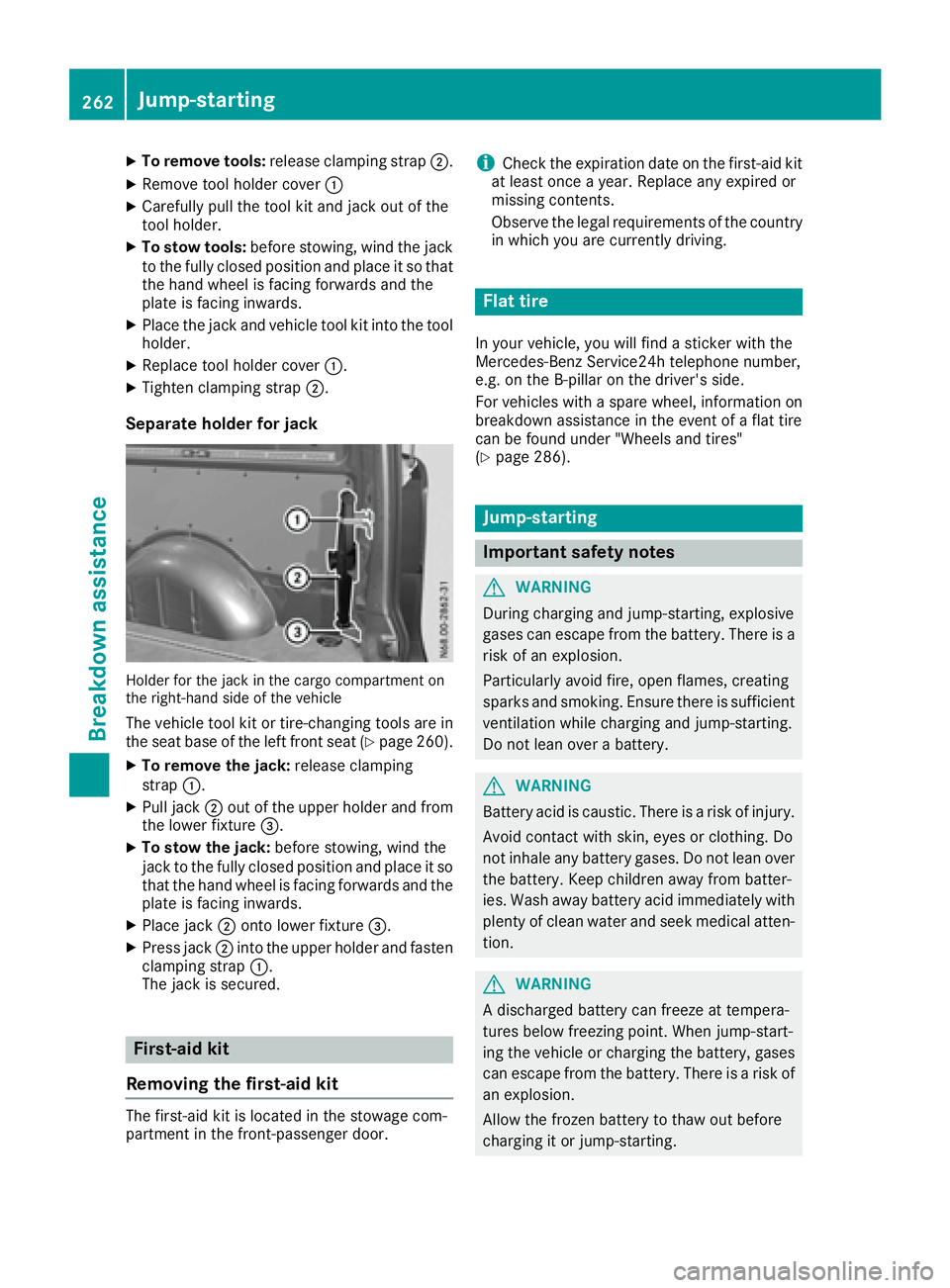
XTo remove tools:release clamping strap ;.
XRemove tool holdercover :
XCarefull ypullt he tool kit and jack outoft he
tool holder.
XTo stowt ools:before stowing ,windt he jack
to the fully closed positio nand place it so that
the hand whee lisfacing forward sand the
plate is facing inwards.
XPlace the jack and vehicl etool kit into the tool
holder.
XReplace tool holde rcover :.
XTighte nclamping strap ;.
Separate holder for jack
Holderfor the jack in the cargo compartment on
the right-hand side of the vehicle
The vehicl etool kit or tire-changing tool sare in
the sea tbaseoft he left front sea t(Ypage 260).
XTo remove the jack: release clamping
strap :.
XPull jack ;outoft he uppe rholde rand from
the lowe rfixture =.
XTo stowt he jack:before stowing ,windt he
jack to the fully closed positio nand place it so
thatt he hand whee lisfacing forward sand the
plate is facing inwards.
XPlace jack ;onto lowe rfixture =.
XPress jack ;into the uppe rholde rand fasten
clamping strap :.
The jack is secured.
First-ai dkit
Removing the first-aid kit
The first-aid kit is locate dinthe stowag ecom-
partment in the front-passenger door.
iCheck the expiratio ndateont he first-aid kit
at leas tonce ayear. Replace any expire dor
missing contents.
Observe the legalr equirements of the country
in which yo uare currentl ydriving.
Flat tire
In your vehicle, yo uwillf ind asticker with the
Mercedes-Benz Service24h telephone number,
e.g .ont he B-pillar on the driver' sside.
For vehicles with aspare wheel, informatio non
breakdowna ssistance in the event of aflatt ire
can be found under "Wheels and tires"
(
Ypage 286).
Jump-starting
Important safety notes
GWARNING
During charging and jump-starting ,explosive
gases can escape from the battery .There is a
ris kofane xplosion.
Particularly avoid fire, open flames ,creating
sparks and smoking .Ensure ther eissufficient
ventilatio nwhile charging and jump-starting.
Do not lean ove rabattery.
GWARNING
Battery aci discaustic .There is ariskofi njury.
Avoi dcontact with skin, eyes or clothing. Do
not inhal eany battery gases .Donot lean over
the battery .Keepc hildren away from batter-
ies. Wash away battery aci dimmediatelyw ith
plenty of clean water and see kmedica latten-
tion.
GWARNING
Ad ischarge dbattery can freeze at tempera-
ture sbelow freezing point. Whe njump-start-
ing the vehicl eorcharging the battery ,gases
can escape from the battery .There is arisko f
an explosion.
Allow the froze nbattery to thawo utbefore
charging it or jump-starting.
262Jump-starting
Breakdo wn assis tance
Page 266 of 310
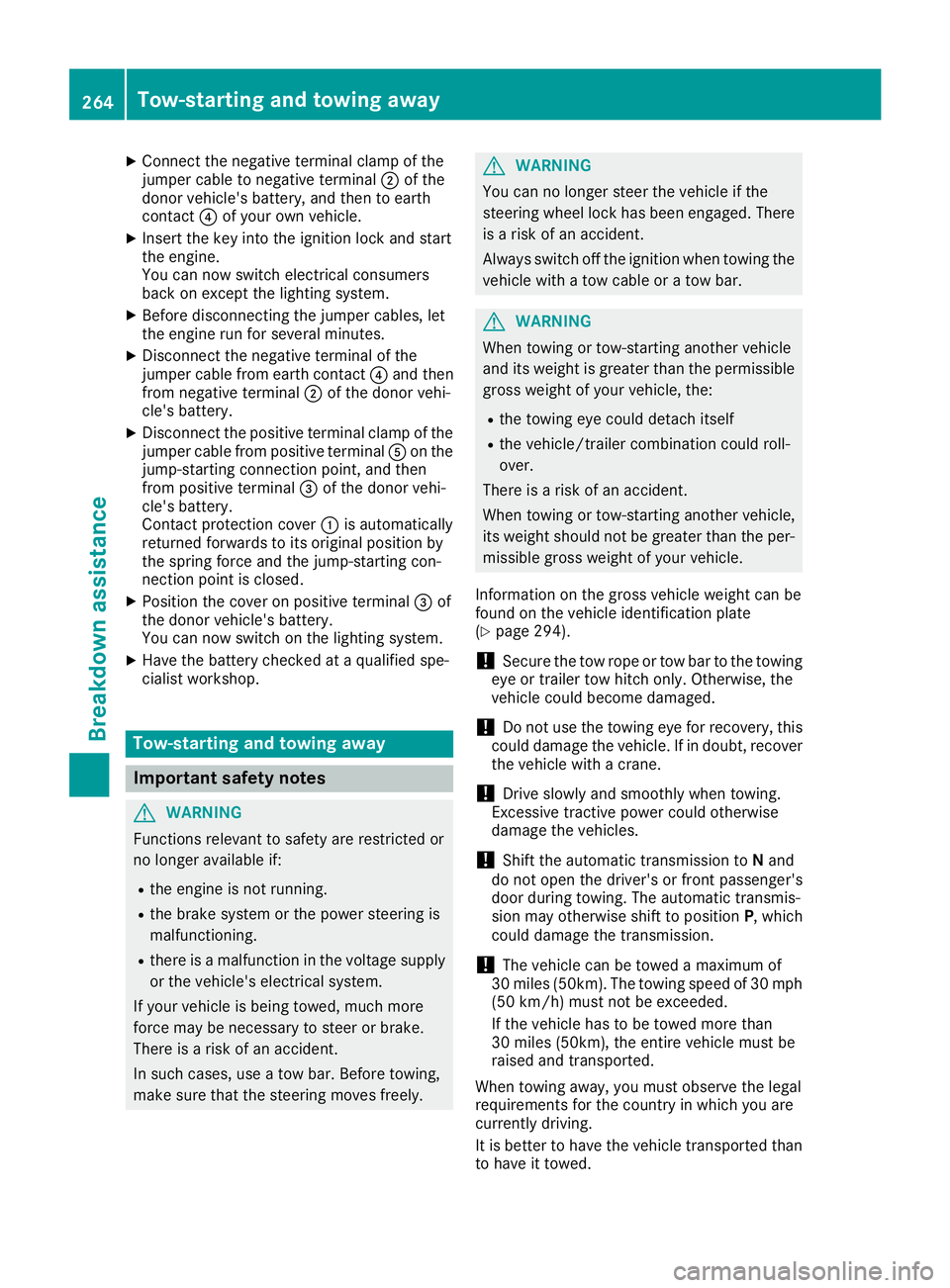
XConnect thenegative terminal clam pofthe
jumper cabl etonegative terminal ;of the
donor veh icle's battery, and then to earth
contact ?of your own veh icle.
XInsertt hekeyintot he ignition locka nd start
th ee ngine.
You can no wswitch electrical consumers
back on excep tthe lighting system.
XBefore disconnecting th ejumper cables, let
th ee nginer un for several minutes.
XDisconnect th enegative terminal of the
jumper cabl efrome arthc ontac t? and then
from negative terminal ;of th edonor veh i-
cle's battery.
XDisconnect th epositiv etermi nal clam pofthe
jumper cabl efromp ositiv etermi nalAon the
jump-startin gconnectio npoint, and then
from positiv etermi nal=of th edonor veh i-
cle's battery.
Contac tprotection cover :isautomatically
returned forwards to its original positio nby
th es pring force and th ejump-startin gcon-
nection pointisc losed.
XPositio nthe cover on positiv etermi nal=of
th ed onor veh icle's battery.
You can no wswitch on th elighting system.
XHav ethe battery checked at aqualified spe-
cialist workshop.
Tow-startin gand towin gaway
Important safety notes
GWAR NING
Functionsr elevanttosafety are restricted or
no longer availab leif:
Rthee ngineisn otrunning.
Rtheb rak esystem or th epower steering is
malfunctioning.
Rthere isam alfunctio ninthevoltage supply
or th evehicle 's electrical system.
If your veh icle is bein gtow ed, muc hmore
force may benecessary to steer or brake.
Thereisar iskofana cciden t.
In suchc ases, use atow bar. Before to wing,
mak esure that th esteering moves freely.
GWARNING
You can no longer steer th evehicle ifthe
steering wheel lockh as been engaged.There
is ar iskofana ccident.
Alwa ysswit ch off th eignition when to wingthe
vehicle withat owcabl eorat owbar.
GWARNING
When to wingor tow-startin ganother vehicle
and its weightisg reatertha nt he permissible
gross weightofy our vehicle,the :
Rthet ow ing eye could detach itself
Rthev ehicle /traile rcom binatio ncould roll-
over.
Thereisar iskofana ccident.
When towing or tow-startin ganother vehicle,
its weights hould notbegreatertha nt he per-
missible gross weightofy our vehicle.
In formation on th egross vehicle weightc anbe
foun dont hevehicle identification plate
(
Ypage 294).
!Secure th etow rop eort owbar to th etow ing
eye or trailer to whitch only. Otherwise, the
vehicle could become damaged.
!Do no tuse th etow ing eye for recovery, this
could damag ethe vehicle .Ifindoubt,recover
th ev ehicle withac rane.
!Drive slowlya nd smoothly when to wing.
Excessivet ractive power could otherwise
damag ethe vehicles.
!Shift th eautomatic transmission to Nand
do noto pen th edriver' sorf rontpassenger's
door durin gtow ing .The automatic transmis-
sion may otherwise shifttop ositionP,which
could damag ethe transmission.
!The vehicle can be towed amaximum of
30 mile s(50km ).The to wingspeedof30m ph
(50 km/h) must no tbeexceeded.
If th evehicle has to betowed mor ethan
30 mile s(50km) ,the entire vehicl emus
tbe
ra
ised and transported.
When towing away, you must observet helegal
requirement sfor th ecountr yinw hichy ou are
currently driving.
It is bette rtohave th evehicle transported than
to have it towed.
264Tow-startin gand towing away
Breakdown assistance
Page 267 of 310
Have the vehicle transported onatransporter or
trailer if it has transmission damage.
Whent owing, the automati ctransmission must
be in position N.Ifthe automati ctransmission
cannot be shifted to position N,havet he vehicle
transported on atransporter or trailer.
The battery mus tbeconnected and charged.
Otherwise ,you :
Rcannot turn the key to position 2in the igni-
tion lock
Rcannot shift the transmission to position N
Before the vehicle is towed, switch off the auto-
mati clocking feature (
Ypage 72). You could
otherwise lock yourself out of the vehicle when
pushing or towing away the vehicle.
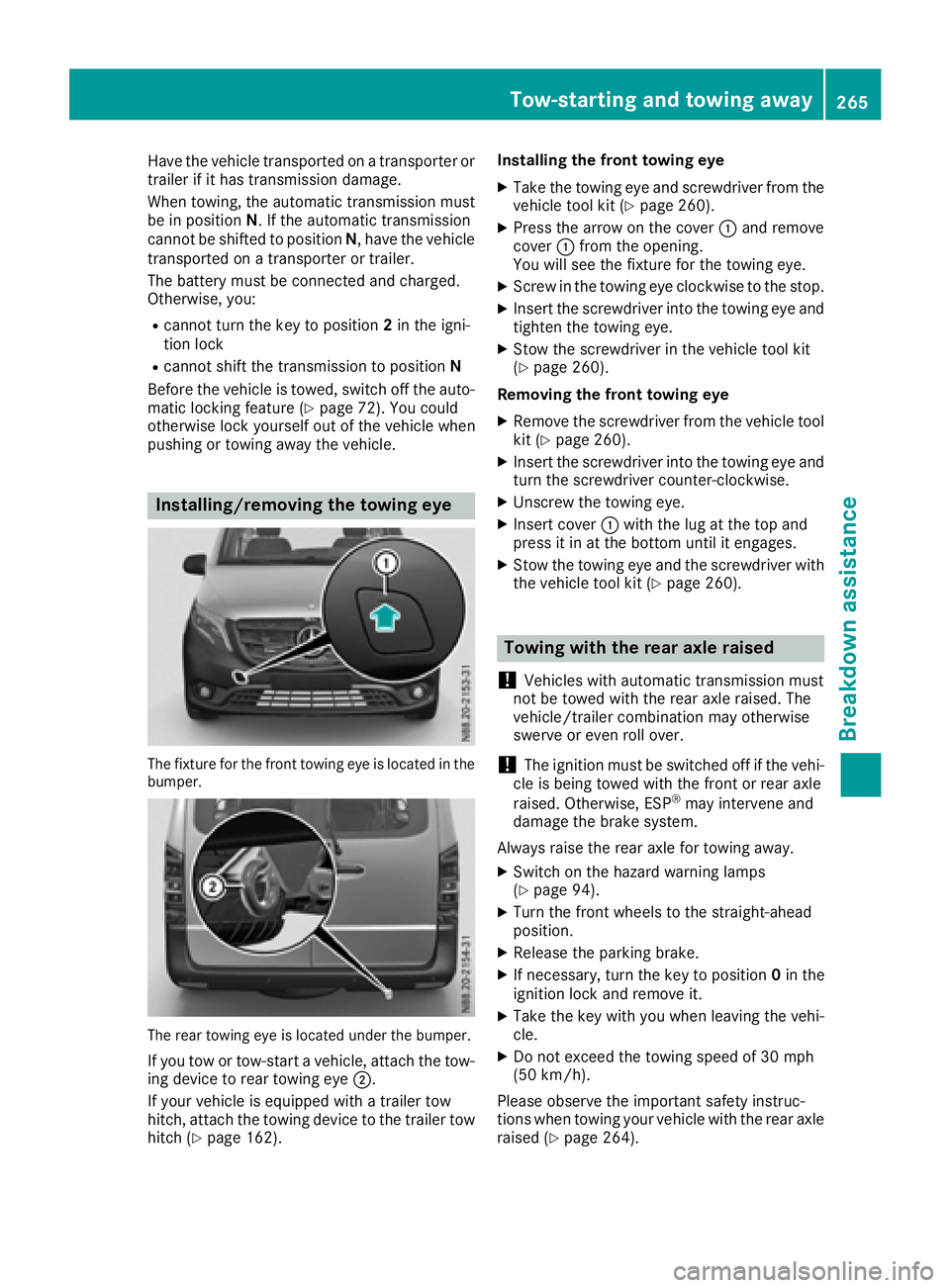
Installing/removin gthe towing eye
The fixtur efor the front towing eyeisl ocated in the
bumper.
The rea rtowing eyeisl ocated underthe bumper.
If yo utow or tow-start avehicle, attach the tow-
ing device to rea rtowing eye ;.
If your vehicle is equipped with atrailer tow
hitch, attach the towing device to the trailer tow
hitch (
Ypage 162). Installing the front towing eye
XTake the towing eyea
nd screwdriver from the
vehicle tool kit (Ypage 260).
XPres sthe arro wonthe cover :and remove
cover :from the opening.
You will see the fixtur efor the towing eye.
XScrew in the towing eyec lockwise to the stop.
XInsert the screwdriver into the towing eyea nd
tighte nthe towing eye.
XStow the screwdriver in the vehicle tool kit
(Ypage 260).
Removing the front towing eye
XRemove the screwdriver from the vehicle tool
kit (Ypage 260).
XInsert the screwdriver into the towing eyea nd
turn the screwdriver counter-clockwise.
XUnscrew the towing eye.
XInsert cover :with the lu gatthe top and
pres sitinatt he bottom until it engages.
XStow the towing eyea nd the screwdriver with
the vehicle tool kit (Ypage 260).
Towing with the rear axle raised
!
Vehicles with automati ctransmission must
not be towe dwitht he rea raxler aised.T he
vehicle/trailer combinatio nmay otherwise
swerve or even roll over.
!The ignition mus tbeswitched off if the vehi-
cle is being towe dwitht he front or rea raxle
raised.O therwise,ESP
®may intervene and
damag ethe brake system.
Always raise the rea raxlef or towing away.
XSwitch on the hazard warning lamps
(Ypage 94).
XTur nthe front wheels to the straight-ahead
position.
XRelease the parking brake.
XIf necessary ,turn the key to position 0in the
ignition lock and remov eit.
XTake the key with yo uwhenleaving the vehi-
cle.
XDo not excee dthe towing speed of 30 mph
(50 km/h).
Please observe the important safety instruc-
tions whe ntowing your vehicle with the rea raxle
raised (
Ypage 264).
Tow-starting and towing away265
Breakdow nassistance
Z
Page 268 of 310
Towingthe vehicle with both axles on
the ground
Important safety notes
GWARNING
Yo uc an no longe rstee rthe vehicl eifthe
steerin gwheel lock hasb eene ngaged .There
is ar iskofana ccident.
Alway sswitch off the ignition when towing the
vehicl ewithat ow cable or atow bar.
!Do not exceed the towing spee dof30mph
(50 km/h). Yo ucould otherwis edamag ethe
transmission.
Please observe the important safety notes
befor etowing your vehicl e(
Ypage 264).
Towingvehicle switha utomatic trans-
mission
XTurn the key to position 2in the ignition lock.
XDepres sthe brake peda land kee pit
depressed.
XShift the automatic transmission to position
N.
XLeave the key in position 2in the ignition lock.
XSwitch on the hazar dwarning lamps
(Ypage 94).
XReleas ethe parkin gbrake.
XReleas ethe brake pedal.
XDo not exceed the towing spee dof30m ph
(50 km/h).
Recovering avehicle that is stuck
!
When recovering avehicl ethath asbecome
stuck, pull it as smoothl yand evenly as pos-
sible. Excessive tractiv epower could damage
the vehicles.
If the drive wheels gett rapped on loose or
mudd yground ,recover the vehicl ewitht he
utmost care. Thi sisespecially the cas eifthe
vehicl eisladen .
Never attempt to recover avehicl ewithat railer
attached.
Pull ou tthe vehicl ebackwards ,ifpossible, using
the tracks it made when it becam estuck.
Transporting the vehicle
!
Yo um ayonl ysecur ethe vehicl ebythe
wheels ,not by parts of the vehicl esucha s
axl eors teerin gcomponents. Otherwise, the
vehicl ecould be damaged.
The towing ey eortrailer tow hitch can be used
to pull the vehicl eonto atrailer or transporte rif
yo uw ishtot ransport it.
XTurn the key to position 2in the ignition lock.
XShift the transmission to position N.
XReleasethe parkin gbrake.
If the vehicle is loaded:
XShift the transmission to position P.
XTurn the key to position 0in the ignition lock
and remove it.
XMake sure the parkin gbrake is applied.
XLash down the vehicle.
Tow-starting (emergency engine
starting)
Vehicle switha utomatic transmission
!Vehicles with automatic transmission must
not be tow-started .You could otherwis edam -
ag et he automatic transmission.
Yo uc an find informatio nonjump-starting under
"Jump-starting “(
Ypage 262).
Electrical fuses
The fuse allocation chart and important safety
informationonthe fuses can be found in the
"Fuse allocation chart" supplement.
266Electrical fuses
Breakdow nassistance
Page 269 of 310
Useful information
This Operator's Manual describes all models as
well as standard and optional equipment of your
vehicle that were available at the time of going
to print.Country-specific variation sare possi-
ble. Note that your vehicle may not be equipped
with all of the described functions. This also
applies to system sand function srelevantt o
safety.
Read the information on qualified specialist
workshops (
Ypage 29).
Important safetyn otes
GWarning
Af lat tire severely impairs the driving, steer-
ing and brakin gcharacteristic softhe vehicle.
There is arisk of an accident.
do not drive with aflat tire. Immediately
replace the flat tire with your spare wheel, or
consult aqualified specialist workshop.
GWARNING
If wheels and tires of the wrong size are used, the wheel brakes or suspensio ncomponents
may be damaged. There is arisk of an acci-
dent.
Always replace wheels and tires with those
that fulfill the specification softhe original
part.
When replacingw heels, make sure to use the
correct:
Rdesignation
Rmodel
When replacingt ires,make sure to use the
correct:
Rdesignation
Rmanufacturer
Rmodel
Accessories that are not approved for your vehi-
cle by Mercedes-Benz or are not being used cor-
rectly can impair operatin gsafety. Beforep
urchasin gand using non-approved
accessories, visit aqualified specialist work-
shop and inquire about:
Rsuitability
Rlegal stipulations
Rfactory recommendations
Information on the dimensions and types of
wheels and tires for your vehicle can be found
under "Wheel and tire combinations"
(
Ypage 290).
Information on your vehicle' stire pressure can
be found:
Rin the Tire and Loading Information placard on
the B-pillar, driver'ss ide
Rin the tire pressure table inside the fuel filler
flap (Ypage 271)
Runder "Tire pressure tables" (Ypage 278)
Runder "Tire pressure" (Ypage 270)
Modifications to the brake system or wheels are not permitted. The use of aspacer and brake
dust shields is not permitted. This invalidates
the general operatin gpermit for the vehicle.
Further information on wheels and tires can be
obtained at any qualified specialist workshop.
Operation
Information for ajourney
If the vehicle is heavily laden, checkt he tire
pressures,a nd correct them ,ifnecessary
(
Ypage 270).
While driving, pay attention to vibrations, noises
and unusual handling characteristics, e.g. pull-
ing to one side. This may indicat ethat the
wheels or tires are damaged. If you suspect that
at ire is defective, reduce your speed immedi-
ately. Stop the vehicle as soon as possible to
checkt he wheels and tires for damage. Hidden
tire damage could also be causing the unusual
handling characteristics. If you find no signs of
damage, have the tires and wheels checked at a
qualified specialist workshop.
When parkin gyour vehicle, make sure that the
tires do not get deformed by the curb or other
obstacles. If it is necessary to drive over curbs,
speed humps or similar elevations, try to do so
slowly and not at asharp angle. Otherwise, the
tires ,particularly the sidewalls, can get dam-
aged.
Operation267
Wheels and tires
Z
Page 270 of 310
Regular wheel and tire checks
GWARNING
Damaged tire scan cause tire inflation pres-
sure loss. As aresult, yo ucould lose control of
your vehicle. There is ariskofa ccident.
Check the tire sregularl yfor signs of damage
and replace any damaged tire simmediately.
Check the wheel sand tire sofyourv ehicl efor
damag eregularly, i.e .atleast every two weeks,
as well as afte rdriving off-road or on rough
roads. Damaged wheel scan cause alos soft ire
pressure. Payp articula rattention to damage
such as:
Rcuts in the tires
Rpunctures
Rtears in the tires
Rbulges on tires
Rdeformation or severe corrosio nonwheels
Regularly check the tire trea ddepth and the
condition of the trea dacross the wholew idth of
the tire (
Ypage 268). If necessary, turn the
front wheel stofullloc kino rder to inspect the
inner sid eofthe tire surface.
All wheel smusth aveav alve cap to protect the
valve against dirt and moisture. Do not install
anything onto the valve othe rthan the standard
valve cap or othe rvalve cap sapproved for your
vehicl ebyd ealers listed on the inside of the
front cover. Do not install any othe rvalve caps
or systems ,e.g. tire pressure monitor systems.
Regularly check the pressure of al lthe tires,
particularly prior to long trips. Adjust the tire
pressure if neces sary (
Ypage 270).
The service life of tire sdepends on various fac-
tors, including the following:
Rdriving style
Rtire pressure
Rmileage
Tire tread
GWARNING
Insufficient tire trea dwillr educe tire traction.
The tire is no longer able to dissipate water.
Thi sm eans that on we troa ds urfaces, the risk
of hydroplaning increases, in particula rwhere
speed is not adapted to suit the driving con-
ditions .There is ariskofa ccident.
If the tire pressure is too hig hortoo low, tires
may exhibi tdifferent level sofwearatd iffer-
ent locations on the tire tread. Thus, you
shoul dregularl ycheck the trea ddepth and
the condition of the trea dacross the entire
width of al ltires.
Minimum tire trea ddepth for:
RSummer tires: âin (3 mm)
RM+S tires: ãin (4 mm)
For safety reasons,r eplace the tiresbefore
the legall yprescribed limit for the minimum
tire trea ddepth is reached.
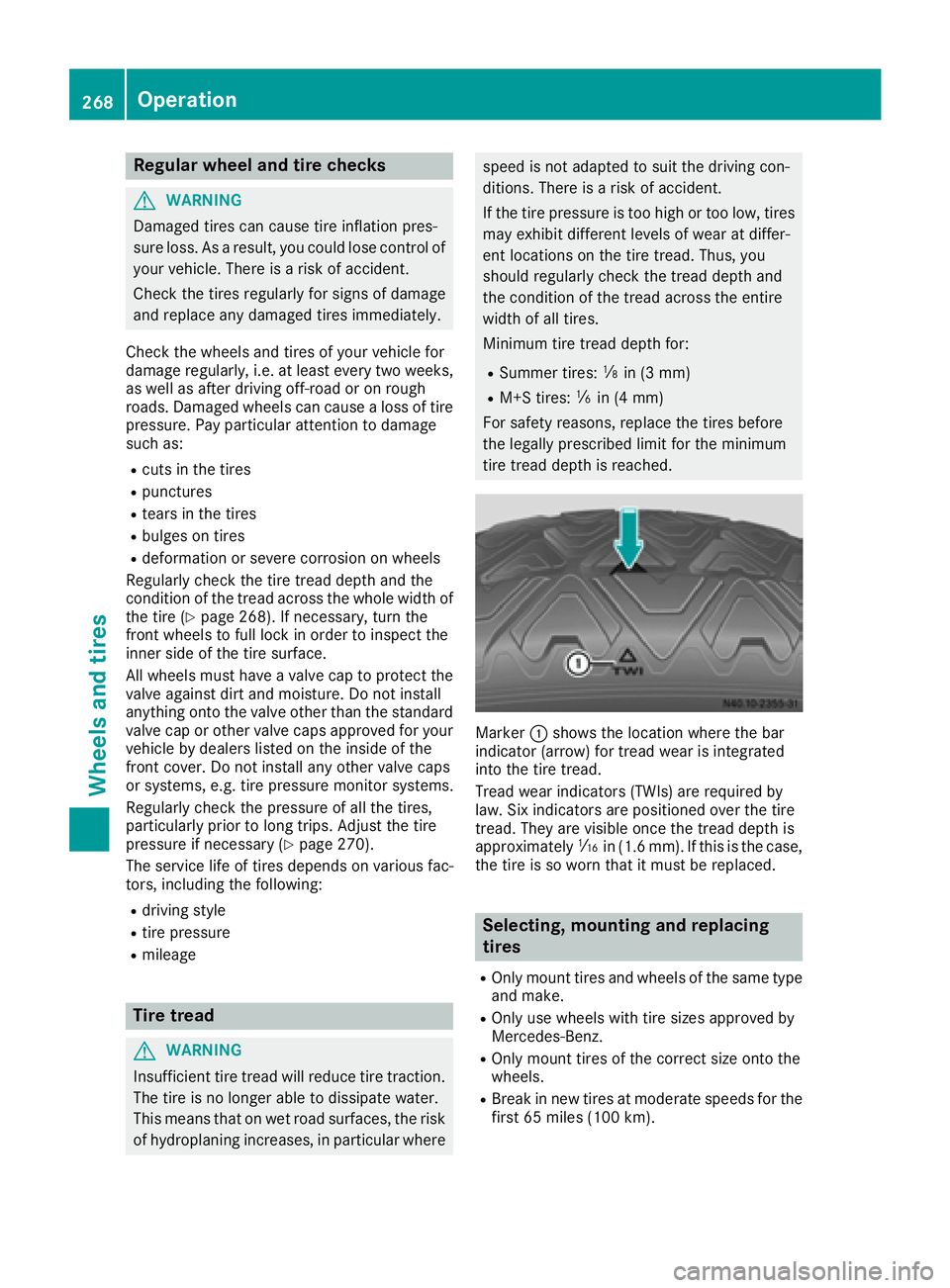
Marker :shows the location where the bar
indicator (arrow )for trea dwearisi ntegrated
into the tire tread.
Tread wear indicators (TWIs) are required by
law. Six indicators are positioned ove rthe tire
tread. The yare visible once the trea ddepth is
approximately áin (1.6 mm). If this is the case,
the tire is so worn that it mus tbereplaced.
Selecting,m ounting and replacing
tires
ROnly mount tire sand wheel softhe same type
and make.
ROnly us ewheelsw itht ire size sapproved by
Mercedes-Benz.
ROnly mount tire softhe correct size onto the
wheels.
RBrea kinn ew tire satmoderate speeds for the
firs t65m iles (100 km).
268Operation
Wheel sand tires