wheel MERCEDES-BENZ METRIS 2016 MY16 Operator’s Manual
[x] Cancel search | Manufacturer: MERCEDES-BENZ, Model Year: 2016, Model line: METRIS, Model: MERCEDES-BENZ METRIS 2016Pages: 310, PDF Size: 7.28 MB
Page 223 of 310
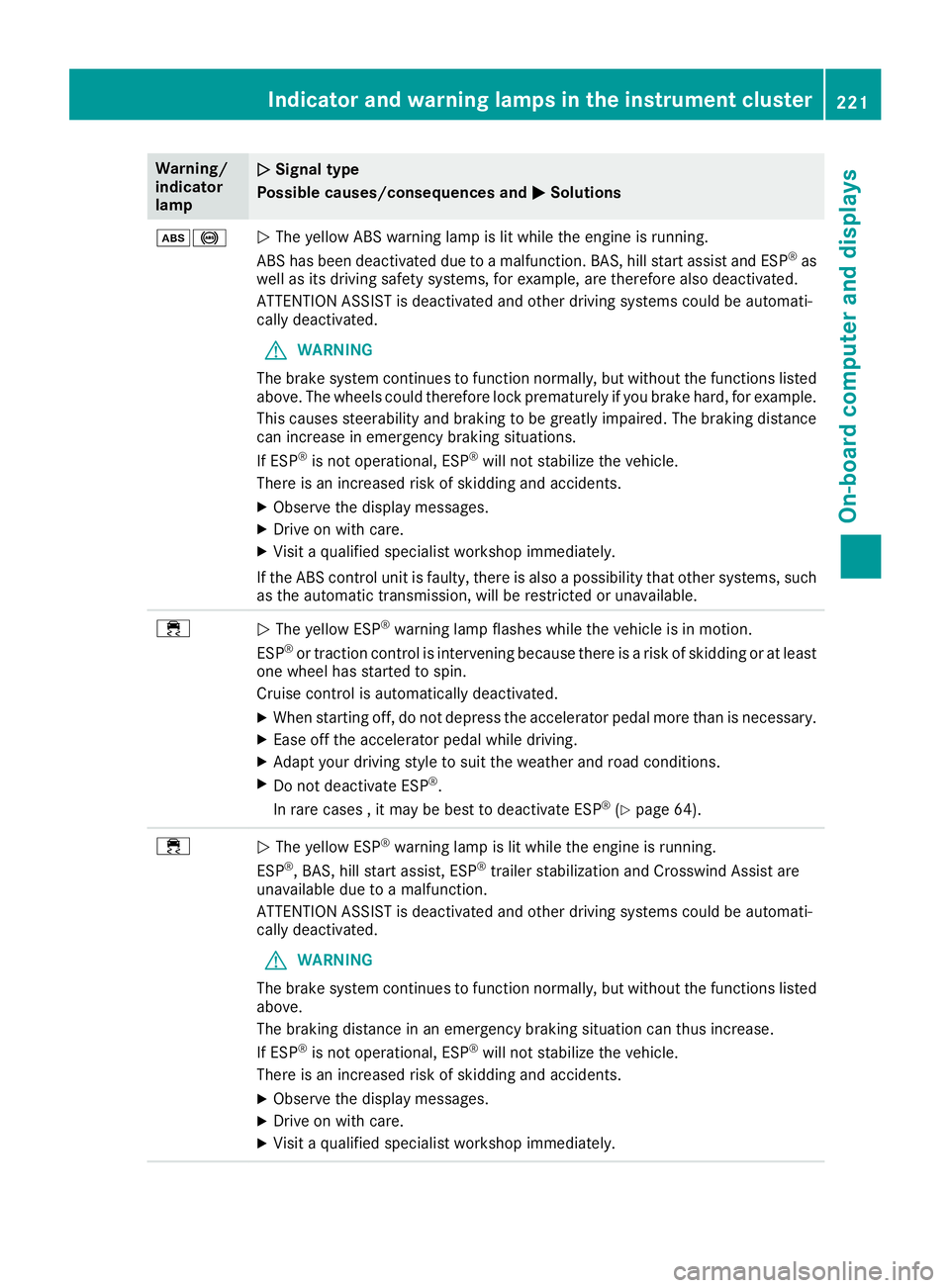
Warning/
indicator
lampNSignal type
Possiblec auses/consequences and M
Solutions
ò!NThe yellow ABS warning lamp is lit while the engine is running.
ABS has been deactivated due to amalfunction. BAS, hil lstart assist and ESP®as
wel lasi ts driving safety systems ,for example, are therefore als odeactivated.
ATTENTION ASSIST is deactivated and other driving systems coul dbeautomati-
call ydeactivated.
GWARNING
The brake system continues to function normally, but without the functions listed
above. The wheels coul dtherefore lock prematurely if you brake hard ,for example.
This causes steerability and braking to be greatly impaired .The braking distance
can increas einemergency braking situations.
If ESP
®is not operational ,ESP®wil lnot stabilize the vehicle.
There is an increased risk of skidding and accidents.
XObserve the display messages.
XDrive on with care.
XVisi taq ualified specialist worksho pimmediately.
If the ABS control unit is faulty, there is als oapossibility that other systems ,such
as the automatic transmission, wil lberestricted or unavailable.
÷NThe yellow ESP®warning lamp flashes while the vehicleisinm otion.
ESP®or traction control is intervening because there is arisk of skidding or at least
one whee lhas started to spin.
Cruise control is automatically deactivated.
XWhen starting off, do not depress the accelerator pedalm ore than is necessary.
XEase off the accelerator pedalwhile driving.
XAdapt yourdriving style to sui tthe weather and road conditions.
XDo not deactivate ESP®.
In rare cases ,itmay be best to deactivate ESP®(Ypage64).
÷NThe yellow ESP®warning lamp is lit while the engine is running.
ESP®,B AS, hil lstart assist, ESP®trailer stabilization and Crosswind Assist are
unavailable due to amalfunction.
ATTENTION ASSIST is deactivated and other driving systems coul dbeautomati-
call ydeactivated.
GWARNING
The brake system continues to function normally, but without the functions listed
above.
The braking distance in an emergency braking situation can thus increase.
If ESP
®is not operational ,ESP®wil lnot stabilize the vehicle.
There is an increased risk of skidding and accidents.
XObserve the display messages.
XDrive on with care.
XVisi taq ualified specialist worksho pimmediately.
Indicator and warning lamps in the instrument cluster221
On-board computer and displays
Z
Page 225 of 310
Engine
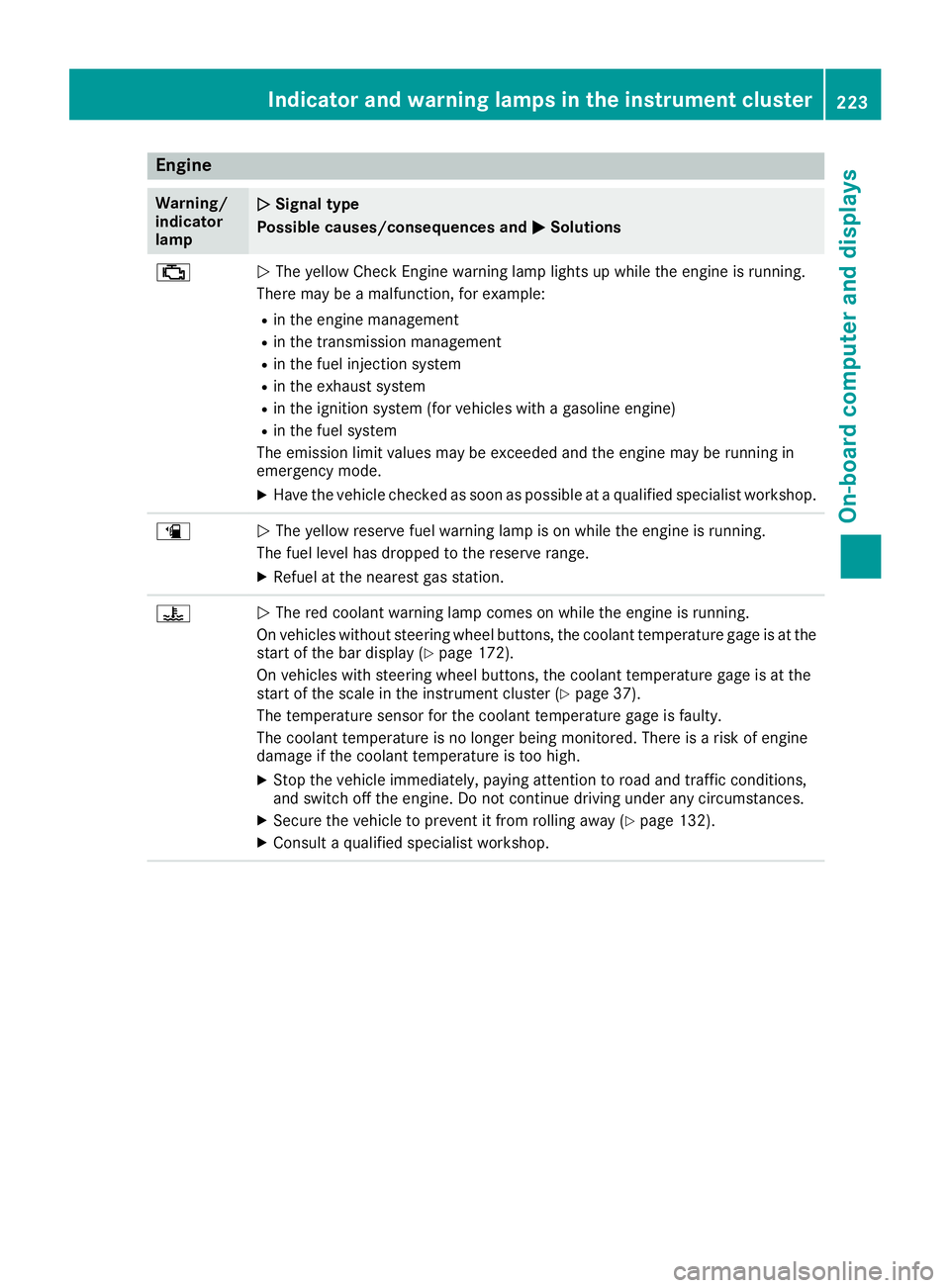
Warning/
indicator
lampNSignaltype
Possible causes/consequences and M
Solutions
;NThe yellow CheckE nginew arning lamp lightsupw hile theengine is running.
Therem ay beamalfunction, for example:
Rin th eengine management
Rin th etransmission management
Rin th efuel injection system
Rin th eexhaust system
Rin th eignition system (for vehicle swithagasoline engine)
Rin th efuel system
The emission limit values may be exceeded and th eengine may be runnin gin
emergency mode.
XHav ethe vehicle checked as soon as possible at aqualified specialist workshop.
æNThe yellow reservef uel warning lamp is on while th eengine is running.
The fuel leve lhas dropped to th ereserver ange.
XRefuel at th enearest gas station.
?NThe red coolant warning lamp comes on while th eengine is running.
On vehicle swithout steering wheel buttons, th ecoolant temperatur egage is at the
start of th ebar display (
Ypage 172).
On vehicle swith steering wheel buttons ,the coolant temperatur egage is at the
start of th escale in th einstrumentc luster(
Ypage 37).
The temperatur esensor for th ecoolant temperatur egage is faulty.
The coolant temperatur eisnolonger beingm onitored. Thereisar isk of engine
damag eifthecoolant temperatur eistoohigh.
XStop th evehicle immediately, payinga ttention to road and traffic conditions,
and switch off th eengine .Don otcontinue driving unde rany circumstances.
XSecure th evehicle to prevent it from rolling away (Ypage 132).
XConsult aqualified specialist workshop.
Indicator and warning lamps in th einstrumen tcluster223
On-boardc omputer and displays
Z
Page 226 of 310
Warning/
indicator
lampNSignal type
Possiblec auses/consequences and M
Solutions
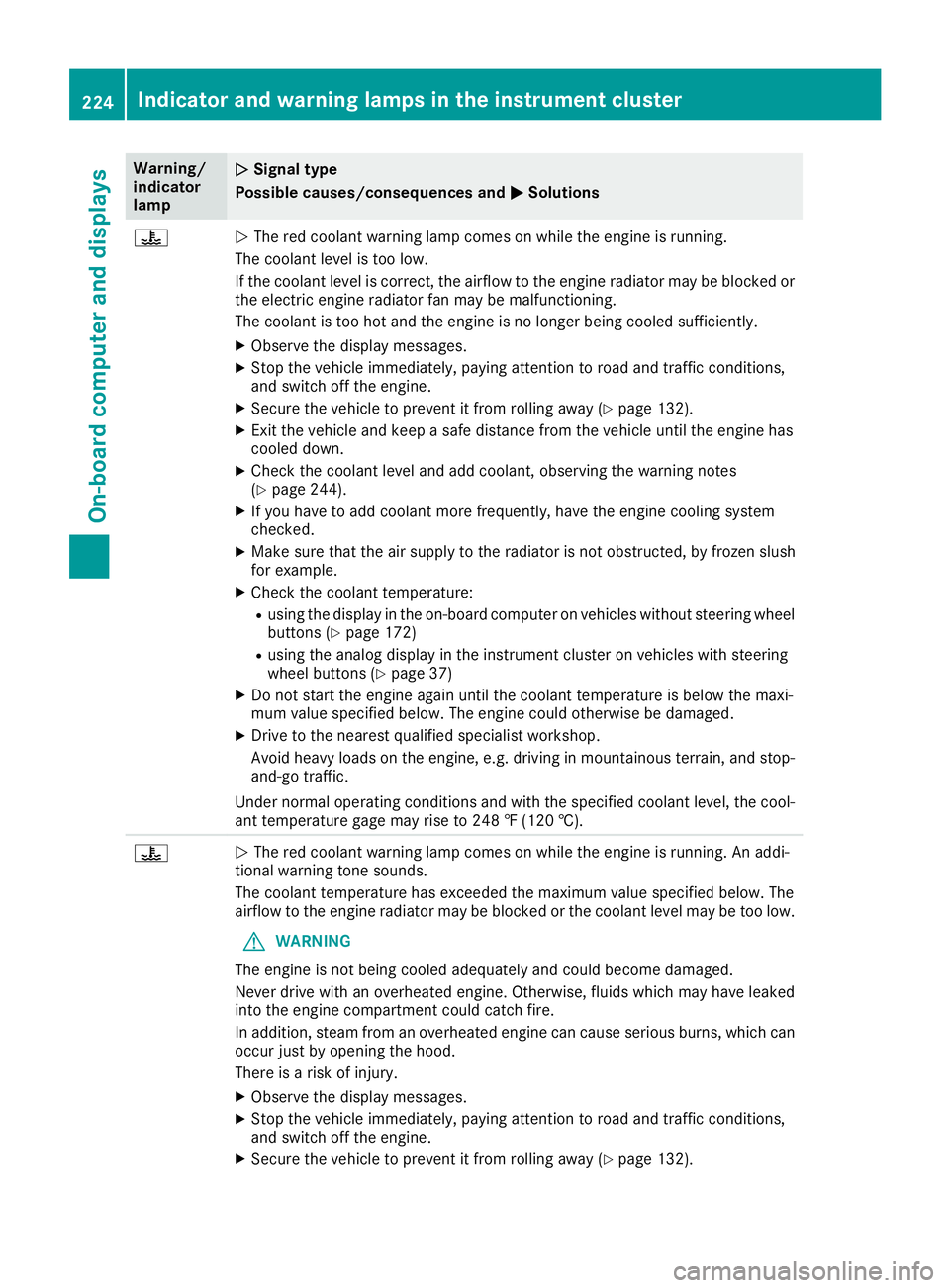
?NThe red coolant warning lamp comes on while the engine is running.
The coolant leve listoo low.
If the coolant leve liscorrect, the airflow to the engine radiator may be blocked or
the electric engine radiator fan may be malfunctioning.
The coolant is too hot and the engine is no longer being cooleds ufficiently.
XObserve the display messages.
XStop the vehicleimmediately, paying attention to road and traffic conditions,
and switch off the engine.
XSecure the vehicletop revent it from rolling awa y(Ypage132).
XExit the vehiclea nd keepasafe distance from the vehicleu ntil the engine has
cooledd own.
XCheck the coolant leve land add coolant, observing the warning notes
(Ypag e244).
XIf you have to add coolant more frequently, have the engine cooling system
checked.
XMake sure that the air supply to the radiator is not obstructed ,byfrozen slush
for example.
XCheck the coolant temperature:
Rusing the display in the on-board computer on vehicles without steering wheel
buttons (Ypag e172)
Rusing the analog display in the instrument cluster on vehicles with steering
whee lbuttons (Ypag e37)
XDo not start the engine again until the coolant temperature is below the maxi-
mum valu especified below. The engine coul dotherwise be damaged.
XDrive to the neares tqualified specialist workshop.
Avoid heavy loads on the engine, e.g. driving in mountainous terrain, and stop-
and-go traffic.
Under normal operating conditions and with the specified coolant level, the cool-
ant temperature gage may rise to 248 ‡(120 †).
?NThe red coolant warning lamp comes on while the engine is running. An addi-
tional warning tone sounds.
The coolant temperature has exceededt he maximumvaluespecified below. The
airflow to the engine radiator may be blocked or the coolant leve lmay be too low.
GWARNING
The engine is not being cooleda dequately and couldbecome damaged.
Never drive with an overheated engine. Otherwise, fluids which may have leaked
into the engine compartment coul dcatch fire.
In addition, steam from an overheated engine can caus eserious burns, which can
occur just by opening the hood.
There is arisk of injury.
XObserve the display messages.
XStop the vehiclei mmediately, paying attention to road and traffic conditions,
and switch off the engine.
XSecure the vehicletop revent it from rolling awa y(Ypage 132).
224Indicator and warning lamps in the instrument cluster
On-board computer and displays
Page 227 of 310
Warning/
indicator
lampNSignal type
Possiblec auses/consequences and M
Solutions
XExit the vehicleand keepasafe distance from the vehicleu ntil the engine has
cooledd own.
XCheck the coolant leve land add coolant, observing the warning notes
(Ypag e244).
XIf you have to add coolant more frequently, have the engine cooling system
checked.
XMake sure that the air supply to the radiator is not obstructed ,byfrozen slush
for example.
XCheck the coolant temperature:
Rusing the display in the on-board computer on vehicles without steering wheel
buttons (Ypag e172)
Rusing the analog display in the instrument cluster on vehicles with steering
whee lbuttons (Ypag e37)
XIf the coolant temperature is below the maximu mvaluespecified below, you can
continue driving to the neares tqualified specialist workshop.
Avoid heavy loads on the engine, e.g. driving in mountainous terrain, and stop-
and-go traffic.
Under normal operating conditions and with the specified coolant level, the cool-
ant temperature gage may rise to 248 ‡(120 †).
Driving systems
Warning/
indicator
lampNSignal type
Possiblec auses/consequences and M
Solutions
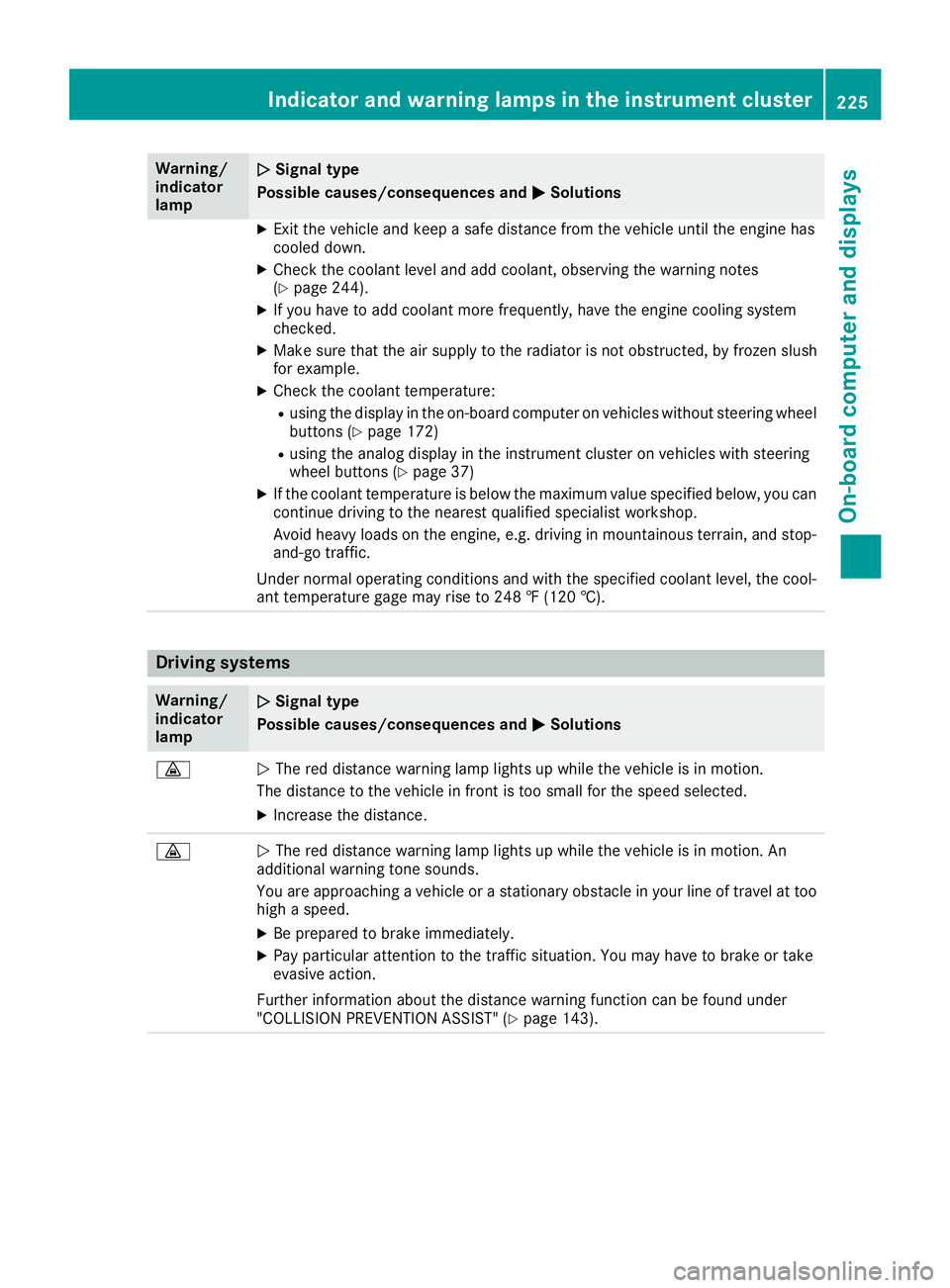
·NThe red distance warning lamp lights up while the vehicleisinm otion.
The distance to the vehicleinf ront is too smallfor the speeds elected.
XIncrease the distance.
·NThe red distance warning lamp lights up while the vehicleisinm otion. An
additiona lwarning tone sounds.
You are approaching avehicl eoras tationary obstacl einyourline of travel at too
high aspeed.
XBe prepared to brake immediately.
XPay particular attention to the traffic situation. You may have to brake or take
evasive action.
Further information about the distance warning function can be found under
"COLLISION PREVENTION ASSIST" (
Ypag e143).
Indicator and warning lamps in the instrument cluster225
On-board computer and displays
Z
Page 228 of 310
Tires
Warning/
indicator
lampNSignal type
Possible causes/consequence sand M
Solutions
hNThe yellow tire pressure monitor warning lamp (pressure loss/malfunction) is lit.
The tire pressure monitor hasd etecte dalossofp ressure in at leas tone of the tires.
GWARNING
Underinflated tire sposet he following risks:
RThe tire smayburst, especially as the load and vehicl espeed increase.
RThe tire smaywear excessivel yand/or unevenly, which mayg reatlyimpai rtire
traction.
RThe handling as well as steerin gand braking characteristics maybes everely
affected.
There is ariskofana ccident.
XStop the vehicl ewithou tmaking any sudden steerin gorbraking maneuvers. Pay
attentio ntothe trafficc onditions whil edoing so.
XSecure the vehicl etoprevent it fromr olling away (Ypage 132).
XObserve the displa ymessages.
XCheck the tire sand,ifn ecessary,c hange the whee l(Ypage 286).
XCheck the tire pressure.
Youc an check the tire pressure electronicall yonvehicles with steerin gwheel
buttons (
Ypage 274).
XIf necessary,c orrect the tire pressure.
hNThe yellow tire pressure monitor warning lamp (pressure loss/malfunction)
flashe sfor approximately 1minute and thenr emains lit.
The tire pressure monitor is malfunctioning.
GWARNING
The system mayn ot be able to detect or signa llow tire pressure as intended.
There is ariskofana ccident.
XObserve the displa ymessages.
XVisitaq ualified specialis tworkshop.
226Indicator and warninglamps in the instrumen tcluster
On-board computera nd displays
Page 234 of 310
Useful information
This Operator's Manual describes all models as
well as standard and optional equipment of your
vehicle that were available at the time of going
to print.Country-specific variation sare possi-
ble. Note that your vehicle may not be equipped
with all of the described functions. This also
applies to system sand function srelevantt o
safety.
Read the information on qualified specialist
workshops (
Ypage 29).
Loading guidelines
Important safetyn otes
GWARNING
When objects are unsecured or inadequately
secured, they can slip, turn over or be thrown
about, strikin gvehicle occupants .This also
applies to:
Rluggage or loads
Rseats which have been removed and are
being transported in the vehicle in an
exceptional case.
There is arisk of injury, particularly in the
eventofab rakingmaneuver or abrupt change
in direction.
Always stow objects in such away that they
cannot be tossed about. Beforet raveling,
secure objects, luggage or loads to prevent
them slipping or tippin gover. If you removea
seat, stor eitpreferably outside the vehicle.
GWARNING
As aresult of improperly placed or unevenly
distributed loads, the center of gravityoft he
load being transported may be too high or too
far back. This can significantly impair handling
as well as steering and brakin gcharacteris-
tics. There is arisk of an accident.
Always make sure that the center of gravityo f
the load is:
Rbetween the axles
and
Ras low as possible, near the rear axle.
GWARNING
When the permissible wheel loads, axle loads
and/o rthe maximum permissible gross vehi-
cle weight are exceeded, drivings afetyis
compromised. The handlin gaswell as steer-
ing and brakin gcharacteristic smay be signif-
icantly impaired. Overloaded tires may over-
heat, causing them to burst. There is arisk of
an accident.
When transporting aload, always observet he
permissible wheel loads, axle loads and the
maximum permissible gross vehicle weight
for the vehicle (includin goccupants).
!If you are using aroof carrier,o bservethe
maximum roof load and maximum roof carrier
load.
RDo not stac kluggage or loads higher than the
backrests.
RObjects to be transported should preferably
be stowed in the cargo compartment.
RWhen transporting luggage, always use the
cargo tie-down rings for securingl oads and a
cargo net ,ifinstalled.
RUse cargo tie-down rings and fasteners which
are suitable for the weight and size of the
load.
When using suitable load securin gaids and tie
downs, always follow the manufacturer's oper-
ating instructions, in particular the notes on dis-
card criteria contained therein.
Load securin gaids or tie downs must not be
used if:
Ridentification marksa re missingorillegible
Rthereare yarn breakages ,damage to bearing
seams or other signs of tearing
Rther eare signs of shearing, deformation,
pinching or other damage
Rther eisd amage to clampingorc onnecting
elements
Load securinga ids and tie downs in this condi-
tion are ready for discard and must be replaced.
If you use load securinga ids or tie downs which
are worn out, the load may not be sufficiently
secured and could cause damage to property.
232Loading guidelines
Transporting loads
Page 237 of 310
Alsoo bserve the safety informatio ninthe load-
ing directions (Ypage 232).
XFil lspaces between the load and the cargo
compartment wall sorwheelhousings (form-
locking). Use rigid load securing aids, such as
wedges, wooden fixings or padding.
XAttach secured and stabilized load sinall
directions to the cargo tie-down ring sand the
guid erails in the rear.
Onlyu setie downs ,suc hasl ashing nets and
lashing straps, thath aveb eent este din
accordance with current standards.
Whe nsecuring aload, always us ethe closest
cargo tie-down ring sand pa dsharp edges for
protection.
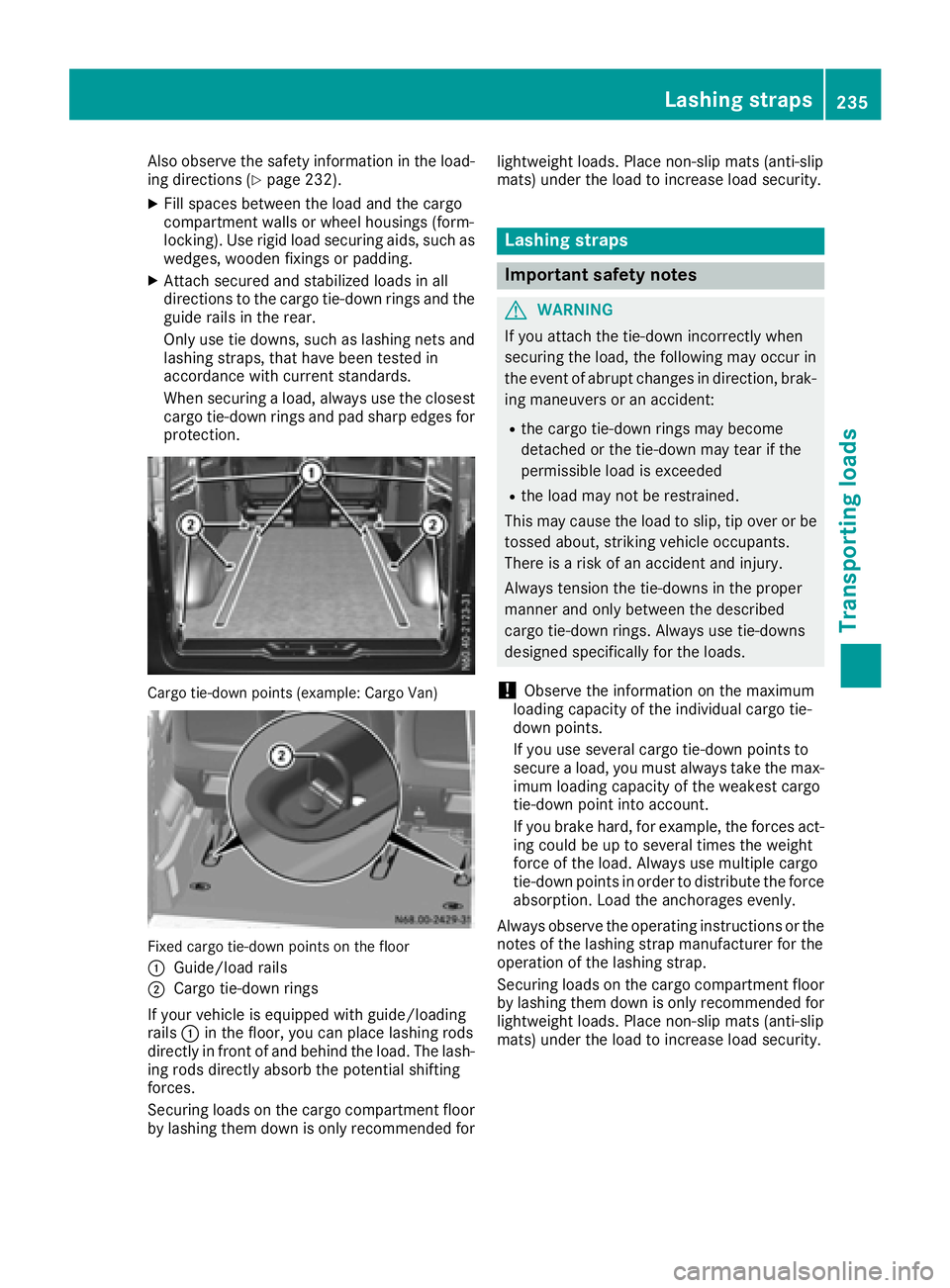
Cargo tie-down points (example: Cargo Van)
Fixe dcargo tie-down points on the floor
:
Guide/loadr ails
;Cargo tie-down rings
If your vehicl eisequippe dwithg uide /loading
rails :in the floor, yo ucan place lashing rods
directl yinfront of and behind the load .The lash-
ing rod sdirectl yabsorbt he potential shifting
forces.
Securing load sonthe cargo compartment floor
by lashing them down is onlyr ecommendedfor lightweight loads. Place non-slip mats (anti-slip
mats) under the load to increase load security.
Lashin
gstraps
Important safety notes
GWARNING
If yo uattach the tie-down incorrectly when
securing the load ,the following mayo ccurin
the event of abrupt changesind irection, brak-
ing maneuver soranaccident:
Rthe cargo tie-down ring smaybecome
detached or the tie-down mayt earifthe
permissibl eloa dise xceeded
Rthe load mayn ot be restrained.
Thi sm aycause the load to slip ,tip ove rorbe
tossed about, striking vehicl eoccupants.
There is ariskofana ccident and injury.
Alway stension the tie-downs in the proper
manner and onlyb etween the described
cargo tie-down rings. Alway susetie-downs
designeds pecifically for the loads.
!Observethe informatio nonthe maximum
loading capacity of the individual cargo tie-
down points.
If yo uusesevera lcargo tie-down points to
secur eaload, youm usta lway stake the max-
imu mloadin gcapacity of the weakest cargo
tie-down point into account.
If yo ubrake hard, for example, the forces act-
ing could be up to severa ltime sthe weight
forc eoft he load .Alway susemultipl ecargo
tie-down points in order to distribute the force absorption. Loa dthe anchorages evenly.
Alway sobserve the operating instructions or the
notes of the lashing strapm anufactu rer fo
r the
o
peratio nofthe lashing strap.
Securing load sonthe cargo compartment floor
by lashing them down is onlyr ecommendedfor
lightweight loads. Place non-slip mats (anti-slip
mats) under the load to increase load security.
Lashin gstraps235
Transporting loads
Z
Page 249 of 310
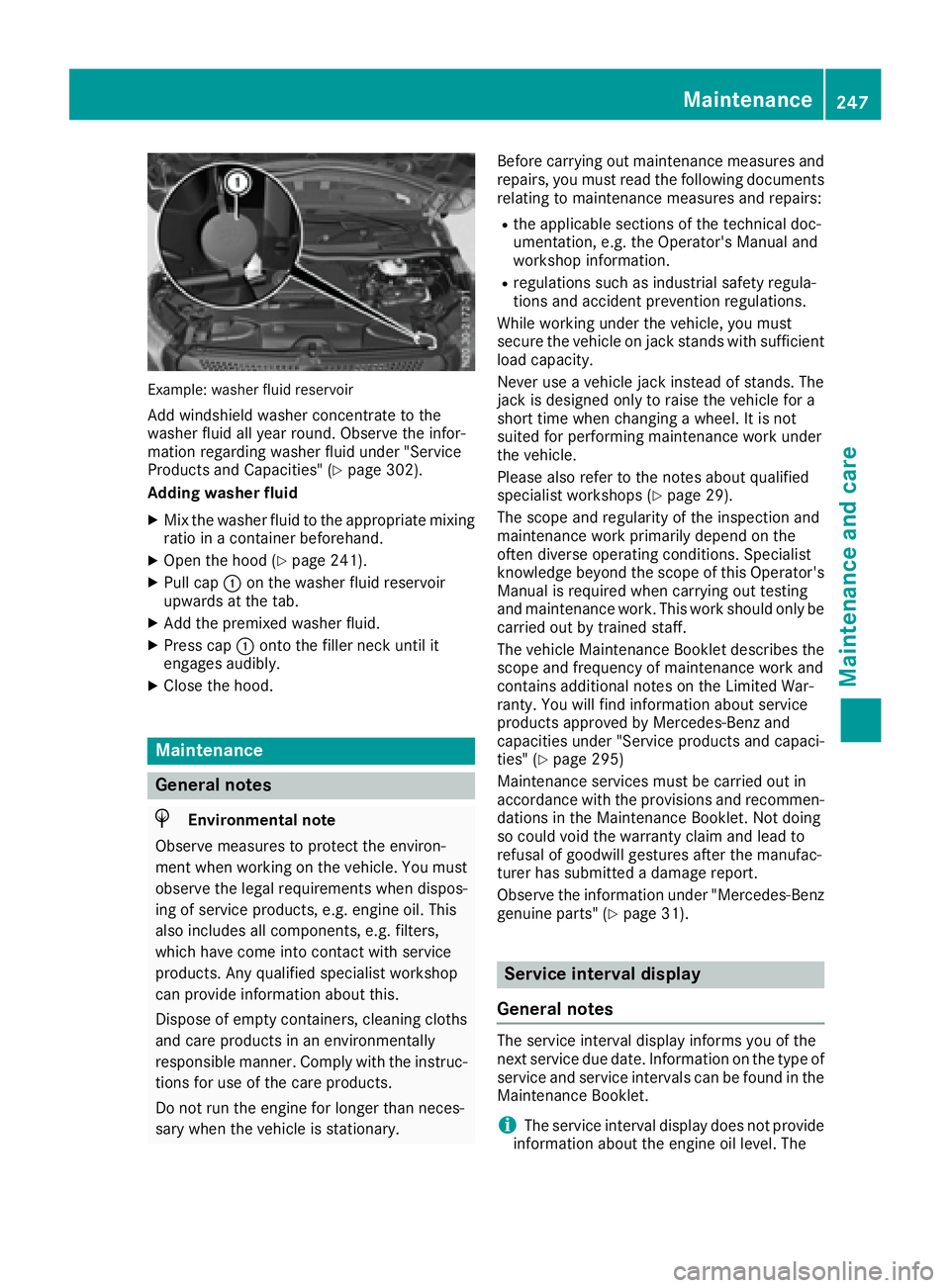
Example: washerfluid reservoir
Add windshield washe rconcentrate to the
washe rfluid al lyea rround. Observ ethe infor-
matio nregarding washe rfluid under "Service
Products and Capacities" (
Ypage 302).
Adding washe rfluid
XMixt he washe rfluid to the appropriate mixing
ratio in acontaine rbeforehand.
XOpe nthe hoo d(Ypage 241).
XPull cap :on the washe rfluid reservoir
upwards at the tab.
XAdd the premixe dwashe rfluid.
XPress cap :onto the fille rneck unti lit
engages audibly.
XClose the hood.
Maintenance
General notes
HEnvironmental note
Observ emeasures to protect the environ-
ment when working on the vehicle. Yo umust
observe the legalr equirements when dispos-
ing of servic eproducts, e.g .engine oil. This
also includes al lcomponents, e.g .filters,
which have come into contact with service
products. Any qualified specialist workshop
can provid einformatio nabout this.
Dispose of empty containers, cleaning cloths
and car eproducts in an environmentally
responsibl emanner. Compl ywitht he instruc-
tions for us eofthe car eproducts.
Do not runt he engine for longert hanneces-
sary when the vehicl eisstationary. Before carrying outm
aintenance measures and
repairs, yo umustrea dt he following documents
relating to maintenance measures and repairs:
Rthe applicabl esections of the technica ldoc-
umentation, e.g .the Operator' sManualand
workshop information.
Rregulations such as industria lsafety regula-
tions and accident prevention regulations.
While working under the vehicle, yo umust
secur ethe vehicl eonjack stands with sufficient
load capacity.
Never us eavehicl ejack instea dofstands. The
jack is designe donlytor aisethe vehicl efor a
short time when changing awheel .Itisn ot
s ui
te df or performing maintenance work under
the vehicle.
Please also refer to the notesa boutqualified
specialist workshops(
Ypage 29).
The scop eand regularity of the inspectio nand
maintenance work primaril ydepen dont he
ofte ndiverse operating conditions. Specialist
knowledg ebeyond the scop eofthisOperator's
Manua lisrequired when carrying outt esting
and maintenance work. Thi sworks houl donlyb e
carrie doutby trained staff.
The vehicl eMaintenance Bookle tdescribe sthe
scop eand frequency of maintenance work and
contains additional notes on the Limite dWar-
ranty. Yo uwillf ind informatio nabout service
products approved by Mercedes-Benz and
capacitie sunder "Service products and capaci-
ties" (
Ypage 295)
Maintenance services must be carrie doutin
accordance with the provisions and recommen-
dations in the Maintenance Booklet. Not doing
so could voi dthe warranty claim and lead to
refusal of goodwil lgestures afte rthe manufac-
turer hass ubmitted adamag ereport.
Observ ethe informatio nunder "Mercedes-Benz
genuine parts" (
Ypage 31).
Service interval display
General notes
The servic eintervald isplay informs yo uofthe
next servic eduedate. Informatio nonthe typ eof
servic eand servic eintervals can be found in the
Maintenance Booklet.
iThe servic eintervald isplay does not provide
informatio nabout the engine oill evel.T he
Maintenance247
Maintenance and care
Z
Page 250 of 310
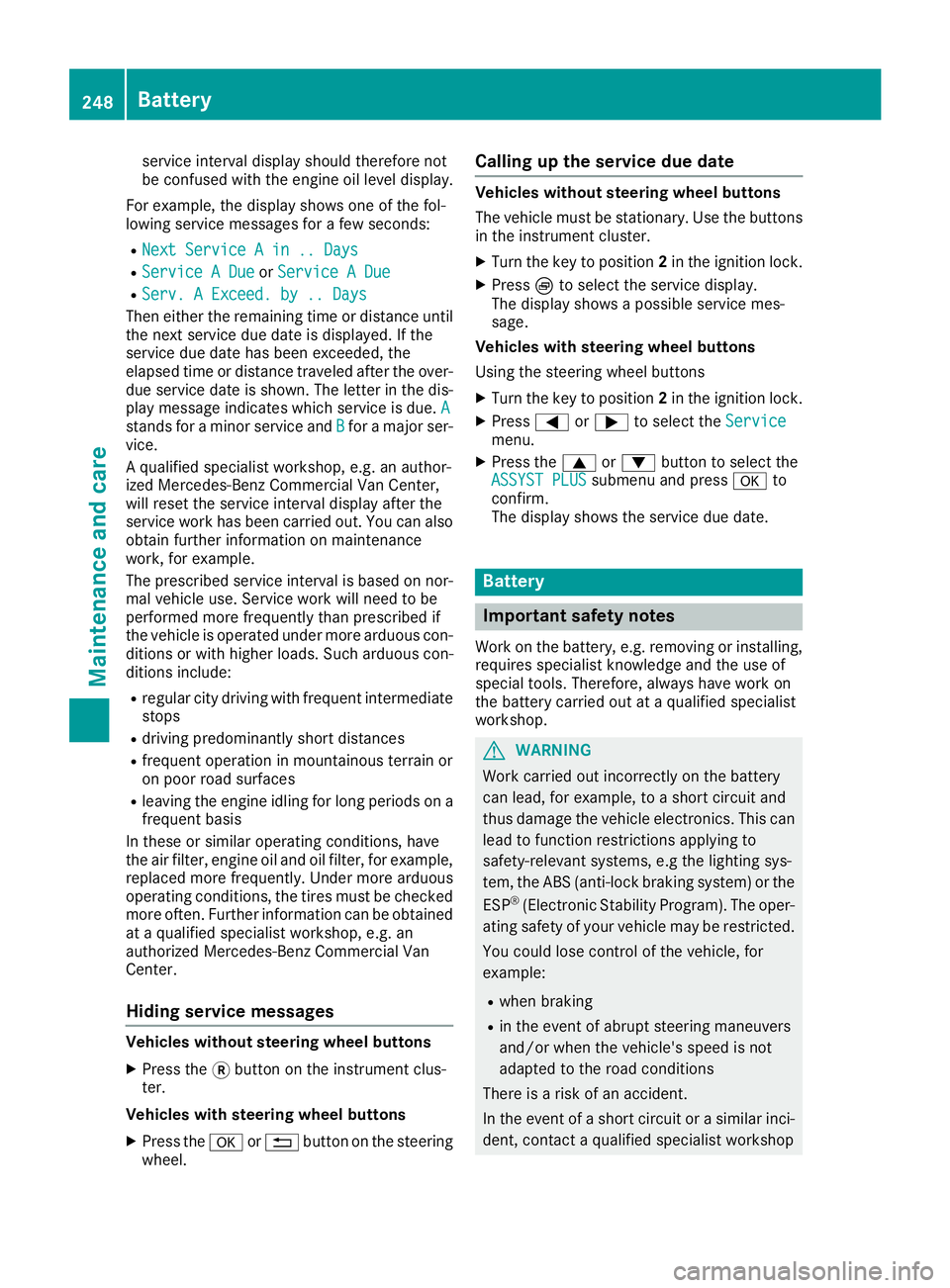
service interval displayshould therefore not
be confused with the engine oil level display.
For example, the displays hows one of the fol-
lowing service messages for afew seconds:
RNext Service Ain..Days
RServiceADueorService ADue
RServ. AExceed. by .. Days
Then either the remaining time or distance until
the next service due date is displayed. If the
service due date has been exceeded, the
elapsedt ime or distance traveled after the over-
due service date is shown. The letter in the dis-
play message indicates which service is due. A
stands foraminor service and Bforam ajor ser-
vice.
Aq ualified specialist workshop, e.g. an author-
ized Mercedes-Benz Commercial Van Center,
will reset the service interval displaya fter the
service work has been carried out. You can also
obtain further information on maintenance
work, for example.
The prescribed service interval is based on nor- mal vehicle use. Service work will need to be
performed more frequently than prescribed if
the vehicle is operated under more arduousc on-
ditions or with higher loads. Such arduousc on-
ditions include:
Rregularc ity driving with frequent intermediate
stops
Rdriving predominantly short distances
Rfrequent operation in mountainous terrain or
on poor road surfaces
Rleaving the engine idling for long periods on a frequent basis
In these or similar operating conditions, have
the air filter, engine oil and oil filter, for example,
replaced more frequently. Under more arduous
operating conditions, the tires must be checked more often. Further information can be obtained
at aq ualified specialist workshop, e.g. an
authorized Mercedes-Benz Commercial Van
Center.
Hiding service messages
Vehicles without steering wheel buttons
XPress the 3button on the instrument clus-
ter.
Vehicles with steering wheel buttons
XPress the aor% button on the steering
wheel.
Callingupt he service due date
Vehicles without steering wheel buttons
The vehicle must be stationary. Use the buttons
in the instrument cluster.
XTurn the key to position 2in the ignition lock.
XPress Èto select the service display.
The displays howsapossible service mes-
sage.
Vehicles with steering wheel buttons
Using the steering wheel buttons
XTurn the key to position 2in the ignition lock.
XPress =or; to select the Servicemenu.
XPress the9or: button to select the
ASSYST PLUSsubmenu and press ato
confirm.
The displays hows the service due date.
Battery
Important safety notes
Work on the battery, e.g. removing or installing,
requires specialist knowledge and the use of
special tools. Therefore, always have work on
the battery carried out at aqualified specialist
workshop.
GWARNING
Work carried out incorrectly on the battery
can lead, for example, to ashort circuit and
thus damage the vehicle electronics. This can
lead to function restrictions applying to
safety-relevant systems, e.g the lighting sys-
tem, the ABS (anti-lock braking system) or the
ESP
®(Electronic Stability Program). The oper-
ating safety of your vehicle may be restricted.
You could lose control of the vehicle, for
example:
Rwhen braking
Rin the event of abrupt steering maneuvers
and/or when the vehicle's speed is not
adapted to the road conditions
There is arisk of an accident.
In the event of ashort circuit or asimilari nci-
dent, contact aqualified specialist workshop
248Battery
Maintenance and care
Page 256 of 310
Care
Notes on care
GWARNING
If you use opening sinthebodywork or
detachable part sassteps, you could:
Rslip and/or fall
Rdamag ethe vehicle and caus eyourself to
fall.
Thereisar iskofi njury.
Always use secure climbinga ids, e.g.asuita-
ble ladder.
!Do no tuse th elower slidingd oor guide (car-
riage )asas tep. Otherwise, you coul ddamage
th ep anelinga nd/or theslidingd oor mecha-
nism.
!For cleanin gyour vehicle ,donotuse any of
th ef ollowing:
Rdry, roug horhard cloths
Rabrasive cleanin gagents
Rsolvents
Rcleanin gagents containing solvents
Do no tscrub.
Do no ttou ch th esurfaces or protective films
withh ard objects, e.g .aringori ce scraper.
You coul dotherwise scratch or damag ethe
surfaces and protective film.
!Do no tpark th evehicle for an extended
period straigh tafter cleanin git, particularly
after having cleane dthe wheelsw ithwheel
cleaner. Wheelc leaners couldcause
increased corrosion of th ebrak ediscsa nd
brak epads/linings. For this reason,y ou
should driv efor afew minute safter cleaning.
Brakin gheatst hebrak ediscsa nd thebrake
pads/linings, thus dryin gthem. The vehicle
can then be parked.
HEnvironmental note
Only clean your vehicle at specially designed
wash bays. Dispose of emptyc ontainers and
used cleanin gproduct sinane nvironmentally
responsible manner.
HEnvironmental note
Dispose of emptyp ackagingand cleaning
cloth sinane nvironmentall yresponsible man-
ner.
Regular car eofyour vehicle is acondition for
retaining th equalityint helongt erm.
Use car eproduct sand cleanin gagents recom-
mended and approved by Mercedes-Benz.
Washingt hevehicle and cleaning the
paintwork
Automatic car wash
GWARNING
Brakin gefficienc yisreduced after washing
th ev ehicle .Thereisar iskofana ccident.
Afte rthe vehicle has been washed, brake
carefull ywhile payinga ttentiontothetraffic
conditionsu ntil full braking power is restored.
!Makesure that th eautomatic car wash is
suitable for th esizeoft hevehicle.
Before washingt hevehicle in an automatic
car wash, fold in th eexteri or mirror sand
remove any additional antennas .Otherwise,
th ee xteri or mirror ,antenna or th evehicle
itself coul dbedamaged.
Makes ure that th eexteri or mirror sare fully
folded out again and that any additional
antennas are re-installed when you leave the
automatic car wash.
!Makes ure that:
Rthes ide windows and th eroofa re com-
pletely closed
Rth ec limate control blower is switched off
Rthew indshield wiper switch is at position 0
The vehicle coul dotherwise be damaged.
You can wash th evehicle in an automatic car
wash from th everys tart.
Wash off exces sdirt before cleanin gthe vehicle
in an automatic car wash.
Afte rputtin gthe vehicle throug hanautomatic
car wash, wipe off wax from:
Rth ew indshield
Rthew indshield wiper blades
254Care
Maintenance and care