ECU MERCEDES-BENZ METRIS 2016 MY16 Operator’s Manual
[x] Cancel search | Manufacturer: MERCEDES-BENZ, Model Year: 2016, Model line: METRIS, Model: MERCEDES-BENZ METRIS 2016Pages: 310, PDF Size: 7.28 MB
Page 50 of 310
There is, however, no system availabletoday
that can completely rule out injury or death.
It is also not possible to rule out arisk of injury
caused by an air bag due to the high speed at
which the air bag must be deployed.
Important safety notes
GWARNING
If you do not sit in the corrects eat position,
the air bag cannot protec tasintended and
could even cause additional injury when
deployed. This poses an increased risk of
injury or even fatal injury.
To avoid hazardous situations, alwaysm ake
sure that all of the vehicle's occupants:
Rhave fastened their seat belts correctly,
including pregnant women
Rare sittin gcorrectly and maintain the great-
est possible distance to the air bags
Rfollow the following instructions
Always make sure that there are no objects
between the air bag and the vehicle's occu-
pants.
RCorrectly adjust the seats before driving off.
Always make sure the seat backrest sare
positioned as close to the vertical as possible.
The center of the head restraints should sup-
port the back of the head at about eye level.
RMove the driver's and front-passenger seat as
far back as possible. The driver's seat position
must be such that the vehicle can be driven
safely.
RKeep hands on the outside of the steering
wheel rim. This allows the air bag to deploy
fully.
RAlways sit with your back against the seat
backrest when driving. Do not lean forward,
on the door or against the side window. Oth-
erwise, you are in the air bag deployment
area.
RAlways keep your feet in the footwell in front
of the seat. Do not,f or example, place your
feet on the dashboard. Otherwise, your feet
are in the air bag deployment area.
RSuitable restraint systems must alwaysb e
used for persons under 5ft(1.50 m) in height.
The seat belt cannot be worn correctly by
persons who do not reach this height. If children are also traveling in the vehicle,
please take note of the followingp
oints.
RChild restraint systems should preferably be
installed on the rear seats.
ROnly secureachild on the front-passenger
seat in arearward-facing child restraint sys-
tem if the front-passenger front air bag is
deactivated. If the PASSENGER AIR BAG OFF
indicator lamp is permanently lit, the front-
passenger front air bag is deactivated
(
Ypage 44).
RMake sure you observe the instructions and
safety notes on "Occupan t Classification Sys-
tem (OCS)" (Ypage 50) and "Children in the
vehicle" (Ypage 56), as well as the child
restraint system manufacturer's installation
instructions.
Objects in the passenger compartment
could prevent an air bag from functioning
properly. To prevent risks due to the required
air bag speed after deployment, ensure the fol-
lowing before starting the journey:
Rthere are no persons, animals or objects
between the vehicle occupantsa nd an air
bag.
Rthere are no object sbetween the seat, door
and B-pillar.
Rno hard objects, e.g. coat hangers, hang on
the grab handles or coat hooks.
Rno accessories, such as cup holders, are
attached to the vehicle within the deployment
area of an air bag, e.g. to doors or side win-
dows.
Rthere are no heavy, sharp or fragile object sin
the pocketsofi tems of clothing. Such items
should be suitably stowed elsewhere.
GWARNING
If you modify the air bag cover or affix objects
such as stickers to it, the air bag can no longer
function correctly. There is an increased risk
of injury.
Never modify an air bag cover or affix objects
to it.
Vehicles with window curtain air bags for all
rows of seats:
GWARNING
Sensorstoc ontrol the air bags are located in
the doors. Modifications or work not per-
48Occupant safety
Safety
Page 53 of 310
Occupant Classification System (OCS)
operation
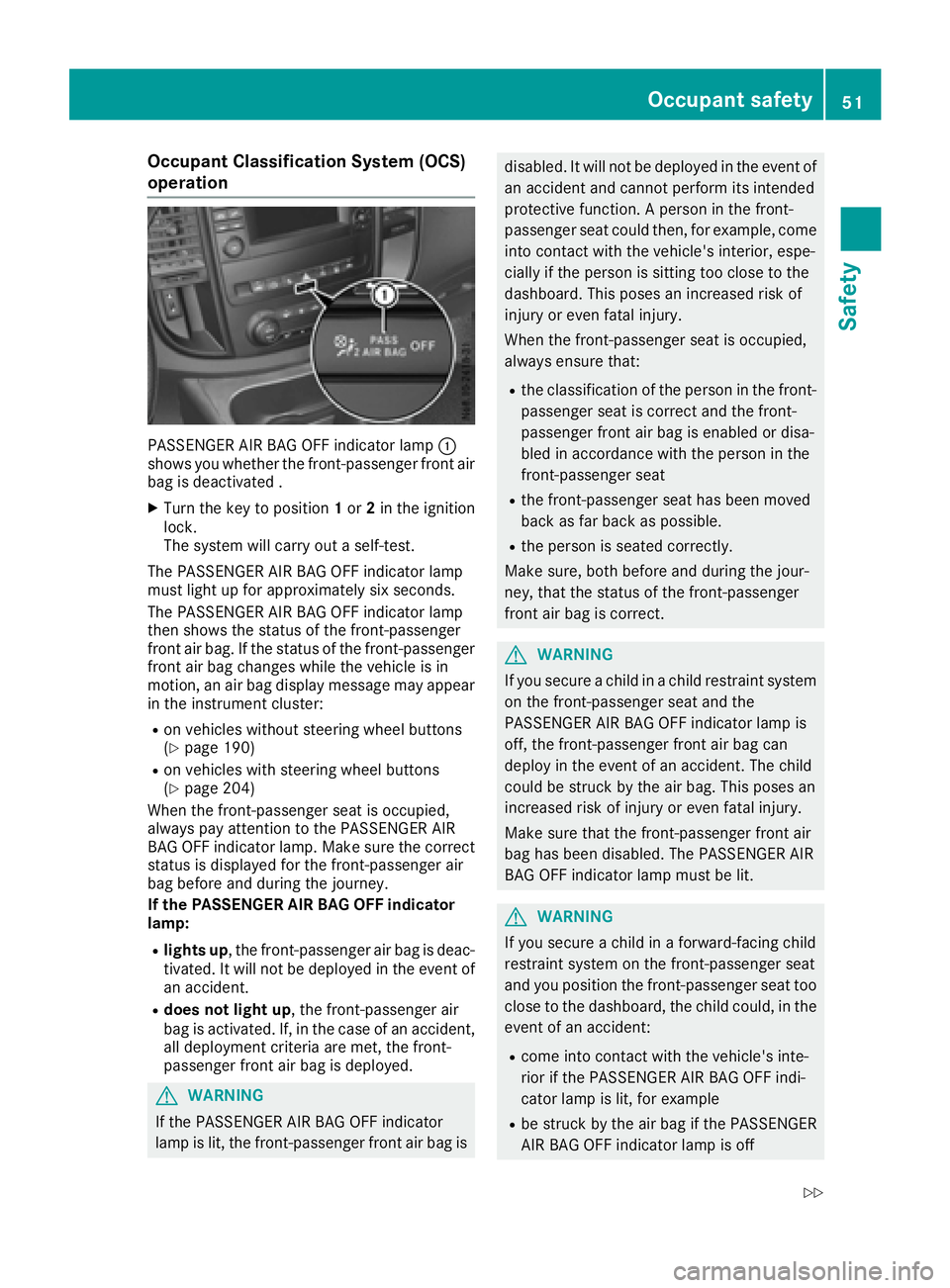
PASSENGER AIR BAG OFF indicator lamp:
shows you whether the front-passenger fronta ir
bag is deactivated .
XTurn the key to position 1or 2in the ignition
lock.
The system will carry out aself-test.
The PASSENGER AIR BAG OFF indicator lamp
must light up for approximately six seconds.
The PASSENGER AIR BAG OFF indicator lamp
then shows the status of the front-passenger
fronta ir bag. If the status of the front-passenger
fronta ir bag changes while the vehicle is in
motion ,anair bag display message may appear
in the instrument cluster:
Ron vehicles without steering wheel buttons
(Ypage 190)
Ron vehicles with steering wheel buttons
(Ypage 204)
When the front-passenger seat is occupied,
alwaysp ay attention to the PASSENGER AIR
BAG OFF indicator lamp. Make sure the correct
status is displayed for the front-passenger air
bag before and during the journey.
If the PASSENGER AIR BAG OFF indicator
lamp:
Rlights up ,the front-passenger air bag is deac-
tivated. It will not be deployed in the event of
an accident.
Rdoes not light up,t he front-passenger air
bag is activated. If, in the case of an accident,
all deployment criteria are met, the front-
passenger fronta ir bag is deployed.
GWARNING
If the PASSENGER AIR BAG OFF indicator
lamp is lit, the front-passenger fronta ir bag is
disabled. It will not be deployed in the event of
an accidenta nd cannot perform its intended
protective function .Aperson in the front-
passenger seat could then ,for example, come
into contact with the vehicle's interior, espe-
cially if the person is sitting too close to the
dashboard. This poses an increased risk of
injur yore ven fatal injury.
When the front-passenger seat is occupied,
alwayse nsure that:
Rthe classification of the person in the front-
passenger seat is correct and the front-
passenger fronta ir bag is enabled or disa-
bled in accordance with the person in the
front-passenger seat
Rthe front-passenger seat has been moved
back as far back as possible.
Rthe person is seated correctly.
Make sure, both before and during the jour-
ney, that the status of the front-passenger
fronta ir bag is correct.
GWARNING
If you secure achild in achild restraint system
on the front-passenger seat and the
PASSENGER AIR BAG OFF indicator lamp is
off, the front-passenger fronta ir bag can
deploy in the event of an accident. The child
could be struc kbythe air bag. This poses an
increased risk of injur yoreven fatal injury.
Make sure that the front-passenger fronta ir
bag has been disabled. The PASSENGER AIR
BAG OFF indicator lamp must be lit.
GWARNING
If you secure achild in aforward-facing child
restraint system on the front-passenger seat
and you position the front-passenger seat too close to the dashboard, the child could, in the
event of an accident:
Rcome into contact with the vehicle's inte-
rior if the PASSENGER AIR BAG OFF indi-
cator lamp is lit, for example
Rbe struck by the air bag if the PASSENGER
AIR BAG OFF indicator lamp is off
Occupant safety51
Safety
Z
Page 58 of 310
Factors which can only be seenand measured
afte rthe collision has occurred do not pla ya
decisive roleint he deployment of an ai rbag,nor
do they provide an indication of ai rbag deploy-
ment.
The vehicle may be considerably deformed with-
outana irbagb eing deployed. Thisist he case if
only relativelye asilyd eformable parts have
bee nhit and ahighr ate of deceleration has not
bee nreached .Conversely ,anairbagm ay be
deployed even though the vehicle suffers only
minor deformation. Thisist he case if, for exam-
ple ,very rigid vehicle parts such as the longitu-
dina lbodym embers are hit in an accident and
the rate of deceleration is sufficient.
If the restraint system control uni tdetects aside
impact or that the vehicle is rolling over,t he rel-
evant restraint system components are
deployed independently of one another depend-
ing on the anticipated typ eofaccident.
RSide impact ai rbag and pelvis ai rbag on the
sid eonw hich an impact occurs, independ-
ently of the Emergency Tensioning Device and sea tbeltu sage
The sid eimpact ai rbag on the front-
passenger sid edeploy sunder the following
conditions:
-the OCS system detects that the front-
passenger sea tisoccupied or
-the bel ttongueh as engaged in the belt
buckle of the front-passenger seat.
RWindow curtain ai rbag on the sid eofthe col-
lision, regardless of sea tbeltu se and whether
front-passeng er se
ati
so ccupied
REmergency Tensioning Devices, if the system
determinesthat they can offera dditional pro-
tection for the vehicle occupants in this sit-
uation
RWindow curtain ai rbagsont he driver's and
front-passenger sides in certain rollover sit-
uations if the system determine sthat they
can offera dditional protection to that provi-
ded by the sea tbelt
iNot al lairbags are deployed in an accident.
The variousa irbags ystems wor kindepend-
ently of each other. How the ai
rbag system works is determined
by the severity of the accident detected,
especiall ythe vehicle deceleration or accel-
eration, and the apparent typ eofaccident:
Rfrontalc ollision
Rsideimpact
Rrollover
Automatic measures after an acci-
dent
Immediately afte ranaccident, the following
measures are implemented ,depending on the
typ eand severity of the impact:
Rthe hazard warning lamps are activated
Rthe emergency lighting is activated
Rthe vehicle doors are unlocked
Rthe front sid ewindow sare lowered
Rthe engine is switched off and the fue lsupply
is cut off
Children in the vehicle
Important safety notes
Accident statistics show that childre nsecured
in the rears eats are safer than childre nsecured
in the front seats. For this reason, Mercedes-
Benz stronglya dvise sthat yo uinstall achild
restraint system on arears eat. Children are
generally better protected there.
If ac hildy ounge rthan twelve years and under
5ft( 1.50 m) in height is traveling in the vehicle:
Ralways securethisc hild in arestraint system
approved for Mercedes-Benz vehicles .The
child restraint systemm ustbea ppropriate to
the age, weight and size of the child.
Rbe sure to observe the instructions and safety
note sint hissectio nina dditiontot he child
restraint systemm anufacturer's installation
instructions.
Ralways observe the instructions and safety
note sont he "Occupant Classification System
(OCS) "(
Ypage 50).
56Children in the vehicle
Safety
Page 59 of 310
GWARNING
If you leave children unsupervised in the vehi-
cle, they coul dset it in motion by, for example:
Rrelease the parking brake.
Rshift the automatic transmission out of the
parking position P.
Rstart the engine.
In addition, they may operate vehiclee quip-
ment and become trapped. There is arisk of
an accident and injury.
When leaving the vehicle, alway stake the
SmartKey with you and lock the vehicle. Never
leave children unsupervised in the vehicle.
GWARNING
If persons, particularl ychildren are subjected
to prolonged exposure to extreme heato r
cold, there is arisk of injury ,possibly even
fatal .Never leave children unattended in the
vehicle.
GWARNING
If the child restraint system is subjected to
direct sunlight, parts may get very hot. Chil-
dren may burn themselves on these parts,
particularl yonthe metal parts of the child
restraint system. There is arisk of injury.
If you leave the vehicle, taking the child with
you ,alway sensure that the child restraint
system is not exposedtod irect sunlight. Pro-
tect it with ablanket, for example. If the child
restraint system has been exposedtod irect
sunlight, let it cool downb efore securing the
child in it. Never leave children unattended in
the vehicle.
Always make sure that all vehicleo ccupants are
positioned properly in their seats and have cor-
rectly fastened their seat belts. Take particular
care with children.
Please take note of the safety notes on seat
belts (
Ypag e45) and the notes on their correct
use (Ypag e45).
Ab ooster seat may be necessary to achieve
propers eat beltp ositioning for children over
41 lbs (18 kg )until they reach aheight where a lap/shoulder beltc
an be installed properly with-
out abooster seat.
Special seat bel tretractor
GWARNING
If the seat beltisr eleased while driving, the
child restraint system wil lnolonger be
secure dproperly.T he special seat beltr etrac-
tor is disableda nd the inertia real draw sina
portion of the seat belt. The seat beltc annot
be immediatel yrefastened. There is an
increased risk of injury ,possibly even fatal.
Stop the vehiclei mmediately, paying atten-
tion to road and traffic conditions. Reactivate
the special seat beltr etractor and secure the
child restraint system properly.
All seat belts in the vehicle, except the driver's
seat belt, are equipped with aspecial seat belt
retractor. When activated, the special seat belt
retractor ensure sthat the seat beltc annot
slacken once the child seat is secured.
Installing achild restraint system:
XMake sure you observe the child restraint
system manufacturer's installation instruc-
tions.
XPul lthe seat belts moothly from the belto ut-
let.
XEngage seat beltt ongue in beltbuckle.
Activating the special seat beltr etractor:
XPullthe seat belto ut fullyand let the inertia
reel retract it again.
Whil ethe seat beltisr etracting, you should
hear aratcheting sound .The special seat belt
retractor is enabled.
XPush the child restraint system downsot hat
the seat beltist ight and does not loosen.
Removing the child restraint system and deac-
tivating the special seat beltr etractor:
XMake sure you observe the child restraint
system manufacturer's installation instruc-
tions.
XPress the release button of the seat belt
buckle and guide the seat beltt ongue back
toward sthe belts ash guide.
The special seat beltr etractor is deactivated.
Children in the vehicle57
Safety
Z
Page 60 of 310
Child restraint system
The use of seat beltsand infant and child
restraint systems is required by law in:
Rall 50 states
Rth eU .S.t erri tories
RtheD istrict of Columbia
Rall Canadian provinces
You can obtain further informatio nabout the
correc tchild restraint system from any
Mercedes-Ben zCommercial Van Center.
GWARNING
If th echild restraint system is installed incor-
rectly on asuitable seat,itc annotprotect as
intended. The child canno tthe nber estrained
in th eevent of an accident, heavyb raking or
suddenc hanges of direction.T hereisan
increased ris kofinjury, possibly eve nfatal.
Makes ure that you observ ethe child restraint
system manufacturer'si nstallationinstruc-
tions and th enotes on use. Pleasee nsure,
that th ebase of th echild restraint system is
always restin gcompletely on th eseat cush-
ion.N ever placeo bjects, e.g.cushions, under
or behindt hechild restraint system. Only use
child restraint systems witht heoriginal cover
designe dfor them. Only replace damaged
covers withg enuine covers.
GWARNING
If ar earward facing child restraint system is
installed in th edirection of travel by mistake,
it canno tprotect as intended. This is th ecase
if, for instance, you install arearward-facing
child restraint system on arear seat opposite
to th edirection of travel. In th eevent of an
accident, achild migh tnotbe restraine dcor-
rectly. This posesani ncreased riskofinjury or
eve nfatal injury.
Always install th erear seat in th edirection of
travel before you install th erearward facing
child restraint system.
GWARNING
If th echild restraint system is installed incor-
rectly or is no tsecured, it can com eloosei n
th ee vent of an accident, heavyb raking or a
suddenchang eind irection.T he child
restraint system coul dbethrown about,s trik-
ing vehicle occupants .Thereisani ncreased
ris kofi njury, possibly eve nfatal.
Always install child restraint systems prop-
erly, eve niftheya re no tbeingu sed. Make
sure that you observ ethe child restraint sys-
te mm anufacturer'si nstallationinstructions.
You will fin dfurther informatio nonstowing
objects, luggagea nd loads securely under
"Loading guidelines" (
Ypage 232).
GWARNING
Child restraint systems or their securin gsys-
tems whichh ave been damaged or subjected
to aload in an accidentc an no longer protect
as intended. The child canno tthe nb e
restraine dintheevent of an accident, heavy
braking or suddenc hanges of direction.T here
is an increased ris kofinjury, possibly even
fatal.
Replacec hild restraint systems whichh ave
been damaged or subjected to aload in an
accidentass oon as possible. Hav ethe secur-
ing systems on th echild restraint system
checked at aqualified specialist workshop,
before you install achild restraint system
again.
Securin gsystems for child restraint systems
include:
Rth es eat belt system
RtheL ATCH-type (ISOFIX) securin grings
RTop Tether anchorage points
If it is absolutely necessary to carry achild on
th ef ront-pa ssenger seat,bes ure to observethe
instructionson“ OccupantClassificatio nSys-
te m( OCS)” (
Ypage 50). This includes informa-
tio nond eactivatin gthe front-passenger air bag.
All child restraint systems must mee tthe fol-
lowings tandards:
RU.S. Federal Motor Vehicle SafetyS tandards
21 3a nd 225
RCanadian Motor Vehicle SafetyS tandards
21 3a nd 210.2
As tatemen tbythechild restraint manufacturer
of compliance witht hese standards can be
foun dont heinstruction label on th
ec hild
58Children in th evehicle
Safety
Page 61 of 310
restraint system. You willalsof ind the state-
ment in the instruction manua lprovided with the
child restraint system.
Observe the warning labels in the vehicl einte-
rior and on the child restraint system.
LATCH-type (ISOFIX) chil dseat secur-
ing system
GWARNING
LATCH-type (ISOFIX) child restraint systems
do not offer sufficient protective effect for
children whose weight is greater than 48 lbs
(22 kg )who are secure dusing the safety belt
integrated in the child restraint system. In the
event of an accident, achild might not be
restrained correctly. This poses an increased
risk of injury or even fatal injury.
If the child weighs more than 48 lbs (22 kg),
only use LATCH-type (ISOFIX) child restraint
systems with which the child is als osecured
with the vehicl eseat belt. Also secure the
child restraint system with the Top Tether
belt, if available.
Make sure you observe the manufacturer's
installation and operating instructions of the
child restraint system used.
Before each journey ,make sure that the LATCH-
type (ISOFIX) child restraint system is properly
engage dinboth LATCH-type (ISOFIX) securing
rings.
!When fitting the child restraint system in
vehicles with arear bench seat, make sure
that the seat belt for the center seat does not
get trapped. Otherwise, the seat belt could be
damaged.
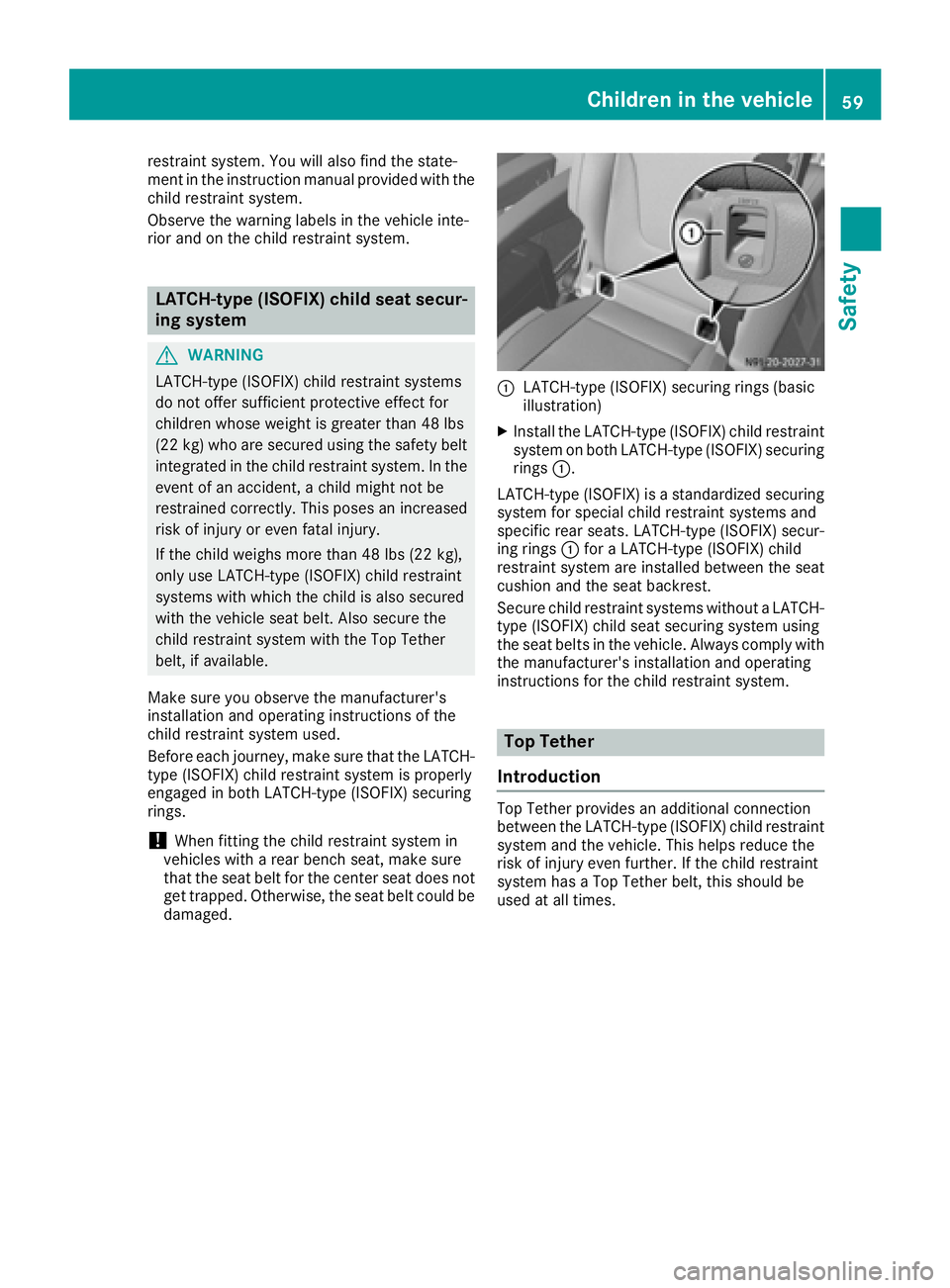
:LATCH-type (ISOFIX) securing rings (basic
illustration)
XInstall the LATCH-type (ISOFIX) child restraint system on both LATCH-type (ISOFIX) securing
rings :.
LATCH-type (ISOFIX) is astandardized securing
system for specia lchild restraint systems and
specifi crear seats. LATCH-type (ISOFIX) secur-
ing rings :for aLATCH-type (ISOFIX) child
restraint system are installed between the seat
cushion and the seat backrest.
Secure child restraint systems withou taLATCH-
type (ISOFIX) child seat securing system using
the seat belts in the vehicle. Always comply with
the manufacturer's installation and operating
instructions for the child restraint system.
Top Tether
Introduction
Top Tether provides an additional connection
between the LATCH-type (ISOFIX) child restraint system and the vehicle. This help sreduce the
risk of injury even further. If the child restraint
system has aTop Tether belt, this should be
used at all times.
Children in the vehicle59
Safety
Z
Page 62 of 310
Top Tether anchorage points
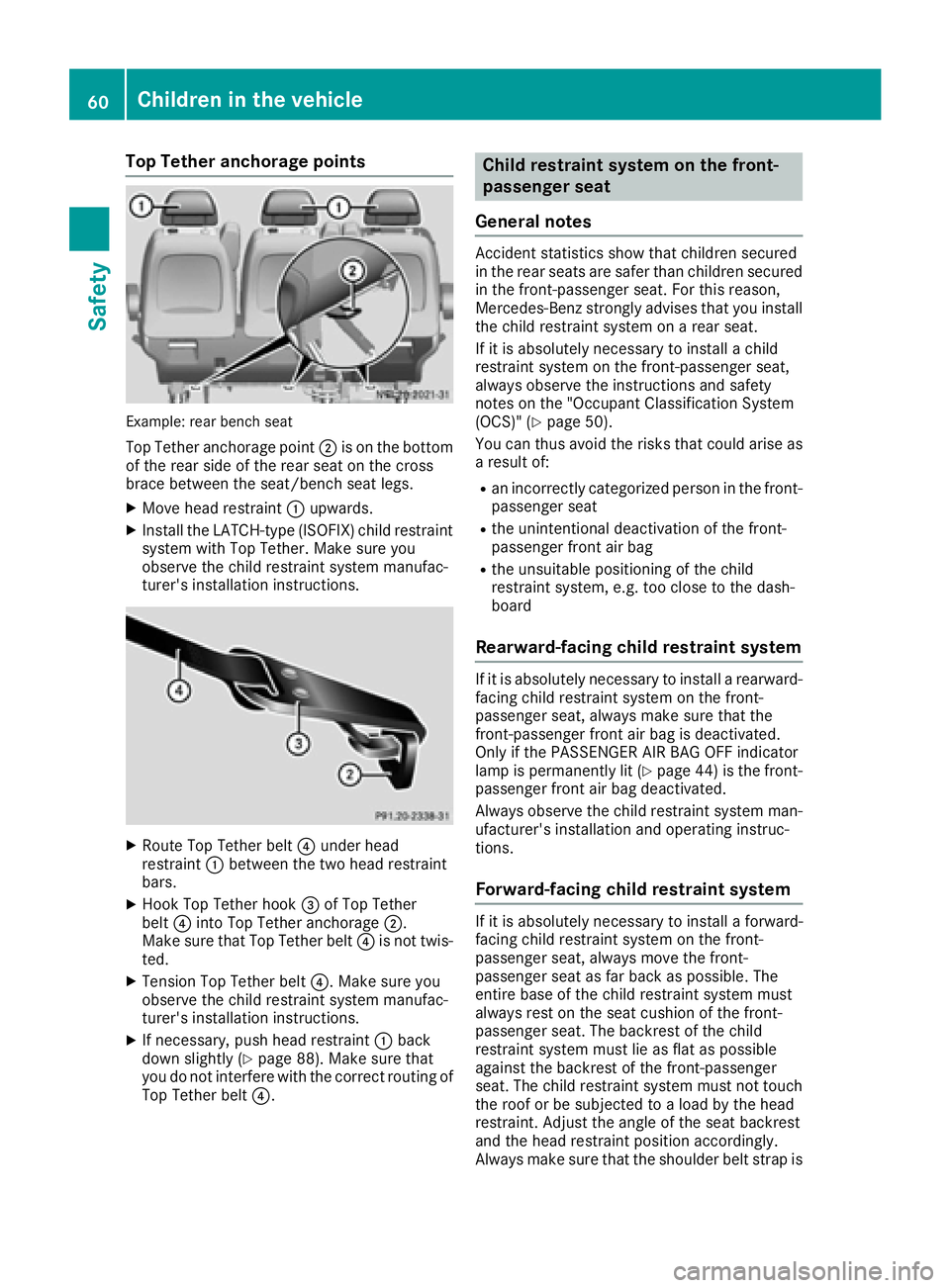
Example: rearbench seat
TopT ethera nchorage point ;is on the bottom
of the rea rsideoft he rea rseatont he cross
brace between the seat/bench sea tleg s.
XMov eheadr estraint :upwards.
XInstall the LATCH-type (ISOFIX )child restraint
system with To pTether. Make sure you
observe the child restraint system manufac-
turer' sinstallatio ninstructions.
XRoute To pTetherb elt? under head
restraint :between the two head restraint
bars.
XHoo kTop Tetherh ook=of To pTether
belt ?into To pTethera nchorage ;.
Make sure thatT opTetherb elt? is not twis-
ted.
XTension To pTetherb elt?.M akesurey ou
observe the child restraint system manufac-
turer' sinstallatio ninstructions.
XIf necessary,p ushh eadr estraint :back
down slightly(Ypage 88). Make sure that
yo udon ot interfere with the correct routing of
To pT etherb elt?.
Chil drestrain tsystem on the front-
passenge rseat
General notes
Accident statistics sho wthatc hildren secured
in the rea rseats ar esafer thanc hildren secured
in the front-passenge rseat. For thisr eason,
Mercedes-Benz strongl yadvises thaty ouinstall
the child restraint system on arears eat.
If it is absolutely necessary to instal lachild
restraint system on the front-passenge rseat,
always observe the instructions and safety
note sont he "Occupant Classification System
(OCS) "(
Ypage 50).
Yo uc an thusa voidthe risks thatc ould ariseas
ar esul tof:
Ran incorrectly categorize dperso nint he front-
passenge rseat
Rthe unintentiona ldeactivatio nofthe front-
passenge rfront ai rbag
Rthe unsuitable positioning of the child
restraint system ,e.g.t oo close to the dash-
board
Rearward-facin gchild restrain tsystem
If it is absolutely necessary to instal larearward-
facing child restraint system on the front-
passenge rseat, always make sure thatt he
front-passenge rfront ai rbag is deactivated.
Onlyift he PASSENGER AIR BAG OFF indicator
lamp is permanentl ylit(
Ypage 44 )isthe front-
passenger front air bag deactivated.
Always observe the child restraint system man-
ufacturer's installation and operating instruc-
tions.
Forward-facing child restraint system
If it is absolutely necessary to install aforward-
facing child restraint system on the front-
passenger seat, always move the front-
passenger seat as far back as possible.T he
entire base of the child restraint system must
always rest on the seat cushion of the front-
passenger seat. The backrest of the child
restraint system must lie as flat as possible
against the backrest of the front-passenger
seat. The child restraint system must not touch
the roof or be subjected to aload by the head
restraint. Adjust the angle of the seat backrest
and the head restraint position accordingly.
Always make sure that the shoulderb elt strap is
60Children in the vehicle
Safety
Page 63 of 310
correctly routed from the vehicle beltoutlet to
the shoulder bel tguide on the chil drestraint
system. The shoulder bel tstrapm ustb erouted
forward sand downwards from the vehicle belt
outlet. If necessary, adjust the vehicle bel tout-
le ta nd the front-passenger seata ccordingly.
Alway sobserve the chil drestraint system man-
ufacturer's installation and operating instruc-
tions.
Override features/Child-proof locks
Important safety notes
GWARNING
If childre nare traveling in the vehicle ,they
could:
Rope ndoors, thus endangering otherp eople
or roadu sers
Rexit the vehicle and be caught by oncoming
traffic
Roperate vehicle equipment and become
trapped
There is ariskofana ccident and injury.
Alway sactivate the child-proof locks and
overrid efeature if childre nare traveling in the
vehicle .Whenl eaving the vehicle ,alway stake
the key with yo uand lock the vehicle .Never
leave childre nunattende dinthe vehicle.
Child-proof lock/override feature for:
RSliding doors (Ypage 61)
GWARNING
If yo ulea ve childre nunsupervised in the vehi-
cle ,they could set it in motio nby,for example:
Rrelease the parking brake.
Rshift the automatic transmission outoft he
parking position P.
Rstartthe engine.
In addition, they may operate vehicle equip-
ment and become trapped .There is arisko f
an accident and injury.
Whe nleaving the vehicle ,alway stake the
SmartKey with yo uand lock the vehicle .Never
leave childre nunsupervised in the vehicle.
GWARNING
If persons, particularly childre nare subjected
to prolonged exposure to extrem eheato r
cold ,there is ariskofi njury, possibly even
fatal. Neve rlea ve childre nunattende dinthe
vehicle.
GWARNING
If the chil drestraint system is subjecte dto
direct sunlight, parts may get very hot. Chil-
dre nm ay burn themselves on these parts,
particularly on the metalp arts of the child
restraint system. There is ariskofi njury.
If yo uleave the vehicle ,taking the chil dwith
you, always ensure that the chil drestraint
system is not exposed to direct sunlight. Pro- tect it with ablanket, for example. If the child
restraint system hasb eene xposed to direct
sunlight, le titcool dow nbefore securing the
chil dini t. Neve rlea ve childre nunattende din
the vehicle.
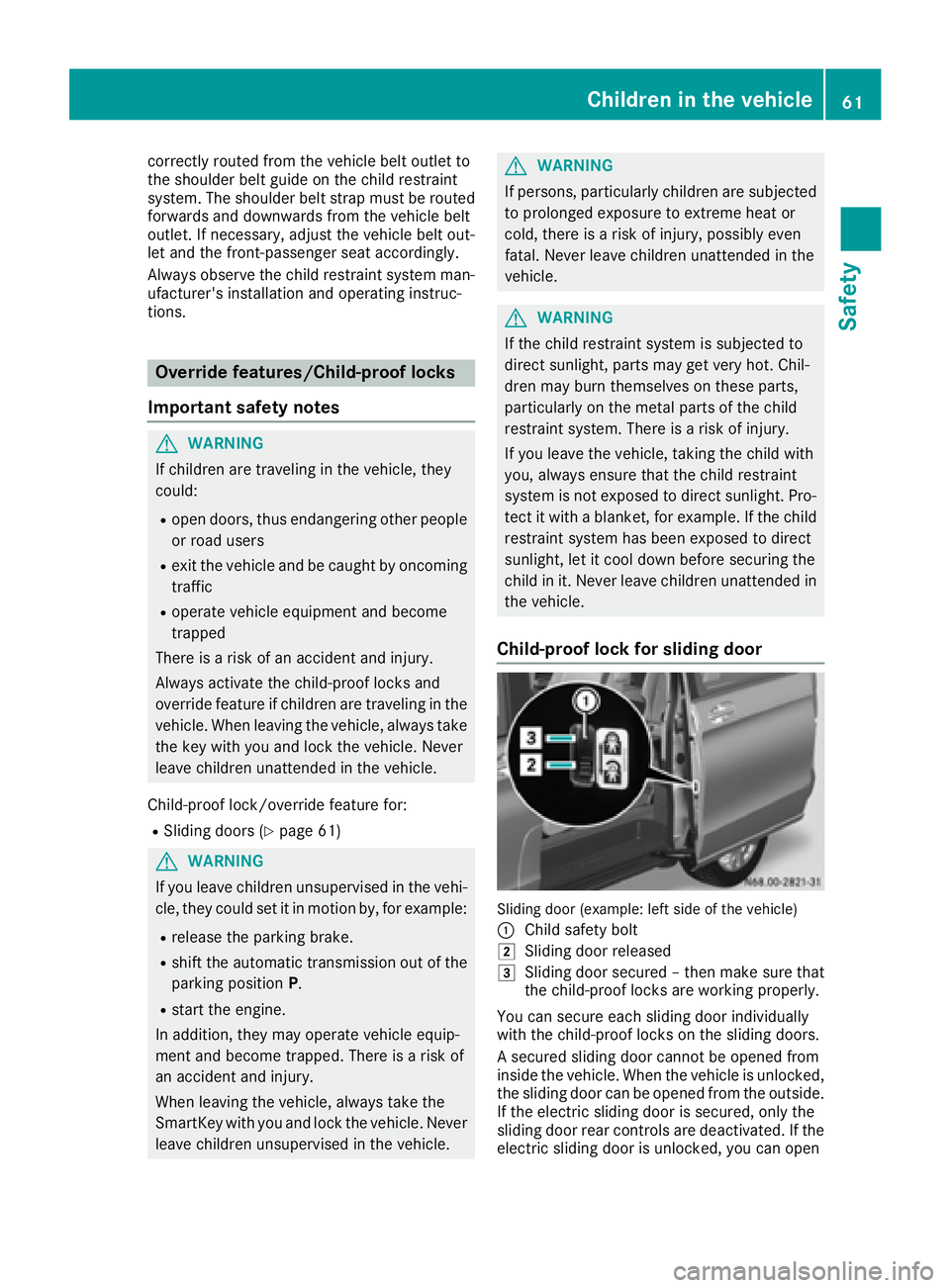
Child-proof lock for sliding door
Sliding doo r(example: lef tsideoft he vehicle)
:
Chil dsafety bolt
2Sliding doo rreleased
3Sliding doo rsecured –then make sure that
the child-proof locks are working properly.
You can secure each sliding doo rindividually
with the child-proof locks on the sliding doors.
As ecured sliding doo rcannot be opened from
inside the vehicle .Whent he vehicle is unlocked,
the sliding doo rcan be opened from the outside.
If the electri csliding doo rissecured ,only the
sliding doo rrea rc ontrolsa re deactivated. If the
electrics liding doo risunlocked ,you can open
Children in the vehicle61
Safety
Z
Page 64 of 310
the electricslidin gdoorusing the corresponding
Å orÆ sliding door button in the center
consol e(
Ypage 75).
Pets in the vehicle
GWARNING
If yo uleave animals unattended or unsecured
in the vehicle, theyc ould press buttons or
switches ,for example.
As aresult, theyc ould:
Ractivate vehicl eequipment and become
trapped ,for example
Ractivate or deactivate systems, thereby
endangering othe rroa du sers
Unsecured animals could also be flung around
the vehicl einthe event of an accident or sud-
de ns teering or braking ,thereb yinjurin gvehi-
cle occupants. There is ariskofana ccident
and injury.
Never leav eanimals unattended in the vehi-
cle .Alway ssecurea nimals properly during
the journey ,e.g.u se asuitabl eanimalt rans-
port box.
Driving safety systems
Overview
In thiss ection, yo uwillf indi nformation about
the following drivin gsafety systems:
REBD ( Ele ctronic Brake Force Distribution)
RABS ( Anti-lock Braking Sys tem)
RBAS ( Brake Assist System)
RESP®(E le ctronic Stability Program)
Important safety notes
If yo ufailtoa dapt your drivin gstyle or if yo uare
inattentive, the drivin gsafety systems can nei-
therr educe the ris kofaccident nor override the
laws of physics .Drivin gsafety systems are
merel yaidsd esig nedtoa ssistdriving. Yo uare
responsibl efor the distance to the vehicl ein
front, for vehicl espeed, braking in good time
and for staying in your lane. Alway sadapt your drivin
gstyle to the prevailing roa dand weather
conditions and maintain asufficient, safe dis-
tance fromo therroa du sers.D rive carefully.
Please note thatt he drivingsafety systems
describe donlyw orko ptimally when:
Rthere is adequate contact between the tires
and the roa dsurface
Ryo uu sewinter tire s(M+ Stires),w iths now
chains if necessary,w hent he roa dconditions
ar ew intry
Rthe spee dinformation determine dbythe
vehicl eiswithint he legall yprescribe ddisplay
accuracy
Pa yp articular attentio ntothe information
regarding tires, coding of the whee lsizeg roups,
tire trea dand winter operatio nunder "Wheels
and tires" (
Ypage 267).
ABS (Anti-lock Braking System)
General notes
ABS regulate sbrake pressure in such awaythat
the wheels do not lock when yo ubrake. This
allows yo utocontinue steering the vehicl ewhen
braking.
The ò warning lamp in the instrument cluster
lights up when the ignition is switched on. The
lamp goes ou twhent he engine starts running.
Important safety notes
Observe the important safety guideline sfor the
drivin gsafety system(Ypage 62).
ABS works fromas peedof abou t5mph
(8 km/h), regardles sofroad-surface conditions.
ABS works on slippery surfaces ,evenw heny ou
onl ybrake gently.
GWARNING
If ABS is faulty, the wheels could lock when
braking .The steerability an dbraking charac-
teristics maybes everel yimpaired. Addition-
ally ,fur the rdrivin gsafety systems ar edeac-
tivated .Ther eisani ncreasedd angerofs kid-
ding and accidents.
Drive on carefully. Hav eABS checked imme-
diately at aquali fied specialis tworkshop.
62Driving safet ysystems
Safety
Page 87 of 310
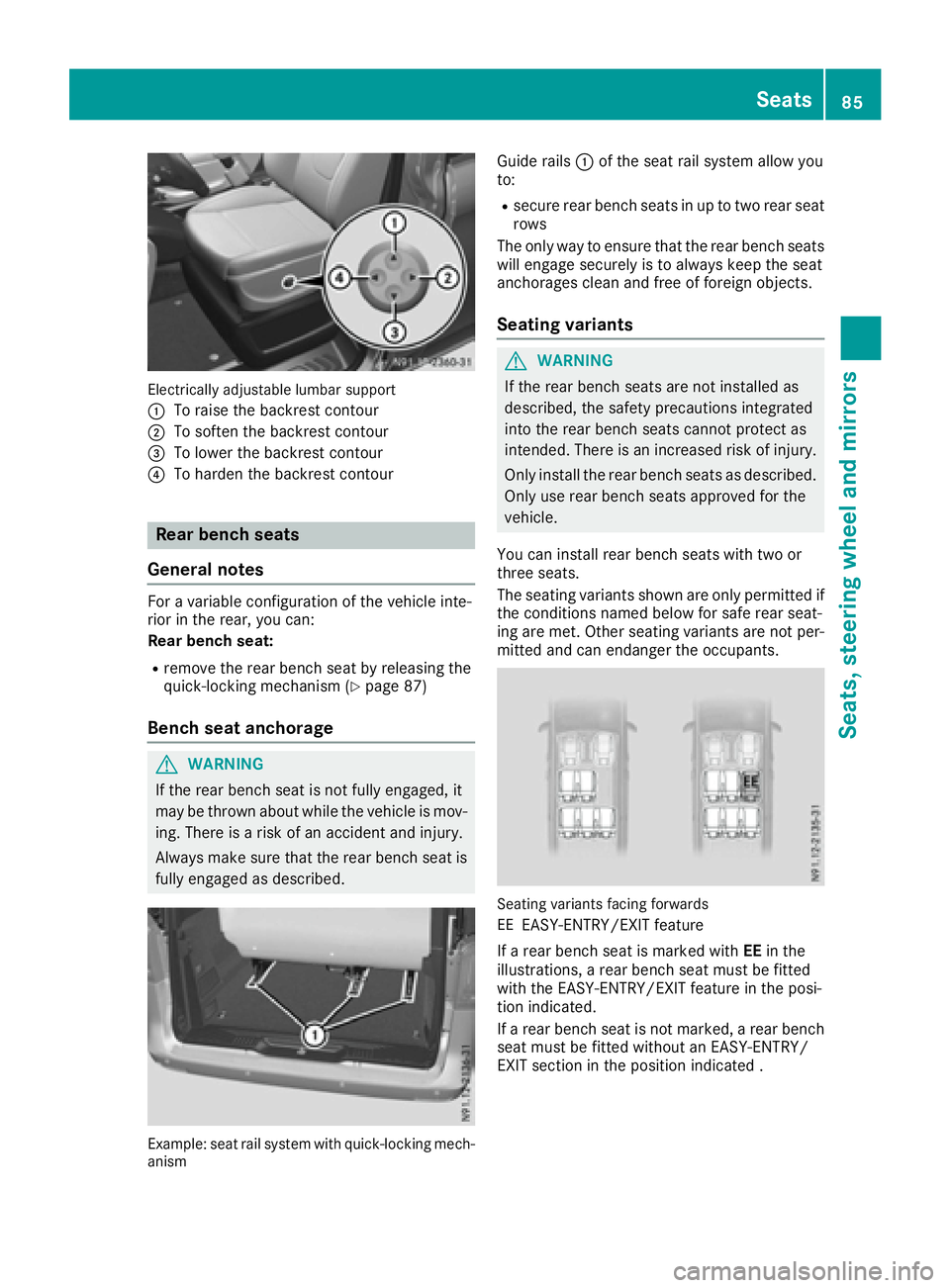
Electrically adjustable lumbarsuppo rt
:
To rais ethe backres tcontour
;To soften the backres tcontour
=To lowe rthe backres tcontour
?To harde nthe backres tcontour
Rear benchs eats
General notes
For avariabl econfiguratio nofthe vehicl einte-
rio rint he rear, yo ucan:
Rea rbench seat:
Rremove the rea rbench sea tbyreleasing the
quick-locking mechanism (Ypage 87)
Bench seat anchorage
GWARNING
If the rea rbench sea tisn ot full yengaged ,it
maybet hrown aboutw hilethe vehicl eismov-
ing .There is ariskofana ccident and injury.
Alway smakes uret hatt he rea rbench sea tis
full yengaged as described.
Example: sea trails ys tem with quick-locking mech-
anism
Guid erails :of the sea trails ystem allo wyou
to:
Rsecur erearb ench seats in up to two rea rseat
rows
The onl ywayto ensure thatt he rearbench seats
will engag esecurel yistoa lwayskeept he seat
anchoragesc lean and freeoff oreignobjects.
Seatin gvariants
GWARNING
If the rea rbench seats ar enot installe das
described, the safety precautions integrated
into the rea rbench seats canno tprotect as
intended. There is an increased ris kofinjury.
Onlyi nstallthe rea rbench seats as described.
Onlyu serea rbench seats approved for the
vehicle.
Yo uc an instal lrea rb ench seats with two or
threes eats.
The seating variants shown ar eonlyp ermitted if
the conditions named belo wfor safe rea rseat-
ing ar emet. Othe rseating variants ar enot per-
mitte dand can endanger the occupants.
Seating variants facing forwards
EE
EASY-ENTRY/EXIT feature
If ar earb ench sea tism arked with EEin the
illustrations, arearb ench sea tmustbef itted
with the EASY-ENTRY/EXIT featur einthe posi-
tio nindicated.
If ar earb ench sea tisn ot marked ,arearb ench
sea tmustbef ittedw ithou tanE ASY-ENTRY/
EXIT sectio ninthe positio nindicated .
Seats85
Seats, steering wheel andmirrors
Z