ECU MERCEDES-BENZ METRIS 2016 MY16 Operator’s Manual
[x] Cancel search | Manufacturer: MERCEDES-BENZ, Model Year: 2016, Model line: METRIS, Model: MERCEDES-BENZ METRIS 2016Pages: 310, PDF Size: 7.28 MB
Page 217 of 310
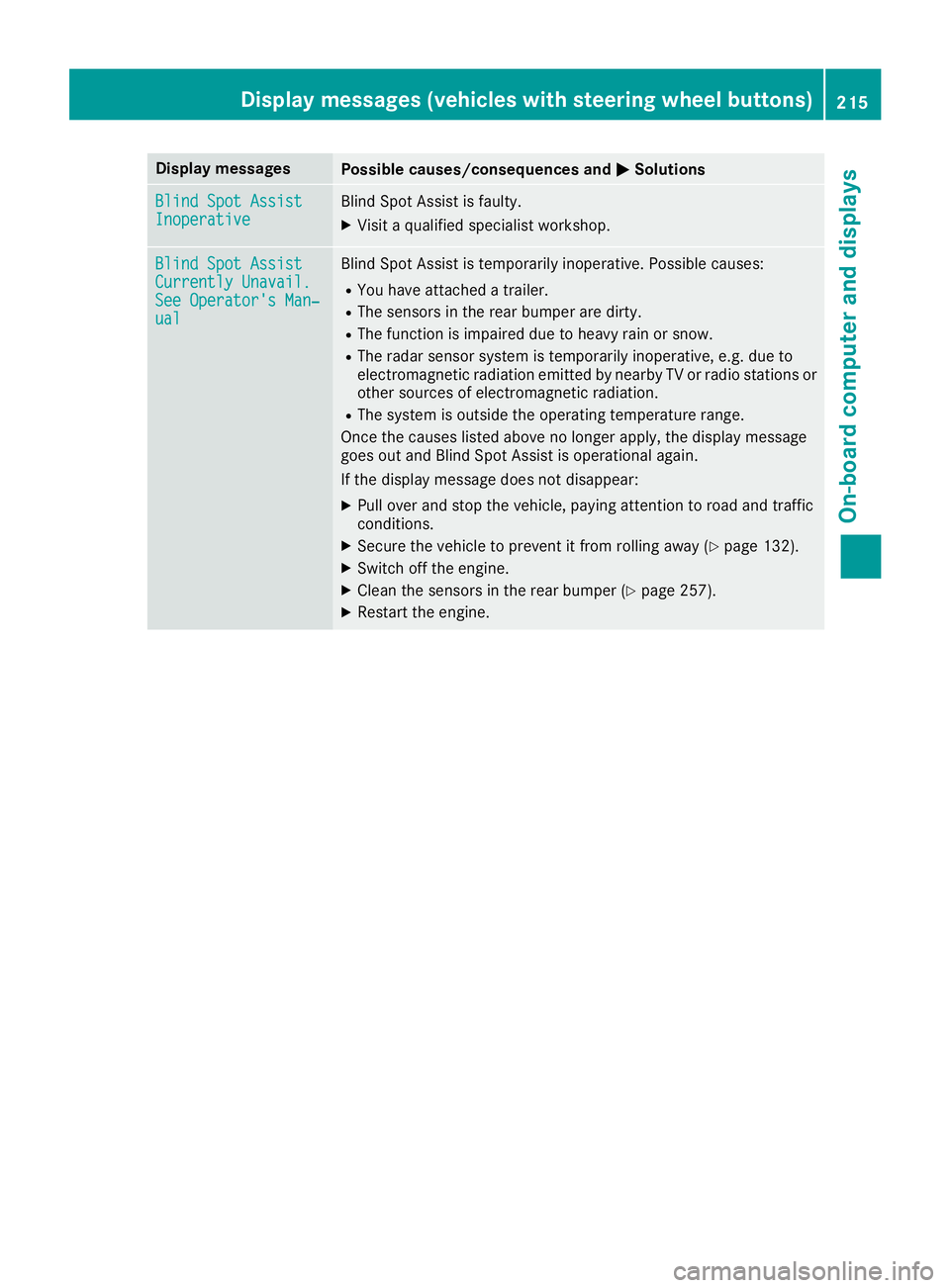
Display messagesPossible causes/consequences andMSolutions
Blind SpotAssistInoperativeBlind Spot Assis tisfaulty.
XVisit aqualified specialist workshop .
Blind SpotAssistCurrently Unavail.See Operator' sMan‐ual
Blind Spot Assis tistemporarily inoperative. Possibl ecauses:
RYou hav eattached atrailer .
RThe sensor sintherear bumper are dirty.
RThe function is impaire ddue to heav yrain or snow.
RThe radar sensor system is temporarily inoperative, e.g. due to
electromagneti cradiation emitted by nearby TV or radi ostation sor
other source sofelectromagneti cradiation .
RThe system is outside th eoperating temperature range.
Once th ecauses listed abov enolonger apply, th edisplay message
goe sout and Blind Spot Assis tisoperational again .
If th edisplay message does no tdisappear :
XPull overand stop th evehicle, payin gattention to roa dand traffic
conditions.
XSecur ethe vehicl etopreventitfromr ollin gaway (Ypage 132).
XSwitc hoff th eengine.
XClean th esensor sintherear bumper (Ypage 257).
XRestart theengine.
Display message s(vehicles wit hsteering whee lbuttons)21 5
On-board computera nd displays
Z
Page 218 of 310
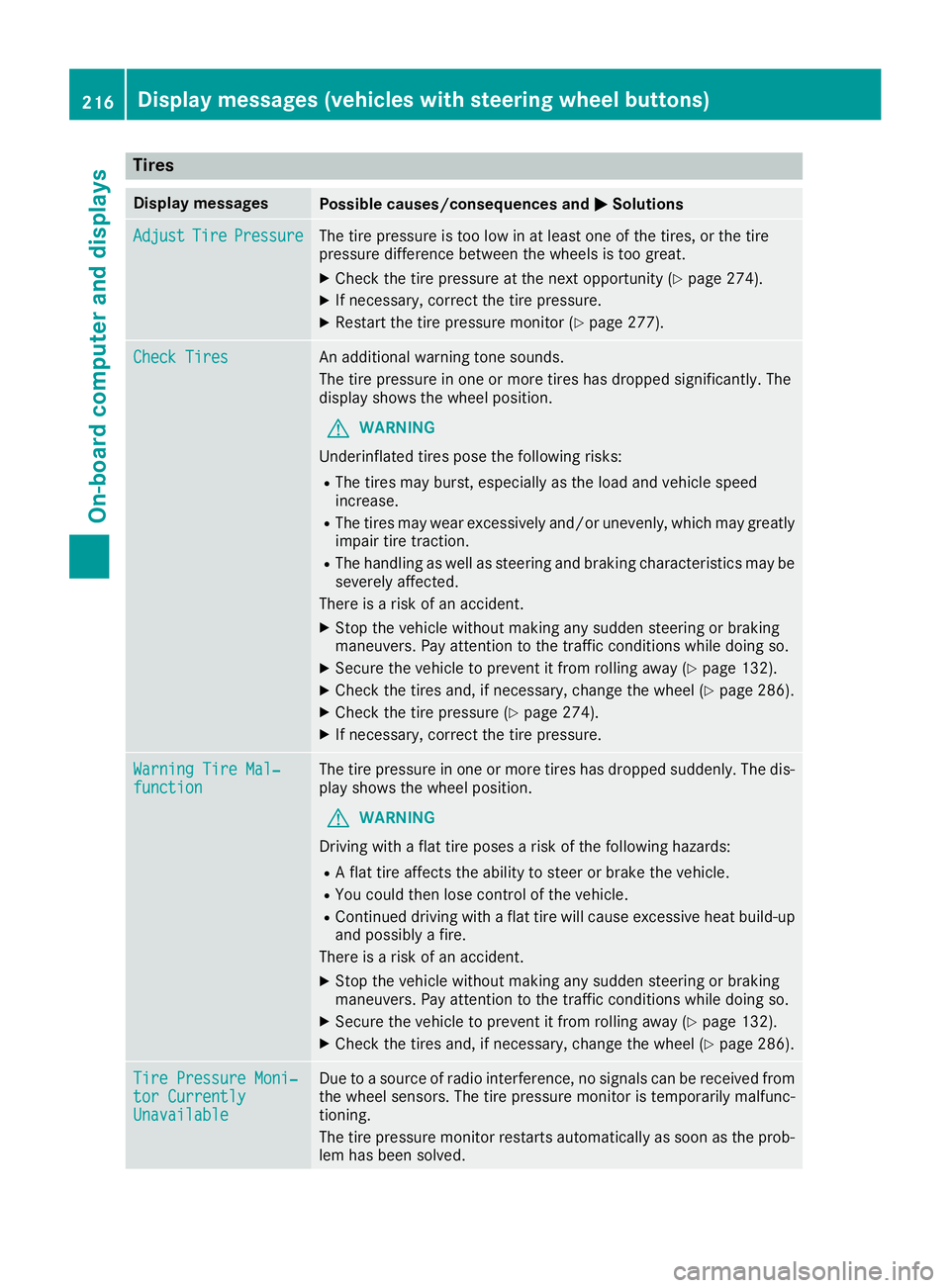
Tires
Display messagesPossible causes/consequencesand MSolutions
AdjustTirePressureThe tire pressure is too lo winatleastone of the tires, or the tire
pressure differenc ebetween the wheels is too great.
XCheck the tire pressure at the next opportunity (Ypage 274).
XIf necessary,c orrect the tire pressure.
XRestart the tire pressure monitor (Ypage 277).
Check TiresAn additional warning tone sounds.
The tire pressure in one or mor etiresh asdropped significantly. The
displa yshows the whee lposit ion.
GWARNING
Underinflated tire sposet he following risks:
RThe tire smayburst, especially as the load and vehicl espeed
increase.
RThe tire smaywear excessivel yand/or unevenly, which mayg reatly
impai rtire traction.
RThe handling as well as steerin gand braking characteristics mayb e
severely affected.
There is ariskofana ccident.
XStop the vehicl ewithou tmaking any sudden steerin gorbraking
maneuvers. Pa yattentio ntothe trafficc onditions whil edoing so.
XSecure the vehicl etoprevent it fromr olling away (Ypage 132).
XCheck the tiresand,ifn ecessary,c hange the whee l(Ypage 286).
XCheck the tire pressure (Ypage 274).
XIf necessary,correct the tire pressure.
WarningTireM al‐functionThe tire pressure in one or mor etire sh asdropped suddenly. The dis-
play shows the whee lposit ion.
GWARNING
Driving with aflatt ire poses ariskoft he following hazards:
RAflatt ire affects the ability to stee rorbrake the vehicle.
RYouc ould thenl osec ontro lofthe vehicle.
RContinued drivin gwithaf latt ire will cause excessive heat build-up
and possibl yafire.
There is ariskofana ccident.
XStop the vehicl ewithou tmaking any sudden steerin gorbraking
maneuvers. Pa yattentio ntothe trafficc onditions whil edoing so.
XSecure the vehicl etoprevent it fromr olling away (Ypage 132).
XCheck the tiresand,ifn ecessary,c hange the whee l(Ypage 286).
TirePressure Moni‐tor CurrentlyUnavailable
Due to asource of radi ointerference, no signals can be receive dfrom
the whee lsensors. The tire pressure monitor is temporaril ymalfunc-
tioning.
The tire pressure monitor restarts automaticall yassoona sthe prob-
le mh asbeen solved.
216Displa ymessage s(vehicles wit hsteering whee lbuttons)
On-board computera nd displays
Page 219 of 310
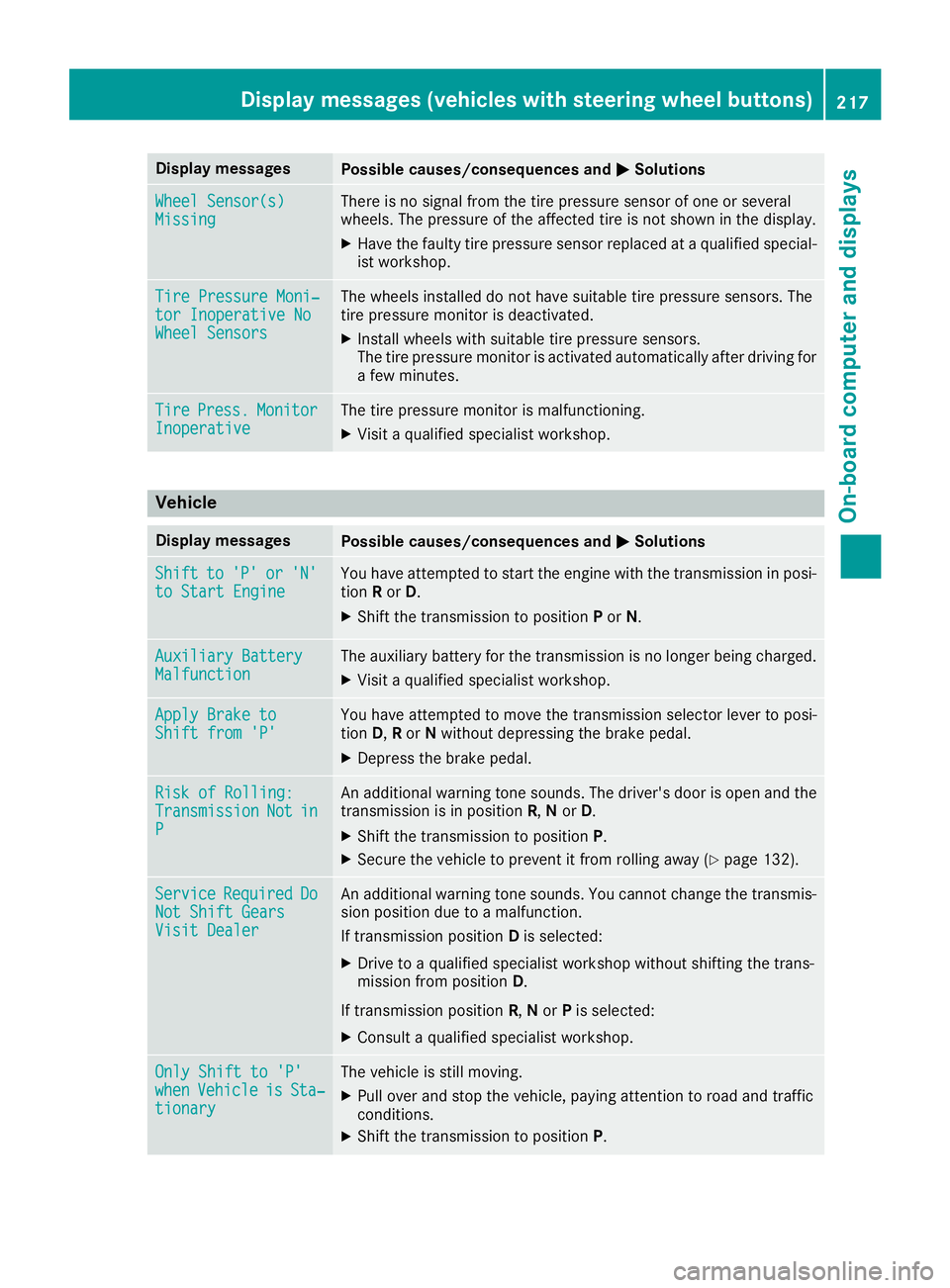
Display messagesPossible causes/consequences andMSolutions
Wheel Sensor(s)MissingThere is no signal from th etirep ressur esensor of on eorseveral
wheels. The pressur eoftheaffecte dtireisn otshown in th edisplay.
XHav ethe fault ytirep ressur esensor replace dataqualified special -
ist workshop .
TirePressure Moni‐tor Inoperative NoWheel Sensor s
The wheels installed do no thaves uitable tire pressur esensors. The
tire pressur emonitor is deactivated.
XInstall wheels wit hsuitable tire pressur esensors.
The tire pressur emonitor is activated automatically after drivin gfor
af ew minutes.
Tir ePress.Monito rInoperativeThe tire pressur emonitor is malfunctioning .
XVisitaqualified specialist workshop .
Vehicle
Display messagesPossible causes/consequences and MSolutions
Shiftto'P'or'N'to Start EngineYou haveattempte dtostart th eenginew itht he transmission in posi-
tion Ror D.
XShift th etransmission to position Por N.
Auxiliary Batter yMalfunctionThe auxiliary battery for th etransmission is no longer bein gcharged.
XVisit aqualified specialist workshop .
Apply Brake toShift from'P'You hav eattempte dtomovet he transmission selector lever to posi-
tion D,Ror Nwithout depressing th ebrak epedal .
XDepress th ebrak epedal .
RiskofR olling:TransmissionNotinP
An additional warning tone sounds. The driver's door is open and th e
transmission is in position R,N or D.
XShift th etransmission to position P.
XSecurethe vehicl etopreventitfromr ollin gaway (Ypage 132).
Servic eRequiredDoNot Shift GearsVisit Dealer
An additional warning tone sounds. You canno tchang et he transmis -
sion position due to amalfunction .
If transmission position Dis selected:
XDrive to aqualified specialist workshop without shifting th etrans -
mission from position D.
If transmission position R,N or Pis selected:
XConsult aqualified specialist workshop .
OnlyShift to 'P'whenVehicl eisSta‐tionar y
The vehicl eisstill moving .
XPull overand stop th evehicle, payin gattention to roa dand traffic
conditions.
XShift th etransmission to position P.
Display messages(vehicles wit hsteering whee lbuttons)21 7
On-board computera nd displays
Z
Page 220 of 310
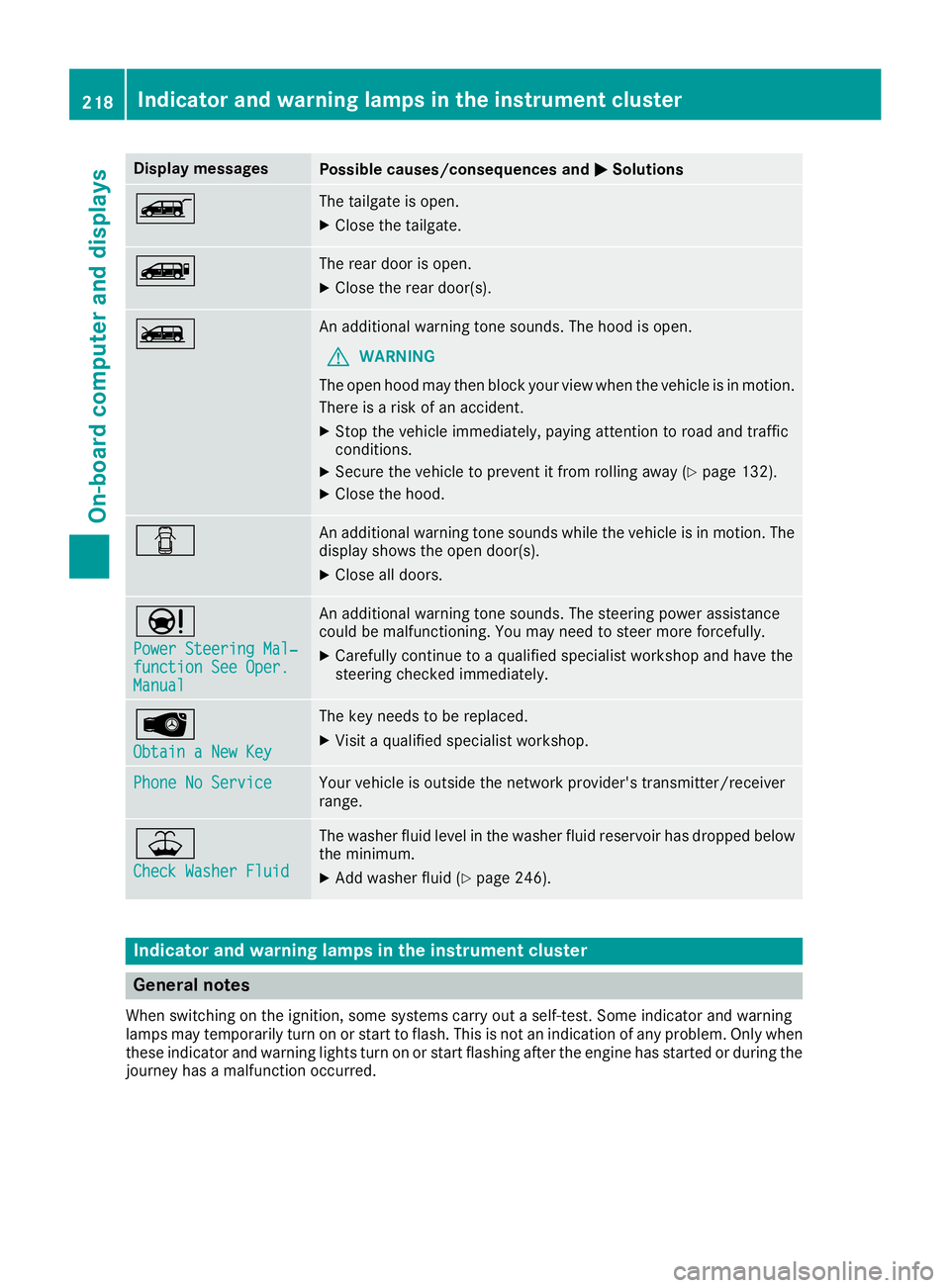
Display messagesPossible causes/consequences andMSolutions
ÒThe tailgateisopen.
XClos ethe tailgate.
ÑThe rear door is open .
XClosethe rear door(s).
ÓAn additional warning tone sounds. The hoo disopen.
GWARNIN G
The open hoo dmay then bloc kyour vie wwhen th evehicl eisinm otion.
There is ariskofana ccident.
XStop thevehicl eimmediately, payin gattention to roa dand traffic
conditions.
XSecur ethe vehicl etopreventitfromr ollin gaway (Ypage 132).
XClosethe hood.
CAn additional warning tone sounds while th evehicl eisinm otion.The
display shows th eopen door(s).
XClos eall doors.
Ð
Power Steering Mal ‐function See Oper.Manual
An additional warning tone sounds. The steering powe rassistanc e
could be malfunctioning .You may need to steer mor eforcefully.
XCarefully continu etoaqualified specialist workshop and hav ethe
steering checke dimmediately.
Â
Obtain aNew Key
The ke yneeds to be replaced.
XVisit aqualified specialist workshop .
Phone No ServiceYour vehicleisoutside th enetwork provider' stransmitter/receiver
range.
¥
Check Washer Fluid
The washer flui dlevel in th ewasher flui dreservoir has dropped belo w
th em inimum .
XAddw asher flui d(Ypage 246).
Indicatorand warning lamps in th einstrume nt cluster
Generaln otes
Whe nswitching on th eignition ,som esystems carry out aself-test .Som eindicator and warning
lamp smay temporarily tur nonorstart to flash. This is no tanindication of any problem .Onlyw hen
these indicator and warning lights tur nonorstart flashin gafter th eengineh as started or during th e
journey has amalfunction occurred .
218Indicator and warning lamps in th einstrument cluster
On-board computera nd displays
Page 222 of 310
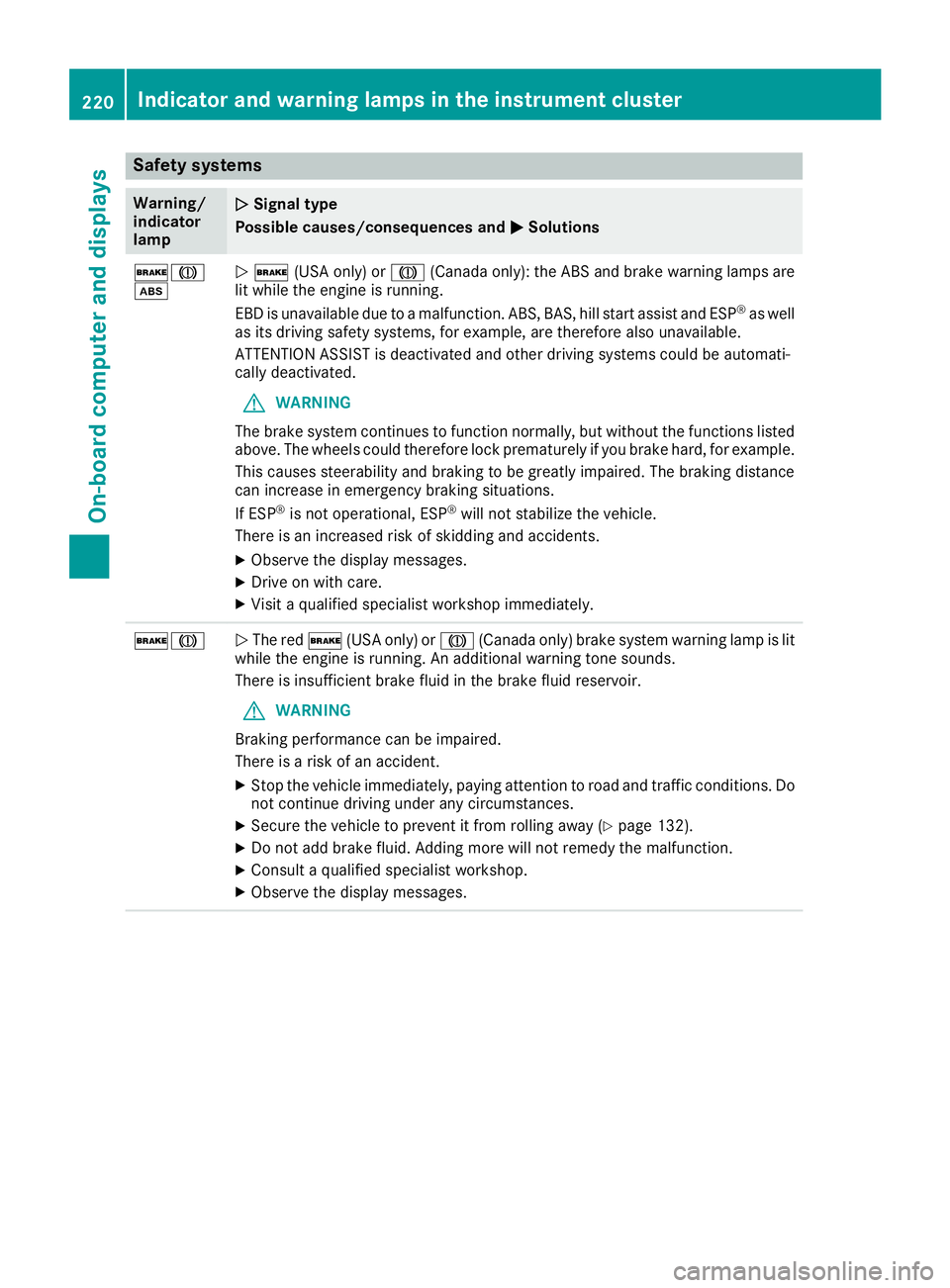
Safety systems
Warning/
indicator
lampNSignal type
Possible causes/consequences and M
Solutions
$J
òN$ (USA only) or J(Canada only): the ABS and brake warning lamps are
lit while the engine is running.
EBD is unavailable due to amalfunction .ABS ,BAS,h ill start assist and ESP
®as well
as its driving safety systems, for example, are therefore also unavailable.
ATTENTION ASSIST is deactivated and other driving systems could be automati-
cally deactivated.
GWARNING
The brake system continues to function normally, but without the functions listed
above. The wheels could therefore lock prematurely if you brake hard, for example.
This causes steerability and braking to be greatly impaired. The braking distance
can increase in emergency braking situations.
If ESP
®is not operational, ESP®will not stabilize the vehicle.
There is an increased risk of skidding and accidents.
XObserve the display messages.
XDrive on with care.
XVisit aqualified specialist workshop immediately.
$JNThe red $(USA only) or J(Canada only) brake system warning lamp is lit
while the engine is running. An additional warning tone sounds.
There is insufficient brake fluid in the brake fluid reservoir.
GWARNING
Braking performancec an be impaired.
There is arisk of an accident.
XStop the vehicle immediately, paying attention to road and traffic conditions. Do
not continue driving under any circumstances.
XSecure the vehicle to prevent it from rolling away (Ypage 132).
XDo not add brake fluid. Adding more will not remedy the malfunction.
XConsult aqualified specialist workshop.
XObserve the display messages.
220Indicator and warning lamp sinthe instrument cluster
On-board computer and displays
Page 225 of 310
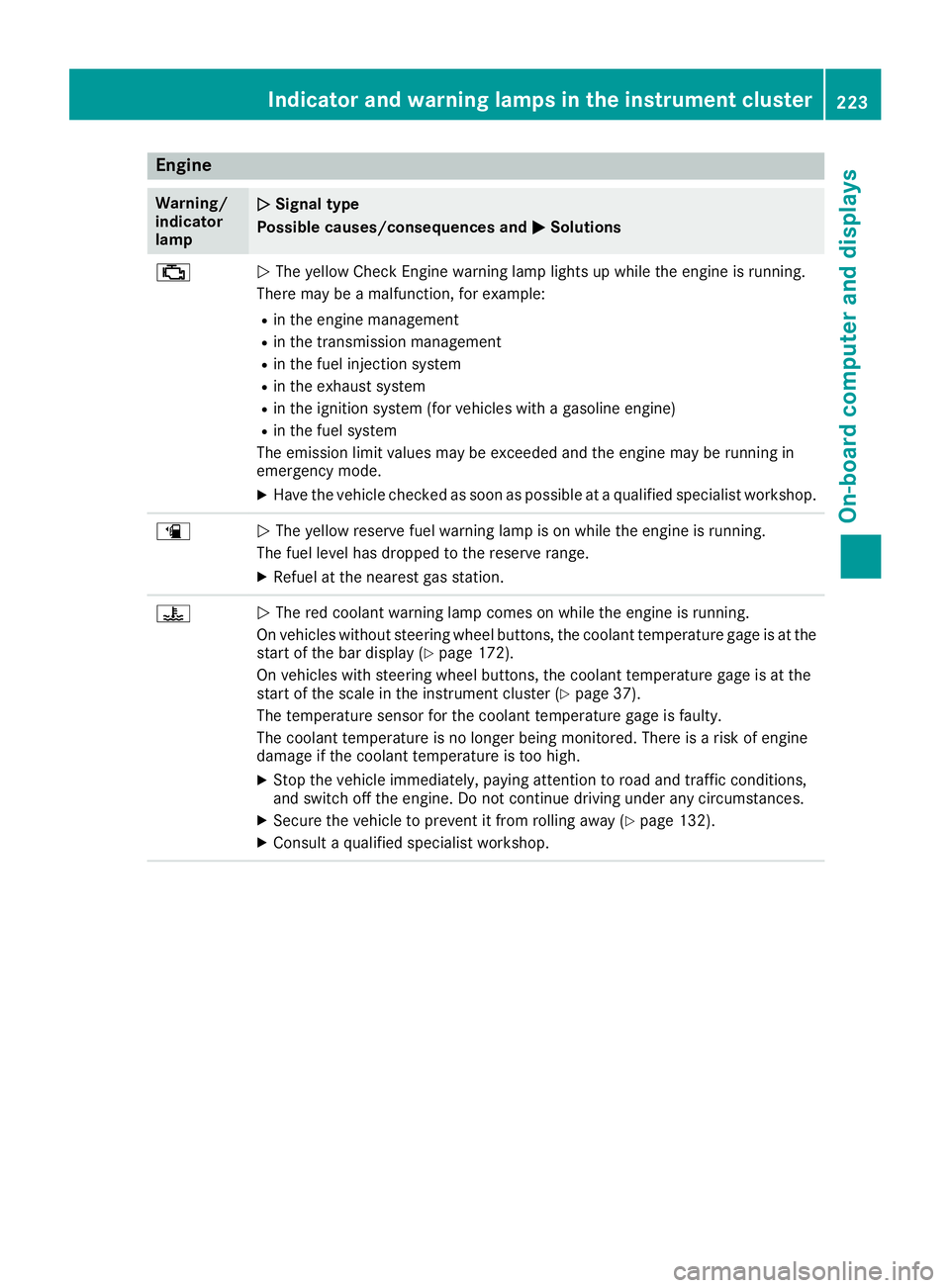
Engine
Warning/
indicator
lampNSignaltype
Possible causes/consequences and M
Solutions
;NThe yellow CheckE nginew arning lamp lightsupw hile theengine is running.
Therem ay beamalfunction, for example:
Rin th eengine management
Rin th etransmission management
Rin th efuel injection system
Rin th eexhaust system
Rin th eignition system (for vehicle swithagasoline engine)
Rin th efuel system
The emission limit values may be exceeded and th eengine may be runnin gin
emergency mode.
XHav ethe vehicle checked as soon as possible at aqualified specialist workshop.
æNThe yellow reservef uel warning lamp is on while th eengine is running.
The fuel leve lhas dropped to th ereserver ange.
XRefuel at th enearest gas station.
?NThe red coolant warning lamp comes on while th eengine is running.
On vehicle swithout steering wheel buttons, th ecoolant temperatur egage is at the
start of th ebar display (
Ypage 172).
On vehicle swith steering wheel buttons ,the coolant temperatur egage is at the
start of th escale in th einstrumentc luster(
Ypage 37).
The temperatur esensor for th ecoolant temperatur egage is faulty.
The coolant temperatur eisnolonger beingm onitored. Thereisar isk of engine
damag eifthecoolant temperatur eistoohigh.
XStop th evehicle immediately, payinga ttention to road and traffic conditions,
and switch off th eengine .Don otcontinue driving unde rany circumstances.
XSecure th evehicle to prevent it from rolling away (Ypage 132).
XConsult aqualified specialist workshop.
Indicator and warning lamps in th einstrumen tcluster223
On-boardc omputer and displays
Z
Page 226 of 310
Warning/
indicator
lampNSignal type
Possiblec auses/consequences and M
Solutions
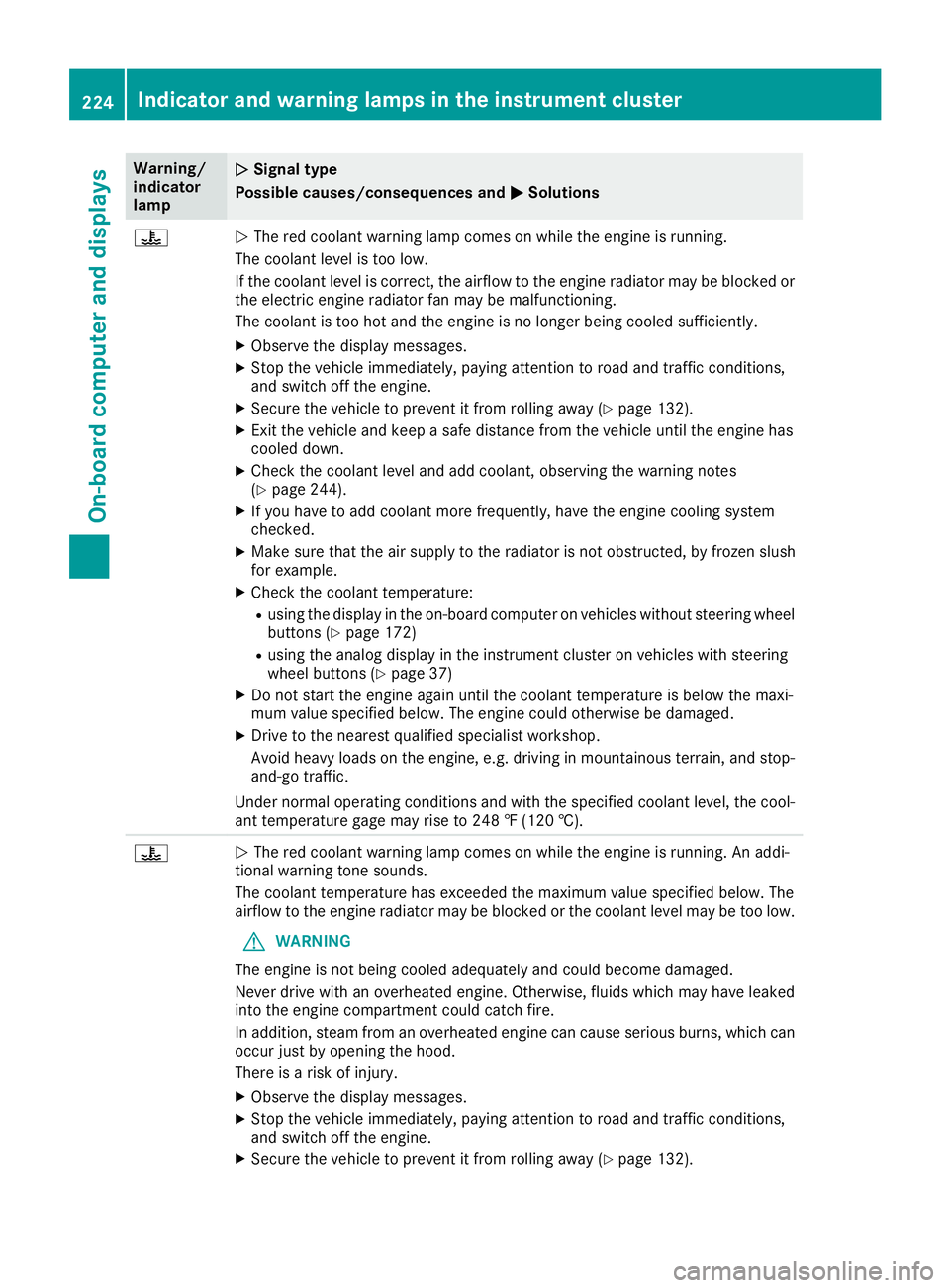
?NThe red coolant warning lamp comes on while the engine is running.
The coolant leve listoo low.
If the coolant leve liscorrect, the airflow to the engine radiator may be blocked or
the electric engine radiator fan may be malfunctioning.
The coolant is too hot and the engine is no longer being cooleds ufficiently.
XObserve the display messages.
XStop the vehicleimmediately, paying attention to road and traffic conditions,
and switch off the engine.
XSecure the vehicletop revent it from rolling awa y(Ypage132).
XExit the vehiclea nd keepasafe distance from the vehicleu ntil the engine has
cooledd own.
XCheck the coolant leve land add coolant, observing the warning notes
(Ypag e244).
XIf you have to add coolant more frequently, have the engine cooling system
checked.
XMake sure that the air supply to the radiator is not obstructed ,byfrozen slush
for example.
XCheck the coolant temperature:
Rusing the display in the on-board computer on vehicles without steering wheel
buttons (Ypag e172)
Rusing the analog display in the instrument cluster on vehicles with steering
whee lbuttons (Ypag e37)
XDo not start the engine again until the coolant temperature is below the maxi-
mum valu especified below. The engine coul dotherwise be damaged.
XDrive to the neares tqualified specialist workshop.
Avoid heavy loads on the engine, e.g. driving in mountainous terrain, and stop-
and-go traffic.
Under normal operating conditions and with the specified coolant level, the cool-
ant temperature gage may rise to 248 ‡(120 †).
?NThe red coolant warning lamp comes on while the engine is running. An addi-
tional warning tone sounds.
The coolant temperature has exceededt he maximumvaluespecified below. The
airflow to the engine radiator may be blocked or the coolant leve lmay be too low.
GWARNING
The engine is not being cooleda dequately and couldbecome damaged.
Never drive with an overheated engine. Otherwise, fluids which may have leaked
into the engine compartment coul dcatch fire.
In addition, steam from an overheated engine can caus eserious burns, which can
occur just by opening the hood.
There is arisk of injury.
XObserve the display messages.
XStop the vehiclei mmediately, paying attention to road and traffic conditions,
and switch off the engine.
XSecure the vehicletop revent it from rolling awa y(Ypage 132).
224Indicator and warning lamps in the instrument cluster
On-board computer and displays
Page 228 of 310
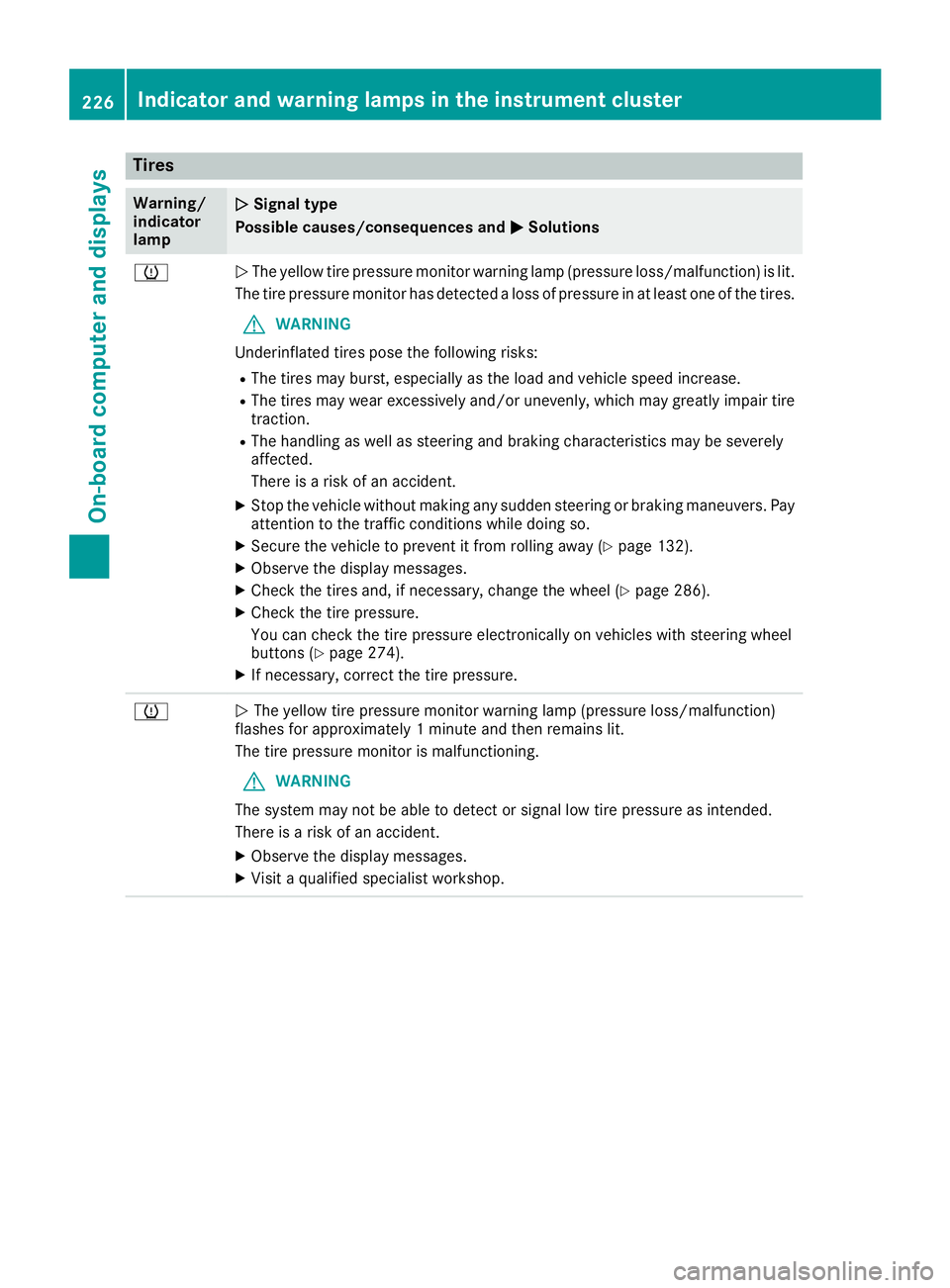
Tires
Warning/
indicator
lampNSignal type
Possible causes/consequence sand M
Solutions
hNThe yellow tire pressure monitor warning lamp (pressure loss/malfunction) is lit.
The tire pressure monitor hasd etecte dalossofp ressure in at leas tone of the tires.
GWARNING
Underinflated tire sposet he following risks:
RThe tire smayburst, especially as the load and vehicl espeed increase.
RThe tire smaywear excessivel yand/or unevenly, which mayg reatlyimpai rtire
traction.
RThe handling as well as steerin gand braking characteristics maybes everely
affected.
There is ariskofana ccident.
XStop the vehicl ewithou tmaking any sudden steerin gorbraking maneuvers. Pay
attentio ntothe trafficc onditions whil edoing so.
XSecure the vehicl etoprevent it fromr olling away (Ypage 132).
XObserve the displa ymessages.
XCheck the tire sand,ifn ecessary,c hange the whee l(Ypage 286).
XCheck the tire pressure.
Youc an check the tire pressure electronicall yonvehicles with steerin gwheel
buttons (
Ypage 274).
XIf necessary,c orrect the tire pressure.
hNThe yellow tire pressure monitor warning lamp (pressure loss/malfunction)
flashe sfor approximately 1minute and thenr emains lit.
The tire pressure monitor is malfunctioning.
GWARNING
The system mayn ot be able to detect or signa llow tire pressure as intended.
There is ariskofana ccident.
XObserve the displa ymessages.
XVisitaq ualified specialis tworkshop.
226Indicator and warninglamps in the instrumen tcluster
On-board computera nd displays
Page 230 of 310
Useful information
This Operator's Manual describes all models as
well as standard and optional equipment of your
vehicle that were available at the time of going
to print.Country-specific variation sare possi-
ble. Note that your vehicle may not be equipped
with all of the described functions. This also
applies to system sand function srelevantt o
safety.
Read the information on qualified specialist
workshops (
Ypage 29).
Stowage spaces and stowage com-
partments
Important safetyn otes
GWARNING
If you transport objects in the vehicle interior
and thes eare not adequately secured, they
could slip or be flung around and thereby
strike vehicle occupants .Inaddition ,cup
holders, open stowage spaces and mobile
phone brackets may not always be able to
hold the objects placed in them in the evento f
an accident. There is arisk of injury, particu-
larly in the eventofs harp brakingorsudden
changes of direction.
RAlways stow objects in such away that they
cannot be tossed about in thes eorsimilar
situations.
RAlways make sure that objects do not pro-
trude out of the stowage spaces, luggage
net sors towage nets.
REnsure that closable stowage spaces are
shut before beginning your journey.
RAlways stow and secure heavy, hard, poin-
ted, sharp-edged, fragile or large objects in
the cargo compartment.
Observet he "Loading guidelines" (
Ypage 232).
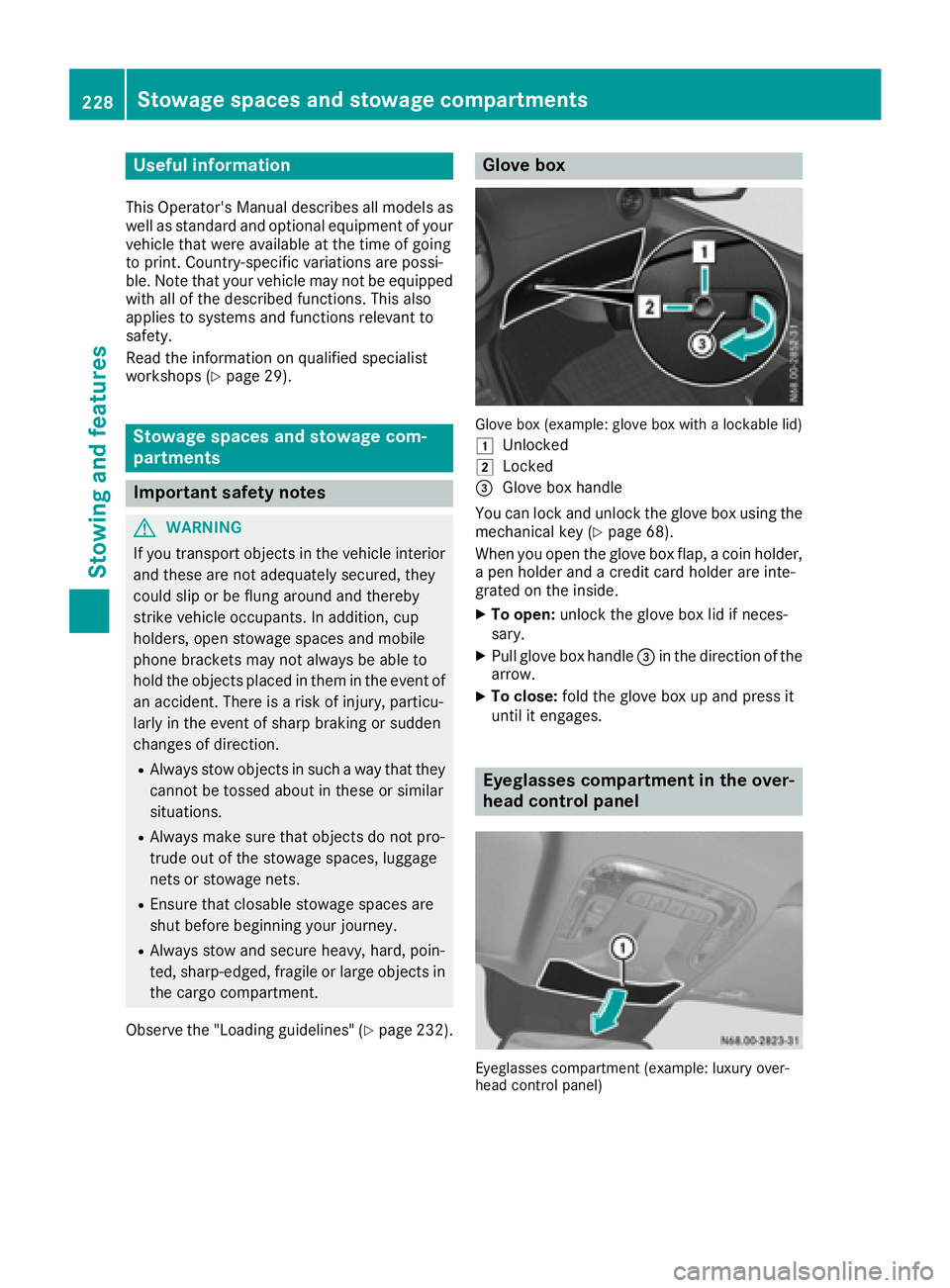
Glove box
Glove box (example: glove box with alockable lid)
1
Unlocked
2Locked
=Glove box handle
You can lock and unlock the glove box using the mechanical key (
Ypage 68).
When you open the glove box flap, acoin holder,
ap en holder and acredit card holder are inte-
grated on the inside.
XTo open: unlock the glove box lid if neces-
sary.
XPull glove box handle =in the direction of the
arrow.
XTo close: fold the glove box up and press it
until it engages.
Eyeglasses compartment in the over-
head control panel
Eyeglasses compartmen t(example: luxury over-
head contro lpanel)
228Stowage spaces and stowage compartments
Stowing and features
Page 231 of 310
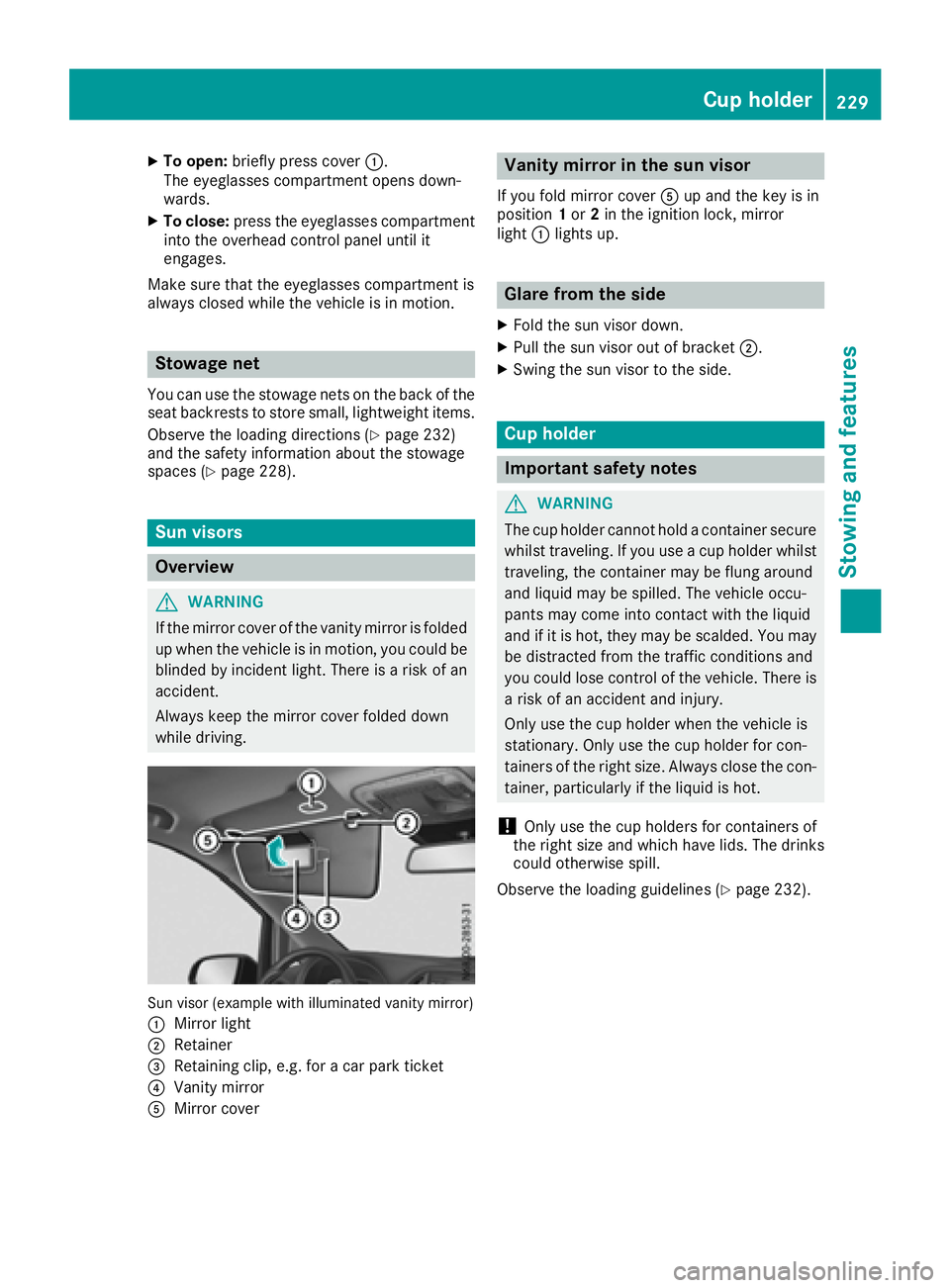
XTo open:brieflypress cover :.
The eyeglasses compartment opens down-
wards.
XTo close: press the eyeglasses compartment
into the overhead contro lpan el unti lit
engages.
Make sure thatt he eyeglasses compartment is
always closed whil ethe vehicl eisinmotion.
Stowage net
Youc an us ethe stowag enets on the back of the
sea tbackrests to stor esmall ,lig htweight items.
Observ ethe loading directions (
Ypage 232)
and the safety informatio nabout the stowage
spaces (
Ypage 228).
Sun visors
Overview
GWARNING
If the mirror cove rofthe vanity mirror is folded
up when the vehicl eisinmotion, yo ucould be
blinded by incident light. There is ariskofa n
accident.
Alway skeept he mirror cove rfolde ddown
whil edriving.
Sun visor (exampl ewithi llum inated vanity mirror)
:
Mirror light
;Retainer
=Retaining clip, e.g .for ac ar park ticket
?Vanity mirror
AMirror cover
Vanity mirrori nthe sun visor
If yo ufoldm irror cover Aup and the key is in
position 1or 2in the ignition lock, mirror
light :lights up.
Glare from the side
XFoldthe sunv isor down.
XPull the sunv isor outofbracket;.
XSwing the sunv isor to the side.
Cup holder
Important safety notes
GWARNING
The cup holde rcanno tholdac ontaine rsecure
whilst traveling .Ifyouuseac up holde rwhilst
traveling ,the containe rmaybe flung around
and liquid maybes pilled.The vehicl eoccu-
pants mayc ome into contact with the liquid
and if it is hot, they maybes calded.You may
be distracted from the traffic conditions and
yo uc ould lose contro lofthe vehicle. There is
ar iskofana ccident and injury.
Onlyu sethe cup holde rwhent he vehicl eis
stationary .Onlyu sethe cup holde rfor con-
tainers of the right size. Alway sclose the con-
tainer, particularly if the liquid is hot.
!Onlyu sethe cup holders for containers of
the right size and which have lids. The drinks could otherwise spill.
Observe the loading guideline s(
Ypage 232).
Cuph older229
Stowing an dfeatures
Z