ECU MERCEDES-BENZ METRIS 2016 MY16 Operator’s Manual
[x] Cancel search | Manufacturer: MERCEDES-BENZ, Model Year: 2016, Model line: METRIS, Model: MERCEDES-BENZ METRIS 2016Pages: 310, PDF Size: 7.28 MB
Page 88 of 310
Please observe the following conditions for safe
rear seating:
ROnly use rear bench seats approved for the
vehicle.
RArear bench seat with three seats withoutan
EASY-ENTRY/EXIT section may only be fitted
in there is no other row of rear seats behind it.
RPassengers may only use the seats if the rear
bench seat has engaged correctly
(
Ypage 87).
EASY-ENTRY/EXIT feature
GWARNING
If the rear bench seat is not fully engaged, it
may be thrown about while the vehicle is mov-
ing. There is arisk of an accident and injury.
Always make sure that the rear bench seat is
fully engaged as described.
GWARNING
When you adjust aseat, you or other vehicle
occupantsc ould become trapped, e.g. on the
seat guide rail. There is arisk of injury.
Make sure when adjusting aseat that no one
has any body parts in the sweep of the seat.
GWARNING
The rear bench seat will not engage when fol-
ded forward. The rear bench seat may inad-
vertently fold backward while accelerating,
braking, changin gdirection suddenly or in the
event of an accident ,for example. People
within the sweep of the rear bench seat may
become trapped. There is arisk of injury.
Before driving off, alwaysf old back the rear
bench seat if it is folded forward. Make sure
that the rear bench seat is fully engaged.
The only way to ensure that the rear bench seat
will engage securely is to alwaysk eep the seat
anchorages clean and free of foreign objects.
The rear seat anchorage is only engaged when
the red indicator tab is no longer visible and is
fully retracted into the seat anchorage.
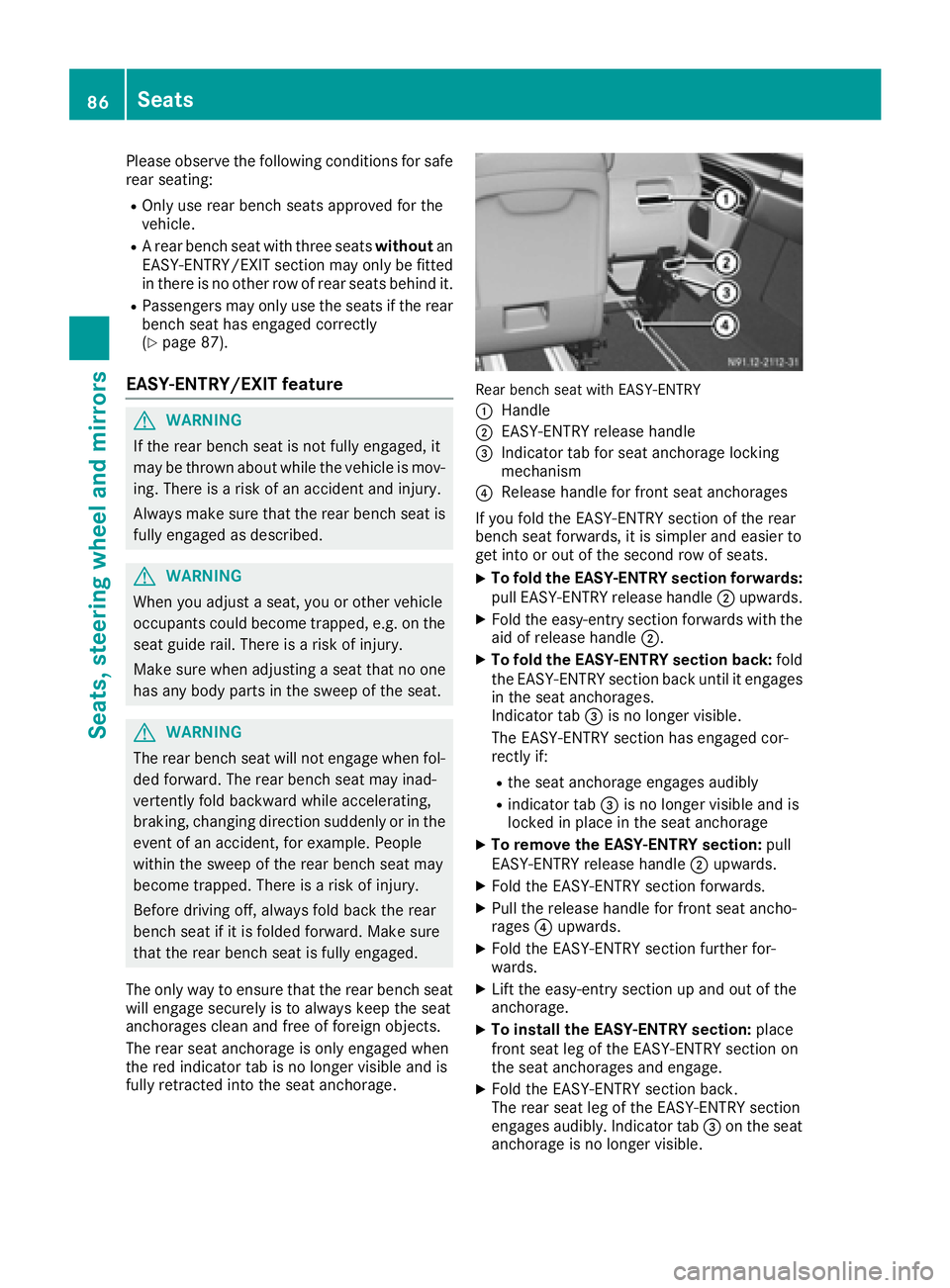
Rear bench seat with EASY-ENTRY
:
Handle
;EASY-ENTRY release handle
=Indicator tab for seat anchorage locking
mechanism
?Release handle for fronts eat anchorages
If you fold the EASY-ENTRY section of the rear
bench seat forwards, it is simpler and easier to
get into or out of the second row of seats.
XTo fold the EASY-ENTRY section forwards:
pull EASY-ENTRY release handle ;upwards.
XFold the easy-entr ysection forwards with the
aid of release handle ;.
XTo fold the EASY-ENTRY section back: fold
the EASY-ENTRY section back until it engages
in the seat anchorages.
Indicator tab =is no longer visible.
The EASY-ENTRY section has engaged cor-
rectly if:
Rthe seat anchorage engages audibly
Rindicator tab =is no longer visible and is
locked in place in the seat anchorage
XTo remove the EASY-ENTRY section: pull
EASY-ENTRY release handle ;upwards.
XFold the EASY-ENTRY section forwards.
XPull the release handle for fronts eat ancho-
rages ?upwards.
XFold the EASY-ENTRY section further for-
wards.
XLift the easy-entr ysection up and out of the
anchorage.
XTo install the EASY-ENTRY section: place
fronts eat leg of the EASY-ENTRY section on
the seat anchorages and engage.
XFold the EASY-ENTRY section back.
The rear seat leg of the EASY-ENTRY section
engages audibly.I ndicator tab=on the seat
anchorage is no longer visible.
86Seats
Seats, steering wheel and mirrors
Page 89 of 310
The EASY-ENTRY section has engaged cor-
rectly if:
Rthe seat anchorage engages audibly
Rindicator tab=is no longer visible and is
fully retracted into the seat anchorage
If the EASY-ENTRY section has not engaged cor-
rectly:
XFold the EASY-ENTRY section forwards.
XFold the EASY-ENTRY section backwards
again and check the lockingm echanism.
Removing/installing the rear bench
seat
Standard rear bench seat:
GWARNING
If the rear bench seat is not fully engaged, it
may be thrown about while the vehicle is mov-
ing. There is arisk of an accident and injury.
Always make sure that the rear bench seat is
fully engaged as described.
GWARNING
If the rear bench seat is not installed as descri- bed or an unsuitable rear bench seat is instal-
led, the seat belts may not provide protection
as intended. There is an increased risk of
injury.
Install the rear bench seat as described. Only
use rear bench seats that are approved for
your vehicle by the distributor named on the
inside cover page.
The only way to ensure that the rear bench seat
will engage securely is to alwaysk eep the seat
anchorages clean and free of foreign objects.
Always observe the notes about the seating var-
iants (
Ypage 85).
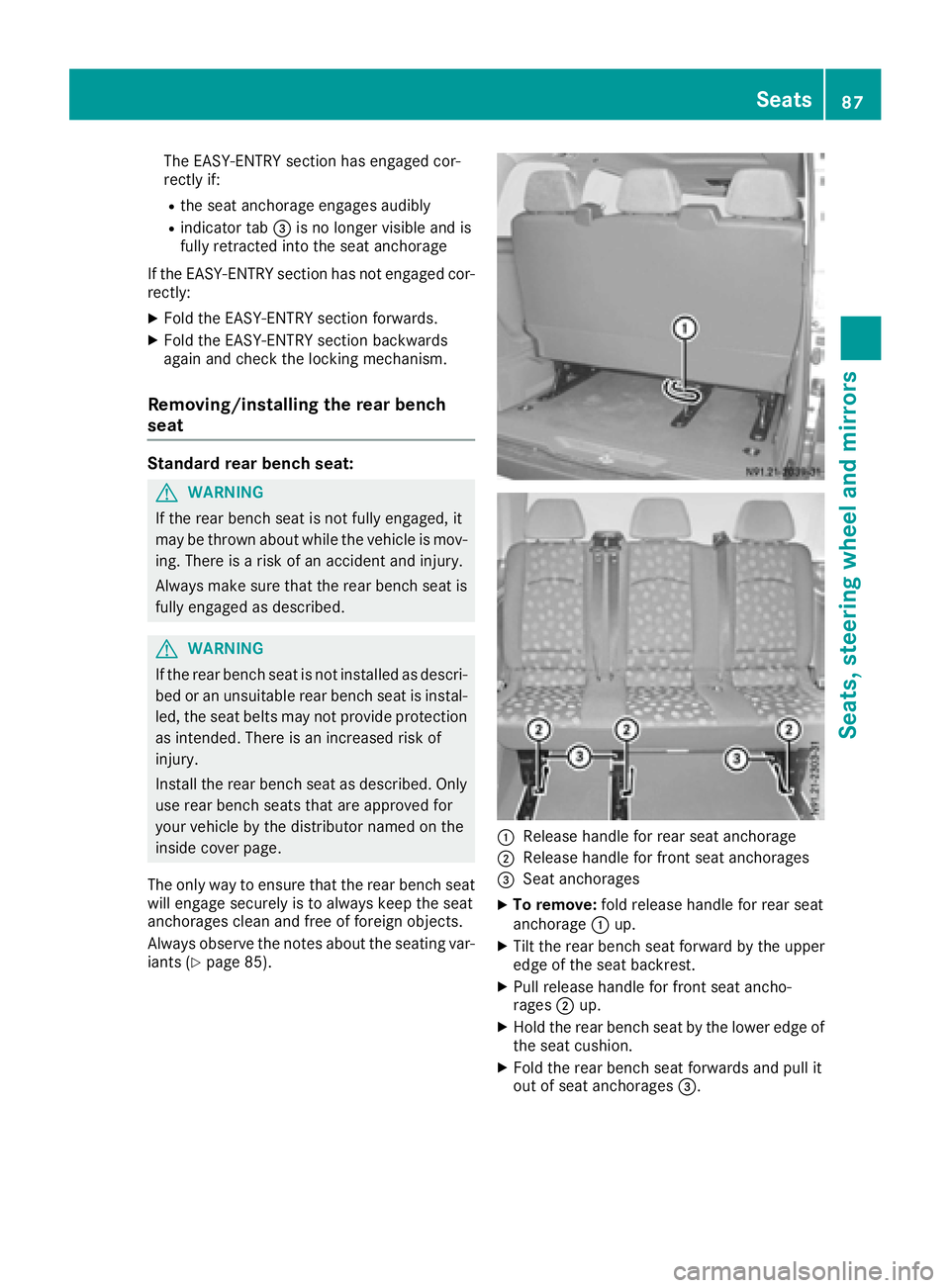
:Release handle for rear seat anchorage
;Release handle for front seat anchorages
=Seat anchorages
XTo remove: fold release handle for rear seat
anchorage :up.
XTilt the rear bench seat forward by the upper
edge of the seat backrest.
XPull release handle for front seat ancho-
rages ;up.
XHold the rear bench seat by the lower edge of
the seat cushion.
XFold the rear bench seat forwards and pull it
out of seat anchorages =.
Seats87
Seats, steering wheel and mirrors
Z
Page 95 of 310
Low-beamheadlamps
When theignitio nisswitche donand thelight
switch is in the Lposition,t heparking lamps
and low-beam headlamps are switche doneven
if th elight sensor does not sense dark ambient
light.T his is particularly useful when there is fog
or rain.
XTo switch on: turnthe key to position 2in the
ignitio nlockors tart th eengine.
XTurn th elight switch to position L.
The L indicator lamp in th einstrument
cluster lightsu p.
Daytime running lamps
XTo switch on: turnthe light switch to the
$ orà position.
Automatic headlamp mode
GWARNING
When th elight switch is set to Ã,thelow-
beam headlamps may not be switche don
automatically if there is fog ,sno woro ther
cause sofpoor visibilityd ue to theweather
conditionss uch as spray. Thereisar isk of an
accident.
In such situations ,tur nt he light switch to
L.
Automatic headlampm ode is onlyadriving aid.
You are responsible for th evehicle lighting at all
times.
When th eparking lamps and low-beam head-
lamps are switche don, th egreen T (parking
lamps)a ndL (low-beam headlamps) indica-
to rlamps in th einstrumentc luster light up.
à is thepreferred light switch setting. The
light settin gisautomatically selected according
to th ebrightnes softheambientl ight (excep-
tion: poor visibilityd ue to weather conditions,
such as fog ,sno wors pray):
RKey in position 1in th eignitio nlock: th epark-
ing lamps are switche don/off automatically
depending on th ebrightnes softheambient
light.
RWhen th eengine is on: depending on the
ambientl ight,thedaytim erunnin glamps or
th ep arking lamps and low-beam headlamps
are switche don/off automatically.
XTo switch on automatic headlamp mode:
turnthe light switch to Ã.
Fog lamps/rear fog lamp
You can onlyswitch th efog lamps on or off
manually in vehicle swhichh ave fog lamps
installed.
Front fog lamps help you to see and be seen in
conditionsofp oor visibilitydue to fog or pre-
cipitation. They can onl ybeoperated together
with th eparking lamps or with th elow-beam
headlamps.
The rear fog lamp improves visibilityofy our
vehicle for th etraffic behindint heeven tof
heavy fog .Observe th elegal requirements of the
countr yyou are currently in when usingt herear
fog lamp.
XTurn th elight switch to LorÃ.
XTurn th ekey to position 2in th eignitio nlock
or start th eengine.
XTo switch th efront fog lamps on/off: press
the N button.
When th egreen N indicator lamp in the
instrumentc luster goes on, th efog lamps are
switche don.
XTo switch th erearfog lamps on/off: press
the R button.
When th eyellow Rindicator lamp in the
instrumentc luster goes on, th erear fog lamp
is switche don.
Standing lamp
!If th ebattery charge is veryl ow, thestand-
ing lamps will switch off automatically to ena-
ble th enexte ngine start.A lways park your
vehicle in accordance with legal regulations,
in as ecure and adequately lit location.A void
leavin gthe T parking lamps on for several
hours. If possible, switch on th eright X or
left W standin glamp.
Switching on th estandin glamps ensures that
th ec orresponding side of th evehicle is illumi-
nated.
Exterior lighting93
Lightsa nd windshield wipers
Z
Page 100 of 310
Signal and ambient light in the tail-
gate
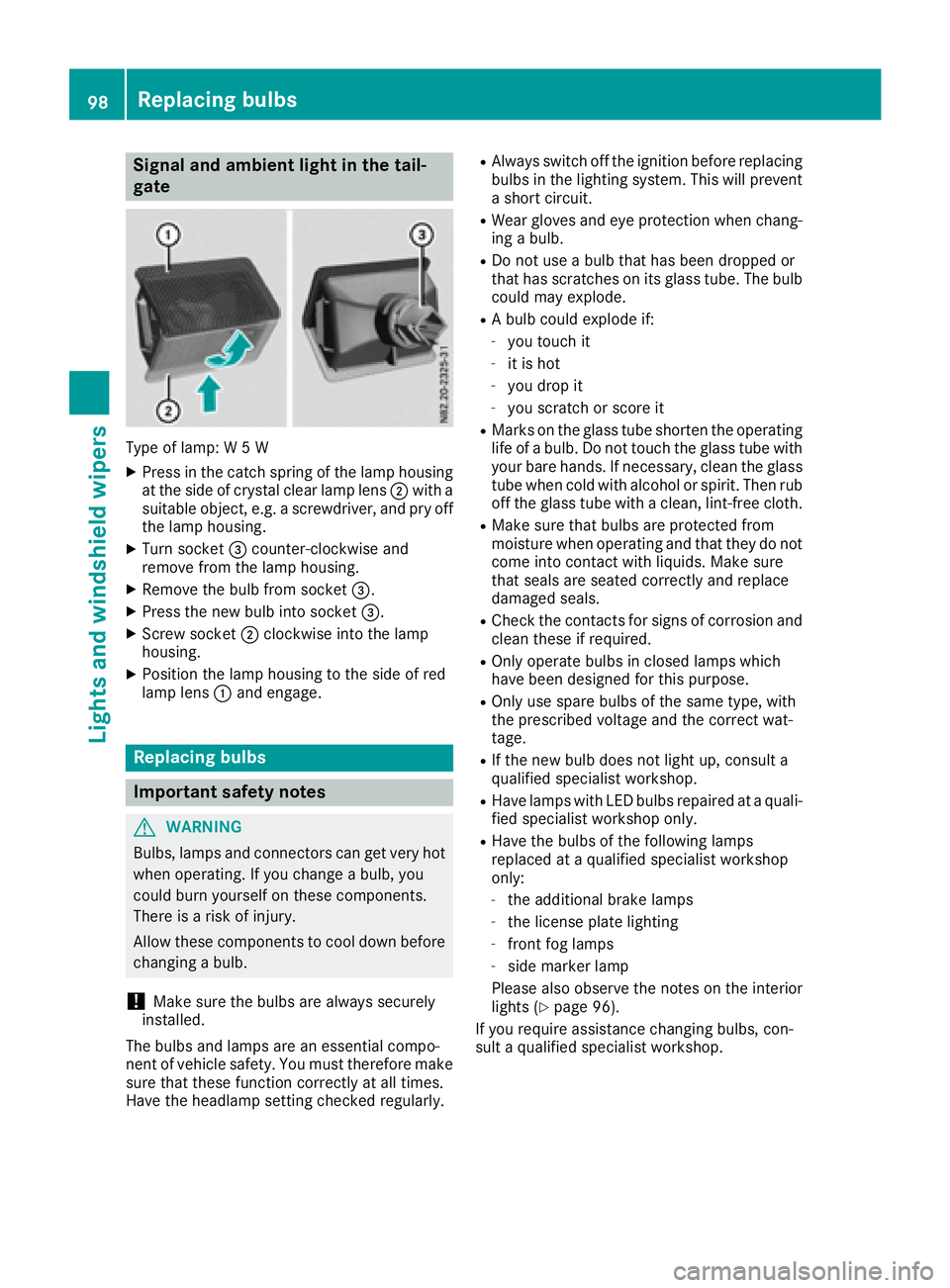
Type of lamp:W5W
XPress in the catch spring of the lamp housing
at the side of crystal clear lamp lens ;with a
suitable object ,e.g. ascrewdriver, and pry off
the lamp housing.
XTurn socket =counter-clockwise and
remove from the lamp housing.
XRemove the bulb from socket =.
XPress the new bulb into socket =.
XScrew socket;clockwise into the lamp
housing.
XPosition the lamp housing to the side of red
lamp lens :and engage.
Replacing bulbs
Important safety notes
GWARNING
Bulbs, lamps and connectors can get very hot
when operating. If you change abulb, you
could burn yourself on these components.
There is arisk of injury.
Allow these components to cool down before
changing abulb.
!Make sure the bulbs are always securely
installed.
The bulbs and lamps are an essential compo-
nent of vehicle safety. You must therefore make
sure that these function correctly at all times.
Have the headlamp settingc hecked regularly.
RAlways switch off the ignition before replacing
bulbs in the lighting system. This will prevent
as hort circuit.
RWear gloves and eye protection when chang-
ing abulb.
RDo not use abulb that has been dropped or
that has scratches on its glass tube. The bulb
could may explode.
RAb ulb could explode if:
-you touch it
-it is hot
-you drop it
-you scratchors core it
RMarks on the glass tube shorten the operating
life ofabulb. Do not touch the glass tube with
your bare hands. If necessary, clean the glass
tube when cold with alcohol or spirit. Then rub
off the glass tube with aclean, lint-free cloth.
RMake sure that bulbs are protected from
moisture when operating and that they do not
come into contact with liquids. Make sure
that seals are seated correctly and replace
damaged seals.
RCheck the contacts for signs of corrosion and
clean these if required.
ROnly operate bulbs in closed lamps which
have been designed for this purpose.
ROnly use spare bulbs of the same type, with
the prescribed voltage and the correct wat-
tage.
RIf the new bulb does not light up, consult a
qualified specialist workshop.
RHave lamps with LED bulbs repaired at aquali-
fied specialist workshop only.
RHave the bulbs of the following lamps
replaced at aqualified specialist workshop
only:
-the additional brake lamps
-the license plate lighting
-front fog lamps
-side marker lamp
Please also observe the notes on the interior
lights (
Ypage 96).
If you require assistance changing bulbs, con-
sult aqualified specialist workshop.
98Replacing bulbs
Lights and windshieldw ipers
Page 122 of 310
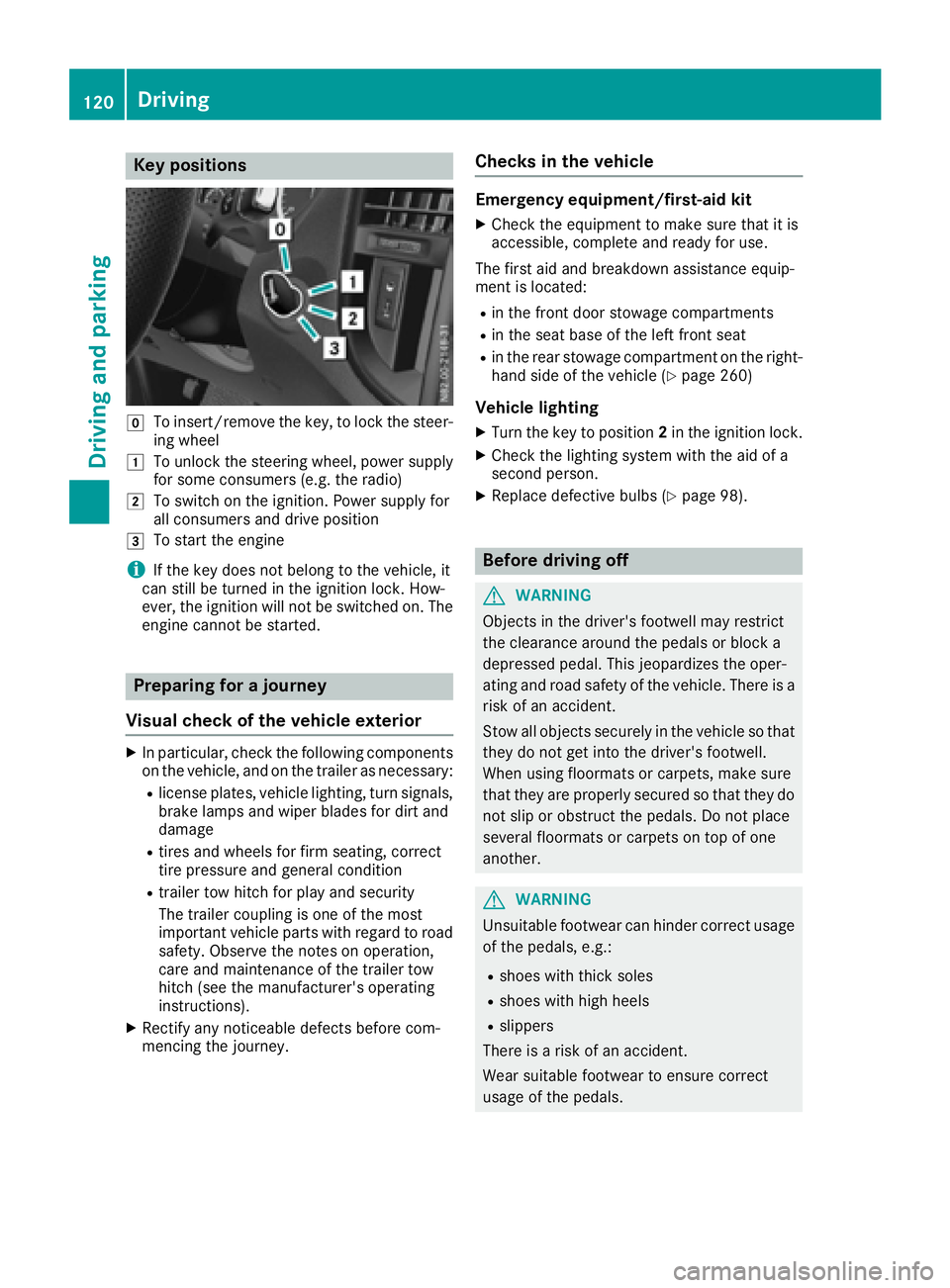
Key positions
gTo insert/remove thekey,tol oc kt he steer -
ing whee l
1To unlockthe steering wheel, powe rsupply
for som econsum ers( e.g. th eradio)
2To switch on th eignition .Powe rsupply for
all consumer sand drive position
3To start th eengine
iIf th ekeydoes no tbelong to th evehicle, it
can still be turne dintheignition lock. How-
ever, th eignition will no tbeswitched on .The
engin ecanno tbes tarted.
Prepa ring for ajourne y
Visua lcheck ofthev ehicle exteri or
XIn particular, chec kthe followin gcom ponent s
on th evehicle, and on th etrailer as necessary:
Rlicense plates, vehicl elighting ,tur ns ignals,
brak elamp sand wiper blade sfor dir tand
damag e
Rtires and wheels for fir mseating ,correct
tire pressur eand general condition
Rtrailer to whitch for play and securit y
The trailer couplin gisoneof th emost
important vehicl epartsw ithr egard to roa d
safety. Observ ethe note sono peration ,
car eand maintenance of th etrailer to w
hitch (see th emanufacturer' soperating
instructions).
XRectify any noticeable defects before com-
mencin gthe journey.
Check sinthevehicle
Emergency equipment/first-aid kit
XChec kthe equipmen ttomakes uret hatiti s
accessible, complet eand read yfor use.
The first aid and breakdown assistanc eequip -
men tislocated:
Rin th efront door stowage compartments
Rin theseat base of th eleftf ront seat
Rin therear stowage compartmen tontheright -
han dside of th evehicl e(Ypage 260)
Vehicle lighting
XTurn th ekeyto position 2in th eignition lock.
XChec kthe lighting system wit hthe aid of a
secon dperson .
XReplac edefective bulbs (Ypage 98).
Before drivingo ff
GWARNING
Objects in th edriver's footwell may restrict
th ec learance around th epedal sorb locka
depressed pedal .This jeopardizes th eoper -
ating and roa dsafet yoft hevehicle. There is a
ris kofana ccident.
Stow all objects securel yint he vehicl esothat
they do no tget int othe driver's footwell.
Whe nusingfloormats or carpets, mak esure
that they are properly secured so that they do no tslip or obstruct th epedals. Do no tplac e
several floormats or carpet sontopof on e
another.
GWARNIN G
Unsuitable footwear can hinder correc tusage
of th epedals, e.g. :
Rshoes withthick sole s
Rshoes wit hhigh heel s
Rslippers
There is ariskofana ccident.
Wear suitable footwear to ensur ecorrect
usage of th epedals.
120Driving
Driving and parking
Page 123 of 310
XStow luggage itemssecurely. Secure the load
as per the loading guideline s(Ypage 232).
XMake sure that the floormats and carpets are
properly secured so that they canno tslipa nd
obstruct the pedals.
XClose al ldoors.
To start the engine
Important safety notes
GWARNING
Combustio nengines emi tpoisonous exhaust
gases such as carbon monoxide. Inhaling
thes eexhaus tgases lead stopoisoning. There
is ar iskoff atalinjury. Therefore neve rlea ve
the engine running in enclose dspaces with-
outs ufficient ventilation.
!Do not depress the accelerato rwhens tart-
ing the engine.
XBefore starting the engine, make sure that:
Ral lt he doors are closed.
Rallt he vehicl eoccupants are wearing their
sea tbelts correctly.
Rthe parking brake is applied.
iIf yo udepress the brake pedal before start-
ing the engine, the pedal trave lmay be shorter
and pedal resistance higher.
If yo udepres sthe brake pedal agai nafter
starting the engine, pedal trave land resist-
ance will be back to norma lagain.
Automatic transmission
XShif tthe transmissio ntoposition P
(Ypage 126).
The transmissio nposition indicator in the dis-
play shows P.
You can also star tthe engine in neutral N.
To start the engine
XTurn the key to position 3(Ypage 120 )inthe
ignition lock and release it as soo nasthe
engine is running.
Driving off
Automati ctransmission
GWARNING
If the engine speed is above the idling speed
and yo uengage transmission position Dor R,
the vehicl ecould pull away suddenly. There is
ar iskofana ccident.
Whe nengaging transmission position Dor R,
always firmly depress the brake peda land do
not simultaneouslya ccelerate.
!Onlyshift into reverse gear Rwhen the vehi-
cle is stationary .Otherwise, yo ucould dam-
ag et he transmission.
XDepres sthe brake peda land keepi t
depressed.
The parking lock is released.
XShift the transmission to position Dor R.
On vehicles with areverse warning feature ,a
warning signals ounds when reverse gear Ris
engaged to alert othe rroa du sers
(
Ypage 122).
XReleas ethe parking brake (Ypage 133).
The F (only USA) or J(only Canada)
indicator lamp in the instrument cluster goes
out.
XReleas ethe brake pedal.
Hil lstart assist automaticall ymaintains the
brake pressure for abouta nother two sec-
ondsa fterthe brake peda lisreleased .This
makes it possibl etopulla wa yw ithou tthe
vehicl eimmediatelyr olling back
(
Ypage 122).
XCarefull ydepress the accelerato rpedal.
It is onlyp ossibl etos hift the transmission from
po
sition Pto the desired positio nifyoudepress
the brake pedal. Onlyt hen is the parking lock
released .Ifthe brake peda lisnot depressed, the
DIRECT SELECTl ever can stil lbemovedbutthe
parking lock remains engaged.
The vehicl eloc ks centrall yonce yo uhavep ulle d
away .The locking knobs in the doors dro pdown.
Yo uc an open the doors from the insid eatany
time.
Yo uc an also deactivate the automatic locking
feature (
Ypage 72).
Driving121
Driving an dparking
Z
Page 125 of 310
function willswitch the engine off automatically
when the vehicl ecomes to astop.
Important safety notes
GWARNING
If the engine is switched off automatically and
you exit the vehicle, the engine is restarted
automatically .The vehicl emay beginm oving.
There is arisk of accident and injury.
If you wis htoexit the vehicle, alway sturn off
the ignition and secure the vehicl eagainst
rolling away.
Automatic engine switch-off
General notes
The ECO start/stop function is operational
when the èECO symbol is shownint he sta-
tus bar of the display.
For this to happen, various conditions, including the following, must be met:
Rthe ECO start/stop function is switched on.
The indicator lam pintheè ECO button is
lit (
Ypag e124).
Rthe outside temperature is above 32 ‡(0†).
Rthe engine has reached its operating temper-
ature.
Rthe set temperature for the vehicle interior
has beenr eached.
Rthe conditio nofcharge of the starter battery
is sufficient.
Rthe system detects that the windshield is not
foggedupw hent he air-conditioning system
or automatic climate control is switched on.
Rthe hood is closed.
Rthe driver's seatb eltisfastened.
Rthe driver's door is closed.
Rthere is no dange rofimmediately rolling
backwards ,e.g. whe nstoppedonas teep gra-
dient.
If at railer is attache dand/or arear carrier
system is installed and connected electri-
cally, this dange risdetected on less steep
gradients.
Only if al lthe conditions for automatic engine
switch-off are fulfilled, does the displays how
the è ECO symbol. All of the vehicle's systems remai
nactive when
the engine is switched off automatically.
The engine can be switched off automatically a
maximu moffour times (initial stop, then three
subsequent stops) in succession. After that, the
displayh ides theèECO symbol. Automatic
engine switch-off is not possibl eagain until the
è ECO symbol is showna gain.
If you open the hood after an automatic engine
switch-off, automatic engine start is deactiva-
ted. Once the hood is closed, you have to start
the engine manually.
If the vehicle is stoppedi
nD or N,t he
ECO start/
stop function switches off the engine automat-
ically once the vehicle is stationary.
Automatic engine start
General notes
The engine is started automatically if:
Ryou switch off the ECO start/stop function by pressing the èECO button The indicator
lamp in the èECO button then goes out.
(
Ypag e124)
Ryou depress the accelerator pedal.
Ryou engag ereverse gear R.
Ryou unfasten you rseatb elt
Ryou open the driver's door.
Rthe vehicle begins to roll away
Rthe brake system requires this.
Rthe temperature in the vehicle interior
increasingl ydeviates from the set value.
Rthe system detects moisture on the wind-
shield whe nthe air-conditioning system is
switched on.
Rthe battery's conditio nofcharge is too low.
The engine is started automatically if you:
Rswitch to transmission program M
(Ypag e129)
Rrelease the brake pedal whe nintransmission
position Dor N
Rswitch to transmission position P
After shifting from transmission position Rto D,
the ECO start/stop function is not available until
the è ECO symbol is shownint he display.
Driving123
Driving and parking
Z
Page 135 of 310
GWARNING
If you leave children unsupervised in the vehi-
cle, they coul dset it in motion by, for example:
Rrelease the parking brake.
Rshift the automatic transmission out of the
parking position P.
Rstart the engine.
In addition, they may operate vehiclee quip-
ment and become trapped. There is arisk of
an accident and injury.
When leaving the vehicle, alway stake the
SmartKey with you and lock the vehicle. Never
leave children unsupervised in the vehicle.
!Always secure the vehiclec orrectly against
rolling away. Otherwise, the vehicleori ts driv-
etrain coul dbedamaged.
!When the vehicleisp arked,alway sremove
the key to prevent the battery from becoming
discharged.
Always park you rvehicl esafel yand secure it
against rolling away. When parking, observe the
lega lrequirements of the country in which you
are currently driving.
To ensure that the vehicleisp roperly secured
against rolling awa yunintentionally:
Rthe parking brake must be firmly applied
Rthe transmission must be in position Pand the
key must be removed from the ignitio nlock
Ron steep uphill or downhill gradients, the front
wheels must be turned toward sthe curb
Parking brake
GWARNING
If you leave children unsupervised in the vehi-
cle, they coul dset it in motion by, for example:
Rrelease the parking brake.
Rshift the automatic transmission out of the
parking position P.
Rstart the engine.
In addition, they may operate vehiclee quip-
ment and become trapped. There is arisk of
an accident and injury.
When leaving the vehicle, alway stake the
SmartKey with you and lock the vehicle. Never
leave children unsupervised in the vehicle.
GWARNING
If you must brake the vehiclew ith the parking
brake, the braking distance is considerably
longer and the wheels coul dlock. There is an
increased dange rofskidding and accidents.
Only use the parking brake to brake the vehi-
cle when the service brake is faulty. Do not
apply the parking brake too firmly .Ifthe
wheels lock, release the parking brake until
the wheels begint urning again.
The brake lampsare not illuminated when you
brake the vehicleu sing the parking brake.
As arule ,you may only apply the parking brake
when the vehicleiss tationary.
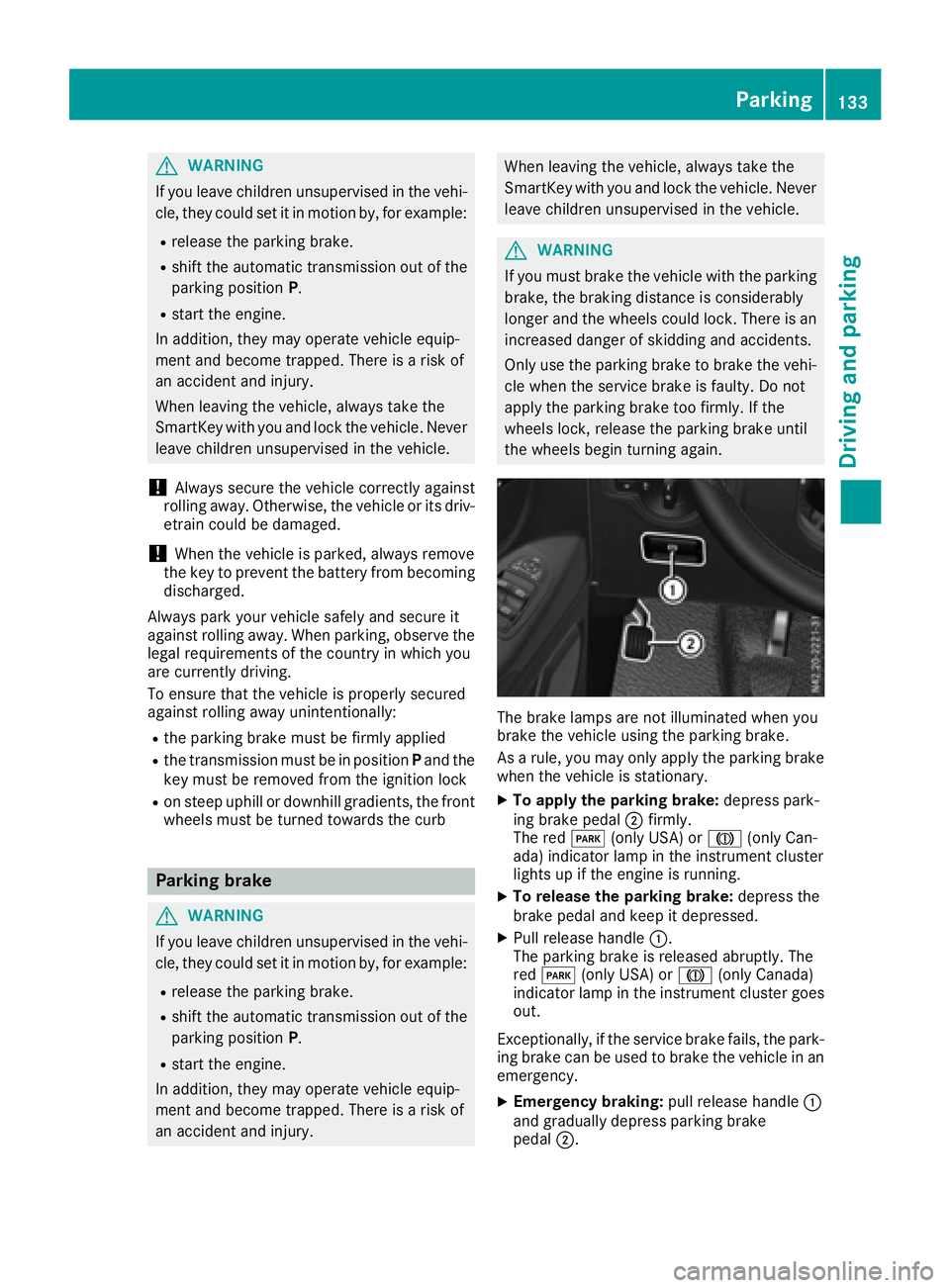
XTo apply the parking brake: depress park-
ing brake pedal ;firmly.
The red F(only USA) or J(only Can-
ada )indicator lamp in the instrument cluster
lights up if the engine is running.
XTo release the parking brake: depress the
brake pedala nd keep it depressed.
XPullrelease handle :.
The parking brake is released abruptly.T he
red F (only USA) or J(only Canada)
indicator lamp in the instrument cluster goes
out.
Exceptionally,ift he service brake fails, the park-
ing brake can be used to brake the vehicleina n
emergency.
XEmergency braking: pullrelease handle :
and gradually depress parking brake
pedal ;.
Parking133
Driving and parking
Z
Page 136 of 310
Switching off the engine
Important safety notes
GWARNING
The automatic transmission switches to neu-
tral position Nwhen you switch off the engine.
The vehicle may roll away.T here isarisk of an
accident.
After switching off the engine, always switch
to parking position P.Prevent the parked vehi-
cle from rolling away by applying the parking
brake.
!If the coolant temperature is very high, e.g.
after driving on hilly roads, leave the engine
running at idle speed for about two minutes
before turning it off.
This allowst he coolant temperature to return
to normal.
Vehicles with automatic transmission
XStop the vehicle.
XShift the transmission to position P.
XApply the parking brake.
XTurn key to position0in the ignition lock and
remove it.
The immobilizer is activated.
If you switch the engine off with the trans-
mission in position Ror D,t he automatic
transmission shifts to Nautomatically.
If you then open one of the front doors or
remove the key from the ignition, the auto-
matic transmission automatically shifts to P.
If you shift the automatic transmission to N
before switching off the engine, the automatic
transmission remains in Neven if afront door
is opened.
XSecure the vehicle to prevent it from rolling
away (Ypage 132).
Parking the vehicle for along period
If you leave the vehicle parked for longer than
4w eeks, the battery may be damaged by
exhaustive discharging.
XDisconnect the battery (Ypage 250).
or
XConnect the battery to atrickle charger.
Be sure to observe the notes on charging the batteries (
Ypage 253).
You can obtain information about trickle
chargers from aqualified specialist work-
shop.
If you leave the vehicle parked for longer than
6w eeks, the vehicle may suffer damage as a
result of lack of use.
XVisit aqualified specialist workshop and seek
advice.
Driving tips
General notes
Important safety notes
GWARNING
If you switch off the ignition while driving,
safety-relevant functions are only available
with limitations, or not at all. This could affect, for example, the power steering and the brake
boosting effect.Y ou will require considerably
more effort to steer and brake. There is arisk
of an accident.
Do not switch off the ignition while driving.
GWARNING
If you operate mobile communication equip-
ment while driving, you will be distracted from traffic conditions. You could also lose control
of the vehicle. There is arisk of an accident.
Only operate this equipment when the vehicle
is stationary.
Observe the legal requirements of the countryi n
which you are driving. Some jurisdictions pro-
hibit the driver from using amobile phone while
driving avehicle.
134Driving tips
Driving and parking
Page 141 of 310
Alwayswearas eatb elt, eve nwhend riving off-
road.
GWARNING
If yo udrive ove robstacle sorinr uts, the steer-
ing whee lmayjerk outofy ourg rip, causing
injury to your hands.
Alway sholdt he steering whee lfirmly with
both hands. Whe ndriving ove robstacles, you
must expect steering forces to increase
briefl yand suddenly.
GWARNING
Flammabl ematerial such as leaves, grass or
twigs mayi gnite if they come into contact with
hot parts of the exhaus tsystem .There is arisk
of fire.
Whe ndriving off roa doronunpaved roads,
check the vehicle's undersid eregularly .In
particular, remove parts of plants or other
flammabl ematerial swhich have become
trapped. In the cas eofdamage, contact a
qualified specialist workshop.
!Whe ndriving off-roadoronu npaved surfa-
ces ,check the undersid eofthe vehicl eand
the wheels and tire satregular intervals .In
particular, remove any trappe dforeign
objects, e.g .stone sand branches.
Such foreig nobjects may:
Rdamage the chassis, the fuel tank or the
brake system
Rcause imbalance sand thusv ibrations
Rbe flung outw heny ou continue driving
If ther eisany damage, inform aquali fied spe-
cialist workshop.
Whe ndriving off-roada nd on construction sites,
sand, muda nd water mixe dwitho il,f or exam-
ple, mayg et into the brakes. Thi smaylead to a
reduction in braking performance or totalb rake
failure, also as aresul tofi ncreased wear .The
braking characteristics will vary depending on
the material thath asgot into the system .Clean
the brakes afte rdriving o
ff-road. If yo uth
en
notice reduce dbraking performance or hear
scraping noises ,hav et he brake system checked
at aq uali fied specialist workshop.A djust your
driving style to the changedb raking character-
istics. Driving off-roadoronc
onstruction sites increa-
ses the possibility of vehicl edamag ewhich may
in turn lead to the failure of certain assemblies
and systems. Adapt your driving style to the off- roa ddriving conditions. Driv ecarefully. Have
any vehicl edamag erectifie dataq ualified spe-
cialist workshop as soo naspossible.
Whe nloadin gyourvehicl efor driving off-roado r
on aconstruction site, kee pthe vehicle's center
of gravity as lo waspossible.
Rule sfor drivin goff-road
!Alway sbearthe vehicle's ground clearance
in mind and avoido bstacles, e.g .deepr uts.
Obstacles mayd amagethe following parts of
the vehicle:
Rthe chassis
Rthe drive train
Rthe fuel and supply tanks
For thisr eason, yo ushoul dalway sdrive
slowly when driving off-road. If yo uhavet o
drive ove robstacles, have the front
passengerd irect you.
iWe recommend thaty ouadditionally carry a
shovel and arecover yrop ew iths hackle in the
vehicle.
REnsure thatl oadsand items of luggage are
securel ystowed or lashe ddown
(
Ypage 232).
RBefore driving off-road, stop the vehicl eand
shift to alow gear.
RIf the surface requires ,temporaril ydeactivate
ESP®when pulling away (Ypage 64).
ROnlyd rive off-roadw itht he engine running
and ageare ngaged.
RDriv eslowly and smoothly. Walking pace is
necessary in many situations.
RAvoi dspinning the drive wheels.
RMake sure thatt he wheels always remai nin
contact with the ground.
RDriv ewithe xtreme car eoveru nknown terrain
where yo ucan onlys ee forashort distance.
As aprecaution, get outoft he vehicletotake
al oo katt he route to be take ninadvance.
RCheck the water depth before fording.
RWatch outf or obstacles(e.g. rocks ,holes,
tree stumps and ruts).
RAvoi dedges where the surface could crumble
or break away.
Driving tips139
Driving an dparking
Z