tow MERCEDES-BENZ METRIS 2016 MY16 Operator’s Manual
[x] Cancel search | Manufacturer: MERCEDES-BENZ, Model Year: 2016, Model line: METRIS, Model: MERCEDES-BENZ METRIS 2016Pages: 310, PDF Size: 7.28 MB
Page 22 of 310
Display messages(vehicle with
steering whee lbuttons )................. 218
Display message s(vehicle with-
ou tsteering whee lbuttons )........... 200
Important safety note s.................... 77
Opening dimensions ...................... 303
Opening/closing from the out-
sid e.................................................. 77
Problem (malfunction) ..................... 77
Tank contents
Displaying the rang e(vehicle with
steering wheelb uttons) ................. 177
Displaying the rang e(vehicle with-
outs teering wheelb uttons) ........... 172
Technical data
Capacities ...................................... 295
Cargo tie-dow npoints .................... 304
Guid erail. ...................................... 304
Loading rails .................................. 304
Rear racks ..................................... 304
Roof carrie r.................................... 304
Tires/wheels ................................. 290
Trailer tow hitch ............................. 305
Vehicl edata. .................................. 303
Vehicl edimensions ........................ 303
Telephone
Accepting acall. ............................ 182
Displa ymessage ............................ 218
Introduction ................................... 181
Numbe rfrom the phone boo k........ 182
Redialing ........................................ 182
Rejecting/ending acall. ................ 182
Temperature
Coolant (displa yinthe instrument
cluster) .......................................... 169
Coolant (displa yinthe on-board
computer) ...................................... 172
Outsid etemperature ...................... 169
Setting (climate control )................ 112
Thef tdeterrents ystems
ATA (Anti-Theft Alarm system) ......... 66
Immobilizer ...................................... 66
Time
Setting (vehicle with steering
wheelb uttons) ............................... 186
Setting the time (vehicle with
steering wheelb uttons) ................. 186 Setting the time (vehicle without
steering wheelb
uttons) ................. 175
Tire pressure
Calling up (on-board computer) ..... 274
Checki ng ma
nually ........................ 274
Di
spla ymessages (vehicle with
steering wheelb uttons) ................. 216
Displa ymessages (vehicle with-
outs teering wheelb uttons) ........... 199
Important safety notes .................. 274
Maximu m....................................... 274
Note s............................................. 273
Recommended ............................... 270
Tables ............................................ 278
Tire labe l........................................ 271
Tire pressure monitor
Checking the tire pressure elec-
tronically ........................................ 276
Function/note s............................. 274
Genera lnotes ................................ 274
Important safety notes .................. 275
Restarting ...................................... 277
Warning lamp ................................. 226
Warning message .......................... 276
Tire pressure table ............................ 278
Tiredness assistant
see ATTENTIO NASSIST
Tires
Aspect rati o(definition) ................. 285
Average weight of the vehicle
occupants (definition) .................... 284
Bar (definition) ............................... 284
Changing awheel .......................... 286
Characteristics .............................. 284
Checking ........................................ 268
Curb weight (definition) ................. 285
Definition of terms ......................... 284
Directio nofrotation ...................... 286
Displa ymessages (vehicle with
steering wheelb uttons) ................. 216
Displa ymessages (vehicle with-
outs teering wheelb uttons) ........... 199
Distribution of the vehicl eoccu-
pants (definition) ............................ 286
DOT (Department of Transporta-
tion) (definition) ............................. 284
DOT, Tire Identification Number
(TIN) ............................................... 283
20Index
Page 23 of 310
GAWR(Gross Axle WeightR ating)
(definition) .................................... .284
GTW (Gross Trailer Weight) (defi-
nition) ............................................ 284
GVW (Gross Vehicle Weight) (def-
inition) ...........................................2 85
GVW R(Gross Vehicle Weight Rat-
ing) (definition) .............................. 285
Important safety notes .................. 267
Increase dvehicle weight due to
optional equipment (definition) ...... 284
Information on driving .................... 267
Kilopascal (kPa)( definition) ........... 285
Labeling (overview )........................ 281
Loadb earing index (definition) ...... 286
Loadi ndex ..................................... 283
Loadi ndex (definition) ................... 285
M+S tire s....................................... 269
Maximu mloadona tire (defini-
tion) ............................................... 285
Maximu mloaded vehicleweigh t
(definition) ..................................... 285
Maximu mpermissibl etire pres-
sure (definition) ............................. 285
Maximu mtire load ......................... 283
Maximu mtire load (definition) ....... 285
Optionale quipmentweight (defi-
nition) ............................................ 285
PSI (pounds pe rsquare inch )(de f-
inition) ........................................... 285
Replacing ....................................... 286
Service life ..................................... 268
Sidewal l(de finition) ....................... 285
Snow chains .................................. 270
Speed rating (definition) ................ 284
Storing ........................................... 286
Structure and characteristics
(definition) ..................................... 284
Summer tire s................................. 269
TIN (Tire Identification Number)
(definition) ..................................... 286
Tire bead (definition) ...................... 285
Tire pressure (definition) ................ 285
Tire pressures (recommended )...... 284
Tire size (data )............................... 290
Tire size desi
gnation, load-bearing
ca
pacity, speed rating .................... 281
Tire trea d....................................... 268 Tire trea
d(definition) ..................... 285
Tota lloa dlim it (definition) ............. 286
Tractio n(definition) ....................... 286
TWR (permissibl etraile rdrawbar
noseweight) (definition) ................. 286
Uniform Tire Quality Grading
Standard s(de finition) .................... 284
Wea rindicator (definition) ............. 286
Wheel and tire combination ........... 291
Wheel rim (definition) .................... 284
Top Tether ............................................ 59
Tow-starting
Emergency engine starting ............ 266
Important safety notes .................. 264
Towing
If the vehicl eisstuck ..................... 266
Installing/removing the towing
eye. ................................................ 265
Towin gatrailer
Active Parking Assist ..................... 154
Axle load ,permissibl e.................... 305
Cleaning the traile rtow hitch ......... 258
Coupling up atraile r...................... 165
Decoupling atraile r....................... 166
Driving tip s.................................... 162
Note sonr etrofitting ...................... 305
Power supply ................................. 167
Trailer load s................................... 305
Towin gaway
Important safety guideline s........... 264
With both axles on the ground ....... 266
With the rea raxler aised ................ 265
Towin geye......................................... 260
Trailer coupling
see Towing atrailer
Trailer loads and drawbar nose-
weights ............................................... 166
Trailer operation
Lights display messages (vehicle
with steering wheelb uttons) ......... 208
Lights display messages (vehicle
withou tsteering wheelb uttons) .... 194
Trailer towing
Blind Spot Assist ............................ 147
ESP
®................................................ 65
PARKTRONIC ................................. 153
Index21
Page 25 of 310
Electronics .....................................294
Emergency unlocking ....................... 68
Equipment ....................................... 25
Limited Warranty .............................2 5
Loading .......................................... 278
Locking (in an emergency) ............... 69
Locking (SmartKey) .......................... 67
Lowering ........................................ 289
Maintenance .................................... 26
Operating safety .............................. 28
Parking for along period. ............... 134
Pulling awa y................................... 121
Raising ........................................... 287
Registration ..................................... 30
Reporting problems ......................... 30
Securing from rolling away ............ 132
Towing away .................................. 264
Transporting .................................. 266
Unlocking (i nanemergency) ........... 69
Unlocking (SmartKey )...................... 67
Vehicl ebattery
see Battery (vehicle)
Vehicl ebodies ..................................... 30
Body/equipment mounting direc-
tive sfor trucks ................................. 30
Vehicl echeck
see Preparing for ajourney
Vehicl edata ....................................... 303
Vehicl edimensions ........................... 303
Vehicl eemergencyl ocking ................ 69
Vehicl eidentificatio nnumber
see VIN
Vehicl eidentificatio nplate .............. 294
Vehicl ekey
see SmartKey
Vehicl etoolkit
in the sea tbase. ............................ 260
Scope. ........................................... 260
Storage location ............................ 260
Stowag ecompartment in the rea r..2 60
Stowag espace in the cargo com-
partment ........................................ 261
Ventilation
see Climate control
VIN
Engine compartment ..................... 295
Typeplate ...................................... 294W
Warning
Stickers ...........................................2 7
Warning and indicator lamps
ABS ................................................ 221
Brakes ...........................................2 20
Check Engine ................................. 223
COLLISION PREVENTION ASSIST .. 225
Coolant .......................................... 223
Distance warning ........................... 225
Door ............................................... 227
ESP
®.............................................. 221
ESP®OFF ....................................... 222
Fuel tank ........................................ 223
General notes ................................ 218
Overview (vehicle with steering
wheel buttons) ................................. 38
Overview (vehicle without steer-
ing wheel buttons) ........................... 36
Parking brake ................................ 133
PASSENGER AIR BAG OFF ...............4 4
Rear doo r....................................... 227
Reservef uel ................................... 223
Restraint system ............................ 222
Seat belt. ....................................... 219
Sliding door ................................... 227
Steering ......................................... 227
Tire pressure monitor .................... 226
Warranty .............................................. 25
Washer fluid
Adding ...........................................2 46
Capacities ...................................... 302
Display messages (vehicle with
steering wheel buttons) ................. 218
Display messages (vehicle with-
out steering wheel buttons) ........... 201
Notes ............................................. 302
Whee land tire combination
see Tires
Whee lboltt ightening torque ........... 289
Wheels
Changing awheel .......................... 286
Checking ........................................ 268
Cleaning ......................................... 256
Important safety notes .................. 267
Interchanging/changing ................ 286
Mounting anew wheel ................... 288
Index23
Page 47 of 310
the occupant's body.The ydon ot, however, pull
vehicl eoccupants back towards the backrest.
Emergency Tensioning Devices do not correct
an incorrect seat positio norincorrectly worn
seat belts.
When triggered ,the seat belt force limiter
reduce sthe force exerted by the seat belt on the
vehicl eoccupant.
The seat belt force limiters for the front seats are
synchronize dwitht he front ai rbags, which
absor bpartoft he deceleratio nforce. This
makes it possibl etoreduce the forces to which
vehicl eoccupants ar esubjected durin ganacci-
dent.
!If the front-passenge rseatisu noccupied,
do not insert the belt tongue into the buckle of
the front-passenge rseat. Thi smayotherwise
lead to the triggerin gofthe Emergency Ten-
sioning Device in the event of an accident,
which will thenn eedtober eplaced.
Important safety notes
GWARNING
If the seat belt is incorrectly fastened ,itcan-
not protect as intended. Furthermore, an
incorrectly fastened seat belt can cause addi-
tional injury,f or example, in an accident, dur-
ing braking or when abruptl ychanging direc-
tion. Thi sposes an increasedr iskofi njury or
eve nfatal injury.
Make sure thata llvehicl eoccupants are
seate dproperly with acorrectl yfas tened seat
belt.
GWARNING
The seat belt does not offer the intende dlev el
of protection if yo uhaven ot moved the back-
res ttoana lmostvertica lposit ion. When brak-
ing or in the event of an accident, yo ucould
slid eunderneath the seat belt and sustain
abdomen or neck injuries, for example. This
posesani ncreasedr iskofi njury or eve nfatal
injury.
Adjust the seat properly befor ebeginning
your journey .Alway sensur ethatt he backrest
is in an almos tvertica lposit iona nd thatt he
shoulde rsectio nofy ours eatb eltisr outed
across the cente rofyours houlder. If
ac hild younger thant welve yearsoldand
under 5ft(1.50 m) in height is traveling in the
vehicle:
Ralways secur ethe child in achild restraint
systems uitabl efor thisM ercedes-Benz vehi-
cle .The child restraint systemm ustbea ppro-
priate to the age, weight and size of the child
Ralways observe the instructions and safety
note sint he "Children in the vehicle" section
of thisO perator' sManual(
Ypage 56 )in
additio ntothe child restraint systemm anu-
facturer' sinstallatio ninstructions
Rbe sure to observe the instructions and safety
note sont he "Occupant classification system
( O
CS) "(Ypage 50)
GWARNING
The seat belts mayn ot perform their intended
protective functio nif:
Rtheya redamaged, modified ,extremely
dirty,b leachord yed
Rthe seat belt buckle is damage dor
extremel ydirty
Rthe Emergency Tensioning Devices ,belt
anchorage sorinertia reels have been modi-
fied
Sea tbelts mays ustain non-visibl edamag ein
an accident, e.g .due to glas ssplint ers.Modi-
fie dord amaged seat belts mayt earorf ail,
e.g .inana ccident. Modified Emergency Ten-
sioning Devices could accidentall ytrigge ror
fail to deploy when necessary.T hisp oses an
increasedr iskofi njury or eve nfatal injury.
Never modify the seat belts ,Emergency Ten-
sioning Devices ,belta nchorage sorinertia
reels .Makes uret hatt he seat belts are
undamaged ,not worn ou tand clean. Follow-
ing an accident, have the seat belts checked
immediatel yataqualified specialis twork-
shop.
Onlyu seseat belts thath aveb eena pproved for
your vehicl ebyMercedes-Benz.
Proper use of the seat belts
Pa ya ttentio ntothe safety note sabout the seat
belt (Ypage 45).
Occupant safety45
Safety
Z
Page 48 of 310
All vehicleoccupants must fasten the sea tbelt
correctl ybefore setting off. Make sure thata ll
occupants ar eweari ng thei rseatb elts correctly
for the entire journey.
Whe nfastening the sea tbelt, make sure that:
RThe sea tbeltt ongu eisinserte dinto the belt
buckle thatb elongs to the seat.
RThe sea tbeltist ightene dacross your body.
Avoi dweari ng bulky clothing, e.g .awinter
coat.
RThe sea tbeltisn ot twisted.
Onlyt hen can the forces produced in the
event of an accident be evenly distributed
across the belt.
RThe shoulde rsectio noft he belt must always
be routed across the cente rofthe shoulder.
The shoulde rsectio noft he belt shoul dnot
come into contact with your neck and must
not be routed under the arm. Where possible,
adjus tthe sea tbelttot he appropriate height.
RThe la pbeltm ustbet auta nd as lo waspos-
sibl eovery ourlap .
The la pbeltm usta lway spassa cross your hip
joints and neve racross your stomach or
abdomen. Pregnant women must take partic-
ular care. If necessary,t he lapbeltc an be
pushe ddowna cross the hipj oints and pulled
tight using the shoulde rsection.
RThe sea tbeltisn ot routed ove rsharp, pointed
or fragile objects.
If the sei te
ms ar eonoriny ourc lothing, e.g.
eyeglasses ,pen s, keys, etc., stow thes eitems
in am ore suitabl eloc ation.
ROnlyo ne persons houlduseeach sea tbelta t
any one time.
On no account shoul dbabie sorc hildren
travel sitting on the la pofanother vehicle
occupant. During an accident, they could be
crushe dbetween the occupant and sea tbelt.
RObjects ar enot secured with aseatb eltift he
sea tbeltisb eing used by one of the vehicle’s
occupants.
Als om akes uret hatt hereareno objects, e.g.
cushions, between the occupant and the seat.
Sea tbelts ar esolel yintende dfor the protection
and restraint of the vehicl eoccupants. To
secur eobjects, luggage or loads, always
observe the "Loading guidelines" (
Ypage 232).
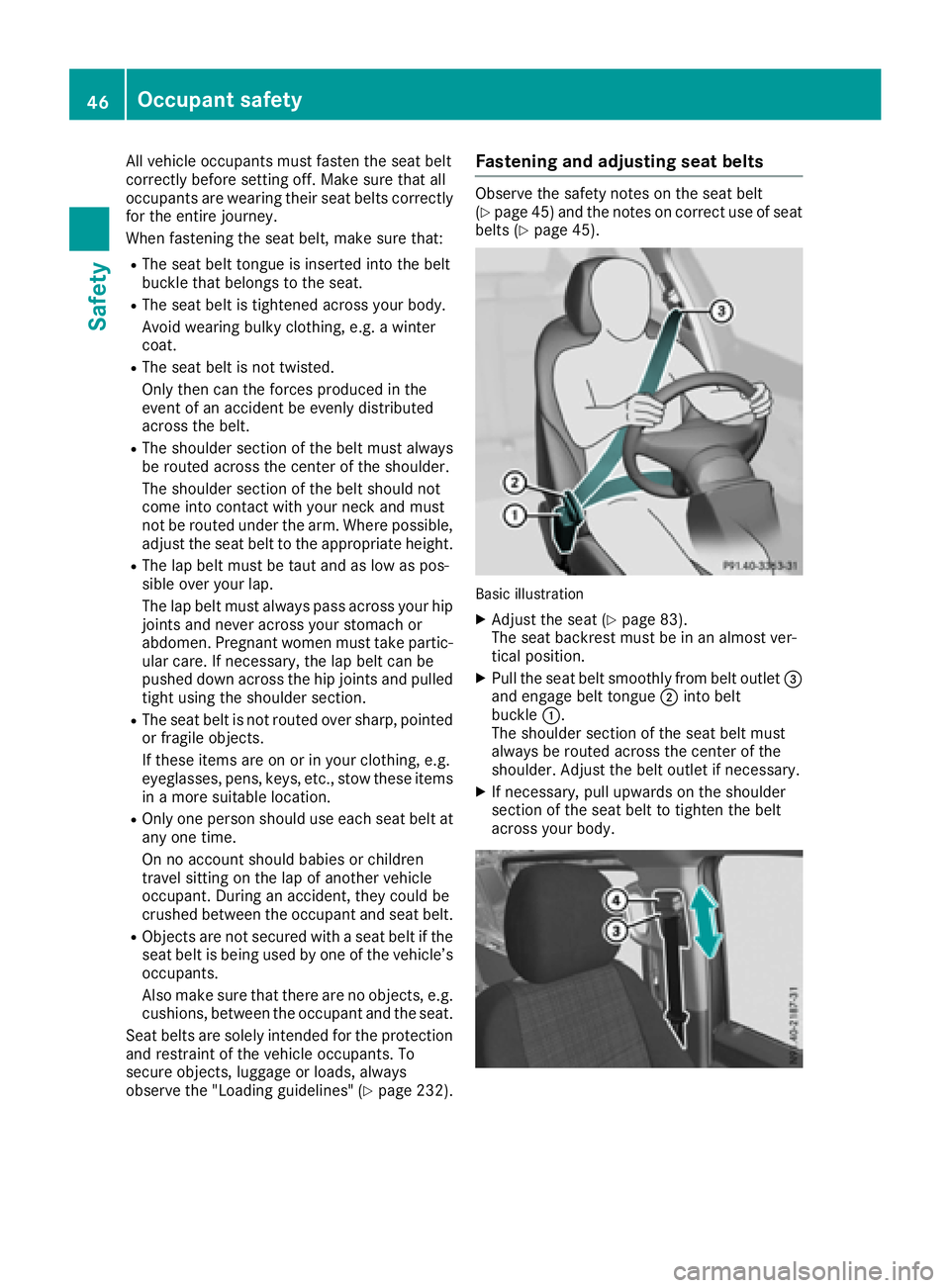
Fastenin gand adjusting seat belts
Observ ethe safety notes on the sea tbelt
(Ypage 45) and the notes on correct us eofseat
belts (Ypage 45).
Basic illustration
XAdjust the sea t(Ypage 83).
The sea tbackres tmustbeinana lmostv er-
tica lposit ion.
XPull the sea tbelts moothl yfrom belt outlet =
and engag ebeltt ongue ;into belt
buckle :.
The shoulde rsectio noft he sea tbeltm ust
always be routed across the cente rofthe
shoulder. Adjust the belt outle tifnecessary.
XIf necessary,p ullu pwar ds on the shoulder
sectio nofthe sea tbelttot ighten the belt
across your body.
46Occupant safety
Safety
Page 49 of 310
The shoulder section of the seat belt must
alwaysberouted across the center of the shoul-
der. Adjust the belt outlet if necessary.
XTo raise: slide belt outlet =upwards.
The belt outlet will engage in various posi-
tions.
XTo lower: hold belt outlet release ?and slide
the belt outlet =downwards.
XLet go of belt outlet release ?in the desired
position and make sure that the belt outlet
engages.
All seat belts except the driver's seat belt are
equipped with aspecial seat belt retractor to
securely fasten child restraint systems in the
vehicle. Further information can be found under
"Special seat belt retractor" (
Ypage 57).
Releasing seat belts
!Make sure that the seat belt is fully rolled up.
Otherwise, the seat belt or belt tongue will be
trapped in the door or in the seat mechanism.
This could damage the door, the door trim
panel and the seat belt. Damaged seat belts
can no longer fulfill their protective function
and must be replaced. Visit aqualified spe-
cialist workshop.
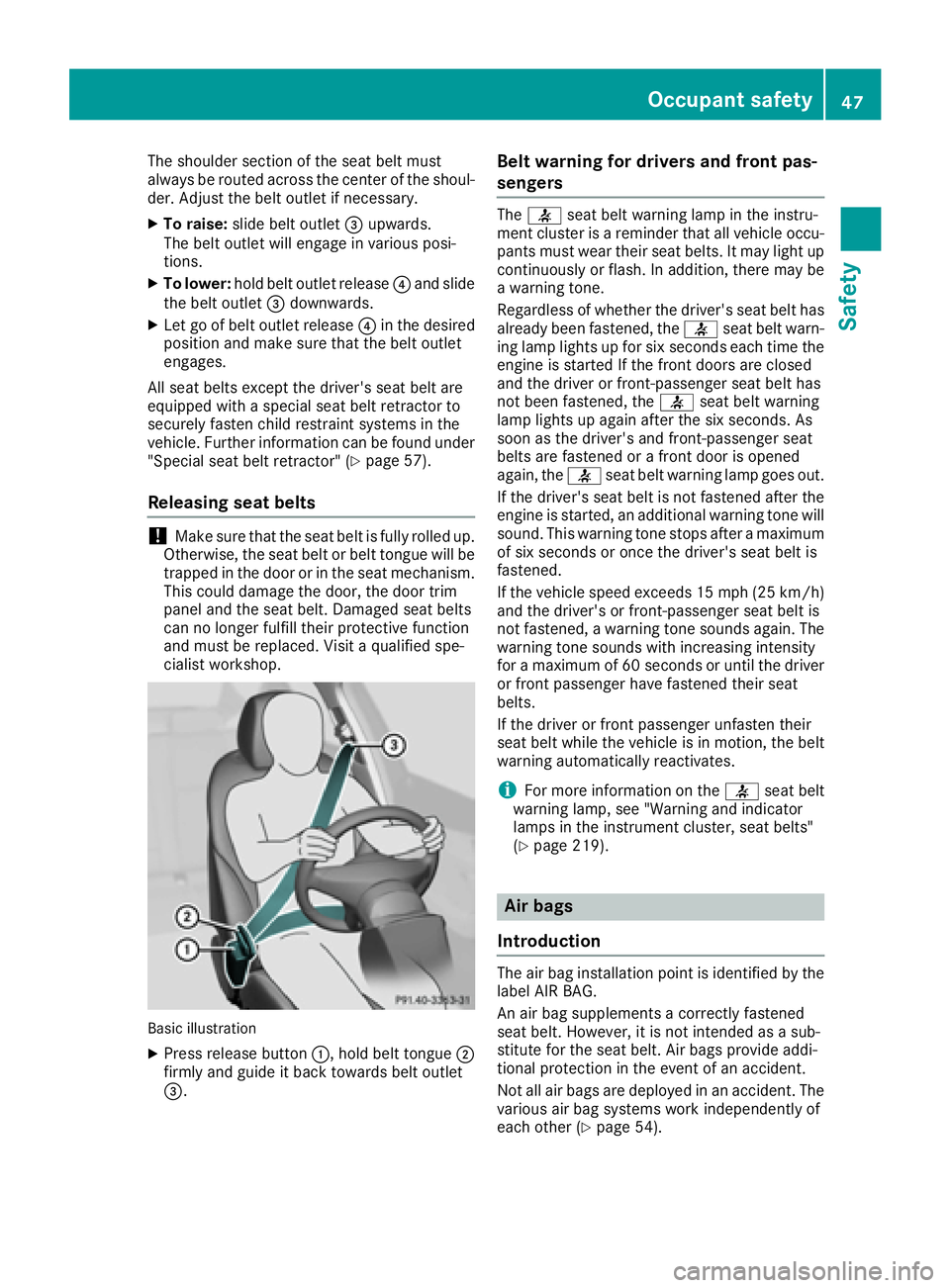
Basic illustration
XPress release button :,hold belt tongue ;
firmly and guide it back towards belt outlet
=.
Belt warning for driver sand front pas-
sengers
The 7 seat belt warning lamp in the instru-
ment cluster is areminder that all vehicle occu-
pants must wear their seat belts. It may light up
continuously or flash. In addition, there may be
aw arning tone.
Regardless of whether the driver's seat belt has
already been fastened, the 7seat belt warn-
ing lamp lights up for six seconds each time the engine is started If the front doors are closed
and the driver or front-passenger seat belt has
not been fastened, the 7seat belt warning
lamp lights up again after the six seconds. As
soon as the driver's and front-passenger seat
belts are fastened or afront door is opened
again, the 7seat belt warning lamp goes out.
If the driver's seat belt is not fastened after the
engine is started, an additional warning ton ewill
sound. This warning ton estops after amaximum
of six seconds or once the driver's seat belt is
fastened.
If the vehicle speed exceeds 15 mph (2 5km/ h)
and th edriver'sorf ront-passenger seat belt is
no tfastened, awarning tone sounds again.T he
warning tone sounds with increasing intensity
for am aximum of 60 seconds or until th edriver
or frontp assenger have fastene dtheir seat
belts.
If th edriver or frontp assenger unfasten their
seat belt while th evehicle is in motion,t hebelt
warning automatically reactivates.
iFor morei nformationonthe7 seat belt
warning lamp, see "Warning and indicator
lamps in th einstrumentc luster, seat belts"
(
Ypage 219).
Air bags
Introduction
The air bag installatio npointisi dentified by the
label AI RBAG.
An air bag supplements acorrectly fastened
seat belt.H owever,itisnotintended as asub-
stitut efor th eseat belt.A ir bags provide addi-
tional protection in th eeven tofana ccident.
Not all air bags are deployed in an accident. The
various air bag systems work independently of
each other (
Ypage 54).
Occupant safety47
Safety
Z
Page 50 of 310
There is, however, no system availabletoday
that can completely rule out injury or death.
It is also not possible to rule out arisk of injury
caused by an air bag due to the high speed at
which the air bag must be deployed.
Important safety notes
GWARNING
If you do not sit in the corrects eat position,
the air bag cannot protec tasintended and
could even cause additional injury when
deployed. This poses an increased risk of
injury or even fatal injury.
To avoid hazardous situations, alwaysm ake
sure that all of the vehicle's occupants:
Rhave fastened their seat belts correctly,
including pregnant women
Rare sittin gcorrectly and maintain the great-
est possible distance to the air bags
Rfollow the following instructions
Always make sure that there are no objects
between the air bag and the vehicle's occu-
pants.
RCorrectly adjust the seats before driving off.
Always make sure the seat backrest sare
positioned as close to the vertical as possible.
The center of the head restraints should sup-
port the back of the head at about eye level.
RMove the driver's and front-passenger seat as
far back as possible. The driver's seat position
must be such that the vehicle can be driven
safely.
RKeep hands on the outside of the steering
wheel rim. This allows the air bag to deploy
fully.
RAlways sit with your back against the seat
backrest when driving. Do not lean forward,
on the door or against the side window. Oth-
erwise, you are in the air bag deployment
area.
RAlways keep your feet in the footwell in front
of the seat. Do not,f or example, place your
feet on the dashboard. Otherwise, your feet
are in the air bag deployment area.
RSuitable restraint systems must alwaysb e
used for persons under 5ft(1.50 m) in height.
The seat belt cannot be worn correctly by
persons who do not reach this height. If children are also traveling in the vehicle,
please take note of the followingp
oints.
RChild restraint systems should preferably be
installed on the rear seats.
ROnly secureachild on the front-passenger
seat in arearward-facing child restraint sys-
tem if the front-passenger front air bag is
deactivated. If the PASSENGER AIR BAG OFF
indicator lamp is permanently lit, the front-
passenger front air bag is deactivated
(
Ypage 44).
RMake sure you observe the instructions and
safety notes on "Occupan t Classification Sys-
tem (OCS)" (Ypage 50) and "Children in the
vehicle" (Ypage 56), as well as the child
restraint system manufacturer's installation
instructions.
Objects in the passenger compartment
could prevent an air bag from functioning
properly. To prevent risks due to the required
air bag speed after deployment, ensure the fol-
lowing before starting the journey:
Rthere are no persons, animals or objects
between the vehicle occupantsa nd an air
bag.
Rthere are no object sbetween the seat, door
and B-pillar.
Rno hard objects, e.g. coat hangers, hang on
the grab handles or coat hooks.
Rno accessories, such as cup holders, are
attached to the vehicle within the deployment
area of an air bag, e.g. to doors or side win-
dows.
Rthere are no heavy, sharp or fragile object sin
the pocketsofi tems of clothing. Such items
should be suitably stowed elsewhere.
GWARNING
If you modify the air bag cover or affix objects
such as stickers to it, the air bag can no longer
function correctly. There is an increased risk
of injury.
Never modify an air bag cover or affix objects
to it.
Vehicles with window curtain air bags for all
rows of seats:
GWARNING
Sensorstoc ontrol the air bags are located in
the doors. Modifications or work not per-
48Occupant safety
Safety
Page 57 of 310
Have the vehicle towedtoaqualifiedspecial-
ist workshop in orde rtohavead eployed air
bagr eplaced.
It is important for your safety and that of any
passengers to hav edeployed ai rbagsr eplaced
and to hav eany malfunctioning ai rbags
repaired. Thisw illh elptom ake surethe ai rbags
continuetop erform theirp rotective functio nfor
the vehicle occupants in the event of acrash.
GWARNING
PyrotechnicE mergency Tensioning Devices
that hav ebeend eployed are no longer opera-
tiona land are unable to perform theiri nten-
ded protective function. Thisp oses an
increased risk of injury or even fata linjury.
Therefore, hav epyrotechnicE mergency Ten-
sioning Device swhich hav ebeent riggered
immediately replaced at aqualifie dspecialist
workshop.
If the Emergency Tensioning Device sorairbags
are deployed, yo uwillh earab angandasmall
amount of powder may also be released.T he
6 restraint system warning lamp will light up.
Only in rare case swillt he bang affect your hear-
ing. The powder released is generally not haz-
ardous to health, it coul dhowever cause short-
term breathing difficultie sinpeople with asthma
or other respiratory problems. If it is safe to do
so, yo ushould leave the vehicle immediately or
openaw indow in orde rtoprevent breathing
difficulties.
Air bags and pyrotechni cEmergency Tensioning
Device s(ETDs) contai nperchlorate material,
which may require specialh andling and regard
for the environment. Check with your loca lgov-
ernment’sd isposal guidelines .Calif ornia resi-
dents, see www.dtsc.ca.gov/
HazardousWaste/Perchlorate/index.cfm .
Methodofoperation
During the first stag eofacollision, the restraint
system control uni tevaluates important physi-
cal data relating to vehicle deceleratio noraccel-
eration, such as:
RDuration
RDirection
RIntensity Base
dont he evaluatio nofthis data, the
restraint system control uni ttriggers the Emer-
gency Tensioning Device sinthe event of afron-
tal or rear-end collision.
An Emergency Tensioning Device can only be
triggered if:
Rthe ignition is switched on
Rthe components of the restraint system are
operational .You can find furthe rinformation
unde r"Re straint system warning lamp"
(
Ypage 43)
Rthe bel ttongueisi nserted into the buckle on
the respective front seat
If the restraint system control uni tdetects ahigh
accident severity,a dditional components of the
restraint system are deployed independently of
one anothe rincertainfrontal collision situa-
tions:
RFront ai rbags
RWindow curtain ai rbag,ift he system deter-
mines that it can offer additional protection to
that provided by the seatb elt
Depending on the person occupying the front-
passenger seat, the front-passenger ai rbag is
activated or deactivated. The front-passenger
front ai rbag can only be deployed in an accident
if the PASSENGER AIR BAG OFF indicator lamp
is off. Observe the informatio nonthe
PASSENGER AIR BAG OFF indicator lamp
(
Ypage 44).
You rvehicle has dual-stage front ai rbags. Dur-
ing the first deployment stage, the front ai rbag
fills with propellant gas which reduces the risk of
injury .The second stag eisthen triggered withi
n
mi
lliseconds, filling the front ai rbag with the
maximum amount of propellant gas.
The deployment threshold sfor the Emergency
Tensioning Device sand ai rbagsa re calculated
on the basis of the vehicle deceleratio noraccel-
eration occurring at various points in the vehi-
cle. Thisp rocess is pre-emptiv einnature. The
ai rb ag mus tbed eployed on time, at the start of
the collision.
The rate of vehicle deceleratio noracceleration
and the directio nofthe force are essentially
determine dby:
Rdistribution of the force during the impact
Rcollision angle
Rdeformation characteristics of the vehicle
Rcharacteristics of the object with which the
vehicle has collided
Occupants afety55
Safety
Z
Page 59 of 310
GWARNING
If you leave children unsupervised in the vehi-
cle, they coul dset it in motion by, for example:
Rrelease the parking brake.
Rshift the automatic transmission out of the
parking position P.
Rstart the engine.
In addition, they may operate vehiclee quip-
ment and become trapped. There is arisk of
an accident and injury.
When leaving the vehicle, alway stake the
SmartKey with you and lock the vehicle. Never
leave children unsupervised in the vehicle.
GWARNING
If persons, particularl ychildren are subjected
to prolonged exposure to extreme heato r
cold, there is arisk of injury ,possibly even
fatal .Never leave children unattended in the
vehicle.
GWARNING
If the child restraint system is subjected to
direct sunlight, parts may get very hot. Chil-
dren may burn themselves on these parts,
particularl yonthe metal parts of the child
restraint system. There is arisk of injury.
If you leave the vehicle, taking the child with
you ,alway sensure that the child restraint
system is not exposedtod irect sunlight. Pro-
tect it with ablanket, for example. If the child
restraint system has been exposedtod irect
sunlight, let it cool downb efore securing the
child in it. Never leave children unattended in
the vehicle.
Always make sure that all vehicleo ccupants are
positioned properly in their seats and have cor-
rectly fastened their seat belts. Take particular
care with children.
Please take note of the safety notes on seat
belts (
Ypag e45) and the notes on their correct
use (Ypag e45).
Ab ooster seat may be necessary to achieve
propers eat beltp ositioning for children over
41 lbs (18 kg )until they reach aheight where a lap/shoulder beltc
an be installed properly with-
out abooster seat.
Special seat bel tretractor
GWARNING
If the seat beltisr eleased while driving, the
child restraint system wil lnolonger be
secure dproperly.T he special seat beltr etrac-
tor is disableda nd the inertia real draw sina
portion of the seat belt. The seat beltc annot
be immediatel yrefastened. There is an
increased risk of injury ,possibly even fatal.
Stop the vehiclei mmediately, paying atten-
tion to road and traffic conditions. Reactivate
the special seat beltr etractor and secure the
child restraint system properly.
All seat belts in the vehicle, except the driver's
seat belt, are equipped with aspecial seat belt
retractor. When activated, the special seat belt
retractor ensure sthat the seat beltc annot
slacken once the child seat is secured.
Installing achild restraint system:
XMake sure you observe the child restraint
system manufacturer's installation instruc-
tions.
XPul lthe seat belts moothly from the belto ut-
let.
XEngage seat beltt ongue in beltbuckle.
Activating the special seat beltr etractor:
XPullthe seat belto ut fullyand let the inertia
reel retract it again.
Whil ethe seat beltisr etracting, you should
hear aratcheting sound .The special seat belt
retractor is enabled.
XPush the child restraint system downsot hat
the seat beltist ight and does not loosen.
Removing the child restraint system and deac-
tivating the special seat beltr etractor:
XMake sure you observe the child restraint
system manufacturer's installation instruc-
tions.
XPress the release button of the seat belt
buckle and guide the seat beltt ongue back
toward sthe belts ash guide.
The special seat beltr etractor is deactivated.
Children in the vehicle57
Safety
Z
Page 60 of 310
Child restraint system
The use of seat beltsand infant and child
restraint systems is required by law in:
Rall 50 states
Rth eU .S.t erri tories
RtheD istrict of Columbia
Rall Canadian provinces
You can obtain further informatio nabout the
correc tchild restraint system from any
Mercedes-Ben zCommercial Van Center.
GWARNING
If th echild restraint system is installed incor-
rectly on asuitable seat,itc annotprotect as
intended. The child canno tthe nber estrained
in th eevent of an accident, heavyb raking or
suddenc hanges of direction.T hereisan
increased ris kofinjury, possibly eve nfatal.
Makes ure that you observ ethe child restraint
system manufacturer'si nstallationinstruc-
tions and th enotes on use. Pleasee nsure,
that th ebase of th echild restraint system is
always restin gcompletely on th eseat cush-
ion.N ever placeo bjects, e.g.cushions, under
or behindt hechild restraint system. Only use
child restraint systems witht heoriginal cover
designe dfor them. Only replace damaged
covers withg enuine covers.
GWARNING
If ar earward facing child restraint system is
installed in th edirection of travel by mistake,
it canno tprotect as intended. This is th ecase
if, for instance, you install arearward-facing
child restraint system on arear seat opposite
to th edirection of travel. In th eevent of an
accident, achild migh tnotbe restraine dcor-
rectly. This posesani ncreased riskofinjury or
eve nfatal injury.
Always install th erear seat in th edirection of
travel before you install th erearward facing
child restraint system.
GWARNING
If th echild restraint system is installed incor-
rectly or is no tsecured, it can com eloosei n
th ee vent of an accident, heavyb raking or a
suddenchang eind irection.T he child
restraint system coul dbethrown about,s trik-
ing vehicle occupants .Thereisani ncreased
ris kofi njury, possibly eve nfatal.
Always install child restraint systems prop-
erly, eve niftheya re no tbeingu sed. Make
sure that you observ ethe child restraint sys-
te mm anufacturer'si nstallationinstructions.
You will fin dfurther informatio nonstowing
objects, luggagea nd loads securely under
"Loading guidelines" (
Ypage 232).
GWARNING
Child restraint systems or their securin gsys-
tems whichh ave been damaged or subjected
to aload in an accidentc an no longer protect
as intended. The child canno tthe nb e
restraine dintheevent of an accident, heavy
braking or suddenc hanges of direction.T here
is an increased ris kofinjury, possibly even
fatal.
Replacec hild restraint systems whichh ave
been damaged or subjected to aload in an
accidentass oon as possible. Hav ethe secur-
ing systems on th echild restraint system
checked at aqualified specialist workshop,
before you install achild restraint system
again.
Securin gsystems for child restraint systems
include:
Rth es eat belt system
RtheL ATCH-type (ISOFIX) securin grings
RTop Tether anchorage points
If it is absolutely necessary to carry achild on
th ef ront-pa ssenger seat,bes ure to observethe
instructionson“ OccupantClassificatio nSys-
te m( OCS)” (
Ypage 50). This includes informa-
tio nond eactivatin gthe front-passenger air bag.
All child restraint systems must mee tthe fol-
lowings tandards:
RU.S. Federal Motor Vehicle SafetyS tandards
21 3a nd 225
RCanadian Motor Vehicle SafetyS tandards
21 3a nd 210.2
As tatemen tbythechild restraint manufacturer
of compliance witht hese standards can be
foun dont heinstruction label on th
ec hild
58Children in th evehicle
Safety