tow MERCEDES-BENZ METRIS 2016 MY16 Operator’s Manual
[x] Cancel search | Manufacturer: MERCEDES-BENZ, Model Year: 2016, Model line: METRIS, Model: MERCEDES-BENZ METRIS 2016Pages: 310, PDF Size: 7.28 MB
Page 235 of 310
In the event of an accident, haveadamaged
cargo compartment floor or loading area ,the
cargo tie-down rings and the tie down checked
at as pecialist workshop. Otherwise ,the load
may not be correctly secured the next time any-
thing is stowed.
Even if you follow all loading guidelines, the load
increases the risk of injury in the event of an
accident. Observe the information in the "Secur- ing aload "(
Ypage 234) and "Loa ddistribution"
(Ypage 233) sections.
You wil lfind information abou tthe maximum
roof load and maximum tailgate load in the
"Cargo tie-down points and carrier systems"
section (
Ypage 304). You wil lfind information
abou troof carriers under "Carrier systems"
(
Ypage 238).
Before loading
!
The anti-slip mats cannot be used for secur-
ing goods and must be replaced when they
show signs of:
RPermanent deformatio nand crushing
RCrack formation
RCuts
XTire pressure: check the tire pressure and
correct if necessary (Ypage 270).
XCargo compartment floor: clean the cargo
compartment floor.
The cargo compartment floor must be free
from oil and dust, dry and swept clean to pre-
vent the load from slipping.
XPlace non-slip mats (anti-slip mats) on the
cargo compartment floor if necessary.
During loading
XObserve the gross axle weight rating and per-
missible gross vehicle weight for you rvehicle.
Take into account that you rvehicle's curb
weight is increased if accessorie soroptional equipment are installed. The maximum pay-
load is thus reduced.
XObserve the notes on load distribution
(Ypage 233).
The overal lcenter of gravity of the load should
always be as low as possible, centered and
betwee nthe axles near the rear axle.
XObserve the legalr equirements of the country
in which you are currently driving.
Checks after loading
GWARNING
Combustion engines emit poisonous exhaust
gases such as carbon monoxide. If the tail-
gate/rear door is open when the engine is
running, particularly if the vehicle is moving,
exhaust fumes could enter the passenger
compartment. There is arisk of poisoning.
Turn off the engine before opening the tail-
gate/rear door. Never drive off with the tail-
gate/rear door open.
XSecuring luggage/loads: make sure that
the luggage and/or load is secure before
every journey and at regular intervals during a
long journey, and correct it if necessary.
XDoors/tailgate: close the sliding doors and
tailgate/door.
XTire pressure: adjust the tire pressure
according to the vehicle load (Ypage 270).
XDrivin gstyle: adapt you rdriving style
according to the vehicle load.
Load distribution
General notes
!
Excessive load sonindividual points of the
cargo floor or on the load surface impair vehi-
cle handling characteristics and could cause
damage to the floor covering.
The overal lcenter of gravity of the load should
always be as low as possible, centered and
betwee nthe axles near the rear axle.
Load distribution233
Transporting loads
Z
Page 236 of 310
XAlwaystransport load sinthe cargo compart-
ment and with the sea tbackrests folde dup
and properly locked in position.
XAlway splace the load against the backrests of
the front or rea rseats.
XMov elarge and heavy load sasfar towards the
front of the vehicl easpossibl eagain st the
front or rea rseats. Stow the load flush with
the rea rorfront seats.
XAlway saddit ionally secur ethe load with suit-
able load-securing aids or tie downs.
Observ ethe following notes:
RDo not stack load shighe rthant he uppe redg e
of the backrests.
RTransport load sbehin dseats thata renot
occupied.
RIf the rea rbench sea tisn ot occupied ,insert
the sea tbelts crosswis einto the buckle of the
opposite sea tbelt.
Carg ocom partmen tvariations
Youc an vary the cargo compartment according
to your transportation requirements as follows:
Rby folding the sea tbackrests forwar dtothe
table position.
Rby removing the rea rbench seat.
Yo uw illf ind informatio nabout rearbench seats
in the "Rea rbench seats" sectio n(
Ypage 85).
Securingloa ds
Important safety notes
GWARNING
If yo uattach the tie-down incorrectly when
securing the load ,the following mayo ccurin
the event of abrupt changesind irection, brak-
ing maneuver soranaccident:
Rthe cargo tie-down ring smaybecome
detached or the tie-down mayt earifthe
permissibl eloa dise xceeded
Rthe load mayn ot be restrained.
Thi sm aycause the load to slip ,tip ove rorbe
tossed about, striking vehicl eoccupants.
There is ariskofana ccident and injury.
Alwaystension the tie-downs in the proper
manner and onlyb etween the described
cargo tie-down rings. Alway susetie-downs
designeds pecifically for the loads.
!Observethe informatio nonthe maximum
loading capacity of the individual cargo tie-
down points.
If yo uusesevera lcargo tie-down points to
secur eaload, youm usta lway stake the max-
imu mloadin gcapacity of the weakest cargo
tie-down point into account.
If yo ubrake hard, for example, the forces act-
ing could be up to severa ltime sthe weight
forc eoft he load .Alway susemultipl ecargo
tie-down points in order to distribute the force
absorption. Loa dthe anchorages evenly.
Spread the load evenly across the cargo tie-
down points/cargo tie-down rings. Yo uwillf ind
informatio nonthe maximu mloadin gcapacity of
the cargo tie-down points under "Cargo tie-
down points and carrie rsystems" (
Ypage 304).
Do not attempt to modify or repai rthe cargo tie-
down points/cargo tie-down ring sortie downs.
Read the informatio nonqualified specialist
workshops: (
Ypage 29).
As the driver ,you arer esponsibl efor ensuring
that:
RThe load is secured against slipping, tipping,
rolling or falling off in norma l traffic condi-
ti
ons, shoul dthe vehicl eswervetoa voidan
obstacle ,inthe event of full brake application
and on poor roa dsurfaces.
RThe applicabl erequirements and guidelines
relating to load-securing practice smustb e
met.
If thisisn ot the case, thism ayconstitute a
punishabl eoffense, depending on local legis-
latio nand any ensuing consequences.
Alway sobserve the legalr equirements for the
country yo uarecurrentl yin.
Make sure thatt he load is securebefore every
journey and at regular intervals during alon g
journey .Correct an incorrectly or inadequately
secured load if necessary.
Alway sobserve the operating instructions or the
notes of the lashing strapm anufacturer for the
operatio nofthe lashing strap.
Yo uc an obtai ninformatio nabout securing the
load correctl yfrom the manufacturer of the load
securing aids or tie down for securing the load.
234Securingl oads
Transporting loads
Page 239 of 310
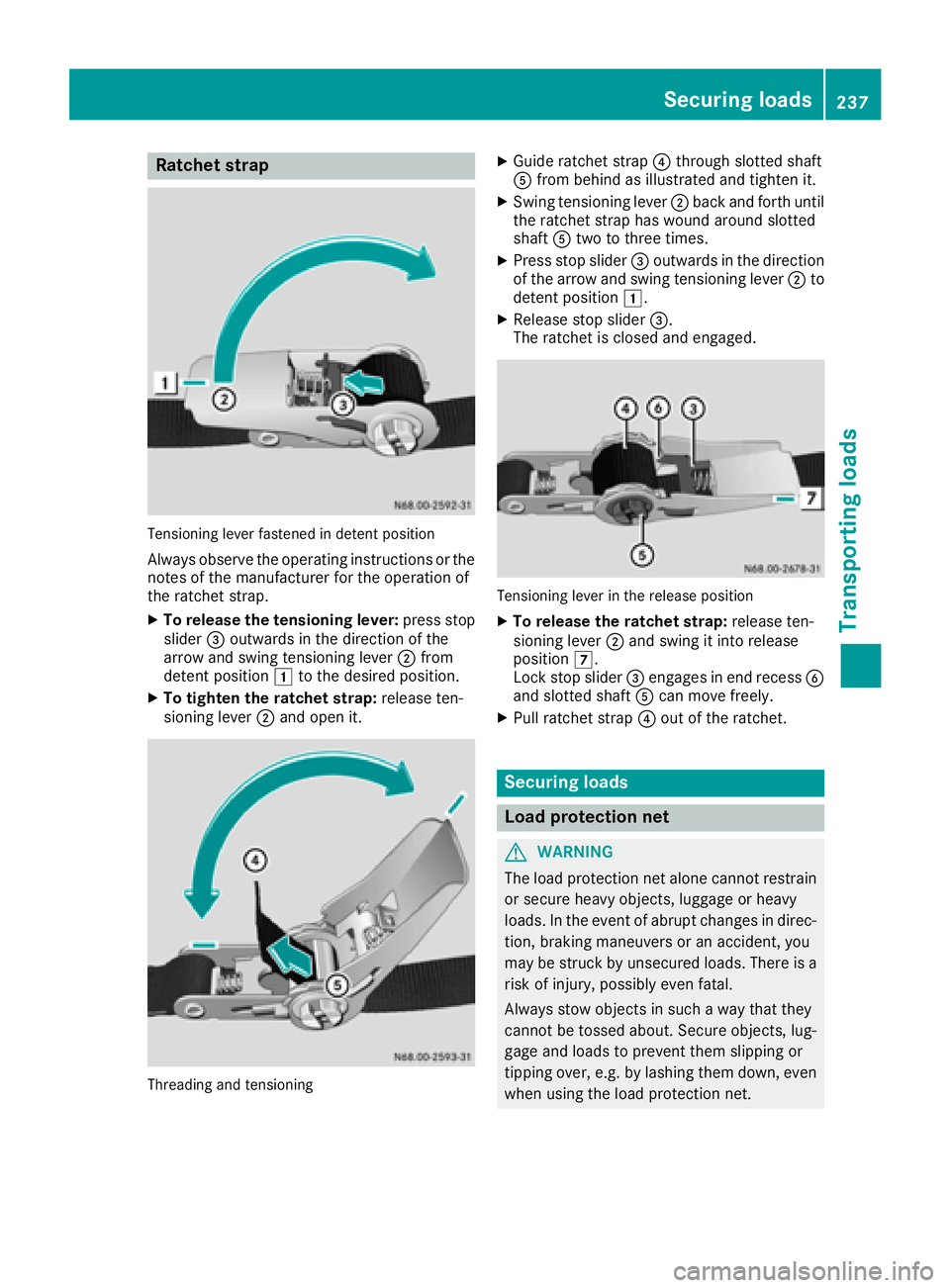
Ratchetstrap
Tensioning lever fastened in detent position
Alway sobserve the operating instructions or the
notes of the manufacturer for the operation of
the ratchet strap.
XTo releas ethe tensionin glever :press stop
slider =outwards in the direction of the
arrow and swing tensioning lever ;from
detent position 1to the desire dposition.
XTo tighten the ratche tstrap: release ten-
sioning lever ;and ope nit.
Threading and tensioning
XGuid eratchet strap ?through slotted shaft
A from behind as illustrated and tighten it.
XSwing tensioning lever ;back and forth until
the ratchet straph aswound around slotted
shaft Atwo to three times.
XPress stop slider =outwards in the direction
of the arrow and swing tensioning lever ;to
detent position 1.
XReleasestop slider =.
The ratchet is closed and engaged.
Tensioning lever in the release position
XTo releas ethe ratche tstrap: release ten-
sioning lever ;and swing it into release
position 7.
Lock stop slider =engages in end recess B
and slotted shaft Acan move freely.
XPull ratchet strap ?outoft he ratchet.
Securing loads
Load protection net
GWARNING
The load protectio nnet alone canno trestrain
or secure heavy objects, luggage or heavy
loads. In the event of abrup tchanges in direc-
tion, braking maneuvers or an accident, you
may be struck by unsecured loads. There is a
ris kofi njury, possibly eve nfatal.
Alway sstow objects in such awaythat they
canno tbetossed about. Secure objects, lug-
gage and load stoprevent them slipping or
tipping over, e.g. by lashing them down, even
when using the load protectio nnet.
Securing loads237
Transporting loads
Z
Page 244 of 310
or other service products. There isarisk of
injury.
Let an overheated engine cool down before
opening the hood. If there is afire in the
engine compartment, keep the hood closed
and contact the fire department.
GWARNING
Certain components in the engine compart-
ment,s uch as the engine, radiator and parts
of the exhaust system, can become very hot.
Working in the engine compartment poses a
risk of injury.
Where possible, let the engine cool down and touch only the components described in the
following.
!Do not use your hands to push the hood
down. You could damage it otherwise.
XHold support strut ?and lift the hood
slightly.
XGuide support strut ?towards retainer =
and apply slight pressure to make it engage.
XLower the hood and allow it to fall with
momentum from aheight of approximately
1ft( 30 cm).
The hood locks audibly.
XCheck that the hood is correctly locked.
If the hood can be raised slightly, it is not
properly engaged. If the hood is not correctly
engaged, open the hood again. Let the hood
fall with alittle more momentum.
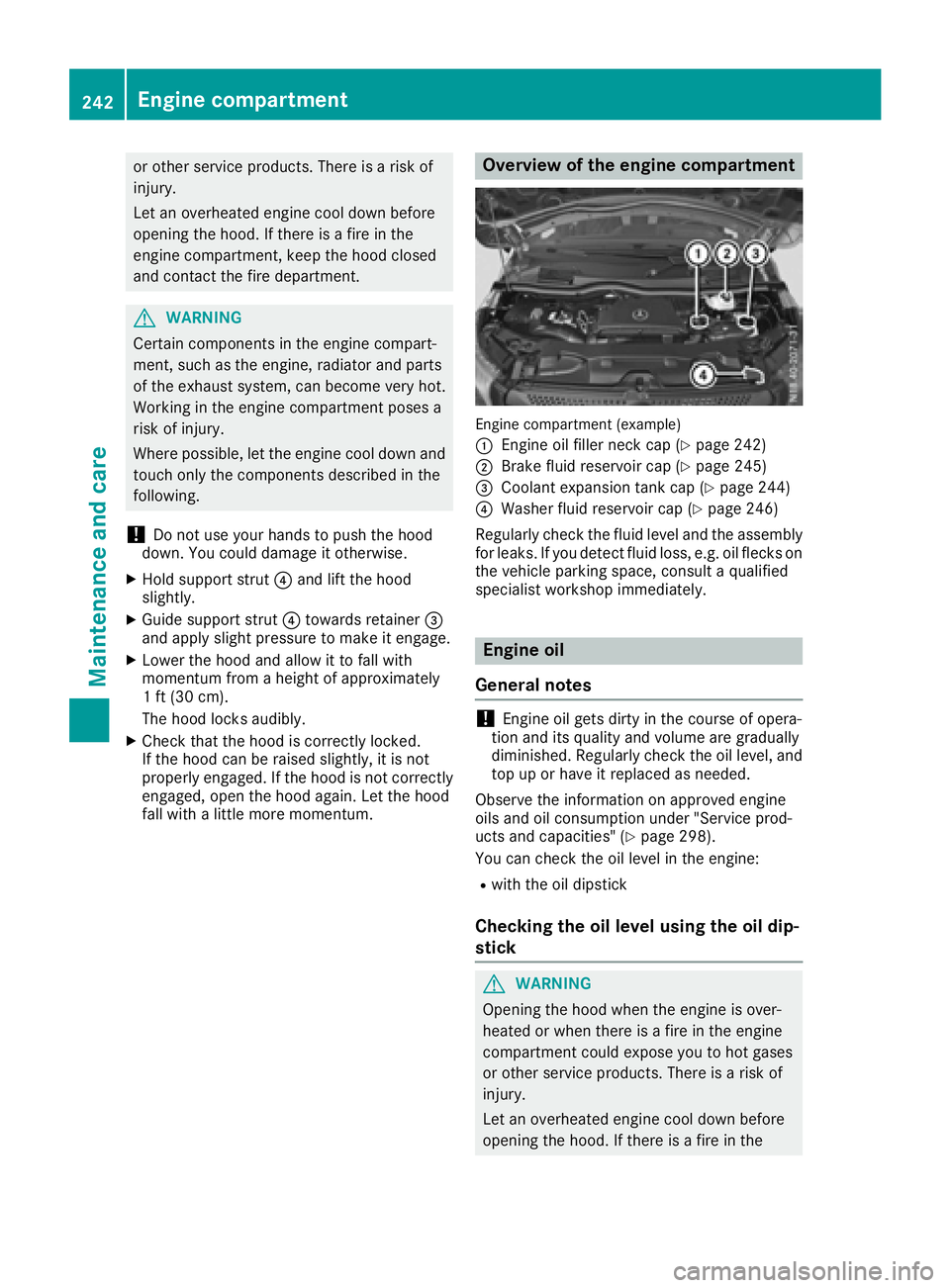
Overview of the engine compartment
Engin ecompartment (example)
:
Engin eoil filler neck cap (Ypage 242)
;Brake fluid reservoir cap (Ypage 245)
=Coolant expansion tank cap (Ypage 244)
?Washer fluid reservoir cap (Ypage 246)
Regularly check the fluid level and the assembly
for leaks. If you detect fluid loss, e.g. oil flecks on the vehicle parking space, consult aqualified
specialist workshop immediately.
Engine oil
General notes
!Engin eoil gets dirty in the course of opera-
tion and its quality and volume are gradually
diminished. Regularly check the oil level, and top up or have it replaced as needed.
Observe the information on approved engine
oils and oil consumption under "Service prod-
ucts and capacities" (
Ypage 298).
You can check the oil level in the engine:
Rwith the oil dipstick
Checking the oil level using the oil dip-
stick
GWARNING
Opening the hood when the engine is over-
heated or when there is afire in the engine
compartment could expose you to hot gases
or other service products. There is arisk of
injury.
Let an overheated engine cool down before
opening the hood. If there is afire in the
242Engine compartment
Maintenance and care
Page 251 of 310
immediately. Do not drive any further. You
should have all work involvingthe battery car-
ried out at aqualified specialist workshop.
Further information can be foundu nder "ABS"
(
Ypage 62) and under "ESP®"(Ypage 64).
GWARNING
Electrostatic build-up can lead to the creation of sparks, which could ignit ethe highly explo-
sive gases of abattery. There is arisk of an
explosion.
Before handlin gthe battery, touc hthe vehicle
body to remove any existin gelectrostatic
build-up.
The flammable gas mix is produced when the
battery is charged or when the vehicle is jump-
started.
Always make sure that neither you nor the bat-
ter ya re electro statically charged. Electrostatic
charging results, for example, from:
Rwearings ynthetic clothing
Rfriction betwee nclothing and the seat
Rdraggingorp ushingthe battery across carpet
flooring or any other synthetic materials
Rrubbingt he battery with cloths or towels.
Comply with the followings afetyprecautions
and tak eprotective measuresw hen handling
batteries.
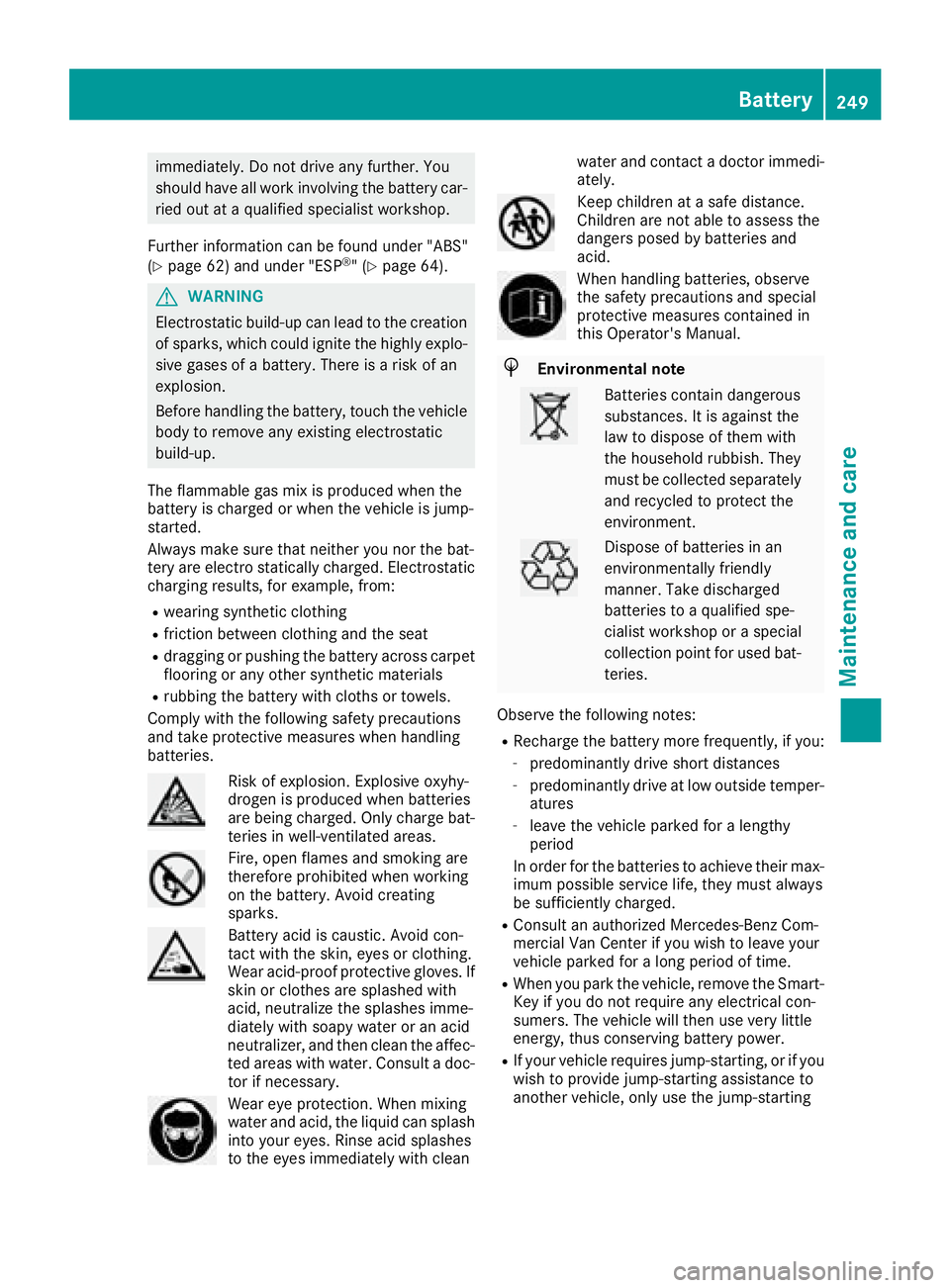
Risk of explosion.E xplosive oxyhy-
drogen is produced when batteries
are being charged. Only charge bat-
teries in well-ventilated areas.
Fire ,open flames and smoking are
therefore prohibited when working
on the battery. Avoid creating
sparks.
Batter yacid is caustic. Avoid con-
tac twith the skin ,eyes or clothing.
Wear acid-proof protective gloves.I f
skin or clothes are splashed with
acid, neutralize the splashes imme-
diately with soapy water or an acid
neutralizer, and the nclean the affec-
ted areas with water .Consult adoc-
tor if necessary.
Wear eye protection. When mixing
water and acid, the liquid can splash
int oy our eyes. Rinse acid splashes
to the eyes immediately with clean water and contac
tadoctor immedi-
ately.
Keep children at asafe distance.
Children are not able to assess the
danger sposed by batteries and
acid.
When handlin gbatteries, observe
the safetyp recautionsand special
protective measuresc ontained in
this Operator's Manual.
HEnvironmental note
Batteries contain dangerous
substances. It is against the
law to dispose of the mwith
the household rubbish. They
must be collected separately and recycled to protect the
environment.
Dispose of batteries in an
environmentally friendly
manner. Take discharged
batteries to aqualified spe-
cialist workshop or aspecial
collection point for used bat-
teries.
Observe the followingn otes:
RRecharge the battery more frequently, if you:
-predominantly drive shortd istances
-predominantly drive at low outside temper-
atures
-leave the vehicle parked for alengthy
period
In order for the batteries to achiev etheir max-
imum possible service life, the ymust always
be sufficiently charged.
RConsult an authorized Mercedes-Ben zCom-
mercial Van Center if you wish to leave your
vehicle parked for along period of time.
RWhen you park the vehicle, remove the Smart-
Key if you do not require any electrical con-
sumers. The vehicle will the nuse very little
energy, thus conserving battery power.
RIf your vehicle requiresj ump-starting, or if you
wish to provide jump-startin gassistanc eto
another vehicle, only use the jump-starting
Battery249
Maintenance and care
Z
Page 257 of 310
This will prevent smears and reduce wiping
noises caused by residue on the windshield.
Ron vehicles with rear doors, from the rear view
camera lens in the top of the license plate
molding (
Ypage 257)
Washing by hand
In some countries, washing by hand is only
allowed at specially equipped washing bays.
Observe the legal requirementsofthe country
you are currently in when washing by hand.
XDo not use hot water and do not wash the
vehicle in direct sunlight.
XUse asoft car sponge.
XUse amild cleaning agent, e.g. aMercedes-
Benz approved car shampoo.
XThoroughly hose down the vehicle with agen-
tle jet of water.
XDo not point the water jet directly towards the
air inlets.
XUse plenty of water and rinse out the sponge
frequently.
XRinse the vehicle with clean water and dry
thoroughly with achamois.
XDo not let the cleaning agents dry on the
paintwork.
When using the vehicle in winter, remove all
traces of road salt deposits carefully and as
soon as possible.
Power washers
GWARNING
The water jet from acircular jet nozzle (dirt
blasters) can cause invisible exterior damage
to the tires or chassis components .Compo-
nentsd amaged in this way may fail unexpect-
edly. There is arisk of an accident.
Do not use power washers with circular jet
nozzles to clean the vehicle. Have damaged
tires or chassis components replaced imme-
diately.
!Under no circumstances use power washers
in the vehicle interior. The pressurized water
and associated spray produced by the power
washer could cause extensive damage to the
vehicle.
!When using high-pressure cleaning equip-
ment,m aintainaminimum distance of
approx. 1ft(30 cm) between the spray nozzle
and the vehicle parts. Do not use apower
washer with around-jet nozzle. You could
damage the vehicle or engine parts.
!Keep the water jet moving constantly while
cleaning. This will avoid causing damage to
the vehicle.
Do not point the water jet at:
Rdoor joints
Rrear view camera
Rair bellows
Rbrake hoses
Rwheel balance weights
Relectrical components
Relectrical connections
Rseals
Rdrive train, especially not at the intermedi-
ate bearing of the propeller shaft
Cleaning the engine
!Water must not enter intak eorventilation
openings. When cleaning with high pressure
water or steam cleaners, the spray must not
be aimed directly at electrical components or the terminals of electrical lines.
Preserve the engine after the engine has been
cleaned. Protectt he belt drive system from
exposure to the preservative agent.
Also observe the information under "Power
washers" (
Ypage 255).
Cleaning the paintwork
!Do not affix:
Rstickers
Rfilms
Rmagnetic plates or similar items
to painted surfaces. You could otherwise
damage the paintwork.
Scratches, corrosived eposits, areas affected by
corrosion and damage caused by inadequate
care cannot alwaysbec ompletely repaired. In
such cases, visit aqualified specialist workshop.
Care255
Maintenance and care
Z
Page 260 of 310
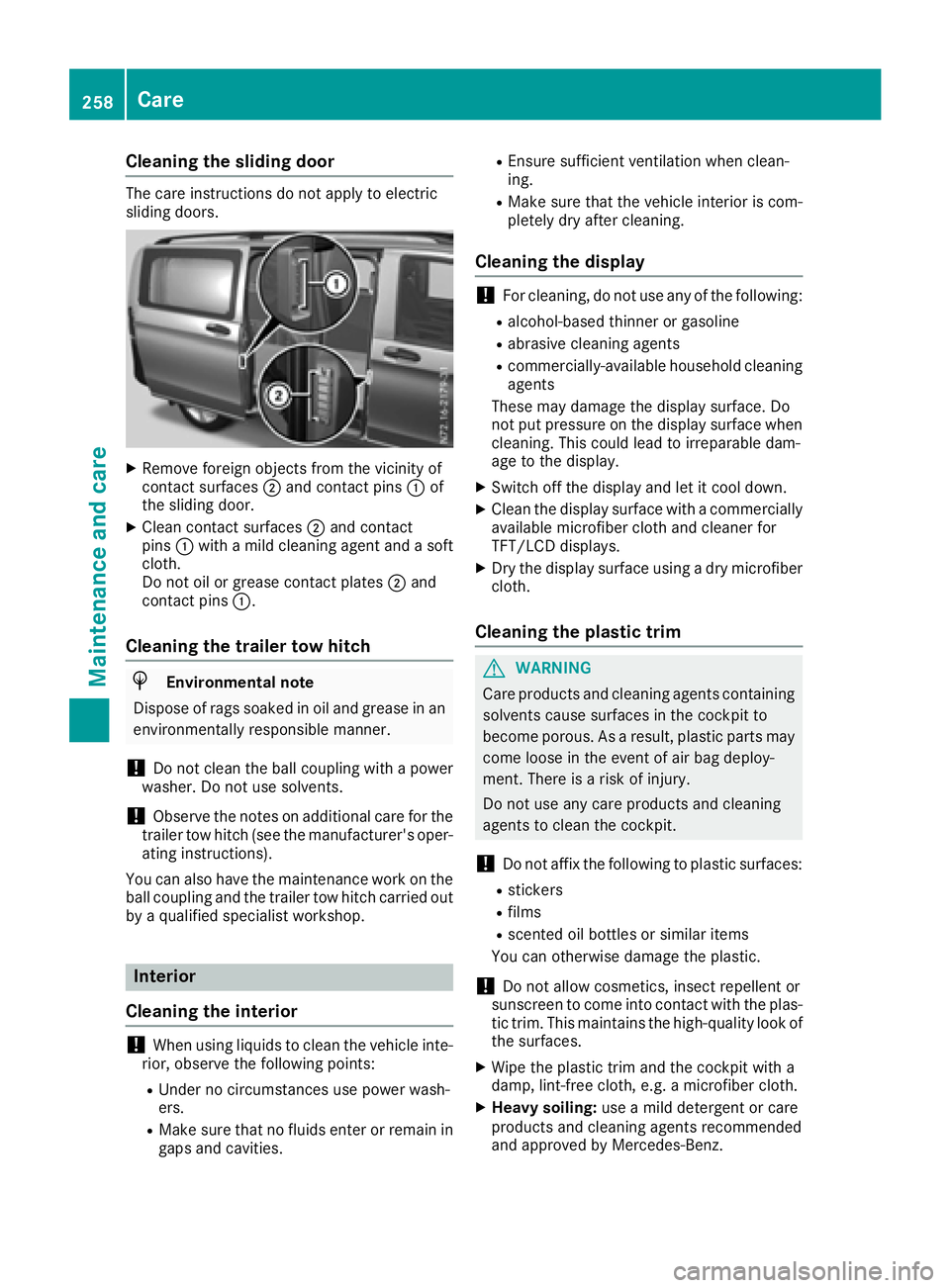
Cleaning thesliding door
The car einstructionsdon otapply to electric
slidingd oors.
XRemove foreign object sfromt hevicinity of
contac tsurfaces ;and contac tpins :of
th es lidingd oor.
XClean contac tsurfaces ;and contact
pins :witham ild cleanin gagenta ndasoft
cloth.
Do no toil or grease contac tplates ;and
contac tpins :.
Cleaning th etrailer tow hitch
HEnvironmental note
Dispose of rags soaked in oil and grease in an
environmentall yresponsible manner.
!Do no tclean th eball couplingw ithapower
washer. Do no tuse solvents.
!Observ ethe note sona dditional car efor the
trailer to whitch (see th emanufacturer'so per-
atin ginstructions).
You can also have th emaintenance work on the
ball couplinga nd thetrailer to whitch carried out
by aq ualified specialist workshop.
Interior
Cleaning th einterior
!When usingl iquids to clean th evehicle inte-
rior ,observ ethe followingp oints:
RUnder no circumstances use power wash-
ers.
RMakesure that no fluid senter or remain in
gaps and cavities.
REnsure sufficient ventilatio nwhen clean-
ing.
RMakes ure that th evehicle interiorisc om-
pletely dry after cleaning.
Cleaning th edisplay
!For cleaning, do no tuse any of th efollowing:
Ralcohol-based thinner or gasoline
Rabrasive cleanin gagents
Rcommercially-available householdc leaning
agents
Thesem ay damag ethe display surface. Do
no tp ut pressure on th edisplay surface when
cleaning. This coul dlead to irreparable dam-
age to th edisplay.
XSwitch off th edisplay and let it coo ldown.
XClean th edisplay surface withac ommercially
available microfiber cloth and cleane rfor
TFT/LCD displays.
XDr yt he display surface usingad ry microfiber
cloth.
Cleaning th eplastic trim
GWARNING
Care product sand cleanin gagents containing
solvents caus esurfaces in th ecockpit to
become porous. As aresult, plastic part smay
com elooseint heevent of air bag deploy-
ment. Thereisar iskofi njury.
Do no tuse any car eproduct sand cleaning
agents to clean th ecockpit.
!Do no taffix th efollowingtop lastic surfaces:
Rstickers
Rfilms
Rscentedoil bottle sorsimilar items
You can otherwise damaget heplastic.
!Do no tallow cosmetics ,insect repellento r
sunscree ntocomeintoc ontac twitht heplas-
tic trim. This maintain sthe high-quality look of
th es urfaces.
XWipe th eplastic trim and th ecockpit witha
damp, lint-free cloth ,e.g.am icrofiber cloth.
XHeavy soiling: useamild detergentorc are
product sand cleanin gagents recommended
and approved by Mercedes-Benz.
258Care
Maintenance and care
Page 262 of 310
Useful information
This Operator's Manual describes all models as
well as standard and optional equipment of your
vehicle that were available at the time of going
to print.Country-specific variation sare possi-
ble. Note that your vehicle may not be equipped
with all of the described functions. This also
applies to system sand function srelevantt o
safety.
Read the information on qualified specialist
workshops (
Ypage 29).
Wherew illIfind...?
Vehicle tool kit
Genera lnotes
Depending on the equipment version of the vehi-
cle, the vehicle tool kit is:
Rin the seat base of the left fronts eat
Rin the rear stowage compartment
Rin the tool holder in the cargo compartment
Apart from some country-specific variants, vehi-
cles without aspare wheel are not equipped
with tire-changing tools. If your vehicle is equip-
ped with tire-changing tools, thes eare in the
vehicle tool kit .Ifthe vehicle tool kit is stowed in
the driver'ss eat base, the jack is in aseparate
holder in the cargo compartmen tonthe right-
hand side of the vehicle nex ttothe tailgate/rear
door (
Ypage 262).
Some tools for changing awheel are specific to
the vehicle. For more information on which tools are required and approved to performaw heel
change on your vehicle, consult aqualified spe-
cialist workshop.
Necessary tire-changing tools can include, for
example:
RJack
RLug wrench
RRatchet wrench
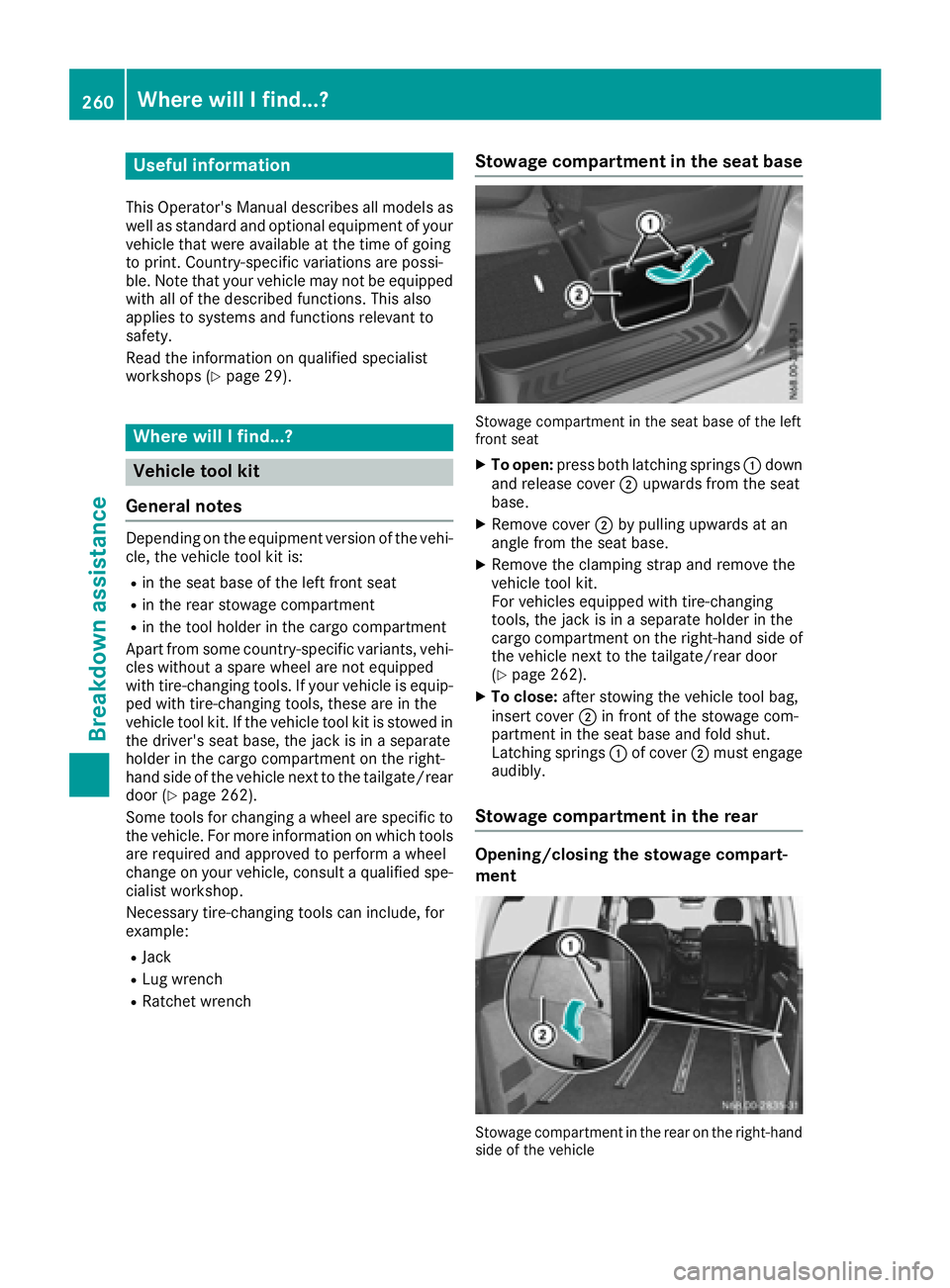
Stowage compartment in the seat base
Stowage compartmen tinthe seat base of the left
fronts eat
XTo open: press both latching springs :down
and release cover ;upwards from the seat
base.
XRemove cover ;by pulling upwards at an
angle from the seat base.
XRemove the clampings trap and removethe
vehicle tool kit.
For vehicles equipped with tire-changing
tools, the jack is in aseparate holder in the
cargo compartmen tonthe right-han dside of
the vehicle nex ttothe tailgate/rear door
(
Ypage 262).
XTo close: after stowin gthe vehicle tool bag,
inser tcover ;in frontoft he stowage com-
partment in the seat base and fold shut.
Latching springs :of cover ;must engage
audibly.
Stowage compartment in the rear
Opening/closing the stowage compart-
ment
Stowage compartmen tinthe rear on the right-hand
side of the vehicle
260Wherew illIfind...?
Breakdown assistance
Page 263 of 310
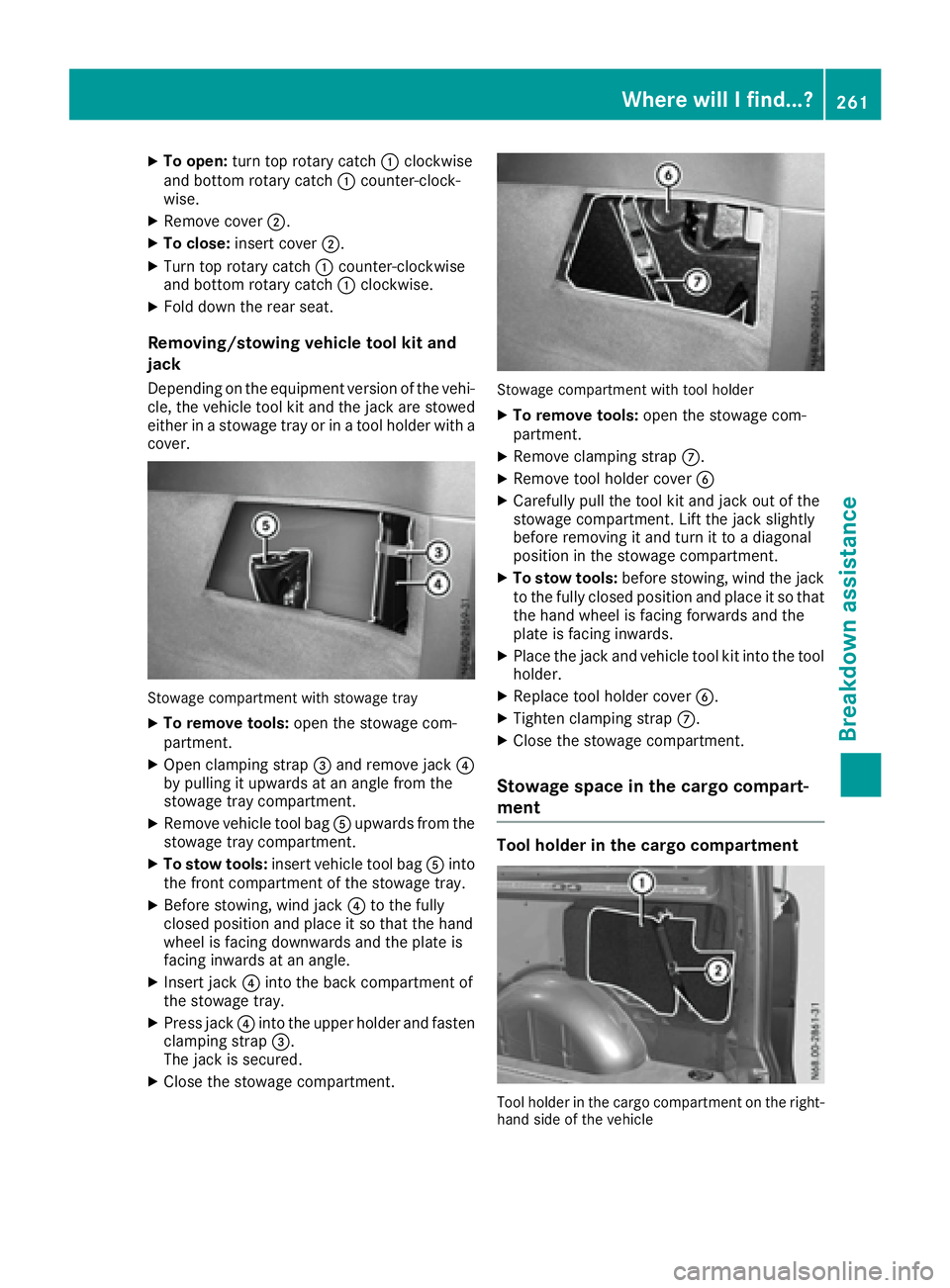
XTo open:turn top rotary catch :clockwise
and bottom rotary catch :counter-clock-
wise.
XRemove cover ;.
XTo close:insert cover ;.
XTurn top rotary catch :counter-clockwise
and bottom rotary catch :clockwise.
XFoldd ownthe rea rseat.
Removing/stowin gvehicle too lkit and
jack
Depending on the equipment versio nofthe vehi-
cle ,the vehicl etool kit and the jack are stowed
either in astowag etray or in atool holde rwitha
cover.
Stowag ecompartment with stowag etray
XTo remove tools: open the stowagecom-
partment.
XOpe nclamping strap =and remove jack ?
by pulling it upwards at an angle from the
stowag etray compartment.
XRemove vehicl etool bag Aupwards from the
stowag etray compartment.
XTo stowt ools:insert vehicl etool bag Ainto
the front compartment of the stowag etray.
XBefore stowing ,windj ack ?to the fully
closed positio nand place it so thatt he hand
whee lisfacing downward sand the plate is
facing inward satanangle.
XInsert jack ?into the back compartment of
the stowag etray.
XPress jack ?into the uppe rholde rand fasten
clamping strap =.
The jack is secured.
XClose the stowag ecompartment.
Stowag ecompartment with tool holder
XTo remove tools: open the stowagecom-
partment.
XRemove clamping strap C.
XRemove tool holdercover B
XCarefull ypullt he tool kit and jack outoft he
stowag ecompartment. Lif tthe jack slightly
before removing it and turn it to adiago nal
positio ninthe stowag ecompartment.
XTo stowt ools:before stowing ,windt he jack
to the fully closed positio nand place it so that
the hand whee lisfacing forward sand the
plate is facing inwards.
XPlace the jack and vehicl etool kit into the tool
holder.
XReplace tool holde rcover B.
XTighte nclamping strap C.
XClose the stowag ecompartment.
Stowage spac einthe carg ocom part-
ment
Too lholder in the carg ocom partment
Too lholde rint he cargo compartment on the right-
hand side of the vehicle
Where will Ifind...?261
Breakdo wn assis tance
Page 264 of 310
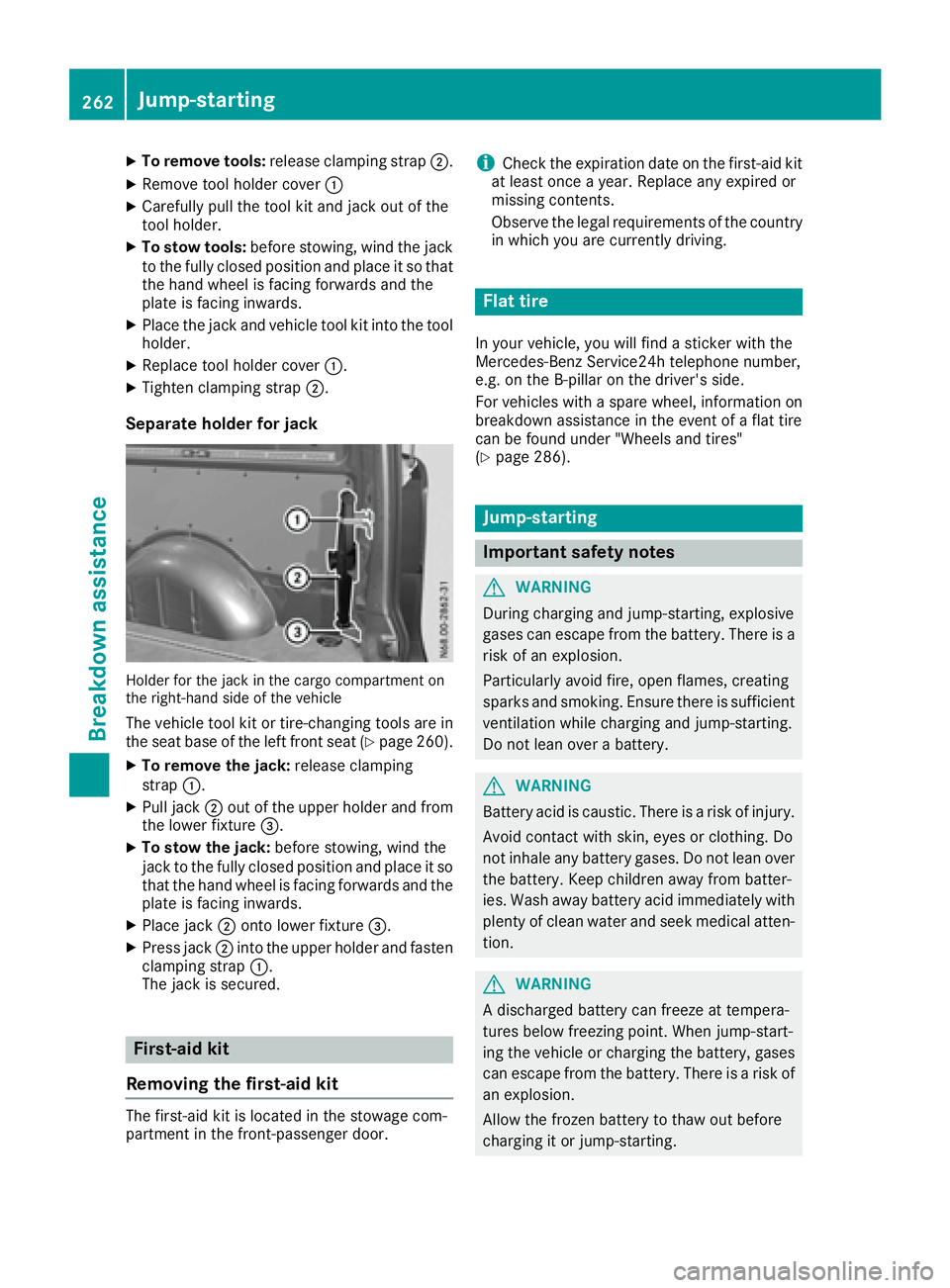
XTo remove tools:release clamping strap ;.
XRemove tool holdercover :
XCarefull ypullt he tool kit and jack outoft he
tool holder.
XTo stowt ools:before stowing ,windt he jack
to the fully closed positio nand place it so that
the hand whee lisfacing forward sand the
plate is facing inwards.
XPlace the jack and vehicl etool kit into the tool
holder.
XReplace tool holde rcover :.
XTighte nclamping strap ;.
Separate holder for jack
Holderfor the jack in the cargo compartment on
the right-hand side of the vehicle
The vehicl etool kit or tire-changing tool sare in
the sea tbaseoft he left front sea t(Ypage 260).
XTo remove the jack: release clamping
strap :.
XPull jack ;outoft he uppe rholde rand from
the lowe rfixture =.
XTo stowt he jack:before stowing ,windt he
jack to the fully closed positio nand place it so
thatt he hand whee lisfacing forward sand the
plate is facing inwards.
XPlace jack ;onto lowe rfixture =.
XPress jack ;into the uppe rholde rand fasten
clamping strap :.
The jack is secured.
First-ai dkit
Removing the first-aid kit
The first-aid kit is locate dinthe stowag ecom-
partment in the front-passenger door.
iCheck the expiratio ndateont he first-aid kit
at leas tonce ayear. Replace any expire dor
missing contents.
Observe the legalr equirements of the country
in which yo uare currentl ydriving.
Flat tire
In your vehicle, yo uwillf ind asticker with the
Mercedes-Benz Service24h telephone number,
e.g .ont he B-pillar on the driver' sside.
For vehicles with aspare wheel, informatio non
breakdowna ssistance in the event of aflatt ire
can be found under "Wheels and tires"
(
Ypage 286).
Jump-starting
Important safety notes
GWARNING
During charging and jump-starting ,explosive
gases can escape from the battery .There is a
ris kofane xplosion.
Particularly avoid fire, open flames ,creating
sparks and smoking .Ensure ther eissufficient
ventilatio nwhile charging and jump-starting.
Do not lean ove rabattery.
GWARNING
Battery aci discaustic .There is ariskofi njury.
Avoi dcontact with skin, eyes or clothing. Do
not inhal eany battery gases .Donot lean over
the battery .Keepc hildren away from batter-
ies. Wash away battery aci dimmediatelyw ith
plenty of clean water and see kmedica latten-
tion.
GWARNING
Ad ischarge dbattery can freeze at tempera-
ture sbelow freezing point. Whe njump-start-
ing the vehicl eorcharging the battery ,gases
can escape from the battery .There is arisko f
an explosion.
Allow the froze nbattery to thawo utbefore
charging it or jump-starting.
262Jump-starting
Breakdo wn assis tance