tow MERCEDES-BENZ METRIS 2016 MY16 Operator’s Manual
[x] Cancel search | Manufacturer: MERCEDES-BENZ, Model Year: 2016, Model line: METRIS, Model: MERCEDES-BENZ METRIS 2016Pages: 310, PDF Size: 7.28 MB
Page 75 of 310
When the ignition is switched on, the vehicle will
lock automatically fromaspeed of approx-
imately 9mph (15 km/h).
You could therefore be locked out if:
Rthe vehicle is being pushed.
Rthe vehicle is being towed.
Rthe vehicle is being tested on adynamometer.
If the vehicle has been automatically locked and
af rontd oor is opened from the interior while the
vehicle is stationary, the vehicle unlock scen-
trally.
Driver's door and front-passenger
door
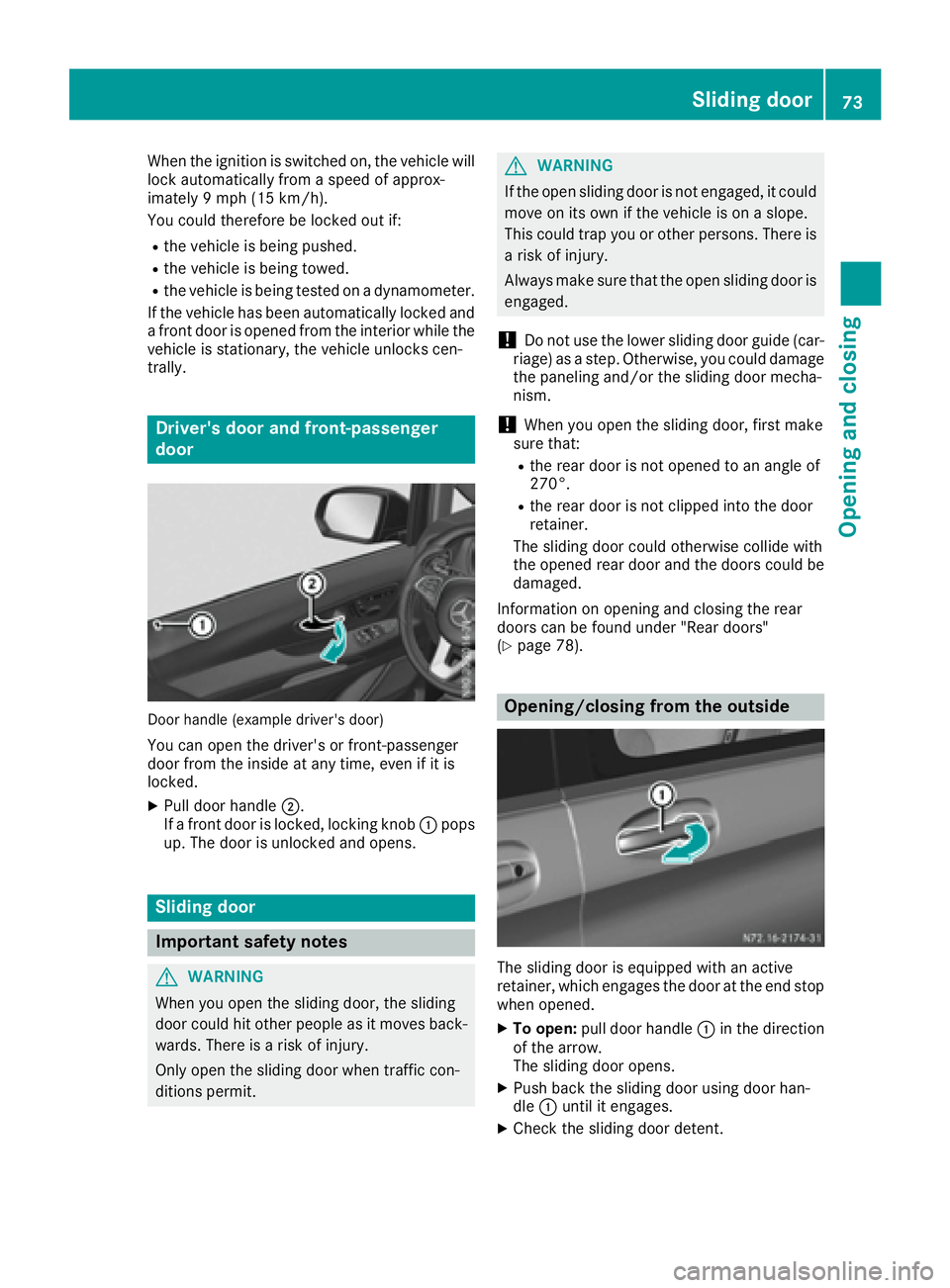
Door handle (example driver's door)
You can open the driver's or front-passenger
door from the inside at any time, even if it is
locked.
XPull door handle ;.
If af rontd oor is locked, lockingk nob: pops
up. The door is unlocked and opens.
Sliding door
Important safety notes
GWARNING
When you open the sliding door, the sliding
door could hit other people as it moves back- wards. There is arisk of injury.
Only open the sliding door when traffic con-
ditions permit.
GWARNING
If the open sliding door is not engaged, it could
move on its own if the vehicle is on aslope.
This could trap you or other persons.T here is
ar isk of injury.
Always make sure that the open sliding door is
engaged.
!Do not use the lower sliding door guide (car-
riage) as astep. Otherwise, you could damage
the paneling and/or the sliding door mecha-
nism.
!When you open the sliding door, first make
sure that:
Rthe rear door is not opened to an angle of
270°.
Rthe rear door is not clipped into the door
retainer.
The sliding door could otherwise collide with
the opened rear door and the doors could be damaged.
Information on opening and closing the rear
doors can be found under "Rear doors"
(
Ypage 78).
Opening/closing from the outside
The sliding door is equipped with an active
retainer ,which engages the door at the end stop
when opened.
XTo open: pull door handle :in the direction
of the arrow.
The sliding door opens.
XPush back the sliding door using door han-
dle :until it engages.
XCheck the sliding door detent.
Sliding door73
Opening and closing
Z
Page 86 of 310
!To avoid damage to the seats and the seat
heating, observe the following information:
Rkeep liquids from spilling on the seats. If
liquid is spilledont he seats, dry them as
soon as possible.
Rif the seat covers are damp or wet, do not
switch on the seat heating. The seat heat-
ing should also not be used to dry the seats.
Rclean the seat covers as recommended;
see the "Interior care" section.
Rdo not transport heavy loads on the seats.
Do not place sharp objects on the seat
cushions, e.g. knives, nails or tools. The
seats should only be occupied by passen-
gers, if possible.
Rwhen the seat heating is in operation, do
not cover the seats with insulating materi-
als, e.g. blankets, coats, bags, seat covers,
child seats or booster seats.
Your seat must be adjusted in such away that
you can wear the seat belt correctly.
Observe the following points:
RPosition the backrest in an almost vertical
position so that you are sitting virtually
upright. Do not drive with the backrest
reclined too far back.
RYour arms should be slightly bent when you
are holding the steering wheel.
RAvoid seat positions that prevent the seat belt
from being correctly routed. The shoulder
section of the belt must be routed over the
middle of your shouldera nd be pulled tight
against your upper body. The lap belt must
always pass across your lap as low down as
possible,i .e. over your hip joints.
RAdjust the head restraint so that it supports
the back of the head at eye level.
RThe distance from the pedalss hould be such
that you can depress them fully.
Please also observe the important safety notes
on "Air bags" (
Ypage 48), "Seat belts"
(Ypage 45) and "Child restraint systems"
(Ypage 58).
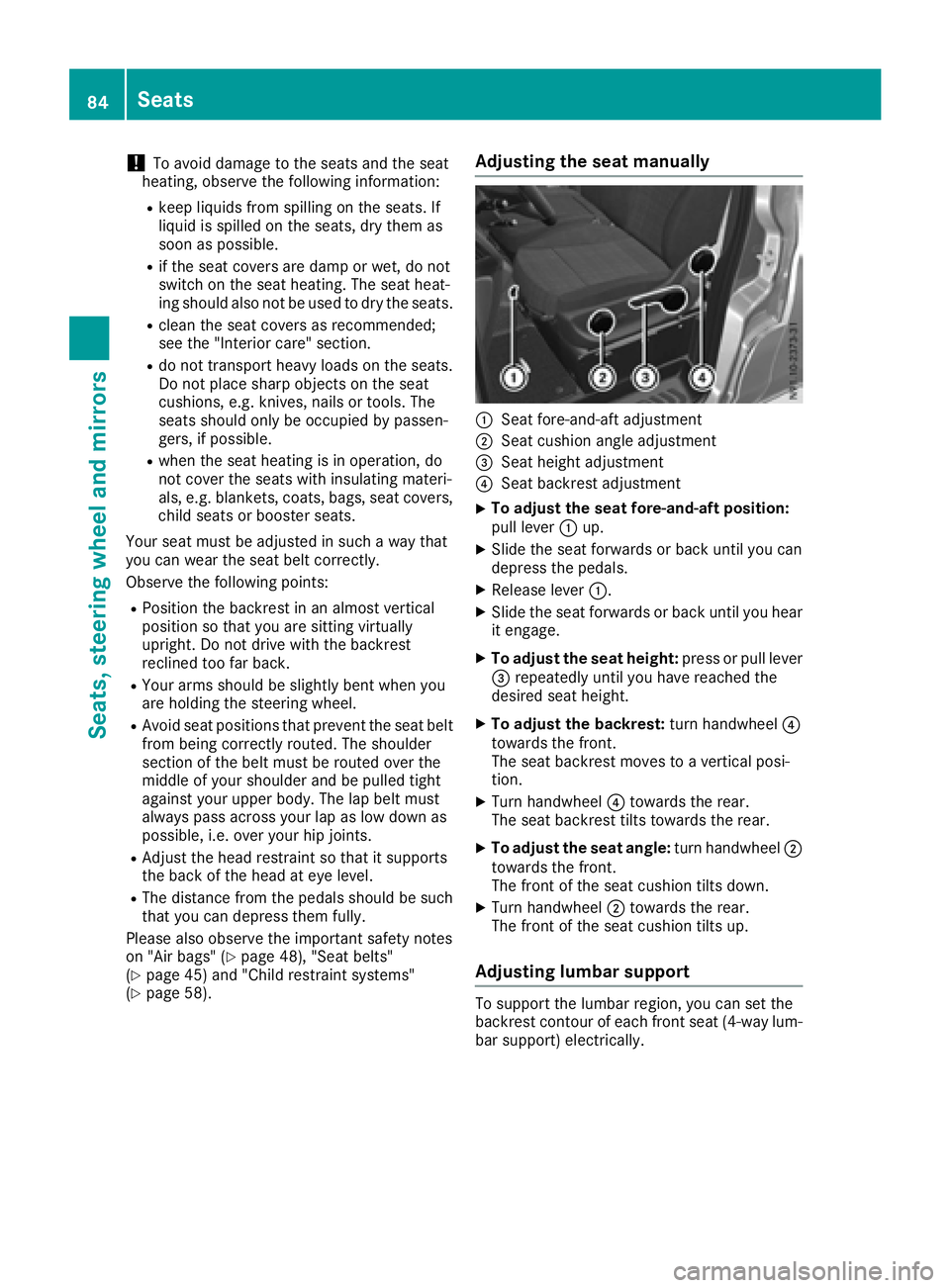
Adjusting the seat manually
:Seat fore-and-aft adjustment
;Seat cushion angle adjustment
=Seat height adjustment
?Seat backrest adjustment
XTo adjust the seat fore-and-aft position:
pull lever :up.
XSlide the seat forwards or back until you can
depress the pedals.
XRelease lever :.
XSlide the seat forwards or back until you hear
it engage.
XTo adjust the seat height: press or pull lever
= repeatedly until you have reached the
desired seat height.
XTo adjust the backrest: turn handwheel?
towards the front.
The seat backrest moves to avertical posi-
tion.
XTurn handwheel ?towards the rear.
The seat backrest tilts towards the rear.
XTo adjust the seat angle: turn handwheel;
towards the front.
The front of the seat cushion tilts down.
XTurn handwheel ;towards the rear.
The front of the seat cushion tilts up.
Adjusting lumbar support
To support the lumbarr egion, you can set the
backrest contour of each front seat (4-way lum-
bar support) electrically.
84Seats
Seats, steering whee land mirrors
Page 107 of 310
XPress new wiper blade:ontow iper arm =
until you hear retainin gclips ;engage.
XFold wiper arm =back ont othe rear window.
Windshield wipers105
Lights and windshield wipers
Z
Page 122 of 310
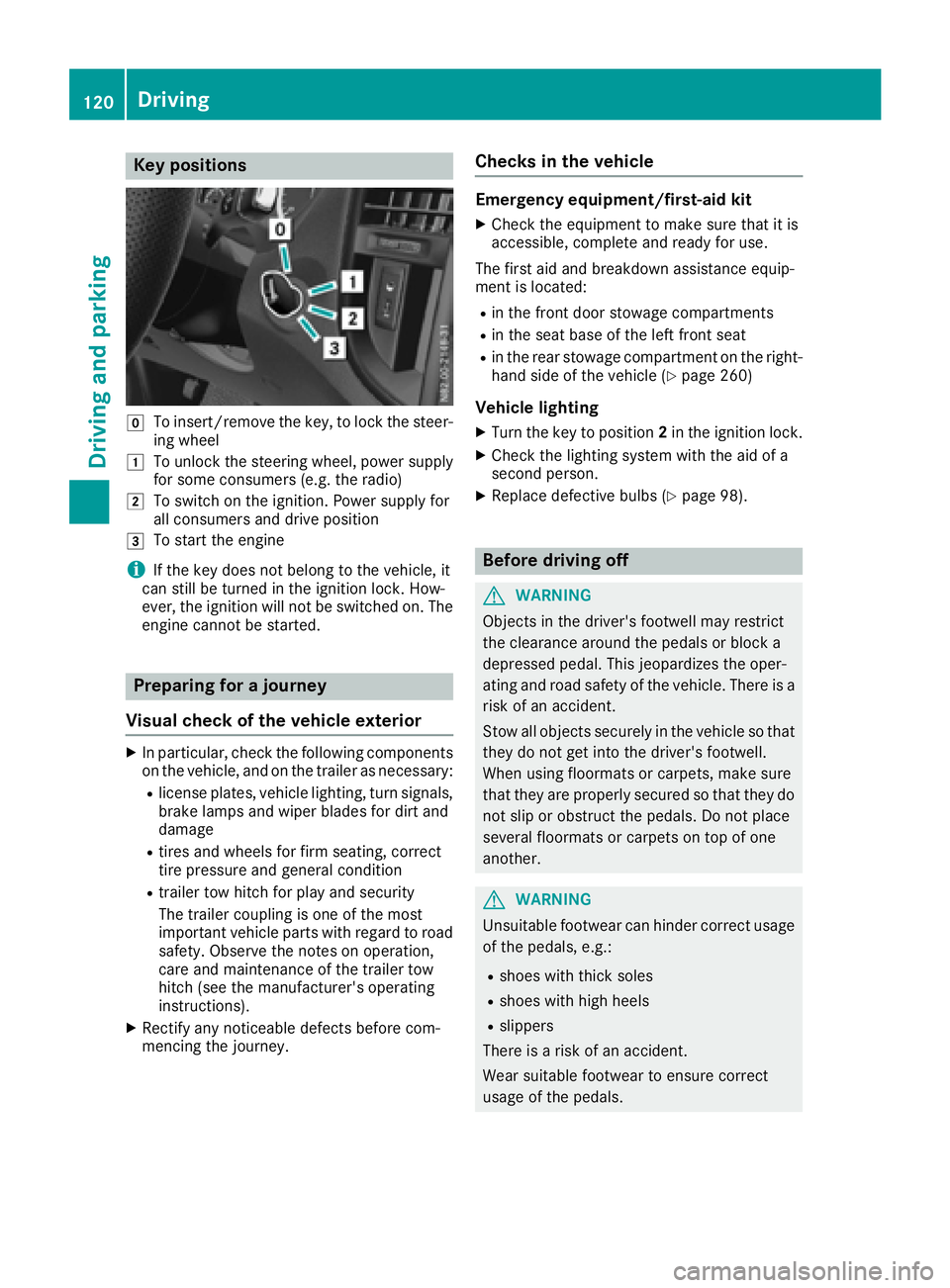
Key positions
gTo insert/remove thekey,tol oc kt he steer -
ing whee l
1To unlockthe steering wheel, powe rsupply
for som econsum ers( e.g. th eradio)
2To switch on th eignition .Powe rsupply for
all consumer sand drive position
3To start th eengine
iIf th ekeydoes no tbelong to th evehicle, it
can still be turne dintheignition lock. How-
ever, th eignition will no tbeswitched on .The
engin ecanno tbes tarted.
Prepa ring for ajourne y
Visua lcheck ofthev ehicle exteri or
XIn particular, chec kthe followin gcom ponent s
on th evehicle, and on th etrailer as necessary:
Rlicense plates, vehicl elighting ,tur ns ignals,
brak elamp sand wiper blade sfor dir tand
damag e
Rtires and wheels for fir mseating ,correct
tire pressur eand general condition
Rtrailer to whitch for play and securit y
The trailer couplin gisoneof th emost
important vehicl epartsw ithr egard to roa d
safety. Observ ethe note sono peration ,
car eand maintenance of th etrailer to w
hitch (see th emanufacturer' soperating
instructions).
XRectify any noticeable defects before com-
mencin gthe journey.
Check sinthevehicle
Emergency equipment/first-aid kit
XChec kthe equipmen ttomakes uret hatiti s
accessible, complet eand read yfor use.
The first aid and breakdown assistanc eequip -
men tislocated:
Rin th efront door stowage compartments
Rin theseat base of th eleftf ront seat
Rin therear stowage compartmen tontheright -
han dside of th evehicl e(Ypage 260)
Vehicle lighting
XTurn th ekeyto position 2in th eignition lock.
XChec kthe lighting system wit hthe aid of a
secon dperson .
XReplac edefective bulbs (Ypage 98).
Before drivingo ff
GWARNING
Objects in th edriver's footwell may restrict
th ec learance around th epedal sorb locka
depressed pedal .This jeopardizes th eoper -
ating and roa dsafet yoft hevehicle. There is a
ris kofana ccident.
Stow all objects securel yint he vehicl esothat
they do no tget int othe driver's footwell.
Whe nusingfloormats or carpets, mak esure
that they are properly secured so that they do no tslip or obstruct th epedals. Do no tplac e
several floormats or carpet sontopof on e
another.
GWARNIN G
Unsuitable footwear can hinder correc tusage
of th epedals, e.g. :
Rshoes withthick sole s
Rshoes wit hhigh heel s
Rslippers
There is ariskofana ccident.
Wear suitable footwear to ensur ecorrect
usage of th epedals.
120Driving
Driving and parking
Page 123 of 310
XStow luggage itemssecurely. Secure the load
as per the loading guideline s(Ypage 232).
XMake sure that the floormats and carpets are
properly secured so that they canno tslipa nd
obstruct the pedals.
XClose al ldoors.
To start the engine
Important safety notes
GWARNING
Combustio nengines emi tpoisonous exhaust
gases such as carbon monoxide. Inhaling
thes eexhaus tgases lead stopoisoning. There
is ar iskoff atalinjury. Therefore neve rlea ve
the engine running in enclose dspaces with-
outs ufficient ventilation.
!Do not depress the accelerato rwhens tart-
ing the engine.
XBefore starting the engine, make sure that:
Ral lt he doors are closed.
Rallt he vehicl eoccupants are wearing their
sea tbelts correctly.
Rthe parking brake is applied.
iIf yo udepress the brake pedal before start-
ing the engine, the pedal trave lmay be shorter
and pedal resistance higher.
If yo udepres sthe brake pedal agai nafter
starting the engine, pedal trave land resist-
ance will be back to norma lagain.
Automatic transmission
XShif tthe transmissio ntoposition P
(Ypage 126).
The transmissio nposition indicator in the dis-
play shows P.
You can also star tthe engine in neutral N.
To start the engine
XTurn the key to position 3(Ypage 120 )inthe
ignition lock and release it as soo nasthe
engine is running.
Driving off
Automati ctransmission
GWARNING
If the engine speed is above the idling speed
and yo uengage transmission position Dor R,
the vehicl ecould pull away suddenly. There is
ar iskofana ccident.
Whe nengaging transmission position Dor R,
always firmly depress the brake peda land do
not simultaneouslya ccelerate.
!Onlyshift into reverse gear Rwhen the vehi-
cle is stationary .Otherwise, yo ucould dam-
ag et he transmission.
XDepres sthe brake peda land keepi t
depressed.
The parking lock is released.
XShift the transmission to position Dor R.
On vehicles with areverse warning feature ,a
warning signals ounds when reverse gear Ris
engaged to alert othe rroa du sers
(
Ypage 122).
XReleas ethe parking brake (Ypage 133).
The F (only USA) or J(only Canada)
indicator lamp in the instrument cluster goes
out.
XReleas ethe brake pedal.
Hil lstart assist automaticall ymaintains the
brake pressure for abouta nother two sec-
ondsa fterthe brake peda lisreleased .This
makes it possibl etopulla wa yw ithou tthe
vehicl eimmediatelyr olling back
(
Ypage 122).
XCarefull ydepress the accelerato rpedal.
It is onlyp ossibl etos hift the transmission from
po
sition Pto the desired positio nifyoudepress
the brake pedal. Onlyt hen is the parking lock
released .Ifthe brake peda lisnot depressed, the
DIRECT SELECTl ever can stil lbemovedbutthe
parking lock remains engaged.
The vehicl eloc ks centrall yonce yo uhavep ulle d
away .The locking knobs in the doors dro pdown.
Yo uc an open the doors from the insid eatany
time.
Yo uc an also deactivate the automatic locking
feature (
Ypage 72).
Driving121
Driving an dparking
Z
Page 128 of 310
Beforeswitching off the engine, always switch
to parking position P.Prevent the parked vehi-
cle from rolling away by applying the parking
brake.
!If the engine is switched off, rolling in neutral
N can damag ethe power transmission and
result in transmission damage.
Alway sobserve the instructions and safety
notes under "Tow starting and towing away"
(
Ypage 264).
Bearinm ind that power transmission between
the engine and the transmission is interrupted
whe nthe engine is switched off. For this reason,
shift the automatic transmission to Pbefore the
engine is switched off and with the vehicle is
stationary. Appl ythe parking brake to prevent
the vehicle from rolling away.
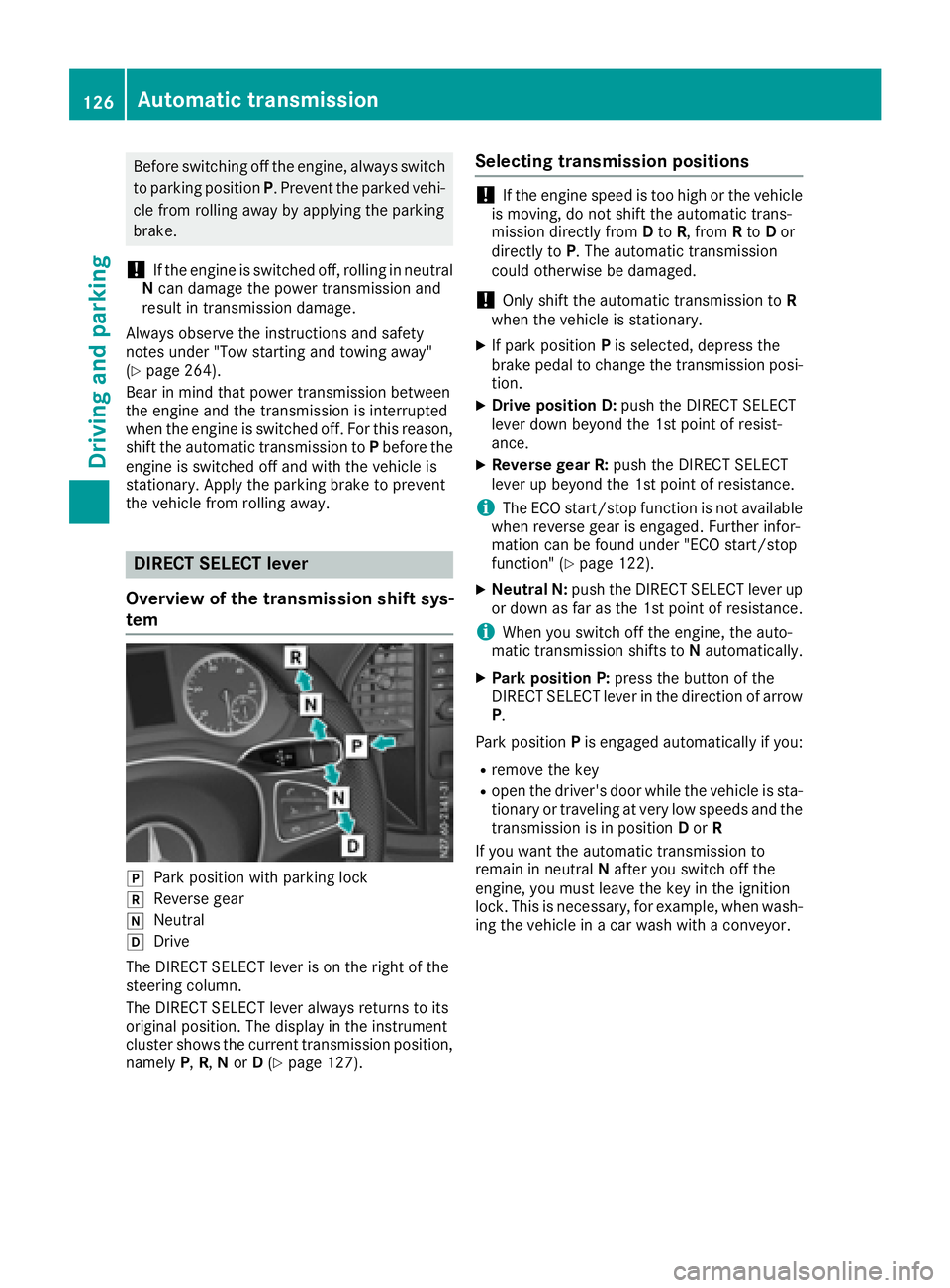
DIREC TSELECT lever
Overvie wofthe transmissio nshift sys-
tem
jPark positio nwithp arking lock
kReverseg ear
iNeutral
hDrive
The DIREC TSELECT lever is on the right of the
steering column.
The DIREC TSELECT lever always returns to its
origina lposition. The display in the instrument
cluster showst he current transmission position,
namely P,R, Nor D(
Ypage 127).
Selecting transmissio npositions
!If the engine speed is too hig horthe vehicle
is moving, do not shift the automatic trans-
missio ndirectly from Dto R,f rom Rto Dor
directly to P.The automatic transmission
could otherwise be damaged.
!Only shift the automatic transmission to R
whe nthe vehicle is stationary.
XIf park position Pis selected ,depress the
brake pedal to chang ethe transmission posi-
tion.
XDrive positionD :push the DIREC TSELECT
lever dow nbeyond the 1st point of resist-
ance.
XReverse gear R: push the DIRECTSELECT
lever up beyond the 1st point of resistance.
iThe ECO start/stop function is not available
whe nreverse gea risengaged .Further infor-
mation can be found under "EC Ostart/stop
function" (
Ypage 122).
XNeutral N: push the DIREC TSELECT lever up
or dow nasfar as the 1st point of resistance.
iWhe nyou switch off the engine, the auto-
mati ctransmission shifts to Nautomatically.
XPark positionP :press the button of the
DIREC TSELECT lever in the directio nofarrow
P.
Park position Pis engaged automaticall yifyou:
Rremove the key
Rope nthe driver'sd oorwhile the vehicle is sta-
tionary or traveling at very low speeds and the
transmission is in position Dor R
If yo uwantthe automatic transmission to
remain in neutral Nafte ryou switch off the
engine, yo umustleave the key in the ignition
lock. Thisisn ecessa
ry, for example, whe nwash-
i
ng the vehicle in acar wash with aconveyor.
126Automatic transmission
Drivin gand parking
Page 129 of 310
Transmission positions
BPark position
Thisprevents the vehicl efromr olling
away when stopped. Do not shift the
transmission into position Punless
the vehicl eisstationary.
The automatic transmission shifts to P automaticall yifyou:
Rremove the key
Ropen the driver's door whil ethe
vehicl eisstationar yortraveling at
ver ylow speeds and the transmis-
sion is in position Dor R.
The parkin gloc ks houl dnot be used
as ab rake when parking. Always
appl ythe parkin gbrake as well once
yo uh avep arked the vehicle.
CRevers egear
Onlys hift the transmission to Rwhen
the vehicl eisstationary.
ANeutral
No powe ristransmitted fromt he
engine to the drive wheels .Releasi ng
the brakes will allo wyouto mov ethe
vehicl efreely, e.g .byp ushing or tow-
ing.
If ESP
®is deactivated or faulty: shift
the transmission to position Nif the
vehicl eisind angerofs kidding,e.g.
on icy roads.
When yo uswitch off the engine ,the
automatic transmission automati-
cally shifts into neutral N.
!If the engine is switched off ,roll-
ing in neutral Ncan damage the
powe rtransmission and resul tin
transmission damage.
7Drive
The automatic transmission changes
gear itself. All forward gear sareavail-
able.
Yo uc an influence gearshifts with
your choice of transmission program.
Yo uc an also restric tthe shift range.
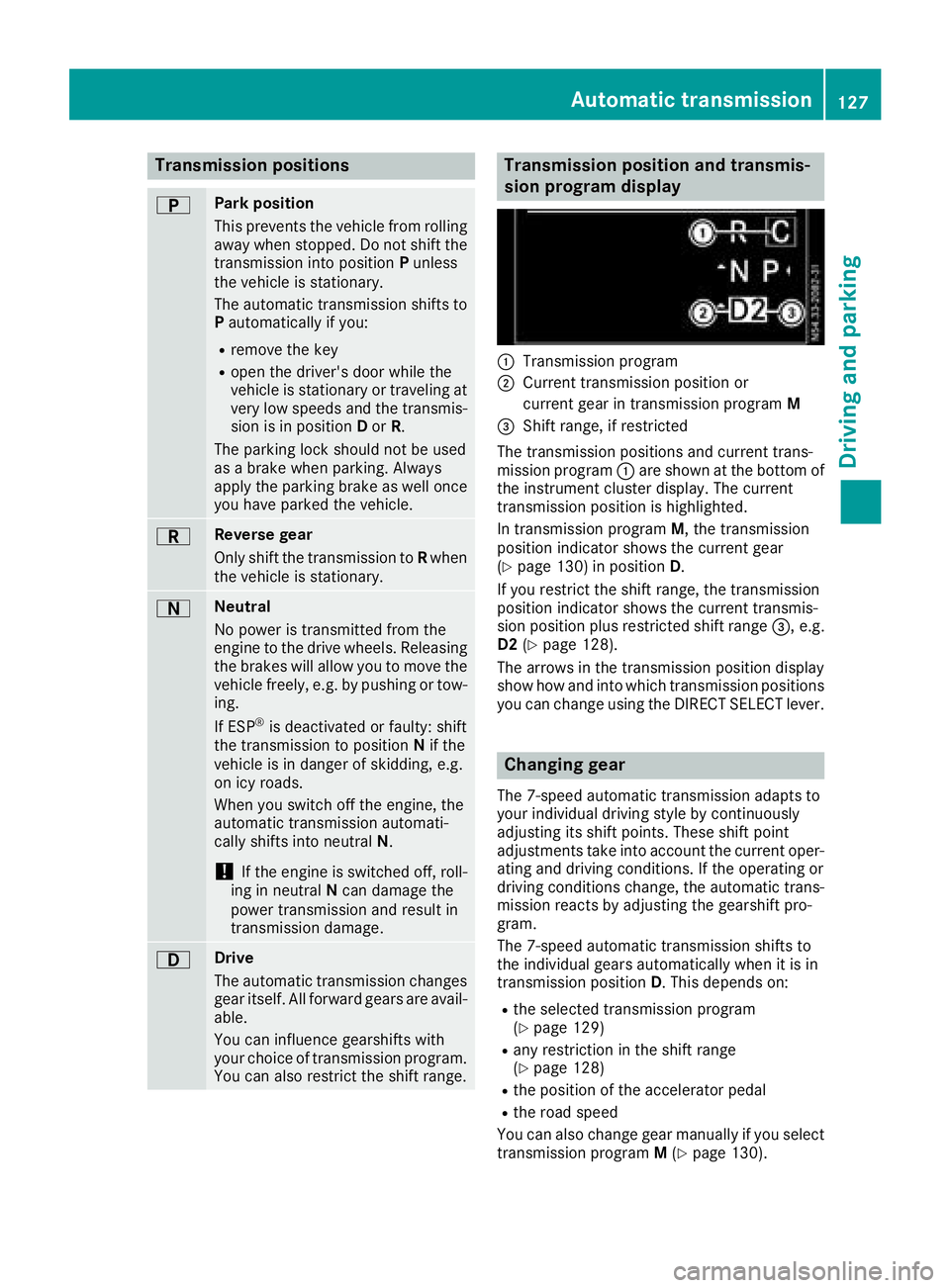
Transmission position and transmis-
sion program display
:Transmission program
;Current transmission positio nor
current gear in transmission program M
=Shift range,ifrestricted
The transmission positions and current trans-
mission program :ares hown at the bottom of
the instrument cluster display. The current
transmission positio nish ighlighted.
In transmission program M,the transmission
positio nindicator shows the current gear
(
Ypage 130 )inposition D.
If yo urestric tthe shift range ,the transmission
positio nindicator shows the current transmis-
sion positio nplusr estricted shift range =,e.g.
D2 (
Ypage 128).
The arrow sinthe transmission positio ndisplay
sho whow and into which transmission positions
yo uc an change using the DIRECT SELECTl ever.
Changin ggear
The 7-spee dautomatic transmission adapts to
your individual drivin gstyle by continuously
adjusting its shift points .These shift point
adjustments take into account the current oper-
ating and drivin gconditions. If the operating or
drivin gconditions change ,the automatic trans-
mission reacts by adjusting the gearshift pro-
gram.
The 7-spee dautomatic transmission shifts to
the individual gear sautomaticall ywhenitisi n
transmission position D.T hisd epen ds on:
Rthe selecte dtransmission program
(Ypage 129)
Rany restrictio ninthe shift range
(Ypage 128)
Rthe positio nofthe accelerator pedal
Rthe roa dspeed
Yo uc an also change gear manuall yifyouselect
transmission program M(
Ypage 130).
Automati ctransmission127
Driving an dparking
Z
Page 132 of 310
Rockingthe vehicle free
At speeds up to 5mph (9 km/h )you can switch
back and forth between drive position Dand
reverse gear Rwithou tapplyin gthe brakes. This
helps when rocking the vehicl eoutof snow or
slush.
XPush the DIREC TSELECT lever alternately up
and dow nbeyond the firs tpoint of resistance.
Towin gatrailer
XDepending on the downhil lgradient, limit the
shift rang e(Ypage 128 )orshift manually into
al ower gear (Ypag e130) in which the engine
wil loperate in the middle of the engine speed
range. This als oapplie sifcruise control is
activated.
Manual gearshifting
General notes
If you select transmission program M,automatic
gearshifting is deactivated and manua lgear-
shifting is automatically activated .You must
then permanently change geary ourself for as
long as the transmission programiss elected.
Permanent manua lgearshifting is deactivated
automatically when you switch from transmis-
sion program Mto another transmission pro-
gram. The automatic transmission then shifts
gears automatically. The display shows the
selected transmission programa nd transmis-
sion position Dagain.
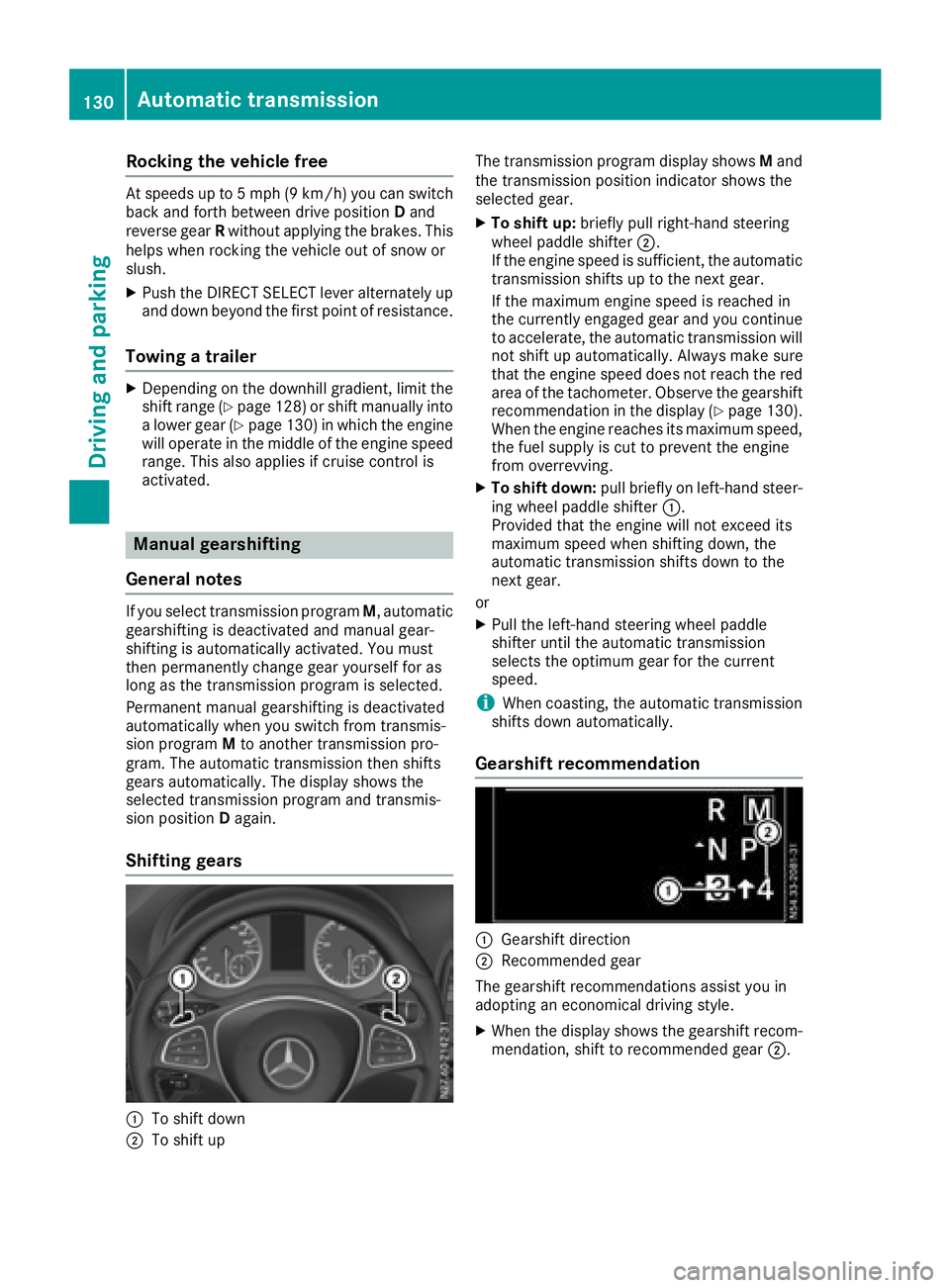
Shifting gears
:To shift down
;To shift up The transmission programd
isplay showsMand
the transmission position indicator shows the
selected gear.
XTo shift up: brieflypullr ight-hand steering
whee lpaddle shifter ;.
If the engine speediss ufficient, the automatic
transmission shifts up to the next gear.
If the maximu mengine speedisr eachedin
the currently engage dgear and you continue
to accelerate, the automatic transmission will
not shift up automatically. Always make sure
that the engine speedd oes not reach the red
area of the tachometer. Observe the gearshift
recommendation in the display (
Ypag e130).
When the engine reache sits maximu mspeed,
the fuel supply is cut to prevent the engine
from overrevving.
XTo shift down: pullbriefl yonl eft-hand steer-
ing whee lpaddle shifter :.
Provided that the engine wil lnot exceed its
maximu mspeedw hen shifting down, the
automatic transmission shifts down to the
next gear.
or
XPul lthe left-hand steering whee lpaddle
shifter until the automatic transmission
selects the optimumg ear for the current
speed.
iWhen coasting, the automatic transmission
shifts down automatically.
Gearshift recommendation
:Gearshift direction
;Recommended gear
The gearshift recommendations assist you in
adopting an economicald riving style.
XWhen the display shows the gearshift recom-
mendation, shift to recommended gear ;.
130Automatic transmission
Driving and parking
Page 135 of 310
GWARNING
If you leave children unsupervised in the vehi-
cle, they coul dset it in motion by, for example:
Rrelease the parking brake.
Rshift the automatic transmission out of the
parking position P.
Rstart the engine.
In addition, they may operate vehiclee quip-
ment and become trapped. There is arisk of
an accident and injury.
When leaving the vehicle, alway stake the
SmartKey with you and lock the vehicle. Never
leave children unsupervised in the vehicle.
!Always secure the vehiclec orrectly against
rolling away. Otherwise, the vehicleori ts driv-
etrain coul dbedamaged.
!When the vehicleisp arked,alway sremove
the key to prevent the battery from becoming
discharged.
Always park you rvehicl esafel yand secure it
against rolling away. When parking, observe the
lega lrequirements of the country in which you
are currently driving.
To ensure that the vehicleisp roperly secured
against rolling awa yunintentionally:
Rthe parking brake must be firmly applied
Rthe transmission must be in position Pand the
key must be removed from the ignitio nlock
Ron steep uphill or downhill gradients, the front
wheels must be turned toward sthe curb
Parking brake
GWARNING
If you leave children unsupervised in the vehi-
cle, they coul dset it in motion by, for example:
Rrelease the parking brake.
Rshift the automatic transmission out of the
parking position P.
Rstart the engine.
In addition, they may operate vehiclee quip-
ment and become trapped. There is arisk of
an accident and injury.
When leaving the vehicle, alway stake the
SmartKey with you and lock the vehicle. Never
leave children unsupervised in the vehicle.
GWARNING
If you must brake the vehiclew ith the parking
brake, the braking distance is considerably
longer and the wheels coul dlock. There is an
increased dange rofskidding and accidents.
Only use the parking brake to brake the vehi-
cle when the service brake is faulty. Do not
apply the parking brake too firmly .Ifthe
wheels lock, release the parking brake until
the wheels begint urning again.
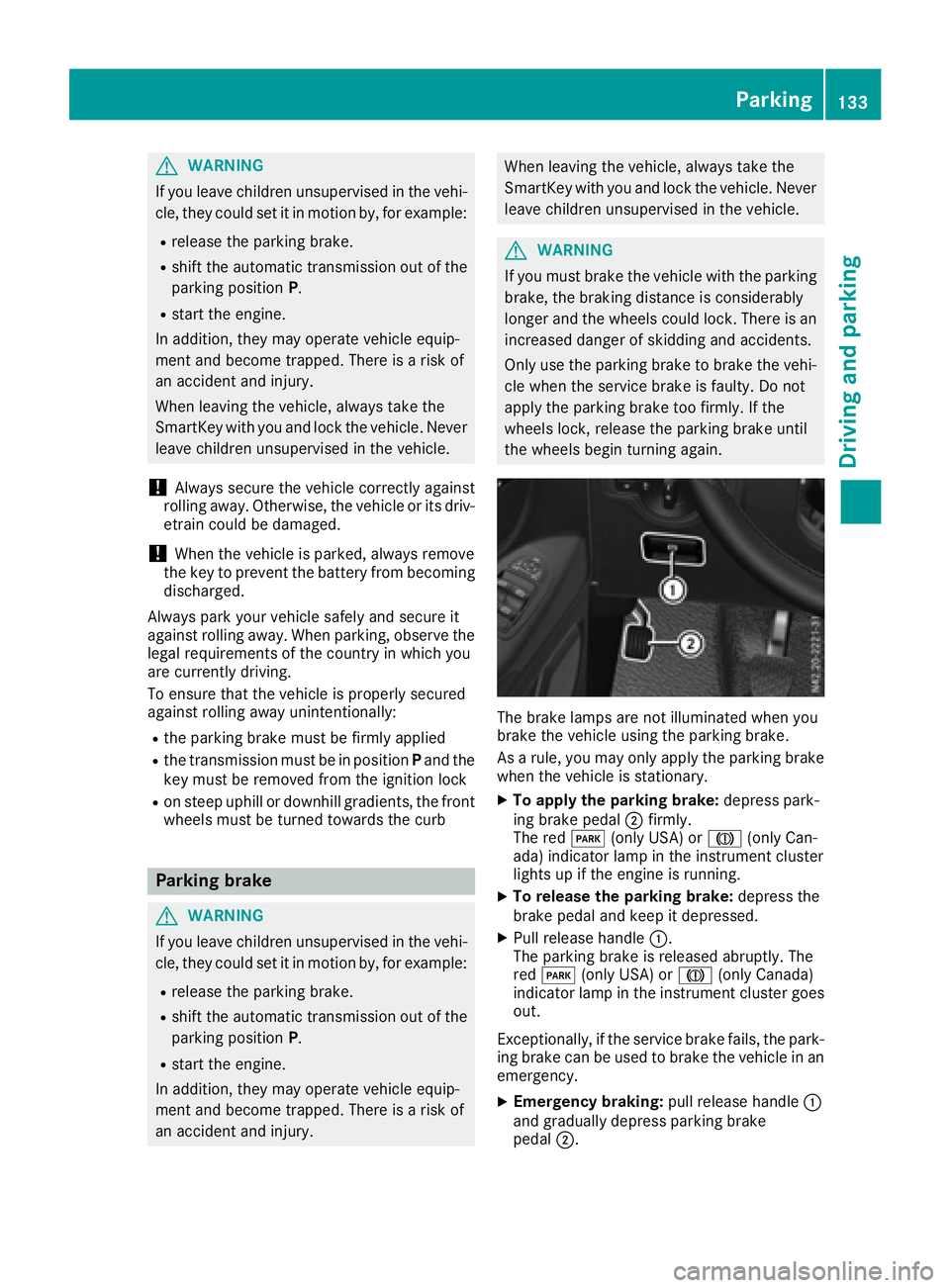
The brake lampsare not illuminated when you
brake the vehicleu sing the parking brake.
As arule ,you may only apply the parking brake
when the vehicleiss tationary.
XTo apply the parking brake: depress park-
ing brake pedal ;firmly.
The red F(only USA) or J(only Can-
ada )indicator lamp in the instrument cluster
lights up if the engine is running.
XTo release the parking brake: depress the
brake pedala nd keep it depressed.
XPullrelease handle :.
The parking brake is released abruptly.T he
red F (only USA) or J(only Canada)
indicator lamp in the instrument cluster goes
out.
Exceptionally,ift he service brake fails, the park-
ing brake can be used to brake the vehicleina n
emergency.
XEmergency braking: pullrelease handle :
and gradually depress parking brake
pedal ;.
Parking133
Driving and parking
Z
Page 138 of 310
Mercedes-Benzrecommends that you have the
maximum permissible speed programed at a
Mercedes-BenzC ommercial Van Center.
Before overtaking, take into consideration that
the engine speed limiter prevents the speed
increasing beyond the programed maximum
speed.
Driving abroad
Service
An extensive network of authorized Mercedes-
Benz Centers is also at your disposal when you
are traveling abroad. Nevertheless, please bear
in mind that service facilities or replacement
parts may not always be immediately available.
The relevant workshop directories are available
from any Mercedes-BenzC ommercial Van Cen-
ter.
Fuel
In some countries, only fuels with ahigher sulfur
content are available.
Unsuitable fuel can cause engine damage. You
will find information about fuel under "Service
products and capacities" (
Ypage 296).
Low-beam headlamps
General notes
When driving in countries in which traffic drives
on the opposite side of the road to the country
where the vehicle is registered, you must switch
the headlamps to symmetrical low beam. This
prevents oncomingt raffic from being blinded.
Symmetrical low beam does not illuminate as
large an area of the edge of the road.
Vehicles with halogen headlamps
The headlamps do not need to be switched to
symmetrical low beam. The legal requirements
of countries in which traffic drives on the oppo- site side of the road to the countryw here the
vehicle is registered are met without the need to
convert the headlamps.
Transport by rail
Transporting your vehicle by rail may be subject to certain restrictions or require special meas- ures to be taken in some countries due to vary-
ing tunnel heights and loading standards.
You can obtain information on this from any
Mercedes-BenzC
ommercial Van Center.
Brakes
Important safety notes
GWARNING
If you shift down on aslippery road surface in
an attempt to increase the engine's braking
effect,t he drive wheels could lose their grip.
There is an increased danger of skidding and
accidents.
Do not shift down for additional engine brak-
ing on aslippery road surface.
Downhill gradients
!Depressing the brake pedal constantly
results in excessive and premature wear to
the brake pads.
This also applies to automatic braking if you
have activated cruise control.
On long and steep downhill gradients, you
should change down to shift range 2or1 in
good time (
Ypage 128).
This should be observed in particular when driv-
ing with aladen vehicle and when towing a
trailer.
You thereby make use of the braking effect of
the engine and do not have to brake as often to
maintain the speed. This relieves the load on the
service brake and prevents the brakes from
overheating and wearing too quickly.
Heavy and light loads
GWARNING
If you rest your foot on the brake pedal while
driving, the braking system can overheat. This increases the stopping distance and can even
cause the braking system to fail. There is a
risk of an accident.
Never use the brake pedal as afootrest.N ever
depress the brake pedal and the accelerator
pedal at the same time.
136Driving tips
Driving and parking