warning light MERCEDES-BENZ METRIS 2016 MY16 Operator’s Manual
[x] Cancel search | Manufacturer: MERCEDES-BENZ, Model Year: 2016, Model line: METRIS, Model: MERCEDES-BENZ METRIS 2016Pages: 310, PDF Size: 7.28 MB
Page 36 of 310
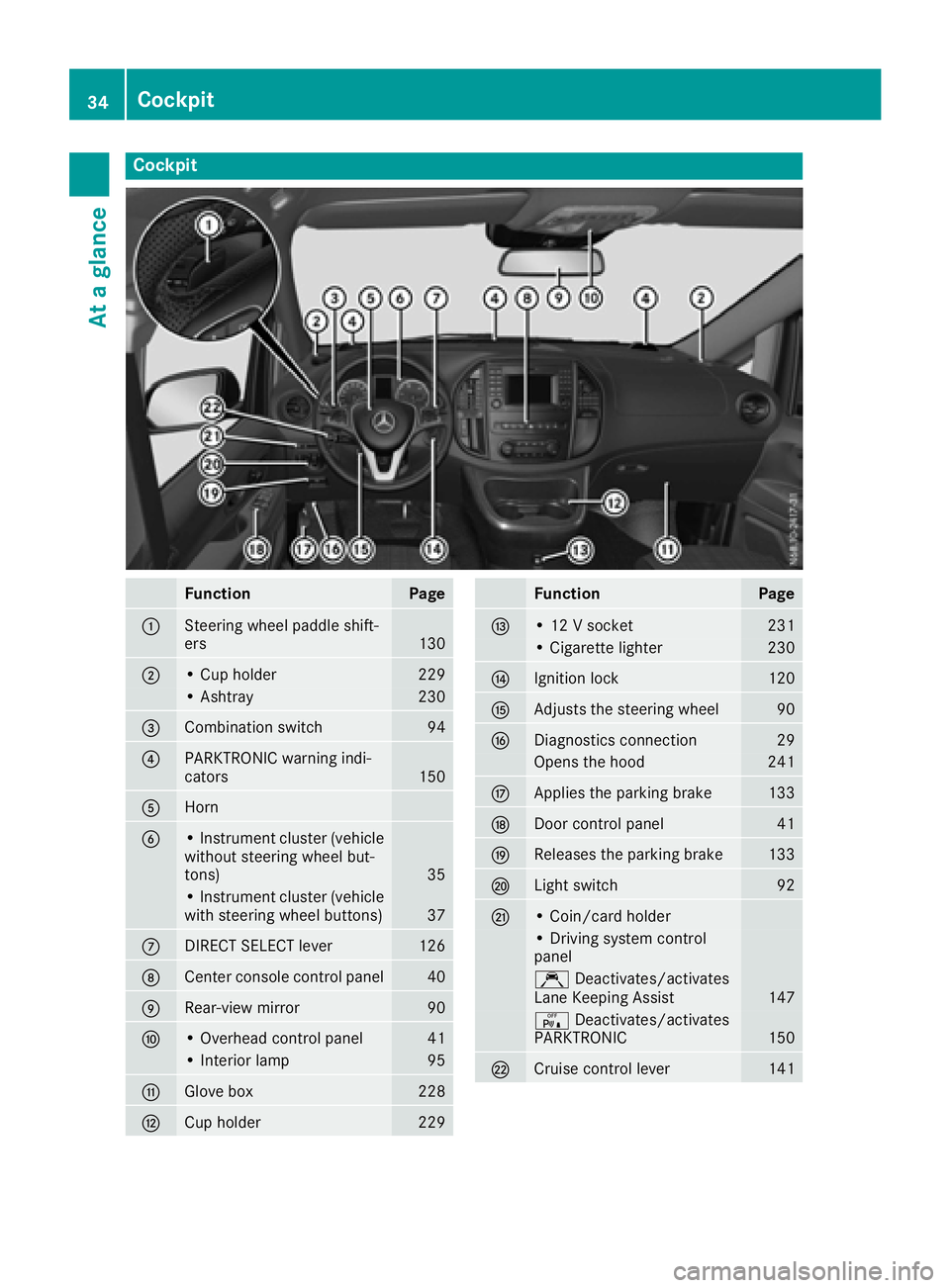
Cockpit
FunctionPage
:Steering wheel paddle shift-
ers130
;•Cup holder229
•Ashtr ay230
=Combination switch94
?PARKTRONIC warning indi-
cators150
AHorn
B•Instr umentc luster(vehicle
without steering wheel but-
tons)
35
•I nstr umentc luster(vehicle
withs teering wheel buttons)37
CDIRECT SELECT lever126
DCente rconsole control panel40
ERear-view mirror90
F•O verhead control panel41
•Inter ior lamp95
GGlove box228
HCup holder229
FunctionPage
I•12Vs ocket231
•Cigarett elighter230
JIgnition lock120
KAdjusts th esteering wheel90
LDiagnostics connection29
Openst hehood241
MApplies th eparking brake133
NDoor control panel41
OReleasest heparking brake133
PLights witch92
Q•Coin/card holder
•D rivin gs ystem control
panel
Ç Deactivates/activates
LaneK eeping Assist147
cDeactivates/activates
PARKTRONIC150
RCruis econtrol lever141
34Cockpit
At ag lance
Page 45 of 310
Useful information
This Operator's Manual describes all models as
well as standard and optional equipment of your
vehicle that were available at the time of going
to print.Country-specific variation sare possi-
ble. Note that your vehicle may not be equipped
with all of the described functions. This also
applies to system sand function srelevantt o
safety.
Read the information on qualified specialist
workshops (
Ypage 29).
Occupant safety
Restraint system introduction
The restraint system can reduce the risk of vehi- cle occupants comingi ntoc ontact with parts of
the vehicle' sinterior in the eventofana ccident.
Furthermore, the restraint system may also
reduce the forces exerted on the vehicle occu-
pant swhen an acciden toccurs.
The restraint system includes:
RSeat belt system
RAir bags
RChild restraint system
RChild seat securings ystem
The components of the restraint system work in
conjunction with each other .They can only offer
the intended level of protection if all vehicle
occupants:
Rare correctly wearing their seat belts.
(Ypage 45)
Radjust their seat and head restraint properly
(Ypage 83).
The driver is also responsible for ensurin gthat
the steering wheel has been correctly posi-
tioned. Observet he information relatin gtothe
correct driver'ss eat position (
Ypage 83).
Always ensure the air bag can inflat eproperly if
deployed (
Ypage 48).
An air bag supplement sacorrectly fastened
seat belt. As an additional safetyd evice, the air
bag increases the level of protection for vehicle
occupants in the eventofana ccident. For exam-
ple, if the protection already provided by acor-
rectly fastened seat belt will suffice, the air bags
are not deployed. Furthermore, only the air bags
that would increase the degree of protection
afforded to the vehicle occupants in the evento fan acciden
tare deployed. Seat belts and air
bags generally do not protect against objects
penetratin gthe vehicle from the outside.
Information on restraint system operatio ncan
be found under "TriggeringofE mergencyTen-
sionin gDevices and air bags" (
Ypage 54).
See “Children in the vehicle” for information on children traveling with you as well as vehicle
restraint system s(
Ypage 56).
Important safetyn otes
GWARNING
If the restraint system is modified, it may no
longer work as intended. The restraint system
may then not performi ts intended protective
function by failing in an acciden tortriggering
unexpectedly, for example. There is an
increased risk of injury, possibly even fatal.
Never modify parts of the restraint system .Do
not attempt to modify the wiring as well as
electronic components or their software.
If it is necessary to modify an air bag system to
accommodate aperson with disabilities, con-
tact aMercedes-Benz Commercial Van Cen-
ter for details. USA only: contact our
Mercedes-Benz Customer Assistance Center
at 1-877-762-8267 for details.
Restraint system warning lamp
The restraint system sfunction sare checked
after the ignition is switched on and at regular
intervals when the engin eisrunning. This allows
malfunction stobedetected in good time.
The 6 restraint system warnin glamp in the
instrumentc luster lights up when the ignition is
switched on. It goes out no later than afew sec-
onds after the vehicle is started. The compo-
nents of the restraint system are on standby.
Am alfunction has occurred if the 6restraint
system warnin glamp:
Rdoes not light up after the ignition is switched
on.
Rdoes not go out after afew seconds when the
engin eisrunning.
Rlights up again when the engin eisrunning.
Occupant safety43
Safety
Z
Page 46 of 310
GWARNING
If restraint system is malfunctioning, restraint
system components may be triggere dunin-
tentionall yormight not be triggere datall in
the event of an accident with ahigh rate of
vehicled eceleration. This can affect the Emer-
gency Tensioning Device or air bag ,for exam-
ple.T his poses an increased risk of injury or
even fatal injury.
Have the restraint system checked and
repaired in aqualified specialist worksho pas
soon as possible.
PASSENGER AI RBAG OFF indicator
lamp
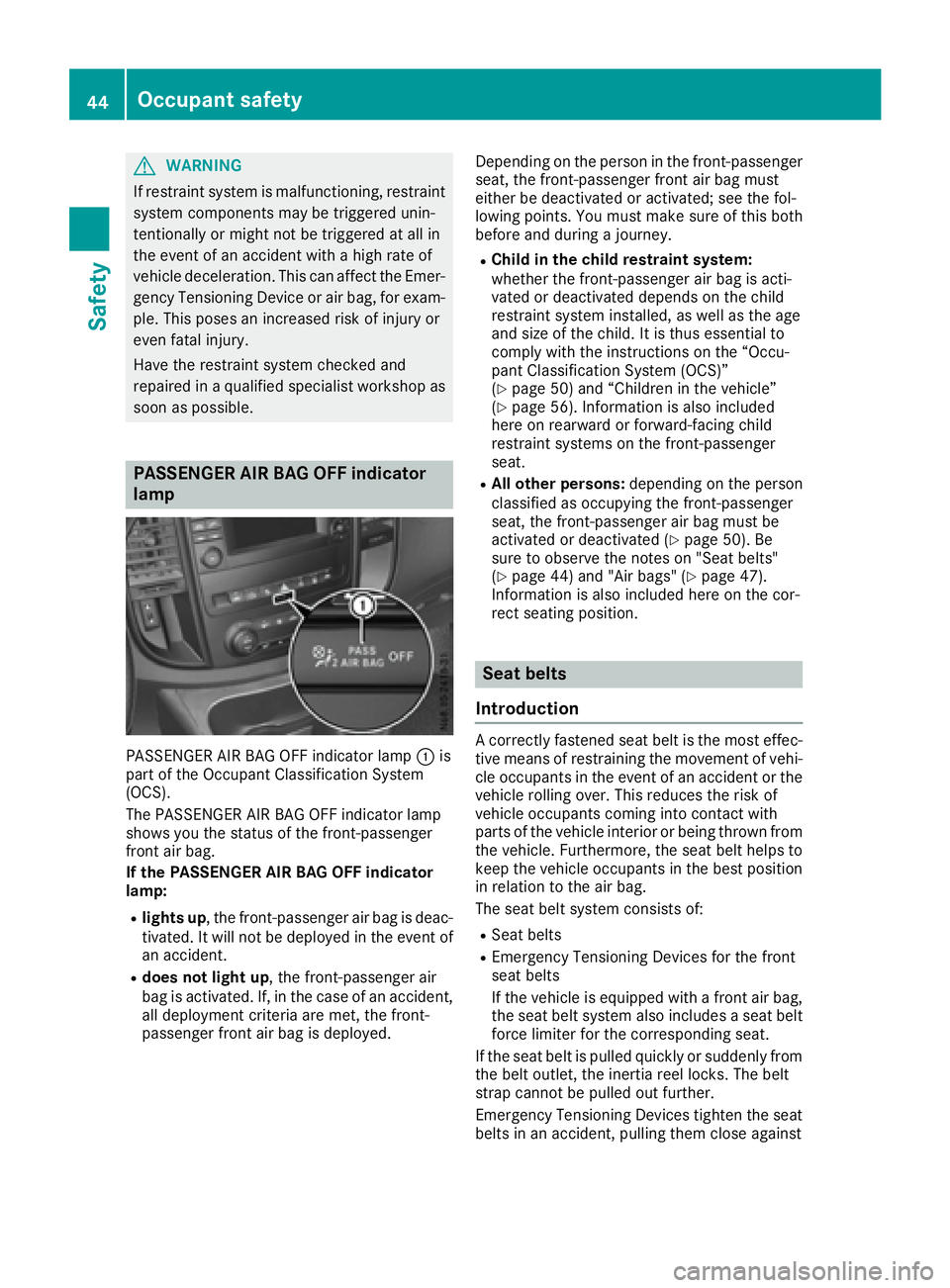
PASSENGER AIR BAG OFF indicator lamp :is
part of the Occupant Classification System
(OCS).
The PASSENGER AIR BAG OFF indicator lamp
showsy ou the status of the front-passenger
front air bag.
If the PASSENGER AI RBAG OFF indicator
lamp:
Rlights up,t he front-passenge rair bag is deac-
tivated. It wil lnot be deploye dinthe event of
an accident.
Rdoes not light up,t he front-passengerair
bag is activated. If, in the case of an accident,
all deployment criteria are met, the front-
passenger front air bag is deployed. Depending on the personint
he front-passenger
seat, the front-passenge rfront air bag must
either be deactivated or activated; see the fol-
lowing points. You must make sure of this both
before and during ajourney.
RChil dint he chil drestraint system:
whethe rthe front-passenge rair bag is acti-
vated or deactivated depends on the child
restraint system installed, as wel lasthe age
and size of the child .Itisthus essentialt o
comply with the instructions on the “Occu-
pant Classification System (OCS)”
(
Ypag e50) and “Childre ninthe vehicle”
(Ypag e56). Information is als oincluded
here on rearward or forward-facing child
restraint systems on the front-passenger
seat.
RAll other persons: depending on the person
classifie dasoccupying the front-passenger
seat, the front-passenge rair bag must be
activated or deactivated (
Ypag e50). Be
sure to observe the notes on "Sea tbelts"
(
Ypag e44) and "Air bags" (Ypag e47).
Information is als oincluded here on the cor-
rect seating position.
Seat belts
Introduction
Ac orrectly fastened seat beltist he most effec-
tive means of restraining the movement of vehi- cle occupants in the event of an accident or the
vehicler olling over. This reduces the risk of
vehicleo ccupants coming into contact with
parts of the vehiclei nterior or being thrown from
the vehicle. Furthermore ,the seat belth elpsto
keep the vehicleo ccupants in the best position
in relation to the air bag.
The seat belts ystem consists of:
RSeat belts
REmergency Tensioning Devices for the front
seat belts
If the vehicleise quipped withafront air bag,
the seat belts ystem alsoincludes aseat belt
force limiter for the corresponding seat.
If the seat beltisp ulled quickly or suddenly from
the belto utlet, the inertia reel locks. The belt
strap cannot be pulled out further.
Emergency Tensioning Devices tighten the seat belts in an accident, pulling them close against
44Occupant safety
Safety
Page 49 of 310
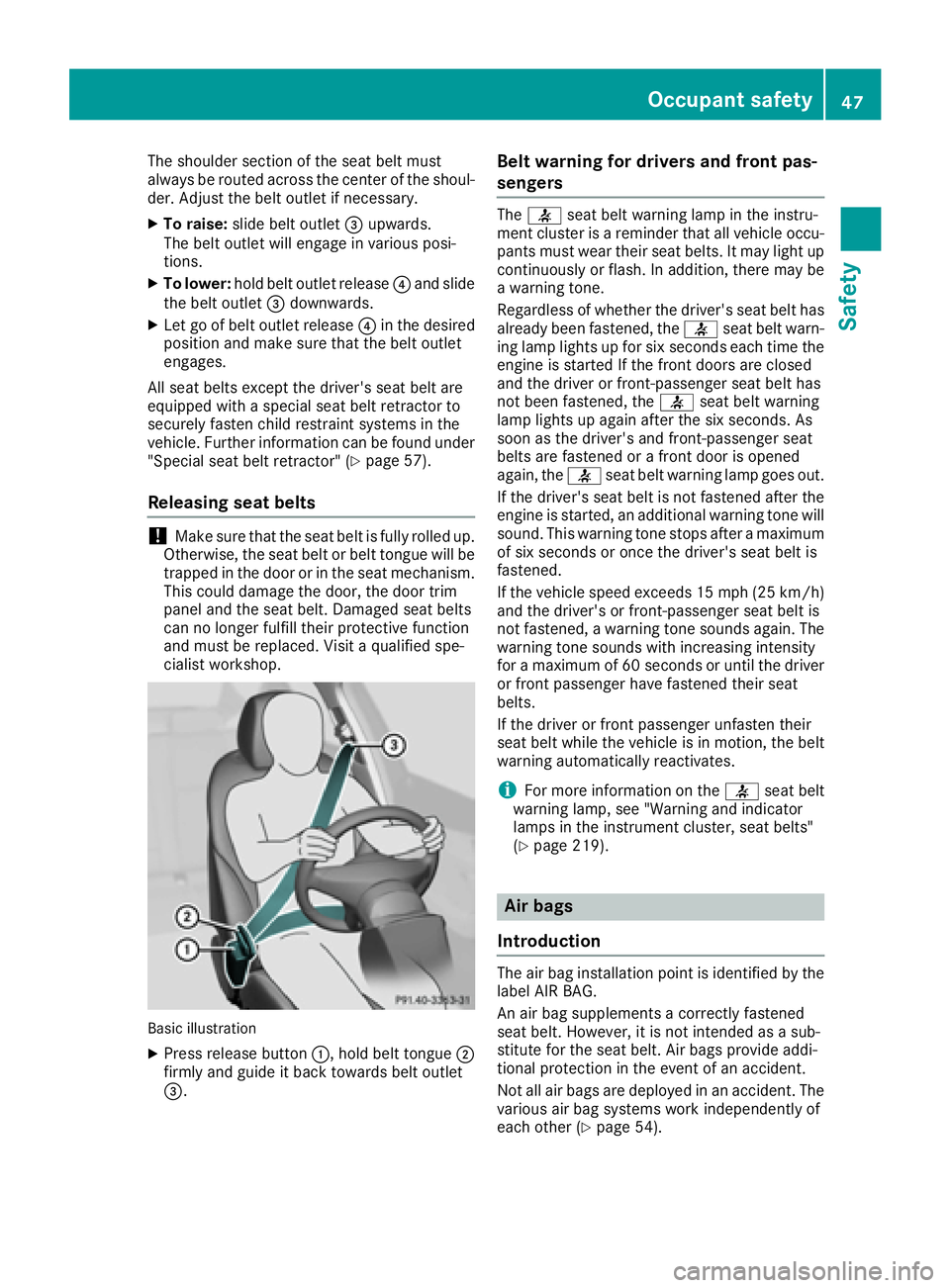
The shoulder section of the seat belt must
alwaysberouted across the center of the shoul-
der. Adjust the belt outlet if necessary.
XTo raise: slide belt outlet =upwards.
The belt outlet will engage in various posi-
tions.
XTo lower: hold belt outlet release ?and slide
the belt outlet =downwards.
XLet go of belt outlet release ?in the desired
position and make sure that the belt outlet
engages.
All seat belts except the driver's seat belt are
equipped with aspecial seat belt retractor to
securely fasten child restraint systems in the
vehicle. Further information can be found under
"Special seat belt retractor" (
Ypage 57).
Releasing seat belts
!Make sure that the seat belt is fully rolled up.
Otherwise, the seat belt or belt tongue will be
trapped in the door or in the seat mechanism.
This could damage the door, the door trim
panel and the seat belt. Damaged seat belts
can no longer fulfill their protective function
and must be replaced. Visit aqualified spe-
cialist workshop.
Basic illustration
XPress release button :,hold belt tongue ;
firmly and guide it back towards belt outlet
=.
Belt warning for driver sand front pas-
sengers
The 7 seat belt warning lamp in the instru-
ment cluster is areminder that all vehicle occu-
pants must wear their seat belts. It may light up
continuously or flash. In addition, there may be
aw arning tone.
Regardless of whether the driver's seat belt has
already been fastened, the 7seat belt warn-
ing lamp lights up for six seconds each time the engine is started If the front doors are closed
and the driver or front-passenger seat belt has
not been fastened, the 7seat belt warning
lamp lights up again after the six seconds. As
soon as the driver's and front-passenger seat
belts are fastened or afront door is opened
again, the 7seat belt warning lamp goes out.
If the driver's seat belt is not fastened after the
engine is started, an additional warning ton ewill
sound. This warning ton estops after amaximum
of six seconds or once the driver's seat belt is
fastened.
If the vehicle speed exceeds 15 mph (2 5km/ h)
and th edriver'sorf ront-passenger seat belt is
no tfastened, awarning tone sounds again.T he
warning tone sounds with increasing intensity
for am aximum of 60 seconds or until th edriver
or frontp assenger have fastene dtheir seat
belts.
If th edriver or frontp assenger unfasten their
seat belt while th evehicle is in motion,t hebelt
warning automatically reactivates.
iFor morei nformationonthe7 seat belt
warning lamp, see "Warning and indicator
lamps in th einstrumentc luster, seat belts"
(
Ypage 219).
Air bags
Introduction
The air bag installatio npointisi dentified by the
label AI RBAG.
An air bag supplements acorrectly fastened
seat belt.H owever,itisnotintended as asub-
stitut efor th eseat belt.A ir bags provide addi-
tional protection in th eeven tofana ccident.
Not all air bags are deployed in an accident. The
various air bag systems work independently of
each other (
Ypage 54).
Occupant safety47
Safety
Z
Page 53 of 310
Occupant Classification System (OCS)
operation
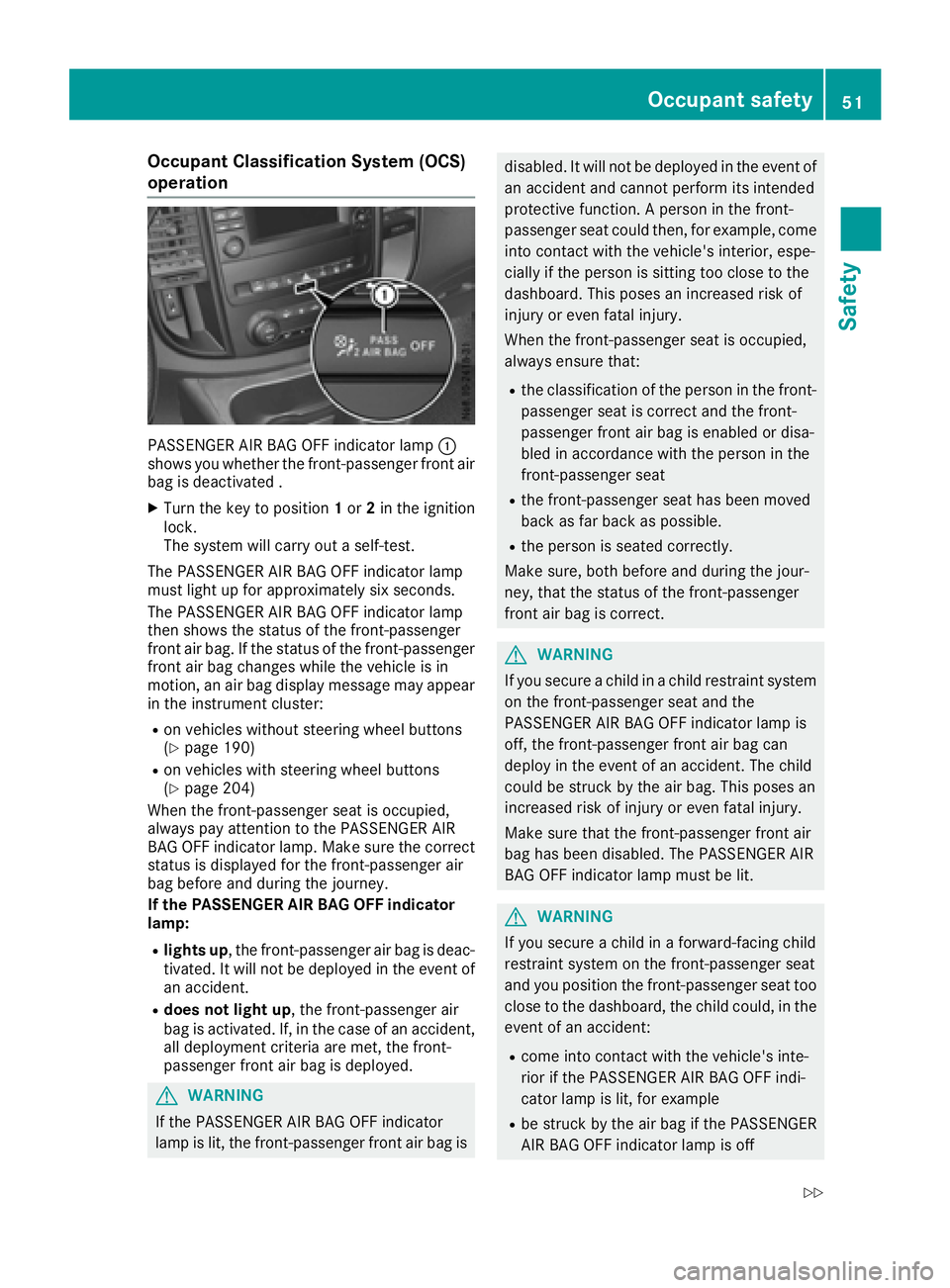
PASSENGER AIR BAG OFF indicator lamp:
shows you whether the front-passenger fronta ir
bag is deactivated .
XTurn the key to position 1or 2in the ignition
lock.
The system will carry out aself-test.
The PASSENGER AIR BAG OFF indicator lamp
must light up for approximately six seconds.
The PASSENGER AIR BAG OFF indicator lamp
then shows the status of the front-passenger
fronta ir bag. If the status of the front-passenger
fronta ir bag changes while the vehicle is in
motion ,anair bag display message may appear
in the instrument cluster:
Ron vehicles without steering wheel buttons
(Ypage 190)
Ron vehicles with steering wheel buttons
(Ypage 204)
When the front-passenger seat is occupied,
alwaysp ay attention to the PASSENGER AIR
BAG OFF indicator lamp. Make sure the correct
status is displayed for the front-passenger air
bag before and during the journey.
If the PASSENGER AIR BAG OFF indicator
lamp:
Rlights up ,the front-passenger air bag is deac-
tivated. It will not be deployed in the event of
an accident.
Rdoes not light up,t he front-passenger air
bag is activated. If, in the case of an accident,
all deployment criteria are met, the front-
passenger fronta ir bag is deployed.
GWARNING
If the PASSENGER AIR BAG OFF indicator
lamp is lit, the front-passenger fronta ir bag is
disabled. It will not be deployed in the event of
an accidenta nd cannot perform its intended
protective function .Aperson in the front-
passenger seat could then ,for example, come
into contact with the vehicle's interior, espe-
cially if the person is sitting too close to the
dashboard. This poses an increased risk of
injur yore ven fatal injury.
When the front-passenger seat is occupied,
alwayse nsure that:
Rthe classification of the person in the front-
passenger seat is correct and the front-
passenger fronta ir bag is enabled or disa-
bled in accordance with the person in the
front-passenger seat
Rthe front-passenger seat has been moved
back as far back as possible.
Rthe person is seated correctly.
Make sure, both before and during the jour-
ney, that the status of the front-passenger
fronta ir bag is correct.
GWARNING
If you secure achild in achild restraint system
on the front-passenger seat and the
PASSENGER AIR BAG OFF indicator lamp is
off, the front-passenger fronta ir bag can
deploy in the event of an accident. The child
could be struc kbythe air bag. This poses an
increased risk of injur yoreven fatal injury.
Make sure that the front-passenger fronta ir
bag has been disabled. The PASSENGER AIR
BAG OFF indicator lamp must be lit.
GWARNING
If you secure achild in aforward-facing child
restraint system on the front-passenger seat
and you position the front-passenger seat too close to the dashboard, the child could, in the
event of an accident:
Rcome into contact with the vehicle's inte-
rior if the PASSENGER AIR BAG OFF indi-
cator lamp is lit, for example
Rbe struck by the air bag if the PASSENGER
AIR BAG OFF indicator lamp is off
Occupant safety51
Safety
Z
Page 54 of 310
This poses an increased risk of injury or evenfatal injury.
Move the front-passenger seat as far back as
possible. Always make sure that the shoulder belt strap is correctly routed from the vehicle
belt sash guide to the shoulder belt guide on
the child restraint system. The shoulder belt
strap must be routed forwards and down-
wards from the vehicle belt sash guide. If nec-
essary, adjust the vehicle belt sash guide and
the front-passenger seat accordingly. Always
observe the child restraint system manufac-
turer's installation instructions.
If OCS determines that:
Rthe front-passenger seat is unoccupied, the
PASSENGER AIR BAG OFF indicator lamp
lights up after the system self-test and
remains lit. This indicates that the front-
passenger air bag has been deactivated.
Rthe front-passenger seat is occupied by a
child of up to 12 months old in astandard
child restraint system, the PASSENGER AIR
BAG OFF indicator lamp lights up after the
system self-test and remains lit. This indi-
cates that the front-passenger air bag has
been deactivated.
But even in the case of a12-month-old child in
as tandard child restraint system, the
PASSENGER AIR BAG OFF indicator lamp can
go out after the system self-test. This indi-
cates that the front-passenger air bag has
been activated. The classification depends,
among other things, on the child restraint sys-
tem and the size and weight of the child. In
this case, install the child restraint system on
as uitable rear seat.
Rthe front-passenger seat is occupied by aper-
son of smaller stature (e.g. ateenager or
small adult), the PASSENGER AIR BAG OFF
indicator lamp lights up and remains lit after
the system self-test depending on the result
of the classification or, alternatively, goes out.
-If the PASSENGER AIR BAG OFF indicator
lamp is not lit, move the front-passenger
seat as far back as possible. Alternatively, a person of smaller stature can sit on
arear
seat.
-If the PASSENGER AIR BAG OFF indicator
lamp is lit, aperson of smaller stature
should not use the front-passenger seat.
Rthe front-passenger seat is occupied by an
adult or aperson of astature corresponding
t o
that of an adult, the PASSENGER AIR BAG
OFF indicator lamp goes out after the system
self-test. This indicates that the front-
passenger air bag has been activated.
If children are also traveling in the vehicle,
please observe the instructions about “Children
in the vehicle” (
Ypage 56).
If OCS is malfunctioning, the red 6restraint
system warning lamp in the instrument cluster
and the PASSENGER AIR BAG OFF indicator
lamp light up simultaneously. This signals that
the front-passenger air bag has been deactiva-
ted and will not be deployed in the event of an
accident .Have the system checked by aquali-
fied technician as soon as possible. Consult a
Mercedes-Benz Commercial Van Center. The
front-passenger seat should only be repaired at aM ercedes-Benz Commercial Van Center.
If the front-passenger seat, the seat cover or the
upholstery is damaged, have the necessary
repair work carried out at aMercedes-Benz
Commercial Van Center.
For safety reasons, Mercedes-Benz recom-
mends that you only use seating accessories
that have been specially approved for
Mercedes-Benz vehicles.
If the driver's air bag deploys, this does not
mean the front-passenger air bag must also
deploy. The Occupant Classification System
(OCS) classifies occupantsont he front-
passenger seat. Dependin gonthe outcome, the
front-passenger air bag is either activated or
deactivated.
System self-test
GDANGER
If the PASSENGER AIR BAG OFF indicator
lamp does not light up during the system self-
test ,then the system is malfunctioning. The
front-passenger front air bag might be trig-
gered unintentionally or might not be trig-
gered at all in the event of an accident with
high deceleration. This poses an increased
risk of injury or even fatal injury.
52Occupant safety
Safety
Page 56 of 310
Problems with the Occupant Classification System (OCS)
Be sure to observe the notes on "System self-test"(Ypage 52).
ProblemPossible causes/consequences andMSolutions
The PASSENGER AIR
BAG OFF indicator lamp
lights up and remains lit,
even though the front-
passenger seat is occu-
pied by an adult oraper-
son of astature corre-
sponding to that of an
adult.The classification of the person on the front-passenger seat is incor-
rect.
XMake sure the conditionsf orac orrect classification of the person
on the front-passenger seat are met (Ypage 50).
XIf the PASSENGER AIR BAG OFF indicator lamp remains lit, the front-
passenger seat may not be used.
XHave OCS checked as soon as possible at aMercedes-Benz Com-
mercial Van Center.
The PASSENGER AIR
BAG OFF indicator lamp
does not light up and/or
does not stay on.
The front-passenger seat
is:
Runoccupied
Roccupied with the
weight of achild up to
twelve months old in a
child restraint system
OCS is malfunctioning.
XMake sure there is nothin gbetween the seat cushion and the child
seat.
XMake sure that the entire base of the child restraint system rests on
the seat cushion of the front-passenger seat. The backrest of the
forward-facing child restraint system must lie as flat as possible
against the backrest of the front-passenger seat. If necessary,
adjust the position of the front-passenger seat.
XWhen installing the child restraint system, make sure that the seat belt is tight. Do not pull the seat belt tight using the front-passenger
seat adjustment .This could result in the seat belt and the child
restraint system being pulled too tightly.
XCheck for correct installation of the child restraint system.
Make sure that the head restraint does not apply aload to the child
restraint system. If necessary, adjust the head restraint accord-
ingly.
XMake sure that no object sare applying additional weight onto the
seat.
XIf the PASSENGER AIR BAG OFF indicator lamp remains off, do not
install achild restraint system on the front-passenger seat. It is
recommended that you install the child restraint system on asuit-
able rear seat.
XHave OCS checked as soon as possible at aMercedes-Benz Com-
mercial Van Center.
Deployment of Emergency Tensioning
Devices and air bags
Important safety notes
GWARNING
The air bag parts are hot after an air bag has
been deployed. There is arisk of injury.
Do not touch the air bag parts. Have a
deploye dair bag replaced at aqualified spe-
cialist workshop as soon as possible.
GWARNING
Ad eployeda ir bag no longer offers any pro-
tection and cannot provide the intended pro-
tection in an accident. There is an increased
risk of injury.
54Occupant safety
Safety
Page 57 of 310
Have the vehicle towedtoaqualifiedspecial-
ist workshop in orde rtohavead eployed air
bagr eplaced.
It is important for your safety and that of any
passengers to hav edeployed ai rbagsr eplaced
and to hav eany malfunctioning ai rbags
repaired. Thisw illh elptom ake surethe ai rbags
continuetop erform theirp rotective functio nfor
the vehicle occupants in the event of acrash.
GWARNING
PyrotechnicE mergency Tensioning Devices
that hav ebeend eployed are no longer opera-
tiona land are unable to perform theiri nten-
ded protective function. Thisp oses an
increased risk of injury or even fata linjury.
Therefore, hav epyrotechnicE mergency Ten-
sioning Device swhich hav ebeent riggered
immediately replaced at aqualifie dspecialist
workshop.
If the Emergency Tensioning Device sorairbags
are deployed, yo uwillh earab angandasmall
amount of powder may also be released.T he
6 restraint system warning lamp will light up.
Only in rare case swillt he bang affect your hear-
ing. The powder released is generally not haz-
ardous to health, it coul dhowever cause short-
term breathing difficultie sinpeople with asthma
or other respiratory problems. If it is safe to do
so, yo ushould leave the vehicle immediately or
openaw indow in orde rtoprevent breathing
difficulties.
Air bags and pyrotechni cEmergency Tensioning
Device s(ETDs) contai nperchlorate material,
which may require specialh andling and regard
for the environment. Check with your loca lgov-
ernment’sd isposal guidelines .Calif ornia resi-
dents, see www.dtsc.ca.gov/
HazardousWaste/Perchlorate/index.cfm .
Methodofoperation
During the first stag eofacollision, the restraint
system control uni tevaluates important physi-
cal data relating to vehicle deceleratio noraccel-
eration, such as:
RDuration
RDirection
RIntensity Base
dont he evaluatio nofthis data, the
restraint system control uni ttriggers the Emer-
gency Tensioning Device sinthe event of afron-
tal or rear-end collision.
An Emergency Tensioning Device can only be
triggered if:
Rthe ignition is switched on
Rthe components of the restraint system are
operational .You can find furthe rinformation
unde r"Re straint system warning lamp"
(
Ypage 43)
Rthe bel ttongueisi nserted into the buckle on
the respective front seat
If the restraint system control uni tdetects ahigh
accident severity,a dditional components of the
restraint system are deployed independently of
one anothe rincertainfrontal collision situa-
tions:
RFront ai rbags
RWindow curtain ai rbag,ift he system deter-
mines that it can offer additional protection to
that provided by the seatb elt
Depending on the person occupying the front-
passenger seat, the front-passenger ai rbag is
activated or deactivated. The front-passenger
front ai rbag can only be deployed in an accident
if the PASSENGER AIR BAG OFF indicator lamp
is off. Observe the informatio nonthe
PASSENGER AIR BAG OFF indicator lamp
(
Ypage 44).
You rvehicle has dual-stage front ai rbags. Dur-
ing the first deployment stage, the front ai rbag
fills with propellant gas which reduces the risk of
injury .The second stag eisthen triggered withi
n
mi
lliseconds, filling the front ai rbag with the
maximum amount of propellant gas.
The deployment threshold sfor the Emergency
Tensioning Device sand ai rbagsa re calculated
on the basis of the vehicle deceleratio noraccel-
eration occurring at various points in the vehi-
cle. Thisp rocess is pre-emptiv einnature. The
ai rb ag mus tbed eployed on time, at the start of
the collision.
The rate of vehicle deceleratio noracceleration
and the directio nofthe force are essentially
determine dby:
Rdistribution of the force during the impact
Rcollision angle
Rdeformation characteristics of the vehicle
Rcharacteristics of the object with which the
vehicle has collided
Occupants afety55
Safety
Z
Page 58 of 310
Factors which can only be seenand measured
afte rthe collision has occurred do not pla ya
decisive roleint he deployment of an ai rbag,nor
do they provide an indication of ai rbag deploy-
ment.
The vehicle may be considerably deformed with-
outana irbagb eing deployed. Thisist he case if
only relativelye asilyd eformable parts have
bee nhit and ahighr ate of deceleration has not
bee nreached .Conversely ,anairbagm ay be
deployed even though the vehicle suffers only
minor deformation. Thisist he case if, for exam-
ple ,very rigid vehicle parts such as the longitu-
dina lbodym embers are hit in an accident and
the rate of deceleration is sufficient.
If the restraint system control uni tdetects aside
impact or that the vehicle is rolling over,t he rel-
evant restraint system components are
deployed independently of one another depend-
ing on the anticipated typ eofaccident.
RSide impact ai rbag and pelvis ai rbag on the
sid eonw hich an impact occurs, independ-
ently of the Emergency Tensioning Device and sea tbeltu sage
The sid eimpact ai rbag on the front-
passenger sid edeploy sunder the following
conditions:
-the OCS system detects that the front-
passenger sea tisoccupied or
-the bel ttongueh as engaged in the belt
buckle of the front-passenger seat.
RWindow curtain ai rbag on the sid eofthe col-
lision, regardless of sea tbeltu se and whether
front-passeng er se
ati
so ccupied
REmergency Tensioning Devices, if the system
determinesthat they can offera dditional pro-
tection for the vehicle occupants in this sit-
uation
RWindow curtain ai rbagsont he driver's and
front-passenger sides in certain rollover sit-
uations if the system determine sthat they
can offera dditional protection to that provi-
ded by the sea tbelt
iNot al lairbags are deployed in an accident.
The variousa irbags ystems wor kindepend-
ently of each other. How the ai
rbag system works is determined
by the severity of the accident detected,
especiall ythe vehicle deceleration or accel-
eration, and the apparent typ eofaccident:
Rfrontalc ollision
Rsideimpact
Rrollover
Automatic measures after an acci-
dent
Immediately afte ranaccident, the following
measures are implemented ,depending on the
typ eand severity of the impact:
Rthe hazard warning lamps are activated
Rthe emergency lighting is activated
Rthe vehicle doors are unlocked
Rthe front sid ewindow sare lowered
Rthe engine is switched off and the fue lsupply
is cut off
Children in the vehicle
Important safety notes
Accident statistics show that childre nsecured
in the rears eats are safer than childre nsecured
in the front seats. For this reason, Mercedes-
Benz stronglya dvise sthat yo uinstall achild
restraint system on arears eat. Children are
generally better protected there.
If ac hildy ounge rthan twelve years and under
5ft( 1.50 m) in height is traveling in the vehicle:
Ralways securethisc hild in arestraint system
approved for Mercedes-Benz vehicles .The
child restraint systemm ustbea ppropriate to
the age, weight and size of the child.
Rbe sure to observe the instructions and safety
note sint hissectio nina dditiontot he child
restraint systemm anufacturer's installation
instructions.
Ralways observe the instructions and safety
note sont he "Occupant Classification System
(OCS) "(
Ypage 50).
56Children in the vehicle
Safety
Page 59 of 310
GWARNING
If you leave children unsupervised in the vehi-
cle, they coul dset it in motion by, for example:
Rrelease the parking brake.
Rshift the automatic transmission out of the
parking position P.
Rstart the engine.
In addition, they may operate vehiclee quip-
ment and become trapped. There is arisk of
an accident and injury.
When leaving the vehicle, alway stake the
SmartKey with you and lock the vehicle. Never
leave children unsupervised in the vehicle.
GWARNING
If persons, particularl ychildren are subjected
to prolonged exposure to extreme heato r
cold, there is arisk of injury ,possibly even
fatal .Never leave children unattended in the
vehicle.
GWARNING
If the child restraint system is subjected to
direct sunlight, parts may get very hot. Chil-
dren may burn themselves on these parts,
particularl yonthe metal parts of the child
restraint system. There is arisk of injury.
If you leave the vehicle, taking the child with
you ,alway sensure that the child restraint
system is not exposedtod irect sunlight. Pro-
tect it with ablanket, for example. If the child
restraint system has been exposedtod irect
sunlight, let it cool downb efore securing the
child in it. Never leave children unattended in
the vehicle.
Always make sure that all vehicleo ccupants are
positioned properly in their seats and have cor-
rectly fastened their seat belts. Take particular
care with children.
Please take note of the safety notes on seat
belts (
Ypag e45) and the notes on their correct
use (Ypag e45).
Ab ooster seat may be necessary to achieve
propers eat beltp ositioning for children over
41 lbs (18 kg )until they reach aheight where a lap/shoulder beltc
an be installed properly with-
out abooster seat.
Special seat bel tretractor
GWARNING
If the seat beltisr eleased while driving, the
child restraint system wil lnolonger be
secure dproperly.T he special seat beltr etrac-
tor is disableda nd the inertia real draw sina
portion of the seat belt. The seat beltc annot
be immediatel yrefastened. There is an
increased risk of injury ,possibly even fatal.
Stop the vehiclei mmediately, paying atten-
tion to road and traffic conditions. Reactivate
the special seat beltr etractor and secure the
child restraint system properly.
All seat belts in the vehicle, except the driver's
seat belt, are equipped with aspecial seat belt
retractor. When activated, the special seat belt
retractor ensure sthat the seat beltc annot
slacken once the child seat is secured.
Installing achild restraint system:
XMake sure you observe the child restraint
system manufacturer's installation instruc-
tions.
XPul lthe seat belts moothly from the belto ut-
let.
XEngage seat beltt ongue in beltbuckle.
Activating the special seat beltr etractor:
XPullthe seat belto ut fullyand let the inertia
reel retract it again.
Whil ethe seat beltisr etracting, you should
hear aratcheting sound .The special seat belt
retractor is enabled.
XPush the child restraint system downsot hat
the seat beltist ight and does not loosen.
Removing the child restraint system and deac-
tivating the special seat beltr etractor:
XMake sure you observe the child restraint
system manufacturer's installation instruc-
tions.
XPress the release button of the seat belt
buckle and guide the seat beltt ongue back
toward sthe belts ash guide.
The special seat beltr etractor is deactivated.
Children in the vehicle57
Safety
Z