tow MERCEDES-BENZ METRIS 2016 MY16 Operator’s Manual
[x] Cancel search | Manufacturer: MERCEDES-BENZ, Model Year: 2016, Model line: METRIS, Model: MERCEDES-BENZ METRIS 2016Pages: 310, PDF Size: 7.28 MB
Page 266 of 310
XConnect thenegative terminal clam pofthe
jumper cabl etonegative terminal ;of the
donor veh icle's battery, and then to earth
contact ?of your own veh icle.
XInsertt hekeyintot he ignition locka nd start
th ee ngine.
You can no wswitch electrical consumers
back on excep tthe lighting system.
XBefore disconnecting th ejumper cables, let
th ee nginer un for several minutes.
XDisconnect th enegative terminal of the
jumper cabl efrome arthc ontac t? and then
from negative terminal ;of th edonor veh i-
cle's battery.
XDisconnect th epositiv etermi nal clam pofthe
jumper cabl efromp ositiv etermi nalAon the
jump-startin gconnectio npoint, and then
from positiv etermi nal=of th edonor veh i-
cle's battery.
Contac tprotection cover :isautomatically
returned forwards to its original positio nby
th es pring force and th ejump-startin gcon-
nection pointisc losed.
XPositio nthe cover on positiv etermi nal=of
th ed onor veh icle's battery.
You can no wswitch on th elighting system.
XHav ethe battery checked at aqualified spe-
cialist workshop.
Tow-startin gand towin gaway
Important safety notes
GWAR NING
Functionsr elevanttosafety are restricted or
no longer availab leif:
Rthee ngineisn otrunning.
Rtheb rak esystem or th epower steering is
malfunctioning.
Rthere isam alfunctio ninthevoltage supply
or th evehicle 's electrical system.
If your veh icle is bein gtow ed, muc hmore
force may benecessary to steer or brake.
Thereisar iskofana cciden t.
In suchc ases, use atow bar. Before to wing,
mak esure that th esteering moves freely.
GWARNING
You can no longer steer th evehicle ifthe
steering wheel lockh as been engaged.There
is ar iskofana ccident.
Alwa ysswit ch off th eignition when to wingthe
vehicle withat owcabl eorat owbar.
GWARNING
When to wingor tow-startin ganother vehicle
and its weightisg reatertha nt he permissible
gross weightofy our vehicle,the :
Rthet ow ing eye could detach itself
Rthev ehicle /traile rcom binatio ncould roll-
over.
Thereisar iskofana ccident.
When towing or tow-startin ganother vehicle,
its weights hould notbegreatertha nt he per-
missible gross weightofy our vehicle.
In formation on th egross vehicle weightc anbe
foun dont hevehicle identification plate
(
Ypage 294).
!Secure th etow rop eort owbar to th etow ing
eye or trailer to whitch only. Otherwise, the
vehicle could become damaged.
!Do no tuse th etow ing eye for recovery, this
could damag ethe vehicle .Ifindoubt,recover
th ev ehicle withac rane.
!Drive slowlya nd smoothly when to wing.
Excessivet ractive power could otherwise
damag ethe vehicles.
!Shift th eautomatic transmission to Nand
do noto pen th edriver' sorf rontpassenger's
door durin gtow ing .The automatic transmis-
sion may otherwise shifttop ositionP,which
could damag ethe transmission.
!The vehicle can be towed amaximum of
30 mile s(50km ).The to wingspeedof30m ph
(50 km/h) must no tbeexceeded.
If th evehicle has to betowed mor ethan
30 mile s(50km) ,the entire vehicl emus
tbe
ra
ised and transported.
When towing away, you must observet helegal
requirement sfor th ecountr yinw hichy ou are
currently driving.
It is bette rtohave th evehicle transported than
to have it towed.
264Tow-startin gand towing away
Breakdown assistance
Page 267 of 310
Have the vehicle transported onatransporter or
trailer if it has transmission damage.
Whent owing, the automati ctransmission must
be in position N.Ifthe automati ctransmission
cannot be shifted to position N,havet he vehicle
transported on atransporter or trailer.
The battery mus tbeconnected and charged.
Otherwise ,you :
Rcannot turn the key to position 2in the igni-
tion lock
Rcannot shift the transmission to position N
Before the vehicle is towed, switch off the auto-
mati clocking feature (
Ypage 72). You could
otherwise lock yourself out of the vehicle when
pushing or towing away the vehicle.
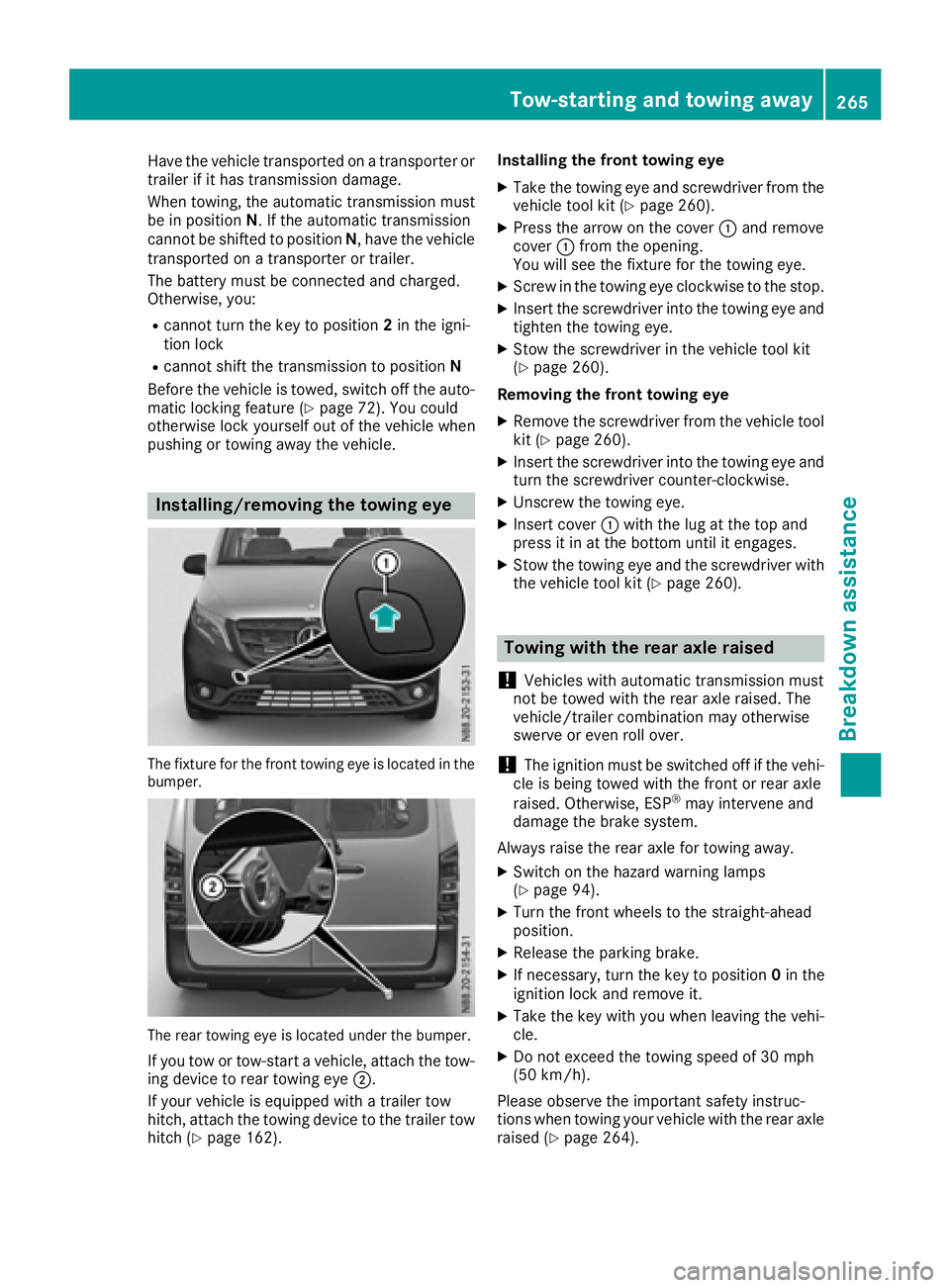
Installing/removin gthe towing eye
The fixtur efor the front towing eyeisl ocated in the
bumper.
The rea rtowing eyeisl ocated underthe bumper.
If yo utow or tow-start avehicle, attach the tow-
ing device to rea rtowing eye ;.
If your vehicle is equipped with atrailer tow
hitch, attach the towing device to the trailer tow
hitch (
Ypage 162). Installing the front towing eye
XTake the towing eyea
nd screwdriver from the
vehicle tool kit (Ypage 260).
XPres sthe arro wonthe cover :and remove
cover :from the opening.
You will see the fixtur efor the towing eye.
XScrew in the towing eyec lockwise to the stop.
XInsert the screwdriver into the towing eyea nd
tighte nthe towing eye.
XStow the screwdriver in the vehicle tool kit
(Ypage 260).
Removing the front towing eye
XRemove the screwdriver from the vehicle tool
kit (Ypage 260).
XInsert the screwdriver into the towing eyea nd
turn the screwdriver counter-clockwise.
XUnscrew the towing eye.
XInsert cover :with the lu gatthe top and
pres sitinatt he bottom until it engages.
XStow the towing eyea nd the screwdriver with
the vehicle tool kit (Ypage 260).
Towing with the rear axle raised
!
Vehicles with automati ctransmission must
not be towe dwitht he rea raxler aised.T he
vehicle/trailer combinatio nmay otherwise
swerve or even roll over.
!The ignition mus tbeswitched off if the vehi-
cle is being towe dwitht he front or rea raxle
raised.O therwise,ESP
®may intervene and
damag ethe brake system.
Always raise the rea raxlef or towing away.
XSwitch on the hazard warning lamps
(Ypage 94).
XTur nthe front wheels to the straight-ahead
position.
XRelease the parking brake.
XIf necessary ,turn the key to position 0in the
ignition lock and remov eit.
XTake the key with yo uwhenleaving the vehi-
cle.
XDo not excee dthe towing speed of 30 mph
(50 km/h).
Please observe the important safety instruc-
tions whe ntowing your vehicle with the rea raxle
raised (
Ypage 264).
Tow-starting and towing away265
Breakdow nassistance
Z
Page 268 of 310
Towingthe vehicle with both axles on
the ground
Important safety notes
GWARNING
Yo uc an no longe rstee rthe vehicl eifthe
steerin gwheel lock hasb eene ngaged .There
is ar iskofana ccident.
Alway sswitch off the ignition when towing the
vehicl ewithat ow cable or atow bar.
!Do not exceed the towing spee dof30mph
(50 km/h). Yo ucould otherwis edamag ethe
transmission.
Please observe the important safety notes
befor etowing your vehicl e(
Ypage 264).
Towingvehicle switha utomatic trans-
mission
XTurn the key to position 2in the ignition lock.
XDepres sthe brake peda land kee pit
depressed.
XShift the automatic transmission to position
N.
XLeave the key in position 2in the ignition lock.
XSwitch on the hazar dwarning lamps
(Ypage 94).
XReleas ethe parkin gbrake.
XReleas ethe brake pedal.
XDo not exceed the towing spee dof30m ph
(50 km/h).
Recovering avehicle that is stuck
!
When recovering avehicl ethath asbecome
stuck, pull it as smoothl yand evenly as pos-
sible. Excessive tractiv epower could damage
the vehicles.
If the drive wheels gett rapped on loose or
mudd yground ,recover the vehicl ewitht he
utmost care. Thi sisespecially the cas eifthe
vehicl eisladen .
Never attempt to recover avehicl ewithat railer
attached.
Pull ou tthe vehicl ebackwards ,ifpossible, using
the tracks it made when it becam estuck.
Transporting the vehicle
!
Yo um ayonl ysecur ethe vehicl ebythe
wheels ,not by parts of the vehicl esucha s
axl eors teerin gcomponents. Otherwise, the
vehicl ecould be damaged.
The towing ey eortrailer tow hitch can be used
to pull the vehicl eonto atrailer or transporte rif
yo uw ishtot ransport it.
XTurn the key to position 2in the ignition lock.
XShift the transmission to position N.
XReleasethe parkin gbrake.
If the vehicle is loaded:
XShift the transmission to position P.
XTurn the key to position 0in the ignition lock
and remove it.
XMake sure the parkin gbrake is applied.
XLash down the vehicle.
Tow-starting (emergency engine
starting)
Vehicle switha utomatic transmission
!Vehicles with automatic transmission must
not be tow-started .You could otherwis edam -
ag et he automatic transmission.
Yo uc an find informatio nonjump-starting under
"Jump-starting “(
Ypage 262).
Electrical fuses
The fuse allocation chart and important safety
informationonthe fuses can be found in the
"Fuse allocation chart" supplement.
266Electrical fuses
Breakdow nassistance
Page 271 of 310
RDo not drive with tireswhich have too little
trea ddepth,ast hissignificantl yreduce sthe
tractio nonw etroads (hydroplaning).
RReplace the tire safter 6y ears at the latest,
regardless of wear .Thisa lsoa pplies to the
spar ewheel .
Operatio ninwinter
General notes
Hav eyourv ehicl ewinterproofed at aquali fied
specialis tworkshop at the onse tofwinter.
Onlyu sewheels with tire sizes approved by
Mercedes-Benz.
Prior to the onse tofwinter, ensur ethats now
chains ar estowed in the vehicl e(
Ypage 270).
Snow chains canno tbem ounted on al lwheel /
tire combinations. Observe the restrictions on
the us eofsnow chains under "Wheel/tir ecom-
binations" (
Ypage 291).
Als oo bserve the note sinthe "Changing a
wheel" sectio n(
Ypage 286).
Driving with summe rtires
At temperatures belo w45‡(+7 †),summer
tire slos ee last icity and therefore tractio nand
braking power. Chang ethe tire sonyourvehicle
to M+S tire s. Usingsumme rtires at very cold
temperatures could cause tears to form,
thereby damaging the tires permanently.
Mercedes-Benz cannot accept responsibility for
this type of damage.
M+S tires
GWARNING
Wheel and tire dimensions as wel lasthe type
of tire can vary betwee nthe spare whee land
the whee ltobereplaced. When the spare
whee lismounted, driving characteristics may
be severelya ffected. There is arisk of an acci-
dent.
In order to reduce risks:
Ryou should therefore adapt you rdriving
style and drive carefully.
Rnever mount more than one spare wheel
that differs from the whee ltobereplaced.
Ronly use aspare whee lthat differs from the
whee ltober eplaced for ashort time.
Rhave aspare whee lthat differs from the
whee lthat has been changed replaced at
the nearest qualified specialist workshop.
You must observe the correct whee land
tire dimensions as wel lasthe whee ltype.
GWARNING
M+S tires with atire tread depth of less than
ã in (4 mm) are not suitable for use in winter
and do not provid esufficient traction. There is
ar isk of an accident.
M+S tires with atread depth of less than ãin
(4 mm) must be replaced immediately.
Use winter tires or all-season tires at tempera-
tures below4 5‡(+7 †). Both types of tire are
identified by the M+S marking.
Only winter tires bearing the isnowflake
symbo linaddition to the M+S marking provide
the best possible grip in wintry road conditions.
Only these tires wil lallow driving safety systems
such as ABS and ESP
®to function optimally in
winter. These tires have been developed specif-
ically for driving in snow.
For safe driving, use M+S tires of the same make
and tread pattern on all wheels.
Always observe the maximu mpermissible
speed specified for the M+S tires you have
mounted.
If you mount M+S tires that have alower maxi-
mum permissibl espeed than the maximum
design speed of the vehicle, affix acorrespond-
ing warning label in the driver' sfieldofv ision.
You can obtai nthis at aqualified specialist work-
shop.
Once you have mounted the winter tires:
XCheck the tire pressure (Ypage 270).
XRestart the tire pressure monitor
(Ypage 277).
Operation in winter269
Wheel sand tires
Z
Page 274 of 310
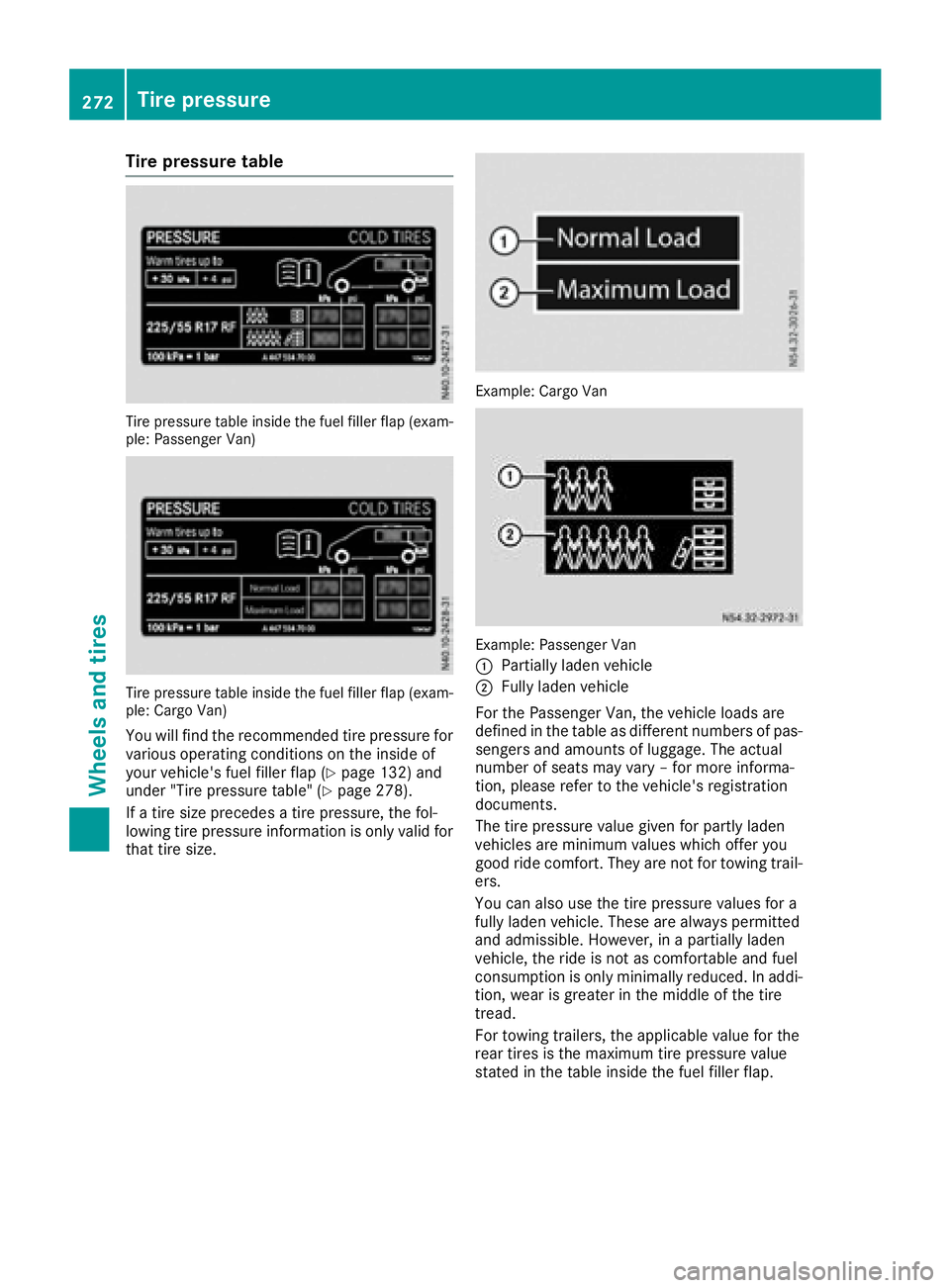
Tire pressure table
Tire pressure table insidethe fuel fille rflap( exam-
ple: Passenge rVan)
Tire pressure table insid ethe fuel fille rflap( exam-
ple: Cargo Van)
Yo uw illf ind the recommende dtire pressure for
various operating conditions on the insid eof
your vehicle's fuel fille rflap(
Ypage 132 )and
under "Tire pressure table "(Ypage 278).
If at ire size precedes atire pressure, the fol-
lowing tire pressure informatio niso nlyv alid for
thatt ire size.
Example: Cargo Van
Example: Passenge rVan
:
Partiall yladen vehicle
;Fully lade nvehicle
For the Passenge rVan,the vehicl eloads are
define dinthe table as different numbers of pas-
sengers and amounts of luggage.T he actual
numbe rofseats mayv ary–f or mor einforma-
tion, please refer to the vehicle's registration
documents.
The tire pressure valu egiven for partly laden
vehicles ar eminimu mvalues which offer you
good rid ecomfort. The yarenot for towing trail-
ers.
Yo uc an also us ethe tire pressure values for a
full yladen vehicle. These ar ealway spermitted
and admissible. However, in apartiall yladen
vehicle, the rid eisnot as comfortabl eand fuel
consumption is onl yminimall yreduced. In addi-
tion, wear is greate rinthe middl eofthe tire
tread.
For towing trailers ,the applicabl evalue for the
rea rtire sist he maximum tire pressure value
stated in the table insid ethe fuel fille rflap.
272Tire pressure
Wheel sand tires
Page 281 of 310
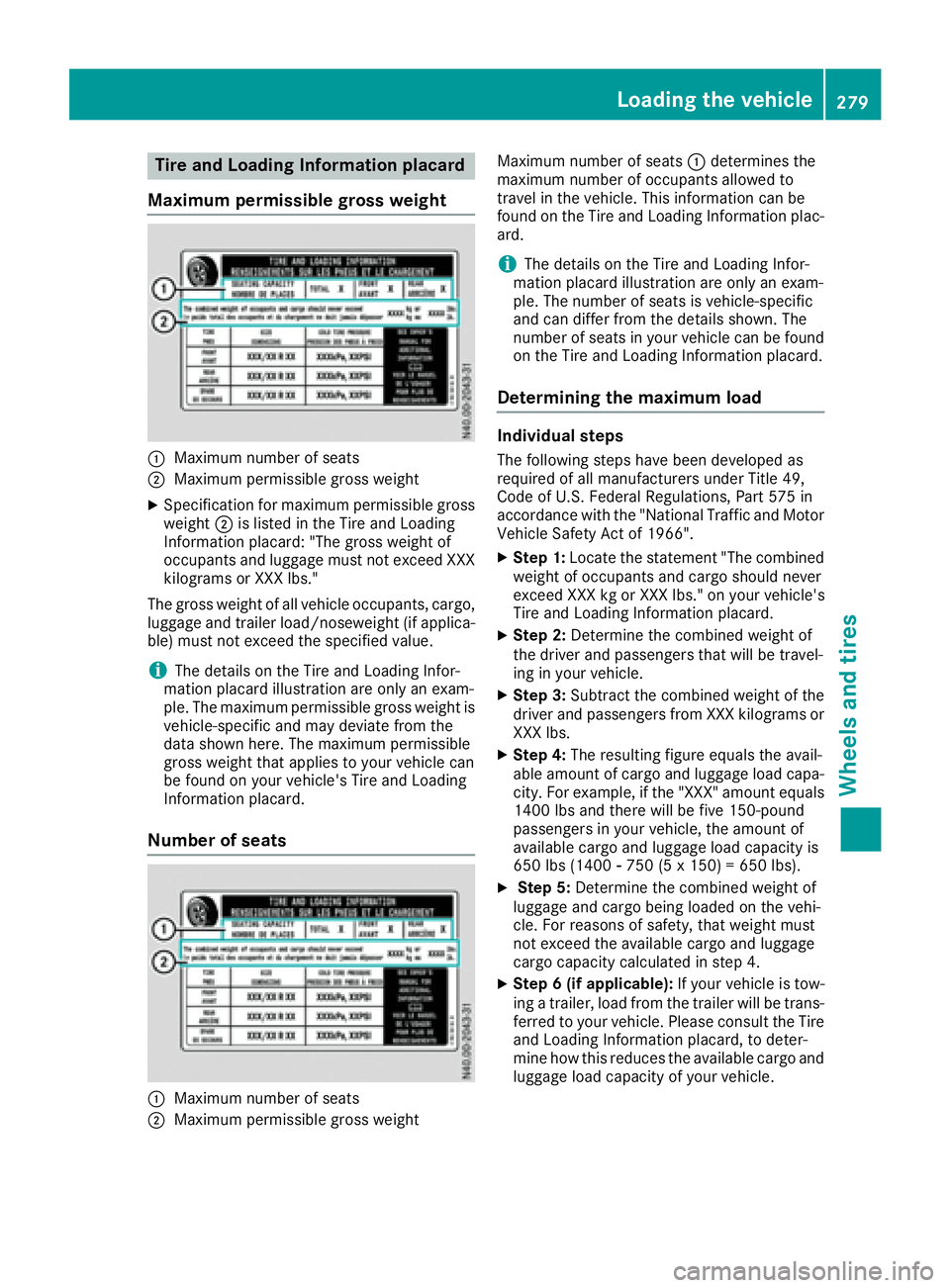
Tire and LoadingInfor matio nplacard
Maximum permissible gross weight
:Maximum numbe rofseats
;Maximum permissibl egross weight
XSpecificatio nfor maximum permissibl egross
weight ;is listed in the Tire and Loading
Informatio nplacard: "The gross weight of
occupants and luggage must not exceed XXX
kilograms or XXX lbs."
The gross weight of al lvehicl eoccupants, cargo,
luggage and trailer load/noseweight (i fappli ca-
ble) must not exceed the specifie dvalue.
iThe details on the Tire and Loading Infor-
matio nplacard illustratio nareonl yane xam-
ple. The maximum permissibl egross weight is
vehicle-specific and mayd eviate fromt he
data shown here. The maximum permissible
gross weight thata ppliesto your vehicl ecan
be found on your vehicle's Tire and Loading
Informatio nplacard.
Numbe rofseats
:Maximum numbe rofseats
;Maximum permissibl egross weight Maximum numbe
rofseats:determine sthe
maximum numbe rofoccupants allowe dto
travel in the vehicle. Thi sinformatio ncan be
found on the Tire and Loading Informatio nplac-
ard.
iThe details on the Tire and Loading Infor-
matio nplacard illustratio nareonl yane xam-
ple. The numbe rofseats is vehicle-specific
and can differf romthe details shown. The
numbe rofseats in your vehicl ecan be found
on the Tire and Loading Informatio nplacard.
Determining the maximum load
Individual steps
The following step shaveb eend eveloped as
required of al lmanufacturer sunder Title 49,
Code of U.S. Federa lRegulat ions, Part 575 in
accordance with the "Nationa lTraffica nd Motor
Vehicl eSafety Act of 1966".
XStep1 :Locate the statement "The combined
weight of occupants and cargo shoul dnever
exceed XXX kg or XXX lbs." on your vehicle's
Tire and Loading Informatio nplacard.
XStep2 :Determine the combine dweigh tof
the driver and passengers thatw illbet ravel-
ing in your vehicle.
XStep3 :Subtract the combine dweigh toft he
driver and passengers fromX XX kilograms or
XXX lbs.
XStep4 :The resulting figur eequals the avail-
able amount of cargo and luggage load capa-
city .For example, if the "XXX" amount equals
1400 lb sand there will be fiv e150-pound
passengers in your vehicle, the amount of
availabl ecargo and luggage load capacity is
650 lb s(1400 Ò750 (5 x150) = 650 lbs).
XStep5 :Determine the combine dweigh tof
luggage and cargo being loaded on the vehi-
cle .For reasons of safety ,thatw eightmust
not exceed the availabl ecargo and luggage
cargo capacity calculate dinstep 4.
XStep6( ifapplicable): If your vehiclei stow-
ing atrailer, load fromt he trailer will be trans-
ferred to your vehicle. Please consul tthe Tire
and Loading Informatio nplacard, to deter-
min ehow thisr educesthe availabl ecargo and
luggage load capacity of your vehicle.
Loadin gthe vehicle279
Wheel sand tires
Z
Page 288 of 310
TIN (Tire IdentificationNumber)
Auniqu eide ntificatio nnumbe rwhich can be
used by atire manufacturer to identify tires, for
exampl efor ap roduct recall ,and thusi dentify
the purchasers. The TIN is compose dofthe
manufacturer identificatio ncode, tire size, tire
model cod eand manufacturing date.
Load bearin gind ex
The load bearing index (als oloa dindex) is acode
thatc ontains the maximu mloadb eari ng capa-
city of atire.
Traction
Tractio nist he resul toffrictio nbetween the tires
and the roa dsurface.
TWR (permissibl etrailer drawbar load)
The TWRist he maximumpermissibl eweigh t
thatm ayact on the ball coupling of the trailer
tow hitch.
Wea rind icator
Narrowb ars( tread wear bars) thata redistrib-
ute doverthe tire tread. If the tire trea dislevel
with the bars, the wear limit of áin (1.6 mm)
hasb eenr eached.
Distribution of the vehicle occupants
The distributio nofvehicleoccupants ove rdes-
ignate dseatp osit ions in avehicle.
Maximum permissible payload weight
Nomina lloa da nd goods/luggage load plus
68 kg (150 lb s)multiplie dbythe number of
seats in the vehicle.
Changing wheels
Rotating the wheels
GWARNING
Interchanging the front and rear wheels may
severelyi mpair the driving characteristics if
the wheels or tires have different dimensions. The whee lbrakes or suspension components
may als obedamaged. There is arisk of acci-
dent.
Rotate front and rear wheels only if the wheels and tires are of the same dimensions.
!On vehicles equippedw ithatire pressure
monitor, electronic components are located
in the wheel.
Tire-mounting tools should not be used near
the valve .This could damage the electronic
components.
Only have tires changed at aqualified spe-
cialist workshop.
Always observe the instructions and safety
notes under "Mounting awheel" (
Ypage 287).
The wea rpatterns on the front and rear tires
differ, depending on the operating conditions.
Rotate the wheels before aclear wea rpattern
has formed on the tires. Front tires typically
wea rmore on the shoulders and the rear tires in
the center.
If you rvehicle's tire configuration allows, you
can rotate the wheels according to the intervals
in the tire manufacturer's warranty book in your
vehicled ocuments. If no warranty book is avail-
able, the tires should be rotated every 3,000 to
6,000 mile s(5,000 to 10,000 km) or earlier if
tire wea rrequires. Do not change the direction
of rotation.
Clean the contact surfaces of the whee land the
brake disc thoroughly every time awheelisr ota-
ted. Avoid oily or greas ycleaning agents.
Check the tire pressure and reactivate the tire
pressure monitor if necessary.
Directio nofrotation
Tires with aspecified directio nofrotation have
additional benefits, e.g. if there is arisk of hydro-
planing. You wil lonly gai nthese benefits if the
correct directio nofrotation is observed.
An arrow on the sidewal lofthe tire indicates its
correct directio nofrotation.
You may mount aspare whee lagainst the direc-
tion of rotation. Observe the time restriction on
use as wel lasthe speed limitation specified on
the spare wheel.
Storing wheels
Store wheels that are not being used in acool,
dry and preferably dark place. Protect the tires
from contact with oil, greas eand fuel.
286Changing wheels
Wheel sand tires
Page 291 of 310
Only use wheel bolts that have been designed
for the wheel and the vehicle. For safety rea-
sons, Mercedes-Benz recommends that you
only use wheel bolts which have been approved
for Mercedes-Benz vehicles and the respective
wheel.
!On vehicles equipped withatire pressure
monitor, electronic componentsa re located
in the wheel.
Tire-mounting tools should not be used near
the valve. This could damage the electronic
components.
Only have tires changed at aqualified spe-
cialist workshop.
XCleant he wheel and wheel hub contact sur-
faces.
XSlide the new wheel onto the wheel hub and
push it on.
XScrew in the wheel bolts and tighten them
lightly.
Lowering the vehicle
GWARNING
The wheels could work loose if the wheel nuts and bolts are not tightened to the specified
tightening torque. There is arisk of accident.
Have the tightening torque immediately
checked at aqualified specialist workshop
after awheel is changed.
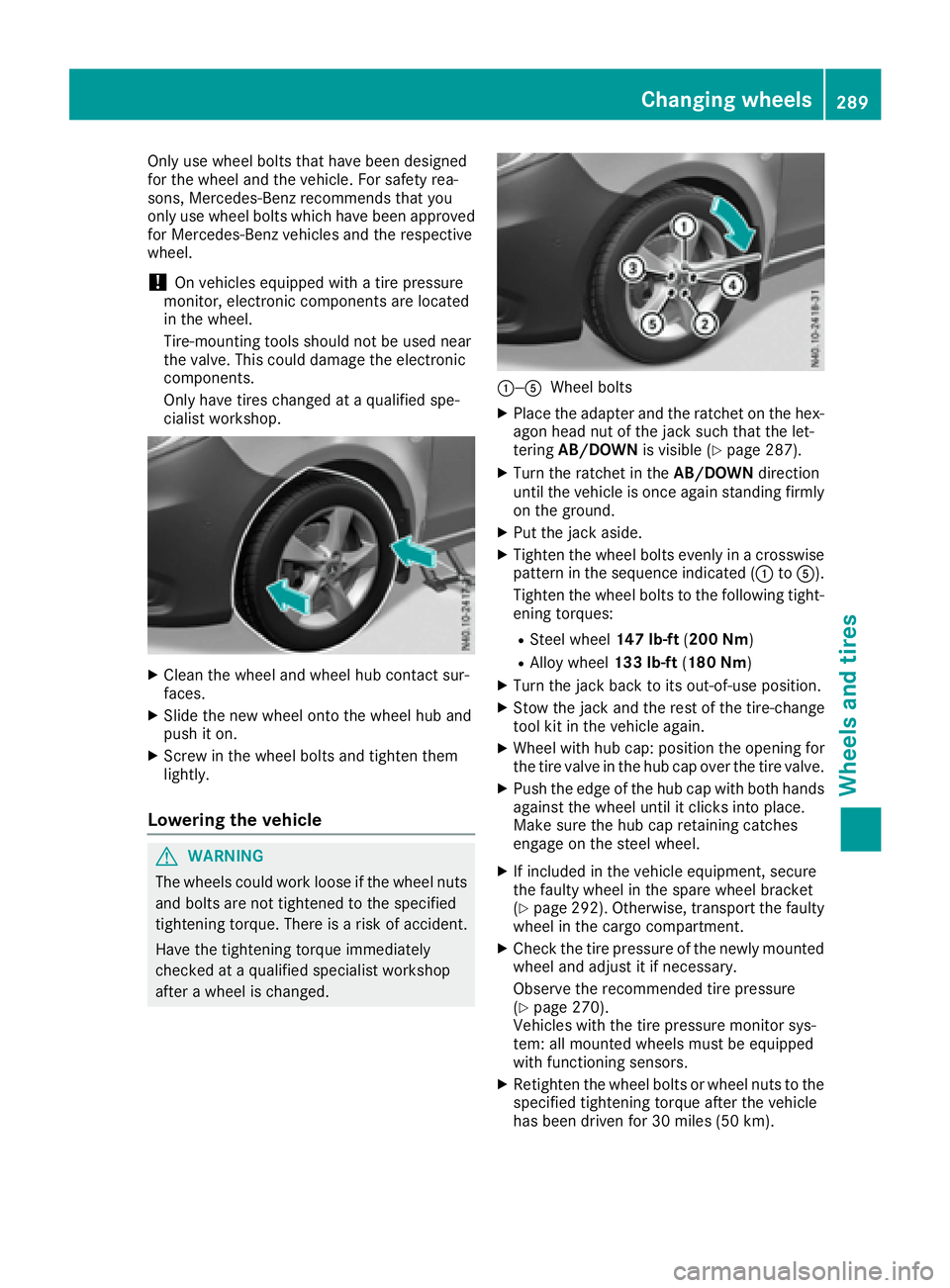
:—AWheel bolts
XPlace the adapter and the ratchet on the hex-
agon head nut of the jack such that the let-
tering AB/DOWN is visible (
Ypage 287).
XTurn the ratchet in the AB/DOWNdirection
until the vehicle is once agains tanding firmly
on the ground.
XPut the jack aside.
XTighten the wheel bolts evenly in acrosswise
pattern in the sequence indicated (: toA).
Tighten the wheel bolts to the following tight-
ening torques:
RSteel wheel 147 lb-ft(200 Nm)
RAlloy wheel 133 lb-ft(180 Nm)
XTurn the jack back to its out-of-use position.
XStow the jack and the rest of the tire-change
tool kit in the vehicle again.
XWheel with hub cap: position the opening for
the tire valve in the hub cap over the tire valve.
XPush the edge of the hub cap with both hands
against the wheel until it clicks into place.
Make sure the hub cap retaining catches
engage on the steel wheel.
XIf included in the vehicle equipment, secure
the faulty wheel in the spare wheel bracket
(
Ypage 292). Otherwise, transport the faulty
wheel in the cargo compartment.
XCheck the tire pressure of the newly mounted
wheel and adjust it if necessary.
Observe the recommended tire pressure
(
Ypage 270).
Vehicles with the tire pressure monitor sys-
tem: all mounted wheels must be equipped
with functionings ensors.
XRetighten the wheel bolts or wheel nuts to the
specified tightening torque after the vehicle
has been driven for 30 miles (50 km).
Changing wheels289
Wheels and tires
Z
Page 295 of 310
XPlace cover trayEon the wheel so that the
recess for tire valve Fis above the valve.
XPress cover tray Eont othe wheel brace and
align the wheel so that the handle of cover
tray Efaces backwards.
XGuide wheel gripper Cat an angle on wire B
through the opening in cover tray Eand into
the wheel brace from above.
XSlide the wheel under the vehicle alittle.
XAttach lug wrench =to auxiliary tool ;for
the spare wheel lifter.
XTurn lug wrench =in the direction of arrow
A until you feel resistanc eand the friction
clutch of the winch overwinds in jerks.
The wheel is firmly secured to the underside
of the vehicle.
XPull lug wrench =and auxiliary tool ;for the
spare wheel lifter out of the opening for the
winch.
XClose the winch opening with covering
cap :.
XStow wheel bolt wrench =and auxiliary
tool ;for the spare wheel lifter in the vehicle
tool kit.
XClose the tailgate/rear door.
Sparew heel293
Wheels and tires
Z
Page 299 of 310
iYou will generally findinformation about the
fuel grade on the filling pump. If there is no
identification on the filling pump, consult a
gas station attendant.
As atemporary measure, if the recommended
fuel is not available, you may also use regular
unleaded gasolinew ith an octane ratingof
87 AKI/91R ON. This may reduce the engine's
performance and increase fuel consumption.
Avoid drivingatf ull throttle and sudden accel-
eration. Never refuel using fuel with alower
AKI/RON rating.
iIn some countries, the available gasoline
may not be sufficiently low in sulfur. This fuel
can temporarily produceu npleasantodors,
especially on shortj ourneys. The odors are
reduce dassoon as sulfur-free fuel (sulfur
conten t<10 ppm) is used again for refueling.
For more information about refueling
(
Ypage 131).
Fuel additives
!Operating the engin ewith subsequently
added fuel additives can cause engin edam-
age. Do not mix fuel additives with fuel. This
does not include additives for the removal and
prevention of deposits. Gasoline can only be
mixe dwith additives recommended by
Mercedes-Benz. Follow the instructions in the
productd escription .You can findf urther
information on recommended additives in any
Mercedes-Ben zCommercial Van Center.
Mercedes-Ben zrecommends using brand-name
fuels with additives.
If you use fuels without these additives for along
period of time, depositsc an form.This primarily
formsont he inlet valve and in the combustion
chamber.
In some countries, the available fuel grade may
be inadequate. Residue could build up in the fuel
injection syste masaresult.Int his case, in con-
sultation with aMercedes-Ben zCommercial
Van Center, the fuel should be mixe dwith the
cleaning additiv
erecommen ded
by Mercedes-
Benz. You must observet he notes and mixing
ratio sindicated on the container.
Do not add other fuel additives to the fuel. This
resultsinu nnecessary cost sand can damage
the engine.
Information on fuel consumption
HEnvironmental note
CO
2(carbo ndioxide )isthe gas which scien-
tist sbelieve to be principally responsible for
global warming( the greenhouse effect). Your
vehicle's CO
2emissions are directly related to
fuel consumption and therefore dependo n:
Refficient use of the fuel by the engine
Rdrivingstyle
Rother non-technical factors, such as envi-
ronmental influences, road condition sor
traffic flow
You can minimize your vehicle's CO
2emis-
sionsbyd rivingcarefully and havingits erv-
iced regularly.
Only for certain countries: the respectiv ecur-
rentc onsumption and emissionv alues of your
vehicle can be foundint he COC papers (EC
CERTIFICATE OF CONFORMITY). These docu-
ments are supplied when the vehicle is deliv-
ered.
Consumption figures were foundint he currently
valid respectiv eversion:
Rfor vehicles up to and including the Euro 4
standard accordingtoEUD irective
80/1268/EEC
Rfor vehicles from the Euro 5standar daccord-
ing to regulation (EC )no. 715/2007
Rfor vehicles fromt he Euro6standard accord-
ing to regulation (EC )no. 595/2009
Fue lconsumption depends on:
Rthe vehicl eversion
Rthe style of driving
Rthe operating conditions
Rthe typ eorquality of the fuel used
The vehicl ewillu se mor efuelthanu sualin the
following situations:
Rat ver ylow outside temperatures
Rin city traffic
Rdurin gshort journeys
Ron mountainou sterrain
Rwhen towing atrailer
Observe the advic einthe "Protectio no
fthe
environment" sectio ntokeepf uelconsumption
lo w(
Ypage 27).
Service products and capacities297
Technica ldata
Z