lock MERCEDES-BENZ METRIS 2016 MY16 Operator’s Manual
[x] Cancel search | Manufacturer: MERCEDES-BENZ, Model Year: 2016, Model line: METRIS, Model: MERCEDES-BENZ METRIS 2016Pages: 310, PDF Size: 7.28 MB
Page 118 of 310
TEMPMATIC air-conditioning system or
dual-zone automatic climate control
XSwitch on climate control(Ypage 110).
XPress thehbutton.
If the indicator lamp in the hbutton lights
up ,air-recirculation mod eisactivated.
Air-recirculation mod eswitches on automati-
cally:
Rat high outside temperatures
Rwhil edrivin ginat unnel(on ly vehicles with a
navigation system).
The indicator lamp in the hbutton is thenn ot
li tu p.Outside ai risadded automaticall yafter
abou t30m inutes.
Air-recirculation mod eisdeactivated automati-
cally:
Rafter approximately 5minute satoutside tem-
peratures belo wabout 45‡(7† )
Rafter approximately 5minute sw hen the cool-
ing with air dehumidification function is deac-
tivated
Rafter approximately 30 minutes at outside
temperatures above about 45 ‡(7†)and
when the cooling with air dehumidification
function is active.
Convenienceo pening/pre-entryc li-
matec ontrol
GWARNING
During convenience opening, body parts
could be drawn in or become trapped
between the side window and the door frame.
There is arisk of injury.
Monitor the entire opening procedure when
using convenience opening. When opening,
make sure that nobody touches the side win- dow. Release the %switch immediately if
somebody becomes trapped, to interrupt the
opening procedure.
XPre-entry climate control and conveni-
ence opening with the key: press and hold
the % button on the key.
The side windows open automatically and the
blower of the climate control system is acti-
vated.
XRelease the %button.
iAt high interior temperatures, the blower is
also switched on when adoor is opened. This
means that slightly cooled air enters the vehi-
cle interior after the engine is started, to cool
the vehicle more rapidly.
Switching the residual heat function
on/off
General notes
Only vehicles with automatic climate control
have the residual heat function.
Once the engine is switched off, it is possible to
make use of the residual heat of the engine to
continue heating or ventilating the front com-
partment of the vehicle for approximately
30 minutes. The heating or ventilation time
depends on the set interior temperature.
Switching the function on/off
XTurn the key to position 0in the ignition lock
or remove it.
XPress the Ìbutton.
If the residual heat function is activated, the
indicator lamp in the Ìbutton comes on.
The blower will run at alow speed regardless
of the airflow setting.
If you activate the residual heat function at
high temperatures, only the auxiliary ventila-
tion will be activated. The blower then runs at
medium speed.
The residual heat function switches off auto-
matically
Rafter approximately 30 minutes
Rif the starter battery's condition of charge is
too low
Rwhen you switch on the ignition
Adjusting the air vents
Important safety notes
GWARNING
Very hot or very cold air can flow from the air
vents .This could result in burns or frostbite in
the immediate vicinity of the air vents.T here
is ar isk of injury.
116Adjusting the air vents
Climatec ontrol
Page 119 of 310
Make sure that all vehicle occupants always
maintainasufficient distance to the air out-
lets. If necessary, redirect the airflow to
another area of the vehicle interior.
The center and side air vents are adjustable.
The air vents can also be adjusted on vehicles
with rear-compartment air conditioning.
In order to ensure the direct flow of fresh air
through the air vents into the vehicle interior,
please observe the following notes:
Rkeep the air inlet between the windshield and
the hood free of blockages, such as ice, snow
or leaves.
Rnever cover the vents or the ventilation grilles
in the vehicle interior.
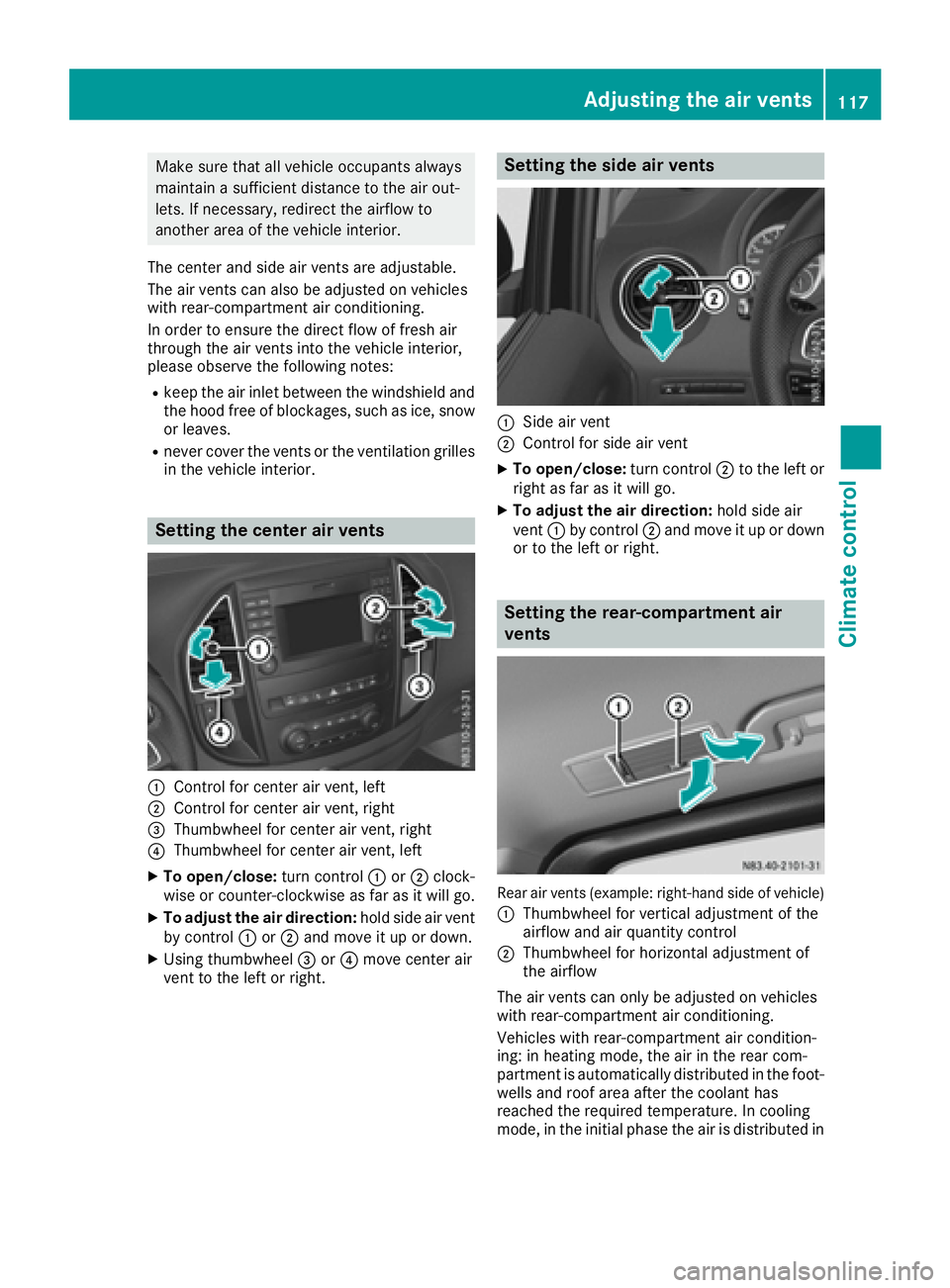
Setting the center air vents
:Control for center air vent, left
;Control for center air vent, right
=Thumbwheel for center air vent, right
?Thumbwheel for center air vent, left
XTo open/close: turn control:or; clock-
wise or counter-clockwise as far as it will go.
XTo adjust the air direction: hold side air vent
by control :or; and move it up or down.
XUsing thumbwheel =or? move center air
vent to the left or right.
Setting the side air vents
:Side air vent
;Control for side air vent
XTo open/close: turn control;to the left or
right as far as it will go.
XTo adjust the air direction: hold side air
vent :by control ;and move it up or down
or to the left or right.
Setting the rear-compartment air
vents
Rear air vents (example: right-hand side of vehicle)
:
Thumbwheel for vertical adjustment of the
airflow and air quantity control
;Thumbwheel for horizontal adjustment of
the airflow
The air vents can only be adjusted on vehicles
with rear-compartment air conditioning.
Vehicles with rear-compartment air condition-
ing: in heating mode, the air in the rear com-
partment is automatically distributed in the foot-
wells and roof area after the coolant has
reached the required temperature. In cooling
mode, in the initial phase the air is distributed in
Adjusting the air vents117
Climatec ontrol
Z
Page 122 of 310
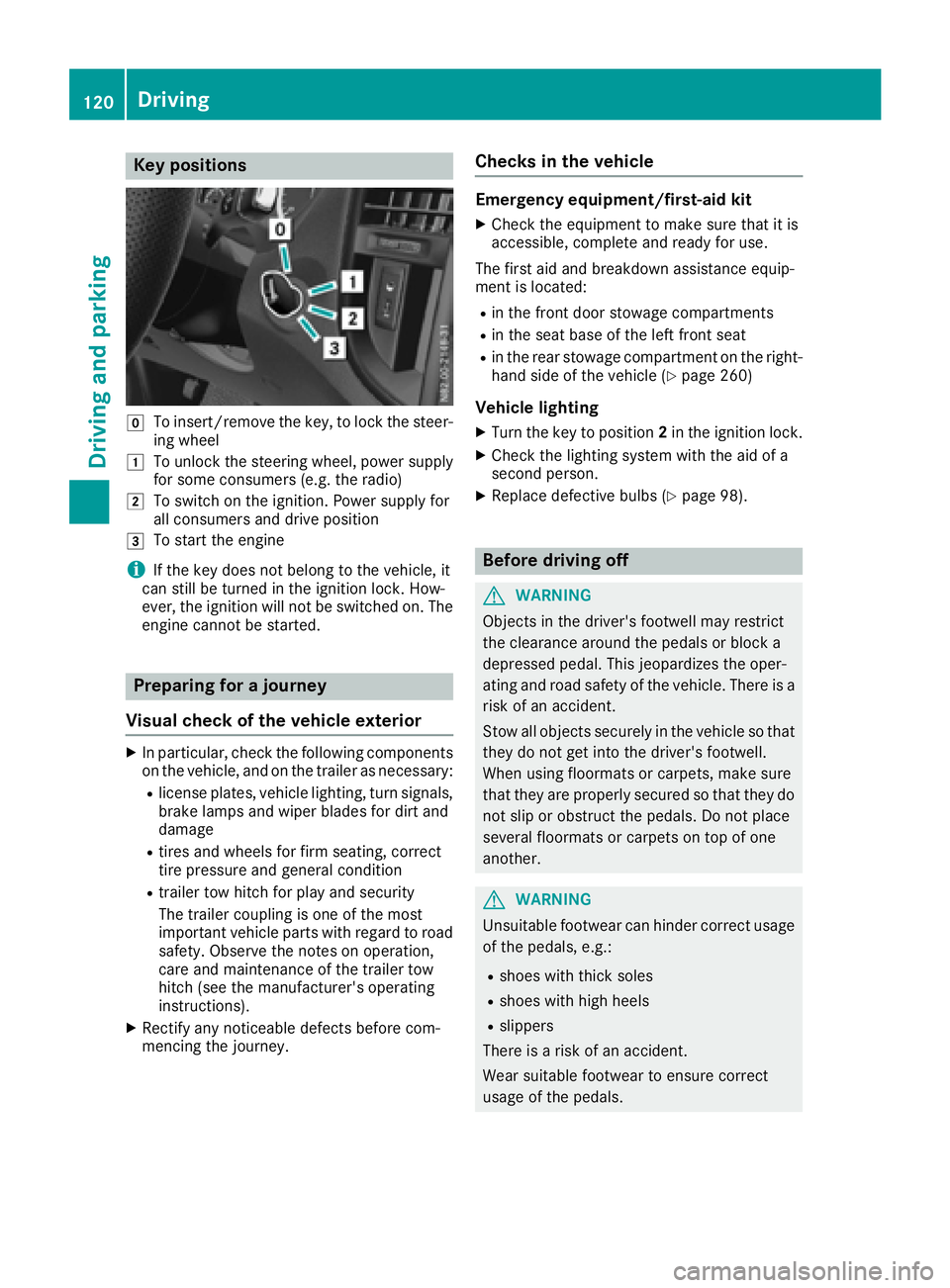
Key positions
gTo insert/remove thekey,tol oc kt he steer -
ing whee l
1To unlockthe steering wheel, powe rsupply
for som econsum ers( e.g. th eradio)
2To switch on th eignition .Powe rsupply for
all consumer sand drive position
3To start th eengine
iIf th ekeydoes no tbelong to th evehicle, it
can still be turne dintheignition lock. How-
ever, th eignition will no tbeswitched on .The
engin ecanno tbes tarted.
Prepa ring for ajourne y
Visua lcheck ofthev ehicle exteri or
XIn particular, chec kthe followin gcom ponent s
on th evehicle, and on th etrailer as necessary:
Rlicense plates, vehicl elighting ,tur ns ignals,
brak elamp sand wiper blade sfor dir tand
damag e
Rtires and wheels for fir mseating ,correct
tire pressur eand general condition
Rtrailer to whitch for play and securit y
The trailer couplin gisoneof th emost
important vehicl epartsw ithr egard to roa d
safety. Observ ethe note sono peration ,
car eand maintenance of th etrailer to w
hitch (see th emanufacturer' soperating
instructions).
XRectify any noticeable defects before com-
mencin gthe journey.
Check sinthevehicle
Emergency equipment/first-aid kit
XChec kthe equipmen ttomakes uret hatiti s
accessible, complet eand read yfor use.
The first aid and breakdown assistanc eequip -
men tislocated:
Rin th efront door stowage compartments
Rin theseat base of th eleftf ront seat
Rin therear stowage compartmen tontheright -
han dside of th evehicl e(Ypage 260)
Vehicle lighting
XTurn th ekeyto position 2in th eignition lock.
XChec kthe lighting system wit hthe aid of a
secon dperson .
XReplac edefective bulbs (Ypage 98).
Before drivingo ff
GWARNING
Objects in th edriver's footwell may restrict
th ec learance around th epedal sorb locka
depressed pedal .This jeopardizes th eoper -
ating and roa dsafet yoft hevehicle. There is a
ris kofana ccident.
Stow all objects securel yint he vehicl esothat
they do no tget int othe driver's footwell.
Whe nusingfloormats or carpets, mak esure
that they are properly secured so that they do no tslip or obstruct th epedals. Do no tplac e
several floormats or carpet sontopof on e
another.
GWARNIN G
Unsuitable footwear can hinder correc tusage
of th epedals, e.g. :
Rshoes withthick sole s
Rshoes wit hhigh heel s
Rslippers
There is ariskofana ccident.
Wear suitable footwear to ensur ecorrect
usage of th epedals.
120Driving
Driving and parking
Page 123 of 310
XStow luggage itemssecurely. Secure the load
as per the loading guideline s(Ypage 232).
XMake sure that the floormats and carpets are
properly secured so that they canno tslipa nd
obstruct the pedals.
XClose al ldoors.
To start the engine
Important safety notes
GWARNING
Combustio nengines emi tpoisonous exhaust
gases such as carbon monoxide. Inhaling
thes eexhaus tgases lead stopoisoning. There
is ar iskoff atalinjury. Therefore neve rlea ve
the engine running in enclose dspaces with-
outs ufficient ventilation.
!Do not depress the accelerato rwhens tart-
ing the engine.
XBefore starting the engine, make sure that:
Ral lt he doors are closed.
Rallt he vehicl eoccupants are wearing their
sea tbelts correctly.
Rthe parking brake is applied.
iIf yo udepress the brake pedal before start-
ing the engine, the pedal trave lmay be shorter
and pedal resistance higher.
If yo udepres sthe brake pedal agai nafter
starting the engine, pedal trave land resist-
ance will be back to norma lagain.
Automatic transmission
XShif tthe transmissio ntoposition P
(Ypage 126).
The transmissio nposition indicator in the dis-
play shows P.
You can also star tthe engine in neutral N.
To start the engine
XTurn the key to position 3(Ypage 120 )inthe
ignition lock and release it as soo nasthe
engine is running.
Driving off
Automati ctransmission
GWARNING
If the engine speed is above the idling speed
and yo uengage transmission position Dor R,
the vehicl ecould pull away suddenly. There is
ar iskofana ccident.
Whe nengaging transmission position Dor R,
always firmly depress the brake peda land do
not simultaneouslya ccelerate.
!Onlyshift into reverse gear Rwhen the vehi-
cle is stationary .Otherwise, yo ucould dam-
ag et he transmission.
XDepres sthe brake peda land keepi t
depressed.
The parking lock is released.
XShift the transmission to position Dor R.
On vehicles with areverse warning feature ,a
warning signals ounds when reverse gear Ris
engaged to alert othe rroa du sers
(
Ypage 122).
XReleas ethe parking brake (Ypage 133).
The F (only USA) or J(only Canada)
indicator lamp in the instrument cluster goes
out.
XReleas ethe brake pedal.
Hil lstart assist automaticall ymaintains the
brake pressure for abouta nother two sec-
ondsa fterthe brake peda lisreleased .This
makes it possibl etopulla wa yw ithou tthe
vehicl eimmediatelyr olling back
(
Ypage 122).
XCarefull ydepress the accelerato rpedal.
It is onlyp ossibl etos hift the transmission from
po
sition Pto the desired positio nifyoudepress
the brake pedal. Onlyt hen is the parking lock
released .Ifthe brake peda lisnot depressed, the
DIRECT SELECTl ever can stil lbemovedbutthe
parking lock remains engaged.
The vehicl eloc ks centrall yonce yo uhavep ulle d
away .The locking knobs in the doors dro pdown.
Yo uc an open the doors from the insid eatany
time.
Yo uc an also deactivate the automatic locking
feature (
Ypage 72).
Driving121
Driving an dparking
Z
Page 127 of 310
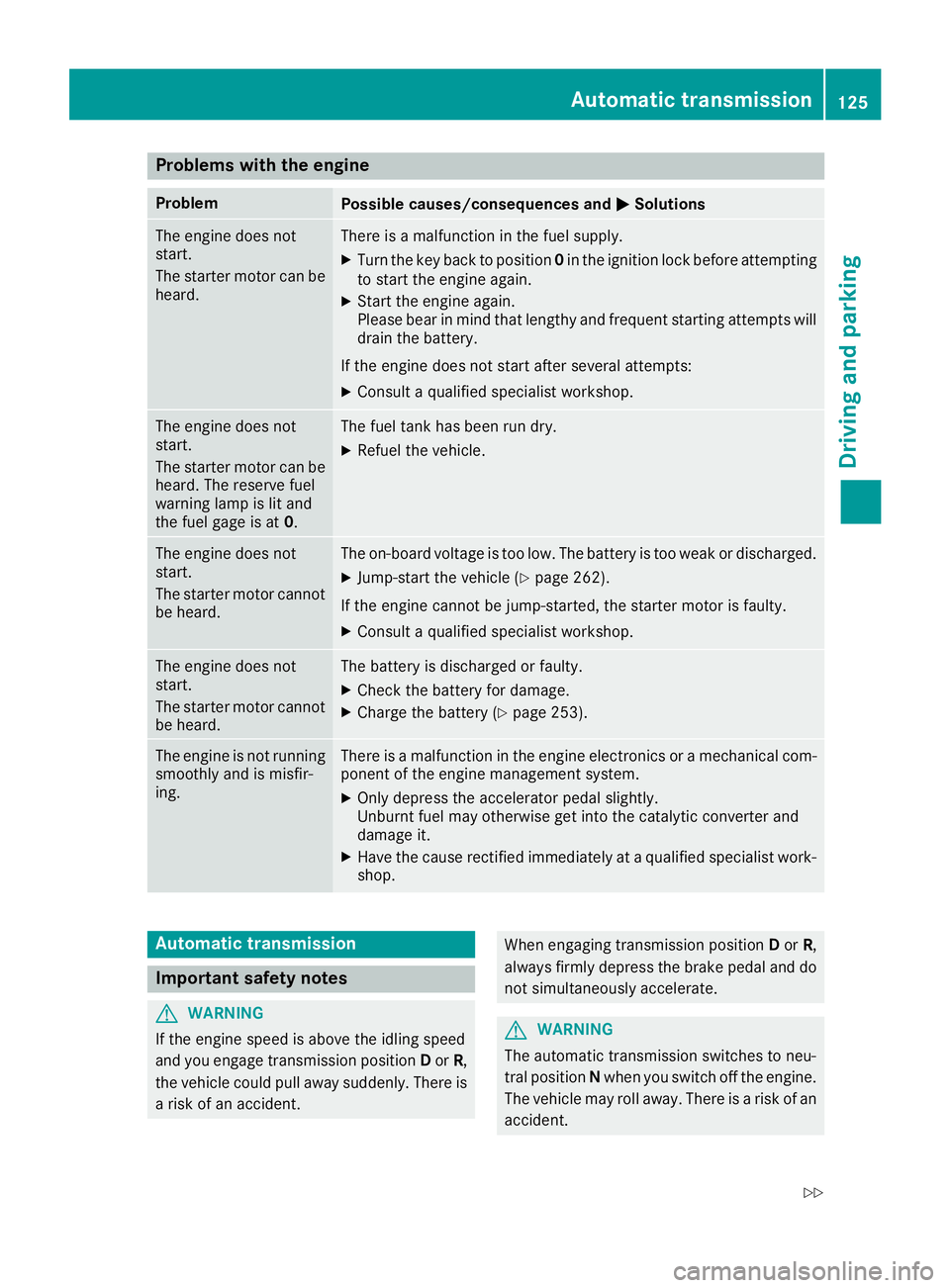
Problems with the engine
ProblemPossible causes/consequences andMSolutions
The engine does not
start.
The starter motor can be
heard.There isamalfunction in the fuel supply.
XTurn the key back to position 0in the ignition lock before attempting
to start the engine again.
XStart the engine again.
Please bear in mind that lengthy and frequent startin gattempt swill
drain the battery.
If the engine does not start after several attempts:
XConsult aqualified specialist workshop.
The engine does not
start.
The starter motor can be
heard. The reserve fuel
warning lamp is lit and
the fuel gage is at 0.The fuel tank has been run dry.
XRefuel the vehicle.
The engine does not
start.
The starter motor cannot
be heard.The on-board voltage is too low. The battery is too weak or discharged.
XJump-start the vehicle (Ypage 262).
If the engine cannot be jump-started, the starter motor is faulty.
XConsult aqualified specialist workshop.
The engine does not
start.
The starter motor cannot
be heard.The battery is discharged or faulty.
XCheck the battery for damage.
XCharge the battery (Ypage 253).
The engine is not running
smoothly and is misfir-
ing.There is amalfunction in the engine electronics or amechanical com-
ponent of the engine management system.
XOnly depress the accelerator pedal slightly.
Unburnt fuel may otherwise get into the catalytic converter and
damage it.
XHave the cause rectified immediately at aqualified specialist work-
shop.
Automatic transmission
Important safety notes
GWARNING
If the engine speed is above the idling speed
and you engage transmission position Dor R,
the vehicle could pull away suddenly. There is
ar isk of an accident.
When engaging transmission position Dor R,
always firmly depress the brake pedal and do
not simultaneously accelerate.
GWARNING
The automatic transmission switches to neu-
tral position Nwhen you switch off the engine.
The vehicle may roll away.T here isarisk of an
accident.
Automatic transmission125
Driving and parking
Z
Page 128 of 310
Beforeswitching off the engine, always switch
to parking position P.Prevent the parked vehi-
cle from rolling away by applying the parking
brake.
!If the engine is switched off, rolling in neutral
N can damag ethe power transmission and
result in transmission damage.
Alway sobserve the instructions and safety
notes under "Tow starting and towing away"
(
Ypage 264).
Bearinm ind that power transmission between
the engine and the transmission is interrupted
whe nthe engine is switched off. For this reason,
shift the automatic transmission to Pbefore the
engine is switched off and with the vehicle is
stationary. Appl ythe parking brake to prevent
the vehicle from rolling away.
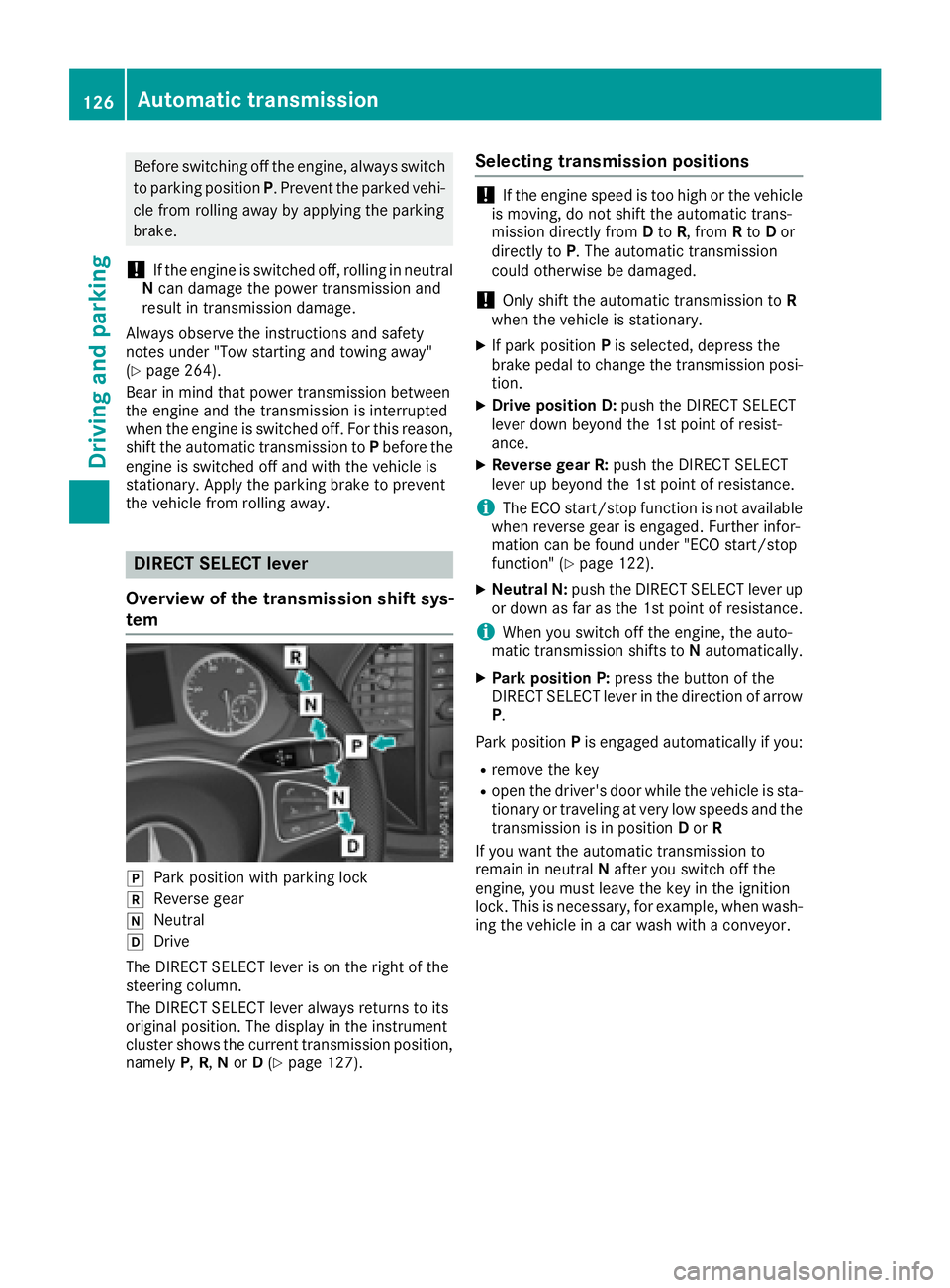
DIREC TSELECT lever
Overvie wofthe transmissio nshift sys-
tem
jPark positio nwithp arking lock
kReverseg ear
iNeutral
hDrive
The DIREC TSELECT lever is on the right of the
steering column.
The DIREC TSELECT lever always returns to its
origina lposition. The display in the instrument
cluster showst he current transmission position,
namely P,R, Nor D(
Ypage 127).
Selecting transmissio npositions
!If the engine speed is too hig horthe vehicle
is moving, do not shift the automatic trans-
missio ndirectly from Dto R,f rom Rto Dor
directly to P.The automatic transmission
could otherwise be damaged.
!Only shift the automatic transmission to R
whe nthe vehicle is stationary.
XIf park position Pis selected ,depress the
brake pedal to chang ethe transmission posi-
tion.
XDrive positionD :push the DIREC TSELECT
lever dow nbeyond the 1st point of resist-
ance.
XReverse gear R: push the DIRECTSELECT
lever up beyond the 1st point of resistance.
iThe ECO start/stop function is not available
whe nreverse gea risengaged .Further infor-
mation can be found under "EC Ostart/stop
function" (
Ypage 122).
XNeutral N: push the DIREC TSELECT lever up
or dow nasfar as the 1st point of resistance.
iWhe nyou switch off the engine, the auto-
mati ctransmission shifts to Nautomatically.
XPark positionP :press the button of the
DIREC TSELECT lever in the directio nofarrow
P.
Park position Pis engaged automaticall yifyou:
Rremove the key
Rope nthe driver'sd oorwhile the vehicle is sta-
tionary or traveling at very low speeds and the
transmission is in position Dor R
If yo uwantthe automatic transmission to
remain in neutral Nafte ryou switch off the
engine, yo umustleave the key in the ignition
lock. Thisisn ecessa
ry, for example, whe nwash-
i
ng the vehicle in acar wash with aconveyor.
126Automatic transmission
Drivin gand parking
Page 133 of 310
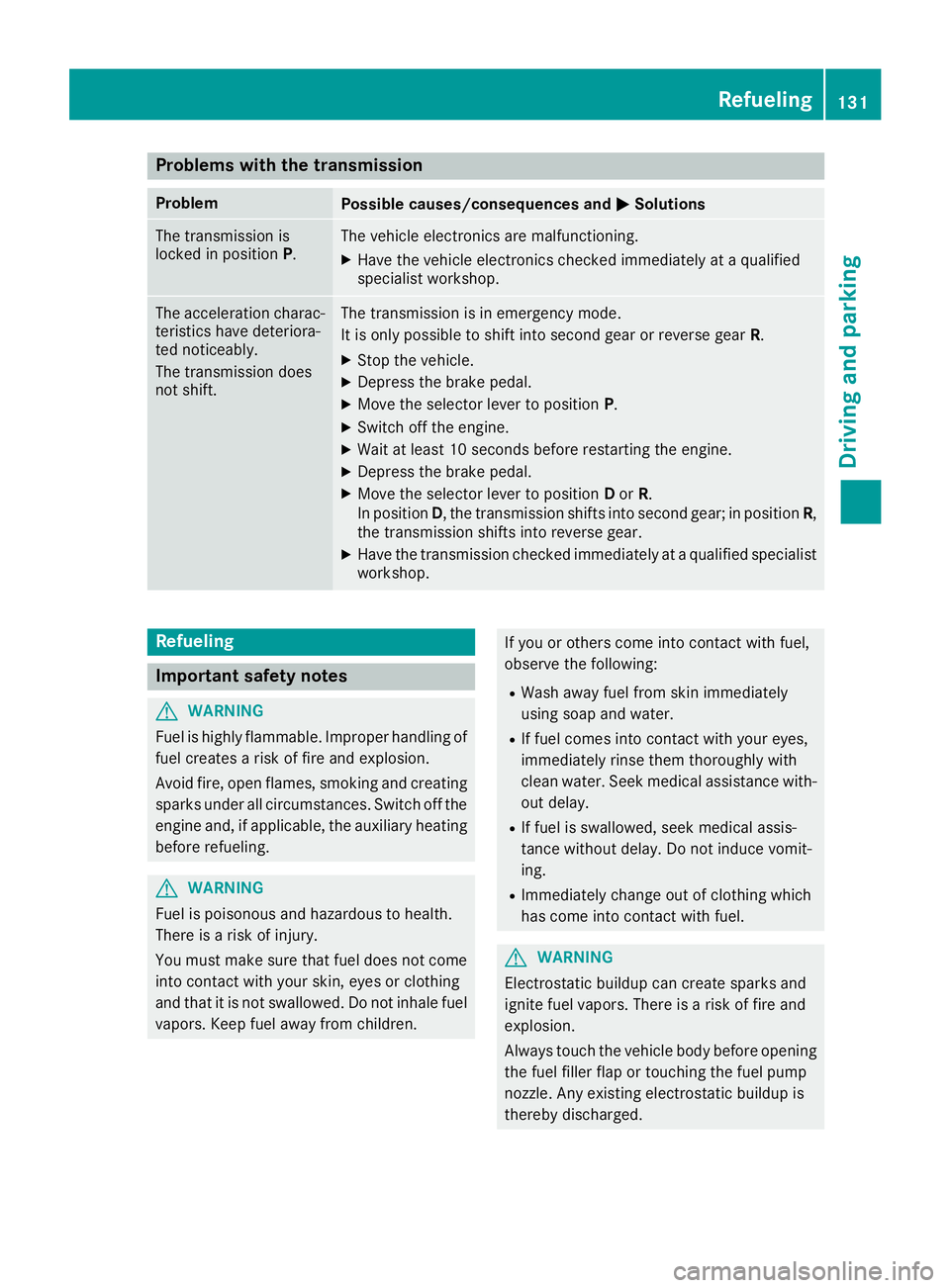
Problems with the transmission
ProblemPossible causes/consequences andMSolutions
The transmission is
locked in positionP.The vehicle electronics are malfunctioning.
XHave the vehicle electronics checked immediately at aqualified
specialist workshop.
The acceleration charac-
teristicsh ave deteriora-
ted noticeably.
The transmission does
not shift.The transmission is in emergency mode.
It is only possible to shift into second gear or reverse gear R.
XStop the vehicle.
XDepress the brake pedal.
XMove the selector lever to positionP.
XSwitch off the engine.
XWait at least 10 seconds before restarting the engine.
XDepress the brake pedal.
XMove the selector lever to positionDor R.
In position D,the transmission shifts into second gear; in position R,
the transmission shifts into reverse gear.
XHave the transmission checked immediately at aqualified specialist
workshop.
Refueling
Important safety notes
GWARNING
Fuel is highly flammable. Improper handling of
fuel creates arisk of fire and explosion.
Avoid fire, open flames, smoking and creating
sparks under all circumstances. Switch off the
engine and, if applicable, the auxiliary heating
before refueling.
GWARNING
Fuel is poisonous and hazardous to health.
There is arisk of injury.
You must make sure that fuel does not come into contact with your skin, eyes or clothing
and that it is not swallowed. Do not inhale fuel
vapors. Keep fuel away from children.
If you or others come into contact with fuel,
observe the following:
RWash away fuel from skin immediately
using soap and water.
RIf fuel comes into contact with your eyes,
immediately rinse them thoroughly with
clean water. Seek medical assistance with-
out delay.
RIf fuel is swallowed, seek medical assis-
tance without delay.Don ot induce vomit-
ing.
RImmediately change out of clothing which
has come into contact with fuel.
GWARNING
Electrostatic buildupc an create sparks and
ignite fuel vapors. There is arisk of fire and
explosion.
Always touch the vehicle body before opening
the fuel filler flap or touching the fuel pump
nozzle. Any existing electrostatic buildupi s
thereby discharged.
Refueling131
Driving and parking
Z
Page 134 of 310
Do not getinto the vehicl eagain durin gthe refu-
eling process. Otherwise, electrostatic charge
could buil dupagain.
HEnvironmental note
If fuel sarehandled improperly, theyp osea
dange rtopersons and the environment. Do
not allo wfuels to runi nto the sewag esystem,
the surface waters ,the ground water or into
the ground.
!Do not switch on the ignition if yo uacciden-
tally refue lwitht he wrong fuel .Otherwise, the
fuel will ente rthe fuel lines .Notify aquali fied
specialis tworkshop and have the fuel tank
and fuel lines draine dcompletely.
!Overfilling the fuel tank could damage the
fuel system.
!Take car enot to spil lany fuel on painted
surfaces .You could otherwis edamag ethe
paintwork.
!Use afilter when refueling fromaf uelcan.
Otherwise, the fuel lines and/or injectio nsys-
tem could be blocke dbyparticle sfromt he
fuel can.
Yo uw illf ind furthe rinformatio nabout fuel and
fuel grade sunder "Service products and capaci-
ties" (
Ypage 296).
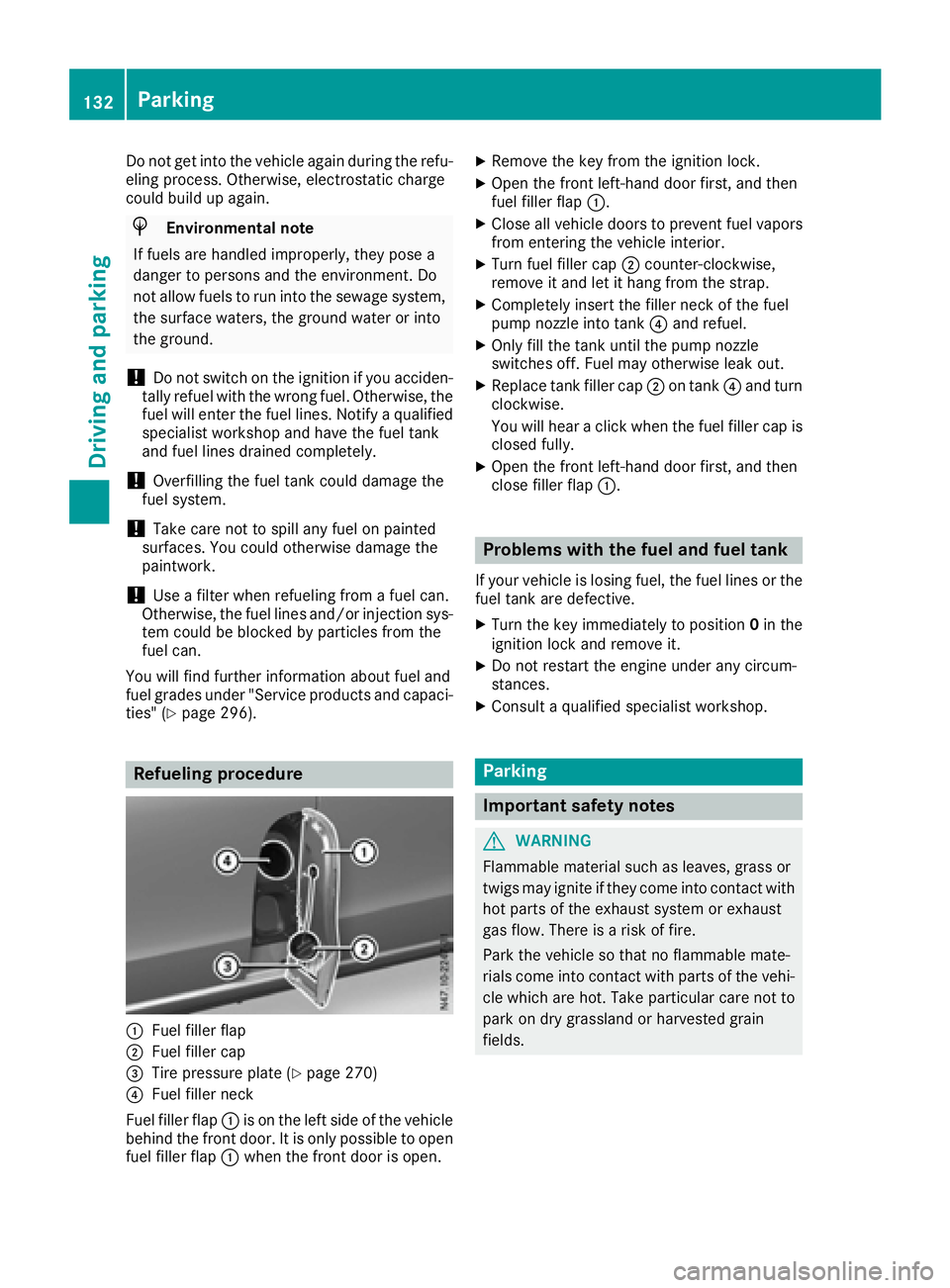
Refueling procedure
:Fue lfille rflap
;Fue lfille rcap
=Tire pressure plate (Ypage 270)
?Fue lfille rneck
Fue lfille rflap :is on the left side of the vehicle
behind the front door. It is onl ypossibl etoo pen
fuel fille rflap :when the front door is open.
XRemov ethe key fromt he ignition lock.
XOpen the front left-hand door first, and then
fuel fillerflap :.
XClose al lvehicl edoors to prevent fuel vapors
frome nteringthe vehicl einterior.
XTurn fuel fille rcap ; counter-clockwise,
remove it and le tithangf romt he strap.
XCompletely insert the fille rneck of the fuel
pump nozzl einto tank ?and refuel.
XOnlyf illt he tank unti lthe pump nozzle
switches off .Fuelm ayotherwis elea ko ut.
XReplace tank fille rcap ; on tank ?and turn
clockwise.
Yo uw illh ea rac lick when the fuel fille rcap is
closed fully.
XOpen the front left-hand door first, and then
close fille rflap :.
Problems with the fuela nd fueltank
If your vehicl eislosingfuel, the fuel lines or the
fuel tank ar edefective.
XTurn the key immediatel ytoposition0in the
ignition lock and remove it.
XDo not restar tthe engine under any circum-
stances.
XConsult aquali fied specialis tworkshop.
Parking
Important safety notes
GWARNING
Flammabl ematerial such as leaves, grass or
twigs mayi gnite if theyc ome into contact with
hot parts of the exhaust system or exhaust
gasf low. There is ariskoff ire.
Park the vehicl esothatnof lammabl emate-
rials come into contact with parts of the vehi-
cle which ar ehot. Take particular car enot to
park on dry grassland or harvested grain
fields.
132Parking
Driving an dparking
Page 135 of 310
GWARNING
If you leave children unsupervised in the vehi-
cle, they coul dset it in motion by, for example:
Rrelease the parking brake.
Rshift the automatic transmission out of the
parking position P.
Rstart the engine.
In addition, they may operate vehiclee quip-
ment and become trapped. There is arisk of
an accident and injury.
When leaving the vehicle, alway stake the
SmartKey with you and lock the vehicle. Never
leave children unsupervised in the vehicle.
!Always secure the vehiclec orrectly against
rolling away. Otherwise, the vehicleori ts driv-
etrain coul dbedamaged.
!When the vehicleisp arked,alway sremove
the key to prevent the battery from becoming
discharged.
Always park you rvehicl esafel yand secure it
against rolling away. When parking, observe the
lega lrequirements of the country in which you
are currently driving.
To ensure that the vehicleisp roperly secured
against rolling awa yunintentionally:
Rthe parking brake must be firmly applied
Rthe transmission must be in position Pand the
key must be removed from the ignitio nlock
Ron steep uphill or downhill gradients, the front
wheels must be turned toward sthe curb
Parking brake
GWARNING
If you leave children unsupervised in the vehi-
cle, they coul dset it in motion by, for example:
Rrelease the parking brake.
Rshift the automatic transmission out of the
parking position P.
Rstart the engine.
In addition, they may operate vehiclee quip-
ment and become trapped. There is arisk of
an accident and injury.
When leaving the vehicle, alway stake the
SmartKey with you and lock the vehicle. Never
leave children unsupervised in the vehicle.
GWARNING
If you must brake the vehiclew ith the parking
brake, the braking distance is considerably
longer and the wheels coul dlock. There is an
increased dange rofskidding and accidents.
Only use the parking brake to brake the vehi-
cle when the service brake is faulty. Do not
apply the parking brake too firmly .Ifthe
wheels lock, release the parking brake until
the wheels begint urning again.
The brake lampsare not illuminated when you
brake the vehicleu sing the parking brake.
As arule ,you may only apply the parking brake
when the vehicleiss tationary.
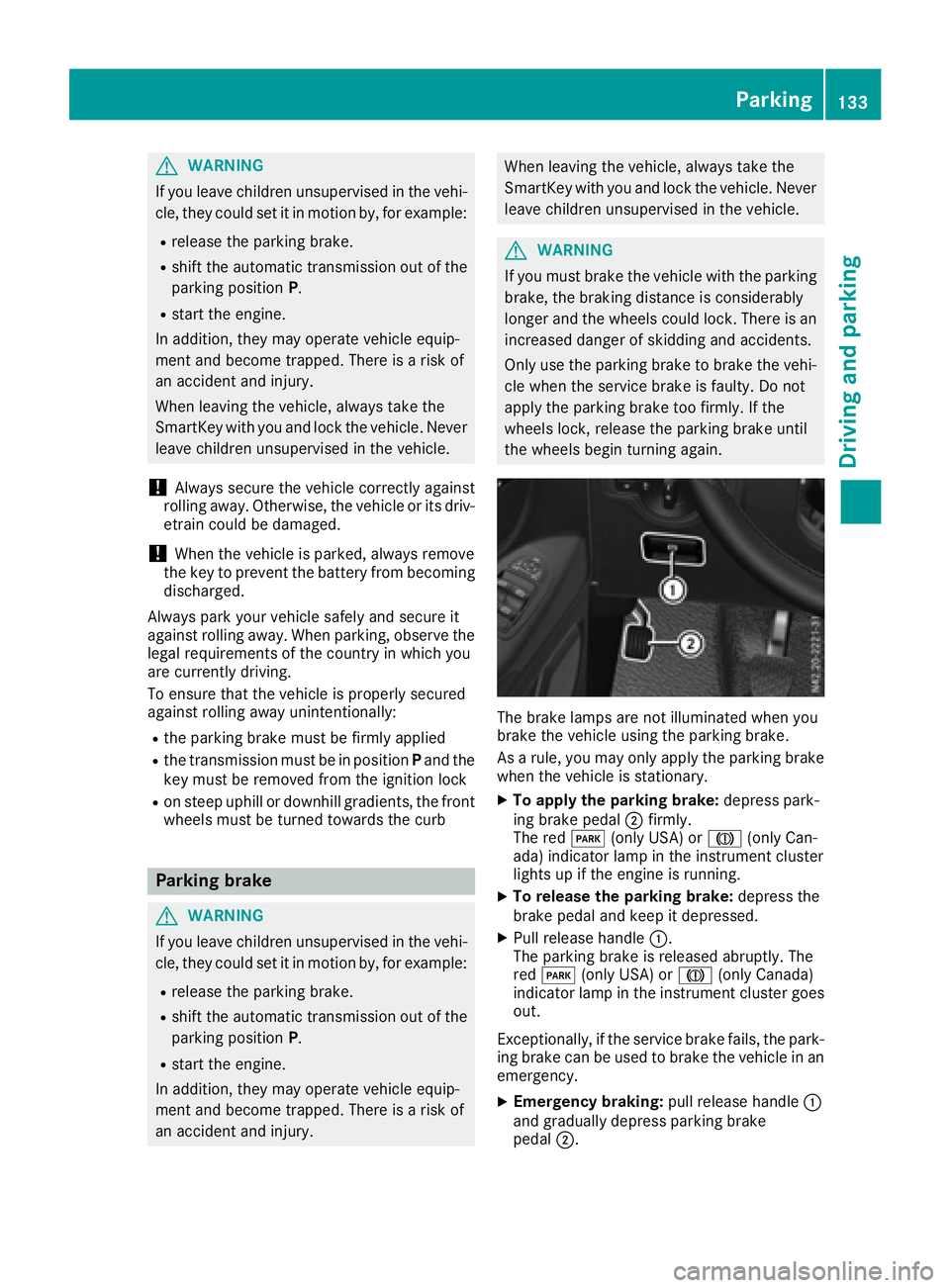
XTo apply the parking brake: depress park-
ing brake pedal ;firmly.
The red F(only USA) or J(only Can-
ada )indicator lamp in the instrument cluster
lights up if the engine is running.
XTo release the parking brake: depress the
brake pedala nd keep it depressed.
XPullrelease handle :.
The parking brake is released abruptly.T he
red F (only USA) or J(only Canada)
indicator lamp in the instrument cluster goes
out.
Exceptionally,ift he service brake fails, the park-
ing brake can be used to brake the vehicleina n
emergency.
XEmergency braking: pullrelease handle :
and gradually depress parking brake
pedal ;.
Parking133
Driving and parking
Z
Page 136 of 310
Switching off the engine
Important safety notes
GWARNING
The automatic transmission switches to neu-
tral position Nwhen you switch off the engine.
The vehicle may roll away.T here isarisk of an
accident.
After switching off the engine, always switch
to parking position P.Prevent the parked vehi-
cle from rolling away by applying the parking
brake.
!If the coolant temperature is very high, e.g.
after driving on hilly roads, leave the engine
running at idle speed for about two minutes
before turning it off.
This allowst he coolant temperature to return
to normal.
Vehicles with automatic transmission
XStop the vehicle.
XShift the transmission to position P.
XApply the parking brake.
XTurn key to position0in the ignition lock and
remove it.
The immobilizer is activated.
If you switch the engine off with the trans-
mission in position Ror D,t he automatic
transmission shifts to Nautomatically.
If you then open one of the front doors or
remove the key from the ignition, the auto-
matic transmission automatically shifts to P.
If you shift the automatic transmission to N
before switching off the engine, the automatic
transmission remains in Neven if afront door
is opened.
XSecure the vehicle to prevent it from rolling
away (Ypage 132).
Parking the vehicle for along period
If you leave the vehicle parked for longer than
4w eeks, the battery may be damaged by
exhaustive discharging.
XDisconnect the battery (Ypage 250).
or
XConnect the battery to atrickle charger.
Be sure to observe the notes on charging the batteries (
Ypage 253).
You can obtain information about trickle
chargers from aqualified specialist work-
shop.
If you leave the vehicle parked for longer than
6w eeks, the vehicle may suffer damage as a
result of lack of use.
XVisit aqualified specialist workshop and seek
advice.
Driving tips
General notes
Important safety notes
GWARNING
If you switch off the ignition while driving,
safety-relevant functions are only available
with limitations, or not at all. This could affect, for example, the power steering and the brake
boosting effect.Y ou will require considerably
more effort to steer and brake. There is arisk
of an accident.
Do not switch off the ignition while driving.
GWARNING
If you operate mobile communication equip-
ment while driving, you will be distracted from traffic conditions. You could also lose control
of the vehicle. There is arisk of an accident.
Only operate this equipment when the vehicle
is stationary.
Observe the legal requirements of the countryi n
which you are driving. Some jurisdictions pro-
hibit the driver from using amobile phone while
driving avehicle.
134Driving tips
Driving and parking