ECU MERCEDES-BENZ METRIS 2020 MY20 Operator’s Manual
[x] Cancel search | Manufacturer: MERCEDES-BENZ, Model Year: 2020, Model line: METRIS, Model: MERCEDES-BENZ METRIS 2020Pages: 320, PDF Size: 26.38 MB
Page 48 of 320
Useful information
This Operator's Manual describes all models
as well as standard and optional equipment of
your vehicle that were available at the time of
going to print. Country-specific variations are
possible. Note that your vehicle may not be
equipped with all of the described functions.
This also applies to systems and functions rel-
evant to safety.
Read the information on qualified specialist
workshops (Y page
32).Occupant safety
Restraint system introduction
The restraint system can reduce the risk of
vehicle occupants coming into contact with
parts of the vehicle's interior in the event of an
accident. In the event of an accident, the
restraint system can also reduce the forces to
which the vehicle occupants are subjected.
The restraint system includes the following
components:
R Seat belt system
R Air bags
R Child restraint system
R Child seat securing system
The various components of the restraint sys-
tem work complementary to one another. They
can only perform their intended protective
function if all vehicle occupants:
R have correctly fastened their seat belt
( Y page
49)
R have correctly adjusted their seat and head
restraint ( Y page 87)
As the driver, you must also ensure that the
driver's seat is in the correct position in rela-
tion to the pedals and the steering wheel.
Depending on your vehicle's equipment, you
can also adjust the steering wheel. Observe
the information relating to the correct driver's
seat position (Y page 87).
Additionally, you must ensure that an air bag
can deploy freely ( Y page 51).
The air bag is supplementary to a correctly fas-
tened seat belt. As an additional safety device,
the air bag increases the level of protection for
vehicle occupants in the event of an accident.
If the protection provided by the seat belt is sufficient, the air bags do not deploy. Further-
more, in the event of an accident, only air bags
which provide greater protection in the given
accident situation deploy. However, seat belts
and air bags generally do not protect against
objects penetrating the vehicle from the out-
side.
Information on how the restraint system oper-
ates can be found in "Deployment of the Emer-
gency Tensioning Devices and air bags"
( Y page
58).
See "Children in the vehicle" for information
on infants and children traveling with you in
the vehicle restraint systems for infants and
children ( Y page 60). Important safety notes
G
WARNING
Modifications to the restraint system may
cause it to no longer work as intended. The
restraint system may then not perform its
intended protective function and may fail in
an accident or trigger unexpectedly, for
example. This poses an increased risk of
injury or even fatal injury.
Never modify parts of the restraint system.
Never tamper with the wiring, the electronic
components or their software.
If it is necessary to modify components of the
restraint system for a person with physical dis-
abilities, contact a Mercedes-Benz Commercial
Van Centerfor details. USA only: contact our
Mercedes-Benz Customer Assistance Center
for details at 1‑877 ‑762‑8267. Restraint system warning lamp
The functions of the restraint system are
checked after the ignition is switched on and
at regular intervals while the engine is running.
Therefore, malfunctions can be detected in
good time.
The 6 restraint system warning lamp on
the instrument cluster lights up when the igni-
tion is switched on. It goes out no later than a
few seconds after the vehicle is started. The
restraint system is operational. 46
Occupant safety
Safety
Page 50 of 320
back in the direction of the seat backrest,
however.
In addition, the Emergency Tensioning Device
cannot compensate for the seat position being
incorrect or for an incorrectly worn seat belt.
When triggered, seat belt force limiters help to
reduce the peak force exerted by the seat belt
on the vehicle occupant.
The belt force limiters on the front seats are
synchronized with the front air bags, which
take on a part of the deceleration force. This
helps to reduce the forces to which vehicle
occupants are subjected during an accident.
! If the front-passenger seat is not occupied,
do not engage the seat belt tongue in the
buckle on the front-passenger seat. Other-
wise, in addition to other systems, the Emer-
gency Tensioning Device could also be trig-
gered in the event of an accident and would
need to be replaced.
Important safety notes The use of seat belts and child restraint sys-
tems is required by law in:
R all 50 states
R the US territories
R the District of Columbia
R all Canadian provinces
Even where this is not required by law, all vehi-
cle occupants should correctly fasten their
seat belts before starting the journey. G
WARNING
If the seat belt is not worn correctly, it can-
not perform its intended protective function.
An incorrectly fastened seat belt can also
cause injuries, for example, in the event of
an accident or when braking or changing
direction abruptly. This poses an increased
risk of injury or even fatal injury.
Always ensure that all vehicle occupants
have their seat belts fastened correctly and
are sitting properly. The various components of the restraint sys-
tem work complementary to one another. They
can only perform their intended protective
function if all vehicle occupants:
R have correctly fastened their seat belt
(Y page
49)
R have correctly adjusted their seat and head
restraint ( Y page 87) G
WARNING
The seat belt does not offer the intended
level of protection if you have not moved the
backrest to an almost vertical position.
When braking or in the event of an accident,
you could slide underneath the seat belt and
sustain abdomen or neck injuries, for exam-
ple. This poses an increased risk of injury or
even fatal injury.
Adjust the seat properly before beginning
your journey. Always ensure that the back-
rest is in an almost vertical position and that
the shoulder section of your seat belt is
routed across the center of your shoulder. G
WARNING
Persons less than 5 ft (1.50 m) tall cannot
wear the seat belt correctly without an addi-
tional and suitable restraint system. If the
seat belt is not worn correctly, it cannot per-
form its intended protective function. An
incorrectly fastened seat belt can also cause
injuries, for example, in the event of an acci-
dent or when braking or changing direction
abruptly. This poses an increased risk of
injury or even fatal injury.
For this reason, always secure persons
under 5 ft
(1.50 m) tall in suitable additional
restraint systems.
If a child younger than twelve years old and
under 5 ft (1.50 m) in height is traveling in the
vehicle: R always secure the child in a child restraint
system suitable for this Mercedes-Benz
vehicle. The child restraint system must be
appropriate to the age, weight and size of
the child.
R ensure that you observe the instructions
and safety notes in the "Children in the vehi- 48
Occupant safety
Safety
Page 51 of 320
cle" section (Y page
60) in addition to the
child restraint system operating instructions
and manufacturer's instructions
R always observe the instructions and safety
notes on the "Occupant Classification Sys-
tem (OCS)" ( Y page 54)G
WARNING
Seat belts may not be able to perform their
protective function in the following situa-
tions, in particular:
R The seat belt is damaged, modified,
extremely dirty, bleached or dyed
R The seat belt buckle is damaged or
extremely dirty
R Modifications have been performed on the
Emergency Tensioning Device, belt
anchorage or inertia reel
Seat belts may be damaged in an accident,
although the damage may not be visible, e.g.
due to splinters of glass. Modified or dam-
aged seat belts may tear or fail, e.g. in an
accident. Modified Emergency Tensioning
Devices could accidentally trigger or not
function as intended. This poses an
increased risk of injury or even fatal injury.
Never modify the seat belts, Emergency Ten-
sioning Devices, belt anchorages or inertia
reels. Make sure that the seat belts are
undamaged, not worn out and clean. Have
the seat belts checked immediately at a
qualified specialist workshop after an acci-
dent.
Only use seat belts that have been approved
for your vehicle by Mercedes-Benz.
Proper use of the seat belts Observe the safety notes on the seat belt
(Y page
48).
In order for the correctly worn seat belt to pro-
vide the intended level of protection, each
vehicle occupant must observe the following
information. Also make sure that all vehicle
occupants have their seat belt correctly fas-
tened during the journey. When fastening the seat belt, always make
sure that:
R the seat belt tongue is only inserted into the
correct belt buckle for the corresponding
seat
R the seat belt fits closely across your body
Avoid wearing bulky clothing, e.g. a winter
coat.
R the seat belt is not twisted
Only then can the forces produced during an
accident be distributed across the surface
of the seat belt.
R the shoulder section of the belt is routed
across the center of your shoulder
The shoulder section of the seat belt should
not touch your neck nor be routed under
your arm or behind your back. If possible,
adjust the seat belt to the appropriate
height.
R the lap belt is fastened closely and routed
as low as possible across your lap, i.e.
across your hips
The lap belt must always be routed across
the hip joints and never across your stom-
ach or abdomen. This is of particular impor-
tance for pregnant women. If necessary,
push the lap belt downwards into your pelvic
area and pull it tight using the shoulder sec-
tion of the belt.
R the seat belt is not routed across sharp-
edged, pointed or breakable objects
Should you have such objects on or in your
clothing, e.g. pens, keys or spectacles, stow
these in a suitable place.
R only one person uses each seat belt at any
one time
Infants and children must never travel sit-
ting on the lap of another vehicle occupant.
In the event of an accident, they could be
crushed between the vehicle occupant and
the seat belt.
R objects are never secured with a seat belt if
the seat belt is also being used by a vehicle
occupant
Also make sure that there are never any
objects between a person and the seat, e.g.
cushions.
Seat belts are solely intended to secure and
restrain vehicle occupants. When securing
objects, luggage or loads, always observe the
instructions and safety notes in "Loading
guidelines"
(Y page 242). Occupant safety
49
Safety Z
Page 52 of 320
Fastening and adjusting seat belts
Observe the safety notes on seat belts
(Y page
48) and the notes on the correct use
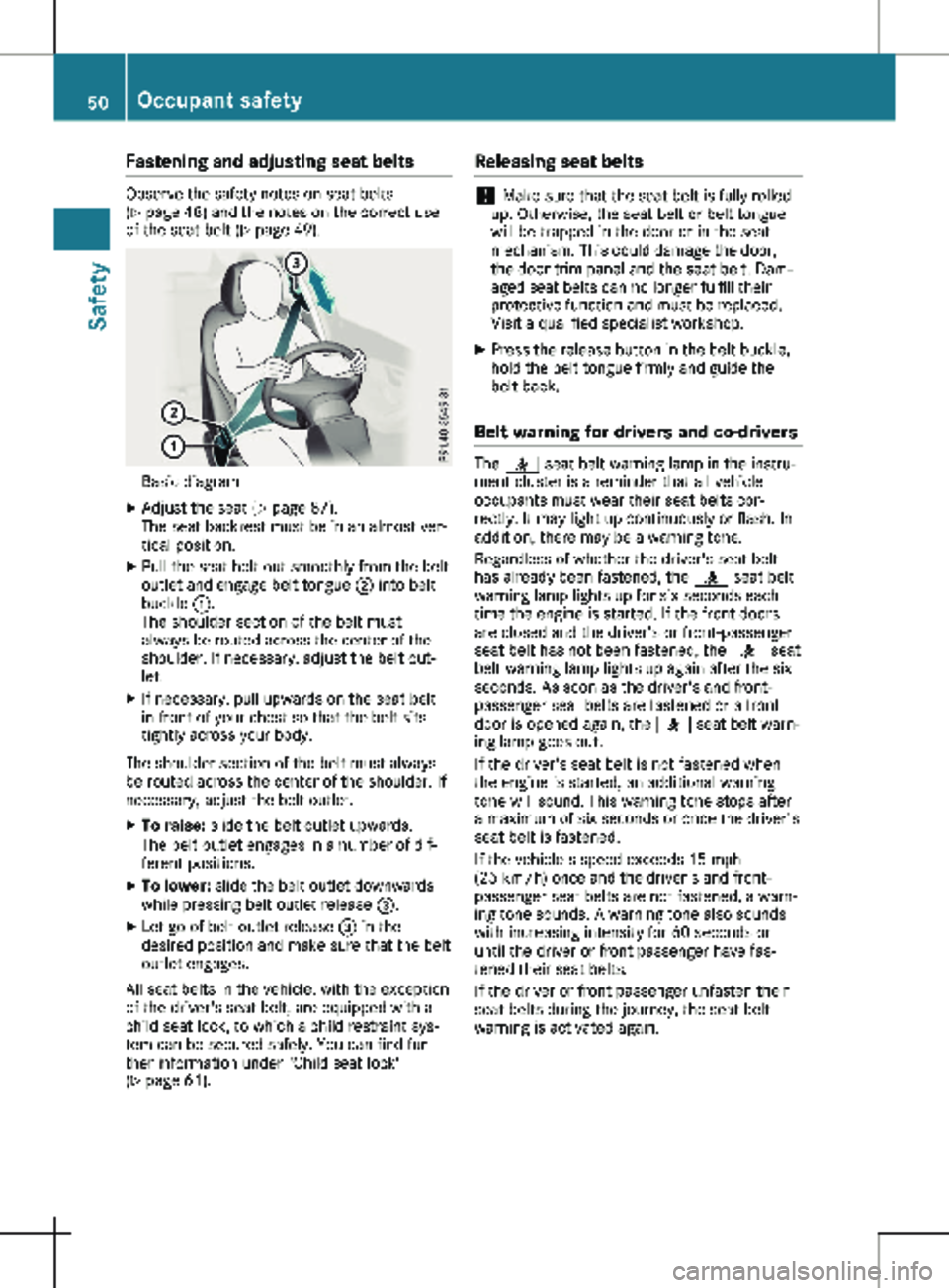
of the seat belt (Y page 49). Basic diagram
X Adjust the seat (Y page
87).
The seat backrest must be in an almost ver-
tical position.
X Pull the seat belt out smoothly from the belt
outlet and engage belt tongue ; into belt
buckle :.
The shoulder section of the belt must
always be routed across the center of the
shoulder. If necessary, adjust the belt out-
let.
X If necessary, pull upwards on the seat belt
in front of your chest so that the belt sits
tightly across your body.
The shoulder section of the belt must always
be routed across the center of the shoulder. If
necessary, adjust the belt outlet. X To raise: slide the belt outlet upwards.
The belt outlet engages in a number of dif-
ferent positions.
X To lower: slide the belt outlet downwards
while pressing belt outlet release =.
X Let go of belt outlet release = in the
desired position and make sure that the belt
outlet engages.
All seat belts in the vehicle, with the exception
of the driver's seat belt, are equipped with a
child seat lock, to which a child restraint sys-
tem can be secured safely. You can find fur-
ther information under "Child seat lock"
(Y page
61). Releasing seat belts !
Make sure that the seat belt is fully rolled
up. Otherwise, the seat belt or belt tongue
will be trapped in the door or in the seat
mechanism. This could damage the door,
the door trim panel and the seat belt. Dam-
aged seat belts can no longer fulfill their
protective function and must be replaced.
Visit a qualified specialist workshop.
X Press the release button in the belt buckle,
hold the belt tongue firmly and guide the
belt back.
Belt warning for drivers and co-drivers The 7 seat belt warning lamp in the instru-
ment cluster is a reminder that all vehicle
occupants must wear their seat belts cor-
rectly. It may light up continuously or flash. In
addition, there may be a warning tone.
Regardless of whether the driver's seat belt
has already been fastened, the 7 seat belt
warning lamp lights up for six seconds each
time the engine is started. If the front doors
are closed and the driver's or front-passenger
seat belt has not been fastened, the 7 seat
belt warning lamp lights up again after the six
seconds. As soon as the driver's and front-
passenger seat belts are fastened or a front
door is opened again, the 7 seat belt warn-
ing lamp goes out.
If the driver's seat belt is not fastened when
the engine is started, an additional warning
tone will sound. This warning tone stops after
a maximum of six seconds or once the driver's
seat belt is fastened.
If the vehicle's speed exceeds
15 mph
(25 km/h) once and the driver's and front-
passenger seat belts are not fastened, a warn-
ing tone sounds. A warning tone also sounds
with increasing intensity for 60 seconds or
until the driver or front passenger have fas-
tened their seat belts.
If the driver or front passenger unfasten their
seat belts during the journey, the seat belt
warning is activated again. 50
Occupant safety
Safety
Page 53 of 320
Air bags
Introduction The installation point of an airbag can be rec-
ognized by the AIRBAG marking.
An airbag complements the correctly fastened
seat belt. It is no substitute for the seat belt.
When deployed, an airbag can increase the
protection provided for the respective vehicle
occupant.
Not all airbags are deployed in an accident.
The various airbags work independently of
each other (Y page
58).
However, no system available today can com-
pletely eliminate injuries and fatalities.
It is also not possible to rule out a risk of injury
caused by an airbag due to the high speed at
which the airbag must be deployed.
Important safety notes G
WARNING
If the front passenger air bag has been acti-
vated, a child on the front passenger seat
may be hit by the front passenger air bag in
the event of an accident. There is a risk of
injury or fatal injury.
NEVER use a rearward-facing child restraint
system on a seat protected by an ACTIVE
FRONT AIRBAG; DEATH or SERIOUS INJURY
to the CHILD can occur.
When installing a child restraint system on the
front-passenger seat observe the vehicle-spe-
cific notes
(Y page 64). You must observe
the notes on rearward and forward-facing child
restraint systems on the front-passenger seat. G
WARNING
If you deviate from the correct seat position,
the air bag cannot perform its intended pro-
tective function and deployment may even
cause further injuries. This poses an
increased risk of injury or even fatal injury.
To avoid any risks, each vehicle occupant
must always make sure of the following:
R Fasten the seat belt correctly. In the case
of pregnant women in particular, make sure that the lap belt is never routed
across the stomach or abdomen.
R Adopt the correct seat position and keep
as far away as possible from the air bags.
R Observe the following notes.
Always make sure that there are no objects
between the air bag and vehicle occupant.
All vehicle occupants must observe the follow-
ing notes to avoid risks posed by the air bag
when it deploys.
R Adjust the seats properly before beginning
your journey. Always make sure that the
seat is in an almost upright position. The
center of the head restraint must support
the head at about eye level.
R Move the driver's and front-passenger seats
as far back as possible. The driver's seat
position must allow the vehicle to be driven
safely.
R Only hold the steering wheel on the outside.
This allows the air bag to be fully deployed.
R Always lean against the backrest while driv-
ing. Do not lean forward or lean against the
door or side window. You may otherwise be
in the deployment area of the air bags.
R Always keep your feet in the footwell in
front of the seat. Do not put your feet on the
dashboard, for example. Your feet may oth-
erwise be in the deployment area of the air
bag.
R For this reason, always secure persons less
than 5 ft
(1.50 m) tall in suitable restraint
systems. Up to this height, the seat belt
cannot be worn correctly.
If a child is traveling in your vehicle, also
observe the following notes:
R Always secure children under twelve years
of age and less than 5 ft (1.50 m) tall in suit-
able child restraint systems.
R Child restraint systems should preferably be
installed on the rear seats.
R Secure a child to the front-passenger seat
only when the front-passenger front air bag
is deactivated, and then only in a rearward-
facing child restraint system. The front-
passenger front air bag is deactivated when
the PASSENGER AIR BAG OFF indicator
lamp is lit continuously (Y page 47).
R Always observe the instructions and safety
notes on the "Occupant Classification Sys- Occupant safety
51
Safety Z
Page 57 of 320
is disabled. It will not be deployed in the
event of an accident and cannot perform its
intended protective function. A person in the
front-passenger seat could then, for exam-
ple, come into contact with the vehicle's
interior, especially if the person is sitting too
close to the dashboard. This poses an
increased risk of injury or even fatal injury.
When the front-passenger seat is occupied,
always ensure that:
R the classification of the person in the
front-passenger seat is correct and the
front-passenger front air bag is enabled or
disabled in accordance with the person in
the front-passenger seat
R the front-passenger seat has been moved
back as far back as possible.
R the person is seated correctly.
Make sure, both before and during the jour-
ney, that the status of the front-passenger
front air bag is correct. G
WARNING
If you secure a child in a child restraint sys-
tem on the front-passenger seat and the
PASSENGER AIR BAG OFF indicator lamp is
off, the front-passenger front air bag can
deploy in the event of an accident. The child
could be struck by the air bag. This poses an
increased risk of injury or even fatal injury.
Make sure that the front-passenger front air
bag has been deactivated. The PASSENGER
AIR BAG OFF indicator lamp must be lit.
NEVER use a rearward-facing child restraint
on a seat protected by an ACTIVE FRONT
AIR BAG in front of it; DEATH or SERIOUS
INJURY to the child can occur. G
WARNING
If you secure a child in a forward-facing child
restraint system on the front-passenger seat
and you position the front-passenger seat
too close to the dashboard, the child could,
in the event of an accident:
R come into contact with the vehicle's inte-
rior if the PASSENGER AIR BAG OFF indi-
cator lamp is lit, for example
R be struck by the air bag if the
PASSENGER AIR BAG OFF indicator lamp
is off
This poses an increased risk of injury or
even fatal injury.
Move the front-passenger seat as far back
as possible. Always make sure that the
shoulder belt strap is correctly routed from
the vehicle belt sash guide to the shoulder
belt guide on the child restraint system. The
shoulder belt strap must be routed forwards
and downwards from the vehicle belt sash
guide. If necessary, adjust the vehicle belt
sash guide and the front-passenger seat
accordingly. Always observe the child
restraint system manufacturer's installation
instructions.
If OCS determines that:
R The front-passenger seat is unoccupied, the
PASSENGER AIR BAG OFF indicator lamp
lights up after the self-test and remains lit.
This indicates that the front-passenger front
air bag is deactivated.
R The front-passenger seat is occupied by a
child of up to twelve months old, in a stand-
ard child restraint system, the PASSENGER
AIR BAG OFF indicator lamp lights up after
the self-test and remains lit. This indicates
that the front-passenger front air bag is
deactivated.
But even in the case of a twelve-month-old
child, in a standard child restraint system,
the PASSENGER AIR BAG OFF indicator
lamp can go out after the self-test. This indi-
cates that the front-passenger front air bag
is enabled. The result of the classification is
dependent on, among other factors, the
child restraint system and the child's stat- Occupant safety
55Safety Z
Page 62 of 320
ation is not high. Conversely, air bags may be
deployed even though the vehicle suffers only
minor deformation. This is the case if, for
example, very rigid vehicle parts such as longi-
tudinal body members are hit, and sufficient
deceleration occurs as a result.
If the restraint system control unit detects a
side impact or if the vehicle rolls over, the
applicable components of the restraint system
are deployed independently of each other
depending on the apparent type of accident.
R Side impact air bag and pelvis air bag on the
side on which an impact occurs, independ-
ent from the Emergency Tensioning Device
and seat belt usage
The side impact air bag on the front
passenger side deploys under the following
conditions:
- the OCS system detects that the front
passenger seat is occupied or
- the seat belt buckle tongue is engaged in
the belt buckle of the front passenger
seat
R Window curtain air bag on the side of
impact, independently of the use of the seat
belt and independently of whether the front-
passenger seat is occupied
R Emergency Tensioning Devices, if the sys-
tem determines that deployment can offer
additional protection in this situation
R Window curtain air bags on the driver's and
front-passenger side in certain situations
when the vehicle rolls over, if the system
determines that deployment can offer addi-
tional protection to that provided by the
seat belt
i Not all air bags are deployed in an acci-
dent. The various air bags work independ-
ently of each other.
How the air bag works is determined by the
severity of the accident detected, especially
the vehicle deceleration or acceleration and
the apparent type of accident:
R Head-on collision
R Side impact
R Rollover Automatic measures after an acci-
dent
Immediately after an accident, the following
measures are implemented, depending on the
type and severity of the impact:
R the hazard warning lamps are switched on
R the emergency lighting in the interior is acti-
vated
R the vehicle doors are unlocked
R the front side windows are lowered
R air-recirculation mode is activated
R climate control is switched off
R the engine is switched off and the fuel sup-
ply is cut off Children in the vehicle
Important safety notes
Accident statistics show that children secured
on the rear seats are safer than children
secured on the front seats. For this reason,
Mercedes-Benz strongly advises that you fit
the child restraint system to a rear seat. The
child is generally better protected there.
If a child younger than twelve years old and
under 5 ft
(1.50 m) in height is traveling in the
vehicle:
R always secure the child in a child restraint
system suitable for Mercedes-Benz vehicles.
The child restraint system must be appropri-
ate to the age, weight and size of the child.
R always observe the instructions and safety
notes in this section in addition to the child
restraint system manufacturer's instruc-
tions.
R always observe the instructions and safety
notes on the "Occupant Classification Sys-
tem (OCS)" ( Y page 54). G
WARNING
If children are left unsupervised in the vehi-
cle, they could, in particular:
R open doors, thereby endangering other
persons or road users.
R get out and be struck by oncoming traffic.
R operate vehicle equipment and become
trapped, for example.60
Children in the vehicle
Safety
Page 63 of 320
In addition, children could set the vehicle in
motion, for example, if they:
R release the parking brake.
R change the transmission position.
R start the vehicle.
There is a risk of accident and injury.
Never leave children unsupervised in the
vehicle.
When leaving the vehicle, always take the
SmartKey with you and lock the vehicle.
Keep the SmartKey out of the reach of chil-
dren. G
WARNING
If persons, particularly children are subjec-
ted to prolonged exposure to extreme heat
or cold, there is a risk of injury, possibly
even fatal. Never leave children unattended
in the vehicle. G
WARNING
If the child restraint system is subjected to
direct sunlight, parts may get very hot. Chil-
dren may burn themselves on these parts,
particularly on the metal parts of the child
restraint system. There is a risk of injury.
If you leave the vehicle, taking the child with
you, always ensure that the child restraint
system is not exposed to direct sunlight.
Protect it with a blanket, for example. If the
child restraint system has been exposed to
direct sunlight, let it cool down before secur-
ing the child in it. Never leave children unat-
tended in the vehicle.
Make sure that all vehicle occupants have fas-
tened their seat belts properly and are seated
correctly. This is particularly important for chil-
dren.
Observe the safety notes on seat belts
(Y page
48) and the notes on the correct use
of the seat belt (Y page 49).
A booster seat may be necessary to achieve
proper seat belt positioning for children over
40 lbs (18 kg) until they reach a height where
a three-point seat belt fits properly without a
booster seat. Special seatbelt retractor
G
WARNING
If the seat belt is released while driving, the
child restraint system will no longer be
secured properly. The special seat belt
retractor is disabled and the inertia real
draws in a portion of the seat belt. The seat
belt cannot be immediately refastened.
There is an increased risk of injury, possibly
even fatal.
Stop the vehicle immediately, paying atten-
tion to road and traffic conditions. Reacti-
vate the special seat belt retractor and
secure the child restraint system properly.
All seat belts in the vehicle, except the driver's
seat belt, are equipped with a special seat belt
retractor. When activated, the special seat belt
retractor ensures that the seat belt cannot
slacken once the child seat is secured.
Installing a child restraint system:
X Make sure you observe the child restraint
system manufacturer's installation instruc-
tions.
X Pull the seat belt smoothly from the belt
outlet.
X Engage seat belt tongue in belt buckle.
Activating the special seat belt retractor:
X Pull the seat belt out fully and let the inertia
reel retract it again.
While the seat belt is retracting, you should
hear a ratcheting sound. The special seat
belt retractor is enabled.
X Push the child restraint system down so that
the seat belt is tight and does not loosen.
Removing the child restraint system and deac-
tivating the special seat belt retractor:
X Make sure you observe the child restraint
system manufacturer's installation instruc-
tions.
X Press the release button of the seat belt
buckle and guide the seat belt tongue back
towards the belt sash guide.
The special seat belt retractor is deactiva-
ted. Children in the vehicle
61
Safety Z
Page 64 of 320
Child restraint system
The use of seat belts and child restraint sys-
tems is required by law in: R all 50 states
R the US territories
R the District of Columbia
R all Canadian provinces
You can obtain further information about the
correct child restraint system from a
Mercedes-Benz Commercial Van Center. G
WARNING
If the child restraint system is installed
incorrectly on a suitable seat, it cannot pro-
tect as intended. The child cannot then be
restrained in the event of an accident, heavy
braking or sudden changes of direction.
There is an increased risk of injury, possibly
even fatal.
Make sure that you observe the child
restraint system manufacturer's installation
instructions and the notes on use. Please
ensure, that the base of the child restraint
system is always resting completely on the
seat cushion. Never place objects, e.g. cush-
ions, under or behind the child restraint sys-
tem. Only use child restraint systems with
the original cover designed for them. Only
replace damaged covers with genuine cov-
ers. G
WARNING
If a rearward facing child restraint system is
installed in the direction of travel by mis-
take, it cannot protect as intended. This is
the case if, for instance, you install a rear-
ward-facing child restraint system on a rear
seat opposite to the direction of travel. In
the event of an accident, a child might not
be restrained correctly. This poses an
increased risk of injury or even fatal injury.
Always install the rear seat in the direction
of travel before you install the rearward
facing child restraint system. G
WARNING
If the child restraint system is installed
incorrectly or is not secured, it can come
loose in the event of an accident, heavy
braking or a sudden change in direction. The
child restraint system could be thrown
about, striking vehicle occupants. There is
an increased risk of injury, possibly even
fatal.
Always install child restraint systems prop-
erly, even if they are not being used. Make
sure that you observe the child restraint sys-
tem manufacturer's installation instructions.
You will find further information on securely
stowing objects, luggage and loads under
"Loading guidelines"
(Y page 242). G
WARNING
Child restraint systems or their securing sys-
tems which have been damaged or subjec-
ted to a load in an accident can no longer
protect as intended. The child cannot then
be restrained in the event of an accident,
heavy braking or sudden changes of direc-
tion. There is an increased risk of injury,
possibly even fatal.
Replace child restraint systems which have
been damaged or subjected to a load in an
accident as soon as possible. Have the
securing systems on the child restraint sys-
tem checked at a qualified specialist work-
shop, before you install a child restraint sys-
tem again.
Securing systems for child restraint systems
are: R the seat belt system
R the LATCH-type (ISOFIX) securing rings
R the Top Tether anchorage points
If it is absolutely necessary to carry a child on
the front-passenger seat, always observe the
notes on the "Occupant classification system"
(OCS) ( Y page
54). Information on disabling
the front passenger airbag can also be found
there. 62
Children in the vehicle
Safety
Page 65 of 320
All child restraint systems must meet the fol-
lowing standards:
R U.S. Federal Motor Vehicle Safety Standards
213 and 225
R Canadian Motor Vehicle Safety Standards
213 and 210.2
Confirmation that the child restraint system
corresponds to the standards can be found on
an instruction label on the child restraint sys-
tem. This confirmation can also be found in
the installation instructions that are included
with the child restraint system.
Observe the warning labels in the vehicle inte-
rior and on the child restraint. LATCH-type (ISOFIX) child seat
securing system
G
WARNING
For LATCH-type (ISOFIX) child restraint sys-
tems in which the child is secured using the
safety belt integrated in the child restraint
system, the maximum permissible weight of
the child and child restraint system together
is 73 lbs (33 kg
).
If the child and the child restraint system
together weigh more than 73 lbs (33 kg), the
LATCH-type (ISOFIX) child restraint system
with integrated safety belt no longer offers
sufficient protection. The LATCH-type (ISO-
FIX) child seat securing system may be over-
loaded, and the child may not be restrained
in an accident, for example. This poses an
increased risk of injury or even fatal injury.
If the child and the child restraint system
together weigh more than 73 lbs (33 kg),
use only a LATCH-type (ISOFIX) child
restraint system in which the child is also
secured with the vehicle seat belt. Also
secure the child restraint system with the
Top Tether belt, if available.
Regularly check that the permissible gross
weight of the child together with the child
restraint system is still maintained.
Always comply with the manufacturer's instal-
lation and operating instructions for the child
restraint system used. Before installing a child seat, move the rear
seat backrest to an upright position. Do not
adjust the backrest of a seat with a LATCH-
type (ISOFIX) child restraint system installed.
Before every trip, make sure that the LATCH-
type (ISOFIX) child restraint system is engaged
correctly in both LATCH-type (ISOFIX) securing
rings
! When fitting the child restraint system in
vehicles with a rear bench seat, make sure
that the seat belt for the center seat does
not get trapped. Otherwise, the seat belt
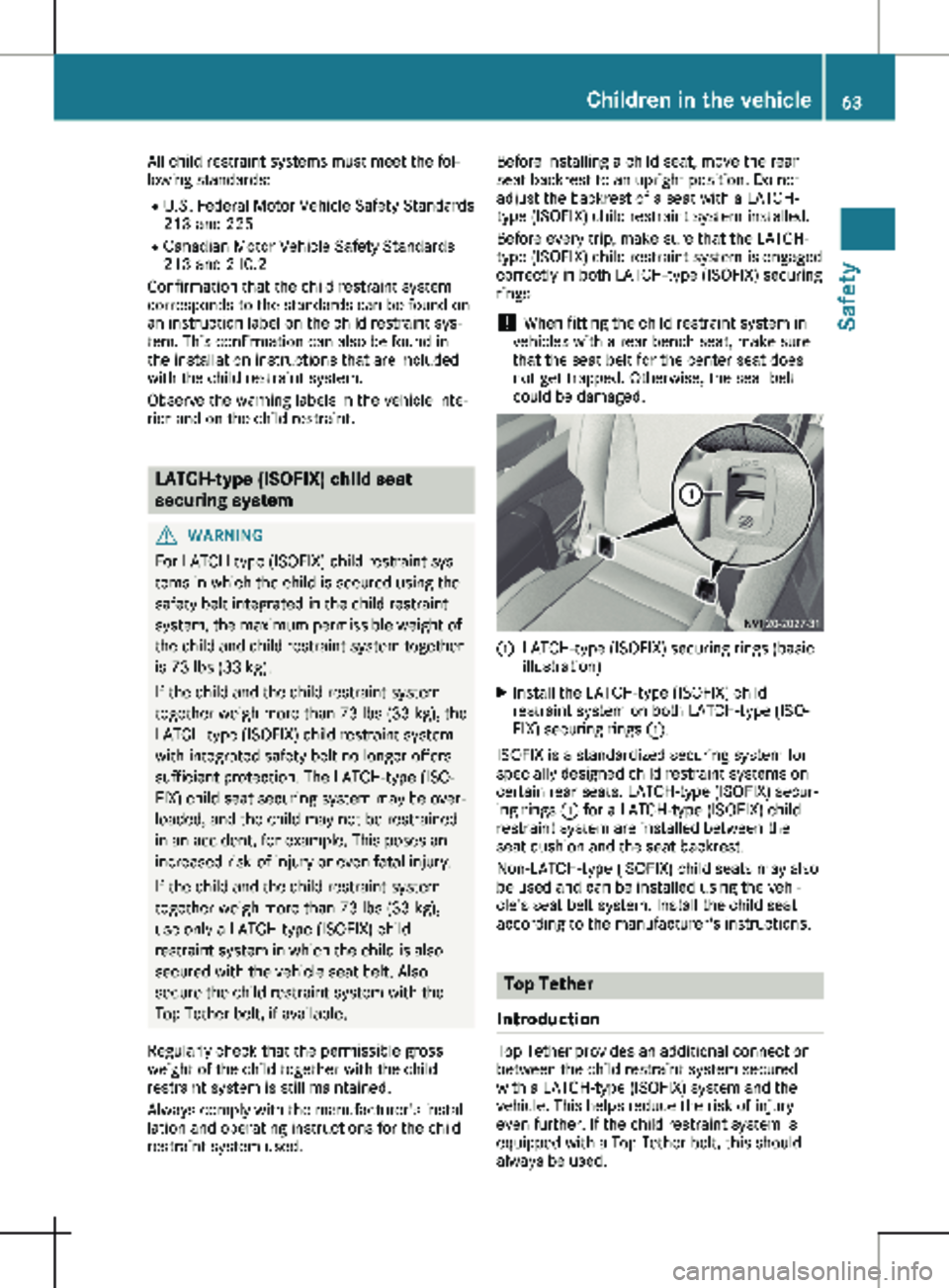
could be damaged. :
LATCH-type (ISOFIX) securing rings (basic
illustration)
X Install the LATCH-type (ISOFIX) child
restraint system on both LATCH-type (ISO-
FIX) securing rings :.
ISOFIX is a standardized securing system for
specially designed child restraint systems on
certain rear seats. LATCH-type (ISOFIX) secur-
ing rings : for a LATCH-type (ISOFIX) child
restraint system are installed between the
seat cushion and the seat backrest.
Non-LATCH-type (ISOFIX) child seats may also
be used and can be installed using the vehi-
cle's seat belt system. Install the child seat
according to the manufacturer's instructions. Top Tether
Introduction Top Tether provides an additional connection
between the child restraint system secured
with a LATCH-type (ISOFIX) system and the
vehicle. This helps reduce the risk of injury
even further. If the child restraint system is
equipped with a Top Tether belt, this should
always be used. Children in the vehicle
63
Safety Z