ECU MERCEDES-BENZ METRIS 2020 MY20 Operator’s Manual
[x] Cancel search | Manufacturer: MERCEDES-BENZ, Model Year: 2020, Model line: METRIS, Model: MERCEDES-BENZ METRIS 2020Pages: 320, PDF Size: 26.38 MB
Page 66 of 320
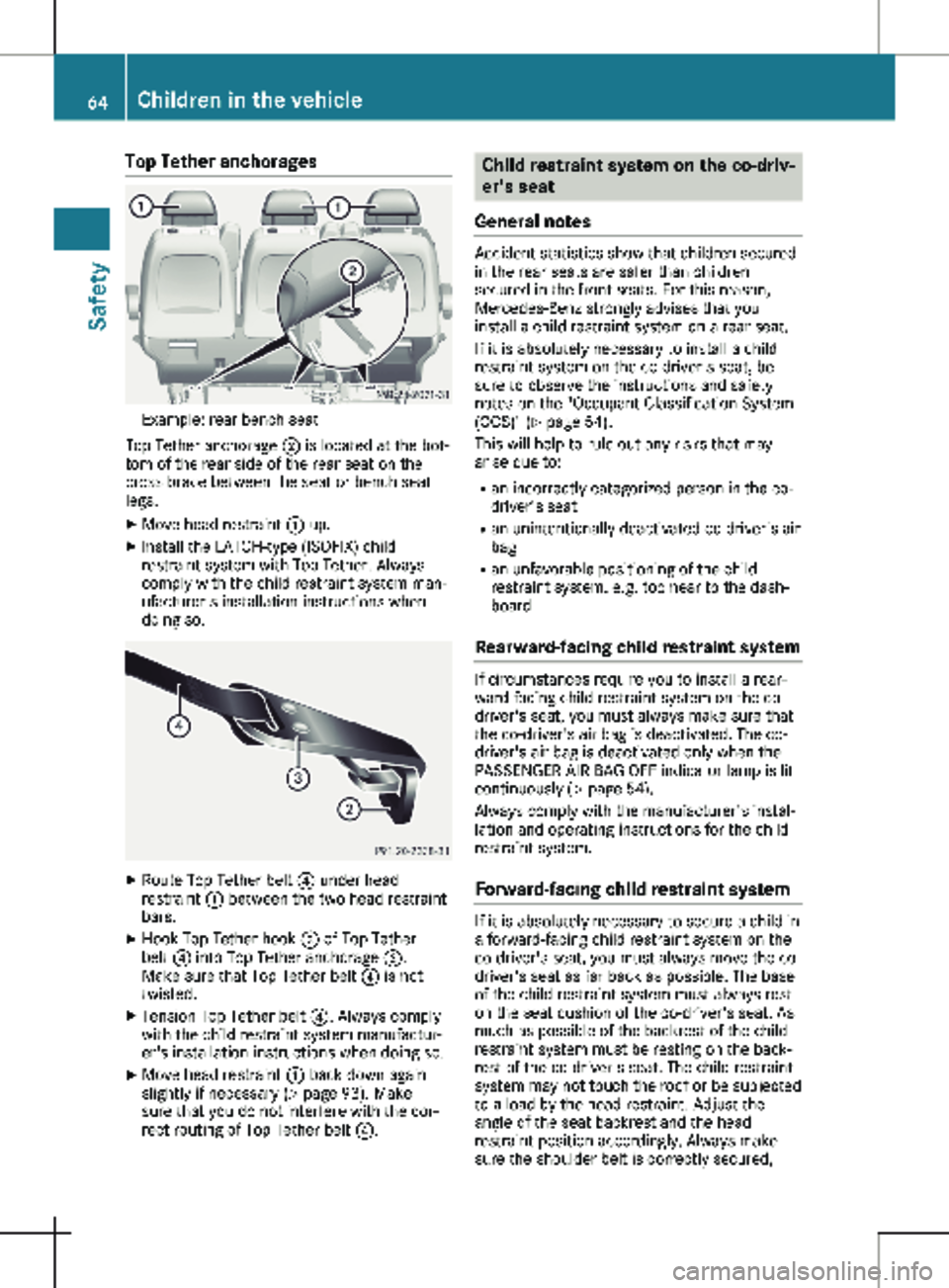
Top Tether anchorages
Example: rear bench seat
Top Tether anchorage ; is located at the bot-
tom of the rear side of the rear seat on the
cross brace between the seat or bench seat
legs.
X Move head restraint : up.
X Install the LATCH-type (ISOFIX) child
restraint system with Top Tether. Always
comply with the child restraint system man-
ufacturer's installation instructions when
doing so. X
Route Top Tether belt ? under head
restraint : between the two head restraint
bars.
X Hook Top Tether hook = of Top Tether
belt ? into Top Tether anchorage ;.
Make sure that Top Tether belt ? is not
twisted.
X Tension Top Tether belt ?. Always comply
with the child restraint system manufactur-
er's installation instructions when doing so.
X Move head restraint : back down again
slightly if necessary (Y page 93). Make
sure that you do not interfere with the cor-
rect routing of Top Tether belt ?. Child restraint system on the co-driv-
er's seat
General notes Accident statistics show that children secured
in the rear seats are safer than children
secured in the front seats. For this reason,
Mercedes-Benz strongly advises that you
install a child restraint system on a rear seat.
If it is absolutely necessary to install a child
restraint system on the co-driver's seat, be
sure to observe the instructions and safety
notes on the "Occupant Classification System
(OCS)"
(Y page 54).
This will help to rule out any risks that may
arise due to:
R an incorrectly categorized person in the co-
driver's seat
R an unintentionally deactivated co-driver's air
bag
R an unfavorable positioning of the child
restraint system, e.g. too near to the dash-
board
Rearward-facing child restraint system If circumstances require you to install a rear-
ward-facing child restraint system on the co-
driver's seat, you must always make sure that
the co-driver's air bag is deactivated. The co-
driver's air bag is deactivated only when the
PASSENGER AIR BAG OFF indicator lamp is lit
continuously ( Y page
54).
Always comply with the manufacturer's instal-
lation and operating instructions for the child
restraint system.
Forward-facing child restraint system If it is absolutely necessary to secure a child in
a forward-facing child restraint system on the
co-driver's seat, you must always move the co-
driver's seat as far back as possible. The base
of the child restraint system must always rest
on the seat cushion of the co-driver's seat. As
much as possible of the backrest of the child
restraint system must be resting on the back-
rest of the co-driver's seat. The child restraint
system may not touch the roof or be subjected
to a load by the head restraint. Adjust the
angle of the seat backrest and the head
restraint position accordingly. Always make
sure the shoulder belt is correctly secured,64
Children in the vehicle
Safety
Page 67 of 320
running from the belt outlet to the belt guide
of the child restraint system. The shoulder belt
strap must be routed forward and down from
the vehicle belt outlet. Adjust the belt outlet
and co-driver's seat as required.
Always comply with the manufacturer's instal-
lation and operating instructions for the child
restraint system. Override feature/child-proof locks
Important safety notes G
WARNING
If children are traveling in the vehicle, they
could in particular:
R open doors, thereby endangering other
persons or road users.
R get out and be struck by oncoming traffic.
R operate vehicle equipment and become
trapped.
There is a risk of an accident and injury.
Always activate the child-proof locks and
override feature if children are traveling in
the vehicle. When leaving the vehicle,
always take the key with you and lock the
vehicle. Never leave children unattended in
the vehicle.
Child-proof lock/override feature for:
R Sliding doors ( Y page
66)G
WARNING
If children are left unsupervised in the vehi-
cle, they could, in particular:
R open doors, thereby endangering other
persons or road users.
R get out and be struck by oncoming traffic.
R operate vehicle equipment and become
trapped, for example.
In addition, children could set the vehicle in
motion, for example, if they:
R release the parking brake.
R change the transmission position.
R start the vehicle. There is a risk of accident and injury.
Never leave children unsupervised in the
vehicle.
When leaving the vehicle, always take the
SmartKey with you and lock the vehicle.
Keep the SmartKey out of the reach of chil-
dren.
G
WARNING
If persons, particularly children are subjec-
ted to prolonged exposure to extreme heat
or cold, there is a risk of injury, possibly
even fatal. Never leave children unattended
in the vehicle. G
WARNING
If the child restraint system is subjected to
direct sunlight, parts may get very hot. Chil-
dren may burn themselves on these parts,
particularly on the metal parts of the child
restraint system. There is a risk of injury.
If you leave the vehicle, taking the child with
you, always ensure that the child restraint
system is not exposed to direct sunlight.
Protect it with a blanket, for example. If the
child restraint system has been exposed to
direct sunlight, let it cool down before secur-
ing the child in it. Never leave children unat-
tended in the vehicle. Children in the vehicle
65
Safety Z
Page 68 of 320
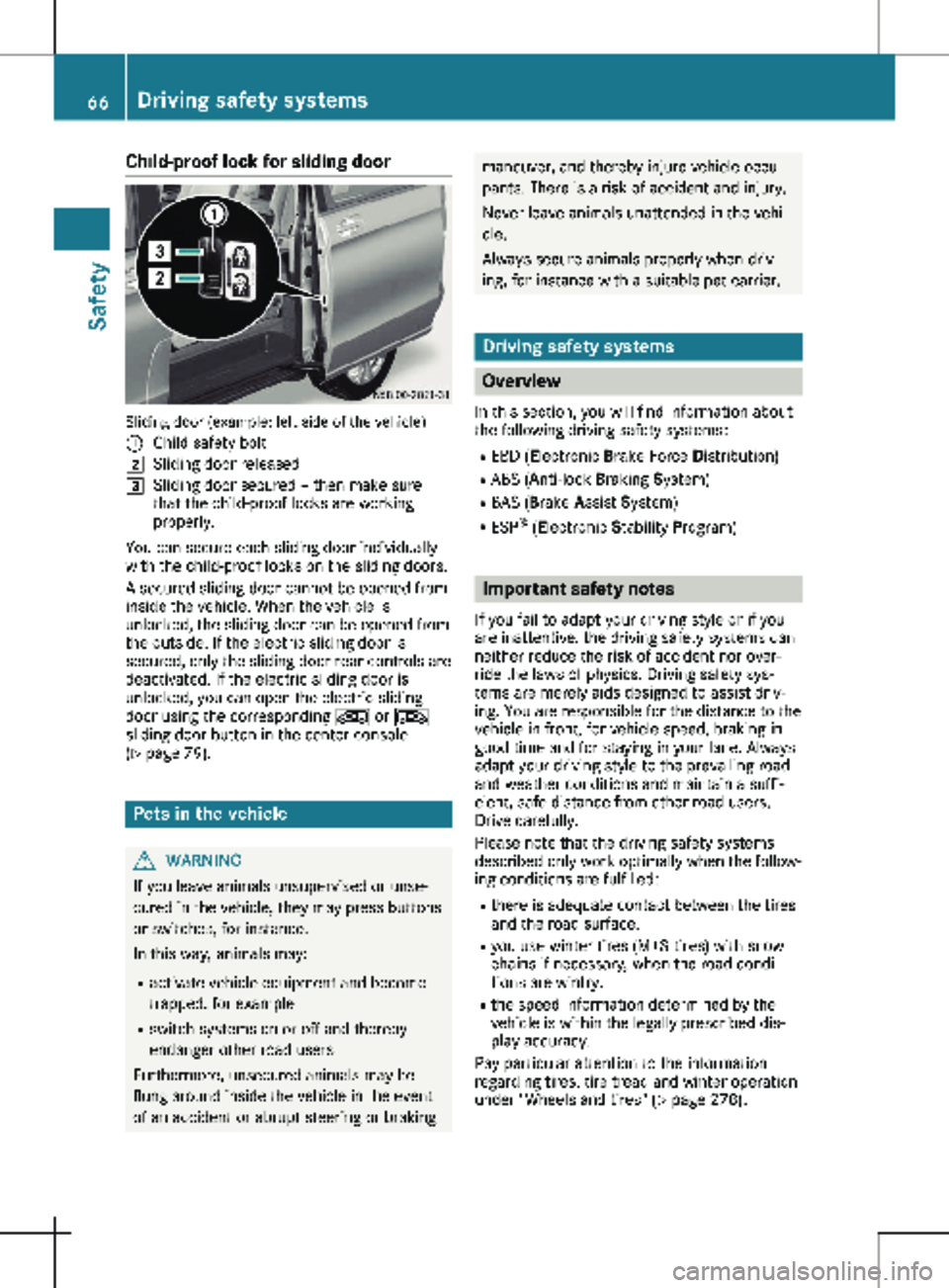
Child-proof lock for sliding door
Sliding door (example: left side of the vehicle)
: Child safety bolt
2 Sliding door released
3 Sliding door secured – then make sure
that the child-proof locks are working
properly.
You can secure each sliding door individually
with the child-proof locks on the sliding doors.
A secured sliding door cannot be opened from
inside the vehicle. When the vehicle is
unlocked, the sliding door can be opened from
the outside. If the electric sliding door is
secured, only the sliding door rear controls are
deactivated. If the electric sliding door is
unlocked, you can open the electric sliding
door using the corresponding Å or Æ
sliding door button in the center console
(Y page
79). Pets in the vehicle
G
WARNING
If you leave animals unsupervised or unse-
cured in the vehicle, they may press buttons
or switches, for instance.
In this way, animals may:
R activate vehicle equipment and become
trapped, for example
R switch systems on or off and thereby
endanger other road users
Furthermore, unsecured animals may be
flung around inside the vehicle in the event
of an accident or abrupt steering or braking maneuver, and thereby injure vehicle occu-
pants. There is a risk of accident and injury.
Never leave animals unattended in the vehi-
cle.
Always secure animals properly when driv-
ing, for instance with a suitable pet carrier. Driving safety systems
Overview
In this section, you will find information about
the following driving safety systems:
R EBD ( Electronic Brake Force Distribution)
R ABS ( Anti-lock Braking System)
R BAS ( Brake A ssist System)
R ESP ®
(Electronic Stability Program) Important safety notes
If you fail to adapt your driving style or if you
are inattentive, the driving safety systems can
neither reduce the risk of accident nor over-
ride the laws of physics. Driving safety sys-
tems are merely aids designed to assist driv-
ing. You are responsible for the distance to the
vehicle in front, for vehicle speed, braking in
good time and for staying in your lane. Always
adapt your driving style to the prevailing road
and weather conditions and maintain a suffi-
cient, safe distance from other road users.
Drive carefully.
Please note that the driving safety systems
described only work optimally when the follow-
ing conditions are fulfilled:
R there is adequate contact between the tires
and the road surface.
R you use winter tires
(M+S tires) with snow
chains if necessary, when the road condi-
tions are wintry.
R the speed information determined by the
vehicle is within the legally prescribed dis-
play accuracy.
Pay particular attention to the information
regarding tires, tire tread and winter operation
under "Wheels and tires" (Y page 278). 66
Driving safety systems
Safety
Page 92 of 320
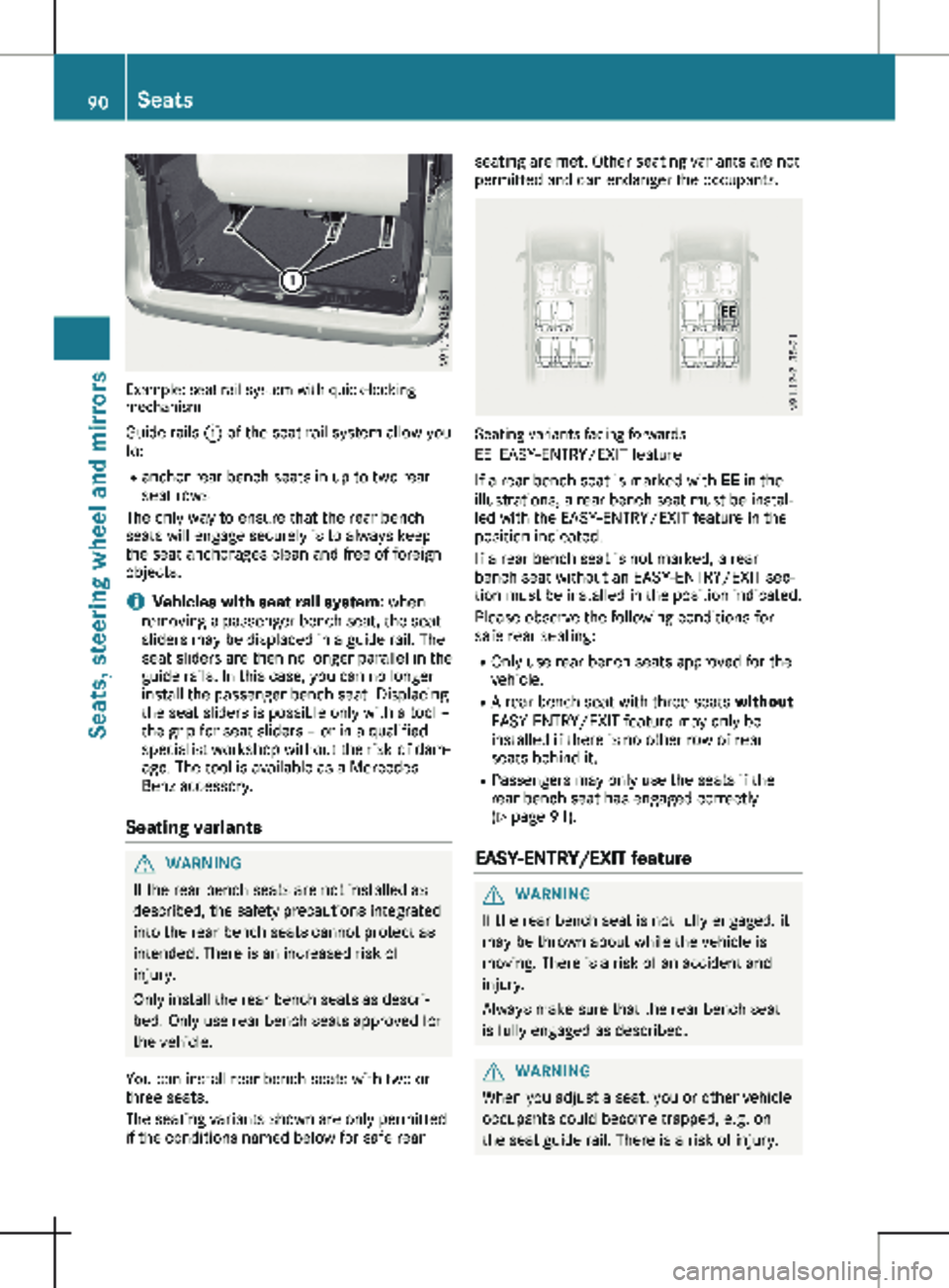
Example: seat rail system with quick-locking
mechanism
Guide rails : of the seat rail system allow you
to:
R anchor rear bench seats in up to two rear
seat rows
The only way to ensure that the rear bench
seats will engage securely is to always keep
the seat anchorages clean and free of foreign
objects.
i Vehicles with seat rail system: when
removing a passenger bench seat, the seat
sliders may be displaced in a guide rail. The
seat sliders are then no longer parallel in the
guide rails. In this case, you can no longer
install the passenger bench seat. Displacing
the seat sliders is possible only with a tool –
the grip for seat sliders – or in a qualified
specialist workshop without the risk of dam-
age. The tool is available as a Mercedes-
Benz accessory.
Seating variants G
WARNING
If the rear bench seats are not installed as
described, the safety precautions integrated
into the rear bench seats cannot protect as
intended. There is an increased risk of
injury.
Only install the rear bench seats as descri-
bed. Only use rear bench seats approved for
the vehicle.
You can install rear bench seats with two or
three seats.
The seating variants shown are only permitted
if the conditions named below for safe rear seating are met. Other seating variants are not
permitted and can endanger the occupants.
Seating variants facing forwards
EE
EASY-ENTRY/EXIT feature
If a rear bench seat is marked with EE in the
illustrations, a rear bench seat must be instal-
led with the EASY-ENTRY/EXIT feature in the
position indicated.
If a rear bench seat is not marked, a rear
bench seat without an EASY-ENTRY/EXIT sec-
tion must be installed in the position indicated.
Please observe the following conditions for
safe rear seating:
R Only use rear bench seats approved for the
vehicle.
R A rear bench seat with three seats without
EASY-ENTRY/EXIT feature may only be
installed if there is no other row of rear
seats behind it.
R Passengers may only use the seats if the
rear bench seat has engaged correctly
( Y page
91).
EASY-ENTRY/EXIT feature G
WARNING
If the rear bench seat is not fully engaged, it
may be thrown about while the vehicle is
moving. There is a risk of an accident and
injury.
Always make sure that the rear bench seat
is fully engaged as described. G
WARNING
When you adjust a seat, you or other vehicle
occupants could become trapped, e.g. on
the seat guide rail. There is a risk of injury. 90
Seats
Seats, steering wheel and mirrors
Page 93 of 320
When adjusting a seat, make sure that no
one has any body parts in the sweep of the
seat. G
WARNING
The rear bench seat will not engage when
folded forward. The rear bench seat may
inadvertently fold backward while accelerat-
ing, braking, changing direction suddenly or
in the event of an accident, for example.
People within the sweep of the rear bench
seat may become trapped. There is a risk of
injury.
Before driving off, always fold back the rear
bench seat if it is folded forward. Make sure
that the rear bench seat is fully engaged.
The only way to ensure that the rear bench
seat will engage securely is to always keep the
seat anchorages clean and free of foreign
objects.
The rear seat leg is only engaged when the red
indicator tab is no longer visible and is fully
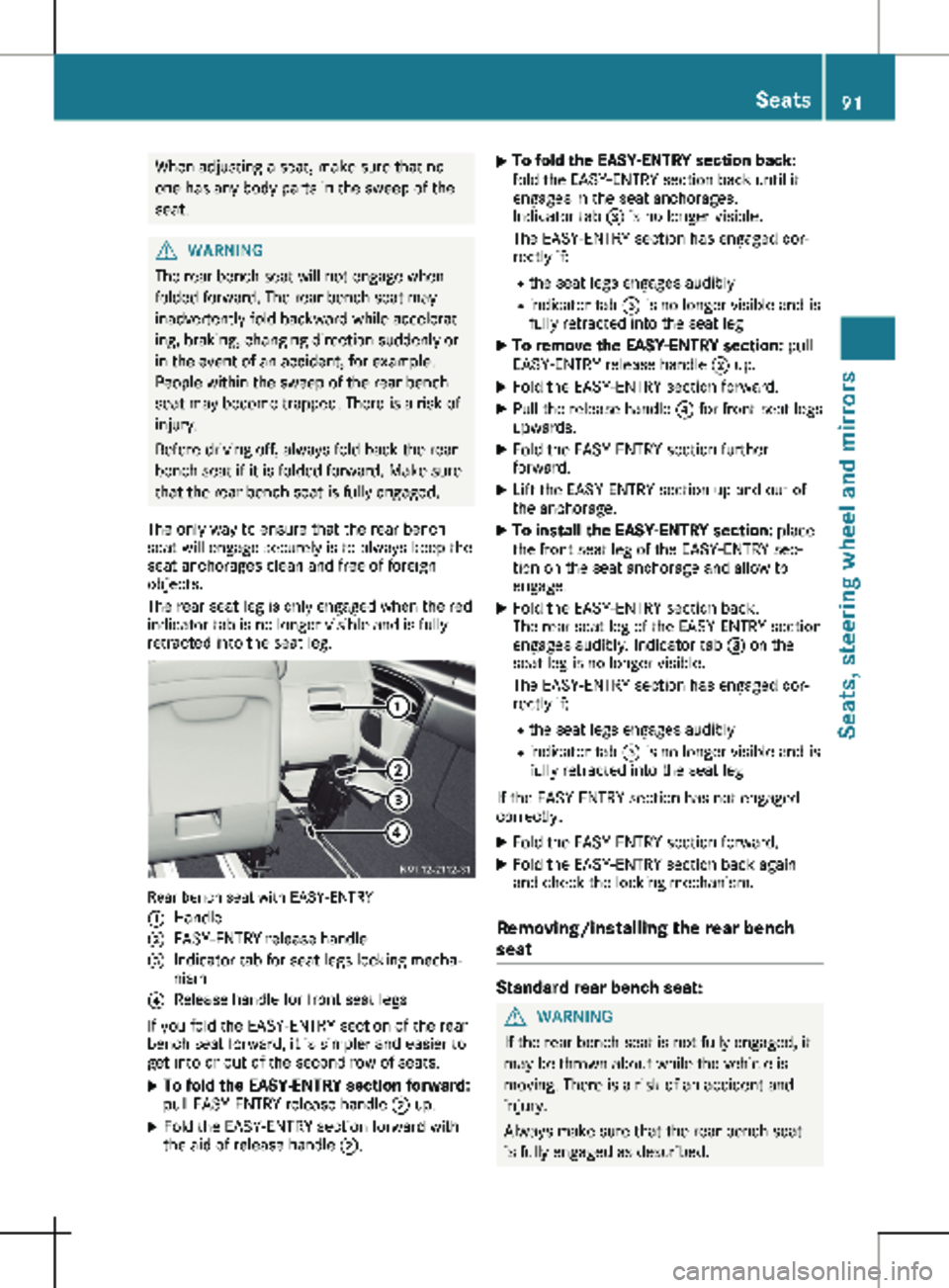
retracted into the seat leg. Rear bench seat with EASY-ENTRY
:
Handle
; EASY-ENTRY release handle
= Indicator tab for seat legs locking mecha-
nism
? Release handle for front seat legs
If you fold the EASY-ENTRY section of the rear
bench seat forward, it is simpler and easier to
get into or out of the second row of seats.
X To fold the EASY-ENTRY section forward:
pull EASY-ENTRY release handle ; up.
X Fold the EASY-ENTRY section forward with
the aid of release handle ;.X
To fold the EASY-ENTRY section back:
fold the EASY-ENTRY section back until it
engages in the seat anchorages.
Indicator tab = is no longer visible.
The EASY-ENTRY section has engaged cor-
rectly if:
R the seat legs engages audibly
R indicator tab = is no longer visible and is
fully retracted into the seat leg
X To remove the EASY-ENTRY section: pull
EASY-ENTRY release handle ; up.
X Fold the EASY-ENTRY section forward.
X Pull the release handle ? for front seat legs
upwards.
X Fold the EASY-ENTRY section further
forward.
X Lift the EASY-ENTRY section up and out of
the anchorage.
X To install the EASY-ENTRY section: place
the front seat leg of the EASY-ENTRY sec-
tion on the seat anchorage and allow to
engage.
X Fold the EASY-ENTRY section back.
The rear seat leg of the EASY-ENTRY section
engages audibly. Indicator tab = on the
seat leg is no longer visible.
The EASY-ENTRY section has engaged cor-
rectly if:
R the seat legs engages audibly
R indicator tab = is no longer visible and is
fully retracted into the seat leg
If the EASY-ENTRY section has not engaged
correctly: X Fold the EASY-ENTRY section forward.
X Fold the EASY-ENTRY section back again
and check the locking mechanism.
Removing/installing the rear bench
seat Standard rear bench seat:
G
WARNING
If the rear bench seat is not fully engaged, it
may be thrown about while the vehicle is
moving. There is a risk of an accident and
injury.
Always make sure that the rear bench seat
is fully engaged as described. Seats
91Seats, steering wheel and mirrors Z
Page 94 of 320
G
WARNING
If the rear bench seat is not installed as
described or an unsuitable rear bench seat
is installed, the seat belts may not provide
protection as intended. There is an
increased risk of injury.
Install the rear bench seat as described.
Only use rear bench seats that are approved
for your vehicle by the distributor named on
the inside cover page.
The only way to ensure that the rear bench
seat will engage securely is to always keep the
seat anchorages clean and free of foreign
objects.
Always observe the notes about the seating
variants (Y page
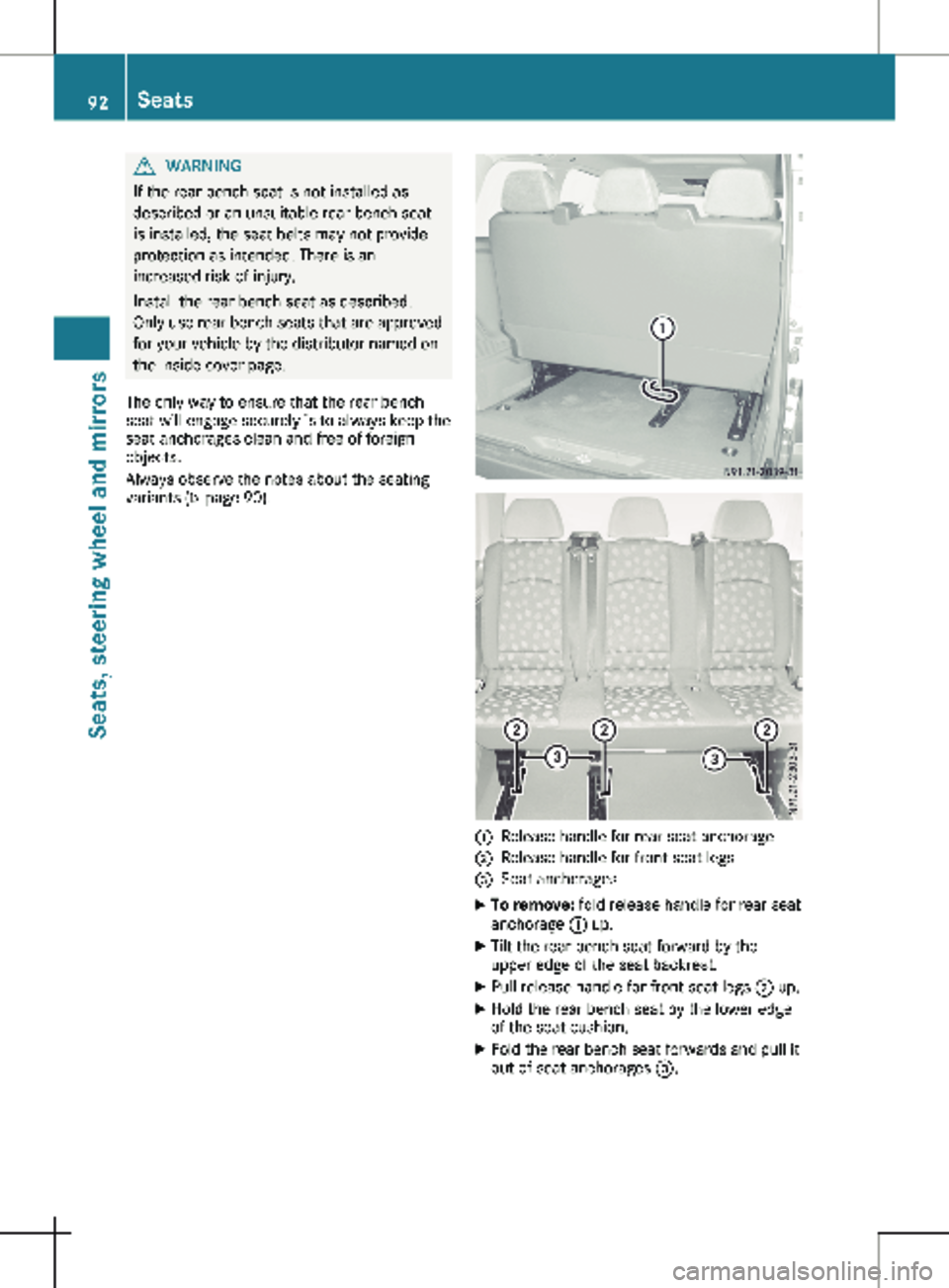
90). :
Release handle for rear seat anchorage
; Release handle for front seat legs
= Seat anchorages
X To remove: fold release handle for rear seat
anchorage : up.
X Tilt the rear bench seat forward by the
upper edge of the seat backrest.
X Pull release handle for front seat legs ; up.
X Hold the rear bench seat by the lower edge
of the seat cushion.
X Fold the rear bench seat forwards and pull it
out of seat anchorages =.92
Seats
Seats, steering wheel and mirrors
Page 102 of 320

Low-beam headlamps
When the ignition is switched on and the light
switch is in the
L position, the parking
lamps and low-beam headlamps are switched
on even if the light sensor does not sense dark
ambient light. This is particularly useful when
there is fog or rain.
X To switch on: turn the key to position 2 in
the ignition lock or start the engine.
X Turn the light switch to the L position.
The L indicator lamp in the instrument
cluster lights up.
Daytime running lamps X
To switch on: turn the light switch to the
$ or à position.
Automatic headlamp mode G
WARNING
When the light switch is set to Ã, the
low-beam headlamps may not be switched
on automatically if there is fog, snow or
other causes of poor visibility due to the
weather conditions such as spray. There is a
risk of an accident.
In such situations, turn the light switch to
L.
Automatic headlamp mode is only a driving
aid. You are responsible for the vehicle lighting
at all times.
When the parking lamps and low-beam head-
lamps are switched on, the green T (park-
ing lamps) and L (low-beam headlamps)
indicator lamps in the instrument cluster light
up.
à is the preferred light switch setting. The
light setting is automatically selected accord-
ing to the brightness of the ambient light
(exception: poor visibility due to weather con-
ditions, such as fog, snow or spray):
R Key in position 1 in the ignition lock: the
parking lamps are switched on or off auto-
matically depending on the brightness of the
ambient light.
R When the engine is on: depending on the
ambient light, the daytime running lamps or the parking lamps and low-beam headlamps
are switched on/off automatically.
X To switch on automatic headlamp mode:
turn the light switch to
Ã.
Fog lamps/rear fog lamp You can only switch the fog lamps on or off
manually in vehicles which have fog lamps
installed.
Front fog lamps help you to see and be seen in
conditions of poor visibility due to fog or pre-
cipitation. They can only be operated together
with the parking lamps or with the low-beam
headlamps.
The rear fog lamp improves visibility of your
vehicle for the traffic behind in the event of
heavy fog. Observe the legal requirements of
the country you are currently in when using
the rear fog lamp.
X Turn the light switch to L or Ã.
X Turn the key to position 2 in the ignition
lock or start the engine.
X To switch the front fog lamps on/off:
press the N button.
When the green
N indicator lamp in the
instrument cluster goes on, the fog lamps
are switched on.
X To switch the rear fog lamp on/off: press
the R button.
When the yellow R indicator lamp in the
instrument cluster goes on, the rear fog
lamp is switched on.
Standing lamps !
If the battery charge is very low, the stand-
ing lamps will switch off automatically to
enable the next engine start. Always park
your vehicle in accordance with legal regula-
tions, in a secure and adequately lit loca-
tion. Avoid leaving the T parking lamps
on for several hours. If possible, switch on
the right X or left W standing lamp.
Switching on the standing lamps ensures that
the corresponding side of the vehicle is illumi-
nated. 100
Exterior lightingLights and windshield wipers
Page 107 of 320
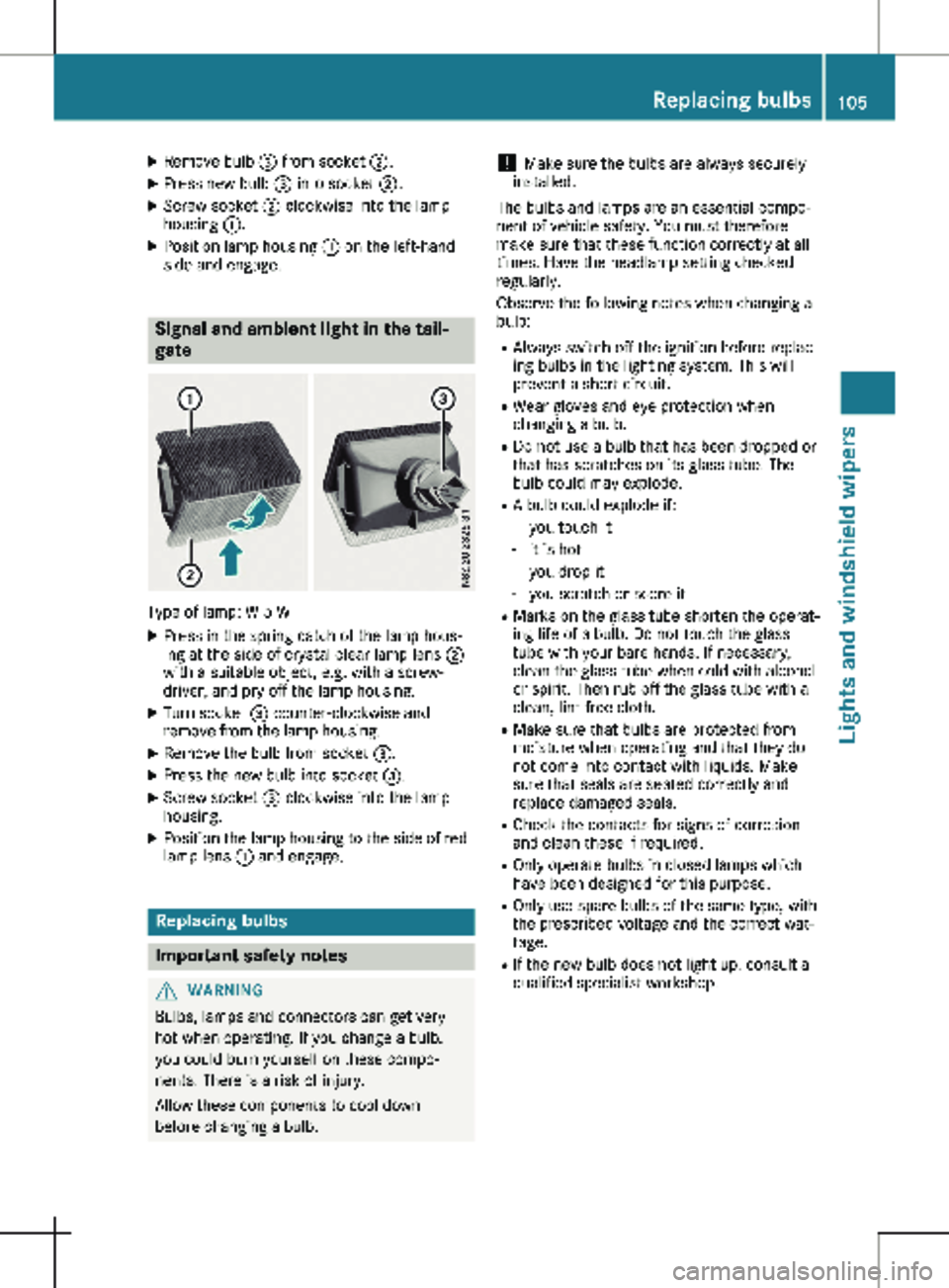
X
Remove bulb = from socket ;.
X Press new bulb = into socket ;.
X Screw socket ; clockwise into the lamp
housing :.
X Position lamp housing : on the left-hand
side and engage. Signal and ambient light in the tail-
gate
Type of lamp: W 5 W
X Press in the spring catch of the lamp hous-
ing at the side of crystal clear lamp lens ;
with a suitable object, e.g. with a screw-
driver, and pry off the lamp housing.
X Turn socket = counter-clockwise and
remove from the lamp housing.
X Remove the bulb from socket =.
X Press the new bulb into socket =.
X Screw socket = clockwise into the lamp
housing.
X Position the lamp housing to the side of red
lamp lens : and engage. Replacing bulbs
Important safety notes
G
WARNING
Bulbs, lamps and connectors can get very
hot when operating. If you change a bulb,
you could burn yourself on these compo-
nents. There is a risk of injury.
Allow these components to cool down
before changing a bulb. !
Make sure the bulbs are always securely
installed.
The bulbs and lamps are an essential compo-
nent of vehicle safety. You must therefore
make sure that these function correctly at all
times. Have the headlamp setting checked
regularly.
Observe the following notes when changing a
bulb:
R Always switch off the ignition before replac-
ing bulbs in the lighting system. This will
prevent a short circuit.
R Wear gloves and eye protection when
changing a bulb.
R Do not use a bulb that has been dropped or
that has scratches on its glass tube. The
bulb could may explode.
R A bulb could explode if:
- you touch it
- it is hot
- you drop it
- you scratch or score it
R Marks on the glass tube shorten the operat-
ing life of a bulb. Do not touch the glass
tube with your bare hands. If necessary,
clean the glass tube when cold with alcohol
or spirit. Then rub off the glass tube with a
clean, lint-free cloth.
R Make sure that bulbs are protected from
moisture when operating and that they do
not come into contact with liquids. Make
sure that seals are seated correctly and
replace damaged seals.
R Check the contacts for signs of corrosion
and clean these if required.
R Only operate bulbs in closed lamps which
have been designed for this purpose.
R Only use spare bulbs of the same type, with
the prescribed voltage and the correct wat-
tage.
R If the new bulb does not light up, consult a
qualified specialist workshop. Replacing bulbs
105Lights and windshield wipers Z
Page 129 of 320
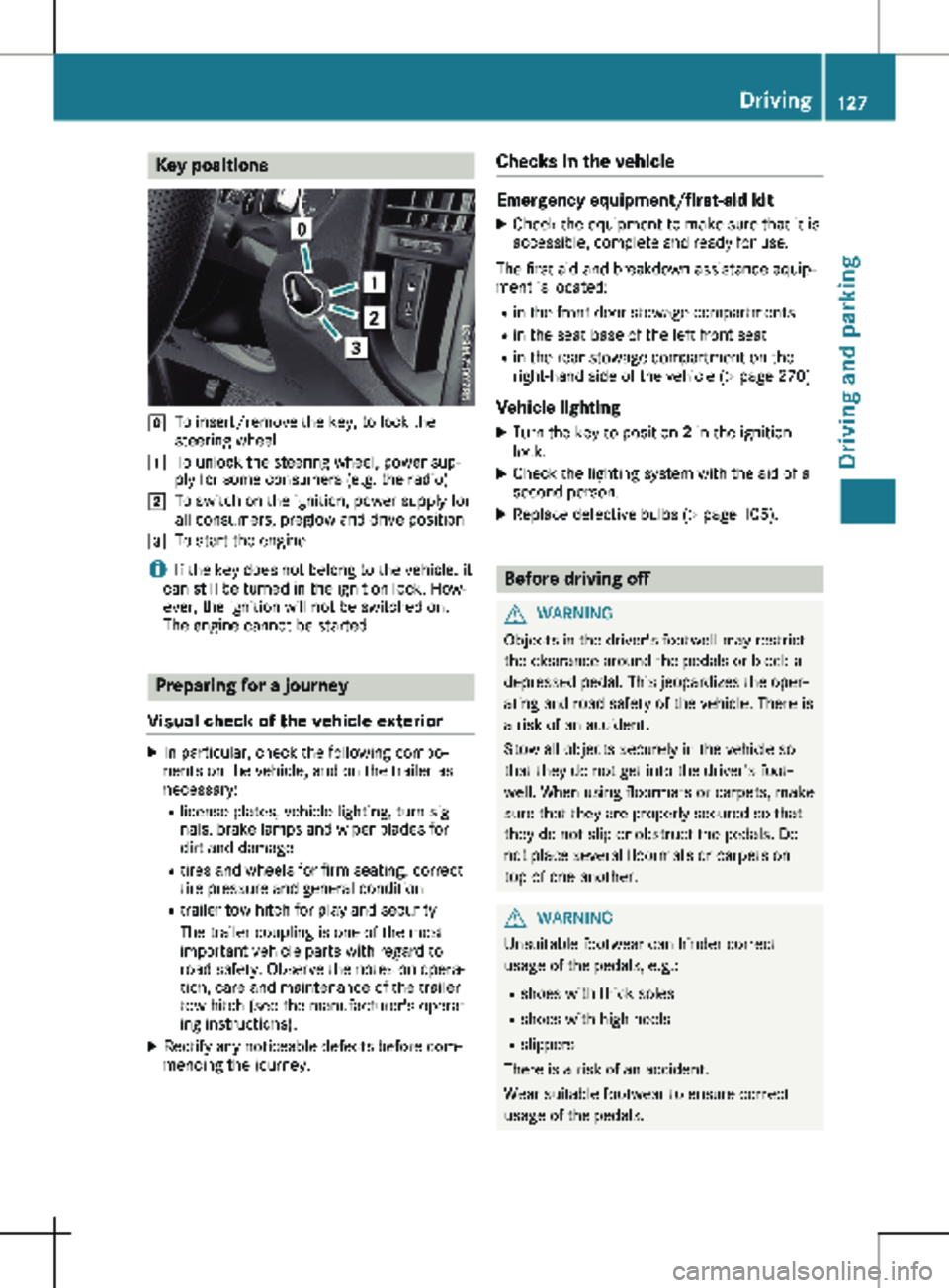
Key positions
g
To insert/remove the key, to lock the
steering wheel
1 To unlock the steering wheel, power sup-
ply for some consumers (e.g. the radio)
2 To switch on the ignition, power supply for
all consumers, preglow and drive position
3 To start the engine
i If the key does not belong to the vehicle, it
can still be turned in the ignition lock. How-
ever, the ignition will not be switched on.
The engine cannot be started. Preparing for a journey
Visual check of the vehicle exterior X
In particular, check the following compo-
nents on the vehicle, and on the trailer as
necessary:
R
license plates, vehicle lighting, turn sig-
nals, brake lamps and wiper blades for
dirt and damage
R tires and wheels for firm seating, correct
tire pressure and general condition
R trailer tow hitch for play and security
The trailer coupling is one of the most
important vehicle parts with regard to
road safety. Observe the notes on opera-
tion, care and maintenance of the trailer
tow hitch (see the manufacturer's operat-
ing instructions).
X Rectify any noticeable defects before com-
mencing the journey. Checks in the vehicle Emergency equipment/first-aid kit
X Check the equipment to make sure that it is
accessible, complete and ready for use.
The first aid and breakdown assistance equip-
ment is located:
R in the front door stowage compartments
R in the seat base of the left front seat
R in the rear stowage compartment on the
right-hand side of the vehicle
(Y page 270)
Vehicle lighting
X Turn the key to position 2 in the ignition
lock.
X Check the lighting system with the aid of a
second person.
X Replace defective bulbs (Y page
105). Before driving off
G
WARNING
Objects in the driver's footwell may restrict
the clearance around the pedals or block a
depressed pedal. This jeopardizes the oper-
ating and road safety of the vehicle. There is
a risk of an accident.
Stow all objects securely in the vehicle so
that they do not get into the driver's foot-
well. When using floormats or carpets, make
sure that they are properly secured so that
they do not slip or obstruct the pedals. Do
not place several floormats or carpets on
top of one another. G
WARNING
Unsuitable footwear can hinder correct
usage of the pedals, e.g.:
R shoes with thick soles
R shoes with high heels
R slippers
There is a risk of an accident.
Wear suitable footwear to ensure correct
usage of the pedals. Driving
127
Driving and parking Z
Page 130 of 320
X
Stow luggage items securely. Secure the
load as per the loading guidelines
(Y page
242).
X Make sure that the floormats and carpets
are properly secured so that they cannot
slip and obstruct the pedals.
X Close all doors. Starting the engine
Important safety notes G
DANGER
Combustion engines emit poisonous
exhaust gases such as carbon monoxide.
Inhaling these exhaust gases is hazardous to
health and can result in poisoning. There is a
risk of fatal injury. Therefore, never leave the
engine running an enclosed space without
adequate ventilation.
! Do not depress the accelerator when start-
ing the engine.
X Before starting the engine, ensure the fol-
lowing:
R all the doors are closed.
R all the vehicle occupants are wearing their
seat belts correctly.
R the parking brake is applied.
i If you depress the brake pedal before
starting the engine, the pedal travel may be
shorter and pedal resistance higher.
If you depress the brake pedal again after
starting the engine, pedal travel and resist-
ance will be back to normal again.
Automatic transmission X
Shift the transmission to position j
(Y page
131).
The transmission position indicator in the
display shows j.
You can also start the engine in neutral posi-
tion i. Starting the engine X
Turn the key to position 3 in the ignition
lock
(Y page 127) and release it as soon as
the engine is running. Driving off
Automatic transmission G
WARNING
The vehicle can suddenly accelerate if the
engine speed is above the engine idling
speed and you then select transmission
position h or k. There is a risk of an acci-
dent.
When engaging transmission position h or
k at a standstill, always keep the brake
pedal depressed firmly and do not depress
the accelerator pedal at the same time.
! Only shift into reverse gear when the vehi-
cle is stationary k. Otherwise, you could
damage the transmission.
X Depress the brake pedal and keep it
depressed.
X Shift the transmission to position h or k.
On vehicles with a reverse warning feature,
when reverse gear k is engaged a warning
tone sounds to alert other road users
(Y page
129).
X Release the parking brake (Y page
138).
The F (only USA) or J (only Canada)
indicator lamp in the instrument cluster
goes out.
X Release the brake pedal.
Hill start assist automatically maintains the
brake pressure for about another two sec-
onds after the brake pedal is released. This
makes it possible to pull away without the
vehicle immediately rolling back
(Y page
129).
X Carefully depress the accelerator pedal.
i It is only possible to shift the transmission
from position j to the desired transmis-
sion position if you depress the brake pedal.
If the brake pedal is not depressed, the
DIRECT SELECT lever can still be moved but
the j position remains engaged. 128
Driving
Driving and parking