fuel MERCEDES-BENZ METRIS 2020 MY20 Operator’s Manual
[x] Cancel search | Manufacturer: MERCEDES-BENZ, Model Year: 2020, Model line: METRIS, Model: MERCEDES-BENZ METRIS 2020Pages: 320, PDF Size: 26.38 MB
Page 31 of 320
Toronto, Ontario M4G 4C9
Possible hazard due to substances
that are hazardous to health
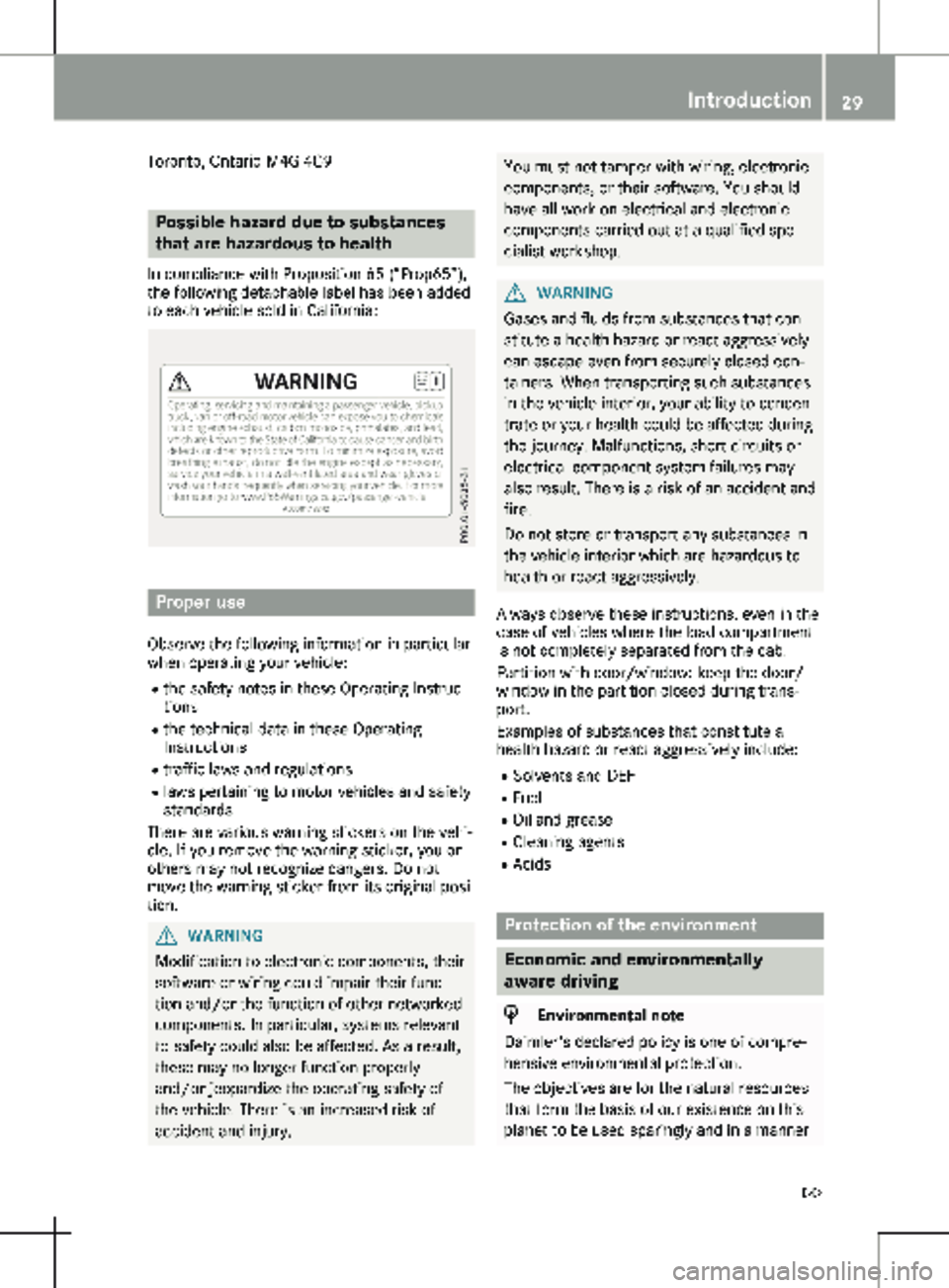
In compliance with Proposition 65 (“Prop65”),
the following detachable label has been added
to each vehicle sold in California: Proper use
Observe the following information in particular
when operating your vehicle:
R the safety notes in these Operating Instruc-
tions
R the technical data in these Operating
Instructions
R traffic laws and regulations
R laws pertaining to motor vehicles and safety
standards
There are various warning stickers on the vehi-
cle. If you remove the warning sticker, you or
others may not recognize dangers. Do not
move the warning sticker from its original posi-
tion. G
WARNING
Modification to electronic components, their
software or wiring could impair their func-
tion and/or the function of other networked
components. In particular, systems relevant
to safety could also be affected. As a result,
these may no longer function properly
and/or jeopardize the operating safety of
the vehicle. There is an increased risk of
accident and injury. You must not tamper with wiring, electronic
components, or their software. You should
have all work on electrical and electronic
components carried out at a qualified spe-
cialist workshop. G
WARNING
Gases and fluids from substances that con-
stitute a health hazard or react aggressively
can escape even from securely closed con-
tainers. When transporting such substances
in the vehicle interior, your ability to concen-
trate or your health could be affected during
the journey. Malfunctions, short circuits or
electrical component system failures may
also result. There is a risk of an accident and
fire.
Do not store or transport any substances in
the vehicle interior which are hazardous to
health or react aggressively.
Always observe these instructions, even in the
case of vehicles where the load compartment
is not completely separated from the cab.
Partition with door/window: keep the door/
window in the partition closed during trans-
port.
Examples of substances that constitute a
health hazard or react aggressively include:
R Solvents and DEF
R Fuel
R Oil and grease
R Cleaning agents
R Acids Protection of the environment
Economic and environmentally
aware driving
H
Environmental note
Daimler's declared policy is one of compre-
hensive environmental protection.
The objectives are for the natural resources
that form the basis of our existence on this
planet to be used sparingly and in a manner Introduction
29 Z
Page 32 of 320
that takes the requirements of both nature
and humanity into account.
You too can help to protect the environment
by operating your vehicle in an environmen-
tally responsible manner.
Fuel consumption and the rate of engine,
transmission, brake and tire wear are affec-
ted by these factors:
R operating conditions of your vehicle
R your personal driving style
You can influence both factors. You should
bear the following in mind:
Operating conditions:
R avoid short trips as these increase fuel
consumption.
R always make sure that the tire pressures
are correct.
R do not carry any unnecessary weight.
R remove roof racks once you no longer
need them.
R a regularly serviced vehicle will contribute
to environmental protection. You should
therefore adhere to the service intervals.
R always have service work carried out at a
qualified specialist workshop.
Personal driving style:
R do not depress the accelerator pedal
when starting the engine.
R do not warm up the engine when the vehi-
cle is stationary.
R drive carefully and maintain a safe dis-
tance from the vehicle in front.
R avoid frequent, sudden acceleration and
braking.
R change gear in good time and use each
gear only up to Ô of its maximum engine
speed.
R switch off the engine in stationary traffic.
R keep an eye on the vehicle's fuel con-
sumption. Environmental issues and recom-
mendations
When prompted by this Operator's Manual to
dispose of materials, please try to regenerate
and recycle these materials. Observe all rele-
vant environmental guidelines and regulations
when disposing of materials. This helps to pro-
tect the environment. Operating safety and vehicle
approval
Important safety notes
G
WARNING
If you do not have the prescribed service/
maintenance work or any required repairs
carried out, this can result in malfunctions
or system failures. There is a risk of an acci-
dent.
Always have the prescribed service/mainte-
nance work as well as any required repairs
carried out at a qualified specialist work-
shop.
Airbags and pyrotechnic Emergency Tension-
ing Devices contain perchlorate material,
which may require special handling or environ-
mental protection measures. National guide-
lines must be observed during disposal.
For California, you will find further information
online at: http://www.dtsc.ca.gov Notes on driving
Damage to the vehicle may occur in the follow-
ing cases:
R The vehicle becomes grounded, e.g. on a
high curb or an unpaved road.
R You drive too fast over an obstacle, e.g. a
curb, a speed bump or a pothole in the road.
R A heavy object strikes the underbody or
chassis components.
In such situations, the body, frame, under-
body, chassis parts, wheels or tires could be
damaged without the damage being visible.
Components damaged in this way can unex-
pectedly fail or, in the case of an accident, no 30
Introduction
Page 41 of 320
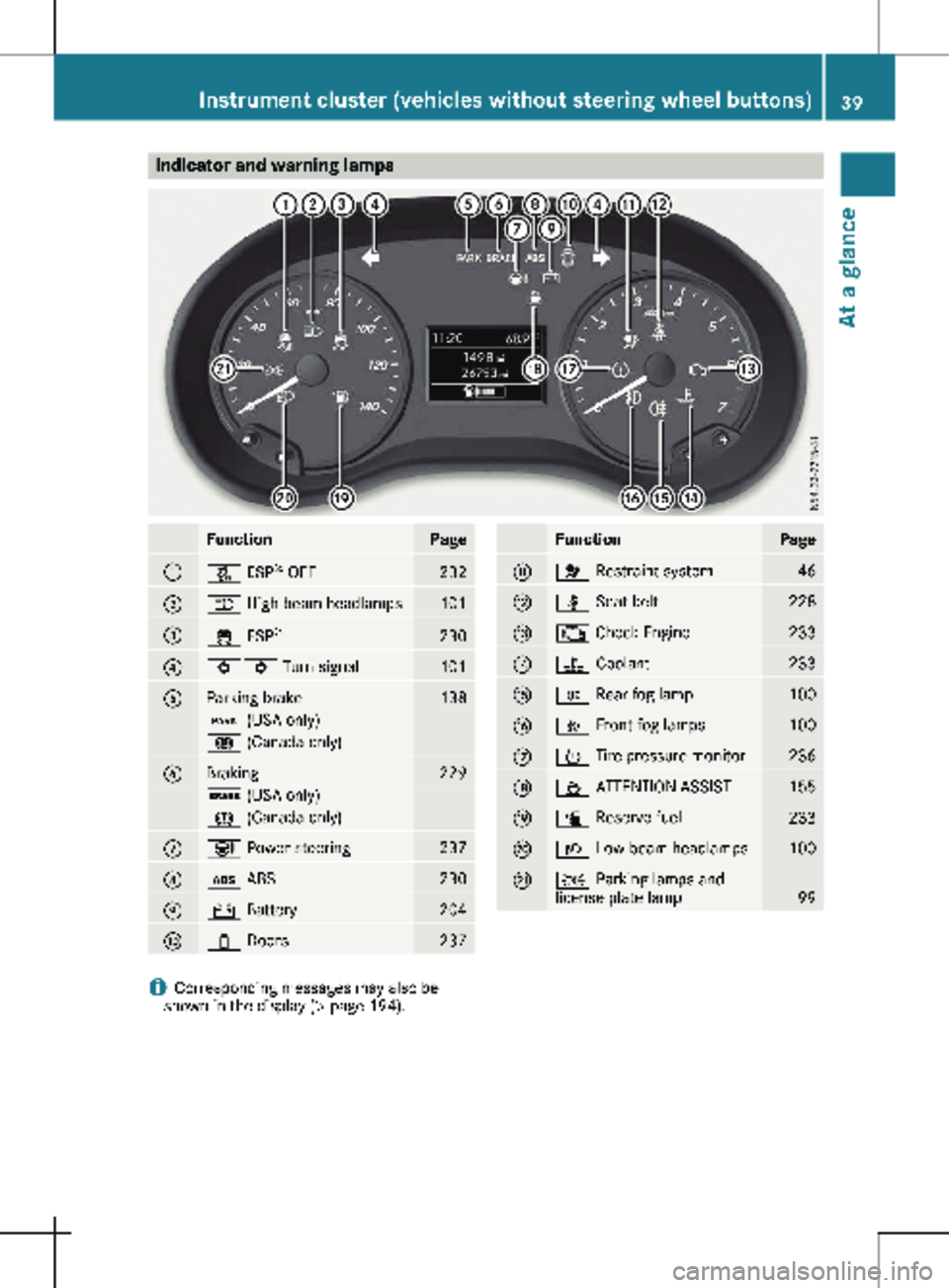
Indicator and warning lamps
Function Page
:
å ESP
®
OFF 232
;
K High-beam headlamps
101
=
÷ ESP
® 230
?
#! Turn signal
101
A
Parking brake 138
F (USA only)
! (Canada only)
B
Braking 229
$ (USA only)
J (Canada only)
C
Ð Power steering
237
D
ò ABS
230
E
# Battery
204
F
1 Doors
237 Function Page
G
6 Restraint system
46
H
ü Seat belt
228
I
; Check Engine
233
J
? Coolant
233
K
R Rear fog lamp
100
L
O Front fog lamps
100
M
h Tire pressure monitor
236
N
À ATTENTION ASSIST
155
O
æ Reserve fuel
233
P
L Low-beam headlamps
100
Q
T Parking lamps and
license plate lamp
99
i
Corresponding messages may also be
shown in the display (Y page 194).Instrument cluster (vehicles without steering wheel buttons)
39
At a glance
Page 42 of 320
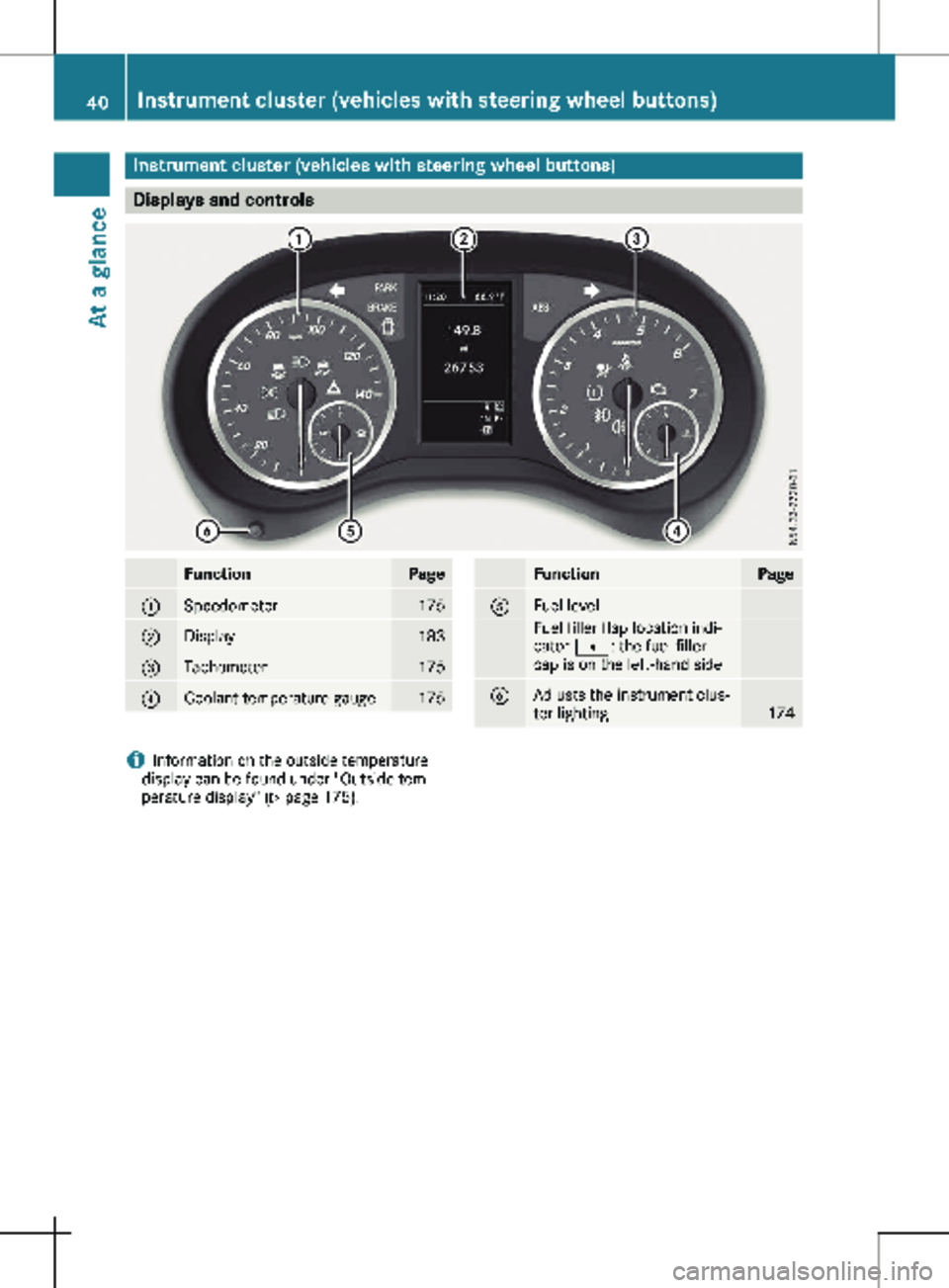
Instrument cluster (vehicles with steering wheel buttons)
Displays and controls
Function Page
:
Speedometer 175
;
Display 183
=
Tachometer 175
?
Coolant temperature gauge 175 Function Page
A
Fuel level
Fuel filler flap location indi-
cator t: the fuel filler
cap is on the left-hand side
B
Adjusts the instrument clus-
ter lighting
174
i
Information on the outside temperature
display can be found under "Outside tem-
perature display"
(Y page 175). 40
Instrument cluster (vehicles with steering wheel buttons)
At a glance
Page 43 of 320
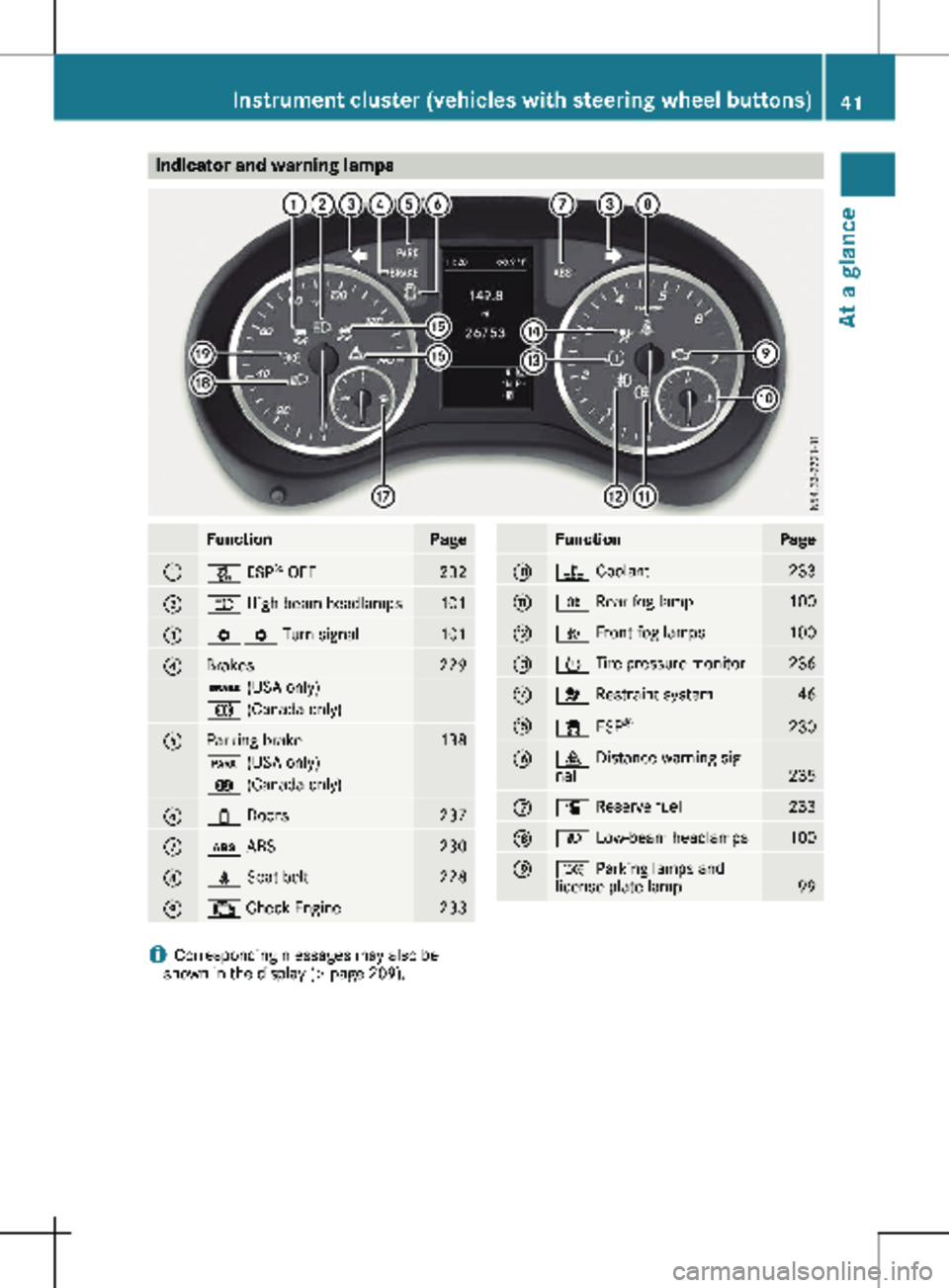
Indicator and warning lamps
Function Page
:
å ESP
®
OFF 232
;
K High-beam headlamps
101
=
#! Turn signal
101
?
Brakes 229
$ (USA only)
J (Canada only)
A
Parking brake 138
F (USA only)
! (Canada only)
B
1 Doors
237
C
ò ABS
230
D
ü Seat belt
228
E
; Check Engine
233 Function Page
F
? Coolant
233
G
R Rear fog lamp
100
H
O Front fog lamps
100
I
h Tire pressure monitor
236
J
6 Restraint system
46
K
÷ ESP
® 230
L
· Distance warning sig-
nal
235
M
æ Reserve fuel
233
N
L Low-beam headlamps
100
O
T Parking lamps and
license plate lamp
99
i
Corresponding messages may also be
shown in the display (Y page 209).Instrument cluster (vehicles with steering wheel buttons)
41
At a glance
Page 62 of 320
ation is not high. Conversely, air bags may be
deployed even though the vehicle suffers only
minor deformation. This is the case if, for
example, very rigid vehicle parts such as longi-
tudinal body members are hit, and sufficient
deceleration occurs as a result.
If the restraint system control unit detects a
side impact or if the vehicle rolls over, the
applicable components of the restraint system
are deployed independently of each other
depending on the apparent type of accident.
R Side impact air bag and pelvis air bag on the
side on which an impact occurs, independ-
ent from the Emergency Tensioning Device
and seat belt usage
The side impact air bag on the front
passenger side deploys under the following
conditions:
- the OCS system detects that the front
passenger seat is occupied or
- the seat belt buckle tongue is engaged in
the belt buckle of the front passenger
seat
R Window curtain air bag on the side of
impact, independently of the use of the seat
belt and independently of whether the front-
passenger seat is occupied
R Emergency Tensioning Devices, if the sys-
tem determines that deployment can offer
additional protection in this situation
R Window curtain air bags on the driver's and
front-passenger side in certain situations
when the vehicle rolls over, if the system
determines that deployment can offer addi-
tional protection to that provided by the
seat belt
i Not all air bags are deployed in an acci-
dent. The various air bags work independ-
ently of each other.
How the air bag works is determined by the
severity of the accident detected, especially
the vehicle deceleration or acceleration and
the apparent type of accident:
R Head-on collision
R Side impact
R Rollover Automatic measures after an acci-
dent
Immediately after an accident, the following
measures are implemented, depending on the
type and severity of the impact:
R the hazard warning lamps are switched on
R the emergency lighting in the interior is acti-
vated
R the vehicle doors are unlocked
R the front side windows are lowered
R air-recirculation mode is activated
R climate control is switched off
R the engine is switched off and the fuel sup-
ply is cut off Children in the vehicle
Important safety notes
Accident statistics show that children secured
on the rear seats are safer than children
secured on the front seats. For this reason,
Mercedes-Benz strongly advises that you fit
the child restraint system to a rear seat. The
child is generally better protected there.
If a child younger than twelve years old and
under 5 ft
(1.50 m) in height is traveling in the
vehicle:
R always secure the child in a child restraint
system suitable for Mercedes-Benz vehicles.
The child restraint system must be appropri-
ate to the age, weight and size of the child.
R always observe the instructions and safety
notes in this section in addition to the child
restraint system manufacturer's instruc-
tions.
R always observe the instructions and safety
notes on the "Occupant Classification Sys-
tem (OCS)" ( Y page 54). G
WARNING
If children are left unsupervised in the vehi-
cle, they could, in particular:
R open doors, thereby endangering other
persons or road users.
R get out and be struck by oncoming traffic.
R operate vehicle equipment and become
trapped, for example.60
Children in the vehicle
Safety
Page 132 of 320
Problems with the engine
Problem
Possible causes/consequences and
M SolutionsThe engine does not
start.
The starter motor can
be heard. There is a malfunction in the fuel supply.
X
Turn the key back to position g in the ignition lock before
attempting to start the engine again.
X Start the engine again.
Please bear in mind that lengthy and frequent starting attempts
will drain the battery.
If the engine does not start after several attempts: X Consult a qualified specialist workshop. The engine does not
start.
The starter motor can
be heard. The reserve
fuel warning lamp is lit
and the fuel gauge is at
0. The fuel tank has been run dry.
X Refuel the vehicle. The engine does not
start.
The starter motor can-
not be heard. The on-board voltage is too low. The battery is too weak or dis-
charged.
X Jump-start the vehicle ( Y page 272).
If the engine cannot be jump-started, the starter motor is faulty.
X Consult a qualified specialist workshop. The engine does not
start.
The starter motor can-
not be heard. The battery is discharged or faulty.
X
Check the battery for damage.
X Charge the battery (Y page
262).The engine is not run-
ning smoothly and is
misfiring. There is a malfunction in the engine electronics or a mechanical
component of the engine management system.
X Only depress the accelerator pedal slightly.
Unburnt fuel may otherwise get into the catalytic converter and
damage it.
X Have the cause rectified immediately at a qualified specialist
workshop. Automatic transmission
Important safety notes
G
WARNING
The vehicle can suddenly accelerate if the
engine speed is above the engine idling
speed and you then select transmission position h or k. There is a risk of an acci-
dent.
When engaging transmission position
h or
k at a standstill, always keep the brake
pedal depressed firmly and do not depress
the accelerator pedal at the same time. 130
Automatic transmission
Driving and parking
Page 136 of 320
Program selector button
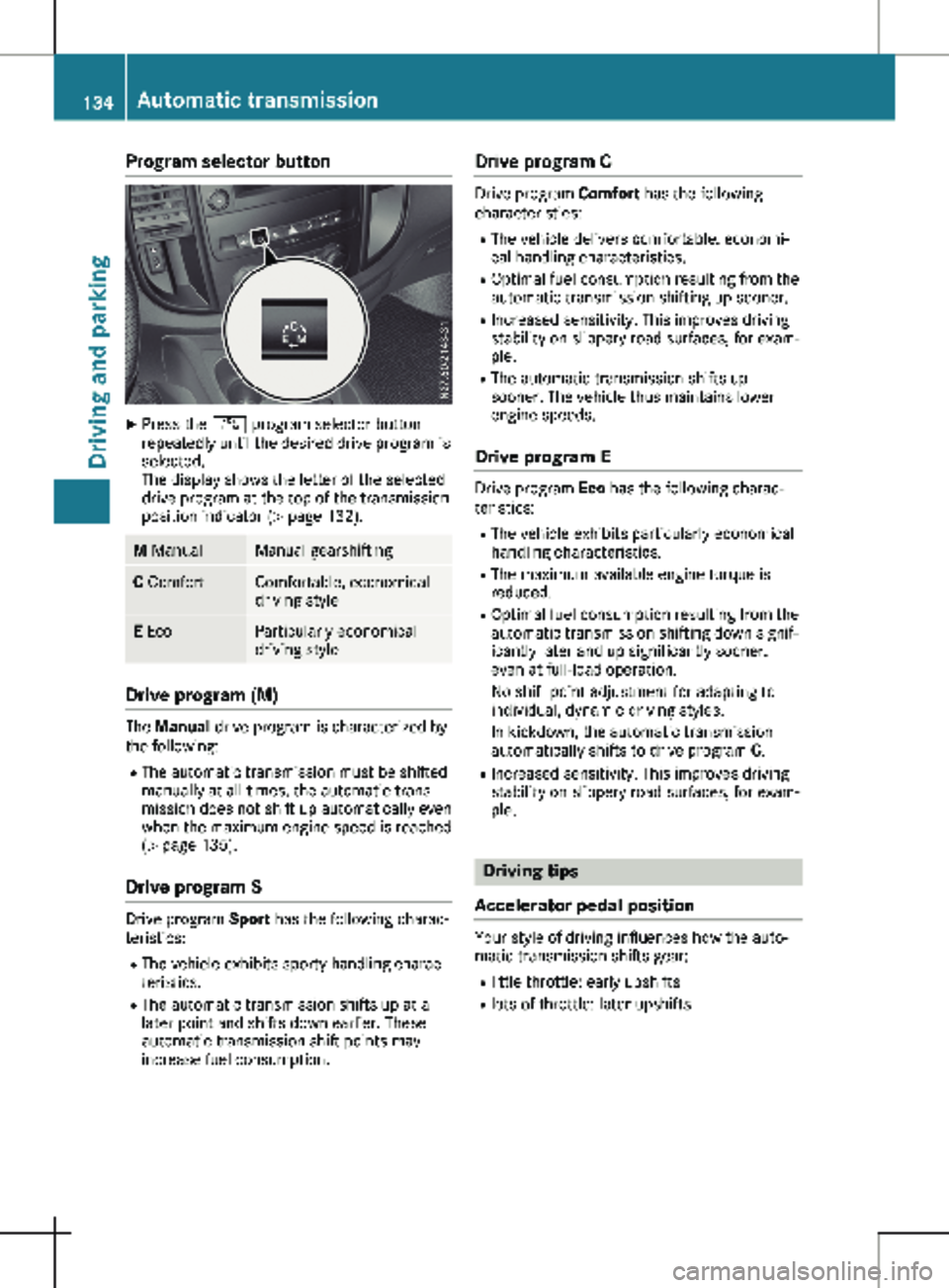
X
Press the É program selector button
repeatedly until the desired drive program is
selected.
The display shows the letter of the selected
drive program at the top of the transmission
position indicator (Y page
132).M Manual Manual gearshifting
C Comfort Comfortable, economical
driving style
E Eco Particularly economical
driving style
Drive program (M)
The Manual drive program is characterized by
the following:
R The automatic transmission must be shifted
manually at all times. the automatic trans-
mission does not shift up automatically even
when the maximum engine speed is reached
(Y page
135).
Drive program S Drive program Sport
has the following charac-
teristics:
R The vehicle exhibits sporty handling charac-
teristics.
R The automatic transmission shifts up at a
later point and shifts down earlier. These
automatic transmission shift points may
increase fuel consumption. Drive program C Drive program Comfort has the following
characteristics:
R
The vehicle delivers comfortable, economi-
cal handling characteristics.
R Optimal fuel consumption resulting from the
automatic transmission shifting up sooner.
R Increased sensitivity. This improves driving
stability on slippery road surfaces, for exam-
ple.
R The automatic transmission shifts up
sooner. The vehicle thus maintains lower
engine speeds.
Drive program E Drive program Eco
has the following charac-
teristics:
R The vehicle exhibits particularly economical
handling characteristics.
R The maximum available engine torque is
reduced.
R Optimal fuel consumption resulting from the
automatic transmission shifting down signif-
icantly later and up significantly sooner,
even at full-load operation.
No shift point adjustment for adapting to
individual, dynamic driving styles.
In kickdown, the automatic transmission
automatically shifts to drive program C.
R Increased sensitivity. This improves driving
stability on slippery road surfaces, for exam-
ple. Driving tips
Accelerator pedal position Your style of driving influences how the auto-
matic transmission shifts gear:
R little throttle: early upshifts
R lots of throttle: later upshifts134
Automatic transmission
Driving and parking
Page 137 of 320
Kickdown
Use kickdown for maximum acceleration:
X Depress the accelerator pedal beyond the
pressure point.
The automatic transmission shifts to the
next gear down, depending on the engine
speed.
X Ease off on the accelerator pedal once the
desired speed is reached.
The automatic transmission shifts up again.
Rocking the vehicle free At speeds up to 5 mph (9 km/h) you can
switch back and forth between drive position
h and reverse gear
k without applying the
brakes. This helps when rocking the vehicle
out of snow or slush.
X Push the DIRECT SELECT lever alternately
up and down beyond the first point of resist-
ance.
Towing a trailer X
Depending on the downhill gradient, limit
the shift range
(Y page 133) or shift man-
ually into a lower gear (Y page 135) in which the engine will operate in the middle
of the engine speed range. This also applies
if cruise control is activated. Manual gearshifting
General notes If you select drive program
M, automatic gear-
shifting is deactivated and manual gearshifting
is automatically activated. You must then per-
manently change gear yourself for as long as
the drive program is selected.
Permanent manual gearshifting is deactivated
automatically when you switch from drive pro-
gram M to another drive program. The auto-
matic transmission then shifts gears automati-
cally. The display shows the selected drive
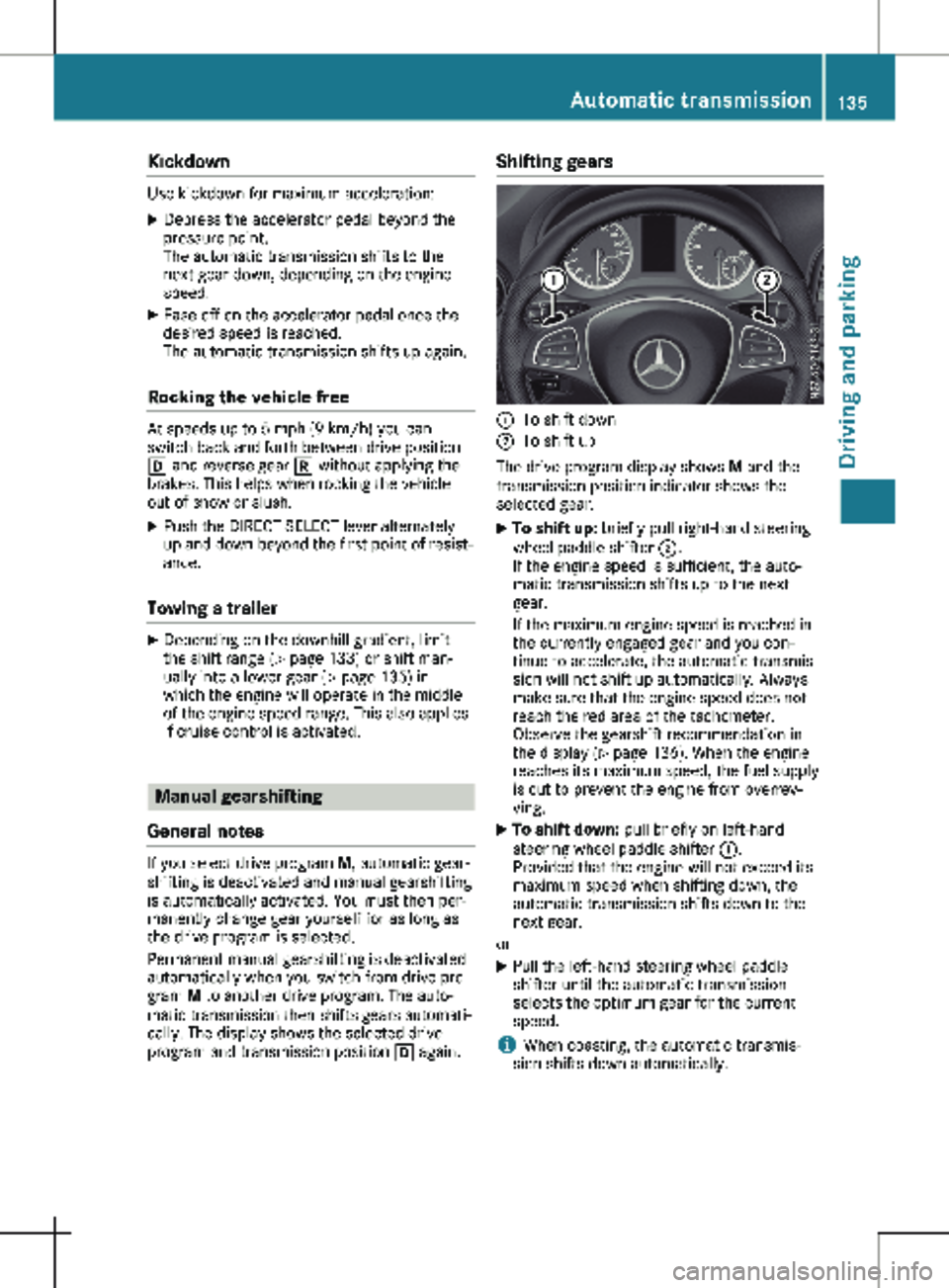
program and transmission position h again. Shifting gears
:
To shift down
; To shift up
The drive program display shows M and the
transmission position indicator shows the
selected gear.
X To shift up: briefly pull right-hand steering
wheel paddle shifter ;.
If the engine speed is sufficient, the auto-
matic transmission shifts up to the next
gear.
If the maximum engine speed is reached in
the currently engaged gear and you con-
tinue to accelerate, the automatic transmis-
sion will not shift up automatically. Always
make sure that the engine speed does not
reach the red area of the tachometer.
Observe the gearshift recommendation in
the display
(Y page 136). When the engine
reaches its maximum speed, the fuel supply
is cut to prevent the engine from overrev-
ving.
X To shift down: pull briefly on left-hand
steering wheel paddle shifter :.
Provided that the engine will not exceed its
maximum speed when shifting down, the
automatic transmission shifts down to the
next gear.
or
X Pull the left-hand steering wheel paddle
shifter until the automatic transmission
selects the optimum gear for the current
speed.
i When coasting, the automatic transmis-
sion shifts down automatically. Automatic transmission
135
Driving and parking Z
Page 138 of 320
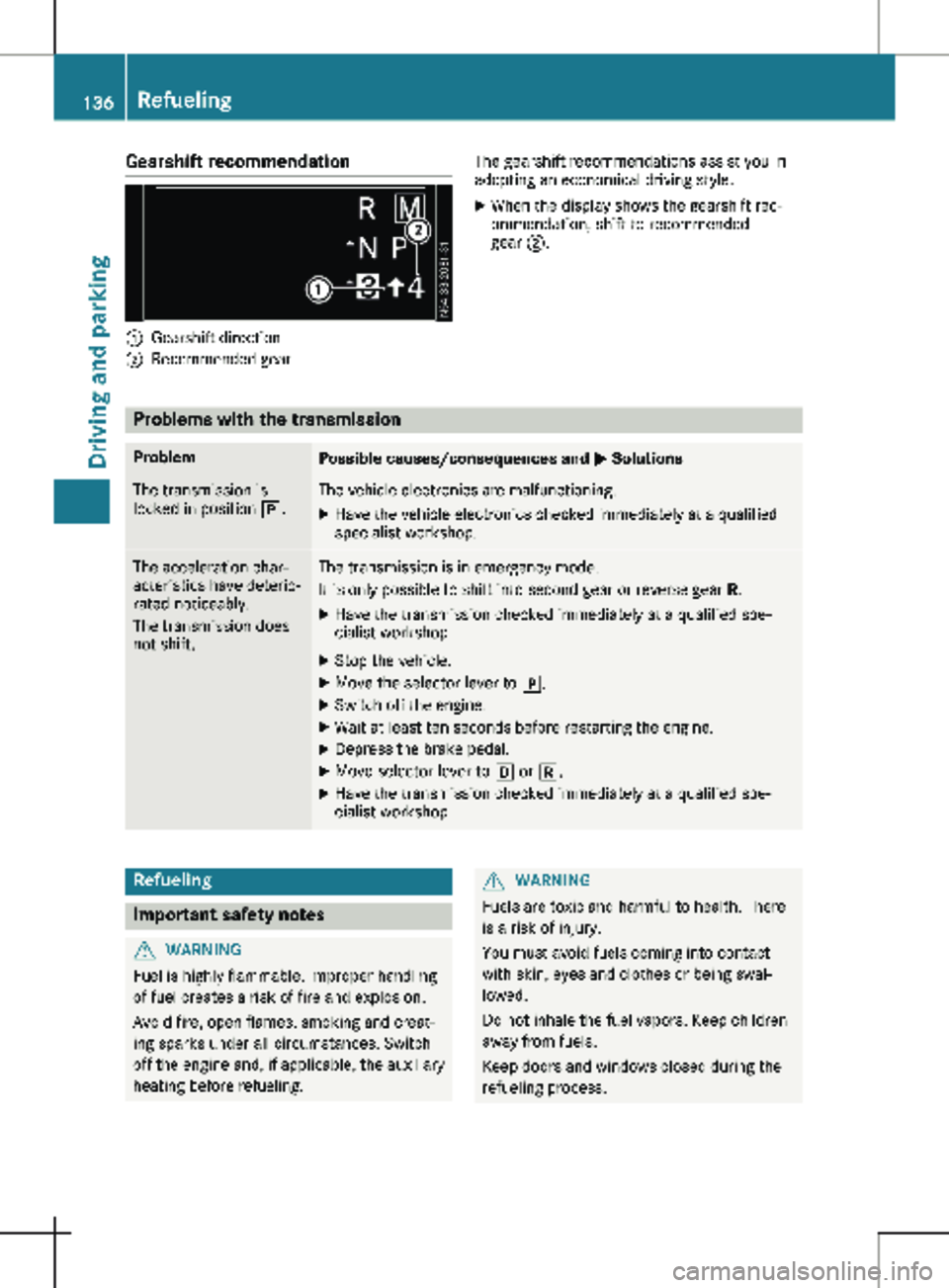
Gearshift recommendation
:
Gearshift direction
; Recommended gear The gearshift recommendations assist you in
adopting an economical driving style.
X When the display shows the gearshift rec-
ommendation, shift to recommended
gear ;. Problems with the transmission
Problem
Possible causes/consequences and
M SolutionsThe transmission is
locked in position j. The vehicle electronics are malfunctioning.
X Have the vehicle electronics checked immediately at a qualified
specialist workshop. The acceleration char-
acteristics have deterio-
rated noticeably.
The transmission does
not shift. The transmission is in emergency mode.
It is only possible to shift into second gear or reverse gear
R.
X Have the transmission checked immediately at a qualified spe-
cialist workshop.
X Stop the vehicle.
X Move the selector lever to j.
X Switch off the engine.
X Wait at least ten seconds before restarting the engine.
X Depress the brake pedal.
X Move selector lever to h or k.
X Have the transmission checked immediately at a qualified spe-
cialist workshop. Refueling
Important safety notes
G
WARNING
Fuel is highly flammable. Improper handling
of fuel creates a risk of fire and explosion.
Avoid fire, open flames, smoking and creat-
ing sparks under all circumstances. Switch
off the engine and, if applicable, the auxiliary
heating before refueling. G
WARNING
Fuels are toxic and harmful to health. There
is a risk of injury.
You must avoid fuels coming into contact
with skin, eyes and clothes or being swal-
lowed.
Do not inhale the fuel vapors. Keep children
away from fuels.
Keep doors and windows closed during the
refueling process. 136
RefuelingDriving and parking