tow MERCEDES-BENZ METRIS 2020 MY20 Operator’s Manual
[x] Cancel search | Manufacturer: MERCEDES-BENZ, Model Year: 2020, Model line: METRIS, Model: MERCEDES-BENZ METRIS 2020Pages: 320, PDF Size: 26.38 MB
Page 25 of 320
Summer tires in winter .................. 280
TIN (Tire Identification Number)
(definition) .....................................
297
Tire bead (definition) ...................... 297
Tire pressure (definition) ................ 296
Tire pressures (recommended) ...... 295
Tire size designation, load-bear-
ing capacity, speed rating .............. 293
Tire tread ....................................... 279
Tire tread (definition) ..................... 297
Total load limit (definition) ............. 297
Traction (definition) ....................... 297
TWR (permissible trailer drawbar
noseweight) (definition) ................. 297
Uniform Tire Quality Grading
Standards (definition) .................... 295
Wear indicator (definition) ............. 297
Wheel and tire combination ........... 302
Wheel rim (definition) .................... 296
Wheel/tire combinations ............... 301
Tool
see Vehicle tool kit
Top Tether ............................................ 63
Tow-starting
Emergency engine starting ............ 277
Important safety notes .................. 274
Towing
If the vehicle is stuck ..................... 276
Installing/removing the towing
eye ................................................. 275
Towing a trailer
Active Parking Assist ..................... 159
Axle load, permissible .................... 315
Cleaning the trailer tow hitch ......... 268
Coupling up a trailer ...................... 170
Decoupling a trailer ....................... 171
Driving tips .................................... 168
Notes on retrofitting ...................... 315
Power supply ................................. 173
Trailer loads ................................... 315
Towing away
Important safety guidelines ........... 274
With both axles on the ground ....... 276
With the rear axle raised ................ 276
Towing eye
Storage location ............................ 270
Trailer coupling
see Towing a trailer Trailer loads and drawbar nose-
weights
...............................................
172
Trailer operation
Lights display messages (vehicle
with steering wheel buttons) ......... 216
Lights display messages (vehicle
without steering wheel buttons) .... 202
Trailer towing
Blind Spot Assist ............................ 153
ESP ®
................................................ 69
PARKTRONIC ................................. 159
Permissible trailer loads and
drawbar noseweights ..................... 172
Transmission
see Automatic transmission
Transmission oil ................................ 310
Transmission positions
Automatic transmission ................. 132
Display (DIRECT SELECT lever) ...... 132
Transport
Lashing straps ............................... 246
Loading guidelines ......................... 242
Stickers ......................................... 246
Vehicle ........................................... 276
Transport by rail ................................ 142
Transportation
Rail ................................................ 142
Transportation aids
Load protection net ....................... 248
Transporting
Cargo compartment variations ...... 244
Load distribution ............................ 243
Securing a load .............................. 244
Trim pieces (cleaning instruc-
tions) .................................................. 269
Trip computer
Displaying (vehicle with steering
wheel buttons) ............................... 184
Displaying (vehicle without steer-
ing wheel buttons) ......................... 177
Resetting (vehicle with steering
wheel buttons) ............................... 185
Resetting (vehicle without steer-
ing wheel buttons) ......................... 177
Selecting the display units (vehi-
cle with steering wheel buttons) .... 192 Index
23
Page 26 of 320
Selecting the display units (vehi-
cle without steering wheel but-
tons) ..............................................
180
Trip meter
see Trip odometer
Trip odometer
Displaying (vehicle with steering
wheel buttons) ............................... 183
Displaying (vehicle without steer-
ing wheel buttons) ......................... 177
Resetting (vehicle with steering
wheel buttons) ............................... 185
Resetting (vehicle without steer-
ing wheel buttons) ......................... 177
Setting the display unit (vehicle
with steering wheel buttons) ......... 192
Setting the display unit (vehicle
without steering wheel buttons) .... 180
Truck
see Vehicle
Truck key
see SmartKey
Turn signal
Changing bulbs (additional turn
signals) .......................................... 107
Turn signals
Display messages (vehicle with
steering wheel buttons) ................. 216
Display messages (vehicle with-
out steering wheel buttons) ........... 202
Replacing bulbs (front) ................... 107
Replacing bulbs (rear) .................... 108
Switching on/off ........................... 101
Trailer display messages (vehicle
with steering wheel buttons) ......... 216
Trailer display messages (vehicle
without steering wheel buttons) .... 202
Turn signals
see Turn signals
Two-way radios
Type approval/frequency .............. 304
TWR (Tongue Weight Rating) (def-
inition) ................................................ 297
Type identification plate
see Vehicle identification plate U
Unlocking Emergency unlocking
....................... 73
From inside the vehicle (central
unlocking button) ............................. 75
With emergency key element ........... 72
USB (audio)
Playing ........................................... 187 V
Vanity mirror Changing a bulb (mirror lamp)
....... 104
Sun visor ........................................ 239
Vehicle
Data acquisition ............................... 35
Display messages (vehicle with
steering wheel buttons) ................. 225
Display messages (vehicle with-
out steering wheel buttons) ........... 208
Electronics ..................................... 304
Emergency unlocking ....................... 72
Equipment ....................................... 27
Limited Warranty ............................. 27
Loading .......................................... 289
Locking (in an emergency) ............... 73
Locking (SmartKey) .......................... 71
Lowering ........................................ 300
Maintenance .................................... 28
Operating safety .............................. 30
Parking for a long period ................ 140
Pulling away ................................... 128
Raising ........................................... 298
Registration ..................................... 33
Reporting problems ......................... 32
Securing from rolling away ............ 138
Towing away .................................. 274
Transporting .................................. 276
Unlocking (in an emergency) ........... 73
Unlocking (SmartKey) ...................... 71
Vehicle battery
see Battery (vehicle)
Vehicle bodies ..................................... 33
Body/equipment mounting
directives for trucks ......................... 33
Vehicle check
see Preparing for a journey24
Index
Page 27 of 320
Vehicle data .......................................
312
Vehicle dimensions ........................... 313
Vehicle emergency locking ................ 73
Vehicle identification number
see VIN
Vehicle identification plate .............. 304
Vehicle key
see SmartKey
Vehicle tool kit
in the seat base ............................. 270
Scope ............................................ 270
Storage location ............................ 270
Stowage compartment in the
rear ................................................ 271
Stowage space in the cargo com-
partment ........................................ 272
Ventilation
see Climate control
Vents
see Air vents
VIN
Engine compartment ..................... 305
Type plate ...................................... 304 W
Warning Stickers
........................................... 29
Warning and indicator lamps
ABS ................................................ 230
Brakes ........................................... 229
Check Engine ................................. 233
COLLISION PREVENTION ASSIST .. 235
Coolant .......................................... 233
Distance warning ........................... 235
Door ............................................... 237
ESP ®
.............................................. 230
ESP ®
OFF ....................................... 232
Fuel tank ........................................ 233
General notes ................................ 227
Overview (vehicle with steering
wheel buttons) ................................. 41
Overview (vehicle without steer-
ing wheel buttons) ........................... 39
Parking brake ................................ 138
PASSENGER AIR BAG OFF ............... 47
Rear door ....................................... 237
Reserve fuel ................................... 233 Restraint system ............................ 232
Seat belt ........................................
228
Sliding door ................................... 237
Steering ......................................... 237
Tire pressure monitor .................... 236
Warranty .............................................. 27
Washer fluid
Adding ........................................... 256
Capacities ...................................... 312
Display messages (vehicle with
steering wheel buttons) ................. 227
Display messages (vehicle with-
out steering wheel buttons) ........... 209
Notes ............................................. 312
Wheel and tire combination
see Tires
Wheel bolt tightening torque ........... 300
Wheels
Changing a wheel .......................... 297
Checking ........................................ 279
Cleaning ......................................... 266
Important safety notes .................. 278
Interchanging/changing ................ 297
Mounting a new wheel ................... 300
Mounting a wheel .......................... 298
Removing a wheel .......................... 299
Removing and mounting the
spare wheel ................................... 303
Snow chains .................................. 281
Storing ........................................... 298
Tightening torque ........................... 300
Wheel/tire combinations ............... 301
Window curtain air bag
Display message (vehicle with
steering wheel buttons) ................. 215
Display message (vehicle without
steering wheel buttons) ................. 201
Operation ......................................... 53
Windows
see Side windows
Windows misted up
see Climate control
Windshield
Cleaning ......................................... 265
Defrosting ...................................... 121
Windshield
see Windshield Index
25
Page 51 of 320
cle" section (Y page
60) in addition to the
child restraint system operating instructions
and manufacturer's instructions
R always observe the instructions and safety
notes on the "Occupant Classification Sys-
tem (OCS)" ( Y page 54)G
WARNING
Seat belts may not be able to perform their
protective function in the following situa-
tions, in particular:
R The seat belt is damaged, modified,
extremely dirty, bleached or dyed
R The seat belt buckle is damaged or
extremely dirty
R Modifications have been performed on the
Emergency Tensioning Device, belt
anchorage or inertia reel
Seat belts may be damaged in an accident,
although the damage may not be visible, e.g.
due to splinters of glass. Modified or dam-
aged seat belts may tear or fail, e.g. in an
accident. Modified Emergency Tensioning
Devices could accidentally trigger or not
function as intended. This poses an
increased risk of injury or even fatal injury.
Never modify the seat belts, Emergency Ten-
sioning Devices, belt anchorages or inertia
reels. Make sure that the seat belts are
undamaged, not worn out and clean. Have
the seat belts checked immediately at a
qualified specialist workshop after an acci-
dent.
Only use seat belts that have been approved
for your vehicle by Mercedes-Benz.
Proper use of the seat belts Observe the safety notes on the seat belt
(Y page
48).
In order for the correctly worn seat belt to pro-
vide the intended level of protection, each
vehicle occupant must observe the following
information. Also make sure that all vehicle
occupants have their seat belt correctly fas-
tened during the journey. When fastening the seat belt, always make
sure that:
R the seat belt tongue is only inserted into the
correct belt buckle for the corresponding
seat
R the seat belt fits closely across your body
Avoid wearing bulky clothing, e.g. a winter
coat.
R the seat belt is not twisted
Only then can the forces produced during an
accident be distributed across the surface
of the seat belt.
R the shoulder section of the belt is routed
across the center of your shoulder
The shoulder section of the seat belt should
not touch your neck nor be routed under
your arm or behind your back. If possible,
adjust the seat belt to the appropriate
height.
R the lap belt is fastened closely and routed
as low as possible across your lap, i.e.
across your hips
The lap belt must always be routed across
the hip joints and never across your stom-
ach or abdomen. This is of particular impor-
tance for pregnant women. If necessary,
push the lap belt downwards into your pelvic
area and pull it tight using the shoulder sec-
tion of the belt.
R the seat belt is not routed across sharp-
edged, pointed or breakable objects
Should you have such objects on or in your
clothing, e.g. pens, keys or spectacles, stow
these in a suitable place.
R only one person uses each seat belt at any
one time
Infants and children must never travel sit-
ting on the lap of another vehicle occupant.
In the event of an accident, they could be
crushed between the vehicle occupant and
the seat belt.
R objects are never secured with a seat belt if
the seat belt is also being used by a vehicle
occupant
Also make sure that there are never any
objects between a person and the seat, e.g.
cushions.
Seat belts are solely intended to secure and
restrain vehicle occupants. When securing
objects, luggage or loads, always observe the
instructions and safety notes in "Loading
guidelines"
(Y page 242). Occupant safety
49
Safety Z
Page 60 of 320
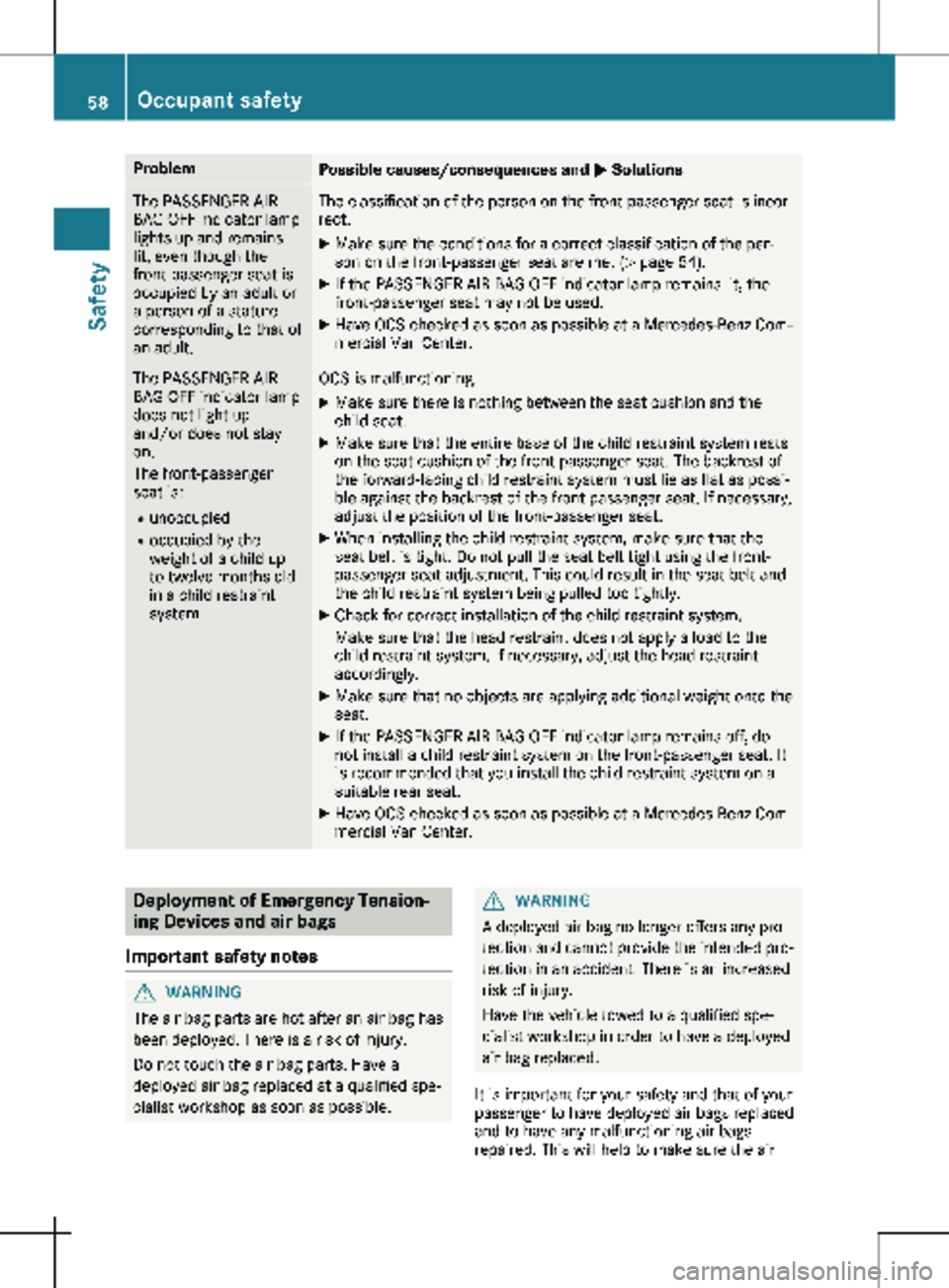
Problem
Possible causes/consequences and
M SolutionsThe PASSENGER AIR
BAG OFF indicator lamp
lights up and remains
lit, even though the
front-passenger seat is
occupied by an adult or
a person of a stature
corresponding to that of
an adult. The classification of the person on the front-passenger seat is incor-
rect.
X Make sure the conditions for a correct classification of the per-
son on the front-passenger seat are met (Y page 54).
X If the PASSENGER AIR BAG OFF indicator lamp remains lit, the
front-passenger seat may not be used.
X Have OCS checked as soon as possible at a Mercedes-Benz Com-
mercial Van Center. The PASSENGER AIR
BAG OFF indicator lamp
does not light up
and/or does not stay
on.
The front-passenger
seat is:
R
unoccupied
R occupied by the
weight of a child up
to twelve months old
in a child restraint
system OCS is malfunctioning.
X Make sure there is nothing between the seat cushion and the
child seat.
X Make sure that the entire base of the child restraint system rests
on the seat cushion of the front-passenger seat. The backrest of
the forward-facing child restraint system must lie as flat as possi-
ble against the backrest of the front passenger seat. If necessary,
adjust the position of the front-passenger seat.
X When installing the child restraint system, make sure that the
seat belt is tight. Do not pull the seat belt tight using the front-
passenger seat adjustment. This could result in the seat belt and
the child restraint system being pulled too tightly.
X Check for correct installation of the child restraint system.
Make sure that the head restraint does not apply a load to the
child restraint system. If necessary, adjust the head restraint
accordingly.
X Make sure that no objects are applying additional weight onto the
seat.
X If the PASSENGER AIR BAG OFF indicator lamp remains off, do
not install a child restraint system on the front-passenger seat. It
is recommended that you install the child restraint system on a
suitable rear seat.
X Have OCS checked as soon as possible at a Mercedes-Benz Com-
mercial Van Center. Deployment of Emergency Tension-
ing Devices and air bags
Important safety notes G
WARNING
The air bag parts are hot after an air bag has
been deployed. There is a risk of injury.
Do not touch the air bag parts. Have a
deployed air bag replaced at a qualified spe-
cialist workshop as soon as possible. G
WARNING
A deployed air bag no longer offers any pro-
tection and cannot provide the intended pro-
tection in an accident. There is an increased
risk of injury.
Have the vehicle towed to a qualified spe-
cialist workshop in order to have a deployed
air bag replaced.
It is important for your safety and that of your
passenger to have deployed air bags replaced
and to have any malfunctioning air bags
repaired. This will help to make sure the air 58
Occupant safety
Safety
Page 63 of 320
In addition, children could set the vehicle in
motion, for example, if they:
R release the parking brake.
R change the transmission position.
R start the vehicle.
There is a risk of accident and injury.
Never leave children unsupervised in the
vehicle.
When leaving the vehicle, always take the
SmartKey with you and lock the vehicle.
Keep the SmartKey out of the reach of chil-
dren. G
WARNING
If persons, particularly children are subjec-
ted to prolonged exposure to extreme heat
or cold, there is a risk of injury, possibly
even fatal. Never leave children unattended
in the vehicle. G
WARNING
If the child restraint system is subjected to
direct sunlight, parts may get very hot. Chil-
dren may burn themselves on these parts,
particularly on the metal parts of the child
restraint system. There is a risk of injury.
If you leave the vehicle, taking the child with
you, always ensure that the child restraint
system is not exposed to direct sunlight.
Protect it with a blanket, for example. If the
child restraint system has been exposed to
direct sunlight, let it cool down before secur-
ing the child in it. Never leave children unat-
tended in the vehicle.
Make sure that all vehicle occupants have fas-
tened their seat belts properly and are seated
correctly. This is particularly important for chil-
dren.
Observe the safety notes on seat belts
(Y page
48) and the notes on the correct use
of the seat belt (Y page 49).
A booster seat may be necessary to achieve
proper seat belt positioning for children over
40 lbs (18 kg) until they reach a height where
a three-point seat belt fits properly without a
booster seat. Special seatbelt retractor
G
WARNING
If the seat belt is released while driving, the
child restraint system will no longer be
secured properly. The special seat belt
retractor is disabled and the inertia real
draws in a portion of the seat belt. The seat
belt cannot be immediately refastened.
There is an increased risk of injury, possibly
even fatal.
Stop the vehicle immediately, paying atten-
tion to road and traffic conditions. Reacti-
vate the special seat belt retractor and
secure the child restraint system properly.
All seat belts in the vehicle, except the driver's
seat belt, are equipped with a special seat belt
retractor. When activated, the special seat belt
retractor ensures that the seat belt cannot
slacken once the child seat is secured.
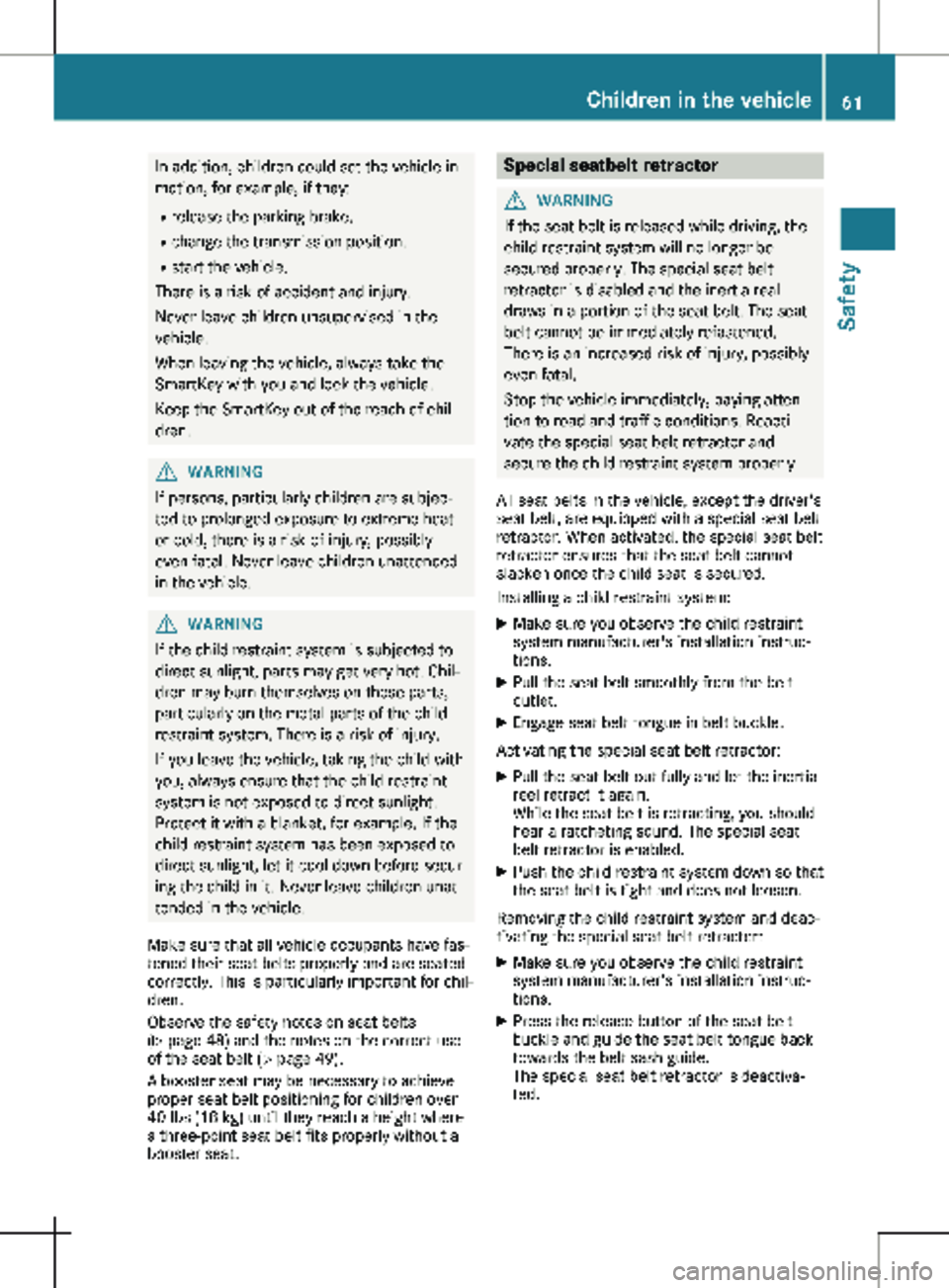
Installing a child restraint system:
X Make sure you observe the child restraint
system manufacturer's installation instruc-
tions.
X Pull the seat belt smoothly from the belt
outlet.
X Engage seat belt tongue in belt buckle.
Activating the special seat belt retractor:
X Pull the seat belt out fully and let the inertia
reel retract it again.
While the seat belt is retracting, you should
hear a ratcheting sound. The special seat
belt retractor is enabled.
X Push the child restraint system down so that
the seat belt is tight and does not loosen.
Removing the child restraint system and deac-
tivating the special seat belt retractor:
X Make sure you observe the child restraint
system manufacturer's installation instruc-
tions.
X Press the release button of the seat belt
buckle and guide the seat belt tongue back
towards the belt sash guide.
The special seat belt retractor is deactiva-
ted. Children in the vehicle
61
Safety Z
Page 64 of 320
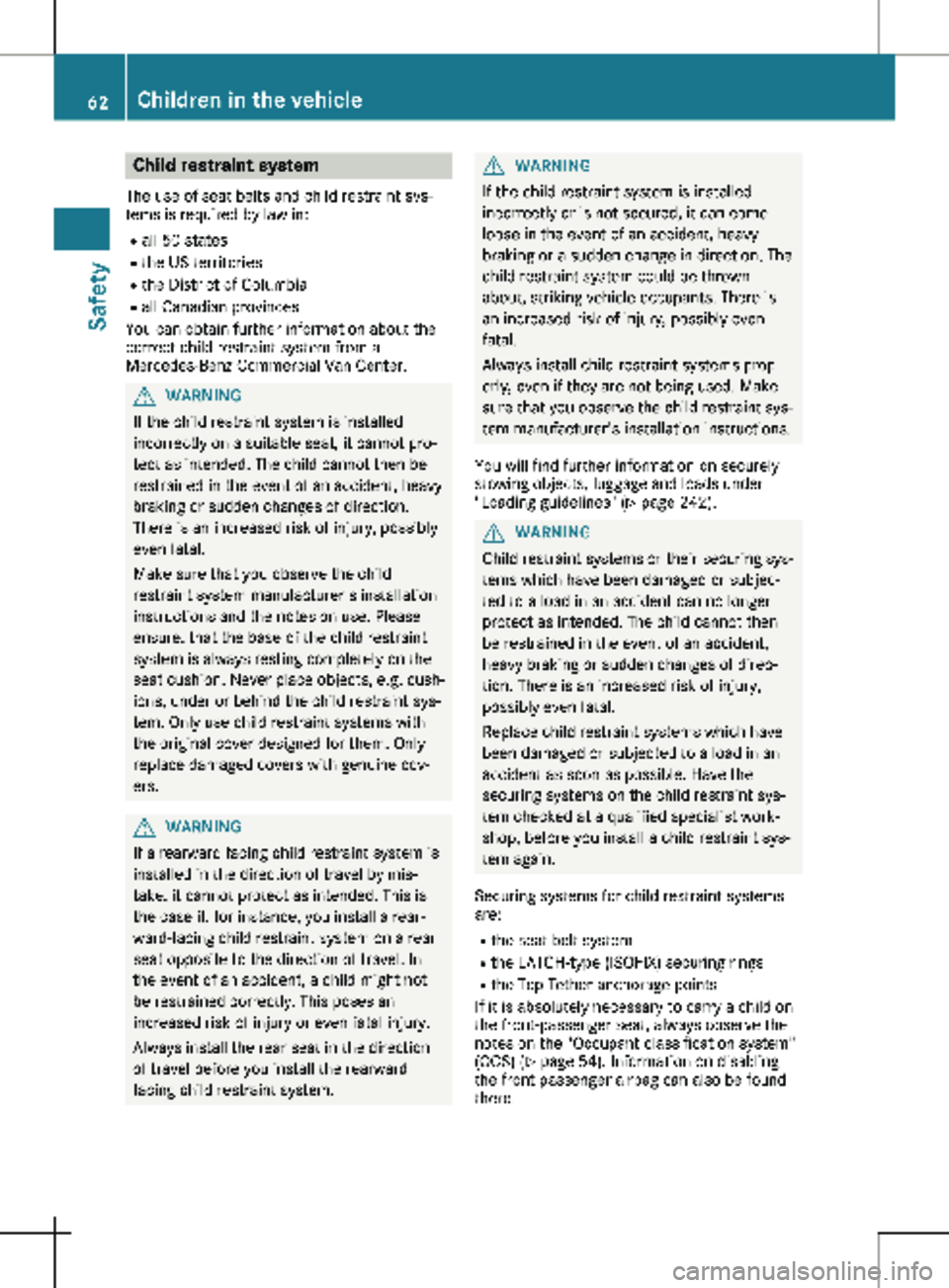
Child restraint system
The use of seat belts and child restraint sys-
tems is required by law in: R all 50 states
R the US territories
R the District of Columbia
R all Canadian provinces
You can obtain further information about the
correct child restraint system from a
Mercedes-Benz Commercial Van Center. G
WARNING
If the child restraint system is installed
incorrectly on a suitable seat, it cannot pro-
tect as intended. The child cannot then be
restrained in the event of an accident, heavy
braking or sudden changes of direction.
There is an increased risk of injury, possibly
even fatal.
Make sure that you observe the child
restraint system manufacturer's installation
instructions and the notes on use. Please
ensure, that the base of the child restraint
system is always resting completely on the
seat cushion. Never place objects, e.g. cush-
ions, under or behind the child restraint sys-
tem. Only use child restraint systems with
the original cover designed for them. Only
replace damaged covers with genuine cov-
ers. G
WARNING
If a rearward facing child restraint system is
installed in the direction of travel by mis-
take, it cannot protect as intended. This is
the case if, for instance, you install a rear-
ward-facing child restraint system on a rear
seat opposite to the direction of travel. In
the event of an accident, a child might not
be restrained correctly. This poses an
increased risk of injury or even fatal injury.
Always install the rear seat in the direction
of travel before you install the rearward
facing child restraint system. G
WARNING
If the child restraint system is installed
incorrectly or is not secured, it can come
loose in the event of an accident, heavy
braking or a sudden change in direction. The
child restraint system could be thrown
about, striking vehicle occupants. There is
an increased risk of injury, possibly even
fatal.
Always install child restraint systems prop-
erly, even if they are not being used. Make
sure that you observe the child restraint sys-
tem manufacturer's installation instructions.
You will find further information on securely
stowing objects, luggage and loads under
"Loading guidelines"
(Y page 242). G
WARNING
Child restraint systems or their securing sys-
tems which have been damaged or subjec-
ted to a load in an accident can no longer
protect as intended. The child cannot then
be restrained in the event of an accident,
heavy braking or sudden changes of direc-
tion. There is an increased risk of injury,
possibly even fatal.
Replace child restraint systems which have
been damaged or subjected to a load in an
accident as soon as possible. Have the
securing systems on the child restraint sys-
tem checked at a qualified specialist work-
shop, before you install a child restraint sys-
tem again.
Securing systems for child restraint systems
are: R the seat belt system
R the LATCH-type (ISOFIX) securing rings
R the Top Tether anchorage points
If it is absolutely necessary to carry a child on
the front-passenger seat, always observe the
notes on the "Occupant classification system"
(OCS) ( Y page
54). Information on disabling
the front passenger airbag can also be found
there. 62
Children in the vehicle
Safety
Page 78 of 320
G
WARNING
If persons, particularly children are subjec-
ted to prolonged exposure to extreme heat
or cold, there is a risk of injury, possibly
even fatal. Never leave children unattended
in the vehicle.
You can open a locked door from the inside at
any time. For the sliding doors, the child-proof
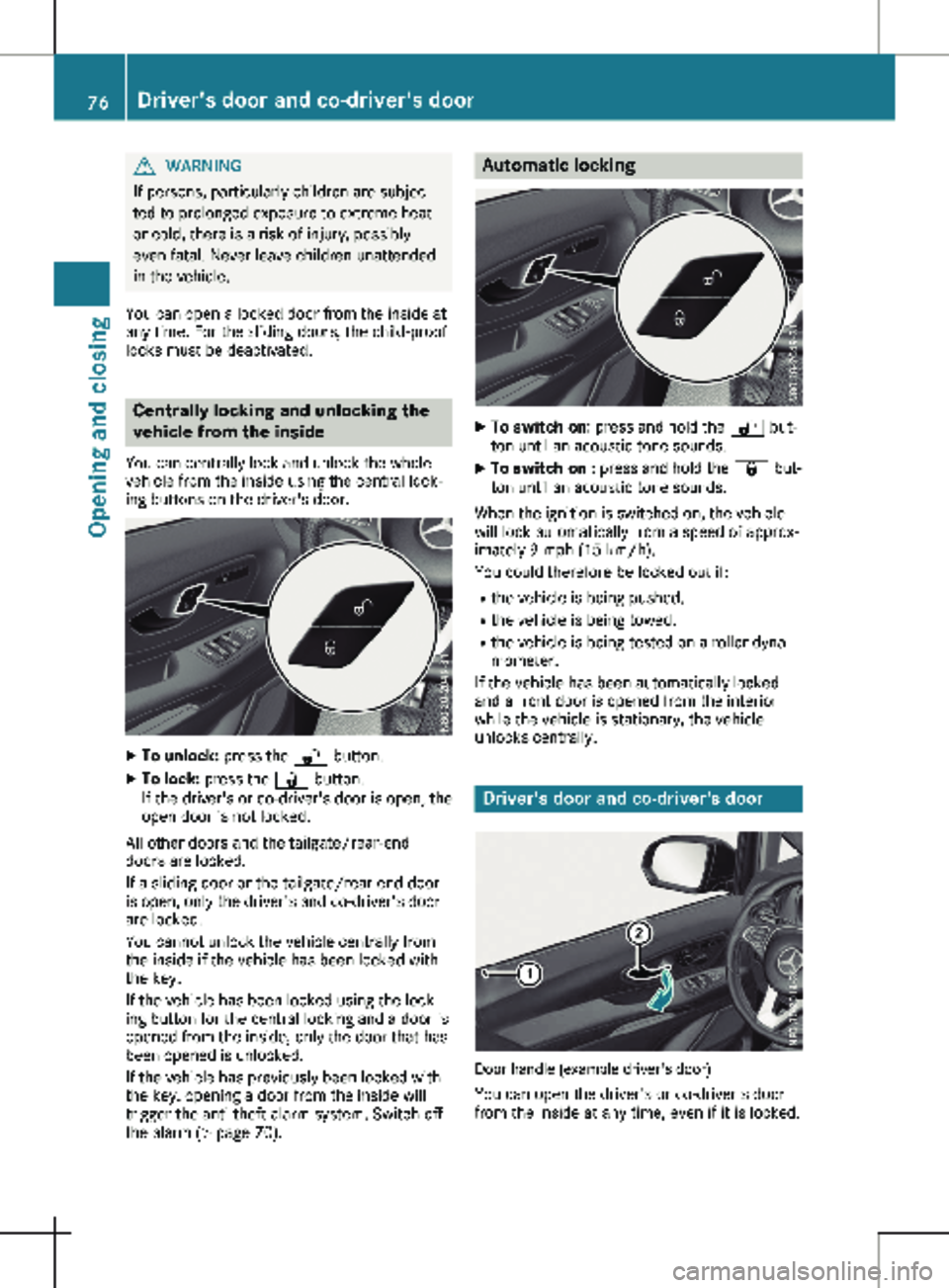
locks must be deactivated. Centrally locking and unlocking the
vehicle from the inside
You can centrally lock and unlock the whole
vehicle from the inside using the central lock-
ing buttons on the driver's door. X
To unlock: press the % button.
X To lock: press the & button.
If the driver's or co-driver's door is open, the
open door is not locked.
All other doors and the tailgate/rear-end
doors are locked.
If a sliding door or the tailgate/rear-end door
is open, only the driver's and co-driver's door
are locked.
You cannot unlock the vehicle centrally from
the inside if the vehicle has been locked with
the key.
If the vehicle has been locked using the lock-
ing button for the central locking and a door is
opened from the inside, only the door that has
been opened is unlocked.
If the vehicle has previously been locked with
the key, opening a door from the inside will
trigger the anti-theft alarm system. Switch off
the alarm
(Y page 70). Automatic locking
X
To switch on: press and hold the % but-
ton until an acoustic tone sounds.
X To switch on : press and hold the & but-
ton until an acoustic tone sounds.
When the ignition is switched on, the vehicle
will lock automatically from a speed of approx-
imately
9 mph (15 km/h).
You could therefore be locked out if:
R the vehicle is being pushed.
R the vehicle is being towed.
R the vehicle is being tested on a roller dyna-
mometer.
If the vehicle has been automatically locked
and a front door is opened from the interior
while the vehicle is stationary, the vehicle
unlocks centrally. Driver's door and co-driver's door
Door handle (example driver's door)
You can open the driver's or co-driver's door
from the inside at any time, even if it is locked. 76
Driver's door and co-driver's door
Opening and closing
Page 90 of 320
!
To prevent damage to the seats and the
seat heating, observe the following notes:
R Do not spill liquids onto the seats. Dry the
seats as soon as possible if liquid does
get spilled on the seats.
R If the seat covers are damp or wet, do not
switch on the seat heating. Also, do not
use the seat heating to dry the seats.
R Clean the seat covers as recommended;
see the "Interior care" section.
R Do not transport heavy loads on the
seats. Do not place pointed objects on
the seat cushions such as knives, nails or
tools. Where possible, use the seats only
for carrying passengers.
R When operating the seat heating, do not
cover the seats with insulating materials,
e.g. blankets, coats, bags, protective cov-
ers, child seats or booster seats.
R When the seat heating is switched on, the
seat surface can be damaged as a result
of objects being placed on the seats, for
example, seat cushions, child seats and
protective covers not approved by
Mercedes-Benz.
Your seat must be adjusted in such a way that
you can wear the seat belt correctly.
Observe the following points:
R Position the backrest in an almost vertical
position so that you are sitting virtually
upright. Do not drive with the backrest
reclined too far back.
R Your arms should be slightly bent when you
are holding the steering wheel.
R Avoid seat positions that prevent the seat
belt from being correctly routed. The shoul-
der section of the belt must be routed over
the middle of your shoulder and be pulled
tight against your upper body. The lap belt
must always pass across your lap as low
down as possible, i.e. over your hip joints.
R Adjust the head restraint so that it supports
the back of the head at eye level.
R The distance from the pedals should be
such that you can depress them fully.
Please also observe the important safety notes
on "Air bags"
(Y page 51), "Seat belts"
(Y page 48) and "Child restraint systems" ( Y page 62). Adjusting the seat manually
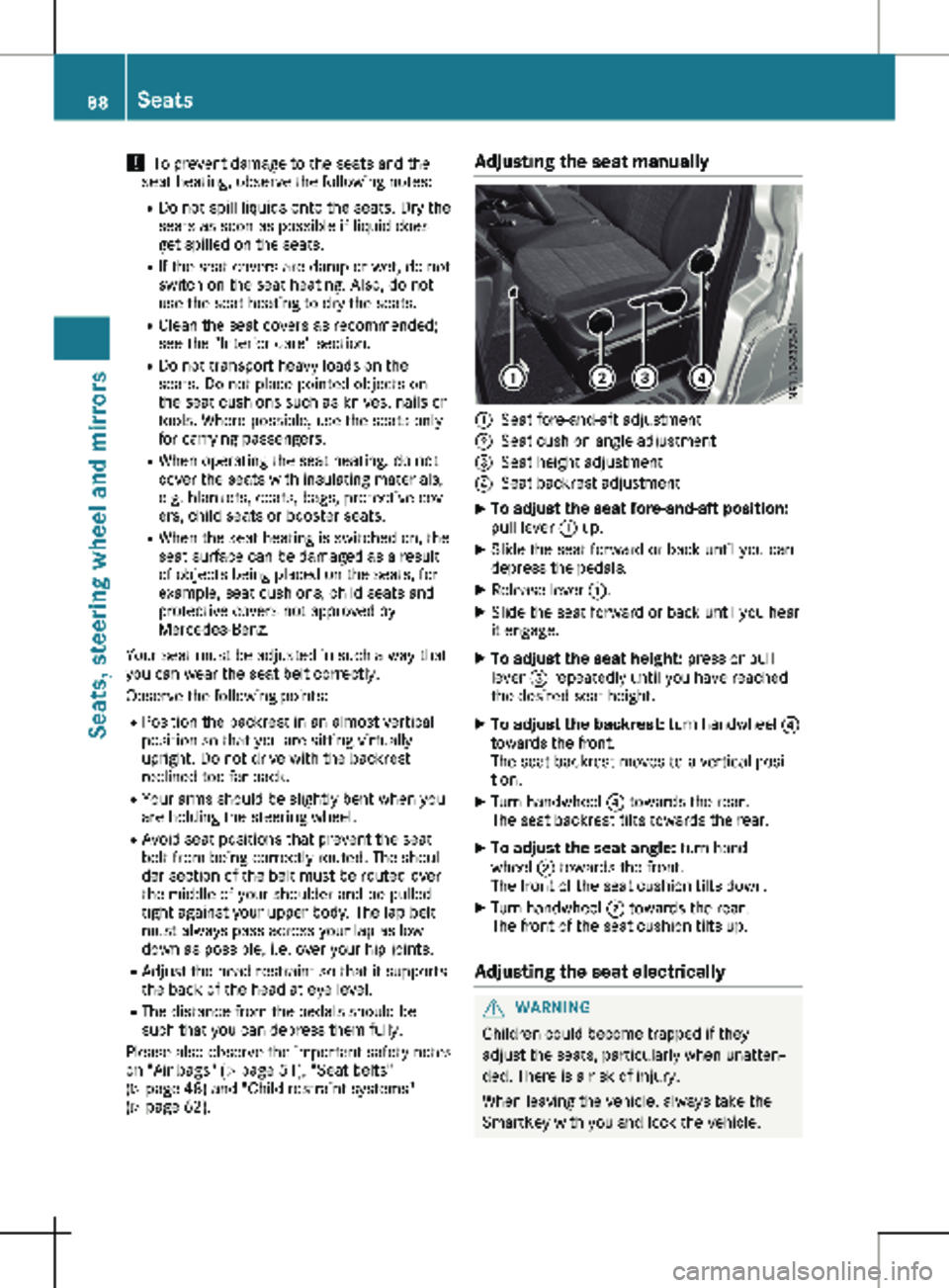
:
Seat fore-and-aft adjustment
; Seat cushion angle adjustment
= Seat height adjustment
? Seat backrest adjustment
X To adjust the seat fore-and-aft position:
pull lever
: up.
X Slide the seat forward or back until you can
depress the pedals.
X Release lever :.
X Slide the seat forward or back until you hear
it engage.
X To adjust the seat height: press or pull
lever = repeatedly until you have reached
the desired seat height.
X To adjust the backrest: turn handwheel ?
towards the front.
The seat backrest moves to a vertical posi-
tion.
X Turn handwheel ? towards the rear.
The seat backrest tilts towards the rear.
X To adjust the seat angle: turn hand-
wheel ; towards the front.
The front of the seat cushion tilts down.
X Turn handwheel ; towards the rear.
The front of the seat cushion tilts up.
Adjusting the seat electrically G
WARNING
Children could become trapped if they
adjust the seats, particularly when unatten-
ded. There is a risk of injury.
When leaving the vehicle, always take the
SmartKey with you and lock the vehicle. 88
Seats
Seats, steering wheel and mirrors
Page 129 of 320
Key positions
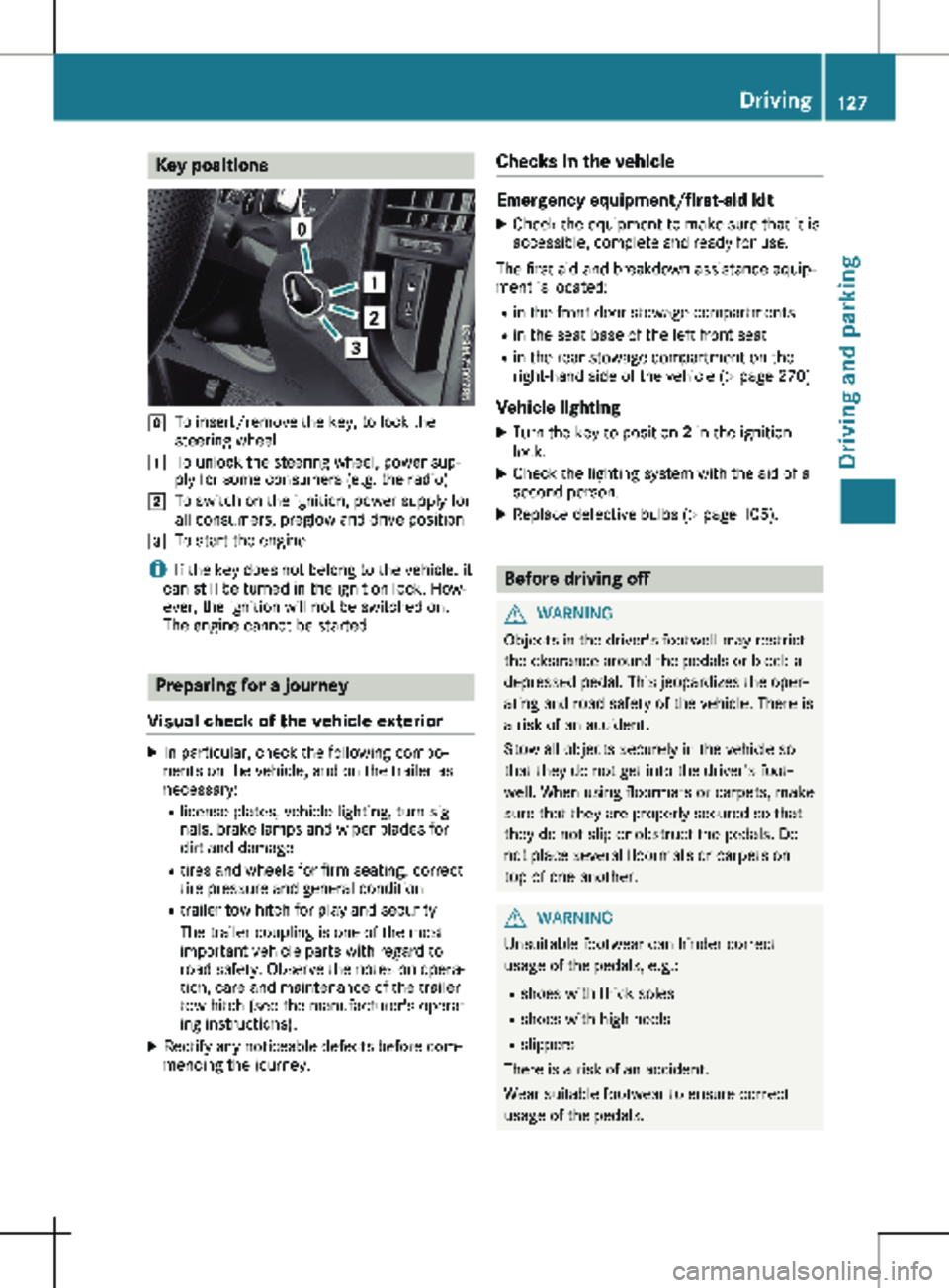
g
To insert/remove the key, to lock the
steering wheel
1 To unlock the steering wheel, power sup-
ply for some consumers (e.g. the radio)
2 To switch on the ignition, power supply for
all consumers, preglow and drive position
3 To start the engine
i If the key does not belong to the vehicle, it
can still be turned in the ignition lock. How-
ever, the ignition will not be switched on.
The engine cannot be started. Preparing for a journey
Visual check of the vehicle exterior X
In particular, check the following compo-
nents on the vehicle, and on the trailer as
necessary:
R
license plates, vehicle lighting, turn sig-
nals, brake lamps and wiper blades for
dirt and damage
R tires and wheels for firm seating, correct
tire pressure and general condition
R trailer tow hitch for play and security
The trailer coupling is one of the most
important vehicle parts with regard to
road safety. Observe the notes on opera-
tion, care and maintenance of the trailer
tow hitch (see the manufacturer's operat-
ing instructions).
X Rectify any noticeable defects before com-
mencing the journey. Checks in the vehicle Emergency equipment/first-aid kit
X Check the equipment to make sure that it is
accessible, complete and ready for use.
The first aid and breakdown assistance equip-
ment is located:
R in the front door stowage compartments
R in the seat base of the left front seat
R in the rear stowage compartment on the
right-hand side of the vehicle
(Y page 270)
Vehicle lighting
X Turn the key to position 2 in the ignition
lock.
X Check the lighting system with the aid of a
second person.
X Replace defective bulbs (Y page
105). Before driving off
G
WARNING
Objects in the driver's footwell may restrict
the clearance around the pedals or block a
depressed pedal. This jeopardizes the oper-
ating and road safety of the vehicle. There is
a risk of an accident.
Stow all objects securely in the vehicle so
that they do not get into the driver's foot-
well. When using floormats or carpets, make
sure that they are properly secured so that
they do not slip or obstruct the pedals. Do
not place several floormats or carpets on
top of one another. G
WARNING
Unsuitable footwear can hinder correct
usage of the pedals, e.g.:
R shoes with thick soles
R shoes with high heels
R slippers
There is a risk of an accident.
Wear suitable footwear to ensure correct
usage of the pedals. Driving
127
Driving and parking Z