tow MERCEDES-BENZ METRIS 2020 MY20 Operator’s Manual
[x] Cancel search | Manufacturer: MERCEDES-BENZ, Model Year: 2020, Model line: METRIS, Model: MERCEDES-BENZ METRIS 2020Pages: 320, PDF Size: 26.38 MB
Page 246 of 320
X
Always transport loads in the cargo com-
partment and with the seat backrests folded
up and properly locked in position.
X Always place the load against the backrests
of the front or rear seats.
X Move large and heavy loads as far towards
the front of the vehicle as possible against
the front or rear seats. Stow the load flush
with the rear or front seats.
X Always additionally secure the load with
suitable load-securing aids or tie downs.
Observe the following notes:
R Do not stack loads higher than the upper
edge of the backrests.
R Transport loads behind seats that are not
occupied.
R If the rear bench seat is not occupied, insert
the seat belts crosswise into the buckle of
the opposite seat belt. Cargo compartment variations
You can vary the cargo compartment accord-
ing to your transportation requirements as fol-
lows:
R by folding the seat backrests forward to the
table position.
R by removing the rear bench seat.
You will find information about rear bench
seats in the "Rear bench seats" section
( Y page
89). Securing loads
Important safety notes
G
WARNING
If you attach the tie-down incorrectly when
securing the load, the following may occur in
the event of abrupt changes in direction,
braking maneuvers or an accident:
R the cargo tie-down rings may become
detached or the tie-down may tear if the
permissible load is exceeded
R the load may not be restrained. This may cause the load to slip, tip over or
be tossed about, striking vehicle occupants.
There is a risk of an accident and injury.
Always tension the tie-downs in the proper
manner and only between the described
cargo tie-down rings. Always use tie-downs
designed specifically for the loads.
! Observe the information on the maximum
loading capacity of the individual cargo tie-
down points.
If you use several cargo tie-down points to
secure a load, you must always take the
maximum loading capacity of the weakest
cargo tie-down point into account.
If you brake hard, for example, the forces
acting could be up to several times the
weight force of the load. Always use multi-
ple cargo tie-down points in order to distrib-
ute the force absorption. Load the ancho-
rages evenly.
As the driver, you are responsible for ensuring
that: R The load is secured against slipping, tipping,
rolling or falling off in normal traffic condi-
tions, should the vehicle swerve to avoid an
obstacle, in the event of maximum full-stop
braking and on poor road surfaces
R The applicable requirements and guidelines
relating to load-securing practices are met
If this is not the case, this may constitute a
punishable offense, depending on local leg-
islation and any ensuing consequences.
Always observe the legal requirements for
the country you are currently in.
Make sure that the load is secure before every
journey and at regular intervals during a long
journey. Correct an incorrectly or inadequately
secured load if necessary.
Always observe the operating instructions or
the notes of the lashing strap manufacturer for
the operation of the lashing strap.
You can obtain information about securing the
load correctly from the manufacturer of the
load securing aids or tie down for securing the
load. Also observe the safety information in
the loading directions ( Y page 242).
X Fill spaces between the load and the cargo
compartment walls or wheel housings (form-244
Securing loads
Transporting loads
Page 250 of 320
X
Guide ratchet strap ? through slotted shaft
A from behind as illustrated and tighten it.
X Swing tensioning lever ; back and forth
until the ratchet strap has wound around
slotted shaft A two to three times.
X Press stop slider = outwards in the direc-
tion of the arrow and swing tensioning
lever ; to detent position 1.
X Release stop slider =.
The ratchet is closed and engaged. Tensioning lever in the release position
X To release the ratchet strap: release ten-
sioning lever ; and swing it into release
position 7.
Lock stop slider = engages in end recess
B.
X Unlock the release catch D by pressing it.
Slotted shaft A can move freely.
X Pull ratchet strap ? out of the ratchet. Securing loads
Load protection net
G
WARNING
The load protection net alone cannot
restrain or secure heavy objects, luggage or
heavy loads. In the event of abrupt changes
in direction, braking maneuvers or an acci-
dent, you may be struck by unsecured loads.
There is a risk of injury, possibly even fatal.
Always stow objects in such a way that they
cannot be tossed about. Secure objects, lug-
gage and loads to prevent them slipping or
tipping over, e.g. by lashing them down,
even when using the load protection net. G
WARNING
If vehicle occupants are seated behind a
load protection net, they may be squeezed
up against the load protection net. There is
a risk of injury, particularly in the event of
braking maneuvers or abrupt changes in
direction.
Never allow vehicle occupants to sit behind
the load protection net.
The load protection net borders the cargo
compartment. It protects vehicle occupants
from light objects and/or luggage slipping or
tipping over. Always observe the notes on
securing loads
(Y page 244).
You can install the load protection net at an
angle behind the front seats or behind the first
row of back seats. Upper retainer
Anchorage (example: fixed cargo tie-down ring)248
Securing loads
Transporting loads
Page 254 of 320
X
Hold support strut ? and lift the hood
slightly.
X Guide support strut ? towards retainer =
and apply slight pressure to make it engage.
X Lower the hood and allow it to fall with
momentum from a height of approximately
1 ft (30 cm
).
The hood locks audibly.
X Check that the hood is correctly locked.
If the hood can be raised slightly, it is not
properly engaged. If the hood is not cor-
rectly engaged, open the hood again. Let
the hood fall with a little more momentum. Overview of the engine compart-
ment
Engine compartment (example)
:
Engine oil filler neck cap (Y page
252)
; Brake fluid reservoir cap (Y page
255)
= Coolant expansion tank cap ( Y page
253)
? Washer fluid reservoir cap (Y page
256)
Regularly check the fluid level and the assem-
bly for leaks. If you detect fluid loss, e.g. oil
stains on the vehicle parking space, consult a
qualified specialist workshop immediately. Engine oil
General notes !
Engine oil gets dirty in the course of opera-
tion and its quality and volume are gradually
diminished. Regularly check the oil level,
and top up or have it replaced as needed.
Observe the information on approved engine
oils and oil consumption under "Service prod-
ucts and capacities" ( Y page
308).You can check the oil level in the engine:
R with the oil dipstick
Checking the oil level using the oil dip-
stick G
WARNING
Opening the hood when the engine is over-
heated or when there is a fire in the engine
compartment could expose you to hot gases
or other service products. There is a risk of
injury.
Let an overheated engine cool down before
opening the hood. If there is a fire in the
engine compartment, keep the hood closed
and contact the fire department. G
WARNING
Certain components in the engine compart-
ment, such as the engine, radiator and parts
of the exhaust system, can become very
hot. Working in the engine compartment
poses a risk of injury.
Where possible, let the engine cool down
and touch only the components described in
the following. Oil dipstick and engine oil filler neck
Only check the oil level when the engine is at
normal operating temperature. X Stop your vehicle as far away from traffic as
possible on level ground.
X Secure the vehicle to prevent it from rolling
away.
X Switch off the engine.
X Wait for five minutes.252
Engine compartment
Maintenance and care
Page 261 of 320
Always make sure that neither you nor the bat-
tery are electro statically charged.
An electrostatic charge can build up in the fol-
lowing situations:
R wearing synthetic clothing
R friction between clothing and the seat
R dragging or pushing the battery across car-
pet flooring or any other synthetic materials
R by rubbing the battery with a cloth or towels
Comply with the following safety precautions
and take protective measures when handling
batteries. Risk of explosion. Explosive oxyhy-
drogen is produced when batteries
are being charged. Only charge
batteries in well-ventilated areas.
Fire, open flames and smoking are
therefore prohibited when working
on the battery. Avoid creating
sparks.
Battery acid is caustic. Avoid con-
tact with the skin, eyes or clothing.
Wear acid-proof protective gloves.
If skin or clothes are splashed with
acid, neutralize the splashes imme-
diately with soapy water or an acid
neutralizer, and then clean the
affected areas with water. Consult
a doctor if necessary.
Wear eye protection. When mixing
water and acid, the liquid can
splash into your eyes. Rinse acid
splashes to the eyes immediately
with clean water and contact a
doctor immediately.
Keep children at a safe distance.
Children are not able to assess the
dangers posed by batteries and
acid.
When handling batteries, observe
the safety precautions and special
protective measures contained in
this Operator's Manual.
H
Environmental note Batteries contain pollutants.
It is illegal to dispose of
them with the household
rubbish. They must be col-
lected separately and dis-
posed of in an environmen- tally responsible recycling
system. Dispose of batteries in an
environmentally responsible
manner. Take discharged
batteries to a qualified spe-
cialist workshop or to a col-
lection point for used bat-
teries.
Observe the following notes: R have the batteries recharged more fre-
quently in the following situations:
- if you predominantly drive short distan-
ces.
- if you predominantly drive at low outside
temperatures.
- if you leave the vehicle parked for a
lengthy period.
In order for the batteries to achieve their
maximum possible service life, they must
always be sufficiently charged.
R Consult an authorized Mercedes-Benz Com-
mercial Van Center if you wish to leave your
vehicle parked for a long period of time.
R When you park the vehicle, remove the key
if you do not require any electrical consum-
ers. The vehicle will then use very little
energy, thus conserving battery power.
R If your vehicle requires jump-starting, or if
you wish to provide jump-starting assistance
to another vehicle, only use the jump-start-
ing connection point in the engine compart-
ment
(Y page 272).
R Have the battery removed at a qualified spe-
cialist workshop. Installation locations
Your vehicle may be equipped with the follow-
ing three batteries, depending on the equip-
ment level:
R Starter battery in the seat base of the right-
hand front seat
R Auxiliary battery in the seat base of the
right-hand front seat
R Additional battery in the seat base of the
left-hand front seat Battery
259
Maintenance and care Z
Page 267 of 320
X
Thoroughly hose down the vehicle with a
gentle jet of water.
X Do not point the water jet directly towards
the air inlet grilles.
X Use plenty of water and rinse out the
sponge frequently.
X Rinse the vehicle with clean water and dry
thoroughly with a chamois.
X Do not let the cleaning agents dry on the
paintwork.
When using the vehicle in winter, remove all
traces of road salt deposits carefully and as
soon as possible.
Power washers G
WARNING
The water jet from a circular jet nozzle (dirt
blasters) can cause invisible exterior dam-
age to the tires or chassis components.
Components damaged in this way may fail
unexpectedly. There is a risk of an accident.
Do not use power washers with circular jet
nozzles to clean the vehicle. Have damaged
tires or chassis components replaced imme-
diately.
! Under no circumstances use power wash-
ers in the vehicle interior. The pressurized
water and associated spray produced by the
power washer could cause extensive dam-
age to the vehicle.
! When using high-pressure cleaning equip-
ment, maintain a minimum distance of
approx. 1 ft (30 cm
) between the spray noz-
zle and the vehicle parts. Do not use a
power washer with a round-jet nozzle. You
could damage the vehicle or engine parts.
! Keep the water jet moving constantly
while cleaning. This will avoid causing dam-
age to the vehicle.
Do not point the water jet at:
R door joints
R rear view camera
R air bellows
R brake hoses
R wheel balance weights
R electrical components
R electrical connections R
seals
R drive train, especially not at the inter-
mediate bearing of the propeller shaft
Cleaning the engine !
Water must not enter intake or ventilation
openings. When cleaning with high pressure
water or steam cleaners, the spray must not
be aimed directly at electrical components
or the terminals of electrical lines.
Preserve the engine after the engine has
been cleaned. Protect the belt drive system
from exposure to the preservative agent.
Also observe the information under "Power
washers"
(Y page 265).
Cleaning the paintwork !
Do not affix:
R stickers
R films
R magnetic plates or similar items
to painted surfaces. You could otherwise
damage the paintwork.
Scratches, corrosive deposits, areas affected
by corrosion and damage caused by inade-
quate care cannot always be completely
repaired. In such cases, visit a qualified spe-
cialist workshop.
X Remove impurities immediately, where pos-
sible, whilst avoiding rubbing too hard.
X Soak insect remains with insect remover
and rinse off the treated areas afterwards.
X Soak bird droppings with water and rinse off
the treated areas afterwards.
X Remove coolant, brake fluid, tree resin, oils,
fuels and greases by rubbing gently with a
cloth soaked in petroleum ether or lighter
fluid.
X Use tar remover to remove tar stains.
X Use silicone remover to remove wax.
Cleaning the windows G
WARNING
You could become trapped by the wind-
shield wipers if they start moving while
cleaning the windshield or wiper blades.
There is a risk of injury. Care
265
Maintenance and care
Z
Page 270 of 320
X
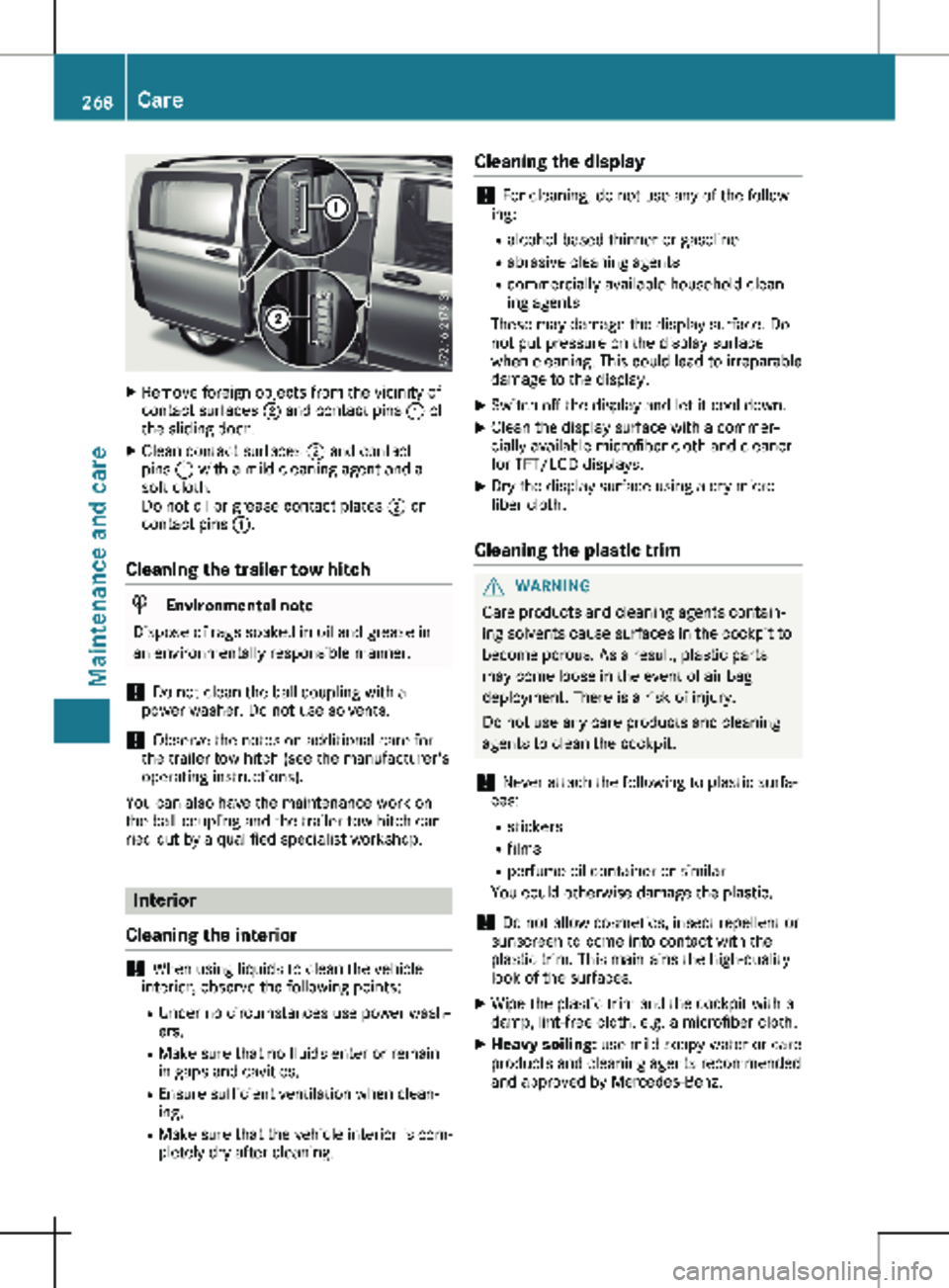
Remove foreign objects from the vicinity of
contact surfaces ; and contact pins : of
the sliding door.
X Clean contact surfaces ; and contact
pins : with a mild cleaning agent and a
soft cloth.
Do not oil or grease contact plates ; or
contact pins :.
Cleaning the trailer tow hitch H
Environmental note
Dispose of rags soaked in oil and grease in
an environmentally responsible manner.
! Do not clean the ball coupling with a
power washer. Do not use solvents.
! Observe the notes on additional care for
the trailer tow hitch (see the manufacturer's
operating instructions).
You can also have the maintenance work on
the ball coupling and the trailer tow hitch car-
ried out by a qualified specialist workshop. Interior
Cleaning the interior !
When using liquids to clean the vehicle
interior, observe the following points:
R Under no circumstances use power wash-
ers.
R Make sure that no fluids enter or remain
in gaps and cavities.
R Ensure sufficient ventilation when clean-
ing.
R Make sure that the vehicle interior is com-
pletely dry after cleaning. Cleaning the display !
For cleaning, do not use any of the follow-
ing:
R alcohol-based thinner or gasoline
R abrasive cleaning agents
R commercially-available household clean-
ing agents
These may damage the display surface. Do
not put pressure on the display surface
when cleaning. This could lead to irreparable
damage to the display.
X Switch off the display and let it cool down.
X Clean the display surface with a commer-
cially available microfiber cloth and cleaner
for TFT/LCD displays.
X Dry the display surface using a dry micro-
fiber cloth.
Cleaning the plastic trim G
WARNING
Care products and cleaning agents contain-
ing solvents cause surfaces in the cockpit to
become porous. As a result, plastic parts
may come loose in the event of air bag
deployment. There is a risk of injury.
Do not use any care products and cleaning
agents to clean the cockpit.
! Never attach the following to plastic surfa-
ces:
R stickers
R films
R perfume oil container or similar
You could otherwise damage the plastic.
! Do not allow cosmetics, insect repellent or
sunscreen to come into contact with the
plastic trim. This maintains the high-quality
look of the surfaces.
X Wipe the plastic trim and the cockpit with a
damp, lint-free cloth, e.g. a microfiber cloth.
X Heavy soiling: use mild soapy water or care
products and cleaning agents recommended
and approved by Mercedes-Benz. 268
CareMaintenance and care
Page 272 of 320
Useful information
This Operator's Manual describes all models
as well as standard and optional equipment of
your vehicle that were available at the time of
going to print. Country-specific variations are
possible. Note that your vehicle may not be
equipped with all of the described functions.
This also applies to systems and functions rel-
evant to safety.
Read the information on qualified specialist
workshops (Y page
32).Where will I find...?
Vehicle tool kit
General notes Depending on the equipment version of the
vehicle, the vehicle tool kit is:
R in the seat base of the left front seat
R in the rear compartment stowage compart-
ment
R in the tool holder in the cargo compartment
Apart from some country-specific variants,
vehicles without a spare wheel are not equip-
ped with tire-changing tools. If your vehicle is
equipped with tire-changing tools, these are in
the vehicle tool kit. If the vehicle tool kit is
stowed in the driver's seat base, the jack is in
a separate holder in the cargo compartment
on the right-hand side of the vehicle next to
the tailgate/rear-end door
(Y page 272).
Some tools for changing a wheel are specific
to the vehicle. For more information on which
tools are required and approved to perform a
wheel change on your vehicle, consult a quali-
fied specialist workshop.
Necessary tire-changing tools can include, for
example:
R Jack
R Lug wrench
R Ratchet wrench
i The jack has a maximum weight of 7.5 kg
depending on the vehicle's equipment.
The maximum payload of the jack can be
found on the sticker on the jack itself. The jack is maintenance-free. In the event of
a malfunction, please contact a qualified
specialist workshop.
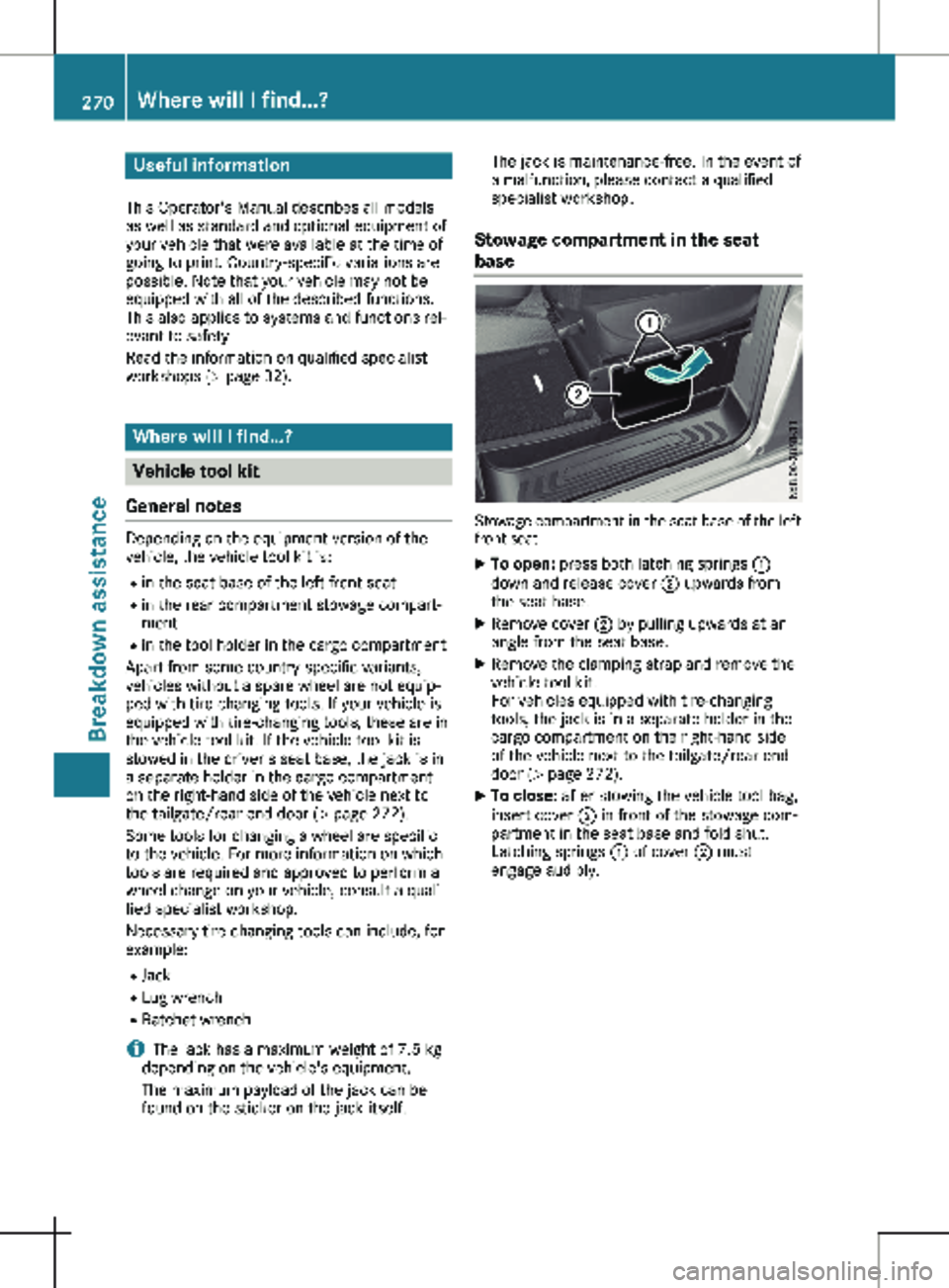
Stowage compartment in the seat
base Stowage compartment in the seat base of the left
front seat
X To open: press both latching springs :
down and release cover ; upwards from
the seat base.
X Remove cover ; by pulling upwards at an
angle from the seat base.
X Remove the clamping strap and remove the
vehicle tool kit.
For vehicles equipped with tire-changing
tools, the jack is in a separate holder in the
cargo compartment on the right-hand side
of the vehicle next to the tailgate/rear-end
door (Y page
272).
X To close: after stowing the vehicle tool bag,
insert cover ; in front of the stowage com-
partment in the seat base and fold shut.
Latching springs : of cover ; must
engage audibly. 270
Where will I find...?
Breakdown assistance
Page 273 of 320
Stowage compartment in the rear
compartment
Opening/closing the stowage compart-
ment
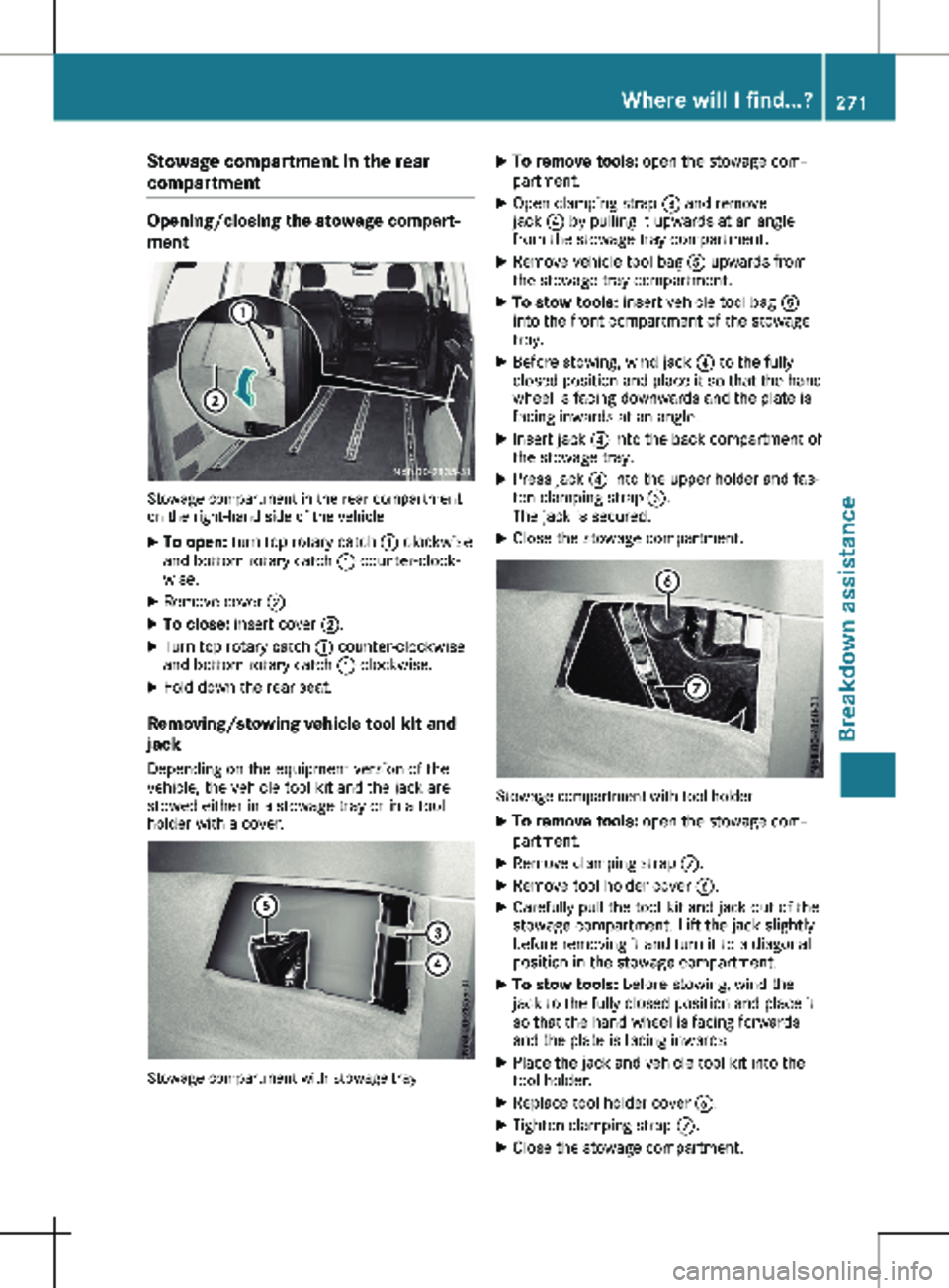
Stowage compartment in the rear compartment
on the right-hand side of the vehicle
X To open: turn top rotary catch : clockwise
and bottom rotary catch : counter-clock-
wise.
X Remove cover ;.
X To close: insert cover ;.
X Turn top rotary catch : counter-clockwise
and bottom rotary catch : clockwise.
X Fold down the rear seat.
Removing/stowing vehicle tool kit and
jack
Depending on the equipment version of the
vehicle, the vehicle tool kit and the jack are
stowed either in a stowage tray or in a tool
holder with a cover. Stowage compartment with stowage tray X
To remove tools: open the stowage com-
partment.
X Open clamping strap = and remove
jack ? by pulling it upwards at an angle
from the stowage tray compartment.
X Remove vehicle tool bag A upwards from
the stowage tray compartment.
X To stow tools: insert vehicle tool bag A
into the front compartment of the stowage
tray.
X Before stowing, wind jack ? to the fully
closed position and place it so that the hand
wheel is facing downwards and the plate is
facing inwards at an angle.
X Insert jack ? into the back compartment of
the stowage tray.
X Press jack ? into the upper holder and fas-
ten clamping strap =.
The jack is secured.
X Close the stowage compartment. Stowage compartment with tool holder
X To remove tools: open the stowage com-
partment.
X Remove clamping strap C.
X Remove tool holder cover B.
X Carefully pull the tool kit and jack out of the
stowage compartment. Lift the jack slightly
before removing it and turn it to a diagonal
position in the stowage compartment.
X To stow tools: before stowing, wind the
jack to the fully closed position and place it
so that the hand wheel is facing forwards
and the plate is facing inwards.
X Place the jack and vehicle tool kit into the
tool holder.
X Replace tool holder cover B.
X Tighten clamping strap C.
X Close the stowage compartment. Where will I find...?
271Breakdown assistance
Page 274 of 320
Stowage space in the cargo compart-
ment
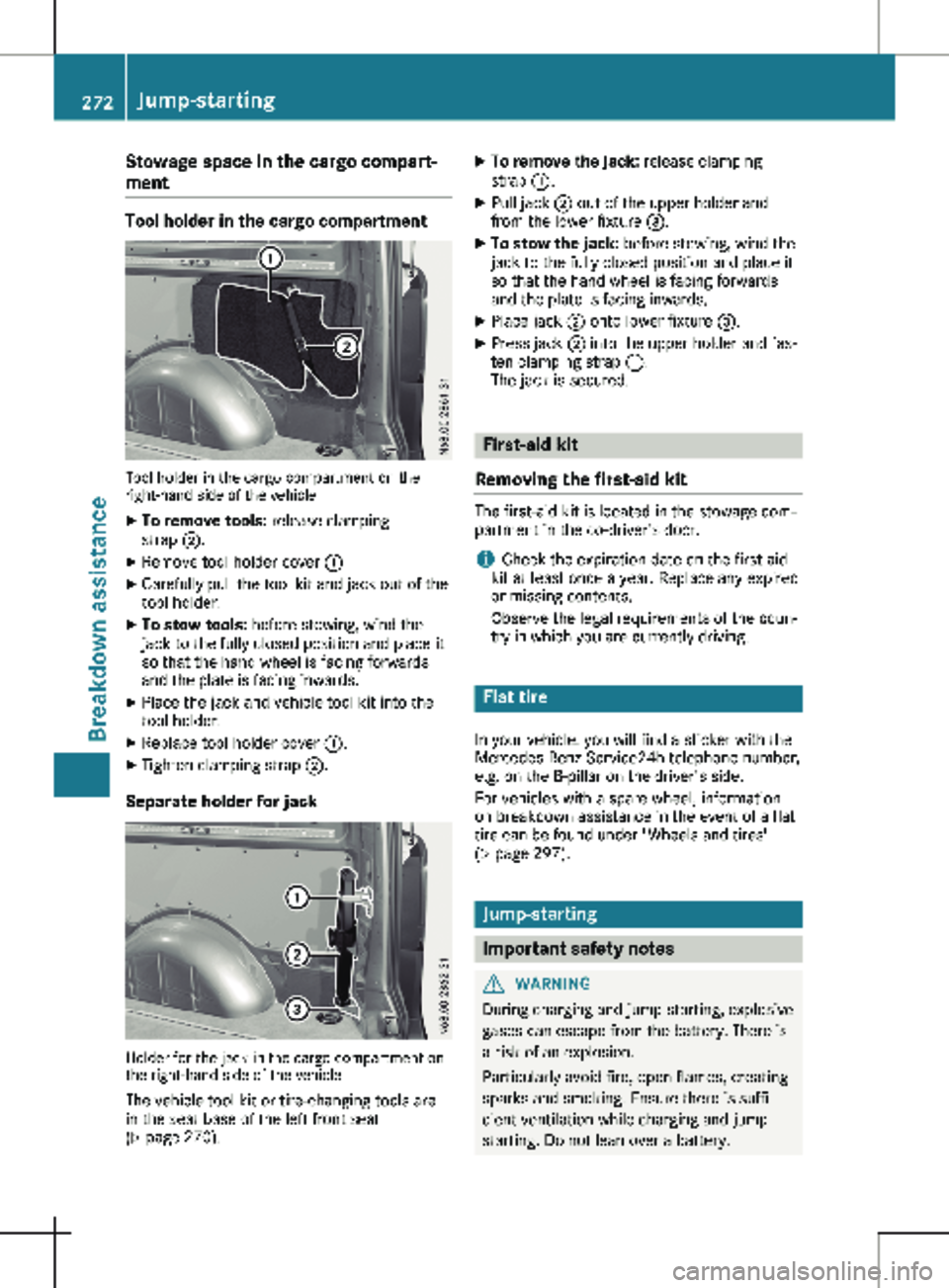
Tool holder in the cargo compartment
Tool holder in the cargo compartment on the
right-hand side of the vehicle
X To remove tools: release clamping
strap ;.
X Remove tool holder cover :
X Carefully pull the tool kit and jack out of the
tool holder.
X To stow tools: before stowing, wind the
jack to the fully closed position and place it
so that the hand wheel is facing forwards
and the plate is facing inwards.
X Place the jack and vehicle tool kit into the
tool holder.
X Replace tool holder cover :.
X Tighten clamping strap ;.
Separate holder for jack Holder for the jack in the cargo compartment on
the right-hand side of the vehicle
The vehicle tool kit or tire-changing tools are
in the seat base of the left front seat
(Y page
270). X
To remove the jack: release clamping
strap :.
X Pull jack ; out of the upper holder and
from the lower fixture =.
X To stow the jack: before stowing, wind the
jack to the fully closed position and place it
so that the hand wheel is facing forwards
and the plate is facing inwards.
X Place jack ; onto lower fixture =.
X Press jack ; into the upper holder and fas-
ten clamping strap :.
The jack is secured. First-aid kit
Removing the first-aid kit The first-aid kit is located in the stowage com-
partment in the co-driver's door.
i Check the expiration date on the first-aid
kit at least once a year. Replace any expired
or missing contents.
Observe the legal requirements of the coun-
try in which you are currently driving. Flat tire
In your vehicle, you will find a sticker with the
Mercedes-Benz Service24h telephone number,
e.g. on the B-pillar on the driver's side.
For vehicles with a spare wheel, information
on breakdown assistance in the event of a flat
tire can be found under "Wheels and tires"
( Y page
297). Jump-starting
Important safety notes
G
WARNING
During charging and jump-starting, explosive
gases can escape from the battery. There is
a risk of an explosion.
Particularly avoid fire, open flames, creating
sparks and smoking. Ensure there is suffi-
cient ventilation while charging and jump-
starting. Do not lean over a battery. 272
Jump-starting
Breakdown assistance
Page 276 of 320
X
Push contact protection cover : of the
jump-starting connection point backwards
against the spring force as far as it will go.
The jump-starting connection point is visi-
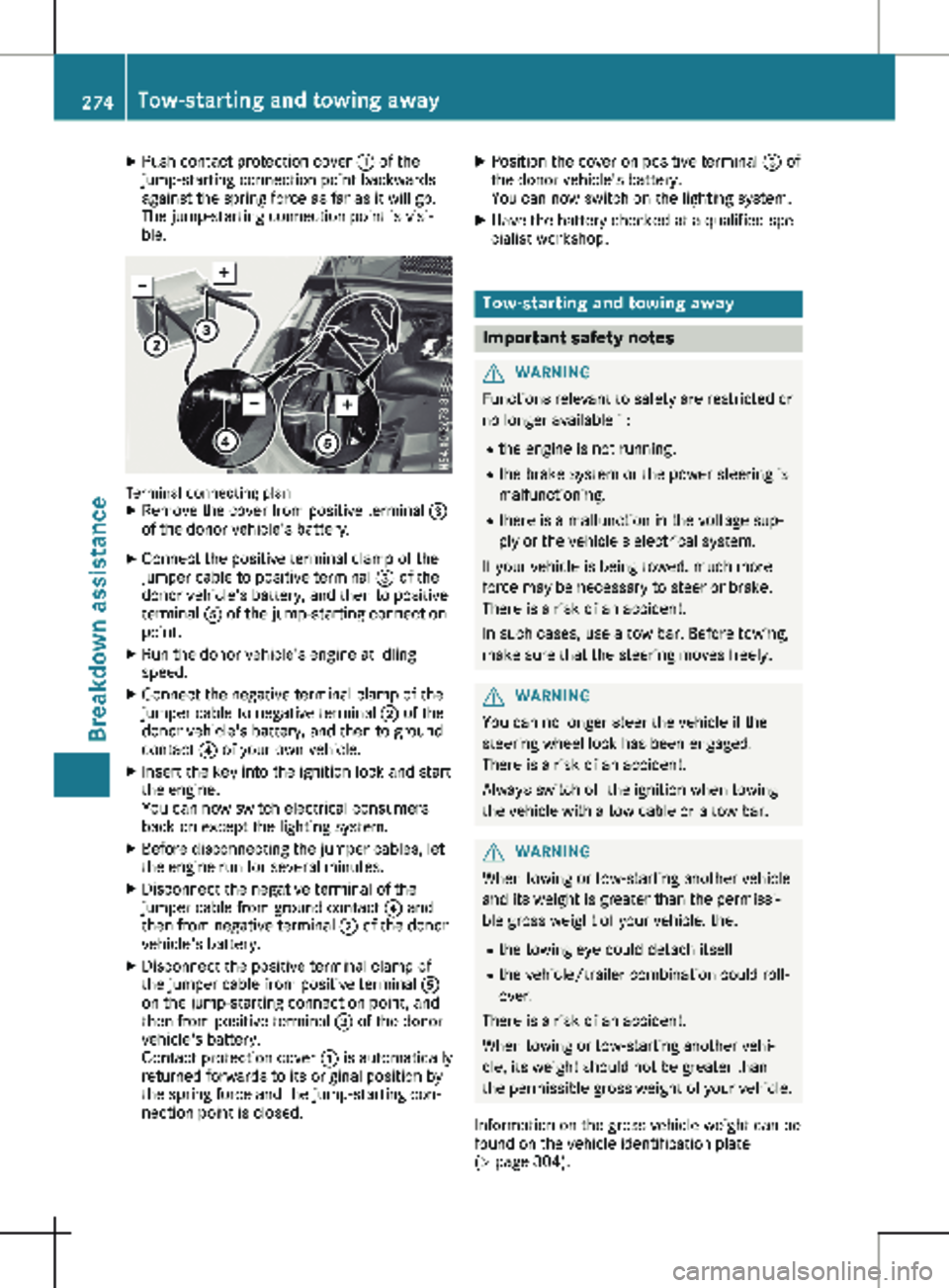
ble. Terminal connecting plan
X Remove the cover from positive terminal =
of the donor vehicle's battery.
X Connect the positive terminal clamp of the
jumper cable to positive terminal = of the
donor vehicle's battery, and then to positive
terminal A of the jump-starting connection
point.
X Run the donor vehicle's engine at idling
speed.
X Connect the negative terminal clamp of the
jumper cable to negative terminal ; of the
donor vehicle's battery, and then to ground
contact ? of your own vehicle.
X Insert the key into the ignition lock and start
the engine.
You can now switch electrical consumers
back on except the lighting system.
X Before disconnecting the jumper cables, let
the engine run for several minutes.
X Disconnect the negative terminal of the
jumper cable from ground contact ? and
then from negative terminal ; of the donor
vehicle's battery.
X Disconnect the positive terminal clamp of
the jumper cable from positive terminal A
on the jump-starting connection point, and
then from positive terminal = of the donor
vehicle's battery.
Contact protection cover : is automatically
returned forwards to its original position by
the spring force and the jump-starting con-
nection point is closed. X
Position the cover on positive terminal = of
the donor vehicle's battery.
You can now switch on the lighting system.
X Have the battery checked at a qualified spe-
cialist workshop. Tow-starting and towing away
Important safety notes
G
WARNING
Functions relevant to safety are restricted or
no longer available if:
R the engine is not running.
R the brake system or the power steering is
malfunctioning.
R there is a malfunction in the voltage sup-
ply or the vehicle's electrical system.
If your vehicle is being towed, much more
force may be necessary to steer or brake.
There is a risk of an accident.
In such cases, use a tow bar. Before towing,
make sure that the steering moves freely. G
WARNING
You can no longer steer the vehicle if the
steering wheel lock has been engaged.
There is a risk of an accident.
Always switch off the ignition when towing
the vehicle with a tow cable or a tow bar. G
WARNING
When towing or tow-starting another vehicle
and its weight is greater than the permissi-
ble gross weight of your vehicle, the:
R the towing eye could detach itself
R the vehicle/trailer combination could roll-
over.
There is a risk of an accident.
When towing or tow-starting another vehi-
cle, its weight should not be greater than
the permissible gross weight of your vehicle.
Information on the gross vehicle weight can be
found on the vehicle identification plate
(Y page
304).274
Tow-starting and towing away
Breakdown assistance