warning MERCEDES-BENZ METRIS 2020 MY20 Operator’s Manual
[x] Cancel search | Manufacturer: MERCEDES-BENZ, Model Year: 2020, Model line: METRIS, Model: MERCEDES-BENZ METRIS 2020Pages: 320, PDF Size: 26.38 MB
Page 270 of 320
X
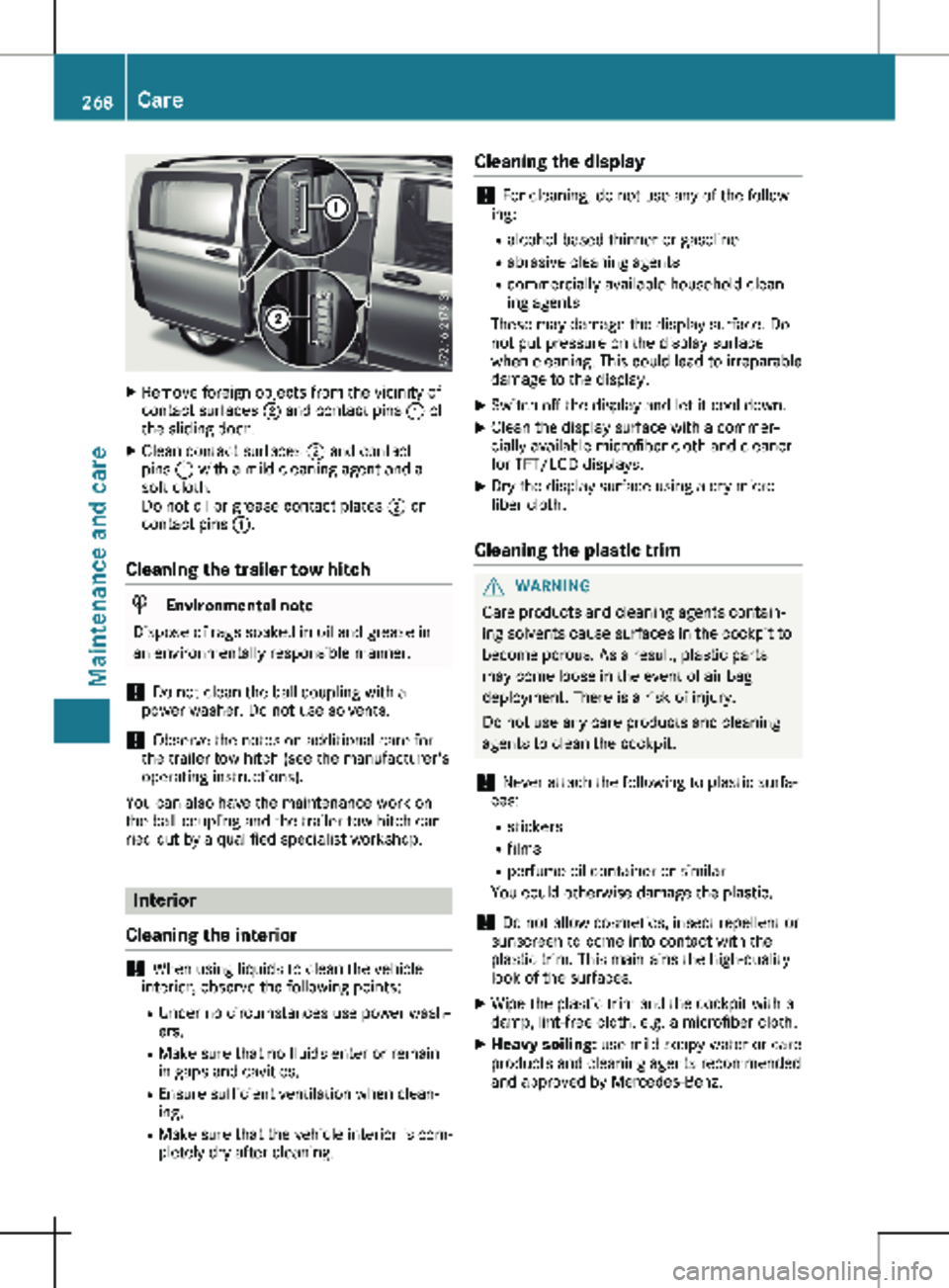
Remove foreign objects from the vicinity of
contact surfaces ; and contact pins : of
the sliding door.
X Clean contact surfaces ; and contact
pins : with a mild cleaning agent and a
soft cloth.
Do not oil or grease contact plates ; or
contact pins :.
Cleaning the trailer tow hitch H
Environmental note
Dispose of rags soaked in oil and grease in
an environmentally responsible manner.
! Do not clean the ball coupling with a
power washer. Do not use solvents.
! Observe the notes on additional care for
the trailer tow hitch (see the manufacturer's
operating instructions).
You can also have the maintenance work on
the ball coupling and the trailer tow hitch car-
ried out by a qualified specialist workshop. Interior
Cleaning the interior !
When using liquids to clean the vehicle
interior, observe the following points:
R Under no circumstances use power wash-
ers.
R Make sure that no fluids enter or remain
in gaps and cavities.
R Ensure sufficient ventilation when clean-
ing.
R Make sure that the vehicle interior is com-
pletely dry after cleaning. Cleaning the display !
For cleaning, do not use any of the follow-
ing:
R alcohol-based thinner or gasoline
R abrasive cleaning agents
R commercially-available household clean-
ing agents
These may damage the display surface. Do
not put pressure on the display surface
when cleaning. This could lead to irreparable
damage to the display.
X Switch off the display and let it cool down.
X Clean the display surface with a commer-
cially available microfiber cloth and cleaner
for TFT/LCD displays.
X Dry the display surface using a dry micro-
fiber cloth.
Cleaning the plastic trim G
WARNING
Care products and cleaning agents contain-
ing solvents cause surfaces in the cockpit to
become porous. As a result, plastic parts
may come loose in the event of air bag
deployment. There is a risk of injury.
Do not use any care products and cleaning
agents to clean the cockpit.
! Never attach the following to plastic surfa-
ces:
R stickers
R films
R perfume oil container or similar
You could otherwise damage the plastic.
! Do not allow cosmetics, insect repellent or
sunscreen to come into contact with the
plastic trim. This maintains the high-quality
look of the surfaces.
X Wipe the plastic trim and the cockpit with a
damp, lint-free cloth, e.g. a microfiber cloth.
X Heavy soiling: use mild soapy water or care
products and cleaning agents recommended
and approved by Mercedes-Benz. 268
CareMaintenance and care
Page 271 of 320
Cleaning the steering wheel and selec-
tor lever
X
Thoroughly wipe with a damp cloth.
X Vehicles with leather upholstery: after
cleaning, use leather care agents that have
been recommended and approved by
Mercedes-Benz.
Cleaning the trim elements !
Do not use solvent-based cleaning agents
such as tar remover, wheel cleaners, pol-
ishes or waxes. There is otherwise a risk of
damaging the surface.
X Wipe the trim elements with a damp, lint-
free cloth, e.g. a microfiber cloth.
X Heavy soiling: use care products and
cleaning agents recommended and
approved by Mercedes-Benz.
Cleaning the seat covers !
Do not use microfiber cloths to clean gen-
uine leather or artificial leather covers. If
used often, a microfiber cloth can damage
the cover.
! Clean:
R artificial leather covers with a cloth mois-
tened with a solution containing 1% deter-
gent, e.g. dish washing liquid.
R cloth covers with a microfiber cloth mois-
tened with a solution containing 1% deter-
gent, e.g. dish washing liquid. Wipe entire
seat sections carefully to avoid leaving
visible lines. Leave the seat to dry after-
wards. Cleaning results depend on the
type of dirt and how long it has been
there.
R genuine leather covers carefully with a
damp cloth, then wipe the covers down
with a dry cloth. Make sure that the
leather does not become soaked. Other-
wise, the leather could become rough or
cracked. Only use leather care agents
that have been tested and approved by
Mercedes-Benz. You can obtain these
from a qualified specialist workshop.
i Please keep in mind that:
R leather covers are a natural product and,
as such, are subject to a natural aging process. Leather may react differently,
e.g. increased wrinkling, to certain envi-
ronmental influences (such as high
humidity or intense heat).
R regular care is essential to make sure that
the appearance and comfort of the covers
are retained over time.
To clean genuine leather covers: X Remove any dust, crumbs etc. If necessary,
carefully vacuum-clean the seat covers.
X Carefully wipe the leather seat covers with a
damp cloth.
X Wipe over again with a dry cloth.
Make sure that the leather does not become
soaked, especially perforated parts.
X Then treat the leather seats with a leather
care foam.
Only use leather care agents that have been
tested and approved by Mercedes-Benz.
Observe the manufacturer's instructions.
Cleaning the seat belts G
WARNING
Seat belts can become severely weakened if
bleached or dyed. This could cause the seat
belts to tear or fail, for instance, in the event
of an accident. This poses an increased risk
of injury or fatal injury.
Never bleach or dye the seat belts.
! Do not clean the seat belts using chemical
cleaning agents. Do not dry the seat belts
by heating at temperatures above
176 ‡
(80 †) or in direct sunlight.
Remove any stains or dirt immediately. This
will avoid residue or damage. X Use clean, lukewarm water and soap solu-
tion.
Cleaning the headliner and carpets X
Headliner: if it is very dirty, use a soft brush
or dry shampoo.
X Carpets: use the carpet and textile cleaning
agents recommended and approved by
Mercedes-Benz. Care
269
Maintenance and care Z
Page 274 of 320
Stowage space in the cargo compart-
ment
Tool holder in the cargo compartment
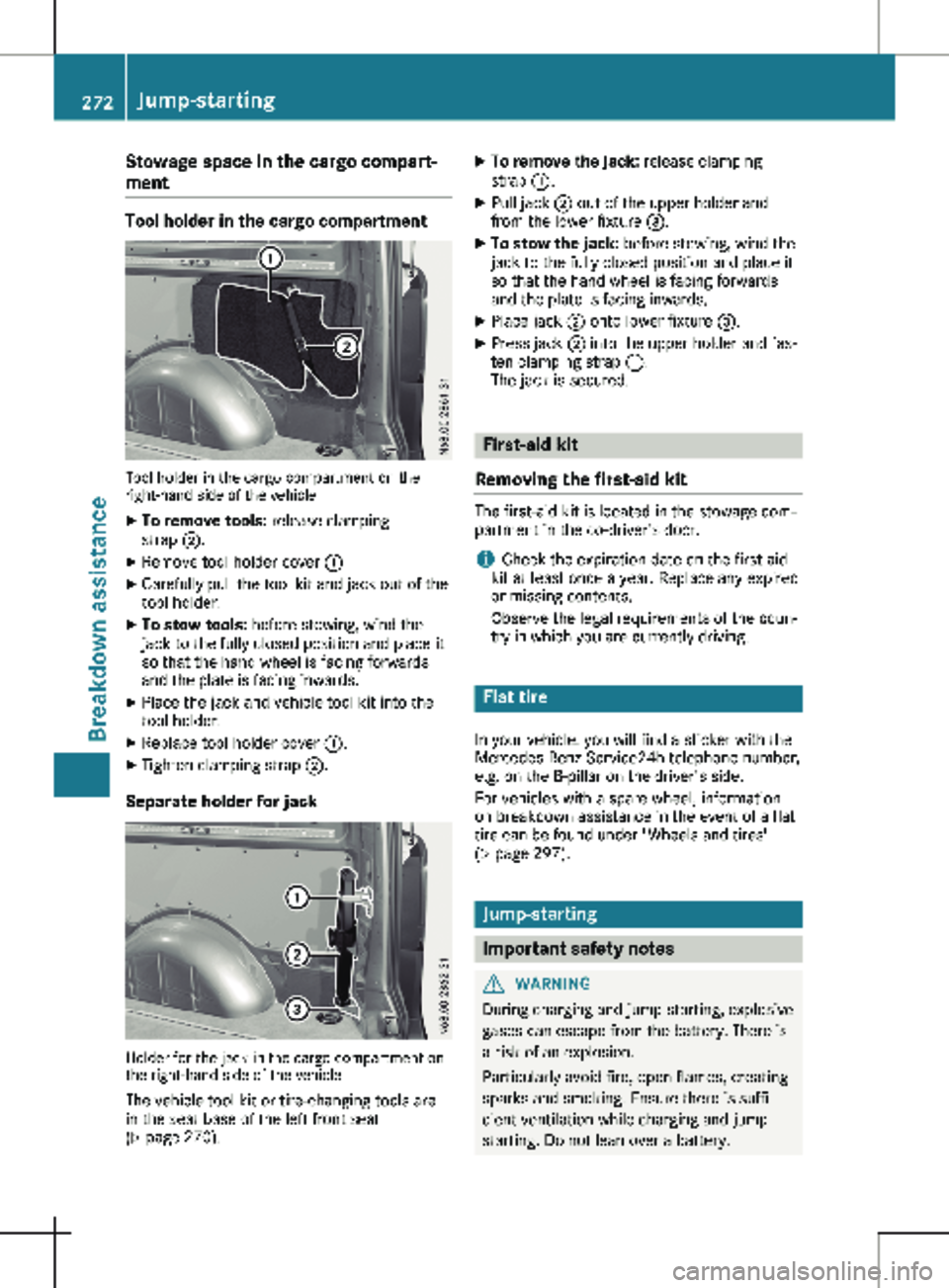
Tool holder in the cargo compartment on the
right-hand side of the vehicle
X To remove tools: release clamping
strap ;.
X Remove tool holder cover :
X Carefully pull the tool kit and jack out of the
tool holder.
X To stow tools: before stowing, wind the
jack to the fully closed position and place it
so that the hand wheel is facing forwards
and the plate is facing inwards.
X Place the jack and vehicle tool kit into the
tool holder.
X Replace tool holder cover :.
X Tighten clamping strap ;.
Separate holder for jack Holder for the jack in the cargo compartment on
the right-hand side of the vehicle
The vehicle tool kit or tire-changing tools are
in the seat base of the left front seat
(Y page
270). X
To remove the jack: release clamping
strap :.
X Pull jack ; out of the upper holder and
from the lower fixture =.
X To stow the jack: before stowing, wind the
jack to the fully closed position and place it
so that the hand wheel is facing forwards
and the plate is facing inwards.
X Place jack ; onto lower fixture =.
X Press jack ; into the upper holder and fas-
ten clamping strap :.
The jack is secured. First-aid kit
Removing the first-aid kit The first-aid kit is located in the stowage com-
partment in the co-driver's door.
i Check the expiration date on the first-aid
kit at least once a year. Replace any expired
or missing contents.
Observe the legal requirements of the coun-
try in which you are currently driving. Flat tire
In your vehicle, you will find a sticker with the
Mercedes-Benz Service24h telephone number,
e.g. on the B-pillar on the driver's side.
For vehicles with a spare wheel, information
on breakdown assistance in the event of a flat
tire can be found under "Wheels and tires"
( Y page
297). Jump-starting
Important safety notes
G
WARNING
During charging and jump-starting, explosive
gases can escape from the battery. There is
a risk of an explosion.
Particularly avoid fire, open flames, creating
sparks and smoking. Ensure there is suffi-
cient ventilation while charging and jump-
starting. Do not lean over a battery. 272
Jump-starting
Breakdown assistance
Page 275 of 320
G
WARNING
Battery acid is caustic. There is a risk of
injury.
Avoid contact with skin, eyes or clothing. Do
not inhale any battery gases. Do not lean
over the battery. Keep children away from
batteries. Wash away battery acid immedi-
ately with plenty of clean water and seek
medical attention. G
WARNING
A discharged battery can freeze at tempera-
tures below freezing point. When jump-start-
ing the vehicle or charging the battery,
gases can escape from the battery. There is
a risk of an explosion.
Allow the frozen battery to thaw out before
charging it or jump-starting.
! Vehicles with a gasoline engine:
avoid
repeated and lengthy starting attempts. Oth-
erwise, the catalytic converter could be
damaged by non-combusted fuel.
If the indicator and warning lamps in the
instrument cluster do not light up at low tem-
peratures, the discharged battery may have
frozen. In this case you may neither charge the
battery nor jump-start the vehicle. The service
life of a thawed battery may be shorter. Start-
up behavior may deteriorate, in particular at
low temperatures. Have the thawed battery
checked at a qualified specialist workshop.
Do not use a rapid charging device to start the
vehicle. If your vehicle's battery is discharged,
the engine can be jump-started from another
vehicle or from a donor battery using jumper
cables. For this purpose, the vehicle has a
jump-starting connection point in the engine
compartment.
When jump-starting, observe the following
points:
R The battery is not accessible in all vehicles.
If the other vehicle's battery is not accessi-
ble, jump-start the vehicle using a donor
battery or a jump-starting device.
R You may only jump-start the vehicle when
the engine and exhaust system are cold.
R Do not start the engine if the battery is fro-
zen. Let the battery thaw first. R
Jump-starting may only be performed from
batteries with a nominal voltage of 12 V.
R Only use jumper cables that have a suffi-
cient cross-section and insulated terminal
clamps.
R If the battery is fully discharged, attach the
battery of another vehicle for a few minutes
before attempting to start. This charges the
empty battery a little.
R Make sure that the two vehicles do not
touch.
Make sure that:
R The jumper cables are not damaged.
R Bare parts of the terminal clamps do not
come into contact with other metal parts
while the jumper cables are connected to
the battery.
R The jumper cables cannot come into contact
with parts such as the V-belt pulley or the
fan. These parts move when the engine is
started and while it is running.
Jumper cables and further information regard-
ing jump starting can be obtained at any quali-
fied specialist workshop. Before connecting the jumper cables
X Apply the parking brake.
X Shift the transmission to position j.
X Switch off all electrical consumers, e.g.
audio equipment, blower.
X Turn the key to position u in the ignition
lock and remove it .
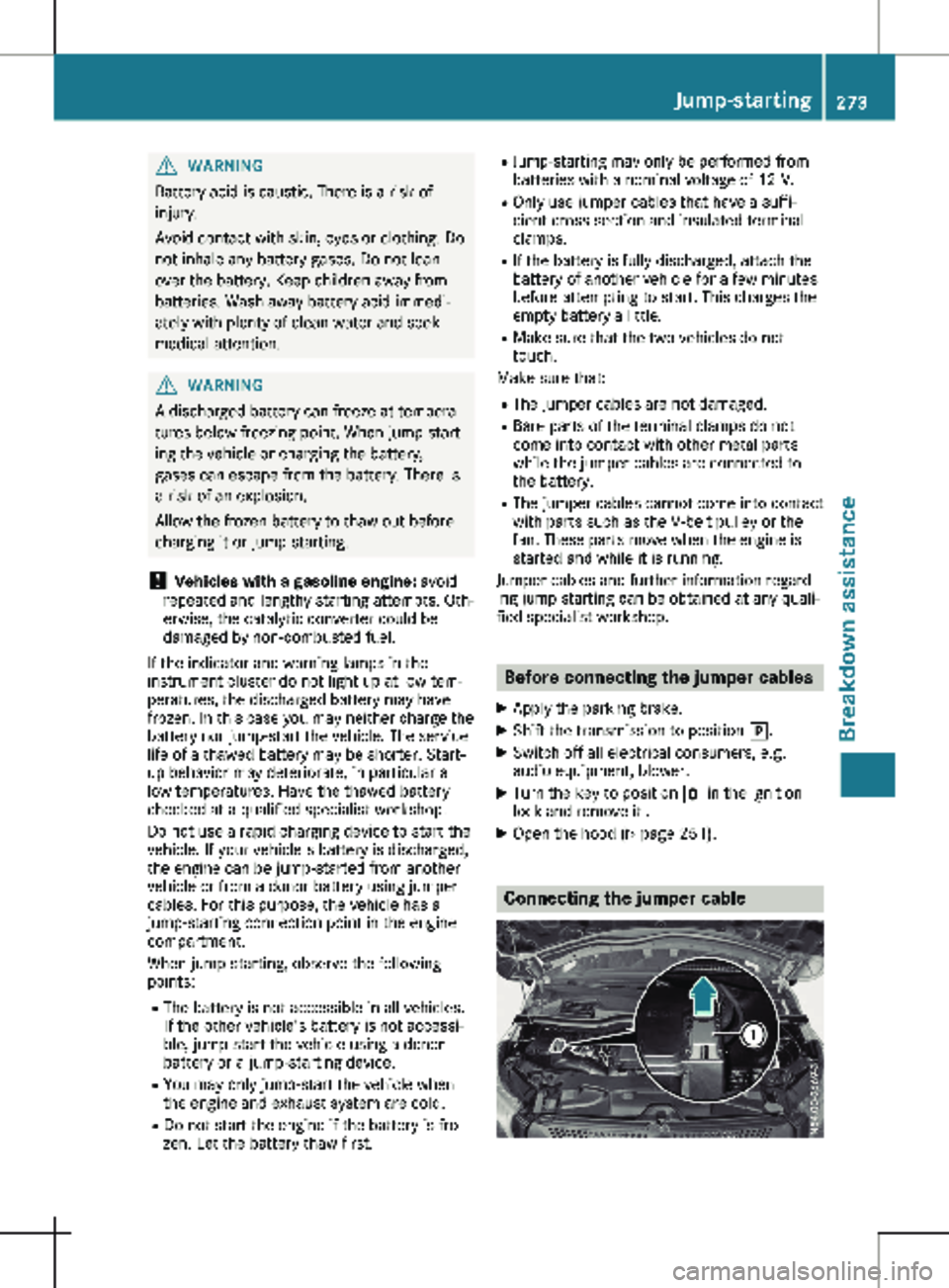
X Open the hood (Y page 251). Connecting the jumper cable Jump-starting
273
Breakdown assistance Z
Page 276 of 320
X
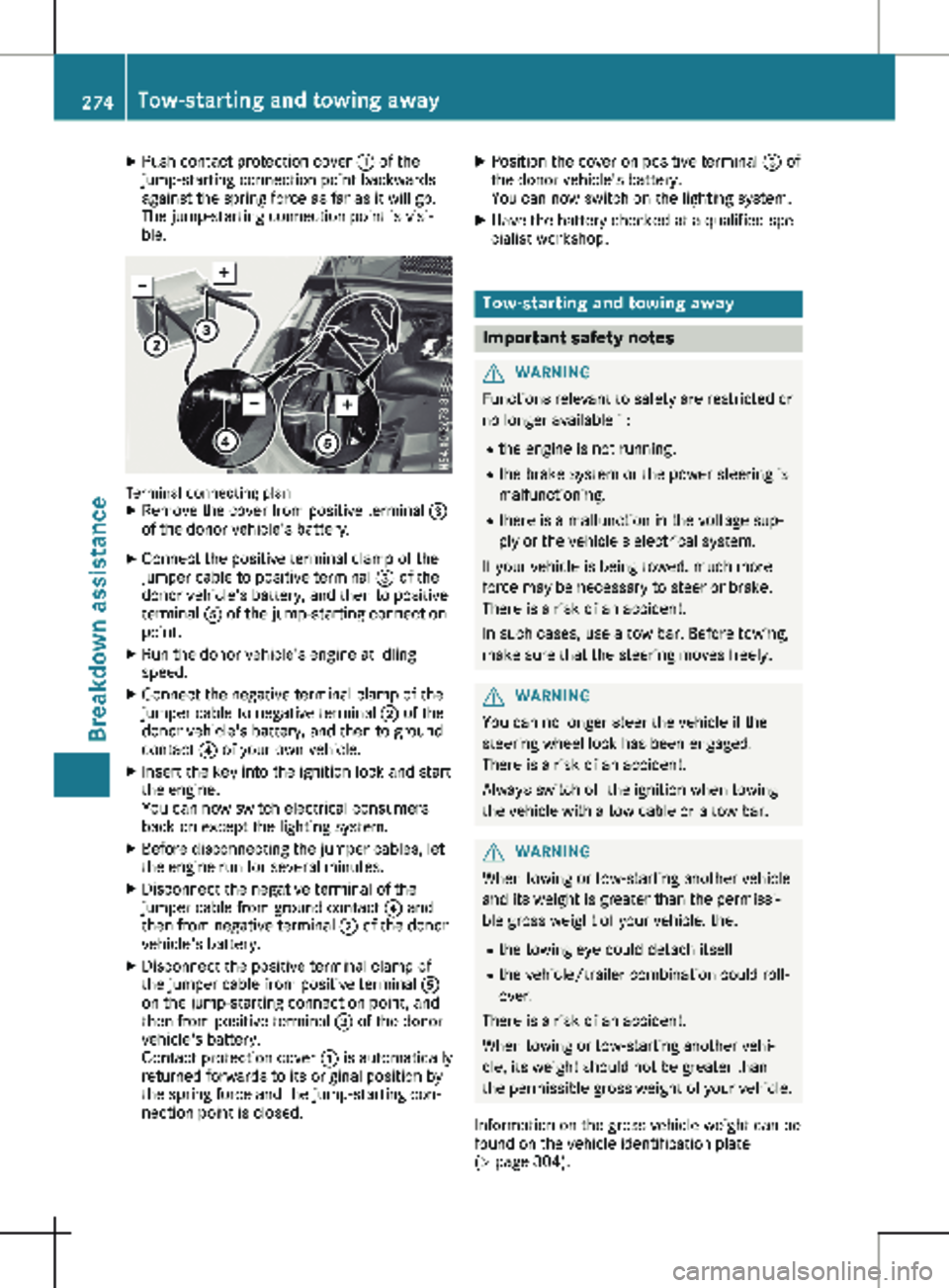
Push contact protection cover : of the
jump-starting connection point backwards
against the spring force as far as it will go.
The jump-starting connection point is visi-
ble. Terminal connecting plan
X Remove the cover from positive terminal =
of the donor vehicle's battery.
X Connect the positive terminal clamp of the
jumper cable to positive terminal = of the
donor vehicle's battery, and then to positive
terminal A of the jump-starting connection
point.
X Run the donor vehicle's engine at idling
speed.
X Connect the negative terminal clamp of the
jumper cable to negative terminal ; of the
donor vehicle's battery, and then to ground
contact ? of your own vehicle.
X Insert the key into the ignition lock and start
the engine.
You can now switch electrical consumers
back on except the lighting system.
X Before disconnecting the jumper cables, let
the engine run for several minutes.
X Disconnect the negative terminal of the
jumper cable from ground contact ? and
then from negative terminal ; of the donor
vehicle's battery.
X Disconnect the positive terminal clamp of
the jumper cable from positive terminal A
on the jump-starting connection point, and
then from positive terminal = of the donor
vehicle's battery.
Contact protection cover : is automatically
returned forwards to its original position by
the spring force and the jump-starting con-
nection point is closed. X
Position the cover on positive terminal = of
the donor vehicle's battery.
You can now switch on the lighting system.
X Have the battery checked at a qualified spe-
cialist workshop. Tow-starting and towing away
Important safety notes
G
WARNING
Functions relevant to safety are restricted or
no longer available if:
R the engine is not running.
R the brake system or the power steering is
malfunctioning.
R there is a malfunction in the voltage sup-
ply or the vehicle's electrical system.
If your vehicle is being towed, much more
force may be necessary to steer or brake.
There is a risk of an accident.
In such cases, use a tow bar. Before towing,
make sure that the steering moves freely. G
WARNING
You can no longer steer the vehicle if the
steering wheel lock has been engaged.
There is a risk of an accident.
Always switch off the ignition when towing
the vehicle with a tow cable or a tow bar. G
WARNING
When towing or tow-starting another vehicle
and its weight is greater than the permissi-
ble gross weight of your vehicle, the:
R the towing eye could detach itself
R the vehicle/trailer combination could roll-
over.
There is a risk of an accident.
When towing or tow-starting another vehi-
cle, its weight should not be greater than
the permissible gross weight of your vehicle.
Information on the gross vehicle weight can be
found on the vehicle identification plate
(Y page
304).274
Tow-starting and towing away
Breakdown assistance
Page 278 of 320
X
Unscrew the towing eye.
X Insert cover : with the lug at the top and
press it in at the bottom until it engages.
X Stow the towing eye and the screwdriver
with the vehicle tool kit (Y page
270).Towing with the rear axle raised
! Vehicles with automatic transmission must
not be towed with the rear axle raised. The
vehicle/trailer combination may otherwise
swerve or even roll over.
! The ignition must be switched off if the
vehicle is being towed with the front or rear
axle raised. Otherwise, ESP ®
may intervene
and damage the brake system.
X Switch on the hazard warning lamps
(Y page
101).
X Turn the front wheels to the straight-ahead
position.
X Release the parking brake.
X If necessary, turn the key in the ignition lock
to position g and remove the key from the
ignition lock.
X Take the key with you when leaving the vehi-
cle.
X Do not exceed the towing speed of 30 mph
(50 km/h
).
Please observe the important safety instruc-
tions when towing your vehicle with the rear
axle raised
(Y page 274). Towing the vehicle with both axles
on the ground
Important safety notes G
WARNING
You can no longer steer the vehicle if the
steering wheel lock has been engaged.
There is a risk of an accident.
Always switch off the ignition when towing
the vehicle with a tow cable or a tow bar.
! Do not exceed the towing speed of
30 mph
(50 km/h). You could otherwise
damage the transmission. Please observe the important safety notes
before towing your vehicle
(Y page 274).
Towing vehicles with automatic trans-
mission X
Turn the key to position 2 in the ignition
lock.
X Depress the brake pedal and keep it
depressed.
X Shift the automatic transmission to position
i.
X Leave the key in position 2 in the ignition
lock.
X Switch on the hazard warning lamps
(Y page
101).
X Release the parking brake.
X Release the brake pedal.
X Do not exceed the towing speed of 30 mph
(50 km/h
). Recovering a vehicle that is stuck
! When recovering a vehicle that has
become stuck, pull it as smoothly and
evenly as possible. If the tractive power is
too high, the vehicles could be damaged.
If the drive wheels get trapped on loose or
muddy ground, recover the vehicle with the
utmost care. This is especially the case if the
vehicle is laden.
Never attempt to recover a vehicle with a
trailer attached.
Pull out the vehicle backwards, if possible,
using the tracks it made when it became
stuck. Transporting the vehicle
! You may only secure the vehicle by the
wheels, not by parts of the vehicle such as
axle or steering components. Otherwise, the
vehicle could be damaged.
The towing eye or trailer tow hitch can be used
to pull the vehicle onto a trailer or transporter
if you wish to transport it. 276
Tow-starting and towing away
Breakdown assistance
Page 280 of 320
Useful information
This Operator's Manual describes all models
as well as standard and optional equipment of
your vehicle that were available at the time of
going to print. Country-specific variations are
possible. Note that your vehicle may not be
equipped with all of the described functions.
This also applies to systems and functions rel-
evant to safety.
Read the information on qualified specialist
workshops (Y page
32).Important safety notes
G
Warning
A flat tire severely impairs the driving, steer-
ing and braking characteristics of the vehi-
cle. There is a risk of an accident.
do not drive with a flat tire. Immediately
replace the flat tire with your spare wheel,
or consult a qualified specialist workshop. G
WARNING
If you install wheels and tires with incorrect
dimensions, the service brake or wheel sus-
pension components may be damaged.
There is a risk of an accident.
Always replace wheels and tires with ones
that comply with the specifications of the
original part.
When replacing wheels, pay attention to the:
R Designation
R Model
When replacing tires, pay attention to the:
R Designation
R Manufacturer
R Model
Accessories that are not approved for your
vehicle by Mercedes-Benz or are not being
used correctly can impair operating safety. Before purchasing and using non-approved
accessories, visit a qualified specialist work-
shop and inquire about the following points:
R
suitability
R legal stipulations
R factory recommendations
Information on the dimensions and types of
wheels and tires for your vehicle can be found
under "Wheel and tire combinations"
( Y page
301).
Information on your vehicle's tire pressures
can be found in the following locations:
R in the Tire and Loading Information placard
on the B-pillar, driver's side
R in the tire pressure table inside the fuel filler
flap ( Y page 282)
R under "Tire pressure tables" (Y page 289)
R under "Tire pressure" (Y page 282)
Modifications to the brake system or wheels
are not permitted. The use of spacers or brake
dust shields is not permitted. This invalidates
the general operating permit for the vehicle.
Further information on wheels and tires can be
obtained at any qualified specialist workshop. Operation
Information for a journey
If the vehicle is heavily laden, check the tire
pressures, and correct them, if necessary
( Y page
282).
While driving, pay attention to vibrations,
noises and unusual handling characteristics,
e.g. pulling to one side. This may indicate that
the wheels or tires are damaged. If you sus-
pect that a tire is defective, reduce your speed
immediately. Stop the vehicle as soon as pos-
sible to check the wheels and tires for dam-
age. Hidden tire damage could also be causing
the unusual handling characteristics. If you
find no signs of damage, have the tires and
wheels checked at a qualified specialist work-
shop.
When parking your vehicle, make sure that the
tires do not get deformed by the curb or other
obstacles. If it is necessary to drive over curbs,
speed humps or similar elevations, try to do so
slowly and not at a sharp angle. Otherwise, the
tires, particularly the sidewalls, can get dam-
aged. 278
Operation
Wheels and tires
Page 281 of 320
Regular wheel and tire checks
G
WARNING
Damaged tires can cause tire inflation pres-
sure loss. As a result, you could lose control
of your vehicle. There is a risk of accident.
Check the tires regularly for signs of dam-
age and replace any damaged tires immedi-
ately.
Check the wheels and tires of your vehicle for
damage regularly, i.e. at least every two
weeks, as well as after driving off-road or on
rough roads. Damaged wheels can cause a
loss of tire pressure. Pay particular attention
to damage such as:
R cuts in the tires
R punctures
R tears in the tires
R bulges on tires
R deformation or severe corrosion on wheels
Regularly check the tire tread depth and the
condition of the tire tread across the whole
width of all the tires
(Y page 279). If neces-
sary, turn the front wheels to full lock in order
to inspect the inner side of the tire surface.
All wheels must have a valve cap to protect
the valve against dirt and moisture. Do not
install anything onto the valve other than the
standard valve cap or other valve caps
approved for your vehicle by dealers listed on
the inside of the front cover. Do not install any
other valve caps or systems, e.g. tire pressure
monitor systems.
Regularly check the pressure of all the tires,
particularly prior to long trips. Adjust the tire
pressure if necessary (Y page 282).
The service life of tires depends on various
factors, including the following:
R Driving style
R Tire pressure
R Mileage Tire tread
G
WARNING
If there is insufficient tire tread, the tire trac-
tion decreases. The tire tread is no longer
able to dissipate water. This increases the risk of hydroplaning when the road surface
is wet, particularly when the vehicle's speed
is not adapted to the road conditions. There
is a risk of an accident.
When the tire pressure is too high or too
low, tires may wear differently at different
points on the tire tread. Therefore, regularly
check the tire tread depth and the condition
of the tread across the whole width of all
tires.
Minimum tire tread depth on:
R Summer tires: â in (3 mm
)
R M+S tires: ã in (4 mm)
For safety reasons, have the tires replaced
before they reach the legally prescribed min-
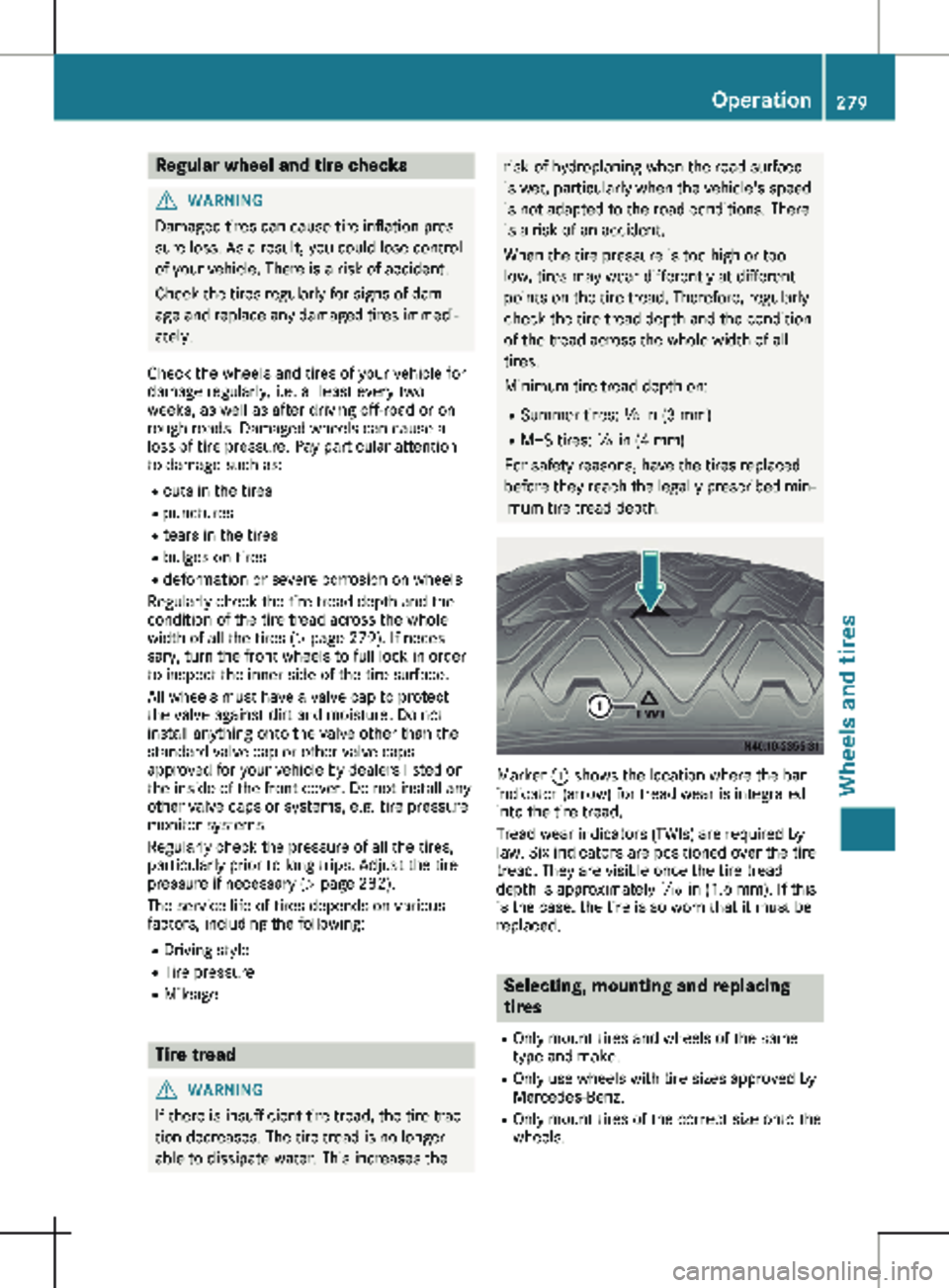
imum tire tread depth. Marker : shows the location where the bar
indicator (arrow) for tread wear is integrated
into the tire tread.
Tread wear indicators (TWIs) are required by
law. Six indicators are positioned over the tire
tread. They are visible once the tire tread
depth is approximately á in (1.6 mm
). If this
is the case, the tire is so worn that it must be
replaced. Selecting, mounting and replacing
tires
R Only mount tires and wheels of the same
type and make.
R Only use wheels with tire sizes approved by
Mercedes-Benz.
R Only mount tires of the correct size onto the
wheels. Operation
279Wheels and tires Z
Page 282 of 320
R
Break in new tires at moderate speeds for
the first
65 miles (100 km).
R Do not drive with tires which have too little
tread depth, as this significantly reduces the
traction on wet roads (hydroplaning).
R Replace the tires after six years at the lat-
est, regardless of wear. This also applies to
the spare wheel. Operation in winter
General notes
Have your vehicle winterized at a qualified spe-
cialist workshop at the onset of winter.
Only use wheels with tire sizes approved for
Mercedes-Benz.
Prior to the onset of winter, ensure that snow
chains are stowed in the vehicle
(Y page
281). Snow chains cannot be moun-
ted on all wheel/tire combinations. Observe
the restrictions on the use of snow chains
under "Wheel/tire combinations"
(Y page 302).
Also observe the notes in the "Changing a
wheel" section ( Y page 297).Driving with summer tires
At temperatures below 45 ‡
(+7 †), summer
tires lose elasticity and therefore traction and
braking power. Change the tires on your vehi-
cle to M+S tires. Using summer tires at very
cold temperatures could cause tears to form,
thereby damaging the tires permanently.
Mercedes-Benz cannot accept responsibility
for this type of damage. M+S tires
G
WARNING
Wheel and tire dimensions as well as the
type of tire can vary between the spare
wheel and the wheel to be replaced. When
the spare wheel is mounted, driving charac-
teristics may be severely affected. There is a
risk of an accident. In order to reduce risks:
R you should therefore adapt your driving
style and drive carefully.
R never mount more than one spare wheel
that differs from the wheel to be replaced.
R only use a spare wheel that differs from
the wheel to be replaced for a short time.
R have a spare wheel that differs from the
wheel that has been changed replaced at
the nearest qualified specialist workshop.
You must observe the correct wheel and
tire dimensions as well as the wheel type. G
WARNING
M+S tires with a tire tread depth of less than
ã in
(4 mm) are not suitable for use in win-
ter and do not provide sufficient traction.
There is a risk of an accident.
M+S tires with a tread depth of less than ã
in (4 mm) must be replaced immediately.
Use winter tires or all-season tires at tempera-
tures below 45 ‡ (+7 †). Both types of tire
are identified by the M+S marking.
Only winter tires bearing the i snowflake
symbol in addition to the M+S marking provide
the best possible grip in wintry road condi-
tions.
Only these tires will allow driving safety sys-
tems such as ABS and ESP ®
to function opti-
mally in winter. These tires have been devel-
oped specifically for driving in snow.
For safe driving, use M+S tires of the same
make and tread pattern on all wheels.
Always observe the maximum permissible
speed specified for the M+S tires you have
mounted.
If you mount M+S tires that have a lower maxi-
mum permissible speed than the maximum
design speed of the vehicle, affix a corre-
sponding warning label in the driver's field of
vision. You can obtain this at a qualified spe-
cialist workshop.
Once you have mounted the winter tires:
X Check the tire pressure (Y page
282).
X Restart the tire pressure monitor
(Y page
288).280
Operation in winter
Wheels and tires
Page 283 of 320
Snow chains
G
WARNING
If snow chains are installed to the front
wheels, they may drag against the vehicle
body or chassis components. This could
cause damage to the vehicle or the tires.
There is a risk of an accident.
To avoid hazardous situations:
R never install snow chains to the front
wheels
R always install snow chains in pairs to the
rear wheels. G
WARNING
If you drive too fast with snow chains moun-
ted, they may snap. As a result, you could
injure others and damage the vehicle. There
is a risk of an accident.
Observe the maximum permissible speed for
operation with snow chains.
When driving with snow chains installed, do
not exceed the maximum permissible speed of
30 mph (50 km/h
). Observe the country-spe-
cific laws and regulations for operation with
snow chains.
! Check the snow chains for damage before
mounting them. Damaged or worn snow
chains may snap and damage the following
components:
R wheel
R wheel housing
R wheel suspension
For this reason, you must use only snow
chains that are free of defects. Observe the
manufacturer's mounting instructions.
! Vehicles with steel wheels:
if you mount
snow chains on steel wheels, you may dam-
age the hub caps. Remove the hub caps
from the relevant wheels before mounting
the snow chains.
Snow chains increase traction on roads in win-
try conditions.
For safety reasons, Mercedes-Benz recom-
mends that you only use snow chains or trac-
tion aids which have been approved for
Mercedes-Benz vehicles. The snow chains or traction aids must be of class U or meet the
SAE type U
specification.
Information about snow chains can be
obtained from any Mercedes-Benz Commercial
Van Center.
When mounting snow chains, please bear the
following points in mind:
R Snow chains cannot be mounted on all
wheel/tire combinations. When mounting
the snow chains, note the permissible tire
and snow chain dimensions. Observe the
restrictions on the use of snow chains under
"Wheel/tire combinations" (Y page 302).
R Mount snow chains only in pairs and only to
the rear wheels. Observe the manufacturer's
mounting instructions.
R Only use snow chains when the road is cov-
ered by a layer of snow. Remove the snow
chains as soon as possible when you come
to a road that is not snow-covered.
R The use of snow chains may be restricted by
local regulations. Observe the appropriate
regulations before mounting snow chains.
R When driving with snow chains installed, do
not exceed the maximum permissible speed
of 30 mph (50 km/h).
R Check the tension of the chains after a dis-
tance of approximately 0.5 miles (1.0 km)
and tighten the chains if required.
You may wish to deactivate ESP ®
when pulling
away with snow chains installed ( Y page 69).
This allows the wheels to spin in a controlled
manner, achieving an increased driving force
(cutting action). Operation in winter
281
Wheels and tires Z