climate control MERCEDES-BENZ METRIS 2020 MY20 Operator’s Manual
[x] Cancel search | Manufacturer: MERCEDES-BENZ, Model Year: 2020, Model line: METRIS, Model: MERCEDES-BENZ METRIS 2020Pages: 320, PDF Size: 26.38 MB
Page 124 of 320
When you deactivate the windshield defrosting
function, the previous automatic climate con-
trol settings are reactivated with the exception
of air-recirculation mode. Air-recirculation
mode remains deactivated. Clearing condensation from the win-
dows
Windows fogged up on the inside Air-conditioning system
You should only select this setting until the
windows are clear again.
X Switch on the rear window defroster if nec-
essary
(Y page 122).
X Switch on climate control (Y page
117).
X Switch off air-recirculation mode
(Y page
123).
X Turn temperature control : clockwise to a
higher temperature and air flow control A
to a blower speed between 3 and 6
( Y page
115).
X If possible, only select the ¯ setting of
the air distribution
(Y page 120).
Only the indicator lamp in the ¯ button
lights up.
X Switch on the cooling with air dehumidifica-
tion function
(Y page 118).
X If the windows still fog up, set the climate
control functions as described for defrosting
of the windshield
(Y page 121).
Dual-zone automatic climate control You should only select this setting until the
windows are clear again.
X Switch on the rear window defroster if nec-
essary
(Y page 122).
X Switch on climate control (Y page
117).
X Switch off air-recirculation mode
(Y page
123).
X Switch on the cooling with air dehumidifica-
tion function
(Y page 118).
X Switch on automatic mode ( Y page
119).
X If the windows continue to fog up, switch on
the windshield defrosting function
( Y page
121). Windows fogged up on the outside You should only select this setting until the
windshield is clear again.
X Switch on the windshield wipers
(Y page
109).
X Switch on climate control (Y page
117).
X In warm and damp weather, do not allow
cold air to flow onto the windows. Close the
side air vents if required
(Y page 124). Switching the rear window defroster
on/off
General notes The rear window defroster consumes a lot of
power. You should therefore switch off the
rear window defroster as soon as the rear win-
dow is clear.
X Turn the key to position 2 in the ignition
lock.
X Press the ¤ button on the control panel.
If the indicator lamp in the ¤ button
lights up, the rear window defroster is
switched on.
The rear window defroster switches off auto-
matically after a few minutes.
Problems with the rear window
defroster The rear window defroster has switched off
prematurely or cannot be activated.
The vehicle starter battery is not sufficiently
charged.
X Switch off any consumers that are not
required, e.g. reading lamps, interior lighting
or seat heating.
When the battery is sufficiently charged, the
rear window defroster can be activated
again.122
Operating the climate control system
Climate control
Page 125 of 320
Switching air-recirculation mode
on/off
Important safety notes You can deactivate the intake of fresh air if
unpleasant odors enter the vehicle from out-
side. The air inside the vehicle is then circula-
ted.
When you switch on air-recirculation mode,
the side windows and windows could fog up
more quickly, in particular at low outside tem-
peratures. Only switch on air-recirculation
mode for a short time.
Air-conditioning system or dual-zone
automatic climate control X
Switch on climate control ( Y page 117).
X Press the h button.
If the indicator lamp in the h button
lights up, air-recirculation mode is activated.
Air-recirculation mode switches on automati-
cally: R at high outside temperatures
R while driving in a tunnel (only vehicles with a
navigation system)
The indicator lamp in the h button is then
not lit up. Outside air is added automatically
after about
30 minutes.
Air-recirculation mode is deactivated automati-
cally:
R after approximately five minutes at outside
temperatures below about 45 ‡ (7 †)
R after approximately five minutes when the
cooling with air-dehumidification function is
deactivated
R after approximately 30 minutes at outside
temperatures above about 45 ‡ (7 †) and
when the cooling with air-dehumidification
function is active Convenience opening/pre-entry cli-
mate control
G
WARNING
During convenience opening, body parts
could be drawn in or become trapped
between the side window and the door
frame. There is a risk of injury. Monitor the entire opening procedure when
using convenience opening. When opening,
make sure that nobody touches the side
window. Release the % switch immedi-
ately if somebody becomes trapped, to
interrupt the opening procedure.
X Pre-entry climate control and conveni-
ence opening with the key:
press and hold
the % button on the key.
The side windows open automatically and
the blower of the climate control system is
activated.
X Release the % button.
i At high interior temperatures, the blower is
also switched on when a door is opened.
This means that slightly cooled air enters
the vehicle interior after the engine is star-
ted, to cool the vehicle more rapidly. Switching the residual heat function
on/off
General notes Only vehicles with dual-zone automatic climate
control have the residual heat function.
Once the engine is switched off, it is possible
to make use of the residual heat of the engine
to continue heating or ventilating the front
compartment of the vehicle for approximately
30 minutes. The heating or ventilation time
depends on the set interior temperature.
Switching the function on/off X
Turn the key to position 0 in the ignition
lock or remove it.
X Press the Ì button.
If the residual heat function is activated, the
indicator lamp in the Ì button comes on.
The blower will run at a low speed regard-
less of the airflow setting.
If you activate the residual heat function at
high temperatures, only the auxiliary ventila-
tion will be activated. The blower then runs
at medium speed. Operating the climate control system
123
Climate control Z
Page 126 of 320
The residual heat function switches off auto-
matically
R after approximately
30 minutes
R if the starter battery's condition of charge is
too low
R when you switch on the ignition Adjusting the air vents
Important safety notes
G
WARNING
Very hot or very cold air can flow from the
air vents. This could result in burns or frost-
bite in the immediate vicinity of the air
vents. There is a risk of injury.
Make sure that all vehicle occupants always
maintain a sufficient distance to the air out-
lets. If necessary, redirect the airflow to
another area of the vehicle interior.
The center and side air vents are adjustable.
The air vents can also be adjusted on vehicles
with rear-compartment air conditioning.
In order to ensure the direct flow of fresh air
through the air vents into the vehicle interior,
please observe the following notes: R keep the air inlet between the windshield
and the hood free of blockages, such as ice,
snow or leaves.
R never cover the vents or the ventilation
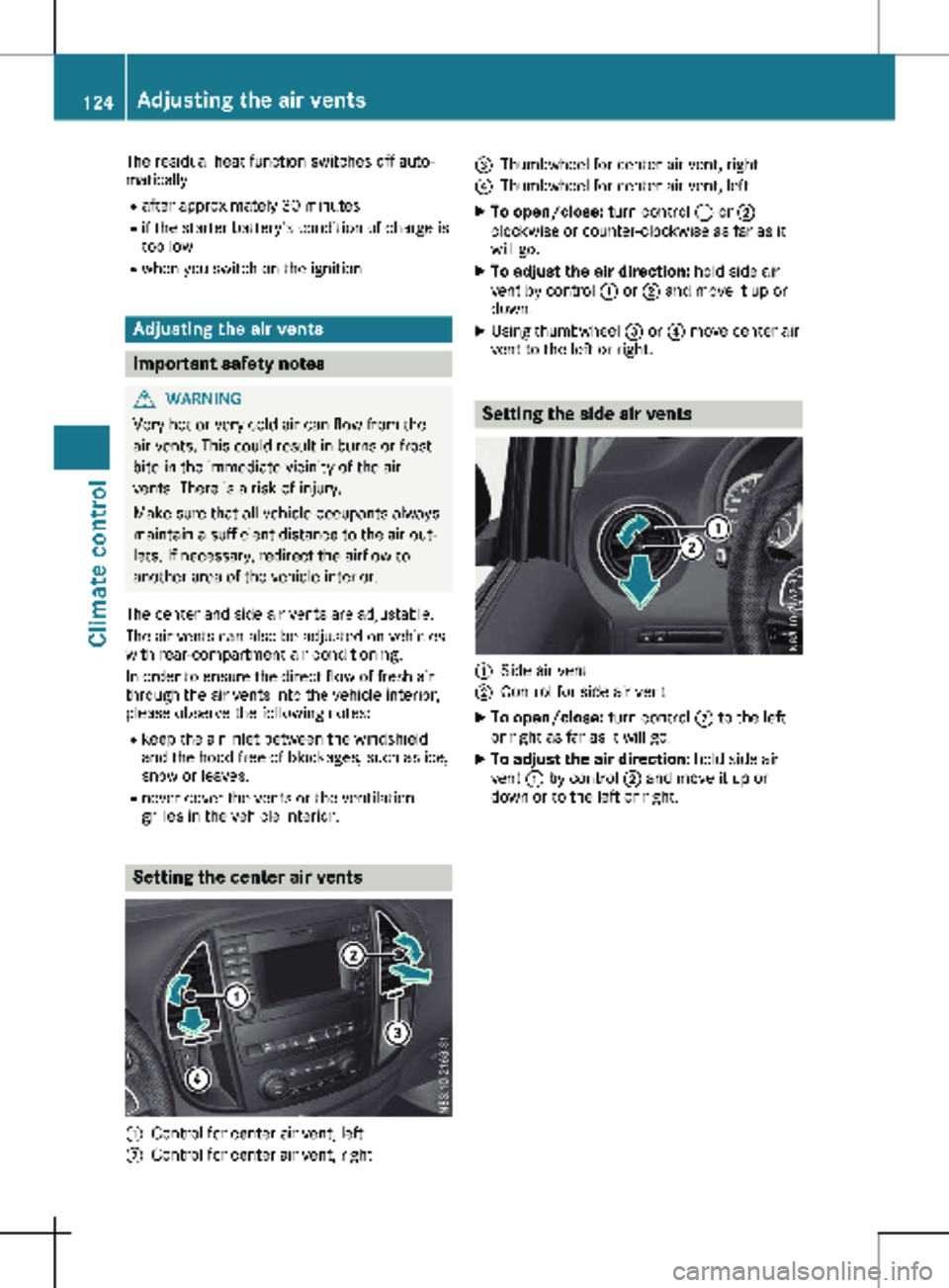
grilles in the vehicle interior. Setting the center air vents
:
Control for center air vent, left
; Control for center air vent, right =
Thumbwheel for center air vent, right
? Thumbwheel for center air vent, left
X To open/close: turn control : or ;
clockwise or counter-clockwise as far as it
will go.
X To adjust the air direction: hold side air
vent by control : or ; and move it up or
down.
X Using thumbwheel = or ? move center air
vent to the left or right. Setting the side air vents
:
Side air vent
; Control for side air vent
X To open/close: turn control ; to the left
or right as far as it will go.
X To adjust the air direction: hold side air
vent : by control ; and move it up or
down or to the left or right. 124
Adjusting the air vents
Climate control
Page 127 of 320
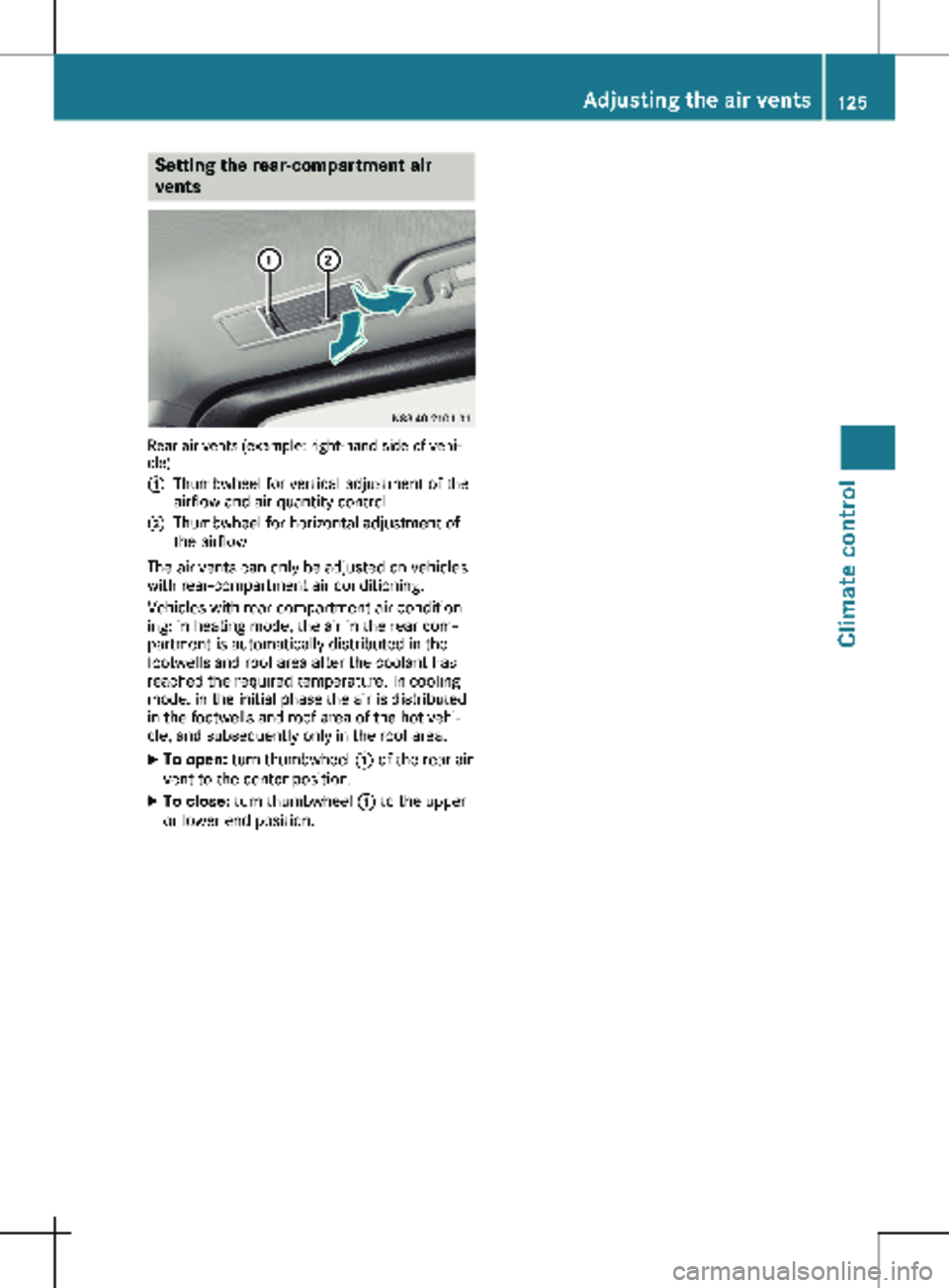
Setting the rear-compartment air
vents
Rear air vents (example: right-hand side of vehi-
cle)
:
Thumbwheel for vertical adjustment of the
airflow and air quantity control
; Thumbwheel for horizontal adjustment of
the airflow
The air vents can only be adjusted on vehicles
with rear-compartment air conditioning.
Vehicles with rear-compartment air condition-
ing: in heating mode, the air in the rear com-
partment is automatically distributed in the
footwells and roof area after the coolant has
reached the required temperature. In cooling
mode, in the initial phase the air is distributed
in the footwells and roof area of the hot vehi-
cle, and subsequently only in the roof area.
X To open: turn thumbwheel : of the rear air
vent to the center position.
X To close: turn thumbwheel : to the upper
or lower end position. Adjusting the air vents
125Climate control Z
Page 266 of 320
!
Do not use the lower sliding door guide
(carriage) as a step. Otherwise, you could
damage the paneling and/or the sliding
door mechanism.
! When cleaning your car, do not use:
R dry, coarse or hard cloths
R abrasive cleaning agents
R solvents
R cleaning agents containing solvents
Do not scrub.
Do not touch the surfaces and films with
hard objects, e.g. rings or ice scrapers. Oth-
erwise, you may scratch or damage the sur-
faces and films.
! Do not park your vehicle for a long period
of time directly after cleaning, particularly
after cleaning the wheel rim with wheel
cleaner. Wheel cleaner can lead to the
increased corrosion of the brake discs and
pads. Therefore, drive for a few minutes
after cleaning. By heating up the brakes, the
brake discs and pads dry. The vehicle can
then be parked for a long period of time. H
Environmental note
Only clean your vehicle at specially designed
wash bays. Dispose of empty containers and
used cleaning products in an environmen-
tally responsible manner. H
Environmental note
Dispose of empty packaging and cleaning
cloths in an environmentally responsible
manner.
Regular care of your vehicle is a condition for
retaining the quality in the long term.
Use care products and cleaning agents recom-
mended and approved by Mercedes-Benz. Washing the vehicle and cleaning
the paintwork
Automatic car wash G
WARNING
Braking efficiency is reduced after washing
the vehicle. There is a risk of an accident. After the vehicle has been washed, brake
carefully while paying attention to the traffic
conditions until full braking power is
restored.
! Make sure that the automatic car wash is
suitable for the size of the vehicle.
Before washing the vehicle in an automatic
car wash, fold in the exterior mirrors and
remove any additional antennas. Otherwise,
the exterior mirror, antenna or the vehicle
itself could be damaged.
Make sure that the exterior mirrors are fully
folded out again and that any additional
antennas are re-installed when you leave the
automatic car wash.
! Make sure that:
R the side windows and roof are completely
closed
R the climate control blower is switched off
R the windshield wiper switch is in position
0
The vehicle may otherwise be damaged.
You can wash the vehicle in an automatic car
wash from the very start.
Wash off excess dirt before cleaning the vehi-
cle in an automatic car wash.
After putting the vehicle through an automatic
car wash, wipe off wax from:
R the windshield
R the windshield wiper blades
This will prevent smears and reduce wiping
noises caused by residue on the windshield.
R on vehicles with rear-end doors, from the
rear view camera lens in the top of the
license plate molding
(Y page 267)
Washing by hand In some countries, washing by hand is only
allowed at specially equipped washing bays.
Observe the legal requirements of the country
you are currently in when washing by hand.
X Do not use hot water and do not wash the
vehicle in direct sunlight.
X Use a soft car sponge.
X Use a mild cleaning agent, e.g. a Mercedes-
Benz approved car shampoo.264
Care
Maintenance and care
Page 307 of 320
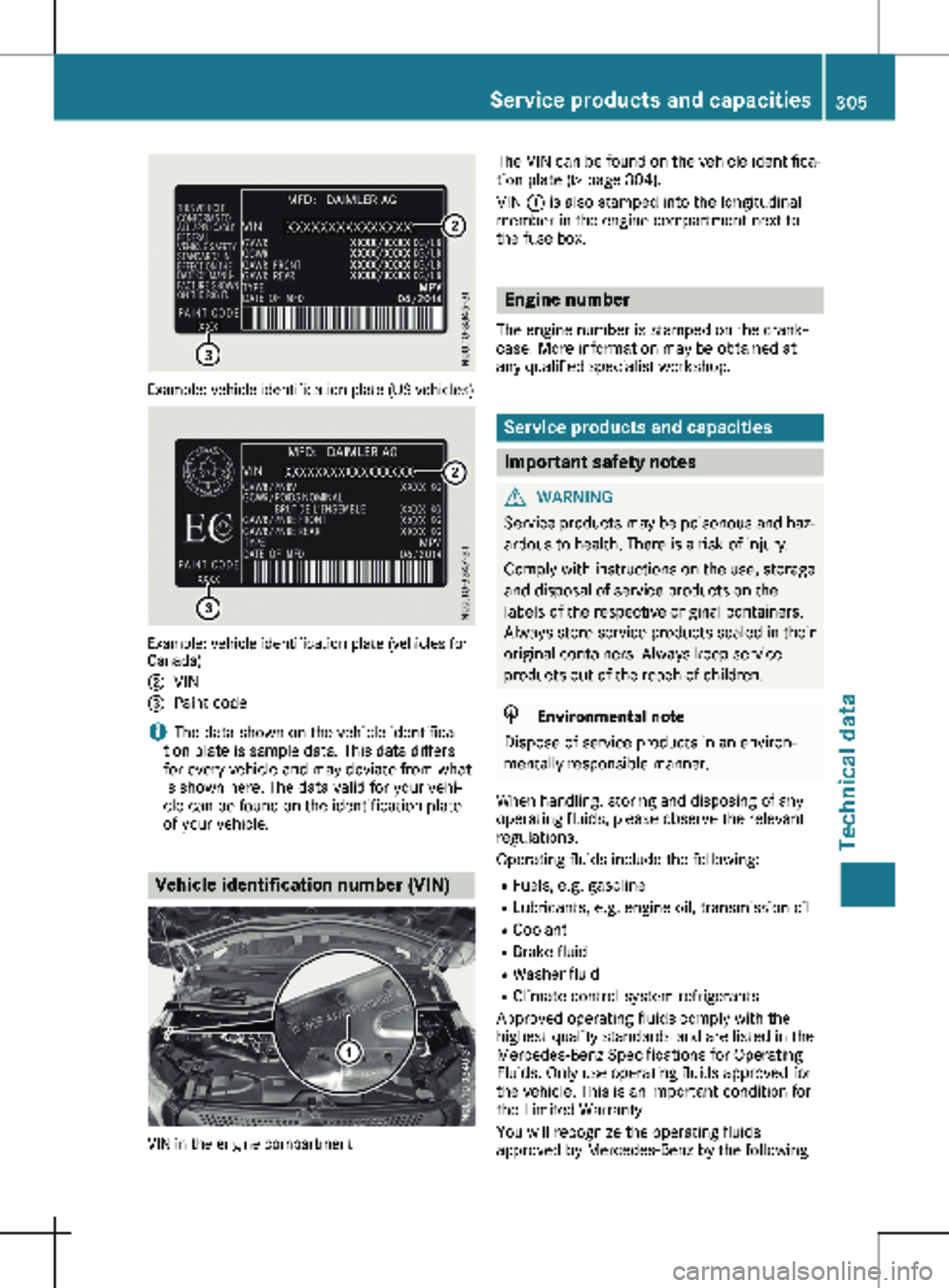
Example: vehicle identification plate (US vehicles)
Example: vehicle identification plate (vehicles for
Canada)
; VIN
= Paint code
i The data shown on the vehicle identifica-
tion plate is sample data. This data differs
for every vehicle and may deviate from what
is shown here. The data valid for your vehi-
cle can be found on the identification plate
of your vehicle. Vehicle identification number (VIN)
VIN in the engine compartment The VIN can be found on the vehicle identifica-
tion plate (Y page
304).
VIN : is also stamped into the longitudinal
member in the engine compartment next to
the fuse box. Engine number
The engine number is stamped on the crank-
case. More information may be obtained at
any qualified specialist workshop. Service products and capacities
Important safety notes
G
WARNING
Service products may be poisonous and haz-
ardous to health. There is a risk of injury.
Comply with instructions on the use, storage
and disposal of service products on the
labels of the respective original containers.
Always store service products sealed in their
original containers. Always keep service
products out of the reach of children. H
Environmental note
Dispose of service products in an environ-
mentally responsible manner.
When handling, storing and disposing of any
operating fluids, please observe the relevant
regulations.
Operating fluids include the following:
R Fuels, e.g. gasoline
R Lubricants, e.g. engine oil, transmission oil
R Coolant
R Brake fluid
R Washer fluid
R Climate control system refrigerants
Approved operating fluids comply with the
highest quality standards and are listed in the
Mercedes-Benz Specifications for Operating
Fluids. Only use operating fluids approved for
the vehicle. This is an important condition for
the Limited Warranty.
You will recognize the operating fluids
approved by Mercedes-Benz by the following Service products and capacities
305
Technical data Z
Page 313 of 320
the coolant system and reduce the engine's
service life.
The coolant is a mixture of water and anti-
freeze and corrosion inhibitor. It performs the
following tasks:
R Anti-corrosion protection
R Antifreeze protection
R Raises the boiling point
When the vehicle is first delivered, it is filled
with a coolant mixture that ensures adequate
antifreeze/corrosion protection. Coolant must
remain in the engine cooling system all year
round to ensure anti-corrosion protection and
a higher boiling point, even in countries with
high outside temperatures.
Check the antifreeze/corrosion inhibitor con-
centration in the coolant every six months.
The percentage of corrosion inhibitor/anti-
freeze additive in the engine cooling system
should:
R be at least
50%. This way, the engine cooling
system is protected against freezing down
to approximately -35 ‡ (-37 †).
R not exceed 55% (antifreeze protection down
to -49 ‡ [-45 †]). Otherwise, heat will not
be dissipated as effectively.
Mercedes-Benz recommends an antifreeze and
corrosion inhibitor that meets the require-
ments in the Mercedes-Benz Specifications for
Service Products Sheet Number 325.
More information can be obtained at any quali-
fied specialist workshop.
Operating fluid: coolant Product name/number
Zerex G40-91, The Valvoline Company
MB Sheet No. 325.5
Maintenance interval
Have the coolant replaced at specified inter-
vals by a qualified specialist workshop.
Capacities Engine cooling system
Coolant
Approx. 11 US qt
(10.4 l
) Climate control system refrigerants
Important safety notes The climate control system of your vehicle is
filled with the refrigerant R ‑134a.
The warning label for the refrigerant being
used can be found on the radiator cross mem-
ber.
! Only the refrigerant R‑134a and the PAG
oil approved by Mercedes-Benz may be
used. The approved PAG oil may not be
mixed with any other PAG oil that is not
approved for R-134a refrigerant. Otherwise,
the climate control system may be dam-
aged.
Maintenance work such as adding refrigerant
or replacing components may only be carried
out by a qualified specialist workshop. All
applicable regulations thereto and the SAE
standard J639 must be adhered to.
All work on the climate control system should
always be carried out at qualified specialist
workshop.
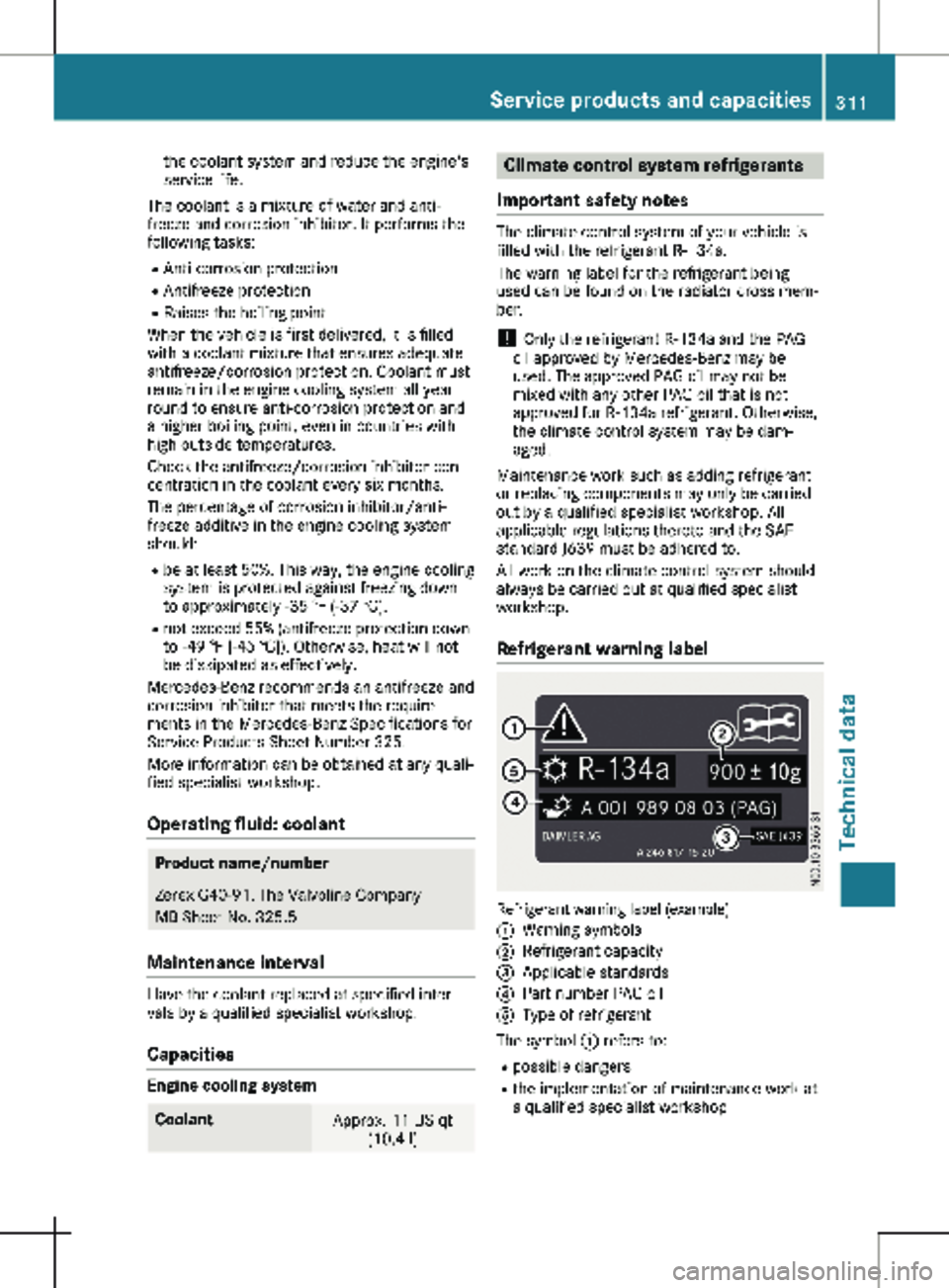
Refrigerant warning label Refrigerant warning label (example)
: Warning symbols
; Refrigerant capacity
= Applicable standards
? Part number PAG oil
A Type of refrigerant
The symbol : refers to:
R possible dangers
R the implementation of maintenance work at
a qualified specialist workshop Service products and capacities
311
Technical data Z