warning MERCEDES-BENZ METRIS 2020 MY20 Operator’s Manual
[x] Cancel search | Manufacturer: MERCEDES-BENZ, Model Year: 2020, Model line: METRIS, Model: MERCEDES-BENZ METRIS 2020Pages: 320, PDF Size: 26.38 MB
Page 29 of 320
Operating Instructions
Before the first journey
These Operating Instructions, the Maintenance
or Service Booklet and the equipment-depend-
ent Supplements are integral parts of the vehi-
cle. Keep these documents in the vehicle at all
times. If you sell the vehicle, always pass all
documents on to the new owner.
Before your first journey, read these docu-
ments carefully and familiarize yourself with
your vehicle.
For your own safety and a longer vehicle life,
always follow the instructions and warning
notes in these Operating Instructions. Disre-
garding them may lead to damage to the vehi-
cle or personal injury.
Any damage to the vehicle which has been
caused by disregarding the instructions will
not be covered by the New Vehicle Limited
Warranty. Implied warranty
! Observe the notes in this Operator's Man-
ual regarding the correct operation of your
vehicle and possible damage to the vehicle.
Damage to the vehicle which is caused by
violation of these notes is not covered by
the Mercedes-Benz implied warranty or the
new or used-vehicle warranty. Vehicle equipment
These Operating Instructions describe all the
models and standard and optional equipment
of your vehicle that were available at the time
of going to print. Country-specific deviations
are possible. Bear in mind that your vehicle
may not be equipped with all the functions
described. This also applies to safety-relevant
systems and functions. The equipment in your
vehicle may therefore differ from that shown in
the descriptions and illustrations.
All systems found in your vehicle are listed in
your vehicle's original purchase agreement.
Contact a Mercedes-Benz Commercial Van
Center if you have any questions about equip-
ment or operation. Service and vehicle operation
Warranty
The Limited Warranty for your vehicle is in
accordance with the warranty terms in the
Service and Warranty Information booklet.
Your Mercedes-Benz Commercial Van Center
will replace and repair all factory-installed
parts in accordance with the terms of the fol-
lowing warranties: R New Vehicle Limited Warranty
R Exhaust System Warranty
R Emission Systems Warranty
R California, Connecticut, Maine, Massachu-
setts, New York, Pennsylvania, Rhode Island
and Vermont Emission Control System War-
ranty
R State Warranty Enforcement Laws ("Lemon
Laws")
Replacement parts and accessories are cov-
ered by the Mercedes-Benz Parts and Acces-
sories Warranties. You can obtain these from
any Mercedes-Benz Commercial Van Center.
i Should you lose your Service and Warranty
Information booklet, contact a Mercedes-
Benz Commercial Van Center for a replace-
ment. The new Service and Warranty Infor-
mation booklet will be posted to you. Customer information for California
In California you are entitled to demand that
your vehicle be exchanged or that the pur-
chase or leasing price be refunded if
Mercedes-Benz USA, LLC and/or authorized
workshops or service centers are not able,
after several justifiable repairs, to rectify major
damage to or malfunctions of the vehicle as
covered by the contractual warranty provi-
sions. Customers who purchase or lease a
vehicle can have the vehicle repaired within a
period of 18 months after delivery or after a
mileage of up to
29,000 km (equals approx.
18,000 miles), whichever comes first, if:
(1) the same serious defect or damage which could lead to fatal or serious injuries to
the occupants of the vehicle during driving
has been repaired at least twice and Introduction
27
Page 31 of 320
Toronto, Ontario M4G 4C9
Possible hazard due to substances
that are hazardous to health
In compliance with Proposition 65 (“Prop65”),
the following detachable label has been added
to each vehicle sold in California: Proper use
Observe the following information in particular
when operating your vehicle:
R the safety notes in these Operating Instruc-
tions
R the technical data in these Operating
Instructions
R traffic laws and regulations
R laws pertaining to motor vehicles and safety
standards
There are various warning stickers on the vehi-
cle. If you remove the warning sticker, you or
others may not recognize dangers. Do not
move the warning sticker from its original posi-
tion. G
WARNING
Modification to electronic components, their
software or wiring could impair their func-
tion and/or the function of other networked
components. In particular, systems relevant
to safety could also be affected. As a result,
these may no longer function properly
and/or jeopardize the operating safety of
the vehicle. There is an increased risk of
accident and injury. You must not tamper with wiring, electronic
components, or their software. You should
have all work on electrical and electronic
components carried out at a qualified spe-
cialist workshop. G
WARNING
Gases and fluids from substances that con-
stitute a health hazard or react aggressively
can escape even from securely closed con-
tainers. When transporting such substances
in the vehicle interior, your ability to concen-
trate or your health could be affected during
the journey. Malfunctions, short circuits or
electrical component system failures may
also result. There is a risk of an accident and
fire.
Do not store or transport any substances in
the vehicle interior which are hazardous to
health or react aggressively.
Always observe these instructions, even in the
case of vehicles where the load compartment
is not completely separated from the cab.
Partition with door/window: keep the door/
window in the partition closed during trans-
port.
Examples of substances that constitute a
health hazard or react aggressively include:
R Solvents and DEF
R Fuel
R Oil and grease
R Cleaning agents
R Acids Protection of the environment
Economic and environmentally
aware driving
H
Environmental note
Daimler's declared policy is one of compre-
hensive environmental protection.
The objectives are for the natural resources
that form the basis of our existence on this
planet to be used sparingly and in a manner Introduction
29 Z
Page 32 of 320
that takes the requirements of both nature
and humanity into account.
You too can help to protect the environment
by operating your vehicle in an environmen-
tally responsible manner.
Fuel consumption and the rate of engine,
transmission, brake and tire wear are affec-
ted by these factors:
R operating conditions of your vehicle
R your personal driving style
You can influence both factors. You should
bear the following in mind:
Operating conditions:
R avoid short trips as these increase fuel
consumption.
R always make sure that the tire pressures
are correct.
R do not carry any unnecessary weight.
R remove roof racks once you no longer
need them.
R a regularly serviced vehicle will contribute
to environmental protection. You should
therefore adhere to the service intervals.
R always have service work carried out at a
qualified specialist workshop.
Personal driving style:
R do not depress the accelerator pedal
when starting the engine.
R do not warm up the engine when the vehi-
cle is stationary.
R drive carefully and maintain a safe dis-
tance from the vehicle in front.
R avoid frequent, sudden acceleration and
braking.
R change gear in good time and use each
gear only up to Ô of its maximum engine
speed.
R switch off the engine in stationary traffic.
R keep an eye on the vehicle's fuel con-
sumption. Environmental issues and recom-
mendations
When prompted by this Operator's Manual to
dispose of materials, please try to regenerate
and recycle these materials. Observe all rele-
vant environmental guidelines and regulations
when disposing of materials. This helps to pro-
tect the environment. Operating safety and vehicle
approval
Important safety notes
G
WARNING
If you do not have the prescribed service/
maintenance work or any required repairs
carried out, this can result in malfunctions
or system failures. There is a risk of an acci-
dent.
Always have the prescribed service/mainte-
nance work as well as any required repairs
carried out at a qualified specialist work-
shop.
Airbags and pyrotechnic Emergency Tension-
ing Devices contain perchlorate material,
which may require special handling or environ-
mental protection measures. National guide-
lines must be observed during disposal.
For California, you will find further information
online at: http://www.dtsc.ca.gov Notes on driving
Damage to the vehicle may occur in the follow-
ing cases:
R The vehicle becomes grounded, e.g. on a
high curb or an unpaved road.
R You drive too fast over an obstacle, e.g. a
curb, a speed bump or a pothole in the road.
R A heavy object strikes the underbody or
chassis components.
In such situations, the body, frame, under-
body, chassis parts, wheels or tires could be
damaged without the damage being visible.
Components damaged in this way can unex-
pectedly fail or, in the case of an accident, no 30
Introduction
Page 33 of 320
longer withstand the strain they are designed
for.
If the underbody paneling is damaged, flamma-
ble material, such as leaves, grass or twigs,
could collect between the underbody and
underbody paneling. If these materials come in
contact with hot parts of the exhaust system
for an extended period, they can catch fire.
G
WARNING
Flammable material such as leaves, grass or
twigs may ignite if they come into contact
with hot parts of the exhaust system. There
is a risk of fire.
When driving on an unpaved road or off-
road, check the vehicle underside regularly.
In particular, remove trapped plant parts or
other flammable material. Contact a quali-
fied specialist workshop immediately if dam-
age is detected.
Have the vehicle checked and repaired imme-
diately at a qualified specialist workshop. If, on
continuing your journey, you notice that driv-
ing safety is impaired, pull over and stop the
vehicle immediately, paying attention to road
and traffic conditions. In such cases, consult a
qualified specialist workshop. Declarations of conformity
Vehicle components which receive
and/or transmit radio waves USA: "The wireless devices of this vehicle
comply with Part 15 of the FCC Rules. Opera-
tion is subject to the following two conditions:
1) These devices may not cause harmful inter-
ference, and 2) These devices must accept any
interference received, including interference
that may cause undesired operation. Changes
or modifications not expressly approved by the
party responsible for compliance could void
the user's authority to operate the equip-
ment".
Canada: "The wireless devices of this vehicle
comply with Industry Canada license-exempt
RSS standard(s). Operation is subject to the
following two conditions: (1) These devices
may not cause interference, and (2) These
devices must accept any interference, includ- ing interference that may cause undesired
operation of the device".
Diagnostics connection
The diagnostics connection is used for con-
necting diagnostic equipment at a qualified
specialist workshop. G
WARNING
If you connect equipment to a diagnostics
connection in the vehicle, it may affect the
operation of vehicle systems. As a result,
the operating safety of the vehicle could be
affected. There is a risk of an accident.
Only connect equipment to a diagnostics
connection in the vehicle, which is approved
for your vehicle by Mercedes-Benz. G
WARNING
Make sure that there is sufficient clearance
around the pedals when floormats are used,
and that the floormats are properly secured.
The floormats must be correctly secured at
all times using the securing knob and retain-
ers.
Before you drive off, check the floormats
and secure them if necessary. A floormat
which is not properly secured can slip and
thereby interfere with the movement of the
pedals.
Do not place floormats on top of one
another.
! Draining the battery through using devices
on the diagnostics connection.
Using devices at the diagnostics connection
places a load on the battery.
R Check the battery charge status.
R Charge the battery if the charge status is
low. Introduction
31 Z
Page 35 of 320
You can find more information on vehicle
safety under:
http://www.safercar.gov Possible danger due to substances
hazardous to health
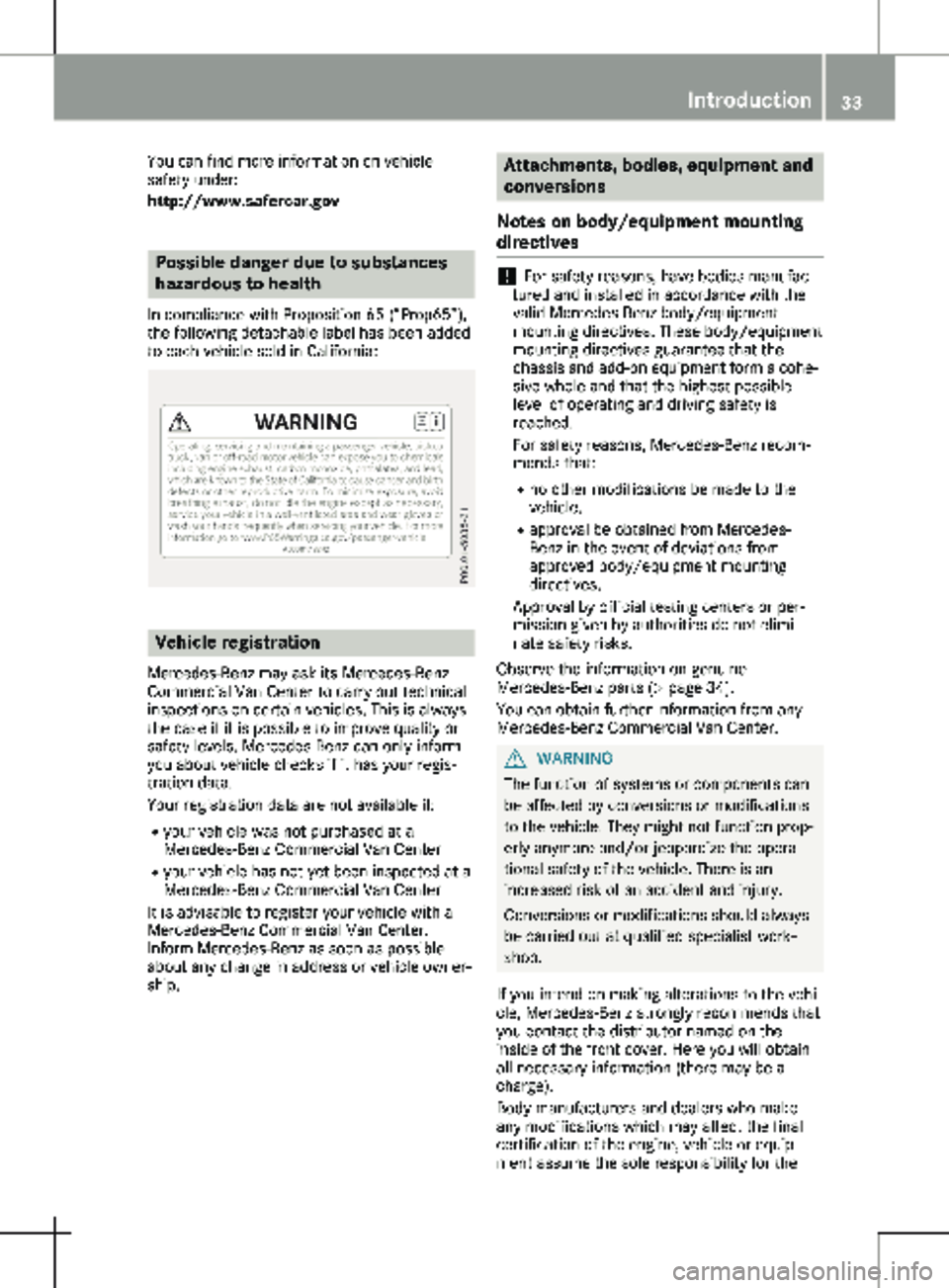
In compliance with Proposition 65 (“Prop65”),
the following detachable label has been added
to each vehicle sold in California: Vehicle registration
Mercedes-Benz may ask its Mercedes-Benz
Commercial Van Center to carry out technical
inspections on certain vehicles. This is always
the case if it is possible to improve quality or
safety levels. Mercedes-Benz can only inform
you about vehicle checks if it has your regis-
tration data.
Your registration data are not available if:
R your vehicle was not purchased at a
Mercedes-Benz Commercial Van Center
R your vehicle has not yet been inspected at a
Mercedes-Benz Commercial Van Center
It is advisable to register your vehicle with a
Mercedes-Benz Commercial Van Center.
Inform Mercedes-Benz as soon as possible
about any change in address or vehicle owner-
ship. Attachments, bodies, equipment and
conversions
Notes on body/equipment mounting
directives !
For safety reasons, have bodies manufac-
tured and installed in accordance with the
valid Mercedes-Benz body/equipment
mounting directives. These body/equipment
mounting directives guarantee that the
chassis and add-on equipment form a cohe-
sive whole and that the highest possible
level of operating and driving safety is
reached.
For safety reasons, Mercedes-Benz recom-
mends that:
R no other modifications be made to the
vehicle.
R approval be obtained from Mercedes-
Benz in the event of deviations from
approved body/equipment mounting
directives.
Approval by official testing centers or per-
mission given by authorities do not elimi-
nate safety risks.
Observe the information on genuine
Mercedes-Benz parts
(Y page 34).
You can obtain further information from any
Mercedes-Benz Commercial Van Center. G
WARNING
The function of systems or components can
be affected by conversions or modifications
to the vehicle. They might not function prop-
erly anymore and/or jeopardize the opera-
tional safety of the vehicle. There is an
increased risk of an accident and injury.
Conversions or modifications should always
be carried out at qualified specialist work-
shop.
If you intend on making alterations to the vehi-
cle, Mercedes-Benz strongly recommends that
you contact the distributor named on the
inside of the front cover. Here you will obtain
all necessary information (there may be a
charge).
Body manufacturers and dealers who make
any modifications which may affect the final
certification of the engine, vehicle or equip-
ment assume the sole responsibility for the Introduction
33 Z
Page 39 of 320
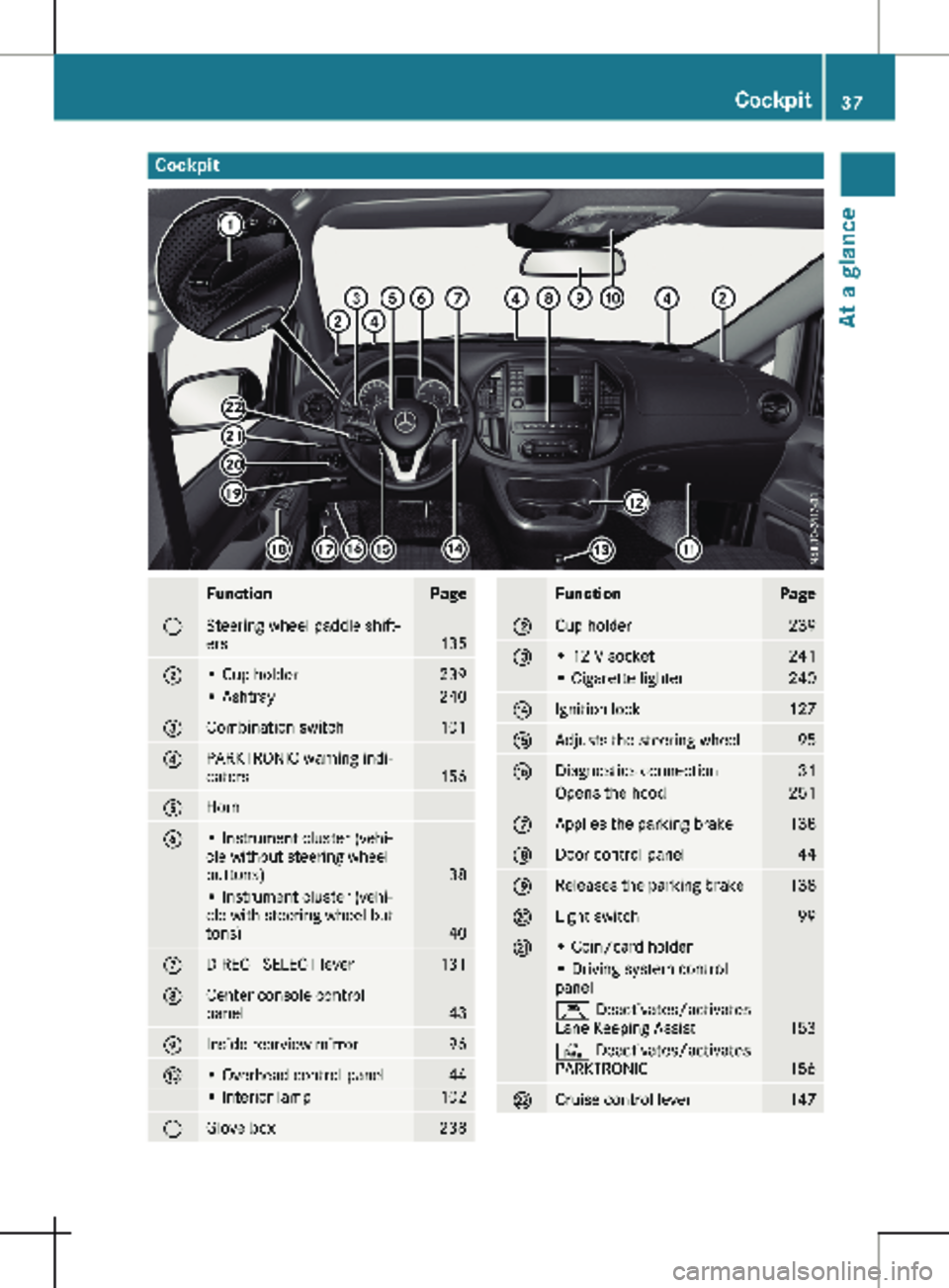
Cockpit
Function Page
:
Steering wheel paddle shift-
ers
135
;
• Cup holder 239
• Ashtray 240
=
Combination switch 101
?
PARKTRONIC warning indi-
cators
156
A
Horn
B
• Instrument cluster (vehi-
cle without steering wheel
buttons)
38
• Instrument cluster (vehi-
cle with steering wheel but-
tons)
40
C
DIRECT SELECT lever 131
D
Center console control
panel
43
E
Inside rearview mirror 96
F
• Overhead control panel 44
• Interior lamp 102
G
Glove box 238 Function Page
H
Cup holder 239
I
• 12 V socket 241
• Cigarette lighter 240
J
Ignition lock 127
K
Adjusts the steering wheel 95
L
Diagnostics connection 31
Opens the hood 251
M
Applies the parking brake 138
N
Door control panel 44
O
Releases the parking brake 138
P
Light switch 99
Q
• Coin/card holder
• Driving system control
panel
Ç Deactivates/activates
Lane Keeping Assist
153
c Deactivates/activates
PARKTRONIC
156
R
Cruise control lever 147Cockpit
37At a glance
Page 41 of 320
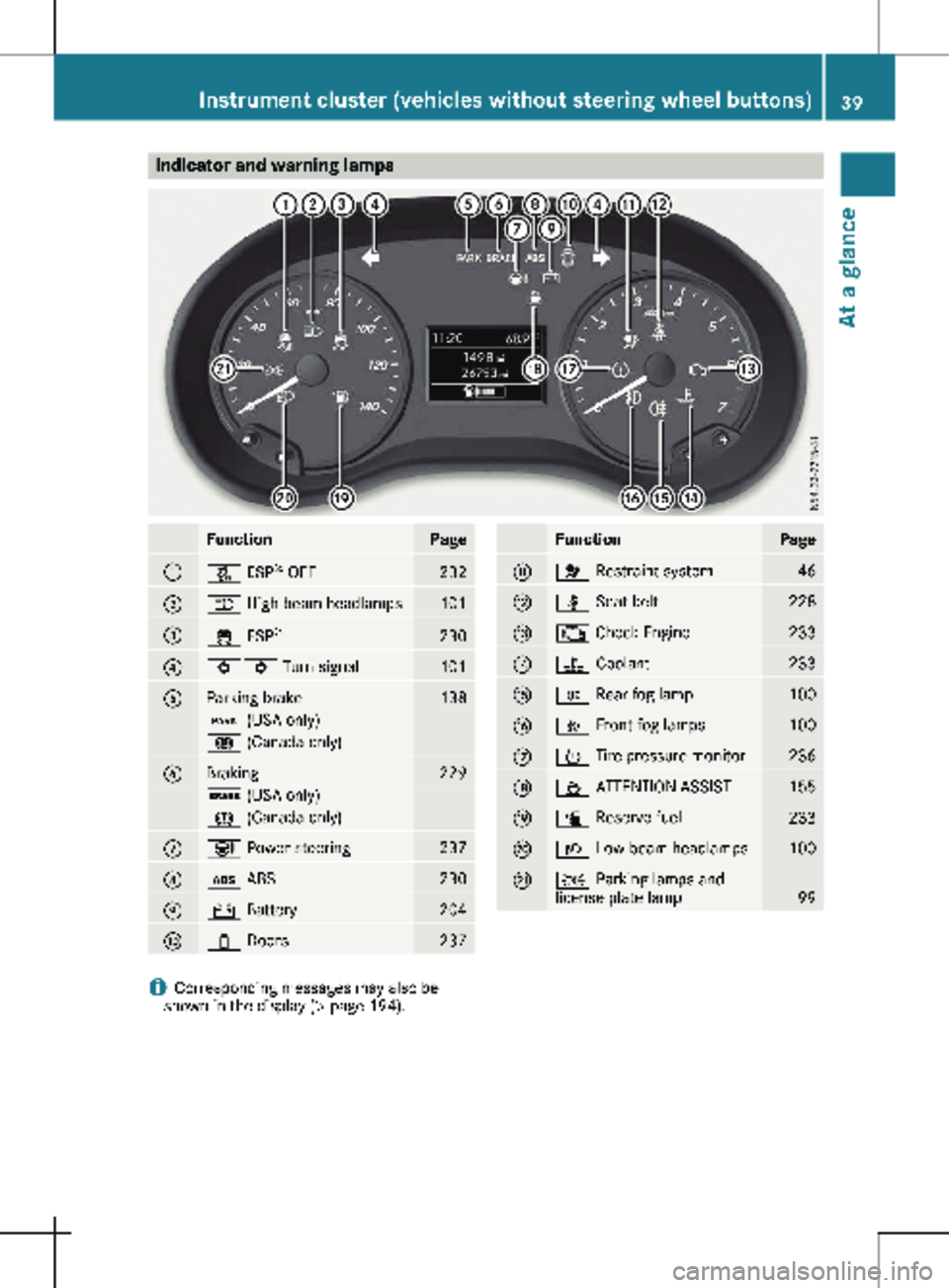
Indicator and warning lamps
Function Page
:
å ESP
®
OFF 232
;
K High-beam headlamps
101
=
÷ ESP
® 230
?
#! Turn signal
101
A
Parking brake 138
F (USA only)
! (Canada only)
B
Braking 229
$ (USA only)
J (Canada only)
C
Ð Power steering
237
D
ò ABS
230
E
# Battery
204
F
1 Doors
237 Function Page
G
6 Restraint system
46
H
ü Seat belt
228
I
; Check Engine
233
J
? Coolant
233
K
R Rear fog lamp
100
L
O Front fog lamps
100
M
h Tire pressure monitor
236
N
À ATTENTION ASSIST
155
O
æ Reserve fuel
233
P
L Low-beam headlamps
100
Q
T Parking lamps and
license plate lamp
99
i
Corresponding messages may also be
shown in the display (Y page 194).Instrument cluster (vehicles without steering wheel buttons)
39
At a glance
Page 43 of 320
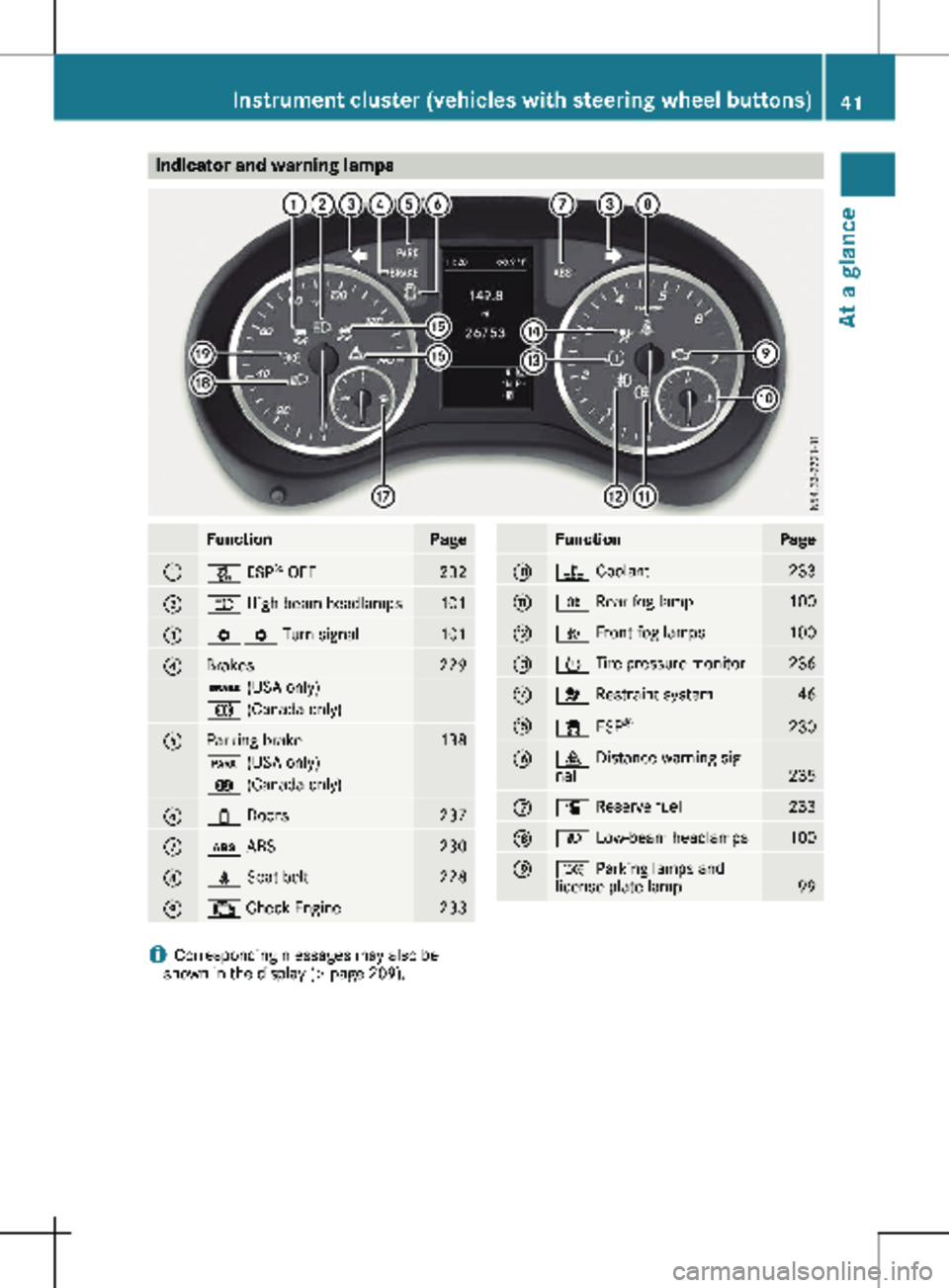
Indicator and warning lamps
Function Page
:
å ESP
®
OFF 232
;
K High-beam headlamps
101
=
#! Turn signal
101
?
Brakes 229
$ (USA only)
J (Canada only)
A
Parking brake 138
F (USA only)
! (Canada only)
B
1 Doors
237
C
ò ABS
230
D
ü Seat belt
228
E
; Check Engine
233 Function Page
F
? Coolant
233
G
R Rear fog lamp
100
H
O Front fog lamps
100
I
h Tire pressure monitor
236
J
6 Restraint system
46
K
÷ ESP
® 230
L
· Distance warning sig-
nal
235
M
æ Reserve fuel
233
N
L Low-beam headlamps
100
O
T Parking lamps and
license plate lamp
99
i
Corresponding messages may also be
shown in the display (Y page 209).Instrument cluster (vehicles with steering wheel buttons)
41
At a glance
Page 48 of 320
Useful information
This Operator's Manual describes all models
as well as standard and optional equipment of
your vehicle that were available at the time of
going to print. Country-specific variations are
possible. Note that your vehicle may not be
equipped with all of the described functions.
This also applies to systems and functions rel-
evant to safety.
Read the information on qualified specialist
workshops (Y page
32).Occupant safety
Restraint system introduction
The restraint system can reduce the risk of
vehicle occupants coming into contact with
parts of the vehicle's interior in the event of an
accident. In the event of an accident, the
restraint system can also reduce the forces to
which the vehicle occupants are subjected.
The restraint system includes the following
components:
R Seat belt system
R Air bags
R Child restraint system
R Child seat securing system
The various components of the restraint sys-
tem work complementary to one another. They
can only perform their intended protective
function if all vehicle occupants:
R have correctly fastened their seat belt
( Y page
49)
R have correctly adjusted their seat and head
restraint ( Y page 87)
As the driver, you must also ensure that the
driver's seat is in the correct position in rela-
tion to the pedals and the steering wheel.
Depending on your vehicle's equipment, you
can also adjust the steering wheel. Observe
the information relating to the correct driver's
seat position (Y page 87).
Additionally, you must ensure that an air bag
can deploy freely ( Y page 51).
The air bag is supplementary to a correctly fas-
tened seat belt. As an additional safety device,
the air bag increases the level of protection for
vehicle occupants in the event of an accident.
If the protection provided by the seat belt is sufficient, the air bags do not deploy. Further-
more, in the event of an accident, only air bags
which provide greater protection in the given
accident situation deploy. However, seat belts
and air bags generally do not protect against
objects penetrating the vehicle from the out-
side.
Information on how the restraint system oper-
ates can be found in "Deployment of the Emer-
gency Tensioning Devices and air bags"
( Y page
58).
See "Children in the vehicle" for information
on infants and children traveling with you in
the vehicle restraint systems for infants and
children ( Y page 60). Important safety notes
G
WARNING
Modifications to the restraint system may
cause it to no longer work as intended. The
restraint system may then not perform its
intended protective function and may fail in
an accident or trigger unexpectedly, for
example. This poses an increased risk of
injury or even fatal injury.
Never modify parts of the restraint system.
Never tamper with the wiring, the electronic
components or their software.
If it is necessary to modify components of the
restraint system for a person with physical dis-
abilities, contact a Mercedes-Benz Commercial
Van Centerfor details. USA only: contact our
Mercedes-Benz Customer Assistance Center
for details at 1‑877 ‑762‑8267. Restraint system warning lamp
The functions of the restraint system are
checked after the ignition is switched on and
at regular intervals while the engine is running.
Therefore, malfunctions can be detected in
good time.
The 6 restraint system warning lamp on
the instrument cluster lights up when the igni-
tion is switched on. It goes out no later than a
few seconds after the vehicle is started. The
restraint system is operational. 46
Occupant safety
Safety
Page 49 of 320
A malfunction has occurred if the
6
restraint system warning lamp:
R does not light up after the ignition is
switched on
R does not go out after a few seconds with the
engine running
R lights up again while the engine is running G
WARNING
If the restraint system is malfunctioning,
restraint system components may be trig-
gered unintentionally or may not be trig-
gered as intended in the event of an acci-
dent. This may affect the Emergency Ten-
sioning Devices or air bags, for example.
There is a risk of injury.
Have the restraint system checked and
repaired immediately at a qualified specialist
workshop. PASSENGER AIR BAG OFF indicator
lamp
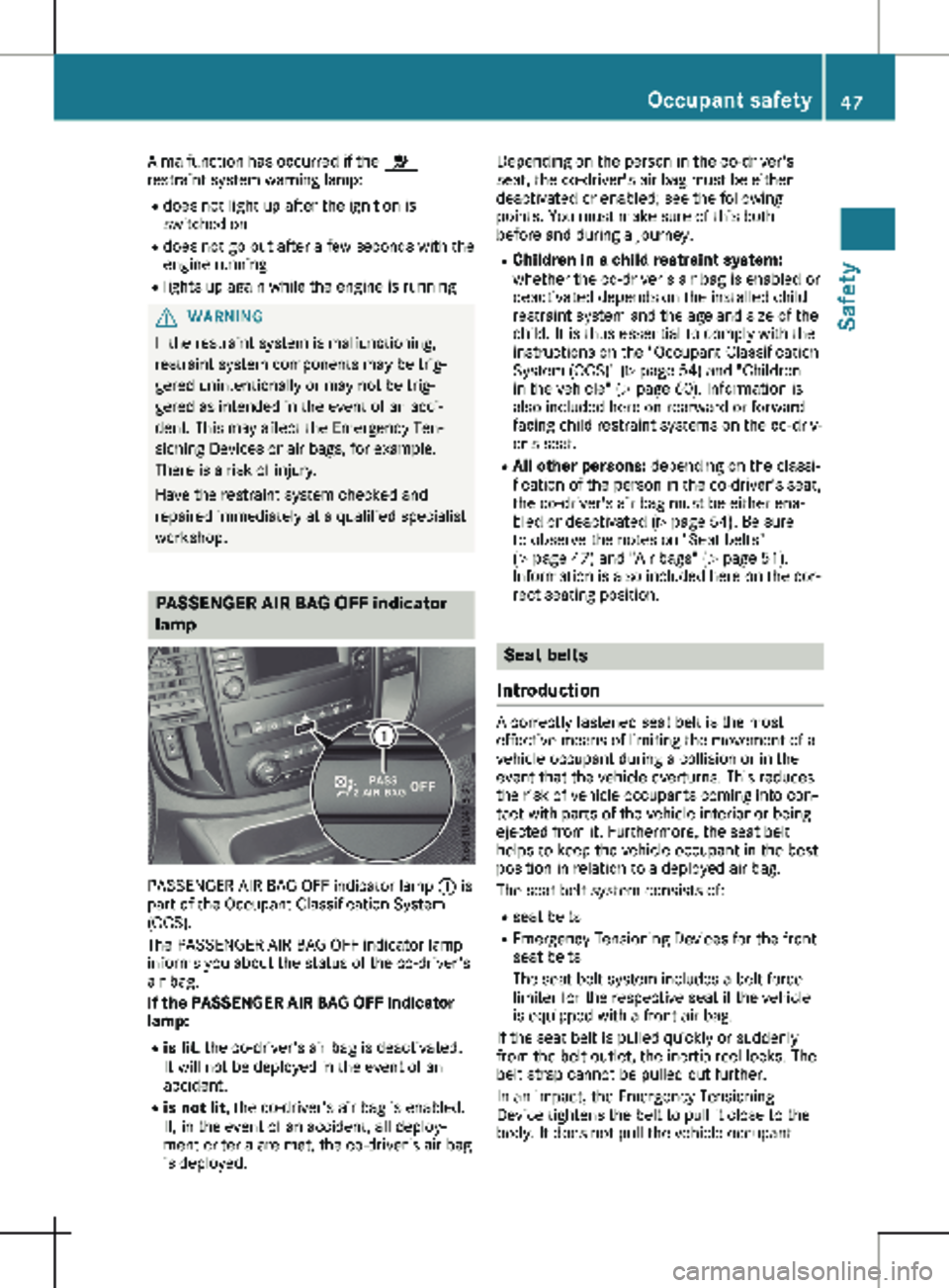
PASSENGER AIR BAG OFF indicator lamp
: is
part of the Occupant Classification System
(OCS).
The PASSENGER AIR BAG OFF indicator lamp
informs you about the status of the co-driver's
air bag.
If the PASSENGER AIR BAG OFF indicator
lamp:
R is lit, the co-driver's air bag is deactivated.
It will not be deployed in the event of an
accident.
R is not lit , the co-driver's air bag is enabled.
If, in the event of an accident, all deploy-
ment criteria are met, the co-driver's air bag
is deployed. Depending on the person in the co-driver's
seat, the co-driver's air bag must be either
deactivated or enabled; see the following
points. You must make sure of this both
before and during a journey.
R Children in a child restraint system:
whether the co-driver's air bag is enabled or
deactivated depends on the installed child
restraint system and the age and size of the
child. It is thus essential to comply with the
instructions on the "Occupant Classification
System (OCS)" ( Y page
54) and "Children
in the vehicle" ( Y page 60). Information is
also included here on rearward or forward-
facing child restraint systems on the co-driv-
er's seat.
R All other persons: depending on the classi-
fication of the person in the co-driver's seat,
the co-driver's air bag must be either ena-
bled or deactivated (Y page 54). Be sure to observe the notes on "Seat belts"
( Y page 47) and "Air bags" (Y page 51).
Information is also included here on the cor-
rect seating position. Seat belts
Introduction A correctly fastened seat belt is the most
effective means of limiting the movement of a
vehicle occupant during a collision or in the
event that the vehicle overturns. This reduces
the risk of vehicle occupants coming into con-
tact with parts of the vehicle interior or being
ejected from it. Furthermore, the seat belt
helps to keep the vehicle occupant in the best
position in relation to a deployed air bag.
The seat belt system consists of:
R seat belts
R Emergency Tensioning Devices for the front
seat belts
The seat belt system includes a belt force
limiter for the respective seat if the vehicle
is equipped with a front air bag.
If the seat belt is pulled quickly or suddenly
from the belt outlet, the inertia reel locks. The
belt strap cannot be pulled out further.
In an impact, the Emergency Tensioning
Device tightens the belt to pull it close to the
body. It does not pull the vehicle occupant Occupant safety
47
Safety Z