automatic transmission MERCEDES-BENZ METRIS 2020 MY20 Operator’s Manual
[x] Cancel search | Manufacturer: MERCEDES-BENZ, Model Year: 2020, Model line: METRIS, Model: MERCEDES-BENZ METRIS 2020Pages: 320, PDF Size: 26.38 MB
Page 277 of 320
!
Secure the tow rope or tow bar to the tow-
ing eye or trailer tow hitch only. Otherwise,
the vehicle could become damaged.
! Do not use the towing eye for recovery,
this could damage the vehicle. If in doubt,
recover the vehicle with a crane.
! Drive slowly and smoothly when towing.
Excessive tractive power could otherwise
damage the vehicles.
! Shift the automatic transmission to posi-
tion i and do not open the driver's or front
passenger's door during towing. The auto-
matic transmission may otherwise shift to
position j, which could damage the trans-
mission.
! You may tow the vehicle for a maximum
distance of 30 miles (50 kilometers). A tow-
ing speed of
30 mph (50 km/h) must not be
exceeded.
For towing distances over 30 miles
(50 kilometers), the entire vehicle must be
raised and transported.
When towing away, you must observe the legal
requirements for the country in which you are
currently driving.
It is better to have the vehicle transported
than to have it towed.
Have the vehicle transported on a transporter
or trailer if it has transmission damage.
The automatic transmission must be in posi-
tion i when the vehicle is being towed away.
If the automatic transmission cannot be shif-
ted to position i, have the vehicle transpor-
ted on a transporter or trailer.
The battery must be connected and charged.
Otherwise, you:
R cannot turn the key to position 2 in the
ignition lock.
R cannot shift the transmission to position i.
Before the vehicle is towed, switch off the
automatic locking feature (Y page 76). You could otherwise lock yourself out of the vehi-
cle when pushing or towing away the vehicle. Installing/removing the towing eye
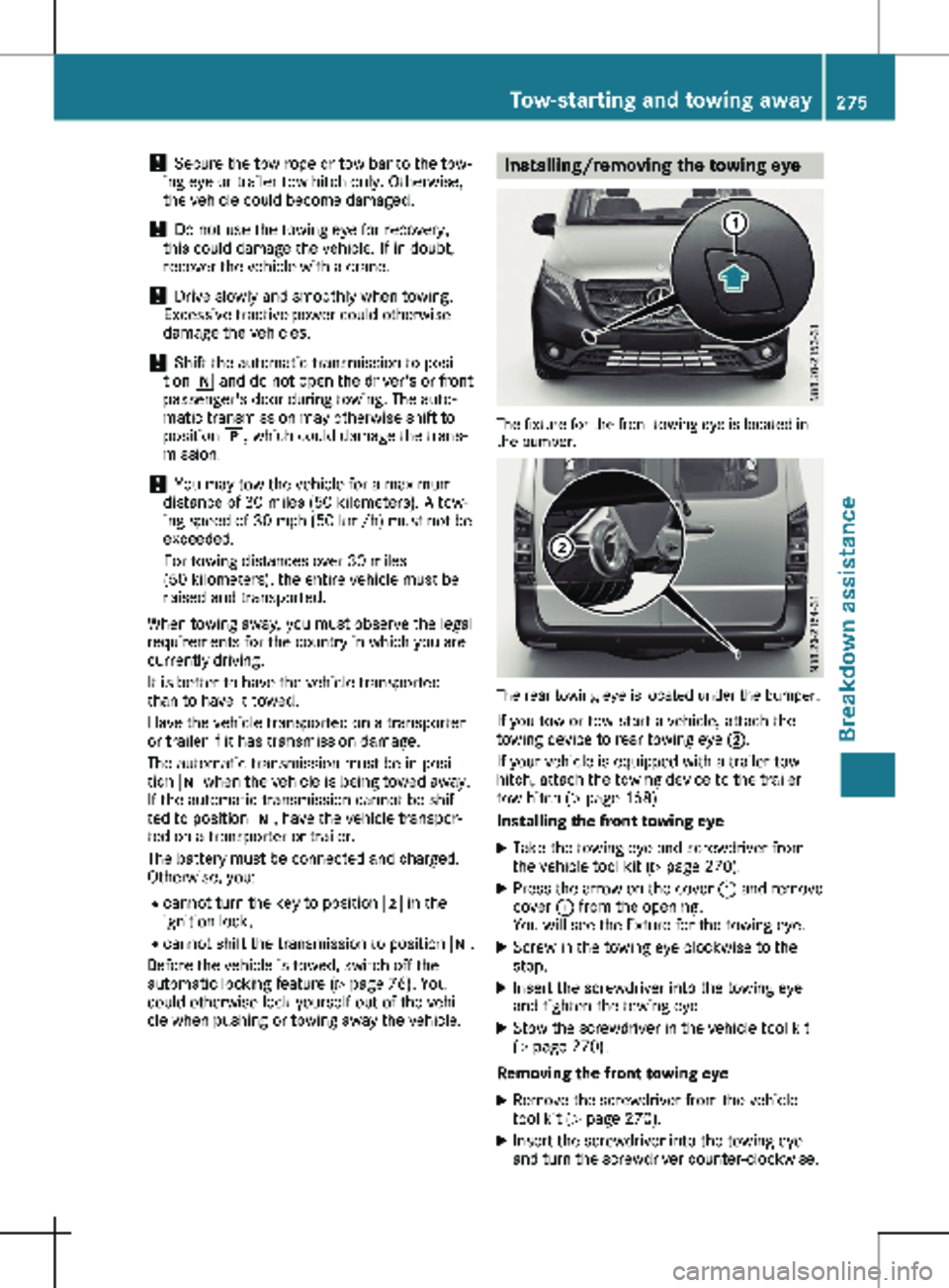
The fixture for the front towing eye is located in
the bumper. The rear towing eye is located under the bumper.
If you tow or tow-start a vehicle, attach the
towing device to rear towing eye
;.
If your vehicle is equipped with a trailer tow
hitch, attach the towing device to the trailer
tow hitch (Y page
168).
Installing the front towing eye
X Take the towing eye and screwdriver from
the vehicle tool kit (Y page
270).
X Press the arrow on the cover : and remove
cover : from the opening.
You will see the fixture for the towing eye.
X Screw in the towing eye clockwise to the
stop.
X Insert the screwdriver into the towing eye
and tighten the towing eye.
X Stow the screwdriver in the vehicle tool kit
(Y page
270).
Removing the front towing eye
X Remove the screwdriver from the vehicle
tool kit
(Y page 270).
X Insert the screwdriver into the towing eye
and turn the screwdriver counter-clockwise. Tow-starting and towing away
275
Breakdown assistance Z
Page 278 of 320
X
Unscrew the towing eye.
X Insert cover : with the lug at the top and
press it in at the bottom until it engages.
X Stow the towing eye and the screwdriver
with the vehicle tool kit (Y page
270).Towing with the rear axle raised
! Vehicles with automatic transmission must
not be towed with the rear axle raised. The
vehicle/trailer combination may otherwise
swerve or even roll over.
! The ignition must be switched off if the
vehicle is being towed with the front or rear
axle raised. Otherwise, ESP ®
may intervene
and damage the brake system.
X Switch on the hazard warning lamps
(Y page
101).
X Turn the front wheels to the straight-ahead
position.
X Release the parking brake.
X If necessary, turn the key in the ignition lock
to position g and remove the key from the
ignition lock.
X Take the key with you when leaving the vehi-
cle.
X Do not exceed the towing speed of 30 mph
(50 km/h
).
Please observe the important safety instruc-
tions when towing your vehicle with the rear
axle raised
(Y page 274). Towing the vehicle with both axles
on the ground
Important safety notes G
WARNING
You can no longer steer the vehicle if the
steering wheel lock has been engaged.
There is a risk of an accident.
Always switch off the ignition when towing
the vehicle with a tow cable or a tow bar.
! Do not exceed the towing speed of
30 mph
(50 km/h). You could otherwise
damage the transmission. Please observe the important safety notes
before towing your vehicle
(Y page 274).
Towing vehicles with automatic trans-
mission X
Turn the key to position 2 in the ignition
lock.
X Depress the brake pedal and keep it
depressed.
X Shift the automatic transmission to position
i.
X Leave the key in position 2 in the ignition
lock.
X Switch on the hazard warning lamps
(Y page
101).
X Release the parking brake.
X Release the brake pedal.
X Do not exceed the towing speed of 30 mph
(50 km/h
). Recovering a vehicle that is stuck
! When recovering a vehicle that has
become stuck, pull it as smoothly and
evenly as possible. If the tractive power is
too high, the vehicles could be damaged.
If the drive wheels get trapped on loose or
muddy ground, recover the vehicle with the
utmost care. This is especially the case if the
vehicle is laden.
Never attempt to recover a vehicle with a
trailer attached.
Pull out the vehicle backwards, if possible,
using the tracks it made when it became
stuck. Transporting the vehicle
! You may only secure the vehicle by the
wheels, not by parts of the vehicle such as
axle or steering components. Otherwise, the
vehicle could be damaged.
The towing eye or trailer tow hitch can be used
to pull the vehicle onto a trailer or transporter
if you wish to transport it. 276
Tow-starting and towing away
Breakdown assistance
Page 279 of 320
X
Turn the key to position 2 in the ignition
lock.
X Shift the transmission to position i.
X Release the parking brake.
If the vehicle is loaded: X Shift the transmission to position j.
X Turn the key to position u in the ignition
lock and remove it.
X Make sure the parking brake is applied.
X Lash down the vehicle. Tow-starting (emergency engine
starting)
General notes !
Vehicles with automatic transmission must
not be tow-started. You could otherwise
damage the automatic transmission.
You can find information on jump-starting
under "Jump-starting“
(Y page 272).Electrical fuses
The fuse allocation chart and important safety
information on the fuses can be found in the
"Fuse allocation chart" supplement. Electrical fuses
277
Breakdown assistance Z
Page 312 of 320
Transmission oil
Automatic transmission Operating fluid: automatic transmission
fluid Product name/number Maintenance
interval Mobil ATF 134 FE
Valvoline ATF Pro 236.15
MB Sheet No. 236.15 —
More information can be obtained at any quali-
fied specialist workshop.
Rear axle Operating fluid: transmission oil
Product name/number Maintenance
interval Mobilube FE 75W-85
Mobilube FE Plus NG
75W-85
MB Sheet No. 235.7 —
More information can be obtained at any quali-
fied specialist workshop.
Brake fluid
G
WARNING
The brake fluid constantly absorbs moisture
from the air. This lowers the boiling point of
the brake fluid. If the boiling point of the
brake fluid is too low, vapor pockets may
form in the brake system when the brakes
are applied hard. This would impair braking
efficiency. There is a risk of an accident.
You should have the brake fluid renewed at
the specified intervals.
! Brake fluid corrodes paint, plastic and rub-
ber. If paint, plastic or rubber has come into
contact with brake fluid, rinse with water
immediately.
When handling, storing and disposing of brake
fluid, please observe the relevant regulations and the important safety notes for service
products (Y page
305).
Over a period of time, the brake fluid absorbs
moisture from the air. This reduces its boiling
point.
Have the brake fluid replaced at specified
intervals by a qualified specialist workshop.
i There is usually a notice in the engine
compartment to remind you when the next
brake fluid change is due.
Use only approved brake fluids that comply
with the Mercedes-Benz Specifications for Ser-
vice Products. Always check for the identifica-
tion DOT 4 plus.
Information about approved brake fluids can
be obtained:
R on the Internet at
http://bevo.mercedes-benz.com. Coolant
Important safety notes G
WARNING
If antifreeze comes into contact with hot
components in the engine compartment, it
may ignite. There is a risk of fire and injury.
Let the engine cool down before you add
antifreeze. Make sure that antifreeze is not
spilled next to the filler neck. Thoroughly
clean the antifreeze from components
before starting the engine.
! Take care not to spill any coolant on pain-
ted surfaces. You could otherwise damage
the paintwork.
When handling, storing and disposing of cool-
ant and antifreeze, please observe the relevant
regulations and the important safety notes for
operating fluids
(Y page 305).
Coolant additive with corrosion and
antifreeze protection !
Use only approved antifreeze/corrosion
inhibitor that complies with MB Specifica-
tion for Service Products, Sheet Number
325. Using other, non-approved antifreeze/
corrosion inhibitors may cause damage to 310
Service products and capacities
Technical data