height MERCEDES-BENZ ML SUV 2008 User Guide
[x] Cancel search | Manufacturer: MERCEDES-BENZ, Model Year: 2008, Model line: ML SUV, Model: MERCEDES-BENZ ML SUV 2008Pages: 381, PDF Size: 7.18 MB
Page 223 of 381
Engine compartment
220 Make sure that the windscreen wipers are
switched off and that the key has been
pulled out of the ignition lock before open-
ing the bonnet.
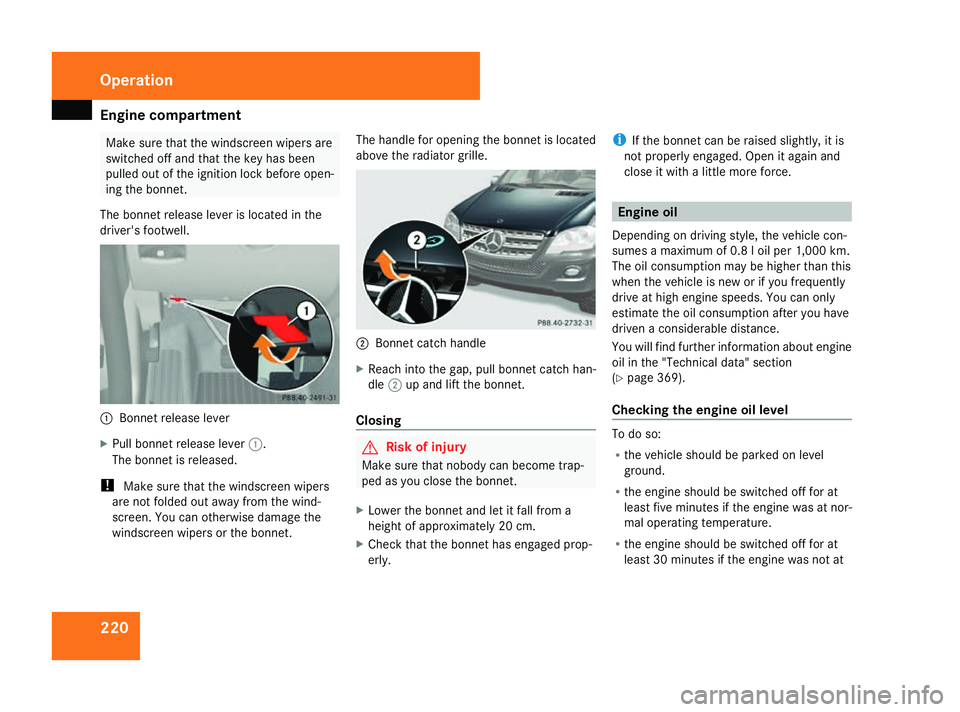
The bonnet release lever is located in the
driver's footwell. 1
Bonnet release lever
X Pull bonnet release lever 1.
The bonnet is released.
! Make sure that the windscreen wipers
are not folded out away from the wind-
screen. You can otherwise damage the
windscreen wipers or the bonnet. The handle for opening the bonnet is located
above the radiator grille.
2
Bonnet catch handle
X Reach into the gap, pull bonnet catch han-
dle 2up and lift the bonnet.
Closing G
Risk of injury
Make sure that nobody can become trap-
ped as you close the bonnet.
X Lower the bonnet and let it fall from a
height of approximately 20 cm.
X Check that the bonnet has engaged prop-
erly. i
If the bonnet can be raised slightly, it is
not properly engaged. Open it again and
close it with a little more force. Engine oil
Depending on driving style, the vehicle con-
sumes a maximum of 0.8 l oil per 1,000 km.
The oil consumption may be higher than this
when the vehicle is new or if you frequently
drive at high engine speeds. You can only
estimate the oil consumption after you have
driven a considerable distance.
You will find further information about engine
oil in the "Technical data" section
(Y page 369).
Checking the engine oil level To do so:
R
the vehicle should be parked on level
ground.
R the engine should be switched off for at
least five minutes if the engine was at nor-
mal operating temperature.
R the engine should be switched off for at
least 30 minutes if the engine was not at Operation
164_AKB; 5; 5, en-GB
wobuchh,
Version: 2.10.6 2008-05-11T11:55:12+02:00 - Seite 220Dateiname: 6515_4293_02_buchblock.pdf; preflight
Page 246 of 381
Trailer towing*
243
X
Close the doors and tailgate.
X Secure the trailer against rolling away. G
Risk of injury
The vehicle is lowered as soon as you dis-
connect the trailer cable. Make sure that
nobody is in the vicinity of the wheel arch
or the underbody. You could otherwise trap
yourself or others.
As soon as you decouple the trailer, the
unladen vehicle rises slightly. Make sure
that you or others are not injured in the
process.
X Remove the trailer cable and decouple the
trailer.
X Switch off the engine. Notes on towing a trailer
G
Risk of accident
When reversing the vehicle towards the
trailer, make sure there is nobody between
the trailer and the vehicle.
Couple and uncouple the trailer carefully. If
you do not couple the trailer to the towing
vehicle correctly, the trailer could become
detached.
Make sure that the following values are not
exceeded:
R The permitted trailer drawbar nose-
weight
R The permitted trailer load
R The permitted rear axle load of the towing
vehicle
R The maximum permissible gross vehicle
weight of both the towing vehicle and the
trailer
You will find the applicable permissible val-
ues which must not be exceeded in the
vehicle documents.
You will find the values approved by the
manufacturer on the vehicle identification
plates and those for the towing vehicle in
the "Technical data" section. You will find installation dimensions and loads
in the "Technical data" section
(Y page 365).
The maximum permissible trailer drawbar
noseweight on the ball coupling is 140 kg.
However, the actual noseweight must not
exceed the value given on the trailer coupling
and trailer identification plates. The lowest
weight applies.
! Use a noseweight as close as possible to
the maximum permissible noseweight. Do
not use a noseweight of less than 50 kg,
otherwise the trailer may come loose.
Bear in mind that the payload and the rear
axle load are reduced by the actual nose-
weight.
i On vehicles without level control, the
height of the ball coupling will alter accord-
ing to the load placed on the vehicle. In this
case, you should use a trailer with a height-
adjustable drawbar.
Driving tips i
Observe the notes on ESP ®
trailer stabi-
lisation (Y page 59).
In Germany, the maximum permitted speed
for vehicle/trailer combinations is 80 km/h. Operation
* optional
164_AKB; 5; 5, en-GB
wobuchh
,V ersion: 2.10.6
2008-05-11T11:55:12+02:00 - Seite 243 ZDateiname: 6515_4293_02_buchblock.pdf; preflight
Page 259 of 381
Where will I find...?
256 able to achieve its load-bearing capacity
due to the restricted height.
Do not start the engine at any time while a
wheel is being changed.
i When using the jack, you should also
observe the safety notes in the "Flat tyre"
section (Y page 323).
Vehicles with a TIREFIT kit/exterior
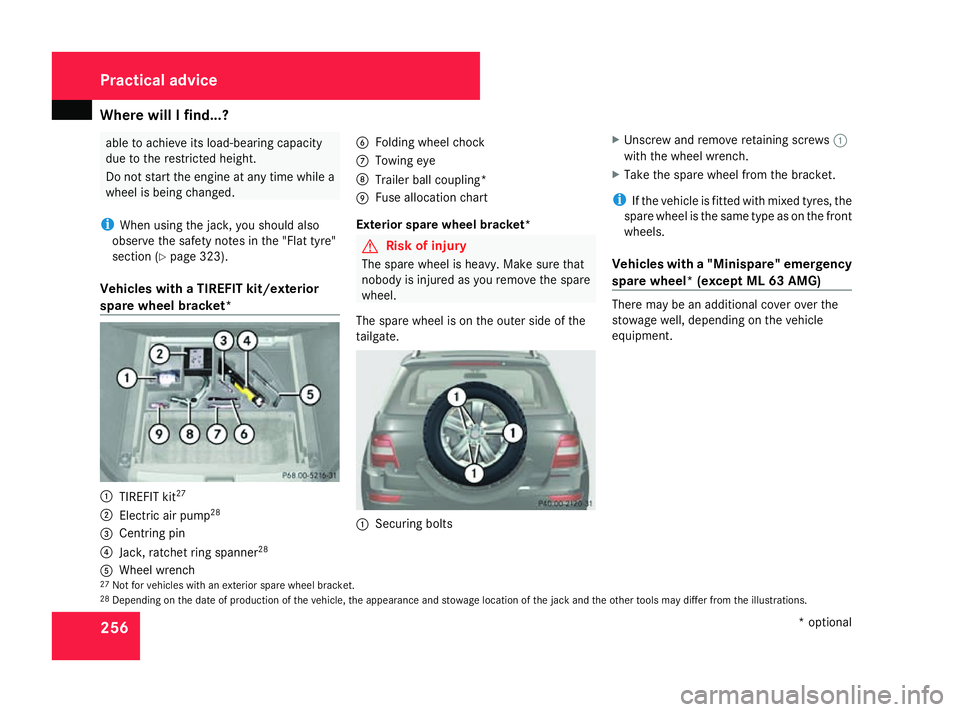
spare wheel bracket* 1
TIREFIT kit 27
2 Electric air pump 28
3 Centring pin
4 Jack, ratchet ring spanner 28
5 Wheel wrench 6
Folding wheel chock
7 Towing eye
8 Trailer ball coupling*
9 Fuse allocation chart
Exterior spare wheel bracket* G
Risk of injury
The spare wheel is heavy. Make sure that
nobody is injured as you remove the spare
wheel.
The spare wheel is on the outer side of the
tailgate. 1
Securing bolts X
Unscrew and remove retaining screws 1
with the wheel wrench.
X Take the spare wheel from the bracket.
i If the vehicle is fitted with mixed tyres, the
spare wheel is the same type as on the front
wheels.
Vehicles with a "Minispare" emergency
spare wheel* (except ML 63 AMG) There may be an additional cover over the
stowage well, depending on the vehicle
equipment.
27 Not for vehicles with an exterior spare wheel bracket.
28 Depending on the date of production of the vehicle, the appearance and stowage location of the jack and the other tools may differ from the illustrations. Practical advice
* optional
164_AKB; 5; 5, en-GB
wobuchh,
Version: 2.10.6 2008-05-11T11:55:12+02:00 - Seite 256Dateiname: 6515_4293_02_buchblock.pdf; preflight
Page 331 of 381
Flat tyre
328
Spare wheel* or the "Minispare" emer-
gency spare wheel*
X Remove the spare wheel from the exterior
bracket (Y page 256).
or
X Remove the "Minispare" emergency spare
wheel from the stowage compartment
under the luggage compartment floor
(Y page 256).
Raising the vehicle G
Risk of injury
The jack is designed only to raise the vehi-
cle for a short time while a wheel is being
changed.
If you intend to work under the vehicle, it
must be placed on stands.
Make sure that the jack is placed on a firm,
non-slip, level surface. Do not use wooden
blocks or similar items as jacking supports.
Otherwise, the jack will not be able to ach-
ieve its load-bearing capacity due to the
restricted height.
Do not start the engine at any time while
the wheel is being changed.
Do not lie under the vehicle when it is being
supported by the jack. If you do not raise the vehicle as described, it could slip off the
jack (e.g. if the engine is started or a door
or the tailgate is opened or closed) and you
could be seriously injured.
G
Risk of accident
If you fail to position the jack correctly, the
vehicle may:
R slip off the jack
R injure you or others
R be damaged
It is thus important to ensure that the jack
is positioned correctly in the respective
jacking points. Before positioning the jack,
remove any dirt that may have collected in
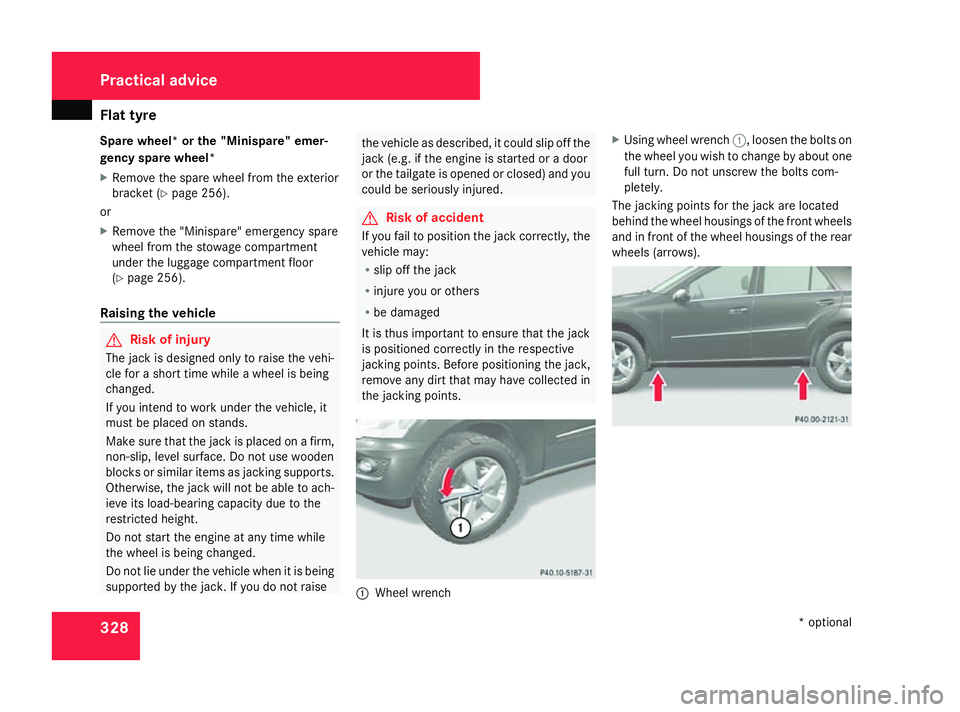
the jacking points. 1
Wheel wrench X
Using wheel wrench 1, loosen the bolts on
the wheel you wish to change by about one
full turn. Do not unscrew the bolts com-
pletely.
The jacking points for the jack are located
behind the wheel housings of the front wheels
and in front of the wheel housings of the rear
wheels (arrows). Practical advice
* optional
164_AKB; 5; 5, en-GB
wobuchh,
Version: 2.10.6 2008-05-11T11:55:12+02:00 - Seite 328Dateiname: 6515_4293_02_buchblock.pdf; preflight
Page 364 of 381
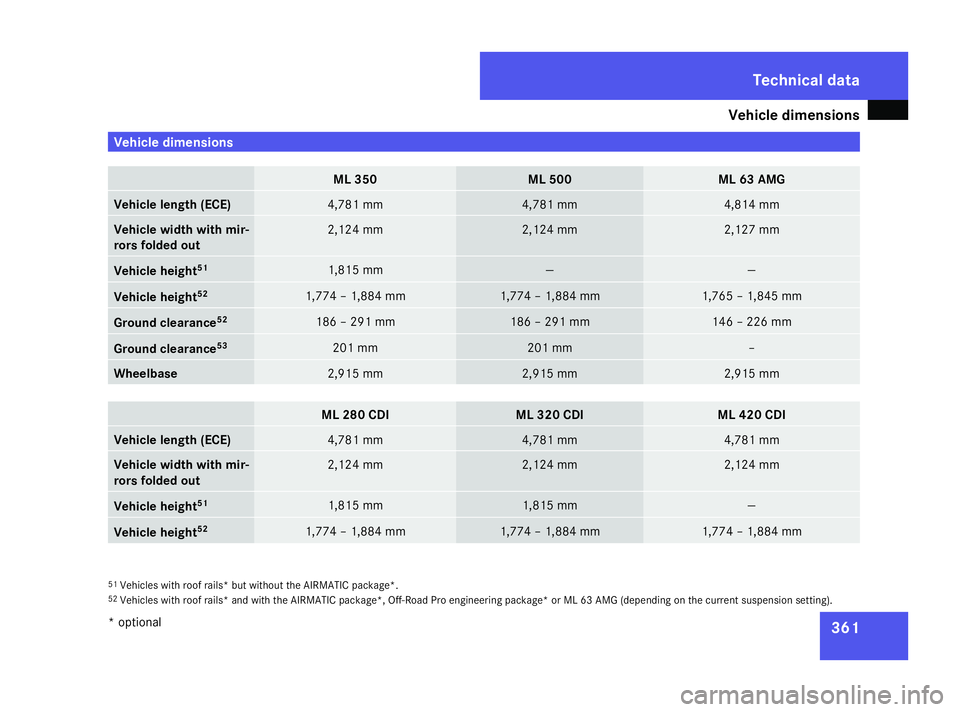
Vehicle dimensions
361Vehicle dimensions
ML 350 ML 500 ML 63 AMG
Vehicle length (ECE) 4,781 mm 4,781 mm 4,814 mm
Vehicle width with mir-
rors folded out 2,124 mm 2,124 mm 2,127 mm
Vehicle height
51 1,815 mm — —
Vehicle height
52 1,774 – 1,884 mm 1,774 – 1,884 mm 1,765 – 1,845 mm
Ground clearance
52 186 – 291 mm 186 – 291 mm 146 – 226 mm
Ground clearance
53 201 mm 201 mm –
Wheelbase 2,915 mm 2,915 mm 2,915 mm
ML 280 CDI ML 320 CDI ML 420 CDI
Vehicle length (ECE) 4,781 mm 4,781 mm 4,781 mm
Vehicle width with mir-
rors folded out 2,124 mm 2,124 mm 2,124 mm
Vehicle height
51 1,815 mm 1,815 mm —
Vehicle height
52 1,774 – 1,884 mm 1,774 – 1,884 mm 1,774 – 1,884 mm
51
Vehicles with roof rails* but without the AIRMATIC package*.
52 Vehicles with roof rails* and with the AIRMATIC package*, Off-Road Pro engineering package* or ML 63 AMG (depending on the current suspension setting). Technical data
* optional
164_AKB; 5; 5, en-GB
wobuchh
,V ersion: 2.10.6
2008-05-11T11:55:12+02:00 - Seite 361 ZDateiname: 6515_4293_02_buchblock.pdf; preflight
Page 365 of 381
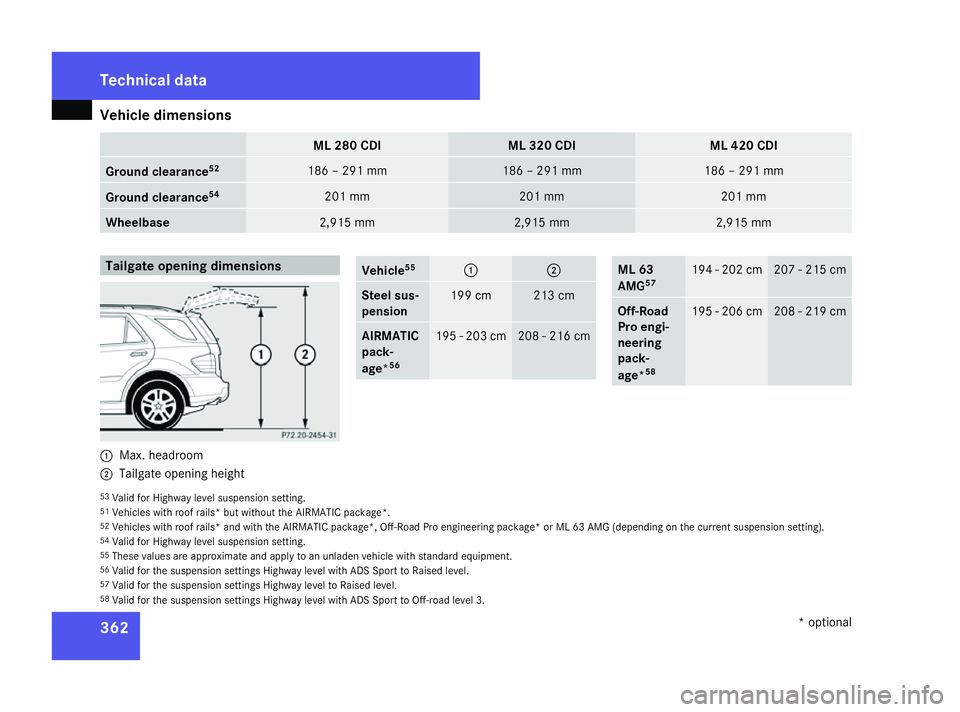
Vehicle dimensions
362 ML 280 CDI ML 320 CDI ML 420 CDI
Ground clearance
52 186 – 291 mm 186 – 291 mm 186 – 291 mm
Ground clearance
54 201 mm 201 mm 201 mm
Wheelbase 2,915 mm 2,915 mm 2,915 mm
Tailgate opening dimensions
1
Max. headroom
2 Tailgate opening height Vehicle
55 1 2
Steel sus-
pension 199 cm 213 cm
AIRMATIC
pack-
age* 56 195 - 203 cm 208 - 216 cm ML 63
AMG
57 194 - 202 cm 207 - 215 cm
Off-Road
Pro engi-
neering
pack-
age*
58 195 - 206 cm 208 - 219 cm
53
Valid for Highway level suspension setting.
51 Vehicles with roof rails* but without the AIRMATIC package*.
52 Vehicles with roof rails* and with the AIRMATIC package*, Off-Road Pro engineering package* or ML 63 AMG (depending on the current suspension setting).
54 Valid for Highway level suspension setting.
55 These values are approximate and apply to an unladen vehicle with standard equipment.
56 Valid for the suspension settings Highway level with ADS Sport to Raised level.
57 Valid for the suspension settings Highway level to Raised level.
58 Valid for the suspension settings Highway level with ADS Sport to Off-road level 3. Technical data
* optional
164_AKB; 5; 5, en-GB
wobuchh ,V ersion: 2.10.6
2008-05-11T11:55:12+02:00 - Seite 362 Dateiname: 6515_4293_02_buchblock.pdf; preflight