warning MERCEDES-BENZ S CLASS 2019 Owners Manual
[x] Cancel search | Manufacturer: MERCEDES-BENZ, Model Year: 2019, Model line: S CLASS, Model: MERCEDES-BENZ S CLASS 2019Pages: 578, PDF Size: 23.31 MB
Page 451 of 578
Neverexceed maximum tire pressure1speci‐fiedforthe tire.
Information on tirecharacteristics
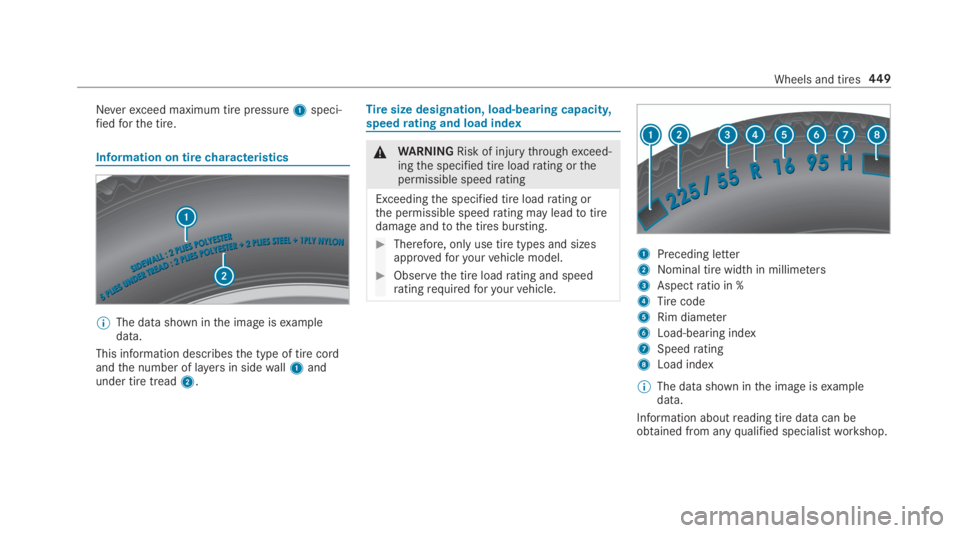
%The data shown inthe image isexampledata.
This information describesthe type of tire cordandthe number of layersin sidewall1andunder tire tread2.
Tiresize designation, load-bearing capacity,speedrating and load index
&WARNINGRisk of injurythroughexceed‐ingthe specified tire loadrating orthepermissible speedrating
Exceedingthe specified tire loadrating orthe permissible speedrating may leadtotiredamageandtothe tires bursting.
#Therefore, only use tire types and sizesapprovedforyourvehicle model.
#Observethe tire loadrating and speedratingrequiredforyourvehicle.
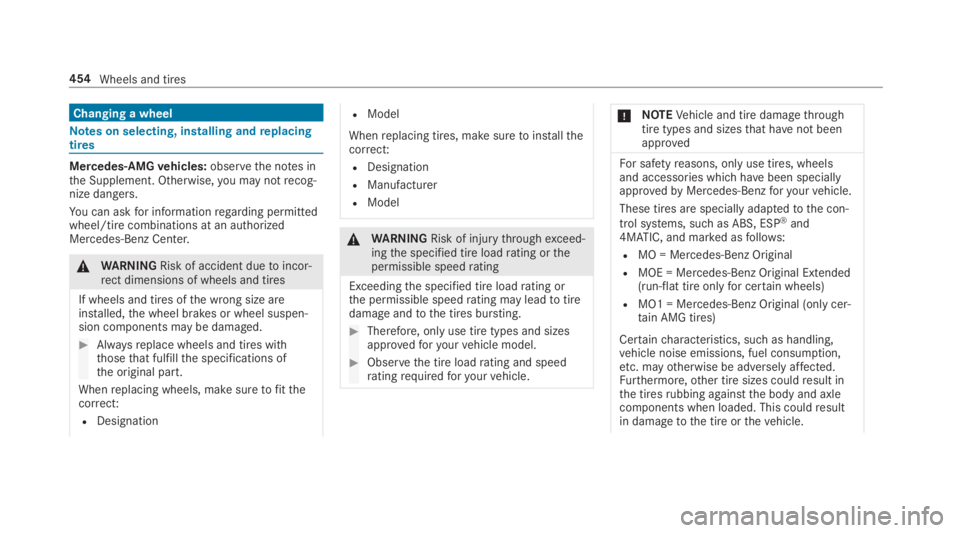
1Preceding letter
2Nominal tire width in millimeters
3Aspectratio in %
4Tirecode
5Rim diameter
6Load-bearing index
7Speedrating
8Load index
%The data shown inthe image isexampledata.
Information aboutreading tire data can beobtained from anyqualified specialistworkshop.
Wheels and tires449
Page 456 of 578
Changing a wheel
Notes on selecting, installing andreplacingtires
Mercedes-AMGvehicles:observethe notes inthe Supplement. Otherwise,you may notrecog‐nize dangers.
You can askfor informationregarding permittedwheel/tire combinations at an authorizedMercedes-Benz Center.
&WARNINGRisk of accident duetoincor‐rect dimensions of wheels and tires
If wheels and tires ofthe wrong size areinstalled,the wheel brakes or wheel suspen‐sion components may be damaged.
#Alwaysreplace wheels and tires withthosethat fulfillthe specifications ofthe original part.
Whenreplacing wheels, make suretofitthecorrect:
RDesignation
RModel
Whenreplacing tires, make suretoinstallthecorrect:
RDesignation
RManufacturer
RModel
&WARNINGRisk of injurythroughexceed‐ingthe specified tire loadrating orthepermissible speedrating
Exceedingthe specified tire loadrating orthe permissible speedrating may leadtotiredamageandtothe tires bursting.
#Therefore, only use tire types and sizesapprovedforyourvehicle model.
#Observethe tire loadrating and speedratingrequiredforyourvehicle.
*NOTEVehicle and tire damagethroughtire types and sizesthat havenot beenapproved
For safetyreasons, onlyuse tires, wheelsand accessories which havebeen speciallyapprovedbyMercedes-Benzforyourvehicle.
These tires are specially adaptedtothe con‐
trol systems, such as ABS, ESP®and4MATIC, and marked asfollows:
RMO = Mercedes-Benz Original
RMOE = Mercedes-Benz Original Extended(run-flat tire onlyfor certain wheels)
RMO1 = Mercedes-Benz Original (only cer‐tain AMG tires)
Certaincharacteristics, such as handling,vehicle noise emissions, fuel consumption,etc. mayotherwise be adversely affected.Furthermore,other tire sizes couldresult inthe tiresrubbing againstthe body and axlecomponents when loaded. This couldresultin damagetothe tire orthevehicle.
454Wheels and tires
Page 457 of 578
Only use tires, wheels and accessoriesthathavebeenchecked andrecommendedbyMercedes-Benz.
*NOTERisktodriving safety fromretrea‐ded tires
Retreaded tires are neithertested norrecom‐mendedbyMercedes-Benz, since previousdamage cannot always be detected onretreaded tires.
Forthisreason driving safety cannot be guar‐anteed.
#Do not use used tires ifyou havenoinformation abouttheir previous usage.
*NOTEPossible damagetowheels or tireswhen drivingover obstacles
Large wheels havea lower tire section width.The lowerthe tire section width,the greateristherisk of damagetowheels or tires whendrivingover obstacles.
#Avoid obstacles or drive particularlycarefully.
*NOTEDamagetoelectronic componentparts fromthe use of tire-mountingtools
Vehicles with a tire pressure monitoringsystem:Electronic component parts arelocated inthe wheel.Tire-mountingtoolsshould not be used inthe area ofthevalve.
This couldotherwise damagethe electroniccomponent parts.
#Havethe tireschanged at aqualifiedspecialistworkshop only.
*NOTEDamagetosummer tires at lowambienttemperatures
Atlow ambienttemperatures,tears couldformwhen driving with summer tires, caus‐ing permanent damagetothe tires.
#Attemperatures below 45 °F (7 °C),use M+S tires .
Accessory partsthat are not approvedforyourvehiclebyMercedes-Benz or are not being usedcorrectly can impairthe operating safety.
Before purchasing and using non-approvedaccessories, visit aqualified specialistworkshopand inquire about:
RSuitability
RLegalstipulations
RFactoryrecommendations
&WARNINGRisk of accident withhighperformance tires
The special tire tread in combination withtheoptimized tire compound meansthattheriskof skidding orhydroplaning onwetroads isincreased.
In addition,the tire grip is greatlyreduced ata low outsidetemperature and tirerunningtemperature.
#Switch onthe ESP®and adaptyourdrivingstyle accordingly.
#Use M+S tire at outsidetemperaturesof lessthan10°C (50 °F).
Wheels and tires455
Page 458 of 578
Observethefollowing when selecting, installingandreplacing tires:
ROnly use tires and wheels ofthe same type(summer tires, winter tires, MOExtendedtires) andthe same make.
ROnly install wheels ofthe same size on oneaxle (left andright).
It is only permissibletoinstall a differentwheel size intheevent of aflat tire in ordertodrivetothe specialistworkshop.
ROnly install tires ofthe correct size ontothewheels.
RVehicles with a tire pressure monitoringsystem:All installed wheels must be equip‐ped with functioning sensorsforthe tirepressure monitoring system.
RAttemperatures below 45 °F (7 °C), use win‐ter tires or all-season tires marked M+Sforall wheels.
Winter tires bearingtheMsnowflake sym‐bol in additiontothe M+S marking providethe best possible grip in wintryroad condi‐tions.
RFor M+S tires, only use tires withthe sametread.
RObservethe maximum permissible speedforthe M+S tires installed.
Ifthis is belowthevehicle's maximum speed,this must be indicatedbyan appropriatelabel inthe driver'sfield of vision.
RBreak in new tires at moderate speedsforthefirst 60 miles (100 km).
RReplacethe tires after sixyears atthe latest,regardless ofwear.
RWhenreplacing with tires that do notfea‐turerun-flatcharacteristics:vehicles withMOExtended tires are not equipped with aTIREFIT kit atthefactory.Equipthevehiclewith a TIREFIT kit afterreplacing with tiresthat do notfeaturerun-flatcharacteristics,e.g. winter tires.
For more information on wheels and tires, con‐tact aqualified specialistworkshop.
Be suretoalso observethefollowing furtherrelated subjects:
RNotes on tire pressure (→page 435)
RTireand Loading Information placard(→page442)
RTiresize designation, load-bearing capacity,speedrating and load index (→page449)
RTirepressuretable (→page 437)
Notes onrotating wheels
&WARNINGRisk of injurythrough differ‐ent wheel sizes
Interchangingthe front andrear wheels ifthewheels or tires havedifferent dimensionsmay severely impairthe drivingcharacteris‐tics.
The wheel brakes or wheel suspension com‐ponents may also be damaged.
#Rotatefront andrear wheels onlyifthewheels and tires are ofthe same dimen‐sions.
456Wheels and tires
Page 462 of 578
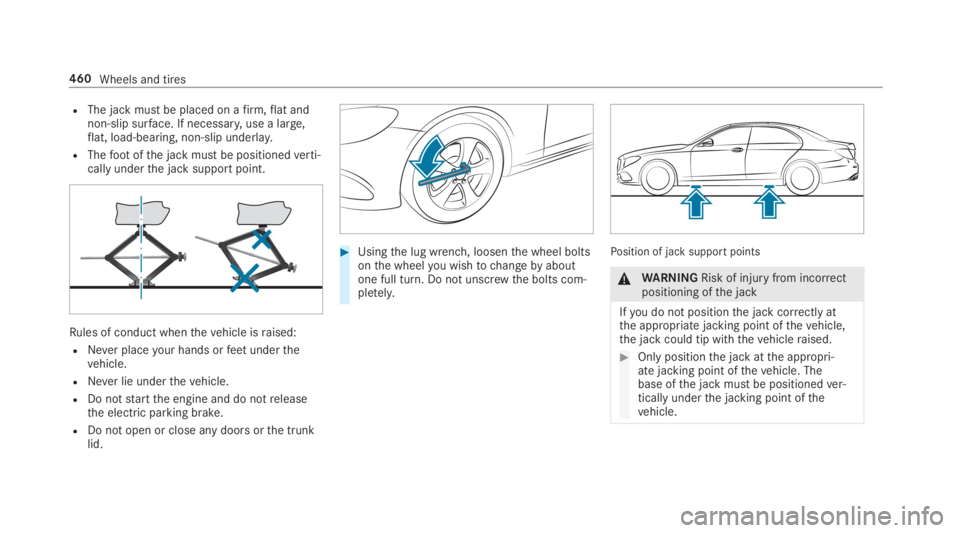
RThe jack must be placed on afirm,flat andnon-slip surface. If necessary,use a large,flat, load-bearing, non-slip underlay.
RThefootofthe jack must be positionedverti‐cally underthe jack support point.
Rules of conduct whenthevehicle israised:
RNever placeyour hands orfeetunderthevehicle.
RNever lie underthevehicle.
RDo notstartthe engine and do notreleasethe electric parking brake.
RDo not open or close any doors orthe trunklid.
#Usingthe lug wrench, loosenthe wheel boltsonthe wheelyou wishtochangebyaboutone full turn. Do not unscrewthe bolts com‐pletely.
Position of jack support points
&WARNINGRisk of injuryfrom incorrectpositioning ofthe jack
Ifyou do not positionthe jack correctly atthe appropriate jacking point ofthevehicle,the jack could tip withthevehicleraised.
#Only positionthe jack atthe appropri‐ate jacking point ofthevehicle. Thebase ofthe jack must be positionedver‐tically underthe jacking point ofthevehicle.
460Wheels and tires
Page 464 of 578
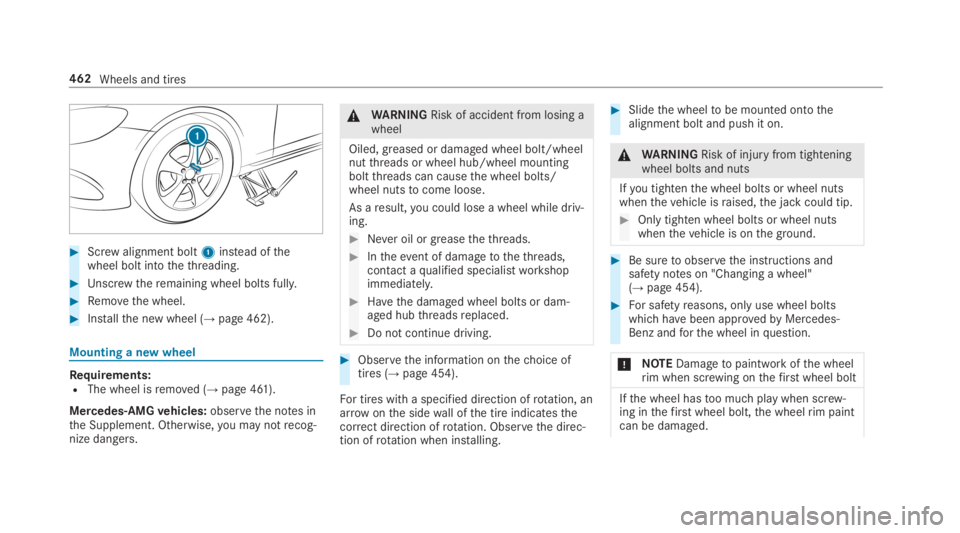
#Screwalignment bolt1instead ofthewheel bolt intothethreading.
#Unscrewtheremaining wheel bolts fully.
#Removethe wheel.
#Installthe new wheel (→page 462).
Mounting a new wheel
Requirements:RThe wheel isremoved (→page 461).
Mercedes-AMGvehicles:observethe notes inthe Supplement. Otherwise,you may notrecog‐nize dangers.
&WARNINGRisk of accident from losing awheel
Oiled, greased or damaged wheel bolt/wheelnutthreads or wheel hub/wheel mountingboltthreads can causethe wheel bolts/wheel nutstocome loose.
As aresult,you could lose a wheel while driv‐ing.
#Never oil or greasethethreads.
#Intheevent of damagetothethreads,contact aqualified specialistworkshopimmediately.
#Havethe damaged wheel bolts or dam‐aged hubthreadsreplaced.
#Do not continue driving.
#Observethe information onthechoice oftires (→page 454).
For tires with a specified direction ofrotation, anarrowonthe sidewall ofthe tire indicatesthecorrect direction ofrotation. Observethe direc‐tion ofrotation when installing.
#Slidethe wheeltobe mounted ontothealignment bolt and push it on.
&WARNINGRisk of injuryfrom tighteningwheel bolts and nuts
Ifyou tightenthe wheel bolts or wheel nutswhenthevehicle israised,the jack could tip.
#Only tighten wheel bolts or wheel nutswhenthevehicle is onthe ground.
#Be suretoobservethe instructions andsafety notes on "Changing a wheel"(→page 454).
#For safetyreasons, onlyuse wheel boltswhich havebeen approvedbyMercedes-Benz andforthe wheel inquestion.
*NOTEDamagetopaintwork ofthe wheelrim when screwing onthefirst wheel bolt
Ifthe wheel hastoo much play when screw‐ing inthefirst wheel bolt,the wheelrim paintcan be damaged.
462Wheels and tires
Page 465 of 578
#Pressthe wheelfirmlyagainstthewheel hub when screwing onthefirstwheel bolt.
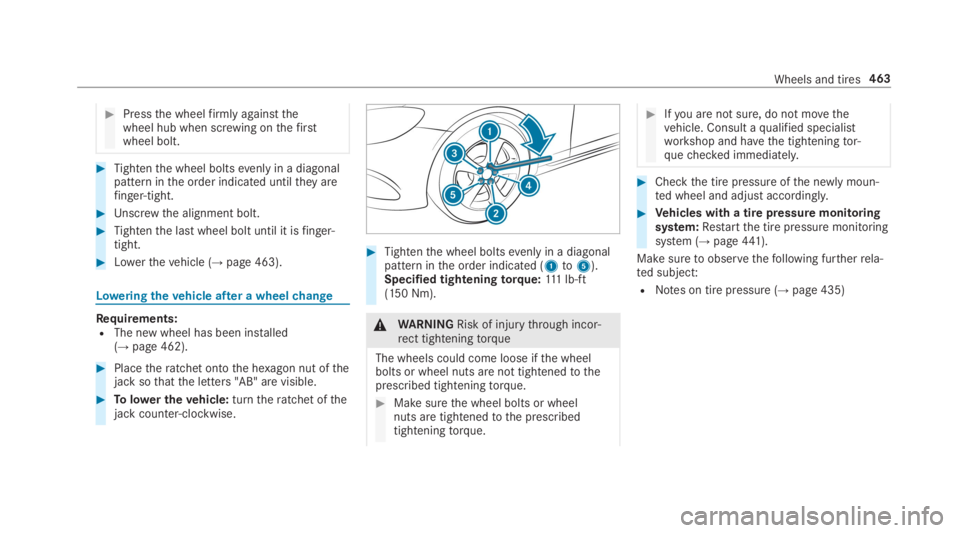
#Tightenthe wheel boltsevenly in a diagonalpattern inthe order indicated untiltheyarefinger-tight.
#Unscrewthe alignment bolt.
#Tightenthe last wheel bolt until it isfinger-tight.
#Lowerthevehicle (→page 463).
Loweringthevehicle after a wheelchange
Requirements:RThe new wheel has been installed(→page 462).
#Placetheratchet ontothe hexagon nut ofthejack sothatthe letters "AB" are visible.
#Tolower thevehicle:turntheratchet ofthejack counter-clockwise.
#Tightenthe wheel boltsevenly in a diagonalpattern inthe order indicated (1to5).Specified tighteningtorque:111lb-ft(150 Nm).
&WARNINGRisk of injurythrough incor‐rect tighteningtorque
The wheelscould come loose ifthe wheelbolts or wheel nuts are not tightenedtotheprescribed tighteningtorque.
#Makesurethe wheel bolts or wheelnuts are tightenedtothe prescribedtighteningtorque.
#Ifyou are not sure, do not movethevehicle. Consult aqualified specialistworkshop and havethe tighteningtor‐quechecked immediately.
#Checkthe tire pressure ofthe newly moun‐ted wheel and adjust accordingly.
#Vehicles with a tire pressure monitoringsystem:Restartthe tire pressure monitoringsystem (→page441).
Makesuretoobservethefollowing furtherrela‐ted subject:
RNotes on tire pressure (→page 435)
Wheels and tires463
Page 466 of 578
Notes ontechnical data
Plug-inhybrid:observethe notes inthe Supple‐ment. Otherwise,you may notrecognize dan‐gers.
Mercedes-AMGvehicles:observethe notes inthe Supplement. Otherwise,you may notrecog‐nize dangers.
The datastated onlyappliestovehicles withstandard equipment.You can obtain furtherinformation from an authorized Mercedes-BenzCenter.
Vehicle electronics
Two-wayradios
Notes on installing two-wayradios
&WARNINGRisk of accident duetoimproperworkon two-wayradios
The electromagneticradiation from two-wayradios can interferewiththe on-board elec‐tronics if RF transmittersare manipulated orretrofitted incorrectly.
This could jeopardizethe operating safety ofthevehicle.
#You should haveallworkon electricaland electronic components carried outat aqualified specialistworkshop.
&WARNINGRisk of accident from incor‐rect operation of two-wayradios
Ifyou operate two-wayradios incorrectly inthevehicle,the electromagneticradiationcould interferewiththe on-board electronics,e.g.:
Rifthe two-wayradio is not connectedtoanexterior antenna
Riftheexterior antenna is not correctlymounted or is not of lowreflection
This could jeopardiesthe operating safety ofthevehicle.
#Havethe low-reflectionexteriorantenna installed at aqualified special‐istworkshop.
#When operating two-wayradios inthevehicle, always connectthemtothelow-reflectionexterior antenna.
*NOTEInvalidation ofthe operating per‐mit duetofailuretocomply with theinstructionsfor installation and use
The operating permit may be invalidated ifthe instructionsfor installation and use oftwo-wayradios are not observed.
#Only use approved frequency bands.
#Observethe maximum permissible out‐put power inthese frequency bands.
#Only use approved antenna positions.
464Technical data
Page 470 of 578
Operatingfluids
Notes on operatingfluids
Mercedes-AMGvehicles:observethe notes inthe Supplement. Otherwise,you mayfailtorec‐ognize dangers.
&WARNINGRisk of injuryfrom operatingfluids harmfulto your health
Operatingfluids may be poisonous and harm‐fulto your health.
#Observethetext onthe original con‐tainers when using,storing or disposingof operatingfluids.
#Alwaysstore operatingfluids sealed intheir original containers.
#Alwayskeepchildrenawayfrom operat‐ingfluids.
&WARNINGRisk offireorexplosion fromfuel
Fuels are highlyflammable.
#Fire, openflames, smoking and creationof sparksmust beavoided.
#Switchoffthe ignition and, ifavailable,thestationary heater, before and whilerefuelingthevehicle.
&WARNINGRisk of injuryfrom fuels
Fuels are poisonous and hazardousto yourhealth.
#Do not swallow fuel or let it come intocontact with skin,eyes or clothing.
#Do not inhale fuelvapor.
#Keepchildrenawayfrom fuel.
#Keep doors and windowsclosed duringtherefueling process.
Ifyou orother people come into contact withfuel, observethefollowing:
#Immediatelyrinse fuel offyour skin withsoap andwater.
#If fuel comes into contact withyoureyes, immediatelyrinsethemthor‐
oughly with cleanwater.Seek medicalattention immediately.
#Ifyou swallow fuel, seek medical atten‐tion immediately.Do not inducevomit‐ing.
#Change immediately out of clothingthathas come into contact withfuel.
+ENVIRONMENTALNOTEEnvironmentalpollution causedbyenvironmentally irre‐sponsible disposal
#Dispose of operatingfluids in an envi‐ronmentallyresponsible manner.
Operatingfluids includethefollowing:
RFuels
RLubricants
RCoolant
RBrakefluid
RWindshieldwasherfluid
RClimate control systemrefrigerant
468Technical data
Page 474 of 578
Mercedes‑MaybachCapacity
S 650 Mercedes-May‐bach11.1US qt(10.5 liters)
S 560 4MATICMercedes-Maybach9.5 US qt (9.0 liters)
Notes on brakefluid
Observethe notes on operatingfluids(→page 468).
&WARNINGRisk of an accident duetovapor pocketsforming inthe brake sys‐tem
The brakefluid constantly absorbs moisturefromthe air. This lowersthe boiling point ofthe brakefluid. Ifthe boiling point istoo low,vapor pockets mayforminthe brake systemwhenthe brakes are applied hard.
This causesthe braking effecttobeimpaired.
#Havethe brakefluidrenewed atthespecified intervals.
Havethe brakefluidregularlyreplaced at aqualified specialistworkshop.Only use brakefluid approvedbyMercedes-BenzaccordingtoMB-Freigabe or MB-Approval 331.0.
You can obtain further information on brakefluidinthefollowing places:
Rinthe Mercedes-Benz SpecificationsforOperating Fluids
-at http://bevo.mercedes-benz.com
-inthe Mercedes-Benz BeVo App
Rat aqualified specialistworkshop
Coolant
Notes on coolantObservethe notes on operatingfluids(→page 468).
&WARNING‑ Risk offireand injury fromantifreeze
If antifreeze comes into contact withhotcomponent parts inthe engine compart‐ment, it may ignite.
#Allowthe enginetocool down beforeadding antifreeze.
#Makesurethat no antifreeze spills outnexttothefiller opening.
#Thoroughly clean off any antifreezefrom component parts beforestartingthevehicle.
*NOTEDamagecausedbyincorrect cool‐ant
#Only add coolantthat has been pre‐mixed withtherequired antifreeze pro‐tection.
472Technical data