warning MERCEDES-BENZ S CLASS 2019 Owners Manual
[x] Cancel search | Manufacturer: MERCEDES-BENZ, Model Year: 2019, Model line: S CLASS, Model: MERCEDES-BENZ S CLASS 2019Pages: 578, PDF Size: 23.31 MB
Page 432 of 578
*NOTEDamageduetoincorrect use ofthetowingeye
When atowingeye is usedtorecover avehi‐cle,thevehicle may be damaged inthe proc‐ess.
#Only usethetowingeyeto towawayortowstartthevehicle.
Tow-startingthevehicle (emergency enginestart)
*NOTEDamagetothe automatic trans‐mission dueto towstarting
The automatic transmission may be damagedinthe process oftowstartingvehicles withautomatic transmission.
#Vehicles with automatic transmissionmust not betowstarted.
#Vehicles with automatic transmission mustnot betow-started.
Electrical fuses
Notes on electrical fuses
&WARNINGRisk of accident and injurydueto overloaded lines
Ifyou manipulate or bridge afaulty fuse or ifyoureplace it with a fuse with a higheramperage,the electric line could beoverloa‐ded.
This couldresult in afire.
#Alwaysreplacefaulty fuses with speci‐fied new fuses containingthe correctamperage.
*NOTEDamagecausedbyincorrect fuses
Incorrect fuses may cause damagetoelectri‐cal components or systems.
#Only use Mercedes-Benz approvedfuses withthe correct fuserating.
Blown fuses mustbereplaced with fuses ofthesamerating, whichyou canrecognizebythecolor and fuserating. The fuseratings and fur‐
ther informationtobe observed are listed inthefuse assignment diagram.
*NOTEDamageor malfunctions causedbymoisture
Moisture may cause damagetothe electricalsystem or cause ittomalfunction.
#Whenthe fuse box is open, make surethat no moisture can enterthe fusebox.
#When closingthe fuse box, make surethatthe seal ofthe lid is positioned cor‐rectly onthe fuse box.
Ifthe newly inserted fuse also blows, havethecause traced andrectified at aqualified special‐istworkshop, e.g. an authorized Mercedes-BenzCenter.
Ensurethefollowing beforereplacing a fuse:
RThevehicle is secured againstrollingaway
RAll electrical consumers are switched off
RThe ignition is switched off
430Breakdown assistance
Page 433 of 578
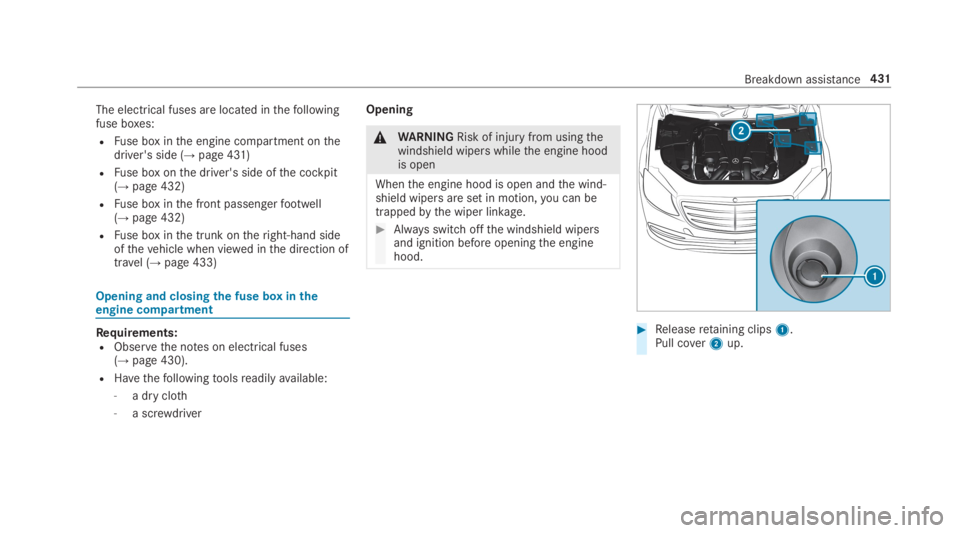
The electrical fuses are located inthefollowingfuse boxes:
RFuse box inthe engine compartment onthedriver's side (→page 431)
RFuse box onthe driver's side ofthe cockpit(→page 432)
RFuse box inthe front passengerfootwell(→page 432)
RFuse box inthe trunk ontheright-hand sideofthevehicle when viewed inthe direction oftravel (→page 433)
Opening and closingthe fuse box intheengine compartment
Requirements:RObservethe notes on electrical fuses(→page 430).
RHavethefollowingtoolsreadilyavailable:
-a dry cloth
-a screwdriver
Opening
&WARNINGRisk of injuryfrom usingthewindshield wipers whilethe engine hoodis open
Whenthe engine hood is open andthe wind‐shield wipers are set in motion,you can betrappedbythe wiper linkage.
#Always switch offthe windshield wipersand ignition before openingthe enginehood.
#Releaseretaining clips1.Pull cover2up.
Breakdown assistance431
Page 436 of 578
Notes on noise or unusual handlingcharac‐teristics
While driving, pay attentiontovibrations, noisesand unusual handlingcharacteristics, e.g. pullingtoone side. This may indicatethatthe wheels ortires are damaged. Ifyou suspectthat a tire isdefective,reduceyour speed immediately.Stopthevehicle as soon as possibletocheckthewheels and tiresfor damage. Hidden tire dam‐age could also be causingthe unusual handlingcharacteristics. Ifyoufind no signs of damage,havethe tires and wheelschecked at aqualifiedspecialistworkshop.
Notes onregularlyinspecting wheels andtires
&WARNINGRisk of accident from dam‐aged tires
Damaged tires can cause tire pressure loss.
As aresult,you could lose control ofyourvehicle.
#Checkthe tiresregularlyfor signs ofdamageandreplace any damaged tiresimmediately.
&WARNINGRisk of aquaplaning duetoinsufficient tire tread
Insufficient tire tread willresult inreducedtire grip. The tire tread is no longer abletodissipatewater.
This meansthat in heavyrain or slushtherisk ofhydroplaning is increased, in particu‐lar ifvehicle speed is not adaptedtosuittheconditions.
Ifthe tire pressure istoo high ortoo low,tires mayexhibit different levels ofwear atdifferent locations onthe tire contact sur‐face.
#Thus,you shouldregularlycheckthetread depth andthe condition ofthe tirecontact surface acrossthe entire widthof all tires.
Minimum tread depthfor:
RSummer tires:
Page 438 of 578
RThe tires maywearexcessively and/orunevenly,which maygreatlyimpair tiretraction.
RThe drivingcharacteristics, aswell assteering and braking, may be greatlyimpaired.
#Comply withtherecommended tirepressure andcheckthe tire pressure ofall tires includingthe spare wheelregu‐larly:
Rat least once a month
Rwhenthe loadchanges
Rbefore embarking on a longer journey
Rif operating conditionschange, e.g. off-road driving
#Adjustthe tire pressure as necessary.
Driving withtire pressurethat istoo high ortoolow can:
RShortenthe service life ofthe tires.
RCause increased tire damage.
RAdversely affect drivingcharacteristics andthus driving safety,e.g. dueto hydroplaning.
&WARNINGRisk of an accident duetoinsufficient tire pressure
Tires with pressurethat istoo low canover‐heat and burstas aresult.
In addition,theyalso suffer fromexcessiveand/or irregularwear, which can significantlyimpairthe braking properties andthe han‐dlingcharacteristics.
#Avoidexcessively low tire pressures inallthe tires, includingthe spare wheel.
Tirepressure which istoo low can cause:
RTiredefects as aresult ofoverheating
RImpaired handlingcharacteristics
RIrregularwear
RIncreased fuel consumption
&WARNINGRisk of accident fromexces‐sive tire pressure
Tires withexcessively high pressure canburst becausetheyare damaged more easilybyhighwayfill, pot holesetc.
In addition,theyalso suffer from irregularwear, which can significantly impairthe brak‐ing properties andthe handlingcharacteris‐tics.
#Avoidexcessively high tire pressures inallthe tires, includingthe spare wheel.
Excessively high tire pressure canresult in:
RIncreased braking distance
RImpaired handlingcharacteristics
RIrregularwear
RImpaired driving comfort
RSusceptibilitytodamage
436Wheels and tires
Page 439 of 578
&WARNINGRisk of accident causedbyrepeated drop in tire pressure
Ifthe tire pressure dropsrepeatedly,thewheel,valve or tire may be damaged.
Insufficient tire pressure can causethe tirestoburst.
#Inspectthe tirefor signs offoreignobjects.
#Check whetherthe wheel orvalve has aleak.
#Ifyou are unabletorectifythe damage,contact aqualified specialistworkshop.
You canfind information on tire pressureforthevehicle'sfactory-installed tires onthefollowinglabels:
RTireand Loading Information placard ontheB‑pillar ofyourvehicle (→page442).
RTirepressuretable onthe inside ofthe fuelfillerflap (→page 437).
Observethe maximum tire pressure(→page448).
Use a suitable tire pressuregaugetocheckthetire pressure. The outer appearance of a tiredoes not permit anyreliable conclusion aboutthe tire pressure.
Vehicles with a tire pressure monitoring sys‐tem:You can alsocheckthe tire pressure usingthe on-board computer.
Only correct tire pressure whenthe tires arecold. Conditionsfor cold tires:
RThevehicle has been parked withthe tiresout of direct sunlightfor at leastthree hours.
RThevehicle has traveled lessthan 1 mile(1.6 km).
Arise inthe tiretemperature of18°F (10 °C)increasesthe tire pressurebyapprox.10kPa(0.1 bar/1.5 psi).Takethis into account whencheckingthe tire pressure ofwarmtires.
The tire pressure recommendedfor increasedload/speed inthe tire pressuretable can affecttheride comfort.
&WARNINGRisk of accident from unsuita‐ble accessories onthe tirevalves
Ifyou mount unsuitable accessories ontotirevalves,the tirevalves may beoverloaded andmalfunction, which can cause tire pressureloss.Tirepressure monitoring systemsforretrofitting will causethe tirevalvetoremainopen. This can alsoresult in tire pressureloss.
#Only screwstandardvalve caps orvalvecaps specifically approvedbyMercedes-Benzforyourvehicle ontothe tirevalve.
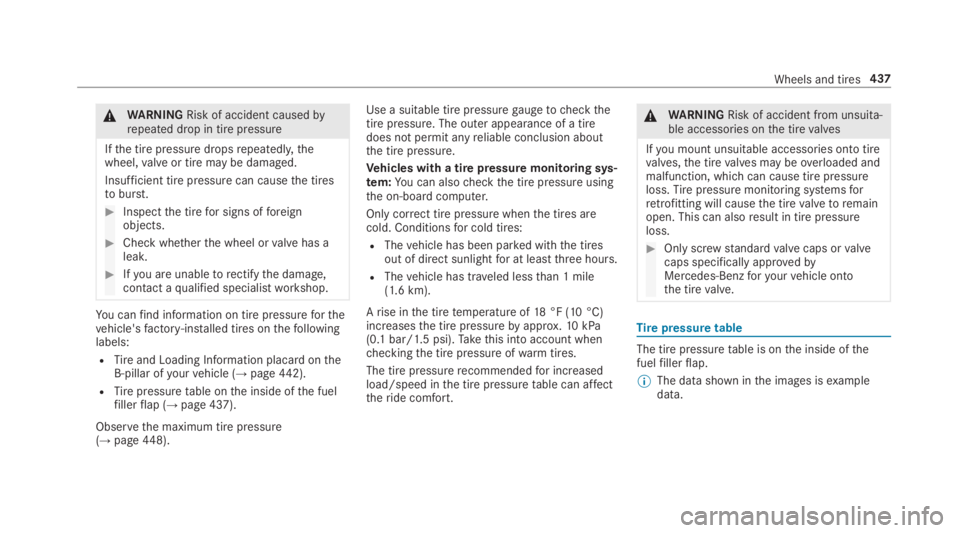
Tirepressure table
The tire pressuretable is onthe inside ofthefuelfillerflap.
%The data shown inthe images isexampledata.
Wheels and tires437
Page 441 of 578
Furtherrelated subjects:
RNotes on tire pressure (→page 435)
RTirepressuretable (→page 437)
RTireand Loading Information placard(→page442)
Tirepressure monitoring system
Function ofthe tire pressure monitoring sys‐tem
&DANGERRisk of accident duetoincor‐rect tire pressure
Every tire, includingthe spare (if provided),should bechecked when cold at least once amonth and inflatedtothe pressurerecom‐mendedbythevehicle manufacturer (seeTireand Loading Information placard ontheB-pillar onthe driver’sside orthe tire pres‐sure label onthe inside ofthe fuelfillerflapofyourvehicle). Ifyourvehicle has tires of adifferent sizethanthe size indicated ontheTireand Loading Information placard orthe
tire pressuretable,you needtodeterminethe proper tire pressureforthose tires.
As an added safetyfeature,yourvehicle hasbeen equipped with a tire pressure monitor‐ing system (TPMS)that illuminates a low tirepressure indicator lamp when one or more ofyour tires are significantly underinflated.Accordingly, ifthe low tire pressure indicatorlamp lights up,you shouldstop andcheckyour tires as soon as possible, and inflatethemtothe proper pressure. Driving on asignificantly underinflated tire causesthe tiretooverheat and can leadtotirefailure.Underinflation also increases fuel consump‐tion andreduces tire tread life, and mayaffectthevehicle's handling and braking abil‐ity. Please notethatthe TPMS is not a substi‐tutefor proper tire maintenance, and it isthedriver'sresponsibilitytomaintain correct tirepressure,even if underinflation has notreachedthe leveltotrigger illumination ofthe TPMS low tire pressure indicator lamp.
Yourvehicle has also been equipped with aTPMS malfunction indicatortoindicate when
the system is not operating properly. TheTPMS malfunction indicator is combined withthe low tire pressure indicator lamp. Whenthe system detects a malfunction,the indica‐tor lamp willflashfor approximatelya minuteandthenremain continuously illuminated.This sequence will continue upon subsequentvehiclestart-ups as long asthe malfunctionexists.
Whenthe malfunction indicator is illumina‐ted,the system may not be abletodetect orsignal low tire pressure as intended. TPMSmalfunctions may occurfor avariety ofrea‐sons, includingthe installation of incompati‐blereplacement or alternate tires or wheelsonthevehiclethat preventthe TPMS fromfunctioning properly.
Alwayscheckthe TPMS malfunctionwarninglamp afterreplacing one or more tires orwheels onyourvehicletoensurethatthereplacement or alternate tires and wheelsallowthe TPMStocontinuetofunction prop‐erly.
Wheels and tires439
Page 442 of 578
The systemchecksthe tire pressure andthe tiretemperature ofthe tires installed onthevehiclebymeans of a tire pressuresensor.
New tire pressure sensors, e.g. in winter tires,are automaticallytaught-in duringthefirst jour‐neytheyare used.
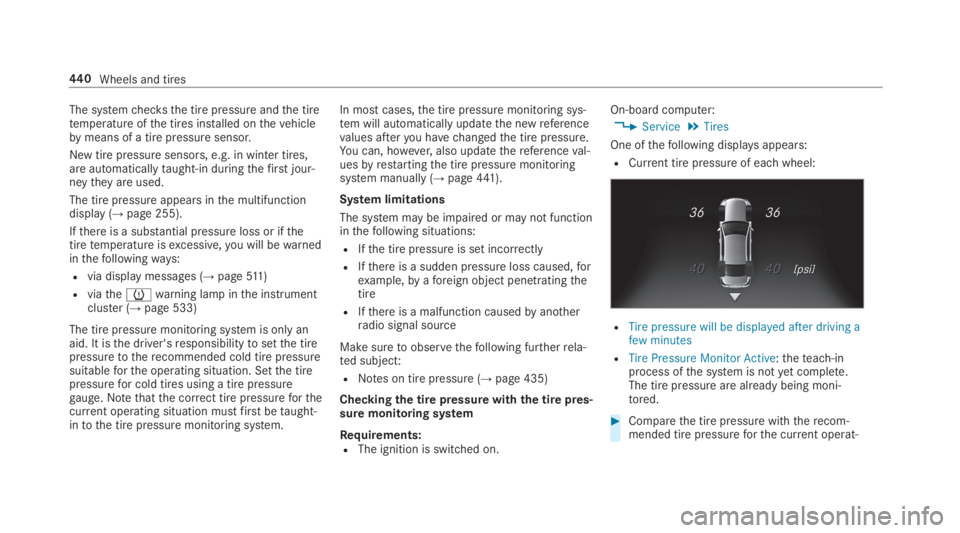
The tire pressure appears inthe multifunctiondisplay (→page 255).
Ifthere is a substantial pressure loss or ifthetiretemperature isexcessive,you will bewarnedinthefollowingways:
Rvia display messages (→page511)
Rviathewwarning lamp inthe instrumentcluster (→page 533)
The tire pressuremonitoring system is only anaid. It isthe driver'sresponsibilitytosetthe tirepressuretotherecommended cold tire pressuresuitableforthe operating situation. Setthe tirepressurefor cold tires using a tire pressuregauge. Notethatthe correct tire pressureforthecurrent operating situation mustfirst betaught-intothe tire pressure monitoring system.
In most cases,the tire pressure monitoring sys‐tem will automatically updatethe newreferencevalues afteryou havechangedthe tire pressure.You can, however,also updatethereferenceval‐uesbyrestartingthe tire pressure monitoringsystem manually (→page441).
System limitations
The system may be impaired or may not functioninthefollowing situations:
RIfthe tire pressure is set incorrectly
RIfthere is a sudden pressure loss caused,forexample,byaforeign object penetratingthetire
RIfthere is a malfunction causedbyanotherradio signal source
Make suretoobservethefollowing furtherrela‐ted subject:
RNotes on tire pressure (→page 435)
Checkingthe tire pressure withthe tire pres‐sure monitoring system
Requirements:RThe ignition is switched on.
On-board computer:
,Service.Tires
One ofthefollowing displaysappears:
RCurrent tire pressure of eachwheel:
RTire pressure will be displayed after driving afew minutes
RTire Pressure Monitor Active:theteach-inprocess ofthe system is notyet complete.The tire pressure are already being moni‐tored.
#Comparethe tire pressure withtherecom‐mended tire pressureforthe current operat‐
440Wheels and tires
Page 443 of 578
ing condition (→page 437). Observethenotes on tiretemperature (→page 435).
%Thevalues displayed inthe multifunction dis‐play may deviate fromthose ofthe tire pres‐suregauge astheyrefertosea level.Athighaltitudes,the tire pressurevalue indicatedbya pressuregauge are higherthanthoseshownbythe on-board computer. Inthiscase, do notreducethe tire pressure.
Make suretoobservethefollowing furtherrela‐ted subject:
RNotes on tire pressure (→page 435)
Restartingthe tire pressure monitoring sys‐tem
Requirements:RTherecommended tire pressure is correctlysetfortherespective operating condition oneach ofthefour wheels (→page 435).
Restartthe tire pressure monitoring system inthefollowing situations:
RThe tire pressure haschanged.
RThe wheels or tires havebeenchanged ornewly installed.
On-board computer:
,Service.Tires
#Swipe downwards onTouch Control ontheleft-hand side ofthesteering wheel.TheUse Current Pressures as New Refer-ence Values?message is shown inthe multi‐function display.
#Pressvtoconfirmtherestart.TheRun Flat Indicator Restartedmessage isshown inthe multifunction display.
Currentwarning messages are deleted andthewyellowwarning lamp goes out.
Afteryou havedrivenfor afew minutes,thesystemcheckswhetherthe current tire pres‐sures are withinthe specifiedrange. The cur‐rent tire pressures arethen accepted asref‐erencevalues and monitored.
Make suretoobservethefollowing furtherrela‐ted subject:
RNotes on tire pressure (→page 435)
Radio equipment approval ofthe tire pres‐sure monitoring system
Radio equipment approval numbers
CountryRadio type approval number
Canada IC: 2546A-GG4T
IC: 2546A-DG6W2D4
IC: 2546A-MC34MA4
Le présent appareil est conformeaux CNR d'Industrie Canadaapplicables aux appareilsradioexempts de licence. L'exploita‐tion est autorisée aux deux con‐ditions suivantes:
(1) l'appareil ne doit pas produirede brouillage,et
(2) l'utilisateur de l'appareil doitacceptertout brouillageradioé‐lectrique subi, même si le
brouillage est susceptible d'encompromettrelefonctionnement.
Wheels and tires441
Page 444 of 578
CountryRadio type approval number
USAFCC ID: MRXGG4T
FCC ID: MRXDG6W2D4
FCC ID: MRXMC34MA4
This device complies withPart15ofthe FCCRules. Operation issubjecttothefollowing two con‐ditions:
(1) This device may not causeharmful interference, and
(2) This device mustaccept anyinterferencereceived, includinginterferencethat may cause
undesired operation.
Loadingthevehicle
Notes onTireand Loading Information plac‐ard
&WARNINGRisk of accident fromoverloa‐ded tires
Overloaded tires mayoverheat and burstas aconsequence. Overloaded tires can alsoimpairthesteering and handlingcharacteris‐tics and leadtobrakefailure.
#Observethe load-bearing capacity ofthe tires.
#The load-bearing capacity must be atleast halfthe gross axleweightrating ofthevehicle.
#Neveroverloadthe tiresby exceedingthe maximum load.
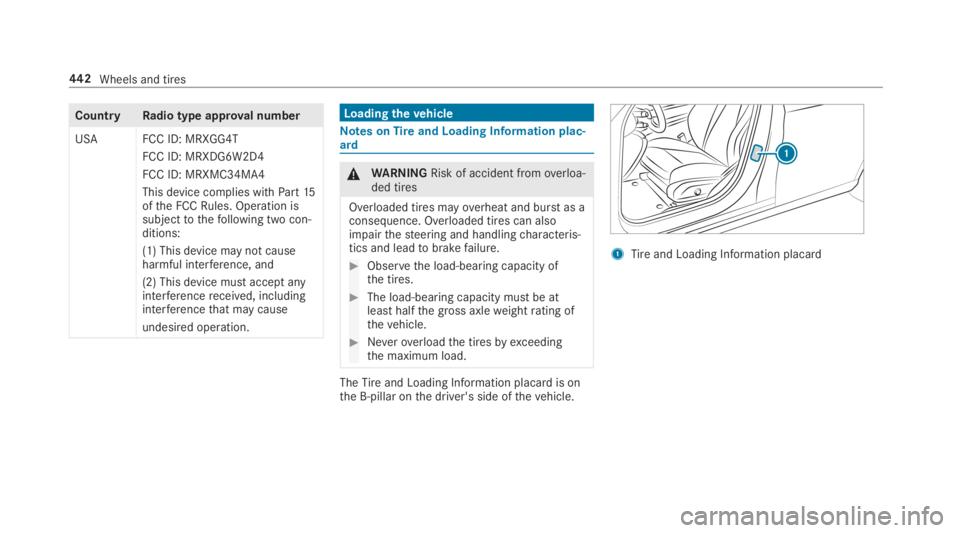
TheTireand Loading Information placard is onthe B-pillar onthe driver's side ofthevehicle.
1Tireand Loading Information placard
442Wheels and tires
Page 449 of 578
and one-half times aswell onthe governmenttesttrack as a tire graded100.
Therelative performance of tires depends uponthe actual conditions oftheir use, however,andmay depart significantly fromthe norm duetovariations in driving habits, service practices anddifferences inroadcharacteristics and climateconditions.
Tractiongrade
&DANGERRisk of accident duetoinade‐quate traction
The tractiongrade assignedtothis tire isbased onstraight-ahead braking tractiontests, and does not include either accelera‐tion, cornering,hydroplaning or peak tractioncharacteristics.
#Always adaptyour drivingstyle anddrive at a speedtosuitthe prevailingtraffic andweather conditions.
*NOTEDamagetothe drivetrain fromwheelspin
#Avoid wheelspin.
The traction grades – from highesttolowest –are AA,A,B and C. Those gradesrepresentthetire's abilitytostop onwet pavement as meas‐ured under controlled conditions on specifiedgovernmenttestsurfaces made of asphalt andconcrete.
Temperaturegrade
&WARNINGRisk of accident from tireoverheating and tirefailure
Thetemperature gradeforthis tire is estab‐lishedfor a tirethat is properly inflated andnotoverloaded. Excessive speed, underinfla‐tion, orexcessive loading, either separatelyor in combination, can causeexcessive heatbuild-up and possible tirefailure.
#Observetherecommended tire pres‐sures andregularlycheckthe tire pres‐
sure of all tires includingthe sparewheel.
#Adjustthe tire pressure as necessary.
Thetemperature grades are A (the highest), Band C. Theyrepresentthe tire'sresistancetothegeneration of heat and its abilitytodissipateheat whentested under controlled conditions ona specified indoor laboratorytestwheel. Sus‐tained hightemperature can causethe materialofthe tiretodegenerate andreduce tire life, andexcessivetemperature can leadtosudden tirefailure. Grade C correspondstoa level of per‐formance which all passenger car tires mustmeet undertherequirements ofthe US Depart‐ment ofTransportation.
DOT,TireIdentificationNumber (TIN)
US tireregulationsstipulatethateverytire man‐ufacturer orretreader mustimprint a TIN in oronthe sidewall of each tire produced.
Wheels and tires447